I decided to run a few soundtracks for the next month, in the early 1980, if a movie came out, it released a soundtrack. I never saw this movie believe it or not, but I have the soundtrack on CD. What can I say, I liked the music and it was a good album. The video was memorable as was the song and it was a staple of the MTV rotation back in the day.
"Maniac" is a song performed by Michael Sembello. The song was used in the 1983 film Flashdance.
"Maniac" appears during an early scene in Flashdance and is used as the backing track of a montage sequence showing Alex (Jennifer Beals) training strenuously in her converted warehouse.
The song was included in Flashdance after Sembello's wife accidentally included it on a tape sent to executives at Paramount Pictures who were looking for music to use in the film.
A popular urban legend holds that the song was originally written for the 1980 horror filmManiac, and that lyrics about a killer on the loose were rewritten so the song could be used in Flashdance.
The legend is discredited in the special features of the film's DVD
release, which reveal that the song was written for the film, although
only two complete lyrics ("Just a steel town girl on a Saturday night"
and "She's a maniac") were available when filming commenced. Like the
title song, it reached number one on the Billboard Hot 100 in September
1983
Flashdance is not a musical in the traditional sense as the characters do not sing, but rather, the songs are presented in the style of self-contained music videos. The success of this film is attributed in part to the 1981 launch of the cable channel MTV (Music Television),
as it was the first to exploit the new medium effectively. By
excerpting segments of the film and running them as music videos on MTV,
the studio benefited from extensive free promotion, and thus
established the new medium as an important marketing tool for movies.
In the mid-1980s, it became almost obligatory to release a music
video to promote a major motion picture—even if the film were not
especially suited for one. An example from the era is the song and music video "Take My Breath Away" from Top Gun (1986), also from Flashdance producers Don Simpson and Jerry Bruckheimer. Giorgio Moroder composed "Take My Breath Away" and several of the songs for Flashdance.
I have nothing to post about, I want to post about the left side of the aisle having a meltdown about President Trumps SCOTUS nomination, the protestors had several different protest signs printed and ready to go.
It didn't care who he picked, they were going to protest because they hate Trump. President Trump could have nominated Obama (With his constitutional law gig from Yale, he would have been a shoo in.) they would have protested because the hated "Cheeto" man nominated him. but I have nothing...
President Trump went to Europe a couple of days ago and put on notice that the NATO members ain't pulling their own weight, according to the charter, they have to contribute 2% of their GDP to their defense and most of the NATO members are not, they are averaging 1.2%
President Trump was especially critical of Germany who from the reports I have seen can't seem to field any tanks because they are down for parts, and out of 128 "Euro" fighters, only 4 are combat ready. The latest German Frigate design can't pass combat trials, it is like the vaunted German efficiency isn't there anymore. This is a far cry from the Cold War days where the German equipment was first rate and as was their training. Now they can't defend themselves, and rely on the Americans to defend Germany while Germany pours money into the "Muslim refugee" crisis as they continue to invite men of Military age unaccompanied by their "Families" to settle in Germany and other NATO countries...Germany has killed off their nuclear power, and coal and hung their hopes on "Green" energy, but it don't work so Germany is piping natural Gas from Russia for their energy needs. President Trump has concerns about the risk from the alliance if Germany is dependent on the Russian gas for their energy. Will Germany act in the best interest of the alliance or Russia? But I have nothing....
There are rumors that Hillary is considering a 2020 run, she still can't accept that she was beaten by a person that by all rights she should have beaten in a race that was rigged in her favor and she still lost. I have heard that the Clinton Crime syndicate Foundation was fundraising during the immigration kerfluffle to the point of millions of dollars for "Immigration groups", I suppose it will be like Haiti where there was fundraising and for some strange reasons the money never made it but Chelsea had a heck of a wedding paid for by the foundation and she draws a heck of a salary. But people still contribute hoping to purchase influence help out the needy. But I have nothing..
And finally the Thailand boys soccer team that got trapped in the cave by rising water was rescued after 12 days in a rescue that mesmerized the world. It shows that there are still good in the world.
Go check out the people on my blogroll....They are really good.
The Battle of Stalingrad was a unique situation, it was battle that shouldn't have happened, but to the ego and arrogance of Hitler. He wanted to destroy the city totally disregarding the military reality of the situation and the arrogance led to the destruction of General Paulus and the German 6th Army.
23 August 1942–2
February 1943. Stalingrad’s worst luck was that it was named after Josef
Stalin. It was a perfect town in Russia, a gem on the Volga River and
an industrial center. So on August 23rd, 1942, Hitler ordered the German
6th Army under Von Paulus to lay siege to Stalingrad.
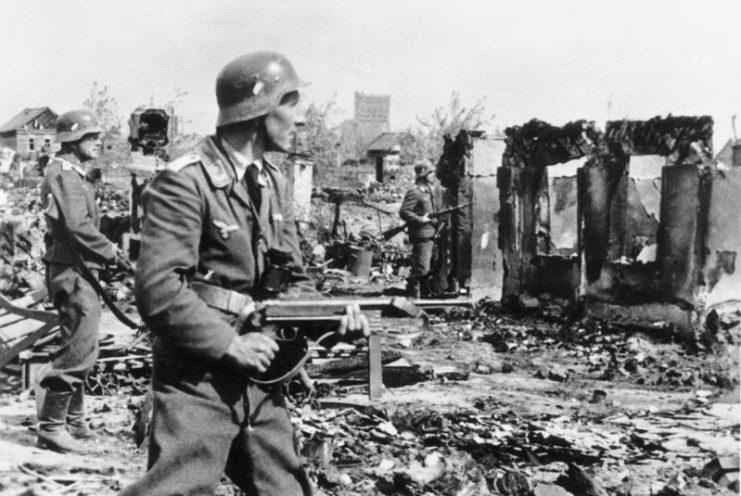
German soldiers of the 24th Panzer Division in action during the fighting for the southern station of Stalingrad.
This of course turned into a
“shoot your self in the foot” proposition. The steel reinforced
buildings still stood after the bombing, and once the Luftwaffe made
short work of the town, it also created a new and perfect environment
that supported the operations of snipers and made the free movement of
armor problematic. High dark rooms with their windows blown out were
perfect for hiding killers watching quietly with bolt action Mosin
Nagants.
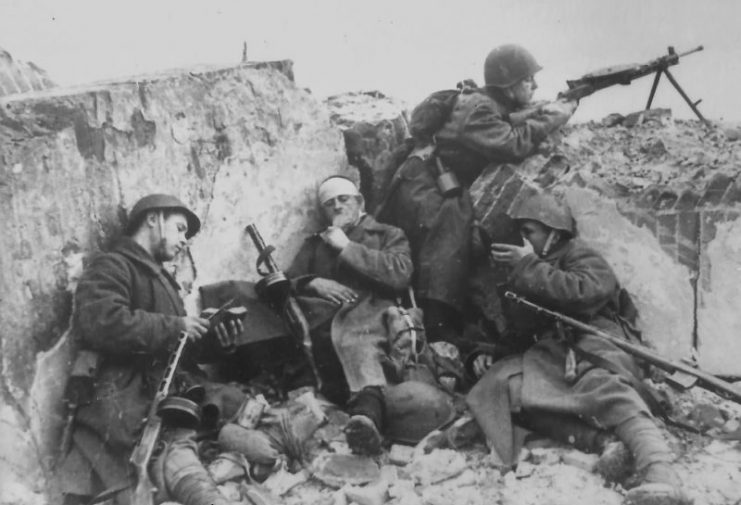
Soviet Solders at Stalingrad.
The Germans began the
offensive with a quarter of a million men under arms and ended up
bringing in over a million men, including Italians, Hungarians, and
Romanians. The Russians started with 170,000 and brought in over a
million additional troops themselves.
This was to become worst
conflict seen on the Eastern Front. The Germans, just over a year after
the invasion of Russia began, now had an intractable Russian force
defending against all odds in an unrelenting arctic winter storm.
Nothing worked. The German guns froze. Their food rations ran thin.
Operation Winter Storm.
Resupply was slowing in the war.
It took thirty trainloads a day to resupply Army Group North. This was
hardly sustainable in the 30º below zero weather. Men starved and
suffered in the bitter cold they were hardly ready for. Alfred Jodl had
refused to pack jackets into the first logistics load because he thought
it would sow doubt in the minds of the soldiers who expected that this
war would be over before winter.
Stalingrad is now called
Volgograd, and there a battle began that some historians call the
largest battle in history. Why Stalingrad? Some say Hitler was trying to
poke a finger in Stalin’s eye by decimating his namesake city. And,
obviously, because of it’s strategic location on a bend in the Volga
River.
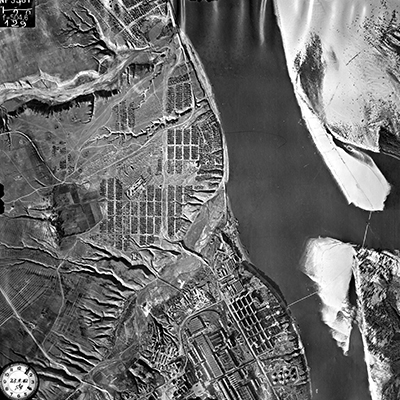
Aerial
image of Stalingrad. Source: Aerial Photographs, compiled 1935–1970;
Records of the Defense Intelligence Agency, Record Group 393; National
Archives at College Park, College Park, MD.
The Germans sought to control this
waterway where oil supplies and manufactured goods were brought into
the northern Soviet territories, and where factories created everything
from tractors to sewing machines to tanks. The total estimated dead
including civilians and combatants was over two million. This alone
makes Stalingrad a holocaust all its own.
One
would think that Hitler would want to capture Moscow, the Soviet capital
city, first, but he delayed Operation Typhoon, the battle for Moscow,
at the last second. He even ordered Heinz Guderian to take his half of
Army Group Center and link up with General Von Paulus to support the
offensive against Stalingrad. The battle began roughly in July 1942 and
ended in February 1943.
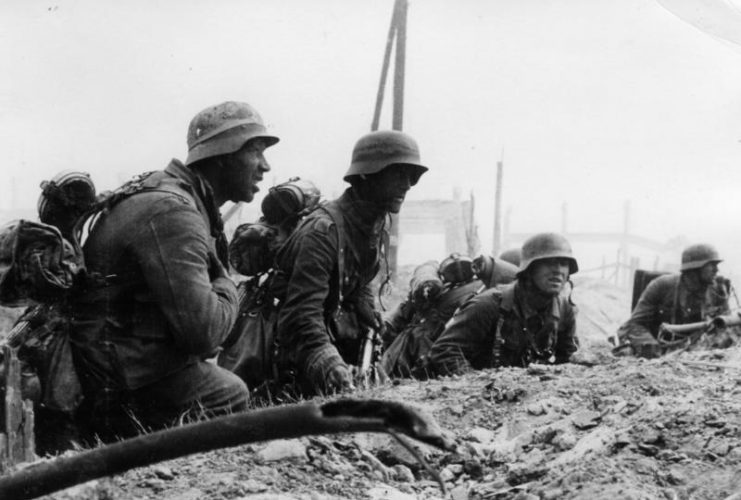
German Infantry in position for an attack.
Some historians, however, give the
battle dates as being November 1942 to January 1943. The entire history
of the German invasion of Russia is rife with these discrepancies.
Sometimes what we call an invasion and what we call a military action
are differentiated by semantics. Suffice it to say that the result was
the same for the Wehrmacht.
In a recent one-hour
program on the History channel, many important things were discovered
and history itself was once again revised. Here are some interesting
points discovered – or repeated depending on what you’ve already read
and seen.
Junkers Ju 87 Stuka dive bombers above the burning city.
In fact, most of the
buildings in Stalingrad were made of steel reinforced concrete. So the
idea that the cinder block construction seen in previous attacks on
Russian cities, where it was ground into powder, turned out to be a
disastrous assumption by German war planners.
A blast expert named David Hadden
traveled to Volgograd and discovered that the reinforced concrete
buildings, for the most part, withstood much of the bombing, and large
windows on all floors gave the blast energy from the bombs a place to
escape. So much of the city was still standing, even if severely
damaged.
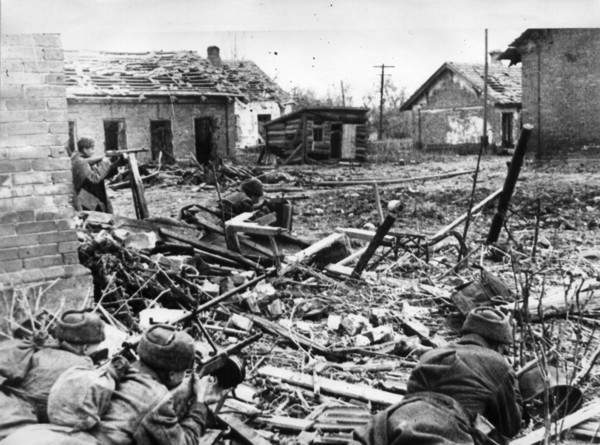
Soviet soldiers are fighting on the outskirts of Stalingrad.
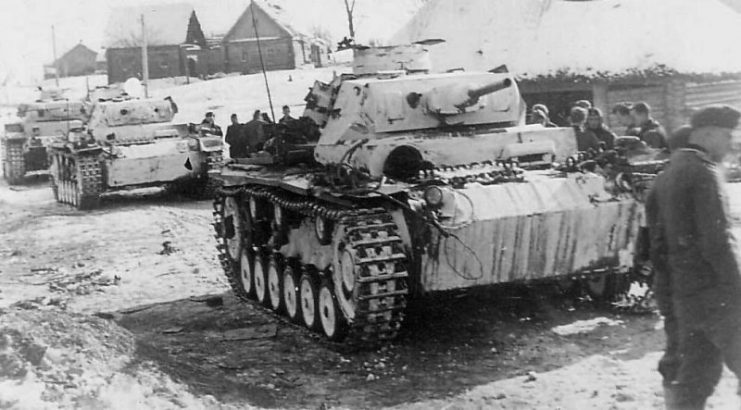
The Panzer Kampfwaggen
Mark III, with its 5 man crew and 37mm gun, was the MBT of the Wehrmacht
in the Stalingrad theatre. The gun itself, however, wasn’t really big
enough to destroy buildings. Once the city’s infrastructure had been
devastated, tanks simply could not pass through the rubble.
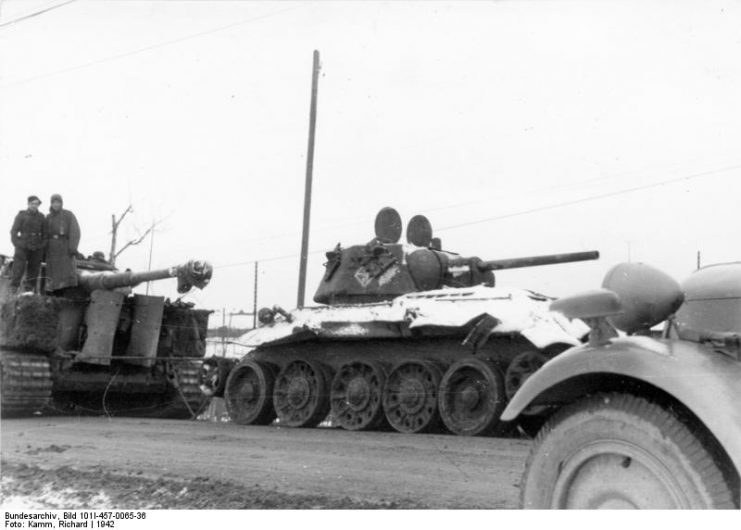
Panzer IIIs with Winter Whitewash – Eastern Front.
Not unlike the use of the phalanx,
armor corps needed open ground and an open field of fire to operate.
But there was little open ground in the ruins of Stalingrad. Also, the
main gun had limitations in terms of elevation, so once it was within a
block or two of a building, snipers in the upper floors were for the
most part protected.
German soldiers clearing the streets in Stalingrad.
Then there is the famous
“drink” the Russians invented called the Molotov cocktail, which could
be dropped from a building onto the back of a tank where the engine and
petrol were located. Left burning long enough it would set off the fuel
and the tank rounds stored in the back of the turret. Soldiers
scrambling out of the tank were easily picked off by snipers.
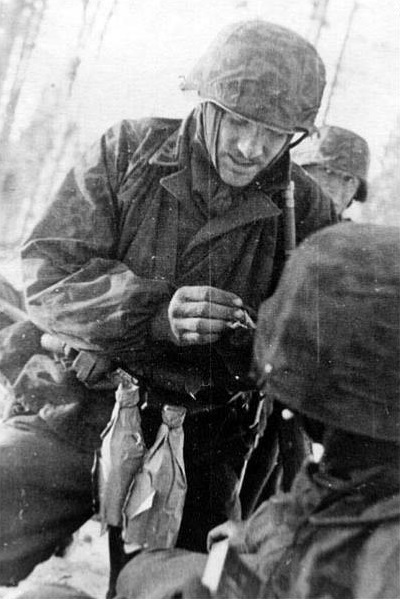
A Molotov cocktail could be made
from many petroleum products: turpentine, gasoline, cooking oil, a cloth
dipped in paraffin and a thickening agent like egg whites or wood soap.
A German Soldier Holding Molotov Cocktails – Eastern Front.
There were places where
German infantry could see a hundred blown out windows in buildings left
standing in the city. Each darkened hole could have easily held and
hidden a sniper. One sniper going from room to room 100 yards away could
pin down an entire company for hours. Pinned down, German infantry
would start to freeze to death in the frigid Soviet winter.
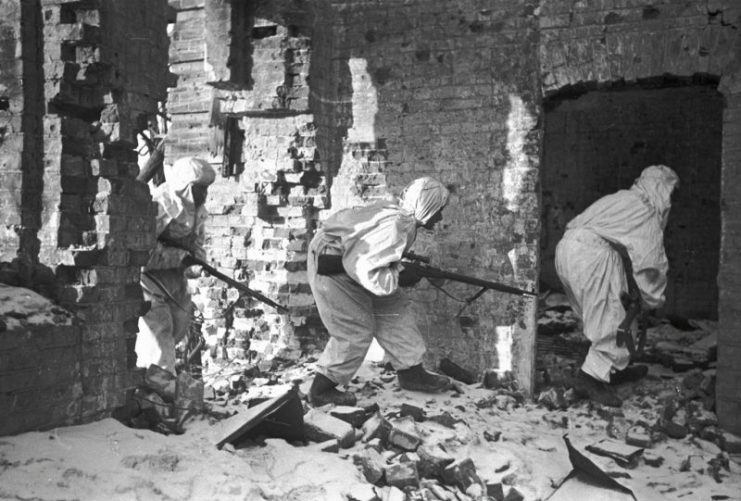
Snipers in camouflage cloaks entering a destroyed house.
Russia had an entire
generation of people who, as a rite of passage, had joined rifle clubs
and learned marksmanship. Little did the Germans know that basically the
average Russian citizen, man or woman, knew how to shoot and shoot
accurately. The scope on the bolt-action Mosin-Nagant was easier to
adjust than the German scope on the Mauser 98K.
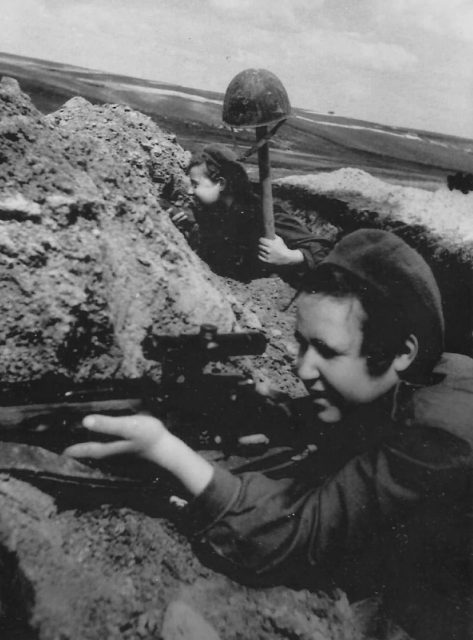
Soviet Snipers.
That might seem like a small
thing, but when snipers are the combatants of choice it isn’t a small
issue at all. Women, although ordinarily non-combatants, were available
in large numbers and many were deadly accurate.
Roza Yegorovna Shanina. Russian sniper, had 54 kills.
And of course, the
Germans were not used to the Russian winter. The Russians lived it every
year of their lives. German gun oil froze, and the Russians mixed their
gun oil with gasoline that enabled it to tolerate another ten to twenty
degrees of cold to operate in. Germans had to sleep with their weapons,
hoping their body heat would keep the weapons from freezing.
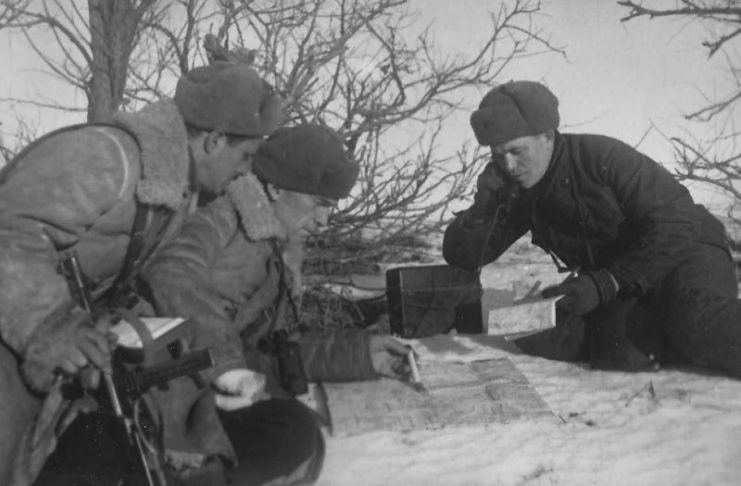
Soviet Soldiers.
Germans did not prepare for disease and starvation, while the Russians were ready
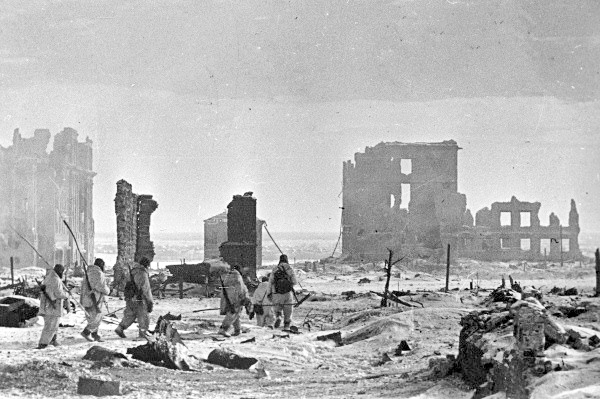
The center of Stalingrad after liberation.
Germans died of
starvation and had to wait until autopsies could be conducted to
discover that when you have no body fat, you die. Well, duh! Plus the
Soviets had developed typhus and tularemia vaccines. The Germans had
not.
The German soldier wore an undershirt, a cotton shirt, a woolen coat,
and a scarf, and a steel helmet. The steel helmet froze and failed to
protect the Germans from cold on the part of their body that most needed
warmth — their heads.
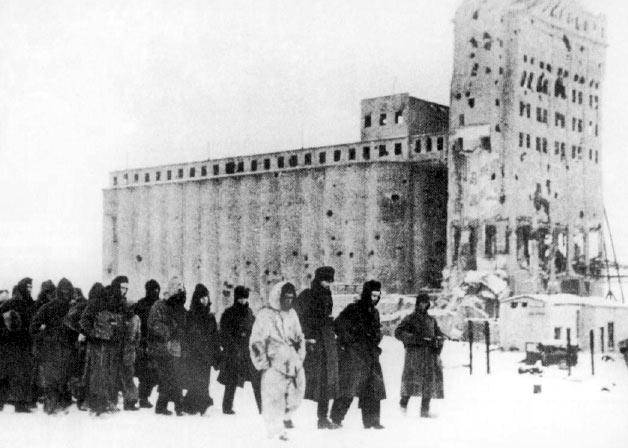
Captured German soldiers being lead to prisoner camps in Stalingrad, 1943.
The Russians wore heavy
cotton undergarments, a woolen tunic, a padded body length tunic over
that which was adapted from the nomadic warriors in the frozen north,
and a fake fur hat.
There was one more element to this: The Russians were defending their country. The Germans were a thousand miles from home
Soviet Cossack Family 1943. Note the warm headgear.
The air campaign set the
battlefield. The armor could not penetrate the city and the
Panzergrenadiers then had to do the dirty work. The rest is history.
I decided to switch to the "70's" channel on the way home, on my favorite channel, the "80's" they were playing...again....the top 40 from 1980....and it was a bunch of lackluster songs with few exceptions. After hearing the countdown 6 different times over the past few days, I was kinda "meh". Well anyway I switched it to the "70's" channel and this song came on and it was "Eureka, this will be a good "Monday Music" song. It also proves that it wasn't only the "80's " that had campy songs. I do remember reading that David Cassidy got trapped in his role and wasn't taken seriously by the music community on account of it.
The Partridge Family Album is The Partridge Family's first album. It was released in 1970 and included their first recording, "I Think I Love You". It has a picture of the whole family on the back and a small picture of David Cassidy and Shirley Jones.
The album cover is made to look like an old-fashioned photo album.
The original release of the album included a framed color photograph of
the group. The exterior label promoting the inclusion of the hit song
was affixed to the jacket itself, not the shrink wrap.
The album reached #4 in the U.S. on the Billboard album chart and #6 in neighbouring Canada on the RPM 100 national album chart. It was produced by Wes Farrell and engineered by Bob Kovach. It was arranged by Mike Melvoin, Billy Strange, Wes Farrell, and Don Peake. A few of the songs on the album feature a choral pop sound by The Love Generation, who were the original voices of The Partridge Family before it was discovered that David Cassidy could sing. They were John and Tom Bahler, Ron Hicklin and Jackie Ward.
Shortly after production on the first album and TV show began David
Cassidy was promoted by Wes Farrell to lead singer. From that point on
they provided the backup vocals for all of the Partridge Family albums, along with Shirley Jones and assorted other singers. The songs on the album were written by such people as Tony Romeo, Terry Cashman, Tommy West, Barry Mann, and Cynthia Weil.
I have this saved in my favorites on "YouTube", I ran across this a few years ago, the infamous "Elephant Story" from Tim Conway. I can watch that clip and bust out a laughing everytime. To try to see everyone try to hold their composure and not let on that they are laughing so hard. I don't know if they can do humor like this anymore. They didn't use any bad words except for "Momma", Vicki Lawrence's character,, she said one word toward the end.
the final season of The Carol Burnett Show during the Password sketch. Cast member Tim Conway
ad-libbed a story about elephants and cracked up his cast mates during
both the dress rehearsal and the final taping. In the first one he talks
about seeing an elephant with a dwarf trainer and mentioning that there
was a rumor going around the circus that the elephant and the trainer
were lovers, pushing Burnett, Lawrence, and Van Dyke to a breaking point
and hiding their faces from the audience. At one point the camera
focuses on Burnett and Lawrence staring at him in exasperation. Finally,
Burnett started swatting at Conway with the game card to get him to
stop. In the second one he talks about seeing a pair of Siamese
elephants during a trip to a freak show, describing in detail how they
were connected at the trunk and the sounds they made. The audience was
in hysterics the entire time while Burnett, Lawrence and Dick Van Dyke
desperately struggled to maintain composure, and even Conway is seen
trying to stifle his laughter numerous times. At one point Lawrence
looked at Burnett, started to look away, then did a quick look back at
her and had to turn away, breaking character and laughing. Several times
when Conway would stop, the rest of the cast would collect themselves,
at which point Conway would continue with his ad libbing, pushing them
again to the edge of breaking up. When Burnett managed to gain her
composure one last time, she turned to Lawrence to help get the script
moving again, to which Lawrence quipped (in character), "You sure that
little asshole's through?" At that point chaos ensued with the entire
cast breaking up and the audience was screaming with delight. Conway and
Van Dyke both fell off the ends of the couch to the floor laughing,
with Conway rolling around and Van Dyke lying flat on his back and
eventually sitting up. Burnett fell back onto the couch and can be seen
muttering to herself while shaking with laughter. Lawrence herself
managed to keep it together for only a few seconds after everyone fell
apart before cracking up herself. In an interview, Lawrence talks about
the famous sketch, recalling that it was her husband's suggestion to
"get" Conway when she found out between tapings that the elephant story
part of the sketch was being changed but was not given any details. The
director's only advice on it was "good luck". She also noted that it
was one of the rare occasions when she really cut loose on the show.
The Famous or "infamous" Elephant Story.
I watched it 2 times in a row and still busted out laughing.
I ran across this article and I thought it was fascinating background on the Cuban Missile Crisis. There was a lot of material that I already knew about the crisis, I had also read the book The Penkovsky Papers that talked about the missile crisis, but I remembered something about a Soviet Submarine and an incident. Well this article reminded me of it.
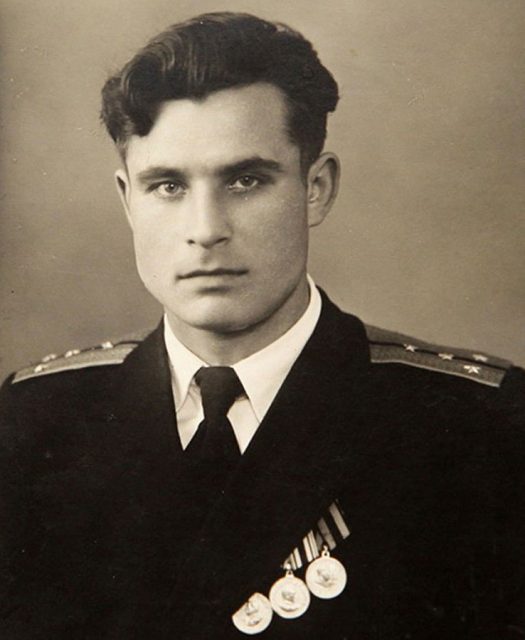
Vasili Arkhipov was a Soviet naval officer who, upon making a split
second decision, prevented the Cuban Missile Crisis from escalating into
a nuclear war.
It is fitting to begin three years after Mr.
Arkhipov’s death. On October 13, 2002, on the 40th anniversary of the
Cuban Missile Crisis, the director of the National Security Archive
Thomas Blanton remarked that “a guy called Vasili Arkhipov saved the
world.”
Vasili Arkhipov. Photo: National Geographic / CC-BY-SA 4.0Mr.
Arkhipov had come a long way from the peasant family that lived near
Moscow in which he had grown up. Educated in the Pacific Higher Naval
School of the Soviet Union, he would serve in the closing month of World
War II aboard a minesweeper during the Soviet campaign against the
Empire of Japan.
After that, he spent two years in the Caspian Higher Naval School and
went on to do submarine service on vessels from the Soviet Navy’s Black
Sea, Baltic, and Northern Sea fleets. In 1961, he became deputy
commander of the new Hotel-class missile submarine K-19.
At a time
when the U.S. and the Soviets were locked in a costly arms race, the
K-19 was a new vessel the Soviets hoped would provide them with the
ability to launch their missiles at their Cold War rival.
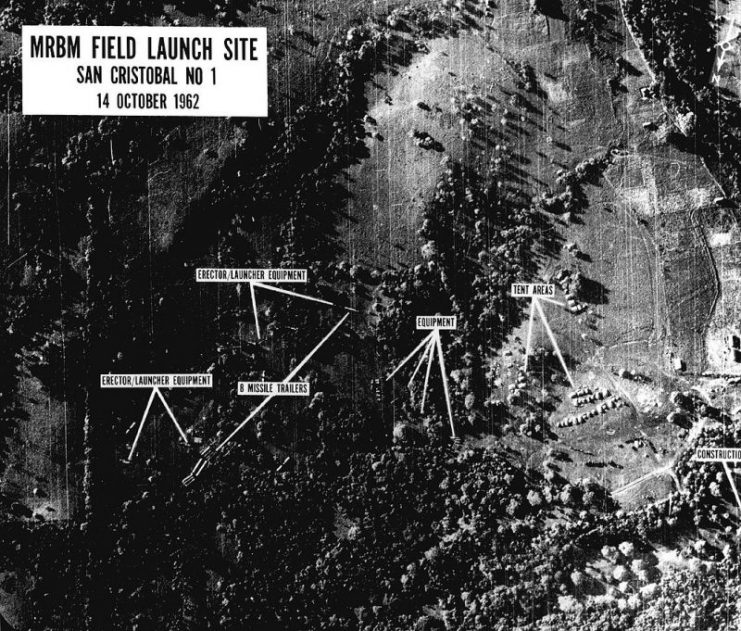
One of the first images of missile bases under construction shown to President Kennedy on the morning of October 16, 1962Commander
Nikolai Shumkov commanded the K-19’s maiden voyage, and his task was to
test a torpedo fitted with a nuclear warhead. The detonation of this
weapon formed a huge plume of radioactive water from its detonation
force of some 4.8 kilotonnes.
During exercises in the North
Atlantic, the K-19 suffered a major leak in its reactor coolant system.
The long-range radio had also been disabled during another incident,
rendering the sub unable to contact its HQ in Moscow. This incident saw
several crew members, along with Arkhipov, exposed to radiation.
Arkhipov
backed Captain Nikolai Vladimirovich Zateyev, who feared that the crew
would mutiny out of sheer desperation, by helping him dump most of the
ship’s small arms arsenal overboard in order to avert the possibility
that this potential mutiny would be an armed one.
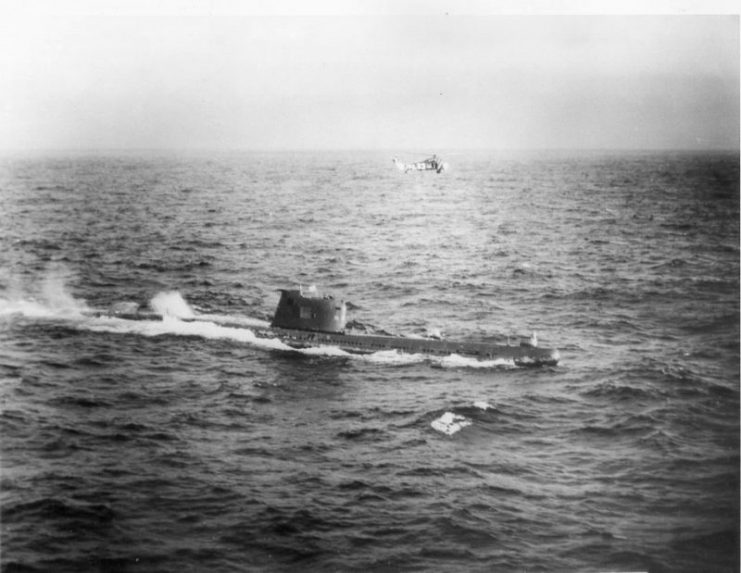
Soviet submarine B-59, in the Caribbean near CubaAmerican
warships that had heard the sub’s desperate short-range distress calls
came to the area and offered assistance. But Commander Zateyev refused
help, fearing Soviet military secrets would be compromised.
The
K-19 finally made it to another Soviet submarine and its crew was
evacuated. The K-19 was then towed home. This incident, it can be safely
assumed, had a profound effect on Arkhipov.
About a year later
during the Cuban Missile Crisis, Arkhipov was second-in-command of the
Soviet Foxtrot-class submarine B-59 which was operating near Cuba at the
time. As the crisis escalated, U.S. naval vessels, clearly unaware of
the fact that Soviet submarines operating in the area were carrying
nuclear torpedoes, dropped depth charges on those vessels in a bid to
get them to surface so that they would not break the United States naval
blockade on Cuba.
Map
of the western hemisphere showing the full range of the nuclear
missiles under construction in Cuba, used during the secret meetings on
the Cuban crisis.When they did so on the B-59,
the captain Valentin Grigorievitch Savitsky believed that war had broken
out and accordingly wanted to fire a nuclear torpedo at the vessels
firing them on.
The three officers who were authorized to launch
this torpedo, which included Arkhipov, the captain, and the vessel’s
political officer, Ivan Semonovich Maslennikov, quickly reviewed their
options. The captain and the political officer were in favor of firing.
Arkhipov argued against launching the torpedo stating they should await
orders from Moscow.
They were forced to surface at the behest of
the fleet of eleven U.S. Navy destroyers and the aircraft carrier that
was engaging them. It was then they learned that no shooting war had
broken out between the US and Soviet forces, but by arguing against the
launching of the nuclear-tipped torpedo, Arkhipov in effect had averted
the start of a nuclear war between the two superpowers.
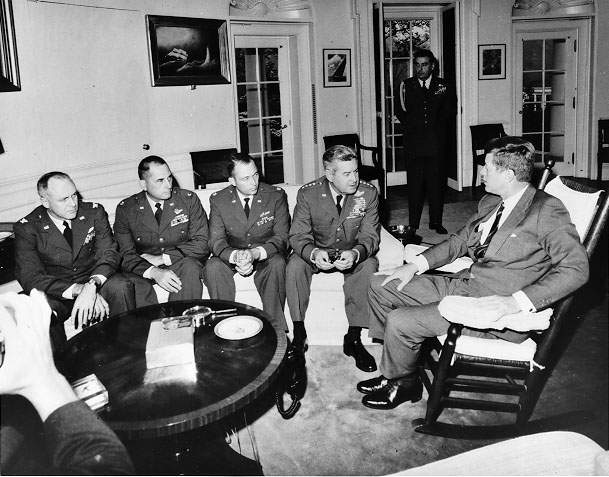
President
Kennedy meets in the Oval Office with General Curtis LeMay and the
reconnaissance pilots who found the missile sites in Cuba.In
fact, Washington had issued a message stating they would be using
‘practice’ depth charges to force Soviet submarines they determined to
be in breach of their blockade to surface. B-59 hadn’t received that
message as they were too deep to pick up radio signals.
It is
worth noting that when coming under fire Arkhipov knew he was risking
two things; getting killed by simply surfacing if a shooting war was in
fact underway and starting a nuclear war by returning fire in such a
manner if one wasn’t underway. So his coolness in making a potentially
fatal decision under such serious circumstances spoke well of him.
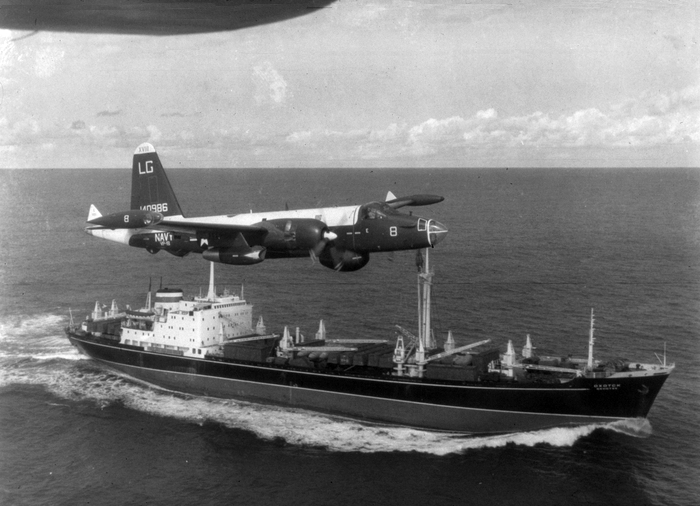
A US Navy P-2H Neptune of VP-18 flying over a Soviet cargo ship with crated Il-28s on deck during the Cuban Crisis.Indeed
it was retrospectively appreciated just how close nuclear war really
was during that time. Robert McNamara acknowledged, after a reevaluation
of the circumstances and the risks of confrontation during those
fateful days that the United States and the U.S.S.R. were “closer [to
nuclear war] than we knew at the time.”
As for Arkhipov, after
those two dangerous episodes in the early 1960s, he continued to serve
in the Soviet Navy, eventually being promoted to rear admiral and
becoming head of the Kirov Naval Academy. He retired in the mid-1980s
and died in 1999.
He died an unsung hero and even to this day the
fateful decision he took on October 27, 1962, is relatively
unacknowledged and not widely known.
I still think it is ironic that me an Army guy studies Navy history. I remembered reading about our subs going up to the Soviet bases and tapping their cables and reading their classified correspondences. This can't be underestimated, this allowed us to know the thoughts of the Soviet military hierarchy and if they were actually preparing for war. This ship probably spent more time in Soviet waters than most of the ships in the Soviet Navy.
It’s pretty likely that you have never heard of the US Navy’s most
decorated warship. That’s because the Navy did not want you to hear of
it while it was in service. What may be more fantastic is that it
received all of those decorations without once firing a weapon in attack
or defense.
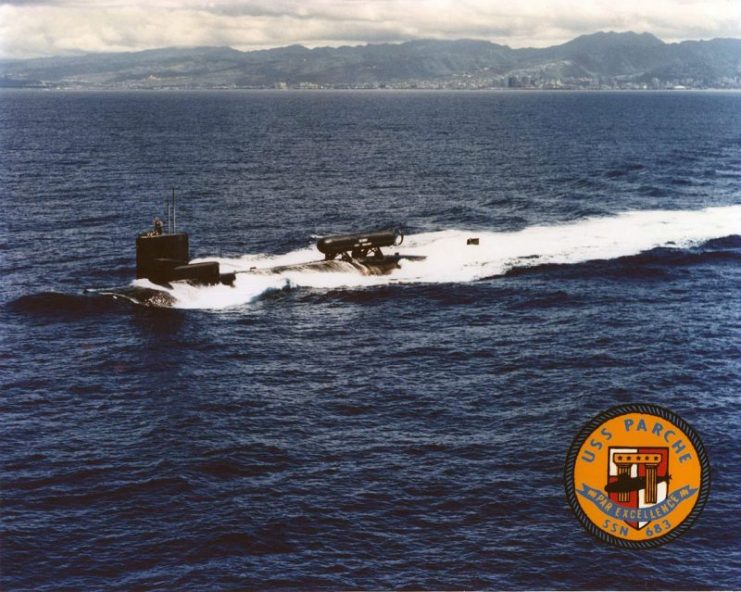
The USS Parche was built in 1970 as a hunter/killer submarine. No
one, not even the shipbuilders that worked on it, knew what was in store
for this special ship. The Parche was built to be a nuclear submarine
which would follow enemy vessels both above and below the sea and then
destroy them. Part of the Sturgeon class as built, it received its
commission in 1974 and served two years in the Atlantic Fleet as
intended. United States Navy attack submarine USS Parche (SSN-683) off Pearl Harbor, Hawaii.
In 1976, the Parche was retrofitted for the first time. There is not
much information about what changed but after the work was complete, the
Parche was rarely heard of by the public. The Navy had chosen the
Parche to support the National Underwater Reconnaissance Office (NURO).
NURO was a secretive joint effort between the Navy and the CIA.
The Parche went from being a typical attack ship to becoming a
“ghost,” spying on the enemy with advanced monitoring, reconnaissance,
and surveillance systems. While the submarine force is referred to as
the “silent service” because subs operate best when no one knows where
they are, the Navy took this concept to the extreme with the crew of the
Parche. Sworn to secrecy, they could tell no one the nature of their
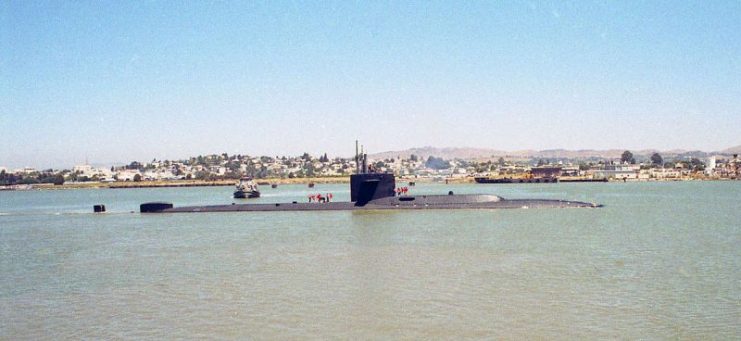
missions. Parche (SSN-683) in the Mare Island Channel departing the yard on 19 August 1994 with the assistance of Skenandoa (YTB-835).
At the end of the 1970s, the Parche had traveled into the Sea of
Okhotsk multiple times with the USS Halibut and the USS Seawolf in order
to wiretap Soviet communications over the cables running across the
seabed. Known as Operation Ivy Bells, the surveillance went undetected
until the National Security Agency (NSA) accidentally leaked details of
the operation in the mid-1980s.
Along with the invaluable intelligence gained from the wiretaps, the
Parche recovered fragments of the USSR’s anti-ship rockets. This allowed
the Navy to analyze them and develop countermeasures to protect US
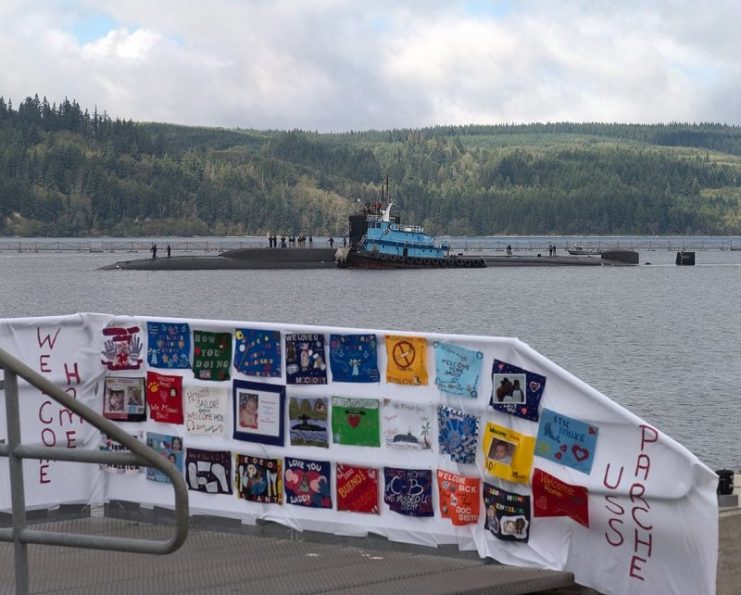
ships. A colorful banner made by family members awaits the crew as the Sturgeon-class submarine USS Parche (SSN 683).
The Parche received numerous additional retrofits throughout the
1980s and 1990s. These overhauls improved the sytems used on the ship,
adding cameras and a longer hull to fit more equipment and more crew –
amongst other things.
The Seawolf and the Parche also received skegs. These legs on the
bottom of the ships allowed them to sit directly on the ocean floor and
allow divers to exit the vessel to perform their wiretap and debris
recovery missions.
In the 2000s, it was determined that the Parche had reached the end
of her lifespan. It was already one of the last Sturgeon-class vessels
in the Navy – having been replaced by the Los Angeles and Seawolf
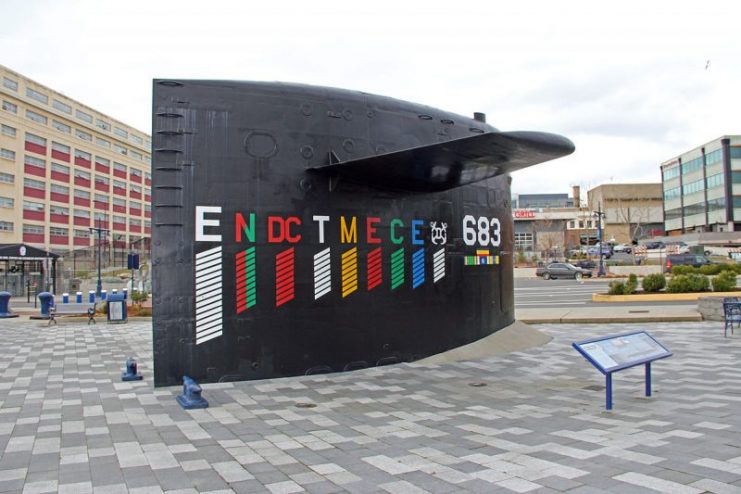
classes. In 2004, the decision was made to decommission the Parche. Sail of the USS Parche (SSN-683).
After serving for thirty years, the Parche was scrapped. The sail
with her markings was retained and is on display in Bremerton,
Washington. The USS Jimmy Carter serves the same purpose as the Parche
today.
The Parche received nine Presidential Unit Citations, ten Navy Unit
Commendations and thirteen Navy Expeditionary Medals, a total unmatched
in the entire history of the US Navy. It will be decades before the
public is informed of all that the Parche did while in service. But the
number of citations and commendations received during her service is
proof that she served her country well.
Happy 4th of July, our country is 242 years old, still young, but compared to a lot of the countries in the world, we are one of the older ones. In this we still having a representative form of government is unusual, usually by this time tyranny has set in, although we have lost some freedom, we still are doing better than every else in the world. Despite the problems, I am grateful that I am an American and I hope the new generation continues to carry the torch forward.
This idealized depiction of (left to right) Franklin, Adams, and Jefferson working on the Declaration was widely reprinted (by Jean Leon Gerome Ferris, 1900
In CONGRESS, July 4, 1776.
The unanimous Declaration of the thirteen united States of America,
"When in the Course of human events, it becomes necessary for one
people to dissolve the political bands which have connected them with
another, and to assume among the powers of the earth, the separate and
equal station to which the Laws of Nature
and of Nature's God entitle them, a decent respect to the opinions of
mankind requires that they should declare the causes which impel them to
the separation." "We hold these truths to be self-evident, that all men are created equal, that they are endowed by their Creator with certain unalienable Rights, that among these are Life, Liberty and the pursuit of Happiness. "That to secure these rights, Governments are instituted among Men, deriving their just powers from the consent of the governed, That whenever any Form of Government becomes destructive of these ends, it is the Right of the People to alter or to abolish it,
and to institute new Government, laying its foundation on such
principles and organizing its powers in such form, as to them shall seem
most likely to effect their Safety and Happiness. Prudence, indeed,
will dictate that Governments long established should not be changed for
light and transient causes; and accordingly all experience hath shewn,
that mankind are more disposed to suffer, while evils are sufferable,
than to right themselves by abolishing the forms to which they are
accustomed. But when a long train of abuses and usurpations, pursuing
invariably the same Object evinces a design to reduce them under
absolute Despotism, it is their right, it is their duty, to throw off such Government, and to provide new Guards for their future security." "Such has been the patient sufferance of these Colonies; and such is
now the necessity which constrains them to alter their former Systems of
Government. The history of the present King of Great Britain is a
history of repeated injuries and usurpations, all having in direct
object the establishment of an absolute Tyranny over these States. To
prove this, let Facts be submitted to a candid world. "He has refused his Assent to Laws, the most wholesome and necessary for the public good. "He has forbidden his Governors to pass Laws of immediate and
pressing importance, unless suspended in their operation till his Assent
should be obtained; and when so suspended, he has utterly neglected to
attend to them. "He has refused to pass other Laws for the accommodation of large
districts of people, unless those people would relinquish the right of
Representation in the Legislature, a right inestimable to them and
formidable to tyrants only. "He has called together legislative bodies at places unusual,
uncomfortable, and distant from the depository of their Public Records,
for the sole purpose of fatiguing them into compliance with his
measures. "He has dissolved Representative Houses repeatedly, for opposing with manly firmness of his invasions on the rights of the people. "He has refused for a long time, after such dissolutions, to cause
others to be elected, whereby the Legislative Powers, incapable of
Annihilation, have returned to the People at large for their exercise;
the State remaining in the mean time exposed to all the dangers of
invasion from without, and convulsions within. "He has endeavoured to prevent the population of these States; for that purpose obstructing the Laws for Naturalization of Foreigners; refusing to pass others to encourage their migrations hither, and raising the conditions of new Appropriations of Lands. "He has obstructed the Administration of Justice by refusing his Assent to Laws for establishing Judiciary Powers. "He has made Judges dependent on his Will alone for the tenure of their offices, and the amount and payment of their salaries. "He has erected a multitude of New Offices, and sent hither swarms of Officers to harass our people and eat out their substance. "He has kept among us, in times of peace, Standing Armies without the Consent of our legislatures. "He has affected to render the Military independent of and superior to the Civil Power. "He has combined with others to subject us to a jurisdiction foreign to our constitution, and unacknowledged by our laws; giving his Assent to their Acts of pretended Legislation: "For quartering large bodies of armed troops among us: "For protecting them, by a mock Trial from punishment for any Murders which they should commit on the Inhabitants of these States: "For cutting off our Trade with all parts of the world: "For imposing Taxes on us without our Consent: "For depriving us in many cases, of the benefit of Trial by Jury: "For transporting us beyond Seas to be tried for pretended offences: "For abolishing the free System of English Laws in a neighbouring Province,
establishing therein an Arbitrary government, and enlarging its
Boundaries so as to render it at once an example and fit instrument for
introducing the same absolute rule into these Colonies: "For taking away our Charters, abolishing our most valuable Laws and altering fundamentally the Forms of our Governments: "For suspending our own Legislatures, and declaring themselves invested with power to legislate for us in all cases whatsoever. "He has abdicated Government here, by declaring us out of his Protection and waging War against us. "He has plundered our seas, ravaged our coasts, burnt our towns, and destroyed the lives of our people. "He is at this time transporting large Armies of foreign Mercenaries
to compleat the works of death, desolation, and tyranny, already begun
with circumstances of Cruelty & Perfidy scarcely paralleled in the
most barbarous ages, and totally unworthy the Head of a civilized
nation. "He has constrained our fellow Citizens taken Captive on the high Seas to bear Arms against their Country, to become the executioners of their friends and Brethren, or to fall themselves by their Hands. "He has excited domestic insurrections amongst us, and has
endeavoured to bring on the inhabitants of our frontiers, the merciless
Indian Savages whose known rule of warfare, is an undistinguished
destruction of all ages, sexes and conditions. "In every stage of these Oppressions We have Petitioned for Redress
in the most humble terms: Our repeated Petitions have been answered only
by repeated injury. A Prince, whose character is thus marked by every
act which may define a Tyrant, is unfit to be the ruler of a free people." "Nor have We been wanting in attentions to our British brethren. We have
warned them from time to time of attempts by their legislature to
extend an unwarrantable jurisdiction over us. We have reminded them of
the circumstances of our emigration and settlement here. We have
appealed to their native justice and magnanimity, and we have conjured
them by the ties of our common kindred to disavow these usurpations,
which, would inevitably interrupt our connections and correspondence.
They too have been deaf to the voice of justice and of consanguinity. We
must, therefore, acquiesce in the necessity, which denounces our
Separation, and hold them, as we hold the rest of mankind, Enemies in
War, in Peace Friends." "We, therefore, the Representatives of the united States of America, in General Congress,
Assembled, appealing to the Supreme Judge of the world for the
rectitude of our intentions, do, in the Name, and by Authority of the
good People of these Colonies, solemnly publish and declare, That these united Colonies are, and of Right ought to be Free and Independent States;
that they are Absolved from all Allegiance to the British Crown, and
that all political connection between them and the State of Great
Britain, is and ought to be totally dissolved; and that as Free and
Independent States, they have full Power to levy War, conclude Peace,
contract Alliances, establish Commerce, and to do all other Acts and
Things which Independent States may of right do. And for the support of
this Declaration, with a firm reliance on the protection of divine
Providence, we mutually pledge to each other our Lives, our Fortunes and
our sacred Honor."
Have you ever wondered what happened to the 56 men who signed the
Declaration of Independence?
Five signers were captured by the British as traitors, and tortured
before they died.
Twelve had their homes ransacked and burned. Two lost their sons serving
in the Revolutionary Army; another had two sons captured.
Nine of the 56 fought and died from wounds or hardships of the
Revolutionary War.
They signed and they pledged their lives, their fortunes, and their
sacred honor. What kind of men were they?
Twenty-four were lawyers and jurists. Eleven were merchants, nine were
farmers and large plantation owners; men of means, well educated. But they
signed the Declaration of Independence knowing full well that the penalty would
be death if they were captured.
Carter Braxton of Virginia, a wealthy planter and trader, saw his ships
swept from the seas by the British Navy. He sold his home and properties to pay
his debts, and died in rags.
Thomas McKeam was so hounded by the British that he was forced to move
his family almost constantly. He served in the Congress without pay, and his
family was kept in hiding. His possessions were taken from him, and poverty was
his reward.
Vandals or soldiers looted the properties of Dillery, Hall, Clymer,
Walton, Gwinnett, Heyward, Ruttledge, and Middleton.
At the battle of Yorktown, Thomas Nelson, Jr., noted that the British
General Cornwallis had taken over the Nelson home for his headquarters. He
quietly urged General George Washington to open fire. The home was destroyed,
and Nelson died bankrupt.
Francis Lewis had his home and properties destroyed. The enemy jailed
his wife, and she died within a few months.
John Hart was driven from his wife's bedside as she was dying. Their 13
children fled for their lives. His fields and his gristmill were laid to waste.
For more than a year he lived in forests and caves, returning home to find his
wife dead and his children vanished. A few weeks later he died from exhaustion
and a broken heart.
Norris and Livingston suffered similar fates. Such were the stories and
sacrifices of the American Revolution. These were not wild-eyed, rabble-rousing
ruffians. They were soft-spoken men of means and education. They had security,
but they valued liberty more. Standing tall, straight, and unwavering, they
pledged: "For the support of this declaration, with firm reliance on the
protection of the divine providence, we mutually pledge to each other, our
lives, our fortunes, and our sacred honor."
They gave you and me a free and independent America. The history books
never told you a lot about what happened in the Revolutionary War. We didn't
fight just the British.
We were British subjects at that time and we fought our own
government!
Some of us take these liberties so much for granted, but we shouldn't.
So, take a few minutes while enjoying your 4th of July holiday and silently
thank these patriots. It's not much to ask for the price they paid. Remember:
freedom is never free!
I will be in Indiana at NOAC, and this is on my scheduler thingie. I am unsure if I will be able to post anything. So I decided to post a couple of my favorite video's that I happen to run across on "Youtube"
This video I ran across back in 2013 and I really liked the precision, they did damm good....for squids. I did something like this in North Georgia college and I understand the precision and discipline necessary for such things. It still is on my bucket list to go to a national TATTOO or the international TATTOO at Edinburgh, the holy grail of TATTOO's I talked about TATTOO 's back in 2014....Has it been that long...and it was interesting reading what I wrote about the petulant boy king back in 2014, LOL
I decided to go with a TV theme, I remembered watching this movie on HBO in the early 1980's. It was a really cool movie and for the time the computer interaction was cutting edge. The movie premise besides the models wanting to be "Perfect" according to the computer, it also explained how commercials can be subliminal in their targeting. the movie was way ahead of its time as far the subject matter ...and Susan Dey had a very nice set of "Friends" in the movie. I have the movie on DVD and watched it a few years ago, some of the stuff was corny, but the movie still to me held the test of time as far as storytelling and the subject matter is still relevant. Also the opening theme was really good, to me it was a cool song kinda edge and later to me it became "New Wave" before New Wave really starting to hit, and the song telling a story.
Sue Saad and the Next was an American new wave band from Los Angeles, California. Its self-titled first album reached No. 131 in the US Billboard 200 in 1980. Although sometimes characterized as one hit wonders, the band achieved a cult following following their breakup in 1986. Sue Saad and the Next also provided part of the soundtracks for several films during the 1980s such as Roadie (1980), Looker (1981) and Radioactive Dreams (1985). Saad performed in Radioactive Dreams and voiced the main theme for Looker.
Looker is a 1981 science fiction film written and directed by Michael Crichton and starring Albert Finney, Susan Dey, and James Coburn. Former NFLlinebackerTim Rossovich is featured as the villain's main henchman.
The film is a suspense/science fiction piece that comments upon and
satirizes media, advertising, TV's effects on the populace, and a
ridiculous standard of beauty.
Though spare in visual effects, the film is notable for being the first commercial film to attempt to make a realistic computer-generated character, for the model named Cindy. It was also the first film to create three-dimensional (3D) shading with a computer, months before the release of the better-known Tron.
Dr. Larry Roberts (Albert Finney), a Beverly Hillsplastic surgeon, is puzzled when four beautiful models working in television commercials request cosmetic surgery
to make changes so minor as to be imperceptible to the naked eye. When
these models later start dying under mysterious circumstances, he
discovers they are all linked to the same advertisement research firm.
The Digital Matrix research firm rates advertising models using a
scoring system to measure the combined visual impact of various physical
attributes in television commercials. In an experiment to increase
their scores, some models are sent to Dr. Roberts to get cosmetic
surgery to maximize their visual impacts. Though the models are
physically perfect after the surgeries, they still are not as effective
as desired, so the research firm decides to use a different approach.
Each model is offered a contract to have her body scanned digitally to
create 3D computer-generated models, then the 3D models are animated for
use in commercials. The contract deals seem to be incredibly lucrative
for the models: once their bodies are represented digitally, they get a
paycheck for life, never having to work again, since their digital
models are used for all their future work in commercials.
However, when these same models start dying under mysterious
circumstances, Roberts becomes suspicious and decides to investigate
Digital Matrix. He has a strong interest in investigating the deaths: He
is considered a prime suspect by the police (from evidence planted at
the scene of one of the murders) and his most recent patient, (with whom
he is involved in a relationship) Cindy (Susan Dey), is the last of the
models to be digitally scanned.
During his investigation, Roberts discovers some advanced technology devices the Digital Matrix corporation is using to hypnotize
consumers into buying the products they advertise. He also discovers
the Light Ocular-Oriented Kinetic Emotive Responses (L.O.O.K.E.R.) gun, a
light pulse device that gives the illusion of invisibility by instantly
mesmerizing its victims into losing all sense of time.
One of the most important weapons in the Second World War, the T-34
medium tank was also one of the most influential designs in the history
of tanks.
Tanks were critical to combat in the Second World War, and all the
combatant nations worked on developing better versions. The Soviets,
with their massive program of mechanization, had been able to experiment
with a wide array of designs in the 1930s. This taught the Soviet
designers what did and didn’t work, leading to the T-34.
The "Christie" Tank, an American design that the Soviets used and copied.
The design work that led to the T-34 began in 1936. Engineers began
from the basis of the BT-7, a capable light tank that had gone through
repeated modifications as designers sought ways to improve it. For the
T-34, the designers enlarged the hull, added an extra roadwheel,
lengthened the suspension, and improved both engine and armament.
T-34/76 medium tank.
Pilot models of the T-34 were created at the Komintern Factory at
Kharkov. Many other factories would be involved when it went into mass
production.
The T-34 went into production in May 1940. It continued in use throughout World War Two and beyond.
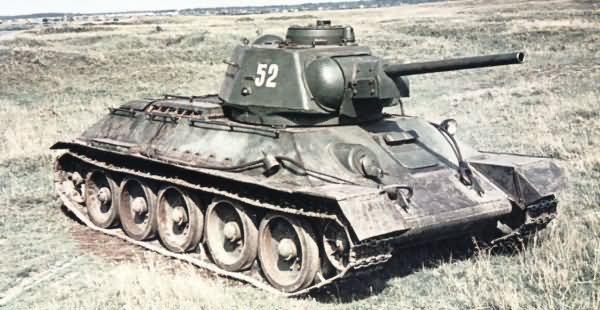
T-34/76 tank in color.
During the war, the Soviets relied on massing forces to defend their
homeland and eventually overwhelm the Germans. The T-34 was perfect for
mass production and huge numbers were produced – 39,698 in total. When the German invaded and they ran into the T-34, they were unpleasantly surprised, the T-34 was better than what the Germans had, but what helped the Germans was the training and the close air support of the Luftwaffe especially the Stuka.
However, production was almost stopped in the early days of the war
on the Eastern Front. The German advance into Russia was so swift and
decisive that it overran the tank arsenals. Through an incredible
application of labor, the Soviets managed to evacuate every movable
machine part from these factories, transporting them by rail deeper into
the USSR.
There they set up new tank production lines, including the
Uralmashzavod (Ural machine factory) at Nizhni Tagil. This factory
churned out thousands of T-34s, keeping up the supply of tanks the Red
Army needed
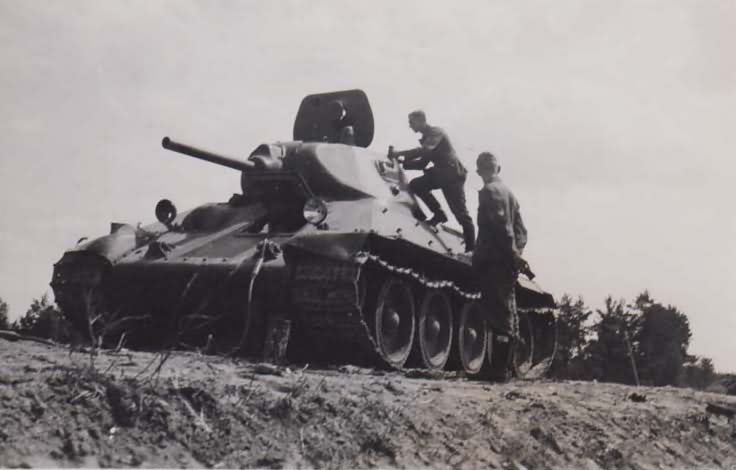
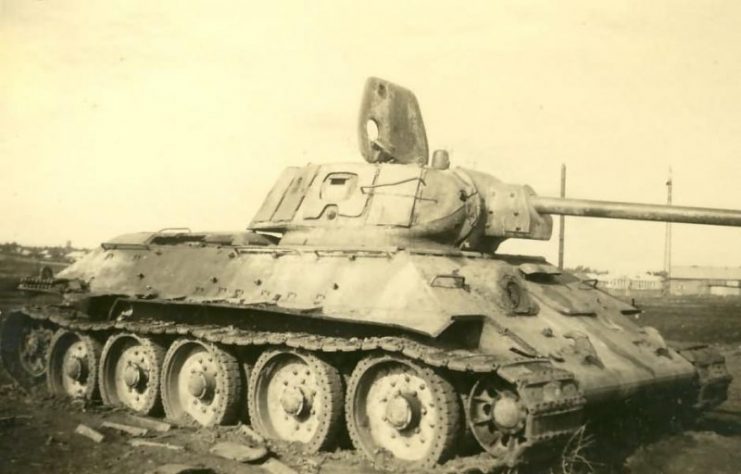
Soviet Tank T-34 76 model 1940 abandoned by the Red Army.
By 1943, there were 43 factories producing just two types of tanks – the T-34 and the heavier KV.
One of the T-34’s most important features was its engine. This was a
high-powered diesel design that was created at the Kharkov Locomotive
Works. It was the result of five years of research and development all
focused on the creation of one engine. It was both reliable and
resistant to fire, making the tank better able to survive being hit.
T-34/76 soviet tank, turret with additional armor.
Many previous tanks had riveted armor. However, fighting in the
Spanish Civil War and in border conflicts between China and Japan had
tested the limits of this design and proven the vulnerability of a
riveted tank. So instead of riveting, the T-34’s armor was joined by
welding, to make it tougher.
The angle of the armor was also re-thought. It was carefully sloped,
to avoid presenting a face at right angles to the trajectory of a shot
against the tank. This made it far more likely that enemy shells would
be deflected off.
Alongside its improved engine and armor, the T-34 carried a powerful weapon for a tank of its size – a high-velocity 76mm gun.
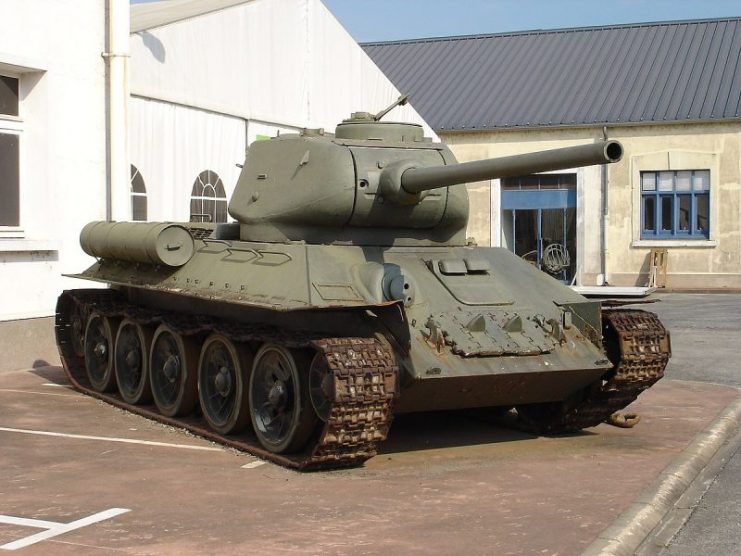
T 34/85 at the Saumur Armored Museum. Photo:
As the war progressed and German tanks improved, a heavier weapon was
needed to penetrate their armor. The 76mm weapon was replaced with the
D-5T 85mm anti-aircraft gun, which would prove as effective against
tanks as it was against planes. At the time, the T-34/85 was one of the
most powerful tanks in the world.
As well as its main gun, the T-34 was equipped with two 7.62mm
Degtyarev machine guns. One of these was mounted coaxially with the main
gun, The other was fitted in the front right-hand side of the hull.
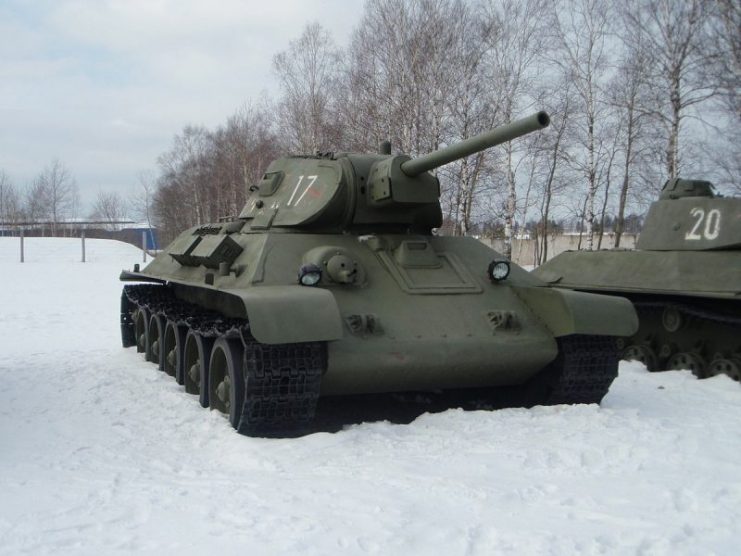
T-34/76 model 1941 in the Tank Museum, Kubinka.
The turret on the first T-34 was cramped and limited in how far it
could depress its gun. Like many features of the tank, it went through
continual improvements over the course of service, creating a more
spacious and better-protected turret.
T-34/76 model 1943 soviet tank.
The importance of being able to function in bad weather had been
proved to the Soviets when they invaded Finland in 1939 and many of
their vehicles stopped working in the snow. While conditions in the USSR
were seldom as trying as in the Finnish winter, the Soviet winter could
also be grueling, and a tank needed to be able to get across mud and
snow. The wide tracks of the T-34 were designed for this purpose.
During the Cold War, the Soviets exported the T-34 tank to their
Warsaw Pact allies. The Czechs started producing their own T-34s in 1951
and the Poles did the same in 1953. The Polish vehicle incorporated
several improvements not seen in the Russian model.
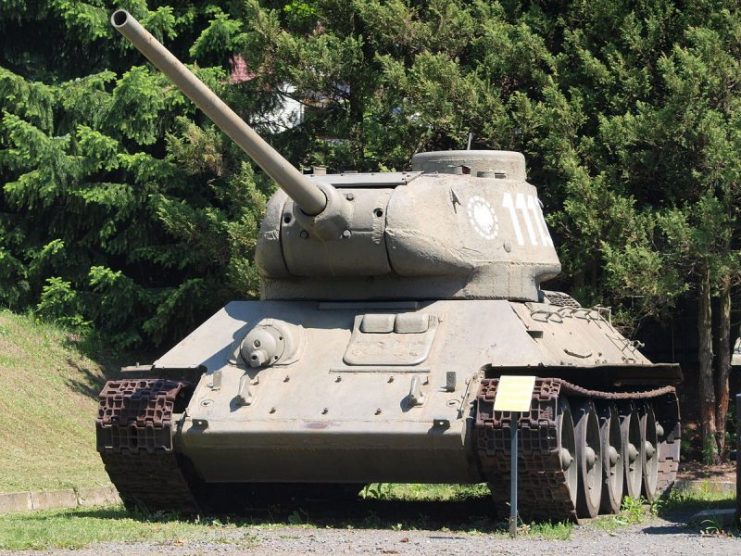
T-34/85 Tank in Poland at the Open Air Exhibition of the Armament of the Polish Armed Forces.
The T-34 saw many adaptations to its design over the course of its
long career. It also became the foundation stone upon which a variety of
other vehicles were built, by both the Soviets and their allies. These
include at least six different armored recovery vehicles, built in the
USSR, Czechoslovakia, East Germany, and Poland.
Like the BT-7 before it, the T-34 became the basis for designing
other, more advanced tanks. The Soviet T-44 tank was based on the T-34,
and in turn became the starting point for the T-54.
T-34-76 (Model 1941).
The effectiveness of the T-34 was such that it remained a mainstay of
the Soviet army for a decade after the war. But by the mid-1950s, it
had been surpassed by its descendant the T-54, and the Red Army began
phasing it out in favor of that tank, with T-34s finally leaving Soviet
service in the 1960s. It continued in service in other Communist
countries for decades afterward, a testament to the enduring quality of
this most influential of tanks.
Additional Photos –
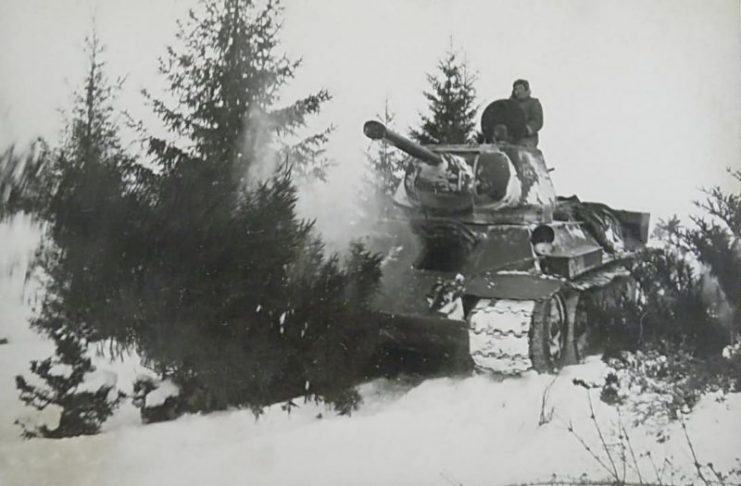
T-34 winter camo turret number 54.
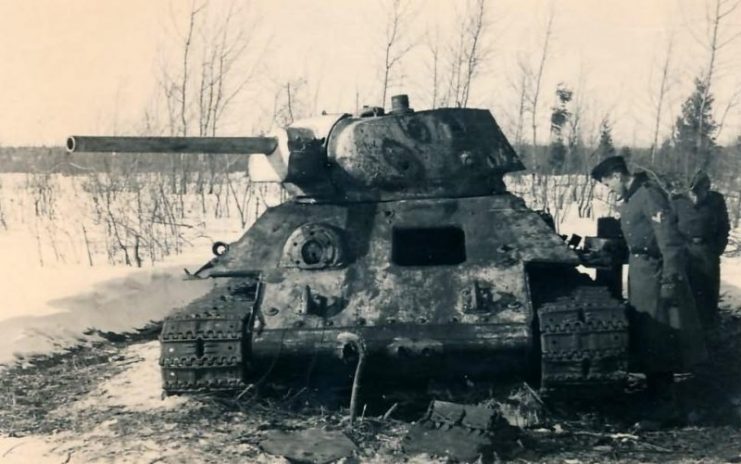
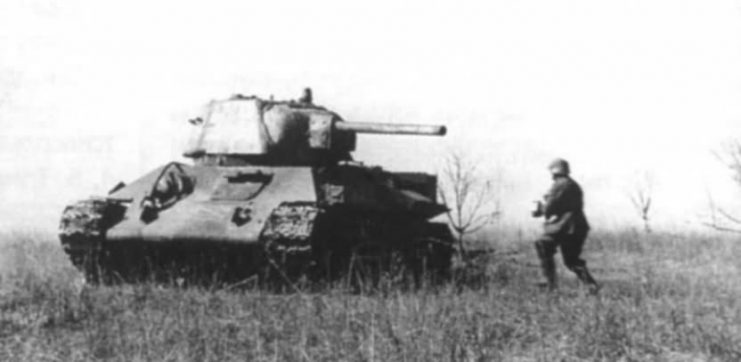
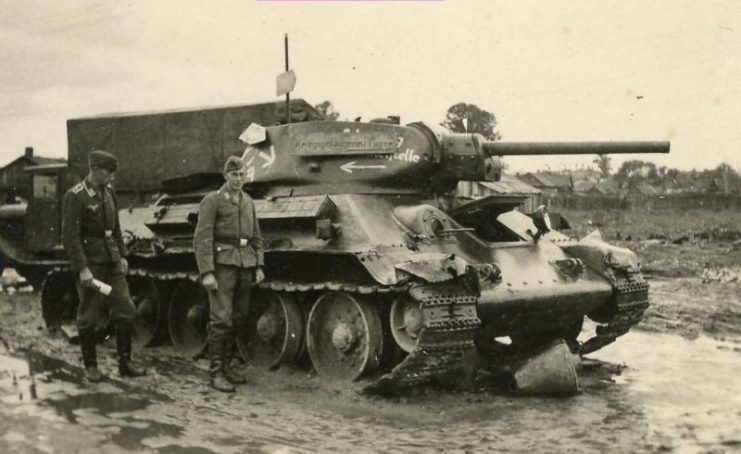
Abandoned T-34/76 with German soldier approaching.
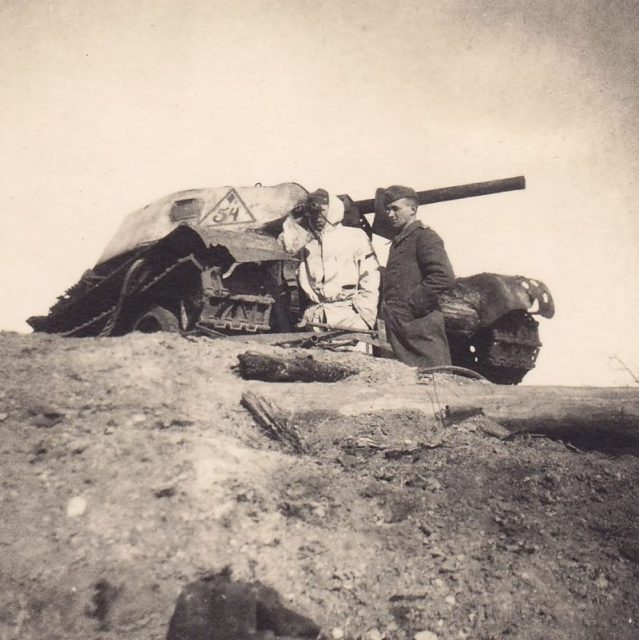
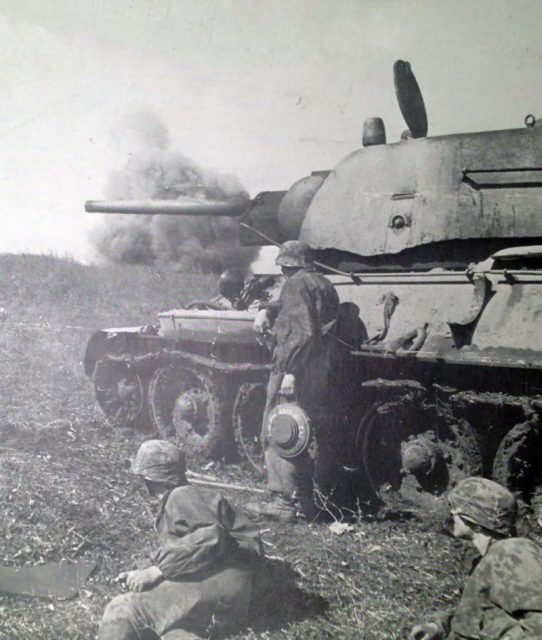
Abandoned T-34/76 with the Uralmash Turret. Panzer Grenadiers in foreground.
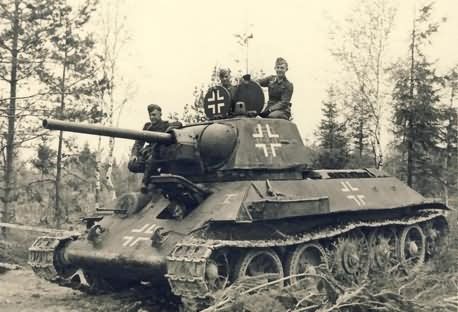
Captured T-34/76 used by the German army.
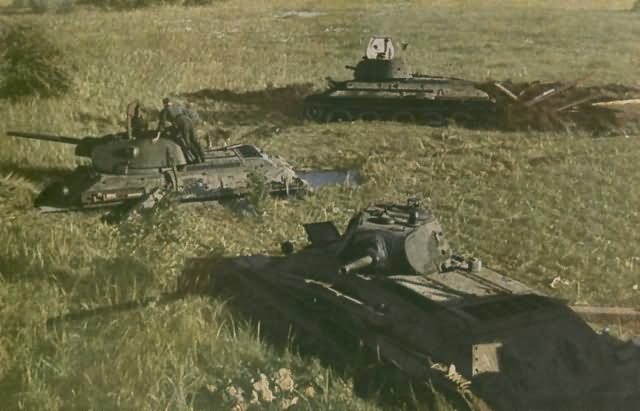
Another Captured T-34/76 used by the German Army.Color Photo of T-34/76 models 1940 and 1941.
Column of Soviet Troops including several T-34s. look like T-34/85 models, you can tell by the gun mantle and the longer barrel
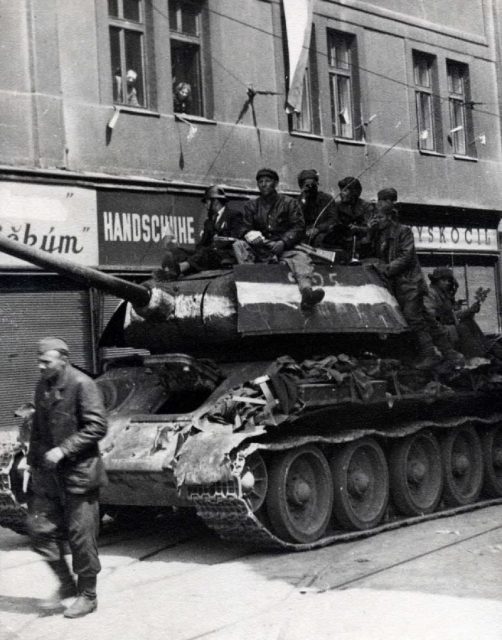
T-34/85 with additional armor in Czechoslovakia 1945.
Here is a movie"White Tiger", it is a Russian movie with english subtitles, the movie tried to be accurate as far as kitting out of the gear, except they had to use a modified JS-3 as the "Tiger Tank" I thought the movie was pretty good, I was telling Mack about the movie while we were returning from Alabama after buying my Garand