Webster

The Constitution was made to guard the people against the dangers of good intentions." --American Statesman Daniel Webster (1782-1852)


Showing posts with label U.S Military. Show all posts

Friday, December 13, 2024

"The Guns of the TET Offensive"

 The "TET" offensive was a truce agreed to by all sides and the communist broke the truce and attacked all the cities in the south of Vietnam hoping to cripple or better off knock the South Vietnamese out of the War, they failed and virtually wiped the "Viet Cong" out as a fighting force and the North Vietnamese took over all the fighting in the south, I think this was the intent all along.

This is my first post in a while, I have been super busy with "Meatspace", I will try to 'splain in a day or three, lol.  

   I shamelessly clipped this from "American Riflemen".


tet_lede_2-full-usmc-m16-hue-2-68-ii.jpg
Images courtesy of author.

On Jan. 30, 1968, forces of the Viet Cong and the North Vietnamese People’s Army launched a series of attacks throughout South Vietnam. The well-coordinated offensive coincided with the Tết holiday, the Vietnamese celebration of the New Year. [W]e remember the Vietnam battles of early 1968 as the “Tet Offensive,” an event that many have described as a turning point in America’s involvement in Vietnam.  
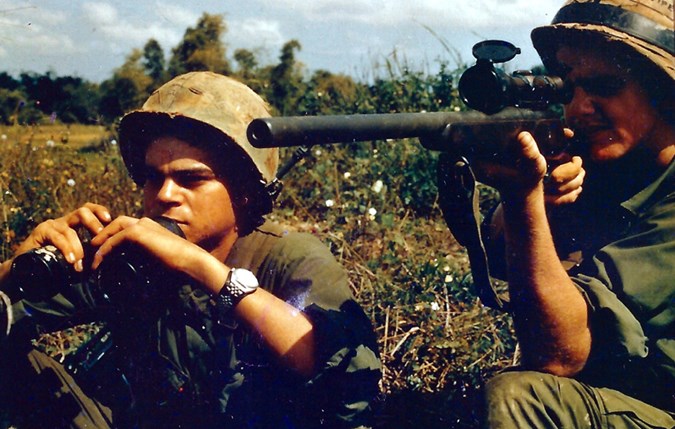

Sniper team of the 5th Marine Regiment at work during January 1968. The Winchester Model 70 rifle proved highly effective in the hands of USMC marksmen.
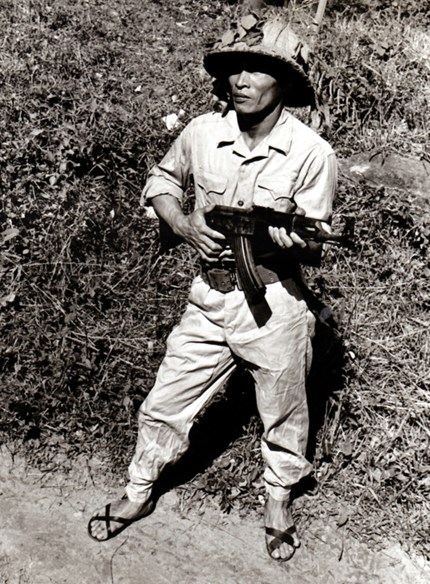

The 1st Marine Division set up this identification photo of a typical Viet Cong guerilla armed with a Chinese Type 56 rifle (copy of the Soviet AK-47). Simple and reliable, the AK-47 and its many variants have proven to be a perfect weapon for insurgents.

During the offensive, a force of more than 80,000 Viet Cong guerillas and NVA regulars attacked more than a hundred communities throughout South Vietnam, including 36 of the 44 provincial capitals. Saigon, the southern capital, was heavily hit.   
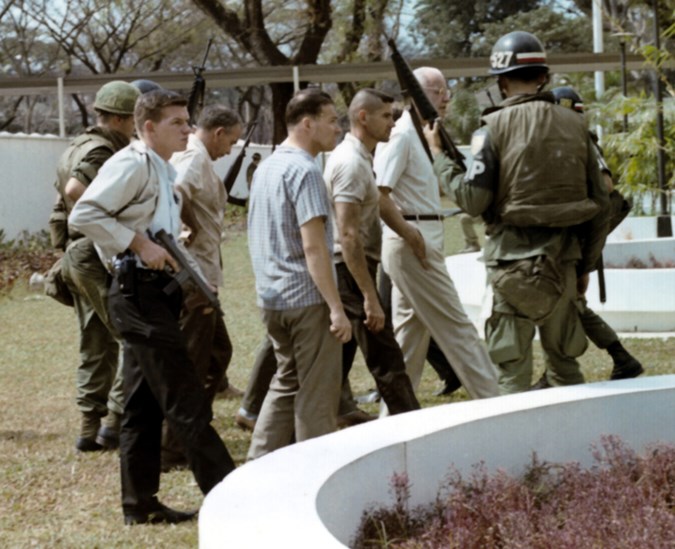

The Berretta M12 9 mm SMG fired its first shots in anger during the defense of the U.S. Embassy in Saigon during the opening stages of the Tet offensive. This photo shows men of the U.S. ambassador’s security detail, in the days following the initial VC attacks. M16 rifles and an M1 Carbine can be seen in the background.
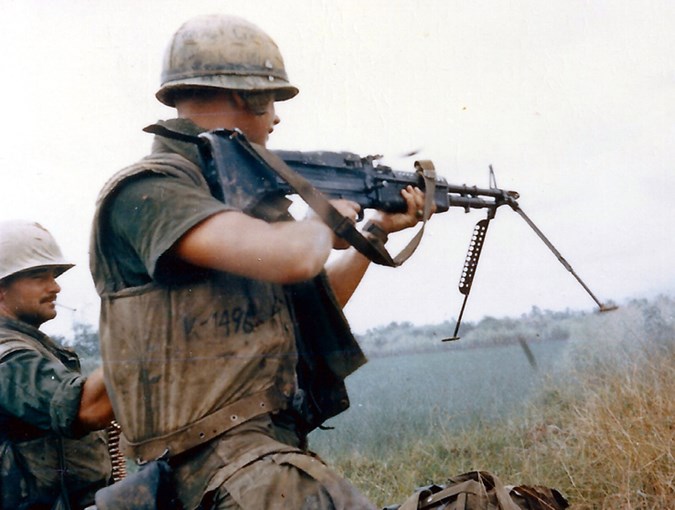

A Marine cuts loose with the 23-lb. M60 machine gun while his assistant keeps the disintegrating link ammo belt loading smoothly.

The initial attacks included an assault on the U.S. Embassy in Saigon by 20 Viet Cong sappers, which killed five American troops and prompted significant coverage by American news reporters—far out of proportion with the actual importance of the embassy battle. The entire VC assault force was annihilated on the embassy grounds within a few hours. Many news reports remained focused on the attack on the building symbolizing America’s presence in South Vietnam.
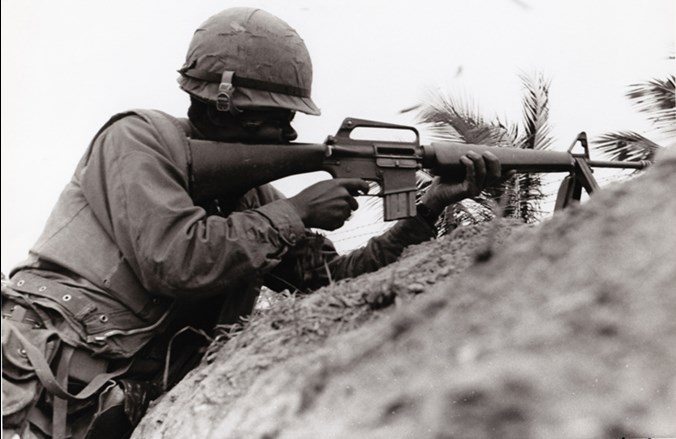

The M16 was still relatively new to the Marine Corps at the beginning of 1968. This Leatherneck uses his with a bipod during the battle for Hue in February 1968.
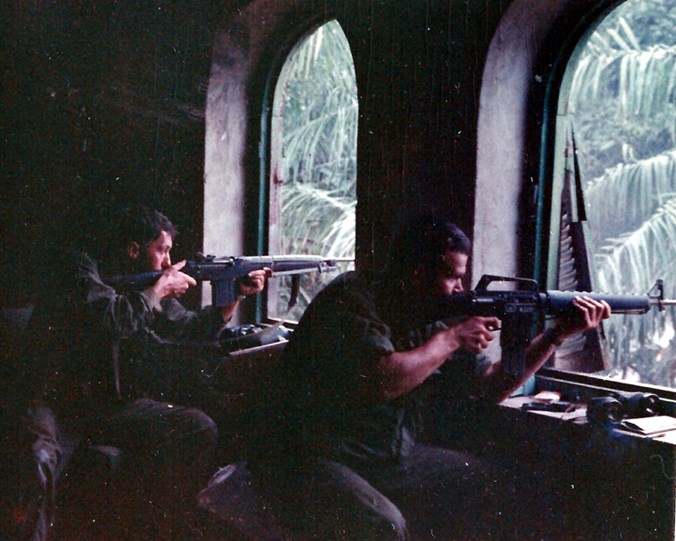

Brothers in Arms: Marines equipped with M14 and M16 rifles engage Viet Cong snipers during the battle for Hue, Feb. 1968.
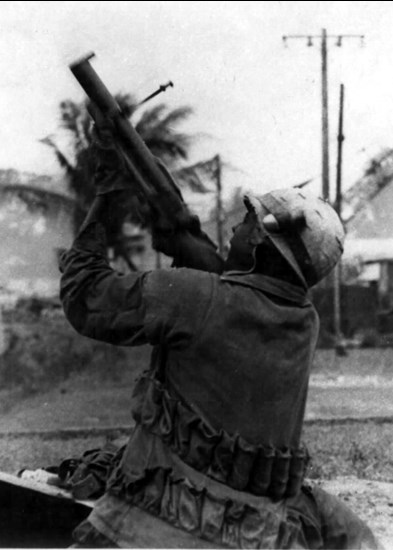

The M79 40 mm Grenade launcher, sometimes called “Thumper” by U.S. troops. Seen here as used by a grenadier of the 1st Marine Division in the battle for Hue, March 1968.
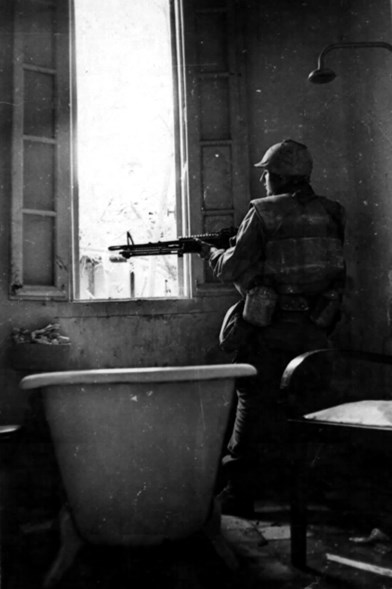

A Marine M60 gunner during the house-to-house fighting in Hue City during February 1968.

Communist forces occupied much of the ancient city of Huế. Relatively close to the DMZ, Hue was strangely unprepared for the assault. Four U.S. Army battalions, three weakened USMC battalions, and eleven ARVN battalions fought hard for more than a month to drive the enemy out. In the end, Huế was almost completely destroyed, and thousands of its residents were massacred in brutal reprisals by the communists. The troops from the North showed their true selves at Huế.
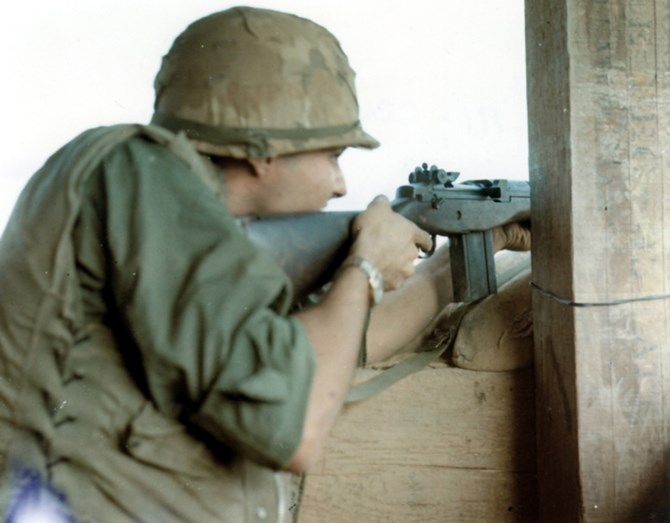

A G.I. of the 12th Aviation Battalion engages the enemy with his M14 rifle at Long Binh, Feb. 1, 1968. In early 1968, the M14 could be found in certain Army units and was still common in the Marine Corps.
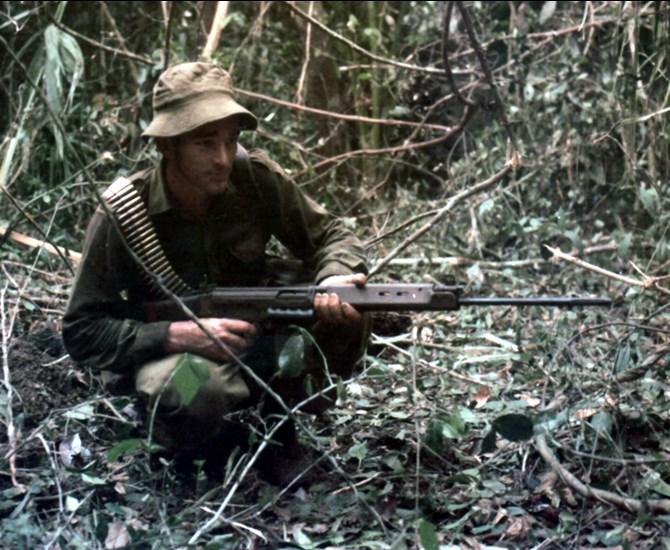

A soldier of the Royal Australian Regiment, equipped with a semi-automatic L1A1 rifle (chambered in 7.62x51 mm NATO) at Bien Hoa during February 1968. The L1A1 “SLR” was standard equipment for the Australian infantryman in Vietnam, and well-liked for its reliability and stopping-power.

Throughout South Vietnam, the fighting was intense from January to June of 1968. At the U.S. combat base at Khe Sahn, in northwestern Quảng Trị Province, two regiments of Marines were surrounded and besieged by three divisions of the North Vietnamese Army. From Jan. 21 until April 6, the Marines held out against relentless NVA attacks. Continuous air strikes and more than 150,000 artillery rounds helped keep the attackers at bay, but ultimately it was the Leathernecks’ resolve that kept Khe Sahn in American hands.
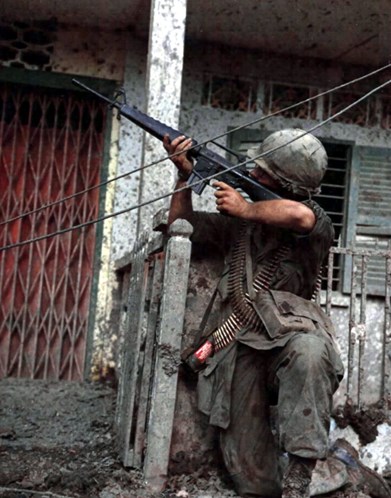

Tet Phase II: A G.I. of the 9th Infantry Division targets VC snipers in the outskirts of Saigon during the second round of attacks in May 1968. The rifleman carries extra ammo belts for his squad’s M60 machine gun.
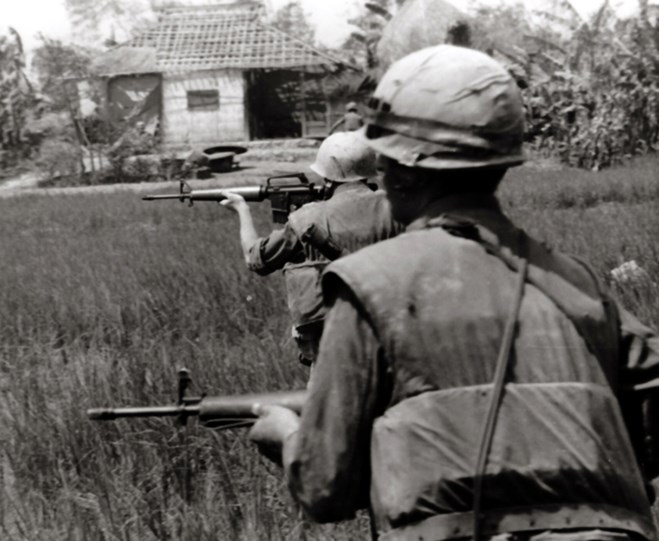

Marines suppress VC positions during Operation Napoleon Saline during early March 1968.

Despite the initial surprise and limited gains, Tet proved to be a tactical disaster for communist forces, who suffered more than 100,000 casualties through all three phases of the offensive. The Viet Cong were essentially eliminated as a fighting force, and no popular uprising was generated in South Vietnam. The NVA suffered heavily and its aggressiveness was blunted as their leaders realized they lacked the resources to sustain such attacks in the face of American firepower.
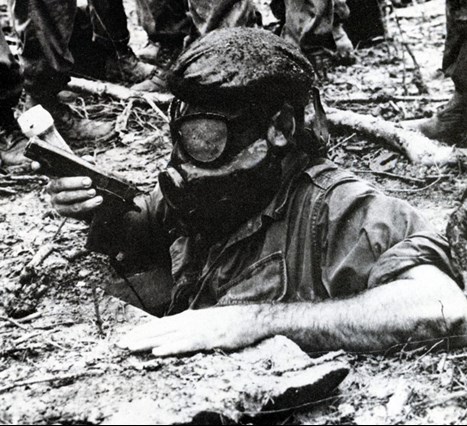

A “tunnel rat” descends into a Viet Cong tunnel. Some tunnel experts considered the powerful .45-cal. M1911 to be “too much gun” in the tight confines in the battle below ground.
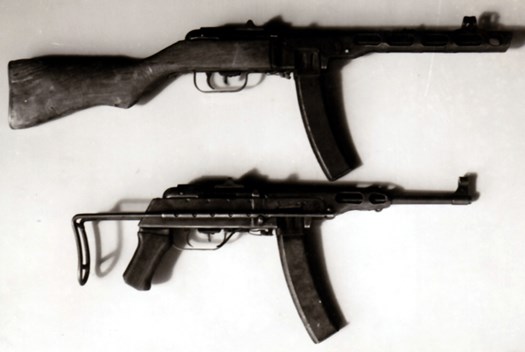

The Chinese Type 50, a copy of the Soviet PPSh-41 submachine gun, chambered in 7.62×25 mm Tokarev. Its cyclic rate is high, normally in excess of 1,000 rpm. The Type 50 only accepts 35-round box magazines. Bottom: K-50M, a North Vietnamese design that shortened and lightened the PPSh-41/Type 50 design, adding a pistol grip and a retractable wire stock. Some of these SMGs were still in service with the Viet Cong during the Tet offensive.  

Despite these battlefield setbacks, Tet became an important strategic victory for North Vietnam. At home, America’s commitment to Vietnam began to wane. Politicians waffled. Anti-war protests grew larger, and the news media regularly stoked the fires of discontent.   
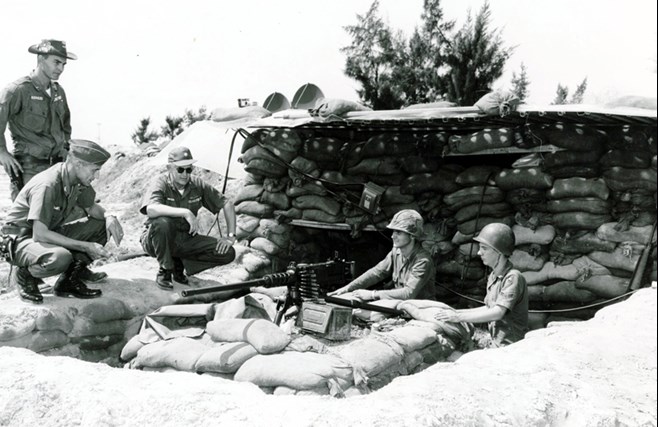
 
Defensive fire: Air Force security troops manning a Browning .50 cal. M2 machine gun, set up for airbase defense.
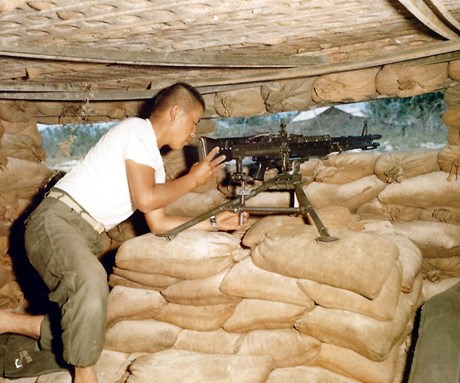

A Marine adjusts his M60 “Pig” mounted on a M122 tripod inside a sandbag bunker.

On Feb. 27, 1968, CBS Anchorman Walter Cronkite broadcasted the following in a special report on Vietnam: “To say that we are closer to victory today is to believe, in the face of the evidence, the optimists who have been wrong in the past. To suggest we are on the edge of defeat is to yield to unreasonable pessimism. To say that we are mired in stalemate seems the only realistic, yet unsatisfactory, conclusion.”
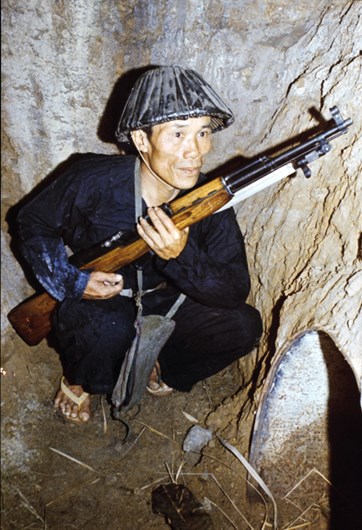

Uncle Ho: Viet Cong guerilla posing with an SKS carbine (or the Chinese Type 56 semi-automatic carbine copy). The SKS provided another excellent rifle for VC and NVA troops.
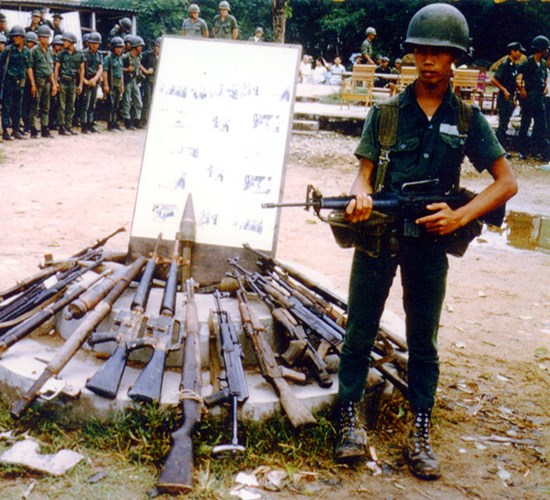

An ARVN trooper guards a typical VC weapons cache—featuring various AK-47s, M16 rifles, the venerable M1 Garand, and even an antique black-powder cannon.

After Tet, President Johnson watched his approval rating fall from 63 to 47 percent. Americans grew distrustful of the Pentagon’s Vietnam reports and criticism of U.S. military leaders created a much-discussed “credibility gap.”
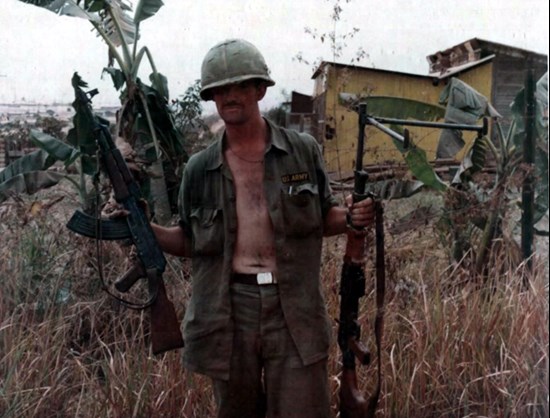

A G.I. of the 9th Infantry Division shows off captured VC weapons early in the Tet offensive at Long Binh. In his right hand is the AK-47, and in his left the RPD squad automatic with its distinctive “club foot” stock. The RPD was the standard light machine gun of most VC units. Chambered in 7.62x39 mm, it fires full-auto only (at about 750 rounds per minute) using a non-disintegrating 100-round belt in a drum container.
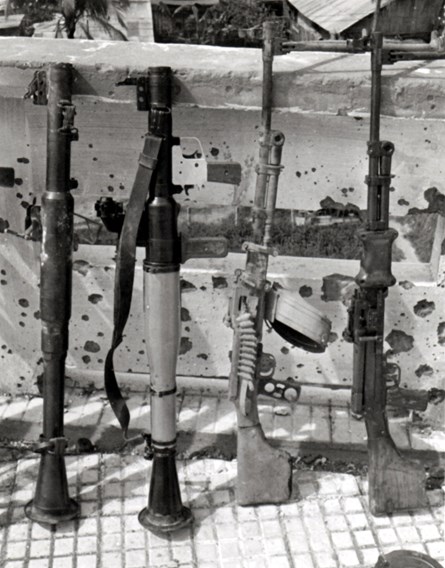

Captured VC support weapons: (left) the RPG-7, and (right) the RPD light machine gun. The RPG gave VC units an easily portable rocket launcher that provided potent anti-tank capability and also handy “artillery piece” for use against buildings and fortified positions.
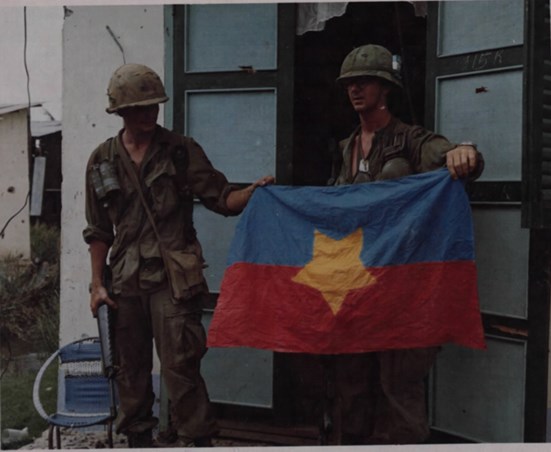

Tet Phase II: G.I.s of the 9th Infantry Division display a Viet Cong flag captured in the Saigon suburbs as Tet’s bloody second phase ends in late May 1968.

None of this did anything to help American troops in Vietnam who, regardless of inaccurate news reports and flinching politicians, never failed to overcome the enemy on, over and below his own turf. Advanced American firepower, coupled with traditional G.I. ingenuity and courage held the line during the Tet Offensive, and turned back the largest communist attack of that long and bitter war.

Sunday, October 15, 2023

"Why Generation Z Will not join the Military"

 I saw this last week and was going to post it but got overcome by events(Going out of town), I also have my own theories, after 2 generations of being told that the West is the source of all evil especially the United States, it is hard to get its younger citizens to step up to the ramparts to defend her, especially when there is a large segment of the population of "Zers" that would support our enemy because they want to see us get lessened for "Past sins".  The "Communist March" through our institutions were exceedingly successful.  I joined during the 1980's during what I called "Reagan's America", we believed in our country and were willing to give Uncle Sam a blank check.  Times have changed.


gen z military recruitment

Photo credit: Lighthouse Films (Getty Images)

The youth of today seems to have zero interest in joining the military and the military can’t seem to figure out why that is. They’ve done studies, conducted polls and the Army even knows that Gen Z has some serious misconceptions about the military. Despite a $4 billion investment in marketing to Gen Z, the combined branches of the military will miss their recruiting goals by nearly 19,000 in 2023. 

Many people in the military and in government believe the recruiting crisis is a serious national security risk, but the military itself just keeps falling short of reaching (or appealing to) Americans born after 1997 – so-called Generation Z. But one Marine officer, a lieutenant and a member of that generation, has written a book detailing what he believes are problems and solutions, and presents research to back it up. 

Lt. Matthew Weiss took it upon himself to research and write “We Don't Want You, Uncle Sam: Examining the Military Recruiting Crisis with Generation Z." As a member of Gen Z with a background working for the defense technology firm Anduril Industries, he saw how companies jockey to attract and retain young talent coming from anywhere in the country. He also earned a bachelor’s degree and master’s degree from the University of Pennsylvania's Wharton School before joining the Corps. 

Most importantly, the military was able to attract him, a talented, educated 25-year-old man who could have done anything. Knowing why he, a member of the military’s key target demographic, decided to join the Marine Corps is probably the most unique insight of all. 

Weiss breaks down what he believes are 21 key issues across four distinct areas that are the core problems keeping Gen Z and the military apart. He then backs up his reasoning with painstaking research with "the intention of diagnosing and solving a real and serious issue facing our nation," he writes. 

gen z military recruitment book
We Don't Want YOU, Uncle Sam: Examining the Military Recruiting Crisis with Generation Z book cover.

There are a few issues he addresses that other generations would expect about Gen Z, such as the power of social media influencers. The U.S. military, he says, can counter that with influencers of their own. Another sticking point is the military pay structure: everyone gets paid the same regardless of performance. This is a generation that watches peers gain followers and influence (and thus more money) through performance. The military, he says, could introduce performance bonus pay. 

On the other hand, there are problems and solutions that may not be as obvious, according to the book. These kinds of problems and solutions could be the key because the military is uniquely suited to address them. First off, Generation Z needs a calling, one they strive for and work toward. It needs to be larger than life, bigger than themselves. 

What better place to answer that calling than the U.S. military? 

Moreover, this is a generation that is constantly receiving updates, pings and dings from their phone. It’s beginning to have a negative effect on them, and they crave time away from the screens and sounds of their daily life to go out and do something “unplugged” and reset. The military can offer this time spent doing real-world responsibility-bearing activities like no other institution, so all is not lost.

For a full rundown on what the United States military can do to appeal to its youngest generation of military-age Americans, check out “We Don't Want You, Uncle Sam: Examining the Military Recruiting Crisis with Generation Z” – on sale now in both paperback and on Amazon Kindle e-readers.

Sunday, September 12, 2021

"U.S Troops Rage at their Leaders will grow unless there is deep reform"

This ties in with my rant that posted Thursday evening.  I saw this on the "New York Post" I'm kinda shocked actually.  The images are from my collection of pics on my laptop. 


Our military’s civilian leadership is corrupt and incompetent. The brass commands respect neither among the citizenry nor the forces it commands. Mid-level officers are in a rage — a dangerous phenomenon that in many other nations triggers insurrections and coups.

Blessedly, our institutions retain enough strength to prevent such outcomes here. That said, we need to tend to those institutions more carefully, if we want them to continue to work.

According to Rasmussen, more than half of Americans rate President Biden’s handling of Afghanistan as “poor.” His approval numbers have plummeted, and a majority of voters don’t trust administration reports on Afghanistan.

The Taliban and their Chinese allies have been mocking the United States on social media, while Beijing also openly threatens Taiwan, gloating that after the military humiliation of Afghanistan, Washington wouldn’t dare defend that island nation against invasion.

Biden’s stilted, disjointed speeches and clumsily scripted meetings with the families of dead service members haven’t helped. Nor has Vice President Kamala Harris impressed, with an awkward mission to Southeast Asia that merely underscored her unfitness to take over as president, if needed.

Meanwhile, the military command has failed miserably. Gen. Mark Milley, chairman of the Joint Chiefs of Staff, has become the butt of jokes. A group of retired senior officers has called on him, and on Defense Secretary Lloyd Austin, to resign. Milley, who found time to lecture us on the dangers of “white rage” last summer, has lately vanished from sight.

Meanwhile, the officers who actually do things are furious. A series of encrypted messages leaked to the media shows officers on the ground in Kabul blasting their orders, complaining that they were being forced to leave Americans behind. “We are f–king abandoning American citizens,” wrote a colonel with the 82d Airborne detachment there. Regular troops were reportedly apoplectic that they weren’t allowed to go rescue US citizens, as British and French forces did.

As this debacle unfolds, the field- and company-grade officers — captains through colonels — are complaining about a double standard in military management: If they screw up even a little, their careers are over. But when the generals screw up, there are no consequences, even when lives or billions of dollars are wasted; then they retire to fat contractor paychecks.

Marine Lt. Col. Stuart Scheller resigned his commission after Kabul to demand accountability from his superiors. He couldn’t stay, he said, because he had lost trust and confidence in them. His words have been echoed, publicly and in private, by many others of similar rank. (I received an email from a serving general making the same points.)

This is against the background of endless loose talk by our high political leaders about “coups,” “insurrections” and “sedition.” The laughable Capitol “riot” certainly didn’t rise to that level, but in a show of insecurity, the Capitol was ringed by 25,000 troops, several times as many as were sent to rescue Americans from Kabul. Banana republic stuff.

Generally speaking, a nation where the civilian leadership fears its citizens and has lost the nation’s confidence, and where the senior military leadership has lost the confidence of those down the chain of command, is a nation in trouble.  

Elsewhere, such circumstances would supply the dry tinder for a military coup. Fortunately, the United States is a bit more resistant. With so much of our government, and even our domestic military force, divided up among the states, a coup is much harder to pull off. And with our institutions, weakened as they are, still comparatively strong, we aren’t likely to see a “Seven Days in May” scenario in the near future.

But while unlikely, that scenario is now more likely than it used to be. And that’s because the people responsible for our great institutions, civilian and military, aren’t doing their jobs. In particular, they aren’t keeping faith with the people they are supposed to serve.

Afghanistan collapsed overnight, because its people lacked faith in its institutions and in those who led them. And no nation is immune to that collapse, if run badly enough for long enough.