I'm Taking a break from "Monday Music" for a couple of weeks"
This article has a lot to it, I know that when we used to go to war, we were all in it to win it. I used to make comments that we used to have the stones to if necessary, use flamethrowers, bayonets and as the Moro Warriors in the Philippines found out when we would use their religion against them, like bury their bodies in pig carcasses (guaranteeing that their souls would wander in the afterlife) after some of our soldiers were killed and mutilated to prove we were bad asses and worthy of respect and what would happen the next time such events happened.. During WWII we were not concerned about the sensitivities of our enemies, we were great friends but were motherfuckers as enemies, we had that reputation. But it changed after Korea, and it got worse during Vietnam, we got more concerned about "not losing" rather than winning. Really? When our forces and treasure are committed, we have to be in it to win it. in my War, Desert Storm, We beat the crap out of Saddam Hussain and the Iraqi Army, We turned the 4th Largest Army into a junkpile, The world saw hyperwar for the first time, but the media saw the massive destruction and they and their democrat allies forces the First President Bush to hold us back, I was so pissed, I was furious I knew that we won a great victory, we had freed Kuwait from a great evil, and punished the Iraqi's, but the job wasn't done, we should have drove on to Baghdad or found a way to depose Saddam or we would be going back. Sure enough we did 12 years later. The same people that forced President Bush to back off, then beat him over the head about "not finishing the Job......Really? This was part of the reason I was so angry when I came back from the War, and getting "RIF'ted" didn't help my attitude.
I saw the same disconnect with Somalia, the mission creep, then Bosnia and so forth, they liked to send in the troops, then saddle them with unrealistic "Rules of Engagement". My brother, who was in Somalia told me of many instances of getting ground fire and wanting to return fire and told to "Hold one while Regiment confers with State Dept Lawyers". And as I recall, the restrictions are just as bad. remember when we had troops in Bosnia and we had that "Humvee and 3 Soldiers Captured", I read that they were forbidden to have loaded weapons by their ROE's in a combat zone by combatants that were committing "Genocide" against each other and they got jumped and were used as propaganda and we lost face. This continued in this century, when we were in Afganistan and Iraq, when the Lightbringer's administration was in office, the ROE's were very restrictive showing a disconnect between the troops on the ground and the people in the "5 sided Puzzle Palace" and in "Foggy Bottom". I They keep bringing in these "experts" in everything...but how to fight and how to win wars. Remember I used a meme last year to describe my "Musings and Rants" about the situation.
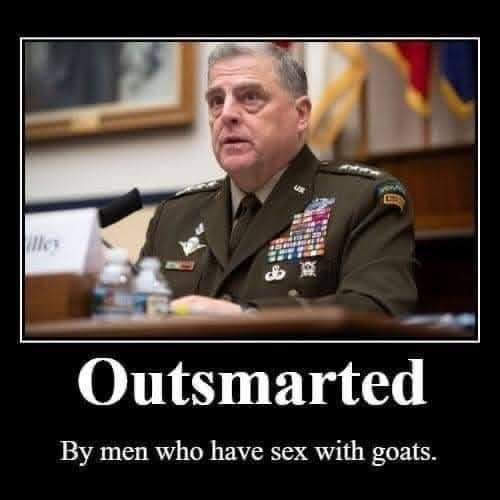
From my "
Rants and Musings" last year I was really pissed. I don't know what the future holds but we as a nation need to get back to the "old ways and growacett and get back if we get involved, we are all in, and everyone else knows it that if we commits troops, we are in to win it and if we have to salt the earth like Rome did to Cartage and also that will remind the clowns to use the Military sparingly because we don't Nationbuild we suck at it, we are better at destroying stuff and hurting people, our way of war is designed that way.
I shamelessly clipped this from "Real Clear Defense"
Clausewitz tells us to measure society’s strength by
whether we achieve victory on the battlefield. Victory entails not just
destroying the enemy’s fighting capability or claiming his territory,
but achieving certain political objectives. American politicians have
shown a willingness to end wars without achieving their objectives. In
other words, they have shown a willingness to lose.
Precedent was set with the 1953 ceasefire in Korea and
upheld when America withdrew from Afghanistan in 2021. It remains
unclear whether politicians intended to lose those wars (and others) or
merely accepted that the price of victory had become too high, that
victory was no longer worth the time or effort required.
Whatever the case, our troops care about winning. Desire
for victory is one reason young Americans leave their homes and families
to enlist. They join to gain a mission, to make a difference, and to
win on the battlefield. Desire for victory was part of the reason our
troops performed so well in the fight against terrorism. Ask anyone who
served whether they believed their combat deployments were making a
difference. Odds are they answer ‘yes’, but acknowledge the overarching
policy was misguided if not destined to fail.
No one blames the troops for our failures in Korea,
Vietnam, or Afghanistan. Rather, it is “the political leaders who have
forgotten that victory matters,” historian and Clausewitz scholar Donald
Stoker told me recently over the phone. And since the politicians do
not believe that victory matters, our troops have found themselves
trapped in endless wars that lead to defeat or stalemate, a doom loop of
poor planning-leads-to-poor results, where the pursuit of war itself
becomes more important than defeat or victory.
In his book Why America Loses Wars (Cambridge,
2019), Stoker argues that flawed thinking about war, especially limited
war, has led to flawed war policy and poor results. And, Stoker
anticipates more of the same unless our political leaders clearly define
their political objectives and apply the necessary military strategies
and resources to achieve those objectives. The following is our
conversation on war and politics.
Can you first define “war” for our readers?
War is the use of military force to achieve a political
aim. The violence (force) element is pivotal. What you will see argued
is that you can have war without violence. That’s wrong. You have
rivalry and competition, but war must have politically directed
violence, directed at an adversary for a political end.
Your writing is concerned with winning on the battlefield. Define victory.
Achieving your political aim. That’s the one that shines
through. When you get what you want, and have the strength or ability to
convince the other side to agree to your terms. This is where the
complexity of the book comes into play. The most difficult chapter to
write was on how to end wars, particularly those wars fought for a
limited aim where often you’re not able to impose your will on the
enemy. In such situations, it’s difficult to force the other side to
come to your point of view, as was the case in the Korean War and the
Gulf War, to name a couple of examples. It was too difficult to get the
agreements to end those wars on the terms we wanted.
I’ll add that we almost never plan for the ending of a war,
which is one reason for our failure to achieve victory in some of our
wars since 1945. This is not just a problem for the United States—most
countries never plan for the end of a war. The Russo-Japanese War
[1904-05] is one of those very few examples where a nation-state (Japan)
contemplated in advance exactly how to end the war. Japan thought
through the negotiation steps needed to end the conflict on favorable
terms. In contrast, the H.W. Bush Administration had thought about the
need for a plan to end the Gulf War but didn’t create one. Instead, it
had General Schwarzkopf negotiate in a very ad hoc way, and he was
criticized for the settlement even though everything he did was approved
by the administration.
You are opposed to loose usage of “war” in
academia, government, and journalism. The term “limited war” is
particularly bothersome. “Hybrid war” as well. To borrow a line from the
Smiths: What difference does it make?
I get criticisms sometimes that I’m worrying about nothing,
but as you dig into the arguments, you discover that we don’t even
agree on basic definitions for “war” and “peace.”
For instance, there’s this constant drumbeat that we’re at
war with Russia, that we’re at war with China. I think many terms we use
confuse “subversion” and “crime” with actual war. Now, the “gray zone”
is a big one used to denote actions occurring in this supposed realm
between peace and war, but my point is that people are again
misunderstanding “subversion” and elements of Great Power Competition. I
think we’re creating new terminology and imaginary complexity that
amounts to sloppy thinking. This affects our ability to plan and make
war.
Let’s apply these terms. Was the Iraq War a failure?
That depends. You can look at the question several different ways.
First, what were the political aims being sought in the
Iraq War? The political aims were to (a) overthrow Saddam Hussein’s
regime; and (b) build a democratic Iraq. You can make a good argument
that we achieved both aims, but that we did not understand that
achieving these aims required different things. Building a democratic
Iraq is a completely different political aim and, when the aims are
different, usually the ways must be different. The Iraq War certainly
killed more people and cost more than it was expected to, but you could
argue that the war was a success.
All that said, I don’t like the question. You could
certainly argue that we helped create a situation in Iraq that allowed
Iran to obtain a dominant position in the country, that this probably
would not have happened without overthrowing Saddam Hussein.
Okay. How about the War in Afghanistan. Was it a failure?
Obviously.
We wanted to (a) overthrow the regime; and (b) build a
democratic Afghanistan. Then, late last year [2021], we decided we
didn’t want to support the regime we created. What we did in Afghanistan
failed to achieve the aim. In Iraq, we got our aim but was it worth it?
I’m iffy on that. In Afghanistan, we didn’t accomplish our political
aim.
But is it a problem of thinking or a problem of
will? We knew the political objective of the war: to create security
conditions for peace and the development of a new government and
military. We also understood the problem: accomplishing the objective
would take 100 years.
Both. Loose terminology is a problem of thinking. But it always boils down to will, too.
Clausewitz would say it always comes down to one side’s
ability to hold. People would argue that the North Vietnamese or the
Afghans were just willing to do it longer.
What if it’s impossible to achieve the aim? I think it’s a
fair question to put forward in the context of Afghanistan. I’ve seen it
in a couple of books. When Mullah Omar and Karzai cut a deal in early
2002, the administration wouldn’t accept the deal because it was very
much an Afghan deal. It was rejected by the administration. Just think
if they had taken the deal – what would have happened? It’s a
fascinating one to think about.
It’s really tough if you’re in the political
decision-making role. You may have to make the decision that you’re
willing to lose. That’s the criticism leveled by Peter Bergen at the
Biden Administration in Afghanistan, that they decided to lose. But did
they really think they were losing the war?
Harry Summers’ book on Vietnam says there was no clear
political aim in Vietnam. But it’s very clear from the Kennedy and early
Johnson administration documents that these administrations wanted a
non-Communist Vietnam. The interesting thing from Summers’ argument is
that there are all these flag officers he interviewed who did not know
the political aim. It’s as if it was not pushed down the chain. There’s a
broken link in the chain.
When you look at the political aims for the Iraq War, it’s
very clear that the administration wanted to overthrow the regime and
establish a democratic Iraq. But then you have Rumsfeld writing in his
correspondence that the goal was not to establish a democratic Iraq.
Moreover, the political aim given to the war planners was to overthrow
the regime, not to plan for creation of a democratic Iraq. The
disconnect between the WH – DoD – ground commanders was huge in the Bush
Administration. I think it was very different in the Obama
Administration. As far as communicating the political aim, I think there
was some improvement in the Obama administration but there was also a
real tightening of control at the WH in the Obama administration.
Consequently, there was a real loss of strategy in favor of tactical
planning. In Ash Carter’s memoir, he writes that the Administration was
slow to figure out a strategy to fight the Iraq War in 2014 and beyond. I
think there was a lack of emphasis on winning during the Obama
Administration.
I’ll add that it’s very weird to see flag officers say that
the point of fighting a war is not to win. You’ll see evidence of that
dating back to the Korean War. It’s very odd. The class I taught at the
Naval War College was essentially on “how to win wars,” but now you’ll
see from military officers and politicians and others that the point is
not to win the war. If you’re not trying to win the war, how will you
ever get to peace? Fighting the war becomes an end. There’s a phenomenon
where the war becomes more tactical the longer it goes on, and planners
and decision-makers lose sight of the strategic picture.
There is a divergence between the academic’s answer
and the participant’s answer. Many veterans believe we won tactically
but lost strategically. There is a sense that the people most
out-of-touch with war—politicians, bureaucrats, other “experts” in war
policy—are the people most responsible for our failure. Can people who
never served in war fully understand war?
I think at some levels “yes” and some levels “no.” There’s a
friend of mine who spent a year in Iraq and a year in Afghanistan. His
father had been an infantryman in Vietnam. He said when he came back
from Iraq, his father finally talked to him about Vietnam and the wounds
he suffered. He never spoke about the Vietnam War beforehand, maybe
because it was too personal and he feared he wouldn’t be understood.
Another colleague had a similar experience with a student who had a
grandfather who served in World War II. The reason why is because they
had someone they knew—someone they knew would understand.
So, yes, I think it’s difficult to really understand the violence and chaos of war unless you’ve experienced it.
You mentioned Clausewitz. I’ve not given you any
preparation, but can you apply his “ends,” “ways,” and “means” analysis
to the engagement in Ukraine?
I’m probably wrong on this because I’m guessing, but here it goes, from the Ukrainian side:
ENDS – I
don’t know. Ukraine wants to secure its independence. Do the Ukrainians
also want to retake land they lost in 2014? Some would argue “yes” but
we don’t know.
WAYS –
depends how you want to slice it. Probably defensive. Attrite the
Russians and give ground until Ukraine can mount an offensive. [Which
has happened since the interview was conducted]
MEANS – an
effort to mobilize the entire country. Zelensky tried to revive
the levée on masse at the beginning of the war, from ages 16 to 60. I’m
uncertain how well this has worked.
That seems right. Thanks for doing the analysis on the fly.
Sure. And one further note on Clausewitz, if I may.
Of course.
He was first and foremost an infantryman, a soldier. We
have this misperception that he was just a staff officer. He was in at
least 36 battles. There were weeks where they would fight every day. He
was at the Battle of Borodino. He once took a bayonet to the side of the
head. He experienced nearly everything about war, from being wounded to
being a prisoner of war, to leading in combat. But he also sat in
meetings with the Czar. He had vast experience and vast education on
war—he built his theoretical approach on all these different things. Bad
theory will get you killed, he believed. And so, I’ve taken up that
last point by writing this book, an attempt to encourage better thinking
about why and how we wage war.
John Waters is a writer in Nebraska.
* The opinions expressed here do not represent the
views of the National Defense University, the Eisenhower School, or the
U.S. government.


