Webster

The Constitution was made to guard the people against the dangers of good intentions." --American Statesman Daniel Webster (1782-1852)


Showing posts with label England. Show all posts

Sunday, January 15, 2017

Different opponents faced by the British Victorian Army

I bought a book in the early 90's called "The Zulu Wars" and a bit later a book called "The khaki and the Red". These books were fascinating to read the different history and battles that the Victorian era British army faced in defending the empire and "PAX BRITANNIA".   Those books along with a book I used in college called "The Defense of Duffers Drift" which talked about small unit tactics during the Boer war.  Some of the stuff was no longer relevant but it encouraged critical thinking.  One of my favorite movies is "Zulu", having the British soldiers stand and fight the word I remember from the movie was "Get some good pikeman", for the use of the bayonet would be needed.
As I recall part of the British soldier to deal and adapt was part of the Victorian heritage that was prevalent at the time, the British soldiers and the culture believed that they were superior to everyone because they were British, it was part of the DNA.  For this reason they pushed the sphere of influence to a point where it was said that "The Sun never sets on the British Empire".  Also I remembered another movie with Michael Caine and Sean Connery "The man who would be King"

It is a different time and I wonder what a Britisher from back then would think about the empire today and the problems that the British are having from the E.U and the invasions of the "Kiffirs" from the subcontinents.


Maintaining your status as a global power is no easy thing. The British Victorian Army was one of the best equipped and most experienced in the world, its forces active from North Africa to the South Pacific. But while this gave many British soldiers useful experience, it also created unique challenges for them, their commanders and the politicians putting them into the field.
The British army was the same wherever they went, but their opponents were wildly different, each one presenting a new combination of skills, tactics, and weaponry for the British to overcome.

1. Egyptian Nationalists
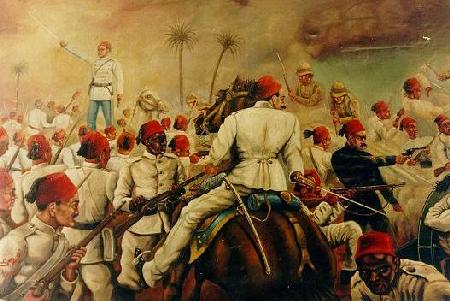
Anglo-egyptian_war
By 1879, the Egyptian government was massively corrupt, inefficient, and favorable to Europeans over locals. Even the law gave better protection to wealthy Europeans in the country than its native inhabitants. France and Britain in particular held huge sway.
Egyptian nationalists led by Colonel Ahmed ‘Urabi seized control of the country, seeking to bring about democratic reforms that would take power away from the elite and reduce foreign influence. France refused to intervene. Britain, on the other hand, used the death of 50 Europeans in riots to justify an invasion in 1882, whose real purpose was the defense of economic interests.
The forces they faced were trained and equipped by Europeans and fought like a regular army. But the British proved superior, defeating ‘Urabi at the Battle of Tel-el-Kebir and taking control of Egypt.

2. Ashanti
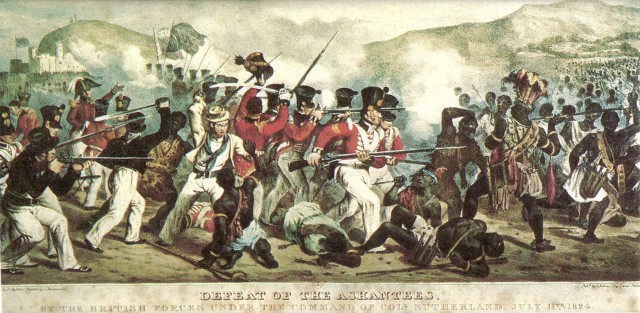


Defeat of the Ashantees, by the British forces under the command of Coll. Sutherland, July 11th 1824
The defeat of the Ashantees, by the British forces under the command of Coll. Sutherland, July 11th, 1824.
As in Egypt, the British fought the Ashanti Empire, located in modern Ghana, for control of economic resources. They wanted to control gold from the region, and ownership or favorable peace treaties could prevent other European powers from getting involved.
The Ashanti were primitively armed but experienced and smart at fighting in local terrain. Launching ambushes out of the hills and jungle, they gained the element of surprise and often outflanked their opponents.
The downside of Ashanti tactics was a lack of cohesion and close order discipline. In the face of increasingly accurate rifles, dispersed troops were more vulnerable than they had been a century before. Unable to break British formations, they were repeatedly defeated.

3. Zulus

Perhaps the most famous of Britain’s colonial opponents, the Zulu Empire was defended by warriors called impis. Tough and aggressive, they could run for miles before charging into battle and overwhelming their opponents with short stabbing spears. They were also highly disciplined, able to maneuver swiftly and coherently on command and willing to throw themselves in waves against the enemy.
To gather together various territories in southern Africa, the British needed to conquer the Zulus. They sent an ultimatum that triggered the war and then invaded Zulu lands.
The Zulus achieved an early victory at Isandlwana, where appalling leadership crippled the British  forces. The famous defense of Rorke’s Drift followed, in which 150 British and colonial troops fought off 3-4,000 Zulus in a desperate engagement.
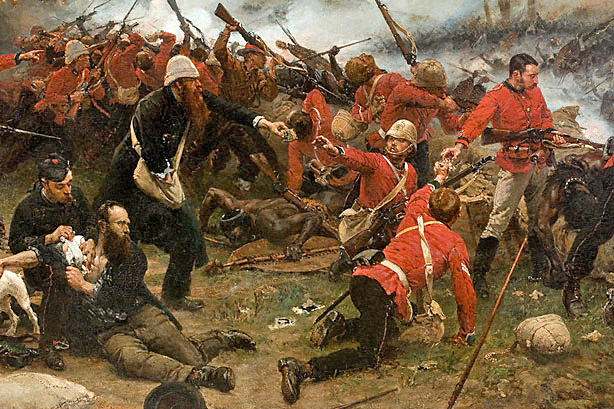


Défense_de_Rorke's_Drift
Defense of Rorke’s Drift.
Despite these early events, the ferocity, tenacity, and courage that had served the Zulus so well were not enough to let Spears beat modern guns. By the final Battle of Ulundi, courageous charges were creating massive casualties for little gain. However, the war had shaken British confidence, teaching some not to under-estimate a technologically inferior force.

4. Maoris


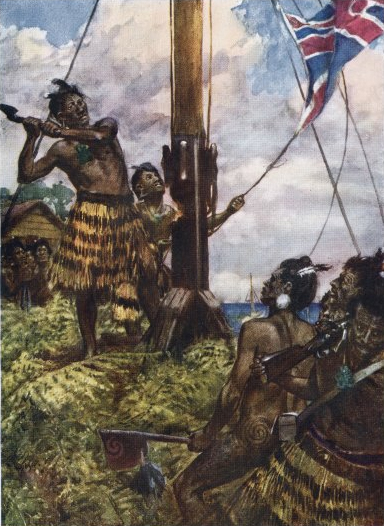
Hone Heke cuts down the flagstaff on Flagstaff Hill at Kororāreka.
A similar lesson was taught in the New Zealand Wars (1845-1872). With settlers spreading across New Zealand, and the colonial authorities backing them against the native Maoris, many locals took up arms to resist.
The Maori way of warfare was the polar opposite of that used by the Zulus. Impi tactics were flowing and aggressive, adapted to fight other African tribes. Those of the Maoris were stationary and defensive, adapted to counter European guns. Creating fortified earthen strongholds called pā, the Maoris held off British and then colonial militia troops, firing from well-prepared defensive positions, forcing the attackers into costly advances. Though the result was once again domination by white colonials, fighting was nowhere near as decisive as in the Zulu Empire.

5. Xhosa
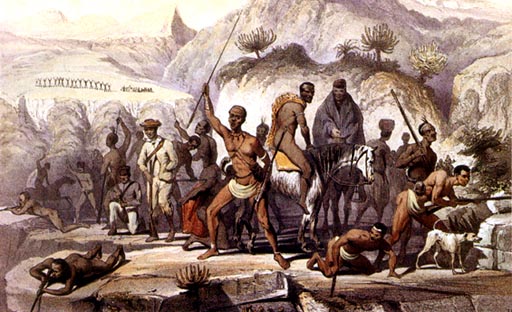


Resistance fighters defend a stronghold in the forested Water Kloof during the 8th Xhosa war of 1851. Xhosa, Kat River Khoi-khoi and some army deserters are depicted
Resistance fighters defend a stronghold in the forested Water Kloof during the 8th Xhosa war of 1851. Xhosa, Kat River Khoi-khoi, and some army deserters are depicted.
The Zulus were not the only natives the British fought in their attempt to unite southern Africa. Further, east, the Xhosa also resisted, triggering the Ninth Xhosa War (1877-9)
Unable to beat the well-equipped British in open battle, the Xhosa retreated to the Amatola Mountains. Here they fought a guerrilla war, making use of the terrain to launch a string of ambushes. By never presenting the British with a target and always withdrawing when put under pressure, they prevented the invaders from gaining an advantage. It was only by building a string of fortifications and creating an elaborate system of mounted pursuit that the British beat them.

6. Mahdists
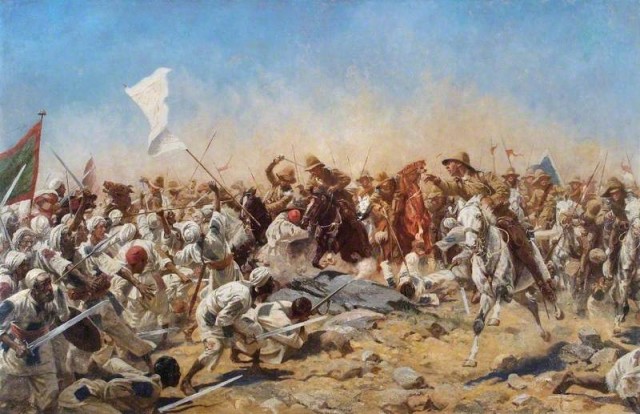


The Battle of Omdurman
The Battle of Omdurman.
The Mahdists in Sudan faced the British with a different challenge in the 1880s and 1890s. Believing their leader Muhammad Ahmad to be the Mahdi, a prophesied Islamic religious leader, they fought with fanatical fervor against foreign influence.
This religious fervor led to frontal assaults even more determined than those of the Zulus. Though these served the Mahdists well early on, they were no match for well-prepared troops equipped with the latest guns. It was such a force that broke them finally broke them at Omdurman in 1898.

7. Boers
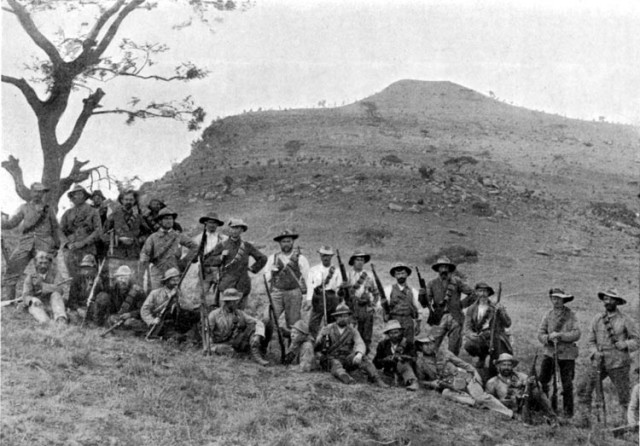


Boer militiamen at Spionkop
Boer militiamen at Spionkop.
While many opponents used elements of guerrilla warfare against the British, the Boer version came closest to what we see in the modern world. The descendants of Dutch settlers, the Boers became caught up in the British attempt to unify southern Africa, and like the natives they resisted.
Smart, accurate marksmen with talented leaders who understood European warfare, they were foes unlike any others the British had faced. They were able to gain large armies and adapt elements of guerrilla warfare to the battlefield, defeating the British in bloody confrontations as well as small actions.
Ultimately, the Boers were undone not by their enemies’ superior tactics or leadership. Indeed, British leadership in the war was often among the worst in history. Yet even the tenacious Boers could not defeat the superior resources of the British Empire, and sheer weight of numbers eventually wore them down

Wednesday, June 20, 2012

"NHS kills off 130,000 elderly patients every year"

This is our future under Obunglercare, the progressives are enamored with the British NHS.  Remember the claim of death panels?   

     I saw this on another of the foreign newspapers that I read since they are not beholding to the ChicagoJesus and will print stuff that is critical of his and the DNC's policies


Top doctor's chilling claim: The NHS kills off 130,000 elderly patients every year

  • Professor says doctors use 'death pathway' to euthenasia of the elderly
  • Treatment on average brings a patient to death in 33 hours
  • Around 29 per cent of patients that die in hospital are on controversial 'care pathway'
  • Pensioner admitted to hospital given treatment by doctor on weekend shift
By Steve Doughty
|

Worrying claim: Professor Patrick Pullicino said doctors had turned the use of a controversial ¿death pathway¿ into the equivalent of euthanasia of the elderly
Worrying claim: Professor Patrick Pullicino said doctors had turned the use of a controversial 'death pathway' into the equivalent of euthanasia of the elderly
NHS doctors are prematurely ending the lives of thousands of elderly hospital patients because they are difficult to manage or to free up beds, a senior consultant claimed yesterday.
Professor Patrick Pullicino said doctors had turned the use of a controversial ‘death pathway’ into the equivalent of euthanasia of the elderly.
He claimed there was often a lack of clear evidence for initiating the Liverpool Care Pathway, a method of looking after terminally ill patients that is used in hospitals across the country.
It is designed to come into force when doctors believe it is impossible for a patient to recover and death is imminent.

It can include withdrawal of treatment – including the provision of water and nourishment by tube – and on average brings a patient to death in 33 hours.
There are around 450,000 deaths in Britain each year of people who are in hospital or under NHS care. Around 29 per cent – 130,000 – are of patients who were on the LCP.

Professor Pullicino claimed that far too often elderly patients who could live longer are placed on the LCP and it had now become an ‘assisted death pathway rather than a care pathway’.

He cited ‘pressure on beds and difficulty with nursing confused or difficult-to-manage elderly patients’ as factors.

Professor Pullicino revealed he had personally intervened to take a patient off the LCP who went on to be successfully treated.
He said this showed that claims they had hours or days left are ‘palpably false’. 
In the example he revealed a 71-year-old who was admitted to hospital suffering from pneumonia and epilepsy was put on the LCP by a covering doctor on a weekend shift.
 
Professor Pullicino said he had returned to work after a weekend to find the patient unresponsive and his family upset because they had not agreed to place him on the LCP.
‘I removed the patient from the LCP despite significant resistance,’ he said.
‘His seizures came under control and four weeks later he was discharged home to his family,’ he said.
Professor Pullicino, a consultant neurologist for East Kent Hospitals and Professor of Clinical Neurosciences at the University of Kent, was speaking to the Royal Society of Medicine in London.
Distressing: The professor has claimed an approved technique of looking after the terminally ill is not being used in all hospitals
He said: ‘The lack of evidence for initiating the Liverpool Care Pathway makes it an assisted death pathway rather than a care pathway.
‘Very likely many elderly patients who could live substantially longer are being killed by the LCP.
‘Patients are frequently put on the pathway without a proper analysis of their condition.
‘Predicting death in a time frame of three to four days, or even at any other specific time, is not possible scientifically.
This determination in the LCP leads to a self-fulfilling prophecy. The personal views of the physician or other medical team members of perceived quality of life or low likelihood of a good outcome are probably central in putting a patient on the LCP.’
He added: ‘If we accept the Liverpool Care Pathway we accept that euthanasia is part of the standard way of dying as it is now associated with 29 per cent of NHS deaths.’
The LCP was developed in the North West during the 1990s and recommended to hospitals by the National Institute for Health and Clinical Excellence in 2004.
Medical criticisms of the Liverpool Care Pathway were voiced nearly three years ago.
Experts including Peter Millard, emeritus professor of geriatrics at the University of London, and Dr Peter Hargreaves, palliative care consultant at St Luke’s cancer centre in Guildford, Surrey, warned of ‘backdoor euthanasia’ and the risk that economic factors were being brought into the treatment of vulnerable patients.
In the example of the 71-year-old, Professor Pullicino revealed he had given the patient another 14 months of life by demanding the man be removed from the LCP.
The Pathway to certain death.jpg
Professor Pullicino said the patient was an Italian who spoke poor English, but was living with a ‘supportive wife and daughter’. He had a history of cerebral haemorrhage and subsequent seizures.
Professor Pullicino said: ‘I found him deeply unresponsive on a Monday morning and was told he had been put on the LCP. He was on morphine via a syringe driver.’ He added: ‘I removed the patient from the LCP despite significant resistance.’
The patient’s extra 14 months of life came at considerable cost to the NHS and the taxpayer, Professor Pullicino indicated.
He said he needed extensive support with wheelchair, ramps and nursing.
After 14 months the patient was admitted to a different hospital with pneumonia and put on the LCP. The man died five hours later.
A Department of Health spokesman said: ‘The Liverpool Care Pathway is not euthanasia and we do not recognise these figures. The pathway is recommended by NICE and has overwhelming support from clinicians – at home and abroad – including the Royal College of Physicians.
‘A patient’s condition is monitored at least every four hours and, if a patient improves, they are taken off the Liverpool Care Pathway and given whatever treatments best suit their new needs.

Read more: http://www.dailymail.co.uk/news/article-2161869/Top-doctors-chilling-claim-The-NHS-kills-130-000-elderly-patients-year.html#ixzz1yM7pWJ00