Webster

The Constitution was made to guard the people against the dangers of good intentions." --American Statesman Daniel Webster (1782-1852)


Showing posts with label technology. Show all posts

Friday, November 17, 2023

The 1.7 Trillion Dollar boost to the Economy.

 Yeah, I shamelessly clipped this off my work email, it ties in with my post yesterday involving GPS. 

GPS IIF-1 satellite

Economic benefits from GPS skyrocketed starting 2010, about the same time these Boeing technicians examined a GPS IIF-1 satellite ahead of its launch.

Credit: Boeing

Much lauded for its technological innovation and military importance, GPS remains just as recognized for its outsize economic effects. From location-based services that consumers use on their smartphones for food orders and package deliveries to planning and fertilizing fields of corn or soy, the iconic U.S. satellite system has come to serve as an economic engine all by itself.

GPS has contributed more than $1.7 trillion to the U.S. economy since 1984, and it “has employed hundreds of thousands of people” worldwide, according to Lisa Dyer, executive director of the GPS Innovation Alliance.

  • Private-sector industries have experienced considerable growth from the advantages GPS provides
  • About 90% of economic benefits have occurred since 2010

Dyer spoke in October as the alliance celebrated the 50th anniversary of GPS. She cited updated figures from a 2019 meta-study by nonprofit research group RTI International, sponsored by the U.S. National Institute of Standards and Technology (NIST).

“From people driving someplace new to multinational corporations coordinating complex logistics networks, hundreds of millions of users rely on GPS every day for navigation and positioning,” the study said. “Its precision-timing capability supports industries as diverse as finance, electricity and telecommunications.”

Almost all of GPS’ current economic value is believed to have materialized starting around 2010, according to researchers. That is when gains in information technologies, miniaturization and commoditization of powerful devices as well as the availability of widespread, robust wireless services started becoming reality. Separate but related phenomena catalyzed an explosion of economic growth, including the transition from analog to digital telecommunications in the consumer world.

“The majority of the benefits were productivity gains and efficiency gains for the American industry,” Alan O’Connor, now senior director at RTI’s Center for Applied Economics and Strategy, said when the study was unveiled. At the time, he was senior director of innovation economics. “They also can be measured in the products and services that were enabled.” He pointed to smartphones and dating apps as ready examples just within his research team.

By industry sector, benefits from GPS have been largest for telecommunications, telematics (e.g., fleet management and logistics) and location-based services such as location features on smartphones and other personal devices. Relative to its total industry size, GPS has been especially transformative for the professional surveying sector, the RTI-NIST report also noted.


GPS underpins a tremendous boost in productivity, requiring less time and effort to achieve similar results. With no viable alternative, researchers estimated GPS provided the surveying industry with $60.4 billion of benefits between 1984 and 2017 and has averaged about $3.4 billion per year since 2010, in today’s dollars.

Nevertheless, telecommunications appear to have benefited the most. Precision timing plays a critical role in synchronization of telecommunications networks, offering service providers greater efficiency in using available spectrums and delivering high-speed wireless services. “Given American society’s intensive use of wireless technologies, it is perhaps not surprising that benefits related to telecommunications are substantial,” the study pointed out.

Other industries, such as finance, leverage GPS because of its reliability and ubiquity, although the precision is far greater than what finance requires, according to the study. Researchers acknowledge that alternatives are, or would have been, readily available for them—yet GPS does play a role in those industries.

GPS also allows for other, albeit indirect, economic benefits. “What is sometimes lost is the real economic benefits relating to GPS,” O’Connor said. “Improved navigation reduces miles driven. We are still realizing the full potential of GPS functionality.”

Other benefits, while expected, have yet to play out; for instance, because of long technology life cycles in some sectors, such as electric utilities, newly installed GPS-enabled equipment might have to coexist with legacy equipment for some time.

GPS is so integral to the U.S. economy that a monthlong GPS outage could cause roughly $38 billion in economic damages, according to updated dollar figures from the study, or about $1.3 billion a day. “If the outage were to occur during the critical planting season, in April and May, and lasted multiple weeks, the impacts could be as much as 50% higher because of the widespread adoption of GPS-enabled precision agriculture technologies by American farmers,” the study stressed.

As with the benefits, damage would likely be amplified for indirect reasons. As noted above, some sectors adopted GPS just because it was simple, convenient and ubiquitous. For example, the maritime sector had both mariners’ skills and the Loran system that provided a two-dimensional positioning signal, but the Loran system was decommissioned in 2010 in favor of GPS.

“This means that although the historical benefits relative to technology alternatives are negligible, the consequences for maritime industries would be significant in the event of an outage, particularly for port operations and the safety of recreational boating,” the study stated.

Major efforts to quantify the economic effects of GPS started 29 years ago. While the RTI-NIST study is not the only effort to catalog the economic benefits of GPS, it is widely cited within related fields as well as in Washington, and it is considered both comprehensive and conservative.

The RTI study measured industries from 1984 to 2017 and values in 2017 dollars, which have been updated for this article. RTI quantified the value of GPS relative to a counterfactual scenario of alternative technologies, if they existed, for each industry in an effort to isolate the effect of GPS. O’Connor and other researchers said they tried to take a conservative approach. Nearly 200 experts in specific GPS applications contributed to the RTI-NIST study over three years.

“An important observation they made from assessing the benefits of GPS is the relationship between science investments, private-sector innovation and time,” Kathleen McTigue, a NIST economist, said after the report was published. “The availability of a reliable, accurate and extremely precise timing signal meant that innovators had one less barrier to their development of the technologies and applications that are pervasive today and that generate the lion’s share of GPS’ economic benefits.”

Another stark takeaway from researchers’ extensive review also still holds true: The economic benefits of GPS likely will keep expanding. “The economic significance of GPS is growing,” the report concluded. “This suggests that the full potential of GPS functionality has yet to be realized.”

Tuesday, April 8, 2014

Some more XP stuff and information. EOL April 8 2014

Today is the last day for support for the XP system,  I guess I will have to check into Windows 7 or something like that.  I cannot use Windows 8 or 8.1, I don't have a touchscreen.  Dangit.   I got some more information on options and upgrades.   I am looking at upgrading from XP to windows 7.  I am looking at Ebay and Amazon.   I don't want to buy a new computer......


Microsoft extends Windows 7 consumer support till 2020

Just earlier today, we read that Microsoft decided to offer extended support for its Windows Vista operating system till April 2017. Now there is great news for Windows 7 consumers too!
windows7 lifecycle 600x186 Microsoft extends Windows 7 consumer support till 2020
Microsoft has announced that it will offer extended support for Windows 7 till January 14, 2020. Windows 7 mainstream support is scheduled to end in January 2015, till which time it will continue to receive feature updates along with security patches. But now with this revision, Windows 7 consumers will receive security updates till January 2015.
This chart explains the difference between Mainstream Support and Extended Support.
microsoft lifecycle 2 Microsoft extends Windows 7 consumer support till 2020
Earlier, Extended Support was not offered for Consumer, Hardware, and Multimedia products, but this announcement marks a clear policy shift in the way Microsoft will be offering consumer products like Windows 7.
That is great news for Windows 7 users – especially for those who are not planning to upgrade to Windows 8.
You can see the details at the Microsoft Lifecycle website.


The Windows operating system commands 90% and the 11 year old Windows XP holds a chunk of it. StatCounter says Windows XP market share is around 19% whereas NetApplication says it is around 29%. Both have their own methodology of calculating this. Windows XP End of Life is fast approaching. The deadline for the lifecycle support for one of the most popular operating systems, the world has ever known in about to be reached. In less than 5 months, Microsoft will cease supporting the decade old operating system, Windows XP. While there are many people who still argue that the operating system isn’t completely dead yet, there are many critically important reasons why you need to take a call now about upgrading to a newer operating system like Windows 8, or even Windows 7 at least!

Windows XP End of Life risks

windows xp end of life The risks of staying with Windows XP after End Of Life
Windows XP is reaching End of Support in 2014 in 5 months. According to Microsoft, Windows XP Extended Support will end on 8th April 2014. Although the Mainstream Support ended on 14th Feb 2009, the Extended Support will end on 8th April 2014. This post explains in detail the difference between Mainstream Support and Extended Support. Windows Embedded products based on Windows XP, however, have different dates for End of Support.
Windows XP Product Lifecycle Support Policy The risks of staying with Windows XP after End Of Life

So what does this mean to the Windows XP user

Microsoft will stop providing security patches and updates to Windows XP SP3. The OS will be dead in the water, and with no support from Microsoft, it will become an open playground for hackers and malware pushers. Microsoft is very likely to even stop pushing updates to its security software Microsoft Security Essentials, which is being run on Windows XP. Will other antivirus software too, do the same? Who knows if they would want to take up the challenge of solely protecting an unsupported operating system – although some of them have said that they would continue to support their security software on Windows XP.
After the end-of-support, attackers could try and reverse engineer security updates to identify any other vulnerabilities that exist in Windows XP. Attackers could then have the advantage knowing very well that any exploits code they develop, will not be patched by Microsoft. This could even spark a frenzy among malware writers & hackers – all wanting to compromise Windows XP systems. Zero-days exploits could then remain effective for even months, before some 3rd-party software decided to patch them.
In fact I wouldn’t be surprised if hackers had already hoarded exploits and malware – and are just waiting till April 18th, to unleash their attacks, knowing very well, that Microsoft may not patch vulnerabilities after End of Life.
This alone makes it imperative that you now start thinking of upgrading to a newer operating system. Hey, I am not here to sell you Microsoft products. Feel free to switch to Mac or a Linux-based OS too. The point being – its time you let go of Windows XP!
Windows XP is like an old shoe, worn-in, cozy, comfortable, which no one wants to discard! Over a period of time, its been patched, patched and patched to make it what it is today! But its time to move on now! The past is dead ! The future, yet unborn ! Time to live in the present, I say!
Time to upgrade from Windows XP
Windows 8 is 21x more secure than Windows XP. But security isn’t the only reason Windows XP users need to move on. In fact, using a dated operating system has its shortcomings on various aspects of computing. There is no support for the latest versions of Microsoft Office, Windows Media Player, Internet Explorer and other Microsoft software.
1] Internet Explorer 11 is available only for Windows 8 & Windows 7, but no support for Windows XP or Windows Vista has been provided by Microsoft.
2] The productivity suite, Microsoft Office 2013 can’t run on a Windows XP machine. So if you are running Windows XP, you can only run up to Office 2010, which obviously is again, old and lacks many new features.
3] The default media player, Windows Media Player too can’t be updated to the latest version. The version 12th is only available for Windows 7 or higher OS.
4] Modern motherboards don’t support Windows XP. Since you are running a decade old operating system, odds are your computer hardware is very old too. There are two problems with having old hardware, one is, as the technology evolved, new software came in the market, and they all demand a powerful processor, a system which is capable of running them. So running them on a downgrade system will not exhibit the best of results and computing experience.
5] The other factor to consider here is again, the security aspect. There are two kinds of security protection you can have. One is, that is the most common, at software level. The other, the one which is quite popular nowadays is Security level at the hardware level itself. For instance, UEFI – Secure boot. So some hardware peripherals have security implementations right out-of-the-box, which lets it protect the integrity of the device and data protection. This feature obviously enhances the security of your system.

6] The new computers offer a better display, powerful processor, more storage, all-day battery life and compact design.
7] The scenario is quite similar at the software end as well. Most of your built-in tools would be outdated. Most of them can’t be updated or even worse, replaced by a 3rd party app. While Chrome and Firefox might will provide you support till next year, securing your system in toto would be next to impossible.
8] To make migration easier for Windows XP users, Microsoft has made available as a free download, PCmover Express for Windows XP, a data migration tool.

Sunday, April 6, 2014

Windows XP and the EOL and the push to 8.1

I have blogged much about the issues I have had with Windows 8.1 that sits on the right hand of Satan is difficult as far as I am concerned, I don't like it at all.  I know that if your product is a touchscreen, than it works well, but there are many 'Luddites" like me that have older equipment and still use keyboards and Mice to move around in the digital world.   I understand that Microsoft wants to focus more energy on the new products that are coming out and that are on the horizon and to keep innovating.  But sometimes you also need to recognize that not all applications you can use a touchscreen for, where I work at, uses XP professional, if my company had to upgrade all the computers we use to touchscreen, the capital outlay would be enormous , we literally have thousands of computers that use the same operating system and are connected to a network that would have to be changed.  You factor that in with the upcoming Obamacare business mandates that have been put off until after the midterm elections, you are talking about a significant business expense and with some companies, this would be the pass/fail point to remain in business or just say "screw it" and fold thereby dumping more people into an already soft job market and a weak Obama economy.
     I have people in Real life say well "Switch to MAC" well I have an issue with the whole "Steve Jobs" cult thing going on if I join the "I" world, all would be kumbaya and the world would be a better place. Yes I know that there are fewer security glitches with apple than with Microsoft, I have no argument with that.  but to be a lemming and follow the crowd I have issues with.  I may have to learn Linux or something along that line so I can keep running my Firefox and other programs that I use.  I don't want to use any Google based operating system, especially with all the data mining associated with them from both the NSA and companies wanting to know where I surf to customize ads for my interest.(Jeez how many ammo, automotive or aviation ads can they hit me with).  I will continue to run XP as long as I can.  I remembered I waited for a while before I got XP because I was using Windows 98 2nd edition and it worked well so I didn't change so I missed the Windows ME, CE and another turd that Microsoft pushed out there before XP arrived.

I have pulled the following information from PC Pitstop, they have talked much about the demise of Windows XP and the push to 8.1

Windows XP Users Remain Loyal

PC Pitstop’s exclusive research is showing that loyalty to Windows XP is strong – despite Microsoft’s plans to end support for the popular OS.
At PC Pitstop, we have been tracking each and every trend related to CPUs, memory, storage, graphics, Windows, and bandwidth.
With tens of millions of PC’s in our database, Pitstop’s market research capabilities are unprecedented in terms of cost, depth, breadth, and accuracy. We have a front seat to all the most exciting trends in computing.
The charts are rendered dynamically so they are always up to date. We believe that our research capabilities are unparalleled in the PC industry and can complement your existing research. Please consider us for your market research needs.

Loyalty to Windows XP continues despite EOL


Windows XP Install Base by Location


Wednesday, November 21, 2012

Driver gets nailed with mobile Office

When I was doing my commercial driving a few years ago, I saw many things behind the wheel by the other drivers and it scared the crap out of me.   Things from talking on cellphones and applying makeup to clipping toenails while driving.  The worst I ever saw was a women driving a kia minivan with a low air front tire and she was reading a book on the steering wheel of her van and weaving back and forth.

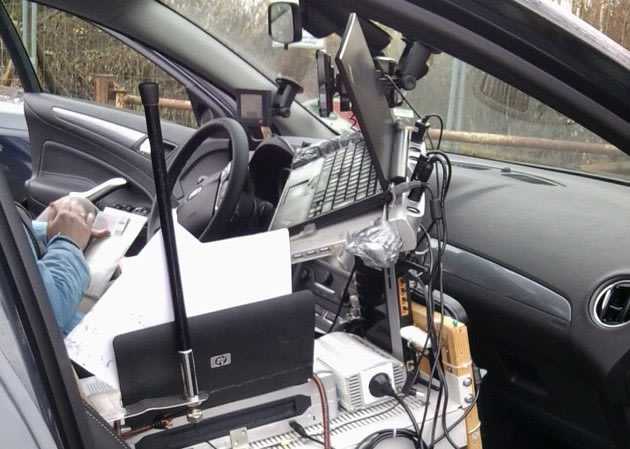
Distracted drivers existed well before the advent of cellphones, and will likely exist long after such devices are shrunk to the size of a thumbnail and implanted under our skins at birth. In the meantime, many drivers will try to split their attention to the road with their work -- and one of the worst such offenders was caught hauling not just a phone or laptop, but an entire mobile office.
Police in the Saarland region of Germany pulled over a Ford Mondeo wagon last week for going about 80 mph in a 62-mph zone. Inside they found a Staples shopping spree in the front seat: a laptop with docking station, a router and wi-fi antenna tied to a cellular data stick, a printer and a power inverter to keep it all humming. The driver had taken some precautions toward distracted driving by mounting his cellphone to the windshield for hands-free use.
The setup looks messy and dangerous -- but as American police are finding, writing a ticket for distracted driving requires a tough level of proof. The German authorities didn't cite the Mondeo driver for any violations, because they didn't see him playing Michael Scott behind the wheel. I hope he's not one of those readers who needs to print out his emails to read them.

Tuesday, November 13, 2012

The S 400 SAM System

I used to mess with Elint when I was in the service.  Targeting the Soviet Air Defence System was my stock in trade.   Even now if I saw a picture of a SA-2 Guideline, I knew immediately that the associated missile system was the "Fansong"   I could ID the photo's of that and other systems.    What can I say, the training I had received was very good.
     I ran across these photo's of a modern Russian SAM system while surfing and decided to cut and paste.   I did wonder if these systems around Moscow replaced the SA-1 Guild in the same locations....

      The  Bold in the photo's are my additions.

Maintenance of S 400 Triumph Anti Aircraft Weapon System


Posted on by CJ
We are going to visit one of the units of Air Defence in the Moscow region which has a famous Russian anti-aircraft weapon system S-400 “Triumph” of a new generation.
The S-400 uses 3 different missiles to cover its entire performance envelope. These are the extremely long range 40N6, long range 48N6 and medium range 9M96 missile. Each one has different capabilities.
The system is intended to destruct all modern and future means of aero-space attack.


The system was put into service in April, 2007.
The tests confirmed that the Russian air defence complex is the best in the world according to its specifications. But the power is not in the army or equipment but in the people who make it work.
This is a charging machine.
These are transport and launch containers with the missiles.
Technical maintenance of the system is held twice a year: in spring and in autumn.  The Russian Army still used the old Soviet style of Conscription and that happens twice a year
The soldiers are listening to the order.  I cannot tell if that is an Officer or an NCO.  The Russian army doesn't have much of an NCO corp, the backbone of any professional Army.  Their officers do a lot of the work that in the west and NCO would do.
It’s a very elaborate work.
If he drop it everything will explode! Just kidding…
The missiles are to be carefully put on the pallets.
More instructions are given.
Maintenance is in full swing.
Be careful with the plasma reflector, soldier!
All system components are based on a wheeled chassis terrain.
They are ready for launch.
The banner says: “The basis of the country’s air defense is anti-aircraft missile troops – the forces of permanent readiness”.Notice the old style Soviet banner with the "CCCP" markings.   
The system is able to destruct object flying with speed up to 4 800 m/s at a distance of up to 400 km (248 miles), at the height of objects – to 30 km. At that the minimum range of the complex is only 2 km (1,24 miles) and the minimum height of the targeted objectives is only 5 m (16,5 ft). American complexes “Patriot”, for example, cannot destruct object flying lower than 60 m (197 ft)  I have no expertise in the Patriot missile system so I cannot confirm or debunk the claim.  But the Soviets traditionally had a overlapping air defense system from the ground always to high altitude to defend the Motherland
It comes into the state of full combat readiness for 5-10 minutes.

Tuesday, August 14, 2012

U.S. Military test hypersonic jet.


A superfast jet that could fly from L.A. to New York City in less than an hour may be one step closer to reality after a key test this week.

The X-51A WaveRider, an unmanned aircraft that could reach speeds up to Mach 6 will be launched from the wing of a B-52 bomber high above the Pacific Ocean on Tuesday, the Los Angeles Times reports.

The WaveRider is expected to zip up into the atmosphere and fly at hypersonic speeds—3,600 mph—for 300 seconds, before breaking up into the ocean.

If successful, if would be the longest jaunt for the test aircraft. The newspaper noted that the development of WaveRider could lead to progress on a passenger jet that could theoretically travel across the U.S. in 46 minutes.

"Attaining sustained hypersonic flight is like going from propeller-driven aircraft to jet aircraft," Robert A. Mercier, deputy for technology in the high speed systems division at the Air Force Research Laboratory in Ohio told the L.A. Times.

But beyond passenger flights, achieving hypersonic speeds could also lead to the development of the next generation of missiles, space vehicles and military aircraft, the Times points out.

The WaveRider program had an issue in June of 2011 when the test vehicle in a similar test to the one planned for Tuesday failed to reach full power.

The Pentagon said it spent about $2 billion on technology and engineering around hypersonic flight over the last decade, the Times reports. This program is estimated to cost $140 million, according to Globalsecurity.org, a military policy research website.

If you're keeping score, the Concorde, a supersonic airliner, crossed the Atlantic at 1,350 mph.

It would take about 3.5 hours, about twice as fast as current commercial airlines. The Concorde was retired in 2003

Friday, August 3, 2012

New Tires.....

They have been testing these for several years now. Resilient Tech was developing them for military applications.
 
[]
[] 
 
 
Amazing new tires.........................
 
Michelin Tires... Absolutely SCARY looking... Look for 'em in August.
These tires are made in South Carolina , USA .
 
SEE-THROUGH TIRES
Radical new tire design by Michelin.
The next generation of tires.
They had a pair at the Philadelphia car show.
 
[]
 
Yes, those are 'spoke' like connections to the inner part of the tire from the outside tread 'wrap!' The next picture shows how odd it looks in motion...
 
[]
 
Makes you wonder how the ride feels doesn't it?
[]
[]
[]
[]
 
These tires are airless and are scheduled to be out on the market very soon.
The bad news for law enforcement is that spike strips will not work on these.
Just think of the impact on existing technology:
A. no more air valves...
B. no more air compressors at gas stations...
C. no more repair kits...
D. no more flats...
These are actual pictures taken at the South Carolina plant of Michelin.