Webster

The Constitution was made to guard the people against the dangers of good intentions." --American Statesman Daniel Webster (1782-1852)


Showing posts with label Greece. Show all posts

Tuesday, August 13, 2019

Greece wants Raparations for WWII

I first blogged about Greece and Debt in 2012 shortly when I started blogging.  I have blogged about Greece quite a bit, especially in the beginning because of the debt issues.  Greece was forced to institute "Austerity" measures to get the money from the EU and Germany is the economic powerhouse and they are calling most of the shots.  Now apparently Greece is asking for reparations from Germany for war damages from WWII.  I have severe issues with this.  Germany was decimated by WWII and they rebuilt themselves after the war.  Greece had the same opportunity and seemed to squandered their opportunity and now they are trying to get more stuff From Germany after the bailout.  Greece has promised more than they can deliver to their citizens and now they are passing the cup to Germany.   Now Greece is wanting even more money from Germany.  If I was the Germans, I would say "Nein".  "Dis hund nicht Jagt" or this dog don't hunt.   


I was reading this article, I have been harping on debt almost as soon as I started blogging.  The E.U thinks that they bailed out Greece, but they basically kicked the can down the road.  Greece will not implement the austerity measures, the politicians have promised soo much free stuff to the population, now the bill is coming due and the population are angry.  They still want all their "free stuff" that has been promised.  The same thing will come here in a few years when the democrat base want their free stuff and the spigot shuts off.
     Something that I noticed in this article is that the government will legislate to force the bondholders to eat the loss.  This disturbs me on several levels  The government will legislate you to lose your money to accept a political settlement?   What happened to the rule of contract law? What about the indenture terms?  The government by imperial fiat made a decree and removed the collective action clause.   What does this do for the bond market?  I guarantee private investors will dump bonds as soon as they are able.  People buy bonds for investments and as a way to save their money in a volatile market.  After this and the imperial edict, they will bail.


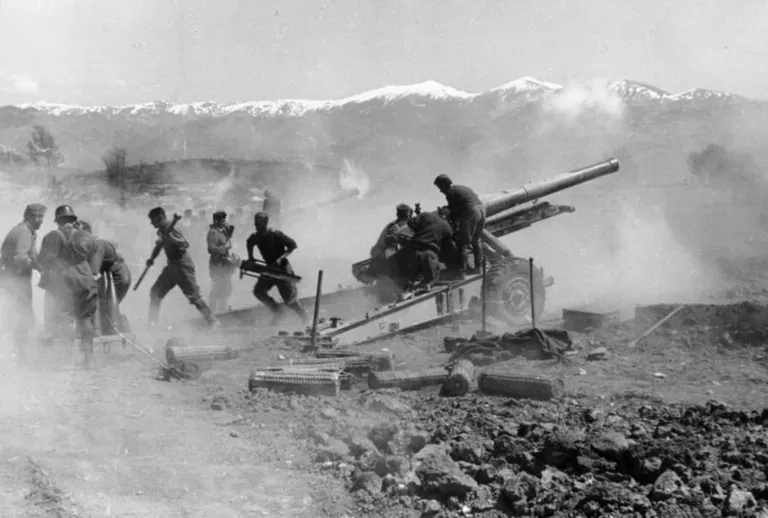
German artillery fires during the advance through Greece, 1941. Bundesarchiv

Left-wing politicians in Greece are pushing for Germany to pay reparations for the damages it caused during World War II. The parliamentary committee has called for a debate on the subject.
For its part, Germany has refused to entertain the notion that it owes anything to Greece. They have refused to pay and have refused to even negotiate with Greece.
But experts in Germany’s Parliament have released a report that undermines the German government position.
The Scientific Services of the Parliament released their findings which were commissioned by the Left Party. In part, the report states that the government is not violating international law by their position, but it is “by no means compulsory.” The report further recommends taking the case to the International Court of Justice to receive legal guidance in the matter.

When the Wehrmacht withdrew from Greece in October 1944 after three and a half years of occupation, it literally left behind “scorched land”: the economy, currency and infrastructure were completely destroyed.
The court at the Hague cannot on its own take up the case since the actions in question occurred over 70 years ago. The German government would need to agree to the process which it has explicitly rejected.
Back in June, the Minister of State at the Federal Foreign Office was asked about the Greek demands and he stated that neither side wished to have the International Court of Justice settle the question.
The Left Party’s deputy, Heike Hansel, said that the report showed that the German government is no longer able to avoid their responsibility for the past actions of the country. He continued by stating that the German government had “completely failed on this issue.”
The government’s position is that all WWII issues were resolved in 1990 with the Treaty on the Final Settlement with Respect to Germany (also referred to as the Two Plus Four Agreement).
The treaty was signed by both East and West Germany. Those are the “Two” in the “Two Plus Four.” The “Four” who signed were the US, the USSR, France and the UK. It allowed for Germany to become a unified and fully sovereign country.
For its part, Germany accepted its current border with Poland and renounced the other claims it had made to territory.
Reparations were not included in the agreement and Greece was not a party in the negotiations for the treaty.
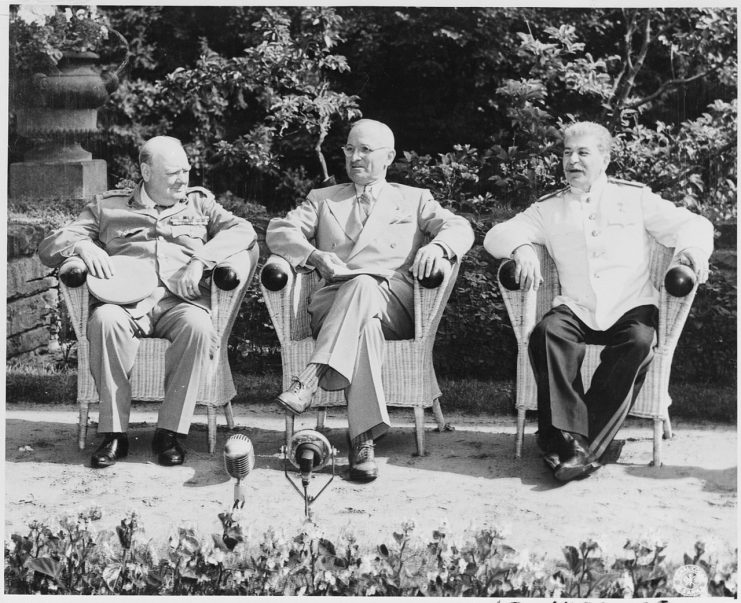
Germany points to the 1945 Potsdam Conference as resolving the question of reparations. The Soviet Union settled the reparation claims of its satellite countries in large part by supplying them with industrial equipment. For their part, the other Allied countries resolved to settle the reparation claims of other countries by dividing up German industrial and naval assets.

The big three.
                                         The big three at Potsdam
Germany also signed an agreement with twelve other nations in the 1950s. Greece was included in this agreement and received 115 million Deutsche marks in 1960 as the final settlement to its claims.
Germany has spent 76 billion euros to compensate for the crimes its Nazi leaders committed in WWII.
What remains to be seen is whether the new government in Greece which was elected on July 7 will continue to push Germany for the reparations.
Prime Minister Kyriakos Mitsotakis, who was elected on July 7, is expected to make his first trip to Germany.
Poland is also demanding reparations from Germany. Between the two countries, $1.2 trillion in claims are being levied against the Germans.
Poland is expected to release a report on September 1 which coincides with the 80th anniversary of the start of WWII. The report is expected to demand $850 billion from the Germans.
Of course, all this posturing is mainly a way for politicians in the two countries to grab the attention of their voters. The current ruling party in Greece ran on a platform of getting justice from Germany and reducing the country’s debt. They have thus far achieved neither goal so they need to show the voters that they are still working on the issues.

Tuesday, May 15, 2012

Greece unable to form government


By Dina Kyriakidou and Paul Taylor
ATHENS/PARIS (Reuters) - Attempts to form a government in Greece collapsed on Tuesday, jolting financial markets at the prospect that leftists opposed to the terms of an EU bailout could sweep to victory in a June election and tip the euro zone deeper into crisis.
The turmoil in Athens sent shock waves around other troubled members of the 17-nation European single currency area. The euro slipped below $1.28, world stocks slid and Spanish and Italian bond yields rose above the danger level of 6 percent as investors scurried for shelter in safe haven German Bunds.
The tremors from Greece, compounding worries about Spain's debt-laden banking system, ended any honeymoon for new French President Francois Hollande, thrusting the growing risks to the euro zone to the top of the agenda for his first meeting with German Chancellor Angela Merkel hours after he took office.
In his inaugural address, the Socialist president called for a European pact to revive growth and temper German-driven austerity measures, seeking to change the direction of euro zone economic policy.
"I will propose to our partners a pact that will tie the necessary reduction of our public debt to the indispensable stimulation of our economies," Hollande declared, saying Europe needed "projects, solidarity and growth".
The French leader's aircraft was struck by lightning shortly after takeoff from a military airport near Paris en route for Berlin, forcing him to turn back and take a substitute plane.
In Athens, President Karolos Papoulias abandoned efforts to broker a compromise on a cabinet of technocrats to steer the country away from bankruptcy, nine days after an inconclusive general election. A caretaker government will now be formed pending a new vote probably in mid-June.
"We resisted in every way," said Alexis Tsipras, leader of the hard-left SYRIZA party, which surged to second place in last week's election on an anti-austerity platform and blocked any deal with pro-bailout mainstream parties.
"We made the decision to not betray your hopes and your expectations," said Tsipras, emboldened by opinion polls showing his party could top the poll in a second vote. "Now it's time to complete it: We will consign in the dustbin of history all the spent forces of the past.
Euro zone finance ministers dismissed talk of Greece leaving the single currency area as "propaganda and nonsense" on Monday. But with hostility to EU/IMF-imposed austerity rising in Greece, speculation about a possible state bankruptcy and euro exit is rattling financial markets and won't go away.
IMF chief Christine Lagarde said it was important to be technically prepared for the possibility of Greece leaving the euro zone, warning that such a move would be "quite messy" with risks to growth, trade and financial markets.
Finnish Prime Minister Jyrki Katainen openly discussed the prospect, telling broadcaster MTV3: "If Greece were to leave the euro it would probably not cause a significant financial crisis that would have happened a couple of years ago.
"But on the other hand, we would have other problems. What kind of impact would it have on European economic development, on Spain's, Italy's economies, would market begin to speculate about other euro countries leaving? Naturally it would have an impact on the stability of Greek society."
MORE TIME?
Averting an immediate default, Greece made a key payment to bondholders who rejected an earlier debt exchange, a move likely to upset the vast majority of creditors who accepted just cents on the euro in a historic bond swap in March.
The outgoing government opted to pay 435 million euros ($552 million) of a May 15 bond to investors who had refused to exchange their debt, despite having insisted that those who rejected the swap would get nothing.
Sworn in with all the pomp of the French Republic, Hollande won support from Germany's opposition Social Democrats (SPD), who vowed to use their parliamentary blocking power to delay ratifying a European budget discipline treaty until Merkel accepts accompanying measures to boost growth and jobs.
Hollande's inauguration with military honors, capped by an open-topped motorcade ride up the Champs Elysees to the Arc de Triomphe in a torrential downpour, marks a potential turning point in the euro zone's debt crisis.
EU officials hope his election will revive proposals for radical steps to overcome the debt crisis such as issuing joint euro zone bonds, which Merkel has so far blocked.
Some policymakers believe it could also lead to heavily indebted member states that are in the grip of a recession being given more time to meet their EU budget balancing targets.
Markets and policymakers are watching the dialogue between the conservative German chancellor and the centre-left French leader for signs that they can overcome their differences on Merkel's drive for austerity and lead the euro zone together.
In Berlin, the Social Democrats, invigorated by their victory over Merkel's Christian Democrats (CDU) in a major regional election on Sunday, said growth measures must go beyond the structural economic reforms advocated by the chancellor.
"That is not our definition of growth nor that of the Socialists in France," said SPD Chairman Sigmar Gabriel.
A senior Merkel ally, CDU parliamentary whip Peter Altmaier, said that while he expected no concrete decisions to be taken at the first Merkel-Hollande meeting, he was confident the euro zone's two most powerful economies would reach a joint position on growth measures in time for an EU summit next month.
"It is important that we study each others' proposals. But I am sure that we will be able to agree a common Franco-German approach by the end of June at the latest," Altmaier told Reuters in an interview.
Despite the SPD's threat, Altmaier said he expected the German parliament to approve the European fiscal compact before the summer recess, which requires some opposition votes to provide the necessary two-thirds majority.
"HOMER" AFTER "MERKOZY"?
Merkel and former French President Nicolas Sarkozy, who left office on Tuesday, had dominated euro zone crisis management since the debt turmoil began in late 2009, earning the nickname "Merkozy" for their sometimes disputed leadership.
Her relationship with Hollande, which one French pundit has already dubbed "Homer" perhaps due to its Greek challenge, may initially be cool as they are from opposing political families.
But the chancellor has promised to welcome the Socialist "with open arms" and the two calm, methodical leaders may be better suited temperamentally than the calculating Merkel and the impetuous, hyperactive Sarkozy.
Hollande has said he will press Berlin to lift its veto on issuing common euro zone bonds to harmonize borrowing costs within the currency area, or to allow the European Central Bank to lend directly to governments.
Both ideas are "red lines" for the centre-right German government, although Merkel has not ruled out euro zone bonds as a long-term prospect if Europe takes more steps towards a tighter political and fiscal union.
Surprisingly strong first quarter growth figures for Germany relieved pressure on shares and the single currency on Tuesday, but worries about the deepening impact of the euro area crisis and a possible Greek exit kept demand for safe-haven assets strong.
The German economy grew 0.5 percent in the first three months of the year, well ahead of forecasts due to a big rise in exports, but weakness elsewhere in the region meant the euro zone stagnated in the first quarter.
(Additional reporting by Catherine Bremer and Brian Love in Paris, Noah Barkin and Andreas Rinke in Berlin, Jan Strupczewski in Brussels and Richard Hubbard in London; Writing by Paul Taylor; Editing by Giles Elgood and Janet McBride)

Monday, April 23, 2012

Public Debt

I am back harping on the debt.  If Obungler get reelected, we will be past the point of no return, and will behave like Greece when the financial necessities force a curtailment of the out of control entitlement spending.

    Here is a poster I saw while surfing around.


Wednesday, March 28, 2012

The entitlement nation?

I have harped for this for years, when people get "Free stuff from the government" they have an entitlement mentality.  They expect more and are totally un appreciative that this is stuff to help them out.  Instead they demand more free stuff because they are "owed" for being here.   I remember a while back when I had posted a story about some person that worked at the IRS for a bit and had to deal with people checking on their tax refund.  he had stated that the people that actually worked were polite and respectful whereas the people that didn't work were rude, obnoxious and DEMANDED their money when they didn't pay anything in but were getting EITC and other "Gimme's" from the government.  If we don't get a handle on this, we will be like Greece and it will get worse.


March 27, 2012
Milton Friedman may have argued that there is no such thing as a free lunch, but you’d have a hard time convincing millions of Americans of that today. They know better – or at least they think they do.
A record 46.5 million Americans rely on food stamps, and in 2010 the federal government paid out more money in the form of benefits than it collected in federal income taxes. But perhaps the most striking measure of the success of the entitlement state has been the way it’s eroded the stigma of being on the dole, while spreading dependency as a virtue as widely as possible. In other words: Everybody should buy everybody’s free lunch. And free breakfast too. (Did I mention free dinner also would be nice?)
RELATED: The ‘Take Care of Me’ Society is Wrecking the USA
The cultural shift has become so pronounced today that even some progressives are showing signs of unease. Were it not for her impeccable ideological pedigree, Alexandra Pelosi, daughter of Nancy Pelosi, former Speaker of the House, might have irreparably damaged her standing with her mother’s friends when she produced a brief video for HBO about her recent encounters outside a New York welfare office. In the Pelosi video, a man waiting in line is drinking beer and smoking cigarettes as he admits that he’s fathered five children by four different mothers. “I’m here to get a check … whatever they’ve got to offer,” he explains. “It’s not like they’ve got a checklist … I’m just here to get what I can get.”
Of course he was. 
In the video, Alexandra Pelosi quizzes one man: “Why should I help you? Why should my tax dollars be going to you?” He replies, “Because my ancestors came here to help build this place – my ancestors, the slaves.” The last time the man worked, he says, was “half a decade” ago.
There was some mild bureaucratic embarrassment in Michigan recently when a 24-year-old woman who won $1 million in the state lottery was found to be collecting food assistance.
Around the country, there is a lot of “taking” going on. There was some mild bureaucratic embarrassment in Michigan recently when a 24-year-old woman who won $1 million in the state lottery was found to be collecting food assistance. “I feel it’s okay because, I mean, I have no income and I have bills to pay,” explained the woman, Amanda Clayton. “I have two houses.” She was utterly without embarrassment of any kind.
Like the upstanding gentleman in Pelosi’s video, Ms. Clayton was echoing the British welfare queen who declared, “I don’t feel bad about being subsidized by people who are working. I’m just working with the system that’s there. If the government wants to give me money, I’m happy to take it. We get what we’re entitled to.”
Clayton, the lottery winner, has now been cut off from government food aid, as of last Wednesday. The Department of Human Services director in Michigan, Maura Corrigan, issued a statement: “Under DHS policy, a recipient of food assistance benefits must notify the state within 10 days of any asset or income change. DHS relies on clients being forthcoming about their actual financial status. If they are not, and continue to accept benefits, they may face criminal investigation and be required to pay back those
But Clayton’s use of taxpayer assistance after buying a new home and car with her winnings was not unusual. Another Michigan resident continued receiving food assistance after he won $2 million in the 2010 state lottery. That’s what prompted congressman Dale Zorn (R-MI) to pass legislation in his state’s House earlier this year that would remove large-sum lottery winners from welfare rolls. (Legislation is pending in the Michigan Senate.)
Yet there’s still plenty of freebies left to dole out. And as those freebies multiply and as politicians up the bidding, notice how often the two sides seem to talk past one another, using words that carry radically different meanings, depending on the speakers.
While GOP presidential candidate Mitt Romney was campaigning last week in Peoria, Illinois, a young woman was caught on camera declaring: “So you’re all for like, ‘yay, freedom,’ and all this stuff. And ‘yay, like pursuit of happiness.’ You know what would make me happy? Free birth control.”
Wants have been transformed into “rights” in America and ultimately into obligations and entitlements.
Consider this young woman’s thought process. In the alchemy of the new entitlement culture, freedom and the pursuit of happiness are transformed into a demand for free stuff that makes her happy. You could argue with her that freedom means something other than free stuff and that the pursuit of happiness was never intended to imply a guarantee of taxpayer-financed bliss. But she knows what she wants, and she wants it for free. Romney, to his credit, told the woman that if she wanted free stuff, she should “vote for the other guy.”
Romney continued, “Politicians get up and promise you all kinds of free stuff, more and more stuff that you won’t have to pay for, and you know what? We get elected that way, in many cases, politicians do. That’s not something I subscribe to.”
But the Romney heckler illustrated the way in which wants have been transformed into “rights” in America and ultimately into obligations and entitlements. The process can be illustrated this way: “I want you to buy me lunch. Therefore, I need lunch. And if I need something, I have a right to it – and you, therefore, have an obligation to pay for it.”
The equation looks like this: Wants = needs = rights = obligations. The laundry list goes far beyond free lunch to include free health care, free cell phones, free birth control, free mortgage bailouts – and on and on.
We’ve seen how this worked out for the Greeks, of course. But for a growing number of Americans, what happened in Greece is irrelevant: The entitlement state appeals to voters who believe they will bear no consequences for the costs or sustainability of the program. Questions of affordability don’t come into it, because they know they will never have to pay for it. (Recall that 49.5 percent of Americans pay no federal income tax at all.)
They are not thinking of the burden to their children, their grandchildren, their friends, their fellow citizens of the country, or anyone else. As long as it is free to them – it’s free. And good luck telling them otherwise.

Tuesday, February 21, 2012

E.U Agrees to a bailout of Greece to the tune of 172 billion EURO

I was reading this article, I have been harping on debt almost as soon as I started blogging.  The E.U thinks that they bailed out Greece, but they basically kicked the can down the road.  Greece will not implement the austerity measures, the politicians have promised soo much free stuff to the population, now the bill is coming due and the population are angry.  They still want all their "free stuff" that has been promised.  The same thing will come here in a few years when the democrat base want their free stuff and the spigot shuts off.
     Something that I noticed in this article is that the government will legislate to force the bondholders to eat the loss.  This disturbs me on several levels  The government will legislate you to lose your money to accept a political settlement?   What happened to the rule of contract law? What about the indenture terms?  The government by imperial fiat made a decree and removed the collective action clause.   What does this do for the bond market?  I guarantee private investors will dump bonds as soon as they are able.  People buy bonds for investments and as a way to save their money in a volatile market.  After this and the imperial edict, they will bail.


By Annika Breidthardt and Jan Strupczewski
BRUSSELS (Reuters) - Euro zone finance ministers agreed a 130-billion-euro ($172 billion) rescue for Greece on Tuesday to avert an imminent chaotic default after forcing Athens to commit to unpopular cuts and private bondholders to take bigger losses.
The complex deal wrought in overnight negotiations buys time to stabilize the 17-nation currency bloc and strengthen its financial firewalls, but it leaves deep doubts about Greece's ability to recover and avoid default in the longer term.
After 13 hours of talks, ministers finalized measures to cut Athens' debt to 120.5 percent of gross domestic product by 2020, a fraction above the target, securing a second rescue in less than two years in time for a major bond repayment due in March.
"We have reached a far-reaching agreement on Greece's new program and private sector involvement that would lead to a significant debt reduction for Greece ... to secure Greece's future in the euro area," Jean-Claude Juncker, who chairs the Eurogroup of finance ministers, told a news conference.
Greece will be placed under permanent surveillance by an increased European presence on the ground, and it will have to deposit funds to service its debt in a special account to guarantee repayments.
The 5 a.m. deal (0400 GMT) was hailed as a step forward for Greece, but experts warned that Athens will need more help to bring its debts down to the level envisaged in the bailout and will remain worryingly "accident prone" in coming years.
By agreeing that the European Central Bank would distribute its profits from bond-buying and private bondholders would take more losses, the ministers reduced Greece's debt to a point that should secure funding from the International Monetary Fund.
Italian and Spanish bond yields fell amid relief among investors that a threat to the wider euro zone had been avoided, although expectations of an agreement had been largely priced into foreign exchange and stock markets.
"It's an important result that removes immediate risks of contagion," Italian Prime Minister Mario Monti told a news conference.
"A nightmare scenario was avoided," said Greek Finance Minister Evangelos Venizelos in Athens. "It is maybe the most important (deal) in Greece's post-war history."
While the deal provides time for the euro zone to put new crisis measures in place over the coming months, it means Greece will struggle for years without economic growth.
The austerity measures imposed on Athens are widely disliked among the population and will put pressure on politicians who must contest an election expected in April.
Further street unrest could test politicians' commitment to cuts in wages, pensions and jobs. Greece's two biggest labor unions called a protest in Athens on Wednesday.
An opinion poll taken just before the Brussels deal showed that support for the two mainstream parties backing the rescue had fallen to an all-time low while leftist, anti-bailout parties showed gains.
Anastasis Chrisopoulos, a 31-year-old Athens taxi driver, saw no reason to cheer the deal.
"So what?" he asked. "Things will only get worse. We have reached a point where we're trying to figure out how to survive just the next day, let alone the next 10 days, the next month, the next year."
Conservative leader Antonis Samaras, a strong contender to become next prime minister, said the rescue package's debt-reduction targets could only be met with economic growth.
"Without the rebound and growth of the economy ... not even the immediate fiscal targets can be met, nor can the debt become sustainable in the long-term," he said during a visit to Cyprus.
Parliaments in three countries that have been most critical of bailouts - Germany, the Netherlands and Finland - must now approve the package. German Finance Minister Wolfgang Schaeuble, who caused an outcry by suggesting that Greece was a "bottomless pit," said he was confident it would be passed.
STUCK IN TRAGEDY
Many economists question whether Greece can pay off even a reduced debt burden, suggesting the deal may only delay a deeper default by a few months.

"I don't think we should consider that they are cleared of any problems, but I do think we've reduced the Greek problem to just a Greek problem. It is no longer a threat to the recovery in all of Europe, and it is another step forward."
Jennifer McKeown, senior European economist at Capital Economics, said: "The austerity measures it will have to implement and increased monitoring by the troika amidst public outrage will make things harder and drive it deeper into recession. There is a risk of a euro zone exit later this year."
A return to economic growth in Greece could take as much as a decade, a prospect that brought thousands onto the streets of Athens to protest on Sunday. The cuts will deepen a recession already in its fifth year, hurting government revenues.
"We sowed the wind, now we reap the whirlwind," said Vassilis Korkidis, head of the Greek Commerce Confederation. "The new bailout is selling us time and hope at a very high price, while it doggedly continues to impose harsh austerity measures that keep us in a long and deep recession."
EXTRA RELIEF
A report prepared by experts from the European Union, European Central Bank and International Monetary Fund said Greece would need extra relief to cut its debts near to the official debt target given the worsening state of its economy.
If Athens did not follow through on economic reforms and savings to make its economy more competitive, its debt could hit 160 percent by 2020, said the report.
"Given the risks, the Greek program may thus remain accident-prone, with questions about sustainability hanging over it," the nine-page confidential report said.
The beefed-up monitoring of implementation of the reforms could bolster accusations among some Greeks of interference in domestic affairs but some critics say that is essential.
Dutch Finance Minister Jan Kees de Jager, one of Athens' most strident critics, told Dutch news agency ANP he had bargained hard for the permanent monitoring mission.
"This program is not something to cheer about," he said.
BOND SWAP
The accord will enable Athens to launch a bond swap with private investors to help put it on a more stable financial footing and keep it inside the euro zone.
About 100 billion euros of debt will be written off as banks and insurers swap bonds they hold for longer-dated securities that pay a lower coupon.
Private sector holders of Greek debt will take losses of 53.5 percent on the nominal value of their bonds. They had agreed to a 50 percent nominal writedown, which equated to around a 70 percent loss on the net present value of the debt.
Juncker said he expected a high participation rate in the deal, a view echoed by the German banking association.
Greece said it would legislate to allow it to enforce losses on bondholders who do not take part voluntarily.
Euro zone central banks will also play their part.
A Eurogroup statement said the ECB would pass up profits it made from buying Greek bonds over the past two years to national central banks for their governments to pass on to Athens "to further improve the sustainability of Greece's public debt."
The ECB has spent about 38 billion euros on Greek government debt with a face value of about 50 billion euros.
The private creditor bond exchange is expected to launch on March 8 and complete three days later, Athens said on Saturday. That means a 14.5-billion-euro bond repayment due on March 20 would be restructured, allowing Greece to avoid default.
The vast majority of the funds in the program will be used to finance the bond swap and ensure Greece's banking system remains stable; some 30 billion euros will go to "sweeteners" to get the private sector to sign up to the swap, 23 billion will go to recapitalize Greek banks.
A further 35 billion or so will allow Greece to finance the buying back of the bonds. Next to nothing will go directly to help the Greek economy.
(Additional reporting by Luke Baker, Julien Toyer, Robin Emmott in Brussels, Daniel Flynn in Paris, Terri Kinnunen in Helsinki, Sarah Marsh in Berlin, Harry Papachristou and George Georgiopoulos in Athens, and Michele Kambas in Nicosia; Writing by Giles Elgood; Editing by Pau