Webster

The Constitution was made to guard the people against the dangers of good intentions." --American Statesman Daniel Webster (1782-1852)


Showing posts with label Ancient History. Show all posts

Thursday, April 14, 2022

3 dangerous weapons from the Ancient World

 I shamelessly clipped this from an article I ran across in my email.  I have heard of these studying ancient history and tactics, and from I have read, the formula for "Greek Fire" has been lost to the mist of time.  They can make the close approximation for it but the exact stuff has been forgotten. Like when Rome fell, and the dark ages hit, a lot of knowledge was lost.
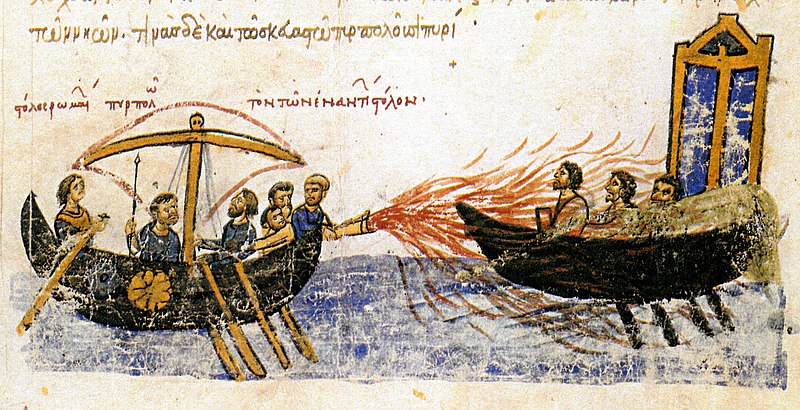
                           "Greek Fire being deployed against the enemies of  Eastern Rome"


Tanks and rifles sure are scary and lethal, so is mustard or chlorine gas. When it comes to creating weapons to annihilate adversaries, we sure can count on how the ancient people effectively forged some of the most formidable and fearsome weapons they had used. Some of them even became the foundation of how our munitions and equipment were developed. With that, here are some of history’s feared and hottest weapons during their time.

                                                                                           Greek Fire
Grenades filled with liquid fire and caltrops from the fortress of Chania 10th and 12th centuries
Grenades filled with liquid fire and caltrops from the fortress of Chania 10th and 12th centuries.

Don’t you just hate it when you accidentally burn yourself by touching hot surfaces? Then you’ll despise the incendiary weapon used by the Eastern Roman Empire in ca. 672. Called the Greek fire, this flame-throwing weapon was what the Byzantine navy typically used during naval battles to burn down enemy ships and effectively provided them with advantages that resulted in military victories. What was truly remarkable about this Greek fire was that it could be ignited even in contact with water, and the victims would continue to burn even while on water.

The Byzantines, later on, developed this weapon by using pressurized nozzles to project the liquid onto the enemy ships, much more like an ancient version of our flamethrower. The formula for this formidable weapon was unsurprisingly a closely guarded state secret, although there were speculations and debate on what it was. The proposal included a mixture of pine resin, naphtha, quicklime, calcium phosphide, sulfur, and or niter.

Greek fire was no doubt a concoction of destruction, but that did not make the Byzantine navy untouchable. Soon, the Muslim navies found ways to defend themselves from it, either by staying out and away from its effective range or by shielding themselves with felt or hides soaked in vinegar.

                                                                        The Man Catcher
The man catcher. (Royal Armoury,

What’s left to do when your castle was in the middle of being besieged by horse-riding enemy forces? For the people of 18th century Europe, they could snare these attackers by catching them like fishes while they were on their horses. The weapon used was the man catcher, also known as catchpole, which consisted of a pole that was mounted with a two-pronged head. The prongs were both semi-circular in shape and had a spring-loaded “door” on the front that allowed the ring to pass around a man-sized cylinder and the victim’s head trapped. And so they would use this man catcher to fish a person from horseback and then drag him to the ground where he could be pinned to either be turned into a prisoner or helplessly killed. On some occasions, it was also used to pin down and contain violent prisoners.

Other countries like Japan also had their own version called sodegarami, tsukubo, and sasumata that were used during law enforcement in Edo-era. The difference was that the sasumata, for instance, had its forked head used to trap down the victim’s neck, legs, arms, or joints.

                                                                     Morning Star
Morning star at the torture museum in Freiburg im Breisgau.

A popular one, the morning star, was like the more evil brother of the mace. Its design was crude and simple: a stick made of either metal or wood topped with a metal ball laced with spikes and blades. This weapon became popularly used by soldiers in the 14th century, particularly in Germany, where it was popularly called Morgenstern. It was used typically by aiming at the heads and faces of foes, which didn’t sound much, but imagine being hit with a heavy ball of spikes on the nose and on your whole face. It could also be used to take enemies down by aiming it at the legs and knees instead. It is sometimes confused with mace, but the main differentiating factor between the two was that the spikes of the morning star, at most, had flanges or small knobs.

Traditionally, it was used by cavalry and infantry units, with the horsemen being given a version that had a shorter shaft. All in all, there were three types of this weapon that varied in terms of workmanship quality. The first one was well-crafted for military use and was given to professional soldiers. The second was simpler and was hand-cut by peasant militiamen, and the spikes were sometimes made from nails. The third was short shafted and made of metal and ornamented with gold and silver for decorative purposes.


Tuesday, June 19, 2018

Alaxanders Legacy "The battle of Gaugamela"


This is another one of my ancient history post that I like to do well...because I like History., I honestly believe that once a people forget their history, they are doomed to repeat it.

In the countless theoretical lists of best generals of all time, Alexander the Great is often at or very near the top, in fact, such lists often spark great amounts of arguments and controversy, but over the other generals, not Alexander.
In his string of victories across his thousands of miles of campaigning, Alexander had one masterpiece that won him an empire and securely ensured the protrusion of Greek culture in the eastern world. That battle was fought near the small village of Gaugamela.
To better understand Alexander’s success, especially at such a young age, one must understand all of the advantages he had in addition to his own inherent talent. Alexander was lucky enough to have excellent mentors in his early life; his personal teacher was none other than Aristotle, a philosopher who learned from Plato, who learned from Socrates. While not directly correlating to warfare, lessons learned from one of the most enlightened thinkers of the ancient world would have had near universal applications.

Alexander also learned valuable lessons from his father. Before Philip, Macedon was an afterthought on the world stage. With Philip’s reorganization of the army into a professional mixed army, Macedon became an organized military power. The core of the army was the sarissa wielding phalanx able to stoutly hold their ground or methodically churn their collective spearheads forward through any foe.
The army had other important elements as well, skilled skirmishers including Cretan archers, a mix of light and heavy cavalry and elite Hypaspists capable of multiple battlefield roles. This mixed army was intended to be used in multiple ways and relied on skilled generals to adapt to conditions of a battle and use the different troops in the best way possible, Philip was quite good at this and taught Alexander the basics of utilizing such an army.
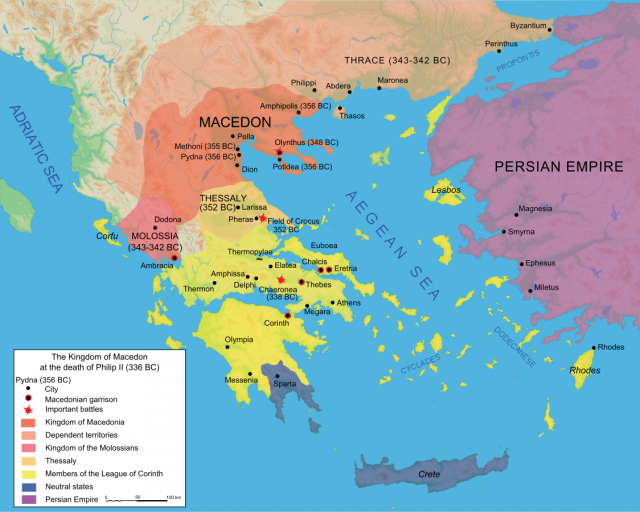
Map of Macedon showing the strides taken by Philip in preparation for a Persian invasion. Persia looms large just across the Aegean
Map of Macedon showing the strides taken by Philip in preparation for a Persian invasion. Persia looms large just across the Aegean. By Marsyas – CC BY-SA 3.0
Philip passed this army down to Alexander in excellent condition. Philip also was the original planner for a Persian invasion and likely passed along a wealth of information and ideas for an invasion, perhaps thoughts on fighting the Persian armies, what they would consist of, how they were led into battle and so on. Ultimately Alexander was given the absolute best tools for his invasion, a professional army meant to be utilized by creative commanders, and outstanding practical and military education for him and many of his leading commanders.
As Alexander invaded Persia, he had immediate success, first winning the battle of the Granicus River that proved the ability of the phalanx to cross a river and still fight effectively. At Granicus, Alexander defeated a Persian satrap, at Issus Alexander faced an army assembled by the Persian King Darius himself. Issus was another victory for Alexander, and he used the victory to march along the coast to Egypt and capture Persian naval bases such as Tyre.
With the coast secure and supply lines in place, Alexander sought to take the fight to Darius again. This time, Darius had as large of a force as he could muster and the stakes were fairly clear, whoever won this battle would have control over Persia.

At the Granicus, Alexander led from the front but also depended on his companions to come to his aid when needed. in this battle as well as many others Alexander risked death but also inspired others.
At the Granicus, Alexander led from the front but also depended on his companions to come to his aid when needed. In this battle as well as many others Alexander risked death but also inspired others.
Darius knew that Alexander needed to come to him, so he picked a flat, featureless battlefield that would favor his larger army and allow his secret weapons to run wild. These secret weapons were as many as 200 chariots covered in spikes and scythed wheels that would attack along with some elephants to break up the tight phalanx formations for the cavalry and infantry to exploit.
The overall numbers of the Persians are widely discussed and disputed. Ancient sources are never lower than about 200,000 and often approach a million while modern sources go as low as about 55,000 and as high as 200,000. Alexander’s numbers are more fixed with about 40-50,000. A number around 70-100,000 seems the most likely for the Persians as evidence does point to a clearly larger army.
Prior to the battle, Alexander’s generals sought to attack at night to make up for their smaller numbers, some thought that a night attack was their only hope against such a numerically superior force. Also, Darius picked the field, not just for his chariots, but also so he could freely send troops around to envelop Alexander’s forces. Alexander’s deployment on the day of battle was also geared specifically towards preventing flanking and total encirclement.
With larger numbers, Darius’ tactics were simple, break formations with chariots and fully attack with extra pressure to extend around the flanks. Alexander’s strategy was a bit more complicated; he needed to account for and defend against the larger forces while also finding a way to secure a victory.
To hold off flanking attempts Alexander swept back his flanks so that flanking troops would need to travel farther and rather than hitting the sides of the formation, they would hit the swept back flanks head on. Various mercenaries formed a small second line to respond to flanks or breaks in a line. At the onset of the battle, Alexander would take his elite companion cavalry and march far to the right of the battle to force Darius’ hand.
Battle_of_Gaugamela,_331_BC_-_Opening_movements
Initial dispositions and opening movements.
When Alexander marched off to the right Darius was forced to match his movements and stretched his left flank out as a fierce cavalry battle ensued on the Macedonian right. On the Macedonian left and center things were tight. The scythed chariots were handled with relative ease; most were let through the ranks and captured as they slowed greatly to turn around. After the chariot charge, however, the large numbers of Persians combined with elite immortals and Persian heavy cavalry put a heavy strain on the phalanx.
Eventually, a gap opened in the center and Persian cavalry poured through. Rather than wheeling and flanking the phalanx, the undisciplined cavalry went straight for the Macedonian baggage train and loot. While the Macedonian infantry were fractured, they still held, and Alexander was able to execute his most key maneuver.
Having marched to the right and stretching out the Persian left, Alexander cut hard to the left in what can only be described as a battlefield scale “juke” move that left much of the Persian left in the companions’ dust as they formed a wedge formation and charged directly at Darius’ position. The wedge cut deep into Darius’ guarding troops, and while it did not reach the king, Darius could clearly see the carnage in front of him and decided to flee the field. Alexander had achieved his goal but still had to finish his battle.
Battle_gaugamela_decisive
Alexander’s decisive attack. By Frank Martini 
Darius was gone but the Persian right was still overloading the Macedonian center and left, and several holes were forming. Desperate messages were sent to Alexander to send help, and Alexander wheeled around his wedge formation and charged towards the rear of the attacking Persians. On the way Alexander and his elite cavalry ran into the most elite of the Persian cavalry and the resulting battle caused a fair share of the casualties for the whole battle.
Eventually, Alexander forced his way through and released the overwhelming pressure of the Persians. After reforming the lines, the Macedonians were able to turn to the offensive and push the rest of the Persians off of the field.
With this great battle, Alexander essentially won Persia. Babylon and most of western Persia readily submitted to Alexander and Darius fled to the east hoping to raise another army only to be later killed by his own men. The battle itself was hard fought, and victory was only assured after Alexander returned from putting Darius to flight and early defeat was spared by the lack of discipline by the victorious Persian cavalry.
Alexander both organized a daring battle plan and also executed it himself, leading from the front and being heavily involved in the most decisive fighting. His genius and his leading by example allowed him to be one of the greatest individual factors for the Macedonian victory, cementing him as the greatest general of all time.

Thursday, April 19, 2018

The First Recorded Battle in History.


The first battle for which we have a clear historical record took place in the Levant in the 15th century BC. Though we know that war had existed for centuries beforehand, and some details of earlier battles are recorded in folklore and religious scripture, the details remain cloudy.
That changed with the Battle of Megiddo.
Dating Difficulties
Ancient Egyptian records, on which we rely for accounts of the Battle of Megiddo, place it in Year 23 of the reign of Pharaoh Thutmose III, on the 21st day of the first month of the third season. Exactly how this relates to our own dating system is uncertain, and historians have variously dated the battle to 1457, 1479 or 1482 BC. All we can say with certainty is that it took place in the first half of the 15th century BC.

War in the Levant
Thutmose III came to the throne at a time when Egypt controlled large swathes of the Levant – the lands of the eastern Mediterranean and the northern Middle East. Early in his reign, he found himself faced with a revolt in this region, based around modern Syria.
Leading the revolt was the King of Kadesh, a city whose strong fortress gave him a secure base. The Canaanites, Mitanni, and Amurru joined his rebel alliance, as did the King of Megiddo, another ruler with a strong fortress base.
Megiddo was strategically vital, controlling the main trade route between Egypt and Mesopotamia, now known as the Via Maris. The rebel forces gathered there.
Pharaoh on the March


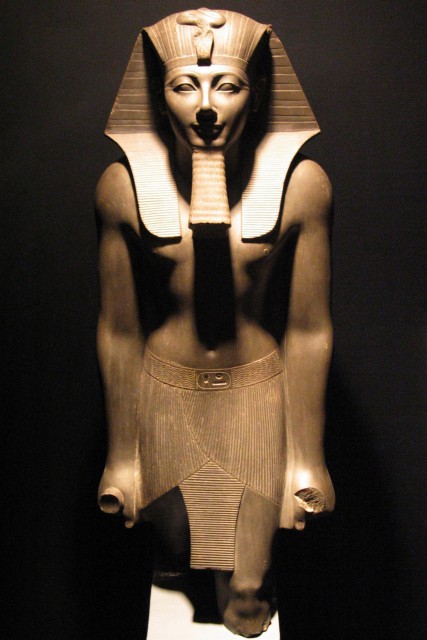
Statue of Thutmose III in Luxor Museum
Statue of Thutmose III in Luxor Museum.
Like many ancient rulers, Thutmose III took personal command of his forces. He gathered an army of between ten and twenty thousand men, consisting of infantry and charioteers, at the border fortress of Tjaru.
This was the heyday of chariot warfare. Horses had not yet been bred strong enough to carry an armed rider, making chariots the only way to move quickly around the battlefield and deliver sudden shock attacks. The recently developed composite bow gave chariot riders a powerful weapon with which to attack infantry before galloping away. Iron weapons, which would eventually lead to the downfall of the chariot aristocracies, had not yet been developed.


At the heart of Pharaoh’s army were the deadliest weapons of their day.
Choosing the most direct but also most dangerous of three available routes, Thutmose took Aruna – the area now called Wadi Ara – with almost no resistance. The Kadeshi army had been sent far to the north and south to block his other routes of advance, and he could now march on Megiddo.
The King of Kadesh, surprised by the Egyptians’ appearance in the center of his defensive line, scrambled to gather his troops on the high ground outside the fortress of Megiddo. Pharaoh gave him little time to prepare.
Opportunity Seized

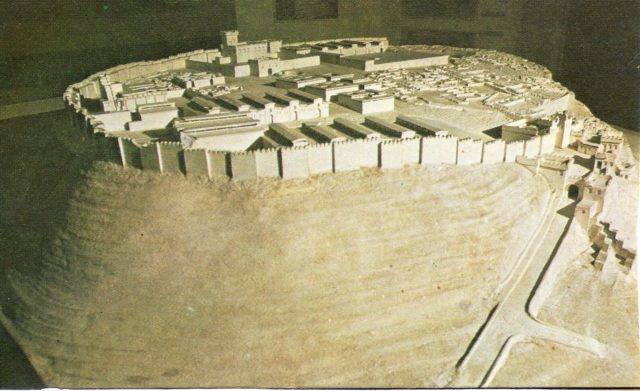
Model of Megiddo, 1457 BC. (By Alma E. Guinness - Alma E.."Reader's Digest: Mysteries of the Bible: The Enduring Question of the Scriptures".Pleasantville, New York/Montreal.The Reader's Digest Association, Inc.1988.ISBN: 0-89577-293-0, CC0 / Wikipedia)
Model of Megiddo, 1457 BC.
Having set up camp at the end of the day, Thutmose then advanced his forces under cover of night. While the Kadeshi concentrated their troops around the fortress, Pharaoh spread his out. Two wings menaced the enemy flanks, while the core of the army advanced in the center. In the morning, he attacked.


The two sides were evenly matched in numbers, with around 10,000 infantry and 1,000 chariots each. But having spread out his forces, Pharaoh was better able to make use of his numbers. While he led the attack in the center, his left wing made a fast, aggressive strike against the rebel flank.
The will of the rebel flank was quickly broken by the speed and skill of the Egyptian attack. The right wing crumbled, and the rest of the army swiftly followed, morale collapsing as warriors saw their comrades flee. Some ran into the city, closing the gates behind them to keep the Egyptians out.
The Egyptians now wasted the opportunity swift victory had given them. Like so many victors throughout history, they set about plundering the enemy camp, capturing 200 suits of armor and 924 chariots. But while they did this the scattered rebels found their way back into Megiddo, climbing up improvised ropes of clothing lowered by people inside the walls. Those who made it to safety included the kings of Megiddo and Kadesh.
Siege and Aftermath
The Battle of Megiddo was immediately followed by a siege. Pharaoh had his men dug a moat and built their own defensive wall around the city. After seven months of slow starvation, the city eventually surrendered. The King of Kadesh escaped, but the rest of those within the city were captured, and spared by a merciful Pharaoh.
As well as armor and chariots, the victors took home over 2,000 horses, 340 prisoners, nearly 25,000 cattle and sheep, and the royal war gear of the King of Megiddo.
More importantly, the victory at Megiddo enabled them to conquer other cities in the region, securing it once more for the Egyptian Empire.
How We Know About Megiddo
How has this single battle become our first clear image of the history of war?
The answer lies with Thutmose III’s personal scribe, Tjaneni. Accompanying his ruler on the campaign, Tjaneni kept a daily record of the war. Years later, Thutmose wanted to have his military exploits carved into the walls of the Temple to Amun-Re at Karnak. Tjaneni’s journal allowed the events of Megiddo to be inscribed in glorious detail, which has lasted to us down the years.
The Egyptian army, therefore, takes a vital place in the early history of warfare for two reasons. Firstly because they had the might to reach so far, including a successful leader and the latest military developments. And secondly, because they recorded their exploits in a form that would last –
 The Ancient Stones of Egypt.


Tuesday, March 20, 2018

How the Romans became a Mediterranean Power and later an empire


The Roman Republic was a magnificent entity. It had its problems, as all governments do, but the men served it proudly and it took many decades before power was continually seized by the likes of Sulla and Caesar. The Republic’s heyday was during and just after the second Punic War, taking advantage of the experiences gained to conquer more of the Mediterranean. This great success was largely due to an earlier set of epic wars, much closer to home for the Romans. These were the Samnite Wars of 343-290 BCE.
Rome’s position before the Samnite Wars is almost laughable. They had fairly recently conquered their great rival city of Veii, less than ten miles away. They had expanded after that, taking down the Latin League and extending south down the coast.
Here the Romans first ran into the Samnites. The Samnites were native to the mountains and hills of south-central Italy and prided themselves on being fierce warriors. The rough hill people were able to bully neighboring tribes, and they grew their influence in the area. A victim of the Samnite’s bullying, the Campanians, centered on the city of Capua, appealed to Rome for help. Rome intervened on behalf of the Campanians and the wars began.

The wars lasted over 50 years, with three distinct wars and peace between each. During these wars, the Romans grew tremendously as a state and a growing territorial empire. Here are a few ways the Romans grew from the wars:
Expansive Building Projects
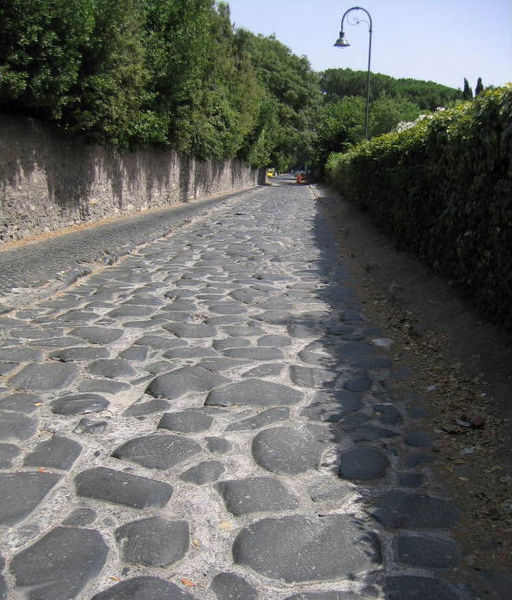
All roads lead to Rome, right? Well, Roman roads had to start somewhere, and that happened to be right in the middle of the Samnite wars. The Appian Way was the first true road built out from the city, with the exception of some older Etruscan roads going north. It wasn’t just a flat packed dirt road, nor was it simply paved, the Romans started with the highest of standards from the very beginning.
Starting with packed earth, layers of fine and coarse crushed rock were added with a slight ridge in the middle. Slabs of rock were fit like a jigsaw puzzle forming a smooth surface with drainage down to ditches if needed. Roman roads were smooth and dry, great for rapidly transporting armies, especially those utilizing pack animals and wagons, which would be most armies by this point in time.


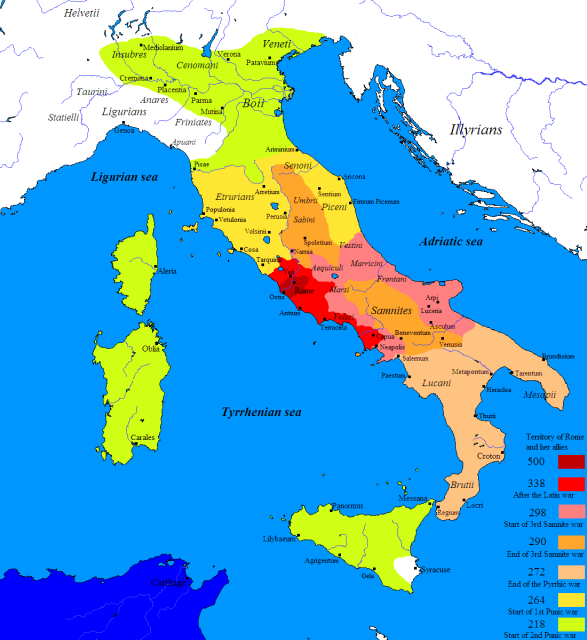
The growth of Roman territory, note the small size at the start of the Samnite Wars.
Roman roads were especially important during the Samnite War as the only other routes south to their allies went dangerously close to a malarial swamp.
In addition to the roads, the first aqueduct was built during the same time. Appius Claudius actually spearheaded both projects (hence Appian way and Aqua Appia) and was a great example of the Roman educated elite doing their best to serve Rome. The Roman population was quickly outgrowing their access to fresh water, and the construction of the aqueduct was a monumental feat of engineering requiring both arches and tunnels to reach Rome.


The Appian Way still carries traffic today.
The Appian Way still carries traffic today. Paul Vlaar – CC BY-SA 3.0
The aqueduct allowed Rome to thrive even through a long period of warring and the solution to the water troubles was so effective that Rome had several aqueducts by Augustus’ day, and he even built one to make a lake for mock naval battles.
Facing Tremendous Odds
The Romans and the Samnites had roughly equal power at the start of the wars, with Rome perhaps having a larger population and Samnium having a slight edge in military power. Soon the Romans began facing enemies everywhere, however, and faced a long uphill battle.
The Samnites were joined by the Etruscans, the former rulers of Rome, but still powerful. The Romans were situated right between the Samnites and Etruscans, forcing a two-front war. The Latin League also rebelled early on, causing problems at the doorstep of Roman homeland. At some points, the Romans even had to face Gauls, their most hated and feared enemy since Rome’s first capture.

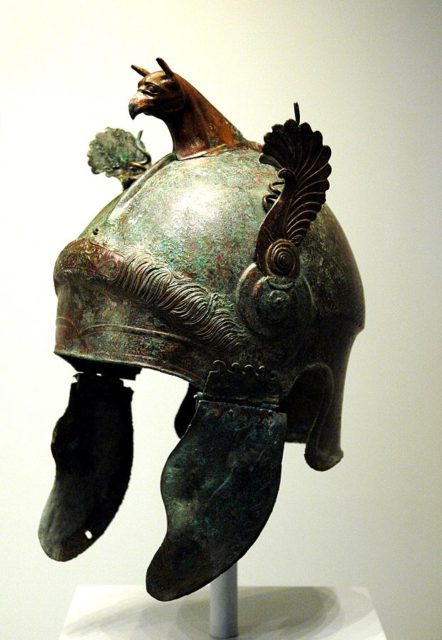
A ceremonial Attic helmet typical of many found in Samnite tombs, ca. 300 BC. Photo Credit.
A ceremonial Attic helmet typical of many found in Samnite tombs, ca. 300 BC. davide ferro – CC BY-SA 2.0
Part of Rome’s solution to facing enemies in every direction was the formation of Roman colonies. These full Latin rights colonies spread the true and trusted Roman influence. This was initially done to create a Roman presence on the southern side of the swamp between Latium and Campania so Rome could have a presence without having to constantly cross swampland.
Facing such odds, and in different directions gave the Romans an early understanding of strategic positioning. Having to march through hostile territory instilled the importance of marching camps and knowing how far from the enemy or allied armies a force was.

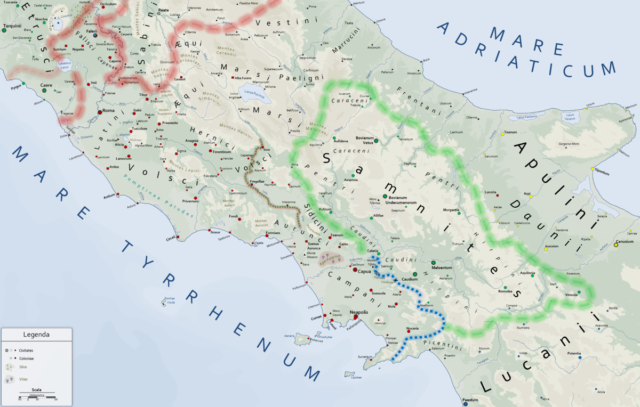
Map of the Third Samnite War. Photo Credit.
Map of the Third Samnite War. ColdEel & Ahenobarbus – CC BY-SA 3.0
The humiliating defeat at the Caudine Forks, where the Romans were simply trapped and forced to surrender, instilled a sense of situational awareness in the Romans. We can see this later in such engagements as the Battle of Telamon; with the exception of Hannibal, the Romans were not often fooled in wartime.
Upgrading the Army
Livy is the most complete source for the Samnite Wars, writing centuries after the events. We just don’t know much about the individual battles, but it does seem that the Romans developed their distinctive fighting style over the course of the Samnite Wars.
The Romans had initially fought in loose warbands, with heroic fighters standing out. they soon adopted the Greek phalanx style as it was simply more effective in larger battles. The phalanx was a solid style of combat but had a few problems in rough terrain. This was painfully evident when the Romans fought in Samnite territory and found their lines would crack and break as they attacked on hilly terrain.
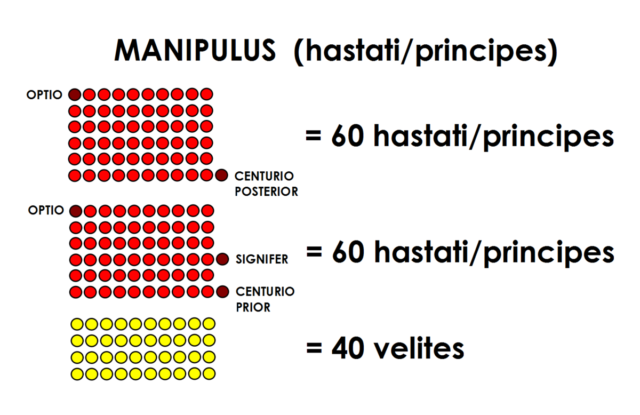
The actual change of style is difficult to follow, but the Romans emerged from the Samnite Wars wielding a different sort of army. Forming three lines, with the youngest in the front and veterans in the rear. The manipular formation formed a checkerboard pattern when viewed from above, with large gaps within the three lines.

Manipulus formation. Image Credit.
Manipulus formation. Cristiano64 – CC BY-SA 4.0
This variable formation allowed Roman armies to adapt to any terrain and any type of attack, as long as they had the right officers and generals leading them. More fighting led to better leadership, which allowed the formation to work like a well-oiled machine.
This new army faced a powerful foe in Pyrrhus of Epirus, a man hoping to be the Alexander of the West. Pyrrhus attacked the Romans with a professional army under established leadership. The Romans took two hard shots but inflicted so much damage and gained valuable experience so that the third large battle was a decisive victory, ousting the talented commander.
Moral Strength

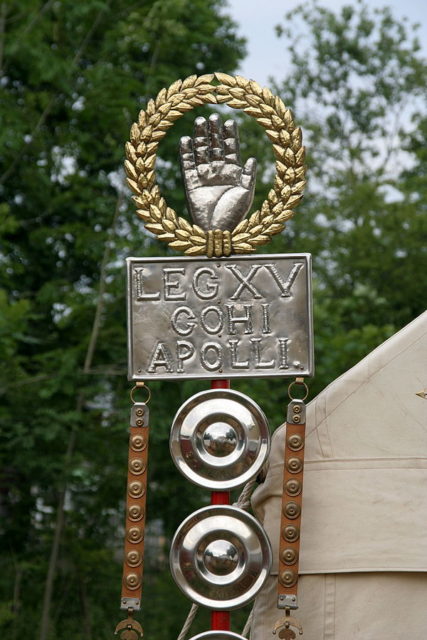
Manipulus symbol. Photo Credit.
Manipulus symbol. MatthiasKabel – CC BY-SA 3.0
Above all, the Samnite Wars gave the Romans a sense of grit and determination that is difficult to measure. Battles went down to the wire, and victory was far from certain. Though far from established fact, Livy records one instance where the Romans charged a Samnite position in battle several times with frustratingly little success. The Romans organized a frenzied last charge before nightfall and finally broke the Samnites. The Samnites were later said that they fled because of the eyes of the Romans, which seemed to blaze, with their frenzied glare and furious expressions.
In another battle, the Romans faced a combined army of Samnites, Etruscans, Gauls, and Umbrians. The Romans’ decisive victory despite overwhelming odds in this battle actually broke the alliance of the above-mentioned states. This was a titanic struggle, just on a regional scale, and gave the Romans the tools they would need to conquer and rule the entire Mediterranean.