This was a "Quora" question, and yes it "almost" happened, but Hitler did a "No-show". I thought it was an interesting question.
In late summer 1932, Winston Churchill and Adolf Hitler nearly dined together at a Munich hotel, until one blunt question caused Hitler to stand Churchill up.
At the time, Churchill was in his "wilderness years"—out of power and holding no official government office. He was traveling through Germany researching a biography of his ancestor, the Duke of Marlborough, and settled into Munich's Hotel Regina.
Adolf Hitler (left), Hermann Göring (center), and Ernst 'Putzi' Hanfstaengl (right) in Berlin in 1932. Hanfstaengl served as Hitler's foreign press chief and attempted to arrange the dinner meeting with Churchill. Photo by Deutsches Bundesarchiv is licensed under CC BY-SA 3.0 de.
Also staying at the Hotel Regina was Ernst "Putzi" Hanfstaengl, an eccentric, Harvard-educated German-American who served as Hitler's foreign press chief. Hanfstaengl recognized Churchill and introduced himself. Eager to bridge a connection between the rising Nazi leader and the famous British statesman, Hanfstaengl mentioned that Hitler was coming to the hotel that evening and suggested they meet for dinner. Churchill agreed.
Later that day, while having drinks with Hanfstaengl, Churchill probed his new acquaintance about the Nazi party's aggressive policies. Churchill remarked that he could understand being angry with people who have done wrong, but asked, "Why is your chief so violent about the Jews? ... What is the sense of being against a man simply because of his birth? How can any man help how he is born?"
Hanfstaengl, recognizing the danger of bringing such a critical stance to his boss, rushed off to relay the conversation to Hitler, hoping the Nazi leader would still see political value in the meeting. Instead, Hitler refused to join him. He reportedly dismissed the invitation entirely, asking, "What part does Churchill play? He is in opposition and nobody attends to him."
Hitler never appeared, standing Churchill up. The two men never crossed paths. Churchill later wrote in his memoirs that this near-miss in Munich was the only time he ever came close to speaking with the man he would eventually lead Britain against in the Second World War.
There was a secret organization that the Nazi's formed toward the end of the war, it was based on the paranormal, the Nazi's had this fascination with the occult, for example the organization Todt, their forced labor organization, a variation of that name means "death or dead". and since they worked many of their workers to death since they were conscript or slave labor, it kinda fits the name.
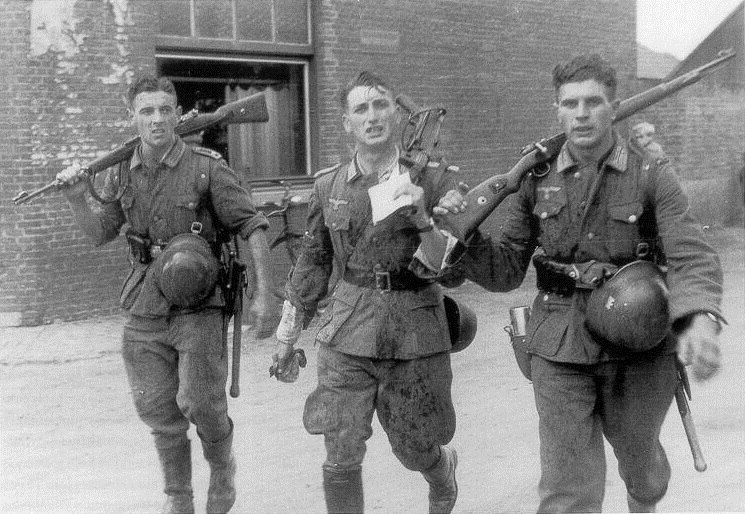
Three German soldiers returning from training exercise, France, October 1941.
It
is said that “desperate times call for desperate measures,” and no one
was more desperate than the members of the Third Reich in 1945 during
the final months of World War II.
Even Adolf Hitler knew the Allies were advancing on Berlin. The thought both terrified and enraged him.
Hitler
had always been a big believer in the occult, numerology, the zodiac,
and more. But by the final months of the war, his belief morphed into a
kind of obsession.
His preoccupation with these matters was well known to his men. They
catered to it by delving into subjects like the existence of the Holy
Grail, witchcraft, and werewolves.
Hitler was fascinated by
werewolves, but he believed in them the same way Germanic folklorists
did, namely that werewolves were merely “flawed, but well-meaning
characters who may be bestial, but are tied to the woods, the blood, the
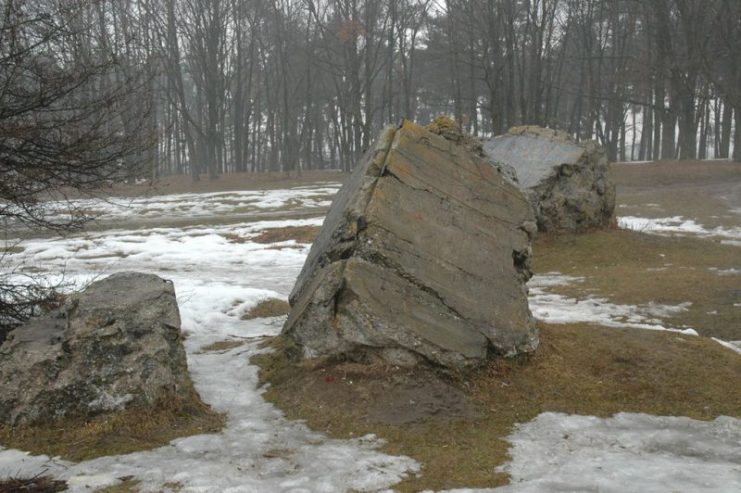
soil,” says Eric Kurlander, author of Hitler’s Monsters: A SupernaturalHistory of the Third Reich. Werwolf – ruins of Hitler’s headquarter near VinnytsiaAccording to Kurland, Hitler used werewolves and wolves as symbols of
German strength and purity against those seeking to destroy them.
Hitler
co-opted the image of the creatures often. In one instance, he named a
plan to destroy his enemy’s supply chain “Operation Werewolf.”
He
also created a group of paramilitary soldiers – werewolves – to confuse
and frighten the advancing Allies and the Soviets, against whom he was
losing badly on the Eastern Front.
By late 1944, even Hitler and
his top men, including Joseph Goebbels, knew the war would soon be over.
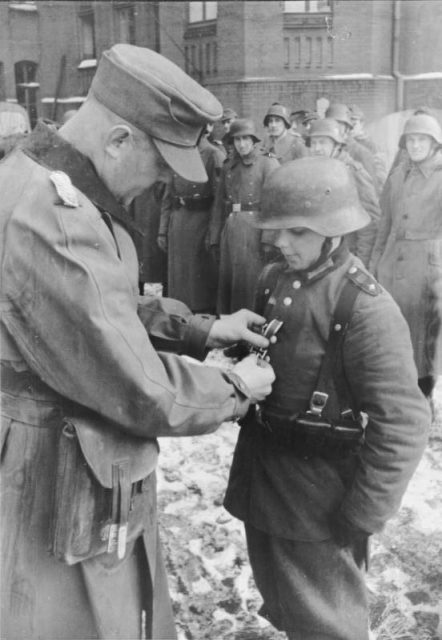
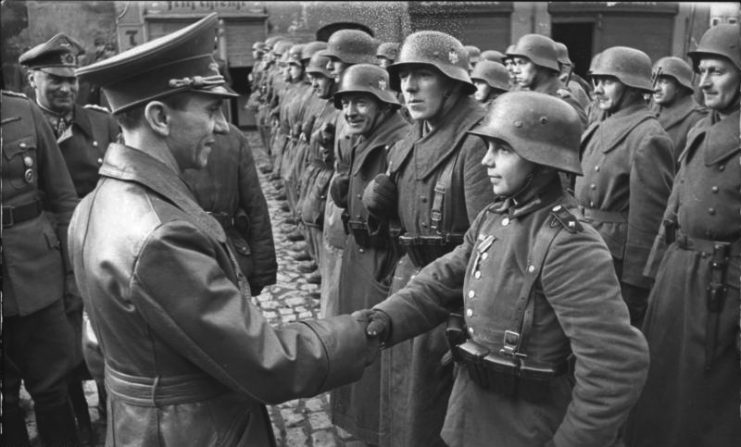
They realized that they couldn’t pull victory from the jaws of defeat. 9 March 1945: Goebbels awards a 16-year-old Hitler Youth, Willi Hübner, the Iron Cross for the defense of LaubanInstead, they chose to delay the inevitable in the hope that they
could devise a more favorable scenario for Germany. Historian Perry
Biddiscombe explains in his book, Werewolf! The History of the National Socialist Guerrilla Movement, 1944-1946 that Goebbels came up with the idea to exploit the werewolf legend.
In
early 1945, Biddiscombe notes, broadcasts began nationwide urging
citizens to join the “werewolf movement.” He describes one broadcast in
which a woman, posing as a werewolf, says, “Lily the werewolf is my
name. I bite, I eat, I am not tame. My werewolf teeth bite the enemy.”
16-year-old Willi Hübner being awarded the Iron Cross in March 1945.Photo: Bundesarchiv,
It might sound a little absurd now, but some Germans back then were
eager to join up because the propaganda stoked fears they already had
about the victors.
However, many Germans were largely tired of the
war, worn out by years of deprivation and conflict. They just wanted
the whole thing to be over.
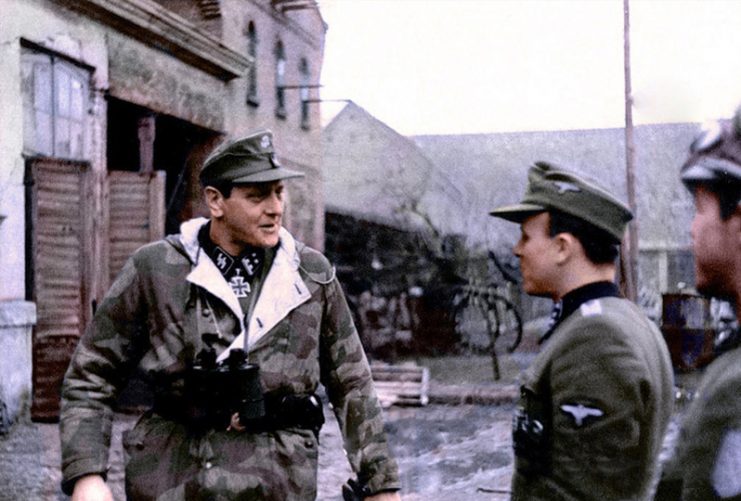
The Allies took the threat seriously as well, even though General Patton declared it “bunk.” SS
Officer Otto Skorzeny, who helped organize and train the paramilitary
“werewolf” forces that were never successfully deployed Goebbels controlled the
media, and he fuelled confusion and fear by alleging that Nazi
werewolves – the paramilitary – were doing real damage. However, any
damage that was done was mostly to the German citizenry.
Biddiscombe
estimates that several thousand injuries resulted from the werewolf
campaigns. They targeted folks who welcomed the Allies and did
substantial damage until 1947.
Kurlander finds this period in Germany’s history particularly intriguing. “It’s fascinating to me,” he told Smithsonian.com,
“that even when everything is coming down around them, the Nazis resort
to a supernatural, mythological trope in order to define their
last-ditch efforts.”
Germany at the end of World War II was a
chaotic place largely destroyed by Allied bombs. Its people were
exhausted from years of Nazi rule and a war that left them hungry and
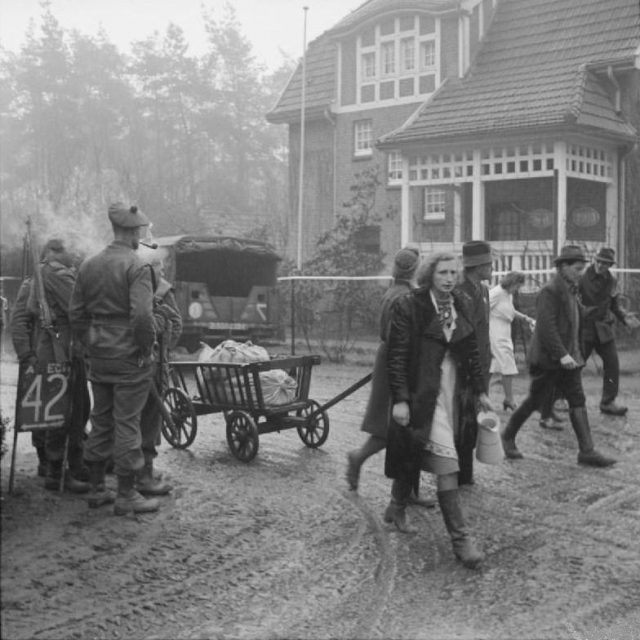
poor. German refugees in Bedburg, near Kleve, 19 February 1945The history of the so-called Nazi werewolves does not really seem as
bizarre as it might in the context of a different country and a
different leader. But with Hitler, all bets were off; even his own men
didn’t know what he might ask of them next.
If the Allied soldiers
were never actually as hurt by the werewolves as he had hoped, his own
people suffered because of them. It is another chapter in the long saga
of Nazi rule, and the damage it caused to the German people.
I have blogged a lot about Stalin and Hitler because I like History, and I believed that both formed a pact for their own reasons, Hitler wanted to invade Poland, then turn his attention to France without worrying about Stalin being froggy at his back. Stalin signed the pact, besides getting a chunk of Poland, they also had a free hand with the Baltic republics with the world distracted by other events. And he also needed to buy time to rebuild the Red Army after the purges of 1937. This was verified when during the "Winter War" when the Soviets invaded little Finland and got their noses bloodied by the Finns when the poor performance of the Red Army was shown to all the world. The signing of the pact shocked the world because National Socialism and Communism were not compatable and people were expecting a clash of Titans.
Prior to World War II, the USSR Soviets and the Nazis signed a
non-aggression pact. Historians say that the agreement cleared the path
for WWII to begin. The Defense Ministry in Russia has just declassified
documents relating to that agreement.
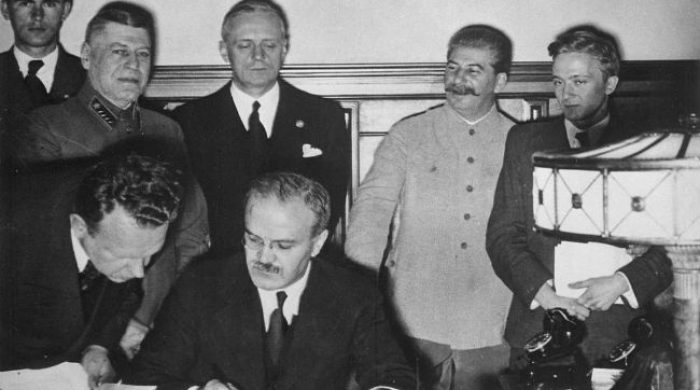
The Molotov-Ribbentrop Pact was signed on August 23, 1939. Along with
the non-aggression pact The two countries agreed to separate Finland,
Estonia, Lithuania, Latvia, Romania and Poland into two “spheres of
influence” controlled by the USSR and Germany.
This ensured that The Red Army would not interfere in Germany’s invasion of Poland which began the war. The
Nazi-Soviet Pact was a pact between Nazi Germany and the USSR. Also
known as the Molotov-Ribbentrop Pact, the agreement was signed in Moscow
on 23 August 1939. Also known as the non-aggression pact.The
Defense Ministry decided not to release the documents in chronological
order. They say that the order the documents are released in will give
readers “the most complete picture” of how the two sides came to sign
the agreement.
The Ministry highlighted a 31-page memo from a Red Army chief of
general staff, Boris Shaposhnikov. According to the ministry, this
document will change the prevailing views of why Russia signed the pact.
The 1938 memo discusses the Soviet’s need to prepare for battle both
against Germany and Poland and also against Japan. It raises concerns
about the vast number of troops, tanks and warplanes that the Germans
could deploy against the USSR on the Belarussian-Ukrainian border.
President Vladimir Putin, speaking in 2014, said that the
Molotov-Ribbentrop Pact was the Soviet response to being isolated by the
Western countries and having its peace efforts rebuffed by the West.
Alexander Dyukov, of the Russian Academy of Science, called
Shaposhnikov’s dispatch a key to studying military history. Sergei
Kudryashov, a researcher with the German Historical Institute in Moscow,
found the document to be uninformative and only interesting in how it
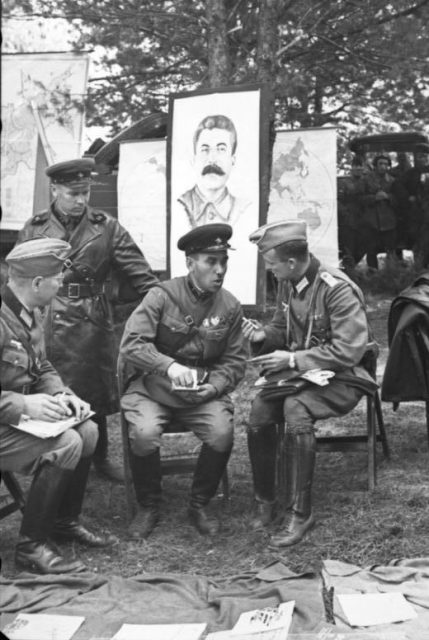
illustrated Soviet understanding of the conditions just before the war. German and Soviet soldiers meet in jointly occupied Brest.
The Defense Ministry said that the motivation behind releasing the
documents was for the purpose of protecting the truth and to keep others
from trying to revise history.
The USSR had attempted to come to terms with Britain and France for a
collective security agreement against Germany. By 1939, with the
likelihood of reaching an agreement with the two countries, Moscow felt
the need to change their policy in order to avoid fighting Germany on
their own.
Joseph Stalin fired his foreign minister, Maksim Litvinov, a Jew who
sought collective security. Litvinov was replaced with Vyacheslav
Mikhaylovich Molotov who almost immediately began negotiating with the
Nazi foreign minister, Joachim von Ribbentrop.
Stalin continued to negotiate with France and Britain until he
finally decided to sign the pact with Germany. He hoped to avoid
conflict with Germany until the Red Army could be built back up
following a purge of officers in 1937.
For Hitler’s part, a nonaggression pact with the Soviet Union freed him to invade Poland with no resistance from the Red Army.
Following the occupation of Poland, Germany would be free to engage
France and Britain without opening another front with the Soviets.
Publicly, the pact prevented either side from attacking the other,
from assisting any country that attacked the other, not to join any
group that threatened the other.
And to consult with each other in any matters that affect the two
parties, and to solve all differences between the two countries through
negotiation and arbitration. The pact was to last 10 years with an
automatic renewal for 5 more years unless either party gave notice to
terminate a year before it expired. Russian
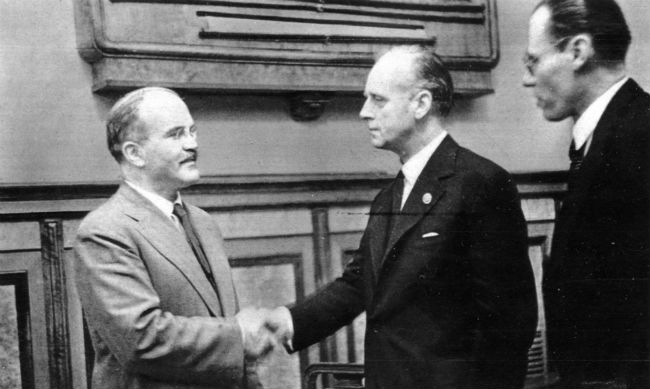
foreign minister Vyacheslav Molotov (left) and German foreign minister
Joachim von Ribbentrop (second from right) signed the non-aggression
pact on 23 August 1939.Secretly, a protocol was
attached to the pact which divided eastern Europe into spheres of
interest controlled by Germany and the Soviet Union. Two additional
points were added which clarified borders and renounced Germany’s rights
to Lithuania in exchange for a sum of money from the Soviets.
The pact ended on June 22, 1941, when the Nazis attacked the Soviets in Operation Barbarossa.
The Soviet Union’s borders in eastern Europe roughly followed those
set in the Molotov-Ribbentrop pact until the 1990s. At that time,
changes within the USSR made it impossible for the central government to
stop the Baltic states from declaring independence.
In the summer of 1944, Adolf Hitler’s monstrous dream of an eternal
empire began to collapse. Five years after his invasion of Poland had
plunged the world into war, his opponents landed in northern France
beginning a swift, destructive advance toward Germany. To the south,
Allied forces were already clawing their way up Italy, while in the
east, the long and bloody struggle of the Russian front had turned
around and Soviet forces were advancing.
Hitler’s approach to
military strategy had never been grounded in reality. With his life’s
work threatened, he took desperate steps to avoid losing the war. Re-manning the West Wall
The
Siegfried Line, also known as the West Wall, was a massive network of
defenses on Germany’s border with France. Built between 1936 and 1939,
it included concrete bunkers, trenches, and anti-tank barriers.
Once Hitler had conquered France, the line became unnecessary as a
western defense. Supplies and soldiers were moved out, and the doors
were locked.
Four years later, with the Allies coming, things
changed. Hitler ordered troops to reoccupy the line. They hurried to
replace rusted parts and cut back overgrown ground. Using the West Wall,
they held up the Allies for six months around the Franco-German border.
However, with Allied forces advancing on every front, a localized
defense line was nowhere near enough. American soldiers cross the Siegfried Line and march into Germany.To
ensure that the full resources of the Reich went into its defense,
Hitler began closing down things he considered unimportant. Theaters and
music halls were closed. The only publishers allowed to continue were
those publishing school textbooks and Hitler’s Mein Kampf. The only parts of universities that kept going were the medical schools.
Luftwaffe PFC in a Ground Division
With
hundreds of thousands of Allied troops on their doorstep, the Germans
needed as many men on the front lines as they could get. One solution
was to take them from elsewhere in the military. Pilot training programs
were shut down, and ships were mothballed; the war at sea had become
irrelevant. Their crews, along with those of the U-boats, were diverted
into the infantry. Anti-aircraft
defences on the Flakturm Tiergarten in Berlin, one of the flak towers
built from 1940. Photo: Bundesarchiv, Bild 183-H27779 / CC-BY-SA 3.0.
One of Hitler’s grandest schemes was Operation Herbstnebel or Autumn Fog.
It was to be a powerful counterattack in the west. Pouring out of the
forested Ardennes, German troops would punch a hole through the Allied
lines, splitting the British and American forces. Like the bold attacks
early in the war, it would leave the enemy reeling and give Hitler an
edge.
However, it was not the early war. Hitler’s lieutenants
tried to talk him out of the attack. They realized they did not have the
fuel, weapons, or manpower to succeed against the Anglo-American
forces.
Hitler was not to be dissuaded. On December 16, the attack
began. Within days, it ground to a halt, bogged down in the Battle of
the Bulge. Hitler had spent an enormous proportion of his reserves and
gained very little. Most of it was retaken within a week. Young Boys and Old Men
Running
out of able-bodied fighting men, Hitler turned whoever was left into
soldiers. Ill and injured soldiers were forced into new units. One was
the “ear and nose” battalion, in which orders often had to be given in
sign language. The old men of the Volkssturm, a force similar to
Britain’s Home Guard, were mobilized. Weapons were given to the Hitler
Youth.
In Hitler’s view, any German who could fight should fight. Winter
1945: Volkssturm members being trained to use the Panzerfaust anti-tank
weapon. Photo: Bundesarchiv, Bild 183-J31391 / CC-BY-SA 3.0.The
more desperate things became, the further Hitler sank into a delusion
that he could hold onto territory just by ordering it. He refused to
allow withdrawals, even tactical ones that might have earned German
forces an advantage. Surrenders were a complete anathema. In East
Prussia, the Po Valley, Bregenz, and other places across Europe, German
soldiers faced a choice between mutiny and a futile death. Soldiers and
civilians alike died needlessly in their thousands.
Field Marshall Model (Hitlers Fireman) He would go from theater to theater and restore the front after a catastrophe, was well respected by the allies, but was suspect under Hitler, Field Marshall Model Committed Suicide surrounded in the Ruhr Pocket, rather than surrender
Hitler
was unable to believe that any failure was his fault and so laid the
blame on his subordinates. He was also unwilling to accept criticism or
disagreement. As the failures mounted and the arguments became more
heated, he began firing his most senior commanders. Heinz Guderian, one
of the greatest tank commanders of the war, was dismissed for a second
time. Heinrich Himmler, Head of the SS, was removed from his post as
Commander of Army Group Vistula. Herman Göring lost his place as
Hitler’s successor; for what that position was worth.
While the ship sank, Hitler reordered the crew. Heinz
Guderian with an Enigma machine in a Sd.Kfz. 251 half-track being used
as a mobile command center during the Battle of France. Photo:
Bundesarchiv, Bild 101I-769-0229-12A / Borchert, Erich (Eric) / CC-BY-SA
3.0.Contingency for a Split Reich
As
the Allies advanced on all sides, it became likely Germany would be
split in two. Desperate as the situation would be for that to happen,
Hitler was determined they would keep fighting. He made arrangements for
the leadership of a physically divided Reich. If the south were cut
off, then Field Marshal Kesselring would take over there and continue
the fight.
Kesselring was one of the most capable leaders and
managers in the whole German military machine, but even he could not
have held out for long. The Alpine Redoubt
The Alpine
Redoubt was an old plan. In the event of failure, the last German forces
would fall back into supplied and fortified positions in the mountains,
where they could keep the Reich alive.
In April 1945, Hitler gave the order.
However,
there was no Alpine Redoubt. Unwilling to accept the possibility of
defeat, Hitler had done nothing to set up the factories, supplies, and
defenses the redoubt needed. The idea of retreating there was a delusion
or a lie.
To the end, Hitler’s plans were less about reality and more about the world he wanted to see.
This was scheduled to post on Sunday, but after realizing that it is Easter, kinda bad taste...SO it will show up on Wednesday, This I posted on my scheduler thingie because I am tied up with a work function for a couple of days.
When I heard about this I figured it was an empty gesture like they gave President Obama the Nobel prize right after he was elected President because they "hoped" that he would bring peace because he was elected as the "Messiah" and they being leftist the Nobel nominating committee bought into this "Hope and Change" snake oil that President Obama was peddling.
Your daily dose of random and strange. Kinda like Aprils Fool, but this was actually a true story. Adolf Hitler was once
nominated for the Nobel Peace Prize. The prize has a long history,
dating back to the late 1800s, and in 1939, Adolf Hitler was nominated
for the Peace Prize. History of the Prize
The history of the prize goes back to the late 1800s. Swedish
industrialist and inventor Alfred Nobel left in his will that he would
like to create a series of prizes, using the funds from his estate.
The prizes proposed fell into several categories: literature,
medicine, chemistry, physics, and peace. The award Hitler was nominated
for was, of course, the Peace Prize, which has been given out annually
since 1901.
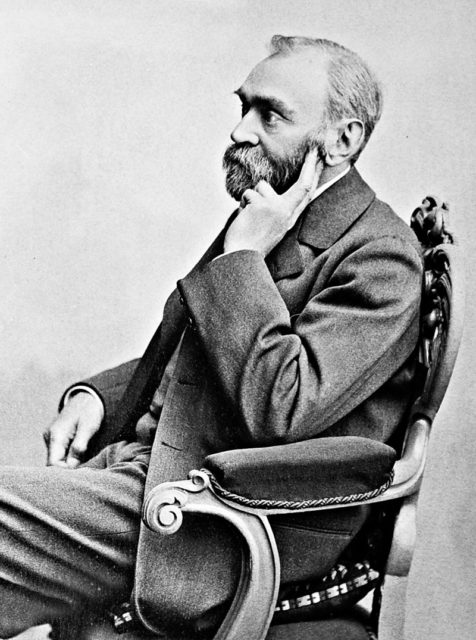
Portrait of Alfred Nobel.
According to Alfred Nobel’s will, the Peace award should go to those
who “have done the most or the best work for fraternity between nations,
for the abolition or reduction of standing armies and for the holding
and promotion of peace congresses.” Nominations for each prize were –
and still are – to be chosen by a Norwegian committee.
Today, the prize is still being given. Each December, the council
narrows down their list of nominees to one. For reference, this past
year there were 376 nominees. The final nominee, is, of course, the
winner, and is granted the name Nobel Laureate. Former Winners and Nominees
The list of winners and nominees of the Nobel Peace Prize is quite
long. Anyone from U.S. Presidents such as Barrack Obama to affiliations
like the Organization for the Prohibition of Chemical Weapons agency
have won. The award has been given out 96 times, to 129 Nobel Laureates.
This number includes repeat winners. In total, 103 individual people
have won the award, while 26 businesses and organizations have won the
award.
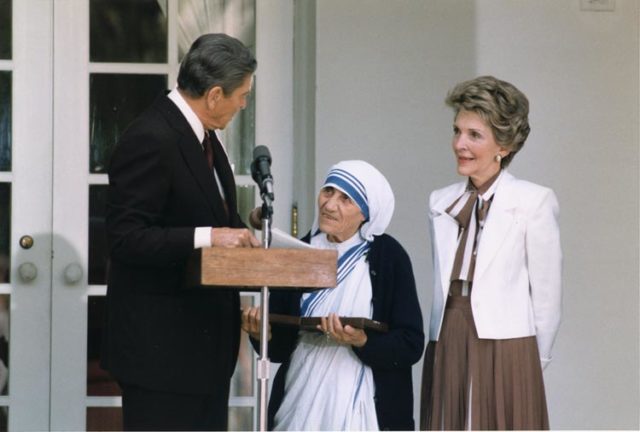
Mother Teresa (middle) seen in the 1980s with former U.S. President Ronald Reagan.
Popular names that have won include the European Union, Martin Luther
King Jr., Mother Teresa, etc. There have been several years where there
were no winners, 1914-1916, 1918, 1923-1924, 1928, 1932, the year
Hitler was nominated (1939) through 1943, 1948, 1955-1966 and lastly
1966-1967.
The number of people who can be nominated to win the Nobel Peace
Prize each year has been growing, and has reached a record number in the
last few years. In 2016, 376 people and organizations were nominated.
This is the most ever. In 2014, the old record was set at 278. The year
Hitler was nominated, 1939, the exact number of nominees is not known,
but it was much less. Hitler’s First Run-In With the Prize
Interestingly enough, Hitler banned anyone from Germany from
receiving the prize in the mid-1930s. It all began when a German
Pacifist, Carl von Ossietzky, was awarded the prize in 1935. Ossietzky
was awarded the prize for exposing the German re-armament that had been
going on for quite some time.
The re-armament was in violation of the Treaty of Versailles, which
was a peace treaty between Germany and the Allied countries, following
World War I. The treaty required Germany to disarm. Once the re-armament
was exposed, it came out that Germany had begun re-arming shortly after
the Treaty of Versailles was signed. It’s also believed that by 1933,
re-armament had increased substantially.
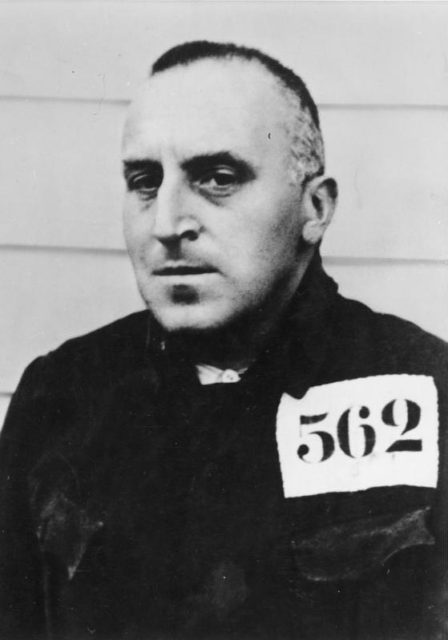
Carl
von Ossietzky, seen in a concentration camp following the leak about
the German re-armament. By Bundesarchiv – CC BY-SA 3.0 de
Ossietzky was given the award for the 1935 Nobel Peace Prize in 1936.
But he didn’t actually expose the German re-armament in 1935. It was
1931 that he exposed the re-armament. In turn, Germany charged him with
high treason and espionage that same year. Ossietzky would spend several
years in concentration camps and police custody until he contracted
tuberculosis, dying in hospital in 1938. Ossietzky’s award caused some
major disruption in the group that chooses who wins the prize, as the
council didn’t believe a convicted criminal should be allowed to win the
prize. This resulted in several officials stepping down.
The Germans were unsurprisingly upset about the award, and Adolf
Hitler banned anyone from Germany being allowed to receive the vote. He
also banned the German media from even mentioning the award. Hitler Gets Nominated – Kind of
Though Hitler banned anyone from Germany receiving the award, he
might have made an exception for one person – himself. In 1939, Adolf
Hitler was nominated for the Nobel Peace Prize – kind of. It was
actually a joke. Erik Gottfried Christian Brandt, a member of the
Swedish Parliament, nominated Adolf Hitler for the award right before
World War II would begin. Brandt wrote a letter to the Norwegian Nobel
Committee that opened with:
“To the Norwegian Nobel Committee I hereby humbly suggest that the Peace Prize for
1939 is awarded the German Chancellor and Führer Adolf Hitler, a man,
who in the opinion of millions of people, is a man who more than anyone
in the world has deserved this highly prestigious reward.”
Brandt was an anti-fascist and saw the nomination as a joke. Thus, he
quickly took back his nomination for Hitler to win the award. He would
go on to say that it was more of a critique of another nomination in
that same year, British Prime Minister Neville Chamberlain.
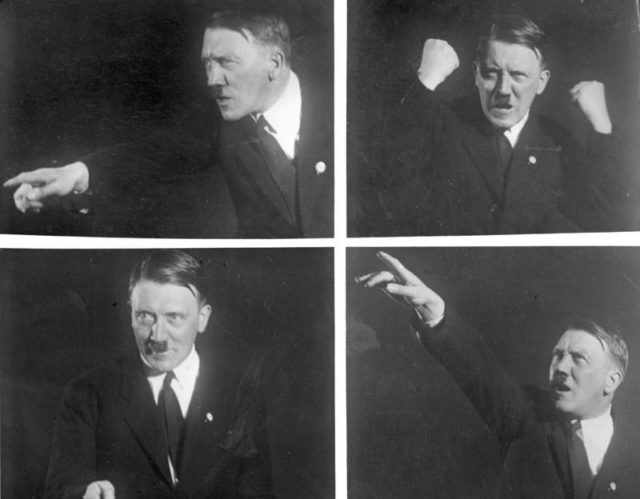
Adolf Hitler during a 1930 camera shoot. By Bundesarchiv – CC BY-SA 3.0 de
No, Adolf Hitler didn’t go on to win the nomination. In fact, as
previously stated, no one did. From 1939-1943, there would be no winners
of the Nobel Peace Prize. Backlash
Even though the nomination was quickly taken back, it still churned
out plenty of backlash. Brandt would go on to be labeled as many things,
such as insane and a traitor. He was taken aback, and released the
response in which he stated it all was meant to be an ironic joke.
The Nobel Peace Prize has always been full of controversy. Since its
inception, each award has been criticized due to the nature of how it’s
awarded. Adolf Hitler’s nomination may have been a joke, but it makes
you wonder, what would have happened if he had actually been
nominated. What if he had won? It would have been truly ironic, with
World War II starting, that, arguably, the main cause of the war, had
won a Peace prize.
I ran across this story a while back, I remembered hearing about it years ago then forgot about it and it cropped up again. I can understand showing mercy to an vanquished enemy, it is a human thing to do, it shows mercy, a unique trait to humans. There is something that says that "we are human, we have honor" and to attack and kill a vanquished foe is dishonorable to many soldiers, especially to Western based soldiers. You just get tired of killing and decide not to do it that day.
The History of War will always be about that which we know for
certain, that which we have reason to believe, and that which will
always be lost to myth and the passage of time.
It is certain that men of war take the most inexplicable stories with
them when they fall in combat. But from time to time, a story survives
and persists that while unproven, would have literally altered the
course of mankind were it true.
Thankfully for us today, such a dubious story is intertwined with
a historically proven recipient of the Victoria Cross. So let us take a
journey into World War I heroism and you can decide where history ends
and a drastically different alternative future begins.
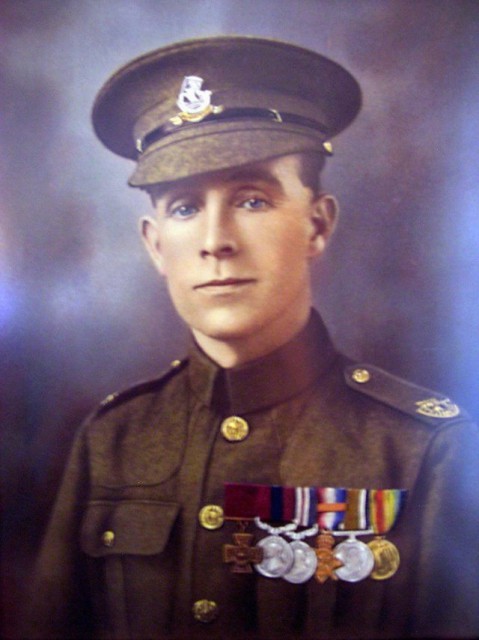
Pte
Henry Tandey Victoria Cross, Distinguished Conduct Medal, Military
Medal) was an English recipient of the Victoria Cross, the highest and
most prestigious award for gallantry in the face of the enemy that can
be awarded to British and Commonwealth forces.
Victoria Cross recipient Henry Tandey is a legitimate hero of war and
the most highly decorated British Private of the first World War. Born
in 1891 and having spent some time growing up in an orphanage, Tandey
would enlist in the Green Howards Regiment of the British Army in 1910.
Before the outbreak of World War I, Tandey would serve in Guernsey and South Africa with the Green Howard’s 2nd Battalion. When war broke out in Europe, he would immediately find himself in the action.
He participated in the Battle of Ypres in 1914 and was subsequently
wounded at the Battle of the Somme in 1916. After a recovery in the
hospital, we was later assigned to 3rd Battalion in May of
1917. He was later wounded yet again during the Battle of Passchendaele
in November of that year before returning to duty in January of 1918.
And while he undoubtedly fought honorably during the prior four
years, it would seem that 1918 was the year he was marked for
exceptional bravery and conspicuous gallantry.
Going Over the Top
As the war entered its final months in August of 1918, he would see action at the 2nd
Battle of Cambrai where he dashed across the dreaded no man’s land of
World War 1 with two others to bomb a German trench. He came back with
20 German prisoners and was awarded the Distinguished Combat Medal as a
result.
Later in September, he participated in an attack at Havrincourt where
he would once again brave heavy fire to bomb German trenches and return
with more prisoners. For this action, he was awarded the Military
Medal.
On September 28th, he was involved in another action at a
canal near Marcoing, France when his platoon began to receive heavy
machine gun fire. Tandey took a Lewis gun team, crawled forward under
the fire and took out the German position.
Once he reached the canal, he helped restore a plank bridge under
intense enemy fire. Later that night, when he and his men were
surrounded by the enemy, he led a bayonet charge that freed his men and
sent the enemy running into the direction of the rest of his company.
For his actions that day, he was awarded the Victoria Cross and
became Britain’s most decorated Private of World War 1. And were the
story to stop there, it would be enough to own its place in the halls of
history.
It is a documented fact that Adolf Hitler fought in World War 1 and
was wounded on a couple of occasions. With such a controversial and
powerful figure who undoubtedly attempted to write his own narrative of
his war experience, separating fact from fiction can be more difficult
than it would seem.
But out of this historical chaos comes the inexplicable story that
would have Adolf Hitler and Henry Tandey cross paths. But more than
cross paths, it would indicate that a wounded Hitler wandered in front
of Tandey’s sights only for Tandey to spare the most evil man of the 20th century.
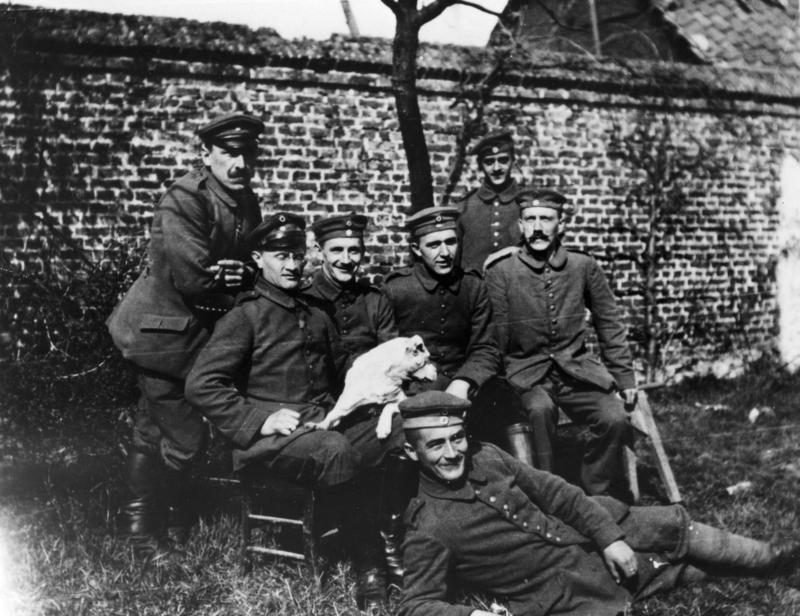
Hitler on the Far Right in WW1
As the story goes, in late 1918, after being wounded in battle, a
young Hitler stumbled across the battlefield only to see a British
soldier with every opportunity to kill him. With the British soldier
recognizing that the wounded man didn’t even raise his rifle, he let him
pass. The wounded Hitler waved at the British soldier and what seemed
like a random act of compassion in the midst of a brutal war would be
lost to history as one of the common untold stories.
As newspapers reported the historic exploits of Henry Tandey, it is
reported that Adolf Hitler recognized him as the man who spared him on
the battlefield on that fateful day. Many years later as Hitler would
rise to power in Germany, he came in possession of a painting that was
reportedly of a Tandey carrying a wounded comrade.
When Neville Chamberlain visited Hitler in 1937 for the negotiations
that led to the Munich Pact, he noticed the painting where Hitler mused
that it was the man who had spared him so long ago. He asked that
Chamberlain pay his regards to Tandey and in an instant, a British
Victoria Cross recipient would be forever tied to Hitler.
Further analysis of the report would prove the account unlikely.
However, the story simply will not go away and as the passage of time
moves on it carries with it a more cemented place in history. We know
that Hitler served in World War 1 and was wounded on multiple occasions,
the last of which was a gas attack.
The young Hitler was reportedly in a hospital recovering from his
wounds when he was informed of the armistice and Germany’s surrender.
Hitler in WWI, before he adopted his signature mustache
What is beyond a shadow of a doubt is that some British men had the
opportunity to kill Hitler in World War 1 and for whatever reason, he
survived. It may very well be that Hitler in his arrogance attempted to
tie himself to one of Britain’s war heroes from the war by referencing
Tandey.
Hitler would survive the Great War and then in a few short decades go
on to set the entire world in flames. But for a well-placed shot or the
random luck of an indiscriminate artillery shell, the future could have
been much different.
So why is it so hard to believe that the man who spared Hitler was a
British War hero? Fact, fiction, and myth. Perhaps the world will
never fully know one of the great stories lost to the passage of time.
On a personal note, I have been again super busy, spend Friday running around and cleaning out the wife's car including removal of all personal effects and license plate. She has started banding around vehicles choices and she seriously likes the Ford Edge. Not a new one, but a 2010 model or newer car and doing other stuff before heading to an "Order of the Arrow" banquet. The Order of the Arrow (OA) is the national honor society of the Boy Scouts of America (BSA). Then spent all day Saturday doing a "looporee" a cub scout event where I was the Archery instructor. This event was cold, it hovered around 45 degrees, cloudy, overcast and some drizzle. As I told some of the other people that were there..".If it ain't raining...it ain't training". Those that are veterans understood the reference...the regular civilians didn't get it...at first. I came home Saturday evening and ate something and crawled into bed. I was beat.
Then the wife wakes me up later on...There was a problem with the hot water heater...and so I got up, crawled my tired butt up into the attic, and sitting in a pile of water in the overflow tub...was the hot water heater.....Sheesh. I shouldn't complain...the hot water heater was 17 years old.....but what timing....... So we spent time over at the in-laws house running laundry and taking hot showers. They say bad things happen in 3...If I had a fallout shelter, I would hide for a week or so until the spate of bad luck passes. Or if nothing else..I don't fly for a few weeks.
I ran across this picture from a non-peoplescube source and thought it would tie in with my earlier post I did on the 2nd amendment.
"When we have a leader that ignores the rule of law...except when it is politically convenient for him. We have a legislative branch that is spineless and divided, and the charismatic leader that has control of the media, the security apparatus and the mob. This is where tyranny comes from. I wonder how this will play out for the future....".
I wonder if this is what a German dissident believed before being sent to a work camp for "Crimes against the state"



 Werwolf – ruins of Hitler’s headquarter near VinnytsiaAccording to Kurland, Hitler used werewolves and wolves as symbols of
German strength and purity against those seeking to destroy them.

 9 March 1945: Goebbels awards a 16-year-old Hitler Youth, Willi Hübner, the Iron Cross for the defense of LaubanInstead, they chose to delay the inevitable in the hope that they
could devise a more favorable scenario for Germany. Historian Perry
Biddiscombe explains in his book, Werewolf! The History of the National Socialist Guerrilla Movement, 1944-1946 that Goebbels came up with the idea to exploit the werewolf legend.