From everything that I read about the Japanese Soldier in WWII was that they were fanatical, dedicated, would sacrifice everything for the goals set by their commanders, they were imbued by a form of "bushido" or Martial spirit or the samurai spirit. Please realize that my descriptions are very simple, I could go on for pages if I wanted to do a deep dive. I respected the Japanese Soldier of WWII for what he could do, I did not admire them They were often cruel to the people they captured, but that was to me part of the draconian disciplinary system of the Japanese Army, where the lower enlisted were beaten by their NCO's for the smallest infractions, and they were frequently treated with disdain by their officers. They viewed the west as "weak" especially the United States, the Pacific War was brutal compared to the European war, it matched the savagery of the Eastern front, and in some cases exceeded it because there was no quarters given by either side. The Americans learned to be very wary of accepting "surrendering" japanese soldiers because it was frequently a ruse to kill more Americans, and if there were any wounded Americans, captured, they were almost always bayoneted by the Japanese. Like I said, very savage. compared to the War in the European Theater. The Americans had no compunctions of using flame throwers and other weapons on japanese positions during the island hopping campaigns. It was a very different war.
I got this off "Quora"
n "Nemesis" The Battle for Japan 1944–45’ by Max Hastings, a British army officer is quoted as making the observation that the Japanese were first class soldiers fighting in a third-rate army.
The soldiers of the Imperial Japanese Army were brave, well trained and highly disciplined. They would rather die than surrender and, consequently, fought to the death to avoid the dishonour of being captured. However, technologically the IJA was backward compared to the other key armies of WWII. It lacked a decent tank nor a doctrine of how to use the ones they did have. In open ground warfare where there was space to maneuver the IJA was hopelessly outclassed, as Slim in Burma and the Red Army in Manchuria before and at the end of the war, proved. Moreover, senior IJA leadership were often appallingly incompetent in sending their forces into battle in adverse circumstances and this manifested especially in the manner in which logistical challenges were fatally underestimated, as noted in the question. This stemmed principally from a shocking underestimation of their enemies. It was frequently assumed that the lightly burdened, fast moving Japanese soldiers would overcome their enemies quickly - as they had done in Malaya and early on in Burma- and capture all the supplies they required from their defeated enemies. But by 1943, the offensive weaknesses of the IJA had been more fully recognized, its initial victories notwithstanding. It became clear that whilst the Japanese soldier was a formidable and ferocious enemy when defending in place behind fixed defensive positions, he was much less so out in the open when attacking.
Unfortunately for the Japanese army, in all three battles mentioned (and others besides) its enemies failed to cooperate by collapsing, forcing the Japanese soldiers to retreat with little food and in difficult conditions. The wounded who could not keep up were either killed or left to kill themselves with grenades, hopefully taking a pursuing Allied soldier with them. In Guadalcanal, on the Kokoda Trail and at Imphal/Kohima, the disastrous result of their offensive failures resulted in mass starvation amongst retreating Japanese soldiers as well as death from disease. Hundreds of thousands of Japanese soldiers in the Pacific were bypassed and left to rot on scores of islands and atolls as the United States Navy juggernaut continued its inexorable and innovative island-hopping advance towards Japan’s home islands.
A stark example of the hopelessly unrealistic ambitions of senior Japanese commanders, and their inability to comprehend logistical challenges, was the idiotic plan to disrupt British plans to retake Burma by attacking Imphal and Kohima in northeastern India. The brainchild of General Renya Mutaguchi commanding 15th Army, it would compel Japanese forces to traverse some of the wettest and most rugged country in Asia where annual rainfall sometimes reached 800 inches, with only a tenuous logistical lifeline, mounted against an enemy with overall numerical superiority and command of the air. It also came at a time when Japanese fortunes elsewhere had taken a decided turn for the worst. Mutaguchi proved a complete incompetent but his plan was approved in Tokyo after the most cursory examination of its feasibility by higher command, possibly because Burma was considered very much a sideshow.
The result was a battle in which the Japanese soldiers fought for many weeks with their usual ferocity but with decreasing prospects of success. Worst of all the 15th Army’s already weak logistical lifeline was disrupted by Allied air attacks, and they began to starve. After Mutaguchi refused pleas from subordinates to retreat, one divisional commander took it upon himself to order his division to do so. The incompetent army commander finally had no option but to order a general retreat. But by this time the monsoon had set in, tracks and trails had become all but impossible to navigate and thousands of Japanese soldiers died of starvation, disease and/or their wounds. The despised Mutaguchi was eventually fired.
One key consequence of this calamity was that the Japanese forces available to contest Field Marshal Bill Slim’s masterful campaign to retake Burma were greatly weakened , and even their fighting spirit in the later stages of the campaign was significantly diminished.
Logistics undoubtedly proved an Achilles heel for the IJA throughout the war.
Everyone knew about the German "Volksturm" with this picture being Iconic for the group.
Well the Japanese had the same kinda thing, and most people didn't know about it. I remember seeing pictures in my WWII books of Japanese soldiers teaching Japanese civilians how to use bamboo spears to attack the American soldiers after they set foot on the homeland. I also know after a few incidents of this plus of the bloodbath of Okinawa, we would have had to eradicate the Japanese as a people and a culture to beat them. and anything less than an unconditional surrender would mean fighting the japanese in 20 years after they rearmed and got smarter and we had demobilized as we tend to do after a major conflict. Hitler Germany taught that little lesson. So when I hear about the revisionist talk about that we should have not used the A-bomb on the Japanese I know that they don't really know history and that they are apologist for the Soviet Union Er the Marxist movement.
I shamelessly clipped this from "American Rifleman"
Japanese women were expected to be combatants in the Volunteer Fighting Corps. These ladies train with a Nambu Type 11 light machine gun (6.5x50 mm Arisaka). It is highly unlikely that even an old Type 11 LMG would have been available to the Japanese militia.
Photo courtesy of author’s collection.
“The bulwark of this Volkssturm in Japan proper is the Second National Army, which in peacetime consists of a large group of untrained males of military age. With the small amount of training now being given this group and with the formal registering on its rolls of all 17- and-18-year-olds since November 1944, the use of civilians in the defense of the Japanese homeland begins to assume increasing military importance.”
—Secret U.S. Military Intelligence document from the Pacific Theater of Operations, March 1945
While the Allied concept of “unconditional surrender” of Axis forces in Europe was sound, the prospects of a national Japanese surrender seemed unlikely. Before anyone knew anything about the war-ending potential of the atomic bomb, American military planners had to prepare to overcome a fanatical defense of the Japanese home islands—a battle during which the Japanese military appeared ready to sacrifice their entire population to protect their homeland.
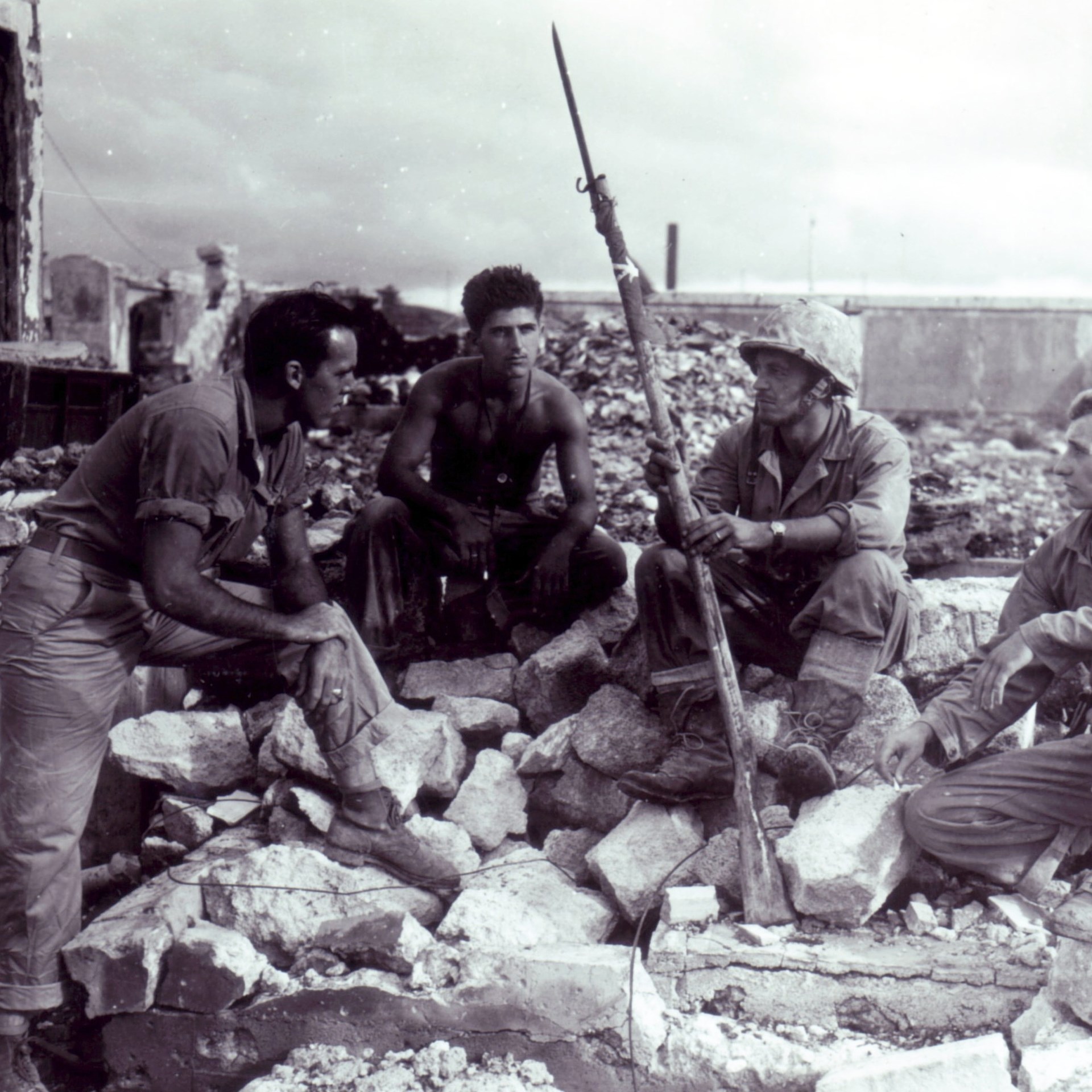
As firearms became more and more scarce, the Japanese turned to the most basic weapons: spears were constructed using standard rifle bayonets or simply a sharpened metal rod. American troops first encountered these on Saipan and sometimes referred to them as “Banzai Sticks.” Photo courtesy of National Archives and Records Administration (NARA).
But while the Japanese spirit was willing, their physical resources were growing weak. The emperor’s forces struggled to provide enough firearms and ammunition to their combat troops. To train and supply a large civilian militia with effective modern small arms would require extreme ingenuity to match the traditional Japanese willingness to sacrifice. Consequently, the Japanese would develop some of the crudest firearms of World War II.
Setting The Stage For Operation Downfall Allied leaders concluded that they could not wait for a blockade and intensive bombings to bring about a Japanese surrender—a massive invasion of the home islands was necessary. Meanwhile, a timeline was set for the defeat of Japan within one year of the surrender of Germany. The larger plan, dubbed “Operation Downfall,” was divided into two parts: Operation Olympic and Operation Coronet.
Olympic was to be the invasion of Kyūshū, scheduled for Nov. 1, 1945. Coronet was the second phase, with a massive force planned to invade Honshu in March 1946. All the main preparations were made without any knowledge of atomic bombs, and until the successful A-bomb test (July 16, 1945), it would have been folly to plan for the intervention of any secret weapon. A massive amount of brute force was the Allied recipe for success.
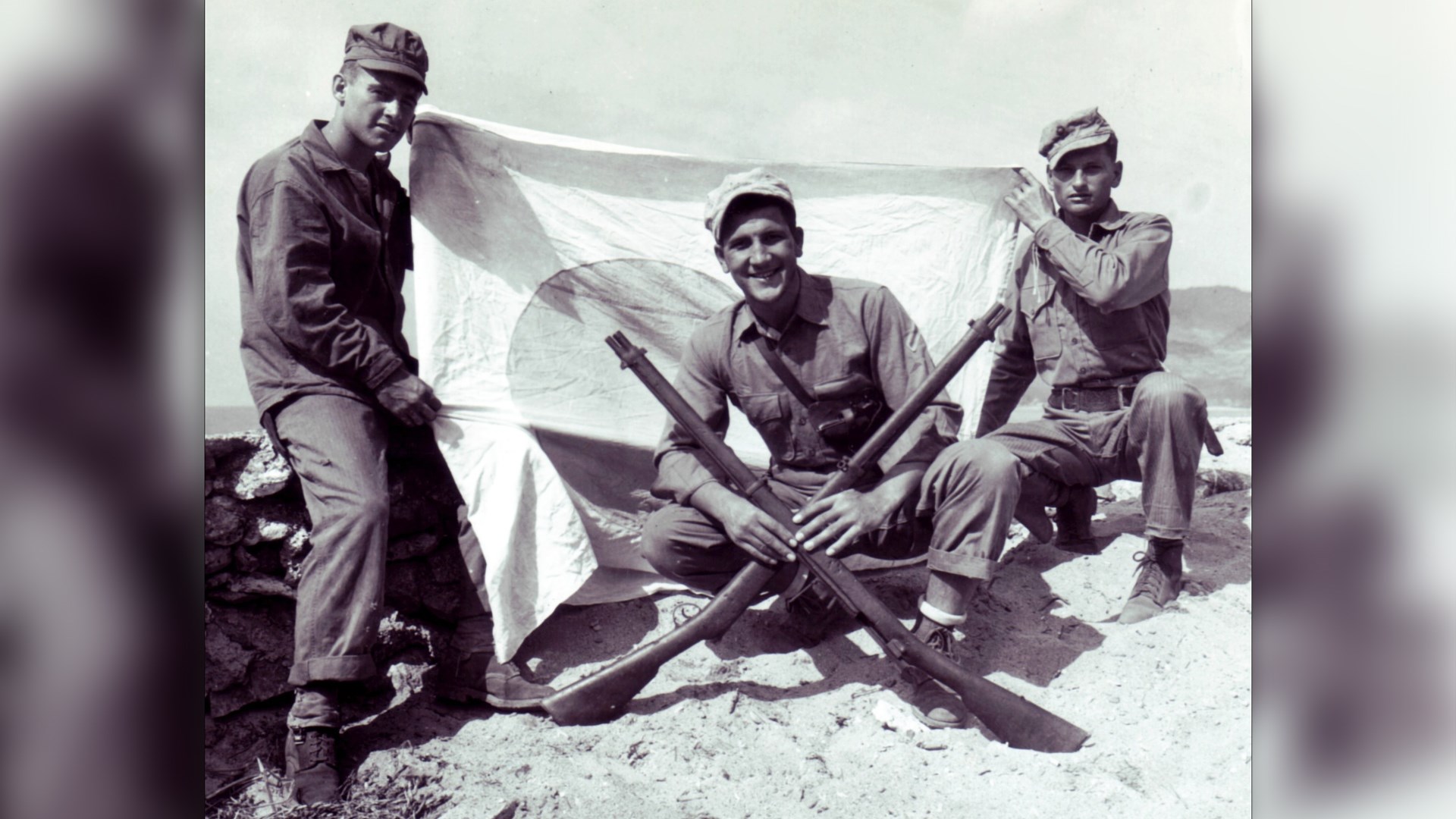
Marines pose with Japanese Type 22 Murata rifles (11 mm) captured on Okinawa. These obsolete rifles were issued to the Japanese Volunteer Fighting Corps. The Type 22 entered service in 1889 and was the first Japanese military rifle to use smokeless powder. Photo courtesy of National Archives and Records Administration (NARA).
As American forces progressed in the island-hopping campaign, reaching islands closer to Japan proper, they encountered more Japanese civilians in the combat zone. These encounters provided a clearer picture of what Allied forces could expect when they invaded the Japanese home islands. American intelligence began to understand the scope of the Japanese militia, and the militarists plans for "The Glorious Death of One Hundred Million."
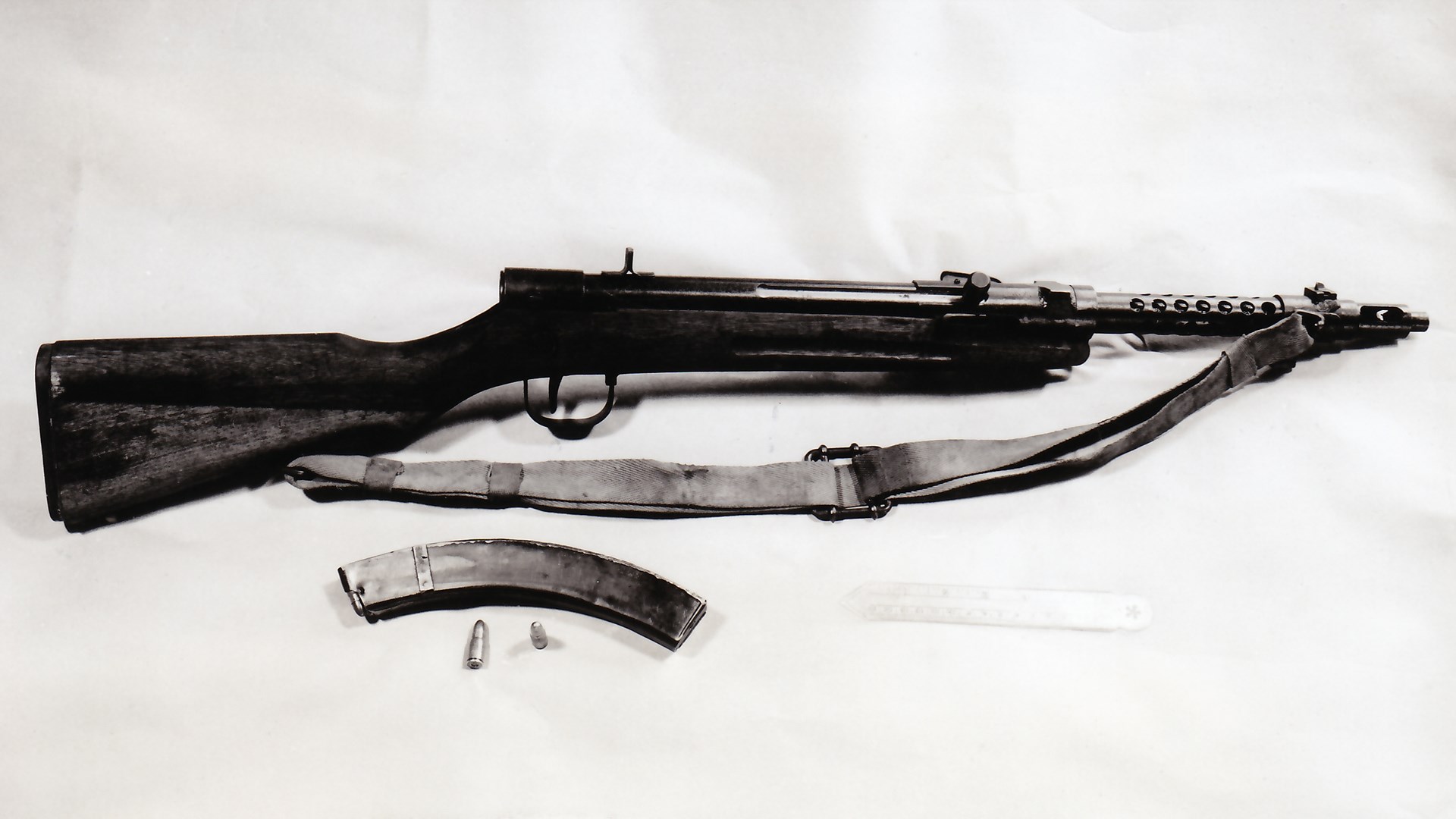
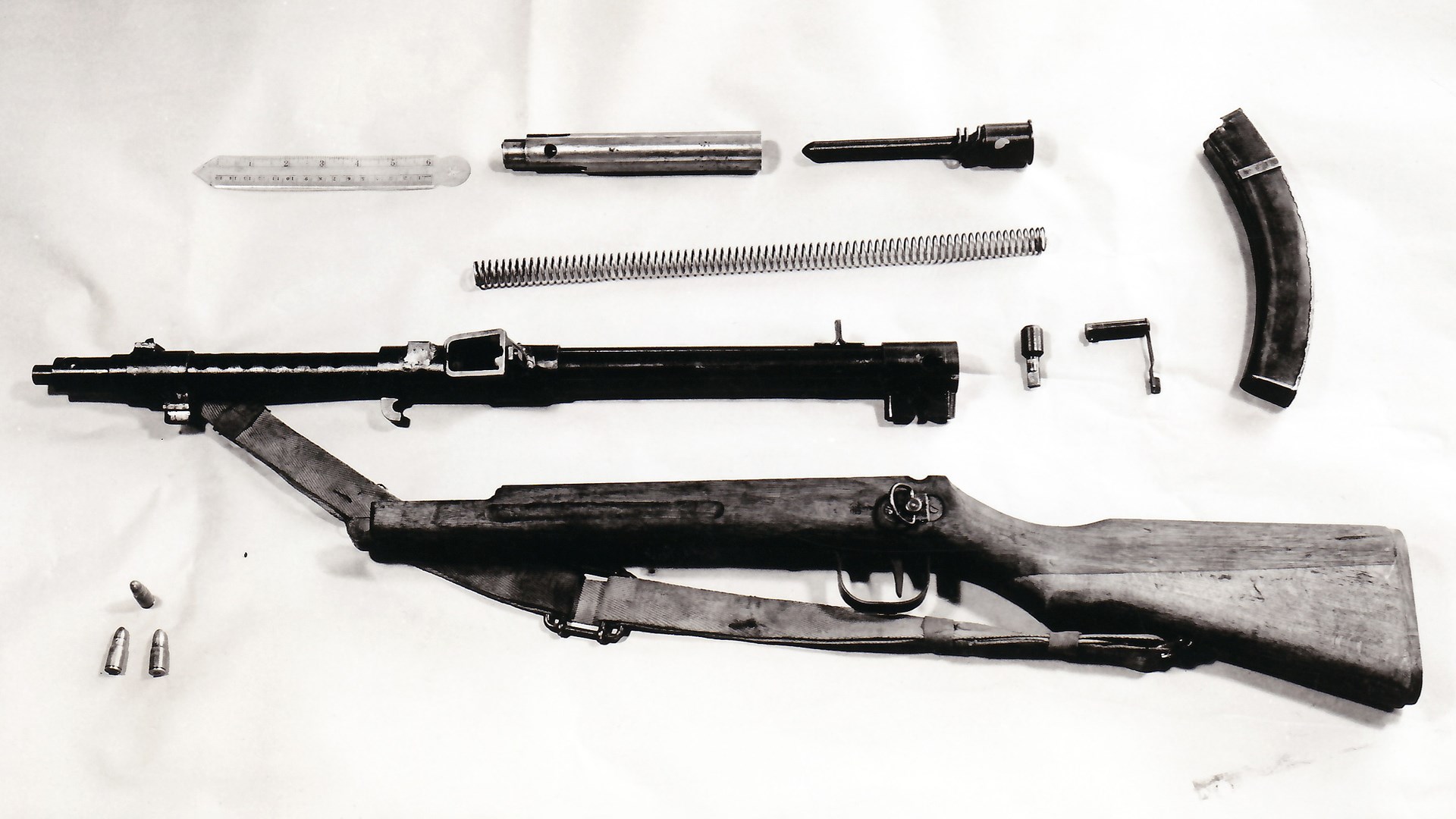
The Japanese Type 2 submachine gun (8x22 mm Nambu) is blowback-operated and fires from an open bolt. Photo courtesy of National Archives and Records Administration (NARA).
In a March 28, 1945, Military Research bulletin, American intel resources reported on the “employment of Japanese civilians in local defense:”
“It has long been the policy of the Japanese Army, even in peacetime, to keep close check upon all Japanese males of military age, not only as to whereabouts and amount of military training received but also as to education and occupational skills. This policy has been facilitated by assigning every fit male to a reserve component of the Army at the time of his conscription examination. In peacetime, those picked for conscript training, released after two years of active service, became members of the First Reserve. Those picked for a short term of replacement training formed the Conscript Reserve.
Both trained groups automatically entered the First National Army on reaching the age of 37. All other males 17-40 (now 17-44) who were not declared "unfit" became members of the Second National Army, a large body of untrained militia subject to call in emergency.
Japan has declared her intention to employ this reservoir of civilian manpower in local defense of the homeland and overseas areas, While It is true that Japanese civilians have not been used too effectively in the areas already attacked (see Bulletin 10), the following factors indicate that the employment of this Japanese "people’s army" will become more important as the war nears Japan Proper:
Greater numbers of Japanese nationals will be encountered
The Army has had greater experience in handling civilians
The individual's determination to fight will increase as the threat to the homeland becomes more imminent
The available numbers, the past employment, and preparations made by the Japanese for the use of these civilian fighters, and the general methods of employment are discussed below.
It must be remembered that the Japanese Army will also continue to use natives as far as possible for military labor and as auxiliary forces, but this study is concerned only with the less variable use of Japanese nationals residing in operational areas.”
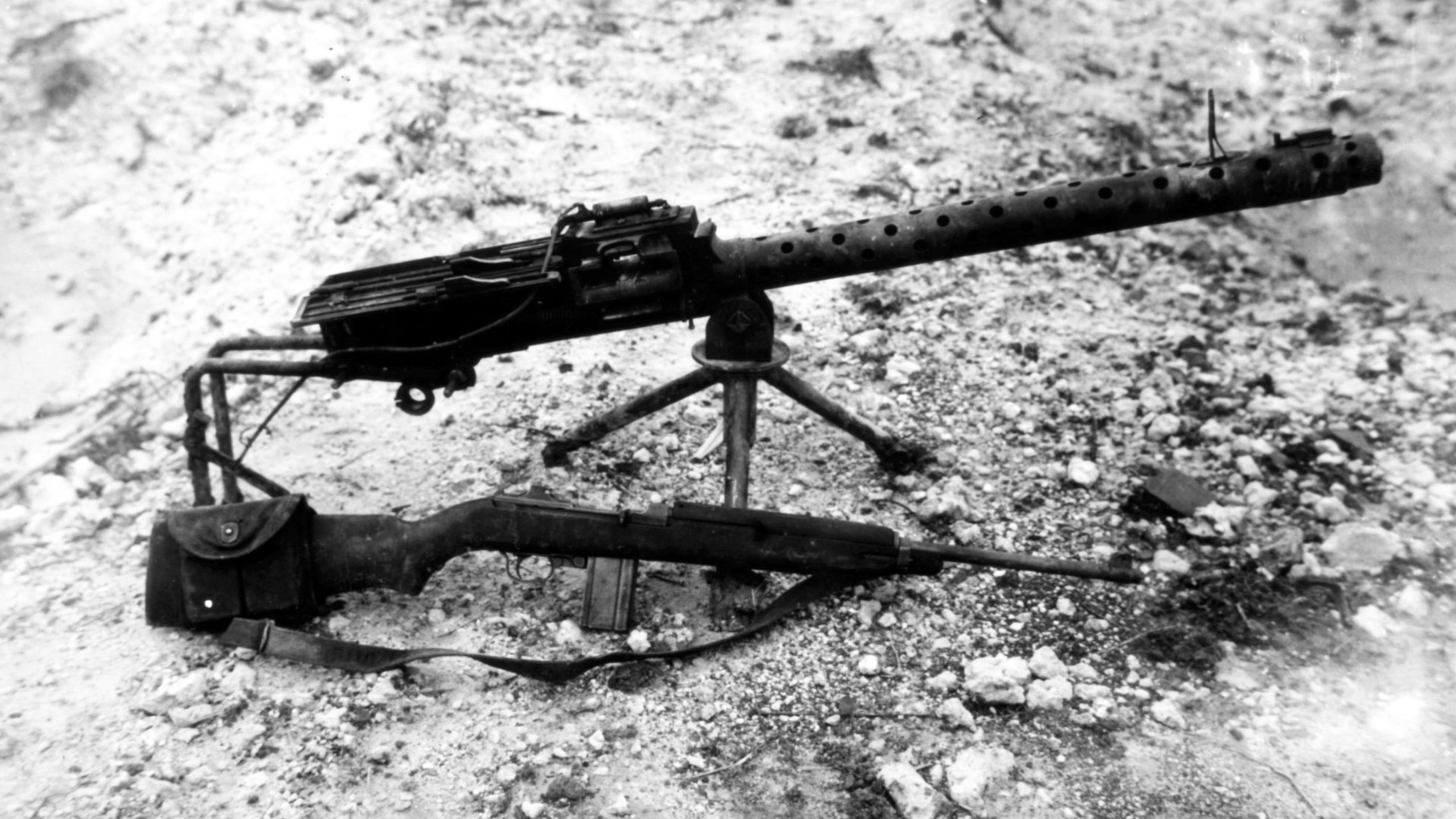
A Japanese (Navy) Type 97 aircraft machine gun adapted for ground use. This gun was a licensed copy of the British Vickers Type E machine gun and was chambered in .303 British. Note the extremely crude front sight, tripod and wire spade grips. The cyclic rate was up to 900 rounds per minute. Photo courtesy of National Archives and Records Administration (NARA).
The report concluded that 17,450,000 men aged 15-59 were available as militia troops in the Japanese home islands.
“The proportion of the above numbers actually available as effective fighting men will be limited by several factors, including local administrative problems and the ability of the Japanese to arm and equip the personnel present in areas under attack.”
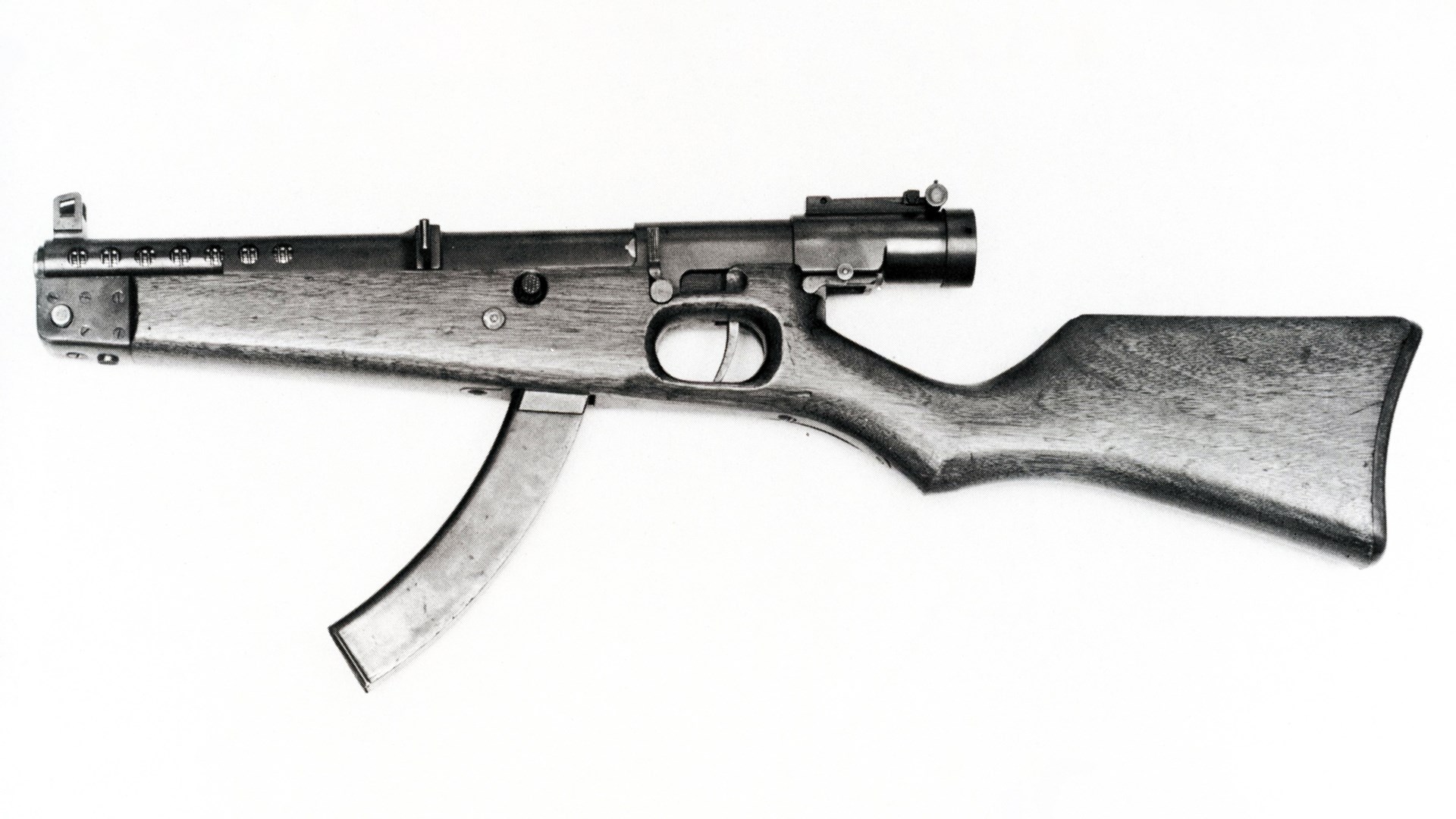
The Japanese Type 100/44 submachine gun (8x22 mm Nambu). Japan showed little interest in submachine guns during the 1930s, and few of the original Type 100 were available in the early war years.
Relaxed Japanese Manufacturing Standards U.S. troops in the field captured various new and modified Japanese wfirearms. Of particular interest were the modifications to the Japanese Model 99 (1939) Pattern 7.7 mm Rifle. These were detailed in an Ordnance intelligence report, produced in late 1944:
“A Japanese 7.7mm rifle of the Model 99 (1939) pattern, recovered in the Ormoc area, is of extreme interest as it Indicates a possible relaxation in the standard of manufacture. The points of variance between this and other rifles of the same model previously recovered are as follows:
The wire monopod has been omitted.
The anti-aircraft lead arms on the back sight have been removed. Also, instead of the sight being machined in one piece, the sight base is now welded to the mount.
The bolt knob is smaller and cylindrical in shape, instead of the usual oval ball.
The safety knob is no longer knurled on its rear face, but is left square, just as it was when it was cut off the lathe.
The wooden stock is much inferior in quality to that usually fitted.
According to a recently captured document, Japanese ordnance chiefs have expressed grave concern at the lack of essential ordnance supplies. With a view to remedying this condition, it was decided that the manufacture of certain items was to cease, while others were to be modified so that an intensified effort could be made to speed up production.”
The Type 100/44 represented a simpler, easier to build variant of Japan’s primary homegrown submachine gun. Weight was 9 lbs., 11 ozs. (loaded). Ammunition feed was via a 30-round box magazine, with an 800-round-per-minute cyclic rate. About 9,000 of the Type 100/44 SMGs were made. Photo courtesy of National Archives and Records Administration (NARA).
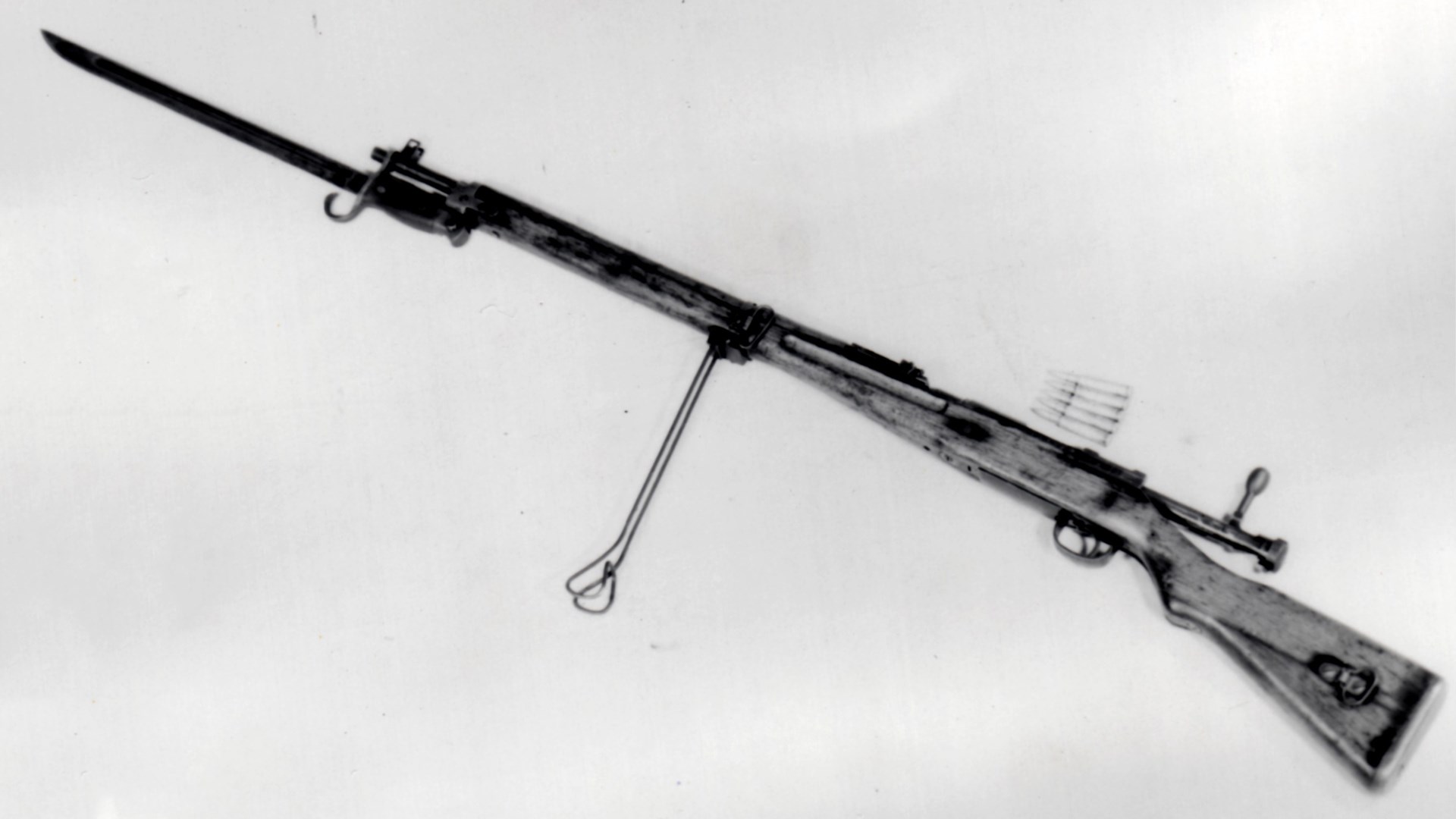
The Type 99 7.7 mm Substitute Rifle In 1943, the Japanese decided to simplify the standard Type 99 rifle and make a “substitute standard” small arm. These modifications included eliminating the sling, cleaning bar and bolt cover, while substituting inferior steel for parts like the bolt and barrel. The simplification eliminated the chromium plate in the barrel, used an inferior grade of wood for the stock, and revised the sight to a range of only 300 meters. This was called a Substitute Type 99 Rifle.
The Japanese Type 99 rifle (7.7x58 mm Arisaka). In the late-war period, Type 99 rifles were often found with particularly crude, short-cut finishing. Photo courtesy of National Archives and Records Administration (NARA).
Japanese rifle collectors have uncovered a tremendous amount of information about the nuances of late-war Japanese arms production. Type 99 rifle collectors have described wide variations in the “Substitute Rifle,” including no serial or series number, unnumbered parts, mismatched parts, front sights missing guards, rear sights missing wings, alternate shapes to the bolt handle and varying types of butt plates.
The Type 2 submachine gun weighed about 9¾ lbs., loaded, and used 30- or (rarely) 50-round magazines. The cyclic rate was 600 rounds per minute. Fewer than 200 are thought to have been made. Photo courtesy of National Archives and Records Administration (NARA).
During April 1945, Japan made a significant change in its civil defense forces, designating them as civilian militia, and by June, conscription laws had been enacted even while the militia was renamed the Volunteer Fighting Corps (Kokumin Giyū Sentōtai). By the end of June, more than 25 million Japanese men were deemed “combat capable” by their hopeful government, but very few of them could be equipped with firearms of any kind. The Volunteer Fighting Corps did not see action during the war, but an early precursor, the local home guard on Okinawa, was equipped with obsolete rifles, most notably the Type 22 Murata rifles (11 mm). In the home islands, all that was available in the short term were spears, swords, axes, clubs and crossbows. Hand grenades were the most plentiful of modern weapons.
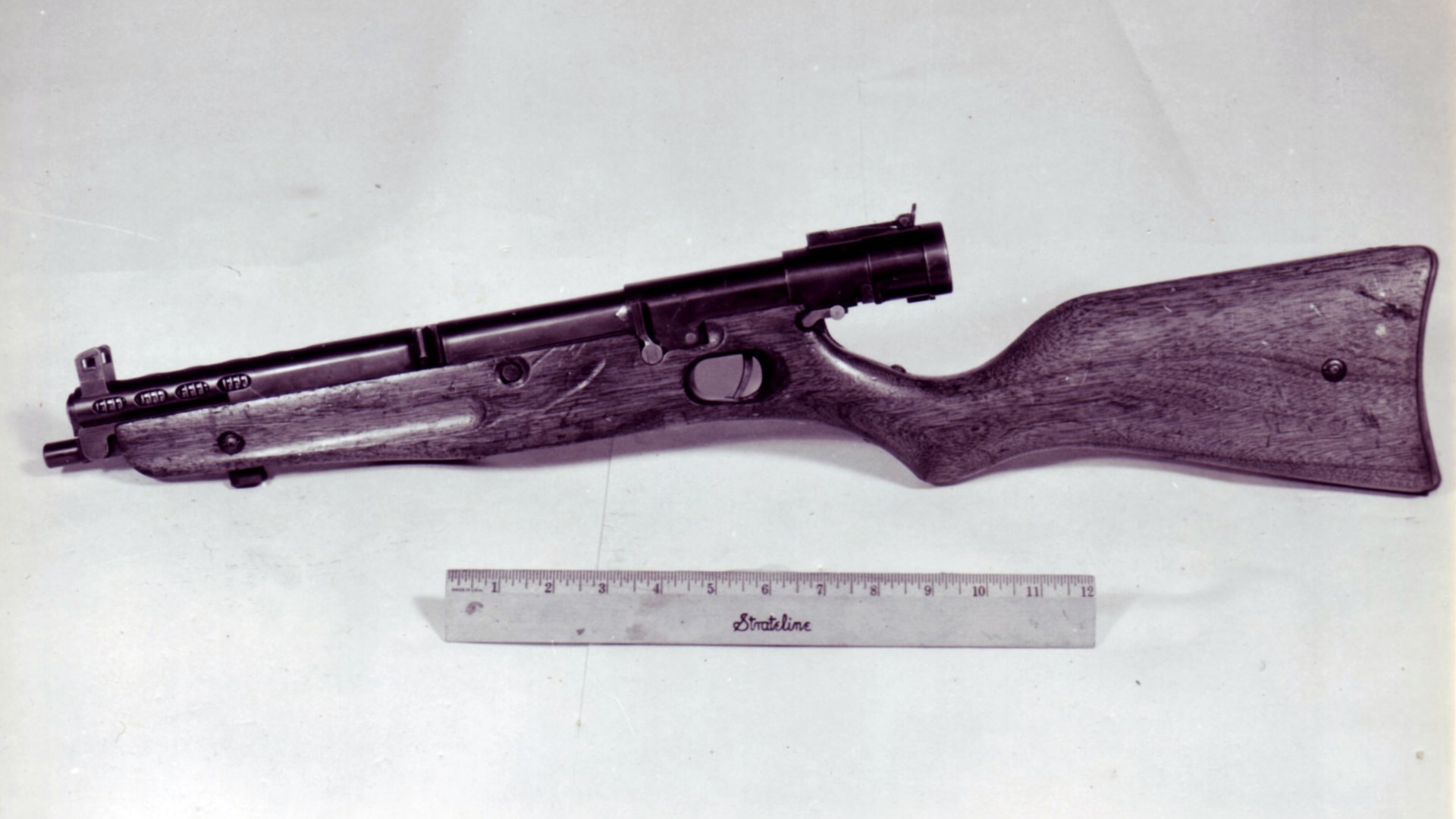
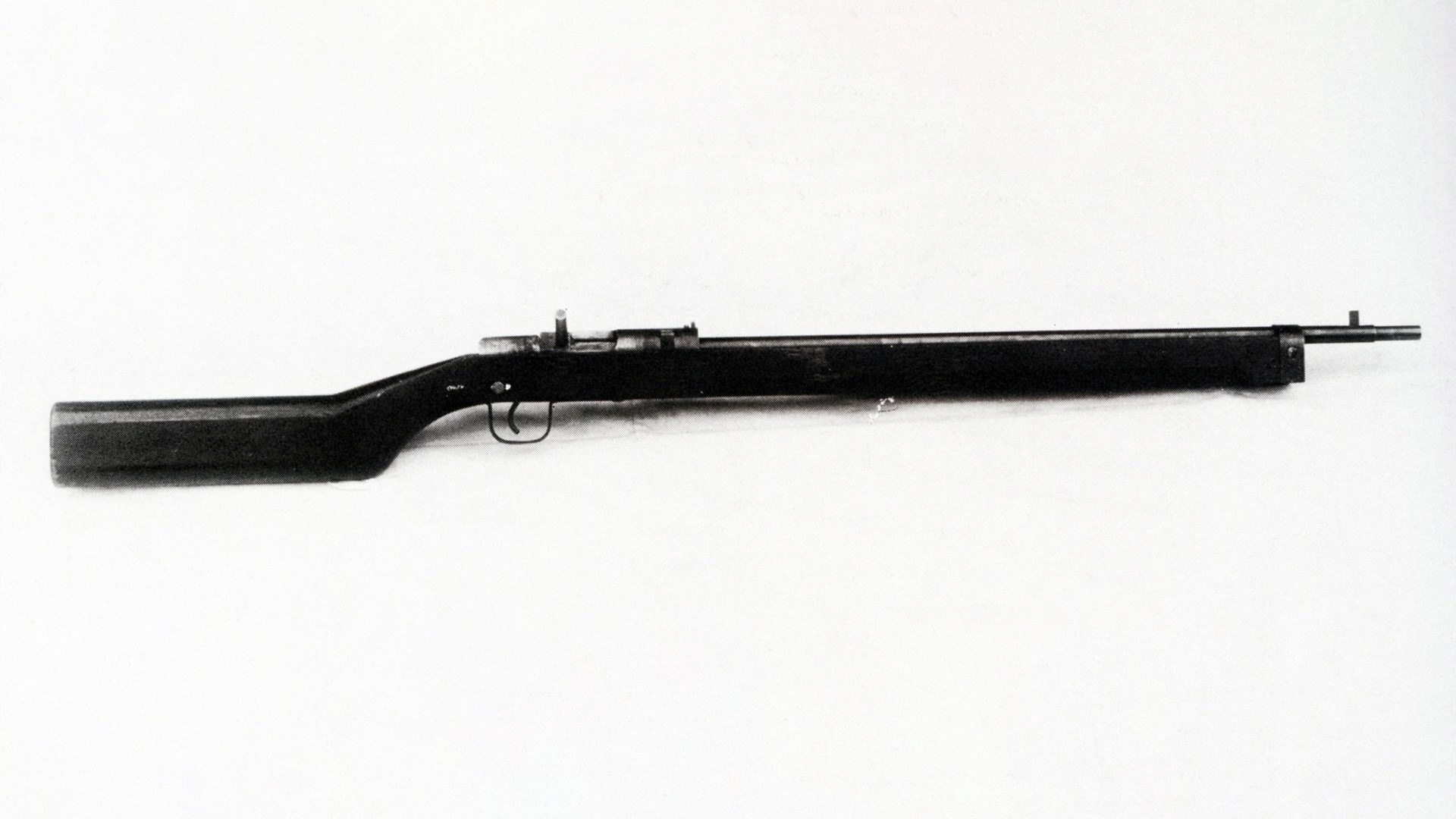
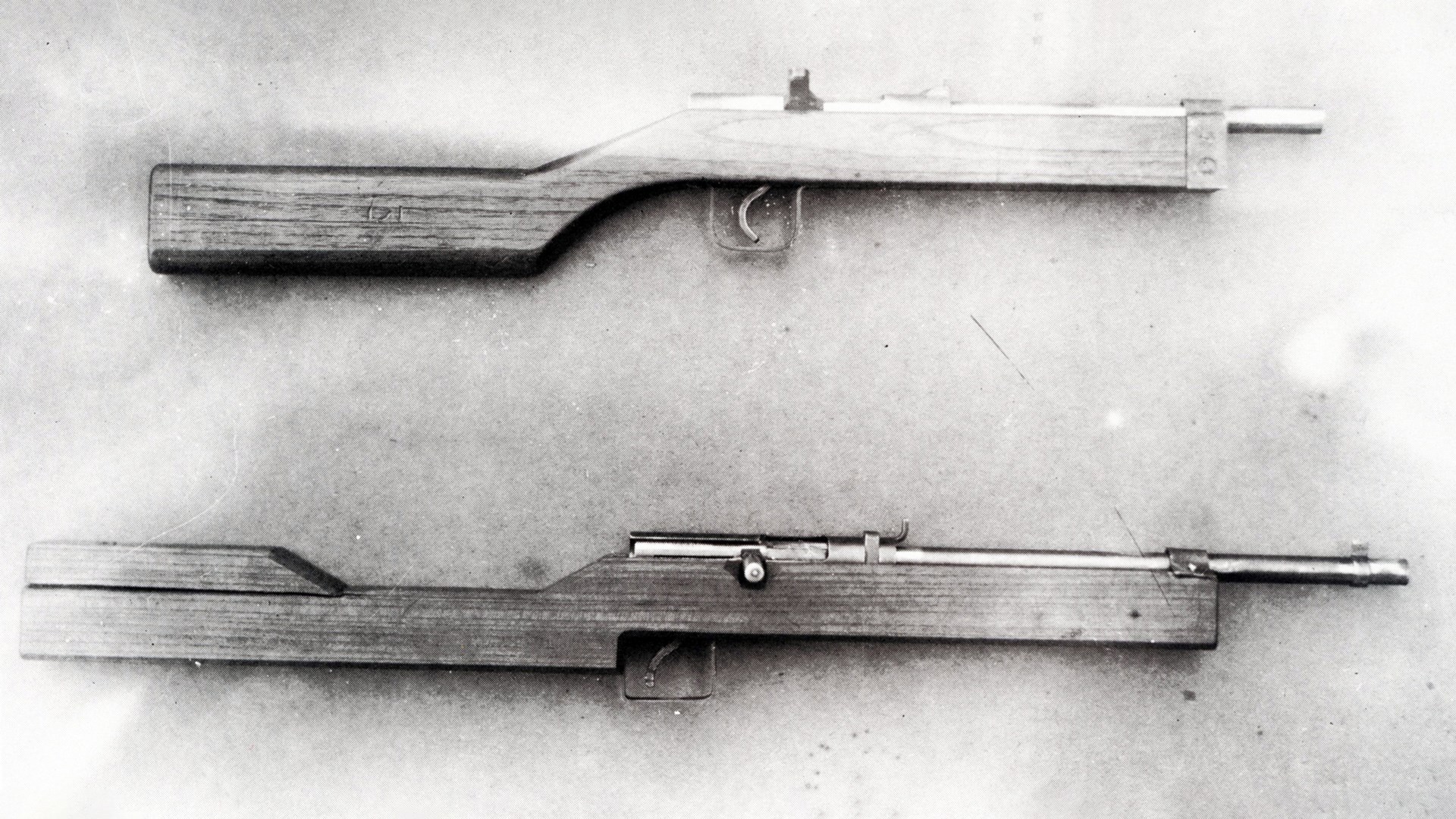
The Japanese "Simple Rifle:" Crude Weapons For The Massed Militia Preparing for the invasion they knew would come, the Japanese embarked on a quick program of simple weapons development to equip their mostly untrained militia. The resulting firearms are some of the rarest guns of the entire war. The following descriptions (and photos) come from a series of U.S. Ordnance Technical Intelligence reports compiled during the first few months of 1946.
Simple 7.7 mm & 8 mm Rifles A very simple rifle that would fire the standard 7.7 mm ammunition was attempted. The length of the barrel was 50 cm, and it was so simple in construction that it, as well as the other parts, could be made on an ordinary lathe. It was a bolt-action, single-shot piece that was intended to equip front-line defense troops in an invasion. However, as the ammunition proved too powerful, it was decided to make the rifle shorter and to use standard 8 mm 14th Year Type pistol ammunition, which proved much more satisfactory.
The original Japanese Simple Rifle: chambered for use with standard 7.7 mm rifle ammunition, the cartridge proved far too powerful for the weapon. The barrel was about 50 cm long. Photo courtesy of National Archives and Records Administration (NARA).The second generation of Japanese Simple Rifles were even more crude—however, as they were chambered for the standard 8 mm pistol ammunition, these single-shot firearms were acceptable for use with the civilian militia. Photo courtesy of National Archives and Records Administration (NARA).
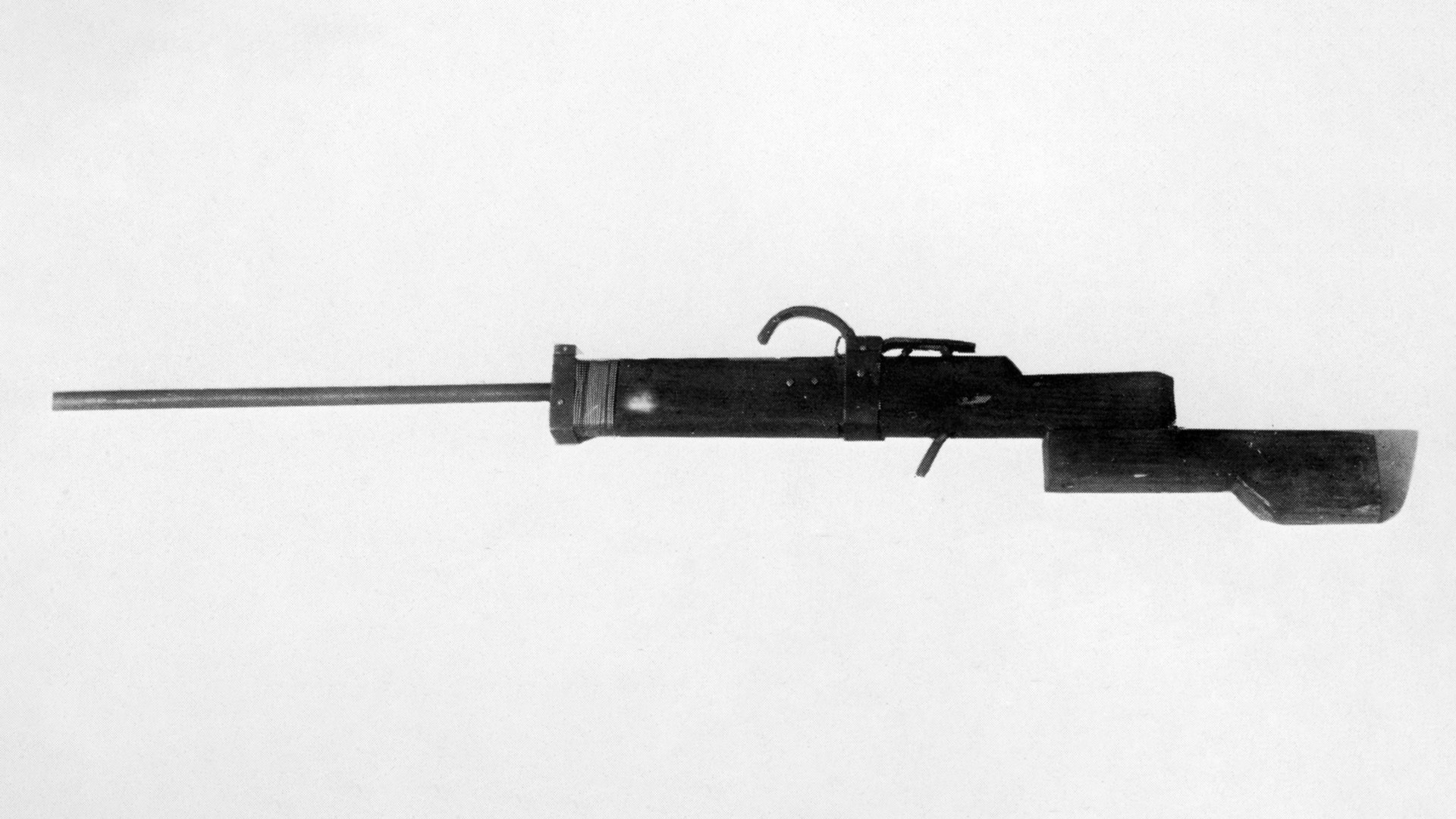
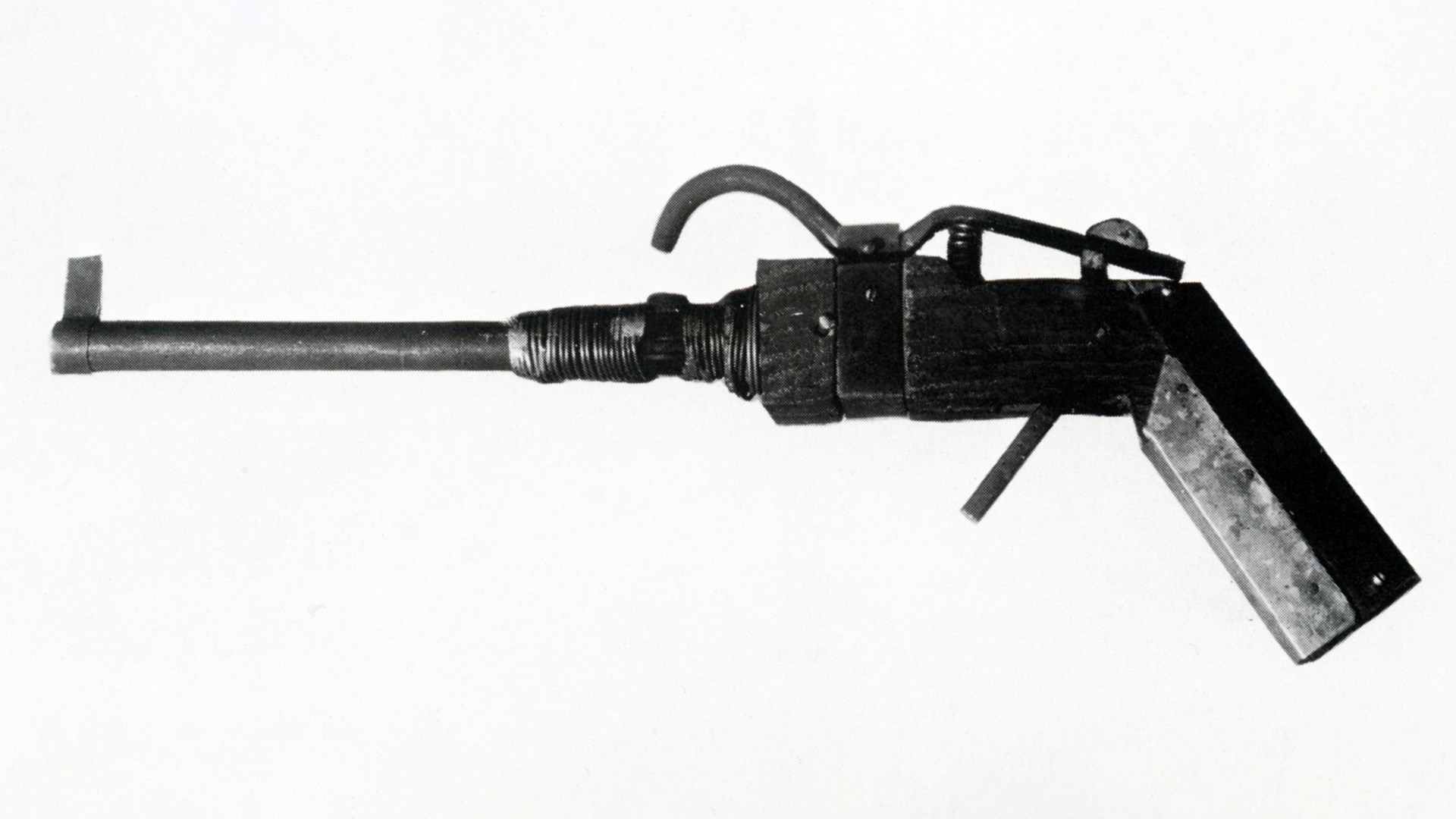
National Rifle & Pistol For Civilian Defense This rifle was developed for the purpose of equipping volunteer defense troops and was a type that could be made by any small factory or smithy shop. The construction was simple as an ordinary piece of pipe (13 mm diameter) formed the barrel. It was loaded with 3 to 5 grams of blackpowder, and the projectile was made from ordinary bar stock cut in sections about 15 mm in length. It was fired by the hammer striking a primer-igniter cap that was placed over a small flash hole on top of the barrel. A pistol version of this firearm was also produced.
The Japanese National Rifle for Civilian Defense—a simple blackpowder weapon with a smoothbore barrel made from pipe. Photo courtesy of National Archives and Records Administration (NARA).The Japanese National Pistol for Civilian Defense—a crude blackpowder weapon that fired a 13 mm ball. Photo courtesy of National Archives and Records Administration (NARA).
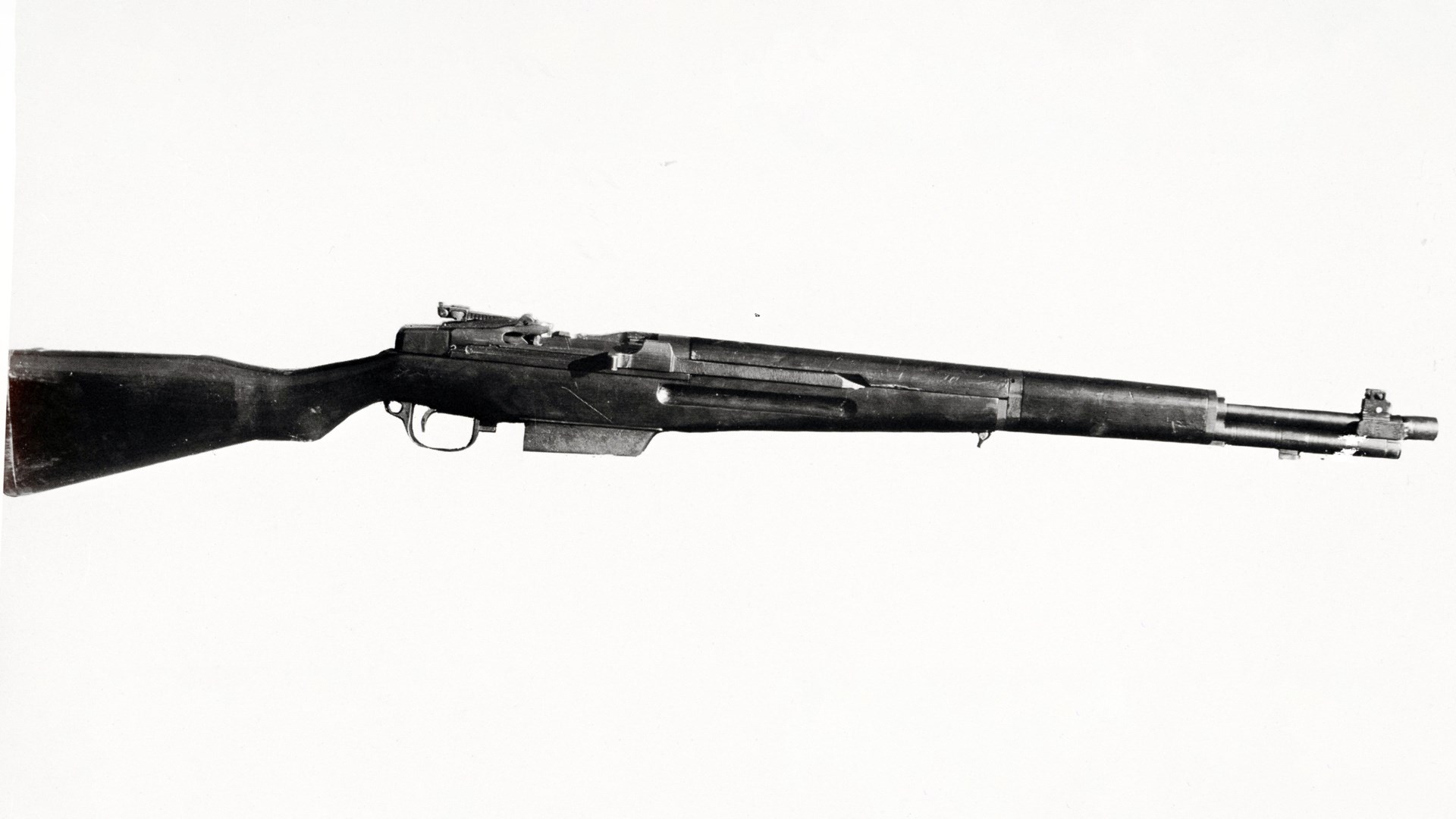
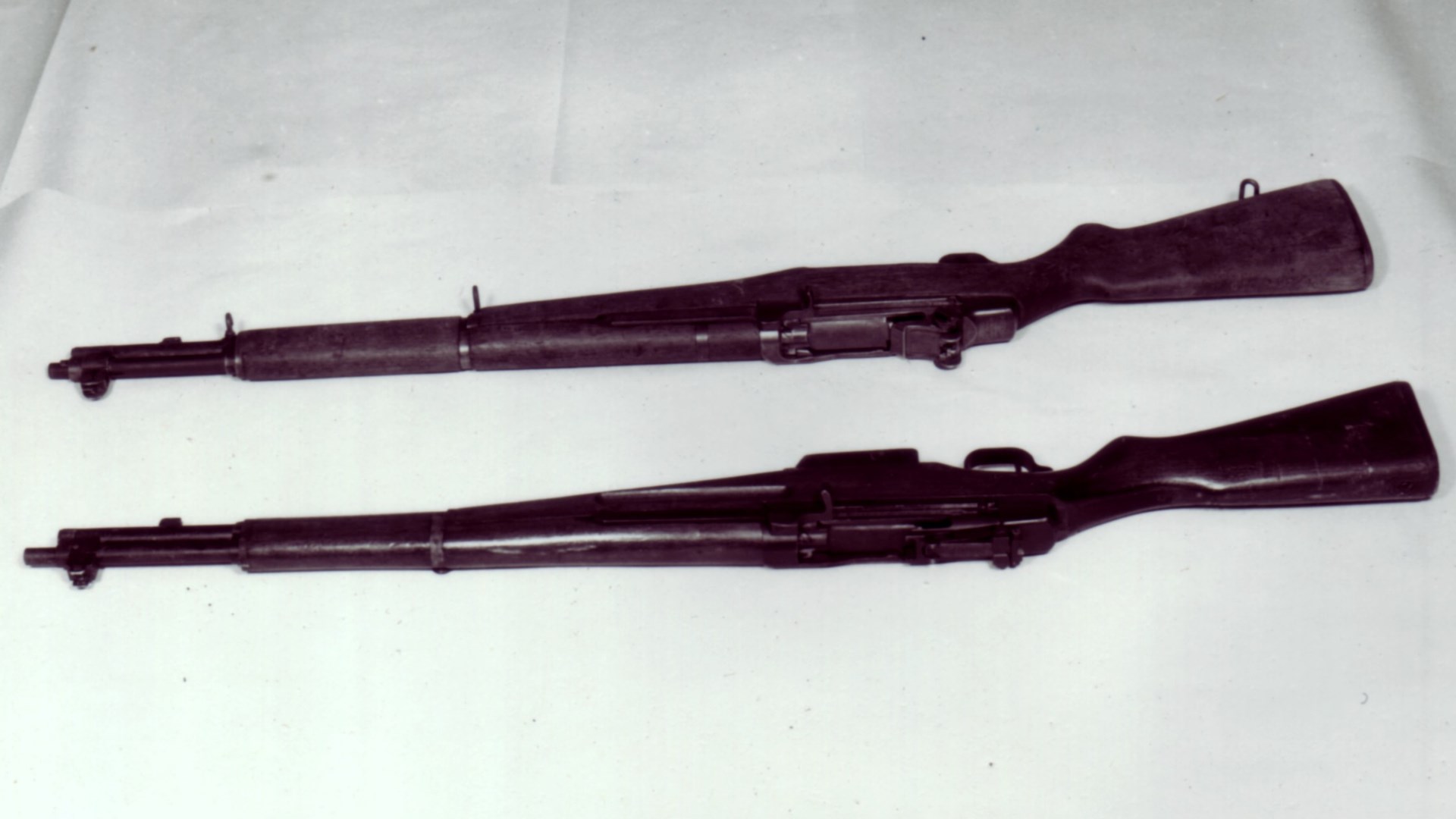
Type 5 Semi-Automatic Rifle (Garand copy) The need for a semi-automatic rifle for the Japanese army was recognized in 1922, but the development of such a firearm was not begun until 1931 when several models were made; all proved unsatisfactory. This study lasted until 1937, at which time research was temporarily discontinued.
In March 1941, the inquiry was again started because of the progress on semi-automatic rifles in foreign countries. At this time, the 1st Section and the Kokura Army Arsenal designed several types of recoil and gas-operated rifles. The results of tests showed that none of the models were entirely satisfactory in operation, and because of the unforeseen difficulty in manufacturing such a rifle, research was again stopped.
About March 1944, there was a strong demand to develop a semi-automatic rifle, especially from the paratroop command. At that time, the Navy introduced a semi-automatic rifle copied from the U.S. M1 (Garand) Rifle that used the standard Japanese 7.7 mm ammunition. In April 1945, models were finished and tested. Although the test results were not entirely satisfactory due to breakage of parts, loading and feeding difficulties, they were considered good enough to adopt the gun. The rifle was standardized as the Type 5.
The Type 5 semi-automatic rifle. Weight was a little over 9 lbs., and length was 42.2".The Type 5 (sometimes called the Type 4) semi-automatic rifle (7.7x58 mm Arisaka). It is estimated that about 125 of these “Japanese Garands” were completed at the Yokosuka Naval Arsenal in late 1944/early 1945. Few surviving examples exist today. Photo courtesy of National Archives and Records Administration (NARA).
World War II finally ended after the atomic bomb attacks on Hiroshima (August 6) and Nagasaki (August 9). While the casualties from the two nuclear blasts were horrific, they pale in comparison to projected number of deaths if dozens of Allied infantry divisions assaulted Japan and Japanese militarist plans to sacrifice the entirety of their population to stop them came to fruition. Armed with bamboo spears and an odd assortment of crude firearms, the Japanese Volunteer Fighting Corps would have inflicted their share of casualties on the invaders, but the utter and tragic destruction of Japan and its people would certainly have followed.
The nation of Japan was helpless before the invading force. They were
outnumbered, and the enemy was about to land on the shores of the
Imperial Home Islands. There was nothing left but to fight to the death
against the savage invaders. But then, suddenly and without warning, a
great wind came and destroyed the enemy fleet. The enemy, Mongols under
Kublai Khan, had been destroyed by a sudden typhoon, a “Divine Wind” or
“Kamikaze,” as it came to be known in Japanese history. In the year
1281, Japan had been saved by this help from above.
Nearly 700
years later, in 1944, the same situation faced Japan. It was not Mongols
this time, but an enormous military force led by the United States that
was threatening to invade Japan. The Western Allies had begun their
inexorable advance against Japan three years earlier at New Guinea and
Guadalcanal, and they were now more than halfway across the vast
Pacific, aiming directly for Japan itself. In desperation, some Japanese
leaders looked to another “Divine Wind” again to save them. This time,
the Kamikaze would not be a typhoon, but swarms of suicide planes that
were to be unleashed at the advancing allies.
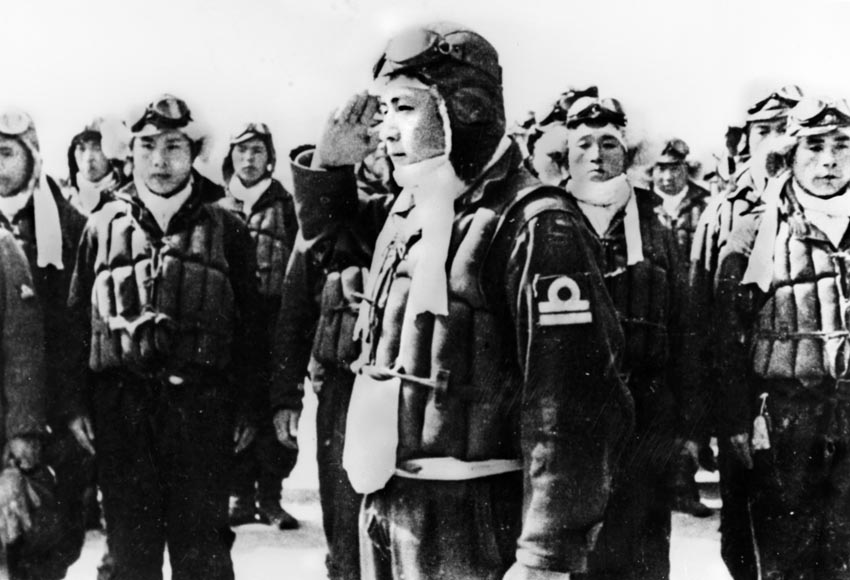
A
kamikaze pilot salutes as he receives his orders for a “divine wind”
mission. It is estimated that over 1,200 pilots (out of 2,314) lost
their lives on such missions.
The concept of
individual suicide was accepted within Japanese society, particularly
among those descended from the warrior, or Samurai, class. Suicide was
generally accepted as the way to atone for failure, and ritual suicide,
also known as seppuku and harakiri, was common among the military of
Japan. It would appear repeatedly during the Pacific war, beginning at
Guadalcanal and lasting to, and even after, Japan’s surrender.
But
mass suicide was something else. Throughout the war, individual
Japanese, particularly pilots whose planes were too badly damaged to
return to base and being culturally unable to accept a surrender to the
enemy, would fly their damaged aircraft into some enemy target, be it a
ship or a ground target. These men were presumed to have been granted a
direct passage to an honored place in heaven for their actions.
Suicide as a doctrinal military tactic, however, did not enter
Japanese military policy until October 1944. By then, the Americans were
invading the Philippines and the Palau Islands, threatening to cut off
Japanese lines of supply from the Far East. Without those supplies,
Japan could not sustain its war effort much longer. All attempts to stop
the American advance had so far failed, and, as in 1281, Japan was
growing increasingly desperate. Once again, the accepted solution was
the Kamikaze.
The origins of the modern Kamikaze are traced to
Luzon, in the Philippines, in October 1944. The Americans were about to
invade those islands, and the Japanese were preparing to meet that
invasion. Captain Rikihei Inoguchi of the Imperial Japanese Navy Air
Forces was at Clark Field discussing attack plans against the
approaching American invasion force. As a senior staff officer of the
1st Air Fleet, he had been assigned the job of organizing the air
defenses of the Philippines.
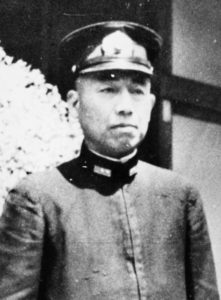
While speaking with Commander Asaichi
Tamai, commanding the 201st Air Group, he was joined suddenly by Vice
Adm. Takijiro Ohnishi, the recently appointed commander of Japanese
Naval Air Forces in the Philippines. Joined by some squadron leaders,
the group sat down to listen to Admiral Ohnishi’s instructions.
Admiral
Ohnishi was himself a pilot and a long-time advocate of naval aviation
in Japan. He had helped plan the Pearl Harbor attack and had been a
protégé of Admiral Isoroku Yamamoto. As a staff officer, Ohnishi had
long been involved in discussions in Tokyo over the use of suicide
operations, arguing against them. But the continued defeats in the
Pacific and the loss of vital resource territory seemed to have changed
his opinion by the time he was appointed to command the 1st Air Fleet in
the Philippines.
Admiral Ohnishi began by stating the obvious:
Japan’s situation was critical. He then explained that the Imperial
Japanese Navy was about to launch an all-out attack on the American
fleet off Leyte. But the Japanese fleet had no air cover of its own; the
1st Air Fleet on Luzon would have to provide that air cover. He had
orders to protect the fleet for at least one week, keeping the American
aircraft carriers from launching strikes that would cripple or destroy
the oncoming Japanese fleet.
The problem was that the 1st Air
Fleet had only 30 serviceable aircraft on Luzon. How could such a small
force hold back the hundreds, perhaps thousands, of American planes
coming to Leyte Gulf?
Admiral Ohnishi presented his solution. He
told the assembled pilots and staff officers, “In my opinion, there is
only one way of assuring that our meager strength will be effective to a
maximum degree. That is to organize suicide attack units composed of
Zero fighters armed with 250-kilogram bombs, with each plane to
crash-dive into an enemy carrier…What do you think?”
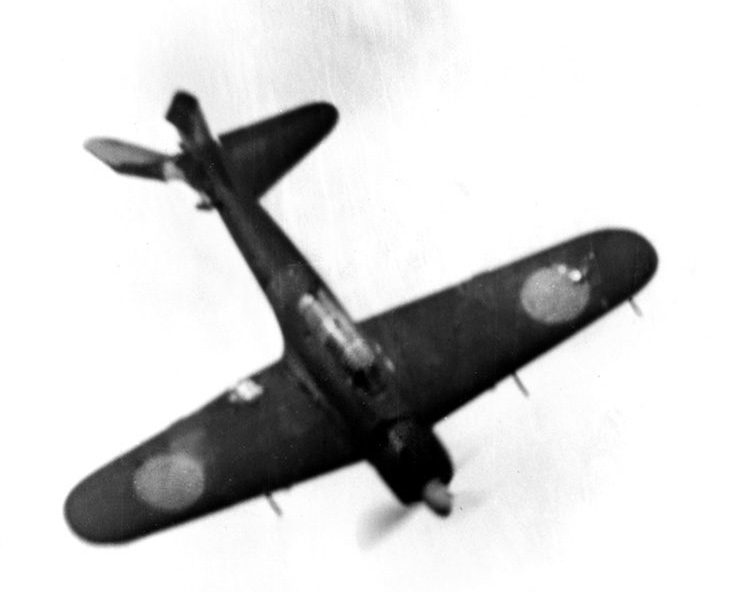
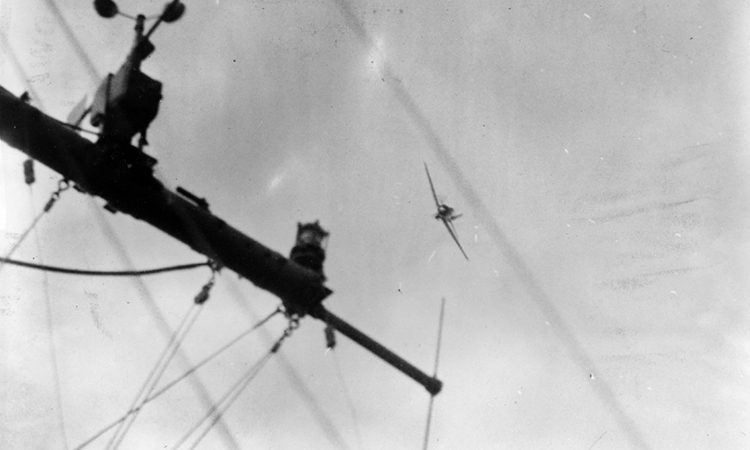
Despite
a broken elevator and wings riddled with bullet holes, a Mitsubishi A6M
“Zeke” Kamikaze plane makes its death plunge toward the carrier USS
Essex off Okinawa, May 14, 1945. Japan’s efforts to cripple the American
invasion of Okinawa brought about the mass employment of suicide
missions.
Silence initially replied to the
admiral’s proposal. Captain Inoguchi remembered, “No one spoke for a
time, but Admiral Ohnishi’s words struck a spark in each of us. Indeed,
‘body-crashing’ (taiatari) tactics had already been used by Navy pilots
in air-to-air combat against big enemy bombers, and there were many
fliers in the combat air units who had urged that the same tactics be
employed against enemy carriers.”
The group then discussed whether
a fighter plane armed with a 250-kilogram bomb would be enough to
disable or even sink an American aircraft carrier. They acknowledged
that accuracy would be greater with a pilot guiding the weapon,
including his own plane, to the target. Commander Tamai, the senior
flying officer present, agreed that the plane and bomb together would be
enough to at least disable any American aircraft carrier it hit.
Commander
Tamai then held a meeting with his pilots, and came back to say, “The
201st Air Group will carry out his proposal. May I ask that you leave to
us the organization of our crash-dive unit?” The Japanese Kamikaze
program of 1944 had begun.
Commander Tamai assembled his enlisted
pilots and explained the new proposal to them. Every one of the 23
pilots joyfully agreed to participate in the Kamikaze program. Returning
to his staff, Commander Tanai and Captain Inoguchi discussed how best
to organize the unit. They wanted an officer, preferably a graduate of
the Japanese Naval Academy at Etajima, to lead the first attack.
After
some discussion, Lieutenant Yukio Seki was selected as the attack
leader. When approached by Inoguchi and Tamai, Lieutenant Seki
responded, “You absolutely must let me do it.”
Discussions
followed regarding the force’s organization. A name was suggested, and
soon the new unit was called Shimpu, another Japanese word for Kamikaze.
Admiral Ohnishi approved the plans, organization, and men for the new
unit.
On the morning of October 20, 1944, the Shimpu attack group
ate breakfast and then assembled for their final instructions. Admiral
Ohnishi gave them a speech encouraging them to succeed, and the 24
pilots were prepared to go. But that was easier said than done.
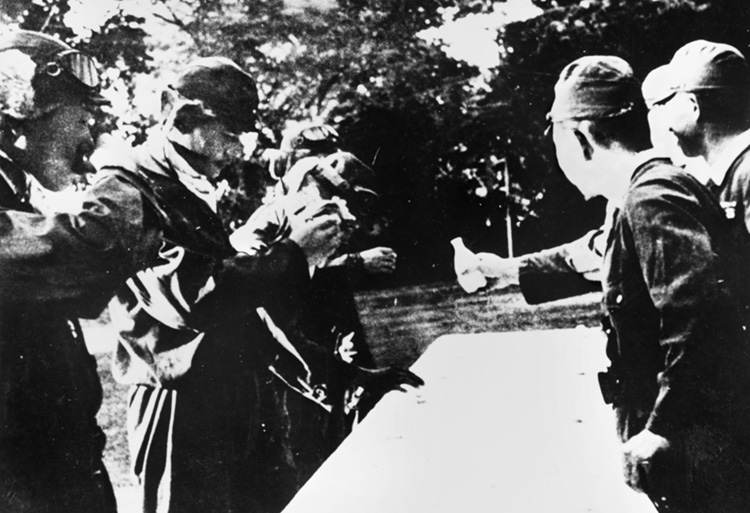
Admiral
Takijiro Ohnishi (right), commander of the Kamikaze Special Attack
Force, dispenses ceremonial cups of sake to suicide pilots about to take
off.
The initial missions had to be aborted:
mechanical failure grounded aircraft, enemy combat air patrols kept the
Japanese grounded, and bad weather prevented takeoff. It wasn’t until
the morning of October 25 that Lieutenant Seki and his group finally
launched their mission.
The Shimpu encountered a support carrier
group known to the Americans as “Taffy 3.” These Americans had already
been attacked by Imperial Japanese Navy surface forces days earlier in
Leyte Gulf. Now, one of the Shimpu group dove out of the sky at the
escort aircraft carrier USS Kitkun Bay (CVE-71).
Sailor Ron
Vaughn, an 18-year-old lookout on Kitkun Bay, spotted the plane as it
climbed, rolled, and plunged down on his ship, aiming for its flight
deck. The ship’s antiaircraft guns opened fire and damaged the plane as
it dove. One round crumpled the tail section, causing it to veer off
course. But the plane hit the water close aboard, damaging the ship and
causing scores of casualties.
Another Shimpu pilot dove on the USS
Kalinin Bay (CVE-68) and hit the deck of the carrier; two others were
driven off by the antiaircraft fire.
American fighter pilots
immediately raced to the scene to defend their home carriers. Despite
their efforts, three more Shimpu planes attacked the escort carrier USS
St. Lo (CVE-63) from above; the first Japanese plane was shot down by
fire from the St. Lo.
The second suffered the same fate, but this
aircraft drew the American’s attention away from the third aircraft,
which was following the ship and simply pulled up, nosed over, and
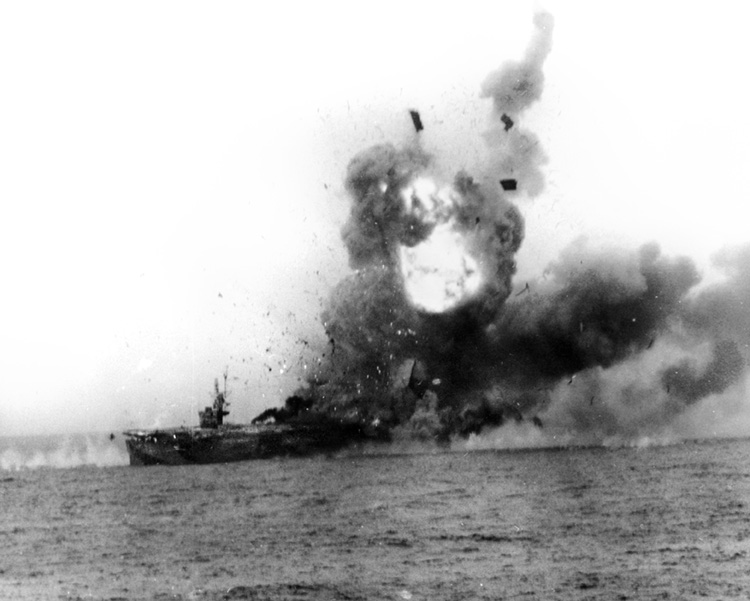
crashed into the vessel. Witnesses remembered that the plane sliced
through the flight deck, igniting fuel and ammunition in the hanger area
below that deck. One sailor insisted that he saw a bomb drop from the
aircraft an instant before the plane crashed into the ship.
The
impact doomed the St. Lo. Explosions rocked the ship from bow to stern.
Damage-control sailors raced around to save their ship, but it was no
use. Thirty minutes after she was hit, the St. Lo sank. With her went
140 American sailors. She was the first “official” kill of the Kamikaze
attack force.
Admiral Ohnishi committed suicide after Japan’s surrender.
Meanwhile,
the Kalinin Bay was hit again and severely damaged; the USS White
Plains (CVE-66) and USS Kitkun Bay were both narrowly missed. Although
all these three ships were damaged, casualties remained few.
Ashore,
the Japanese awaited the results of the first Kamikaze attack.
Commander Tadashi Nakajima was at his base on Cebu Island when three
Mitsubishi A6M Zero fighter planes landed there. Out of the first to
land came Chief Warrant Officer Hiroyoshi Nishizawa, who ran up to
Commander Nakajima and made his report: Of the five Kamikazes and four
escorts, he reported, Lieutenant Seki had hit a carrier, and a second
Kamikaze hit the same ship, which soon sank. The third Kamikaze struck
another carrier, setting it afire. The fourth plane crashed into a light
cruiser which “sank instantly.” The fifth Kamikaze disappeared. Three
of the four escorts managed to return to Cebu.
The report was a
fiction. In fact, only the USS St. Lo was sunk, with the Kitkun Bay and
White Plains damaged. No light cruiser was struck on October 25. This
report, inaccurate as it was, was forwarded to Tokyo, which accepted it
at face value and broadcast it to the Japanese nation as a great victory
by the newly established Kamikaze Corps.
Believing a great
success had been achieved from a small group of aircraft, the Kamikaze
program continued on October 26. For the expenditure of five Kamikazes
and two escorts, the light carrier USS Suwannee (CVE-27) was slightly
damaged. Earlier, the USS Santee (CVE-29) had been damaged by a Kamikaze
that approached so swiftly that no guns had been able to fire before it
slammed into the ship.
By now, the standard operating procedure
for the launching of Kamikazes had been established. First, they would
await a report from a search plane that would locate, identify, and
report on an American carrier group. Often, these reports were
inaccurate, and a mission would have to be aborted when no ships were
found by the Kamikaze pilots. Each Kamikaze flight had at least two
escorting fighters to assist them in getting past the American combat
air patrols that protected the American carrier battle groups.
Weather
was, of course, always a factor. How many Kamikazes were assigned to
any one mission depended upon the conditions reported by the scouts.
Approaching their targets, the Kamikazes would increase their speed to
make their approaches while the escorting fighters protected them from
the combat air patrol. The signal, “All Planes Attack!” was given by the
flight leader’s raised arm, and each pilot picked his own target, then
plunged down toward it.
The deeds of the “Kamikaze Special Attack
Corps,” one of the names for the new Kamikaze force, had by now reached
Tokyo. Emperor Hirohito had responded to this new tactic with a message
to his naval aviators through Admiral Ohnishi. The message read, “Was it
necessary to go to this extreme? They certainly did a magnificent job.”
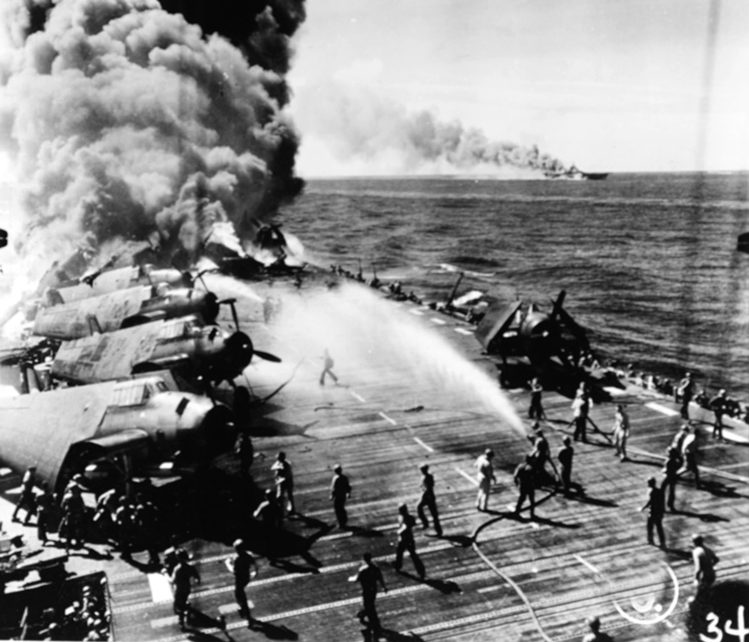
Crewmen
aboard the carrier USS Belleau Wood off the Philippines pour water on
aircraft and burning flight deck after a Kamikaze strike, October 30,
1944. The carrier USS Franklin, also hit by a suicide plane, burns in
the distance.
Captain Inoguchi, who was with
Admiral Ohnishi in Manila, felt that the first sentence of the Emperor’s
words were something of a criticism of Ohnishi’s new project, and
Ohnishi appeared quite upset upon reading this message. But he remained
determined to gain the Emperor’s favor by increasing his success.
Kamikaze
strikes continued against American ships throughout the Philippine
Campaign, including the invasion of Luzon and the clearing of the
southern Philippines.
Meanwhile, the idea spread throughout the
Imperial Japanese Navy and was taken up by the Imperial Japanese Army,
as well. One of the chief reasons for this was the lack of skilled
pilots. At the outbreak of the war, Japanese pilots had been the best of
the best. But over the three years that the war had thus far
progressed, attrition had whittled down those expert pilots to a
precious few, many of whom where now busy training their replacements.
But
the training of new pilots took time and fuel, neither of which the
Japanese had in abundance. A Kamikaze pilot, though, did not need the
in-depth training that a pre-war fighter pilot needed. He only needed to
be able to take off, fly a distance, and crash into an enemy ship. Even
formation flying was optional, although helpful.
As one historian
has written, “Loss of aircraft and veteran pilots and shortages of fuel
led to a reliance on suicidal Kamikaze units by 1944, made up of
largely green, ill-trained aviators and a mélange of planes.”
The
Kamikaze idea had by now spread far and wide among the Japanese
military. Soon Kamikaze Corps were being established in Japan itself.
Those forward bases under attack by the advancing Americans were often
provided with some “Special Attack Units.” Soon this title was expanded
to other suicidal methods of defeating the enemy.
One such method
was known as the “Kaiten”—a manned suicide torpedo that was intended to
sneak into American-held harbors and sink enemy ships at anchor. Then
came the “Ohka” (Cherry Blossom)—a human-piloted bomb released from a
carrying aircraft over the target and flown into that target by the
pilot.
The
first major warship sunk by the Kamikazes was the carrier USS St. Lo,
which was hit off Samar in Leyte Gulf, October 25, 1944. One hundred
forty Americans died.
There were also suicide
explosive speedboats (“Shin’yo” or Sea Quake)—small plywood craft filled
with explosives and driven by a crew of one or two into enemy ships as
they approached the shore of a Japanese base. Hundreds of these were
later captured unused in the Philippines and Okinawa.
At the war’s
end, near Okinawa, even the Imperial Japanese Navy’s super-battleship,
the IJN Yamato, was turned into a form of Kamikaze. (See WWII Quarterly,
Spring 2020.) But none of these other efforts achieved either the fame
or the success of the Imperial Japanese Navy’s “Kamikaze Special Attack
Corps.”
Some ships just seemed to draw the attention of the
Kamikazes. One such ship was the Australian heavy cruiser HMAS
Australia. Perhaps because her appearance different from that of
American ships, she was hit repeatedly, although her near-identical
sister ship, HMAS Shropshire, who often sailed alongside her, was never
hit. Some called her “the Kamikaze Magnet.”
HMAS Australia had
been in the war since the early days of 1939 and had earned herself an
enviable battle record. But she just couldn’t seem to shake the
Kamikazes. She was first targeted in Leyte Gulf on October 21, 1944,
leading some Australians to claim that she was the first victim of the
Kamikazes, and not the USS St. Lo.
That day, the attacking
aircraft was seen to be hit by antiaircraft fire and almost crashed into
the water. But the plane recovered, and despite further heavy
antiaircraft fire, punched into the port side of the heavy cruiser. This
sounds more like a “body-crashing” (Taiatari) tactic than a Kamikaze
attack, but the strike cost the ship her captain, Captain Emile F. V.
Dechaineux, along with five officers and 23 enlisted sailors. Scores of
others were wounded.
The ship returned to the war after repairs in
November, well after the Kamikaze had begun in earnest. In early
January 1945, the HMAS Australia was attacked no less than five times by
Kamikazes. On January 5, she was struck by a Zero, which hit her
amidships; 25 men on the gun crews died and another 30 were wounded.
Damage was slight, and she remained on station with a gunfire support
group off Leyte.
The next day she was hit again, at the middle
smokestack on the starboard side, killing 14 and wounding 26. Damage was
minimal, and she remained on station. January 7 was a quiet day, but
January 8 was not.
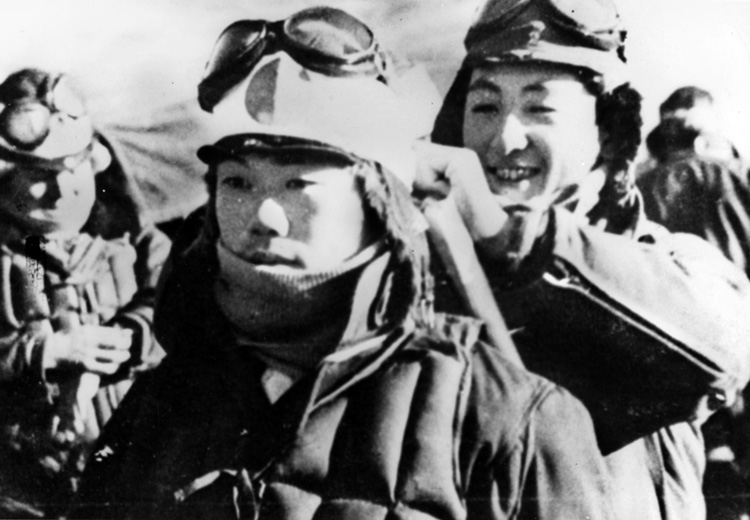
A
solemn Kamikaze pilot has his hachimaki headband, symbolizing manly
courage, attached by a smiling comrade. Ancient Samuri warriors wore a
folded white cloth when going into battle to keep their long hair and
sweat out of their eyes.
A Japanese bomber came
in, chased by four fighters of the combat air patrol. The enemy went
down barely 20 meters off the HMAS Australia’s port side. It skidded
into the cruiser’s hull, but caused no damage or casualties. Less than
20 minutes later, another Japanese bomber appeared and repeated the same
events. But this time, the bomb that the plane was carrying went off
and ripped a large hole in the cruiser’s port side, flooding two
compartments. Once again, there were no casualties. Asked if he wanted
to withdraw for repairs, Captain J.M. Armstrong refused and remained on
station.
By January 9, the Sixth U S. Army was wading ashore on
the main Philippine Island of Luzon, and HMAS Australia was offshore in
support. Eight Kamikazes came in searching for the invasion fleet, and
two headed for the Australia. One of these hit the USS Mississippi
(BB-41) and the other hit the Australia at her foremast, crushing her
forward smokestack and rendering the forward fire room inoperable. With a
hole in her side, her forward fire room out of action, and her speed
reduced, the Australia had had enough. This time she accepted the offer
to retire for repairs, once again with no additional casualties.
Kamikazes
appeared in almost every battle after Leyte. But by far their most
successful and deadly campaign came against the American invasion of
Okinawa. Here, Marines and the soldiers of the Tenth U. S. Army faced a
determined defense, one of whose primary objectives was to draw the
American fleet into a position that would make it vulnerable for attacks
from nearby Japan.
One of the negative by-products of rushing
pilots through an abbreviated training program to qualify them as
Kamikazes was that they had poor ship identification skills. This error
was felt most by the “small boys”—the auxiliary ships that often
accompanied the major fleet units to supply, fuel, and otherwise provide
succor to them when needed.
These included some described by
their titles, including LCS(L)3, or Landing Craft Support (Large) Mark
3. Developed from the original Landing Craft Infantry, or LCI, some had
been modified with rockets, machine guns, 20mm and 40mm guns, and other
assorted armament which, to the untrained Japanese pilot desperately
trying to find a target while avoiding the combat air patrol and
antiaircraft fire, were often mistaken for combat vessels such as
destroyers and even cruisers. As a result, these flat-bottomed,
diesel-powered, 160-foot-long ships often became the targets these
Japanese pilots were seeking.
The U.S. Navy’s Fifth Fleet, under
Admiral Raymond Spruance, was the largest in the world (535 warships),
but its position at Okinawa was exposed. It was committed to the island
for all manner of support and supply duties, which made its ships
stationary targets for the Japanese, who no longer had to guess where
the American fleet could be found.
To protect the fleet, the
Americans had established a series of “radar picket” posts around the
island to give early warning of the Japanese approach. Instead, these
soon presented to the Japanese aviators’ lonely targets, ripe for
attack. The radar-picket destroyers and destroyer escorts were supported
by various “little boys,” which were known at these posts as “pall
bearers,” since they spent so much time picking up survivors out of the
water, making them an inviting target for the Japanese.
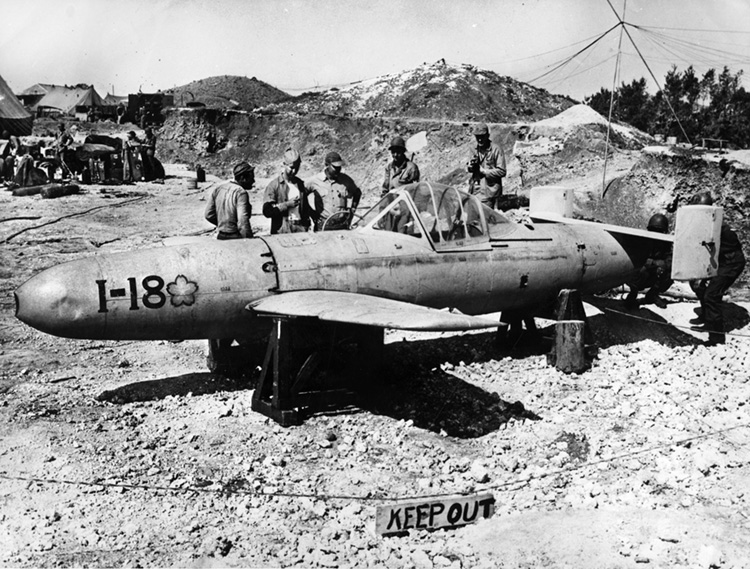
Marines examine a captured Yokosuka MXY-7 Ohka rocket-propelled suicide flying bomb found at the Yontan airfield.
The
Japanese reaction began slowly. On March 20, 1945, the Japanese
Imperial General Headquarters came up with a major offensive involving
Kamikaze pilots called Ten-Goō(“Heavenly Operation”). Tasked with
leading this operation was Vice Adm. Matome Ugaki, commander of the IJN
Fifth Air Fleet.
After gathering every flyable plane he could
find, no matter its obsolescence or original purpose, Ugaki assembled
3,000 of them at bases across Kyushu. The plan, dubbed Operation
Kikusui, was simple: guided by the few experienced pilots Japan had
left, the suicide pilots would be sent out in waves to find the American
ships and destroy them. The veteran pilots would then return to their
bases to pick up another group and repeat the process.
On April 6,
1945, the Japanese struck in force with Kikusui No. 1 against the U.S.
Navy’s Task Force 58 and the British Royal Navy’s Task Force 57, the
latter operating between Formosa and Okinawa. Some 700 planes—half of
them suicide planes—took off and went hunting for the Allied fleets.
The
first to be attacked at Okinawa were the destroyers USS Bush (DD-529)
at picket station number 1, the Colhoun (DD-801) at picket station
number 2, and the Cassin Young (DD-793) at picket station number 3.
Although the three destroyers put up a deadly screen of antiaircraft
fire, enough enemy planes got through to sink both the Bush and Colhoun;
the Cassin Young barely escaped the same fate—for now.
Elsewhere,
the destroyers USS Howorth (DD-592) and Hyman (DD-732) were severely
damaged, while the destroyers USS Leutze (DD-481) and Morris (DD-417)
were knocked out of the war. Destroyer USS Mullany (DD-528) was so badly
damaged that she had to be scrapped. Destroyer USS Newcomb (DD-586) was
also sent home for good, as was the USS Rodman (DD-456).
The list
of sunken ships included LST-447 and support ships Logan Victory and
Hobbs Victory. The minesweeper USS Defense (AM-317) went down as well.
The USS Haynsworth (DD-700) was damaged, as was the USS Feiberling
(DE-640). And this was only one day’s success for the Kamikazes.
The
suicide pilots also tried attacking two American carriers, the
Bennington (CV-20) and Belleau Wood (CV-24), but both ships escaped with
minimal damage.
Both sides suffered badly during Kikusui No. 1.
The Japanese had hit 17 American ships, sunk or knocked 11 out of the
war, and killed over 360 sailors. The Japanese, in turn, had lost over
350 planes and pilots—planes and pilots that could not be replaced.
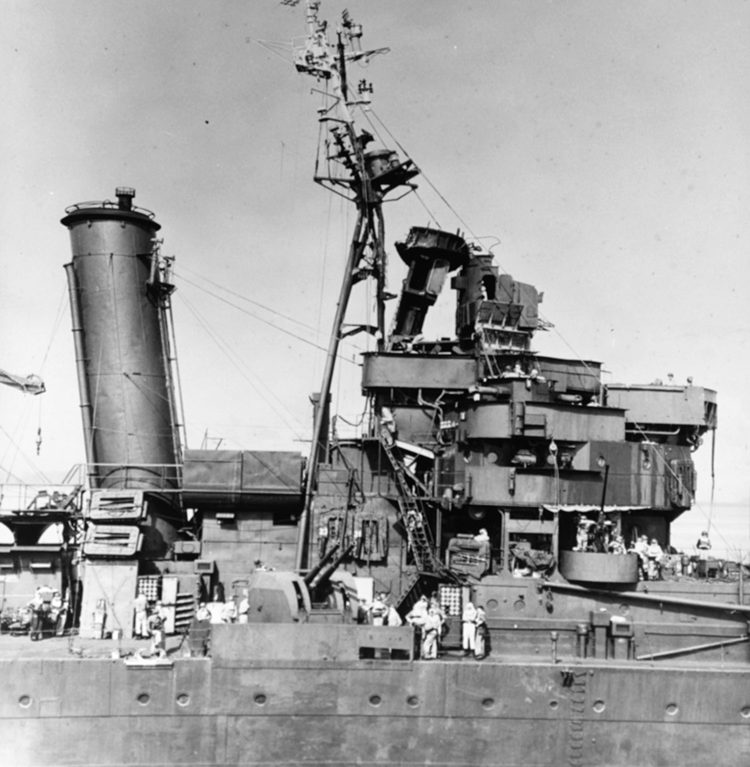
The
Australian heavy cruiser HMAS Australia, showing damage incurred on
October 21, 1944, was struck so many times by suicide pilots that she
earned the nickname “the Kamikaze magnet.” She was never sunk, however.
The
next day the massive battleship IJN Yamato steamed toward Okinawa and
her doom at the hands of the American pilots from Task Force 58.
The
loss of Yamato did not stop the Japanese from continuing their suicide
attacks on the Allied fleets. After suspending operations for a few days
due to bad weather, on April 11, Kikusui No. 2 was launched—a two-day
assault by 185 suicide planes accompanied by 150 escorts. The carrier
USS Enterprise (CV-6) was the first to feel the enemy’s sting, which
knocked it out of action for two days while repairs were made. The
carrier Essex (CV-9), too, was hit but not sunk.
On April 12,
another dozen ships were hit, with the destroyer USS Mannert L. Abele
(DD-733) and LCS(L)-33 going down. On that same day, the Cassin Young
was in the middle of the fight for her life, as she was targeted during a
heavy Kamikaze raid. Her gunners shot down five aircraft, but a sixth
crashed into her foremast, exploding in midair only 50 feet above the
ship.
Surprisingly, only one man was killed, but 58 were wounded,
many seriously. Although badly damaged, Cassin Young made it to Keramo
Retto under her own power and would return to Okinawa in May after
repairs. She would be attacked again in July, suffering major damage and
loss of life, but she refused to be sunk. (The ship is today on display
at the Charleston Navy Yard in Boston, Massachusetts.)
Each day,
one or more ships were being hit and disabled, if not sunk. The radar
picket posts were the most vulnerable, set far from other support and
usually exposed to the incoming enemy air raids before anyone else. The
raids went on daily throughout April, May, and June, and ship after ship
was lost to the incessant aerial attacks.
CinCPac Admiral Chester
W. Nimitz grew increasingly concerned and pushed Lt. Gen. Simon B.
Buckner, commanding the Tenth U. S. Army, to move quickly to clear
Okinawa of enemy resistance so that he could withdraw his ships from
Japanese target practice. But the Japanese ashore were as determined as
those in the air, and the battle continued well into June.
One the
worst attacks by the Kamikazes was that suffered by the USS Laffey
(DD-724), stationed at radar picket post number 1 on April 16. The first
USS Laffey had been sunk during the naval battles for Guadalcanal. The
current USS Laffey, laid down in 1942, had already established herself
as a worthy successor to her namesake and had participated in the naval
support during the landings in Normandy. On April 16, 1945, she would
prove her worth once again.
Soon after dawn, 50 enemy planes were
closing in on the fleet, and Laffey’s radar picked up four enemy planes
approaching her. Three were shot down by Laffey’s antiaircraft fire, and
the fourth was shot down by the guns on board Lieutenant Howell
Chickering’s nearby LCS(L)-51. Carrier-borne Corsairs were slicing
through the enemy formation, downing as many planes as they could.
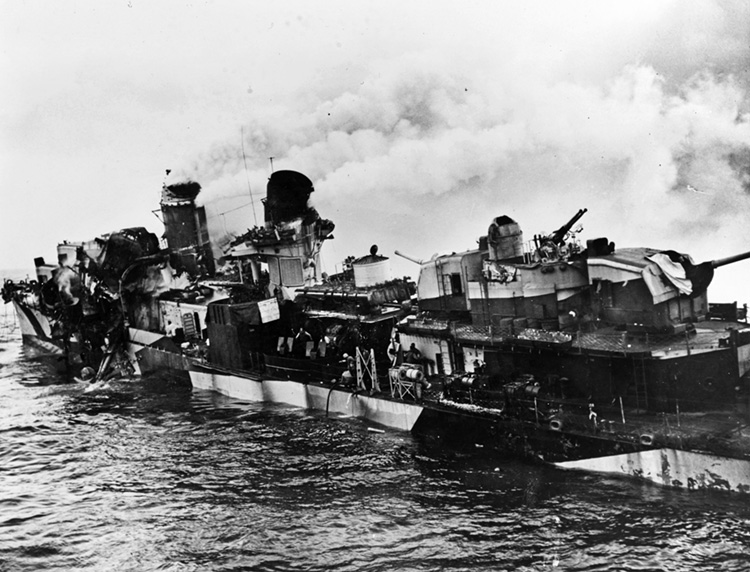
The
destroyer USS Hazelwood smoulders after being hit by a Kamikaze
attacker off Okinawa, April 29, 1945. Ten officers and 67 men were
killed, including the commanding officer; 36 were missing, presumed
dead.
A fifth plane attacked Laffey, only to be
shot down as well. Then a sixth streaked in, strafing the ship as it
approached. Several casualties resulted from the strafing before this
plane crashed into the ship at the after funnel, jamming the
fire-control radar.
A seventh aircraft smashed into the forward
gun mount and then ricocheted off the ship, leaving no serious damage.
An eighth plane was shot down as it attacked. But a ninth Zero used that
attack to approach undetected and crashed into the starboard 20mm
battery, damaging nearby 40mm batteries, starting a gasoline fire, and
setting off the ammunition.
Almost immediately, a tenth plane hit
the ship’s fantail, knocked out the aft 5-inch gun, and damaged three
20mm antiaircraft guns there. Plane number 11 dropped its bomb first
near the depth-charge rails before crashing into the aft 5-inch gun
mount, already damaged by a previous plane.
Plane number 12
dropped its bomb close aboard, jamming the rudder to a hard-left
position. The Laffey now had no operable guns in the rear of the ship.
The captain, Lt. Cmdr. Frederick J. Becton, now had a ship on fire and
with no guns protecting her stern. The Japanese quickly took advantage
of this weakness, and two more planes came in from astern, crashing
again into the 5-inch mount number 53 and killing several of the crew
who were fighting fires there.
Plane number 15 was shot out of the
sky as it approached from the port quarter. A pursuing combat air
patrol Corsair was so close on his heels that he hit the ship’s mast and
ditched nearby. But this attack knocked out the ship’s radar.
Plane
number 16 was next in line and was shot down over the ship by the
combat air patrol, but not before its bomb shredded the ship’s bow with
shrapnel, knocking out power to 5-inch mount 52, which continued to
operate manually.
Plane number 17 was shot down, and plane number
18 was disintegrated by a shell from mount 52. Plane number 19 was also
shot down, by mount number 51. A twentieth plane came in through the
smoke off the Laffey and dropped its bomb on mount number 53 before
breaking off the ship’s yardarm. It was then splashed by the combat air
patrol.
A
suicide pilot homes in on the carrier USS Enterprise during the battle
for Okinawa, May 14, 1945. The pilot destroyed Big E’s forward elevator,
killed 14, injured 32.
Plane number 21 also
dropped its bomb, knocking out two 20mm antiaircraft mounts before being
shot down by the combat air patrol. A final attacker was also taken out
by the combat air patrol.
The USS Laffey was miraculously still
afloat but in serious trouble. It was down at the stern, the rudder was
jammed, and most of its guns were disabled. Fortunately, the hull and
engines had not been damaged. She had been hit by six Kamikazes, damaged
by two other near misses, struck by three bombs, and had other close
calls. She lost 31 killed and 72 wounded, but the fires were soon under
control and the flooding stopped. She was towed to a repair base off
Okinawa and, after service during the Korean War, would eventually end
up as a memorial at Patriot’s Point, Charleston, South Carolina. Both
LCS(L)s supporting her also survived, although with significant
casualties.
But, like a swarm of angry wasps, the Kamikazes kept
coming. As the battle progressed, their attacks and numbers began to
thin out. Since Okinawa was lost and the next invasion would no doubt be
at Japan itself, the Japanese decided to hoard their remaining Kamikaze
planes and pilots for the final battle.
One of the greatest
tragedies to befall the American fleet was that of the carrier USS
Bunker Hill (CV-17), the flagship of Vice Adm. Marc A. Mitscher’s Task
Force 58. On May 11, the carrier was on station 76 miles east of Okinawa
when a Japanese “Zeke” fighter suddenly appeared out of the cloud
cover.
Having just been refueled with nearly two million gallons
of high-octane aviation fuel, the Bunker Hill was a floating Molotov
cocktail waiting for a spark. The Zeke crashed into the flight deck,
which was brimming with 30 planes waiting to take off; in the hangar
deck below were 48 more that had been fueled and armed.
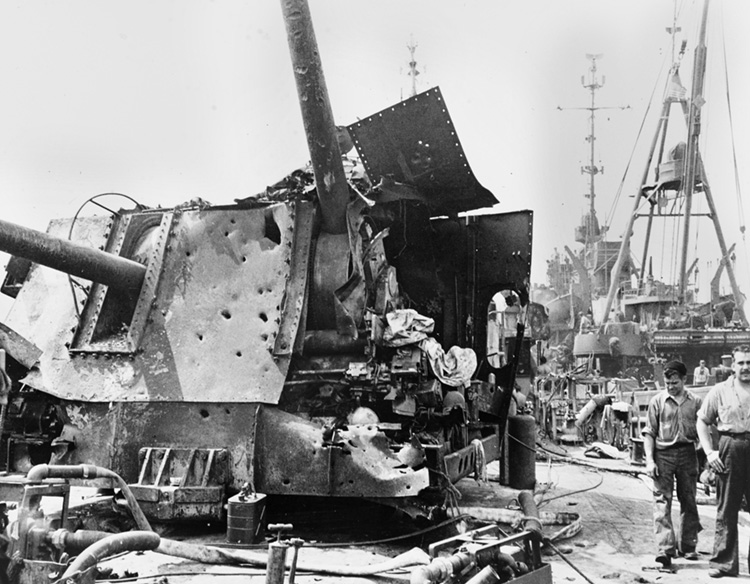
The
shattered 3.5” gun mount aboard the USS Laffey. The ship was attacked
by 22 Japanese planes on April 16, 1945, and struck by four bombs and
five suicide planes. Thirty-one sailors were killed, 72 wounded.
While
the planes on deck exploded and burned, another Kamikaze dashed in and
slammed into the ship’s control center, known as “the island.” Crewmen
sprang into action in a valiant, but ultimately futile, effort to
contain the blaze. Other ships pulled alongside to aid in the effort but
they, too, stood no chance against the roaring inferno.
In the
end, 346 officers and men out of the ship’s complement of 3,000 lost
their lives, 43 were missing, and another 264 were injured. The charred
wreck of the carrier managed to return for repairs to Bremerton,
Washington, via Pearl Harbor, but it would never fight again.
At
the end of the war, the Japanese themselves compiled a recapitulation of
the record of the “Kamikaze Special Attack Corps.” They recorded that,
of the 2,314 planes dispatched (including escorts), 1,086 returned. For
the 1,228 planes “expended,” they claimed 81 ships sunk and 195 damaged,
for a total of 276 ships.
Postwar records indicate that the
correct figures are 34 ships sunk, including three light carriers and 13
destroyers. Of the 195 ships the Japanese claimed as damaged, they had
actually damaged 288 ships, including 16 fleet aircraft carriers, three
light carriers, and 17 escort carriers. It should be noted that several
ships, like the HMAS Australia and USS Laffey, were hit repeatedly but
not sunk. So, the Japanese claim of a total of 276 enemy ships sunk or
damaged by Kamikazes is understated. In fact, they hit 322 allied ships,
sinking 34. It was not the “Divine Wind” of 1281, but it was a
respectable effort, nevertheless.
But, despite all her efforts to
halt the American invasion of Okinawa, Japan had shot her bolt. Once
Okinawa fell, she had very little chance of preventing a full-scale
invasion of the Home Islands.
As the intelligence officer of the Fifth Fleet put it, “The Japanese are defeated, but we have not yet won the victory.” The Kamakaze and the resistance on Iwo Jima and Okinawa with the suicides of the civilians jumping to their death sealed the fate of the Japanese, and the casualties that the Americans suffered prompted President Truman to use the Atomic Bombs to force a surrender.
Overall I was impressed, I know a lot about the battle, I have blogged about "Midway" a lot in the past. The Movie did touch on how out classed the TBD "Devastator" was against the Japanese and how bad the torpedo's we had. It wasn't just the Aerial Torpedo's that were bad, the Submarine Torpedo's sucked just as bad. It was a group of Submariners taking one of their torpedo's and hoisting it on a crane and dropping the torpedo straight down on the warhead contact .After the non explosion of the torpedo, it finally proved to the ordinance dept that the torpedo's were faulty. The Movie also touched on the conflict that the Japanese General Staff had, you had the Army that was worried about Russia and China and the Navy was concerned about the United States.
The General Staff was locked until the Doolittle raid shook up the Japanese Psyche.
Here is a technical analysis of the Movie. Sure it had technical inaccuracies but it was accurate in a lot of things and it is worth seeing with a bag of popcorn and watch the movie. I will be adding the blue-ray version to my collection.
I had ordered my gun socks from Amazon, got them for $7.00 apiece.. and got them in the mail last night..
I was happy since I would not have to deal with "Sportsman guide" and break my self imposed ban. Like I said, I and many other gun owners remembered how we were treated after Sandy Hook by them. I understand that it was all business and I get that...but I also remembered a quote from the book "The GodFather" by Mario Puzo "Sure you can say that it is all business and nothing is personal, but when it comes to business it is all personal." When you have a business relationship with someone or a company, there is an equal exchange for goods and service, you develop a business relationship and there is a certain loyalty that goes into the business relationship and the loyalty is a 2 way street.
Well anyway my O3, My Mosin and 2 of my .22LR rifles are now happy. They are all gunsocked, LOL.
I was loaned a book by a friend of mine from work, it talks about the battle of Midway from the Japanese perspective....and it is a different point of view..
I knew from past books and other articles that I have read, the Japanese Army and the Japanese Navy really didn't get along....we talk about the Army/Navy rivalry that the United States had...we still have it to a certain extent. I remember reading in a book called "Prodigal Soldiers"
"Documenting the
transformation of the U.S. military from Vietnam to the Gulf War, a
history of a generation of officers examines changing ideas about war,
ending the draft, reducing racial tensions, and integrating women into
the ranks."
Yep that book, I remembered buying a copy of the book in the late 90's and I was mesmerized because I lived through the story from my time in the service to going to the Gulf War. I remember seeing how my Dad was treated after Vietnam and how the Military was portrayed as the "Bad guys" in all the movies and TV shows to the debacle of "Desert One". The soldiers were afraid to wear their uniforms off post because how they would be treated. To the time in the early 1980's when President Reagan showed unabashed pride in being an American and it filtered down. From our first forays in Grenada in 1983, I remembered the commercials changing from "The Army wants to join you" to "Be all you can be" and the difference several years made as the United States Military transformed itself from the nightmare that Vietnam created to the force that crushed Saddam Hussain. But I digressed...I remembered reading about the group called "The Iron Majors" whose sole function was to make sure that their own service got all it could, even at the expense of the other service and the country..Well Japan had it far worse than we ever could. In the book I read that the Japanese Military was focused on 2 foes, the Japanese Army focused on Russia and the Japanese Navy focused on the United States and the 2 worked at cross purpose to each other. The Japanese Army was hungry for war, they have been fighting in China since 1937 but the Navy was far less interested in getting into a fight. Their squabbles went all the way up to the imperial staff that advised the emperor Hirohito. The book also explained that the attack in Pearl Harbor was an attack to keep the United Stated from interfering with the seizures of the Dutch East Indies and all their rich resources. I already knew that from my other reads but it was interesting reading it from their perspective. The book explained the Japanese philosophy of attack and defense and it is a very good read. I am half way through the book and hope to have it done in a day or so...depending on what else is going on.