Webster

The Constitution was made to guard the people against the dangers of good intentions." --American Statesman Daniel Webster (1782-1852)


Showing posts with label Air Force. Show all posts

Thursday, June 25, 2026

"Qatar Gifted Air Force 1 in Final Stages"


Sorry I couldn't post yesterday, Work got ahead of me.

      I snagged this off "Aviation Week"
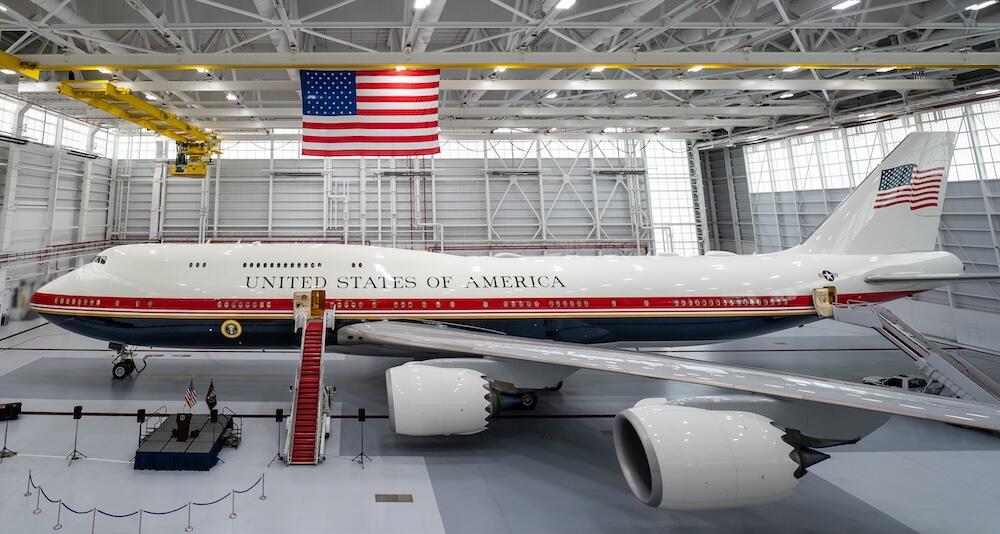
Air Force One

The U.S. Air Force has officially received the Qatar-gifted Boeing 747-8i and will conduct the final commissioning flights ahead of its entrance into service as the next Air Force One in the coming weeks.

The service announced June 19 that the aircraft, officially called the VC-25B Bridge Aircraft, had arrived at Joint Base Andrews, Maryland, where the Presidential Airlift Group will begin its introduction to the role. The aircraft has the new red, white, blue and gold livery, and “final government modifications.”

According to the Air Force, the new 747 fills an imperative to relieve pressure on the current aging VC-25A fleet, which has seen its heavy maintenance cycles extended.

“The safety and security of the commander in chief is our highest priority,” Air Force Secretary Troy Meink said in an announcement. “From the beginning, we meticulously evaluated every requirement to accelerate delivery while maintaining the high standards expected of the presidential mission. This effort proves that the U.S. Air Force can move fast without sacrificing quality, security or reliability.”

This final stage will allow White House officials to validate that the aircraft can meet the Air Force One mission, along with finalizing protocols for presidential transport, the service said in the announcement. Once completed, it will officially enter service in the executive airlift fleet alongside VC-25As and C-32s.

While many of the specifics have not been disclosed, the Air Force says this aircraft was modified with advanced technologies to meet the requirements of the mission. As Aviation Week first reported in January, the interior of the aircraft will remain largely the same. It is not clear how extensively the 747 has been modified for self-protection, which is a large driver of the work on the Boeing VC-25Bs that have been in development for several years. The Air Force announcement states some of the capabilities have been skipped.

“No risk was taken in security, safety or mission communications, but the collective team made trades on some of the less commonly used mission sets that Boeing must deliver to support the next 40 years,” the service said in the announcement.

As the aircraft was in modification, the Air Force has been training pilots to fly the 747-8i—a significant change from the existing 747-200 training for the current fleet. The service leased an Atlas Air 747-8F last October for training and has purchased two 747-8is from Lufthansa for training. Additionally, the Air Force says it delivered a full mockup of the interior in January for the White House to begin training.

“We are proud to deliver the VC-25B Bridge aircraft to the president,” Air Force Chief of Staff Gen. Ken Wilsbach said in the announcement. “Many thought it could not be done, but the United States Air Force was able to execute and provide a secure, reliable airborne command post on an accelerated timeline.”

Thursday, October 27, 2022

China Recruiting Western Pilots....

 I saw in several of the news sources that I follow that the RAF and other European Air Forces are refusing to recruit white males due to the "DIE" and adopting unrealistic "Diversity" goals so the white males are going elsewhere where their skills are in demand.  And from what I have read, the standards of the Western Air Forces have been "Broadened to allow maximum recruitment effort".  Whatever that means.  This concerns me to a degree, your fighter pilots are supposed to be the best in the world, but if you no longer allow or train for that, the cost in national treasure and prestige can be devastating.  I snagged this from a 3rd party in my work email.

TFASA says it is the only independent test-pilot school outside Europe and the Americas.


test pilots

On April 23, 2022, a Hongdu L-15/JL-10 jet trainer crashed in Anhui, China. Both pilots ejected from the aircraft safely, but what raised eyebrows was who was in the aircraft.

When villagers rushed to the scene, they videoed on their cellphones a Chinese pilot and, next to him, a non-Chinese pilot dressed in a sand-colored flight suit speaking in accented English.

The internet went abuzz with theories. Some said he was a Russian pilot working in conjunction with the Chinese on the L-15 aircraft project, and some suggested he was a test pilot from Serbia or Latin America, where China is hoping to market the aircraft.

Beijing never gave an explanation on the origin of the mysterious pilot.

  • South African company helps place Western pilots in China
  • Political indoctrination might affect Chinese pilots’ skills

Six months later, the UK government revealed that as many as 30 former British military pilots are in China providing training to the People’s Liberation Army (PLA). Since then, reports have suggested that China has also headhunted former Australian and French pilots for similar roles; French naval personnel are of particular interest because of their aircraft carrier experience.

A South African company, the Test Flying Academy of South Africa (TFASA), has been named as an intermediary for foreign pilots to work in China. It even advertises a four-year contract to work at an undisclosed location in “Far East Asia.” Job requirements state that pilots must be graduates of either a U.S. or UK military flight-test school.

An anonymous pilot in Australia tells Reuters that the company is “clearly targeting Western/Five Eyes test pilots,” the latter referring to Australia, Britain, Canada, New Zealand and the U.S. UK defense officials said the pilots are being offered “lucrative” pay packages worth more than £200,000 ($226,000) a year.

Following their UK counterparts, the Australian Defense Department has commenced an investigation to see if any ex-military pilots have been lured to China.

So what is TFASA? Formed in 2003, it states on its website that it is the only independent test pilot school outside Europe and the Americas. Its website sports numerous high-resolution photos of PLA aircraft—namely, the L-15, Shenyang J-16 and one image of an FTC-2000 with a group of Western pilots.

Jean Rossouw, a former test pilot with the South African Air Force (SAAF), is chairman of TFASA and a director of the China-linked Avic-International Flight Training Academy (AIFA). AIFA is a joint venture partner of TFASA. C. Jurie van Wyngaard, TFASA CEO, is also a SAAF pilot who previously held roles at Pilatus and Saab.

TFASA is also involved in aircraft sales for Blackshape Prime, Blackshape Gabriel and Ikarus C42 light aircraft.

Although the pace of the People’s Liberation Army Air Force’s (PLAAF) modernization has been quick, its tactics and operational concepts are not validated in any aspects. Countries such as Japan and South Korea are trained to Western standards, whereas India has combat experience against Pakistan, but the PLAAF remains untested. With the exception of a handful of exercises with Thailand and Turkey, Beijing has no benchmark for how its pilots and fighters will deal with potential foes.

Collin Koh, a research fellow at the Institute of Defense and Strategic Studies at the S. Rajaratnam School of International Studies in Singapore, says the current skills and tactics introduced by the foreign pilots could be hindered by existing PLAAF political indoctrination.

“In other words, Western and Western-inspired air forces tend not only to put more emphasis on the individual aptitude of the combat aviator but also give a wide berth of autonomy in decision-making,” Koh says.

“Given the extent of centralization and political control within the PLA, which we are seeing being strengthened under [Chinese President Xi Jinping], one should question whether inducting these new insights and skill sets from foreign instructors may make a significant difference in the way the PLAAF operates, unless there’s a monumental shift in the command and control as well as political indoctrination,” Koh continues.

UK officials say there is no evidence that pilots recruited to work in China have broken the Official Secrets Act, the UK’s primary law against espionage.

But since the government in London is taking a more hawkish line toward China, along with other European nations and the U.S., the UK’s Defense Ministry is considering what actions it can take to prevent military expertise from being transferred to potential adversary states in the future. In particular, the UK is looking at using confidentiality contracts and nondisclosure agreements to prevent such transfers of information. Meanwhile, a new National Security Bill currently being examined by lawmakers will create additional tools to tackle “contemporary security challenges,” officials say.


Tuesday, August 14, 2012

U.S. Military test hypersonic jet.


A superfast jet that could fly from L.A. to New York City in less than an hour may be one step closer to reality after a key test this week.

The X-51A WaveRider, an unmanned aircraft that could reach speeds up to Mach 6 will be launched from the wing of a B-52 bomber high above the Pacific Ocean on Tuesday, the Los Angeles Times reports.

The WaveRider is expected to zip up into the atmosphere and fly at hypersonic speeds—3,600 mph—for 300 seconds, before breaking up into the ocean.

If successful, if would be the longest jaunt for the test aircraft. The newspaper noted that the development of WaveRider could lead to progress on a passenger jet that could theoretically travel across the U.S. in 46 minutes.

"Attaining sustained hypersonic flight is like going from propeller-driven aircraft to jet aircraft," Robert A. Mercier, deputy for technology in the high speed systems division at the Air Force Research Laboratory in Ohio told the L.A. Times.

But beyond passenger flights, achieving hypersonic speeds could also lead to the development of the next generation of missiles, space vehicles and military aircraft, the Times points out.

The WaveRider program had an issue in June of 2011 when the test vehicle in a similar test to the one planned for Tuesday failed to reach full power.

The Pentagon said it spent about $2 billion on technology and engineering around hypersonic flight over the last decade, the Times reports. This program is estimated to cost $140 million, according to Globalsecurity.org, a military policy research website.

If you're keeping score, the Concorde, a supersonic airliner, crossed the Atlantic at 1,350 mph.

It would take about 3.5 hours, about twice as fast as current commercial airlines. The Concorde was retired in 2003

Sunday, June 17, 2012

Unmanned Airforce plane returns earth after 15 months in space.


I am glad to know that we do have a capability to launch something if we need it since the shuttle is "retired".  Having to depend on the Russians to launch anything if we need it is asking for trouble.
LOS ANGELES (AP) — An unmanned Air Force space plane steered itself to a landing early Saturday at a California military base, capping a 15-month clandestine mission.
The spacecraft, which was launched from Cape Canaveral Air Force Station in Florida in March 2011, conducted in-orbit experiments during the mission, officials said. It was the second such autonomous landing at the Vandenberg Air Force Base, 130 miles northwest of Los Angeles. In 2010, an identical unmanned spacecraft returned to Earth after seven months and 91 million miles in orbit.
The latest homecoming was set in motion when the stubby-winged robotic X-37B fired its engine to slip out of orbit, then pierced through the atmosphere and glided down the runway like an airplane.
"With the retirement of the Space Shuttle fleet, the X-37B OTV program brings a singular capability to space technology development," said Lt. Col. Tom McIntyre, the X-37B's program manager. "The return capability allows the Air Force to test new technologies without the same risk commitment faced by other programs. We're proud of the entire team's successful efforts to bring this mission to an outstanding conclusion."
With the second X-37B on the ground, the Air Force planned to launch the first one again in the fall. An exact date has not been set.
The twin X-37B vehicles are part of a military program testing robotically controlled reusable spacecraft technologies. Though the Air Force has emphasized the goal is to test the space plane itself, there's a classified payload on board — a detail that has led to much speculation about the mission's ultimate purpose.
Some amateur trackers think the craft carried an experimental spy satellite sensor judging by its low orbit and inclination, suggesting reconnaissance or intelligence gathering rather than communications.
Harvard astrophysicist Jonathan McDowell, who runs Jonathan's Space Report, which tracks the world's space launches and satellites, said it's possible it was testing some form of new imaging.
The latest X-37B was boosted into orbit atop an Atlas 5 rocket. It was designed to stay aloft for nine months, but the Air Force wanted to test its endurance. After determining the space plane was performing well, the military decided in December to extend the mission.
Little has been said publicly about the second X-37B flight and operations. At a budget hearing before the Senate Armed Services subcommittee in March, William Shelton, head of the Air Force Space Command, made a passing mention.
That the second X-37B has stayed longer in space than the first shows "the flexibility of this unique system," he told lawmakers.
Defense analysts are divided over its usefulness.
Joan Johnson-Freese, professor of national security affairs at the Naval War College, said such a craft could give the U.S. "eyes" over conflict regions faster than a satellite.
"Having a vehicle with a broad range of capabilities that can get into space quickly is a very good thing," she said.
Yousaf Butt, a nuclear physicist and scientific consultant for the Federation of American Scientists, thinks the capabilities of the X-37B could be done more cheaply with a disposable spacecraft.
"I believe one of the reasons that the mission is still around is institutional inertia," he said.
The arc of the X-37 program spans back to 1999 and has changed hands several times. Originally a NASA project, the space agency in 2004 transferred it to the Pentagon's research and development arm, DARPA, and then to the secretive Air Force Rapid Capabilities Office. Hundreds of millions of dollars have been poured into development, but the current total spent remains a secret.
Built by Boeing Government Space Systems, a unit of the company's satellite manufacturing area, the 11,000-pound space plane stands 9 1/2 feet tall and is just over 29 feet long, with a wingspan of less than 15 feet. It possesses two angled tail fins rather than a single vertical stabilizer. Once in orbit, it has solar panels that unfurl to charge batteries for electrical power.
McDowell of the Jonathan's Space Report sees a downside. He noted it'll be tough for the Air Force to send up such planes on short notice if it has to rely on the Atlas V rocket, which requires lengthy preparations.
"The requirement to go on Atlas V is a problem; they may need to look at a new launch vehicle that would be ready to go more quickly," he said