Webster

The Constitution was made to guard the people against the dangers of good intentions." --American Statesman Daniel Webster (1782-1852)


Showing posts with label American Rifleman. Show all posts

Wednesday, October 28, 2026

"Ori-Gun-I" The ZEV Technologies FDP Carbine"


I was reading my "American Rifleman magazine, and saw this and was thinking *wow*, If you wanted something that you could stick into a regular backpack or a briefcase and not really draw attention to yourself, this would do it.  Most of the Normies would have no idea what it is and it would allow you to take it to places that wouldn't draw attention to yourself and give you options on defending yourself incase the people with bad intentions show up in places where they are not supposed to be.   The possibilities are intriguing. 

   I with absolutely no shame clipped it from "American Rifleman"


Magpul/ZEV FDP Carbine
Photos by Forrest MacCormack

How do I even begin this article? On the one hand, a straight-up history of various folding firearms would be a place to start, given that “FDP” stands for Folding Defensive Platform. We could start with some of the flintlock and percussion-cap pistols of the 18th and 19th centuries that had folding triggers. There’s the Burgess folding shotgun of the late 1800s (a design we’re seeing coming back around in the Pak 12 introduced at SHOT Show 2026). There’s also the Russian PP-90 or the Ares FMG, and even more recently, the KelTec SUB2000, folding Glock G19 and Smith & Wesson FPC. Guns that fold are really not all that novel or new.

What about discreet firearms? There’s the Heckler & Koch MP5K Operational Briefcase or the Military Armament Corporation MAC 10 and 11 briefcase designs. The Lifecard looks like an oversize credit card until it is folded out to a single-shot pistol. We could even toss the belt-buckle-riding North American Arms mini-revolver in the mix if we use the “hiding in plain sight” method of (non)concealment. These options are fewer and farther between than straight-up folding guns simply because of Any Other Weapon (AOW) considerations; basically, if a firearm doesn’t look like a firearm when it is capable of firing, it is considered an AOW and therefore falls under NFA regulations. Even some wallet-style pocket holsters can run afoul of this burdensome regulation if they allow the holstered gun to fire when in the holster itself (in addition to not being exactly safe for carry).
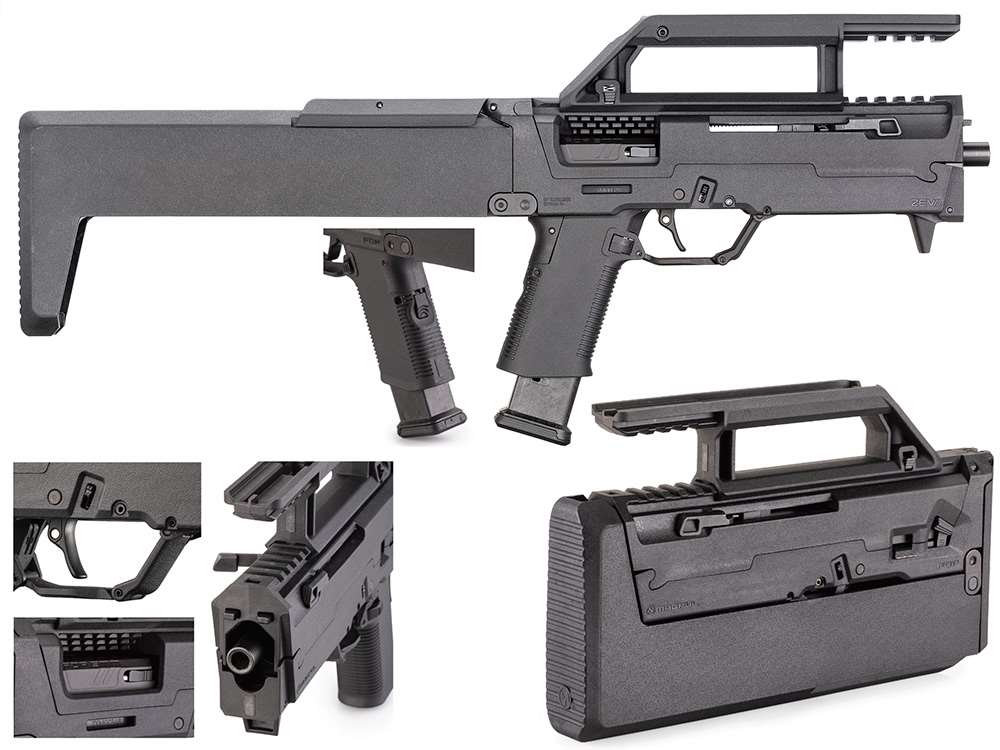
Magpul/ZEV FDP Carbine features
In its folded configuration, the FDP certainly doesn’t look like a traditional firearm • Even in the open position, the FDP has an unconventional profile • The trigger also folds as part of the mechanism, and it includes an automatic firing-pin safety • The position of the extractor serves as a loaded-chamber indicator • Its unconventional appearance extends to the muzzle due to the polymer enclosure • Standard 17-round Glock magazines will fit flush in the grip, while the included 21-round magazines are slightly extended.


It’s the rare confluence of folding design and discreet nature that make the FDP so interesting. Looking at the folded firearm, it looks like—well, it looks like a tool kit you’d see on “Star Trek” or something. It doesn’t look like a firearm, which was the original intention behind the predecessor to the FDP, the FMG-9.

Drake Clark, Magpul’s sales and business development manager, walked the floor of SHOT Show with a folded FMG-9 stuck in his back pocket (with the carry handle removed), taking time to show it to folks he knew who would be interested (which should be everyone, because it’s just that darn cool). Per Clark, as a matter of fact, “Really what we wanted was the Russian folding gun, the PP-90, but that wasn’t happening. You can’t easily get your hands on an Ares folding gun like in Robocop [2] either. If we can’t get the cool thing we want, we build it. We like cool s**t and we like tinkering, key ingredients of the Magpul recipe.”

The funny part, though, is that the FMG-9 wasn’t even Magpul’s first foray into firearm prototyping. Two years before the FMG-9 caused a stir at SHOT Show, Magpul had unveiled the PDR, a futuristic bullpup that looked like the love child of a PS90 and an M4. Around the same time as the FMG-9, the Masada—the rifle that would turn into the Bushmaster/Remington ACR— was also revealed, aiming at the piston-driven market dominated by FN’s SCAR and LWRCI’s M6. Magpul reiterated with the FMG-9 that, while not a firearm company, it could certainly produce cool prototypes.

As mentioned, the FDP started life as the FMG-9, introduced at SHOT Show 2008—yes, that’s right, if it were a human, it would be old enough to vote now. In 2021, the project transmogrified into the FDP, which is finally hitting store shelves some 18 years after the first prototype wowed us. It’s been a long road, but the Magpul (and Zev) folding pistol-caliber carbine has finally moved past the cryptid-like status of other firearms like the revitalized Bren Ten or the resurrected AutoMag.

But, it hasn’t really been in production purgatory for 18 years, mind you. When the FMG-9 was displayed at SHOT, it was fully intended to be a “look what we can do” sort of thing, not a “we are going to have this for sale.” After returning from a vacation abroad in late 2007, Mike Mayberry (the designer behind the PMag) took inspiration from the Ares FMG, sat down at his design table and whipped up what would become the FMG-9. Some late-night hustling with an early 3-D printer, and prototypes were ready for SHOT Show in January 2008.
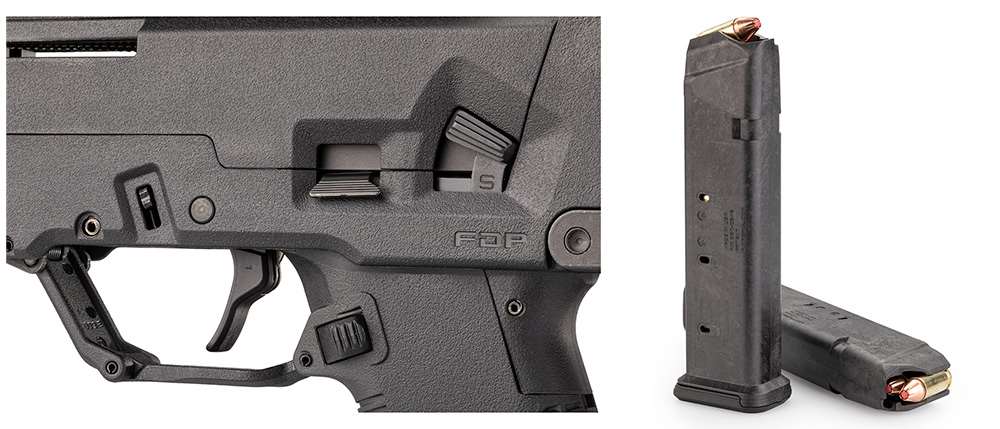
Magpul/ZEV FDP Carbine controls and magazine
Controls are centrally located—as expected—on the left side of the FDP, with the magazine release, thumb safety and slide release all accessible from a firing grip • Two 21-round Magpul PMags are included with the FDP.


Having the FMG-9’s likeness displayed in an extremely popular video game series in 2011 only intensified the mystique of Magpul’s folding carbine—but remember, it was never intended to go into production. Think of it like the fantastic concept cars that GM and Ford roll out to drum up interest, but are never going to make, like the Cadillac Sixteen revealed in the early 2000s with four-wheel steering and a 13.6 liter, V16 engine. The Sixteen was never produced, but the four-wheel steering made it into production vehicles.

What jump-started the project and turned the corner into reality was a partnership with Zev Technologies in the late 20-teens. Zev’s OZ9 pistol and its chassis concept became the basis for the FDP, the successor to the FMG. Magpul would make the polymer bits, the stock, mags and carry handle/sight array; Zev would make the barrel, slide and fire-control assembly. In 2021, the FMG-9 morphed into the semi-automatic FDP, and the folding firearm project was officially underway.

Yes, it took a little bit of time for the concept to become a reality. Zev Technologies president Taylor Goode explained, “Inno-vation doesn’t happen overnight. The FDP is literally a gun that folds. Not a chassis—a true folding gun. Getting it from concept to production took a lot of engineering, both on the “go-bang” internals and the folding shell from our friends at Magpul. We know folks waited a long time to see this one come to life, but we set out to create an entirely new platform that exceeds expectations, not a novelty. That requires a lot of due diligence. The result has been worth the wait.”
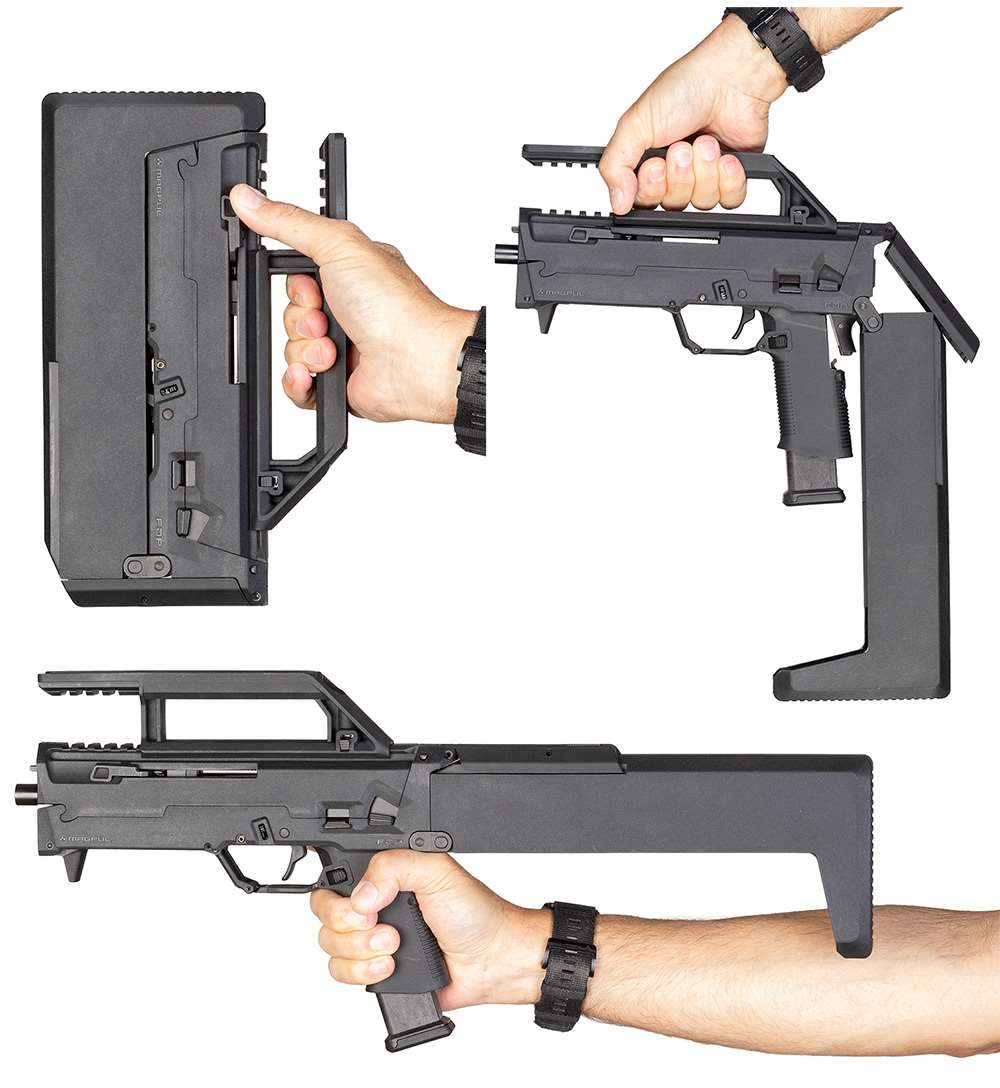
Opening the FDP
Opening the FDP involves holding it with the hinge pointed downward, depressing the charging handle slightly and letting gravity unfold it into position. Ensure the stock cover and grip levers are locked.


So, with all this information about the work that went into the design and eventual production of the FDP, what does it boil down to? It might be tempting to dismiss the FDP as a gimmick; after all, the party trick of the unfolding is pretty showy and attention-getting. To be fair, that’s not a bad thing; as Tamara Keel has made the case—repeatedly—in her “From the Counter” column in this very publication, that shooting is and should be fun. Bring the FDP to the range, and I guarantee you will raise the interest of your fellow shooters. It is most decidedly different; no question about that.

More importantly, it is not a one-trick pony. It offers a lot more than just the novelty of “hey, this toolkit-looking thing turns into a pistol-caliber carbine”—it’s actually a quality, capable firearm as well. Granted, when you see the names “Zev Technologies” and “Magpul” as the two companies behind the FDP, it’s tipping your hand as to how the gun can be expected to work. Neither company is any slouch in the excellence department; combined, the result should be spectacular.

And the FDP really is great. While recording some video for social media, we ran a number of magazines through the FDP quickly (slow-fire, when recorded in slow-motion, is about as much fun to watch as paint drying). Not only were there no malfunctions, but the accuracy (even with the … ahem … rudimentary sights) was top-notch. At 25 yards, I think maybe a half-dozen rounds left the C-zone of a standard IPSC target—and I was not taking my time with a solid shooting stance and focusing on the basics.

The folding component is definitely more than just an attention-getting device, too. The careful, clever engineering that goes into the FDP allows it to look rather innocuous—if you were to transport it in a messenger bag, should someone peek inside, they’d see a nondescript black case. It’s not like a large-format pistol that will immediately alert others to the presence of a firearm. Also, it takes standard Glock magazines, so if you carry a Glock-based 9 mm handgun, you’ve got the added convenience of double-dipping in your feeding devices.
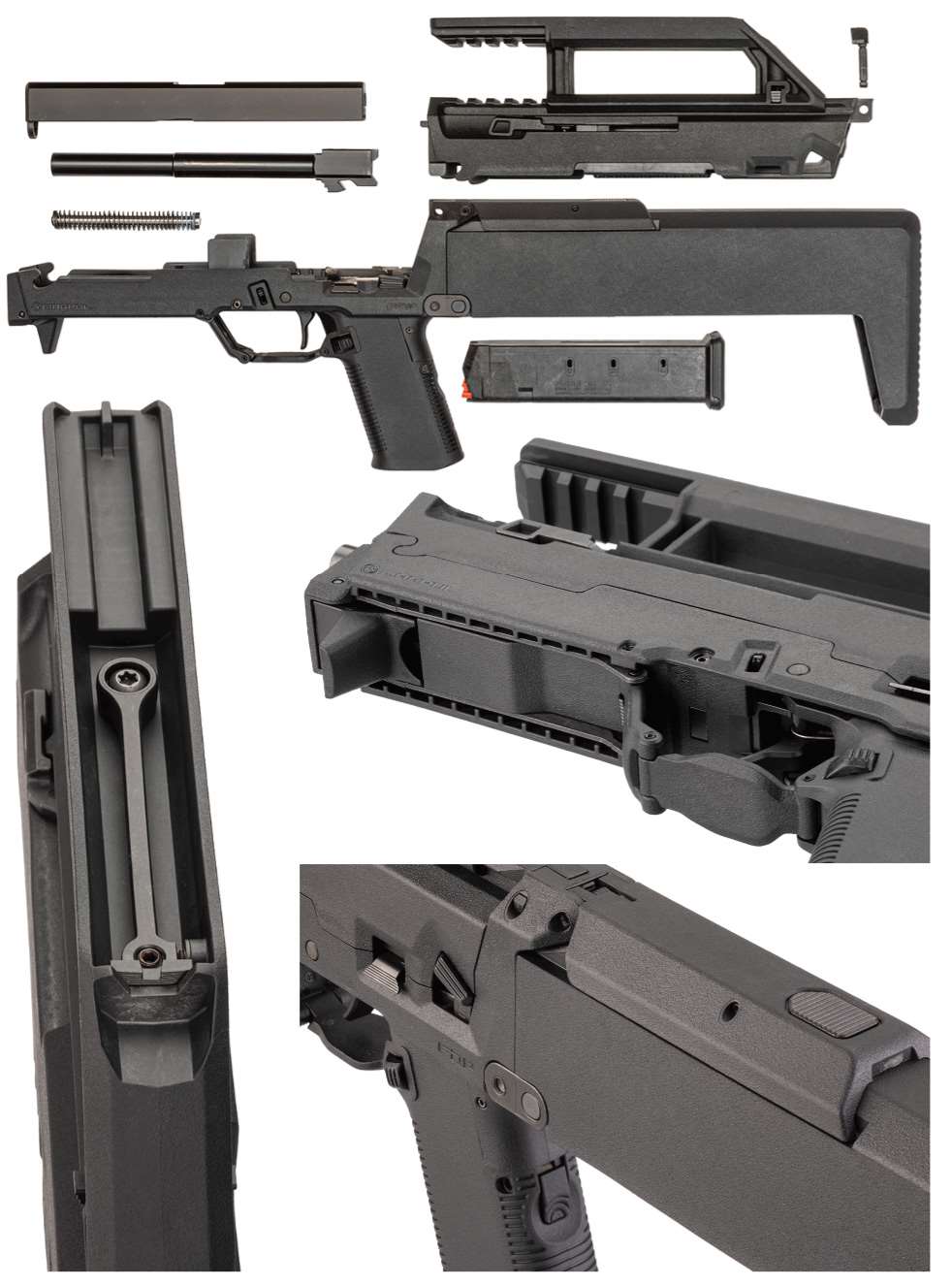
Magpul/ZEV FDP Carbine features
Taking down the FDP for cleaning follows the same procedure as most striker-fired handguns, with the added step of removing the top cover first • Integral to the carry handle are the black front and rear sights • The folding trigger guard and molded hand stop are visible underneath the FDP • The lever on the top of the stock and on the back of the grip need to be depressed to close the FDP.


There are some drawbacks, to be sure. If you, like me, prefer red-dot sights on your defensive carbine, while it’s certainly easy enough to add one to the FDP, you lose the element of surprise. It will still fold, of course; however, when it is in the folded configuration, the red-dot sight will be clearly visible, thereby diminishing the “hiding in plain sight” aspect of the folded FDP. It’s also an SBR, which in and of itself isn’t a huge issue with the tax reduced to zero thanks to the efforts of your NRA. However, there are certain rules currently in place with SBRs that make ownership less convenient than for suppressors—namely the requirement to alert ATF if you’re taking it to a different state. Efforts are underway to change this, but at present, it remains a consideration.

If you want to accessorize the FDP, it’s not as easy as a traditional carbine. There aren’t any M-Lok slots to add lights or lasers. There’s no section for accessories, nor any ARCA rail or sling swivel studs for a bipod mount. But again, that’s not why you’re buying the FDP. It’s the “foldy-boi” aspect, not the ability to trick it out, that gives the FDP its appeal.

Let’s talk about the folding part. It’s both ingenious and simple. To unfold the FDP, simply grasp the carry handle with the fold facing the ground. Depress the charging handle slightly, and the gun unfolds into its usable form. Make sure that both the pistol grip and the cover plate at the top of the buttstock are locked into position, then insert a loaded magazine and use the charging handle to load. To fold it up, make sure it’s unloaded (check twice, just to be safe) and close the slide. Push the lever on top of the stock cover plate as well as the lever on the grip to unlatch both, and then the FDP can be closed.

Operationally, it’s basically an overgrown handgun. The magazine inserts in the grip, the barrel tilts up during firing (which makes it look odd when shooting with a suppressor attached, but I digress) and the controls are where you would expect them to be on pretty much any polymer-frame, striker-fired handgun. The magazine catch is reversible, and the charging handle (which, of course, also folds) is mirrored on the right and left sides; the safety lever is right-hand only, as is the slide-release lever. There’s a vestigial loaded-chamber indicator built into the extractor that is flush with the slide when a round is inserted for additional peace of mind, too.

Since it uses a short-recoil-operated, locked-breech system rather than simple blowback, recoil is quite light, even for an already-gentle 9 mm SBR. The sights are functional and adjustable, and accuracy is about what you’d expect from such platforms. You’re not going to win bullseye competitions with the FDP, but it’s certainly accurate enough for home- and self-defense scenarios, even those at more extended distances. At close ranges, the type you’d see for typical self-defense engagements, it’s easy to put rounds right where you want them pretty much as quickly as you can pull the trigger.
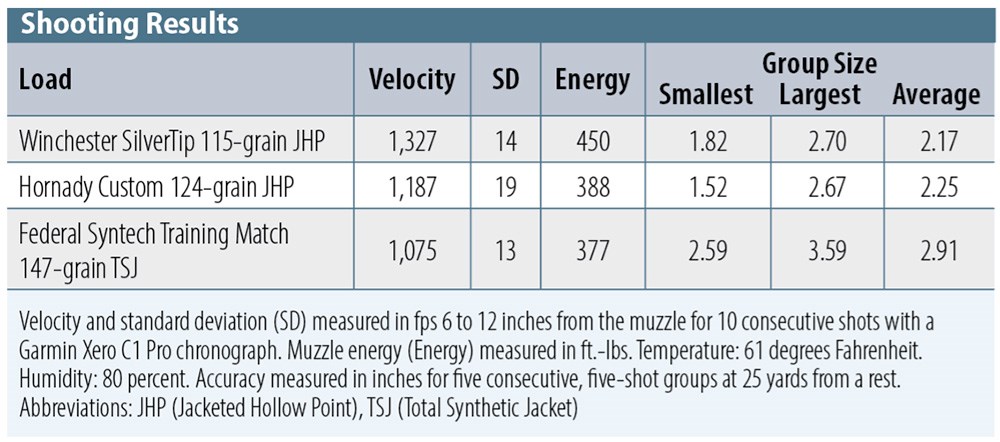
Magpul/ZEV FDP Carbine shooting results

More critical is reliability—I wanted to give the FDP a workout, so more than 500 rounds were fired (It’s also crazy fun on the range, so I might have run a few more magazines than usual). One single stovepipe was experienced, toward the end of testing when the FDP had gotten both rather hot and pretty dirty. I’m not terribly concerned, as it happened with a magazine of questionable vintage (a “pre-ban” Glock 33-round magazine I’ve owned for almost 30 years). One lone failure out of 500 rounds isn’t a dealbreaker in my opinion, especially if you clean and lubricate properly.

It’s hard not to love the FDP. Combining “cool factor” with a gun that actually functions well and can be used for defensive purposes is a fait accompli; there’s definitely cachet to having an eye-catching firearm that also serves a useful purpose. Even if the FDP wasn’t great for self-defense—and it is great for self-defense—it would still be an important addition to the firearm market; the engineering that goes into the folding characteristics will almost certainly be carried over into future projects.

Useful, cool and reliable? That’s a trifecta of awesome in my book. If you want it because it’s neat, it certainly is. But, if you want it because it’s neat and you can actually use it, that’s its true beauty, because it simply works and works well.
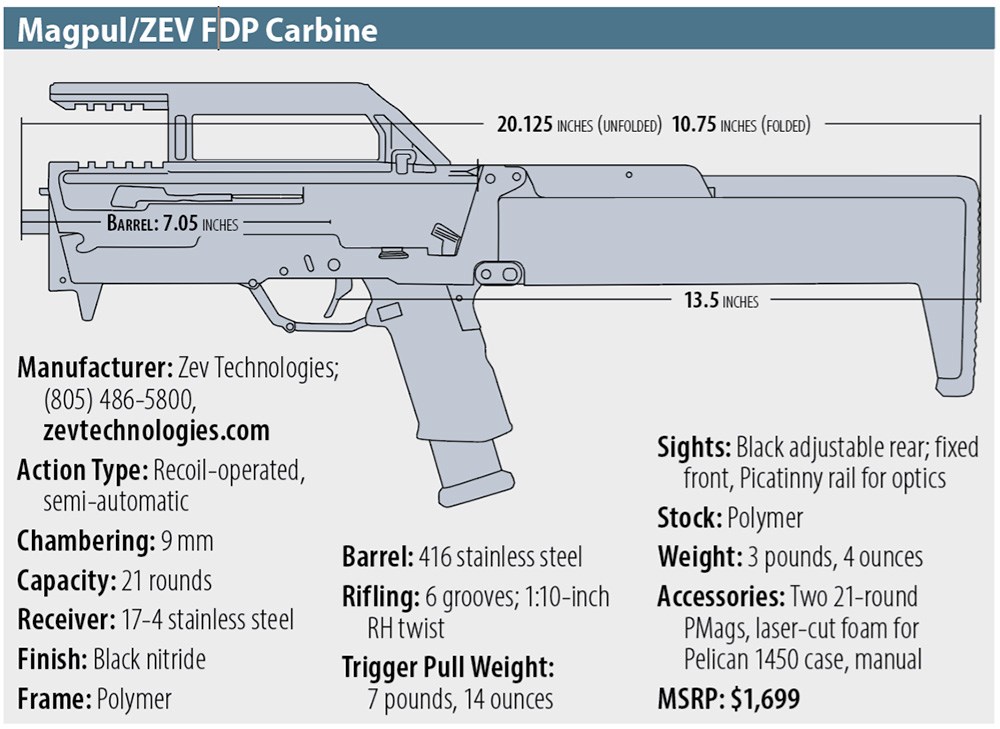
Magpul/ZEV FDP Carbine specs

Thursday, August 27, 2026

"CZ Discontinues the 75 line"


I always had a soft spot for the "CZ" line of pistols, when I was in Germany, they were considered the "Gold Standard" for pistols, especially 9mm's in the 1980's.  Sure the Browning Hi-power was famous, but the CZ-75 to those in the know definitely was no slouch.  I own several CZ type of pistols and a CZ shotgun, a "CZ-107" kinda unusual.  


       I had picked up a CZ75C "Compact" it is a 9mm pistol The Czech-Republic made compact variant of the legendary CZ-75, these particular 9x19mm chambered pistols were an Israeli contract order. Note the additional slide markings of the Massada and Menora image.


 Supposedly these were issued to park rangers at the Masada Park which is where the historic Masada Fortress is located. The odd thing is the misspelling of Massada on the slide, leading some to believe these might be fakes; intentionally made up to be some sort of rare surplus pistol. However, most collectors do believe these to be real genuine Israeli handguns. One interesting feature on these Massada pistols is that they use a dual recoil spring setup, unlike other CZ compacts. (GRH)

      I wanted a CZ for a long time and wished that I had bought  a CZ75 back when I was stationed in Germany now I have one although it is a compact.  I had a heck of a time finding any real info on the pistol.  The Ergonomics feel really good, almost like my baby Beretta...before i lost it in that durn canoe accident.....*sniff*.


I shamelessly clipped this from "American Rifleman"

CZ Honors

For more than five decades, the CZ 75 has stood at the center of the CZ story. The distinctive pistol was designed by Frantisek Koucky, in what was then the nation of Czechoslovakia without the computerized engineering or 3D modeling so common today. The handgun launched a tradition of innovation and shooting characteristics that helped establish the company’s enviable reputation with generations of shooters around the world. As CZ honors that legacy in 2026, the company will also conclude production of three longstanding members of the CZ 75 family: the CZ 75 B, CZ 75 BD and CZ 75 Compact.

“Few firearms are as closely connected to the identity of CZ as the CZ 75,” said Chris Sprangers, director of marketing for CZ-USA. “For generations, this platform has introduced shooters around the world to what CZ stands for: innovation, thoughtful engineering, and exceptional shooting characteristics. The CZ 75 B, CZ 75 BD and CZ 75 Compact have each carried that legacy forward, and as their production comes to a close, we are proud to honor the role they have played in both our history and the experiences of CZ owners around the world.”

The discontinued models have each carried the CZ 75 design forward. For decades, they have been valued by shooters for their balance, craftsmanship and proven design. CZ remains proud of what they represent and grateful for the generations of customers who have made them part of their shooting stories.

Production of these classic models is concluding, but it is not the end of the CZ 75 story. The CZ 75 remains an important part of the CZ brand, with models including the CZ 75 SP-01, CZ 75 SP-01 Tactical, CZ 75 P-01 and CZ 75 D PCR continuing the legacy.

Saturday, July 25, 2026

The Nylon 66 "A Rifle For The Future"


 I clipped this off "American Rifleman"   I have a "Nylon 66", paid $99 at a pawn shop for it in the early 2000's.  I had a Magazine fed version when I was a kid  and I was a dork and gave away to a kid of a friend of mine when I came back from Desert Storm and later regretted doing that.  I happen to walk into a pawnshop and saw one and plunked the money on the spot surprising my wife when I did so considering that I normally am very measured with any purchases I make.  My son loves my nylon and loves shooting it since he was a kid over his .22 rifles.  If I run across another one, I will probably buy it.  I run a snake through the barrel keeping it clean, but somehow not being able to break it down and clean "Da Innards" seems unnatural. 


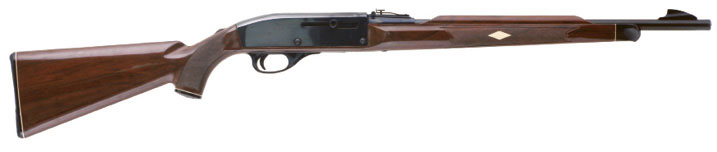
Remington Nylon 66

Polymer stocks, grips and frames are common on firearms today, but that wasn’t the case back in 1959, when Remington introduced the Nylon 66. Roughly 4,500 became available for sale in January of that year with a price tag of just under $50.

The design was radical and marketed as “The gun of the future.” The stock and receiver were constructed from a synthetic mix that DuPont—which assumed ownership of Remington in 1933—created in 1935. The concoction was actually known as Fiber 66 at the time, a name subsequently swept up in a large family of mixtures often simply referred to as Nylon.

DuPont’s encyclopedic knowledge of chemistry, along with injection-molding expertise, and Remington’s renowned reputation for crafting fine firearms were a historically timed collision of industries in this rifle. An American Rifleman article that covers the gun’s development and summarizes, “The end result was that it became the most successful .22-cal. rifle Remington has ever made, with total production of more than 1,000,000 by 1991 when the Nylon 66 was discontinued.”

First year sales for the blowback-operated semi-auto were so good that the company couldn’t keep up with orders. That demand wasn’t just because enthusiasts wanted to be the first on their block to own a “plastic” firearm, either. The self-lubricating polymer receiver was one attraction. Then there was the rugged stock. It wore a 19.5" barrel and had a 38.5" overall length, but managed to remain light—coming in at roughly 4 lbs. 8 ozs. More than likely, though, the torture testing Remington widely publicized to showcase reliability and fast-growing reputation for accuracy sealed the deal.

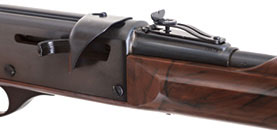
The Nylon 66 featured a tubular magazine that held fourteen .22 LR cartridges. It had to be removed from the side of the buttstock to be reloaded. The exterior of the polymer receiver wore a steel shell that was also home to the rear leaf sights, although it was grooved for mounting a scope.

Today, you can expect to pay around $300 for a lightly used, cosmetically solid Nylon 66. As condition drops, of course, so does the price on this groundbreaking rifle. 


remington66_lede.jpg
This article first appeared in American Rifleman, January 2009.

By John Gyde and Roy Marcot

In the early 1950s, Remington Arms Co. did not have a mid-priced .22-cal. semi-automatic rifle. Management knew that there were three high-cost components of any sporting arm—the barrel, receiver and stock. Engineers analyzed each to see if any significant cost savings could be obtained. They soon concluded that barrels did not offer much opportunity for savings, so they focused on the receivers and stocks.
Remington touted the synthetic Nylon 66 rifle as “The only .22 Alaskan fishermen find able to withstand corrosive sea spray,” as demonstrated by a Bob Kuhn painting. The 1959 image (top) shows Nylon 66 stock production at Remington’s Ilion, N.Y., plant. Note the canisters of Zytel waiting to be turned into Nylon 66s.

Remington asked the chemical engineers at DuPont to come up with a plastic that could replace both the wooden stock and the receiver. The specs given to the DuPont chemical development department in the early 1950s were: The material must be capable of forming any shape desired; it must have a high tensile-impact and flexural strength; it must have high abrasion resistance; it must have high resistance to heat distortion; it must be resistant to cold temperatures, it must, if exposed to a flame, not continue to burn when that flame is removed; it must be impervious to solvents, oils, mild acids, alkalis, fungus, rodents, and insects; it must have a finish that is easy to repair; it must be light in weight; it must hold permanent colors; it must have no corrosive effect on other parts; and it must be self-lubricating and dimensionally stable. undefined

DuPont’s control of Remington (since 1933) provided a resource for the new synthetic rifle stock, which was a radical concept of a combination receiver/stock as one unit made entirely of injection-molded plastic. In less than four months, DuPont’s engineers came back to Remington with Nylon Zytel-101. The Nylon story began when DuPont operated an R&D Laboratory called “Purity Hall.” The lab’s name was to emphasize the separation of the R&D work from production at DuPont. The efforts of Gerald Berchet and Wallace Carothers resulted in 81 new polyamides in 1935. From those new polymers, Polyamide 6-6 was chosen for further testing. It was soon after referred to as “Fiber 66.” The name “Nylon” was adopted by DuPont soon after. The first practical use of the new material was for ladies stockings, which were (and still are) called nylons. The actual DuPont material was structural Zytel Nylon 101, a member of the Nylon 66 family of plastics.

Remington knew that fabricating a .22-cal. Nylon rifle posed three formidable challenges. Would it have durability, accuracy and dependability? An internal memo dated July 7, 1955, reported a preliminary action design had been completed as a cooperative project with DuPont Polychemicals Dept., and a prototype of the new plastic-stocked rifle had been built. The design consisted of two hollow nylon pieces that were fused together to form the completed stock. The center section was covered by a low-cost, formed-steel metal cover—giving it the appearance of a more conventional gun with a steel receiver, and a prototype nylon stock was machined from bar stock.

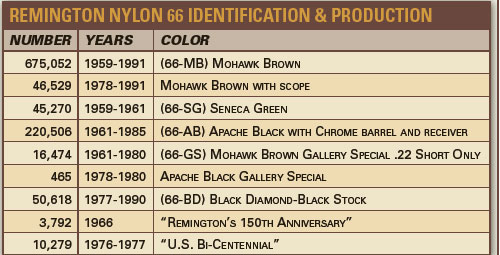
Nylon 66 rifles used DuPont’s Zytel Nylon 101—part of the Nylon 66 family of plastics—for the stock and receiver, and it had a metal receiver cover. Stocks were offered in Mohawk Brown, Seneca Green and Apache Black.

The assembled rifle was then tested by firing 75,000 rounds with a malfunction rate of only 0.005 percent. Refinements on this prototype continued through the summer and fall of 1955. Testing continued to ensure there would be no distortions during molding and that stock shrinkage would not occur after the rifles were assembled.

A nylon gun had never before been made. Its appearance and feel would be significantly different from any other .22 on the market. Would the shooting public buy it? Remington hoped to gain acceptance through overwhelming evidence of the reliability and ease of use of the new gun. This was a gamble, but Remington felt the public would buy an unconventional .22 rifle—if it was extremely reliable and dependable. The new rifle had to sell at no more than other mid-level .22 rifles on the market.

Considerable time and energy were devoted to cost-control measures. But this was complicated by delays and cost increases on parts supplied by outside vendors. Also, Remington management changed the projected number of nylon rifles that would be produced, and the unit cost of certain parts changed with the size of the projected order. Even with costs not completely firm, Remington continued to proceed with development.

Remington Model 555 Bearcat Prototype Rifles
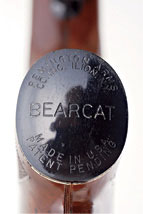
Early on, Remington engineers referred to the new rifle as the Model 555. A few of the early, prototype guns carrying the barrel stamp “Model 555” have surfaced. The nickname “Bearcat” was initially proposed for the Model 555. But in 1958 Sturm, Ruger & Co. introduced its Bearcat revolver, so Remington dropped the name. undefined

Remington design engineers launched the most extensive field-testing program it had have ever attempted, conducting tests almost continuously in late 1955, 1956, 1957 and into 1958. Hundreds of thousands of rounds were fired. In January 1958, Remington provided each of its sales representatives two prototype Model 555s for field-testing. They were each given one in olive drab green (later renamed Seneca Green) and one in walnut (later renamed Mohawk Brown). The salesmen were asked to fire a minimum of 1,000 rounds in each gun under adverse conditions, then return the gun with the results within 30 days.
On Feb. 23, 1958, salesman Delbert Conner sent his written report to Wayne Leek, Remington’s primary gun designer of the day. Conner’s summary was four pages long. His report began: “My first impression of these guns was, that they were just toys—or maybe air rifles for Buck Rogers. I doubt that the color or material will make much difference on the first showings. The public will refer to them as plastic ... .”

Conner then went into detail about the testing routine to which he subjected the rifles. He fired 2,000 rounds of various brands of ammunition. He held the guns right-side-up, upside-down and sideways. He fired slowly, then rapid fire by fanning the trigger until the barrel on one of the test guns was too hot to touch. He tested it in a blinding windstorm with blowing sand. Then he deliberately drove his station wagon over one (front and rear tires). The next morning, he took it in a boat to the middle of a lake and lowered it, fully loaded, to the bottom with a string on the trigger guard. He retrieved it, drained the water, and shot 100 rounds without a malfunction. He did manage to crack the front of a stock by deliberately dropping a gun from some unspecified elevation onto a concrete sidewalk. He reported that it functioned flawlessly both before and after that incident. His summary stated: “Looks like a plastic toy—performance and accuracy unbelievable.” And then he returned the rifles to Ilion, but wrote “I would surely like to have one back—charged to my sample account—if and when available.”

Introducing The Nylon 66
On May 2, 1958, Remington changed the model designation from Model 555 to Nylon 66. The final approval for formal introduction was given by management on Dec., 17, 1958. Just why Remington changed the model designation from Model 555 to Nylon 66 is not known. Approximately 4,450 production Nylon 66s were made in late 1958 for shipment after the first of the year. The retail price in January 1959 was $49.95. The Nylon 66 was called the “Gun Of Tomorrow” and introduced with an advertising blitz. Its dependability in adverse conditions was used as the primary selling point. Remington ads said: “This is the rifle trappers depend on from Hudson Bay to the Everglades. The only .22 that Alaskan fisherman find able to withstand the attacks of corrosive sea spray—To protect their nets from marauding sea lions!” Remington claimed “lubricant-free nylon ball bearings throughout the mechanism eliminate the need for lubricants of the functional parts of this rifle.”
A “Gallery Special” Nylon 66 was introduced in 1961, and the “.22 Short Only” variant was made until 1981. It had a shell deflector shield on the receiver’s right side. Most of the 16,474 Gallery 66s were in Mohawk Brown.


Initial Nylon 66 Publicity
In 1959, Tom Frye, a field representative for Remington, set out to surpass Ad Topperwein’s world record (set in 1907) of shooting 72,500 2½" wooden blocks as they were tossed into the air while missing only nine. Frye used three Nylon 66 rifles and maintained an average pace of 1,000 shots per hour (one shot every four seconds) for 13 consecutive eight-hour days. When the smoke cleared, he had shot at 100,010 blocks and hit 100,004, missing only six! The rifles were cleaned only five times during the Marathon trial.

The Nylon 66 was accepted enthusiastically. Demand exceeded projections and production capacity during its introductory year—1959. The Nylon 66 was initially available in two colors; Mohawk Brown (N66MB) and Seneca Green (N66SG). Production was scheduled to be 70 percent in Mohawk Brown and 30 percent in Seneca Green. The names were derived from the Mohawk and Seneca Native American tribes that originally lived near what would become Ilion, N.Y. Production rifles in Seneca Green were dropped in late 1962 because of limited demand.

undefined

Nylon 66 Characteristics
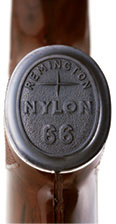
The Nylon 66 had a Zytel-101 stock that was injection-molded in two halves, of which one-half had a tongue and the other a groove. They were then bonded together. The buttstock and fore-end, of course, were two pieces and the middle section was the receiver. Between 1959 and 1969, Remington offered the following guarantee on all Nylon 66 rifle stocks: “We guarantee that this stock will not warp, crack, chip, fade or peel for the life of the rifle, or we will replace it free.” The buttplate, the fore-end tip, and the pistol grip cap were all black plastic bonded in place. Each had a white spacer. There were two reinforcing screws with nuts under the receiver cover, and there was one more under the ivory white diamonds on each side of the fore-end.
 
The magazine was in the butt, loaded through the buttplate and held 14 standard or high-velocity .22 LR rimfire cartridges. The striker was either an investment steel casting or a forging, which required no machining except for the hole down its center. The bolt was a steel machined forging. The striker and bolt ran in grooves in the self-lubricating nylon receiver. The other parts were either stainless steel or mild steel stampings, or, like the trigger guard and the trigger itself, were plastic. The forward face of the bolt had no spot-facing cut as originally fabricated; soon a semi-circular end mill cut was added.

The barrel measured just over 19½" and was clamped to the receiver by a screw-secured barrel bracket in a cradle formed within the stock. When the rifle needed cleaning, the barrel could be easily removed and cleaned from the breech. The barrel at its breech had two gas relief cuts added very soon after production started. In the event of a ruptured case, these cuts were to allow the hot gases to escape in a vertical direction, thus not hurting the shooter.

One of the main advantages from a manufacturer’s point of view was that it could be assembled with little or no hand fitting. In spite of the lack of hand fitting, the trigger pulls were excellent. The total weight of the rifle was about 4 lbs., 8 ozs. A slight disadvantage was that the magazine tube had to be completely removed before reloading, unlike the Models 16, 24 and 241, which were loaded through ports in the side of the buttstock.

In order to avoid shooter rejection of this “plastic gun,” the designers covered the nylon receiver with a blued steel stamping. They must have decided that as long as they were going to disguise the receiver with a steel shell, they would make the shell serve some useful purpose so the rear sight assembly was riveted to it. The cover was grooved so a scope could be mounted. It has been found that when a scope was mounted and the gun was gripped too rigidly the point of impact could change. The steel cover also held the ejector into the receiver. Finally, the flat spring that tensioned the cartridge feed guide was mounted by a rivet to the underside of the cover. The receiver covers and barrels were changed from blued to a matte black finish near the end of production.

The receiver cover had no serial number stamped on it until October 1967, just prior to the enactment of the 1968 Gun Control Act, which required that all guns have serial numbers. Serial numbering of the Nylon 66 and its spin-offs started at serial number 400000 and went to 419011, but at that time the number was stamped on the underside of the barrel just aft of the front sight. Three months later in 1968 the serial number started with 419012 and went to serial number 473710. In December 1968, the serial number range was changed to 2100000. When this series of serial numbers reached 2599999 in February 1977, the letter “A” was added in front of the numbers.

Nylon 66 Markings
The original logo stamped on the barrel in the open space just in front of the rear sight was “PAT. PEND.” over “22 L.R. ONLY” plus the date code and the final inspector’s stamp. Later the “PAT. PEND.” was dropped as the patent was granted and the stylized word “Remington” was added. Most Nylons also have the oval stamp with “REP” on the right rear of the barrel meaning “Remington English Proofed.” In the early 1980s, Remington started to use a much larger stamp on the barrel behind the front sight. It read: “REMINGTON 22 LONG RIFLE ONLY.” In 1959, Remington still had two other autoloading .22s on the market: the older Model 550-1 and the newer Model 552. The Model 550-1 sold for $46.75, and the Model 552 sold for $52.25. Therefore, the Nylon 66 acted as a “middle of the line” gun at $49.95.

Nylon 66 Legacy
The Nylon 66 was a huge gamble for Remington, as traditionally “real” guns had wood stocks. But it was a huge success. The end result was that it became the most successful .22-cal. rifle Remington has ever made, with total production of more than 1,000,000 by 1991 when the Nylon 66 was discontinued. The Nylons have been a “love-’em or hate-’em” gun ever since they were introduced. The appearance and feel were certainly non-traditional. The “love-’ems” seem to be winning, judging by the collector interest and price escalation of the less-common variations. Will Remington ever bring back this low-cost, lightweight 22? Only time will tell.

Wednesday, January 7, 2026

"8 of the smallest Handguns you can Own"

The smallest pistol I have is a G-43 in a "DeSantis Superfly Holster"  works well for me, but having a "mouse gun can be beneficial having something smaller although the superfly doesn't print and is comfortable, there would be time that a smaller pistol would be better, although finding one that would fit my needs and work when necessary is the trick.


I shamelessly clipped this from "American Rifleman"

Smallest Pistols Handguns

One of the very first handguns that I ever saw up close was my dad's Belgian Baby Browning chambered in .25 ACP. I was fascinated by the fact that it was small enough to fit in the palm of his hand, and yet it was still a fully functional pistol. Once I was old enough to start buying handguns of my own, my enthusiasm for the smallest-of-the-small didn't waver.

In pursing this littlest handgun hobby of mine, I've enjoyed opportunities to evaluate a variety petite pistols ranging from 9 mm defensive-carry models to unique, rimfire “utility” guns. Whether you are looking for a more compact daily-carry pistol or something spiffy to add to your collection, here are a few of the smallest handguns currently on the market:

8. Taurus GX4 T.O.R.O.: Double-Stack Micro Nine
Although sub-subcompact, double-stack magazine 9 mm pistols have been available since 1995, it was the launch of the SIG Sauer P365 in 2018 that triggered the latest concealed-carry trend colloquially known as “micro nine pistols.” These handguns are intended to fill the niche between the double-stack subcompact and single-stack 9 mm pocket pistols. Over the last few years, these semi-automatic guns have become a new standard in the concealed-carry market. In addition to their slim frames and 10- to 13-round magazine capacities, the micro nines are about as small as you can get while still retaining the option to configure the slide for a red-dot optic.

Taurus GX4 micro nine pistol red=dot optic smallest handguns pistols 9 mm
The GX4 sports useful upgrades often reserved for more expensive pistols, including metallic sights, front and rear cocking serrations and interchangeable grip backstraps.

Several micro nines are the right size for this slot, but I opted for a Taurus USA model that I've worked with more than some other guns. The Taurus GX4 is shown here with the T.O.R.O. optics-ready slide. While the SIG P365 set the standard for this category, the GX4 is sized to match, accepts 11-round flush-fit, or 13-round extended magazine, and it provides a useful set of features at a lower price point than most of its competition. MSRP starts at $399. TaurusUSA.com

7. Diamondback DB9: Single-Stack 9 mm Pocket Pistol
No matter how you slice it, modern single-stack 9 mm pistols designed for pocket carry are slimmer and lighter than the micro nines. Diamondback Firearms offers one of the smallest currently available. When I worked with the DB9 for the first time more than a decade ago, I was surprised to handle a 9 mm semi-auto pistol that was dimensionally similar to subcompact pistols chambered for the more diminutive .380 ACP cartridge. The fact that the DB9 could handle the more potent 9 mm cartridge in such a small package meant that had to purchase it when the evaluation timeframe was complete.

diamondback firearms db9 pistol
The DB9’s small size makes it easy to carry but more challenging to master.

Today, single-stack 9 mm pocket pistols are fairly common in a variety of configurations and price points, but the DB9 remains as one of the smallest available. The pistol I have on hand tips the scale at 12.8 ozs., and that includes an empty magazine. The tradeoff for DB9's feathery effect is a stiff level of recoil when using standard-pressure 9 mm ammunition. It is manageable, though not exactly enjoyable. Recently, Diamondback released the Gen 4 version of the DB9 with updates to the slide's cosmetics and the grip's texturing. MSRP is $305. DiamondbackFirearms.com

6. Bond Arms Stinger Series: Double-Barrel Pocket Protection
Bond Arms’ claim to fame is offering some of the smallest and most powerful handguns available. The company's stainless-steel, standard-frame guns live up to this boast with dual barrels chambered for cartridges including .357 Mag., 10 mm Auto, .44 Spl., .45 Colt and .410 bore shotshells. As small and potent as they are, the all-steel construction and big-bore, swing-up barrels can make these pistols a bit chunky for pocket carry.

stainless steel bond arms singer derringers on wood log
The Stingers were developed in answer to customer requests for a slimmer, lighter pistol.

The company has answered customer requests for a slimmer, lighter version of these tough little guns, 12 ozs., with the double-barrel Stinger series. Shown here are the new Stinger RS (Top) and the original aluminum-frame Stinger (Bottom) released in 2021. Fitted with a 3” barrel assembly, the Stinger RS, which stands for Rough Series, features stainless-steel construction but at about half the frame width of the standard version. This shaves the weight down to 16 ozs. Barrels are interchangeable, too, and Bond Arms offers versions in .380 ACP, 9 mm Luger and .38 Spl., and apparently a .327 Fed. Mag. option is coming. The pistols ship with a set of rubber grips, as well as ultra-thin polymer grips. MSRP starts at $279. BondArms.com

5. Ruger LCP Max: Double-Stack .380 ACP
In 2008, the launch of Ruger's Light Carry Pistol, or LCP, sparked an American sub-compact arms race, which set the standard for .380 ACP pocket pistols for years to come. But with a single-stack magazine and a capacity of six or seven rounds, some folks wanted a boost in performance. In 2011, the company launched the LC9, an upsized version of its LCP chambered for 9 mm Luger with more capacity. Though it was slightly larger and heavier, the LC9 retained a slim and trim profile for everyday carry. That wasn’t enough, as folks always want more if they can get it. So, in 2021, Ruger presented the Max-9, a micro nine that accepts double-stack magazines.

Ruger LCP Max pistol handgun in hand left side view black gun
This version of the LCP can hold nearly double the rounds of the original version.

The company could have left off there, but it made sure that the LCP would not be left behind in the trend of double-stack upgrades. As such, 2021 also marked the arrival of the LCP Max chambered for .380 ACP. Just like its micro-nine compatriot, the most noteworthy change to the new LCP came in the form of a new frame for increased ammunition capacity with only a nominal change to the grip’s width. It accepts a 10-round flush-fit, or 12-round extended magazine, which makes for a significant increase. The LCP Max sports a night sight with tritium and has a smooth and light trigger pull. MSRP is $479. Ruger.com

4. KelTec P32: Single-Stack .32 ACP Micro
Prior to the .380 ACP pocket-pistol rush of the late 2000s, there was the petite .32 ACP dust-up of the late 1990s. The .32-cal. contenders for American holster space at the time included the Seecamp LWS-32, Berretta 3032 Tomcat, North American Arms Guardian and the KelTec P32. At the time, the P32 was the odd man out. It had one of those “newfangled” lightweight, injection-molded polymer frames with an internal aluminum chassis instead of an all-stainless-steel or aluminum frame. With an unloaded weight of 6.6 ozs., it was the lightest and least-expensive model in the running.

Keltec P32 small black pistol handgun right side view
The P32 may be part of a dying breed, but it still offers a balance of size and performance that's tough to beat.

Still in production more than two decades later, the P32 fits right in with the today's defensive semi-automatic pistols with polymer frames. There's no question that the .380s are more powerful, but the P32 is surprisingly comfortable to shoot for its size. And when compared to the Ruger LCP II chambered in .22 LR, the P32 is slightly shorter, a bit thinner and weighs a noticeable, 4.2 ozs. lighter while also packing centerfire cartridges. Although the .32 ACP is no longer a hot topic, the P32 still comfortably fills a niche between the .380s and .22s. Who knows? The cartridge just might make a comeback. MSRP is $360. Keltec.com

3. Trailblazer Lifecard: Folding Single-Shot .22 WMR
Trailblazer Firearms offers what I would consider one of the smallest guns available today. The single-action LifeCard is a folding, single-shot utility pistol. Its unusual form factor makes it one of the easiest pistols to carry that I've worked with so far. The flat, squared-off folded profile is comparable in size to a tin of mints or a credit card holder. It can be tucked into just about any pocket, including the watch pocket of a pair of jeans.

LIfecard folding pistol 22 MAG WMR gun in hand outdoors grass background
When folded, the Lifecard will fit comfortably in just about any pocket.

lifecard .22 WMR pistol on wood

The .22 WMR (magnum) version of the Lifecard, with its steel and aluminum construction, weighs in at just 6.4 ozs., features a simple trench-sight system, a three-round ammunition compartment in the grip and is available in a variety of colors. The company also offers a .22 LR version with a polymer grip, which reduces the pistol's weight and cost. MSRP starts at $299. TrailblazerFirearms.com

2. Ruger LCP II: Single-Stack .22 LR
A few years ago, I penned a respectful eulogy for the small-caliber pocket pistols sometimes referred to as 'mouse guns'. However, in 2021, Ruger chose to breathe new life into the rimfire pocket pistol market. The LCP II Lite Rack chambered in .22 LR is based on the popular LCP II chambered in .380 ACP. It has the same external dimensions and trigger pull. But the slide is configured for ease of use. The magazine holds 10 rounds of .22 LR ,and this version of the LCP has a thumb safety lever on the left side.

Ruger LCP II LIte Rack pistol with ammunition magazine art
The LCP II is a modern, polymer-framed take on the classic 'mouse gun' pocket pistol.

A close contender for this slot is the Beretta 21A Bobcat, which is a well-made and reliable rimfire pocket pistol. The LCP is about 0.25" taller and 0.25" longer than the Beretta. However, the LCP weighs less, 10.9 ozs., has a thinner grip, 0.92" at the widest point, and holds up to 11 rounds of ammunition instead of 7+1. The LCP II also has a suggested retail price that is $40 less than the 21A Bobcat. For those who wish to shoot this pistol with a sound suppressor, Ruger offers a drop-in threaded barrel and recoil spring kit on the shopruger.com website. MSRP is $439. Ruger.com

1. North American Arms Mini Short: Single-Action .22 Short Revolver
North American Arms' (NAA) diverse series of mini single-action revolvers has represented the smallest multi-shot handguns available for quite some time. These delightfully tiny, stainless-steel revolvers are well-made with an attention to detail that shows this is a company that takes its products seriously. I've seen these revolvers put together at the factory in Provo, Utah, and I have to say, the process seems more like watchmaking than gun assembly.

North American Arms revolver on lifecard folding handgun pistol guns wood table outdoors
The Trailblazer Lifecard may be the size of a tin of mints, but the NAA Short can almost fit inside that tin.

The NAAs are available in three frame sizes, with the version chambered in .22 Short (NAA-22S) being the smallest of all. This revolver weighs in at 4.2 ozs. and has a profile that comfortably fits on top of a Trailblazer Lifecard. With its small grip, tiny controls and the mild recoil produced by the pill-sized .22 Short cartridges, this diminutive revolver provides an utterly unique shooting experience. However, the .22 Short-chambered Mini should be respected for what it is, a proof-of-concept handgun of which pushes the limits of size and shootability right to the edge of practicality. MSRP is $255. NorthAmericanArms.com

Friday, October 24, 2025

LEO Trade in's "The Sleeper Surplus Market."


I own a couple of ex-police pistols, my "Smif" 686 has the "Dekalb Police" stamped on it.  and I own a Glock 22C that was a LEO Trade-in from next county over from where I live.  I have no issued with former Police pistols, usually they are taken care of...unless they belonged to a big city police than the "gun culture" isn't as ingrained as it is in "Flyover country".   

   I shamelessly snagged this "American Rifleman"


** When you buy products through the links on our site, we may earn a commission that supports NRA's mission to protect, preserve and defend the Second Amendment. **
Leo Surplus Guns Horman

The first decade of the new millennium was something of a golden era for the more casual firearm collectors here in the United States. At that time, the marketplace was replete with internationally manufactured military surplus rifles and handguns selling at impressively low prices. Russian Mosin-Nagant bolt-actions with all-matching serial numbers and the original stocks were selling for $89. I had buddies who were packing Bulgarian and East German Makarovs chambered in the then-plentiful 9x18 mm Makarov pistol cartridge since they were compact, well-made and available for around $200. SKS rifles and Tokarev pistols also abounded at low prices.

But as time marched on, two market factors kicked in to cause surplus gun prices to rise. First off, these retired military firearm caches were fairly expansive, but they were not infinite. The firearms, along with the $0.05 to $0.10 per round surplus ammunition, simply dried up. Secondly, the folks in possession of these overseas caches eventually figured out what American collectors were paying for these guns. As a result, they upped their prices. What are the more budget-minded self-defenders and casual collectors to do now that the military surplus supply is mostly tapped out?

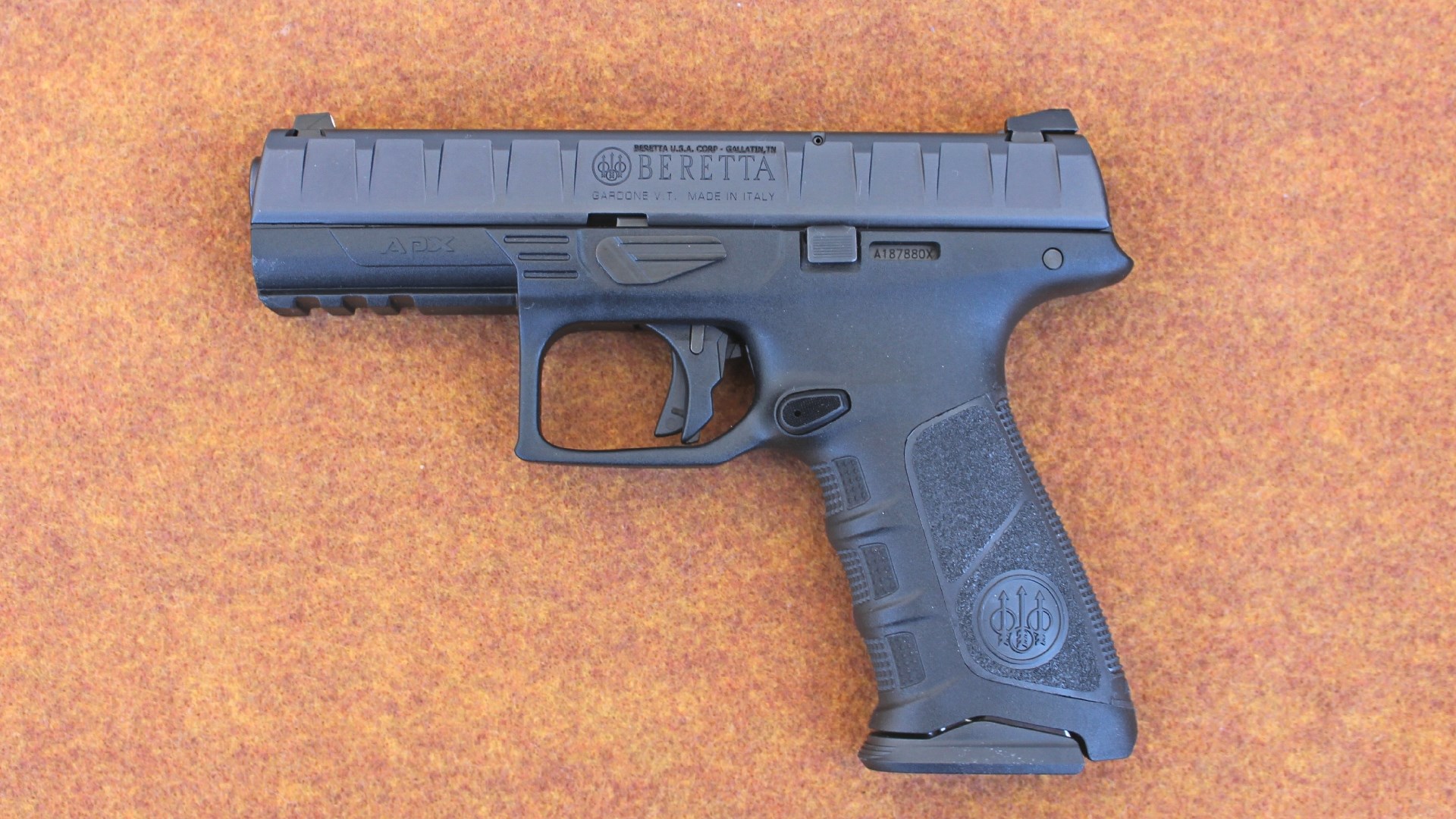
Beretta APX pistol black color left-side view on brown background
Occasionally, unissued, as-new guns like this Beretta APX will crop up at bargain prices.

There is still a steady supply of quality used rifles, shotguns and handguns that sometimes goes overlooked by the general shooting public. I’m referring to law enforcement officer (LEO) trade-ins. These retired long guns and handguns guns have been toted around a good deal but not fired all that often. Even though they have been swapped out for something new, and they may not win a beauty contest, these guns still have plenty of working life in them. Best of all, these guns can usually be purchased at attractively low prices.

I’ve been dipping into this sleeper surplus supply via AIM Surplus over the last few years. This company has proven to be a top-notch source for a variety of now off-duty pistols and revolvers. The guns have been great to work with and the examples shown here have come from this company. Here is a closer look at the benefits and trade-offs of LEO trade-ins.

Bang For The Buck
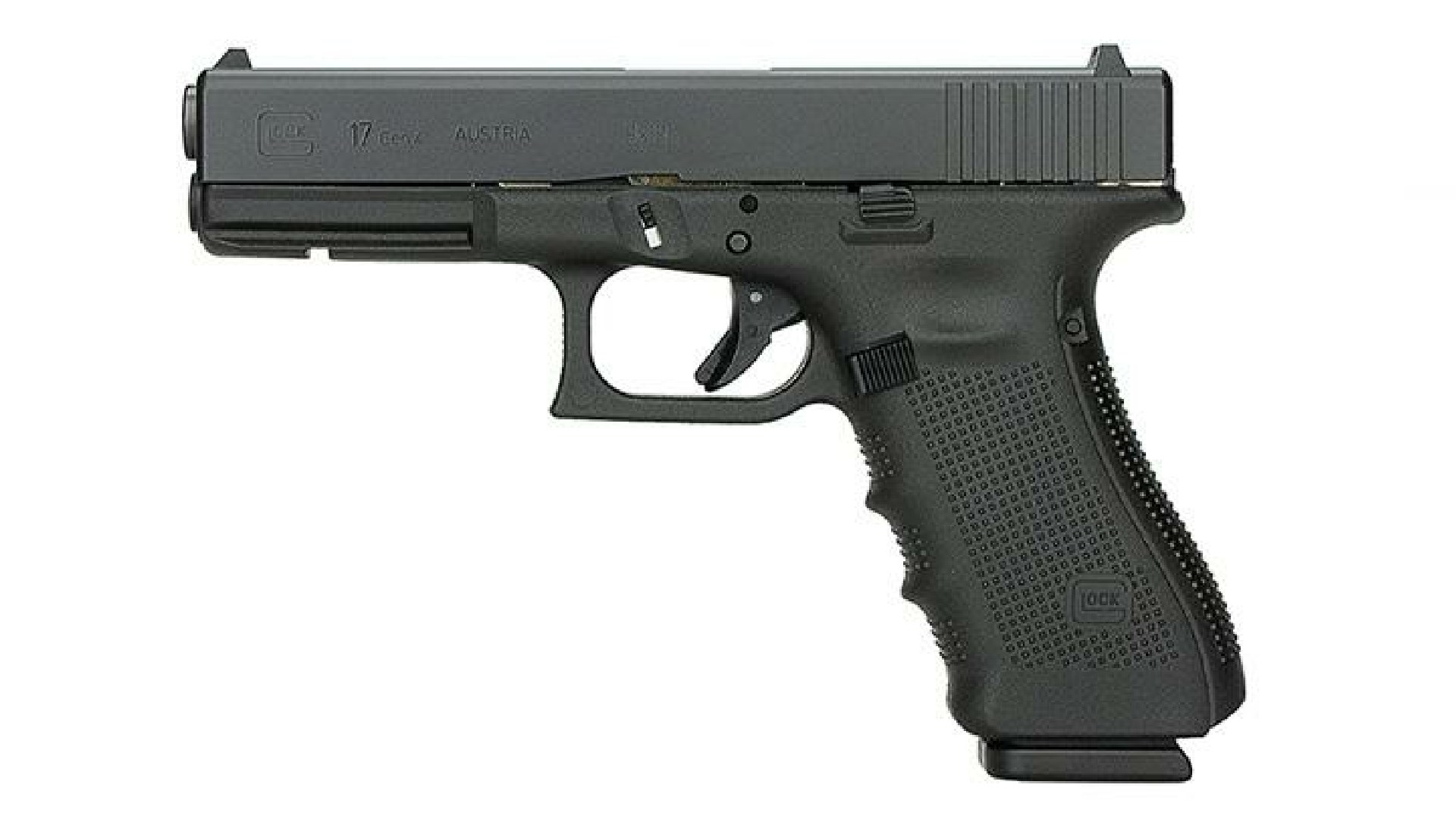
LEO trade-ins, like other used guns, have the potential to provide greater value per dollar spent than some brand-new guns selling for similar prices. For example, AIM Surplus recently listed an allotment of 9 mm Glock 17 Gen 4 pistols in great shape on sale for $319. Glocks like this often cost somewhere around $600 brand new. As of this writing, the company is offering a golden find. It's a shipment of unissued Beretta 9 mm pistols originally ordered for the Brazilian police in as-new condition. The pistols ship in unfired condition in their original cases with all of the factory accessories, including an owner's manual in Portuguese! When these first-generation guns were launched, they had a suggested retail price of $500. But these unissued Berettas are on sale for $299.95.

Glock G17 Gen 4 black pistol left-side view on white backgorund
A less-expensive used Glock like this G17 Gen 4 can be outfitted with a variety of accessories and upgrades.

The common trade-offs that attend the lower prices include some degree of wear and tear and possibly no factory extras. Unless otherwise specified by the seller, expect dings, scratches, holster wear and possibly some corrosion from long term storage. There's also a good chance these used guns will need a deep cleaning along with the typical inspection, bench checks and lubrication before shooting.

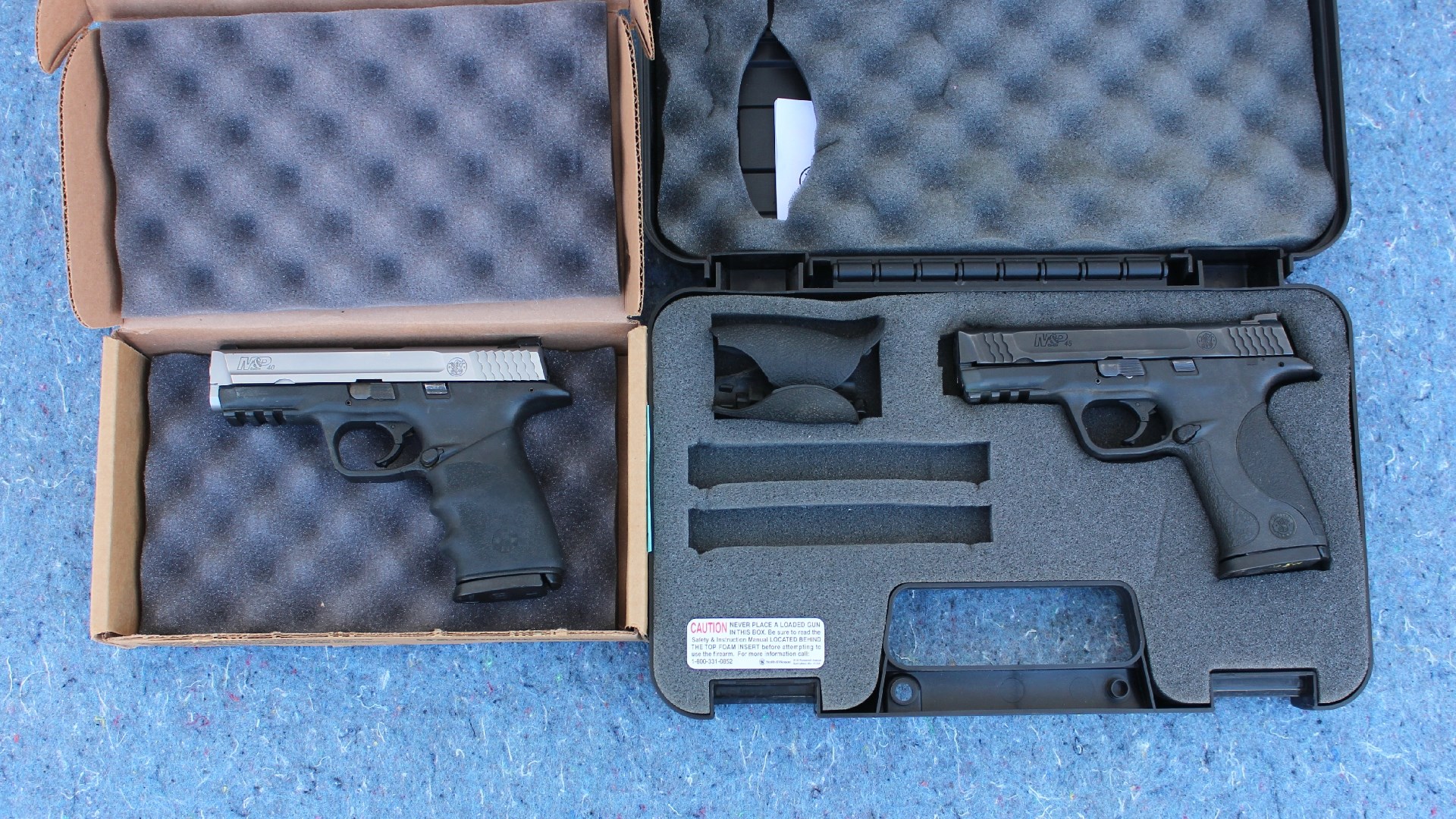
As for the original factory support gear, it can be a coin toss. In a recent evaluation of two Smith & Wesson M&P pistols, one arrived in the original case, two extra backstraps and an owner's manual. The other shipped in a small cardboard box, no additional backstraps and an aftermarket grip sleeve installed. The listings should be clear as to the number of magazines you'll get. It's unusual for pistols to ship without at least one. Make sure to double check the site inventory to see if compatible used magazines are being sold separately. For the M&Ps, the retired factory magazines were selling for around $15 which is notably less than $42 to $49 for new magazines. 

Handguns in factory boxes side-by-side left-side view
Factory original accessories may or may not be included.

Last Year's Fashions
Law enforcement agencies tend to stick with firearms from reputable manufacturers. Popular providers include previously mention Beretta, Glock and Smith & Wesson along with other trusted brands including FN, HK and SIG Sauer. And the models selected tend to have a proven track record for desirable qualities including durability, reliability and repeatable defensive accuracy. Although the selection of used models is not as expansive as the commercial market place, the quality is solid. 

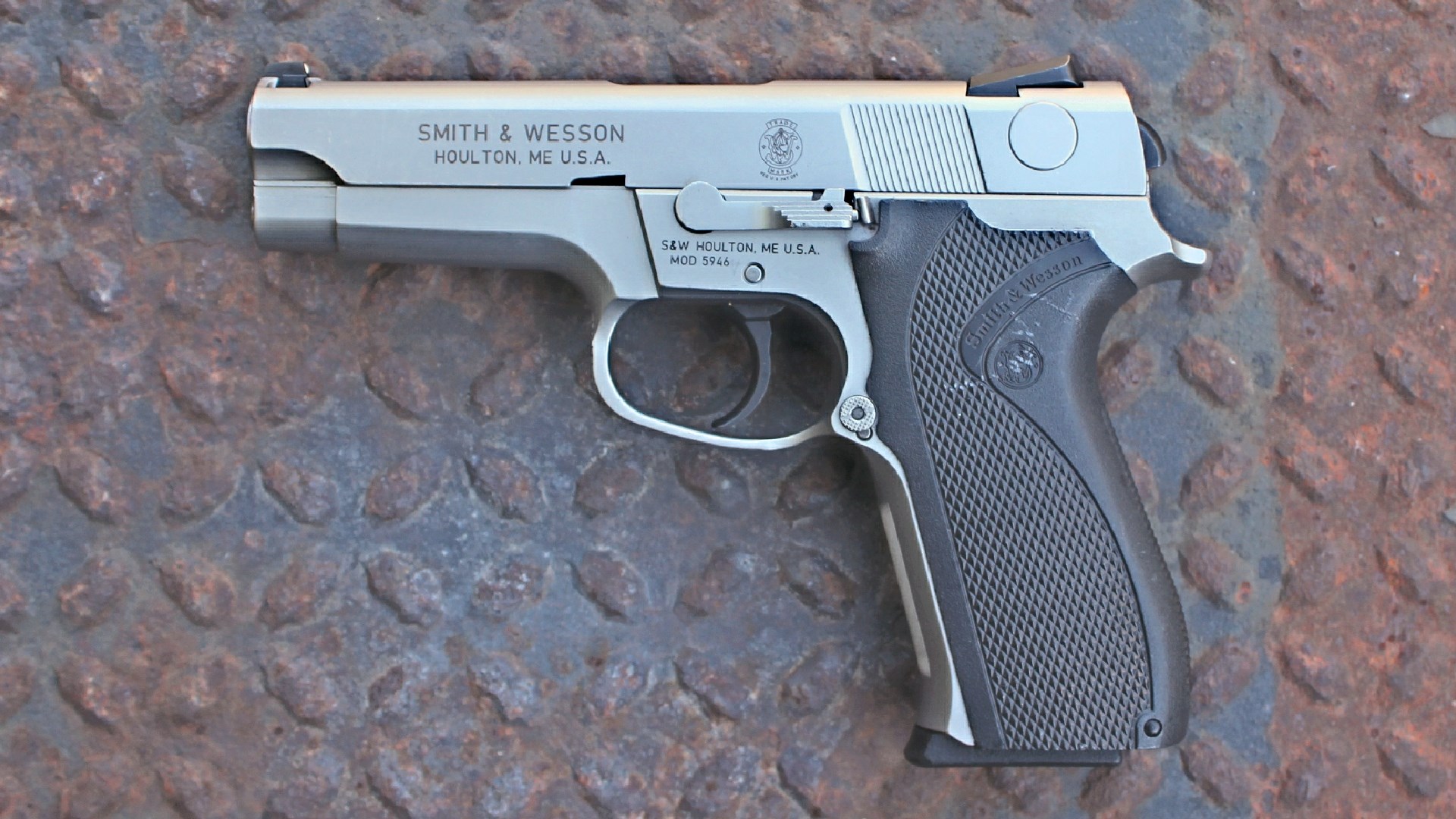
Smith & Wesson 5946 stainless steel pistol left-side view on rusted treadplate
This Smith & Wesson 5946 was produced before compensated barrels, night sights, accessory rails and optics-ready slides became popular.

As technology and shooting trends evolve, so do the features manufacturers provide. Some of the latest and greatest defensive pistols leave the factory with compensated barrels, night sights, optics-ready slides, dustcover accessory rails and tuned triggers. Older pistols may lack any or all of these features. Some models can be upgraded with some of these features while other cannot. Whether a LEO trade-in is a bargain at that price or not will depend on your needs and objectives. 

Cartridge Selection
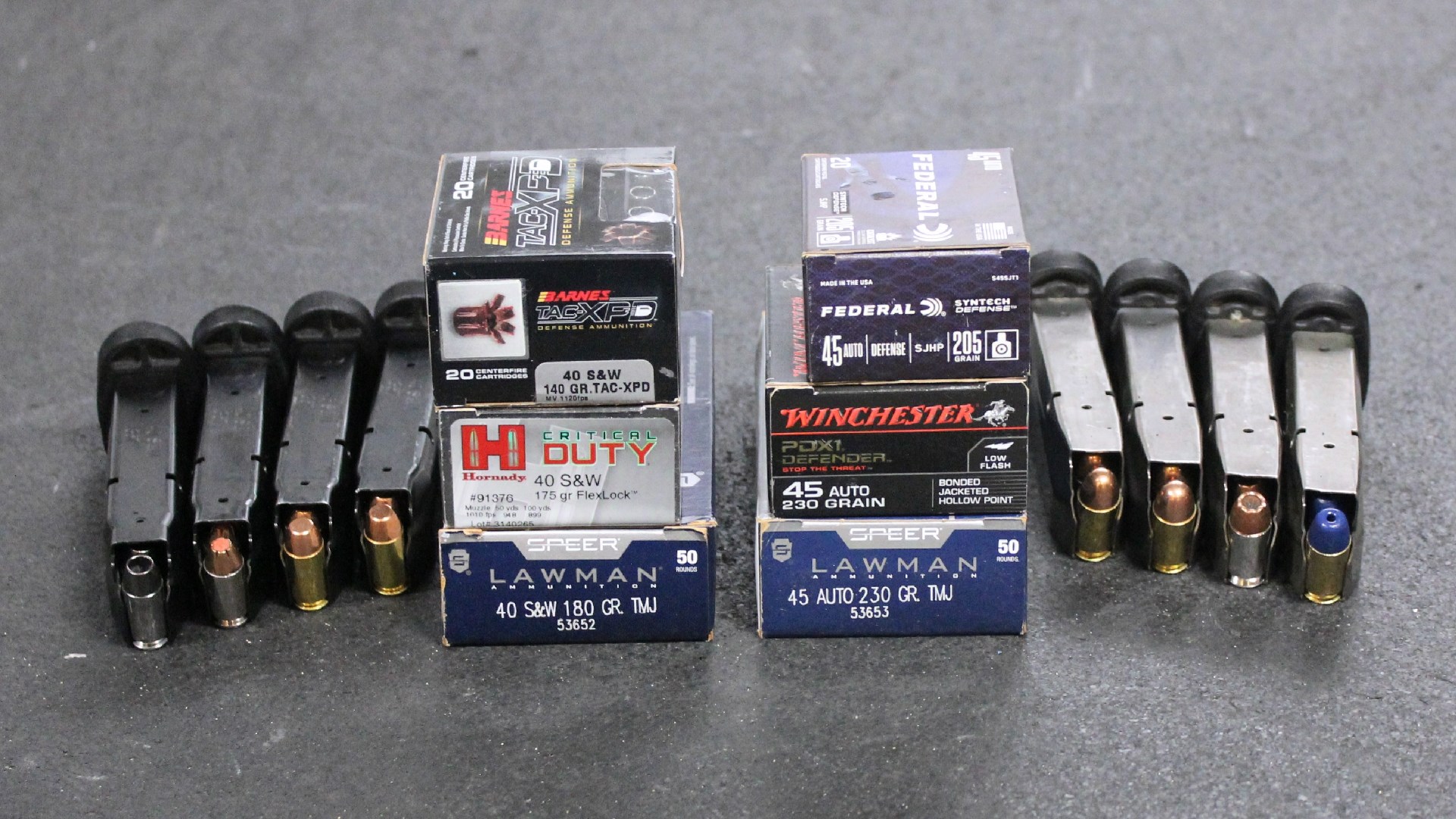
LEO trade in guns are typically chambered in standard calibers. Retired shotguns are going to be 12 gauge. AR platforms will most likely be .223 Rem./5.56 NATO or .308 Win. Double-action revolvers are going to be configured for .357 Mag. or .38 Special. As for pistols, expect 9 mm, .40 S&W and .45 ACP options to be the dominant choices. Whether or not this caliber range is a plus or a trade-off depends what you have in mind. If there is a caliber you would like to try, like .45 ACP or .40 S&W, then a LEO trade-in allows you to try this caliber on for size without breaking the bank. The same is true for those who are gifted, inherit or find a great deal on .45 ACP or .40 S&W ammunition but don't currently have a pistol chambered for it. A sub $250 handgun is a great way to put the ammunition to work for you.

Pistol magazines shown with ammunition boxes in 9 mm .40 S&W and .45 ACP
Pistol caliber options are usually 9 mm, .40 S&W or .45 ACP

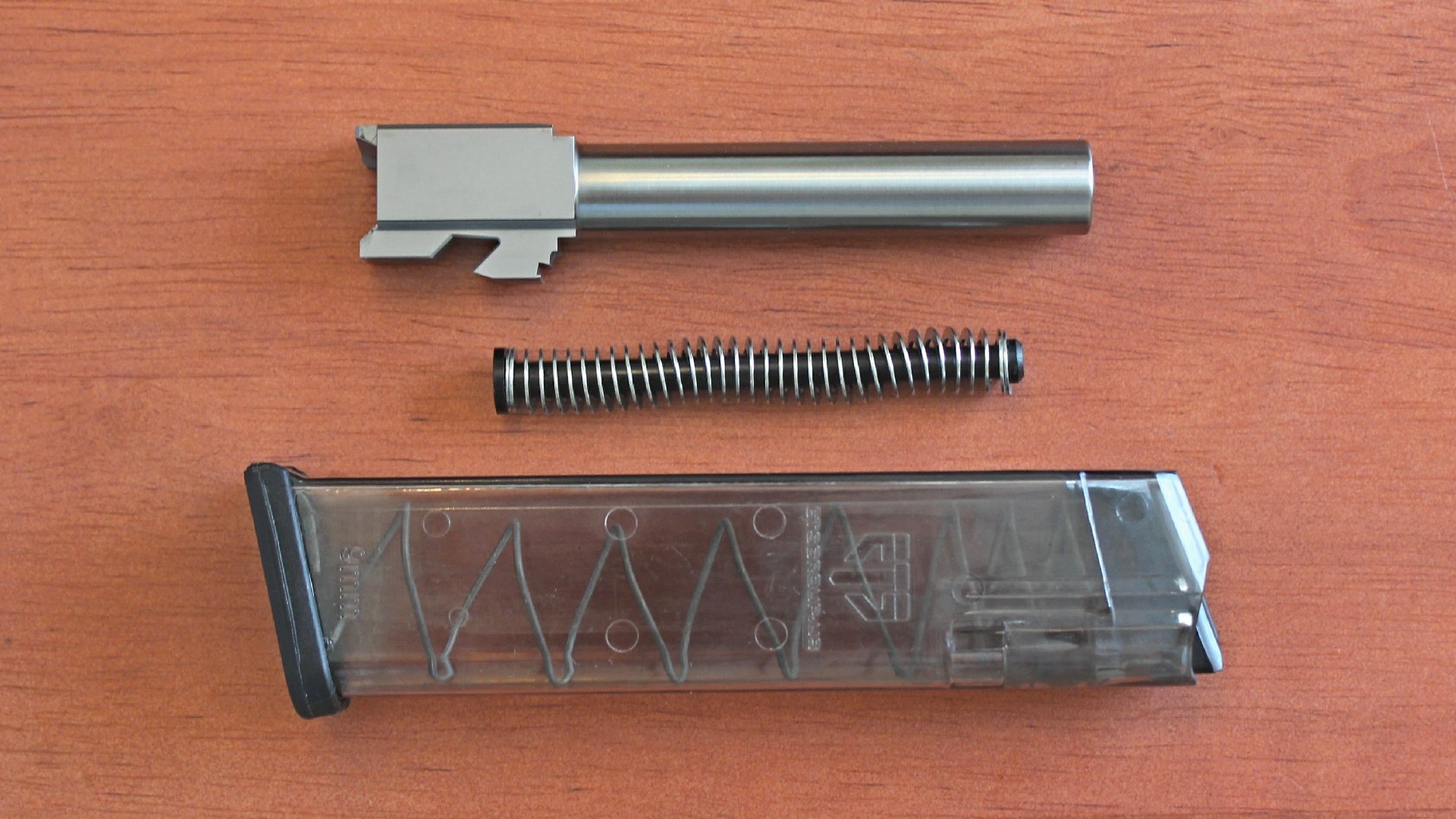
It should be noted that, with just about everyone in a uniform switching to 9 mm pistols, the .40 S&W semi-automatics are selling cheaply! There's certainly nothing wrong with buying one and shooting it as-is. However, with some makes and models, a simple barrel and magazine swap will convert these guns from .40 S&W to 9 mm. Even with the extra parts, the pistol will still cost less than a new 9 mm and you'll have a dual-caliber pistol. That could be useful just in case the 9 mm ammunition supply dries up (again).

Gun parts barrel recoil spring assembly clear polymer magazine shown on wood table
Some .40 S&W pistols can be converted to 9 mm with a simple barrel and magazine swap.

Budget Friendly Defensive Options?
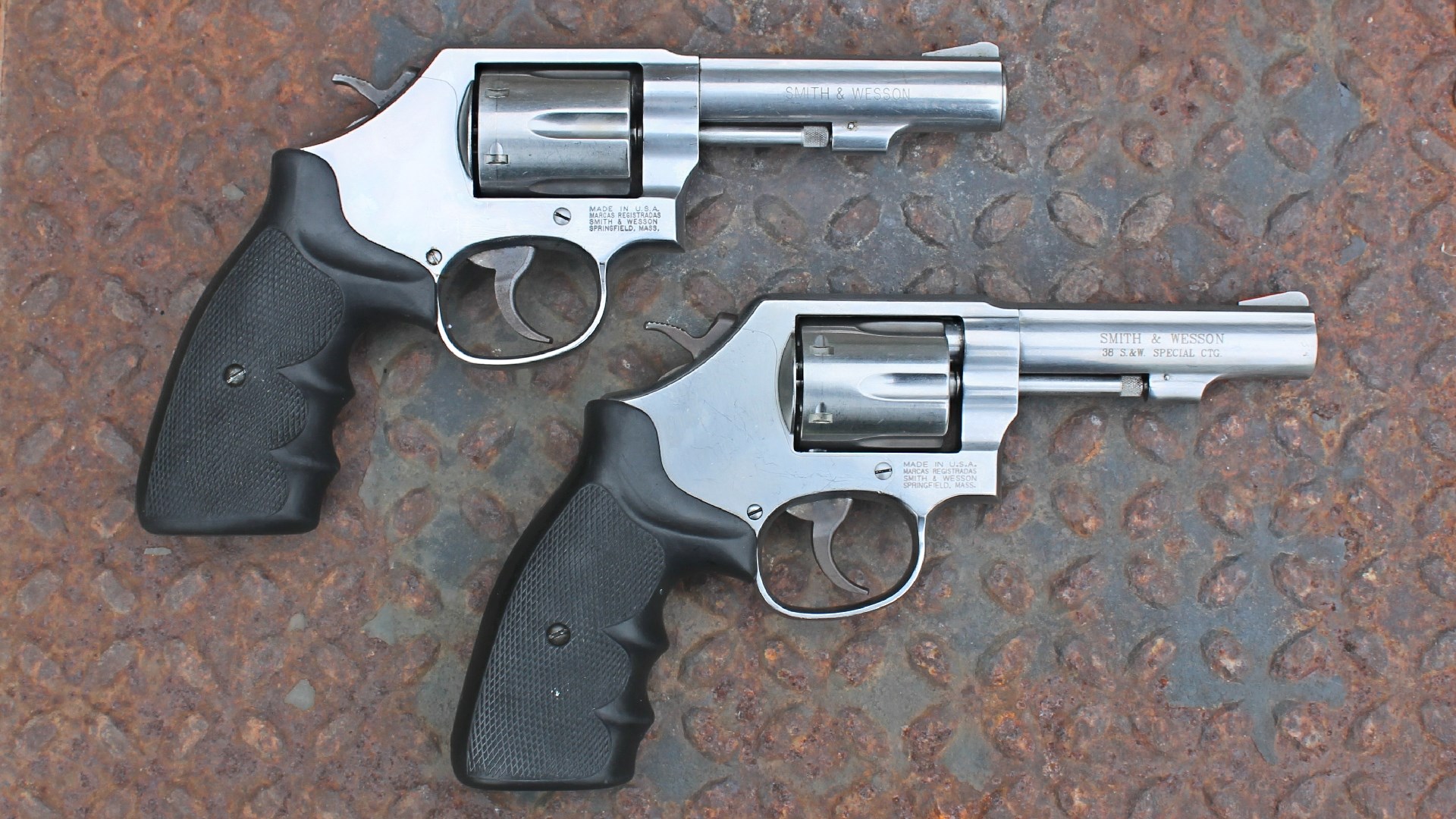
Over the years, I've evaluated a variety of handguns provided by AIM Surplus, including a SIG Sauer P226 chambered in .40 S&W, a Smith & Wesson Model 5946 9 mm and Smith & Wesson's Model 64 series .38 Special revolvers. These handguns, along with others, exhibited levels of performance, reliability and accuracy suitable for personal protection inside and outside of the home. These guns may be older and outfitted with more basic sets of features, but they will get the job done. And because guns like this are procured by the hundreds and thousands, affordable holsters, magazines and other support gear tends to be readily available.

Smith & Wesson Model 64 revolvers right-side view stainless steel guns with black stocks shown on rusted treadplate background
A used .38 Special like the Smith & Wesson Model 64 is a great way to add a revolver to the collection without breaking the bank.

The test guns mentioned here have all been ready to use when they arrived or only called for minor fixes, like swapping the grip. Much like automobiles, firearms contain what manufacturers refer to as "consumable components." These are the parts that wear out based on frequency of use and are likely to be swapped out, or possibly upgraded, within the working lifespan of the machine in question.

In most cases, the parts are designed to be relatively easy to replace and affordable to purchase. For cars and trucks, the consumables consist of air filters, brake pads, windshield wiper blades, tires, etc. For handguns, these parts can include sights, action springs (hammer, trigger, striker, etc.) grips, magazines and magazine components like the follower, spring or baseplate.

SIG Sauer P226 grip frame shown with adhesive leftover from tape
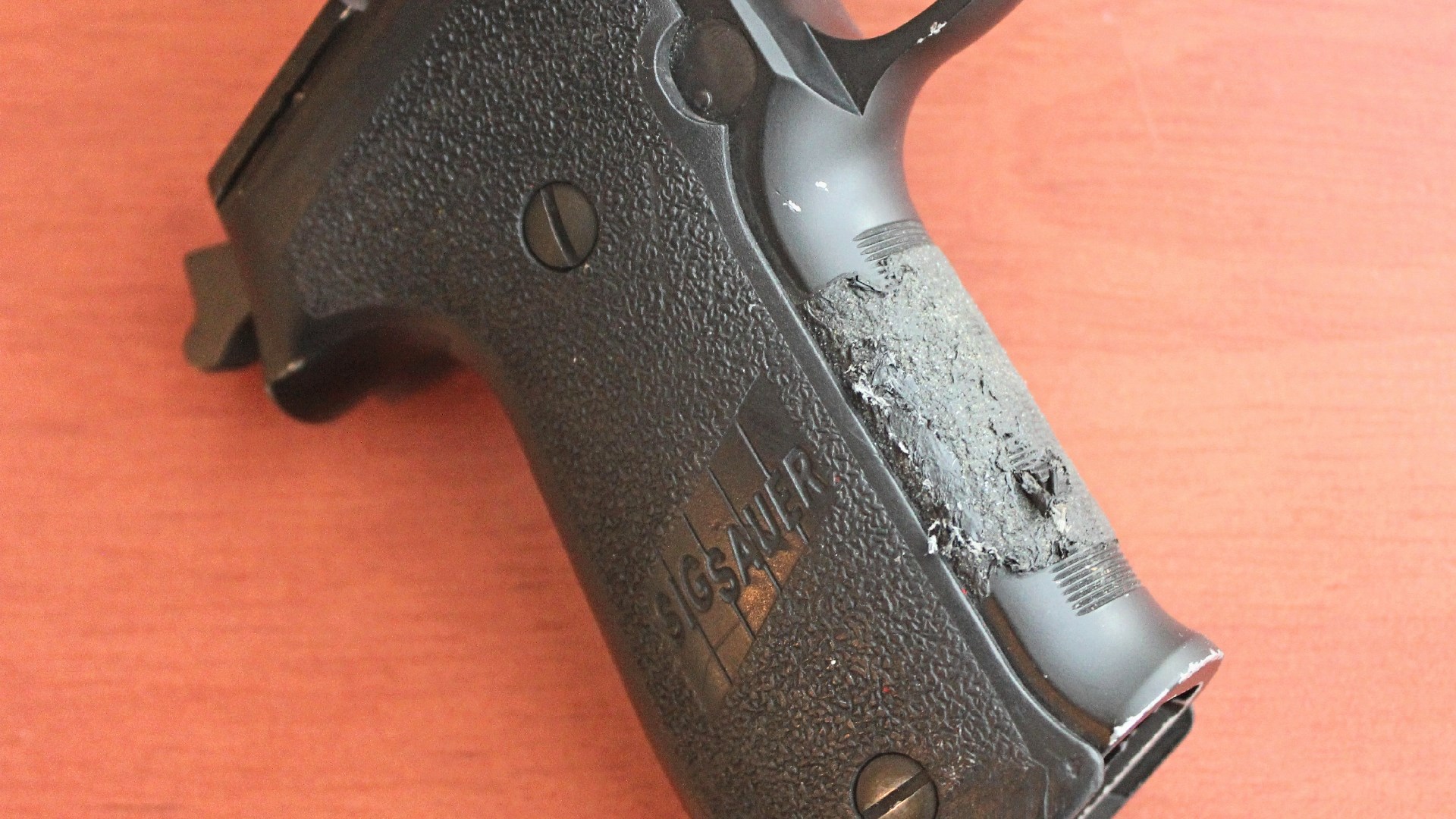
The author gave this SIG Sauer P226 a good cleaning and installed a new set of Hogue rubber stocks.

The way to know if your gun might need parts replaced is to vet it properly before staging it for personal protection. Give it a thorough cleaning and proper lubrication, then run a set of bench checks to verify that all of the controls and functions are cycling properly. If it all looks ship-shape, then head to the range and fire 100 to 200 rounds, including at least two or three of magazines worth of your preferred defense hollow-point loads. If there are no malfunctions, clean and lubricate once more and you are good to go. But if you run into problems you can't resolve, put the gun back in the safe until it can be inspected and repaired by a qualified gunsmith.

The key to making the most of the LEO trade-in market is vigilance. Great deals like those discussed here show up regularly, but they may not stick around for long. The available inventory is constantly changing. Keep an eye out and, if you find a good fit for your needs, don’t wait too long to buy it. For more information about the handguns mentioned here, and other currently available LEO trades, visit aimsurplus.com.

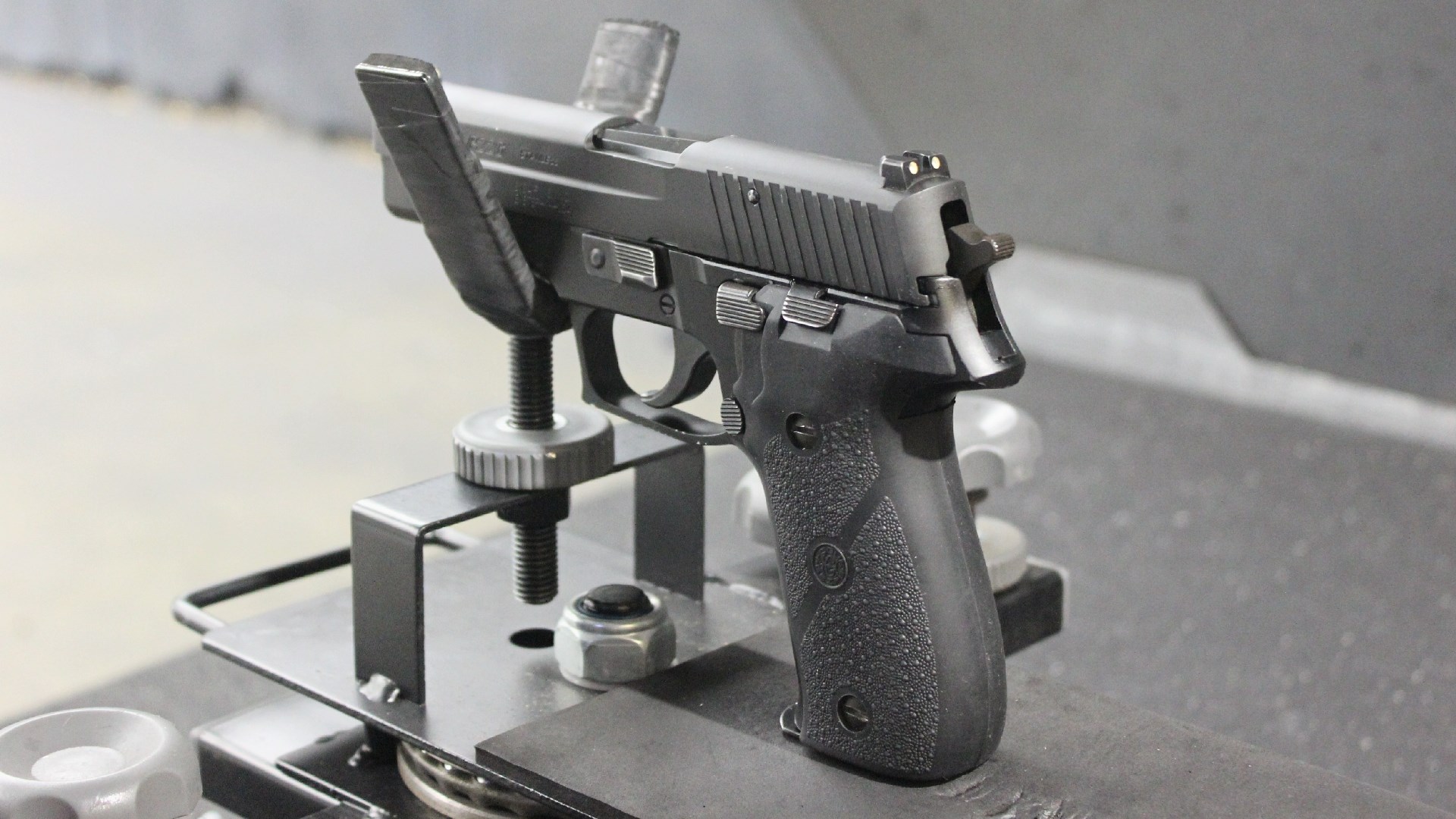
SIG Sauer P226 in shooting rest cradle