I have blogged a lot about Stalin and Hitler because I like History, and I believed that both formed a pact for their own reasons, Hitler wanted to invade Poland, then turn his attention to France without worrying about Stalin being froggy at his back. Stalin signed the pact, besides getting a chunk of Poland, they also had a free hand with the Baltic republics with the world distracted by other events. And he also needed to buy time to rebuild the Red Army after the purges of 1937. This was verified when during the "Winter War" when the Soviets invaded little Finland and got their noses bloodied by the Finns when the poor performance of the Red Army was shown to all the world. The signing of the pact shocked the world because National Socialism and Communism were not compatable and people were expecting a clash of Titans.
Prior to World War II, the USSR Soviets and the Nazis signed a
non-aggression pact. Historians say that the agreement cleared the path
for WWII to begin. The Defense Ministry in Russia has just declassified
documents relating to that agreement.
The Molotov-Ribbentrop Pact was signed on August 23, 1939. Along with
the non-aggression pact The two countries agreed to separate Finland,
Estonia, Lithuania, Latvia, Romania and Poland into two “spheres of
influence” controlled by the USSR and Germany.
This ensured that The Red Army would not interfere in Germany’s invasion of Poland which began the war. The
Nazi-Soviet Pact was a pact between Nazi Germany and the USSR. Also
known as the Molotov-Ribbentrop Pact, the agreement was signed in Moscow
on 23 August 1939. Also known as the non-aggression pact.The
Defense Ministry decided not to release the documents in chronological
order. They say that the order the documents are released in will give
readers “the most complete picture” of how the two sides came to sign
the agreement.
The Ministry highlighted a 31-page memo from a Red Army chief of
general staff, Boris Shaposhnikov. According to the ministry, this
document will change the prevailing views of why Russia signed the pact.
The 1938 memo discusses the Soviet’s need to prepare for battle both
against Germany and Poland and also against Japan. It raises concerns
about the vast number of troops, tanks and warplanes that the Germans
could deploy against the USSR on the Belarussian-Ukrainian border.
President Vladimir Putin, speaking in 2014, said that the
Molotov-Ribbentrop Pact was the Soviet response to being isolated by the
Western countries and having its peace efforts rebuffed by the West.
Alexander Dyukov, of the Russian Academy of Science, called
Shaposhnikov’s dispatch a key to studying military history. Sergei
Kudryashov, a researcher with the German Historical Institute in Moscow,
found the document to be uninformative and only interesting in how it
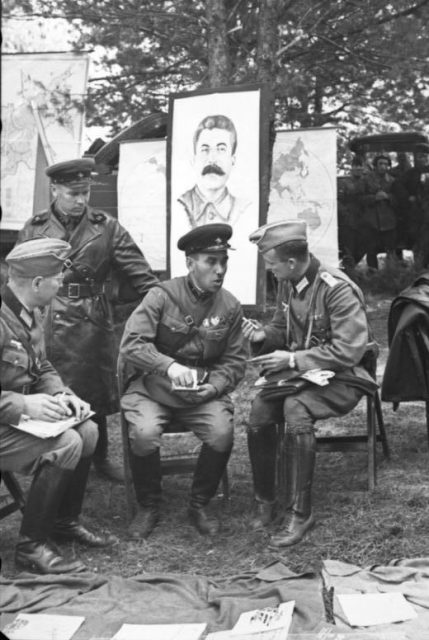
illustrated Soviet understanding of the conditions just before the war. German and Soviet soldiers meet in jointly occupied Brest.
The Defense Ministry said that the motivation behind releasing the
documents was for the purpose of protecting the truth and to keep others
from trying to revise history.
The USSR had attempted to come to terms with Britain and France for a
collective security agreement against Germany. By 1939, with the
likelihood of reaching an agreement with the two countries, Moscow felt
the need to change their policy in order to avoid fighting Germany on
their own.
Joseph Stalin fired his foreign minister, Maksim Litvinov, a Jew who
sought collective security. Litvinov was replaced with Vyacheslav
Mikhaylovich Molotov who almost immediately began negotiating with the
Nazi foreign minister, Joachim von Ribbentrop.
Stalin continued to negotiate with France and Britain until he
finally decided to sign the pact with Germany. He hoped to avoid
conflict with Germany until the Red Army could be built back up
following a purge of officers in 1937.
For Hitler’s part, a nonaggression pact with the Soviet Union freed him to invade Poland with no resistance from the Red Army.
Following the occupation of Poland, Germany would be free to engage
France and Britain without opening another front with the Soviets.
Publicly, the pact prevented either side from attacking the other,
from assisting any country that attacked the other, not to join any
group that threatened the other.
And to consult with each other in any matters that affect the two
parties, and to solve all differences between the two countries through
negotiation and arbitration. The pact was to last 10 years with an
automatic renewal for 5 more years unless either party gave notice to
terminate a year before it expired. Russian
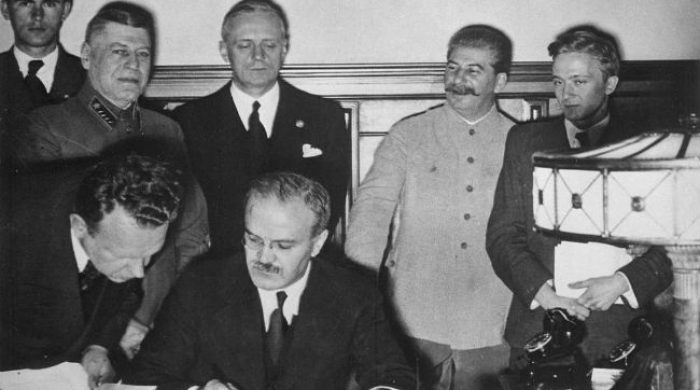
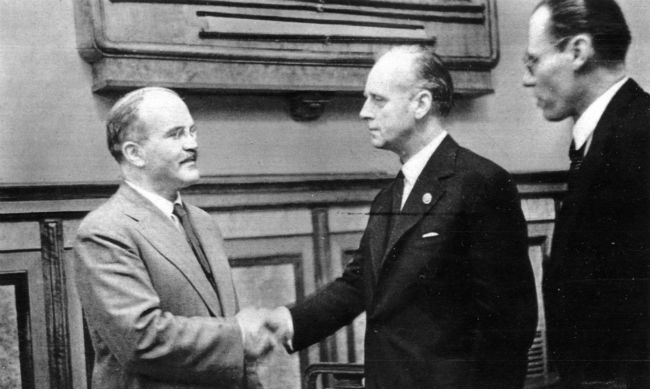
foreign minister Vyacheslav Molotov (left) and German foreign minister
Joachim von Ribbentrop (second from right) signed the non-aggression
pact on 23 August 1939.Secretly, a protocol was
attached to the pact which divided eastern Europe into spheres of
interest controlled by Germany and the Soviet Union. Two additional
points were added which clarified borders and renounced Germany’s rights
to Lithuania in exchange for a sum of money from the Soviets.
The pact ended on June 22, 1941, when the Nazis attacked the Soviets in Operation Barbarossa.
The Soviet Union’s borders in eastern Europe roughly followed those
set in the Molotov-Ribbentrop pact until the 1990s. At that time,
changes within the USSR made it impossible for the central government to
stop the Baltic states from declaring independence.
I am an avid student of History and especially Military History, and like Victor Suvorov wondered if Stalin was planning on invading the German Territories but Hitler got the jump on him with Operation Barbarossa before Stalin was ready. I do know from my history books that Stalin had given stern orders to his generals not to provoke the Germans no matter what they did. I also knew that Stalin had entire Field Armies stationed near the border. Hitler had gotten a poor impression of the Soviet Armies from their dismal performance during the "Winter War" with Finland. I will give my own impression before y'all read this article that follows the pic of Stalin. The Soviets had better equipment especially their Tanks were superior. What helped the Germans besides the Soviets being out of position was their far superior training and the Luftwaffe hitting all the airfields and destroying the Soviet Air armies while they are on the ground. Part of what saved the Soviets in the end was that they were able to move their well equipped Eastern armies that were facing the Japanese after the Japanese let slip that they were focusing on the Americans and their own plans with the Greater East Asian Co-Prosperity Sphere and had no interest in dealing with the Soviets yet. So the Soviets sent their Eastern armies west to launch the offensive that pushed the Germans away from Moscow. The Soviets also used a dual organization for their army that created "Fronts" which is extra military organization that allows the Soviets to run 3 to 5 armies effectively in battle as the Germans found out.
I read a book called "Inside the Soviet Army"in the mid 80's, and I used that book and anything else that I could find during that time to learn about my enemy and without bragging, it made me a pretty good analyst..as far as Soviet doctrine went and how they fight.
For
many years I maintained far too many magazine subscriptions, more
periodicals than I could possibly read or even skim, so most weeks they
went straight into storage, with scarcely more than a glance at the
cover. But every now and then, I might casually browse one of them,
curious about what I had usually been missing.
Thus, in the summer of 2010, I happened to leaf through an issue of Chronicles, the small-circulation flagship organ of the marginalized paleoconservative movement, and soon began reading a blandly-titled book review.
But the piece so astonished me that it immediately justified all the
many years of subscription payments I had sent to that magazine.
The
reviewer was Andrei Navrozov, a Soviet emigre long resident in Britain,
and he opened by quoting a passage from a previous 1990 book review,
published almost exactly twenty years before:
[Suvorov] is arguing with every book, every article, every film, every
NATO directive, every Downing Street assumption, every Pentagon clerk,
every academic, every Communist and anti-Communist, every
neoconservative intellectual, every Soviet song, poem, novel and piece
of music ever heard, written, made, sung, issued, produced, or born
during the last 50 years. For this reason, Icebreaker is the most original work of history it has been my privilege to read.
He himself had written that earlier book review, which ran in the prestigious Times Literary Supplement following the original English publication of Icebreaker, and his description was not overblown. The work sought to overturn the settled history of World War II.
Icebreaker‘s
author, writing under the pen-name Viktor Suvorov, was a veteran Soviet
military intelligence officer who had defected to the West in 1978 and
subsequently published a number of well-regarded books on the Soviet
military and intelligence services. But here he advanced a far more
radical thesis.
The
“Suvorov Hypothesis” claimed that during the summer of 1941 Stalin was
on the very verge of mounting a massive invasion and conquest of Europe,
while Hitler’s sudden attack on June 22nd of that year was intended to
forestall that looming blow. Moreover, the author also argued that
Stalin’s planned attack constituted merely the final act in a much
longer geopolitical strategy that he had been developing since at least
the early 1930s.
Following
the Bolshevik Revolution, the new Soviet regime had been viewed with
extreme suspicion and hostility by other European countries, most of
which also regarded their own domestic Communist Parties as likely fifth
columns. So to fulfill Lenin’s dream and carry the revolution to
Germany and the rest of Europe, Stalin somehow needed to split the
Europeans, and break their common line of resistance. He allegedly
viewed Hitler’s rise as exactly such a potential “icebreaker,” an
opportunity to unleash another bloody European war and exhaust all
sides, while the Soviet Union remained aloof and bided its strength,
waiting for the right moment to sweep in and conquer the entire
continent.
To
this end, Stalin had directed his powerful German Communist Party to
take political actions ensuring that Hitler came to power and then later
lured the German dictator into signing the Molotov-Ribbentrop Pact to
divide Poland. This led Britain and France to declare war on Germany,
while also eliminating the Polish buffer state, thereby placing Soviet
armies directly on the German border. And from the very moment he
signed that long-term peace agreement with Hitler, he abandoned all his
defensive preparations, and instead embarked upon an enormous military
build-up of the purely offensive forces he intended to use for European
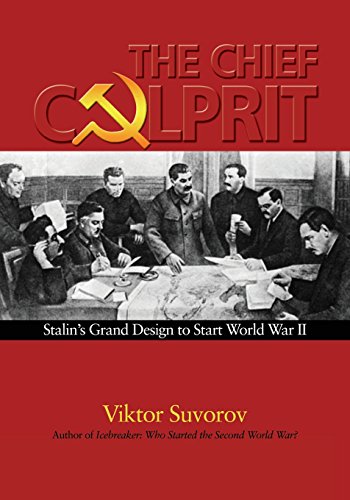
conquest. Thus according to Suvorov, Stalin ranks as “the chief
culprit” behind the outbreak of World War II in Europe, and the updated
English edition of his book bears that exact title.
To
my great surprise I discovered that Suvorov’s remarkable theories had
gained enormous worldwide prominence since 1990, and had been widely
discussed almost everywhere except in America and the other
English-speaking countries. As Navrozov explained:
[The English edition of the] book sold 800 copies.
Some months later, a German edition of the book, under the title Der Eisbrecher: Hitler in Stalins Kaulkul,
was published in Germany by a smallish house, Klett-Cotta, to timid and
gingerly reviews. It sold 8,000 copies. In 1992, Suvorov’s manuscript
was delivered to a maverick publisher in Moscow, and at last the book
saw the light of day in the original Russian, quickly selling out its
first print run of 100,000 copies. In the years that followed, over five
million copies have been sold, making Suvorov the most-read military
historian in history.
And yet, in the nearly 20 years that have elapsed between Icebreaker‘s launch in England and the present publication of The Chief Culprit, no British, American, Canadian, or Australian publisher saw fit to exploit potentially global interest in the drifting Icebreaker—or
to so much as touch Suvorov with a barge pole—despite the fact that the
almost unobtainable $20 copies of the long-out-of print Hamish Hamilton
edition have been changing hands on the internet for upward of $500.
Since
1990, Suvorov’s works have been translated into at least 18 languages
and an international storm of scholarly controversy has swirled around
the Suvorov Hypothesis in Russia, Germany, Israel, and elsewhere.
Numerous other authors have published books in support or more often
strong opposition, and even international academic conferences have been
held to debate the theory. But our own English-language media has
almost entirely blacklisted and ignored this ongoing international
debate, to such an extent that the name of the most widely-read military
historian who ever lived had remained totally unknown to me.
Finally
in 2008, the prestigious Naval Academy Press of Annapolis decided to
break this 18 year intellectual embargo and published an updated English
edition of Suvorov’s work. But once again, our media outlets almost
entirely averted their eyes, and only a single review appeared in an
obscure ideological publication, where I chanced to encounter it. This
conclusively demonstrates that throughout most of the twentieth century a
united front of English-language publishers and media organs could
easily maintain a boycott of any important topic, ensuring that almost
no one in America or the rest of the Anglosphere would ever hear of it.
Only with the recent rise of the Internet has this disheartening
situation begun to change.
Determining
Stalin’s true motives and the basis of his foreign policy during the
1930s is hardly easy, and his statements and actions are subject to
multiple interpretations. Therefore, the theory that the dictator spent
all those years deftly preparing the outbreak of World War II appears
quite speculative to me. But the other central claim of the Suvorov
Hypothesis—that the Soviets were themselves on the verge of attacking
when the Germans struck—is an extremely factual question, which can be
evaluated based on hard evidence. I find the case quite compelling, at
least if the facts and details that Suvorov cites in support are not
totally spurious, which seems unlikely with the Naval Academy Press as
his publisher.
The
Eastern Front was the decisive theater of World War II, involving
military forces vastly larger than those deployed in the West or the
Pacific, and the standard narrative always emphasizes the ineptitude and
weakness of the Soviets. On June 22, 1941, Hitler launched Operation
Barbarossa, a sudden, massive surprise attack on the USSR, which caught
the Red Army completely unaware. Stalin has been regularly ridiculed
for his total lack of preparedness, with Hitler often described as the
only man the paranoid dictator had ever fully trusted. Although the
defending Soviet forces were enormous in size, they were poorly led,
with their officer corps still not recovered from the crippling purges
of the late 1930s, and their obsolete equipment and poor tactics were
absolutely no match for the modern panzer divisions of Germany’s
hitherto undefeated Wehrmacht. The Russians initially suffered
gigantic losses, and only the onset of winter and the vast spaces of
their territory saved them from a quick defeat. After this, the war
seesawed back-and-forth for four more years, until superior numbers and
improved tactics finally carried the Soviets to the streets of a
destroyed Berlin in 1945.
Such
is the traditional understanding of the titanic Russo-German struggle
that we see endlessly echoed in every newspaper, book, television
documentary, and film around us. But even a cursory examination of the
initial situation has always revealed strange anomalies.
Many
years ago, while in Junior High, I became an avid war-gamer with a
strong interest in military history, and the Eastern Front of World War
II was certainly a very popular topic. But every reconstruction of
Operation Barbarossa always noted that the Germans owed much of their
great initial success to the very odd deployment of the huge Soviet
forces, which were all massed along the border in vulnerable formations
almost as if preparing for an attack, and some writers casually
suggested that this might have indeed been the case. But the sheer
volume of supporting evidence amassed by Suvorov goes far beyond this
sort of idle speculation, and he produces a historical picture radically
different than what our standard accounts have always implied.
First,
although there was been a widespread belief in the superiority of
Germany’s military technology, its tanks and its planes, this is almost
entirely mythological. In actual fact, Soviet tanks were far superior
in main armament, armor, and maneuverability to their German
counterparts, so much so that the overwhelming majority of panzers were
almost obsolescent by comparison. And the Soviet superiority in numbers
was even more extreme, with Stalin deploying several times more tanks
than the combined total of those held by Germany and every other nation
in the world: 27,000 against just 4,000 in Hitler’s forces. Even during
peacetime, a single Soviet factory in Kharkov produced more tanks in
every six month period than the entire Third Reich had built prior to
1940. The Soviets held a similar superiority, though somewhat less
extreme, in their ground-attack bombers. The totally closed nature of
the USSR meant that vast military forces remained entirely hidden from
outside observers.
There
is also little evidence that the quality of Soviet officers or military
doctrine fell short. Indeed, we often forget that history’s first
successful example of a “blitzkrieg” in modern warfare was the crushing
August 1939 defeat that Stalin inflicted upon the Japanese 6th Army in
Outer Mongolia, relying upon a massive surprise attack of tanks,
bombers, and mobile infantry. And Stalin apparently thought so highly
of many of his top military strategists in 1941, that despite his huge
initial losses, many of them remained in command and were eventually
promoted to the highest ranks of the Soviet military establishment by
the end of the war.
Certainly,
many aspects of the Soviet military machine were primitive, but exactly
the same was true of their Nazi opponents. Perhaps the most surprising
detail about the technology of the invading Wehrmacht in 1941 was that
its transportation system was still almost entirely pre-modern, relying
upon wagons and carts drawn by 750,000 horses to maintain the vital flow
of ammunition and replacements to its advancing armies.
Meanwhile,
major categories of Soviet weapons systems seem almost impossible to
explain except as important elements of Stalin’s offensive plans.
Although the bulk of the Soviet armored forces were medium tanks like
the T-28 and T-34, generally far superior to their German counterparts,
the USSR had also pioneered the development of several lines of highly
specialized tanks, most of which had no counterpart elsewhere in the
world.
(*)
The Soviets had produced a remarkable line of light BT tanks, easily
able to shed their tracks and continue on wheels, achieving a top speed
of 60 miles per hour, two or three times faster than any other
comparable armored vehicle, and ideally suited to exploitation drives
deep into enemy territory. However, such wheeled operation was only
effective on paved highways, of which Soviet territory had none, hence
were ideally suited for travel on Germany’s large network of autobahns. In 1941 Stalin deployed almost 6,500 of these autobahn-oriented tanks, more than the rest of the world’s tanks combined.
(*)
For centuries, Continental conquerors from Napoleon to Hitler had been
stymied by the barrier of the English Channel, but Stalin was far better
prepared. Although Stalin’s vast USSR was entirely a land-power, he
pioneered the world’s only series of fully amphibious light tanks, able
to successfully cross large rivers, lakes, and even that notoriously
wide moat last successfully traversed by William the Conqueror in 1066.
By 1941, the Soviets deployed 4,000 of these amphibious tanks, far more
than 3,350 German tanks of all types used in the attack. But being
useless in defense, they were all ordered abandoned or destroyed.
(*)
The Soviets also fielded many thousands of heavy tanks, intended to
engage and defeat enemy armor, while the Germans had none at all. In
direct combat, a Soviet KV-1 or KV-2 could easily destroy four or five
of the best German tanks, while remaining almost invulnerable to enemy
shells. Suvorov recounts the example of a KV which took 43 direct hits
before finally becoming incapacitated, surrounded by the hulks of the
ten German tanks it had first managed to destroy.
Other evidence of the scale and intent of Stalin’s armies in the summer of 1941 are equally telling:
(*)
During the early years of World War II, the Germans effectively
utilized paratroops and air-mobile forces to seize key enemy targets far
behind the front lines during a major offensive, and this was an
important component of their victories against France in 1940 and Greece
in 1941. Such units are necessarily lightly armed and no match for
regular infantry in a defensive battle; hence their only role is an
offensive one. Germany entered the war with 4,000 paratroops, a far
larger force than anything found in Britain, France, America, Italy, or
Japan. However, the Soviets had at least 1,000,000 trained
paratroopers, and Suvorov believes that the true total was actually
closer to 2,000,000.
(*)
Sometimes the production decisions of major weapon systems provide
strong hints of the broader strategy behind their development. The most
widely produced military aircraft in history was the heavily armored
IL-2, a powerful Soviet ground-attack bomber that was originally
designed as a two-man system, with the rear gunner able to effectively
defend the plane against enemy fighters during its missions. However,
Stalin personally ordered the design changed to eliminate the second man
and defensive armament, which left the bomber extremely vulnerable to
enemy aircraft once the war broke out. Stalin and his war-planners had
seemingly banked on possessing near-total air supremacy during the
entire course of any conflict, an assumption plausible only if the
German luftwaffe were destroyed on the ground by a surprise attack on the very first day.
(*)
There is considerable evidence that in the weeks prior to the German
surprise attack, Stalin had ordered the release of many hundreds of
thousands of Gulag prisoners, who were issued basic weapons and
organized into NKVD-led divisions and corps, constituting a substantial
part of the Second Strategic Echelon located hundreds of miles from the
German border. These units may have been intended to serve as
occupation troops, allowing the much more powerful front-line forces to
press onward and complete the conquests of France, Italy, the Balkans,
and Spain. Otherwise, I can find no other plausible explanation for
Stalin’s action.
(*)
The planned invasion and occupation of a large country whose population
speaks a different language requires considerable logistical
preparation. As an example, prior to their attack the notoriously
methodical Germans printed and distributed to their troops large numbers
of German-Russian basic phrasebooks, allowing effective communication
with the local Slavic villagers and townsmen. Ironically enough, at
around the same time, the USSR seems to have produced very similar
Russian-German phrasebooks, allowing conquering Soviet troops to easily
make themselves understood to German civilians. Many millions of these
phrasebooks had been distributed to Soviet forces on the German border
during the early months of 1941.
Suvorov’s
reconstruction of the weeks directly preceding the outbreak of combat
is a fascinating one, emphasizing the mirror-image actions taken by both
the Soviet and German armies. Each side moved its best striking units,
airfields, and ammunition dumps close to the border, ideal for an
attack but very vulnerable in defense. Each side carefully deactivated
any residual minefields and ripped out any barbed wire obstacles, lest
these hinder the forthcoming attack. Each side did its best to
camouflage their preparations, talking loudly about peace while
preparing for imminent war. The Soviet deployment had begun much
earlier, but since their forces were so much larger and had far greater
distances to cross, they were not yet quite ready for their attack when
the Germans struck, and thereby shattered Stalin’s planned conquest of
Europe.
All
of the above examples of Soviet weapons systems or strategic decisions
seem very difficult to explain under the conventional defensive
narrative, but make perfect sense if Stalin’s orientation from 1939
onward had always been an offensive one, and he had decided that summer
1941 was the time to strike and enlarge his Soviet Union to include all
the European states, just as Lenin had originally intended. And Suvorov
provides many dozens of additional examples, building brick by brick a
very compelling case for this theory.
The
book is not overly long, running perhaps 150,000 words, and $20 plus a
few mouse clicks on Amazon will provide you a copy to read and judge for
yourself. But for those who desire a simple summary, Suvorov’s 2009
lecture at the Eurasia Forum of the Annapolis Naval Academy is
conveniently available on YouTube, though slightly hindered by his weak
English:
Also his C-Span series
Controversial
theories, even if backed by seemingly strong evidence, can hardly be
properly evaluated until they have been weighed against the
counter-arguments of their strongest critics, and this should certainly
be the case with the Suvorov Hypothesis. But although the last three
decades have seen the development of a large secondary literature, much
of it sharply critical, nearly all this international debate has taken
place in Russian, German, or Hebrew, languages that I do not read.
There
are some exceptions. Several years ago, I came across a website debate
on the topic, and one strong critic claimed that Suvorov’s theories had
been totally debunked by American military historian David M. Glantz in
Stumbling Colossus, published in 1998. But when I ordered and
read the book I was sorely disappointed. Although purporting to refute
Suvorov, the author seemed to ignore almost all of his central
arguments, and merely provided a rather dull and pedantic recapitulation
of the standard narrative I had previously seen hundreds of times,
laced with a few rhetorical excesses denouncing the unique vileness of
the Nazi regime. Most ironically, Glantz emphasizes that although
Suvorov’s analysis of the titanic Russo-German military struggle had
gained great attention and considerable support among both Russian and
German scholars, it had been generally ignored in the Anglo-American
world, and he almost seems to imply that it can probably be disregarded
for that reason. Perhaps this attitude reflected the cultural arrogance
of many American intellectual elites during Russia’s disastrous Yeltsin
Era of the late 1990s.
A far superior book, generally supportive of Suvorov’s framework, was Stalin’s War of Annihilation,
by prize-winning German military historian Joachim Hoffmann, originally
commissioned by the German Armed Forces and published in 1995 with an
English revised edition appearing in 2001. The cover carries a notice
that the text was cleared by German government censors, and the author’s
introduction recounts the repeated threats of prosecution he endured
from elected officials and the other legal obstacles he faced, while
elsewhere he directly addresses himself to the unseen government
authorities who he knows are reading over his shoulder. When stepping
too far outside the bounds of accepted history carries the serious risk
that a book’s entire print-run will be burned and the author imprisoned,
a reader must necessarily be cautious at evaluating the text since
important sections have been skewed or preemptively excised in the
interests of self-preservation. Evaluating scholarly debates on
historical issues becomes difficult when one sides faces incarceration
if their arguments are too bold.
Can
we say whether Suvorov is right? Since our information gatekeepers of
the English-language world have spent the last three decades closing
their eyes and pretending that the Suvorov Hypothesis does not exist,
the near-complete absence of any substantial reviews or critiques makes
it very difficult for me to come to any definite conclusion. But based
on the available evidence, I believe it is far more likely than not that
Suvorov’s theories are at least substantially correct. And if so, our
current understanding of World War II—the central formative event of our
modern world—is entirely transformed.
Suvorov
notes that treaties or pacts are traditionally named for the city in
which they are signed—the Warsaw Pact, the Baghdad Pact, the Munich
Agreement—and thus the so-called “Molotov-Ribbentrop Pact” signed in
August 23, 1939 by which Hitler and Stalin agreed to the division of
Poland should more properly be called “the Moscow Pact.” As a direct
result of that agreement, Stalin gained half of Poland, the Baltic
States, and various other advantages, including a direct border with
Germany. Meanwhile, Hitler was punished by declarations of war from
France and Britain, amid worldwide condemnation as a military aggressor.
Although Germany and Russia both invaded Poland, the latter managed to
avoid being dragged into any war with Poland’s erstwhile allies. Thus,
the primary beneficiary of the Moscow Pact was clearly Moscow.
Given
the long years of trench warfare on the Western front during the First
World War, almost all outside observers expected the new round of the
conflict to follow a very similar static pattern, gradually exhausting
all sides, and the world has shocked when Germany’s innovative tactics
allowed it to achieve a lightening defeat the allied armies in France
during 1940. But at that point, Hitler regarded the war as essentially
over, and was confident that the extremely generous peace terms he
immediately offered the British would soon lead to a final settlement.
As a consequence, he returned Germany to a regular peacetime economy,
choosing butter over guns in order to maintain his high domestic
popularity
Stalin,
however, was under no such political constraints, and from the moment
he had signed his long-term peace agreement with Hitler in 1939 and
divided Poland, he ramped up his total-war economy to an even higher
notch. Embarking upon an unprecedented military buildup, he focused his
production almost entirely upon purely offensive weapons systems, while
even discontinuing those armaments better suited for defense and
dismantling his defensive lines of fortifications. By 1941, his
production cycle was complete, and he made his plans accordingly.
And
so, just as in our traditional narrative, we see that in the weeks and
months leading up to Barbarossa, the most powerful offensive military
force in the history of the world was quietly assembled in secret along
the German-Russian border, preparing for the order that would unleash
their surprise attack. The enemy’s unprepared airforce was to be
destroyed on the ground in the first days of the battle, and enormous
tank columns would begin deep penetration thrusts, surrounding and
trapping the opposing forces, achieving a classic blitzkrieg
victory, and ensuring the rapid occupation of vast territories. But the
forces preparing this unprecedented war of conquest were Stalin’s, and
his military juggernaut would surely have seized all of Europe, probably
soon followed by the remainder of the Eurasian landmass.
Then
at almost the last moment, Hitler suddenly realized the strategic trap
into which he had fallen, and ordered his heavily outnumbered and
outgunned troops into a desperate surprise attack of their own on the
assembling Soviets, fortuitously catching them at the very point at
which their own final preparations for sudden attack had left them most
vulnerable, and thereby snatching a major initial victory from the jaws
of certain defeat. Huge stockpiles of Soviet ammunition and weaponry
had been positioned close to the border to supply the army of invasion
into Germany, and these quickly fell into German hands, providing an
important addition to their own woefully inadequate resources.
The
enormous and fully-militarized resources of the Soviet state,
supplemented by the contributions of Britain and America, did eventually
turn the tide of battle and lead to a Soviet victory, but Stalin ended
up with only half of Europe rather than its entirety. Suvorov argues
that the fatal weakness of the Soviet system was its total inability to
compete with non-Sovietized states in the peacetime production of
civilian goods, and because such states had still survived after the
war, the Soviet Union was doomed to eventual collapse.
Navrozov, the Chronicles
reviewer, is a Russian Slav and therefore hardly favorable to the
German dictator. But he closes his review with a remarkable statement:
Therefore, if any of us is free to write, publish, and read this today,
it follows that in some not inconsequential part our gratitude for this
must go to Hitler. And if someone wants to arrest me for saying what I
have just said, I make no secret of where I live.
I have blogged about Stalin in the Past, his effect on the Soviet Union and in the world, he has killed more people with the exception of Chairman Mao, The purges he did in the 1930 to the Ukrainians and wiped whole villages as he forced a man made famine as he seized their assets to finance the heavy industry he wanted. Stalin created the first modern police state with the NKVD . The purges he also forced on the Russian people after he disarmed him. Stalin also purged the Red Army, killing off one third of the officers in a purge because of his paranoid nature and listening to his NKVD Chief Beria. The resulting purge affected the Red Army during the Winter War and told Hitler that the Red Army was weak an disorganized and that the Soviet Union was vulnerable.
Here are some facts about Stalin that wasn't commonly known.
The Second World War saw the rise of some truly monumental figures,
on both sides of the conflict. With leaders Franklin D. Roosevelt in
America and Britain’s Winston Churchill leading the battle for the
world’s future, nations rose and fell on the decisions of a few
incredibly powerful men.
One of these individuals in particular – Joseph Stalin – was a titan
in the east of Europe, and was instrumental in winning the battle for
the Eastern Front. From his poor beginnings in Georgia to the dark myths
that still swirl around his time in power, here are four facts about
the man who called himself the Man of Steel.
The Georgian Hero
There are few men more associated with Russia than Stalin, but he was
not actually from there originally. He was Georgian, and although the
country was ruled by the Russian Empire, he grew speaking the local
language and maintained a close connection his original nationality.
Born in Gori, in the east of the country, he was originally named
Iosif Vissarionovich Dzhugashvili. The town of his birth remained
extremely loyal to Stalin throughout the years, where he was held up as
an inspiration and a national hero.
Decades later, after Stalin’s death, the new Russian Premier Nikita
Khrushchev presented a damning speech, in which he heavily criticized
his predecessor and attacked the “cult of personality” he had helped
create. Although the speech shocked and outraged people around the
world, Gori actually erupted into riots as a result, with protests
continuing unabated until a military crackdown days later.
Comrade Index Card
The Man of Steel’s rivals wanted to brand him as a menial secretary
It is clear that Stalin wanted to present himself as a hard and
uncompromising man, determined to uphold his beliefs at any cost. To
this end, he wrote articles under the moniker “The Man of Steel”, from
which the name Stalin is actually derived.
However, a rival within the Communist Party had other ideas. When
Stalin assumed the position of General Secretary within the
organization, Leon Trotsky began referring to him as Comrade Index Card.
This belittling title came about because of the slightly mundane
secretarial tasks that Stalin had to carry out in his new role within
the party.
Trotsky recognized his rival’s potential, of course, and probably
wished to paint him as a minor bureaucrat, rather than the Man of Steel
he claimed to be. The nickname wasn’t enough to hold him back, however,
and Stalin’s rise to power soon had Trotsky on the run.
The Orthodox Priest
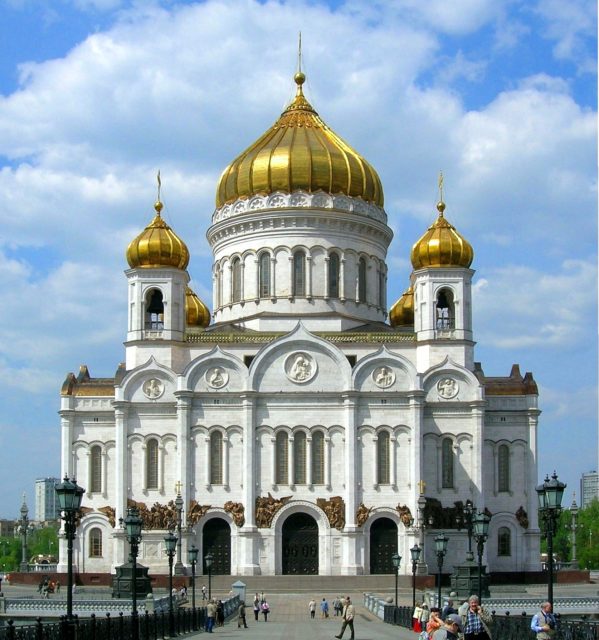
Orthodox churches were actually torn down under Stalin
One of the defining features of Stalin and his government was the
promotion of atheism and the persecution of religious groups and
practices. Churches were demolished, anti-religious laws instated and
atheistic educational programs were widely implemented in schools.
Under Stalin’s rule, the Russian Orthodox Church faced intense
opposition, and almost completely vanished during the 1930’s.
Remarkably, however, he actually once trained to become an Orthodox
priest himself.
In the late 1800’s, a young Stalin enrolled in the Spiritual Seminary
in Tiflis, the capital of Georgia. Initially, he was an excellent
student, achieving high grades and working hard. However, as time went
on he had a change of heart and became a committed atheist, rejecting
his original path and leaving the religious school in 1899.
The Sinister Scientist
Ivanov is at the center of some dark and fantastical theories about Stalin
Inevitably, as with many of the most sinister figures from the Second
World War, there is no shortage of lurid urban myths and unlikely
conspiracy theories about Stalin. However, one that has gained
particular traction – almost to the point of being recognized as fact –
is Stalin’s desire to create a “super soldier” by crossing animal and
human DNA.
The story goes that the Man of Steel tasked a scientist named Ilya
Ivanovich Ivanov with the job of creating a chimpanzee-human hybrid.
With substantial funding behind him, Ivanov then traveled to Africa to
procure primates that could be artificially inseminated with human
genetic material. His experiments were continuing apace, when the Soviet
authorities changed their minds and had him fired.
However, although Ivanov was certainly keen to experiment in this
dubious field of science, there is very little evidence that Stalin even
knew about his work, much less that he was in favor of it. The story is
largely rooted in a poorly-sourced newspaper article from 2005, and
thankfully it is almost certainly no more than an urban myth.
I ran across this article reading another historical magazine, and figured I would expound upon it. I knew for a long time that Stalin had employed "doubles" to guard against assassination, and to do things that he didn't want to do. Here is a picture of Stalin visiting Berlin.
The truth of the matter was that this was reenactment in 1949 and that wasn't Stalin. Stalin never went to Berlin as I understand it. he had a fear of flying and used trains exclusively, for his meeting in Potsdam and in Yalta.
Mikheil Gelovani
In 1938, Gelovani first portrayed Stalin in Mikheil Chiaureli's The Great Dawn. His performance won him the Order of the Red Banner of Labour on 1 February 1939 and the Stalin Prize during 1941.
Afterwards, Gelovani "established a monopoly on the role of Stalin",
which he continued to portray in twelve other pictures until the
premier's death.Gelovani greatly resembled Stalin physically, except in his stature: he was much taller than the latter.
Reportedly, he was not the premier's favorite candidate for depicting
himself on screen: since he was Georgian, he mimicked Stalin's accent
"to perfection". Therefore, the leader personally preferred Aleksei Dikiy, who used classic Russian pronunciation. However, Gelovani appeared in his role much more than Dikiy. According to the The Guinness Book of Movie Facts and Feats, Gelovani had probably portrayed the same historical figure more than any other actor. When the two met, the general secretary told the actor: "you are observing me thoroughly... You do not waste time, do you?"
Soviet cinema played an important part in cultivating the leader's cult of personality: from 1937 and onward, in a gradual process, Stalin's reign was legitimized by depicting him as Vladimir Lenin's most devout follower[ and by positively presenting historical autocrats - like in Sergei Eisenstein's Ivan the Terrible.
Due to his identification with Stalin, Gelovani was barred from
playing other roles in cinema; he was not allowed to depict "mere
mortals." From 1942 to 1948, he was a member of the cast in the Gorky Moscow Art Theatre.
During World War II, the personality cult was abandoned in favor of
patriotic motifs, but returned already at the war's late stages, and
with greater intensity than ever after 1945: Stalin was soon credited as
the sole architect of victory. In the postwar films in which he portrayed him - The Vow, The Fall of Berlin and The Unforgettable Year 1919 - Gelovani presented the leader as "a living god."
The actor was awarded three more Stalin Prizes, all of which were
granted for his performances of the premier in film: in 1942 for The Defence of Tsaritsyn, in 1947 for The Vow and in 1950 for The Fall of Berlin. On 3 June 1950, he was given the title People's Artist of the USSR.
After Stalin's death in 1953, Gelovani was denied new roles in films, since he was completely identified with the character of the dead ruler. From 1953 until his death in 1956, he acted in Moscow's State Theater for Film Actors. Andreas Kilb wrote that he ended his life "a pitiful Kagemusha" of Stalin. Gelovani is buried in the Novodevichy Cemetery, alongside his wife Ludmila.
Following Nikita Khrushchev's Secret Speech in 1956, most of the pictures he appeared in as Stalin were either banned or had the relevant scenes removed.
This is a clip of the Soviet Propaganda film that was used to help create this cult of personality around Stalin as the patient father figure....despite the gulags, the NKVD terror raids and other things he did to totally subdue Russia. it was almost a "Stockholm Syndrome". type of effect that he had.
Felix Dadaev (left) in the 1940s and the real Joseph Stalin (right).
Rumors circulated in Russia for decades that Joseph Stalin had a
“twin” who replaced him during certain situations. After decades of
rumors, finally Stalin’s decoy decided to talk. Felix Dadaev, a former
dancer and juggler was ordered to the Kremlin to work as Stalin’s body
double. For more than half a century, Dadaev remained silent, fearing a
death sentence should he dare to open his mouth. But in 2008, at the age
of 88, and with the apparent approval of the Putin regime, he finally
came forward to write his autobiography. Dadaev’s autobiography explains
that he was one of four men employed to impersonate the supreme leader,
taking his place in motorcades, at rallies, on newsreel footage etc.
Dadaev was born in the Caucasian highlands of Dagestan and when his
family moved to Grozny, in Chechnya, he began taking ballet lessons.
When the Second World War started, he was required to fight and was so
badly injured during the Soviet liberation of Grozny in 1942 that his
family was told he had been killed. He was one of seven corpses
delivered to a hospital, but he and another guy were still alive.
Fortunately, he got better, though that “death” was the start of a
strange double life. Soon his resemblance to 60-year-old Stalin (which
got him teased in school) caught the eye of Soviet intelligence agents,
who started using him to save the real Stalin from assassination plots
and lame public ceremonies.
Even Stalin’s closest comrades couldn’t spot the imposter.
Just into his 20s, Dadaev was a great deal younger than Stalin, but
make-up and the strain of war meant that he could pass as a 60-year-old.
“We had all experienced so much suffering that I looked much older than
I was”, Dadaev said. Trained at the personal request of Stalin, Dadaev
attended rallies and meetings across Soviet Union wearing the leader’s
trademark Red Army cap and heavy overcoat encrusted with medals. He
watched movies and speeches of Stalin to perfect the mimicry of his
movement and intonation. Some say that Dadaev, like other Stalin’s body
doubles, was trained by Alexei Diky, an actor who played the role of
Stalin in propaganda films.
Felix Dadaev in his military uniform.
In an age before media dominated, he didn’t have to mimic perfectly
Stalin’s vocal inflections, just his look and mannerisms. And he pulled
it off so well even Stalin’s closest comrades couldn’t spot the
imposter. “By the time my make-up and training were complete, I was like
him in every way, except perhaps my ears. They were too small”. Interesting facts:
Another Stalin’s body double was a man identified only as “Rashid”.
Rashid so closely resembled the dictator that when he joined the army he
was dismissed almost immediately. Even his facial scars nearly matched
the Soviet leader’s pockmarks from a bout with smallpox. He spent two
years studying with Alexei Dikiy. Rashid claimed there were other Stalin
lookalikes employed by the NKVD (predecessor of KGB), although he never
met any. He claimed to have heard of another Stalin double who was
hired to live in the dictator’s dacha outside of Moscow in the late
1940s and 1950s when Stalin was dying. After Stalin’s death in 1953,
Rashid moved to a provincial city and shaved off his mustache and
gradually became bald. Yet even then the resemblance proved so striking
that he often received stares on the street, they were afraid that the dictator had gone into hiding with them.
A man who looked so much like Josef Stalin
that he was hired to sit in for the Soviet dictator
at meetings and banquets has died in the southern city
of Krasnodar. He was 93. The newspaper Rabochaya Tribuna
identified the Stalin double only as Rashid and said without
explaining further that he died "several days ago."
Later Rashid made a career as Stalin’s double. Officials
at the KGB heard of his adventures at the Army recruiting office and
eventually tracked him down. Rashid spent 2 years studying with Alexei
Dikiy, an actor who played the role of Stalin in films. But Rashid's role was to
play Stalin "live," at public functions such as banquets. (Was Dikiy jealous?
Or too busy playing Stalin in the movies to play him in real life?)
No mention is made in the obituary of the role Stalin
played in his hiring, if any, or if Rashid was ever
allowed to meet or study the man he was to impersonate.
He may have been taught to impersonate by Stalin’s first impersonator,
and by images of that impersonator on the silver screen.
There are also other doubles mentioned in the obituary,
doubles multiplying into quadruples and more. It’s not
at all clear what the total number of Stalin’s doubles actually was (were?).
Rashid never met with any other Stalin lookalikes except Dikiy,
but he told of another Stalin double who was hired to live
in the dictator's dacha outside of Moscow in the late 1940s
and 1950s when Stalin was dying. This double filled in
for Stalin for media events and other times when Stalin
had to meet government functionaries and others.
I was unable to find any photo's of "Rashid"
Perhaps some of the "Official" photo's of Stalin were of him...I don't know.
I am a history nut, I would like to see Volgograd and St Petersburg and check out the museums. This stuff is on my bucket list. I may pile on Putin, but the Russian people I respect a lot, and they take their history seriously. I got this off the AP wire. The pics are compliments of "google"
MOSCOW (AP) — The southern Russian city where the Red Army decisively turned back Nazi forces in a key World War II battle will once again be known as Stalingrad, at least on the days commemorating the victory.
The city was renamed Volgograd in 1961 as part of the Soviet Union's rejection of dictator Joseph Stalin's personality cult. But the name Stalingrad is inseparable with the battle, in which at least 1.25 million people died.
Russia on Saturday plans extensive ceremonies to mark the 70th anniversary of the battle's end.
The Volgograd city council passed
a measure Thursday to use the name Stalingrad in city statements on
the commemoration day, on Russia's May 9 Victory Day and on four other days connected with the battle, the ITAR-Tass news agency reported.