I pulled this off Quora, I saw it taking a "Microbreak" at work surfing the phone. so I shamelessly clipped it.
In 1974, surviving WWII commanders wargamed Hitler's invasion of Britain and made a darkly comedic discovery: the Royal Navy wouldn't even need to fire its guns to sink the German fleet.
The highly detailed simulation of Operation Sea Lion was held at the Royal Military Academy Sandhurst and featured actual combat veterans making the decisions, including Luftwaffe General Adolf Galland and Kriegsmarine Admiral Friedrich Ruge.
The wargame yielded several unexpected insights, starting with the initial assault. Most historical assumptions suggest the Royal Air Force and Royal Navy would have crushed the invasion fleet before it ever reached the beaches. Instead, the Sandhurst simulation showed that the Germans would have successfully landed around 90,000 troops in Kent and Sussex. Because the British Army had abandoned most of its heavy equipment during the evacuation of Dunkirk just months earlier, the coastal defenses were too weak and disorganized to stop the initial beachhead. The German army quickly pushed inland, capturing their early objectives.
But the success was short-lived, largely due to the fatal flaw in German logistics. The Kriegsmarine lacked purpose-built landing craft, forcing them to commandeer hundreds of flat-bottomed river barges from the Rhine to transport men and supplies across the English Channel.
Once the British realized a full-scale invasion was underway, the Royal Navy unleashed the Home Fleet from Scapa Flow. When the British cruisers and destroyers arrived in the Channel, they found that they did not need to rely on their main guns to destroy the German supply lines. Simply steaming through the invasion flotilla at high speed would generate enough wake to swamp and capsize the flimsy, unseaworthy river barges.
With the Channel completely severed by the Royal Navy and the RAF, the 90,000 German troops who had successfully landed were suddenly trapped. Cut off from food, medical supplies, and artillery shells, their advance ground to a halt. The Luftwaffe suffered massive losses attempting an improvised aerial resupply. Facing a fully mobilized British defense and completely out of ammunition, the entire German invasion force was compelled to surrender within six days, proving that without absolute naval and air supremacy, Sea Lion was a guaranteed trap for the German army.
German invasion barges, many of them commandeered river vessels, waiting at Boulogne Harbour in France during the Battle of Britain. Source: Wikimedia Commons.
I have posted before about WWII Germany's only Aircraft Carrier. I had blogged about that carrier back in 2016. Now this is a "What if" if Germany had gotten their carriers into the war especially after seeing the effect that carriers were having on the war in the Pacific.
It might be easy to throw out a discernible “no” when asking such a
historical “what if” given that we know the real outcome. What if the
Germans developed the atomic bomb? What if America was ready for Pearl
Harbor? What if the D-Day landings had failed? Yet, military history
captures the imagination in part, in that we get to live out events
beyond our own time in history.
The German military was feared for
many reasons in the 1930’s and 40’s, but the might of their aircraft
carriers was not one of them. Germany would produce only 2 aircraft
carriers, if you could actually call either a full production. Both
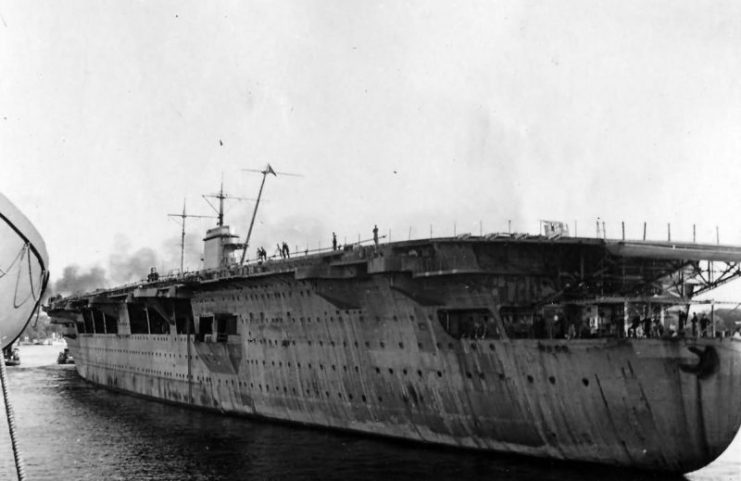
remained in port and neither would see service. Stern View of the Graf Zeppelin German Aircraft Carrier.Given
that we know the outcome without the carriers in action and that
outcome was less than favorable to the Germans, let’s consider the
alternative. Could Germany have won the battle of the Atlantic with
momentum on it’s side had the aircraft carriers been pressed into
service? Would allied shipping already in a state of fear over the
dreaded U-boat have been given more problems than they could solve with
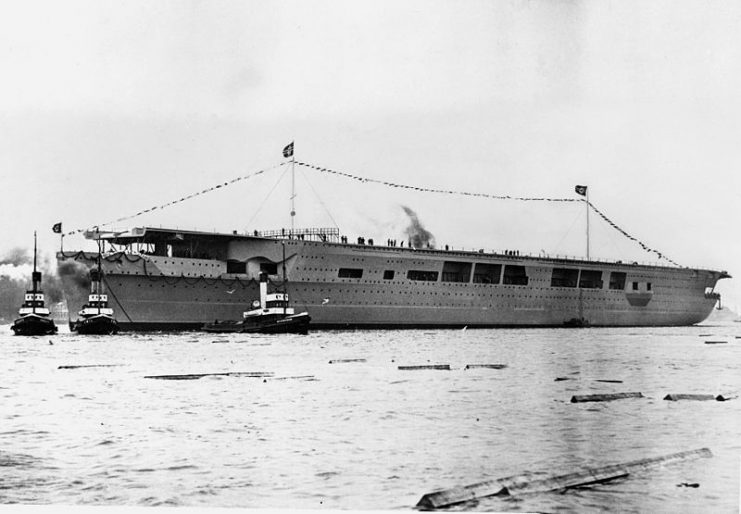
the addition of air power at sea? Graf Zeppelin at her launch December 1938It
can be said of war that the military leadership’s primary mission is to
give the enemy more problems than they can solve. It is the premise
behind combined arms exercises that bring to bear the full spectrum of
military power. Air, land, and sea converge to create these myriads of
problems for the enemy.
In that sense, it would be a discernible
yes that the presence of German aircraft carriers in the Atlantic would
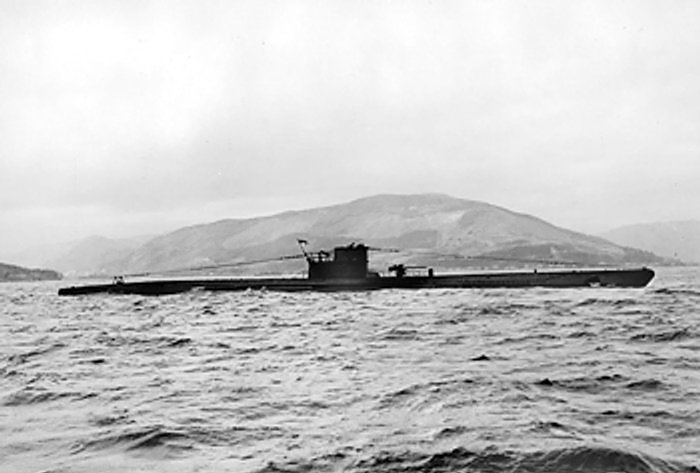
have created another problem for the allies. U-570 scourge of the sea to the allies during WW2Ponder the Bismarck roaming the open seas among herds of wolfpack U-boats and the aircraft of the Graf Zeppelin soaring overhead. The Allied “problems” would now exist under, on the surface and above the sea.
The importance of aircraft carriers in the Pacific proved their
strategic and tactical value. It demonstrates with certainty that
Germany would have gained some strategic and tactical value had they put
completed carriers to sea. Would it have been enough to win the Battle
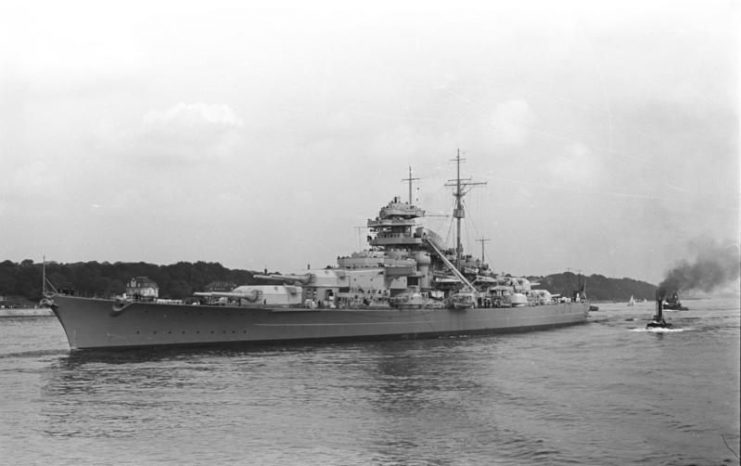
of the Atlantic? Bismarck in 1940. By Bundesarchiv, To
answer this question, one needs to discover the reason Germany decided
to forgo the full production of aircraft carriers in the first place. In
the 1930’s Germany did indeed put out a call for two aircraft carriers
the first of which would be the Graf Zeppelin launched on December 8, 1938.
The 2nd designated Flugzeugtrager B
would follow but would quickly find itself scrapped. Neither saw
functional service and the reason boiled down to a limit in resources
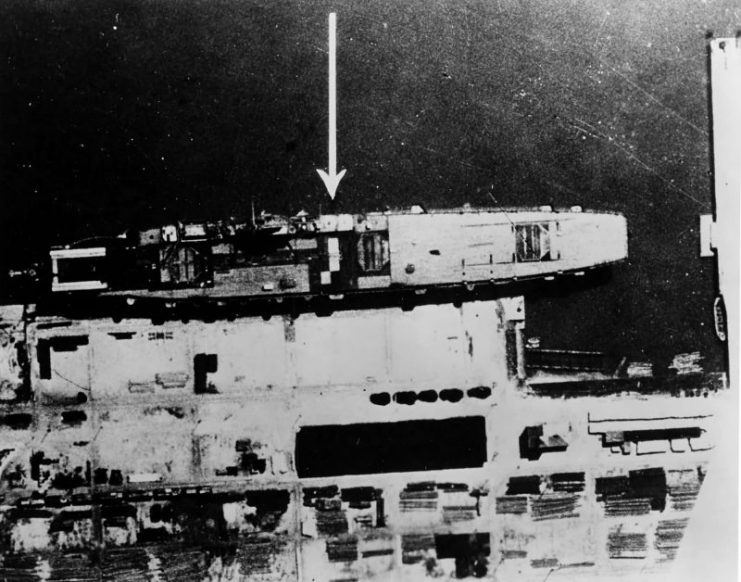
and a change in priorities. RAF reconnaissance photo showing Graf Zeppelin at Gotenhafen – 6 February 1942With Germany’s rapid advance on the ground throughout Europe there
was an emphasis placed on coastal guns and shore defenses. Moreover,
there was a reported shortage of anti-aircraft guns that would be
necessary to defend the ship.
As the war pressed on, a shortage of
pilots further stretched resources to the limits and by 1943 the new
head of the Kriegsmarine, Karl Donitz, ordered the program scrapped.
Whereas the presence of aircraft carriers in the Atlantic would have
indeed created a new problem for the Allies to solve, it would have most
certainly pulled resources from other parts of Germany’s losing war
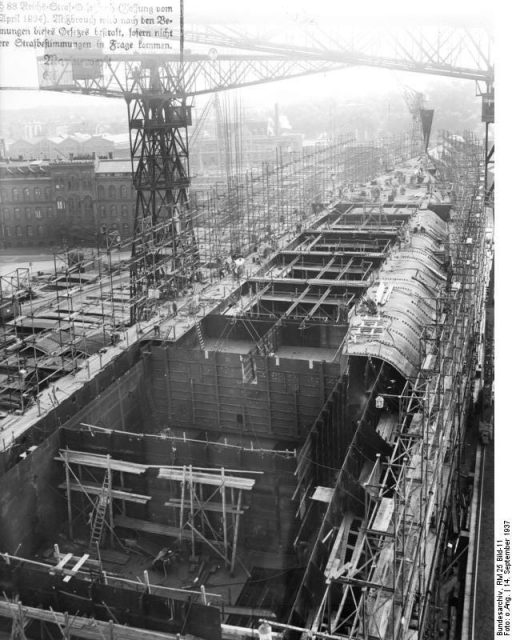
effort. Flugzeugträger B under construction. By Bundesarchiv
In the end, the quality of both the Graf Zeppelin and the Flugzeugtrager B
would have fallen far behind that of the Allied Navies. Unless one
hopes to imagine a fantastic scenario where Germany would have produced 5
to 8 carriers in a world where they lacked the resources to produce 2,
the point seems moot. By 1942, the Americans and Japanese were far ahead of the Germans in quality of their carriers and the numbers.
German aircraft carriers roaming the
Atlantic would have most certainly caused problems and won its fair
share of victories, but the fate of the war itself would have been
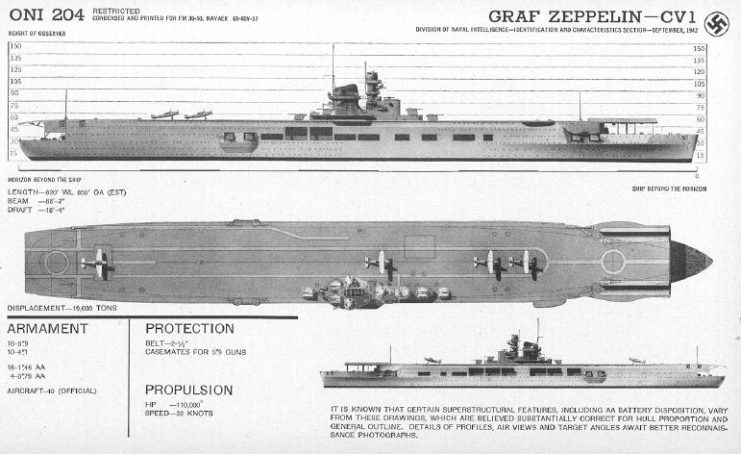
sealed. Drawing depicting the Graf ZeppelinIn the end, the Graf Zeppelin and the Flugzeugtrager B would have found companionship at the bottom of the Atlantic with the famed Bismarck.
To have won a battle is not to have won the war. When one considers the
Battle of the Atlantic as the sum of events from 1939 to 1945, it
doesn’t appear that the outcome would have been any different If Germany had hoped to compete in the Atlantic with carriers, 1938 was
far too late to have launched its first. The victory in this scenario
again goes to the Allies and modern divers would have two new ghost
ships in the Atlantic in which to explore