My apologies for not posting sooner, I have been very busy at work, Overtime is wide open at my employer, the B737 plug debacle doesn't affect us, our 737-900's are a bit older than the FAA mandates so they are way outside the range of possibles.
I was taking a microbreak and saw this response on Quora on the Can, and it was a good response, so I shamelessly nicked it. if someone out there in internet land decides to use it against a blue hair liberal, have at it, entertain yourself, LOL.
A dude from Seattle (Yeah I'm shocked) wrote the response. Theo Edmonds.
Let me guess: you go to an elite college, have green and purple hair, tats and piercings, change your pronoun daily, bought a “Palestinian” flag on Amazon while sipping your Frappuccino at Starbucks and thought Israel was spelled “Isreal” just 6 weeks ago.
You live in a cocoon and your parents would be ashamed of you.
Do you know not 10,000 but 100,000 civilians were killed or permanently displaced in Azerbaijan just four days before the October 7 attack on Israel? A group of Armenians who had lived there peacefully for decades wanted to secede. The Azerbaijanis weren’t going to give up land and swore to their genocide. The last 100,000 abandoned their homes and left (I repeat) four days before the October 7 attack. You didn’t give a shit.
In June 2022 the UN finally tallied the number of deaths in Yemen by Saudis in defense against Iran-controlled Houthi terrorists: 150,000 killed and another 227,000 dead due to cutting off all food and healthcare services for years. The Saudis don’t fuck around - if they get attacked, all hell breaks loose. Again, just 16 months ago. You didn’t give a shit.
You probably don’t know this but right next door to Israel, in Syria, their leader, Bashir Al-Assad had his own civilians killed. Many with chemical weapons. As of March this year, the UN counted 613,000 killed, 15.3 million displaced. Again, right next door to Israel. And again, you didn’t give a shit.
I could go on and on.
But you didn’t care. You don’t care.
All you care about is feeling good about yourself - virtue signaling - and protesting night after night - from the river to the sea, globalize the intifada - without an inkling of why and what it means. You and your racist professors at your liberal arts school, drawing T-charts and labeling Jews as “oppressors”. Believe me, your professor who taught you that knew exactly what they were doing. The Arab students who got you involved knew exactly what they were doing. You were the one who had no clue.
Next time you attend a protest, look around. You’ll see an unnatural number of “brown-skinned” people. Much higher that the typical population. Most you will not know. The ones you do probably aren’t in any of your classes. Know why? They were planted there. They aren’t students. They are funded by Qatar and Saudi Arabia to stir up easily swayed liberals like yourself. The same groups funded your professors and paid for middle eastern studies departments which didn’t exist just a few years ago. Aren’t those the professors who discussed T-charts and listed for you the oppressed (the 2.1 BILLION MUSLIMS who span 15,000 miles from Marrakesh to Jakarta) and the oppressors (the 15 million Jews, most in tiny Israel)? Sound familiar?
I’m not over exaggerating when I say this is chaos vs civilization. This is a group of internationally recognized terrorists, attached to the same group who attacked the US on 9–11 (look it up), France, the UK, Belgium, Netherlands and almost every other western country. This time they’re targeting a tiny global minority of 15 million people who share an outsized amount of goodwill to humankind around the world, who have been oppressed, attacked, exiled for thousands of years. Half of them were killed just 80 years ago in an event called the Holocaust (look that up as well).
And you have been brainwashed to think this tiny oppressed minority, who just kept trying to survive, is the oppressor? This tiny group who removed all their citizens from Gaza 18 years ago and left it for the Gazans, including an industry and economy and a gorgeous coastline to turn it into the Dubai of the Mediterranean. And instead used it as a terrorist staging areas for an estimated 50,000 rockets aimed at civilians. And the scariest thing is if you went to visit them, with your green and purple hair and tattoos and piercings, they’d take you to the nearest rooftop and push you off (look it up).
No, that narrative that Israel stole their land isn’t true either. Israel was given the land by the UN just like Syria, Iraq, Jordan and Lebanon. Before they were countries they were controlled by the foreign Turkish - you know, from Turkey - for 500 years called the Ottoman Empire (look it up). The land wasn’t anyone’s until after World War I (look it up) and given to them the Arab groups freely. Except Israel, where a day after the UN gave the land to them, all those Arab countries attacked this nascent country with the intent to genocide - sorry, “unalive” - them all and take their land and divide it up between themselves. Yes, you got it - there was never going to be a Palestinian land even then when their own Arab sister and brothers were trying to seize control. I could go on and on about how a million Jews were displaced from across the 7000 mile Arab world in retaliation for the Arabs losing that genocidal war they started, and Israel took those million refugees in, yet the Palestinians still fester.
These people are not your friends. They do not want to defund the police. These “brown skinned people” outnumber the Israelis 140:1 (who more than half of Israelis are from the Middle East - see ‘refugees’, above). Let me repeat that number: 140:1. And here’s another: Muslim countries to Jewish countries: 50:1. And weirdly, over 20% of the Israeli population is Arab with full rights and benefits, so the claim of apartheid is a lie as well.
Shame on you and your friends who are promoting rape, kidnapping, torture and murder. Shame on you for promoting anti-LGBTQ and intolerance. And shame on you for being so easily brainwashed. Never have there been such racist attacks and protests against such a tiny minority in the US since black slavery.
And the next attack won’t be Tel Aviv. Globalize the intifada means these people want to expand extremist Islam around the world. They will be bringing the rapes, torture, burning civilians alive and murder to your front doorstep next.
I saw this on Quora and thought it was an interesting perspective.
My message to the non-Hebrew speakers. Feel free to share.
Until Saturday I was Stav Bartel. From then and until further notice I am Chief Sergeant Stav Bartel, fighter in the IDF 7109 reserve infantry battalion.
I would like to share that since Saturday morning I am in near the front in Gaza, fighting against the barbarian invasion of Hamas. I want to bless all who genuinely strive to know the truth. Do not back down and don't let the cynics shove irrelevant pseudo-rationales that would downplay the scale of this crime. There are numerous reports all over the media from reliable sources. These events are unfolding and Western media begin to realize them much later than needed. Do not let anyone decive you.
Lots of my friends and acquaintances had their loved ones were butchered. The enemy is cynically denying anything they themselves filmed doing. Don't legitimize this. Hamas is evil, don't fall into that stupid relativistic attitude, that attempts to show the "other side" of Hamas. See the true pictures from Gaza, the voice of the Gazans, but not the voice of Hamas. A group that launches an attack that massacres, butchers innocent men, women and babies, a group that burns houses with civilians trapped inside, forcing them to flee and then massacring them. My friends told me the TERRORISTS were piling bodies from the festival with a tractor and tried to burn them.
A family member of a friend of mine was raped three times. Others were abducted. An acquaintance of mine told me she hid in a bunker after the attack on the rave party, luckily left to treat the wounded, and she saw the terrorists throwing grenades into the bunkers. Her friends were injured, others killed. She carried them wounded under fire. I've received these testimonies already on Saturday morning. At the kibbutzim, babies were abducted, others killed, choked, and beheaded. Grandmothers were abducted, entire families were wiped out. This is not an IDF assault from air on a building used by Hamas, housing civilians as human shields. And this is no mistake. There is no way to compare. None of these people were a threat to anyone, they were not next to IDF troops. And this attack had no military objective. This is not a legitimate response to anything, not a proper way to deal with occupation or blockade. There is absolutely no way to justify any of this.
This was done by hands. This is not arresting Palestinian rioters. I've done it countless times during my service. Never, NEVER through my entire service have we ever treated an arrested Palestinian that way. We never beat them, never torture them. Never hurt them for fun. Quite the contrary. And if any of my soldiers mistreated them I would stop them immediately. We were always told, the IDF's morals are the Purity of Arms, the Value of Human Life. We have been attacked so many times, we were equipped with guns and could massacre the masses, but we never did. We suffered rocks and molotov cocktails, got injured but never lost our humanity. Never tortured. I have always had a soft spot for Palestinian children, when entering their homes, I hated the idea of their fear. I often comforted them. And also during the checkpoints. Countless times we laughed with them, gave them high fives. We treated them as human.
I know the situation in for the Palestinians is not good. I know it is far from right. We are not blind to it. And more often then not I've regretted our governments. It is complicated. I believe they deserve to live good lives just like we do.
But Hamas are not true representatives of the Palestinians. They are a proxy of Iran, they are a lunatic, ultra-religious murderous organization. They portray themselves as the weak, freedom fighters, but in truth, they are just thugs. All of them. We are no saints, but they are the devil. While we sometimes fall in judgment, they have no morals in the first place. They celebrate death, cheer for the sight of fire and destruction and enjoy the smell of blood. They are animals and they have always been, ever since they started with the suicide bombings. And Hezbollah and the PIJ and all other TERRORIST Organizations are no different.
I woke up on Saturday with a rocket barrage on my city, Tel Aviv, in the metropolitan area of 3 million people was attacked. A rocket fell in my neighborhood, where there is no military presence, no strategic sites. Just civilians. Soon we received the reports of terrorists armed for an all out war, rampaging through cities and villages, butchering people, desecrating their bodies and burning houses. We saw the videos of thousands of people fleeing from the festival. And there are stories I've heard that I can't yet process. I am unable to even think about them. So much blood and gore on the most innocent of lives.
No more than 6 hours later, I was already on my way south to arm up with hundreds of other reservists in my unit. Some of them I've never seen, people who did not show up to previous reserve activity for years have showed up. 300 thousand Israelis showed up. This is the largest deployment in the country's history. This is how eager we are to defend our homeland. And civilians are doing circle in the air just to provide us with food and equipment. Everyone joined, not a single soul in Israel remained indifferent. Jews, Drzue, Christians, Arabs, Bedouin, people who just a few seconds ago only saw their differences, have all united against evil. There is no question here, Hamas must be eradicated, just like ISIS. And what they have done is as big a crime against Israel as it is to the Palestinians. They have done nothing but bring on death and destruction on themselves, and we haven't started yet.
I am now near the front, thwarting continuous infiltration attempts. They try and fail. Dozens of terrorist were killed. They are getting weaker and weaker and we are getting stronger and braver. They keep shooting on civilians. Rockets are falling near us, exploding over our heads. But our spirit is strong, we are strongly united, brothers and sisters, from all over the country, religious, secular, rich, poor... And the ground is shaking below our feet front our air force pounding of the devil's den.
While their leaders are hiding in bunkers, some of our leaders, members of the Knesset, have showed up, volunteered to join the fighting units. My battalion commander, who lives in a kibbutz just next to the strip, who was abroad at the time, has lost his 18-year-old son, and before burying or even seeing him, he decided to take a flight, show up and help in whatever he can, even though he was given the option to stay home and whip. This is the spirit of our country. And we have no other land to go to. This is our secret weapon. We have one homeland.
My Israeli friends from across the world all began organizing donations, others have bought tickets, cutting their trips by months and came back to recruit. My little cousins set up stations to collect food and supplies from civilians for the soldiers. My family is doing anything they can and so everyone else.
I have gave much thought about my grandparents who fought the Nazi attempt to eradicate them, and others who suffered persecution anywhere they've been. Here we are united together, we have the right and duty to help ourselves. And we will do that for eternity. We cannot be beaten, and whoever will challenge us will be destroyed.
I am no religious person, but now more than ever the words Am Yisrael Chai are inscribed on my heart.
I hope to come back as well as possible, to tell our story.
I first read about the Six Day war in High School when Israel launched a preemptive strike against several Arab countries that were planning on attacking them, but the Israelis struck first because they knew if the Arab countries got their act together and struck together, it would overwhelm their defenses and push them into the sea and crush the Israeli State which was the dream of the Pan Arab alliance.
By the summer of 1967, the modern state of Israel laid claim to a
short but bloody history. After declaring independence in spring 1948,
the nascent Jewish state was invaded by a coalition of Arab nations bent
on the destruction of Jewish settlements. Following a brief but fierce
war that saw the death of nearly one percent of its population, Israel
secured a grudging armistice with the Arab belligerents. The agreement
brought an end to large-scale fighting, but failed to secure Arab
recognition of Israeli independence, making further conflict inevitable.
In
less than a decade, Israel once again found itself locked in a shooting
war with its largest Arab neighbor. In response to Egyptian blockades
of the Suez Canal and the Gulf of Aqaba, Israel launched an invasion of
the Sinai Peninsula on October 29, 1956. The attack was coordinated with
the British and the French, who dropped airborne forces near the Suez
in the hopes of seizing the canal.
The affair ended in an
embarrassing foreign-relations disaster for Great Britain and France as
they were forced to accept a cease-fire due to pressure from the United
States and the United Nations. Israeli forces had been stunningly
successful during the ground campaign, seizing Sinai in short order. The
IDF, though, had not been able to capture one of the most heavily
defended of the Egyptian positions, the strategically vital high ground
near the seemingly insignificant crossroads of Abu Agheila. The position
was taken only after being abandoned by the Egyptians.
That brief
war, though, was not without long-term ramifications. The fact that
Britain and France had been forced to withdraw their troops due to
political pressure only emboldened the Egyptians, and anti-Israeli
rhetoric ramped up in the years that followed. As a result, the
peacekeepers of the United Nations Emergency Force (UNEF) were
garrisoned in Sinai in order to keep the belligerents at arm’s length.
At
the time, Egypt was experiencing a wave of nationalist fervor, largely
due to the ascendance of Colonel Gamal Abdel Nasser, one of the most
charismatic leaders in the Middle East. Nasser had assumed the
presidency of Egypt in 1954, just two years after he had helped
orchestrate a successful coup. Nasser used powerful rhetoric that
espoused greater unity for the Arab world, retribution for displaced
Palestinians, and the reduction of the State of Israel.
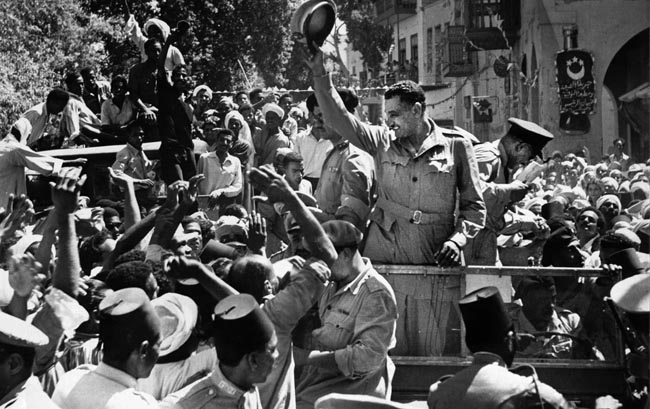
Egyptian President Gamal Abdel Nasser believed the United States would restrain Israel from making an attack on Egypt.
Nasser’s
magnetic charm also crossed national boundaries, and his promotion of
pan-Arab unity found a wide audience across the region. By the
mid-1960s, Nasser’s mounting influence in the Arab world was a source of
grave alarm to Israel’s intelligence services. By 1964, IDF analysts
predicted that a renewed war with an emboldened Egyptian army would
likely occur as early as 1967.
Due to his previous professional
contacts within the Egyptian Army, Nasser promoted a number of personal
cronies to the highest ranks, chief among them Field Marshal Abdel Hakim
Amer. Former vice president of Egypt and overall commander of Egyptian
forces, Amer had seen extensive combat service. First commissioned in
the Egyptian army in 1939, Amer had served against Israel in both 1948
and 1956 and had commanded Egyptian troops that intervened in the North
Yemen Civil War.
Unfortunately, cronyism and statist paranoia
gripped much of the Egyptian senior officer corps. Amer likewise
appointed personal cronies or conferred promotion based on political
considerations. A number of senior officers were known to possess a
greater interest in Cairo nightlife than the military arts. Intelligence
operatives spent much of their time monitoring suspect Egyptian
officers rather than gathering intelligence on the Israelis. Ultimately,
the misplaced focus on politics ensured that the Egyptian senior
command bore a greater resemblance to an elite club of uniformed
sycophants than a cadre of professional combat leaders.
Despite
the shortcomings of the high brass, the Egyptian military possessed a
vast arsenal of fearsome weaponry due to an alliance with the Soviet
Union. Nasser’s increasingly hostile stance to the Western powers made
him an attractive ally to the Soviets, who regarded him as a
non-capitalist revolutionary democrat. Nasser and Amer were designated
as Heroes of the Soviet Union in 1964 and awarded accompanying medals.
Such
symbolic honorifics were accompanied with more concrete support in the
form of modern weaponry. Since the close of the Sinai conflict, the
Soviets had bestowed billions of dollars worth of military aid on the
Arab states. The Arabs in the region fielded 1,700 tanks, 2,400 pieces
of artillery, and 500 jet aircraft. Nearly half of the armaments went to
Egypt, Israel’s most dangerous foe. Greater Arab unity likewise
increased the threat to Israel. In October 1966, for example, Egypt and
Syria secured a diplomatic rapprochement and signed a mutual defense
pact.
The explosive combination of Arab military alliance and
anti-Zionist rhetoric resulted in a dangerous powder keg for the greater
Middle East. Misled by erroneous Syrian intelligence that pointed to an
Israeli buildup on its northern border, Nasser and his generals grew
increasingly jingoistic during the spring of 1967. On May 19, Nasser
made the ominous move of requesting the removal of the 3,500 United
Nations peacekeepers stationed in Sinai. With United Nation troops out
of the way, Egypt began preparations for an inevitable war in Sinai.
The
Middle East faced an irreversible crisis when Egypt ordered the closure
of the Straits of Tiran—the strategic waterway that controlled the Gulf
of Aqaba—on May 21, 1967. With Israeli access to the Gulf of Aqaba
denied, Israel’s southern port of Eilat was entirely cut off from
international waters. Widely regarded as an act of war, the closure of
the Straits of Tiran was almost certain to result in conflict, and
Nasser was unambiguous regarding the intention of his decision. “It will
be total, and the objective will be Israel’s destruction,” he said,
referring to a possible outbreak of war.
As diplomatic efforts
(including proposed mediation) continued to fail, more Arab powers
readied for war. In addition to Egypt and Syria, Jordan and Lebanon
began mobilizing their armed forces. Even distant Muslim states
including Iraq, Kuwait, Morocco, Libya, Saudi Arabia, and Tunisia either
mobilized or contributed token forces to the fight against Israel.
Ahmad ash-Shuqayri, chairman of the Palestine Liberation Organization,
gave voice to the mounting desire for war with an ominous public
statement. “We shall destroy Israel and its inhabitants,” he said. “As
for the survivors, if there are any, the boats are ready to deport
them.”
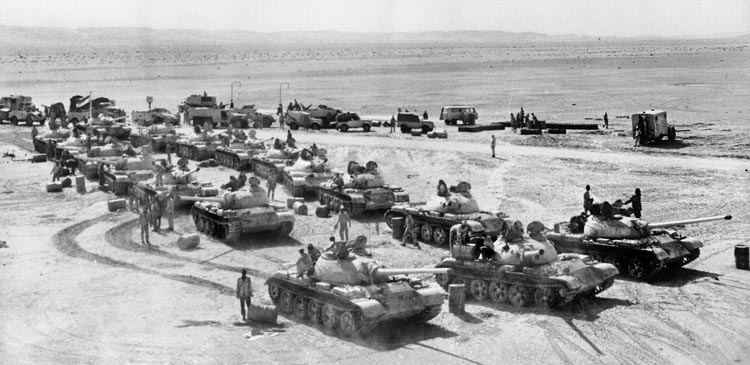
A
column of Egyptian tanks moves into the Sinai Desert on May 7, 1967,
joining divisions already positioned on the Egyptian-Israeli border.
Despite
the overall lax condition of the Egyptian Army, the Israeli high
command harbored a deep respect for the fighting mettle of the average
Egyptian soldier. Largely due to Israel’s experience in failing to crack
the defenses of Abu Agheila in 1956, the Egyptians were particularly
feared for their willingness to fight tenaciously from fortified
positions. Russian military engineers helped the Egyptians construct
imposing fieldworks at key strategic positions across the vast expanse
of Sinai.
A virtual panic gripped the highest echelon’s of
Israel’s government as the nation braced itself for what could become a
struggle for survival. Because any conflict would inevitably result in
the IDF waging a war on multiple fronts, Israeli military doctrine
stressed initiative and aggressive tactics as a part of an overall
strategy of destroying numerically superior Arab armies before they had a
chance to respond. In many respects, Israeli tactics ironically copied
the blitzkrieg of Nazi Germany in World War II.
In the years
leading up to the Sinai Campaign in the Six Day War, the IDF was
transformed into a more mobile force that gravitated toward an
armor-dominated army, as opposed to an army made up of predominantly
infantry. Brigadier General Israel Tal, commander of the Israeli Armored
Corps, was a key developer of his nation’s armored doctrine. In large
part due to Israel’s small population, Tal favored heavy tanks and
firepower at the expense of lighter and faster tanks. Such an approach
offered Israeli tank crews better protection, as well as the upper hand
during long-range armored duels.
Due to friendly relations and
consequent arms contracts with the Western powers, tanks such as the
American Patton and the British Centurion fit the bill. Israeli tankers
received rigorous training in maneuver and gunnery. “After the air
force, armor is the factor that decides the fate of battles on land,”
said Tal. “The task of armor is to carry the battle into the enemy’s
territory and thus obtain a quick decision.”
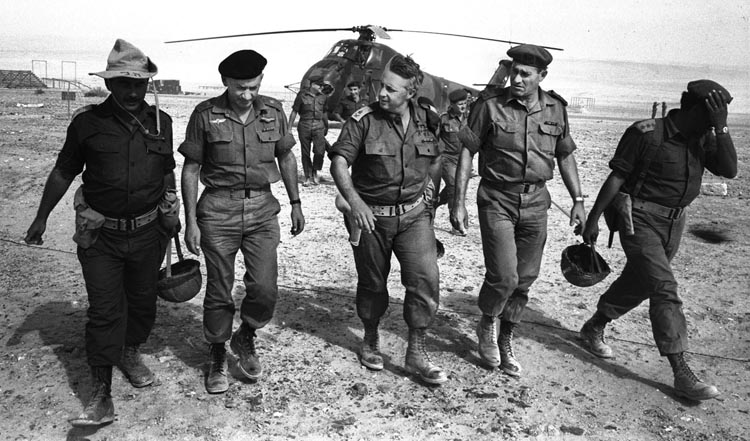
General
Ariel Sharon, center, confers with his subordinates just days before
Israel’s launch of a preemptive strike into the Sinai.
In
any pending conflict, though, the vaunted Egyptian fieldworks in the
vicinity of Abu Agheila could not simply be bypassed. With the
assistance of Soviet advisors, Egyptian engineers had constructed a
substantial barrier that would stall any potential Israeli advance with a
robust defense in depth.
In front of the forward base at Umm
Katif, Egyptian infantry manned two mutually supporting lines of
trenches. The trenches were further bolstered by artillery positions,
mortar pits, dug-in tanks, and bunkers. To the north, immense sand
dunes, which were deemed impassable to armor, were considered effective
flank protection. The eastern approaches to the position, the most
likely avenue of an Israeli attack, were protected by wide belts of mine
fields and barbed wire. Abu Agheila, which commanded the central route
across Sinai, was likewise the most heavily fortified position on the
peninsula.
Actually, the formidable task of cracking the defenses
at Abu Agheila had commanded the attention of the Israeli high command
since 1956. The Israeli Command and Staff College staged exercises each
year against mock Abu Agheila fortifications, and the exercises were
updated each year based on fresh intelligence of the ever-evolving
Egyptian defenses. Most Israeli field commanders and staff officers were
consequently familiar with the Abu Agheila defense complex. In keeping
with Israeli doctrine, which promoted aggressive initiative from junior
officers, participants in the program were encouraged to develop their
own tactics in launching assaults.
Such intensive preparation for
war, paired with reckless saber-rattling across the border, resulted in a
fateful decision by the Israeli cabinet. In a series of tense meetings
in a Tel Aviv bunker on June 4, Israeli military officers were nearly
unanimous on the need to launch a preemptive attack on Egypt, which was
continuing the Sinai buildup in preparation for launching its own
attack. Quite understandably, the politicians demurred.
In the
corner of the conference room, Brig. Gen. Ariel Sharon brooded. Sharon,
who commanded one of the Israeli divisions mustered on the Sinai Front,
was worried by the political indecision that left front-line troops in
the lurch. Combat units were “moving here and there, crossing each
other’s paths and taking up positions, only to move back from them a day
later and take up different ones,” recalled Sharon. “The army did not
look as if it knew what it was doing.”
Sharon took a grimmer view
of the closure of the Straits of Tiran, and regarded it as a provocation
that demanded an inevitable military response. “We have the power to
destroy the Egyptian Army, but if we give in on the free-passage issue,
we have opened the door to Israel’s destruction,” he said. “We will have
to pay a far higher price in the future for something that we in any
case had to do now.”
For the frontline commanders, continued
diplomatic dawdling only invited a tougher fight. Every day that passed
allowed the Egyptians more time to dig in and prepare. For his part,
Sharon was exasperated by the waiting game. “The Army is ready as never
before,” he said. “All this fawning to the powers, begging for help,
undermines our case. If we want to survive here, we have to stand up for
our rights.”
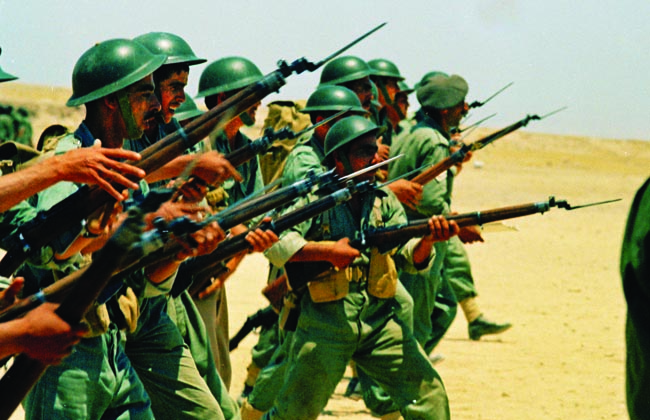
Jordanian troops drill on the Israeli border on June 1, just a few days before the start of the war.
By
the evening of June 4, such reasoning had swayed the government’s
cabinet ministers, who, at last, opted for war. “The government has
determined that the armies of Egypt, Syria, and Jordan are deployed for a
multi-front attack that threatens Israel’s existence,” stated the
official orders. “It is therefore decided to launch a military strike
aimed at liberating Israel from encirclement.”
Those orders
unfolded with startling force early on the morning of June 5, 1967. In a
desperate attempt to neutralize Egypt’s formidable air power, the
Israeli Air Force launched a stunning series of preemptive attacks on
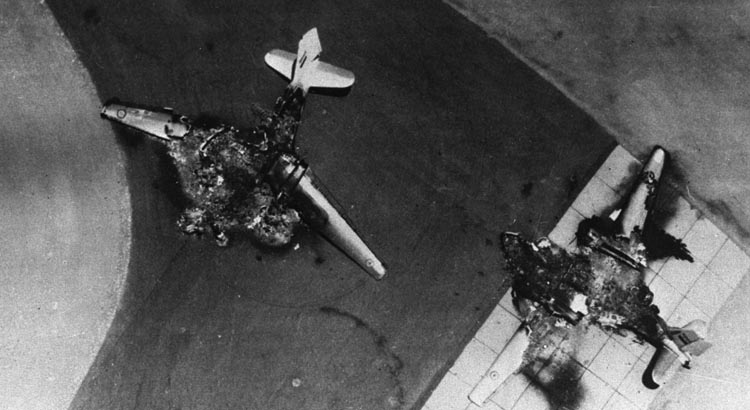
enemy airfields throughout Egypt. Known as Operation Moked, the attack
caught the Egyptians entirely by surprise. In a matter of hours,
approximately 200 Israeli aircraft conducted multiple attacks that
eventually destroyed 338 Egyptian aircraft, most of which were never
able to get off the ground. Subsequent attacks destroyed all 29 aircraft
of the Jordanian Air Force, as well as 61 Syrian planes.
With the
Arab air fleets out of commission, the Israelis were free to push their
ground forces into Sinai free from the threat of aerial attack. Overall
command of the Sinai Front was assigned to Brig. Gen. Yeshayahu Gavish.
Gavish had three ugdah (divisions) at his immediate disposal. The
Israeli right flank along the Mediterranean coast was commanded by Brig.
Gen. Israel Tal, who led a division that was to sweep along the primary
coastal route across Sinai. In the center, Brig. Gen Avraham Yoffe, a
tough veteran who had seen extensive combat since he was 16 years old,
led two armored brigades. On the left, Ariel Sharon commanded an
imposing ugdah, the 38th Armored Division, which was a mixed outfit of
four brigades that included armor, infantry, airborne, and artillery
units.
A career army man, Sharon was a barrel-chested bull of a
warrior to whom fighting had become a way of life. A native Israeli who
had been born in British Palestine in 1928, Sharon was just 14 when he
joined the Haganah militia. During the Israeli War of Independence, he
served as a junior officer. Prone to lead by example, he was badly
wounded in action with Jordanian troops.
The Israeli Air Force destroyed the Egyptian Air Force in a stunning pre-emptive strike on the first day of the war.
Sharon
was given command of a special forces outfit, Unit 101, in 1953. His
tenure at the head of the commandos, though, would leave an indelible
stain on his career as an officer. In October 1953, Sharon led an
operation into the Jordanian West Bank that targeted Palestinian
terrorists. During the fighting, more than 60 civilians were reportedly
killed.
During the 1956 Sinai Campaign, Sharon commanded an elite
unit of paratroopers that seized vital ground at the Mitla Pass. As a
professional soldier, Sharon was regarded as a keen student and
meticulous planner. On the battlefield, he earned the reputation as a
hard-driving combat leader who was willing to personally lead his men
into tough fighting.
Sharon’s objective was the imposing complex
of Egyptian defenses around Abu Agheila, which commanded the central
route across Sinai. The Egyptians were convinced that the main Israeli
attack would be farther south, leading them to leave their forces spread
woefully thin at Abu Agheila and the forward position of Umm Katif.
Against the 8,000 Egyptians of the 2nd Infantry Division, Sharon had
concentrated 14,000 Israeli troops.
Sharon also possessed a keen
advantage in armor: 150 tanks consisting of a mix of Centurions, Super
Shermans, and the lighter French AMX-13s. By comparison, the Egyptians
could muster just 66 T-34’s. The Egyptians did possess an advantage in
artillery, fielding a fearsome array of Soviet 122mm cannons and 152mm
howitzers which easily outclassed the Israeli artillery.
Sharon
had developed a meticulous and audacious plan for the reduction of the
impressive Egyptian defenses. A keen student of military tactics, he not
surprisingly opted for a massive flanking movement against the Egyptian
stronghold. Following an airborne assault aimed at silencing the enemy
artillery, Israeli artillery would unleash a punishing barrage on
Egyptian positions. Armored columns would harass the enemy’s flanks
while the main thrust, largely consisting of infantry, would strike the
Egyptians from the north. The main attack would use the cover of sand
dunes which the Egyptians considered impassable.
Clearly aware
that Israeli troops had been stalled by the Abu Agheila defenses in
1956, Sharon had formulated an extremely complex plan in the hopes of
completely overwhelming the Egyptian defenders. The success of the
entire plan, though, would depend on near-perfect timing, the
coordination of various columns, and a dose of good luck.
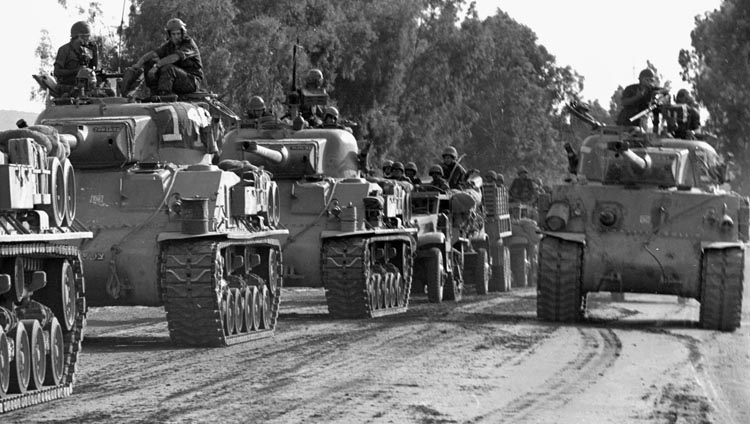
Israeli
armor prepares for the advance into the Sinai Desert. The Israelis
entered the Six-Day War with more than twice as many tanks as the
Egyptians.
Sharon would have more than his share
of good fortune in the unfolding battle. His main force crossed the
border on June 5 and made for Abu Agheila. South of Umm Katif, Sharon
launched a diversionary attack toward Egyptian positions at Qusaymah.
Although he attacked Qusaymah with just two reserve battalions and a
handful of tanks, the Egyptians became increasingly convinced that any
direct attack on Abu Agheila was unlikely, and focused their attention
on points south.
Taking advantage of the Egyptian confusion,
Sharon put his complex plan in motion. On the right, Colonel Natke Nir’s
task force struck off on one of the most crucial and dangerous parts of
Sharon’s grand plan. Nir commanded an independent armored battalion,
which was to swing to the north of the Umm Katif positions along an
insignificant desert trail known as the Batur Track. His objectives were
to reduce an Egyptian outpost at Point 181, then fall on the rear of
Abu Agheila, seizing Ruafa Dam, cutting off the route of retreat and
blocking the roads to any Egyptian reinforcements.
Nir commanded
an assortment of heavily armed troops, which included mechanized
infantry, mortar, and rocket teams, as well as reconnaissance and
engineering units. The hard-hitting core of his unit consisted of 45
Centurion Mark V tanks, whose wide tracks made them well suited for the
dangerous flank attack along the sandy wastes of the Batur Track. More
important, the Centurions, armed with 105mm main guns, packed the
necessary punch for a shooting match with Soviet-made armor.
Due
to scant intelligence, Nir was unsure what resistance would be
encountered at Point 181, but as his tanks approached the high ground,
they received a warm reception and were driven back after fierce
fighting. After calling in air support from the IAF, Nir struck again.
While his infantry fixed the Egyptians from the front, Nir sent his
armor on wide flanking attacks against the Egyptians.
In the face
of the multi-pronged attack, Egyptian defenses at Point 181 collapsed,
once again opening the Batur Track to Nir’s armor. The brutal fight for
the position had cost Nir several of his subordinate officers and eight
tanks.
The operation to seize Abu Agheila continued at sundown,
when a daring helicopter-borne infantry attack was launched from Israeli
positions. Sharon had planned for three waves of six helicopters to
land 200 paratroopers in the enemy’s rear. The craft were carrying
elements of the 80th Paratroop Brigade under the command of Colonel
Matt. Matt’s elite paratroopers were tasked with the vital operation of
silencing enemy artillery, consisting of deadly Soviet-made 130mm
cannons, before the Egyptian guns could decimate Sharon’s advancing
armor and infantry.
Sharon shared a special bond with his
paratroopers. A former paratrooper himself, the general continued to don
the red beret of the Israeli airborne. War correspondent Yael Dayan was
present when Sharon conferred with Matt just prior to the attack.
Sharon’s voice “changed some when he talked to the parachutists’
commander,” said Dayan. “He knew them all by first name, and they were
his men, and somehow he gave me the feeling he was talking to a brother
in whose hands he entrusted a hard job.”
Despite Sharon’s
confidence in his paratroopers, the operation was indeed a hard job from
the outset. During the flight to the landing zone, nearly half of the
helicopter pilots lost their bearings in the darkness, veered far off
course, and never succeeded in landing their loads of paratroopers at
the designated target. After a harrowing flight over the desert, the
rest of the helicopters touched down about two miles northwest of the
Egyptian artillery park in terrain considered impassable to the
Egyptians. Matt’s paratroopers, each of whom was laden with a heavy load
of weaponry and equipment, began the arduous trek toward their target.
Although
the paratroopers were highly conditioned warriors, they struggled under
heavy loads as they trudged through the sand dunes. Urged on by their
officers, the men pressed forward. With no warning, Egyptian artillery
and mortar fire began landing on the planned route of attack, sending up
great plumes of sand and dust. Matt kept his head despite the
tremendous crash of artillery. “I guessed from the location of falling
bombs that the enemy was firing blind, not having actually seen us, only
hearing the unfamiliar noise of the helicopters in their rear area,”
said Matt.
Lt.
Col. Mordecai Zippori’s 14th Armored Brigade eliminated Egyptian
forward outposts at Abu Agheila in two hours of hard fighting.
Despite
the occasional burst of Egyptian illumination rounds, the paratroopers
struggled to find their way in the dark; but as Matt pressed forward,
the enemy position was clearly located by the telltale muzzle flashes of
Egyptian artillery. Matt and his men reached the perimeter of the
Egyptian artillery park at 12:00 AM. They then formed up for the planned
assault.
As the Israelis rushed forward, they could not believe
their luck. The artillery position they were about to assault, which had
no protective minefields or barbed wire, was wide open to attack. Matt
had given orders to individually assault each enemy gun, and as the
paratroopers entered the position, they split up to target their
objectives. The Egyptian gun crews had been taken entirely by surprise
and panicked in the confusion. The Israelis likewise targeted enemy
ammunition bunkers, which were soon engulfed in flames. In minutes, the
Egyptian gun crews had scattered in confusion, and much of the artillery
was destroyed or disabled.
A convoy of Egyptian supply trucks,
illuminated by their own headlights, arrived unexpectedly at the
artillery park just as the Israelis had overrun the position. The
disoriented Egyptian drivers had no warning and drove into the mouth of a
deadly ambush. Riddled with Israeli small arms fire, trucks careened
out of control or burst into flames.
While Matt was shocked by the
carnage his men had inflicted, the operation to silence the Egyptian
guns had been a remarkable success. For his part, Matt had regarded his
assignment as sure to result in a tough fight, and he was elated with
his success. As his men mopped up and gathered their dead and wounded,
Matt received a radio communication from Sharon, who ordered the
paratroopers evacuated. The main attack could proceed unfettered by the
threat of an impenetrable Egyptian artillery screen
Israeli columns would make the most of the advantage. Sharon gave
orders for his artillery to open fire on the Egyptians at 10:00 PM. His
arsenal of firepower consisted of 105mm and 155mm howitzers, 120mm and
160mm mortars, and British 25-pounders. As he glanced across the desert,
he issued legendary orders for his gunners. “Let everything tremble,”
he said.
A sheet of flame lit up the desert floor as the guns
opened up, raining down an unrelenting storm of fire on the Egyptian
defenses. For nearly half an hour, the Israelis unleashed the most
intense artillery bombardment in the history of the IDF. Even Sharon, a
career soldier, was amazed by the tremendous show of firepower. “I have
never seen such a fire in all my life,” he said.
In the hope that
the fierce shelling had softened up the Egyptian defenses, Sharon
unleashed the troops of his main assault. Thundering toward the Egyptian
lines were the tanks of Lt. Col. Mordecai Zippori’s 14th Armored
Brigade, containing two battalions of Super Sherman tanks mounting 105mm
guns. Zippori’s task was to seize forward Egyptian observations posts
and then use his armor as fire support for the infantry attack on the
main Egyptian trenches. Zippori’s tankers had faced determined
opposition at the forward Egyptian post at Tarat Umm Basis, which was
occupied by the elite members of Egypt’s 2nd Reconnaissance Battalion.
The Egyptians broke after two hours of fierce fighting, and Zippori’s
brigade continued to steamroll startled enemy outposts as it drove
forward.
Israeli momentum, though, soon ground to a halt. Although
the IAF began launching sorties against the enemy defensive complex
centered on Abu Agheila, Egyptian artillery was able to maintain a heavy
and accurate fire against the advancing Israeli armor. To avoid sending
his tanks into a killing zone, Zippori ordered his tank crews to stop
the advance.
Earlier that afternoon, Sharon ordered his infantry,
the Kuti Brigade commanded by Colonel Yekutiel Adam, to cross the
frontier and move toward Umm Katif. Adam’s three battalions, one of
which was a part-time reserve outfit, had ridden to the front in a
curious parade of civilian vehicles. After reaching Tarat Um Basis, the
foot soldiers dismounted and trudged a dozen miles through sand dunes to
the north of the enemy.
Adam’s brigade, which was tasked with
assaulting the lines at Umm Katif, had taken up its assault positions on
the Egyptian left by 10:00 PM. Adam opted to throw his two regular
battalions into the initial assault and hold back his part-time
reservists as a general reserve in case of emergency. Once again, the
Egyptians would be confounded by the direction of the attack, which came
from sand dunes that were considered impassable. To the north of the
Umm Katif position, the Egyptians had planted no mines.
Rushing in
from the dunes in the black of night, Adam’s men slammed hard into the
trenches, quickly folding the Egyptian left. The Egyptians, though,
quickly regrouped and put up a stiff fight; brutal hand-to-hand combat
ensued in the trenches. The Egyptian colonel in command of the defenses,
whose command bunker was located in the second line of trenches,
frantically tried to order artillery strikes against the
Israeli-occupied first trench. His position, though, was overrun by the
advancing Israelis, who captured the command staff.
Despite the
determined defense of much of the Egyptian infantry, the tactical
surprise gained by the Israelis began to tell. Israeli infantry rapidly
moved through the trenches. In the confusion of the night fighting, the
foot soldiers averted friendly fire incidents by use of colored
signaling flashlights. Each battalion had a specific color. One was red,
another green, and yet another blue. By 1:00 AM on June 6, the Israelis
sat astride the central route and began assaulting the southern half of
the Umm Katif defenses. Clearly sensing that he was poised for victory,
Adam ordered his reserve battalion into the fight.
The situation
quickly degenerated for the Egyptians. Soon after Adam’s successful
assault of the trenches, Israeli engineers succeeded in opening a hole
in the minefields and barbed wire to the east of Umm Katif so that
Israeli armor could advance. The operation would be a difficult one,
though. As a lead platoon of tanks inched its way through the gap, one
of the tanks struck a mine and was disabled, blocking the path. The
engineers frantically worked to widen the breach for the remainder of
the tanks. Only the mounting confusion in Egyptian ranks saved the
stalled tanks from annihilation. Three hours later, Israeli tanks were
pouring through the gap and widening the Israeli breach of the Umm Katif
position.
After a harrowing nightlong journey through the sand
dunes north of Abu Agheila, Natke Nir finally succeeded in getting his
Centurion tanks in position for an assault on Egyptian troops stationed
at Ruafa Dam. His attack, which rolled in from the west, came as a
complete shock to the startled Egyptian defenders, whose attention had
been focused on the main attack coming from the east. In short order,
the Egyptian position collapsed, and Nir struck east in order to link up
with the Israeli main body.
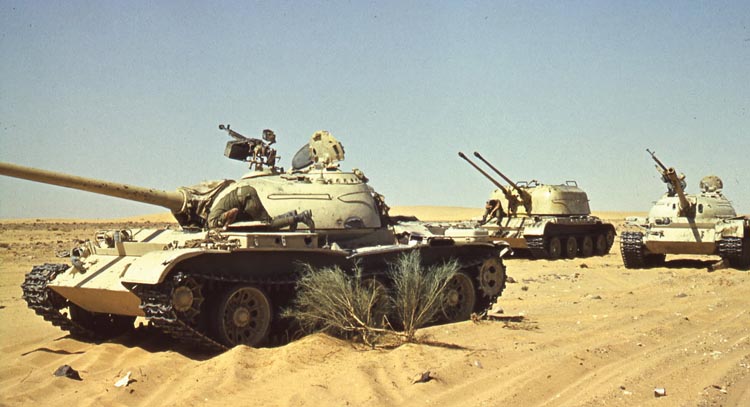
Captured
Egyptian armor parked in the Sinai desert. The Israelis’ remarkable
victory had exceeded military planners’ most optimistic timetables.
At
that point, the Egyptian defenses began to hopelessly unravel. For two
hours, Egyptian tankers waged a determined but uncoordinated fight with
the closing vise of advancing Israeli armor. By the early morning hours,
only isolated detachments of Egyptians continued to fight, but they
were quickly overwhelmed. The Egyptian defensive works of the Abu
Agheila complex, once considered one of the strongest defensive
positions in the world, had fallen in a single night of fierce fighting.
The
loss of Abu Agheila, paired with startling Israeli victories farther
north, brought about the entire collapse of the Egyptian defense of the
Sinai Peninsula. In Cairo, a demoralized Field Marshall Amer panicked
and ordered his entire army to give up the fight, make for the Suez
Canal, and regroup on the west bank. By the early afternoon, Egyptian
forces were in full flight to the west, with hard-driving Israeli
armored columns hot on their heels.
Far from letting the Egyptians
escape, the Israelis sent smaller armored forces in a mad dash for the
few strategic passes through the mountains of western Sinai. Once again,
decisive action enabled the Israelis to gain control of the only
Egyptian escape routes. Although a good number of Egyptians escaped, the
outcome of the fighting in Sinai had proved nothing short of
catastrophic. The Egyptian Army had lost 80 percent of its tanks,
artillery, and trucks. The Egyptians also suffered 11,000 men killed,
wounded, or captured. In the Abu Agheila sector alone, the Egyptians
lost 2,000 men and 60 tanks. In contrast, the Israelis lost 40 men and
19 tanks in that sector.
The remarkable victory in Sinai had
outpaced the most optimistic of Israeli timetables and exceeded even the
wildest dreams of Sharon. The 38th Armored Division’s remarkable
success at Abu Agheila not only secured Ariel Sharon’s reputation as a
cunning strategist, but also was a key factor in the crushing Israeli
victory during the 1967 Arab-Israeli War, which lasted less than a week.
During the conflict, later styled the Six Day War, the IDF stormed to
stunning wins on every front.
In addition to occupying the Sinai
Peninsula and the Gaza Strip, the Israelis crushed Syrian columns in the
northeast, securing possession of the strategic Golan Heights. Israeli
possession of the Golan ensured that Jewish farmers, who had faced
perennial shelling from Syrian artillery on the heights, would enjoy a
level of security heretofore unknown.
Similarly, the Israelis
delivered crippling blows to enemy troops in the West Bank. Despite
stubborn Jordanian fighting, the IDF badly wrecked Jordanian columns.
The fighting left Israel in control of all territory west of the Jordan
River, which included the holy city of Jerusalem, the most treasured
prize in the Middle East.
The Mossad is well known and considered one of the elite intelligence
institutions in the world. The organization has accomplished many
incredible feats over the years. Applauded by some and despised by
others, the Mossad has an impressive track record.
Perhaps one of
the most sensitive targets that the Mossad went after was when they
decided to “acquire” a Mikoyan-Gurevich MiG-21, which was the most
advanced fighter plane that the Soviets used at that time.
The
Mossad’s plans to steal a MIG-21 did not initially go smooth, and they
failed a couple of times before succeeding. The first attempt was made
in Egypt when the undercover team thought that they had found a pilot
that would fly the plane to Israel for the sum of one million dollars. Chief
of Staff Yitzhak Rabin, Defense Minister Moshe Dayan and Air Force
Commander Mordechai Hod are watching an aerial display in which the MiG
21 was first introduced.The pilot they
approached, Adib Hanna, reported the approach to the Egyptian
authorities and the Mossad agent, Jean Thomas and his father were hanged
in December 1962 while the rest of the team were sentenced to prison.
The
second attempt took place in Iraq where the agents again identified two
pilots they believed would fly the plane to Israel, only to discover
that they wouldn’t so they were forced to seriously assault the pilots
to stop them from blowing the whistle on the operation. MiG-21 photographed at Air Force hangar landed at the base.The
Mossad got their big break when, in 1964, a Jewish man contacted the
Israeli Embassy in Tehran with information that a friend of his
girlfriend was married to an Iraqi pilot who was disgruntled because his
Christian background precluded him from promotion within the Iraqi
military.
The pilot, Munir Redfa, was ready to leave Iraq, so the
Mossad sent a female agent to Iraq to befriend Redfa and invited him to
travel to Europe to meet with a higher-level Mossad delegation. MiG-21 as photographed at the air force hangar at the base where it was placed.They
offered him a million dollars US along with full-time employment and
Israeli citizenship. He agreed to their plan with the proviso that his
family would also be smuggled out of Iraq and into Israel.
Redfa undertook a clandestine trip to Israel to see where he would
land. While there, he also met with Major General Mordechai “Mottie”
Hod, the commander of the Israeli Air Force. They discussed the flight
path that Redfa would take and some of the difficulties and dangers that
the flight would face. Mordechai Hod (left) – Commander of the Israeli Air Force.Redfa,
being Christian, was not trusted by his superiors and only allowed to
fly with small fuel tanks, so he needed to make careful plans for the
flight.
The Mossad then set about extracting Redfa’s family from
Iraq. Redfa’s wife, Betty, and two tiny children aged three and five
were collected from a trip to Paris and flown to Israel while Redfa’s
parents and other family members were taken to the Iranian border where
Kurdish rebels assisted with transporting them to Iran. Once there, they
were flown to Israel.
On the 16th August 1966, Redfa was flying
over the northern sections of Jordan and then diverted toward Israel.
The Jordanians contacted the Syrian authorities who informed them that
it was a Syrian Air Force plane on a training exercise. Redfa’s MiG-21, the subject of Operation Diamond, at the Israeli Air Force Museum in Hatzerim. Staying
the course, Redfa simply kept on flying until he crossed the Israeli
border, where he was met by two Israeli fighter planes and escorted to
his landing at Hatzor.
The MIG’s capabilities were analyzed by the
Israeli Air Force, and with a new number, 007 – a nod to James Bond,
the plane was flown against the Israeli fighter jets in simulations so
that Israeli pilots could learn how to fight against it. This was vital
preparation, and during the Six Day War, the Israeli pilots downed six
Syrian MIG-21’s without losing a single plane themselves.
In
January 1968, the “007” MIG was loaned to the USA for further
evaluation, and in return, the Israeli government purchased the Phantom
F-4 fighter.
I have seen the gnashing of teeth, the wailing of liberal elitist media and the rending of sackcloth about the Israeli offensive in the Gaza strip after Hamas repeatedly fired rockets into Israel. I even saw that some CNN talking head complained about the "Iron Dome" system that it defeated the Qassam rockets that Hamas likes to fire into Israel. That it takes away the military advantage that Hamas has. They made some comment that Israel should have given hamas the iron dome system so the palestinians can defend themselves. Lessee...Israel spends millions to develop the iron dome system as a defensive system whereas hamas hides rockets and munitions in schools, churches and they dig tunnels into Israel to kill civilians as an offensive option.
Here is some information on the rocket system used by the palestinian militants.
The Qassam rocket (Arabic: صاروخ القسام Ṣārūkh al-Qassām; also Kassam) is a simple, steel artillery rocket developed and deployed by the Izz ad-Din al-Qassam Brigades, the military arm of Hamas. Three models have been produced and used, with the first introduced in 2001.
More generally, all types of Palestinian rockets fired into southern Israel, for example the Palestinian Islamic JihadAl Quds rockets, are called Qassams by the Israeli media, and often by foreign media. The Qassam gained notoriety as the best-known type of rocket deployed by Palestinian militants mainly against Israeli civilians, but also some military targets during the Second Intifada of the Israeli–Palestinian conflict. Since 2000, Palestinian rockets, which include the Qassam, alongside others such as the Grad rocket, have been used to kill 22 Israeli citizens and one Thai national (as of January 9, 2009).
These rockets cannot be fired precisely to target specific military
objectives in or near civilian areas. Human Rights Watch issued an
analysis, stating, that "such weapons are therefore indiscriminate when
used against targets in population centers. The absence of Israeli
military forces in the areas where rockets hit, as well as statements by
leaders of Palestinian armed groups that population centers were being
targeted, indicate that the armed groups deliberately attacked Israeli
civilians and civilian objects.
The international community considers indiscriminate attacks on
civilians and civilian structures that do not discriminate between
civilians and military targets as illegal under international law.
The aim of the Qassam rocket design appears to be ease and speed of
manufacture, using common tools and components. To this end, the rockets
are propelled by a solid mixture of sugar and potassium nitrate, a widely available fertilizer. The warhead is filled with smuggled or scavenged TNT and urea nitrate, another common fertilizer. This is close to Ammonite.
The rocket consists of a steel cylinder, containing a rectangular
block of the propellant. A steel plate which forms and supports the
nozzles is then spot-welded to the base of the cylinder. The warhead consists of a simple metal shell surrounding the explosives, and is triggered by a fuse constructed using a simple firearm cartridge, a spring and a nail.
While early designs used a single nozzle which screwed into the base,
recent rockets use a seven-nozzle design, with the nozzles drilled
directly into the rocket baseplate. This change both increases the
tolerance of the rocket to small nozzle design defects, and eases
manufacture by allowing the use of a drill rather than a lathe
during manufacture due to the smaller nozzle size. However due to the
cone shape of each of the 7 nozzles, each nozzle's inside must be made
with a lathe, or else the interior of the nozzle would be cylindrical
rather than conical (see rocket engine nozzle). Unlike many other rockets, the nozzles are not canted, which means the rocket does not spin about its longitudinal axis
during flight. While this results in a significant decrease in
accuracy, it greatly simplifies rocket manufacture and the launch
systems required.
The cost of the materials used for manufacturing each Qassam is up to $800 or €500 (in 2008-9) per rocket.
Now back to my original post, I have seen the world media shamelessly carry the water for the palestinian militants. I have a hard time with this....first off where is their objectivity? 2nd..What does these liberals think will happen to them if an islamic caliphate is established... What do these liberals will think will happen? I am sure the islamic militants are the tolerant ones to all that they believe to be non believers and that they will exude the goodness of islam to the so helpful djimmitude
Something to keep in mind....The palestinians are on the bottom of the Arab world as far as social order or hierarchy. The other Arabs use the palestinians as a tool to stick it to Israel. The palestinians are the bottom feeders relying on other Arabs and the United Nations for sustenance and support. I hear all this stuff about "free palestine" Funny thing...There was never a palestinian nation....before Israel was established in 1948, the land was a British protectorate. the British took over from the Ottoman Turks after the Turks were on the losing side in WWI. The Turks ancestors seized the land after the crusades.
The palestinians had a chance to have their own nation in 1948 but threw their lot in with the Arab armies that attacked Israel right after the formation of the state of Israel. The palestinians hoped to see the Zionist exterminated, instead the Israeli's won the battles and the palestinians became refugees in Jordan and other places and the generation of hatred continues.
Hamas is winning the media war against Israel, and it helps that the media is squarely on the side of the militants...you know the people that use Children as weapons.
If the same media was around during WWII we would see articles like this:
Now before anybody tells me that I am an Israili apologist....You are incorrect...I havn't forgotten the U.S.S Liberty.