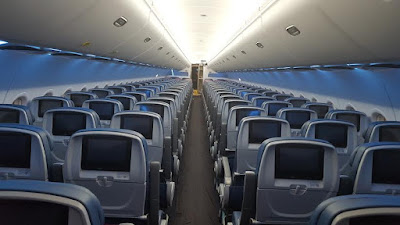
For those who follow my little corner of the internet know that I am working a LOT of overtime and I figure I would post some pictures of what we are working on....It is actually pretty cool.
This is the plane we are working one.....It is a Boeing 757
The twin-engine, medium-range 757 was up to 80 percent more fuel
efficient than the older 727 jetliners it was designed to replace but
retained the 727’s short-field capability. The 757-200 carried up to 228
passengers and had a range of approximately 3,900 nautical miles (7222
kilometers).
The 757 and the 767 were developed concurrently, so both shared the
same technological advances in propulsion, aerodynamics, avionics and
materials. The pioneering two-crew computerized flight decks, or “glass
cockpits,” of the 757 and 767 are nearly identical, so pilots could
easily qualify to fly both.
The first 757 rolled out of the Renton, Wash., factory in 1982. On
March 29, 1991, a 757, powered by only one of its engines, took off,
circled and landed at the 11,621-foot-high (3542-meter-high) Gonggar
Airport in Tibet. The airplane performed perfectly although the airfield
was in a box canyon surrounded by peaks more than 16,400 feet (4998
meters) high.
In 1996, the company launched the 757-300. It seated up to 280
passengers and had about 10 percent lower seat-mile operating costs than
the -200. The first 757-300 was delivered in 1999. By then Boeing had
delivered more than 1,000 757s. Four 757s were modified as replacements
for the older 707-based VC-137 executive transports for government
officials and designated C-32As.
In late 2003, Boeing decided to end 757 production because the
increased capabilities of the newest 737s and the new 787 fulfilled the
757 market’s needs. On Nov. 28, 2005, Boeing concluded the remarkable
23-year run of the 757 passenger airplane by delivering the final one to
Shanghai Airlines. The airplane was the 1,050th Boeing 757.

We are doing interior upgrades to the airplanes in our fleet. My employer charges a premium for the customer experience, the upgraded seats, WiFi and many creature comforts. The airplanes we are modernizing were to be tacky....stripped...they had seats in them...and that was it..The plane is a very good plane but the other company had different ideas on passenger aminities..the WiFi was added later after the merger. The version of the airplanes we are working on were originally "red tails". The Boeing's that are originally on our fleet are called "blue Tails". Those airplanes have more amenities for the airplane travelers. They have monitors in the headrest interactive games and movie selections and recharging ports for electronic devices and many other stuff that the legacy "red tails" don't. This is that the seats look like right after they are removed from the airplane
old seats...
We then start removing the seats, then we start removing the old over head bins..they are easier to remove once the seats are out of the airplane.
We have already removed the overhead ceilings, we will start removing the PSU's "Passenger Service Units" this has the flight attendant call button, the reading light and the emergency O2 masks. The ductwork that you see in the ceiling will be removed, cleaned, and reconfigured for the new mod.
We have removed the seats, the overhead bins, the ductworks and we have started the metal fabrications and antenna movement and installation for the WiFi and all the wiring for the electronics and passenger interactive games and videos and other stuff.
The sidewall panels are installed, the overhead bins are installed, we are starting to install the ductworks, the antenna for the WiFi is installed, the seats will be going in, the galleys and Lavatories are already installed.
This was the view from the back of the airplane, we have installed the ductworks and fixing to install the overhead ceilings. You can see the Lavatories. They use a LCD lighting or mood lighting.
, the carpets are installed.
You can see the huge difference in the interior modifications, this takes us about 45 days give or take to do the mods, this includes moving the mid lav from the left side to the right side. This is where my overtime comes from$$ The airplane gets a huge facelift and the customer gets the experience that they pay for. We call this stuff "arts and crafts" We make jokes about it but it is neat to see and it is considered a capital improvement and a benefit to our customers and us, it gives us long term job security as long as my employer remains ahead of the rest of the airlines, we will be the preferred carrier for the discerning customer who won't mind paying the extra coins for the extra amenities.