Webster

The Constitution was made to guard the people against the dangers of good intentions." --American Statesman Daniel Webster (1782-1852)


Wednesday, February 19, 2020

Some Reasons to consider the M-14/M1A

I am continuing my articles on the M-14 pattern Rifle(Down Jim), LOL.  Again I shamelessly clipped this from "American Rifleman", this article showed up in my email feed last week and I thought it was pretty good.


The internet is rife with essays by self-styled firearm experts who seem hell-bent on disparaging various legacy platforms for all manner of supposed deficiencies—despite the fact that those same guns are held in high regard by large numbers of satisfied users. Such differences of opinion are understandable given the fact that each of us has a uniquely individual set of experiences, knowledge and preferences that informs our choices.
One platform that seems to be a magnet for criticism is the M14 rifle. In fact, some call it out as an ideal example of failure with explanations such as: “It’s too heavy and too long. It was the shortest-lived service rifle in U.S. history and was only adopted because the process was corrupt. It was unsuccessful in singlehandedly replacing the M1 GarandM1903 SpringfieldM1917 EnfieldM1 CarbineM3 submachine gun, M1928/M1 Thompson, and M1918 Browning automatic rifle.”

Of those claims, the first is purely subjective, the last represents an unrealistic goal and those that follow are arguable, considering that the rifle still sees some military service today and that the parties involved in its adoption are no longer with us. More to the point, none of the complaints are relevant to a discussion of the merits available to the average rifleman by modern-day, semi-automatic M14 clones.
Springfield Armory continues to offer semi-automatic M1A rifles styled like a traditional M14.

Examples from such companies as Springfield Armory (whose corporate cornerstone is the trademarked M1A) LRB Arms, Bula Defense and James River Armory remain not only commercially viable, but are available in a wide variety of configurations, including polymer- and folding-stock and short-barrel models. And since most command the better part of two grand in price, that should answer any questions as to the value they hold in the minds of modern consumers.
At the risk of appearing to indulge in the same brand of myopic self-rationalization as the aforementioned “experts,” I’d like to suggest that the old warhorse is not only still worthy of consideration by today’s armed citizen, but is uniquely qualified as one of the best general-purpose rifle choices for uncertain times. Why? Because of six characteristics that lend it an undeniably attractive character.
Military Pedigree

Civilian firearms derived from military designs offer their users several advantages over those developed solely for the commercial market, and the M14-style rifle is no exception. Such designs are typically overbuilt as they are intended to suffer the exigencies of wartime abuse and neglect. They typically consist of separable subassemblies that ease cleaning and inspection and decrease parts loss.

Spare parts left over from military contracts eventually find their way into the civilian marketplace, which virtually ensures the user’s ability to keep the firearm in working order indefinitely. Provisions for the attachment of accessories such as optics, muzzle devices, bayonets, etc., and the on-board storage of cleaning equipment is another advantage. Finally, military firearms like the M14, because they are employed by wide-ranging user group, usually exhibit well-developed mechanical and ergonomic features.
Rugged Construction

The original M14 rifle was nearly devoid of polymers and nonferrous “light” metals or construction methods designed to shave a few ounces or favor inexpensive manufacture. Its parts are nearly all made from machined steel forgings—a process renown for longevity and durability. Its steel barrel threads into the receiver, which also provides the locking recesses for the two-lug steel bolt. The gun is basically a gas-operated bolt-action with a strong, simple mechanism that can withstand tens of thousands, if not a couple of hundred thousand, rounds of firing.

In fact, the improved drawings used to machine the receivers of today’s semi-automatic clones, whether from precision investment castings or forgings, along with improvements in metallurgy and quality control of bolts, barrels, gas cylinders and other parts, makes the current crop of civilian rifles even more reliable and refined, in some respects, than those the military had made by the U.S. Springfield Armory, Harrington & Richardson, TRW and Winchester.
Reliable Operation

Being an offshoot of the M1 Garand, and with aspects of its design perfected by none other than John C. Garand himself, the M14’s basic operating system had already proven itself throughout multiple theaters of World War II and in the Korean War before undergoing a baptism by fire in the Vietnam War. In fact, the gun’s detachable box magazine and piston-driven, gas cutoff mechanism were further refinements of the Garand’s more rudimentary en bloc clip and dog-legged, one-piece piston/operating rod.

Standing in distinct opposition to unsubstantiated claims about how the Garand-derivative family of arms is overly susceptible to the ingress of debris are reams of testimonials from G.I.s across a generation that praise the rifle’s performance across dramatically distinct climatic and terrain conditions. Given responsible care and lubrication and fed proper ammunition, today’s M14-style rifles, which include Ruger’s Mini-14 series, can be counted on work exactly as designed for many years.
Simple Ergonomics
Oftentimes, those who have intimate familiarity with one particular firearm platform, either through personal preference or professional service, have difficulty accepting another—and that’s understandable. But when one particular style of firearm or operating mechanism and one arrangement of controls becomes so sacrosanct that all others are deemed wrong, that becomes legalism, and such is the case with AR-style controls. The M14, by contrast, has quite usable controls in a slim, ergonomic platform. The M14-style rifle has a reciprocating charging handle on the right (ejection) side that’s simply an extension of its operating rod. It allows for positive chambering by a nudge of the heel of the hand.
In a compact package, the M14-style rifle offers numerous benefits in terms of ergonomics and handling, as exemplified by this Springfield Armory SOCOM16.

The bolt catch, which can be replaced with a commercial version that also acts as a release, is on the left side of the receiver. The safety lever is operated by the trigger finger, and it pivots into the triggerguard from the outside, ensuring that the trigger finger is off the trigger when going “on safe.” The design also ensures that the trigger finger comes away from the trigger momentarily when the lever is pivoted to the triggerguard’s outside before the finger returns to the trigger to go “on fire.” The magazine hooks and rocks into position with an audible “click,” and the magazine release is also centrally located. Windage and elevation adjustments do not require the use of tools. It is, overall, a simple, tried-and-true set of controls that rely mostly on gross motor skills.
Ingenious Design

Several aspects of the M14’s design make it stand out from the crowd. Its ingenious White expansion and cutoff gas system—with a separate piston that moves rearward to strike the operating rod—minimizes damage with a variety of bullet types and weights used in it. In addition, a valve on the gas cylinder allows the gas system to be manually turned off, resulting in what is essentially a straight-pull rifle that can be cycled faster than a traditional bolt-action, since all that’s required is to withdraw the operating rod handle to the rear and then simply release it, allowing the recoil spring to return the bolt into battery. 

Also, the rifle has a feature that most newer guns, even military designs, no longer possess: a built-in guide that allows the magazine to be fed using stripper clips. Such clips present an efficient and lightweight option for carrying additional ammunition. Additionally, the attachment of either conventional or forward-positioned optics using a wide variety of bolt-on mounts is easy. Finally, few could successfully argue against the M14-style rifle’s excellent sights and trigger, both of which contribute to a level of accuracy that well serves most hunting and defensive roles.

Traditional Aesthetics

Rifles made of wood and steel have served remarkably well in both civilian and military circles for about seven centuries. Sure, for about as many decades, polymer and nonferrous metals have proven to offer some advantages—but primarily in weight savings, not longevity. So, when it comes down to it, there’s simply nothing fundamentally wrong with a traditionally styled rifle made of wood and steel.
Springfield Armory's new M1A Tanker blends classic aesthetics with a compact, shortened profile that provides for easy handling.

In fact, the appearance of such a gun could be an advantage during circumstances in which a more modern, tactical design might draw unwanted attention. With a flush-fit magazine and a shortened muzzle compensator, such as in Springfield’s recently released M1A, the Tanker, the M14-style rifle has a form factor that is significantly more svelte than the average modern sporting rifle, despite its greater weight.

For all of the above reasons and more, the M14-style rifle offers a level of utility and capability—all in an understated package—not commonly encountered in many more modern firearms. Is it the “perfect” rifle? By no means, but it is surely underestimated and underappreciated when objectively evaluated.
The M14 platform continued to see active military service well into the 21st century, albeit in a modernized Mk 14 EBR configuration. Photo courtesy of PEO Soldier.

Tuesday, February 18, 2020

The M-14 in Vietnam.


I clipped this from "American Rifleman", This was written by Chuck Karwan whom unfortunately passed away in 2008.  I am looking at a 308 pattern rifle, most likely an AR-10 derivative.  I have a lot of respect for the M-14 Rifle, I was issued one when I was at North Georgia College and was familiar with the rifle, especially the weight.  I own an M-1 Garand which is a very good rifle.  I have comsidered getting a M1A type rifle, but the cost is more expensive than an AR-10 pattern rifle and I am very familiar with the AR pattern Rifle from my military service and my owning civilian versions of that rifle.


I have a tremendous amount of personal experience with the M14 rifle. I first handled one and saw it demonstrated at Camp Perry, Ohio, when I was only 13. I lived with one in my room for four years as a cadet at West Point. I qualified with it, drilled with it, paraded with it, competed with it, trained with it and trained cadets in following classes how to shoot it.

While I was a cadet at West Point, the M16 was entering U. S. military service in large numbers, particularly in Vietnam. I became a fan of the M16, but it was clear even then that the M16 had a number of performance limitations compared to the M14. The Army took the "one or the other but not both" approach, and within a few years, the M14 was completely replaced by the M16A1 as the standard U. S. Army service rifle.
The M14 hung on longer in Vietnam than most people realize. It is still used extensively by the Navy for base and ship security and even by the Navy SEALs. Also, the Marines still use the M14 in the Designated Marksman Rifle role with a scope sight. I carried an M14 through jump school and again through Ranger School. An M14 was my primary arm during most of my first active-duty assignment in an infantry battalion and throughout my Jungle Operations training in Panama just prior to going to Vietnam.

When I went to Vietnam and the 1st Cavalry Division in August 1970, my primary rifle for most of the first half of my tour was an XM16E1 (an M16A1/M203 grenade launcher combination), but we had a fair number of M14s in use alongside our M16s. While an infantry rifle platoon leader, I almost always had at least two M14s in my platoon and, sometimes, an XM21, the M14's sniper version. At the time, my platoon rarely consisted of more than two eight- to 10-man squads.

A U.S. infantryman walks through brush in Vietnam with his M14 rifle held in the low-ready position.

Interestingly, one of the platoon's M14s was a non-standard carbine version. It had its barrel shortened to just in front of the gas system, the barrel rethreaded and the front sight/flash suppressor assembly remounted. This special M14 was "off the books" and was highly coveted by platoon members who handed it on as its various carriers rotated out of the unit.

The story behind this interesting rifle began when the platoon was on R&R in a rear area. Several platoon members noticed the gun in the back of an MP's jeep and decided they needed it more than some MP REMF. While several platoon members distracted the MP, another lifted the M14 carbine from the back of his jeep. It became part of that platoon's armament thereafter.

How the rifle got into that short-barreled configuration we will never know. I do know that H&R had made some experimental prototype M14 carbines, but I do not know if it was one of those or an in-country conversion. That M14 carbine was handy, powerful and most definitely loud!

It was during this period that I really developed an appreciation for the M14 and its 7.62 mm NATO cartridge for jungle operations. Two particular incidents come to mind that helped influence my feelings. One involved an encounter with a Vietcong who dove behind a tree just as I spotted him. My attempt to shoot him through the tree with my M16 failed miserably, and he got away. I was quite sure that if I had been shooting an M14, he would not have escaped.

On another operation, my patrol was called up for an emergency extraction because we were needed badly somewhere else. When we arrived at the only potential landing zone within many miles of thick jungle, we found a tropical hardwood tree located in such a way that a helicopter could not land. After barely chipping the bark off the tree with a machete, it was obvious that something else would have to be done to get rid of it. As I considered using several of our precious claymore mines to take the tree out, one of my more experienced troops came up with his M14 and offered to shoot the tree down.

An American infantryman wades through swamps in Vietnam, carrying an M14 in his right hand and an M20 bazooka in his left hand.

After making sure we had no troops downrange, with a good bit of skepticism, I gave him the go ahead. He walked over to the tree, held his rifle fairly level to the ground and began shooting through the tree left to right with shots spaced about an inch or two apart. Before he got through his second magazine the tree fell over as nice as you could please. I later worked with 1st Cavalry Division snipers using XM21s to take out the enemy by shooting them through the trees they were behind. During small-unit engagements, one sniper named Staff Sergeant Crow liked to use a technique called "precision traversing fire."

After identifying the likely location of an enemy soldier behind a tree, he would aim maybe a foot or two off the ground at the edge of the tree and, in a cadence not unlike rapid fire in a match, move each subsequent shot across the tree a few inches apart. Often before he traversed to the opposite side of the tree, an enemy soldier would fall away from the tree, hit by a combination of bullets and wood fragments. In one particular engagement, he accounted for nine of the enemy using that technique.

I came to the conclusion that the 7.62 mm NATO cartridge was the best choice for combat in heavily forested areas like our area of operations in III Corps in Vietnam, due to its superior penetration. I am not talking about "bucking brush." No conventional rifle bullet does that very well. I am simply saying that in heavily timbered areas the superior penetration of the 7.62 mm NATO compared to the 5.56 mm NATO is highly valuable in getting to an enemy taking cover behind trees or in bunker-type fighting positions made from logs.

After about a half year in the jungle, running combat patrols, I got promoted to company executive officer. It didn't take long before I discovered that the division sniper detachment was largely manned by gun enthusiasts like myself. After we got to be friends, they gave me a customized M14 that one of their armorers had built using a standard M14 barreled action.

A Vietnam-era U.S. infantryman kneels behind an M14 rifle set up for prone firing with a bipod.

It was glass-bedded into an M14E2 pistol grip stock with the front hand grip removed and a standard M14 buttplate fitted. My customized M14 had a quick detachable Griffin & Howe type scope mount base on the left side. I had an old Korean War-vintage M84 scope sight in rings that could be attached in an instant. That rifle shot beautifully and was my almost constant companion for most of the rest of my tour. Indeed, the only other rifle I ever carried in combat was an XM21sniper rifle.

My custom M14 and my XM21 were a joy to carry—accurate, reliable and real confidence builders when things got hot. They were also extremely reliable. I remember one particular incident where I took a spill in a swampy area and completely submersed my M14 and myself in deep, soupy mud. Both my rifle and I were coated with brown muck from head to toe and were, I imagine, quite a sight.

All I did was find a relatively clean puddle of water and swish my rifle around in it. When I test fired it, it worked perfectly. Naturally, I did a thorough cleaning as soon as I could. As an aside, my customized M14 is now part of the West Point Museum collection. The reason many of my troops liked the M14 was the same reason I came to prefer it: superior penetration against cover. In a contact, our main base of fire came from the one or two M60 machine guns that we carried. If they went down, only the M14s had the power and penetration to fill in effectively.

I left active duty and began my career as a gun writer about 24 years ago. Since that time, I have had lots of exposure to various commercial versions of the M14—particularly the Springfield Armory M1A line. In all my years of experience with the military M14 and its commercial derivatives, I have fired or been present at firing tens of thousands of rounds through them. Much of the time, it was in nasty field or combat conditions. I think I could count all of the observed malfunctions in all that time on one hand. Take it from me, M14s are extremely durable and reliable performers.

Monday, February 17, 2020

Monday Music "Hold Out for a Hero" by Bonnie Tyler


I am continuing my string of "bugaloo" songs.  This discussion was started in the "Monster Hunter Nation, Hunters Unite", it is a facebook group with enthusiast of the ILOH "International Lord of Hate" A.K.A Larry Correia.  We were talking about what song would we use if we looked out of our window or glanced at our security camera and saw this.....


One of the alphabet bois lining up to take down your house...What would be your "Valhalla" song and you would set it up to play as you load up magazines and prepare yourself.
Holding Out for a Hero" is a song recorded by Welsh singer Bonnie Tyler for the soundtrack to the 1984 film Footloose, and later included on her 1986 album Secret Dreams and Forbidden Fire. It was written by Jim Steinman and Dean Pitchford. Initially, the song only just reached the Top 100 in the UK Singles Chart, but made it to number 2 the following year, and re-entered the charts again at number 69 in 1991. The song reached No. 1 on the Irish Singles Chart on 28 September 1985. It reached the top 40 in the United States and Canada. The song's instrumental break was reused from an earlier song by Jim Steinman called "Stark Raving Love", which featured on Steinman's 1981 album Bad for Good.

Jim Steinman had been recruited to work on the Footloose soundtrack, for which he wrote "Holding Out for a Hero" with Dean Pitchford. Steinman suggested Tyler's name when he was approached about finding a singer to record the song. Tyler recorded the song at the Paramount Studios, and was shown the scene of the film where the song would feature.

The video was produced by Jeffrey Abelson, and directed by Doug Dowdle, with the concept by Keith Williams. It was the second music video (following Deniece Williams' "Let's Hear It For The Boy") that successfully promoted Footloose while having no movie footage in the video.
The video starts off with Bonnie Tyler escaping from a burning house; the video is set primarily in the vicinity of the burning house and on the edge of the Grand Canyon – interspersed with shots of angelic background singers dressed all in white. Evil cowboys dressed in black, carrying neon whips appear before Tyler, threatening her; a cowboy hero dressed in white, brandishing a revolver, appears on horseback and the evil cowboys flee on horseback, with the hero in pursuit. As the song fades out, the hero cowboy appears in front of Tyler.


Saturday, February 15, 2020

Some Valentine day humor...

 I have been under the weather for a couple of days and when you are feeling like crap, the muse just hides...if you know what I mean.

I work in the Airline industry and I saw this and only those that associate around airplanes will really get this humor.

Happy Valentine day humor...


Thursday, February 13, 2020

Do the Meek inherit anything?

I saw this article and I thought it was an interesting article. 

Who is more noble in the grand scheme of life, he who is incapable of violence, or he who is capable, but abstains? If you are too weak to do harm, is your abstention from it attributable to the goodness within you?
How many times have you heard the phrase “The meek shall inherit the Earth”? More often than not, the phrase is misunderstood by those who use it. In its modern usage, it’s designed as some sort of chastisement against men of action, masculinity, and those who dare. Stemming from Jesus’ Sermon on the Mount, many have since taken the meaning of the word ‘meek’ to indicate the weak, or otherwise frail, and that the Earth is due to them as some sort of compensation for their trials and tribulations of our current age. Now, the phrase is a celebration of weakness, cowardice, and submission.
In reality, the word meek does not reflect the true intent or definition that it once did. From the original Greek translation, praus was not a word referring to the weak, but instead referred to one who expressed control or power without undue harshness. In the original Greek, the broken horse was referred to as the original praus. This mass of bone and muscle was controlled by light pressure from the knee, or a twist of a bridle, and was not weak, it was control. Meekness is, at its true root, control over power.

The history of our intellectual-class and the modern usage of the phrase, time and time again, reveals how useful the lie of meekness has been to those who still espouse it. Jordan Peterson, despite his controversial views on other topics, was right in pointing this out. In Jordan Peterson’s explanation, meek referred to a man with a sword and the training to use it when needed. Chögyam Trungpa expounded upon meekness further in his book Shambhala, describing that meekness is one of the essential faces of the warrior, “The warrior of meek: kind and mercy to others.”
In all cases, control is the root of meekness, not weakness. A strong man who is capable of violence and knows the power of his own hands, but sheathes his weapons when they are not needed, is in control of himself. Nietzsche himself commented that most cowards are moral, not because they are moral at their root, but because they use it as a disguise to hide their weakness. Therefore, their benevolence is less a product of their moral integrity, but their inability to harm in the first place. The blessed meek in the Sermon on the Mount were not flabby soyboys crying about chads taking their women or a poltroon justifying that he’ll “be the bigger man” when he should be defending his woman against slander. Meekness is control, not wimpish inaction.
Weak people are rightly lower in naturally ordered hierarchies, especially when they have no other redeemable qualities to raise their status. Claiming that “The meek shall inherit the Earth” is merely the peacocks tail for these frail creatures who cannot compare to the hawks or eagles above them. This is not to say that strength is the only value, or that the mighty should rule, but you must have some sort of strength or value. Strength is not limited to the physical. We often see that idiots are the first to flap their gums about topics in which they believe they’ve learned. Meanwhile, real experts are controlled and measured when they reveal the depths of their understanding. Control is a value on parity with strength and intelligence.
Cultivate strength and control in everything you do. And, become someone who deserves their inheritance due to the blessed meek.

Wednesday, February 12, 2020

Monday Music er Wednesday Music "Its My Life" by Bon Jovi

My Apologies, this should have dropped on Monday, I tend to load the scheduler thingie on my blog especially at the beginning of my week because my work schedule and other stuff really stacks up at the beginning of the week. For some reason this post was still in "draft" and not loaded.

I am continuing my string of "bugaloo" songs.  This discussion was started in the "Monster Hunter Nation, Hunters Unite", it is a facebook group with enthusiast of the ILOH "International Lord of Hate" A.K.A Larry Correia.  We were talking about what song would we use if we looked out of our window or glanced at our security camera and saw this.....


One of the alphabet bois lining up to take down your house...What would be your "Valhalla" song and you would set it up to play as you load up magazines and prepare yourself.

This song hit around 2000, I was working at Ford at the Assembly Plant, I was doing a job that I didn't like, Most of the jobs I could run "pretty good" I was a utility which means to maintain my classification, I had to run 7 different jobs.  I one time counted them, I could run 84 different jobs on the assembly line.  Most of the jobs in the body shop, I can run along with some of the jobs in "Trim" which was where the interior of the car came from.  But this job which was the "Steering column build up job really whipped my butt."  This job should have been run by 2 different people but Atlanta being Atlanta, ran with less.  It was the Assembly Plant trademark.   But this song would play a lot on the boombox that somebody had brought to the line and I associate music where I was where I first heard of the song.......Yeah it is strange....but that is me.  So when ever I hear of this song, and it is a good song,  It almost had a "Boy band" quality but it was a better quality music.  I still associate it with me damm near killing myself running the steering column buildup job. 

"It's My Life" is Bon Jovi's first single from the album Crush. It was released on May 23, 2000. It was written by Jon Bon Jovi, Richie Sambora, and Max Martin. The song was hit #1 across several countries (although it only reached #33 in the US). However, it has the distinction of making Bon Jovi the only band once classified as 1980s hair metal to reach the top 40 in the 2000s, a testament to how the song managed to introduce the band to a new, younger fanbase. The song is arguably their most well known post-1980s hit single and it has been performed live at almost all shows since its release.

  
The song has many classic Bon Jovi features, such as Sambora's use of the talk box, and a line in the second verse "For Tommy and Gina, who never backed down" refers to Tommy and Gina, a fictional working class couple that Bon Jovi and Sambora first wrote about in their 1986 hit "Livin' on a Prayer".
"It's My Life" is also notable for its line referencing fellow New Jerseyan Frank Sinatra: "My heart is like an open highway / Like Frankie said / I did it 'My Way'." Jon Bon Jovi and Richie Sambora apparently had a disagreement over those lines, with Bon Jovi recalling:
I had just come home from making U-571 and I said "Sinatra made 16 movies and toured 'til he was 80. This is my role model". He [Sambora] said, "You can't write that damn lyric. Nobody cares about Frank Sinatra but you." And I wrote it anyway.


The song became an anthem that appealed to many fans. As Jon Bon Jovi later stated:
When I was writing "It's My Life", I thought I was writing very self-indulgently about my own life and where I was in it. I didn't realize that the phrase "It's My Life" would be taken as being about everyone--by teenagers, by older guys, mechanics, whatever. "It's my life, and I'm taking control". Everyone kind of feels that way from time to time.

The music video was directed by Wayne Isham. Will Estes (as Tommy) and Shiri Appleby (as Gina) are the two main characters (as it says in the lyrics "for Tommy and Gina, who never back down"). At the beginning, Tommy is watching a video of a Bon Jovi concert on his computer when Tommy's mother ordered him to take out the trash and suddenly Gina calls, and during the whole video, Tommy starts running down to his apartment and obediently takes out the trash and starts runs through the streets of Los Angeles up to the concert, getting chased by dogs, running a marathon, posing for pictures, and jackknifing a truck. The video was inspired by the movie Run Lola Run. Jon Bon Jovi met Will Estes on the set of U-571 and chose him to be in the video. The music video features the 2nd Street Tunnel as one of the main settings. 

Sunday, February 9, 2020

How France Helped Argentina during the Falkland War.

I ran across  this article on the Falkland war, I have blogged before about the Falkland war, and I knew that France had supplied many weapons to the Argentinians, including the Exocet that had a lethal reputation that was proven during the resulting Falkland war.  Even back then when I was a sophomore in High School during the Falkland War, I had a wishy washy image of the French and wondered if they were helping the Argentinians because the French have a history with the British and it wasn't sunshine and rainbows.  After reading this article it kinda confirmed the initial impressions.  I also had the same opinion because the French supplied the Iraqi's.  I wondered if they played both sides against the middle because it would help France if the United States was lessened by a bloody battle/war in the Persian Gulf against Saddam Hussain. Yes I know that the French had the Foreign legion here to help and they did exceedingly well from what I know.  But the French had sacrificed the legion before in Vietnam and the surrounding areas due to the Indochina War and Algeria due to politics. 


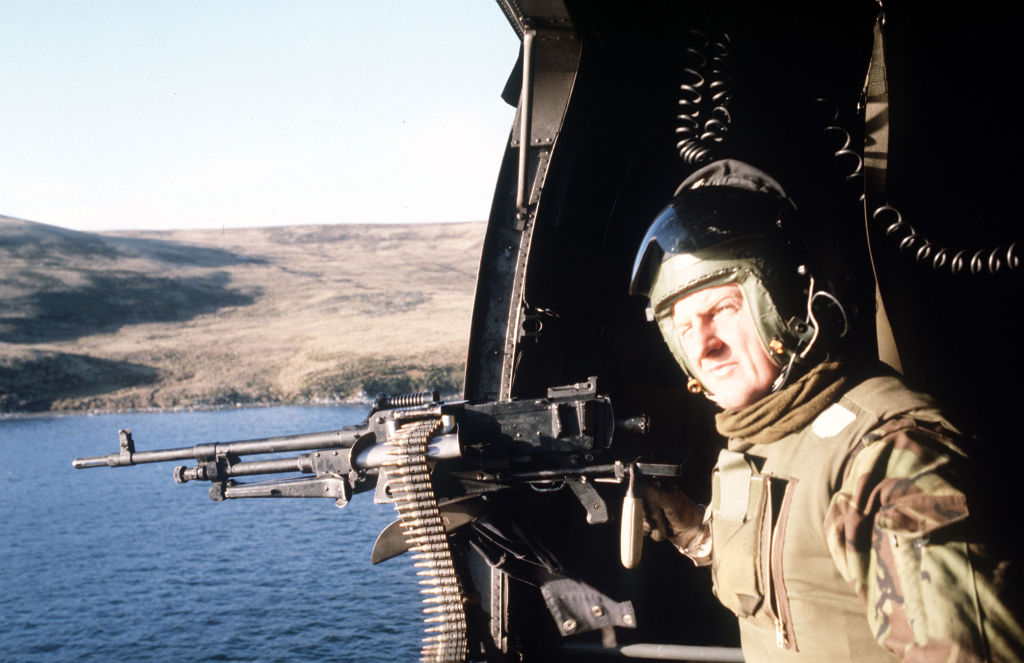
A crewman mans a General Purpose machine gun mounted in the hatchway of a helicopter on patrol over San Carlos Water during the Falklands conflict.   (Photo by PA Images via Getty Images)
A crewman mans a General Purpose machine gun mounted in the hatchway of a helicopter on patrol over San Carlos Water during the Falklands conflict. (Photo by PA Images via Getty Images)
During the 1982 Falklands War, the British were able to reclaim their territory from invading Argentinian forces.
During the war, the British received support from France but formerly secret documents show that the French may have been working both sides of the conflict.
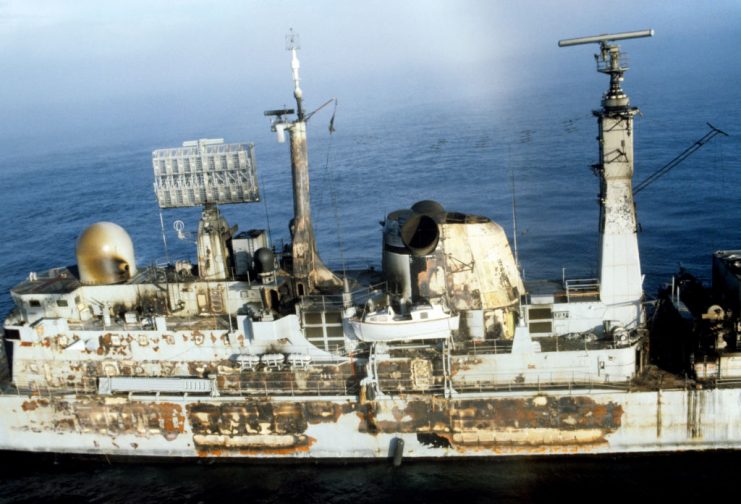
In May of that year, the Argentine forces used Exocet missiles during an airstrike that killed 32 people. The missiles were fired at the British ships HMS Sheffield and Atlantic Conveyor.


HMS Sheffield after being hit by an Argentine Exocet missile in the South Atlantic. (Photo by Martin Cleaver – PA Images/PA Images via Getty Images)
HMS Sheffield after being hit by an Argentine Exocet missile in the South Atlantic. 
The missiles were sold to Argentine by France prior to the war before it seemed likely the two countries would enter into combat with each other.
When the war began, France embargoed weapons sales and support for Argentina. They also allowed the British to use French ports in West Africa and provided them with information on the weapons and planes that they had sold to Argentina.
French President Francois Mitterrand made the decision to aid the British. While the UK’s Secretary of State for Defence Sir John Nott praised France as being the UK’s “greatest ally,” members of the French government were not pleased with their president’s decision.
The French ambassador to London, Emmanuel de Margerie, wrote a scathing description of Margaret Thatcher as “Victorian, imperialist, and obstinate” with a “tendency to get carried away by combative instincts.”
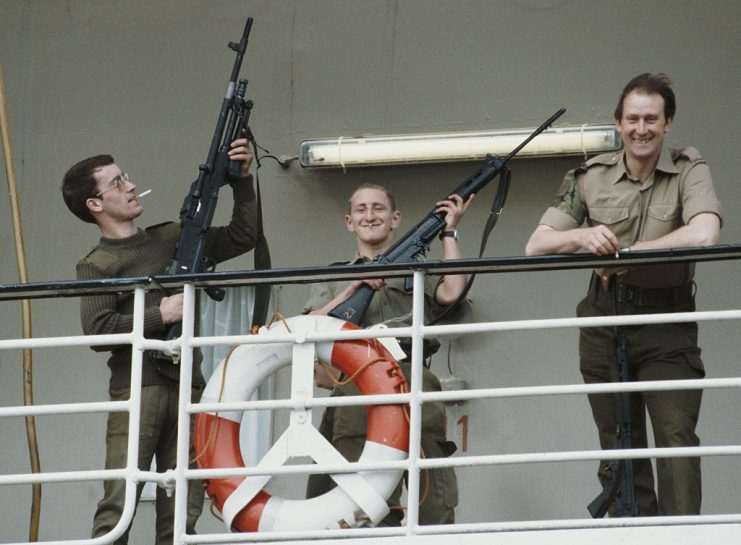
A group of British soldiers show of their rifles as they stand on the deck of the RMS Queen Elizabeth 2 (QE2) before the ship departs for the Falklands, from Southampton docks on Wednesday, May 12, 1982. The QE2 took part in the Falklands War during 1982, carrying troops and volunteer crew to the South Atlantic conflict, with her decks converted into three helicopter landing pads. (Photo by Bryn Colton/Getty Images)A group of British soldiers show of their rifles as they stand on the deck of the RMS Queen Elizabeth 2 (QE2) before the ship departs for the Falklands, from Southampton docks on Wednesday, May 12, 1982. The QE2 took part in the Falklands War during 1982, carrying troops and volunteer crew to the South Atlantic conflict, with her decks converted into three helicopter landing pads.French official Bernard Dorin decried Britain’s “superpower arrogance” and their “profound contempt for Latinos.” He made these claims in a document titled, “The Falklands: Lessons from a Fiasco.”
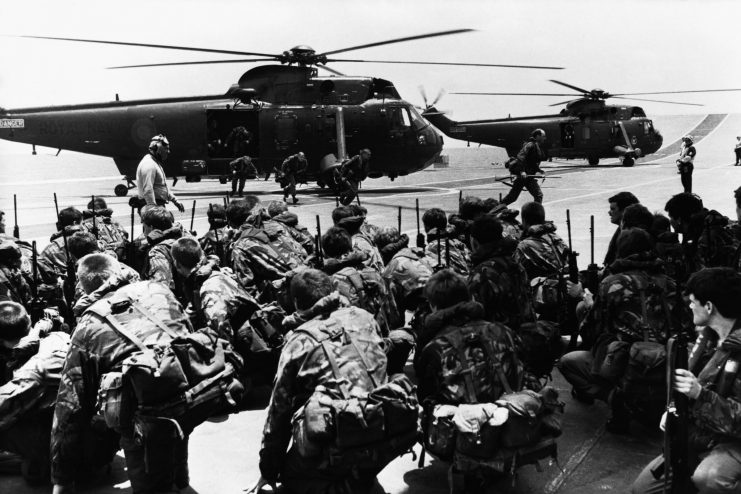
A BBC investigation has uncovered evidence that, even though the embargo was in place, a team from France worked with the Argentine troops in the Falklands during the war. The team allegedly tested the missile systems to ensure they would fire.

Three of the missiles failed and the team repaired the issue which allowed the missiles to be used against British troops.
During the war, 659 Argentinian and 253 British troops were killed.
The Falklands War began when Argentinian troops invaded the Falkland Islands on April 2, 1982. The Falklands are a British territory located in the southwest Atlantic Ocean off the coast of Argentina.
Argentina has long claimed rights to the islands, which they call Malvinas. Argentina inherited the islands from the Spanish crown in the early 1800s.

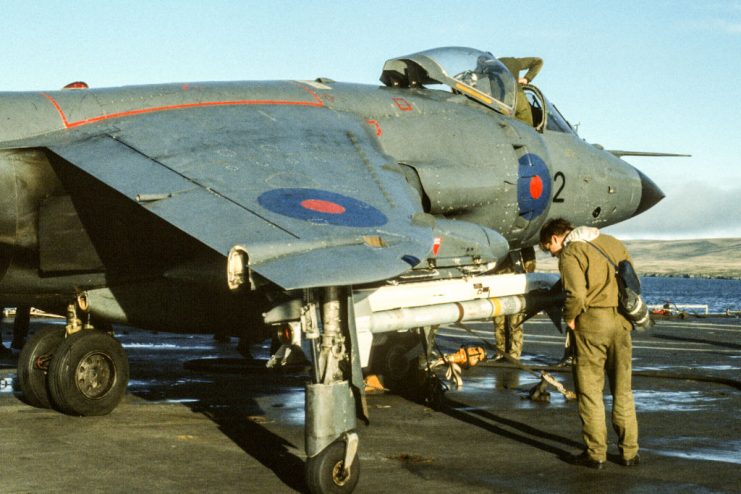
Sidewinder missile on an 800 squadron Sea Harrier aircraft landing on HMS Fearless L10 during the Falklands War 1982. It was unable to land at the damaged Sheathbill air strip, the pilot was Lt-Cdr Neil Thomas. (Photo by Terence Laheney/Getty Images)
Most of the residents of the Falklands are of British descent. Britain claims rights to the islands based on their long-term administration of them and on the principle of self-determination for the islanders.
Argentina did not believe that the UK would respond with force if they invaded the islands. But, despite being 8,000 miles away, British Prime Minister Margaret sent a force of warships and hastily refitted merchant ships to reclaim the British territory.

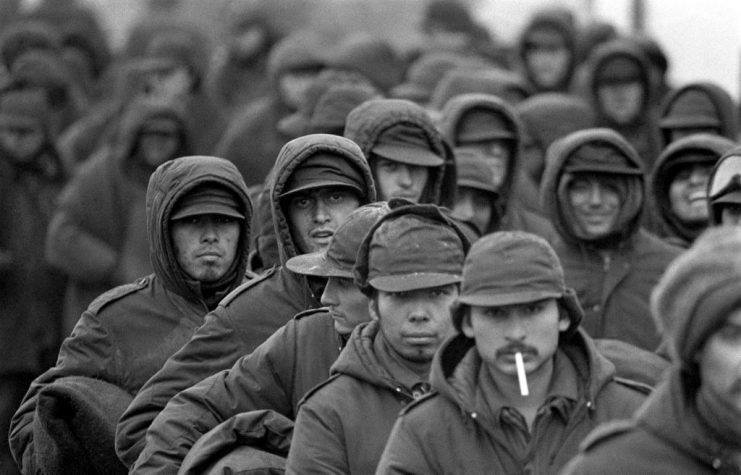
A hint of a smile on some of the faces of these Argentinian prisoners of war at Port Stanley, capital of the Falkland Islands, waiting to be repatriated via Montevideo. . (Photo by PA Images via Getty Images)
The British submarine HMS conqueror sank the Argentine cruiser General Belgrano on May 2, 1982. 300 crew were lost with the ship. After that, the Argentine military kept their ships in port.
But the Argentine air force was still a threat to the British. Their aircraft sank several British warships, including the HMS Sheffield with an Exocet Missile, whom the Frigate's Friend or Foe system wasn't updated to classify the Exocet as "Foe"

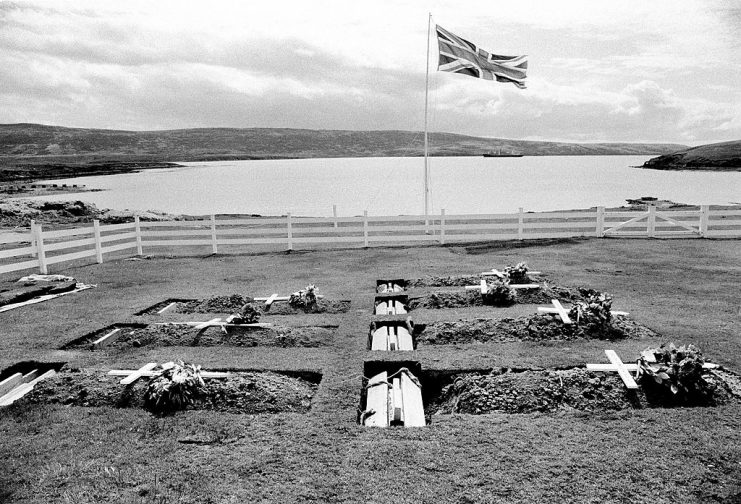
The Blue Beach War Cemetery in Port San Carlos in the Falkland Islands, October 1982. In the foreground (right) is the grave of Lieutenant-Colonel H. Jones (1940-1982), who was posthumously awarded the Victoria Cross. (Photo by Tom Stoddart/Getty Images)
Still, the British were able to land on the Falklands on May 21, 1982. The conscripted Argentinian troops had plenty of time to dig in and fortify their defenses but they were not trained well enough to defend against the oncoming British forces.
On June 11, 1982, the battle for the capital, Stanley, was underway and the Argentinians surrendered on June 14, 1982

Saturday, February 8, 2020

The Zeppelin Accident at Echterdingen and the "MesserSpit"

 I was stationed at Stuttgart Army Airfield for 3 and a half years, I got sent there in 1987 after doing a tour with the 1st Infantry Division(FWD) at Cooke Barracks at Geoppingen. SAAF was a good place to be and it was a a good tour and during that time we got sent to the Persian Gulf.  I used to run 10K a day, I would run parallel to the road then cut cross country and work my way back to the gate.  It took me a smidge over an hour.  I used to run past the memorial and I never stopped, I wish I had, but back then I always figured "one day" and as much of a history nut that I am that I didn't do that.  It is on my bucket list to go back to Stuttgart and check out my old haunts and see how things look and visit one of my friends that lives over there and works at the "FlugPlatz"   Here is some pics and information that I saw on "google" about the Zeppelin Monument. 

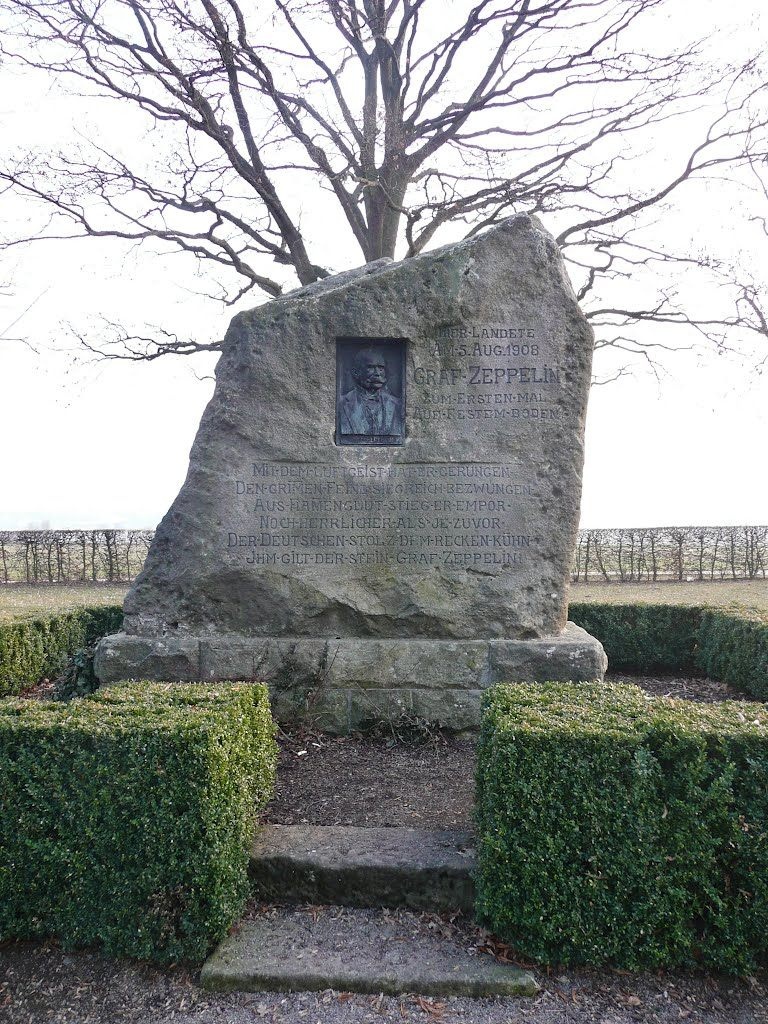
Here is the monument to the LZ-4 is at Echterdingen where the LZ-4 met its fateful accident.
Echterdingen, LZ-4 Monument
LZ-4 Monument at Echterdingen. Photo credit: Undetermined


The memorial was erected in 1908. The monument is decorated with bronze plaques, a portrait of Graf Zeppelin on the front and a rising eagle on the back. In addition to the portrait an inscription reads: "Here Count Zeppelin landed for on solid ground for the first time on the 5th of August 1908." The inscription under the portrait reads: "He struggled long and hard with the Spirit of the Air Successfully vanquished the grim opponent. From a sea of flames he rose up More magnificent than ever before. To the pride of Germans he soared up courageous; To him is set in stone (the name) Count Zeppelin!" (thanks to Alastair Reid for the translation). The back shows a rising eagle and the inscription: "As through the dark clouds of the Aar rises to the golden light, so by tribulation and need the hero struggles to victory."
The monument is located at (Lat Lon) 48.681222 009.180318.(You can cut and paste this on "google Maps" and see a map of the location and the area.

On July 1, 1908, Ferdinand von Zeppelin’s fourth airship, LZ-4, made a record-breaking 12-hour flight over Switzerland.  The German government promised financial support if Zeppelin’s ship could make a full 24-hour endurance flight and the count agreed to the challenge.
LZ-4 leaving its hangar on the Bodensee for the 24 hour test flight that ended in the crash at Echterdingen.
LZ-4 leaving its hangar on the Bodensee for the 24 hour test flight that ended at Echterdingen.
LZ-4 departed its floating hangar on the Bodensee on August 4, 1908 but was forced to make an emergency landing in a field at the town of Echterdingen the next day.  The ship was pulled from its temporary mooring by a sudden storm and destroyed when its hydrogen ignited.
Wreckage of LZ-4 at Echterdingen
LZ-4 Wreckage at Echterdingen
Rather than losing faith in Count Zeppelin’s work in response to the crash, the German public rallied behind his efforts.  Germans contributed 6 million marks for the construction of a new airship in what became known as the “Miracle at Echterdingen” and the enthusiastic support of the German people gave new life to the zeppelin enterprise.  The next 30 years of zeppelin development was made possible by the Miracle at Echterdingen.
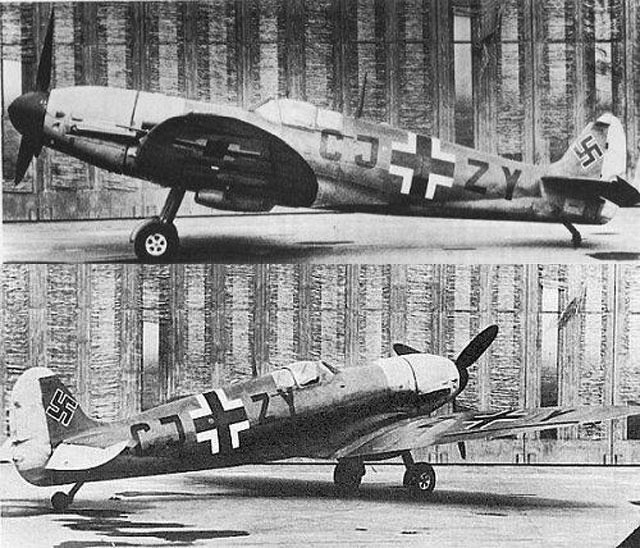
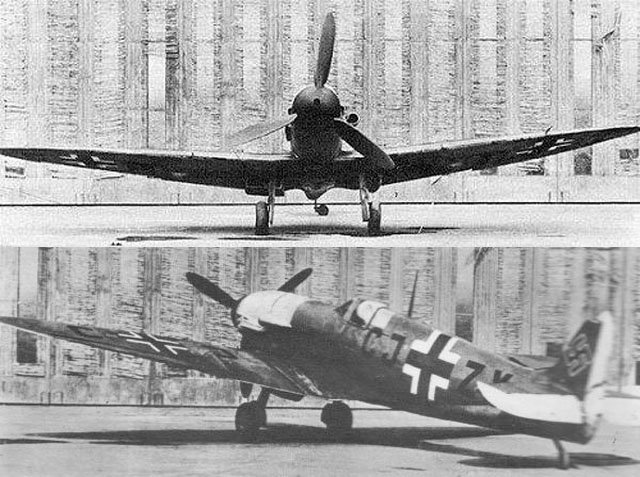
    While I was reading up on Echterdingen, apparently my post in the 1980's was a test site for the Luftwaffe, they experimented with a captured Spitfire.  I remembered seeing the flooded entrances to the underground bunkers that had tunnels connecting all the kasernes around Stuttgart to protect them from the Allied bombings.  They also hid a bunch of industry in the tunnels to protect
Spitfire Vb (EN830/NX-X) fell into German hands late in 1942. On November 18th while being flown by P/O Bernard Sheidhauer of the Free French Air force, attached to 131 “County of Kent” Sqn RAF, he and his No.1
P/O Henri de Bordas had been on a “rhubarb” (an RAF World War II code name for operations by aircraft seeking opportunity targets).
Making land fall at St Aubin sur Mer they picked up and followed the Caen to Cherbourg railway attacking several targets along the way. During the mission they were met by flak and purposely avoided Carentan because of the concentration of flak in the area.
Over the small town of Ecausseville, de Bordas lost sight of his partner, he continued to circle for as long as he could, but to no avail. He returned to Westhampnett. Scheidhauer’s aircraft had suffered some sort of damage and started to lose fuel. By mistake he headed west instead of north, after crossing a stretch of water he sighted land which he mistakenly thought was the Isle of Wight.  Picking out a suitable field he place his aircraft down into a wheels up landing. Coming to rest in a field of turnips close to Dielament Manor, Trinity.
Climbing from the aircraft he was met by locals who informed him of his navigational error, he was in fact in German Occupied Jersey and not the Isle of Wight.  Scheidhauer tried to destroy the aircraft, he attempted to acquire some fuel to set fire to it, but there was none, he smashed the instrument panel as best as he could and gave away various items of equipment to the gathering crowd of locals.
The Germans arrived after about 20 minutes and he was taken prisoner, ending up at Stalag Luft 111. He was later murdered by the Gestapo for his part in the ‘Great Escape’.
En830 was dismantled and shipped to mainland Europe. It reached Echterdingen without guns and ammunition, with the gun ports closed. The radio equipment had been replaced with ballast, but it still had its original Merlin 45 engine. Several flights were made by Daimler-Benz pilots before conversion was attempted. A decision was made to replace the instruments and the entire electrical system with standard German equipment, because the Luftwaffe used a 24 volt system, whilst the RAF used a 12 volt standard.
A 3.0 m. diameter Bf.109G propeller was added, together with the carburetor scoop from a Bf.109G.
After a couple of weeks, and with a new yellow-painted nose, the Spitfire returned to Echterdingen. Pilot Ellenreider was the first to try the aircraft. He was stunned that the aircraft had much better visibility and handling on the ground than the Bf.109. It took off before he realised it and had an impressive climb rate, around 70 ft. (21 m.) per second. Much of the Spitfire’s better handling could be attributed to its lower wing loading.
The Spitfire’s wing area was about 54 sq. ft. (5m²) greater than that of the Bf.109. The Messerschmitt was faster at low altitude, but at 11,000 ft. the speeds evened out. The DB 605A engine gave better performance, according to the test group, than the Merlin, which was rated 150 hp below the DB 605A. It gave this “MesserSpit” a ceiling of 41,666 ft. (12700 m.), about 3,280 ft. (1000 m.) more than a Bf.109G with the same engine and 5,166 ft. (1475 m.) more than that of a Spitfire Mk.V.
After a brief period at Rechlin verifying the performance data, the modified Spitfire returned to Echterdingen to serve officially as a test bed. It was popular with the pilots during and after work hours. MesserSpit career ended on 14th August, 1944, when a formation of US bombers attacked Echterdingen, wrecking the Spitfire. The remains of the Spitfire Messerschmitt hybrid were scrapped at the Klemm factory at Böblingen

Thursday, February 6, 2020

I just don't have it in me...

I have been seeing the events that have been transpiring the past few weeks and have been wanting to comment.

    I watched the SOTU address and it was a combination of SOTU and a campaign rally and it was very successful. When President Trump Recognized Charles McGee one of the last surviving Tuskegee airman and his grandson in the stands, man talking about righting a wrong.

 It shows that warriors transcend color.  For all the crap that guy went through from WWII, Korea and Vietnam.  They used to have a word for people like that back in the day "Perfect Attendance". and his great grandson looking on in admiration plus all the economic news and other lightlights plus giving Rush Limbaugh the Presidential Metal of Freedom at the SOTU was a masterstroke.  This puts Rush up there with Paul Harvey. We also saw the temper tantrums by the democrats up to the finale...
And one final comment about the SOTU, I didn't hear a bunch of "I" and "Me" like the last occupant of the oval office whose narcissism knew no bounds.
President Trump of course was acquitted by the Senate, The democrats of course pushed for more witnesses hoping to find the magic formula to turn sour grapes into wine but of course they failed.  The senate is to pass judgment, not gather evidence.

 The house was supposed to launch the investigation but of course they skewed the results and only called people that were beneficial to their cause of "impeaching the MFer".  The democrats trying to make the process dignified and serious, of course forgetting that they were calling for his impeachment before he even took the oath of office kinda puts the kibbotz on that. The underlying problem is that eventually a democrat will win the presidency because all things are cyclical, and the GOP will immediately go for impeachment because payback is a cast iron bitch.

 the end results, very little got done by the congress because of the shit show that the democrats ran in their 3 plus year temper tantrum because Trump wasn't supposed to win and the mantle was going to be passed to felonia von pantsuit* after the annointed one finished his term and this would have continued the intersectional identity politics of the modern left.  President Trump totally upset their timetable and proved many of the statements of the democrats to be false, especially relating to the economy when the prevailing wisdom was that "the jobs were going away and not coming" back to paraphrase a Billy Joel Song "AllenTown" But the jobs did come back and many people are working again, consumer confidence in the economy is higher than it ever has been.  This will be the final results of the impeachment hearings and shitshow.


Speaking of 2020 elections, the democrats had their Iowa caucus and all I can say is this...
It has taken them over 3 days to tabulate the results and what is telling to me and many others is that the people that want to run the country can't even run a caucus.  I suppose all that math isn't stressed anymore in the tabulation, the tongue in cheek comments I have seen on farcebook is that Bernie won but in fairness to the others, his delegates and votes got distributed to the other candidates in the name of "equality", you know...from each according to their ability to each according to their needs.
 
As they are tallying and re-tallying, I wonder if some "missing" boxes will magically appear like all other democrat elections, like what happened to Al Franken when all these "missing boxes" appeared and they happen to all be democrats.  Word on the street is that Bernie won, but he scares the crap out of the establishment democrats.
They haven't conditioned enough people yet for full on socialism.  They figured 20 more years should do it as the college indoctrination continues to take hold..

This is an ongoing theme where kids go to college and they are pumped full of leftist propaganda and are fertile grounds to be radicalized.  I did a search on my blog using the word "college"and the amount of stuff I have written in the past about the crappy state of American colleges.

 It seems like college has become a place where instead of people learning the skills necessary to succeed in life, instead they look for crutches and reasons for their failures..
But I just don't have it in my to explain......

  On a different note, I spent a bit of time installing foglights on my truck, I have been meaning to do that for a while but finally saw some on Amazon(Love Amazon) and ordered them.
Ran the wires through the engine compartment.
Ziptying everything so it doesn't move and adding extra shielding...
Wiring the switch...
 and finally the end results....and just beat the rain as it hit the area.
You can see the amazon truck in the cul-de-sac delivering to one of my neighbors.


Monday, February 3, 2020

Monday Music "1812 Overture" and performed by many Bands and movies and events

I am continuing my string of "bugaloo" songs.  This discussion was started in the "Monster Hunter Nation, Hunters Unite", it is a facebook group with enthusiast of the ILOH "International Lord of Hate" A.K.A Larry Correia.  We were talking about what song would we use if we looked out of our window or glanced at our security camera and saw this.....

One of the alphabet bois lining up to take down your house...What would be your "Valhalla" song and you would set it up to play as you load up magazines and prepare yourself.


he Year 1812 Solemn Overture, festival overture in E major, Op. 49, popularly known as the 1812 Overture, is a concert overture written in 1880 by Russian composer Pyotr Ilyich Tchaikovsky to commemorate the successful Russian defence against Napoleon's invading Grande Armée in 1812.
The overture debuted in Moscow on August 20, 1882, conducted by Ippolit Al'tani under a tent near the then-unfinished Cathedral of Christ the Saviour, which also memorialized the 1812 defence of Russia. Tchaikovsky himself conducted another performance at the dedication of Carnegie Hall in New York City. That was one of the first times a major European composer visited the United States.
The 15 minute overture is best known for its climactic volley of cannon fire, ringing chimes, and brass fanfare finale. It has also become a common accompaniment to fireworks displays on the United States' Independence Day. The 1812 Overture went on to become one of Tchaikovsky's most popular works, along with his ballet scores to The Nutcracker, The Sleeping Beauty, and Swan Lake.


On September 7, 1812, at Borodino, 120 km (75 mi) west of Moscow, Napoleon's forces met those of General Mikhail Kutuzov in a concerted stand made by Russia against the seemingly invincible French Army. The Battle of Borodino saw casualties estimated as high as 100,000 and the French were masters of the field. It was, however, ultimately a pyrrhic victory for the French invasion.
With resources depleted and supply lines overextended, Napoleon's weakened forces moved into Moscow, which they occupied with little resistance. Expecting capitulation from the displaced Tsar Alexander I, the French instead found themselves in a barren and desolate city, parts of which the retreating Russian Army had burned to the ground.
Deprived of winter stores, Napoleon had to retreat. Beginning on October 19 and lasting well into December, the French Army faced several overwhelming obstacles on its long retreat: famine, typhus, frigid temperatures, harassing cossacks, and Russian forces barring the way out of the country. Abandoned by Napoleon in November, the Grande Armée was reduced to one-tenth of its original size by the time it reached Poland and relative safety.  Stalin did the same thing to the Germans, he employed a "scorched" Earth policies against the Germans as the Soviet Army retreated, he was trading space for time and waiting for "General Winter" to make an appearance and that really afected the Germans because they were still a "Summer Army".  Hitler refused to allow greatcoats and other gear to show up at the frint because it promoted "Defeatism". 
Prince Albert Hall
The earliest traceable orchestral recording, which does not include the shots and features no percussion apart from bells, was by the Royal Albert Hall Orchestra conducted by Landon Ronald, was issued by His Master’s Voice on three 12-inch 78rpm sides in 1916. A Royal Opera Orchestra recording of about the same time similarly contains no shots at all.
Antal Doráti's 1954 Mercury Records recording with the Minneapolis Symphony Orchestra, partially recorded at West Point, and using the Yale Memorial Carillon in New Haven, Connecticut, uses a Napoleonic French single muzzleloading cannon shot dubbed in 16 times as written. On the first edition of the recording, one side played the Overture and the other side played a narrative by Deems Taylor about how the cannon and bell effects were accomplished. (Later editions placed the commentary after the performance on side 1 and the Capriccio Italien on side 2.) A stereophonic version was recorded on April 5, 1958, using the bells of the Laura Spelman Rockefeller Memorial Carillon, at Riverside Church. On this Mercury Living Presence Stereo recording, the spoken commentary was also given by Deems Taylor and the 1812 was coupled with Tchaikovsky's Capriccio Italien. Later editions coupled the 1812 Overture with Dorati's recording of Beethoven's Wellington's Victory, which featured the London Symphony Orchestra and real cannon.
Kenneth Alwyn's early stereo recording for Decca used a recording of slowed-down gunfire instead of cannon fire. Robert Sharples and the London Festival Orchestra released a recording in 1963, later remastered in quadrophony by Decca.


The Black Dyke Band has recorded a brass band arrangement of the piece. This recording on their album Symphonic Brass includes the cannon shots as originally written.
The Berlin Philharmonic Orchestra conducted by Herbert Von Karajan, and the Don Cossacks Choir recorded the piece in 1967 for Deutsche Grammophon.
In 1971, CBS released a recording with the Philadelphia Orchestra conducted by Eugene Ormandy, also featuring the Mormon Tabernacle Choir, the Valley Forge Military Academy band and real artillery shots. British rock drummer Cozy Powell sampled the overture at the end of the track "Over The Top" in his eponymous 1979 studio album. The first digital recording occurred in 1979 by Telarc of the Cincinnati Symphony Orchestra. High-definition cannon shots using full-sized 19th century military cannons were also recorded. In addition to becoming Telarc's best-selling record and establishing them as a company, the record soon became a popular and well-known method for testing hifi record-playing equipment and related setups. Only the best and most fine-tuned allowed the cannon shots to be played properly (an accompanying warning for users not to destroy their audio equipment was included with the record). In 1989, the Swingle Singers recorded an a cappella version of the overture as part of an album whose title is 1812.
In 1990, during a worldwide celebration of the 150th anniversary of Tchaikovsky's birth, the Overture was recorded in the city of his youth by the Saint Petersburg Philharmonic Orchestra using 16 muzzleloading cannons fired live as written in the 1880 score. That recording was done within earshot of the composer's grave. The festival was televised for the first time in USA on March 9, 1991. The Texan band "The Invincible Czars" released a rock version of 1812 Overture for the bicentennial of the Battle of Borodino in September 2012. The band had already debuted their arrangement of the piece at the 20th annual OK Mozart classical music festival at Bartlesville, Oklahoma, with professional orchestra musicians, in June 2009, complete with fireworks at the finale.

The riff of the Overture's final movement is guitar-sampled by the rock group Rush in the "Overture" suite of their cult-favorite song 2112, from the album of the same name. Of note is that 2112 occurs exactly 300 years after the Overture's date in its title.
The overture is the title screen music for the 2000 PC game Risk II. It is also the in-game music of the 1982 video game Astro Chase.
In the sci-fi fantasy show Farscape, John Crichton converts a DRD to belt out the overture in order to ground him and help maintain his focus. He even paints the French flag on the droid and labels it "1812".
The piece is featured a couple of times throughout the 1994 film Blown Away starring Jeff Bridges and Tommy Lee Jones, most notably in one of the closing scenes of the movie where Jim Dove's fiancée is performing the song as part of an orchestra.
The piece is featured prominently in the film V for Vendetta.

In the popular stop-motion animated sketch comedy Robot Chicken, the piece was used for a sketch titled "Ode to the Nut Shot" from the second ever episode, "Nutcracker Sweet".
The melody of Dan Fogelberg's top ten hit "Same Old Lang Syne" is drawn from the distinctive leitmotif that represents the Russian forces in the piece.
In Ratchet & Clank Future: A Crack in Time, the RYNO V weapon plays the 1812 Overture while firing.
In Borderlands: The Pre-Sequel, part of the overture's finale plays when the Claptrap character enters Pirate Ship Mode.
Tommy Wiseau's 2015 sitcom The Neighbors uses the overture as its intro theme.
The Band of the Fighting Irish perform the song at the end of the 3rd quarter during Notre Dame Football games.
The riff of The Move's 1966 hit single "Night of Fear" was adapted from 1812 Overture.
In the film Captain Underpants: The First Epic Movie, a piece similar to this is played, but is called "1812 Ofarture", in which the piece is played with sounds of whoopee cushions, bloating, nose picking, mucus shooting, and flatulence.