Webster

The Constitution was made to guard the people against the dangers of good intentions." --American Statesman Daniel Webster (1782-1852)


Wednesday, September 4, 2019

rants and musings...

This may be a short rant and musings or a long one...depends on how I feel as words trip on the keyboard as I hunt and peck type.
    First off I will touch on the Odessa shooting that happened in the very red state of Texas, Apparently Yon shitbird failed the background check and according to the Brady Law, there is supposed to be a penalty for that but 99.5% of people that try to buy a firearm but fail to pass a background check? nothing happens to them.

What does it  says a top of the ATF form 4473?
WARNING: You may not receive a firearm if prohibited by Federal or State law. The information you provide will be used to determine whether you are prohibited from receiving a firearm. Certain violations of the Gun Control Act, 18 U.S.C. 921 et. seq., are punishable by up to 10 years imprisonment and/or up to a $250,000 fine.
This the Brady Law that gave us the Background checks has to be one of the least enforced laws in the books.  basically if you are a bad guy, you can try to pass a background check and buy a gun from a store.  This is a double edged sword, We know that everyone that works in government is the absolutely top notch employee and makes no mistakes when data entering........Right? 
 
    Also we have had Walmart recently say that they will stop selling most ammo and guns in their stores because of the El Paso shooting and of course you had that assclown open carry into Walmart right after the shooting to make a political statement......Really how tone deaf in the optics do you have to be? Really??  Well Walmart is joining the other places where they are restricting firearm access.  And apparently Kroger is doing the same thing....Well there went over 2 decades of incremental gun rights wiped out.  What the hell?


    We have people trying to make nice with the leftist from politicians to corporations...they don't get it, the left will still hate your guts and if they have their way, they will send us to camps after they strip us of our wealth in the name of "fairness" and "Reparations"  and send us to camps to be "reeducated" in the proper groupthink.  It would have not be so many as you think.  I recall a statistic that I read 6 years ago when Obama was president and they were making noises of confiscation.  This came from a left wing think tank "To make the changes to the country that the democrats want, they will have to basically kill off 10% of their countrymen to force the others to accept the new world that is envisioned by President Obama and his supporters."

     That the democrats would still try to push in the face of such odds, I think that they bank on the inherent politeness that most of the people on the right side of the aisle tend to exhibit.  What many people on the right side of the aisle don't realize is that we view them as the "Loyal Opposition" and still willing to work with them.  They view us a "Nazi's, Hitler, evil, got to be eliminated, exterminated, scourge of man ", you get the picture?    This is the future for political discourse in this country, if you don't agree with the shifting sands of public opinion, you are to be vilified...
The singing monkeys in Hollywood control to a great extent the social discourse, people listen to what some vapid headed washed up actress spout her latest round of bullcrap(Hey Alyssa Milano, I am looking at you kid).    The left has controlled the narrative since the 1960's and they are really pushing the boundaries trying to "Stay Edgy".
   
This cartoon I used years ago when I first started blogging in 2011,  and it still fits the current narrative

    What is it with college professors and trying to atone for the triple sins of white, male and straight.  Jeez, I heard of some assclown saying that "White people need to fade away into oblivion"
On Tuesday, the head of Western Connecticut State University’s psychology department openly shared his own misgivings with being white.
In the piece titled “Race Traitor?” the professor states that “Whiteness needs to go a-way,” claiming that if “whiteness” is based on “the increasing destruction of the environment” and the “total demolition of value,” specifically “truth, integrity, honesty, defense of the common good, common sense, love broadly construed, recognition of the inherent humanity of others, and so on,” then the concept “should be allowed to dissolve into oblivion, erode into nothingness.”
Barrett goes on to muse about his personal tumultuous relationship with his identity.
“I don’t know all of what it means to be white or male or a U.S. citizen,” he writes. “I need Others to tell me. Introspection is self-limiting.”
 I am a traitor to my race,” proclaims Barrett. “If the relative power and status of the white race were to slowly diminish in influence over time — to be replaced with concepts and source of identity that would facilitate better stewardship of the earth and more respect for the rights of all humans, then I would welcome this.” “I would be okay with the eventual loss of power and privilege associated with being white,” continues the professor. “Race itself could lose its social, political, and economic significance."
    You can  read the rest of the Masturbatic fantasy here
        I lost 10 IQ points reading this stuff.  I had a heck of a time finding the article, it took 30 minutes and Duck,Duck,go   Google was no help and I am not surprised.


    This is making the latest rounds on college campuses, and you wonder why people are reluctant to send their kids to schools for a higher education.  

 This is also causing a ripple effect through the smaller colleges.  There is more competition for the fewer students and more students are more concerned about job prep and student debt.  You can readmore here and watch the video 

     There is also a concern because of some polling that most of the young people  have a positive view of communism and socialism and how this will fare with the future voting cycle.  This is the reason why the democrats have gone whole hog on promising the biggest payouts to the left side of the political aisle.

  They are promising more free stuff to the young people, thanks to the crappy education have no clue how economics works and who is going to pay for all this pie in the sky edicts that the democrats want to pass.  And of the Democrats can't pass up dancing on the blood of the innocents when it comes to scaring the crap out of people.
The Media is pushing this mass shooter hysteria because it benefits the democrats on their fundraising because they know that this is the only chance of beating Trump in 2020 is to flood the message through all media outlets in the hopes of drowning the truth of President Trumps policies in a sea of lies and misinformation.
     
              And finally Hurricane Dorian is moving up the coast after beating the crap out of the Bahamas.  And of course leftist being leftist hoped that the hurricane would head to President Trump Mare-de-Lago and wipe it off the face of the planet...


..after the latest claims that Hurricane Dorian was caused by "Climate Change"...Somehow the 119 other Hurricanes since 1850 don't seem to make the cut.....
                                                        

Sunday, September 1, 2019

Monday Music "AllenTown" by Billy Joel. A Labor Day Special.

I am changing it up from Music that sucks to music that I like because it is a Major Holiday. Labor Day,  On this  Monday Music. I am going with "Allentown" from Billy Joel, I remember a line from the song, "The jobs went away and the union people crawled away" this happened when in the video it showed a worker getting his pink slip while in the shower.  I thought about this when my job went away at Ford Motor Company.


 Inside the door of my toolbox at work, I kept my
Old Ford Toolbox and modified it. 

Don't get me wrong, I understand why Ford did what they did and they treated us good in a really bad situation.  I was the only republican to hold union office, I was a heck of a good shop steward.  The rank and file knew it, I didn't hide it, and half of them voted for the GOP despite the union recommending anybody democrat.  I had my own issues with the democratic party, even back then, they treated the UAW as an ATM, mention "worker platitudes" and they would take our money, but they were beholding to the environmental movement.  and I knew if the environmental groups had their way, my job would be gone.  Well it went away anyway. but it was for different reasons.
Stickers on my old gun safe.
        I got lucky, I got hired by a local airline and am a chemtrail technician now and doing very well, unlike many of my Ford peeps,   they didn't do so well.  It was difficult making the adjustments.  Even now I am sensitive to the subject of "Outsourcing". 
.

"Allentown" is a song by American singer Billy Joel, which first appeared on Joel's The Nylon Curtain (1982) album, accompanied by a conceptual music video. It later appeared on Joel's Greatest Hits: Volume II (1985), 2000 Years: The Millennium Concert (2000), The Essential Billy Joel (2001), and 12 Gardens Live (2006) albums. Also, it was featured in Hangover II (2011) "Allentown" is the lead track on The Nylon Curtain, which was the seventh best-selling album of the year in 1982. The song reached #17 on the Billboard Hot 100, spending six consecutive weeks at that position and certified gold. Despite the song placing no higher than #17 on the weekly Billboard Hot 100 chart, it was popular enough to place at #43 on the Billboard year-end Hot 100 chart for 1982.
Upon its release, and especially in subsequent years, "Allentown" has emerged as an anthem of blue collar America, representing both the aspirations and frustrations of America's working class in the late 20th century.


The song's theme is of the resolve of those coping with the demise of the American manufacturing industry in the latter part of the 20th century. More specifically, it depicts the depressed, blue-collar livelihood of residents of Allentown, Pennsylvania and Bethlehem, Pennsylvania in the wake of Bethlehem Steel's decline and eventual closure. Joel witnessed this first-hand while performing at the Lehigh Valley's numerous music venues and colleges at the start of his career in the late 1960s and early 1970s.
The introductory rhythm of the song is reminiscent of the sound of a rolling mill converting steel ingots into I-beams or other shapes. Such a sound was commonly heard throughout South Bethlehem when the Bethlehem Steel plant was in operation from 1857 through 1995.
     When Joel first started writing the song, it was originally named "Levittown", after the Long Island town right next to Hicksville, the town in which Joel had grown up. He had originally written a chord progression and lyrics for the song, but struggled for a topic for the song. Joel remembered reading about the decline of the steel industry in the Lehigh Valley, which included the small cities of both Bethlehem and Allentown. While the steel industry was based in Bethlehem with none of it in Allentown, Joel named the song "Allentown" because it sounded better and it was easier to find other words to rhyme with "Allentown." Although Joel started writing the song in the late 1970s, it wasn't finished until 1982.


A year after the song was released, the mayor of Allentown sent a letter to Joel about giving some of his royalties to the town. Mayor Joseph Daddona, who sent the letter, said it would help for scholarships for future musicians. On January 20, 1983, the letter was mailed to Joel, and a local paper published an article on the subject the next day, quoting Daddona as saying: "Not only would this fund be a great way to share a tiny part of your good fortune to others in Allentown, it would also help keep alive the 'Allentown' song and the Billy Joel legend (which you've already become here)."
When Joel performed the song in Leningrad during the concert recorded and later released as Концерт, he introduced the song by analogizing the situation to that faced by Soviet youths: "This song is about young people living in the Northeast of America. Their lives are miserable because the steel factories are closing down. They desperately want to leave... but they stay because they were brought up to believe that things were going to get better. Maybe that sounds familiar."

The video, directed by Russell Mulcahy and featuring choreography by Kenny Ortega, was in heavy rotation on MTV during 1982 and 1983. The original version of the video features partial male nudity when male coal workers are taking a shower at the beginning, but that part was edited when it aired on MTV. (Although it has aired uncut on both VH1 Classic and MTV Classic in recent years.)

Thursday, August 29, 2019

Truck Comparison

I have been continuing to teach my son the "Millennial anti-theft device" also known as the 5 speed.  He commented that with him shifting gears, he has to pay attention to the road.   I inwardly smiled and said "Eureka, me thinks the kid grasps the reasons."   Actually the truck being a stick was a fortuitous happenstance, and he now has the mechanics down for shifting, he just has to "do it regularly".  He is so excited to have his own truck and he knows the penalty if his grades go down.....Can you say "Big yellow Banana?, the loser cruiser"   That is the kiss of death, LOL.  

Big Height difference,

Wednesday, August 28, 2019

New arrival at Casa De Garabaldi

We got my son his truck this weekend.

 The truck is a 2002 F150.5 speed and a v6 and 4X4.  A co worker was selling it so I had no doubts on the condition and how the truck was taking care of.  It is a base truck, but everything works.

We went out today learning how to drive a stick, there are some fits and starts but he did ok.  I didn't want him on the road during rush hour so we curtailed the lessons. 


Monday, August 26, 2019

Monday Music "Wild,Wild West" By the Escape Club

I am continuing songs that I don't care for.  It was catchy but corny, but it never grew on me.  I don't dislike it like Men at work song "Its a Mistake" .  but I don't care for it.  I will change the channel when this song comes one my Sirius/XM.  A lot of people really liked it, it was very popular in the clubs in Germany when I was stationed there.


"Wild, Wild West" is a song by The Escape Club from their debut album of the same name. The single hit the charts in late 1988 and eventually reached No. 1 on the Billboard Hot 100 the week of November 12, 1988, making The Escape Club the only British artist to have a No. 1 hit in the United States while never charting in the UK.
 The lyrics, with phrases such as "I love her eyes and her wild, wild hair," "heading for the '90s, living in the wild, wild west," are augmented with gunshot, laser and blaster (a la STAR WARS) sound effects. Critics have noted that portions of the song bore a strong similarity to Elvis Costello's "Pump It Up" due to the distinct drum beat and vocal patterns during the verses.


Sunday, August 25, 2019

"How to track a person".

I learned some of this stuff in the Boy Scouts in the late 70's.  Back then the BSA was run by the veterans of WWII, Korea and Vietnam and they didn't mind passing their skills down to us.  I remembered instead of tracking a person, I was tracking a "Track". I and my NCOIC was in a "jeep",


One of these, We had the doors off because it was September 1986 and we were on maneuvers in Baveria.  Somehow our "track" wandered off, and this is before cell phones and we didn't have a radio and the track was moving and hasn't set up yet.  Well I was going through this German town and following what I believed was our "Track".  A Track was Army slang for any of the M113 Series of vehicles....There were "tanks" which were the M60's and the new M-1's and the "Tracks" were the 113 series,   I really don't know what they called the later Bradley series of APC's.  Well anyway we we were following one of these....
Well anyway whenever a tracked vehicles uses it "Laterals" or even its "Pivot steer" it locks the tracks and turns on the stopped track.  Well when it makes the turn, it picks up all the rocks and gravel that is on the road and sprays then in a pattern.  Well I started driving down this town and noticed the "pattern" and turned down that road and my NCO asked "What the hell are you doing?" and I replied "Following the Track".  He snorted "Yeah right.....". but I went through this town and drove straight and slowed down when I got to a side street and looked for the "pattern", and kept the process going for a while and finally we saw the track 45 minutes later.  I glanced at my NCO and he shrugged, but I think I impressed him with that.

     I shamelessly clipped this from "Art of Manliness"

October 13, 2016 Last updated: January 26, 2019

How to Track a Human

man tracking human footprints on river bed illustration
It’s a common trope in classic Westerns. A posse is rounded up to find some bad guys who’ve headed out into the desert to hide. To help track them down, they bring on an Indian scout. To the astonishment of the cowboys, the native guide can determine how many people are in the bad guy’s gang, how long ago they camped at a particular spot, and that one of the ruffians is injured. It almost seems like magic.
But it’s not.
The scout was simply using a set of keen, field-developed senses, and practicing good forensics.
A few years ago when I did the ITS Tactical Muster, one of my favorite classes at the event was on human tracking, taught by professional combat tracker John Hurth. In just a few short hours, John was able to show us how to know what’s going on with someone on the lam and where he or she is headed simply by looking at their footsteps or noticing a broken branch.
Why would you need to know how to track a human? You’ll probably never have to go on a manhunt for a fugitive, but it’s a handy skill to have nonetheless. Maybe your kid wanders away from your house, or you lose a buddy in a remote wilderness area. Instead of wandering frantically and aimlessly, calling their name, you can know how to search for them effectively and efficiently.
Plus, once you know how to track a human, you can reverse engineer the process as well; that is, you’ll better be able to make your own escape without leaving a trail. You know, just in case you find yourself on an island, being chased by a stalker playing “the most dangerous game.”
Below, we provide a primer on tracking humans. Keep in mind, to really learn how to do this stuff, you need to practice it and practice it for years. But with some dedication, you may eventually reach the level of tracking evinced by the crack trackers in Butch Cassidy and the Sundance Kid, of whom the protagonists repeatedly said with exasperation, “Who are those guys?”

Develop Your Situational Awareness

The most important attribute a tracker must develop is his situational awareness. Without it, clues and signs that would lead him to his target go unnoticed.
Situational awareness comes down to two things: 1) observing, and 2) correctly interpreting your observations.
Learning how to become more observant takes time and dedication. It requires changing your mindset, training your memory and senses, and daily practice in truly noticing what you see. Fortunately, we have some fantastic guides on how to do all of those things:
Once you sharpen your powers of observation, you next need to know how to correctly interpret what you see, in order to reach correct conclusions about what’s going on. To do that, you must broaden and deepen your mental models.

Broaden and Deepen Your Mental Models

Mental models are simply ways of looking at and understanding the world. These paradigms create our expectations for how the world works — helping us grasp what’s happened before, what’s happening now, and what’s likely to happen next.
For a tracker, the mental models he needs to broaden and deepen the most are the ones that will better help him find his target. These fall into two main categories: environment and psychology/habits.

Environment

The most obvious subject a tracker needs to know inside and out is the environment in which he is tracking. He needs to understand things like how snow keeps a track changes depending on whether it’s more wet or dry. He needs to know that spiders usually spin their webs late in the evening (if footprints are beneath an unbroken spider web, the tracker can assume that the target passed the point earlier in the day). He needs to know about the fauna and rocks in the area. He needs to know how the wind blows. He needs to know the usual temperature of embers a certain number of hours after a campfire has burned out.
He also needs to know how stuff ages in an environment. A skilled tracker can look at objects or signs in his surroundings and roughly gauge how long ago they were left there by his target. He knows how long it takes for paper to start to brown or a plastic bottle to become discolored after being discarded in a desert or forest. He should be able to look at a broken branch and, based on the color of the exposed wood, roughly guess when it was broken. He even knows what human feces look like 1, 2, 3 days after it was excreted by his target. Developing these mental models will come with practice and time, but one way to build them up before you need them is to make “aging stands.”
Aging Stands: The Tracker’s Experiment
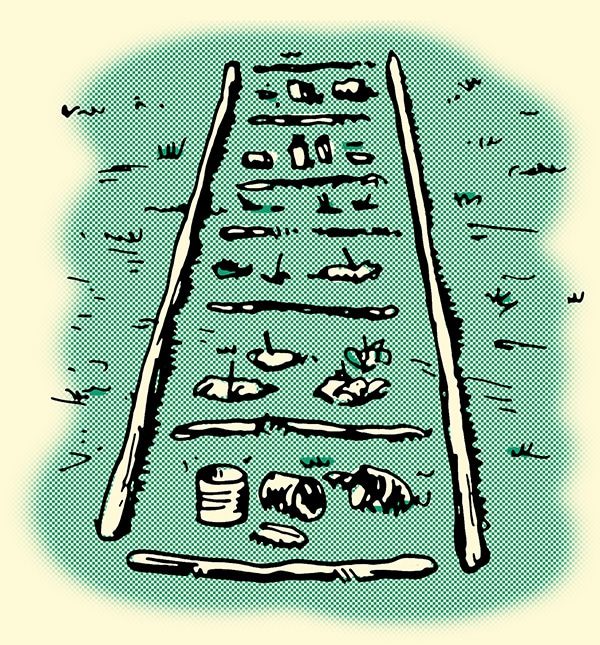
aging stand for learning human tracking techniques illustration
Aging stands are described by expert combat tracker John Hurth as “science experiments” for trackers. You make a one-row grid on the ground out of branches and place different objects into its squares. Ideally, each square will be exposed partly to direct sunlight and partly to areas shaded and protected by trees. In week one, you put items that you want to test in the first square: footprints, paper, broken twigs, water bottles, and yes, even poop. You want to make sure you have duplicate samples in the shaded and unshaded part of the square.
Each day, visit your aging stand and take notes on how things have changed. How have the exposed branches changed color? Has the paper started fading? What’s happened to the poop? Have the impressions of the footprints changed over time?
The next week, move to the next square in the grid and put fresh samples of the same items in it. Compare them to the samples in the first week’s square. Take notes on differences. The next week put new samples in the third square. Compare them to the first and second week’s squares. Over time, you’ll get a rough idea of the aging progression undergone by both natural and manufactured items.
You’ll want to conduct aging stand experiments at different times of the year — spring, summer, fall, and winter — to learn how seasonal variations in humidity, temperature, and precipitation affect the aging process. It’s a laborious exercise, but it’s essential for creating the mental models you need to successfully track someone.

Human Psychology & Behavior

A tracker needs to not only know what’s going on in the environment in which he’s following a target, but what’s going on in the target’s head as well. He needs to develop mental models that deal with human behavior, and this means having a robust knowledge of human psychology and sociology. Knowing the mindset and cultural background of your target can help you know how he’ll act and lead you to where he is. The famous scout Frederick Russell Burnham had this to say about developing these kinds of mental models:
“It is imperative that a scout should know the history, tradition, religion, social customs, and superstitions of whatever country or people he is called on to work in or among. This is almost as necessary as to know the physical character of the country, its climate and products. Certain people will do certain things almost without fail. Certain other things, perfectly feasible, they will not do. There is no danger of knowing too much of the mental habits of an enemy. One should neither underestimate the enemy nor credit him with superhuman powers. Fear and courage are latent in every human being, though roused into activity by very diverse means.”
Besides general cultural and psychological mental models, you need to develop mental models for your particular target. Does he like to eat certain foods? Does he have any medical conditions? Does he smoke or bite his nails? Is he familiar with the outdoors or is he a city dweller? Does he have any particular fears or insecurities? Does he know anyone in the area?
Knowing this sort of information about your target will inform the way you conduct your search and interpret the evidence you find in the field. For example, if you know your target smokes, you’ll be on the lookout for cigarette butts. If he has diabetes, and you come across a puddle of urine that smells fruity, you’ll know you’re on the right track.

Scan and Search: Taking in Your Environment

Now that you’re working on increasing your situational awareness by becoming more observant and developing appropriate mental models (this is in fact an exercise that should never end), it’s time to start actually tracking.
When you’re out tracking, you’ll be engaging in two visual modes: scan and search.

Scan

When you scan the landscape, the goal is to get a general, big-picture overview of your surroundings. Keep an open focus. Don’t have any particular thing you’re looking for, as that will cause “target blindness” and result in your missing other pieces of evidence. Visually sweep the area for possible anomalies in your environment like tracks, litter, blood stains, etc.
Rather than scanning an area haphazardly, tracking experts David Diaz and V. L. McCann recommend dividing it horizontally into thirds:
“Imagine the territory in front of you is a two-dimensional canvas of a painted nature scene. The top boundary is the horizon; the bottom boundary is the ground in front of you. Now divide that canvas into three equal parts: the foreground, the mid-distance, and the far ground…
In order to ‘see’ everything in such a vast area, it must be scanned systematically. With a horizontal movement of your eyes, sweep the foreground from left to right, right to left, and left to right, moving your line of vision up just enough to slightly overlap the area above the last sweep.”
In this way, you methodically work your way up to the far ground and ensure that you don’t miss anything — distant or near — lying before you.

Search

Diaz and McCann describe searching as “in-depth analysis of an area or object.” You can begin searching at any point in the scanning process once you’ve noticed an anomaly. Searching involves looking at the anomaly more closely and recording it in your mind or notebook for later analysis.
Just because you’ve searched one anomaly, doesn’t mean you should stop your scan of the area. Keep scanning and looking for more anomalies that you can more closely examine. As you continue your scan and search, take extra caution to avoid contaminating signs that you’ve uncovered. Leave litter where you found it, and don’t walk on footprints. You want to leave things in their original locations so you can put the pieces together and construct a story based on the evidence found.

Using Light for Scanning and Searching
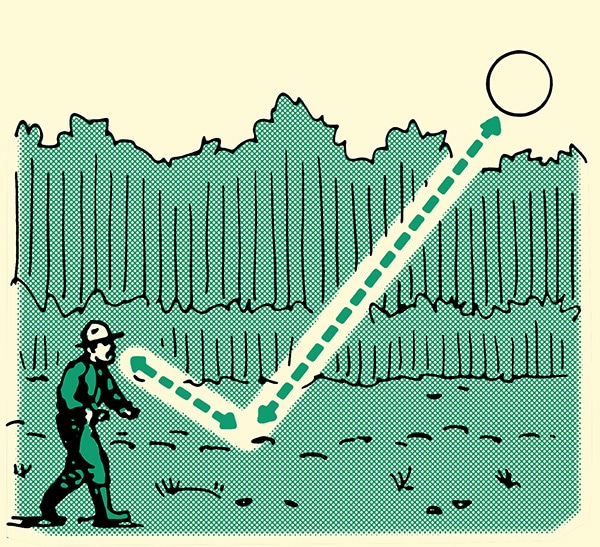
man tracking humans using angle of sunlight to help illustration
As you scan and search, use the light available to you to better locate possible anomalies. For example, in the morning and evening, the sun casts long shadows over impressions in the ground, bringing them into sharper relief. To better see these shadows, position yourself so that the tracks you’re following are between you and the light source. This will require you to change your position in relation to the tracks. Be mindful of not contaminating them with your own prints as you do so.
Tracking at night is possible with the assistance of a light source like a flashlight. You’ll want to use a colored light like green or red to avoid disrupting your night vision. (Side note: red used to be the preferred nighttime light color, but many operators are switching to green because it allows them to see objects more clearly without reducing night vision that much.)
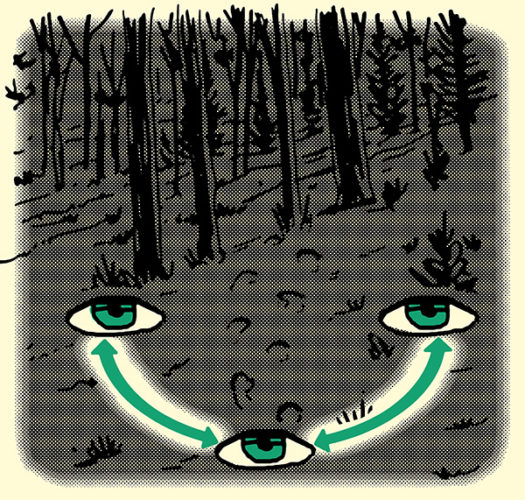
using night vision to track someone in the dark
When you’re searching at night, if you look directly at the object you’ve identified, you’ll likely stop seeing it. Looking directly at objects requires you to use the cone area of the retina, and that’s not very active during low-light settings. To make up for this deficiency, you’ll want to use what Diaz and McCann call “off-center vision.” Instead of looking directly at the object you’ve identified, you’ll want to look left, right, above, and below it, pausing at times to verify the properties of the object.

Know What To Look For

As you scan and search your environment, you want to be on the lookout for a few indicators that will help you track your target. Hurth suggests being on the lookout for the following visual indicators (I haven’t included all of them — check out John’s book for the complete, exhaustive list):
Ground Indicators (on the ground)
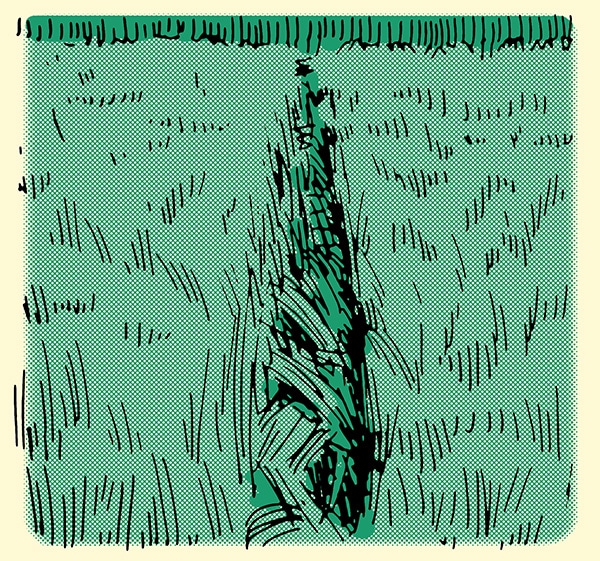
how to track a person grass disturbed in straight line illustration
  • Footprints
  • Vehicle tracks
  • Trampled grass
  • Boot and shoe scuffs
  • Turned over dead leaves
  • Disturbed grass or soil
  • Mud, soil, sand, and water transferred from footwear onto another medium
Track Traps: The Honey Pot of Ground Indicators
Hurth suggests being on the lookout for “track traps.” These are areas on the ground that do an excellent job of capturing your target’s tracks. He calls them “honey pots” because they leave so much information behind. Mud, sand, soft dirt, and snow are great examples of track traps. Bodies of water or oil spills can be track traps too. A target who steps in water or oil will likely leave footprints on the ground after stepping in the fluid.
Aerial Indicators (above your ankle)
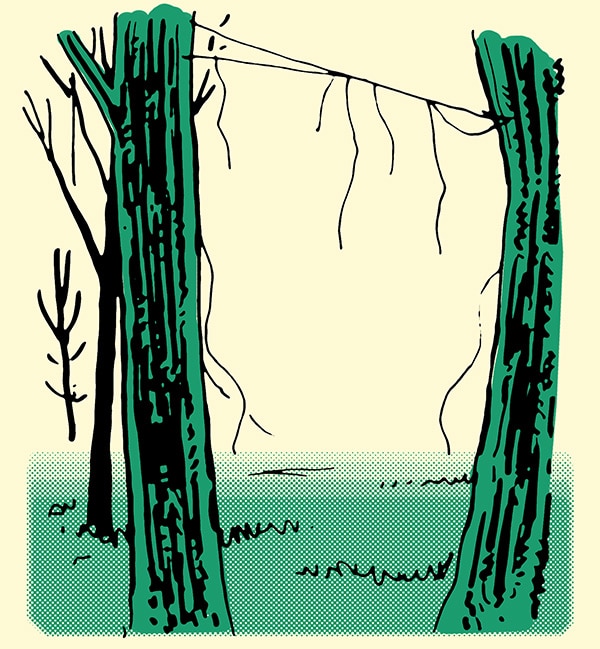
broken spider web between two trees how to track a person illustration
  • Broken cobwebs
  • Detached or missing leaves
  • Broken branches that point in the direction of the target
  • Scratches or scuffs on trees
  • Cut or broken vegetation
  • Tall grass or vegetation pushed down into an unnatural position
  • Clothing fabric in branches
  • Hair in branches
Litter Indicators (objects discarded intentionally or unintentionally)
  • Cigarette butts
  • Candy and food wrappers
  • Spent ammo casings
  • Used medical supplies
  • Gum/tobacco
  • Clothing
Blood Indicators
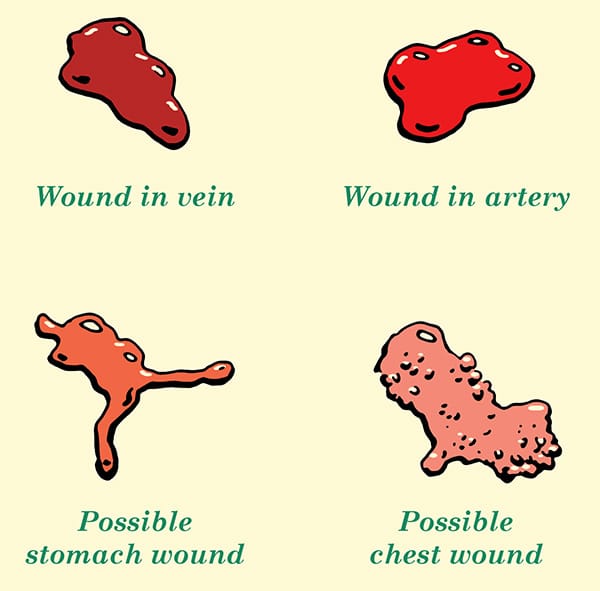
blood indicators what type of wound identification illustration
Your target might be injured and consequently leaving blood stains. The color of the blood stain can tell you a lot about the injury he or she has and how long it’s been since they left the blood stain there.
  • Dark red drops of blood. Indicates a venous wound. Non-life-threatening.
  • Bright red streaks of blood. Indicates a possible arterial wound. Life-threatening.
  • Pink, frothy blood. Indicates a possible wound to the lungs.
  • Light red, foul-smelling blood. Indicates a possible wound to the stomach.
Blood changes color over time as it’s exposed to the elements. Initially, blood spots will be brighter but will eventually fade to a brown or rust color.
Bodily Discharge Indicators
Vomit, poop, pee, snot — these bodily discharges may not be pleasant to contemplate, but they can not only help lead you in the direction of your target, but also paint a picture of his current condition.
Vomit and poop can tell you what sort of food your target’s been eating. If there’s a lot of liquid, clear vomit or you see diarrhea, there’s a chance he could be dehydrated.
If you find a urine spot that has a very fragrant ammonia smell, the target is likely dehydrated. If it has a fruity smell, there’s a chance he’s diabetic.
how to track a person man's urine on the ground illustration
Man peeing
how to track a person woman's urine on the ground illustration
Woman peeing
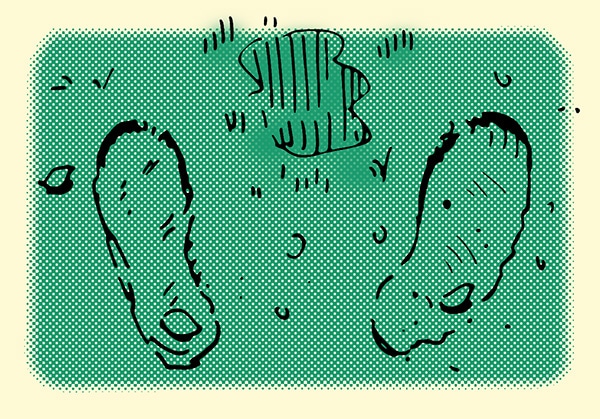
The relation of a urine stain’s position to a set of footprints can tell you if it came from a man or a woman. If the urine stain is in front of the footprints, probably a dude. If the stain is in the middle of the footprints or near the heels, likely a lady who popped a squat to do her business.
Audio and Olfactory Indicators
As a tracker, you can’t just rely on your sight to track down your target. Sounds — heavy breathing, talking, crying, movement in brush, coughing, etc. — can provide insights as to where your target is.
Smells can also provide useful clues. The smell of smoke can lead you to a campfire where the target is currently or has been recently. If the target’s been without a shower for a couple of days, he might also be giving off some pungent body odor.
Bottom line: as you scan and search with your eyes, don’t take your nose and ears offline. They can provide useful information you’d be missing using sight alone.

Identifying and Interpreting Footprints

While you should be scanning and searching for signs and indicators like blood, trampled grass, and broken cobwebs, footprints will be one of your primary ways of following and tracking your target.
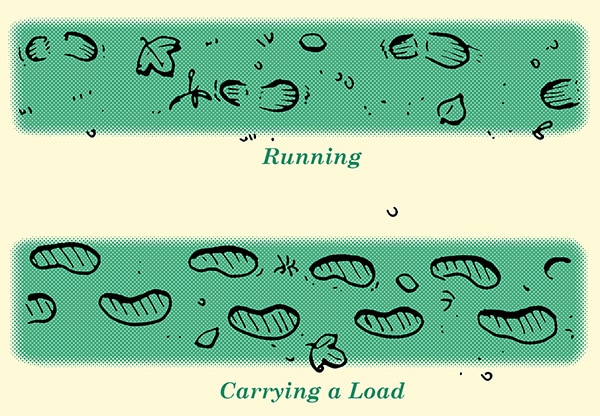
A professional tracker is so adept at tracking footprints that he can identify individuals simply with a glance at the impressions in the ground. They can also immediately tell if the person is running, carrying a load, carrying another person, or even walking backwards.
The ability to create this dossier on a target simply by looking at their footprints requires some careful observation. Here’s what to look for when identifying and interpreting footprints.

Collect Information on a Footprint Data Card

A footprint data card is your police sketch of your target’s footprint. (John has a template in his book.) You’ll draw the pattern of the sole of his footwear on the card, determine if it’s a boot, shoe, or sandal, and make measurements that include the length of the print overall, the width of its heel (and its length if it’s a boot), and the width of the ball of the foot. You’ll also note if the impression reveals any manufacturer or sizing labels and if the toe is rounded, square, or pointed. You’ll want to record the time and location you located the print and the direction of travel as well.
Hurth recommends putting a nickname on top of the footprint data card based on its salient characteristics. So if you see a “Vibram” logo in a print, you can call that print “Vibram.”
If the target is barefoot, you’ll want to note whether he has a high arch, regular arch, or is flat-footed. You’ll want to measure the width of the ball of the foot and the heel. Make notes about their toes too — missing digits? Hammer toe?

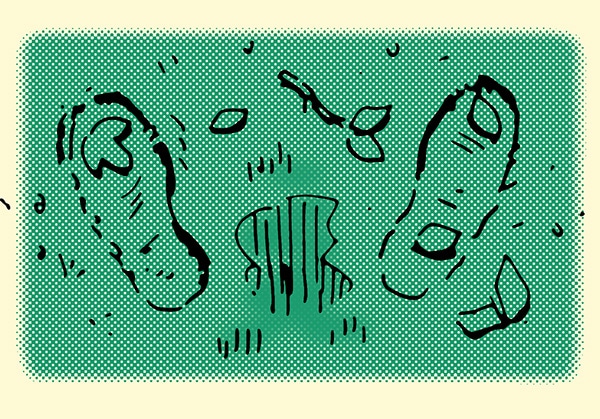
Interpreting Footprints
determining meaning in footprints when tracking humans illustration
If you look closely enough at footprints, they can tell you a lot about what your target was doing when he left them.
For example, the spacing and depth of the impressions can tell you about the target’s gait — whether he was running or walking. Impressions that are far apart from each other and deeper in the toe or the heel indicate that the target was running; impressions that are shallower and closer together indicate walking.
If the gait is shorter and the impressions are deeper, the target was likely carrying a load like a backpack. If you see a short gait and deep impressions, along with intermittent additions of another set of prints next to the target’s, you can deduce that he was carrying a person (and occasionally putting them down for breaks).
A set of impressions that have a circular indention to the side indicates that the target is using a walking cane or stick.
If one foot leaves a deeper impression than the other, it likely means the target is favoring that leg and that the other leg is injured.
So as you look at footprints, don’t just stop with the observation phase. Try to put together a story of what your target was doing, as this can help you develop a theory as to what he’s likely to do next.

Determining the Number of People in a Group by Footprints
determining number of people in a group with footprints illustration
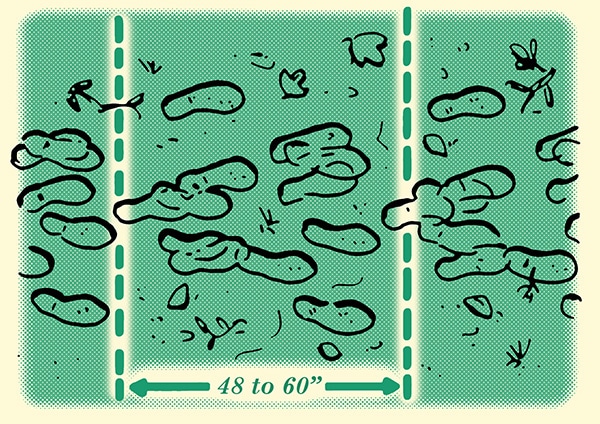
Sometimes counting the number of people in a target group is easy because there are distinct sets of footprints that you can count. But often the footprints overlap and mix together. How do you get a count then?
One way is to use the Box Method to get an estimate. Draw a line behind one print and then measure 48-60 inches forward and draw another line. Count all full and partial prints between those two lines (round up if you end on an odd number). Divide the total print count by two, and you’ll have a rough estimate of the number of people in your target group.

Practice Reading Footprints

Reading and interpreting footprints is a skill that can be acquired through practice. A great way to do that is to create an artificial track trap out of sand and then have your friends walk through it in different ways while you’re not looking. They can run, limp on one leg, carry each other, walk and then kneel, drag a body, pretend to fight each other, etc.
After they’ve left their tracks, go to the track trap and interpret what they did by looking at the tracks. After you’ve recreated the scenario your friends acted out, use a rake to clear the track trap’s slate and have your buds walk through it again.
I did this exercise with Hurth at the ITS Tactical Muster and had a blast. It’s pretty cool to be able to determine whether a fight went on or if someone was carrying a rifle simply by looking at footprints.

Putting It All Together: Creating a Story of Your Target

Tracking requires you to be hyper observant of your environment while simultaneously orienting your observations to the mental models in your head. This back and forth observing and orienting allows you to create a story of what’s going on with your target even though you weren’t there to observe them firsthand. By creating this story about your target as you collect evidence, you’ll be in a better position to figure out where they’re headed so you can find them.
_____
Sources
Combat Tracking Guide by John Hurth (If you get the chance, take a course from John. He’s extremely knowledgeable and a great teacher.)
Tracking Humans by David Diaz and V.L. McCann

Friday, August 23, 2019

White Nationalist...?

This post is hard for me to write,  I consider myself and my friends "Nationalist" which to me means that we have pride in being an American.  But the past few months the democrats have changed from screeching "Racism" to changing it to "White Nationalist".   I find myself wading through a myriad of emotions trying to write this post,

It seems like I and people like me are being blamed for all the sins of the world.   The are equating anyone that disagrees with them as "racist" and of that don't work, the new  double barrel shotgun in their arsenal is "White nationalist" or White Supremacist" and if they don't like you, they give you both barrels.  I will use the example given here, By a panelist on MSNBC

You don’t communicate to them, you beat them. You beat them. They are not a majority of this country — the majority of white people in this country are not a majority of the country. All the people who are not fooled by this need to come together, go to the polls, go to the protests, do whatever you have to do. You do not negotiate with these people, you destroy them.”

It is ok to talk about genocide against white people, it is politically correct and acceptable, but if it had been a white dude that said that stuff, there would have been gnashing of teeth and wailing and screaming by the gatekeepers of knowledge of the endemic racism of white people but since it is a POC saying that stuff, it is perfectly acceptable.  This guy is basically saying that if you disagree with the liberal left, you need to be wiped out and destroyed.  Funny how genocide against an group of people is perfectly acceptable in political discourse and nobody calls him on it because he is of the "protected class" of liberal intersectional politics.

   I do not agree with the Jew in the background manipulating the scene, that is straight up Aryan nations crap,  but the rest of the cartoon is what I see as my perception.

     I believe that the "old fashioned " values that made America great are being attacked all across the board, they are trying to break our spirits, break our belief in our country and in God.   We are the representatives of Western Civilization, where the individual is prized.  In other societies, it is what family or what tribe you belong to, Life is cheap.   I see us regular people being pushed into the "White nationalist" camp and I don't like this.   I am a student of history and I see bad things coming down the pike.  When a group get demonized to such a extent, then "The People" cry out for the government to punish them for the past sins.  The same things happened to the Jews in Europe with the pograms and this culminated with the final solution.  Also this is what Lenin and later Stalin did to the Kulaks and this is what I see for us.
     The buzzword is "White Nationalist", now., they flat out ran the word"Racist" into the ground and buried it. The left had to come up with a new word and they have, I wonder what the next word is.

      Again why is this going one? besides to punish us because we bitter clingers and deplorables voted for Trump, was he the optimum candidate? hell no...but he was a hell of a lot better off then the alternative known as Felonia Von Pantsuit.  The endgame is to break the middle class, a huge chunk of the "Middle class is white.   The people that believe that they are "Our betters" due to education, family connections, and flat out beliefs think that they are fit to rule over us like the nobles of old, and we the middle class or what was known as the "Mercantile Class" are the checks and balance against the will of the nobles or "Our betters".  The "Cloud People" wants 2 classes of people, them and the "Dirt people", and the dirt people are the poor, the ones that get their sustenance from the state and will do what they are told because they know their place in the great scheme.  To break us, they gotta take our guns, and they will use emotions to push through controls after controls that don't tackle the root cause of violence in America but will be used to strip the means of protection that we the middle class use against tyranny of the state and the occasional wolf that tries to grab one of us.  Once we are stripped of our means of defense, then many people will agree to all the restrictions on us by the state "For your protection". mind you.

     Once they have stripped us of our firearms, then it will be easier to strip us of our wealth and once they have stripped us of our wealth, then we can be herded into camps to to be reeducated and atone for the past sins of our race by working us to death.   Think Pol Pot and the Khymer Rouge but on a bigger scale. Stalin emptied entire villages in the Ukraine and either had them killed off or sent to the camps where most died.  But it is just the excuse, the real goal is to seize all of our wealth and break our political power so the people in charge can rule by imperial fiat.
     This is what I see coming and I am not sure how to stop it.

Thursday, August 22, 2019

The Standoff at Ruby Ridge

I remembered this going on after I returned from Desert Storm.  Before this I was very supportive of the "Alphabet agencies" but the incidents at Ruby ridge dismayed me, then Waco really pissed me and a bunch of other people off.  Ruby Ridge in my opinion was basically a "dick" measuring contest and it got worse after Bill Clinton became President.  Bill and Janet Reno wanted to use WACO to make examples of people that they didn't like for ideological reasons.  This all started in Ruby Ridge and the lawlessness and cancer spread due to the political appointments by Bill Clinton and yes I blamed Hillary back then, the phrase was "Co president".  Hillary was very active and I believe that she told Reno what to do, Bill was too laid back to get stupid like that and I am sure that the administration wanted to make an examples of the Branch Dividians.  Gotta put those people in their place you know...

I met Randy Weaver at a gun show at the farmers market in the late 1990's.  I only talked for him for a minute but I did buy a sticker.  I should have bought more but back then I didn't. 
     
   The article was supposed to post earlier than it did, but I got the time wrong in the scheduler thingie.


 I got this article from ammo.com

The Siege at Ruby Ridge is often considered a pivotal date in American history. The shootout between Randy Weaver and his family and federal agents on August 21, 1992, is one that kicked off the Constitutional Militia Movement and left America with a deep distrust of its leadership – in particular then-President George H.W. Bush and eventual President Bill Clinton and Attorney General Janet Reno.
The short version is this: Randy Weaver and his wife Vicki moved with their four kids to the Idaho Panhandle, near the Canadian border, to escape what they thought was an increasingly corrupt world. The Weavers held racial separatist beliefs, but were not involved in any violent activity or rhetoric. They were peaceful Christians who simply wanted to be left alone.
Specifically for his beliefs, Randy Weaver was targeted by the Bureau of Alcohol, Tobacco and Firearms (ATF) in an entrapping “sting” operation designed to gain his cooperation as a snitch. When he refused to become a federal informant, he was charged with illegally selling firearms. Due to a miscommunication about his court date, the Marshal Service was brought in, who laid siege to his house and shot and killed his wife and 14-year-old son.
Randy Weaver was, in many ways, a typical American story. He grew up in an Iowa farming community. He got decent grades in high school and played football. His family attended church regularly. He dropped out of community college and joined the United States Army in 1970. After three years of service, he was honorably discharged.
One month later he married Victoria Jordison. He then enrolled in the University of Northern Iowa, studying criminal justice with an eye toward becoming an FBI Agent. However, he dropped out because the tuition was too expensive. He ended up working in a John Deere plant while his wife worked as a secretary before becoming a homemaker.
Both of the Weavers increasingly became apocalyptic in their view of the world. This, combined with an increasing emphasis on Old Testament-based Christianity, led them to seek a life away from mainstream America, a life of self-reliance. Vicki, in particular, had strong visions of her family surviving the apocalypse through life far away from what they viewed as a corrupt world. To that end, Randy purchased a 20-acre farm in Ruby Ridge, ID, and built a cabin there.
The land was purchased for $5,000 in cash and the trade of the truck they used to move there. Vicki homeschooled the children.

The Weavers Move to Ruby Ridge

After moving to Ruby Ridge, Weaver became acquainted with members of the Aryan Nations in nearby Hayden Lake. He even attended some rallies. The FBI believed his involvement in the church was much deeper than it actually was – they thought he was a regular congregant of the Aryan Nations and had attended the Aryan Nations World Congress.
Both Randy and Vicki were interviewed by the FBI in 1985, with Randy denying membership in the group, citing profound theological differences. Indeed, the Weavers (who had some points of agreement with the Aryan Nations, primarily about the importance of the Old Testament) mostly saw their affiliation with the Aryan Nations as a social outlet. Living off-grid, the nearby members of the Aryan Nations were neighbors in remote northern Idaho.
Later, in 1986, Randy was approached at a rally by undercover ATF informant Kenneth Faderley, who used a biker alter ego of Gus Magisono and was currently monitoring and investigating Weaver’s friend Frank Kumnick. Faderley introduced himself as an illegal firearms dealer from New Jersey. Randy later encountered Faderley at the World Congress of 1987. He skipped the next year’s Congress to run for county sheriff, an election that he lost.
The ATF claims that in 1989, Faderley purchased two illegally shortened shotguns from Randy Weaver. However, Weaver disputes this, saying that the shotguns he sold Faderley were entirely legal and were shortened after the fact. The notes from the case show that Faderley purchased the guns and showed Weaver where to shorten them, which would constitute illegal entrapment. What’s more, the government preyed on the destitute nature of the Weavers, who lived in a small cabin in the woods with no electricity or running water.
The real purpose of the investigation was not to grab Weaver, but to use him to infiltrate a group in Montana being organized by Charles Howarth. In November 1989, Weaver refused to introduce Faderley to Howarth, and Faderley was ordered by his handlers to have no further contact with Weaver.

Randy Weaver Refuses to Turn Snitch

In June 1990, Faderley’s cover was blown. It was then that the ATF reached out to Weaver, stating that they had evidence he was dealing illegal firearms. They told him they would drop all charges if he would agree to become their new informant regarding the investigation of the Aryan Nations groups in the area. Weaver refused.
To coerce him into changing his mind, the Feds staged a stunt where a broken down couple were at the side of the road. Weaver stopped to help them and was handcuffed, thrown face down in the snow and arrested. He had to post his home as bond. Still he refused to become a federal informant.
The irony of the federal government’s desire to obtain informants within the Aryan Nations is that different branches of federal law enforcement and intelligence gathering occupied five of the six key positions in the organization. This means that the Aryan Nations were effectively a government-run shop, with agents spying on each other to ensure the integrity of an investigation – into an organization almost entirely run by the federal government.
The government had an obsession with the Aryan Nations due to Robert Jay Matthews, who was a member of The Order, a terrorist organization including members of the Aryan Nations. The FBI’s Hostage Rescue Team burned Matthews alive inside his own home.
Due to his ongoing refusal to snitch, Weaver was then arrested in January 1991, on illegal firearms sales charges. These charges stemmed from Weaver’s earlier “sale” of two shortened shotguns to Faderley, the undercover ATF agent – a sale which the feds later admitted constituted illegal entrapment.
Weaver’s court date was set for February 19, 1991, then changed to the next day. Weaver, however, received notice that his court date was not until March 20. He missed his February court appearance and a bench warrant was issued for his arrest. The United States Marshals Service wanted to allow Weaver the chance to appear for what he thought was his court date, however, the United States Attorney’s Office sought a grand jury indictment on March 14th – six days before his notice said he was due in court.
Already skeptical of the Feds after their repeated strongarm tactics, both Randy and Vicki saw this as further evidence that Weaver would not receive a fair trial. They increasingly isolated themselves on their Ruby Ridge farm, vowing to fight rather than surrender peacefully.
During the standoff, a voluntary surrender date was negotiated with the Marshals Service for October 1991, but the United States Attorney’s Office refused the settlement. The Deputy Director of the Special Operations Group of the Marshals Service, using evidence obtained through surveillance, believed that the best course of action was to drop the indictment, issue a new one under seal, and use undercover agents to arrest Weaver, who presumably would have dropped his guard. This recommendation was again rejected.

Shooting the Weavers’ Dog: The Siege of Ruby Ridge Begins

On August 21, 1992, six heavily armed, camouflaged U.S. Marshals went to the Weaver property with the purpose of reconnaissance. The Weavers’ dogs gave away the position of the Marshals, alerting their 14-year-old son Sammy and a 24-year-old friend of the family named Kevin Harris, who investigated what the dogs were barking at while armed.
Unsurprisingly, there are several accounts of how the shooting began.
The Weavers claim that the camouflaged Marshals fired first and refused to identify themselves. The Marshals claim that when they rose to identify themselves, they were fired on by Sammy Weaver and Kevin Harris. In yet another version of events, Marshals shot the Weavers’ dog Striker as he exposed their position and were fired upon by Sammy in retaliation.
Once the shooting began, Randy Weaver’s son, Sammy, was shot in the back by Marshals immediately after yelling, “I’m coming, dad!” as he ran back to the house. That is to say, he was fleeing the scene, not regrouping for another attack.
After this initial exchange, the FBI’s Hostage Rescue Team – sometimes disparagingly called the “Hostage Roasting Team,” due to their proclivity to burn down buildings – was called in to assess the situation.
Sniper and observer teams were deployed by the Hostage Rescue Team. A sniper aimed for an instant kill shot on Randy, but Randy moved at the last minute and the shot entered his shoulder, exiting through his armpit. He then fled back to the house from the shed where he had been viewing the body of his dead son.
A second shot missed Kevin Harris and hit Vicki in the head, who was holding their 10-month-old daughter at the time in her arms, a powerful image often invoked in the telling of the story. This same second shot hit Harris after exiting Vicki. An internal investigation found that the second shot was out of policy and that the failure to request surrender was “inexcusable.”
FBI Sniper Lon Horiuchi fired through a door without seeing who was on the other side of it – at people who were fleeing and posed no threat. He was later charged with manslaughter in these deaths, but the charges were dropped. Horiuchi was also involved in the Waco siege, and Timothy McVeigh printed up cards for gun shows encouraging people to target him. Indeed, McVeigh considered targeting Horiuchi and his family rather than the federal building. In 1995, he pleaded the Fifth when questioned about the matter by the United States Senate. His whereabouts are currently unknown.
The rules of engagement were changed on the fly to effectively encourage shooting anyone on sight. This included the remaining Weaver children, who were known to carry weapons 81 percent of the time. Once the siege began, none of the Weavers fired a shot.
The standoff lasted ten days, and involved between 350 and 400 agents who cruelly named their camp, “Camp Vicki.” They would routinely call out “Vicki, we have blueberry pancakes,” but claimed to not know that she was dead. Supporters of the Weavers and opponents of the ATF and FBI formed a vigil.
Weaver’s commanding officer from Vietnam, James “Bo” Gritz (who was currently running for President on the Populist Party ticket) acted as a mediator between the family and government agents. Radio broadcaster Paul Harvey intervened, offering to pay for a robust defense for Weaver if he surrendered. This was what led Weaver to abandon the standoff and surrender himself to federal authorities.

The Aftermath of the Federal Siege at Ruby Ridge

Weaver was charged with ten counts, including the original charges, of illegal firearms sales. His attorney, Gerry Spence, successfully defended Weaver against a host of charges, including murder, by using a self-defense argument. Weaver was ultimately only convicted of the charge of failure to appear, for which he was sentenced to 18 months in prison and a fine of $10,000. He was credited with time served plus three months. Kevin Harris was acquitted of all charges. These were the longest deliberations in Idaho criminal history.
Weaver sued the federal government, which avoided a civil trial by awarding damages of $1,000,000 each to the three surviving Weaver children and $100,000 to Randy. Harris eventually received a settlement of $380,000 after several years of appeals against a government who claimed they would never issue any payment to someone who had killed a federal marshal.
It is worth noting that the federal government took active steps to cover their tracks after the Siege of Ruby Ridge. The chief of the bureau's Violent Crimes and Major Offenders Section pled guilty to attempting to destroy all copies of the FBI’s internal report on the siege. Federal Judge Edward Lodge penned a lengthy list of misdeeds, including fabrication of evidence and refusing to comply with court orders.
Deval Patrick, then-Assistant Attorney General for Civil Rights and later Governor of Massachusetts, later found that federal agents had not used excessive force.
One of the biggest changes after the Siege of Ruby Ridge was a change in the rules of engagement. In October 1995, the Senate Subcommittee on Terrorism, Technology and Government Information ordered all federal agencies to standardize their rules of engagement, particularly as pertained to deadly force. Randy and his daughter Sara wrote a book about the events in 1998 entitled The Federal Siege at Ruby Ridge. The family now live in Kalispell, Montana. Sara became a Born Again Christian in 2012, and forgave the federal agents.
There was, predictably, very little meaningful blowback on the United States Marshals Service or any other parts of the federal government. The Ruby Ridge Task Force delivered a highly redacted 542-page report. And the six marshals involved in the initial shootout were given the highest commendations awarded by the United States Marshal Service.
In 1997, the Justice Department declined to prosecute senior FBI officials for covering up the details of the case. Two FBI agents were prosecuted, one served 18 months in prison for destruction of evidence and the other had the charges dismissed. The second-in-command of the FBI was demoted and three other agents were suspended.
In 1996, Weaver offered his services to defuse tensions between the FBI and the Montana Freeman, however, this offer was declined. In 2000, Weaver visited the former site of the Branch Davidian Church that had been destroyed in another high-profile siege. He later offered support to Edward and Elaine Brown, who were resisting federal taxes at the time.

How It Could Have Gone: John Joe Gray

While it might be easy to take the cynical route and say that Ruby Ridge changed nothing (particularly in the wake of the Waco Siege, which took place a mere year after the Siege of Ruby Ridge), we have at least one example of the federal government admitting that it tread lightly to avoid another Ruby Ridge-like situation.
John Joe Gray is a sovereign citizen living on a 50-acre wooded ranch in Trinidad, Texas. During a traffic stop, he became involved in an altercation with Texas Trooper Jim Cleland. Cleland reached for a .357 in Gray’s car. His car was filled with anti-government literature, including pamphlets referencing bombing a bridge. After the altercation with the Trooper, he was charged with two felonies: taking a police officer’s weapon and assault on a public servant.
Gray promised to have no weapons while he was awaiting trial and posted bond. After the fact, a judge declared that his bond was insufficient. He then ordered Gray arrested. Henderson County Sheriff Ray Nutt stated that "This kook is not worth it. Ten of him is not worth going up there and getting one of my young deputies killed."
So how long did local, state and federal authorities allow Gray to hole up on his ranch without any kind of armed confrontation? Just a few days shy of 15 years, in what was the longest law enforcement standoff in American history.
The charges were eventually dropped, under the premise that Gray had essentially served a 15-year house arrest term and that a militant confrontation in the style of Ruby Ridge didn’t benefit anyone.
While Randy Weaver’s stand might have made the Feds think twice about coming in guns blazing the next time they can’t strongarm someone – with an eccentric lifestyle and unusual beliefs – into turning informant, this is likely cold comfort for Weaver who lost his 14-year-old son and wife.
This is why those in the freedom, patriot, Constitutional, survival and Second Amendment movements remember this day. It is a chilling reminder of the predatory and aggressive nature of federal law enforcement.