Those that have been reading my blog for a while know that I was stationed in Germany for 5 years in the mid 1980's through 1991, and I was stationed in the Stuttgart Area and I was quite a connoisseur of German Bier. but my favorite was "Stuttgarter Hoffbrau", I wish they sold it here, but it is a moot point since I don't drink anymore.
But it is on my bucket list to go to Germany and I will drink one bottle to honor all of my friends that I knew in the Military that "have crossed over" while in Service and afterwards. I ran across this story and got a chuckle out of it, my brother who goes to Astan has been on that German base in question.
Germany is following suit with the U.S. and NATO wind-down of
large-scale military activity in Afghanistan, with just 1,100 troops
left in the nation. This exodus has presented Germany with an odd problem of what to do with their enormous stockpile of beer.
Over
the past 20 years, Germany has deployed over 100,000 troops to
Afghanistan, but after the announcement in April that the U.S. will have
pulled out all of its forces by September 11th, 2021, other nations
including Germany have decided to do the same. This has left Germany
with the logistical problem of their stockpiles of beer which have
supplied their troops over the years.
German troops stationed in
Afghanistan were given a daily allowance of beer to be consumed at
certain times, with each soldier being allotted up to two cans of beer
or equivalent beverage per day. The import of alcohol into the country
is completely banned except to Camp Marmal, Germany’s base in
Afghanistan.
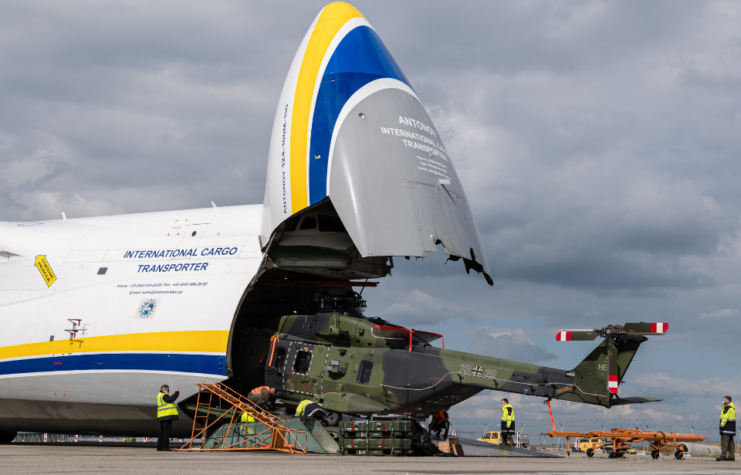
Photo Credit: Jens Schlueter/Getty Images
Since
the U.S. announcement in April, violence in the country has risen, a
situation blamed on the Taliban by NATO, who say they have not honored
their commitments to reduce bloodshed in the country.
The
increased level of danger in Afghanistan meant German troops have been
banned from consuming alcohol. This ban has not helped to reduce the
amount of alcohol in stockpiles, which was already a large amount: over
60,000 cans of beer and hundreds of bottles of champagne and wine.
Germany is unable to sell the alcohol in the country, as its sale,
possession, and consumption are illegal in Afghanistan. In fact, a
citizen who has been discovered consuming alcohol can receive up to 60
lashes of a whip, imprisonment, or a fine. They are also unable to
destroy it for environmental reasons.
On Monday, a spokesperson for the German military said they have
hired a civilian contractor who will take the alcohol back to Germany.
This contractor will then sell the alcohol off, which should cover the
costs of its transportation.
The contractor will have completed their work before the German military has completely withdrawn from Afghanistan
I ran across this from American Rifleman and thought it was worth a "read"
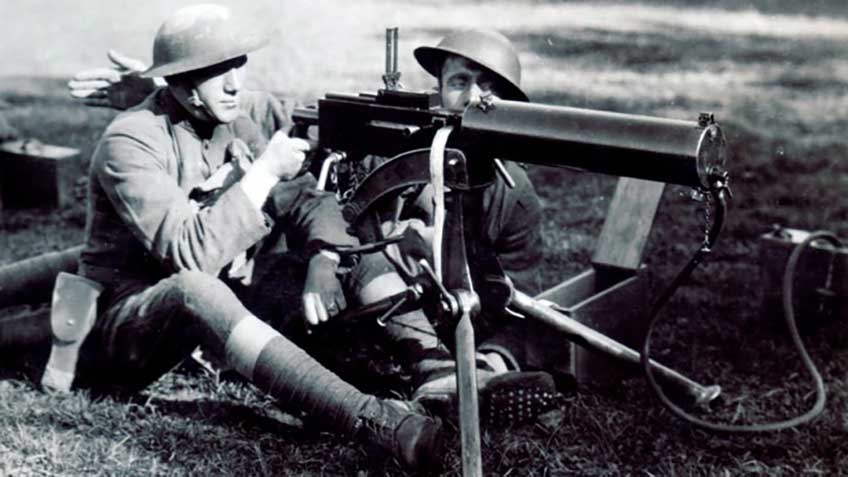
Browning began developing his .50-cal. machine gun when he was 63 years old. Shown above is an early water-cooled version. His air-cooled model armed every American aircraft in World War II and remains in use today worldwide. Image courtesy of Museums at Union Station.
Anything a person might want to learn about handling a John Moses Browning firearm can be found online. You can learn how to load, fix and shoot one, and you can study how it was used throughout history. From single-shot rifles for hunting elk back in 19th-century Utah to the M2 .50-cal. machine gun used to assault Taliban strongholds in 21st-century Afghanistan, Browning-designed firearms have been there and done that. What you couldn’t learn, until now, though, was how those firearms came to be invented—at least not in the words of the men who actually did the “inventing.”
While John Moses Browning came up with the ideas, the task of translating them into steel prototypes for manufacturers such as Winchester, Colt, and Fabrique Nationale in Belgium was a brotherly endeavor. In previously unknown early 20th century documents, Browning, his brother Matthew and half-brother Jonathan “Ed” describe that creative process in their own words. They allow a first-hand look into how Browning used his extraordinary ability to think in three dimensions to create mechanical systems ranging from tiny pocket pistols for self-defense to five-foot long aerial machine guns.
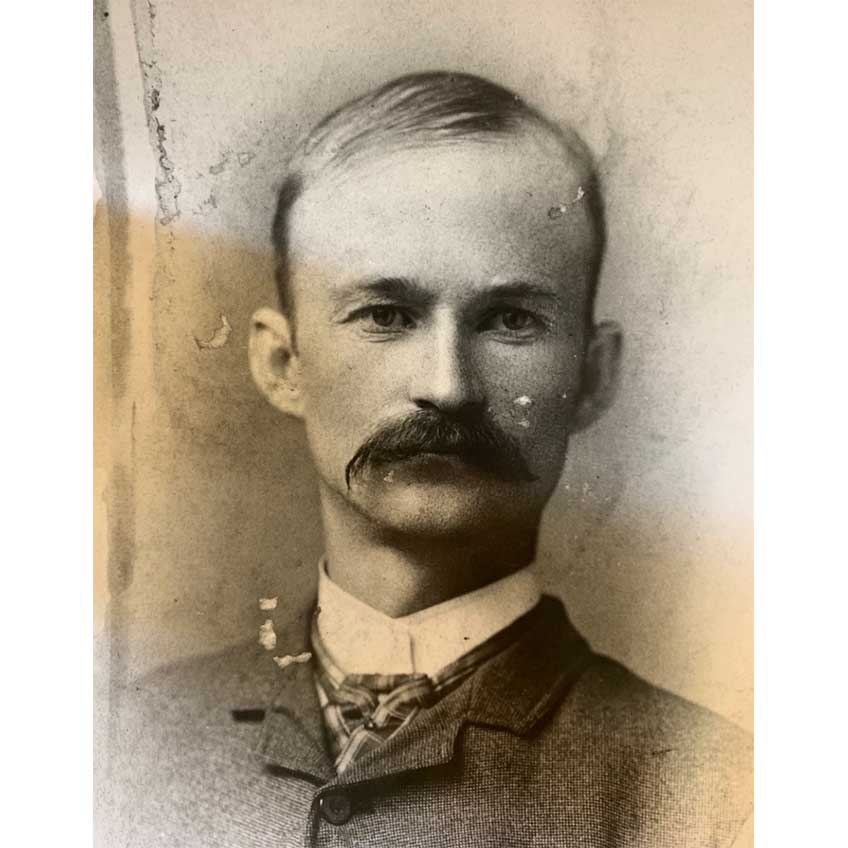
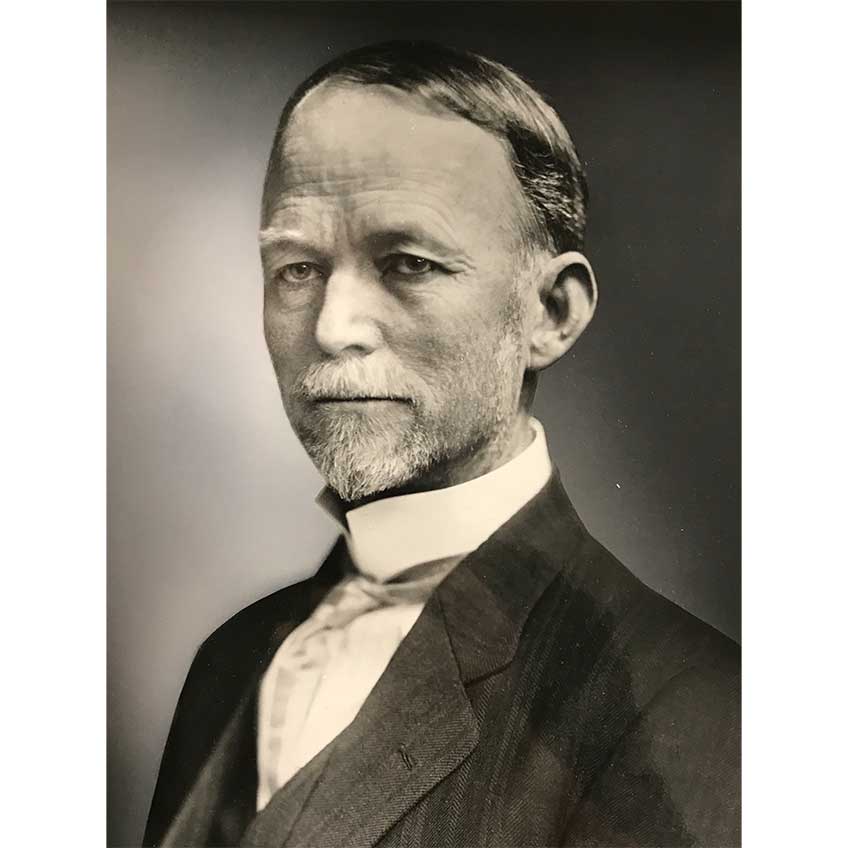
John Moses Browning circa 1890, as he neared the height of his creative powers. Courtesy of Weber State University, Stewart Library, Special Collections.
Browning’s impact on American firearm culture and world history can hardly be overstated. His light, accurate and famous Winchester “.30-30” hunting rifle and pump-action shotguns dominated the American market, while in Europe more than 1.25 million Browning pistols were sold between 1899 and 1914. In fact, a Serbian assassin used his Model 1910 to murder Archduke Franz Ferdinand and ignite World War I. Decades later, the RAF fighters that won the Battle of Britain were armed with Browning guns chosen for their remarkable reliability. Indeed, during World War II, every battle Americans fought on land or in the air was fought with Browning's inventions: the 1911 pistol, the Browning Automatic Rifle, his tripod-mounted .30-cal. machine gun and the powerful, long-range M2. Some troops were even armed with a Browning shotgun design dating to 1893.
So how did he do it? To Browning, objects were ideas. He had the unique ability to visualize and manipulate objects in his head, enabling him to go from mind to metal. Remarkably, he never used blueprints. The modern world calls it “spatial thinking,” and we utilize a rudimentary version of that skill when packing a suitcase, as we fold shirts, pants, socks and jackets into shapes that fit the container. Advanced spatial thinking includes “mental rotation,” the ability to imagine three-dimensional objects and rotate them left and right or up or down. And then there is, “spatial realization,” involving “multi-step manipulations” of the objects in your mind.
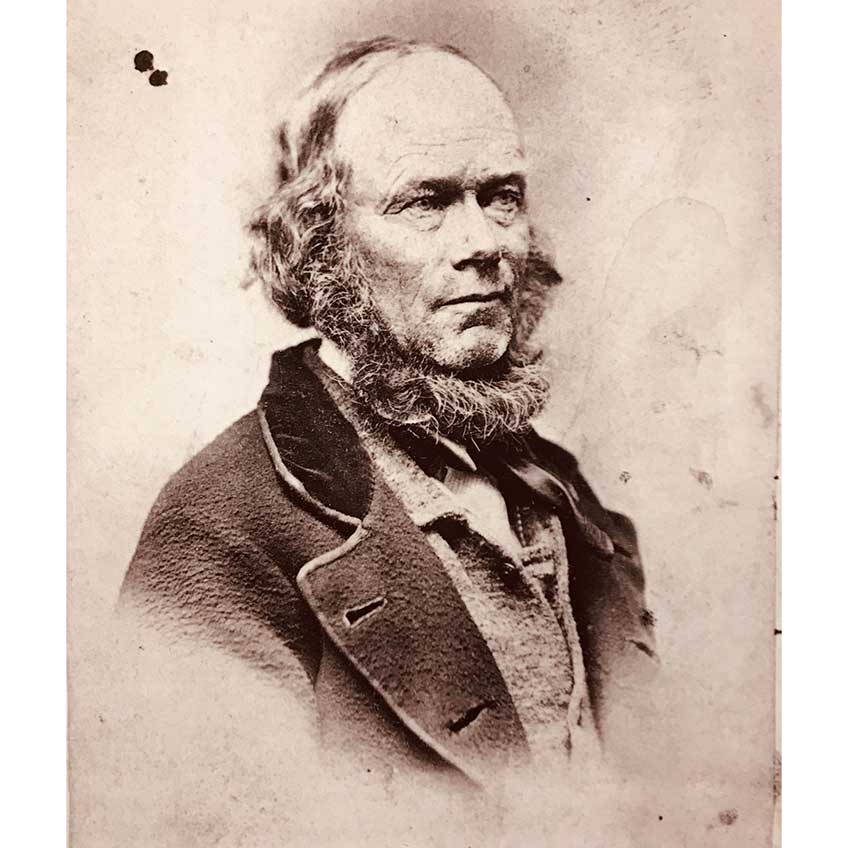
Jonathan Browning, an early convert to the Church of Jesus Christ of Latter-Day Saints, was a gunsmith, businessman and father of the famous inventor. Image courtesy of Museums at Union Station.
For John Browning, that native skill was amplified by years spent working in the frontier town of Ogden, Utah, under the tutelage of his father, gunsmith Jonathan Browning. In 1865, at age 10, the young inventor built a primitive shotgun out of abandoned gun parts, only to be scolded by his father—not for stealing scarce powder to shoot three wildfowl but for making such a crude weapon.
Thinking through a new firearm mechanism could be a slow process. Granddaughter Judy Jones Browning, whose father was Browning’s youngest son, Val, said that her mother, Ann, watched her father-in-law sit lost in thought during evening visits, tapping his fingers on the side of his bald head, watching mechanisms working in his mind, “until he drove my mother crazy.”
Because none of Browning’s American-made firearms carried his name, the public first encountered him in World War I, when the Army adopted his Browning Automatic Rifle and .30-cal. machine gun. The popular press labeled him the “Thomas Edison” of firearms, though unlike Edison, Browning sought no publicity. He never gave a formal interview, and he kept no diary. After his death, there was no documentation of his work for historians to pore over. Browning left no drawings or blueprints because he never used them. Exactly how a Browning idea became a working firearm had never been fully understood.
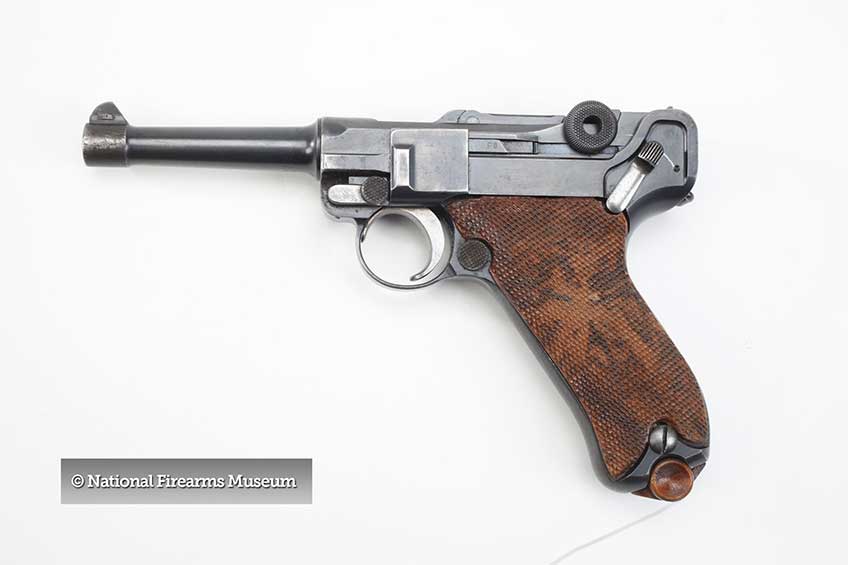
Browning's development process was highlighted during a patent dispute with Georg Luger, inventor of the famous German P.08.
It can be now, thanks to documents from the 1900s when one of Browning’s rare design failures ensnared him a lengthy patent dispute with Georg Luger, who developed the German slant-grip pistol that became the favorite souvenir of World War I doughboys and World War II GIs. The brawl was over a small metal shape that acted like a cam and that Luger used to reduce the size of the gun’s toggle-link action and so turn it into a svelte example of early 20th century engineering. The problem was that Browning had gotten there first and used the same idea in a prototype for an autoloading shotgun—and he had already filed for a patent. Fearing a threat to his pistol sales, Luger declared that Browning stole the idea from him. It was a preposterous claim—as Luger’s attorney all but admitted and as the U.S. Patent office ruled—nevertheless, the result was an eight-year legal brawl that required the Browning brothers to testify, under oath, about how they worked.
Those depositions, combined with newly available letters Browning wrote to his patent attorney, lay out the process. His first step was to design a breech mechanism. “With me, the breech closure is the initial point, everything else is designed to conform to it,” Browning wrote in 1900. What he learned making one firearm was applied to the next, and he went back and forth between projects. While thinking through a new design, he’d make rough sketches in a sort of graphical shorthand. “He can tell what he wants from the sketches, but no one could work from them,” his brother Matt told Luger’s attorney in 1901
Matthew Sandefur Browning, John's younger brother and lifelong business partner, circa 1915. Courtesy of Museums at Union Station.
“My brother does not make working drawings,” Matt said, “After he has made sketches and has got the shape of the parts in his mind, he usually makes a templet or plate of steel, the shape of the receiver. Then he drills holes and cuts grooves and rivets pieces on this plate, then makes the breech parts in a skeleton form, so he can see how the breech parts co-act with one another ... he always being present tells how wide to make the cuts and how thick to make the parts.” Note Matthew’s language: Browning “tells” someone how to cut the steel. Who did he tell? Occasionally Matt, but usually their half-brother Ed. “I have done the biggest part of the work, that is, the manual labor on all of them, and construct the models and guns,” Ed said.
Jonathan “Ed” Browning had the same father as John and Matt but a different mother. Their father, Jonathan, was a Mormon with three wives. His second wife, Elizabeth, gave birth to John and Matthew, and his third wife, Ann, was Ed’s mother. Ed left a job at Ogden’s railroad yard in 1879 to join John and Matt’s gunsmithing and sporting-goods business, where he proved himself a talented machinist. By 1887 he—not John Moses Browning—was mostly responsible for churning out the dozens of Browning’s prototypes.
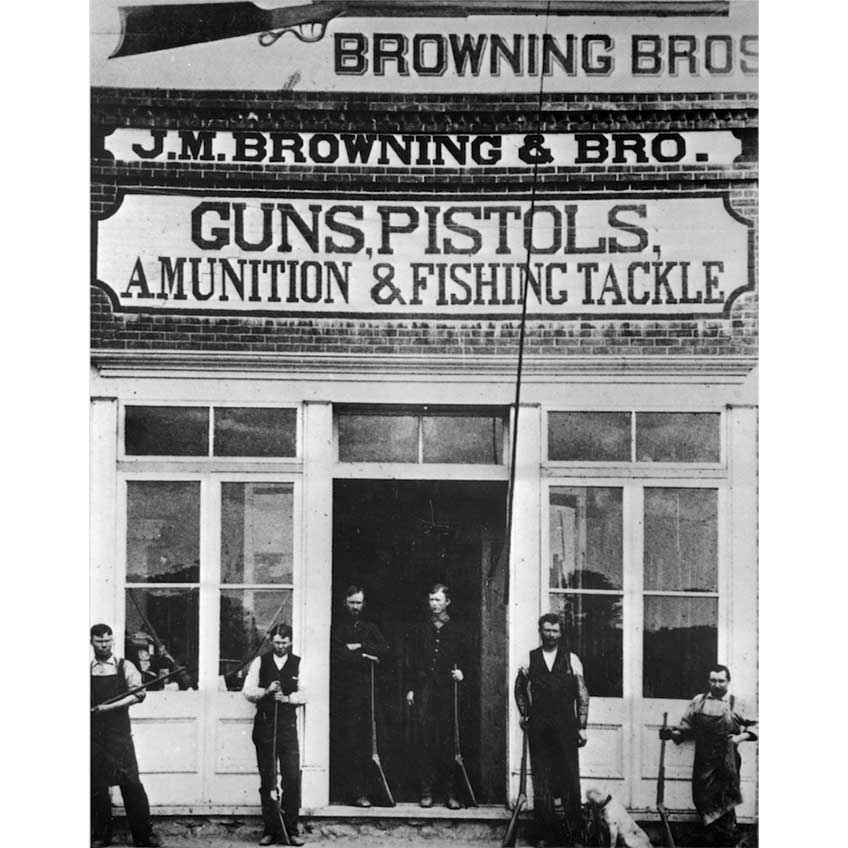
The first Browning storefront, circa 1879. John and Matt stand in the doorway, flanked by their brothers. Frank Rushton is on the far right. All are holding the first Browning rifle, the famous single-shot. It is still in production. Image courtesy of the Utah State Archives.
Indeed, as Browning told Luger’s attorney he only “assisted in making the model” shotgun, before adding, “Of course, I invented it.” John literally stood at Ed’s shoulder as he worked, John thinking and Ed making. While Browning had the ideas, Ed’s role likely gave him the opportunity to act as editor to John’s ideas as they were turned into steel.
Indeed, as Browning told Luger’s attorney he only “assisted in making the model” shotgun, before adding, “Of course, I invented it.” John literally stood at Ed’s shoulder as he worked, John thinking and Ed making. While Browning had the ideas, Ed’s role likely gave him the opportunity to act as editor to John’s ideas as they were turned into steel.
“Every cut that we made we discussed whether that is right or not,” Ed said, “and every part is looked at and talked over a great deal … to make it and make it over again may be as high as three times, probably—possibly more than that—before we leave it … to determine whether they are strong enough, whether they are heavy enough, or too heavy, and possibly a part won’t do and we have to throw it away. And once in a while my brother John M. would get stuck, and would have to take some time to get it straightened out.” Ed said he never worked on a John Browning design when the inventor was on one of his lengthy trips to the Colt and Winchester factories or the FN complex in Belgium, but when they bent over a work bench, their minds synced together. An American army officer who worked with John and Ed at the Colt plant in Connecticut confirmed as much in a letter, writing, “Both had told me how the one got an idea and the other put into metal the thoughts of the other.”
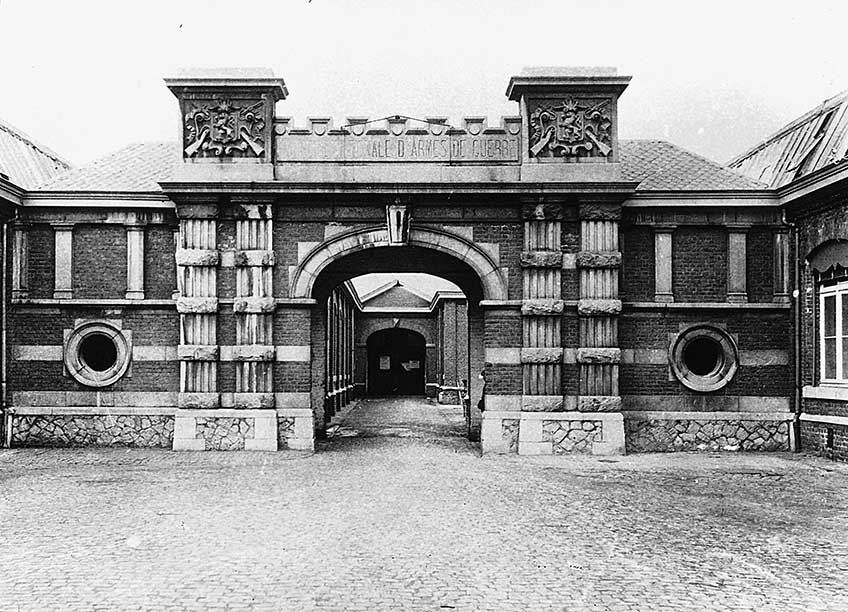
Many of Browning's designs were produced by Fabrique Nationale in Belgium, and Browning traveled to Belgium dozens of times throughout his life.
Browning’s own testimony was largely spent refuting Luger’s claims of theft. He dismissed Luger as a one-gun wonder. “In fact, Mr. Luger has not made many inventions, to my knowledge … the pistol is all that I know of Mr. Luger ever having done in the way of inventions and firearms.” In a later court document Browning said the German may have stolen the toggle-link innovation from him. Of course another possibility is that both men, one in America, one in Germany, hit on the idea independently.
Once completed in the fall of 1898, Browning’s five-round, toggle-link shotgun prototype did not sit idle. Financial success allowed Browning to test each step of a design by firing hundreds or thousands of shells while watching and listening for a hiccup or a pause that signaled a faulty part or dimensional error. Friends and shooting partners took the shotgun trap shooting and hunting and remarked on the toggle-link action. On one day, Browning recruited 32-year-old soda pop bottling manager James H. Emmett to help test. “Browning was shooting it, and I was throwing objects for him to shoot at, and I was shooting it and he throwed up for me while I shot it.” Emmett was fascinated. “One of the most forcible (sic) things about it, I know when I got through shooting it the last shot, these here things,” and he pointed to the toggle links, “would stick up in front of your eyes.”
John Moses Browning filed his patent for a “Recoil Operated Firearm” on May 6, 1899. The gun that would become the Auto-5 was the first successful semi-auto shotgun.
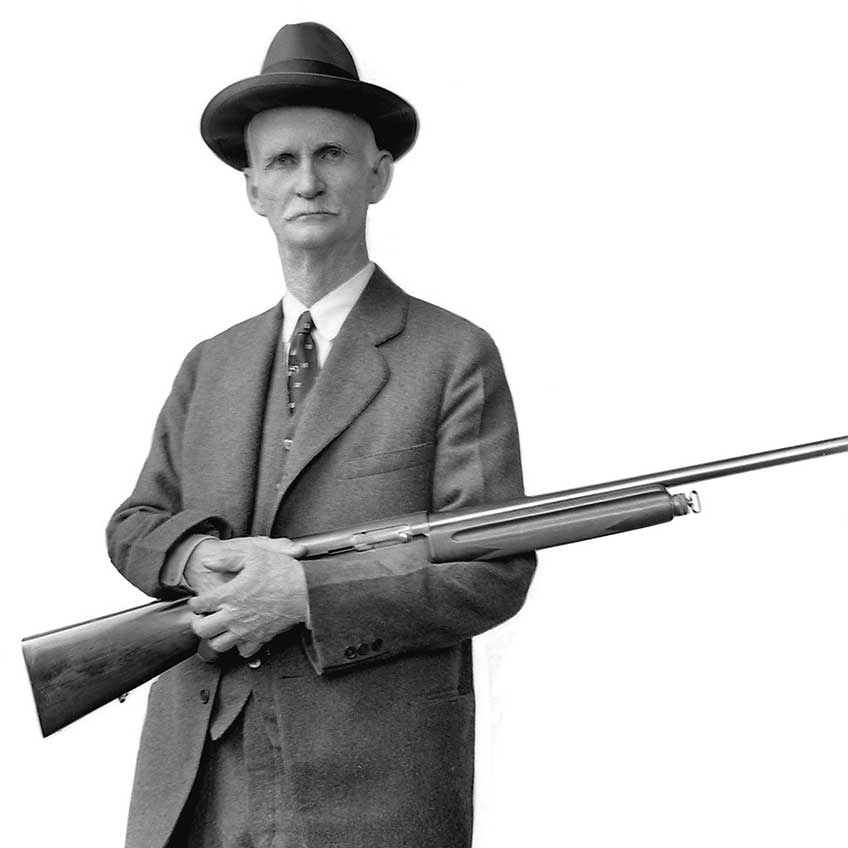
History has shown that the toggle link action was a developmental dead-end. Browning sent his prototype off to Winchester, which found his gun unworkable, and no modern firearm uses the action. Never at a loss for ideas, Browning had, in fact, abandoned the concept while he and Luger were still in court. By 1901, he was completing work on a totally different mechanism for what became known as the Auto-5, the long-recoil autoloading shotgun with the notable "hump." Browning licensed the patent to FN in Belgium after Winchester declined Browning’s financial demands. That rejection has been called the worst decision in Winchester’s history, but exactly why and how that happened has long been misunderstood. Recently uncovered archival documents and letters correct the details of that and other significant events in Browning’s life, including his discovery by Winchester in 1883 and his later association with FN, which began years before the commonly accepted date of 1902. Of what there is no doubt is the success of the Auto-5. It became one of the best-selling hunting and sport shotguns ever produced. Indeed, so many have been made—4 million at least—that a production estimate is guess. As his grandson Bruce W. Browning once wrote, “Production figures on this gun cannot even be estimated … it has been copied by manufacturers in so many countries.”
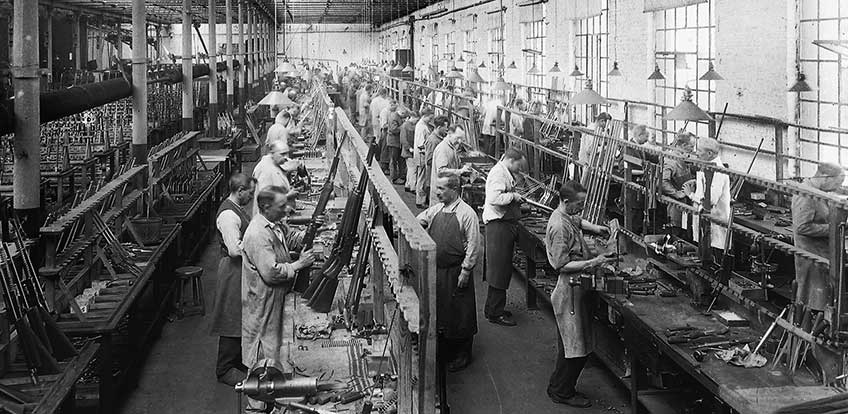
FN Shipped its first Auto-5 to Browning in 1903, and basic production ceased in 1978. A few special Auto-5 runs were produced later. Shown here is Auto-5 assembly at FN during the 1930s.
As for the patent dispute, the case produced a mixed result. Browning was initially declared to be the first inventor, and so in 1903, he and Colt sought to halt Luger’s American sales. That case dragged out until in 1908 when a federal appeals court ruled that neither Browning—nor, by extension, Luger—could claim to be idea’s originator, so Luger was free to continue selling his popular gun. Adding insult to injury, Browning and Colt were ordered to reimburse Luger's legal fees. Browning was right about Luger in one respect, however. The German inventor only produced one successful firearm (and that built on the work of Hugo Borchardt.) Browning in the meantime went on to create the Colt 1911, his two famous machine guns, the Woodsman target pistol and the automatic rifle, among other arms.
John Browning went on inventing until his death at the FN plant in 1926. On that final trip to Belgium, he was accompanied for the first time by his wife, Rachel. The day after celebrating Thanksgiving in a Liege apartment with his son Val and daughter-in-law Ann, the inventor walked up the short flight of stairs to the FN offices and soon thereafter suffered a heart attack and died. He laid in state in company’s boardroom, where a plaque honoring the inventor can still be seen.
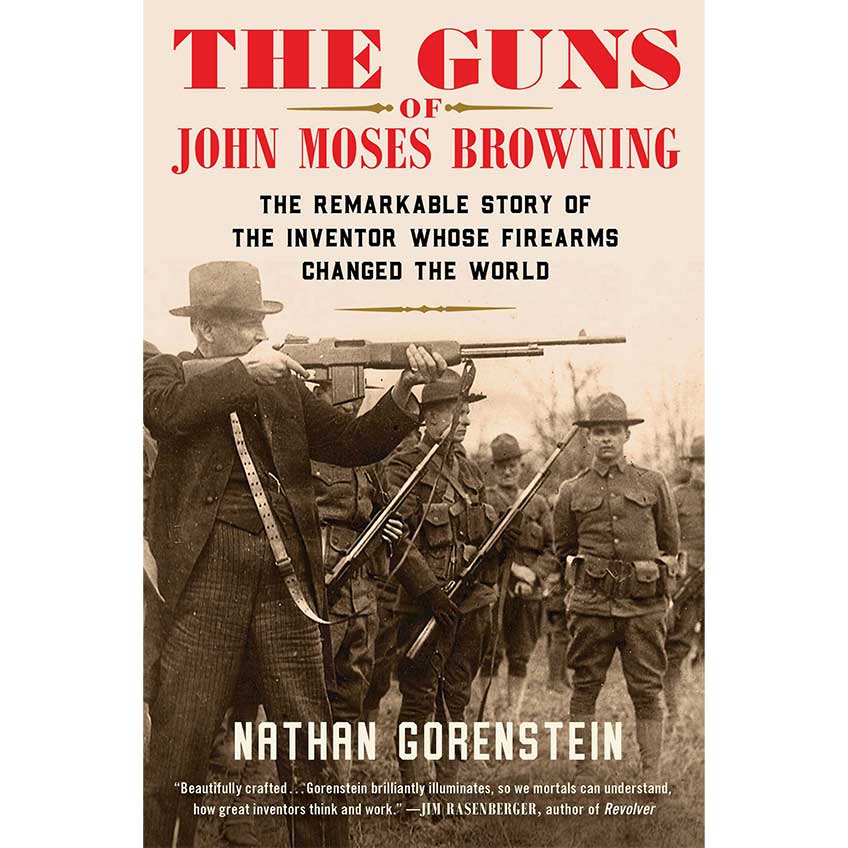
The Guns of John Moses Browning
Scribner Books’ latest offering, “The Guns of John Moses Browning” by Nathan Gorenstein, highlights the story of one of the most influential firearm inventors in history. The new book dives into the background of Browning’s incredible genius, highlighting his self-taught background and his ability to “think in three dimensions” that allowed him to create revolutionary firearm designs without relying on blueprints.
In its 320 pages, the book covers the life of John Moses Browning, from his birth and early years on the American frontier in Ogden, Utah, to his death in November 1926 at his Fabrique Nationale office in Belgium. Along the way, readers are treated to an in-depth look at Browning’s development process, as well as historical anecdotes where Browning’s guns played a role in many of the momentous events of the 20th century.
Gorenstein’s work strikes a balance between accessibility and lavish detail, and the end result is a book that informs those unfamiliar with firearm mechanisms while providing tantalizing details not known to even the most serious firearm enthusiast. The prologue opens with a 19-year-old Gavrilo Princip and accurately describes the operation of his FN 1910 pistol, a Browning design, as he fires the fateful shots that kill Archduke Franz Ferdinand and his wife, Sophie. Another chapter takes readers behind the scenes as Gorenstein reconstructs the development process of Browning’s gas-operated machine gun. You’ll learn about how a single sprig of sweet clover inspired Browning to head back to his shop and start experimenting with his .44-cal. Winchester lever-action rifle. The results of his experimentation would change warfare and the world forever. Toward the end, readers are treated with tantalizing details of the items Browning left following his death, including a .22-cal. target pistol, two semi-automatic shotguns of his own design and a single .22-cal. rifle.
I Shamelessly "Nicked" this from "American Rifleman". I saw the article and really enjoyed the article and saw quite a few guns I never thought about being involved on "D" Day. So I reproduced the article in its entirety.
When we think of the D-Day invasion of Normandy in June 1944, images of Allied and German infantrymen locked in combat with the standard guns of 1944 come to mind.
We inevitably think of rifles such as the M1 Garand and the Lee-Enfield No. 4, Mk. I exchanging fire with German Kar98k Mausers. We picture the M1A1 Thompson submachine gun fighting it out with the German MP40, and the MG42 spitting bullets at British and Canadian light machine gun sections armed with the mighty Bren.
While these guns of D-Day certainly fought the battle, a variety of other firearms also provided the firepower that made Normandy so vicious and bloody. Among this variety were firearms that typically do not come to mind when one thinks of D-Day. Some oddities and oddballs showed up during the 10 weeks that followed June 6,1944, and they fought right alongside the firearms that are more familiar to us.
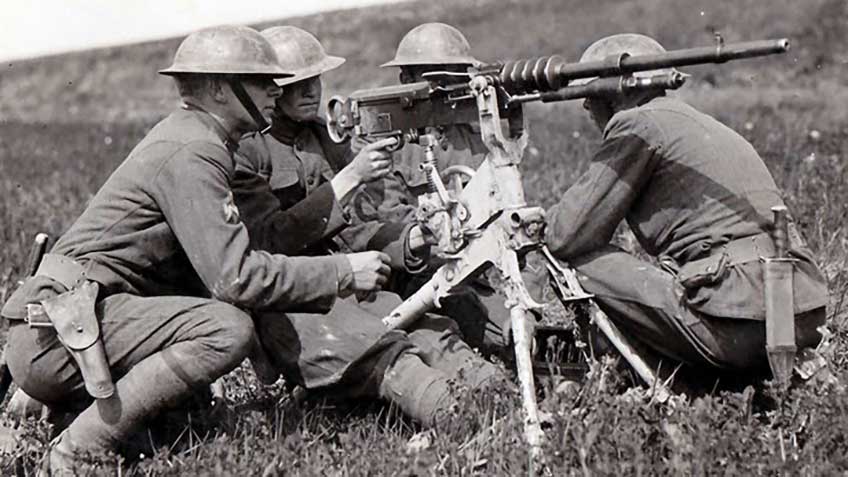
A Hotchkiss Model 1914 shown during World War I.
Hotchkiss Model 1914
Among the belt-fed machine guns that served both sides in France that summer, there were some surprises-especially on the German side. Although the Third Reich produced outstanding automatic arms before and during World War II, occasionally German troops were issued captured machine guns-such as the French Hotchkiss Model 1914 in 8x50 mm R Lebel.
At least one German unit was using that machine gun during the intense struggle for the city of Caen, because troops from the King’s Own Scottish Borderers (an element of the British 3rd Infantry Division) picked up a Hotchkiss Model 1914 and put it to their own use.
The interesting chain of custody that eventually resulted in British troops using a French-made machine gun that had been captured from the Germans reflects the unique and multi-national circumstances that made World War II an often complex global event.
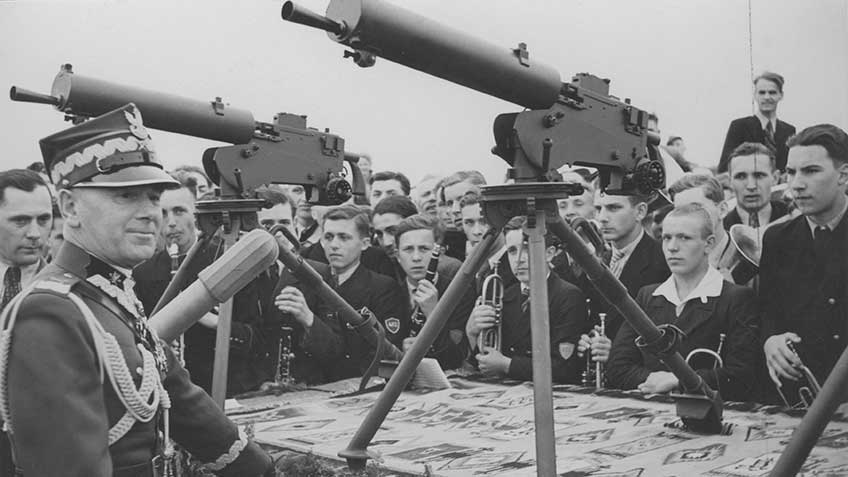
Polish wz.30 HMGs presented by the youth to Marshal E. Rydz-Śmigły. (Polish National Digital Archive)
Polish Ckm wz.30
The Wehrmacht also made good use of a captured water-cooled heavy machine gun in Normandy: the Ckm wz.30. Manufactured in Poland by Ciezki Karabin Maszynowy and chambered for the 7.92x57 mm Mauser cartridge, the wz.30 was capable of laying down sustained fire in a way that air-cooled machine guns simply could not. Franz Gockel was a corporal assigned to the 716.Infanterie-Division’s Grenadier-Regiment.726 at the Widerstandsnest 62 bunker complex on June 6.
From his fighting position looking down on the Fox Green Sector of Omaha Beach, Gockel directed fire on men of the U.S. 16th Infantry Regiment, 1st Infantry Division, when they began landing at 6:30 a.m. on June 6. He fired his wz.30 throughout the morning until being wounded and, thereafter, was evacuated for medical treatment.
The U.S. M1917 Heavy Machine Gun shown in its WWI configuration. The A1 variant was a slight modification introduced in the 1930s.
U.S. M1917A1 Heavy Machine Gun
The bitter irony is that Franz Gockel killed an unknown number of Americans on D-Day using an obscure Polish machine gun that was based on John M. Browning’s M1917 design. That same design, chambered in the M2 .30-cal. Cartridge (better known as .30-’06 Sprg.), also saw extensive service in Normandy as the U.S. M1917A1 Heavy Machine Gun.
Although it had its origins in World War I, in 1944, the M1917A1 was employed by the 8th Infantry Regiment, 4th Infantry Division, and other ground-pounder units. But it was also a gun used by the Army Airborne forces. Since parachute infantry regiments could not easily jump with the cumbersome water-cooled Browning, they were armed instead with the lighter M1919A4 air-cooled machine gun.
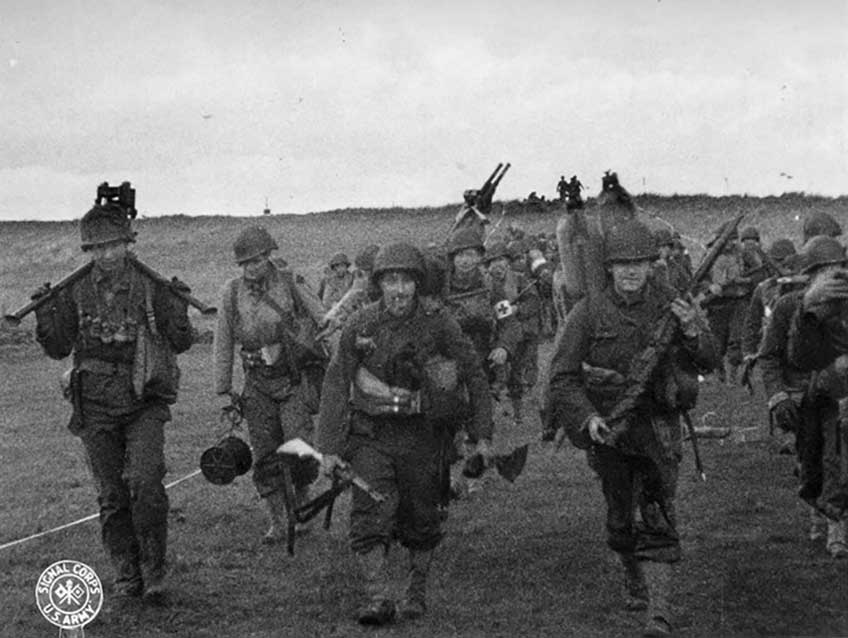
Soldiers of the 4th Infantry Division advancing inland. The man at the far left is carrying the tripod for an M1917A1 water-cooled heavy machine gun, along with four Mk. II fragmentation grenades suspended around his neck by a string.
In the 82nd Airborne Division’s 325th Glider Infantry Regiment though, heavy machine gun sections used the M1917A1. Following the successful liberation of the city of Ste.-Mère-Église during the pre-dawn hours of D-Day, the 82nd Airborne began attacking its other objectives. Among those objectives was the strategically important Merderet River bridge at the tiny settlement of La Fière.
There a 600-yd. causeway stretched across the marsh to the hamlet of Cauquigny. During the first three days of the invasion, the 82nd Airborne struggled with the German 91st Luftland Divisionto control the critically important hotspot in Normandy. Throughout it all, the glider infantrymen of the 325th used the M1917A1 Heavy Machine Gun to lay down sustained and effective defensive automatic fire.
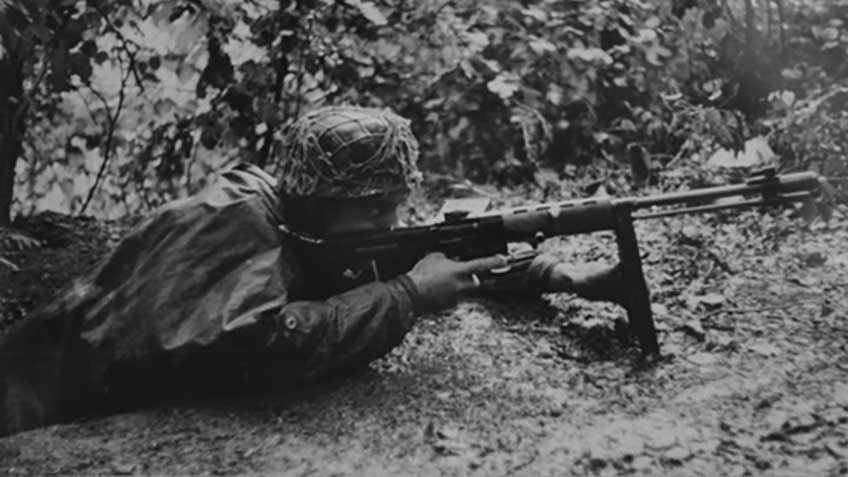
A German paratrooper seen in Normandy with a late model Ausführung "E" (Type I) FG42.
Fallschirmjägergewehr Model 1942
Just as the 82nd and 101st Airborne Divisions had paratroopers in the fight in Normandy, so did the German 91st Luftland Division. Assigned to the 91st was the 6th Fallschirmjäger Regiment, a combat-experienced Luftwaffe unit that engaged the 101st Airborne Division in the area around the city of Carentan.
Known for being especially well-trained and well-equipped battlefield opponents, Germany’s Fallschirmjäger units were also remarkably well-armed. They carried the typical assortment of German infantry arms-the Kar98k Mauser carbine, the MP40 submachine gun and the MG42 belt-fed machine gun-but some of the regiment’s paratroopers carried the Fallschirmjägergewehr Model 1942-universally known as the FG42.
It combined the features of a hand-held infantry rifle and a squad automatic weapon. Firing the 7.92x57 mm Mauser rifle cartridge, the FG42 was most certainly not an underpowered carbine. With select-fire capability, it spanned the gap between rifle and machine gun. The FG42 was ahead of its time in that it fired from the open bolt in the full-automatic setting and from the closed bolt in semi-automatic.
That provided closed-bolt accuracy in semi-automatic mode and open-bolt heat dissipation in full auto-truly the best of both worlds. Even though Germany was well known for its high-quality automatic firearms during World War II, the FG42 was in a league of its own and it provided individual Fallschirmjäger with a superlative firepower capability.
The commanding officer of the 3rd Fallschirmjäger Division, Generalleutnant Richard Schimpf, was even known to carry one in combat as his personal arm when his division joined the battle in Normandy.
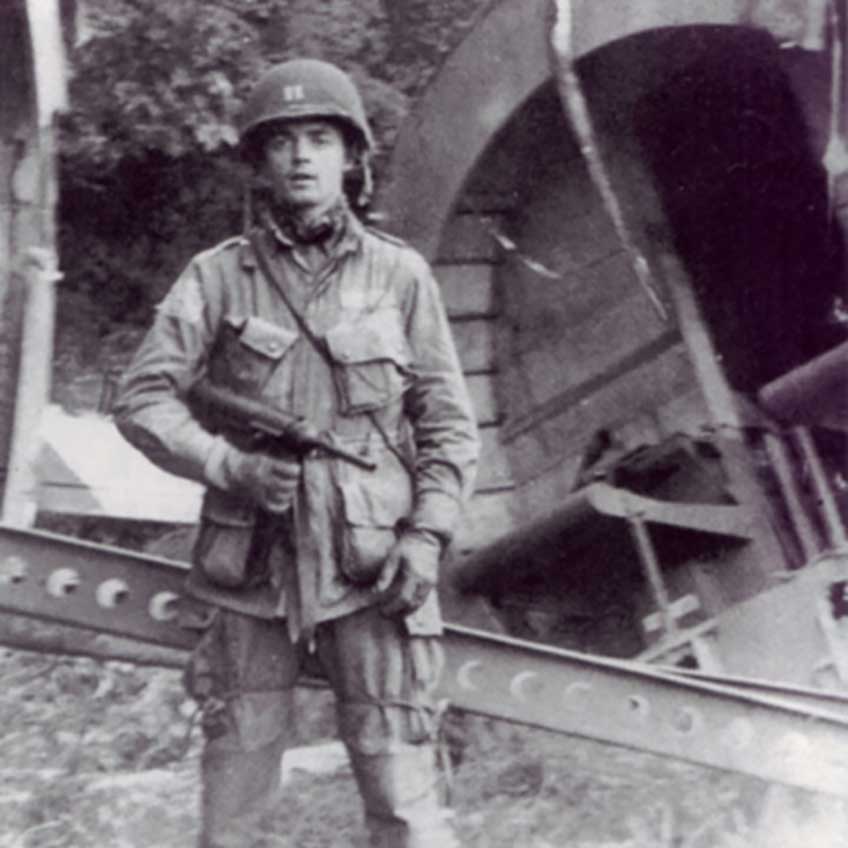
Capt. Bob Piper of G Company, 505th Parachute Infantry Regiment, 82nd Airborne Division shown in front of a wrecked Horsa glider in Normany. He is armed with a Guide Lamp M3 submachine gun.
U.S. M3 "Grease Gun"
Like the German paratroopers, American paratroopers also carried automatic arms that provided a high volume of fire. Although they had nothing to compare to the firepower of the FG42, the men of the 82nd Airborne and the 101st Airborne were armed with submachine guns that could send a large number of bullets toward a target in very short order.
Anyone familiar with the American airborne in Normandy has no doubt seen photographs of paratroopers carrying the renowned Thompson submachine gun. Most frequently seen is the M1A1 Thompson, the model that was developed for mass-production and was manufactured by Auto Ordnance Co. of Bridgeport, Conn., and Savage Arms Corp. of Utica, N.Y. However, a limited number of the earlier M1928A1 Thompsons were carried by paratroopers during the campaign-some of which were still equipped with the iconic wooden vertical foregrip.
But by the summer of 1944, a new submachine gun was ready to join the ranks of the U.S. Army in Europe-a submachine gun that was being produced back in the States for less than half the cost of the cheapest mass-production version of the Thompson: the M3 “grease gun.”
In its World War II combat debut, the “grease gun” armed paratroopers and the crews of armored vehicles during the Normandy invasion. It was 2 lbs. lighter than the Thompson, it was handier than the Thompson-thanks to its collapsible stock-and it was a bargain for the U.S. government, with each unit costing a mere $20.94 delivered.
Although its cyclic rate was significantly slower than the Thompson’s, the M3 nevertheless fired the same 230-gr., .45 ACP. bullet and was, therefore, every bit as lethal.
Heeres-Küsten-Batterie Pointe Du Hoc 15.5-cm. K 418(f)
On D-Day, a force of 225 men from the U.S. Army’s 2nd Ranger Battalion was given the special D-Day mission of landing four miles west of Omaha Beach at a place called Pointe Du Hoc. After coming ashore, the Rangers would have to scale 100-ft. tall cliffs to conduct an assault against one of the most threatening German gun batteries in lower Normandy.
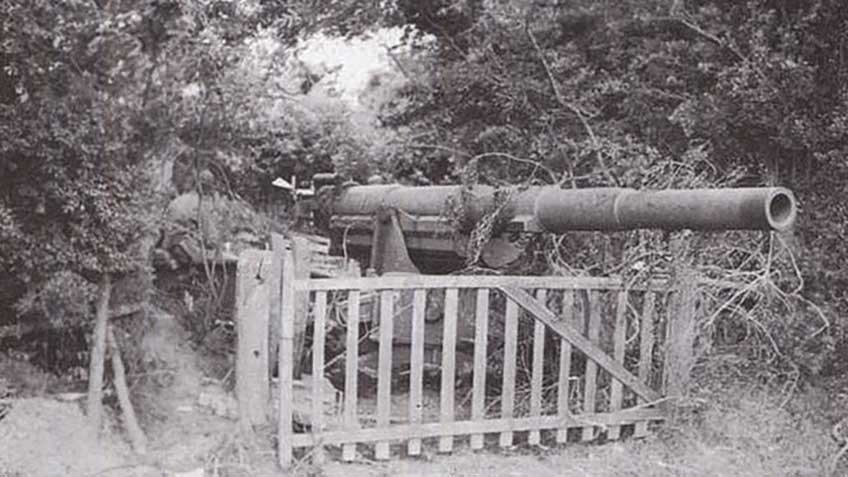
Established in May 1942, Heeres-Küsten-BatteriePointe Du Hoc was a position armed with six French Canon de 155mm Grande Puissance Filloux (GPF) mle. 1917. The guns had been captured in 1940 and subsequently placed in German service with the designation 15.5 cm K 418(f). At Pointe Du Hoc, they were mounted on concrete traversing tables that extended their maximum effective range, improved their already impressive accuracy, and transformed them into formidable anti-ship weapons. The Ranger mission on D-Day, which was commanded by Lt. Col. James Earl Rudder, had the objective of preventing the guns from firing on the fleet.
At 7:10 a.m., Rudder’s force landed, scaled the cliffs, and swiftly pushed the enemy back from the battery area. That is when the Rangers discovered that no guns were mounted at the point. Instead, timbers had been placed on each of the six concrete traversing tables to present the false appearance that the battery remained armed.
The Rangers also found two casemates for heavy artillery at Pointe Du Hoc, but they were still under construction and their guns had not yet been mounted. In late April, the Germans removed the guns from the point to a position almost a mile to the south, but the Rangers did not know that at the time.
After they secured the battery position at the point, the Rangers moved on to the next phase of their mission, which was to set up a roadblock on the Vierville/Grandcamp road. While doing this, they put out flank security for the roadblock and quickly stumbled across the guns concealed along a hedgerow-enclosed lane.
First Sergeant Leonard “Bud” Lomell and S/Sgt. Jack Kuhn then used thermite grenades to destroy each gun’s traversing and elevation mechanisms. After that, Lomell used the buttstock of his M1A1 Thompson to smash the sights for each gun.
Although not designed for such a purpose, the Thompson nevertheless proved effective. Those 155 mm guns-among the deadliest guns of D-Day-never fired a shot in opposition to the Normandy invasion.
Vickers K Gun
Overnight on June 6 and 7, the Germans launched a series of powerful counterattacks that pushed the Rangers back to the point. By the time vehicles from Omaha Beach linked up with Rudder’s force at Pointe Du Hoc on June 7, the Rangers had suffered 135 casualties, mostly during the German counterattacks on the night of June 6.
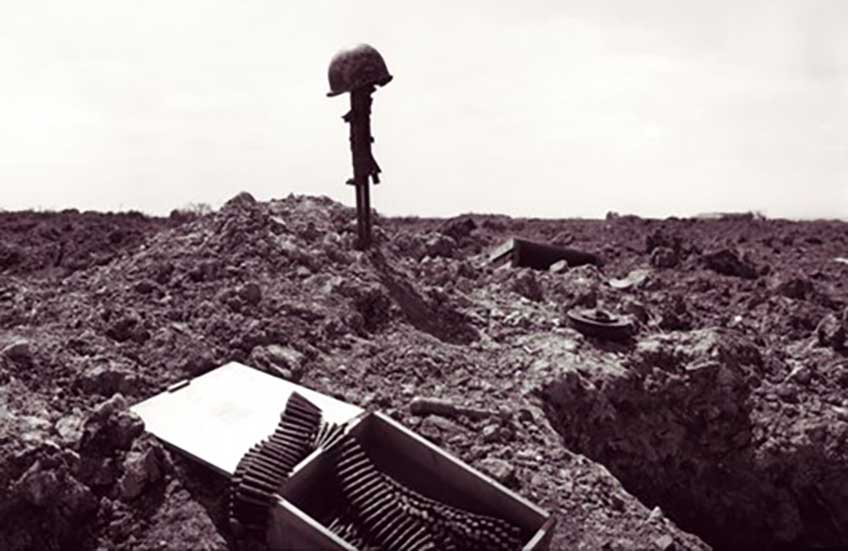
In the aftermath of the intense battle, one particular memorial to a fallen Ranger was raised amid the craters and debris at Pointe Du Hoc. A U.S. M1 helmet was placed on top of the handgrip of a Vickers K Gun, the muzzle of which was stuck into the soil.
Although a British design chambered for the .303 British cartridge, K Guns were mounted on the ends of extending ladders that were, in turn, mounted on DUKW amphibious trucks. The plan was that the DUKWs would swim up to the beach, then roll up to the base of the cliff at Pointe Du Hoc and extend the ladders so that the K Guns could provide suppressing fire while the Rangers conducted their assault on the battery.
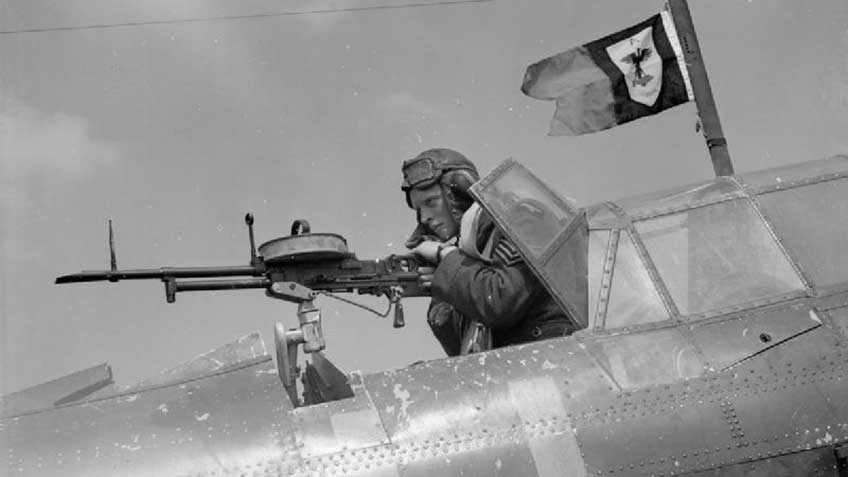
A sergeant air-gunner mans his .303 Vickers K-type gas-operated machine gun from the rear cockpit of a Fairey Battle of No. 103 Squadron RAF at St-Lucien Ferme near Rheges. Note the unofficial flight and squadron pennant flying from the radio mast. (Imperial War Museums)
Because of its blended hand grip/trigger and 60-round pan magazine, the K Gun was anatomically well-suited for the mission in ways that the M1918A2 BAR and the M1919A4 .30-cal. machine gun were not. Of course, the Rangers could not expect to be resupplied with .303 cartridges, but they were not planning to use their K Guns beyond the morning of June 6, anyway.
When the ammunition ran out, it would be all over and the K Guns were to be discarded as the battle pushed inland. That is why a British automatic weapon can be found among the spent shell casings and exhausted smoke grenades at Pointe Du Hoc in the American sector of the invasion area.
Two types of Reising submachine guns were procured by the U.S. Marine Corps during World War II. The first type is the Model 50, which had a full length wooden stock and a compensator found on the barrel. The variant with the folding stock was the Model 55 and was procured for use by the Marine Corps parachute units early in World War II.
Harrington & Richardson Model 50 Reising
The Vickers K Gun was not the only obscure firearm associated with the battle at Pointe Du Hoc. On the afternoon of June 6, the Rangers began sending prisoners down to the beach. They were not just German soldiers, but also Italian and French laborers from Organisation Todt who had been captured during the battle among Pointe Du Hoc’s craters.
When the prisoners reached the beach, they were loaded aboard landing craft being used to evacuate the wounded out to the ships lying just off shore. Although they ultimately ended-up aboard an LST (Landing Ship, Tank), at first the prisoners were taken to the battleship U.S.S.Texas (BB-35). With prisoners coming aboard, the ship’s Marine Detachment was called on to draw arms and serve as guards.
While the Marine NCOs carried M1911A1 pistols, the guards themselves were armed with one of the unlikeliest guns of D-Day: the Model 50 Reising submachine gun made by Harrington & Richardson. It may not be well-known, but U.S. Marines participated in the D-Day invasion, and many of them did so with their Reisings.
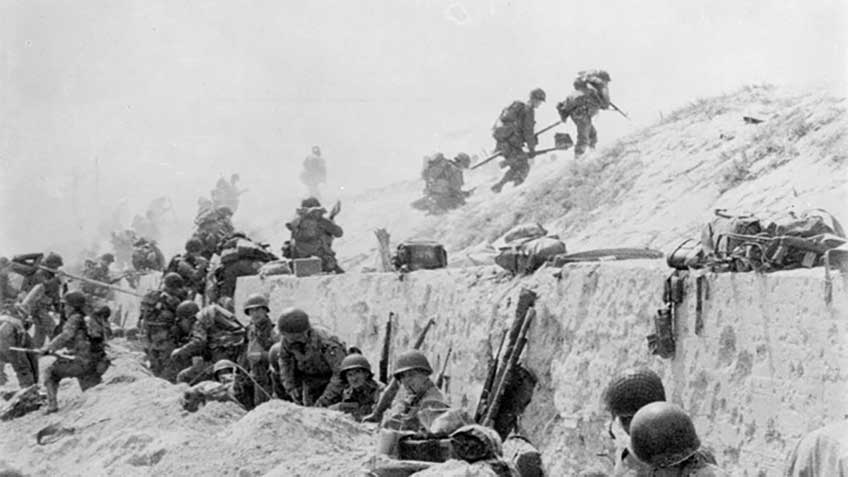
U.S. Army VII Corps Soldiers from the 4th Infantry Division crossing the seawall and sand dunes on Utah Beach. The men in the foreground are from the 101st Airborne Division's 327th Glider Infantry Regiment, which landed amphibiously rather than by glider. Note the M1A1 Carbine on top of the seawall at the far right.
M1A1 Carbine
Even among the more common U.S. infantry firearms involved in the assault on fortress Europe there were some surprises. Because of its light weight and detachable, 15-round box magazine, the M1 Carbine saw widespread use during the invasion, but the straight stock version of the carbine was not the only configuration that fought the battle for Normandy.
The M1A1 Carbine, with its folding stock, was also present in large numbers. Although the fact that it showed up in the airborne division drop zones is not an altogether learned observation, the photographic record also reveals that the M1A1 made a few appearances on the invasion beaches, too.
As the battle developed on Omaha Beach on D-Day morning, a group of soldiers from L Company, 16th Infantry Regiment, 1st Infantry Division, together with some troops from the 29th Infantry Division’s 116th Infantry Regiment, sought shelter at the base of the high chalk cliffs of the Fox Red Sector.
In a photograph showing the mixed group gathered there, one man has the folding stock of his M1A1 Carbine tucked under his forearm while he cleans sand out of its action. An image captured at about that same time only 16 miles to the west shows troopers from the 101st Airborne Division’s 327th Glider Infantry Regiment gathering on Utah Beach. In that photograph, one man has laid his M1A1 Carbine on top of the seawall there before moving inland.
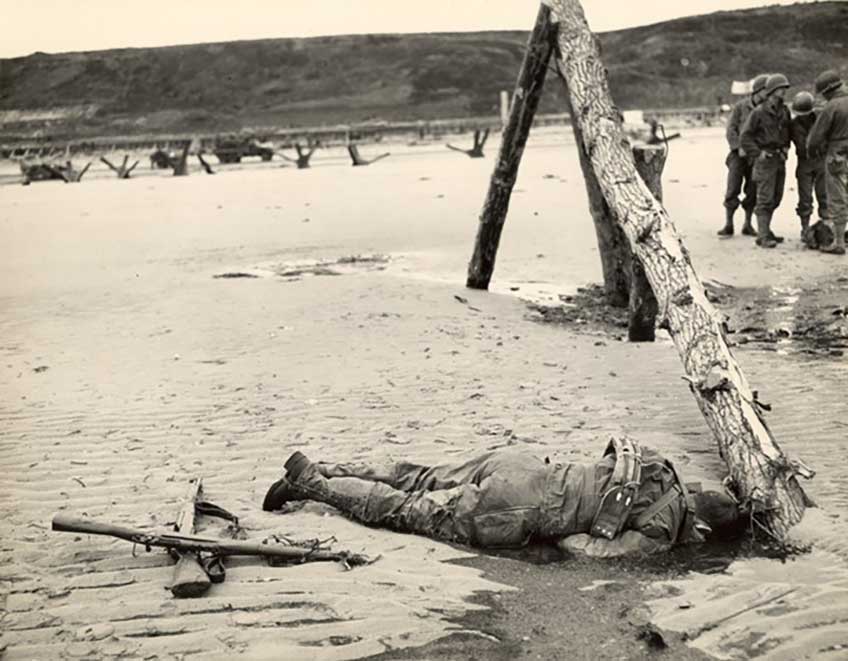
The body of a young U.S. Soldier lies face-down in the sand at the base of an obstacle on Omaha Beach. His M1942 HBT trousers and M1941 Field Jacket suggests that he was a ranger either from the 2nd or 5th Battalion. He still wears his M1926 Inflatable Lifebelt and two rifles lay at his feet: an M1 Garand and a Model 1903 Springfield.
U.S. Model 1903 Springfield
The U.S. Army infantry rifleman who liberated France during the summer of 1944 did not always do so using the U.S. Rifle, Cal. .30, M1. Although the Garand was certainly the most abundant service rifle in use with American troops at the time, another rifle did the job alongside it: the Model 1903 Springfield.
From the sands of Omaha to the streets of Cherbourg, the ’03 was there through it all. In old and new configurations, it fought from June 6 through to the end of the campaign in the hands of soldiers from both support units and front-line combat units.
In fact, one of the most famous photographs taken in Normandy in June 1944 shows a group of soldiers carrying ’03 rifles while they climb the bluff above Omaha Beach. They are all from the 2nd Infantry Division’s 23rd Infantry Regiment, and they brought 1903 rifles to France that summer because their commanding officer told them to.
Col. Hurley E. Fuller, a World War I combat veteran, preferred the M1903 rifle, and he made sure that the men of his regiment carried it instead of the Garand. Thus, even as late as June 1944, the Model 1903 Springfield was the primary battle rifle of one of the infantry regiments attacking Hitler’s fortress Europe.
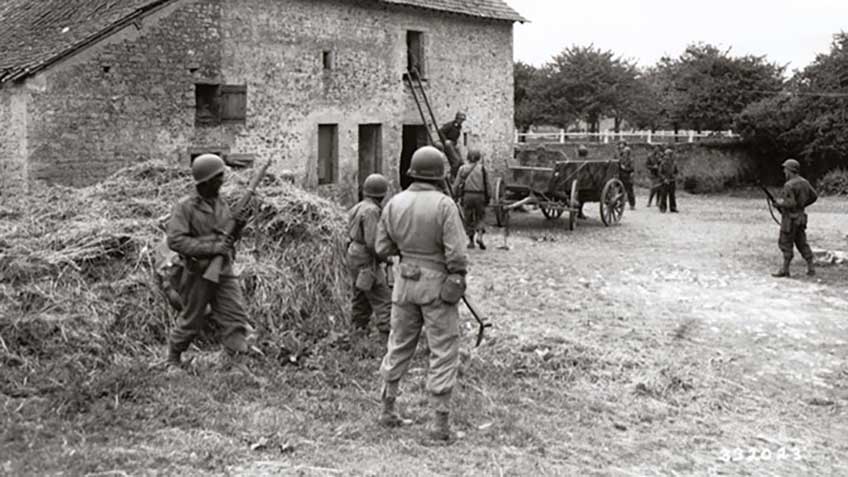
African-American Soldiers from the 320th Barrage Balloon Battalion aid in the hunt for a German sniper in Saint-Laurent-sur-Mer on June 10, 1944. The Soldier at the far left is armed with a Model 1903A3 Springfield.
U.S. Model 1903A3 Springfield
The M1903 rifle also served in many of the other U.S. units fighting in Normandy during the summer of 1944. In fact, its use was so widespread that one particular photograph of an Ordnance Maintenance and Repair Company working in a hedgerow enclosed field near St.-Lô on July 18, 1944, shows hundreds of ’03s piled up and stacked high for servicing.
Although the photograph depicts only examples of the standard M1903 rifle, the newer M1903A3 was present for the Normandy battle as well. Modified for World War II mass production and manufactured by Remington and Smith Corona, the ’03A3 conserved precious raw materials and could be made faster and at less cost.
A product-improved version of the ’03, it was distributed among support troops from Military Police and Barrage Balloon battalions and shows up in photographs throughout the campaign, although with less frequency than the standard M1903 rifle.
U.S. Model 1903A4 Springfield Sniper Rifle
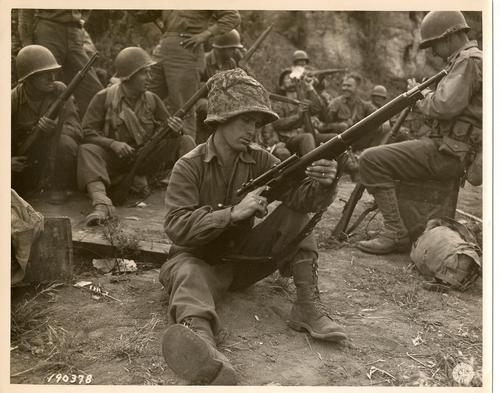
Still another version of the ’03 participated in the liberation of France: the M1903A4 sniper rifle. With its Weaver M73 (or M73B1) 2.75X scope mounted using the Redfield Junior base, the ’03A4 provided the U.S. Army’s only sniping platform during World War II.
Although it served many different units during the campaign, we know that at least one ’03A4 served in the 313th Infantry Regiment, 79th Infantry Division, because the rifle can be seen in a photograph taken in Cherbourg on June 26, 1944.
The photographic record provides some of the best documentary evidence of which firearms were being used where and when in Normandy.
For the most part, it shows the use of the standard small arms that we normally associate with Allied and German infantry battalions in combat during the summer of 1944. That same record leaves evidence of the interesting diversity of guns used on both sides of the fighting.
The surprises that showed up on the beaches and in the hedgerows of northern France that summer reveal the significant demands exerted on both sides of the conflict to put as many guns as possible in the fight.
My Apologies for not doing a "Monday Music" last week, it was Memorial Day and Yes I had several songs I could have used and have used in the past from Billy Joel "Good Night Saigon," To Paul Hardcastle "19" or a couple of others and not ran with my present theme, but I was on vacation and my "baby laptop" loves to eat paragraphs and place the curser in strange places making it difficult to get a groove going. so I didn't post much.
I am continuing my string of "bugaloo" songs. This discussion was started in the "Monster Hunter Nation, Hunters Unite", back in November of 2019? it is a Facebook group with enthusiast of the ILOH "International Lord of Hate" A.K.A Larry Correia. We were talking about what song would we use if we looked out of our window or glanced at our security camera and saw this.....
One of the alphabet bois lining up to take down your house...What would be your "Valhalla" song and you would set it up to play as you load up magazines set up the Tannerite Rover, turn on the water irrigation system and fill it with gasoline instead of water and prepare yourself.
I figured it would scar the alphabet boys if they come busting in and hearing a song about people standing for their beliefs and willing to fight for them no matter the cost, Good Music unlike that crap they listen to now. What can I say, My humor is warped....just a bit. Next week will be "Come Out and Play" by The OffSpring...How Appropiate, LOL, Now that should really cause some psych evals., hehehe, some poor ATF guy trying to explain the attraction to his mother because he is imaging himself as The savior of the American way rather than working for an agency that have the initials of a convenience store. Now because we ain't gonna answer that door. They can kick it in and start "the Dance" I decided to roll with " You spin me around like a record "because we are being spun like a record by the most oppressive American .gov in History and by the alphabet agencies because they don't like people that ain't on the democrat plantation. Well I kinda like my freedom and stuff and that is anathema to the deep state and their operatives.
Youthquake is the second album by the British pop group Dead or Alive, released in May 1985. The album was their commercial breakthrough in Europe and the United States, due to the lead single "You Spin Me Round (Like a Record)", which was a UK number-one hit and a top 20 hit in the United States. Additional single releases from the album included "Lover Come Back To Me", "In Too Deep" and "My Heart Goes Bang (Get Me to the Doctor)". This was Dead or Alive's first collaboration with the Stock Aitken Waterman production team. Youthquake was re-released in the UK on compact disc in 1994, with the two bonus tracks that were previously included on the original CD and cassette versions of the album.
Recent US and Japanese reissues have reverted to the original vinyl track listing.
The album peaked at No. 9 in the UK and was certified Gold by the BPI for sales of over 100,000 copies. It also peaked at No. 31 in the US and was certified Gold by the RIAA for sales over 500,000. In Canada the album peaked at No. 8 and was certified platinum.
The album cover was taken by fashion photographerMario Testino.
"You Spin Me Round (Like a Record)" is a song by British band Dead or Alive on their 1985 album Youthquake. Released as a single in 1984, it reached No. 1 in the UK in March 1985, taking 17 weeks to get there. It was the first UK No. 1 hit by the Stock Aitken Waterman production trio. On the U.S. Billboard Hot 100, it peaked at No. 11 on 17 August of that year. In 2003, Q ranked the song at number 981 in their list of the "1001 Best Songs Ever", Blender listed it at number 289 on its ranking of "Greatest Songs Since You Were Born" in 2005 and in 2015, it was voted by the British public as the nation's 17th favourite 1980s number one in a poll for ITV. Musician and actor Gary Kemp described the song as "one of the best white dance records of all time."
Dead or Alive's vocalist Pete Burns stated in his autobiography that he composed "You Spin Me Round" by using two existing songs as inspiration for creating something new:
How did I write "Spin Me"? I listened to Luther Vandross's 'I Wanted Your Love'. It's not the same chord structure, but then that's the way I make music – I hear something and I sing another tune over it. I didn't sit and study the Luther Vandross album – I heard the song and it locked. [...] I'm trying to structure the music and I know what I want. [...] It's like do this, do this, do this - and suddenly it hits. I don't want to do Luther Vandross's song, but I can still sing the same pattern over it. And there was another record, by Little Nell, called "See You 'Round Like A Record". [...] So I had those two, Van Dross [sic] and Little Nell and – bingo! – done deal.
— Pete Burns, Freak Unique (2007)
According to Burns, the record company was unenthusiastic about "You Spin Me Round", to such an extent that Burns had to take out a £2,500 loan to record it, then once it had been recorded "the record company said it was awful. It was unanimous – it was awful, it was rubbish." Burns stated that the band had to fund production of the song's video themselves.
Interviewed for BBC Radio 4's The Reunion: The Hit Factory, in April 2015, Burns said that the confrontational attitude of the producers was met with an equally confrontational attitude from the band and that this led to "quite a bad vibe" for the entirety of the studio time, describing the experience as "a time of intense friction"
This will go in Chronological order, several things happened. I am using my "Old Laptop" to do my blogging, it is better than nothing but things happened here at Casa de Garabaldi..some bad and a lot not. First off back in April My Dad Passed away.
I had gotten more details, the cause was his heart ultimately failed him, but it was 3 weeks to the day after his 2nd "jab" that he passed. According to my Stepmom, you could see the "slide" after 24 hours until his passing. Needless to say it solidified my opposition to getting the "Jab". Besides I already had "da Covid" as did my wife and kid, so as long as my employer don't demand it as a condition of employment I will not get it. They did say that any new hires have to already have it. They are playing it smart, they are "encouraging" everyone to get it, but not demanding it, not putting them legally on the hook if it goes bad unlike some of the other airlines that are demanding it of their employees.
Well we had the memorial service last week, We had to wait for my brother to return from certain place overseas, it was already planned out long in advance between my Dad and my Brother, If my brother had returned back early, it would have disrupted his return for his daughter(my Niece) graduation from high school so my Dad had my brother promise to return at the normal time. my brother was on a rotation schedule with so many weeks here and so many weeks "over there", you know what I mean. My Dad had everything planned out. he knew that his last lung operation 2 years ago that it could go pear shaped in a hurry and so he had everything already set and planned out as much as possible to spare the load on my stepmom.
I took a quick picture before the service started, I don't know if it was appropriate or not, and I didn't care. it was a really good service and my stepmom had a person playing "Amazing Grace" on Bagpipes played by a real bagpiper because that is what my Dad wanted and when it started playing when the urn left to be interred, there was not a dry eye in the place. The flag on the table I got and the other flag, my brother got. I had to mention the passing on my Dad back in April to the Service on Thursday to tie them together. I do have a picture of the marker, but I will not post it, I do value my anonymity, something about not getting fired, LOL I will be planted in the same place as my Dad It was cathartic for me to write this on my blog, I do miss my Dad and I know that eventually I will see him when St Peter has my orders cut and I report to Fiddlers Green , but I hope not for a while if y'all know what I mean.
My Dads Flag, along with a shell from the 21 gun salute and a coin from the Patriots Guards Riders who were out in force because both my Dad and my Stepmom who is a Ride Capt are heavily involved.
Closeup of the coin and the shell, I will be buying a "Shadowbox" today probably
On a different note, I decided to upgrade the Focus a bit, I bought some LED Fog Lights,
I brought the car a bit into the garage, and pried off the foglight cover
Then I looked at the light on the car...
Saw that there were 3 "Torx" bits holding the light in place....
I used a screw driver with a bit holder, I normally don't use a cordless motor for stuff like this, good way to strip the head when you put them back on and when you remove them, the torque from the motor can spin the screw off into unexpected directions that include places that you can't reach and since it is only 3 of them, it isn't worth the hassle....now if there was 20 of them.....then out comes the motor...
I pulled the light out, the LED lights were "Plug and Play", y'all also notice the gloves I am wearing...Its a habit I have when I am working with any kind of lights, your skin, especially your hands have oils on them that leave a residue on the bulbs and that will shorten the lifespan of the bulbs, so to prevent burning out a bulb early, I always wear a glove. I plugged in the new bulb and reattached the lens the car. along with the cover
Now the test..
You see the difference between the left and the right, the passenger side is the one that has the LED light. I then repeated the process for the drivers side...
Quick and easy Mod, I have gotten the LED lights for the highbeams, but not the regular lights, so I haven't changed them out yet. The rest of the car already is LED either from the factory or I had converted it.
I had bought an old Mauser a while back, and the wood was really dry because it had been in storage for so long, well I had rubbed some linseed oil on the stock to try to help the wood, but it had raised the grain. And one of my readers suggested a formula from his grandfather. I used 600 grit sandpaper and sanded down the stock after taping off the metal, and using 1/3 linseed oil, 1/3 turpentine and 1/3 beeswax..well the only beeswax I would find was this stuff..
Well I mixed them together and rubbed the mixture into the rifle and let it set for a day, then repeated the process. Man what a difference,
The pictures don't do it justice, it looks really good. The thing is that you have to let it sit for several days to let the mixture soak into the wood really good, if you handle it too soon, you put fingerprints all over it.....ask me how I know....LOL. and Thanks Rick for the recipe, you made an old rifle look really good.
We took my Son on a lake house for vacation, as a reward for graduation, Now I can retire my Tazer, LOL. The same week my laptop crashed, that is why I haven't blogged much. Using my baby laptop is problematic for blogging. it eats paragraphs. It is better than my smart phone....but not by a whole much.
It was a very nice House, I just relaxed, whereas my son and his friends fished a lot, and did the kayaking thing, and got waved at by the girls when they came by on the motorboats, usual lake stuff, LOL and we had the firepit going at night
While we were there, we went to one of the WMA's that had a good shooting range and the kids fired skeet and Trap. My son gotten one of his non shooting friends into shooting trap and he bought a "Tristar" pump shotgun with a 28 inch barrel and it take beretta chokes so this kid was stoked busting clays at the range.
Shooting at the "Trap House"
My Over and Under waiting for my Son to shoot skeet, they have a really nice skeet range, all you need is a fishing license to shoot there, so I bought one so I can shoot also.
My son shooting My Dads Glock, that pistol shoots really good especially with the holographic sight on it. I also fired my reworked Sigma, the one that my friend Mack had to tweak, I had added a new apex trigger and springs because it was reliable, but the trigger flat out sucked. Well when I put in the new trigger, it no went bang anymore. And I know enough to know to call for help and Mack came to my rescue. He had told me that I had installed it correctly, and that the fault was in the "vagaries" of the molding of the Sigma itself, the first generation were not 100% identical so Apex "Shot the Margins" as they say, so you basically had to "tweak" it after you installed it, so Mack had to tweak it. And the Sigma ran much better, although I had a couple of FTF, and those was attributed to old magazines, I had asked Mack about that and he concurred, he noticed that when he fired it because I still had the "Clinton Gun ban" magazines with the pistol, you know the 14 round magazine with the 10 round crimp? So I am going to have to buy new magazines. he recommended OEM because 3rd party magazines are not as reliable. He also noticed something else..he put an older Glock upper on the Sigma lower...and it fit!, and that explained the lawsuit, LOL when Glock sued S&W back in the 90's,
On a different note, it seems like the country is falling apart...between the gas prices, the inflation, the debt, the Middle East....but I guess the Biden Supporters have one thing going for them
We had a good week, Didn't want to return to work. lemme tell you