I shamelessly clipped this from Farcebook while taking a "Microbreak" from work ;) . A guy named Michael Smith wrote this, I follow him on that blighted platform.
The musings of a politically incorrect dinosaur from a forgotten age where civility was the rule rather than the exception.
I shamelessly clipped this from Farcebook while taking a "Microbreak" from work ;) . A guy named Michael Smith wrote this, I follow him on that blighted platform.
I have blogged "A LOT ABOUT EUROPE" if y'all want to spend several hours going through 13+ years + worth of blog post, LOL, some have stood the test of time....others ...not soo much. This article pertains mostly to the snide Eurowheenies in Western Europe. The Eastern Europeans have their stuff together, especially Poland.
I clipped this off "Farcebook"
I clipped this from SSG , This also was mentioned by the ILOH at one of my favorite Websites, and he asked a question about people who were good at catching fraud. Larry was an investigative accountant, and catching people stealing money was a specialty and he was pretty good at catching what he called "Red Flags" and there are a bunch of them, basically statistically impossibilities and he would ask others to vet what he comments and there are others that are more into number crunching than he is and they got more into it and they also agree with what he said and expounded on it. you can check out on his website for more information. The problem is that the media is totally in the tank for Biden and are burying the story because it is not in "their" interest to broadcast it.
I had heard rumblings about this back in 2021 about the "pay to play" that the donks had pushed, I had always said that the Antifa and the BLM rioters are the footsoldiers of Soros, and they would use them to support a political cause because to the left, political violence is a volume knob to turn up or down depending in the political situation, but to us on the right side of the aisle....
Mike Benz stated that the Democratic Party anticipated Black Lives Matter mobilization if Joe Biden called for protests, particularly in the event President Donald Trump won the 2020 election.
Benz said Democrats assumed Black Lives Matter would respond to such a call but believed further testing was needed to assess how reliably the group could be mobilized during an election crisis.
Benz said the party viewed large-scale demonstrations as increasing the stakes and believed it was necessary to strengthen ties with Black Lives Matter in order to ensure responsiveness.
He described what he characterized as a deliberate effort by Democrats to secure loyalty through financial and political concessions.
“And they just assumed that black lives matter would mobilize in the event of a Biden call to take to the streets. But they said, well, we’ll need to do more testing. We just assumed they would in this war game. We should robustly test their likely receptivity so they can be mobilized at election time in case Trump clearly wins the election, the scale of recent demonstrations has increased the stakes for the Democrat party to build strong ties with Black Lives Matter and be responsive to the movement’s demands,” Benz said.
According to Benz, Democrats discussed providing substantial financial support to Black Lives Matter in order to secure that loyalty.
He specifically referenced a figure of $50 billion and linked the funding to business and labor organizations.
“Give black lives matter what they want. Give them $50 billion in Chamber of Commerce money,” Benz said.
Benz further claimed that a private agreement between the U.S. Chamber of Commerce and the AFL-CIO played a role in managing protest activity during that period.
He said the agreement was referenced in a Time magazine article by Molly Ball and was connected to decisions surrounding protest activity.
“If you remember, Chamber of Commerce signed the secret deal with the AFL CIO.
That was the crux of the Molly Ball Time magazine article to have the protesters stand down when it was announced by one so,” Benz said.
Benz stated that from June 2020 through November 2020, Democratic leaders discussed plans at senior levels to provide favors to Black Lives Matter with the expectation that those actions would later result in political cooperation.
He said the goal was to ensure that the organization would respond to calls for mass protests if Trump prevailed in the election.
“Between June 2020 and November 2020, the Democrat Party openly planned the highest levels to do favors for black lives matter, so that black lives matter would owe them favors and be responsive to a Biden call to take to the streets, to street protest Trump out of office if he won 52-47 in a landslide Electoral College victory,” Benz said.
Benz characterized these discussions as a strategic effort to prepare for election outcomes Democrats viewed as unfavorable.
He said the planning was tied directly to concerns about a clear Trump victory and the role that organized street protests could play in challenging the result.
I decided to continue to roll with some 70's Disco. Saturday night Fever rejuvenated the Genre that was starting to fade. A lot of people hated Disco but I like the fast paced music and man talk about the costumes. You don't see stuff like that now a days. I make no bones about it, I prefer the older music to what is playing now...Occasionally I hear something that is "modern" that I consider really talented like Adele. But overall I think the Music industry is in the doldrums of suckitude. Where are the acts that blazed a trail with talent....now it is just "shock " value. Where is the showcase of talent? Like I have commented in a prior posting...Look at Motown....they influenced music like nothing else did and look what is coming out now.... I have been accused of living in the past....Perhaps I am....it keeps me young I suppose.
"Disco Inferno" is a 1976 song by The Trammps from the album of the same name. With two other cuts by the group it reached number one on the Billboard Hot Dance Club Play chart in early 1977, but had limited mainstream success in the U.S. until 1978, after being included on the soundtrack to the 1977 film Saturday Night Fever, when a re-release hit number 11 on the Billboard Hot 100.
It was also notably covered by Cyndi Lauper on the A Night at the Roxbury soundtrack and Tina Turner on the What's Love Got to Do with It soundtrack.
The song was originally recorded by The Trammps in 1976 and released as a single. It was inspired by a scene in the 1974 blockbuster film The Towering Inferno in which a discotheque is caught in the blaze. According to Tom Moulton, who mixed the record, the Dolby noise reduction had been set incorrectly during the mixdown of the tracks. When engineer Jay Mark discovered the error and corrected it, the mix had a much wider dynamic range than was common at the time. Due to this, the record seems to "jump out" at the listener. With "Starvin'" and "Body Contact Contract", it topped the U.S. Disco chart for six weeks in the late winter of 1977. On the other US charts, "Disco Inferno" hit number nine on the Black Singles chart, but it was not initially a significant success at pop radio, peaking at number fifty-three on the Billboard Hot 100.
"Disco Inferno" gained much greater recognition once it was included on the soundtrack to the 1977 film Saturday Night Fever, this time in extended form, running nearly 11 minutes. Re-released by Atlantic Records, the track peaked at number eleven in the U.S. during the spring of 1978, becoming The Trammps' biggest and most-recognized single. Later, it was included in the Saturday Night Fever musical, interpreted by the 'DJ Monty' in the "Odissey 2001" discothèque.
The song also became an unofficial theme song for former New York Yankees outfielder Bernie Williams. It was often played at old Yankee Stadium while the scoreboard and video systems displayed the phrase "Bern Baby Bern", a play on the song's refrain and Williams' first name.
In 1996, "Disco Inferno" was included on the soundtrack to the cult comedy film Kingpin and featured in two pivotal scenes in which Roy Munson (played by Woody Harrelson) confidently strolls into a bowling alley. The song was also used in the trailer to the Adam Sandler comedy Bedtime Stories. In 2006, the extended version was featured on a remastered version of the Ghostbusters soundtrack.
On September 19, 2005, "Disco Inferno" was inducted into the Dance Music Hall of Fame
Yesterday I had posted "50" Stocking Stuffers for guys that I got from the "Art of Manliness" website, well I was checking out that link I had posted and I started diving deep into the "Lock picking" one, soo much that I ordered me a set of tools for educational use mind you. I used to be really good at getting into cars in the 80's and 90's, but I haven't tried in 20+ years even though my Dad gave me his slim Jim from when he was a cop. Just haven't felt the need. Funny that, LOL
Again I shamelessly clipped this from "Art of Manliness"
![]()
Some of you might be thinking, “Brett, why should I learn how to pick a lock if I don’t plan on breaking into people’s homes?”
Great question.
There are a few good reasons why law-abiding citizens should learn how to pick a lock:
Lock picking opens your eyes to the “illusion of security.” We all lock our doors to keep our loved ones safe at night and to secure our possessions during the day. After I picked my first lock within two minutes of learning how to do it, I realized that locks don’t really do much except provide the illusion of security. Locks make us feel safe, but if someone really wanted to get in your house, they could easily pick the lock on your front door. If they didn’t know how to do that, they could find another way in. You can’t just rely on a lock to keep you and your family safe. You need to utilize other tools and tactics and create multiple layers of security.
Realizing how little locks actually keep you and your stuff safe was both terrifying and surprisingly heartwarming. Terrifying because I saw that someone could easily enter my house and walk off with a crapload of stuff without having to break a window; heartwarming because seeing how easy it is to pick a lock and yet how rarely people get burgled, made me realize that most people don’t break into homes because, well, most people are good people.
It makes you handy. If you’ve ever been locked out of your house or car, you know how annoying it is to be standing there like a chump, waiting for someone to show up with a key or a professional locksmith to arrive. Wouldn’t you love to be able to jimmy your way in yourself? Not only can this skill save you a lot of time and money, being able to solve a problem like that on your own is pretty dang satisfying. Plus, you can help out all your friends when they get locked out too.
Knowing how to pick a lock may even help you save a life one day. ITS Tactical has highlighted a few instances in which someone picked their way into an older parent’s home because they weren’t answering the phone, only to find their parent collapsed on the floor. Could they have kicked the door down or broken a window? Sure. But picking a lock just takes a few seconds and doesn’t leave any damage. So why wouldn’t you do that if you could?
It’s a cool and fun skill! There’s simply a “cool” factor of knowing how to pick a lock. Of all the Jason Bourne-esque skills every man wishes he had, it’s one of the most attainable. The idea that I can surreptitiously enter most doors without a key makes me feel all-powerful, like some sort of super ninja-spy.
It’s also a fun little hobby and something I like to do when I’m taking breaks from work or hanging out with the kids while they do their kid thing on the carpet. If you get really into lock picking, you can actually go to events and contests to test your skills against other lock pickers.
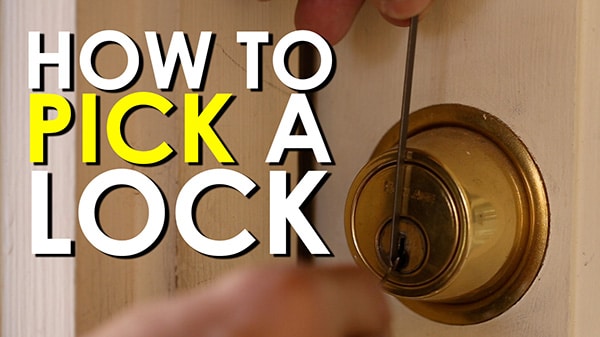
Below we walk you through basic lock-picking techniques for tumbler locks. I made a lock picking YouTube video a few years ago that shows how to do this step-by-step.
There’s a common misconception that the only people who can legally own lock-picking tools are first responders or licensed locksmiths. The reality is that in most states, as long as you’re not trying to illegally enter someone’s home with your lock-picking set, you can legally own, carry, and use lock-picking tools.
There are, however, some states that have laws that make owning lock-picking tools prima facie evidence of criminal intent. If you’re caught with picks in these states and you want to avoid criminal charges, you have to prove that you didn’t plan on committing a crime.
Long story short: owning lock-picking tools and learning how to pick locks is perfectly legal and ethical as long as you do so without nefarious intent. Just be a decent human being. For a summary of lock-picking laws across the country, see here.
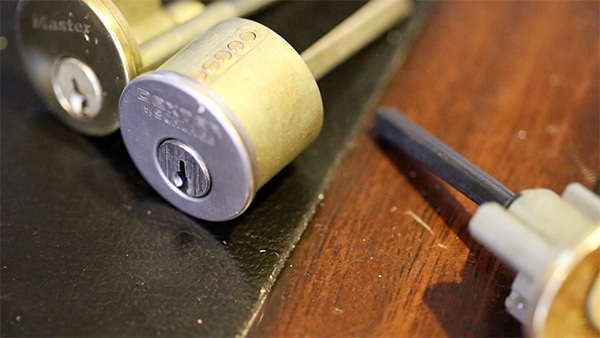
Pin tumbler locks are the most common locks found on the front doors of homes. So it makes for a good first lock to learn how to pick.
You don’t really need to understand how basic pin tumbler locks work to successfully pick them, but it does help.
The design of the basic pin tumbler lock has been in use since 4000 BC. Of course, it’s gotten more complex over the millennia. The design that is used in most cylinder locks — like the one on your front door — has been around since 1861, and it hasn’t changed much. Basically, most of the world is using a technology that’s been around for a century and a half to keep their most prized possessions safe and secure.
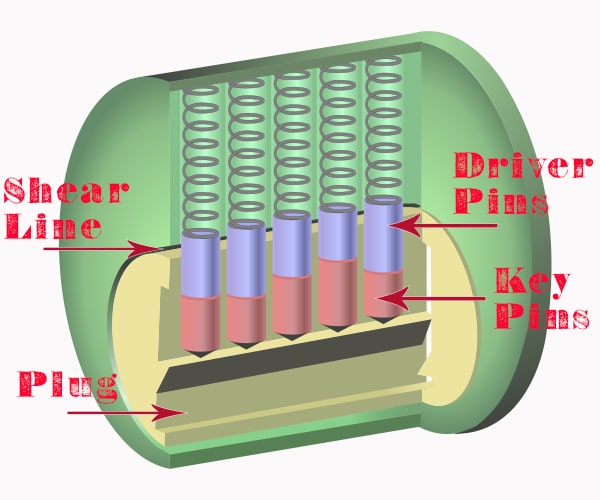
Here’s the anatomy of most run-of-the-mill pin tumbler locks:

Pin tumbler locks consist of an outer cylindrical casing (colored green) in which a plug is housed. The small gap between the outer casing and the plug is called the shear line. Remember that. It will come in handy here in a bit. The plug has an opening for the key. When the proper key is inserted into the plug, the plug can rotate, thus unlocking the lock. On top of the plug, a series of five or six holes are drilled. The holes contain key pins (colored red) of different lengths. They’re called key pins because they touch the key when you insert a key into the plug. Above each key pin is a driver pin that’s spring-loaded. Pins are also sometimes referred to as “binding pins.”
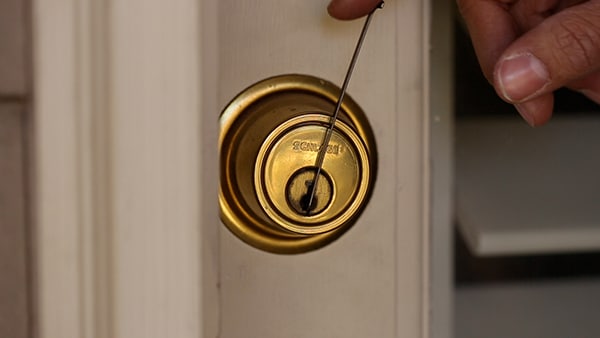
So you have an idea of how the pins look in action, here’s a gif of me inserting a pick into a see-through practice lock:

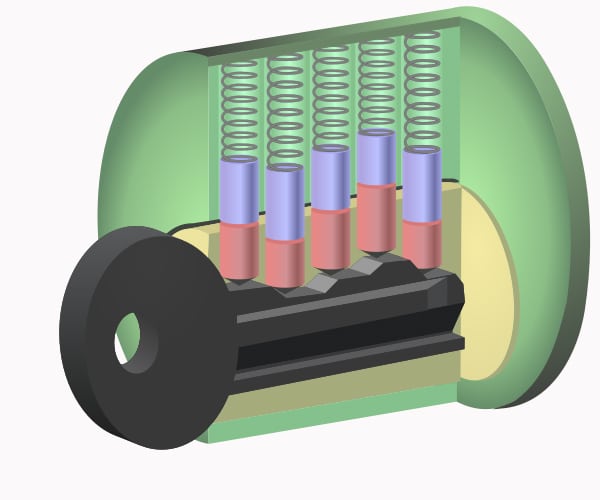
In the diagram above, there’s no key in the plug. Because of the different key pin lengths, the driver pins cross the shear line, making it impossible for the plug to rotate. If you put a wrong key into a lock, the notches on the key won’t lift up the key pins at the right height, causing them to protrude through the shear line as you can see in the diagram below:

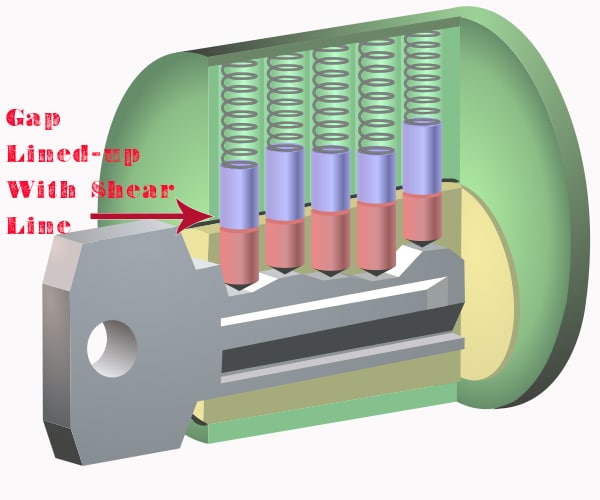
In order for the plug to rotate, you need to lift each of the key pins and driver pins to the correct height — until the gap between the key pins and driver pins reaches the shear line. When all of the pins reach this position, the plug can rotate. That’s what happens when you put a properly cut key into a lock:

Pretty simple, huh?
When you pick a lock, all you’re doing is using tools, instead of a key, to line up the gap between the key pins and driver pins with the shear line between the outer casing and the plug. That’s it. And it’s super easy to do.
There are various tools you can use to pick a lock. For this post, we’re going to focus on using the most common lock-picking tools: a tension wrench and pick rakes.
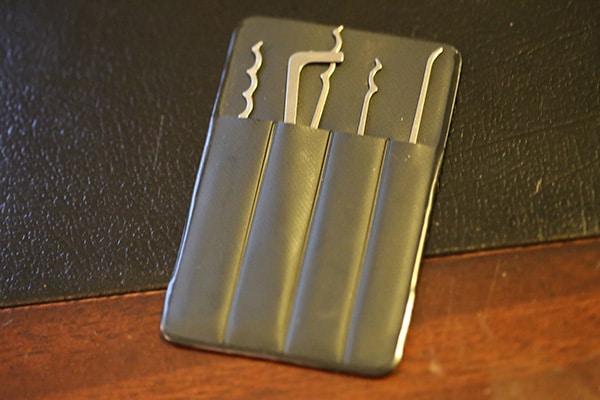
Below is my wallet-sized lock-picking set that I got from SEREPick while I was at the ITS Muster. The picks are made of titanium. There’s one tension wrench and several rakes with different numbers of ridges, which allow you to pick several pins at a time. There’s also a pick that allows you to pick one pin at a time. Some locks will require you to do that.

If you’re looking for something a little sturdier and robust, you can find lock-picking sets several places online (even Amazon). If you want to be even more of a MacGyver, you could even make your own picks from a windshield wiper.
You can also use a paperclip to pick a lock. Check out our article on how to pick a lock with a paperclip.
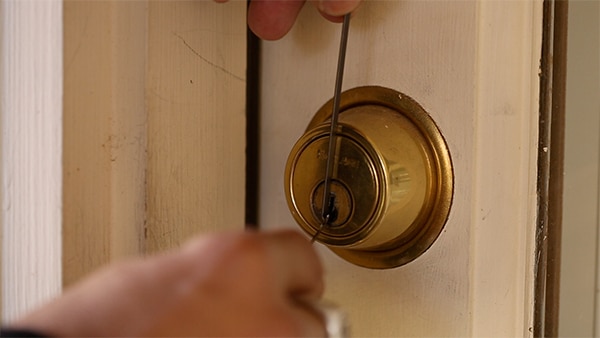
Lock picking is more art than science. You definitely have to develop a “feel” for it. Each lock is different, but the same basic principles apply. The easiest way to pick a lock is to use the fast and dirty method: scrubbing.
1. Insert Tension Wrench into the Bottom of Key Hole and Apply Slight Pressure

The tension wrench is the key (no pun intended) to successfully picking a lock. Thanks to video games, people wrongfully think it’s the pick, because that is the thing that’s actually lifting the key pins to line up with the shear line.
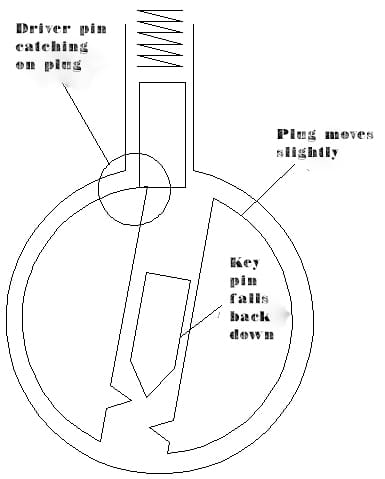
Here’s why the tension wrench is so important: as you’re lifting the pin sets with your pick you need to apply tension on the plug. If you’re applying the right amount of torque on the plug, once the driver pin passes the shear line, the plug will rotate slightly. When you pull your pick out, the key pin will drop back down, but the driver pin will catch the edge of the plug, thus staying above the shear line. Here’s a diagram of what it looks like:

You’ll keep lifting pins with your pick and applying pressure with your tension wrench, until all the driver pins have cleared the shear line.
So far so good? Alrighty.
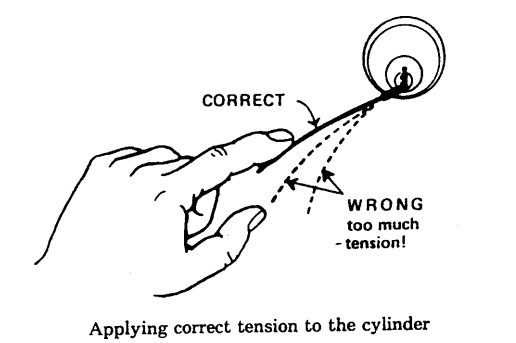
So take your tension wrench and place it in the bottom of the key hole. Apply slight pressure in the direction you would turn the key if you had it. And by slight I mean slight. If you apply too much pressure, you’re just going to cause the driver pins to bind below the shear line. You need to have enough give to let the driver pins rise above the shear line, but have enough torque that when they start dropping down, an edge of the drive pin catches the plug as it starts to rotate.
How much is too much pressure? If your tension wrench is bending a lot, then you’re probably applying too much pressure. So lean on the side of applying less pressure than more.
2. Insert Pick at Top of Lock

Pick your pick. I prefer the Bogota rake that has three ridges. This one has picked every lock that I’ve used it on very easily.
Slide the rake all the way to the back.
3. While Applying Slight Torque to Your Wrench, Scrub Your Pick Back and Forth in the Key Hole
Keep applying that slight pressure on your tension wrench. I use my left hand for that. With your right hand, scrub or rake the inside of the plug with your pick. As you pull the pick back, simultaneously lift up in order to apply pressure on the pins. It looks sort of like this motion:

4. Repeat Until All the Pins Set
Keep applying torque on your wrench and scrubbing the pins until they all set. You may need to apply more torque and pressure on the pins with your pick as you get near the last one or two pins that need to set. If you’re not making any progress, you probably applied too much torque with the wrench. Relax, let the pins reset, and start over again, focusing on not using too much pressure.
That’s it! Really. That’s all there is to it. You can successfully pick most pin and tumbler locks using this scrubbing method.
You may run across locks that require a little bit more finesse by picking each pin set one at a time. In these trickier locks, you may need to get more methodical by looking for the pin stack that resists the most and picking it first and then repeating the process until all the pins are successfully picked.

Like I said above, lock picking is more art than science. The best way to learn how to do it is to simply pick locks as much as possible. Buy yourself different pin and tumbler locks at the hardware store and keep them on your desk or by your couch. When you’re taking a break from work or while you’re watching TV, practice picking. I’ve got three or four locks in my drawer that I’ll bust out during the day for practice sessions.
You’re one step closer to becoming Jason Bourne. Remember, use this knowledge for fun or for legal entries. If you’re going to burgle, only burgle hamburgers. Robble, robble.
What can I pick a lock with?
Your best bet is a lock-picking set that includes a tension wrench and a set of rakes. My favorite is the set from SEREPick. In a pinch, you could fashion some lock picks with a paper clip, bobby pin, or even windshield wiper blades. In my experience, picking a lock with paper clips is more difficult because they have a tendency to break in the lock.
Is lock picking legal?
Depends on which country or state you live in. In most instances, as long as you’re picking a lock and don’t have criminal intent, you’re fine. In some states, owning a set of lock picks is prima facie evidence of criminal intent and things get more complicated. Be sure to check local laws before buying a lock-picking set.
Can you pick a lock with a credit card?
Not tumbler locks. But some locks on internal doors can be opened by jimmying a credit card between the lock and the door. Here’s how to use a credit card to open these doors.
Further Reading
If you want to get more in-depth in the art of lock picking, check out these two sources:
CIA Lock Picking Field Operative Training Manual
The MIT Guide to Lock Picking (This baby goes really in-depth into the mechanics and physics of why we’re able to pick locks. Very thorough. Definitely recommend reading it