Webster

The Constitution was made to guard the people against the dangers of good intentions." --American Statesman Daniel Webster (1782-1852)


Showing posts sorted by relevance for query Greece. Sort by date Show all posts

Tuesday, August 13, 2019

Greece wants Raparations for WWII

I first blogged about Greece and Debt in 2012 shortly when I started blogging.  I have blogged about Greece quite a bit, especially in the beginning because of the debt issues.  Greece was forced to institute "Austerity" measures to get the money from the EU and Germany is the economic powerhouse and they are calling most of the shots.  Now apparently Greece is asking for reparations from Germany for war damages from WWII.  I have severe issues with this.  Germany was decimated by WWII and they rebuilt themselves after the war.  Greece had the same opportunity and seemed to squandered their opportunity and now they are trying to get more stuff From Germany after the bailout.  Greece has promised more than they can deliver to their citizens and now they are passing the cup to Germany.   Now Greece is wanting even more money from Germany.  If I was the Germans, I would say "Nein".  "Dis hund nicht Jagt" or this dog don't hunt.   


I was reading this article, I have been harping on debt almost as soon as I started blogging.  The E.U thinks that they bailed out Greece, but they basically kicked the can down the road.  Greece will not implement the austerity measures, the politicians have promised soo much free stuff to the population, now the bill is coming due and the population are angry.  They still want all their "free stuff" that has been promised.  The same thing will come here in a few years when the democrat base want their free stuff and the spigot shuts off.
     Something that I noticed in this article is that the government will legislate to force the bondholders to eat the loss.  This disturbs me on several levels  The government will legislate you to lose your money to accept a political settlement?   What happened to the rule of contract law? What about the indenture terms?  The government by imperial fiat made a decree and removed the collective action clause.   What does this do for the bond market?  I guarantee private investors will dump bonds as soon as they are able.  People buy bonds for investments and as a way to save their money in a volatile market.  After this and the imperial edict, they will bail.


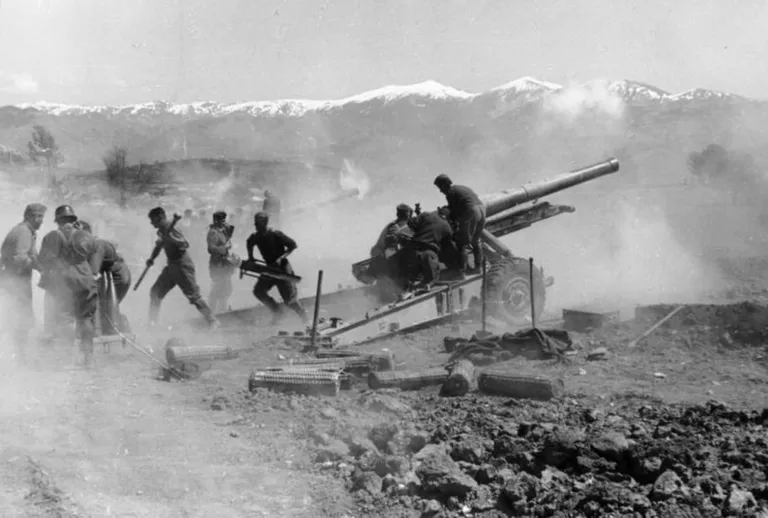
German artillery fires during the advance through Greece, 1941. Bundesarchiv

Left-wing politicians in Greece are pushing for Germany to pay reparations for the damages it caused during World War II. The parliamentary committee has called for a debate on the subject.
For its part, Germany has refused to entertain the notion that it owes anything to Greece. They have refused to pay and have refused to even negotiate with Greece.
But experts in Germany’s Parliament have released a report that undermines the German government position.
The Scientific Services of the Parliament released their findings which were commissioned by the Left Party. In part, the report states that the government is not violating international law by their position, but it is “by no means compulsory.” The report further recommends taking the case to the International Court of Justice to receive legal guidance in the matter.

When the Wehrmacht withdrew from Greece in October 1944 after three and a half years of occupation, it literally left behind “scorched land”: the economy, currency and infrastructure were completely destroyed.
The court at the Hague cannot on its own take up the case since the actions in question occurred over 70 years ago. The German government would need to agree to the process which it has explicitly rejected.
Back in June, the Minister of State at the Federal Foreign Office was asked about the Greek demands and he stated that neither side wished to have the International Court of Justice settle the question.
The Left Party’s deputy, Heike Hansel, said that the report showed that the German government is no longer able to avoid their responsibility for the past actions of the country. He continued by stating that the German government had “completely failed on this issue.”
The government’s position is that all WWII issues were resolved in 1990 with the Treaty on the Final Settlement with Respect to Germany (also referred to as the Two Plus Four Agreement).
The treaty was signed by both East and West Germany. Those are the “Two” in the “Two Plus Four.” The “Four” who signed were the US, the USSR, France and the UK. It allowed for Germany to become a unified and fully sovereign country.
For its part, Germany accepted its current border with Poland and renounced the other claims it had made to territory.
Reparations were not included in the agreement and Greece was not a party in the negotiations for the treaty.
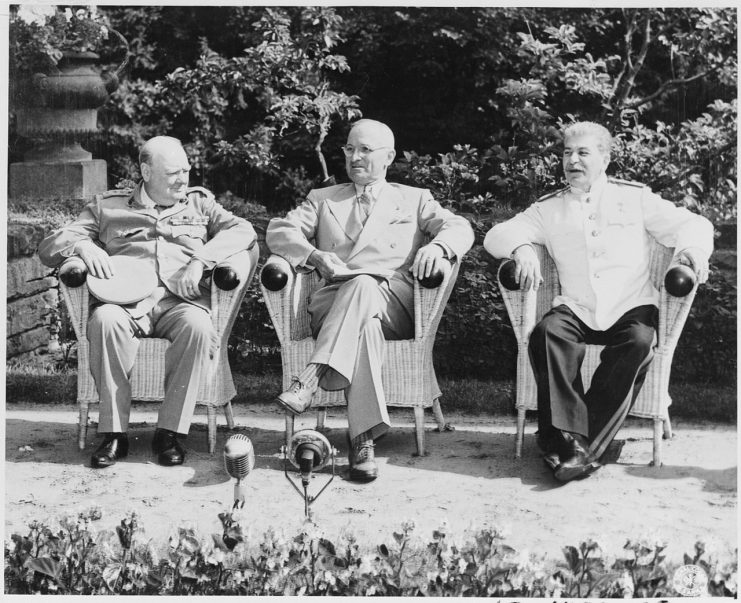
Germany points to the 1945 Potsdam Conference as resolving the question of reparations. The Soviet Union settled the reparation claims of its satellite countries in large part by supplying them with industrial equipment. For their part, the other Allied countries resolved to settle the reparation claims of other countries by dividing up German industrial and naval assets.

The big three.
                                         The big three at Potsdam
Germany also signed an agreement with twelve other nations in the 1950s. Greece was included in this agreement and received 115 million Deutsche marks in 1960 as the final settlement to its claims.
Germany has spent 76 billion euros to compensate for the crimes its Nazi leaders committed in WWII.
What remains to be seen is whether the new government in Greece which was elected on July 7 will continue to push Germany for the reparations.
Prime Minister Kyriakos Mitsotakis, who was elected on July 7, is expected to make his first trip to Germany.
Poland is also demanding reparations from Germany. Between the two countries, $1.2 trillion in claims are being levied against the Germans.
Poland is expected to release a report on September 1 which coincides with the 80th anniversary of the start of WWII. The report is expected to demand $850 billion from the Germans.
Of course, all this posturing is mainly a way for politicians in the two countries to grab the attention of their voters. The current ruling party in Greece ran on a platform of getting justice from Germany and reducing the country’s debt. They have thus far achieved neither goal so they need to show the voters that they are still working on the issues.

Tuesday, February 21, 2012

E.U Agrees to a bailout of Greece to the tune of 172 billion EURO

I was reading this article, I have been harping on debt almost as soon as I started blogging.  The E.U thinks that they bailed out Greece, but they basically kicked the can down the road.  Greece will not implement the austerity measures, the politicians have promised soo much free stuff to the population, now the bill is coming due and the population are angry.  They still want all their "free stuff" that has been promised.  The same thing will come here in a few years when the democrat base want their free stuff and the spigot shuts off.
     Something that I noticed in this article is that the government will legislate to force the bondholders to eat the loss.  This disturbs me on several levels  The government will legislate you to lose your money to accept a political settlement?   What happened to the rule of contract law? What about the indenture terms?  The government by imperial fiat made a decree and removed the collective action clause.   What does this do for the bond market?  I guarantee private investors will dump bonds as soon as they are able.  People buy bonds for investments and as a way to save their money in a volatile market.  After this and the imperial edict, they will bail.


By Annika Breidthardt and Jan Strupczewski
BRUSSELS (Reuters) - Euro zone finance ministers agreed a 130-billion-euro ($172 billion) rescue for Greece on Tuesday to avert an imminent chaotic default after forcing Athens to commit to unpopular cuts and private bondholders to take bigger losses.
The complex deal wrought in overnight negotiations buys time to stabilize the 17-nation currency bloc and strengthen its financial firewalls, but it leaves deep doubts about Greece's ability to recover and avoid default in the longer term.
After 13 hours of talks, ministers finalized measures to cut Athens' debt to 120.5 percent of gross domestic product by 2020, a fraction above the target, securing a second rescue in less than two years in time for a major bond repayment due in March.
"We have reached a far-reaching agreement on Greece's new program and private sector involvement that would lead to a significant debt reduction for Greece ... to secure Greece's future in the euro area," Jean-Claude Juncker, who chairs the Eurogroup of finance ministers, told a news conference.
Greece will be placed under permanent surveillance by an increased European presence on the ground, and it will have to deposit funds to service its debt in a special account to guarantee repayments.
The 5 a.m. deal (0400 GMT) was hailed as a step forward for Greece, but experts warned that Athens will need more help to bring its debts down to the level envisaged in the bailout and will remain worryingly "accident prone" in coming years.
By agreeing that the European Central Bank would distribute its profits from bond-buying and private bondholders would take more losses, the ministers reduced Greece's debt to a point that should secure funding from the International Monetary Fund.
Italian and Spanish bond yields fell amid relief among investors that a threat to the wider euro zone had been avoided, although expectations of an agreement had been largely priced into foreign exchange and stock markets.
"It's an important result that removes immediate risks of contagion," Italian Prime Minister Mario Monti told a news conference.
"A nightmare scenario was avoided," said Greek Finance Minister Evangelos Venizelos in Athens. "It is maybe the most important (deal) in Greece's post-war history."
While the deal provides time for the euro zone to put new crisis measures in place over the coming months, it means Greece will struggle for years without economic growth.
The austerity measures imposed on Athens are widely disliked among the population and will put pressure on politicians who must contest an election expected in April.
Further street unrest could test politicians' commitment to cuts in wages, pensions and jobs. Greece's two biggest labor unions called a protest in Athens on Wednesday.
An opinion poll taken just before the Brussels deal showed that support for the two mainstream parties backing the rescue had fallen to an all-time low while leftist, anti-bailout parties showed gains.
Anastasis Chrisopoulos, a 31-year-old Athens taxi driver, saw no reason to cheer the deal.
"So what?" he asked. "Things will only get worse. We have reached a point where we're trying to figure out how to survive just the next day, let alone the next 10 days, the next month, the next year."
Conservative leader Antonis Samaras, a strong contender to become next prime minister, said the rescue package's debt-reduction targets could only be met with economic growth.
"Without the rebound and growth of the economy ... not even the immediate fiscal targets can be met, nor can the debt become sustainable in the long-term," he said during a visit to Cyprus.
Parliaments in three countries that have been most critical of bailouts - Germany, the Netherlands and Finland - must now approve the package. German Finance Minister Wolfgang Schaeuble, who caused an outcry by suggesting that Greece was a "bottomless pit," said he was confident it would be passed.
STUCK IN TRAGEDY
Many economists question whether Greece can pay off even a reduced debt burden, suggesting the deal may only delay a deeper default by a few months.

"I don't think we should consider that they are cleared of any problems, but I do think we've reduced the Greek problem to just a Greek problem. It is no longer a threat to the recovery in all of Europe, and it is another step forward."
Jennifer McKeown, senior European economist at Capital Economics, said: "The austerity measures it will have to implement and increased monitoring by the troika amidst public outrage will make things harder and drive it deeper into recession. There is a risk of a euro zone exit later this year."
A return to economic growth in Greece could take as much as a decade, a prospect that brought thousands onto the streets of Athens to protest on Sunday. The cuts will deepen a recession already in its fifth year, hurting government revenues.
"We sowed the wind, now we reap the whirlwind," said Vassilis Korkidis, head of the Greek Commerce Confederation. "The new bailout is selling us time and hope at a very high price, while it doggedly continues to impose harsh austerity measures that keep us in a long and deep recession."
EXTRA RELIEF
A report prepared by experts from the European Union, European Central Bank and International Monetary Fund said Greece would need extra relief to cut its debts near to the official debt target given the worsening state of its economy.
If Athens did not follow through on economic reforms and savings to make its economy more competitive, its debt could hit 160 percent by 2020, said the report.
"Given the risks, the Greek program may thus remain accident-prone, with questions about sustainability hanging over it," the nine-page confidential report said.
The beefed-up monitoring of implementation of the reforms could bolster accusations among some Greeks of interference in domestic affairs but some critics say that is essential.
Dutch Finance Minister Jan Kees de Jager, one of Athens' most strident critics, told Dutch news agency ANP he had bargained hard for the permanent monitoring mission.
"This program is not something to cheer about," he said.
BOND SWAP
The accord will enable Athens to launch a bond swap with private investors to help put it on a more stable financial footing and keep it inside the euro zone.
About 100 billion euros of debt will be written off as banks and insurers swap bonds they hold for longer-dated securities that pay a lower coupon.
Private sector holders of Greek debt will take losses of 53.5 percent on the nominal value of their bonds. They had agreed to a 50 percent nominal writedown, which equated to around a 70 percent loss on the net present value of the debt.
Juncker said he expected a high participation rate in the deal, a view echoed by the German banking association.
Greece said it would legislate to allow it to enforce losses on bondholders who do not take part voluntarily.
Euro zone central banks will also play their part.
A Eurogroup statement said the ECB would pass up profits it made from buying Greek bonds over the past two years to national central banks for their governments to pass on to Athens "to further improve the sustainability of Greece's public debt."
The ECB has spent about 38 billion euros on Greek government debt with a face value of about 50 billion euros.
The private creditor bond exchange is expected to launch on March 8 and complete three days later, Athens said on Saturday. That means a 14.5-billion-euro bond repayment due on March 20 would be restructured, allowing Greece to avoid default.
The vast majority of the funds in the program will be used to finance the bond swap and ensure Greece's banking system remains stable; some 30 billion euros will go to "sweeteners" to get the private sector to sign up to the swap, 23 billion will go to recapitalize Greek banks.
A further 35 billion or so will allow Greece to finance the buying back of the bonds. Next to nothing will go directly to help the Greek economy.
(Additional reporting by Luke Baker, Julien Toyer, Robin Emmott in Brussels, Daniel Flynn in Paris, Terri Kinnunen in Helsinki, Sarah Marsh in Berlin, Harry Papachristou and George Georgiopoulos in Athens, and Michele Kambas in Nicosia; Writing by Giles Elgood; Editing by Pau

Wednesday, June 29, 2011

Can it happen here?

 I got this from here

   I will highlight certain key passages that I believe are pertinent and relevant.


Blood In The Streets

June 29, 2011 by John Myers
Blood In The Streets
PHOTOS.COM
On June 15, riots broke out in Athens, Greece. On Tuesday, violence erupted again.
The headline above once pertained to bear markets and the pounding investors would take.* Nowadays, real blood is being spilled in Western democratic cities like Vancouver, Canada, and Athens, Greece. With America’s economy stuck in recession and with the dismal and arrogant leadership provided by President Barack Obama and Congress, it is not hard to imagine similar violence in American cities.
Such an idea would have seemed preposterous four years ago. But that was before the financial crisis of 2008. For three years, anger has been building — and not just in places like the Middle East where violence is as much a part of their culture as the Quran.
On June 15, riots broke out in Athens, the birthplace of democracy. On Tuesday, violence erupted again. The outbursts were ignited by further austerity measures ordered by the Greek government.
The free lunch Greek citizens have been getting for decades is being ripped off the table. The country has already gobbled up the first $139 billion European Union-led bailout. Any talks on a second bailout for Greece hinge on a further belt-tightening. The people of Greece, raised on socialist handouts, are in no mood to stay on a diet.
On June 15 and again Tuesday, protestors poured onto the streets throwing rocks at Parliament. Riot police finally quelled the unrest, but more violence is expected.
Last week, Greece was hit by rolling blackouts as workers at the main power utility began 48-hour rolling strikes to protest the company’s privatization, part of austerity plans needed to avoid a national debt default.
Selling off assets in the utility is a step the socialist government in Athens must take in its $71 billion privatization plan, which must be completed by 2015. The Greek people don’t want spending cuts and higher taxes. But the Greek Parliament is staring down the barrel of a gun. If it doesn’t implement changes by the end of the month, the country will not get the last $17 billion of bailout money.
To ease the crisis in Greece, EU finance ministers agreed to raise the amount of money they will provide for countries drowning in debt. The move is a last-ditch attempt to keep Greece’s financial crisis from spreading to Ireland and Portugal.
All of this has international bankers worried. Last week, Canada’s finance minister, Jim Flaherty, warned there is still “a real danger” of contagion from the ongoing debt crises in Europe, including the possibility of some damage to the country’s banking system.
“Canada is not an island — no country, any more, is an island — our economies are clearly interrelated,” Flaherty said at a breakfast appearance in Toronto following emergency discussions with other G7 countries.

It’s All Greek To Me

Flaherty should also worry about Canada’s homegrown rioters.  The same day Athens was burning, so was Vancouver.
On the evening of June 15, the team favored to win Game 7 of the Stanley Cup Finals, the Vancouver Canucks, lost. The Cup went to the Boston Bruins, who did not cheat their way to the NHL Championship or get help from the referees. They simply were the better team.
Like most sports fans, I am often brokenhearted. At the conclusion of most seasons, I say, “Wait until next year!” But thousands of Vancouver Canuck fans didn’t say that. Instead, they said things like: “Let’s blow up cop cars; let’s beat up bystanders; and let’s throw bricks though windows!” And that is exactly what they did.
More than 100 rioters were arrested by Vancouver police; as many as 1,000 people could face criminal charges. The dragnet will be aided by the audacity of the looters who photographed and videotaped their rampage and then displayed it on social media websites like Facebook.
The physical cost for the few hours of rioting is more than $1 million, but experts say the long-term damage to Vancouver’s tourist industry could be billions of dollars.
As in Athens, the rioters in Vancouver were mostly gangs of youths bent on creating chaos. This begs two questions:
  1. What would happen in a city like Vancouver if the fledgling economic recovery collapses and the citizens face hardship?
  2. What are the chances this kind of violence will erupt in the United States?
On FoxNews.com, Bill O’Reilly wrote: “The question is: Could this kind of thing happen in America? And the answer is yes. About half the population here now believes income redistribution is the right thing to do. We’re setting the table for violence in this country. Once people start depending on the government for their livelihood, for essentials, and then those essentials are taken away, you’re going to have violence. Also, the more loons there are, the more potential for violence there is. Those anarchists want to burn down everything.
“So we can watch this stuff in Vancouver and Greece, but we shouldn’t think it can’t happen here. The pinheads in America are mounting.”

Before you dismiss O’Reilly as a fearmongering right-wing extremist, it is worth noting that someone on the far left is also frightened of chaos coming to America. Democratic strategist James Carville spoke out about civil unrest that might spring from a still-sick U.S. economy on Don Imus’ syndicated radio show, Imus in the Morning.
“(The recession) is a terrible thing that has happened to people’s lives… If 54,000 (new) jobs is the new norm – this is going to be very, very tough. Some people say it just might be one more thing. We don’t know.”
Carville added that the consequences of America’s continuing financial crisis will not be limited to politics, and he warned of civil unrest because of the bleak economic situation.
“People, you know, if it continues, we’re going to start to see civil unrest in this country. I hate to say that, but I think it’s eminently possible.
Carville and O’Reilly have agreed on something. If you don’t believe in the possibility, you would have to be naïve. Economic collapse almost always leads to civil strife. What the Vancouver riots demonstrated is that citizens today are spoiled and think they are entitled to whatever they expect.
I have a feeling the world’s staggering economic recovery is about to fall over dead. And not just for Greece. When that occurs, punks like those who rioted in Vancouver will have a lot more to be upset about than the fact their hockey team didn’t win.
Action to take: Take precautions for you and your family should there be violence in and around your neighborhood. Store extra food and water and have your home well secured. Also take whatever defensive measures you feel are prudent. Secure cash on hand and safely inside your home as well as physical gold and silver.
Yours in good times and bad,
–John Myers
Editor, Myers’ Energy & Gold Report

Tuesday, May 15, 2012

Greece unable to form government


By Dina Kyriakidou and Paul Taylor
ATHENS/PARIS (Reuters) - Attempts to form a government in Greece collapsed on Tuesday, jolting financial markets at the prospect that leftists opposed to the terms of an EU bailout could sweep to victory in a June election and tip the euro zone deeper into crisis.
The turmoil in Athens sent shock waves around other troubled members of the 17-nation European single currency area. The euro slipped below $1.28, world stocks slid and Spanish and Italian bond yields rose above the danger level of 6 percent as investors scurried for shelter in safe haven German Bunds.
The tremors from Greece, compounding worries about Spain's debt-laden banking system, ended any honeymoon for new French President Francois Hollande, thrusting the growing risks to the euro zone to the top of the agenda for his first meeting with German Chancellor Angela Merkel hours after he took office.
In his inaugural address, the Socialist president called for a European pact to revive growth and temper German-driven austerity measures, seeking to change the direction of euro zone economic policy.
"I will propose to our partners a pact that will tie the necessary reduction of our public debt to the indispensable stimulation of our economies," Hollande declared, saying Europe needed "projects, solidarity and growth".
The French leader's aircraft was struck by lightning shortly after takeoff from a military airport near Paris en route for Berlin, forcing him to turn back and take a substitute plane.
In Athens, President Karolos Papoulias abandoned efforts to broker a compromise on a cabinet of technocrats to steer the country away from bankruptcy, nine days after an inconclusive general election. A caretaker government will now be formed pending a new vote probably in mid-June.
"We resisted in every way," said Alexis Tsipras, leader of the hard-left SYRIZA party, which surged to second place in last week's election on an anti-austerity platform and blocked any deal with pro-bailout mainstream parties.
"We made the decision to not betray your hopes and your expectations," said Tsipras, emboldened by opinion polls showing his party could top the poll in a second vote. "Now it's time to complete it: We will consign in the dustbin of history all the spent forces of the past.
Euro zone finance ministers dismissed talk of Greece leaving the single currency area as "propaganda and nonsense" on Monday. But with hostility to EU/IMF-imposed austerity rising in Greece, speculation about a possible state bankruptcy and euro exit is rattling financial markets and won't go away.
IMF chief Christine Lagarde said it was important to be technically prepared for the possibility of Greece leaving the euro zone, warning that such a move would be "quite messy" with risks to growth, trade and financial markets.
Finnish Prime Minister Jyrki Katainen openly discussed the prospect, telling broadcaster MTV3: "If Greece were to leave the euro it would probably not cause a significant financial crisis that would have happened a couple of years ago.
"But on the other hand, we would have other problems. What kind of impact would it have on European economic development, on Spain's, Italy's economies, would market begin to speculate about other euro countries leaving? Naturally it would have an impact on the stability of Greek society."
MORE TIME?
Averting an immediate default, Greece made a key payment to bondholders who rejected an earlier debt exchange, a move likely to upset the vast majority of creditors who accepted just cents on the euro in a historic bond swap in March.
The outgoing government opted to pay 435 million euros ($552 million) of a May 15 bond to investors who had refused to exchange their debt, despite having insisted that those who rejected the swap would get nothing.
Sworn in with all the pomp of the French Republic, Hollande won support from Germany's opposition Social Democrats (SPD), who vowed to use their parliamentary blocking power to delay ratifying a European budget discipline treaty until Merkel accepts accompanying measures to boost growth and jobs.
Hollande's inauguration with military honors, capped by an open-topped motorcade ride up the Champs Elysees to the Arc de Triomphe in a torrential downpour, marks a potential turning point in the euro zone's debt crisis.
EU officials hope his election will revive proposals for radical steps to overcome the debt crisis such as issuing joint euro zone bonds, which Merkel has so far blocked.
Some policymakers believe it could also lead to heavily indebted member states that are in the grip of a recession being given more time to meet their EU budget balancing targets.
Markets and policymakers are watching the dialogue between the conservative German chancellor and the centre-left French leader for signs that they can overcome their differences on Merkel's drive for austerity and lead the euro zone together.
In Berlin, the Social Democrats, invigorated by their victory over Merkel's Christian Democrats (CDU) in a major regional election on Sunday, said growth measures must go beyond the structural economic reforms advocated by the chancellor.
"That is not our definition of growth nor that of the Socialists in France," said SPD Chairman Sigmar Gabriel.
A senior Merkel ally, CDU parliamentary whip Peter Altmaier, said that while he expected no concrete decisions to be taken at the first Merkel-Hollande meeting, he was confident the euro zone's two most powerful economies would reach a joint position on growth measures in time for an EU summit next month.
"It is important that we study each others' proposals. But I am sure that we will be able to agree a common Franco-German approach by the end of June at the latest," Altmaier told Reuters in an interview.
Despite the SPD's threat, Altmaier said he expected the German parliament to approve the European fiscal compact before the summer recess, which requires some opposition votes to provide the necessary two-thirds majority.
"HOMER" AFTER "MERKOZY"?
Merkel and former French President Nicolas Sarkozy, who left office on Tuesday, had dominated euro zone crisis management since the debt turmoil began in late 2009, earning the nickname "Merkozy" for their sometimes disputed leadership.
Her relationship with Hollande, which one French pundit has already dubbed "Homer" perhaps due to its Greek challenge, may initially be cool as they are from opposing political families.
But the chancellor has promised to welcome the Socialist "with open arms" and the two calm, methodical leaders may be better suited temperamentally than the calculating Merkel and the impetuous, hyperactive Sarkozy.
Hollande has said he will press Berlin to lift its veto on issuing common euro zone bonds to harmonize borrowing costs within the currency area, or to allow the European Central Bank to lend directly to governments.
Both ideas are "red lines" for the centre-right German government, although Merkel has not ruled out euro zone bonds as a long-term prospect if Europe takes more steps towards a tighter political and fiscal union.
Surprisingly strong first quarter growth figures for Germany relieved pressure on shares and the single currency on Tuesday, but worries about the deepening impact of the euro area crisis and a possible Greek exit kept demand for safe-haven assets strong.
The German economy grew 0.5 percent in the first three months of the year, well ahead of forecasts due to a big rise in exports, but weakness elsewhere in the region meant the euro zone stagnated in the first quarter.
(Additional reporting by Catherine Bremer and Brian Love in Paris, Noah Barkin and Andreas Rinke in Berlin, Jan Strupczewski in Brussels and Richard Hubbard in London; Writing by Paul Taylor; Editing by Giles Elgood and Janet McBride)

Saturday, March 5, 2011

Thermopylae

This is a worthy event to investigate, for anyone interested in the Warrior Ethos. http://www.stevenpressfield.com/   

    I read his book "Gates of fire"  the movie 300 was based on it.   It is one of my favorite books

The Battle of Thermopylae (Greek: Μάχη τῶν Θερμοπυλῶν) was fought between an alliance of Greek city-states, led by Sparta, and the Persian Empire of Xerxes. The battle occurred during the second Persian invasion of Greece, at the pass of Thermopylae ('The Hot Gates'). The Persian invasion was a delayed response to the defeat of the first Persian invasion of Greece, ten years prior at the Battle of Marathon. Xerxes amassed a huge army and navy and set out to conquer all of Greece.


The Second Persion Invasion of Greece.


A Greek force of approximately 7,000 men marched north to block the pass in the summer of 480 BC. The Persian army (alleged by the ancient sources to have numbered one million but actually considered at between 100,000 and 300,000) arrived at the pass in late August or early September. Vastly outnumbered, the Greeks held off the Persians for three days in combat, before the rear-guard was annihilated in one of history's most heroic last stands. During two full days of battle, the small force led by King Leonidas I of Sparta blocked the only road by which the massive Persian army could pass. After the second day of battle, a local resident named Ephialtes betrayed the Greeks by revealing a small path that led behind the Greek lines. Aware that his force was being outflanked, Leonidas dismissed the bulk of the Greek army, and remained in a rearguard element of 300 Spartans, 700 Thespians, 400 Thebans and perhaps a few hundred others, the vast majority of whom were killed.

I had the opportunity to visit the site of the Battle of Thermopylae, while training with Greek Special Forces prior to the 2004 Olympics.


Simonides Monument on the Kolonos hillock, believed to be the actual location of the Last Stand.


Ω ΞΕΙΝ ΑΓΓΕΛΛΕΙΝ ΛΑΚΕΔΑΙΜΟΝΙΟΙΣ ΟΤΙ ΤΗΔΕ ΚΕΙΜΕΘΑ ΤΟΙΣ ΚΕΙΝΩΝ ΡΗΜΑΣΙ ΠΕΙΘΟΜΕΝΟΙ
"Go tell the Spartans, Passerby, that here, in accordance to their laws, Three Hundred lie."


At the time of the battle, Thermopylae was actually a pass between the mountains and the sea; control of this pass was critical to the Greek defensive strategy. Due to seismic activity, however, the shoreline has shifted, and the seas have withdrawn. A modern highway roughly follows the ancient shoreline.


A modern view of the pass at Thermopylae, viewed roughly from the area of the Spartan camp northward toward the Persian position. The modern road marks the ancient shoreline.


Thermopylae shoreline changes over the course of history.


Thermopylae is viewed by scholars as “the battle that changed the world”. The clash between the Spartans and other Greeks on one side, and the Persian horde on the other, was a clash between freedom and slavery. The Greek victories at Thermopylae Marathon, fought some ten years earlier, were turning-points not only in the history of Ancient Greece, but also of World History; subjugation to the Persians would have snuffed out Western Civilization in its infancy. In the mid-19th century, the economist John Stuart Mill described the battle of Marathon as “more important than the battle of Hastings, even as an event in English history”.


The modern monument of the Spartans with the bronze statue of Leonidas. An inscription reads Molon Labe; King Leonidas' reply to Xerxes demand that the Greeks lay down their arms: "Come and Get Them."

Monday, June 27, 2011

Are there really socialist?

I got this from PJ media
Two unconnected developments were announced this past week. President Obama is releasing oil from the Strategic Petroleum Reserve, despite the absence of a global embargo or horrific natural disaster — and despite a litany of assertions from 2008 that drilling and increased supply might only have a marginal effect on prices.
Like the sudden Afghan withdrawal announcement, the tapping is largely explained by political worries about reelection, as in increasing oil supplies to lower gas prices by election time — and thus avoiding campaign ads equating Obama’s opposition to drilling with high prices at the 2012 pump.
In a second piece of news, the Europeans seem to be winning far more plane orders than Boeing. One wonders whether that fact is remotely connected with airlines’ collective worries about obtaining orders on time and as specified — as in uncertainty whether Obama’s NLRB ruling that attempted to shut down a nearly $1 billion new aircraft line in South Carolina translates into something like “who knows what those Americans are doing next?”
All this raises some questions. The strangest things about the global statist crack-up are socialists’ unhappiness with their socialist utopia, and their subsequent efforts to avoid the consequences of the very redistributive state that they themselves once so gladly crafted.
Greece is the locus classicus. Why are the Greeks protesting? Against whom? They obtained long ago the promised bloated sector and high taxes that all schemed to avoid. Their alma mater EU is hardly a demonic capitalist-run plutocracy, but a kindred socialist state. Is Greece an oil producer, industrial powerhouse, high-tech innovator — anything that might explain the sort of upscale life, modern infrastructure, legions of Mercedeses, and plush second homes that one began to see in Greece after 1985?
In truth, socialist Greeks are furious that they have impoverished themselves and demand that private money and far harder-working Germans bail them out — but why so, when socialism should not need outside capitalist-generated dollars? Could not the Greeks, Soviet style, set up a Cuban collective, and adjust their lifestyles (there goes Kolonaki culture) to their means, living in an opportunity of result utopia with a huge public sector, more siestas, high but ignored taxes — with a collective good riddance to those awful intrusive German bankers?
Here at home, Obama got his ObamaCare. Why, then, did he grant hundreds of exemptions — many to northern California liberals? Should they instead not have lined up to volunteer to implement such a wonderful, long-needed entitlement?
He said energy would rightly sky-rocket, given his determination to curb fossil fuel production (cf. “bankrupt” coal companies). Why then is Obama concerned that gas hit $4; is not such a high price a welcomed retardant to burning hot fuels? The higher the gas prices, the more that subsidized wind and solar power, and electric cars are attractive, and thus the more we enjoy “sustainable” power. Right? Am I missing something about this desire within our grasp of “living within our means”?
Obama enjoyed big majorities in both houses of Congress; and on the campaign trail he had promised a de facto amnesty under the euphemism of “comprehensive immigration reform.” So why did he not grant such exemptions, and absorb 11, 15, or 20 million new “citizens” from Oaxaca? Is not that the point of amnesty, to welcome in new constituencies who will remember a benefactor at the polls?
We have heard that taxes, more taxes, and more taxes are the cure for the massive deficits, run up by out of control spending. OK, fine. But why then does multimillionaire John Kerry go to great lengths to avoid taxes on his yacht (why a luxury yacht when so many have so little?); why are redistributive overseers like Timothy Geithner, Eric Holder, Tom Daschle, Charles Rangel, and Hilda Solis either late or delinquent in paying the federal, state, or local governments what they owe? Were not high taxes on the upper incomes like themselves the point of it all? Should not they pay all they can to ensure that their brethren receive needed entitlements? I thought Bono would lead an international effort of multimillionaire rock stars to relocate to socialist states like Ireland or Greece, so that they might gladly pay 75% of their incomes (which at “some point” they had enough of) to help others closer to home. Why instead is he fleeing to low-tax nations? Did not such socialists have enough money by now without undermining the socialist state?


     More here

Friday, February 22, 2013

"Where to go...or not to go.... When Travelling"

I am taking a break from writing my congresscritters to make my opinion known about the gun control issues.  Write often, in paper and mail it.  It makes more of an impression.  And send it to the local offices, the congressman has staffers that man the location and this helps him/her have a pulse on the locals..Remember the first job of a congressman..is to get re-elected and pissing off the local is not a way to do it.

One of the benefits of my job besides being to swear at airplanes when they don't mind...Try doing that in a customer service job....been there and done that.   I have travel opportunities, when I was in the service, I travelled all over Europe(western) and East Germany including Berlin before the wall fell.  I saw this list from Yahoo Travel and several places on that list I wouldn't mind going, Israel, Greece, and Japan off that list.  I also would like to check out Russia St Petersburg and Volgograd(Stalingrad) and of course Moscow.  I have passport but the wife doesn't so I may start taking trips without her;) outside the country.    I will add my recommendations also besides what the author wrote...Mine will be in BOLD  The opinions by me are my opinion.  If other people have other good places to visit, Please add them to the list.

    Here is the list from Yahoo Travel:


(Photo: Andrew Kazmierski / Dreamstime.com)
Intrepid travelers like to push their limits—they'll test their stamina, language skills, and culinary daring in far-flung destinations around the globe. But we don't like to see anyone risk their personal safety on an ill-researched sojourn.

So, each year Budget Travel gives you the lowdown on some spots that should, at least for the near term, stay on your "don't bother" list, some that are a definite "maybe," and a few that you may be surprised to hear get a definite "yes."

Jersey Shore

Sure, you know that Superstorm Sandy hit the New Jersey coastline last fall, tearing up boardwalks, hotels, vacation homes, and beaches. What you may not know, however, is that "the shore" will be open for business this summer. In fact, Lori Pepenella, Long Beach Island's destination marketing coordinator, recently told the Newark Star-Ledger, "As businesses are investing and rebuilding, we're getting the message out that we're open right now." 

While rebuilding post-Sandy is a challenge, especially for areas such as Seaside Heights, whose boardwalk sustained serious damage, New Jersey's $38 billion hospitality industry depends on a thriving shore and everyone is sprinting toward a successful Memorial Day weekend. For those of you who thought this might be the summer to skip New Jersey's miles of family-friendly beaches, legendary boardwalks and amusement parks, and notorious party scene, local boosters are working hard to change your mind: Atlantic City is telling anyone who will listen that contrary to rumor, its boardwalk was not destroyed by the hurricane, and Long Beach Island has produced a video to promote its open-for-business status at visitlbiregion.com. 

To Go or Not to Go: Go.  What and get fleeced by the excessive taxes and fees?   and get treated like crap?

(Photo: iStockphoto)Cuba

For those of us who grew up during the Cold War, the question may still seem fanciful: Want to visit Cuba? But whereas the Caribbean island was once off-limits except to the most adventurous of American travelers (who would typically enter Mexico or Canada before flying to Cuba), it is now possible for U.S. citizens to see this amazing country by booking with a licensed tour operator that performs "people-to-people" trips. 

A package will include interaction with Cubans and classes in Cuban culture and history and should also include a visa, airfare, hotel, meals, and an experienced tour guide. They don't come cheap—week-long trips are often more than $2,000 per person—but are the best way to ensure that you comply with U.S. law and that you see the island in the safest way. While accurate crime statistics are not available from Cuba yet, the U.S. Department of State cautions visitors to be alert for pickpocketing, purse-snatching, and burglaries, but traveling with a licensed people-to-people tour guide will help minimize any danger.

To Go or Not to Go: Go, if you can afford a U.S.-approved people-to-people tour.  Costly but worthy of interest.


(Photo: Reiley / Dreamstime.com)
Spain

It's a sign of the economic times that a nation of Spain's stature could even make our list of questionable destinations. The final quarter of 2012 saw Spain's economic output drop 1.8 percent compared with last year, its worst performance since the global economic meltdown of 2009. As the country embraced an austerity program to bring down its budget deficit, demonstrators took to the streets, often meeting an aggressive response from the police.

In Barcelona, some demonstrators even demanded independence. It's important to keep all this in perspective, though: The U.S. Department of State has not issued a warning against visiting Spain, and the country still poses only the crime threats one might expect in any developed region: You need to be as aware of the potential for pickpocketing, mugging, and break-ins as you would when visiting, say,Italy or France. In addition, some of the advice the State Department has issued for visiting places likeGreece and Israel, where the potential for spontaneous public demonstrations is high, should be heeded when visiting Spain: Stay away from demonstrations (they are not spectactor sports, and passersby have been swept up in police actions in Barcelona), and check with your hotel's concierge for updates on the potential for unrest in your destination.

To Go or Not to Go: Go.  The exchange rate is favorable against the dollar, just avoid all the protest spots.


(Photo: Courtesy David Shankbone/Wikimedia Commons)
Israel

With some of the world's holiest sites, sacred to Jews, Muslims, and Christians alike, Israel is a one-of-a-kind destination. From the ancient streets of Jerusalem to the nightlife of Tel Aviv, this is a place where the past rubs elbows with the present like no other. Unfortunately, all that elbow-rubbing comes with a downside, and Israel has been the scene of religious tension, terrorist attacks, and flat-out war over the course of its 60-plus years. 

The U.S. Department of State strongly warns Americans not to visit the Gaza Strip and most areas of the West Bank (other than Jericho and Bethlehem), because of ongoing tensions and risks that can range from rock-throwing to rocket fire. On the other hand, major cities such as Haifa and Tel Aviv are as safe as any in the world, and Jerusalem, as long as you observe some common-sense rules, is an unforgettable experience that shouldn't be missed. While in Jerusalem, avoid street protests and approach religious sites with caution on holy days, Fridays, Saturdays, and Sundays because of potential congestion and security restrictions. As with any troubled region, you will feel most supported and informed if you travel with an experienced tour operator and stay in touch with the staff at your hotel about the potential for political and religious demonstrations.

To Go or Not to Go: Go, but avoid the West Bank and Gaza.  Historical alert...well worth it.  Just pay attention to your surroundings.

(Photo: Courtesy Mardetanha/Wikimedia Commons)
Mexico

Yes, millions of U.S. citizens visit Mexico safely each year, but as the U.S. Department of State points out, it's best to stick to major cities such as Mexico City and popular resort areas such as Los Cabos and destinations in Quintana Roo such as Cancun, Cozumel, Playa del Carmen, Riviera Maya, and Tulum, where the crime rate can actually be lower than in some U.S. cities.

But more adventurous travelers should spend some time at state.gov reviewing the warnings about visiting border regions and some Mexican states (including Tamaulipas, Michoacan, Sonora, Chihuahua, and others) that have seen heavy drug-trafficking activity, including daytime gun battles, carjackings, and kidnappings. Regardless of where you travel in Mexico, be prepared for the same risks you might encountering when visiting any American city.

To Go or Not to Go: Go, but only to major cities and resort towns.  Avoid the Border towns and Stick to the resorts if you go, 

(Photo: Chuongy / Dreamstime.com)
Japan
2012 saw an increase of 30 percent in tourism to Japan over the preceding year, according to the Japan National Tourist Organization. It's no wonder people stayed away in 2011: In March of that year the nation was rocked by the largest earthquake in its history, a magnitude 9 quake that destroyed buildings and triggered a tsunami on the island's northeast coast, causing the deaths of thousands and a meltdown at a major nuclear-power plant, including a release of dangerous radiation. But millions have returned to Japan in the past year, buoyed by the nation's swift recovery efforts. Today, major destinations such asTokyo are completely safe and 2013 may even set a record for visitors.

To Go or Not to Go: Go, as long as you avoid the area around the Fukushima Daiichi nuclear-power plant.  Enjoy the culture


(Photo: Mikael Damkier / Dreamstime.com)
Egypt
The political unrest that rocked Egypt two years ago, including public uprisings against then-president Hosni Mubarak, certainly put Egypt front-and-center on the world stage, and inspired some to delay travel plans to the north African nation. But sites such as the pyramids and Great Sphinx at Luxor, museums and historical sites in Cairo, and the beauty of the Lower Nile (now enjoying a resurgence in river cruises) still inspire waves of visitors, and the U.S. Department of State does not explicitly warn Americans away from Egypt. It does suggest that you stay away from public demonstrations, which can be unpredictable and sometimes turn violent. Visiting Egypt with an experienced tour guide, or staying in a major hotel whose concierge regularly monitors the potential for unrest, is your best bet.  

To Go or Not to Go
: Go, but, for now, stick with well-trod tourist sites such as Cairo and Luxor.  Don't go at all...With the Muslim Brotherhood in charge, Westerners are easy prey for somebody wanting to make a name for themselves with Allah.

(Photo: Andreas Karelias / Dreamstime.com)
Greece

There's no sugar-coating it: The economic downturn and austerity measures have inspired strikes and public demonstrations in Greece, especially in major squares in the capital city ofAthens. While they are usually peaceful and pose no threat to the democratic government, some demonstrations have turned violent, including fire-bombings and vandalism. 

It's best to avoid ogling demonstrations because of their potential to turn ugly. Americans visiting Athens should be aware that anti-migrant sentiment can make some visitors targets of aggressive behavior—and even police sweeps. The U.S. Department of State especially cautions Americans of African, Asian, Hispanic, and Middle Eastern descent to be on guard because they may be mistaken for migrants. All Americans should carry a copy of a passport or photo ID at all times. That said, tourism to Greece is still a booming business—major hotels in Athens, resorts on the islands, and other destinations with knowledgeable staff and on-site security are not only safe but among the most rewarding vacation spots you could choose.

To Go or Not to Go
: Go to the islands, stick to the beaten path in Athens.  Most of the demonstrations are in Athens...Go outside the city to the tourist geared areas.  The Exchange rate is favorable for the Dollar.

(Photo: Lawrence Weslowski Jr / Dreamstime.com)
Haiti

When we say a travel destination "has it all," we usually don't mean crime, cholera, damaged infrastructure, and limited police and medical resources. Unfortunately, that is the situation in Haiti three years after a magnitude-7 earthquake demolished much of the already-impoverished nation (which shares the island of Hispaniola with the Dominican Republic), killing more than 300,000 people. While Haiti has spent billions just to maintain basic services, risks are high and resources for visitors are slim—traveling there as anything but a volunteer will only add to the strain. The U.S. Department of State warns that Americans have been victims of murder and kidnapping, including attacks on arriving visitors that have occurred right outside the Port-au-Prince airport.

To Go or Not to Go: Don't go.  Are you kidding me...?  They added this to the list as a joke.  the only thing I want with Haiti is the UN to move there...and stay.

(Photo: Olga Kolos / Dreamstime.com)
Syria

Sure, Syria boasts some of the most dramatic ruins and landmarks in the Middle East, but this one's a no-brainer: "No part of Syria should be considered immune from violence," reports the U.S. Department of State, warning Americans not to visit the troubled nation (and those Americans who remain in Syria are urged to leave immediately). Anti-government activity and the Syrian government's use of deadly force—including aerial bombing of civilian areas, armed clashes between government and opposition groups, and the arrest, detention, and torture of individuals—have made Syria one of the most dangerous places on earth. And once inside, it can be difficult to get a flight out or to cross the border into neighboring countries, which include Iraq, Jordan, Lebanon, Turkey, and Israel.

To Go or Not to Go: Don't go.   Don't even think about it...Too much turmoil....Don't want to be branded as a zionist spy or something and make a guest appearance on AL-Jezzera TV.