For almost a half-century, the bolt-action rifle reigned supreme in
America’s military small-arms arsenal. The long-lived use of the
bolt-action was, by no means, unique to the United States. Almost
without exception, the bolt-action military rifle was a staple in the
arsenals of most industrialized nations from the late 1800s through the
Second World War.
The United States’ first standardized bolt-action service rifle was the .30-40 Krag-Jorgenson, adopted in 1892 and put into production at the Springfield Armory two years later. The Krag
was followed by the legendary Model of 1903 Springfield, which saw
widespread service in both World Wars. The ’03 was augmented during
World War I by another bolt-action rifle, the U.S. Model of 1917
“American Enfield.” Even after adoption of the semi-automatic M1 Garand
rifle in 1936, the U.S. military relied heavily on bolt-action rifles
throughout World War II. And today, bolt-action rifles remain in use by
the American military as sniping arms in Iraq and Afghanistan.
Although the Krag was America’s first standardized bolt-action
service rifle, it was not the first bolt-action utilized by our armed
forces. From the late 1870s through the late 1880s, several types of
bolt-action rifles were procured for testing, evaluation and limited
issue by the U.S. Army, Navy and Marine Corps. These arms were the Hotchkiss, Remington-Lee, Remington-Keene and Chaffee-Reese, which were chambered for the same blackpowder .45-70 Gov’t cartridge
used by the Model of 1873 “Trapdoor” Springfield. The Model of 1895
Winchester 6 mm U.S. Navy (Lee-Navy) rifle, which featured an unusual
straight-pull bolt and clip-loading capability, was adopted in 1895. It
was employed during the Spanish-American War and for a couple of years
afterward.
Although these early repeating, bolt-action American military rifles
may not be extremely well-known today, they were preceded by an even
lesser-known bolt-action, the Model of 1871 Ward-Burton.
The genesis of the Ward-Burton occurred during the first few years
following the conclusion of the War Between the States. After
Appomattox, the U.S. Army had a large number of serviceable, but
obsolete, muzzleloading rifle-muskets in its inventory. Since funds were
tight in the immediate post-war period, the Ordnance Department chose
to convert some of these surplus muzzleloaders into breechloaders. A
conversion devised by Springfield Armory Master Armorer Erskine S. Allin
was used to convert the leftover rifle-muskets. This was accomplished
by milling out the top rear portion of the muzzleloader’s barrel and
attaching a hinged breechblock. The altered arms were dubbed “Allin
Conversions.” The Model of 1865 utilized a .58-cal., rimfire metallic
cartridge and was the first of the so-called “Trapdoor Springfields.” The Model of 1865 was soon superseded by the much-improved Model of 1866, which featured a simpler breech
mechanism and a greatly superior cartridge, the .50-70 Gov’t. The Model
of 1866 was followed by another .50-70 Trapdoor Springfield, the Model
of 1868, which utilized a newly made receiver rather than one fabricated
from surplus muzzleloaders as were the previous two Allin Conversions.
Although a quantum leap forward as compared to the ponderous
muzzleloaders, the Allin-designed Trapdoor was intended to be an interim
arm until an improved breechloading
system could be developed. The period of 1870 to 1872 was a time of
experimentation and uncertainty for the U.S. Army Ordnance Department.
It was clear that the muzzleloader was woefully out-of-date and that the
breechloader was the future of military rifles. It was not certain,
however, exactly what would be the optimum breechloading mechanism with
which to arm the U.S. military.
To this end, the Ordnance Department encouraged submission of various
designs so that the most promising could be field tested and evaluated
for possible adoption as an improved breechloading service rifle. Four
basic breechloading mechanisms were eventually selected for limited
production and evaluation. Funds were appropriated by Congress for these
designs to be manufactured by the Springfield Armory for trial and
field testing. All were chambered for the standard .50-70 rifle
cartridge (or its carbine equivalent), while the barrels and most of the
furniture were finished in “National Armory Bright.” These arms were:
(1.) The Model of 1870 “Trapdoor”
Springfield—Springfield Armory manufactured 11,533 M1870 rifles and 341
M1870 carbines. The Model of 1870 was a slightly modified version of the
Model of 1868 Trapdoor Springfield rifle.
(2.) The Model of 1870 “Rolling
Block”—Springfield manufactured 1,008 rifles and 314 carbines of this
design for trial by the U.S. Army. Patent rights to the
Rolling
Block mechanism were held by the Remington Arms Co. Shortly after
production of the Model of 1870 trial arms ceased, Springfield Armory
manufactured 10,001 Model of 1871 Rolling Block rifles. The Model of
1871 rifle featured an improved “locking action” mechanism, which
automatically brought the hammer to half-cock when the breechblock was
closed. The U.S. Navy issued some Springfield-made .50-70 Rolling Block
rifles, also designated as the “Model of 1870,” during this period.
Although differing in some relatively minor details from the U.S. Army
Model of 1870 (including blued barrels and bayonet lugs), these were
considered as issue arms by the Navy rather than trial arms.
(3) The Model of 1870
Springfield/Sharps—The Sharps was a popular civilian arm that had
previously seen military use in the Civil War. A number of Civil
War-era
percussion Sharps were modified after the war to chamber the .50-70
center-fire metallic cartridge, and a fair number, mainly Model of 1867
Carbines, were already in service with the U.S. Army. Most of the M1870
trial arms utilized modified Sharps percussion receivers, but 300 newly
made actions were used by Springfield Armory to assemble some of the
later trial rifles. With the exception of the basic Sharps action,
Springfield produced the balance of the components. Total production of
the M1870 Springfield/Sharps trial guns amounted to 1,300 rifles and 308 carbines.
(4) The Model of 1871 Ward-Burton
Bolt-Action—The U.S. Springfield Armory produced 1,011 rifles and 316
carbines of the Ward-Burton pattern.
The above arms were each entirely different breechloading designs
that enabled the Ordnance Department to evaluate the attributes—positive
and negative—of the various mechanisms. The Trapdoor Springfield,
Sharps and Rolling Block were, in varying degrees, familiar due to their
prior U.S. military and civilian use. On the other hand, the
bolt-action Ward-Burton was something of an unknown to the soldiers
charged with its testing.
For the record, there were two “quasi bolt-action” U.S. military
arms that predated the Ward-Burton. The Greene breechloading percussion
rifle, made in very limited numbers from about 1859 into the early
1860s, featured a unique under-hammer action with a rudimentary
bolt-operated mechanism. The Palmer carbine of the Civil War era
utilized a bolt to open the chamber, but it was fired by means of a
separate, side-mounted hammer. Neither were designed with what can be
accurately characterized as a true bolt-action mechanism. Like virtually
all subsequent modern bolt-action rifles, the Ward-Burton had the
striker, ejector and extractor self-contained in the bolt body. While
the norm for bolt-action designs today, this was a novel, if not
radical, mechanism in the early 1870s.
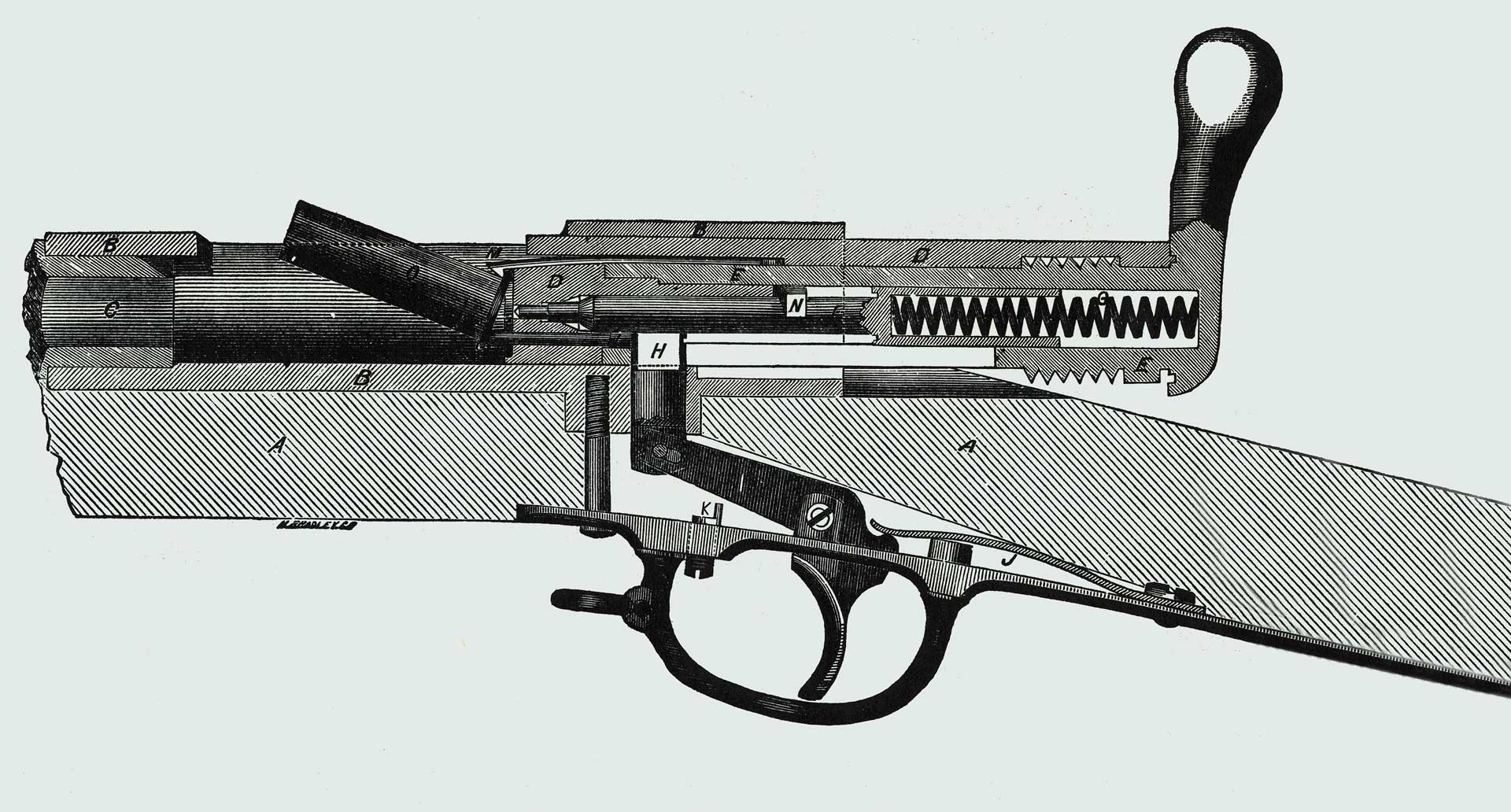
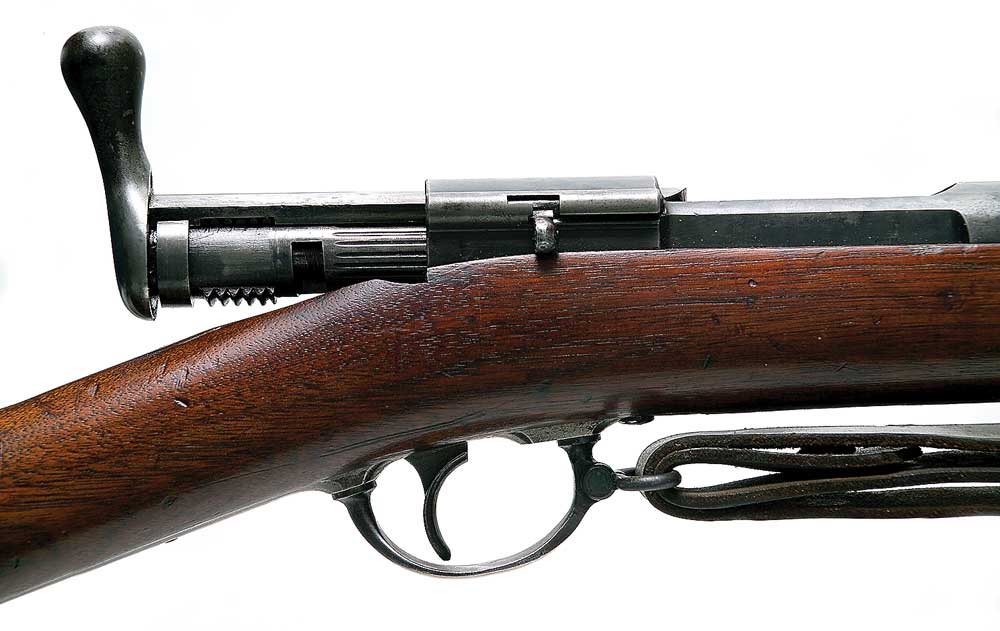
The Ward-Burton was invented and patented by two Americans, Gen. W.G.
Ward and Bethel Burton. The Ward-Burton rifle was a single-shot design
that featured a bolt with two sets of threads on either side of the body
that locked into corresponding threads machined into the inside of the
receiver. The stubby bolt handle rotated downward to lock the action and
rotated upward to disengage.
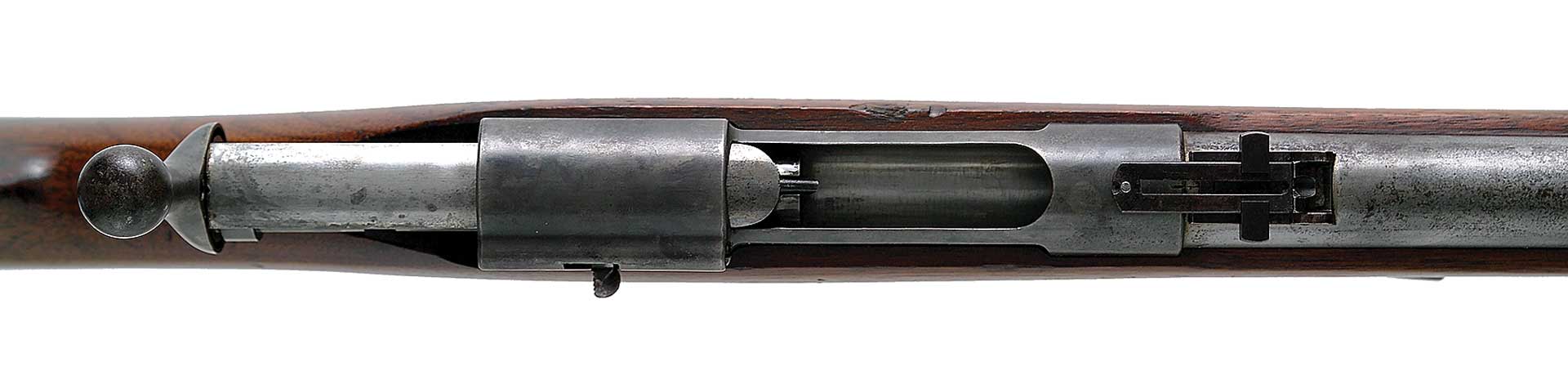
When the bolt was drawn to the rear, the empty cartridge case was
automatically ejected, and the rifle was ready for a fresh cartridge to
be inserted. It was cocked when the bolt was pushed forward. There was a
small, spring-loaded bolt lock on the right rear of the receiver that
functioned as a safety.
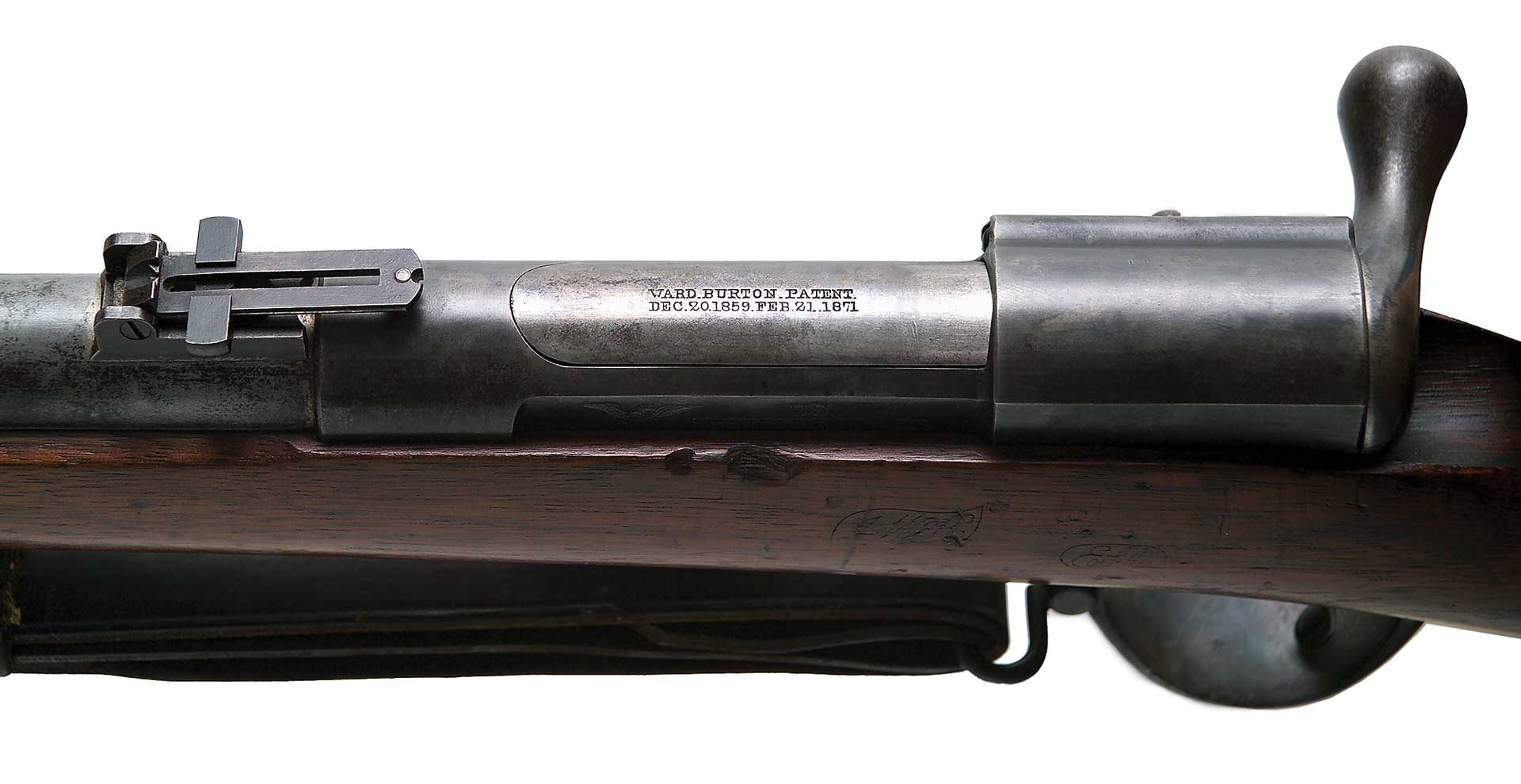
The Model of 1871 Ward-Burton was in production at Springfield Armory
in 1871 and 1872. The receiver was case-hardened, and the left side was
marked “WARD BURTON PATENT, DEC.20,1859, FEB.21.1871” with a “spread
eagle” over “U.S. SPRINGFIELD 1871.” They were not serially numbered.
The barrel and most of the furniture were finished in “National Armory
Bright,” as were the other trial arms of the period. The Ward-Burton
rifle had a 32 1⁄8" barrel secured to the full-length stock by two
barrel bands and was fitted with a folding-leaf rear sight. It had the
same type of cleaning rod as the Model of 1868 Trapdoor Springfield
rifle. The Ward-Burton rifle was issued with the Model of 1855 socket
bayonet and also used the same type of leather sling as the .50-70
Trapdoor Springfield rifles.
The Model of 1871 Ward-Burton carbine
had a 22" barrel secured by a single barrel band to an appropriately
shortened stock. It was fitted with a ring-and-bar attachment on the
left side of the stock similar to the other Springfield Armory carbines
of the era. The stocks of both the Ward-Burton rifle and carbine were
typically marked with two different inspection stamps: “ESA” (Erskine S.
Allin) and “JWK” (John W. Keene). Ward-Burton rifles and carbines were
stamped “US’ on their buttplate tangs. With the obvious exception of the
bolt-action mechanism, the Ward-Burton shared many of the same features
as the Model of 1870 Trapdoor Springfield.
The Model of 1871 Ward-Burton rifles and carbines were issued to a
number of U.S. Army units for field testing, along with the other
.50-70 breechloading trial designs. The U.S. Army’s 13th Infantry was
one of the units that tested Ward-Burton rifles. While made in very
limited numbers, Ward-Burton carbines saw a surprising amount of use by
several Army units, including the 1st, 3rd, 4th, 5th 6th, 7th and 9th
U.S. Cavalry companies. Most of these cavalry units were also
concurrently issued Model of 1870 Trapdoor Springfield, Model of 1870
Rolling Block and Model of 1870 Sharps trial carbines.
While nominally trial arms, some of the Ward-Burtons—especially the
carbines—saw at least a modicum of combat use. Ward-Burton carbines are
known to have seen service during the Yellowstone Expedition, and they
were issued to cavalry units stationed in Nebraska, Texas, Colorado and
Kansas.
The various trial arms, including the Ward-Burton, were subjected to
grueling and rigorous use. In the majority of the subsequent test
reports, the Ward-Burton did not fare well in the estimation of the
reporting officers. For example, an officer of the 6th U.S. Cavalry
succinctly stated that the Ward-Burton carbine was “ ... unfit for
cavalry service ... .” The Ward-Burton rifle did not perform any better
than the carbine. As an illustration, an officer of the 13th Infantry
opined that the Ward-Burton rifle had caused too many accidents, and “
... the men are afraid of it … .” Another officer of the same unit
initially found favor with the arm in his early reports in the summer of
1872, but by the winter of the same year, his opinion had totally
changed. He proclaimed the Ward-Burton rifle as “ … a dangerous and
inferior musket.” Ultimately, not one of the 95 final reports of field
testing recommended the Ward-Burton for adoption.
There were several reasons for the near universal dislike of the
Ward-Burton. Undoubtedly, the unusual (for its day) bolt-action was
distrusted by many of its users. Unlike the Trapdoor Springfield, Sharps
and Rolling Blocks, all of which had large outside hammers that could
be readily observed, it was difficult to ascertain whether the
Ward-Burton’s action was cocked and/or loaded. A number of accidents
occurred because troops unfamiliar with the design discharged guns they
assumed were unloaded. Several design flaws contributed to the
Ward-Burton’s problems, including a screw that could shear off during
recoil. Improper heat treatment of the bolt also caused some failures,
which led to further distrust.
As the results of the field trials were reviewed and evaluated, it
became apparent that the Ward-Burton was not suitable for continued
production or widespread issue, and it was dropped from further
consideration. Ward and Burton developed a repeating, magazine-fed
version, but the design didn’t even get into the trial stage due, in
large measure, to the negative reputation of the Model of 1871 rifle and
carbine.
The Model of 1870 Trapdoor Springfield was eventually selected as the
best trial breechloader. A slightly modified version, the Model of 1873
chambered for the new .45-70 Gov’t cartridge, became the Army’s
standardized shoulder arm. The .45-70 Trapdoor remained in production
until shortly after adoption of the Krag in 1892.
Despite its shortcomings in the field trials and subsequent
rejection by the Army, the Model of 1871 Ward-Burton rifle and carbine
are popular with collectors today. A Ward-Burton rifle or carbine in
excellent condition is among the most attractive U.S. martial arms of
the Indian War period. When compared to its contemporaries, the
Ward-Burton has a surprisingly modern appearance. Many saw hard use
during the infantry and cavalry field trials, and most surviving
specimens are well-worn. The Ward-Burton is significant as the first
true bolt-action produced for the U.S. military. It is an example of an
interesting—if ultimately unsuccessful—martial arm. Surviving examples,
particularly carbines, are increasingly harder to find on the collector
market today, especially in excellent condition.
While often overlooked alongside its better-known contemporaries,
such as the Trapdoor Springfields, Rolling Blocks and Sharps, the
Ward-Burton represents a significant milestone in the evolution of U.S.
military arms. Whatever flaws it may have possessed, the Ward-Burton has
the distinction of being the first U.S. military bolt-action rifle, and
as such, is one of the more interesting, and historically significant,
firearms of the Indian War era.