Webster

The Constitution was made to guard the people against the dangers of good intentions." --American Statesman Daniel Webster (1782-1852)


Showing posts with label Angry Staff Officer. Show all posts

Wednesday, October 1, 2025

The Origins of "The Knife Hand"


I am "out of Pocket" until Saturday due to work so I have a few things on the scheduler thingie" scheduled to *drop*   I will try to drop a photo here and there if I can.

To those that have experienced the "Knife Hand", something that is uniquely American Military, I know the crayon eating group A.K.A. the U.S.M.C. say that they invented the Knife Hand, but they are trying to "culturally appropriate" the Knife hand from the grand daddy of all the services, the U.S. Army.  I and many others have experienced the "Knife Hand" first hand in Basic, it is a time honored tradition passed down from the mist of time like the lore of Old.  The Knife Hand.  I shamelessly cribbed the article from "Angry Staff Officer".


There are many iconic images in U.S. military history: Washington crossing the Delaware, the surrender at Appomattox, troops landing on Omaha Beach, to name a few. But few paintings or photographs have managed to capture one of the most significant weapons in the U.S. arsenal: the knife hand.

size0
Army Reserve drill sergeant, Staff Sgt. Robin Brown of Belton, S.C., with Company C, 1st Bn., 518th Inf. Reg., 98th Training Div. (IET), uses a demonstrator to teach the proper way to do several basic movements to Clemson University Reserve Officer Training Corps cadets during a drill and ceremony lab conducted by drill sergeants of the division on Clemson’s Bowman Field, Sept. 3, 2015. (U.S. Army photo by Sgt. Ken Scar) (Photo Credit: Sgt. Ken Scar)

Able to cleave the air with a thunderous blast of justice while projecting command aura, the knife hand serves as one of the single most effective weapons for modern U.S. military leaders. Indeed, new recruits into the U.S. military are greeted by knife hand-wielding drill sergeants, inspiring fear, respect, and awe. The knife hand can be used to discipline wayward troops, drive a point home during a briefing, or to direct the firepower of America’s finest in combat. It is no stretch of the English language to say that the knife hand has done more for the U.S. military than when they started putting the Skittles packets in MREs. But where did this monumental motion come from?
The origins of the military knife hand are shrouded in mystery and legend. As with all important facets of history, scholars are divided on the subject. Some say that it dates from the American Civil War. In its original form, the knife hand was known as the doigt de guerre, seen in the image below, in a historical recreation of that gesture employed by Capt. Canastadus Rufudus of the First Georgia Fusiliers (light). This gesture was inherited from the French military tradition.

19495539_10211678878360127_979182733_o
Author Emo Mutz’s recreation of the doigt de guerre.

Unfortunately, the doigt de guerre proved difficult to see in the era of black-powder musketry, so the revised System of Infantry Tactics by Brig. Gen. Silas Casey established the knife hand in its current form, as noted in “Title Fourth, School of the Battalion Part First, Article Third, couteau à main:
“The hand, dexter, shall be formed as of a plane, inclined so the distal side of the hand is perpendicular to the ground. The hand shall be raised smartly to an angle of 45 degrees and, through rapid vigourous motion, be brought down in a series of strokes viz a trebuchet.”
The couteau à main was quickly adopted by the Federal Army who had, without the benefit of the knife hand, gone through a rapid succession of commanding generals before Lt. Gen. Grant’s staff implemented it as a means of communicating orders. Grant would often keep his knife hand holstered at the ready as seen in the below photograph, using a popular military pose as a sheath for his deadly weapon. This procedure was widely adopted as can be seen in many surviving images of Civil War Soldiers to this day.

grant1
Knife hand, holstered. 

However, some scholars believe that the knife hand comes to the U.S. military from the Prussian tradition. It was during the Seven Years War that a young Second Lieutenant Friedrich Wilhelm von Steuben first used the messerhand to direct his troops during the Battle of Prague. Some say that his time as aide-de-camp to Frederick the Great further enforced his belief that the use of the messerhand could be used not only in combat, but in instruction as well. In 1777, when von Steuben – now bearing the title of “Baron” – arrived in the United States, he brought his theory of the messerhand with him.
During the grim winter at Valley Forge, Baron von Steuben began a training regimen for the Soldiers of the Continental Line. Often frustrated by the language barrier, von Steuben would demand for someone to translate his profanity into English. However, the Prussian officer did find one thing that exceeded the bounds of simple language: the knife hand.
As we read in a letter from a young Pennsylvanian officer in 1778, “Brite and early today, We stood to for Drill, the Colde pierced my Bones, but then we did see the Prussian noble, and unleasheth he a Mighty Hand, borne aloft with a Precise and Dread Purpose. Even as unto the Maker shall I never forget the swift Fury and Exactness with which he did upbraid us, as the way the Creator of the Universe set all in His Image. Strange to tell, my feeling of chill vanished away when his Hand did stab in my face and all was replaced with a Fierce and Fiery feeling of Awe.”
Because of von Steuben’s regimen of training – as well as the knife hand that he had empowered them with – the Continental Army was able to go into battle in 1778 equipped with the tools needed to stand toe-to-toe with the British Redcoats. Because of the knife hand, American gained its independence from England. From then on, the knife hand entered into unwritten U.S. military doctrine.

M-Monmouth-7-4C-LW12
Two Soldiers in the background can be seen attempting to brandish the knife hand at the Battle of Monmouth, 1778. It is possible that von Steuben’s technique may have been too difficult to grasp. Fortunately, Molly Pitcher knew what she was doing.

Of course, the knife hand could have merely developed out of the habitual need to brandish something. And since officers and non-commissioned officers may no longer use a sword, saber, riding crop, or spontoon to point at things, the knife hand has rapidly come into vogue, a pattern beginning after World War II.
Whatever its origins, the knife-hand has left its imprint on the U.S. military. Its use has come under some criticism lately, as being too harsh. However, used at the correct time and place, the knife hand is still a crucial weapon, whether on the battlefield under fire or when kee
pin

Tuesday, June 6, 2023

"Why The American Experience in WWI Matters"...


I saw this article from "Angry Staff Officer" and sometimes I use his stuff on my blog if I really 
like it.  He is really opinionated  and "Mack" twigged me onto this guy years ago.

Why the American Experience in World War I Matters Today

One would say that picking the day before the anniversary of D-Day in World War II is an odd time to talk about the first world war, yet, here we are. Because the more that I look at the war in Ukraine, the more I am drawn back to World War I. And no, not because of trenches and massed artillery bombardments. Those have been staples of modern war and are hardly unique to the fighting going on now. Hell, earthen protective positions have been around as long as someone realized that you could put a big mound of dirt between you and the person trying to kill you. Instead, I look at it from the American perspective and context of the Great War.  Now, since the U.S. perspective is mostly overlooked, this will require a lot of explaining. So, let’s get to it.

As the war in Ukraine continues in its second year, there are many in the U.S. Army who look towards it with great interest. Indeed, I would hazard to say that there have been few contemporary conflicts that have captured the attention of the U.S. military as has Russia’s invasion of Ukraine. From the doctrinal standpoint, an Army that is attempting to extricate itself from decades of low intensity conflict can watch large scale combat operations play out in real time. And it’s not like it takes a lot of imagination to see ourselves in this conflict, given that we can watch our equipment and technology as used by the Ukrainian military. Nor are we lacking accounts of Americans to follow as U.S. veterans travel to Ukraine to fight – for some, hoping to find a “good” war, to counterbalance their own years in Iraq or Afghanistan. In all of this, there are ties back to the American experience in World War I.

When the U.S. entered World War I in April of 1917, it could hardly be described as a dominant land power. The Army was small and lacked the new technology of the day – machine guns, heavy artillery, tanks, airplanes – in any large numbers. Nor did we have doctrine to take into account what all this new tech did to the essentially fragile human soldiers who would fight with it. These same soldiers would somehow have to be drawn from all parts of the U.S. population. It is not too far a stretch to say that the U.S. Army of 1916 was closer to the Army of 1865 than the Army of 1918. Change, therefore, was in the air.

Of course, change is the evil “c” word for the Army. It is highly resistant to organizational and institutional change. And yet, between 1917-1918, the Army underwent a radical transformation shaped by the new realities of war and technology. As we today struggle to figure out how unmanned aerial systems and the space and cyber domains will change warfare, the Army of 1917 struggled with how the machine gun and pneumatic recoil artillery had changed the battlefield. They asked the same questions that we do today: is new technology best used at the lowest level, where it can provide direct support to the ground pounder? Or is it best used en masse, in a formation commanded by someone who is intricately familiar with its capabilities? The Army of 1917 eventually determined that machine guns should be grouped into machine gun battalions, which could be broken up by companies and platoons, if needed, to support the infantry. Artillery was grouped into divisions, with two regiments of light artillery and one of heavy – too few, as it turned out in the end.

But because General John J. Pershing believed the rifle was still the dominant weapon in war, all force structure changes due to technology were based around supporting the infantryman. Pershing designed massive divisions of 28,000 soldiers each, all based around supporting the advance – and attrition – of the division’s four infantry regiments. Technology and doctrine – albeit misguided doctrine – shaped force structure. Flawed doctrine resulted in flawed force structure that turned out to be too unwieldy and cumbersome for the modern battlefield. Nor did that doctrine account for aircraft, tanks, and other emerging technologies.

View of a supply tank named “Griff” carrying supplies for advanced troops in the Caution Paddock, near Villeret, France, involving the 30th Division. The tank went where other transportation could not go (September 29, 1918) [Photograph by: U.S. Army Signal Corps, #24532].
 
From George T. Skinner Papers, WWI 59, WWI Papers, Military Collection, State Archives of North Carolina, Raleigh, N.C.

This adaptation of force structure to fit technology was not an easy change. Old, established units were broken up and turned into entirely different units. Cavalry troops in the National Guard traded their sabers for machine guns. Coast artillery soldiers picked up rifles or manned field guns. Infantry platoons now carried such things as automatic rifles and grenade launchers, while other infantrymen trained on 37mm guns and Stokes mortars. The old ways of doing business – almost unchanged for 50 years – were going by the wayside. Modern war required adaptation and moving away from the “Well that’s how we’ve always done it,” approach. The Army was rapidly changing. Just as it must today to adapt to the needs and hazards of the modern battlefield.

Who was serving was changing as well. In order to man this massive force, the War Department had requested Congress to authorize conscription. Soon, millions of people found themselves in uniform. Women were in service, granted official military status for the first time although having served in every war since the founding. In a war fought between ethnic groups in Europe, the U.S. was unique in fielding units that seemed to boast every ethnicity in its ranks – with the glaring absence of African Americans, who were segregated in separate units. Despite the wishes of many racists in the War Department, the American Expeditionary Force fielded two divisions of Black combat troops who acquitted themselves incredibly well in dehumanizing circumstances. The Army was changing, because modern war doesn’t care what color you are – or what your sexuality or gender identities are, either, I might add.

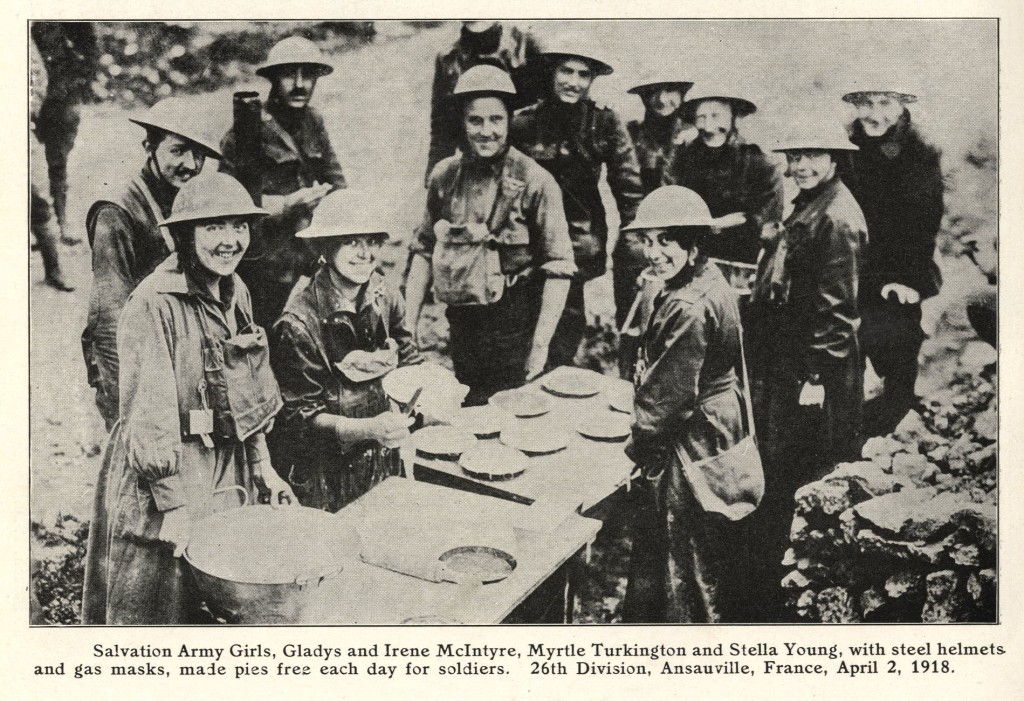
Although technically serving in non-government organizations like the Red Cross, Salvation Army, and YMCA, young women served just behind or sometimes even on the front lines of the AEF, coming under artillery, gas, and aircraft attack (Courtesy of the State Library of Massachusetts)

In a matter of months, the American Expeditionary Force (A.E.F.) ballooned to several hundred thousand troops in France between the fall of 1917 and the spring of 1918. By the late summer, there were over a million Americans in the theater of operations. By the fall – and the Armistice – over two million. Casualties, too, were exponentially high: over 50,000 dead and 200,000 wounded, in about six months of sustained combat operations. Misguided doctrine, abbreviated training, and inexperienced leaders caused many casualties. However, as the rest of the combatants of that war demonstrated, most of those casualties came because modern war – modern large scale combat operations – comes with a staggering price tag. A nation that will go to war must be prepared to give up her young people.

And World War I taught the United States that it must be the entire nation which goes to war. War – as we see it in Ukraine – must be a whole of government endeavor. One part of the nation cannot go to war while the other goes to the mall, as has been the experience of the U.S. for the last two decades as laid out by military and political leaders alike. Large scale wars, where entire cities are obliterated, are so horrendous that you must leverage all of a nation’s resources to end the war as soon as possible. And that nation must be willing to pay the requisite price in blood and treasure.

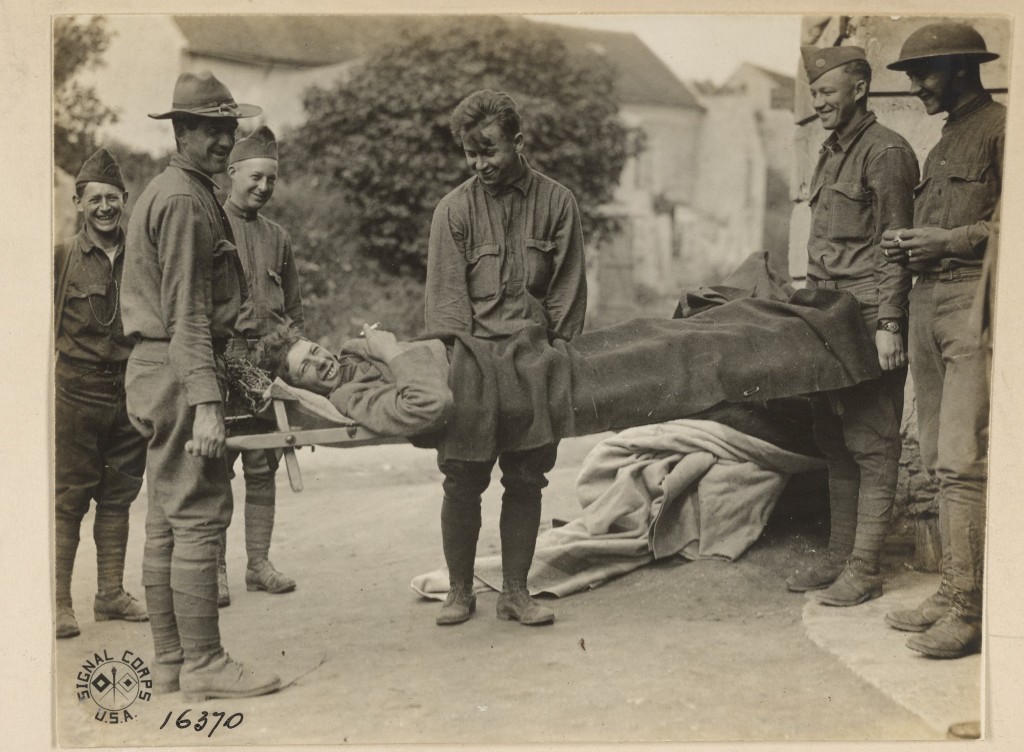
W.J. Duke of Co. L, 103rd Regt. Inf., wounded but still able to smile for the camera, near Mery, France, July 22, 1918. U.S. Army Signal Corps Collection, National Archives, 111-SC-16370.

For the U.S. of 1918-1919, that price was too high. The nation turned away from international affairs and stepped back from the world stage. Veterans, however, remained incredibly proud of their service. They formed organizations like the American Legion and dedicated memorials to their fallen comrades in towns and cities across the U.S. and France. They went back to France in mass numbers to visit their comrades buried there and to visit the places they had been during the war. In 1927, 30,000 veterans and their spouses travelled France in what was called the “Second A.E.F.” By 1937, their numbers had diminished to fewer than 10,000 but the pilgrims still came. There would be no more. Between 1939 and 1945, the veterans of World War I watched as everything they fought and bled for was washed away in a tide of bloodshed and fury. Like the veterans of Iraq and Afghanistan today, they watched as familiar towns and cities fell to a conquering enemy. It was surely hard to find a good answer to the question, “What was it all for?” One veteran in the 1980s answered the question, “Was your service during World War I of any specific benefit (or detriment) when you returned to civil life?” with, “No, just the loss of about 2 years that the world didn’t seem to feel was of any value to the country.”1 Many today could echo that sentiment.

Today, many veterans of the Global War on Terror find themselves asking that same question. Moral injury in the U.S. military and veteran community is not something that has been significantly addressed in any large way. People deal with it in many ways. Many have chosen to go back to war, to take the skills they acquired and use them in what is thought of as a “good” war, to help preserve Ukraine as a nation and as a people. Many World War I veterans sought to find “good” wars as well, some serving in the Abraham Lincoln Brigade in the Spanish Civil War. Many served in the Allied forces in World War II. Moral injury takes a strong toll.

No war changed the U.S. Army in the way that World War I did. And very few wars have been forgotten so quickly. As much as those who follow the combat operations in Ukraine want to look at maneuver operations from World War II for comparisons, I would invite them to reexamine World War I. The paradigm shifts in technology and manpower were extreme. They might look very familiar for those today interested in how armies adapt to new technology and new ways of fighting war. Most importantly, studying World War I can help today’s veterans of the war on terror find a linkage to another group of veterans who struggled to make sense of their service and sacrifice.


Wednesday, April 13, 2022

What's in a Name: the Problem with "Warfighter"

 I returned from my adventures in another state, but I caught "The Crud", I have absolutely no energy, and no appetite.  Still had a blast and am planning on going again next year.  I will blog about it in a day or two.

      I shamelessly cribbed this from "Angry Staff Officer", I have used his material before on my blog, my friend Mack twigged me on to him years ago.

Back in the late 1990s, when the Army was being all that it could be, the Army began leaning into the concept that soldiers should think of themselves as “warriors” in order to increase the fighting spirit of the force. I’ve already said my rant, er, I mean, my piece on this, which you can find here. But that same thought process of the time gave rise to another monstrosity: warfighter.

Now, not only is this an assault on the English language in general – “I’m not a teacher, I’m a smartsgiver” – it is also patently and dangerously misleading. Why? Because it assumes that the sole role of the Army – and the military in general – is to only fight wars. The Army has gone one step further and made sure that no one escape just what the Army’s mission is, by giving itself its own mission: “To deploy, fight and win our nation’s wars by providing ready, prompt and sustained land dominance by Army forces across the full spectrum of conflict as part of the joint force.” Pretty convenient when you get to issue your own mission statement, huh?

Now, you might be saying, “What’s the big deal? Shouldn’t we always want the Army to think about winning wars?” Sure, yes, absolutely. Only, see, the problem is, the Army spends most of its time not fighting actual wars. Throughout the history of the Army’s conflicts, “war” – the political act of nations trying to impose their will on each other via violence – takes a very back seat role. Conflict, yes. There’s plenty of that. Irregular, always messy, few clearly defined rules, shifting objectives, politically fraught, sometimes ethnically or racially charged, fought with either little fanfare or with intense media interest. These conflicts have happened anywhere from North America to Africa, from the Pacific to the Middle East, from Siberia to Latin America.

There are also plenty of the Army’s missions that have nothing whatsoever to do with conflict: since 1787, the Army has engaged in public relief missions, infrastructure construction, labor disputes, management of federal lands or national parks, natural disaster relief, or dealing with public unrest. All told, these types of combat missions and non-combat missions make up the majority of what the U.S. Army does.

So, why does this happen? Why does the Army mostly do things that don’t sound like killing people and breaking stuff? Because as much as the AGSU-wearing folks in the five-sided puzzle palace would like you to believe that the Army is actually the master of its fate and the captain of its soul, it is not. The Army receives its missions from the executive branch of the U.S. and its funding from the legislative branch. So while the Army would love to focus on nothing but fighting conventional wars, sometimes the political will of the nation requires it to do something else. Most of the time, the nation’s political and public wills are in unison. Oftentimes, however, the political will diverges from the public will and the Army can find itself fighting a confusing conflict without the support of the people it serves. Obviously, this is not something the Army is excited about.

And so, we turn to the concept of the warfighter. This concept that says that our nation’s military force will only be used for achieving overwhelming military superiority over our nation’s enemies. This concept is troubling for two main reasons.

One, that we have decided as an article of faith that establishing military dominance wins wars. This is all the more amazing since this is the Army that can’t stop quoting Clausewitz’s dictum about war as a continuation of politics. Somewhere along the way, we stopped actually thinking about what that meant. We began to believe that war and politics could be separated from each other, as if they did not go hand-in-hand.

The consequence of this has been to separate the political from the military ends in conflict. John Shy and Thomas Collier put it best in their chapter on “Revolutionary War since 1945” in Makers of Modern Strategy, when talking about the U.S. military’s response to Vietnam: “The senior American military commanders never took seriously the idea that the political effort, presumably going on behind the security screen provided by large-scale combat operations, should have equal or greater priority.” ​(page 856)

This sort of assumption about combat dominance leading to victory also has played a hand in the overall tactical focus of the modern-day U.S. Army. Nearly all leaders with combat experience have had it only at the tactical level rather than the operational or strategic, where things other than firepower dominance come into play. This, in turn, leads to a generation of leaders who only know how to apply tactical solutions to strategic problems.

The second reason that the concept of a “warfighter” is troubling goes back my first point surrounding the Army’s missions. If our leaders only expect to be warfighters, what happens when they’re presented with a situation short of war? And as a reminder, that has been the vast majority of the Army’s experience since the nation was founded. Are we properly building leaders who are capable of handling a diverse range of tactical, operational, and strategic problems if we maintain a myopic focus on the concept of a warfighter?

While it is true that winning wars against the nation’s existential threats is a no-fail mission, failing in other conflicts can severely damage the military’s credibility. Building generations of leaders who only see their role as “managers of violence” does little to help the U.S. navigate the complex waters of geopolitics in the 21st century.


Thursday, January 6, 2022

American War and American Memory

 I snagged this from "Angry Staff Officer", My friend Mack dialed me onto the guy a while back and according to him, he is pretty angry. 


                                                      The Vietnam War
 

Collective memory is a fascinating thing. “Never forget.” That’s a phrase that we often hear associated with things like 9/11 or Pearl Harbor, usually splashed across social media pages on the anniversary of those days. Or maybe there are calls to never forget the sacrifices at Normandy or Bastogne. These national calls for memory tend to ask us to recall that one specific moment in time where the nation was shocked by extreme loss of life. Never forget. Well, never is a long time. And what is it that we are reminding ourselves not to forget? The feelings of loss? National pride? The individuals who died? Our national sacrifice?

                                                      Philippine insurrection
 

Americans, as a nation, prefer to keep collective memory at the selective level of merely glossing over the high points of our past. Engaging in specifics slows us down and makes for poor talking points. But in a nation whose norm is to have troops engaged in combat operations rather than being at peace throughout our history, this selective memory becomes a dangerous thing. It is dangerous not just to our historical consciousness, but to our ability to successfully use military power to achieve the ends of national security. 


                                                The Banana Wars

The American military as a tool of foreign policy is most successful when tied to the whole of society. America’s great military victories of the Civil War, World War I, and World War II came not simply because of the U.S. military’s tactical acumen – indeed, one can even say that victory came in spite of many tactical and operational failures. They came because the federal government was able to harness the full potential of America’s unprecedented economic prowess and build a logistics system that simply overwhelmed opponents on the battlefield. These three major conflicts saw a national, unified war effort, with the nationalization of industry, commerce, and labor towards one common end. 


                                    General Custer Model I have on my shelf.

In an era where political and corporate individualism seems paramount, the idea of the governmental power to forcibly put millions of people into uniform via the draft or to control all transportation and industrial assets seems foreign and archaic. Yet, this very idea of American exceptionalism is built on the history of just those things. In each of those three conflicts that I mentioned in the previous paragraph, patriotism alone was not enough to bring victory. It took forcible measures to tie the whole of society to the war effort, a profound paradox for a nation that prides itself on individual liberties.


                                                         Capture Of Baghdad

And yet, the very act of national service does more to shape our collective memory than anything else. World War I saw four million Americans in uniform – World War II, 16 million. These were unprecedented numbers, and remain so. Americans by the millions had to change their lives because of military service, and the military itself had to change to accommodate these citizen-soldiers. Military service began to change society, just as society was also changing the military. When service becomes generalized, it gives society something to remember, not just those few individuals who experienced specific events.


                                                   Reconstruction Era

Conversely, when society is not brought into the equation of military conflict, we see a profound disconnect in American memory. America’s longest and most controversial conflicts were waged by a small percentage of society largely well out of sight during the periods of national expansion, colonialism, and economic imperialism. Conflicts such as the 2nd Seminole War (1835-1842), the Plains Wars (1850s-1880s), Reconstruction (1865-1877), the Philippine Wars (1899-1914), the Banana Wars (1898-1930s), Vietnam (1955-1973), the wars in Iraq (1991-present), and military operations in Afghanistan (2001-2021). These wars largely do not fit in to our national consciousness and memory – either because they do not fit the narrative of American exceptionalism, because the majority of society did not feel the effects of these wars, or because society was divided over the role of the nation in these conflicts. These military conflicts also saw atrocities, massacres, and indiscriminate killings of non-combatants at a scale unmatched until strategic bombing and the use of atomic weaponry in World War II. Many saw the weakening of neighbor states, the destabilization of entire regions, or the full-scale dismemberment of cultures and societies. American memory is selective.


                                                        American Involvement in Afghanistan

Why is this important? Because as we look ahead into another year at the beginning of a new decade of a constantly changing world, America needs to take a hard look at herself and ask whether we are remembering or forgetting the right things. This is not only vital to our collective consciousness as to who we are as a nation, but to the success of future military operations. The best tactics, technology, and generalship mean very little at the strategic level. If we continue to separate society from military conflicts, we can expect to see little change in the coming decades. And we will continue to amass military conflicts that very few Americans will remember. Never forget, indeed.

Sunday, November 7, 2021

Afganistan isn't 1975 South Vietnam

 I shamelessly "Clipped" this from "Angry Staff Officer", who my friend and fellow blogger Mack turned me onto this guy several years ago and Mack told me that he had met the guy and this guy is really angry.  it is a different thought on the debacle in Afghanistan. and speaking on China, they still will profit with our disastrous pullout from that area.


Situation in August 1945 – West Point Military Atlas of WWII  

By 1945 China’s “Century of Humiliation” reached maximum entropy. Since the 1840s, centrifugal forces, including history’s worst civil war, western concessions, and Japanese invasion, had torn China apart. The country was split between Chiang Kai Shek’s Kuomintang (KMT) and Mao Tse Tung’s Chinese Communists, (CCP). The KMT governed much of China’s heartland either directly or through local warlords while the CCP had fled to the North. The war with Japan had displaced nearly 100 million Chinese and cost hundreds of thousands of lives. Chinese infrastructure was woefully the rest of Asia – even the previously impressive Yellow River dikes had been destroyed by the KMT in a desperate attempt to slow the Japanese.

American entry into World War II made China a formal ally. Through the 1940s, the United States had relatively good standing among the Chinese due its missionary presence, charity, and Open Door policy. Even Mao had a broadly favorable view of the United States and would host US liaisons known as the “Dixie Mission.” President Roosevelt envisioned a post-war China as one of the “Big 4” world powers and earnestly furthered the KMT’s standing with military aid, equipment, and military trainers while basing more than 100,000 troops in China.

“We feel no program of US aid to China can possibly be effective if activated solely through [the KMT]” – John Stuart, US Ambassador to China, 1948

However, Chiang frustrated his American advisors, Generals Albert Wedemeyer and Joseph Stillwell, who found him obstinate and unwilling to make necessary reforms. While Chiang had a large army, his ability to wield it was limited by incompetence, corruption, and nepotism.

First Lady Eleanor Roosevelt and Madame Chiang, February 1943 – Library of Congress  

For example, the KMT could barely muster a quarter of its listed four million troops – a “ghost soldier” situation foreshadowing Afghanistan. Despite $700 million in Allied aid, by 1945 Wedemeyer reported: “China faces economic collapse…[Chiang] is losing support…[while] showing a loss of flexibility and a hardening of narrowly conservative views.” As in Afghanistan, weapons and money worsened corruption and inflation while hindering local governance.

Postwar China Policy

After the Japanese surrender in August 1945, Roosevelt’s hopes for a post-war KMT-CCP coalition quickly ran aground. Not only was China devastated (requiring $9 billion just to get to prewar status) but departing US forces left Chiang with dwindling military capability dependent on American parts, ammunition, and expertise. Moreover, the Japanese departure enabled resumption of the KMT-CCP civil war. Early August skirmishes escalated – by December fighting flared across 11 provinces.

The Truman Administration faced an impasse: longtime State Department “China Hands” were skeptical about the KMT’s ability to utilize aid while the “China Lobby,” consisting of pro-KMT Congressmen and business leaders urged further assistance. Truman struck a middle course, agreeing to complete agreed-upon equipment transfers but nothing more. Truman emphasized American military assistance was not for “fratricidal warfare.” The President hoped for a CCP-KMT accord but was committed to demobilization.

To bring the parties together, Truman sent recently-retired General George Marshall to China. Truman instructed Marshall to achieve a cessation of hostilities by means of a “national conference of major political elements” and insisted Chiang’s one-party government be “broadened to include other elements.” Landing in China  in January 1947, within weeks Marshall brokered a peace agreement to be monitored by American, KMT, and CCP observers. However, after a brief sojourn to Washington, Marshall returned to China to a ruptured peace. Chiang launched several assaults in Marshall’s absence and the CCP resumed guerilla attacks. Marshall spent the rest of 1946 unsuccessfully attempting to again negotiate another peace but an attempt at a National Assembly in November failed after a CCP boycott.

 Mao with Marshall – Mission to Yenan, Carolle Carter.

Meanwhile, support for the American presence eroded. In July 1946, CCP troops ambushed a convoy outside Tianjin, killing three Marines. Likewise, the rape of a Beijing girl by a US Marine incited anti-American resistance. Absent the Japanese menace, the Chinese resented foreign presence.

By winter of 1946, Marshall had adopted Stillwell and Wedemeyer’s assessment of Chiang, believing him duplicitous and far too willing to exploit gaps in American thinking for his own ends. At his final one-on-one meeting with Chiang, Marshall urged him to make peace with the CCP, believing the KMT had “overestimated their ability.” Chiang rebuffed Marshall, saying the CCP would be “brought to terms within 3 months.” However, Chiang’s advances into Manchuria instead devastated KMT forces, who found themselves isolated to railway garrisons and under constant attack from CCP guerrillas.

Marshall, now Secretary of State, returned home in January 1947 to a new strategic situation. Amid the collapse of the European economy and his growing mistrust of Soviet motives, Truman shunned further open-ended aid to the KMT. However, the administration was split on how to proceed. Wedemeyer believed American policy contradictory: “it was unreasonable to insist Chiang both institute democratic reforms and collaborate with the Communists” while denying aid. We said we wanted a strong and independent China but refused the [KMT] material and political aid and support without which it could not crush the Communists.” Others, mostly at State, believed American policy hoped for the impossible – supporting the sclerotic KMT because they were not communist made little sense as the neither the KMT or CCP reflected US ideals or interests.

I have tortured my brain, and I can’t now see the answer… the lasting solution of China’s problems must come from the Chinese themselves. – George Marshall

Ironically, while the Truman Administration was split on China, had it coalesced around an aggressive approach to the Soviets, whose support for communist partisans in Europe pushed Truman to abandon his pragmatism. The difference was stark. Truman denied Chiang’s request for aid, approving only a small advisory team and limited weapons. The next week, Truman asked Congress for aid to Greece and Turkey and committed to defending liberalism globally in what became known as the Truman Doctrine.

Assessment – Losing a Country?

In China, CCP successes accelerated throughout 1948, defeating the Nationalists in three campaigns, costing Chiang 1.5 million troops through “death, injury, or defection.” The collapse was staggering: Though in 1945 KMT forces outnumbered the CCP 1.6 million to 166,000, by mid-1948 the forces were roughly equal in number while the CCP had the momentum. Throughout the summer, the US officials attempted to facilitate economic aid while simultaneously evacuating Americans. A desperate Chiang dispatch his wife to Washington. It failed: Madame Chiang Madame Chiang departed the White House “wearing a grim smile.” By the end of 1949, the communists ruled Beijing and Chiang was ensconced in Taiwan.

Modern recriminations about the collapse in Afghanistan are timid compared to attacks levied after China “went red.” Senator McCarthy called multiple Truman officials Soviet stooges and even accused Marshall of treason. Coming on the heels of the Soviets obtaining the bomb and the Berlin Blockade, China’s red turn appeared was another failure in an already bad year. As in Afghanistan, Truman’s critics rarely offered solutions beyond “stay the course.” Nonetheless, “losing” a country prefigured in American strategic calculus  and presidential perceptions of credibility. President Johnson cited China as he escalated the war in Vietnam saying, “I am not going to lose Vietnam! I am not going to be the president who saw Southeast Asia go the way China went.”

Modern Comparisons

As they would in Afghanistan, American efforts in China focused on not losing rather than winning. Moreover, the mission shifted, from placing pressure on the Japanese to securing China’s place as a global power to prevent communist expansion. However, since the Administration did not see a feasible way to transform the KMT into an effective partner, Truman saw continuing marginal assistance as “demonstrating limited anti-communist resolve” without involving the United States in China’s Civil War. While Truman regretted failing to slow America’s rapid post-war demobilization, Marshall regarded China as a lost cause in which nothing could forestall KMT collapse, telling Congress: “A great deal must be done by the Chinese authorities themselves…nobody else can do it for them.” Wedemeyer attributed the collapse to lack of will, telling Congress in 1950, “It is not a question of equipment. [the KMT] could have defended the Yangtze with broomsticks if they had wanted.” George Kennan distrusted the KMT so much he recommended an international commission run Taiwan rather than Chiang.

Returning to the implications of the embarrassing American departure from Afghanistan, three issues come to mind: credibility, competence, and prioritization. First, saying American credibility is at stake in Afghanistan overestimates how states view credibility and underestimates what the US (and its allies and partners) did. Indeed, if 20 years, trillions in spending, and thousands of lives are not demonstrations of credibility, then what is? Moreover, calls that link Afghanistan with other US commitments not only exaggerate US commitments in degree but in kind. Afghanistan is not Taiwan or Korea or Japan; Afghanistan is a Central Asia backwater, neither a treaty ally, nor essential interest and certainly not vital to the USA.

If anything, American’s rivals will view abandoning a failing project as indicative of a renewed American willingness to prioritize by, finally, pivoting toward the Pacific. Indeed, setting reasonable priorities amid competing interests and limited power while eschewing trivial goals is what we should expect of American statecraft. As far as perceptions US reliability and credibility, that was quickly shown to be intact by the AUKUS agreement. China’s latent attempt to join the Trans-Pacific Partnership, embrace of Han Nationalism, and aggressive “Wolf Warrior” diplomacy are not the traits of a erstwhile superpower but, as Hal Brands and Michael Beckley argue, a declining power.

  Contested Control of Afghanistan Summer 2021 – New York Times  

American competence, however, cannot escape scathing review not only due to the embarrassing departure but 20+ years of poor strategy, worse policy implementation, and, at times, outright deceit. The abandonment of pending and approved special immigrant visa (SIV) applicants is a moral stain and culminates years of logjams within a program with well-known issues. Like so much in Washington, everyone agreed it was a problem but, save for a few individuals, no institution, party, or group was able to engender a solution . Within Afghanistan and the broader national security apparatus billions of dollars and years of military time was wasted building supposedly well-trained Afghan Security Forces, who collapsed against an enemy they outnumbered 10:1 and against whom they leveraged modern equipment. While some American military officers rightly deserve criticism for decades of demonstrably false “turning the corner” assessments and a flawed approach to equipping foreign forces (did the Afghan Army need UH-60 Blackhawks when their MI-17s worked well?) with US equipment, the fundamental failures lie with the National Security Establishment, Congress, and an American public –  all of whom supported, or at least acquiesced, to a 20-year program with nebulous goals and indications of failure throughout.

Indeed, the American people were specifically asked to not sacrifice during the “Global War on Terror.” GWOT represents the culmination of a strand of American foreign policy that simultaneously sees Americans as leading but apart from the world. This may be geographically true, but as events over the last generation have shown, it is practically implausible. In Afghanistan (and the Middle East more broadly), America has suffered the same fate as every overstretched empire and often absolved itself of lives taken abroad as justified simply because doing so “protected the homeland.” Disregarding this innocent naivete, especially for foreign policy elites who subscribed to the notion of “American seeing further” will do the nation’s interests (and budget) well. As soldier-scholar Andrew Bacevich has said, “the inverse of innocence is not guilt but awareness.”

Leaving Afghanistan will not cripple American power or credibility; America will remain the sole superpower for the foreseeable future. Nevertheless, power gaps are closing, and American statecraft must improve, reaching an adroitness not seen for a generation. Our rivals’ interpretation of American credibility, competence, and willpower will be based on facts, most ably demonstrated by competent action. In the end, what matters is what Beijing and Moscow think, based on what American does, not what it says.

American foreign policy cannot presume preeminence; rather the country must use its power wisely in a manner Michael O’Hanlon calls “Resolute Restraint.” Preeminence is one thing while being able to guarantee rapid victory worldwide is another. The former is attainable, the latter is not. Doubling down on global pre-eminence and seeing risk everywhere risks unsustainable security spending and counterproductive responses as the US drone program has already done. In choosing and executing sound policy linked to realistic policy goals while working with allies and partners generally aligned with US values and interests, American statecraft can secure the homeland and our interests abroad. Doing so, however, requires an accurate assessment of what happened in Afghanistan, like China before it.


Thursday, October 7, 2021

"How the Baron Harkonnen failed at Grand Strategy".

 I got this from "Angry Staff Officer", he likes to normally use "Star Wars " to make a point and he switched up to "Dune", and I have read the book and actually really liked the 1980's version of the movie and it had a killer soundtrack.  I have been very busy at work and haven't had time for blogging, by the time I get home, I am whipped and all I want to do is go to bed after I eat supper.  We have another week of all out overtime before the new shifts shut off the spigot, so I am going after it while I can.   I got these pics off "DuckDuckGo"


 Science Fiction had its share of questionable Military Commanders and Strategist Star Wars’ Emperor Palpatine, and his love of doubling or even tripling down on the whole “floating orb of death” strategy, of course. Darth Vader’s fixation on his wayward son to the exclusion of pretty much anything else springs to mind. And then there’s Thanos’ single-minded obsession with halving the world’s population while sounding like a whiny philosophy grad student. But no commander in all of sci-fi warfare has ever been a better tactician and worse military strategist than Baron Vladimir Harkonnen in Dune. Overly confident, manipulative, ruthless—based on his introduction in Frank Herbert’s classic 1965 novel, he’s the ideal bad dude. By the middle of the book he’s even managed to claim control of the desert planet Arrakis, displacing—and [spoilers, but in my defense you’ve had like 60 years] killing—his arch-rival Duke Leto Atreides and claiming the only means of production for the most valuable natural resource in the galaxy: melange, aka “the spice.”  Helluva start. But although he’s a master of intrigue, the Baron can’t master grand strategy to save his ample posterior, and as for understanding the human terrain – well, there’s less chance of that than a Bene Gesserit school not meddling in gene pools.


Before he completely tanks his hold of Arrakis, the Baron is a damn good tactician and tolerably good at the operational art. He unleashes a decisive attack—moving troops through time and space—on multiple targets, and uses audacity and surprise to overwhelm House Atreides. He even manages to con the Padishah Emperor Shaddam IV into sending some of his elite Sardaukar soldiery to help with the fighting in return for some sweet spice kickbacks and an assurance that this would be the last of the Great House infighting. He’s playing the kind of 3-D chess that ought to grant him a “go” at every warfighter exercise for the foreseeable future. Still, he still ends up losing everything. How? Well, like many would-be-dictators, he throws away his hard-earned conquest through a series of bone-headed post-conflict decisions driven by avarice and a short-sighted reliance on his own genius.


The Baron’s Grand Strategy 

This massive bungling of a perfect invasion largely stems from how Baron sees the world. For him, it’s just House Harkonnen and … everyone else. His overall goal is to ensure that the Harkonnens have a path to the emperor’s throne—and for that, he has to think big. Really big. Not just boring boots-on-the-ground  strategy, but grand strategy: long-range, multigenerational planning that considers all the instruments of national power, from military to economic to social to political to diplomatic. But as a grand strategist, the Baron leaves a lot to be desired. He goes all-in for the initial push to seize Arrakis and then completely falls apart in the post-conflict planning. 


     Baron Harkonnen and his nephew, “Beast” Rabban, being told to "Squeeze" Arrakis

Rather than put together a scheme that accounts for all peoples on Arrakis, he adopts one that leaves the host-nation inhabitants, the Fremen, without agency. He emplaces a puppet governor—his nephew, “Beast” Rabban—to hunt and kill them while wringing every cent possible out of the planet. This serves a two-fold purpose: pay for his losses from the war with the Atreides and make the people of Arrakis hate Rabban. He then plans to replace Rabban with his other nephew, Feyd-Rautha, who will come on the scene as a savior figure. In the Baron’s thick-headed mind, he will now have the loyalty of his people as well as plenty of money. Win-win. Much like every would-be conqueror, this plan backfires in the most predictable of ways.

                                                                  The Baron and Fayd Rautha
 

Look, you can’t just waltz in and start tyrannizing people without expecting some backlash. Napoleon learned this the hard way when he kicked his way into Spain and Portugal, only to be confronted with a growing force of irregulars who tied down his much larger conventional armies. “It was that miserable Spanish affair that killed me,” he stated after he’d lost. Similarly, if you impose harsh economic penalties on a colony to pay for a war, you can expect that people might get a little fed up and ask why they need you around at all. Want proof? Look at George III. When the king and the English Parliament went looking for cash to fund the (very expensive) Seven Years War (1754-1763), they turned to the 13 North American colonies to throw in their fair share. Not a totally unreasonable request considering the war benefited the colonies most. But then, a decade later, the locals were growing increasingly restless and had some new and interesting ideas about freedom.

So, yeah, the Baron tripped right into the age-old trap of nation-building in order to gain a monopoly over a commodity that he didn’t fully control or understand. Ya love to see it.

The Spice


The Guild Navigator visits Emperor Padishah Emperor Shaddam IV to ask why he is helping House Harkonnen.

 In Frank Herbert’s world, melange is the most valuable commodity in the known universe. It grants the user extended psychic abilities, longer life, and heightened awareness—while also being incredibly addictive to the point of death if there is a withdrawal. A wicked bummer, that. But because of its attributes, pilots can use it to traverse space and time, “folding space” to bring massive starships from planet to planet safely. The Guild Navigators—completely addicted to spice—become the entire gateway to space travel. 

One might ask, Why wouldn’t they just use machines or artificial intelligence to work out the computations necessary for space travel? It worked in Star Wars and Star Trek, after all. But for Herbert’s world, think about machines more along the lines of The Matrix. In Herbert’s universe, humans ultimately had to rise up against the technology they created and destroy it in a bloody, multigenerational battle known as the Great Revolt, or “Butlerian Jihad.” Out of that came a great dictum: “Man may not be replaced.” In order not to violate this dictum, melange-based space travel becomes the norm. With it, the ever-pervasive spice – and the addiction that can kill you, of course.


And because spice comes from only one place—Arrakis—it becomes the focal point for the balance of power in Dune. This single point of control means that whoever controls the source, controls the universe. Furthermore, if you are a desert-dwelling Atreides-in-exile, as well as pseudo-religious-prophet insurgent bent on restoring the family name, when you realize that spice production can be destroyed at its source, you realize, as Duke Leto’s son Paul Atreides does, that you have an incredible amount of leverage: “The power to destroy a thing is the absolute control over it.” It’s disconcerting how rapidly an adolescent figures this out while the Baron is still spending most of his time trying not to get assassinated.

Spice becomes the key driver of conflict in Dune. Although there are the other usual motivations—feuds, jealousy, political ambitions, religious fanaticism, a weird focus on bloodlines, and giant worms—the spice is the catalyst that sets conflict in motion. It is that historical flash point, that key terrain, that every conflict is centered on. Without it, a nation-state is doomed to obscurity. Yet somehow, the Baron just doesn’t understand quite what that means.

War in Dune

Now, maybe we’re being a little unfair to the Baron; after all, he’s been pretty handicapped by his creator in his ability to make war. Written in the 1960s, Dune is the product of an era steeped in disruptive and violent change. In the span of that decade, US post-WWII atomic supremacy had been up-ended by the revelation that the Soviet Union also had nuclear weapons. In 1957, the Soviet Union changed the game yet again, with the launch of Sputnik, the first rocket to put an artificial satellite into orbit around Earth. This sets off the arms race, where the US and Soviet Union compete to develop the first intercontinental ballistic missiles that can strike each others’ home countries, ushering in the era of mutually assured destruction, or MAD. Fun, right?

In Dune, MAD is used as a plot point to enforce the ban on the use of atomic weapons. Simply put, if one family house uses atomics against other humans, the rest of the Great Houses will destroy that belligerent in entirety. Rather than MAD, it becomes AD—assured destruction. This places MAD within the greater context of the historical mutually-supportive treaties that sprang up during the Cold War, such as NATO and the Warsaw Pact, with the added twist that offenders would see annihilation brought upon them.

In removing atomics as a viable military option, Herbert forces his combatants to seek alternate ways of war. Massive conflicts between large bodies of troops are generally too expensive since the Spacing Guild can control politics at large by charging exorbitant sums for moving troops from planet to planet. Therefore, low-intensity conflict becomes the name of the game. Assassinations, raids, sabotage, and proxy wars are the most common types. The threat of complete destruction drives people to seek alternate ways of competing in great power politics. 

Basically, the mantra becomes, how can I do my competitor the most harm the most quietly and the most cheaply?

The Baron excels at the assassination and sabotage stuff, but pretty much bankrupts himself in his military operation to seize Arrakis, hence the need to replenish his treasury. But it’s a gamble that he’s willing to take, since he cannot dominate the other Great Houses with force alone. It’s too expensive. Therefore, he chooses political and economic power as his means to the ultimate end. At the nexus of all this is the control of the gatekeeper of power: the spice. 

The Baron’s Blunder

The Baron’s aforementioned invasion of Arrakis was flawless. Tactically, he’d mastered the art of war in the Dune universe up to that point. But if your overall goal is achieving sustainable power with an eye to the emperor’s throne, your wartime aims cannot end on the battlefield. This has been a hard concept for nations to grasp – for pretty much ever. I mean, just look around.

The Baron’s grand strategy suffered a similar fate. Once he conquered Arrakis, he focused too heavily on the spice—and still didn’t fully understand its value. His wily designs on the throne saw melange as a means to an end: it was expensive, he controlled it, so he could raise money to buy influence. He completely failed to factor in the population of Arrakis itself. As he pointed out to Rabban, if he killed too many people, he would have even more shipped in to take their place. This is where the Baron revealed himself to be an utter simpleton, because he ignored what Paul Atreides identified almost immediately.


                      Riding the Sandworm on Arrakis

As the Baron’s rival, Paul quickly gathered the importance of a disenfranchised local populace that was also incredibly skilled at fighting in the local terrain. Like, you want assured mobility? How about crazy religious fanatics riding massive sandworms through severely restricted terrain for assured mobility? Through his influence with the desert population of the Fremen, Paul also found out that the spice was not just a commodity—it was part of an ecosystem, and could be destroyed. Able to see past the mere monetary value of the spice, Paul was able to diffuse its power and completely upend the power balance on Arrakis, albeit with some bizarre drug-crazed religious warlord overtones. 


                              The Fremen (Local Indigenous People of Arrakis(Dune)
 

Baron Harkonnen’s reliance on using the spice for monetary gain as well as ignoring the indigenous population led to a whole series of massive oversights whereby he found himself suddenly facing a violent and effective insurgency. By the time he grasped the magnitude of it, it was too late. Much like the Baron in his attack on Arrakis, Paul made a masterful tactical decision. He launched a surprise attack through a storm, used atomics to breach a massive mountain wall, and then assaulted through it with a legion of Fremen on sandworms. As one does. Like a ‘thopter in a sandstorm, the Baron didn’t stand a chance. 


              Aalya(Paul's sister) is the one that actually kills the Baron with the Gom Jabbar/

Ultimately, you can win all the battles you want but still end up a piece of space junk if you don’t have a plan for what happens after the combat. World domination isn’t a single-sum game. Anyone who says otherwise is just spice-drunk.