Webster

The Constitution was made to guard the people against the dangers of good intentions." --American Statesman Daniel Webster (1782-1852)


Showing posts with label China. Show all posts

Tuesday, April 22, 2025

Taiwan Increases Drone Production and fortifies supply chain.

Taiwan is preparing for things to get *sporty* with the PRC. They are preparing their supply chains for interruptions and knowing that the Communist Chinese are having internal issues have been casting a baleful eye at what they consider their *Breakaway Provence* .  Traditionally the Security of Taiwan was guaranteed by the U.S. 7th Fleet but with the weakness in the U.S. Military that is present right now and the present Administration is behind the power curve to correct it, I don't blame the Taiwanese for being concerned. 

     Taiwan is taking lessons from the Russia Ukraine Kerfluffle and the effectiveness of the drones on both sides.  THey are hoping that it will forstall the "PLAN" and their attempt to conquer the island, remember Mainland China has an export economy, and a large youth unemployment problem, and the tariff war with the United States is causing the Chinese a lot of heartburn.

    I shamelessly clipped this from *Aviation Weekly* 


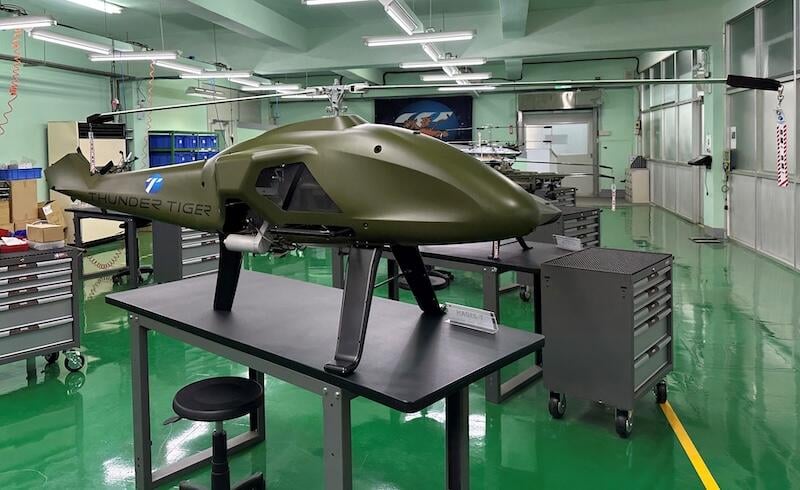
A T250AH Raptor autonomous helicopter

A T250AH Raptor autonomous helicopter manufactured by Thunder Tiger, which is a member of the Taiwan Excellence Drone International Business Opportunities Alliance.

Credit: Matthew Fulco/Aviation Week Network

TAIPEI, Taiwan—Taiwan’s state-backed drone industry alliance has grown from 50 members at its September 2024 inception to more than 200 today and is expeditiously decoupling from China-based supply chains, Chairman Hu Kai-Hung tells Aviation Week.

Hu, who also serves as the chairman of Taiwan’s Aerospace Industrial Development Corporation (AIDC), says that the drone alliance is laser-focused on creating a “non-red supply chain”—the red referring to China—to align with the requirements of the U.S., which has flagged the security threats posed by Chinese drones.

Members of the Taiwan Excellence Drone International Business Opportunities Alliance (Tediboa) are required to prove the origin of their components, Hu says.

The alliance includes the largest Taiwanese drone manufacturers, like Geosat Aerospace and Thunder Tiger, as well as many smaller companies that specialize in the production of specific uncrewed aircraft system (UAS) components.

Hu acknowledges that Taiwan faces considerable challenges breaking into an industry dominated by China. Shenzhen-based DJI alone has an estimated 70% share of the global UAS market. “Taiwan is a latecomer to the drone sector, but it can leverage its advanced technology and manufacturing capabilities to cooperate with the growing number of countries that want a reliable alternative to China,” he says.

In addition to the U.S., Tediboa has made inroads in Eastern Europe, signing agreements with Estonia, Latvia, Lithuania and Poland. They make ideal partners for Taiwan because of their experience supporting Ukraine—including with autonomous technologies—as it defends itself against Russia’s full-scale invasion, and their antipathy toward authoritarian expansionism, Hu says.

Most recently, Tediboa has stepped up cooperation with Asian countries, including Japan and India—both of which are intensifying efforts to reduce dependence on Chinese drone suppliers. Japan said in February it would expand its supply of domestically produced UAS to partner countries in the Indo-Pacific beginning in the 2025 fiscal year. India has canceled three orders totaling 400 military UAS due to security concerns about China-made components.

While Tediboa feels increasingly confident about the integrity of its supply chain, there is one area which Hu sees as high risk. “We are worried about the reliability of access to rare earths and other critical minerals dominated by China,” he says, noting how Beijing has weaponized its control of those supply chains in its trade war with the U.S. “These are crucial for certain drone components, and we don’t have an easy replacement if China cuts off supply to Taiwan.”

Tuesday, April 15, 2025

"The Case For Bringing back American Grit"


*Doesn't exist anymore, Porche North America Headquarters now are at that location.*

Those of y'all that have been visiting my blog for a long time know that I used to be a Ford Motor Company Assembly worker, we used to build the Ford Tauruses and Mercury Sables, but Ford had too many factories for its market share in the United States in the middle of the 2000's, even though we built a quality product, and got quality and efficiency awards, in the end it didn't matter.  My job got "Outsourced."  I knew that the Taurus was slated to end in 2006 and we were supposed to get the new "Ford Fusion" but it got sent to Mexico instead and I hoped we would get another car line, but it wasn't to be.  We got shuttered as part of Fords "Way Forward".  I don't hate Ford because of what happened, they treated us good in a bad situation, we basically got 1 years salary, they maintained our medical for 6 months,  they told us in January that the plant was closing in October for those that took the *buyout* and if you had 10 years, you were vested and kept your pension.  They also gave employees the option to transfer to "Louisville Assembly Plant" or "Kentucky Truck Plant" and Ford would help pay relocation expenses.  Or for those that wanted to go to college, they would pay for 4 years college(up to a certain amount) and pay a stipend and medical until completion.  Like I said, they treated us good in a bad situation.  A lot of places they would have given 2 weeks notice or some places, there would have been a padlock on the gate and the hourly employees would have had to go to the Dept of labor to try to get their last paychecks.  I still drive Fords even today, I still own the stock I bought back then.  I say all this to say is , I wish someone had fought for the American Workers back in the day like President Trump is doing now, the rank and file had seen our jobs go overseas, thanks to "NAFTA" and China getting "Most Favoured Nation " and the other presidents from  both parties screwed the American workers.  Most of the countries have been screwing us to the wall for generations with "Tariff "they would tariff the crap out of our goods and we would not do the same and they would dump their cheaper goods on our market and basically run our industry out of existence.  I an a big fan on insourcing, especially things that are necessary for our national defense. 

      It is a problem  when soo much of our stuff is made by a potential hostile power *cough*hack* China*cough*hack*, but I do have a concern, China has an export economy, and a large youth unemployment problem, I can see *Poo Bear* and the Chinese Military doing a preemptive strike because they fear domestic unrest far worse than they fear a foreign war., because domestic unrest is a threat against their power whereas a foreign war is a way to unite the people against a foreign enemy especially one of the "Foreign Devils" and also it will take care of some of the overpopulation of unemployed youth, remember to a communist society, you have no value except to serve the state and if you are "Cannon Fodder", well it sucks to be you and we have a large "5th column" problem, especially with our youth after several generations of being indoctrinated by the educational system, I see a bunch of kids helping the CHICOM's out because they hate the United States because they have been conditioned to because of *systemic racism* or *Climate Change* or Patriarchy* or a bunch of other words loved by the progressive leftbut basically they have lost faith in Western civilization and they will also become *Disposable* and not realizing what they are actually doing until it is too late.


     I shamelessly clipped this off *GAB* the Free Speech Social Media outlet.


The heart of America has always beat to the rhythm of hammers on steel, the hum of factories, and the pride of craftsmen shaping raw materials into something enduring. For too long, we’ve surrendered that heartbeat to the hollow clatter of foreign assembly lines. We traded our sovereignty, our dignity, and the well-being of our people for the fleeting convenience of cheaply made trinkets. But now, with tariffs reshaping the economic landscape, we stand at the threshold of a rebirth—a return to the essence of what made this nation unstoppable. This isn’t just about economics; it’s about resurrecting the soul of America.

Let’s be clear: the decay of American manufacturing didn’t happen by accident. It was a slow-motion betrayal. We outsourced our jobs, shuttered our factories, and handed over the keys to our prosperity to nations that don’t share our values or our dreams. My grandfather’s refrigerator, bought when he married my grandmother, still runs today. It wasn’t a fluke. It was built by American hands, forged with American steel, and engineered with the kind of pride that doesn’t cut corners. That fridge is a relic of an era when “Made in America” wasn’t a nostalgic slogan—it was a stamp of excellence. Today, we’re surrounded by disposable goods designed to break, replace, and drain our wallets. This isn’t progress. It’s a surrender.

Tariffs are not punishment. They’re a lifeline. By making it harder for foreign competitors to undercut our industries, we’re forcing a reckoning. Suddenly, it’s no longer cheaper to ship jobs overseas. Suddenly, companies that abandoned our heartland for foreign sweatshops will have no choice but to come home. This is how we rebuild. This is how we stop the bleeding. Critics will whine about “trade wars” or “higher prices,” but what’s the alternative? A nation of consumers, not creators? A people stripped of purpose, staring at screens, ordering plastic junk from faceless corporations overseas? That’s not a future. That’s a death spiral.

American men and women are starving for purpose. We weren’t born to click “Add to Cart” and wait for delivery trucks. We were born to invent, to engineer, to sweat over a weld until it’s perfect. The pioneer spirit that carved railroads across mountains and raised skyscrapers into the sky hasn’t vanished—it’s been suffocated by a culture that tells us building things is someone else’s job. Tariffs are the spark that reignites that fire. When factories reopen, when workshops hum back to life, we won’t just be manufacturing goods. We’ll be restoring dignity. Every job created here, every product stamped “Made in USA,” is a middle finger to the lie that America’s best days are behind her.

This is about more than economics. It’s about identity. For decades, we’ve been force-fed the myth that globalization is inevitable, that competition with countries exploiting their workers and polluting their rivers is “fair.” But since when did Americans settle for “fair” when we could strive for dominance? Our ancestors didn’t cross oceans and plains to become passive observers of their own destiny. They built. They fought. They innovated. Tariffs are the first step in rejecting the cowardice of offshoring and embracing the courage of self-reliance.

The road ahead won’t be easy. There will be short-term costs. But since when did greatness come without sacrifice? The naysayers can keep their flimsy gadgets and their fragile supply chains. We’ll take the struggle of rebuilding, because on the other side of that struggle is a nation that makes things again—things that last. A nation where fathers and mothers point to bridges, engines, and yes, refrigerators, and say, “We built that.” A nation where the American spirit, too long caged by complacency, finally breaks free.

This is our moment. The tariffs are more than policy—they’re a declaration. We are done outsourcing our future. We are done surrendering our pride. Let the world call it protectionism. We’ll call it patriotism. The golden age of American building begins now.

The skeptics love to preach about the “global economy” as if it’s some sacred, unalterable force of nature. But let’s strip away the euphemisms. What they call “globalization” is really just a race to the bottom—a system that rewards countries for exploiting laborers, gutting environmental standards, and hollowing out the industries of their so-called “partners.” America didn’t become a superpower by bowing to such extortion. We became a superpower by outworking, outthinking, and outbuilding everyone else. Tariffs level the playing field, yes, but their greater purpose is to remind the world that America doesn’t follow rules—we set them. This isn’t isolationism; it’s defiance. We’re done playing the sucker in a rigged game.

Consider the small towns and cities scattered across the Rust Belt, the South, and the heartland. These communities weren’t just clusters of factories; they were ecosystems of innovation and pride. When the factories left, they took more than jobs. They took identity. They took the Friday night camaraderie of workers sharing a beer after a hard week, the local diners buzzing with shifts changing, the scholarships funded by plant profits for kids to learn trades. Tariffs won’t just revive factories—they’ll revive the glue that holds these towns together. This isn’t nostalgia. It’s justice. For every Main Street boarded up, for every family fractured by addiction or despair in the wake of economic collapse, tariffs are a down payment on redemption.

And let’s talk about the men and women who’ve been told their skills are obsolete. The welders, machinists, and electricians—the ones who don’t just push buttons but solve problems with calloused hands and sharp minds. These aren’t “old economy” jobs. They’re timeless trades, the backbone of any society that values self-reliance. Tariffs will force us to reinvest in apprenticeships, in vocational schools, in the kind of hands-on education that doesn’t saddle kids with debt but instead gifts them purpose. Imagine a generation raised not on influencers peddling vanity, but on mentors teaching them to measure twice and cut once. That’s how cultures endure. That’s how legacies are forged.

Detractors screech about inflation, but they ignore the hidden costs of our current decay. Yes, a $10 toaster from overseas is cheap—until you factor in the billions spent on welfare for displaced workers, the opioid crisis fueled by joblessness, or the national security risks of relying on China for everything from microchips to antibiotics. What’s more expensive: paying a fair price for a toaster built in Ohio, or surrendering our resilience as a nation? Tariffs force us to confront these truths. They’re not a tax on consumers; they’re an investment in sovereignty. When we build our own goods, control our own supply chains, and employ our own people, we’re not just saving money—we’re saving ourselves.

Some will say automation renders this vision outdated. Nonsense. Automation isn’t the enemy; offshoring is. Imagine combining American ingenuity, robotics, and high-tech manufacturing with the grit of our workforce. We’d dominate. Germany didn’t abandon its factories—it married precision engineering with cutting-edge tech. Japan didn’t outsource its auto industry—it perfected it. America can do both, but only if we have the courage to protect and nurture our industrial base first. Tariffs buy us time to innovate here, on our soil, rather than handing our future to rivals.

This is also a spiritual battle. Consumerism has turned us into a nation of renters—of our gadgets, our homes, even our identities. We scroll, we swipe, we discard. But building things changes you. It roots you. There’s a reason our grandfathers held onto that fridge for 60 years: it was a testament to their values. Durability. Integrity. Legacy. When we 

The road ahead demands more than tariffs, of course. We’ll need to slash regulations that strangle small manufacturers, rewrite trade deals that put America first, and celebrate blue-collar work as noble, not “backup” career. But tariffs are the catalyst. They’re the spark in the dark, the signal to the world that America is done outsourcing its soul. For every CEO who claims he “has no choice” but to move jobs overseas, tariffs scream back: You do now.

History doesn’t remember nations for what they bought. It remembers them for what they built. The pyramids. The railroads. The internet. Our ancestors didn’t cling to safe, small, soulless lives—they gambled on greatness. Tariffs are our gamble. They’re a bet that American hands still yearn to shape steel, that American hearts still hunger for purpose, and that this country’s best chapters aren’t behind her, but waiting to be written. Let the doubters cling to their cheap trinkets.

We’re building cathedrals.


Andrew Torba
CEO, Gab AI Inc
Christ is King


Saturday, May 27, 2023

Why China can't dump Boeing despite the dreams of Airbus.

 I am presently in Florida visiting my brother and his family for the memorial day weekend. So yes I threw another aviation themed post against the wall, LOL.  This one also came from my work email from a 3rd party source.   I used this one because it did mention some demographic issues that the Chinese have and I thought that was interesting.

China Eastern Airlines Airbus A320-200 (foreground) and Boeing 737-800.

Credit: Rob Finlayson

Manufacturing mainline aircraft is a natural monopoly that governments and airlines prevent from becoming an actual monopoly by sustaining at least two major OEMs. This approach preserves competition as well as most of the scale economics that a monopoly would bring. The result has been a roughly even Airbus-Boeing contest, now complemented at the low end by Embraer E2s, and has generally served airlines well.

But markets shift. The 737 MAX agony left Boeing well behind Airbus in narrowbody prospects, and a cutback in orders from China’s huge market has further worsened the prospect of US OEM sales. In scale industries, size matters because fixed costs can be spread across more units, giving leaders a further advantage.

But observers are also questioning how long China will continue its rapid economic and aviation growth with a declining and aging population. Combine this question with Boeing’s slippage, and the aircraft purchasing landscape airlines will face in the future is looking increasingly blurry.

Boeing’s problems in China started with the MAX in 2018, well before COVID, with the first of two fatal crashes. In 2019, after the second crash, the aircraft was grounded, dramatically slowing new orders. The pandemic and subsequent design and delivery problems at Boeing further affected orders, although demand for the MAX has returned.

Chinese carriers had taken 125 Boeing aircraft in 2018, but took only 35 in 2019, three in COVID-hit 2020, four in 2021 and 11 in 2022. Airbus’ Chinese business was also hit by the pandemic but has recovered much more strongly than Boeing’s.

Data

Source: International Monetary Fund

In an Aviation Week Check 6 podcast, Sash Tusa, an analyst at the UK’s Agency Partners, attributed much of Airbus’ strength in China to the opening of its final assembly line (FAL) in Tianjin country in 2009. The European airframe OEM had only 10%-15% of the market in 2009.

“Boeing owned the market,” Tusa noted. Airbus’ share has risen steadily since.

Aerodynamic Advisory’s Richard Aboulafia traces Boeing’s slippage to different causes: The US-China trade conflict begun under President Trump has continued and intensified under the Biden Administration. “Boeing is a hostage to that,” Aboulafia argues. And tensions over Taiwan could lead to much more disrupted trade or worse.

In any case, there are limited prospects for a turnaround. “Assuming that the current geopolitical environment doesn’t radically improve soon, then I doubt you’ll see many Chinese orders for Boeing,” Teal Group senior analyst Bruce McClelland said. “It may be that China quietly lets undisclosed orders get delivered, but don’t expect any big public announcements.”

McClelland too sees China using Boeing as way to show its displeasure at US policies. “Favoring Airbus helps China pursue its aim of getting Europe to hew to a more Chinese-friendly path,” he said.

Opportunties

How much does this matter to Boeing? It’s significant, but maybe not as drastic as it appears, especially in light of other fast-growing markets. For example, India’s economy was only one-sixth the size of China’s in 2021 but averaged 7% annual growth before COVID. The International Monetary Fund (IMF) projects that India will account for 13% of global economic growth in the next five years, more than half the 23% share expected from China. US civil aviation exports to the Middle East were growing 7% annually before COVID, a pace that should roughly resume as the virus passes. South American economies are also expected to grow significantly.

Data

Source: World Bank, China Civil Aviation Administration

These other opportunities have a hopeful implication.

“China’s not a big problem for Boeing,” Aboulafia insists. He judges that Airbus’ backlog now has about two-thirds of the high-volume, low-margin narrowbody global market, while Boeing has two-thirds of the low-volume, high-margin widebody market.

Even Boeing’s reduced share of narrowbodies should translate eventually into 40-50 737s produced per month, which the Aerodynamic analyst says does not drive unit costs up too much. “They produced 30 per month with respectable margins,” Aboulafia said, adding that he thinks Boeing will still recover at least some share of the China market as growth resumes.

McClelland essentially agrees, seeing China as a “long but still moderate challenge for Boeing.”

Teal Group estimates that China, including Hong Kong and some undisclosed orders, represents only 13%-14% of the global backlog of aircraft orders. And it estimates that Airbus and Boeing have similar portions of their own backlogs dedicated to China, although, “Boeing’s China backlog is probably shakier than Airbus’.”

Overall, “Boeing is just going to have to work harder than Airbus to make itself successful in the rest of the world, McClelland said.

Not that China will cease playing a major role in aviation as in the rest of the global economy. GDP drives aviation, especially in less-mature markets. China’s official real GDP, sometimes questioned, grew an average of 8% annually in the decade before COVID, slowing only to 7% annual growth in the last five years before the virus hit. The latest estimates are that the nation will achieve 6% real growth in 2023.

This growth has been achieved despite slowing population growth and, from around 2014, a flat labor force. Real GDP per worker was rising 8% annually in the decade before the virus. Chinese brains, hard work and high savings, not more Chinese, have chiefly been responsible for the country’s growth.

Now the country is headed for a long decline in population. The United Nation’s mid-case estimate puts China’s 2050 population at 1.317 billion, while another private forecaster puts it even lower, at 1.312 billion. Both figures are well down from 2022’s 1.426 billion. These estimates imply a decline of about 0.3% annually in the population.

By itself, that would not slow growth down much, but other factors will. First, when a country loses population because of declining fertility rates, it also means the population is aging, and that means fewer workers. This has already happened to some degree. China’s labor force participation rate was near 60% early in the 21st century but decreased to 55% on the eve of COVID.

Aircraft

Chinese airlines began returning the Boeing 737 MAX to commercial operations in January, and Boeing has more than 130 China-bound MAXs in storage. Credit: Christopher Wong/S3studio/Getty Images

By 2050, only 55% of China’s population is expected to even be in the prime working age group of 20 to 64, according to forecasters at PopulationPyramid.net. By way of contrast, India’s expected population of 1.67 billion is predicted to still be growing and to have 61% of its people in the prime working ages by 2050.

Second, of course, the richer a country gets, the harder it is to maintain rapid growth. After China shed Marxist economics, annual growth rates were often in double digits in the early 1980s and 1990s. More recently, they have been about half that rate. A gradual slowing of the growth per highly industrious Chinese worker is therefore likely.

It is therefore not surprising that forecasters differ widely on China’s future economic growth. Many still see 3.5%-5% average annual growth continuing until mid-century. But skeptics like researchers at the Lowy Institute see an average of 2%-3%. Small differences in compounding growth rates imply big differences in the ultimate size of the market.

Bounce-Back

But short-term, there is no doubt of a strong bounce-back in Chinese aviation. China’s air traffic was growing even more rapidly than its economy pre-COVID and took a much sharper dive during the pandemic.

Air travel should therefore recover very strongly as restrictions are lifted in China and across Asia-Pacific nations, as has been the case this year. China’s February 2023 total traffic, passenger plus cargo, was up 29% over same month of 2022.

That favors the environment for at least some progress in China by Boeing.

“If Chinese traffic starts to surge ... then you could see a softening of China’s stance toward Boeing,” McClelland argues. One early sign may be Hong Kong’s Greater Bay Airlines’ recent order for 15 MAXs and five 787s. And in late April, Chinese regulators published a report viewed as easing deliveries of new MAXs to China. Boeing has stored more than 130 MAXs destined for China. Finally, McClelland believes that Airbus and Boeing each have a significant number of undisclosed Chinese orders.

Even under trade and political tensions, the US is not without leverage on China’s aircraft purchasing policies. Wolfe Research analyst Myles Walton points out that half the systems on China’s COMAC C919, intended to compete in the narrowbody market, come from US suppliers.

“Abandonment by China of Boeing planes would be an untenable outcome for US policymakers to allow technology sharing to continue,” he said.

So a disadvantage in, but not an exclusion from, the Chinese market looks most likely for Boeing. And this market will still be huge, albeit probably declining in relative importance in the future.

And, like China, the US OEM is recovering, with first-quarter revenue up 28%, year-over-year, expecting to produce 38 737s later this year and a backlog of more than 4,500 commercial aircraft.

In Boeing’s first-quarter earnings call, CEO Dave Calhoun noted that China’s domestic travel was at pre-pandemic levels and would continue to grow.

“So, they need airplanes,” he noted.

The company also said all MAX operators in China had returned to flying their aircraft and 45 of the 95 737 MAXs in China were back in service.


Wednesday, February 22, 2023

Debris is Recovered from the Chinese Balloon shot down over South Carolina.

 I can't fathom why it took the Xiden Administration soo long to "deep Six" this balloon after it was spotted, and to let it float its merry way across the United States until the outcry was soo bad he was forced to act.  then there was the unnamed pin head from the DOD that said that there were 3 of those balloons during the Trump administration and he did nothing and John Bolton whom despises President Trump called out this source as "incorrect, misdirection, and full of bovine scatology" and the DOD quickly backpetaled when they were called out on it.  I guess having "Trump Derangement Syndrome" and trying to curry favors with Xiden blew in your face, I would step back from that falsehood also.

     I snagged this from a 3rd party source from my work email.


A U.S. Navy sailor loads debris from the Chinese surveillance balloon onto a ship on Feb. 10 in Virginia Beach, Virginia.

U.S. forces have completely recovered the Chinese surveillance balloon shot down off the South Carolina coast on Feb. 4, though officials warn they may never recover the other three unidentified objects downed by fighter jet missiles the following week. 

U.S. Northern Command in a Feb. 17 statement said recovery operations concluded the day before, with the final pieces of debris transferred to an FBI laboratory in Virginia. U.S. Navy and Coast Guard vessels have left the area near Myrtle Beach with all air and maritime safety perimeters lifted. 

National Security Council spokesman John Kirby during a Feb. 17 briefing said crews retrieved all that was recoverable, including the payload structure, electronics and optics. 

“They’re analyzing it, they’re looking at it, and we need to let them do their work in a thoughtful, deliberate way,” Kirby says. “I want to caveat all this by saying there may be some things we will not be able to disclose.”

During the briefing, Kirby was asked about Aviation Week reporting that the object downed Feb. 11 in the Yukon Territory of Canada could have been a hobbyist pico balloon launched by the Northern Illinois Bottlecap Balloon Brigade (NIBBB) that went missing off the west coast of Alaska the day before. Kirby says the White House cannot confirm the report or what the remains of that balloon, or the other two objects downed over Alaska and Lake Huron, will end up being. 

“We haven’t recovered it. It’s very difficult until you can get your hands on something to be able to tell,” Kirby says. “We all have to accept the possibility that we may not be able to recover it.”

The object in Yukon is in rough, remote territory in cold weather. The object downed Feb. 10 over Alaska is on a shelf of sea ice. The one shot down in Lake Huron on Feb. 12 is in a deep water, and Canadian officials announced Feb. 16 that they were ending the search on their side of the border. 

Even with the possibility that the objects shot down by F-22s and F-16s were small, cheap hobbyist balloons, Kirby defended the decision to take them down based on the circumstances at the time. 

“Given the situation we were in, the information available, the recommendation of our military commands, it was exactly the right thing to do at exactly the right time,” he says.

The possibility that the objects end up being $12 balloons launched by hobbyists would be a good thing, he argues. 

“Frankly, given the circumstances, in light of what happened with this spy balloon, wouldn’t that be a better outcome?” he says. “If it turns out that they were, in fact, civilian or recreational use or weather balloons and therefore benign, which is what the intelligence community thinks. Isn’t that a better outcome than to have to think about the possibility of greater threats to our national security?”

If the downed object in Yukon does belong to the NIBBB, Kirby says he is not aware of any plan to reimburse it for the cost of the balloon.

President Joe Biden on Feb. 16 outlined his plan to better detect, track and regulate uncrewed flying objects, and to overhaul procedures for the military to respond. This includes a new inventory of uncrewed airborne objects, improved ability to detect objects in airspace and revised regulations for the launch and operations of the objects. 

The military parameters will likely be classified. They will be sent to Congress within days and go into effect quickly, Kirby says. 

The saga of the Chinese balloon and subsequent unidentified objects comes as the Pentagon is finalizing its upcoming budget requests, and there could be funding shifted to address the issue. 

“If there needs to be more resources, to have more resources applied to this particular challenge, then that’s certainly a conversation worth having,” Kirby says.


Thursday, October 27, 2022

China Recruiting Western Pilots....

 I saw in several of the news sources that I follow that the RAF and other European Air Forces are refusing to recruit white males due to the "DIE" and adopting unrealistic "Diversity" goals so the white males are going elsewhere where their skills are in demand.  And from what I have read, the standards of the Western Air Forces have been "Broadened to allow maximum recruitment effort".  Whatever that means.  This concerns me to a degree, your fighter pilots are supposed to be the best in the world, but if you no longer allow or train for that, the cost in national treasure and prestige can be devastating.  I snagged this from a 3rd party in my work email.

TFASA says it is the only independent test-pilot school outside Europe and the Americas.


test pilots

On April 23, 2022, a Hongdu L-15/JL-10 jet trainer crashed in Anhui, China. Both pilots ejected from the aircraft safely, but what raised eyebrows was who was in the aircraft.

When villagers rushed to the scene, they videoed on their cellphones a Chinese pilot and, next to him, a non-Chinese pilot dressed in a sand-colored flight suit speaking in accented English.

The internet went abuzz with theories. Some said he was a Russian pilot working in conjunction with the Chinese on the L-15 aircraft project, and some suggested he was a test pilot from Serbia or Latin America, where China is hoping to market the aircraft.

Beijing never gave an explanation on the origin of the mysterious pilot.

  • South African company helps place Western pilots in China
  • Political indoctrination might affect Chinese pilots’ skills

Six months later, the UK government revealed that as many as 30 former British military pilots are in China providing training to the People’s Liberation Army (PLA). Since then, reports have suggested that China has also headhunted former Australian and French pilots for similar roles; French naval personnel are of particular interest because of their aircraft carrier experience.

A South African company, the Test Flying Academy of South Africa (TFASA), has been named as an intermediary for foreign pilots to work in China. It even advertises a four-year contract to work at an undisclosed location in “Far East Asia.” Job requirements state that pilots must be graduates of either a U.S. or UK military flight-test school.

An anonymous pilot in Australia tells Reuters that the company is “clearly targeting Western/Five Eyes test pilots,” the latter referring to Australia, Britain, Canada, New Zealand and the U.S. UK defense officials said the pilots are being offered “lucrative” pay packages worth more than £200,000 ($226,000) a year.

Following their UK counterparts, the Australian Defense Department has commenced an investigation to see if any ex-military pilots have been lured to China.

So what is TFASA? Formed in 2003, it states on its website that it is the only independent test pilot school outside Europe and the Americas. Its website sports numerous high-resolution photos of PLA aircraft—namely, the L-15, Shenyang J-16 and one image of an FTC-2000 with a group of Western pilots.

Jean Rossouw, a former test pilot with the South African Air Force (SAAF), is chairman of TFASA and a director of the China-linked Avic-International Flight Training Academy (AIFA). AIFA is a joint venture partner of TFASA. C. Jurie van Wyngaard, TFASA CEO, is also a SAAF pilot who previously held roles at Pilatus and Saab.

TFASA is also involved in aircraft sales for Blackshape Prime, Blackshape Gabriel and Ikarus C42 light aircraft.

Although the pace of the People’s Liberation Army Air Force’s (PLAAF) modernization has been quick, its tactics and operational concepts are not validated in any aspects. Countries such as Japan and South Korea are trained to Western standards, whereas India has combat experience against Pakistan, but the PLAAF remains untested. With the exception of a handful of exercises with Thailand and Turkey, Beijing has no benchmark for how its pilots and fighters will deal with potential foes.

Collin Koh, a research fellow at the Institute of Defense and Strategic Studies at the S. Rajaratnam School of International Studies in Singapore, says the current skills and tactics introduced by the foreign pilots could be hindered by existing PLAAF political indoctrination.

“In other words, Western and Western-inspired air forces tend not only to put more emphasis on the individual aptitude of the combat aviator but also give a wide berth of autonomy in decision-making,” Koh says.

“Given the extent of centralization and political control within the PLA, which we are seeing being strengthened under [Chinese President Xi Jinping], one should question whether inducting these new insights and skill sets from foreign instructors may make a significant difference in the way the PLAAF operates, unless there’s a monumental shift in the command and control as well as political indoctrination,” Koh continues.

UK officials say there is no evidence that pilots recruited to work in China have broken the Official Secrets Act, the UK’s primary law against espionage.

But since the government in London is taking a more hawkish line toward China, along with other European nations and the U.S., the UK’s Defense Ministry is considering what actions it can take to prevent military expertise from being transferred to potential adversary states in the future. In particular, the UK is looking at using confidentiality contracts and nondisclosure agreements to prevent such transfers of information. Meanwhile, a new National Security Bill currently being examined by lawmakers will create additional tools to tackle “contemporary security challenges,” officials say.


Sunday, November 25, 2012

China Lands new fighter jet on Chinese carrier

This will cause problems for our navy, Our carrier striking force has served our interest and kept the peace for many years, now we have a resurgent China and they would love for us to leave the Pacific and let them spread their influence, threaten Taiwan, the Philippines, we have spilled blood together with them, and other nations up to and including Australia.


  • A carrier-borne J-15 fighter jet takes off from the Liaoning, China's first aircraft carrier, in this undated handout photo released November 25, 2012. China has successfully conducted flight landing on its first aircraft carrier, the Liaoning, after its delivery to the People's Liberation Army (PLA) Navy on September 25, 2012, according to Xinhua News Agency. REUTERS/Xinhua/Zha Chunming
    A carrier-borne J-15 fighter jet …

SHANGHAI (Reuters) - China has carried out its first successful landing of a fighter jet on its first aircraft carrier, state media said on Sunday, a symbolically significant development as Asian neighbors fret about the world's most populous country's military ambitions.
The home-built J-15 fighter jet took off from and landed on the Liaoning, a reconditioned Soviet-era vessel from Ukraine which only came into service in September this year.
China ushered in a new generation of leaders this month at the 18th Communist Party Congress in Beijing, with outgoing President Hu Jintao making a pointed reference to strengthening China's naval forces, protecting maritime interests and the need to "win local war".
China is embroiled in disputes with the Philippines and Vietnam over South China Sea islands believed to be surrounded by waters rich in natural gas. It has a similar dispute with Japan over islands in the East China Sea.
It has also warned the United States, with President Barack Obama's "pivot" to Asia, not to get involved.
"We should make active planning for the use of military forces in peacetime, expand and intensify military preparedness, and enhance the capability to accomplish a wide range of military tasks, the most important of which is to win local war in an information age," Hu said.
China has advertised its long-term military ambitions with shows of new hardware, including its first test flight of a stealth fighter jet in early 2011, an elite helicopter unit and the launch of the aircraft carrier.
China is boosting military spending by 11.2 percent this year, bringing official outlays on the People's Liberation Army to 670.3 billion yuan ($100 billion) for 2012, after a 12.7 percent increase last year and a near-unbroken string of double-digit rises across two decades.
Beijing's public budget is widely thought by foreign experts to undercount its real spending on military modernization, which has drawn repeated calls from the United States for China to share more about its intentions.
China's state-run Xinhua news portal said the J-15 - which can carry multi-type anti-ship, air-to-air, and air-to-ground missiles - is comparable to the Russian Su-33 jet and the U.S. F-18. It did not say when the landing on the carrier took place.
(Reporting by Shanghai Newsroom; Editing by Nick Macfie)

Wednesday, May 30, 2012

R.O.C Wants to purchase F-35's

   With Obungler and his administration fearing to upset the Red Chinese because of the massive debt that we owe the Chinese, they are stalling on selling the Taiwanese more advanced weapons to preclude a Chinese attack on what they call their breakaway province  an internal matter is what Obungler will justify the United States not coming to their aid as called by treaty obligations.  The Red Chinese have stealth fighters in their inventory, I remember the Chinese running all over Bosnia buying up the pieces of that F117 stealth fighter that was shot down in the late 90's.  Why we didn't drop a cluster bomb on the wreckage to vaporize it I don't know...but wait, we had a democratic president in charge back then.  This demonstrates the international problems of the massive debts that we have accrued, this debt hampers the ability of the United States on the international stage, it also doesn't help that we have a vacillating president on the stage representing us.  The Taiwanese government believes that the F-35 will achieve parity with the Chinese J-20 that is believed to be parity to the United States F-22 Raptor


F-35 fighters best suit Taiwan's air defense needs: official

ROC Central News Agency
2012/05/29 15:23:29
Taipei, May 29 (CNA) F-35 stealth fighters are the new-generation combat aircraft that best serve Taiwan's air defense needs, a military official said Tuesday, the latest hint that the government may not be as keen to acquire advanced F-16 C/D fighters as once thought.
The F-35s, with their short takeoff capability, would bolster the country's defense capabilities, as airports are likely to be destroyed by enemy forces in the event of war, the official said on condition of anonymity because of the sensitivity of the issue.
The official's remarks came after the U.S. House of Representatives voted earlier this month in favor of the U.S. government selling 66 F-16 C/Ds to Taiwan to help the island close its military gap with China.
Taiwan has long lobbied Washington to sell it the advanced fighters, but the Obama administration decided last year to offer Taiwan a retrofit package for its aging F-16 A/B fleet rather than new F-16 C/Ds.
Since then, the U.S. Congress has pushed the government to also sell Taiwan the more advanced fighters, and following the House vote, the Ministry of National Defense issued a statement thanking it for its support.
But it also noted that Taiwan was reassessing its need for more advanced jet fighters because some of the functions of the upgraded F-16 A/Bs were better than those of the F-16 C/Ds, and it said that Taiwan, like Japan and Australia, would pursue the purchase of new-generation combat aircraft.
Because Japan and Australia have announced plans to buy F-35s, the statement triggered speculation that Taiwan's interest in the F-16 C/D fighters had cooled.
Asked about the issue, the official said the ministry will make an overall assessment of foreign purchases of military aircraft and make sure the defense budget is well spent.
"There are many options on the table," the official said. "These include cutting the number of F-16 C/Ds we have requested."
In an interview with CNA, ministry spokesman Maj. Gen. Luo Shou-he reiterated Taiwan's gratitude for U.S. support and urged Washington to continue selling Taiwan defensive weapons based on the Taiwan Relations Act (TRA).
The TRA, enacted in 1979 when Washington and Taipei severed ties, obliges the U.S. to help Taiwan defend itself.
In September 2011, the U.S. approved the sale of a retrofit package for F-16 A/B fighters and related training at an estimated cost of US$5.85 billion.
(By Elaine Hou)
ENDITEM/ls

Tuesday, May 22, 2012

Counterfeit Chinese parts slipping into U.S. Military equipment


I wonder how many of these parts and chips have a backdoor weakness that could be exploited by a hostile power....like the Peoples Republic of China......or some proxy.
Counterfeit electronic parts from China are "flooding" into critical U.S. military systems, including special operations helicopters and surveillance planes, and are putting the nation's troops at risk, according to a new U.S. Senate committee report.
A year-long investigation conducted by the Senate Armed Services Committee found more than one million suspected counterfeit parts made their way into the Department of Defense's supply chain and were bound for use by "critical" military systems, according to the 70-plus-page document released Monday. In addition to Navy helicopters and surveillance planes, the parts were slated to be put into the Air Force's newest cargo planes.
"The failure of a single electronic part can leave a soldier, sailor, airman, or Marine vulnerable at the worst possible time," the report says. "Unfortunately, a flood of counterfeit electronic parts has made it a lot harder to prevent that from happening."
Chinese companies were identified as the "primary source" of the counterfeit goods and the Chinese government was criticized for its alleged disinterest in cracking down on counterfeiting there. The report said that Chinese companies take discarded electronic parts from all over the world, remove any identifying marks, wash and refurbish them, and then resell them as brand-new – a practice that poses a "significant risk" to the performance of U.S. military systems.
But the committee also pointed a finger at the Pentagon and U.S.-based defense contractors that rely on "hundreds of unvetted independent distributors."
According to the document, the investigation "revealed failures by defense contractors and [the Department of Defense] to report counterfeit parts and gaps in DoD's knowledge of the scope and impact of such parts on defense systems."
"Our committee's report makes it abundantly clear that vulnerabilities throughout the defense supply chain allow counterfeit electronic parts to infiltrate critical U.S. military systems, risking our security and the lives of the men and women who protect it," said Senate Armed Services Committee ranking member Sen. John McCain (R.-Arizona). "As directed by last year's Defense Authorization bill, the Department of Defense and its contractors must attack this problem more aggressively, particularly since counterfeiters are becoming better at shielding their dangerous fakes from detection."
A spokesperson for the Department of Defense did not immediately respond to requests for comment on this report, but another spokesperson told CNN the Pentagon was aware of the report and officials "looked forward to reviewing it."
"The Department takes very seriously the issue about counterfeit parts," Col. Melinda Morgan said. "We are working aggressively to address this issue..."
Months after the Senate committee launched its investigation, the Pentagon said in November it was moving to protect against counterfeit parts by modifying policies and improving its internal process as well as working more closely with private companies in the industry.
Then, Defense spokesperson George Little noted that "there has been no loss of life or catastrophic mission failure as a result of these parts entering the supply chain."
Representatives for the Chinese government at its embassy in Washington, D.C., and consulate in New York, New York did not immediately respond to request for comment on this report.

Wednesday, December 14, 2011

China's fake deserted Disneyland

 I read this with some interest on Yahoo news.

Along the road to one of China’s most famous tourist landmarks – the Great Wall of China – sits what could potentially have been another such tourist destination, but now stands as an example of modern-day China and the problems facing it.

Situated on an area of around 100 acres, and 45 minutes drive from the center of Beijing, are the ruins of ‘Wonderland’. Construction stopped more than a decade ago, with developers promoting it as ‘the largest amusement park in Asia’. Funds were withdrawn due to disagreements over property prices with the local government and farmers. So what is left are the skeletal remains of a palace, a castle, and the steel beams of what could have been an indoor playground in the middle of a corn field.

Pulling off the expressway and into the car park, I expected to be stopped by the usual confrontational security guards. But there was absolutely no one to be seen. I walked through one of the few entrances not boarded up, and instantly started coughing. In front of me were large empty rooms and discarded furniture, all covered in a thick layer of dust, along with an eerie silence that gave the place a haunted feeling – an emotion not normally associated with a children’s playground.

Once outside again, I came across some farmers who originally owned the land and are now using it to once again to grow their crops. Their tracks and plantations can be seen running through and surrounding the uncompleted buildings. Walking further, I came across a rather farcical sight of some farmers digging a well next to a castle; a moment I will always savor as a photographer in a place like China where castles are not in huge supply. I explained this to the farmers and they just shrugged their shoulders, oblivious to a photographer’s happiness. I asked them what happened, and they simply answered the developers ran out of money, and they are getting back to doing what they do best. They are even slowly starting to plant trees and build shelters near the buildings, adding they think it is now safe to think the developers are never coming back. This I can believe, as the absence of any security (something very rare in China) leads one to think that even the developers have given up on what is already there.

All these structures of rusting steel and decaying cement, are another sad example of property development in China involving wasted money, wasted resources and the uprooting of farmers and their families. It is a reflection of the country’s property market which many analysts say the government must keep tightening steps in place. The worry is a massive increase in inflation and a speculative bubble that might burst, considering that property sales contribute to around 10 percent of China’s growth.

Wednesday, November 30, 2011

Digging into China's Nuclear Tunnel

I saw this on Yahoo, a good read, the linkie is here


The Chinese have called it their “Underground Great Wall” — a vast network of tunnels designed to hide their country’s increasingly sophisticated missile and nuclear arsenal.
For the past three years, a small band of obsessively dedicated students at Georgetown University has called it something else: homework.
Led by their hard-charging professor, a former top Pentagon official, they have translated hundreds of documents, combed through satellite imagery, obtained restricted Chinese military documents and waded through hundreds of gigabytes of online data.
The result of their effort? The largest body of public knowledge about thousands of miles of tunnels dug by the Second Artillery Corps, a secretive branch of the Chinese military in charge of protecting and deploying its ballistic missiles and nuclear warheads.
The study is yet to be released, but already it has sparked a congressional hearing and been circulated among top officials in the Pentagon, including the Air Force vice chief of staff.
Most of the attention has focused on the 363-page study’s provocative conclusion — that China’s nuclear arsenal could be many times larger than the well-established estimates of arms-control experts.
Graphic: Evidence of China’s nuclear storage system)
“It’s not quite a bombshell, but those thoughts and estimates are being checked against what people think they know based on classified information,” said a Defense Department strategist who would discuss the study only on the condition of anonymity.
The study’s critics, however, have questioned the unorthodox Internet-based research of the students, who drew from sources as disparate as Google Earth, blogs, military journals and, perhaps most startlingly, a fictionalized TV docudrama about Chinese artillery soldiers — the rough equivalent of watching Fox’s TV show “24” for insights into U.S. counterterrorism efforts.
But the strongest condemnation has come from nonproliferation experts who worry that the study could fuel arguments for maintaining nuclear weapons in an era when efforts are being made to reduce the world’s post-Cold War stockpiles.
Beyond its impact in the policy world, the project has made a profound mark on the students — including some who have since graduated and taken research jobs with the Defense Department and Congress.
“I don’t even want to know how many hours I spent on it,” said Nick Yarosh, 22, an international politics senior at Georgetown. “But you ask people what they did in college, most just say I took this class, I was in this club. I can say I spent it reading Chinese nuclear strategy and Second Artillery manuals. For a nerd like me, that really means something.”
For students, an obsession
The students’ professor, Phillip A. Karber, 65, had spent the Cold War as a top strategist reporting directly to the secretary of defense and the chairman of the Joint Chiefs of Staff. But it was his early work in defense that cemented his reputation, when he led an elite research team created by Henry Kissinger, who was then the national security adviser, to probe the weaknesses of Soviet forces.
Karber prided himself on recruiting the best intelligence analysts in the government. “You didn’t just want the highest-ranking or brightest guys, you wanted the ones who were hungry,” he said.
In 2008, Karber was volunteering on a committee for the Defense Threat Reduction Agency, a Pentagon agency charged with countering weapons of mass destruction.
After a devastating earthquake struck Sichuan province, the chairman of Karber’s committee noticed Chinese news accounts reporting that thousands of radiation technicians were rushing to the region. Then came pictures of strangely collapsed hills and speculation that the caved-in tunnels in the area had held nuclear weapons.
Find out what’s going on, the chairman asked Karber, who began looking for analysts again — this time among his students at Georgetown.
The first inductees came from his arms-control classes. Each semester, he set aside a day to show them tantalizing videos and documents he had begun gathering on the tunnels. Then he concluded with a simple question: What do you think it means?
“The fact that there were no answers to that really got to me,” said former student Dustin Walker, 22. “It started out like any other class, tests on this day or that, but people kept coming back, even after graduation. . . . We spent hours on our own outside of class on this stuff.”
The students worked in their dorms translating military texts. They skipped movie nights for marathon sessions reviewing TV clips of missiles being moved from one tunnel structure to another. While their friends read Shakespeare, they gathered in the library to war-game worst-case scenarios of a Chinese nuclear strike on the United States.
Over time, the team grew from a handful of contributors to roughly two dozen. Most spent their time studying the subterranean activities of the Second Artillery Corps.
While the tunnels’ existence was something of an open secret among the handful of experts studying China’s nuclear arms, almost no papers or public reports on the structures existed.
So the students turned to publicly available Chinese sources — military journals, local news reports and online photos posted by Chinese citizens. It helped that China’s famously secretive military was beginning to release more information, driven by its leaders’ eagerness to show off China’s growing power to its citizens.
The Internet also generated a raft of leads: new military forums, blogs and once-obscure local TV reports now posted on the Chinese equivalents of YouTube. Strategic string searches even allowed the students to get behind some military Web sites and download documents such as syllabuses taught at China’s military academies.


 Read the rest here