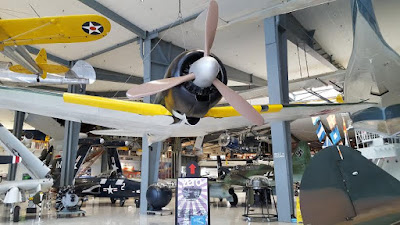
Webster

The Constitution was made to guard the people against the dangers of good intentions." --American Statesman Daniel Webster (1782-1852)


Showing posts with label Museum. Show all posts

Thursday, February 16, 2023

Some goings on here at Casa De Garabaldi

 I have been busy...Yep..."Meatspace" has sunk its claws into me...So I have found it difficult to find time to blog.   I am working a lot, To those that don't know, I am a commercial Chemtrail Technician, and right now it is busy, unless it is broke, or out of time or scheduled maintenance...it is flying.  Commercial aviation uses a rolling maintenance schedule to maintain its "Airworthiness" on the airframe and powerplant.  Unlike a private plane that gets an annual every year than an occasional overhaul, Commercial planes have a rigid schedule for maintenance checks, they are called "service", Transit" or a variation of a "Letter" check all the way to overhaul.  And a lot of the parts are governed by hours and cycles.  My employer uses "predictive Maintenance" to schedule parts changes especially on parts that have a cycle life.  A cycle is one takeoff and landing.  Aviation parts are built to such a high tolerance and bench marked to work statistically past a certain point.  My employer knows this and schedules parts changes before the part is "scheduled to fail" so we get the plane in and handled before it breaks, swap out the part, and check out anything else then turn the plane loose again.  This is why our reliability is so high in the industry.  This is expensive to do and a lot of carriers don't do this because this entails having a vendor supply chain and a logistics support for the parts.  We charge more than some because of the reliability factor.  Unless the"Extenuating Factors like the FAA NOTAM System or something like that....." If we have any say, the plane lands when it is suppose to and leaves when it is supposed to with no deviation, Maintenance delays are no excuse.   I say all that to say that I have been very busy, and to keep my anonymity I don't announce my employer on my blog, back in 2016 and 2020, I had some of my former Ford Peeps, they were suffering with TDS try to get me fired from my employer because I being a former union rep strayed off the reservation and wouldn't support the donk candidates.  The hate is real so I wish to keep my job, I hope y'all understand.


                                    (She took my Picture, so I took her picture...Turnabout is fair play)

       Well anyway I took some time to go to  Eastern Tennessee to visit my Mom, she turns 80
and it is kinda a big deal.     My brother came up from Florida, and we drove up in the Wife's Edge, far more comfortable than my Focus. My son flew up, he used his flight privileges since he now works at the same employer as I do.   We had to of course stopped off at ....

You betcha....Tradition.....For some reason, it makes every road trip start off good, or any time I  
go to Scout camp to run a shooting event or something....or any other excuse I can come up with.
   Well anyway We stopped off at Smokey Mountain Knife Works, where I bought a knife and then Buds

I picked up some shotgun ammo some "OO" buck for a good price  for my 870 that I have had since the 80's, so it is one of the good ones.  one of the few guns I didn't lose in that durn kayak accident.*sniff*sniff*.  and while I was there I saw this.....
Yep a "Baby Nagant"   They had both the carbine version and the full length for $369.  I always thought 
they were an "Urban Legend", apparently not....
 
KSA keystone 91 30 22lr mosin rifle snow

The KSA 91/30 Mini Mosin is a youth-sized version of the classic Russki infantry arm but in a single-shot .22LR format (Photos: KSA)

Pennsylvania-based Keystone Arms is headed to market with the first in a line of downsized classics with their Mini Mosin .22 rifle.

The KSA 91/30 looks like a venerable Soviet Mosin-Nagant Model 91/30, the staple of the Red Army throughout World War II. However, instead of the shoulder-bruising 7.62x54R chambering and 29-inch barrel, Keystone’s Mini will be a single-shot .22LR rimfire with a more youth-accommodating 20-inch barrel. Similarly, instead of arctic birch, the U.S-made gun will feature a walnut stock.

“This ‘Mini-Mosin’ is the perfect size for your little ‘Comrade,'” said Keystone on social media last Friday. The company, best-known for their Crickett and Chipmunk series of single-shot rifles and pistols, went on to explain even smaller Mosins — such as the M38 — are still “a full-size rifle in a large caliber that a youth will have an unpleasant experience with.”

No word on MSRP yet but you can expect the company to have the prototype guns on display at the NRA’s Annual Meetings in Indianapolis later this month. If so, Guns.com will be on hand to sniff out more information, so stay tuned. 

       This was off the website...


      Yep, I did think about it....but I didn't have enough cash on me....and it is kinda of a novelty thing
and unfortunately I have more pressing needs for my money.
 

     I had to put another battery in the "Precious" A.K.A my F150, "The Battery" I had bought from
Advance Auto Parts I swore had a dead cell in it and they wouldn't exchange and they kept blowing me off, and it kept dying on me.  I would go out to the truck and would have to jump the truck off all the time, it got old and frustrating.  I finally went to SAMS Club and bought a "Duracell" battery and swapped out the battery.  Now the truck cranks when I want her to.  I was irritated with Advance on this, but I had to drive 100 miles to clear the P1000 codes so I can get the truck emission tested, it will be the last time because the truck is 25 years old and the truck passed with flying colors.

    My son and I had gone to "Udvar-Hazy" Aviation museum over at Dulles in D.C.  it was a day trip, first flight in and next to last flight out.  The preceding pic was the "Dash-80" the Prototype that spawned the 707 series and the future of Boeing Commercial Aircraft Company.


And of course they had other planes there....
                                                                The F6F "Hellcat"
                                                             The "Sparrowhawk" off the "U.S.S.Macon"
The "Concorde"

Boeing 377"Stratocruiser"


Me 163"Komet"

Mig 21"Fishbed"


"Mig 15" and the "F-86 Sabre" Korean War Adversaries

F-22"Raptor"
                                                                         F-35B"Lightning"
As I understand it, this was a survivor from the Pearl harbor attacks, she was a mail plane and survived the war and after a circuitous route, made it to the Smithsonian. 


F4U "Corsair"

Curtiss P-40 "Warhawk
And of course we saw ...

  You Betcha....."Flak-Bait"   I was stoked to see that plane and I saw what looked to be a Ju-87 "Stuka" in the shop plus other aircraft.
 
 
I got my copy from Larry Correia "In Defense of the 2nd Amendment " written in his unique style,

If you want to be able to debate and defend using logic against those that want to strip our 2nd amendment right from us, this book is a great help.  Now to convert the gun control crusaders is a lost cause, what we need to do is to convince "John and Jane Q Public", the undecided, using logic and reasoning, not "Feelingz" and "Emotions" like our opponents would do.  That is how we win the culture war against the rabid left.  We get the regular people on our side and they will look at the anti's as kooks and squirrels.  We will be the "Sane ones" and this book will help.  Go to Amazon and get your copy.  


Friday, September 27, 2019

USS Texas in trouble..

I ran across this article while surfing around.  I really hope they can pull it together and save the ship.  There ain't any WWI Dreadnough around anymore.  Most of the American ones were either used as target ships for "Operation Crossroads" because it was quicker to blow them up rather than scrap or put the ships in a museum and others were scrapped.  We were drawing down after WWII and quickly demobilizing back to a peacetime military and we had a bunch of "Modern" ships from WWII so the older ships were expended.  USS Texas was spared such a fate as was the USS Olympia which was Admiral Dewey's flagship at the battle of Manila( where Old NFO manned the tiller and stood resolutely by, but that is another story) and IJN Mikasa the only pre-Dreadnough battleship left in the world.  The USS Texas is tangible link to our past and it showed when men of Iron sailed on ships of steel.  Tradition is important to anybody with a martial interest, it gives the Soldiers and Sailors today a link to the past and it reaffirms their belief in themselves and their country.  I keep thinking if I ever scored the lottery, I would blow a huge chunk of my fortune to save those ships.


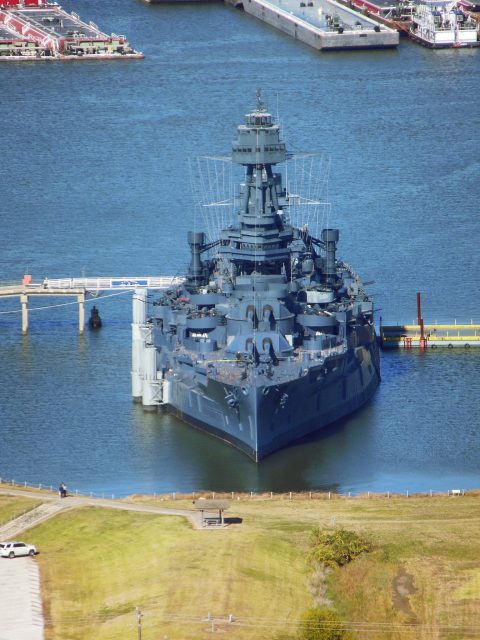
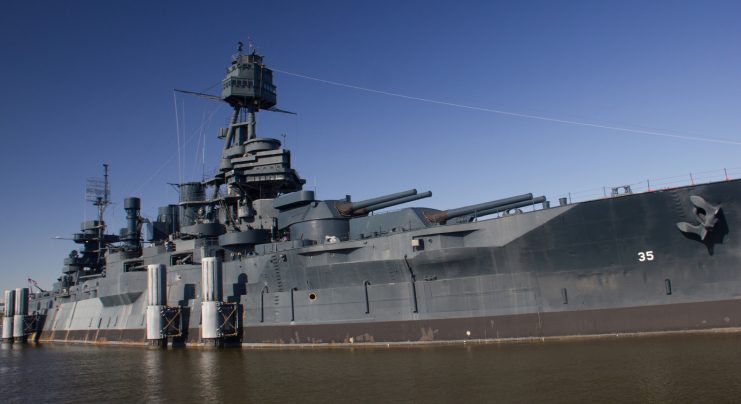
Battleship Texas BB35 is a New York-class battleship that has the distinction of having served in both World War I and World War II. The 104-year-old ship is facing possibly its toughest battle as it fights a two front war against time and budgetary constraints.
The aging battleship is currently closed to the public as it undergoes repairs. Corrosion has caused leaks in the hull of the last remaining WWI dreadnought. Officials have stated that they are pumping 300,000 gallons of water out of the hull every day.

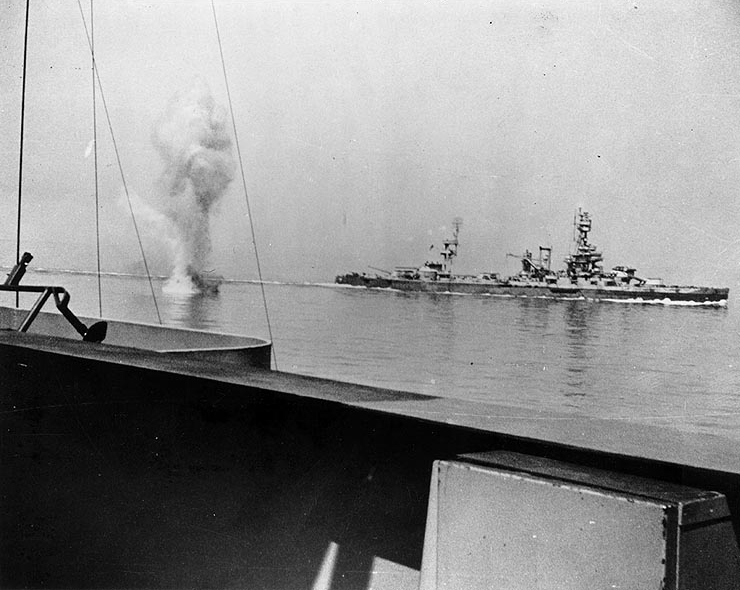
A heavy German coast artillery shell falls between Texas (in the background) and Arkansas while the two battleships were engaging Battery Hamburg during the battle of Cherbourg, France, 25 June 1944
The state of Texas had been paying for maintenance on the ship but it has announced that it will no longer do so after paying $35 million to have the ship floated to a shipyard to undergo the repairs.
This means that the ship will have to support itself based on admission fees. That would require 300,000 people to pay to visit it each year in order to fund its own maintenance costs. Currently, the ship is berthed by the San Jacinto Battle Monument in La Porte, Texas. That site does not get enough visitors to keep the ship afloat.

The tale of American exploits during WWI and WWII will not be complete without mention of Texas BB 35
Galveston has emerged as a front runner to provide a home for the Texas. They have two locations that could take the battleship, though both have problems which need to be addressed before the ship could dock there. These findings are from a citizen-led committee’s report which provides recommendations on where the ship could be berthed.
Seawolf Park on Pelican Island and Pier 21 located on Galveston’s harbor are the two locations identified in the report.

A veteran of two world wars
Bruce Bramlett, executive director of the Battleship Texas Foundation, says that the ship needs to find a spot with higher visitation which would rule Seawolf Park out in his mind. “That would be a worse location that what we’re in,” he said.
Seawolf Park currently sees 80,000 visitors per year according to park managers for the Galveston. This is not nearly enough to support the Texas. But Galveston Island Convention & Visitors Bureau Chief Tourism Officer, Michael Woody, believes that the number would rise with the Texas berthed there.

Having the historic ship located in Seawolf Park, which already hosts the USS Cavalla and the USS Stewart, would provide opportunities for education programs, school trips, corporate events and even increase leisure traffic at the park.
Pier 21 has the benefit of being near downtown and cruise ship traffic. This would provide the necessary numbers to support the ship. But having the battleship docked there would exacerbate parking and crowding issues already being experienced at the pier.
Also, the berth at Pier 21 is 510 feet long but the Texas is 560 feet long. With budgetary constraints, the city may simply not be able to afford the work required to bring the Texas to that site.
The city officials have stated that they will require more information before deciding if they want to make a bid for hosting the Texas.
Representative Mayes Middleton is on the committee researching locations in Galveston says that the bottom line is whether Galveston has the number of visitors required to support the Texas. He says that since the ship needs 300,000 visitors each year and Galveston sees over 7 million tourists every year, the numbers aren’t a problem.
The committee is expecting to release the full report along with its recommendations this month.
Meanwhile, the Battleship Texas Foundation, which is responsible for the upkeep and maintenance of the Texas, is pushing for the ship to be placed in a dry berth. The constant contact with salt water has weakened the hull of the ship and caused many leaks.
Work on building the Texas began in 1910.  After serving in both world wars, the Texas was placed under the care of the Battleship Texas Commission in 1947. The Texas became one of the first museum ships in the US. In 1983, leadership of the Texas was transferred to the Texas Park and Wildlife department. At that time, a survey showed that the watertight seal. The ship was closed to the public for nearly two years while repairs were made.
In 2010, a new leak led to the ship sinking 2-3 feet. In 2012, 30 new leaks were discovered. The ship was once again repaired and reopened to the public.
The Battle Ship Commission would like to see the ship placed in a dry berth, out of the water. Then they could stop spending money on repairs. But getting the Texas out of the water will cost $40 million. The foundation is willing to raise part of the money but seeking assurance from the government that they will provide the rest.

Friday, April 15, 2016

Pensacola Naval Museum Part 2

This is part 2 of my Pensacola Trip to the Naval Aviation Museum.  The trip was awesome, and like I stated in the prior post, You can walk up and actually touch the airplanes....something that most museums don't allow.

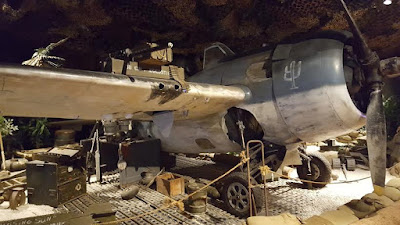
      Grumman Wildcat F4F-3
Cactus Air Force refers to the ensemble of Allied air power assigned to the island of Guadalcanal from August 1942 until December 1942 during the early stages of the Guadalcanal Campaign, particularly those operating from Henderson Field. After December, the official name of the unit became Commander, Aircraft, Solomons (AirSols), but Cactus Air Force was still used frequently to refer to the organization. The term "Cactus" comes from the Allied code name for the island. In April 1943 the organization was redesignated as AirSols.
      The airfield was frequently attacked by the Japanese Air units and their surface ships.  They even were shelled by a couple of Imperial Battleships, the Kongo and the Haruna.  The Navy and Marine Pilots and ground personnel held off the Japanese attacks, the Navy had several battles around Guadalcanal trying to protect the Marines on that island, The casualties and losses were immense, the Japanese would run "the Slot" trying to resupply their men and the U.S. Navy would try to stop them.  The end results was that it bled the Japanese and in the end, they finally withdrew what was left of their forces and the United States neutralized the huge Japanese base at Rabaul with the "wither on the vine" tactics. and their operations in the Solomon islands helped pave their eventual return to the Philippine Islands.
The ground crewmen frequently labeled bombs to help deal with the frustrations of being shelled and shot at by the Japanese.  In the modern world, such things might be frowned upon as "hurtful" but back then we were made of sterner stuff.  The Great depression and the Japanese Attack at Pearl Harbor had molded the United States servicemen into steel, the "special Snowflakes" had been weeded out by natural selection.  I could go on and on about the battle at Guadalcanal but that is a subject for another time.
     

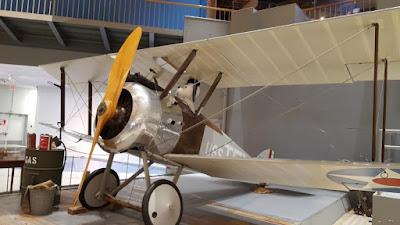
F.1 Camel C8228, built by Sopwith in 1917, is on display at the National Naval Aviation Museum in Pensacola, Florida.
Man Snoopy gets around...I saw him at the Apollo Spacecraft Museum in Florida last year...
And here he is in the role that was made for him.....
The nemesis of the Red Baron
Here is a view of the "Main Area" what I call of the Museum
You see many airplanes on display, like I stated you can WALK up to an airplane and actually examine it.  I am sure that they would frown on you climbing on one...Just a guess.
   Here a few more things that I saw...
Here is the Story on this car....Notice the refueling probe on the roof.  
I also saw this airplane out there....the propellers are different as is the livery, I wonder if Old NFO can shed some light on it.  I saw no information on this airplane there..
 My son and I got hungry and so we ate at the "Cubi Cafe".  In addition to the displays, the museum operates an IMAX theatre, museum store, and cafe. The Cubi Point Café is itself an exhibit as it displays squadron memorabilia from the closed NAS Cubi Point Officers' 
I took pictures of a couple of the plaques, some were simple and others were very ornate.  I wonder if some "nugget" got voluntold "you are responsible for the plaque" and some of them really took the assignment and ran with it....like this one...
Or this one...

I wonder what fleet air units do now for plaques since the Cubi Air Station was closed down in 1992
and if they still do stuff like this.    The detail on some of these plaques are amazing.  It was interesting to see the history of a unit and after looking at some of them, I started recognizing names from past deployments.  
     Also there is a mockup on the floor of the Museum of the U.S.S Cabot island with a coupe of aircraft on "ready 5" I believe the term was..But today was some kind of ceremony from the chairs and color guard units standing around.
I and my son enjoyed the museum immensely, we would go again....Like I said in the prior post, you have to come in through the west gate off Blue Angel Parkway to get to the museum.  It is in my humble opinion one of the best aviation museums in the United States.   Did I say you can walk up to an airplane....there is no barrier ropes preventing examinations..?   I must have...somewhere.  Go check it out, I plan on going again  I am sure I missed stuff in there from my past 2 trips.


Tuesday, April 12, 2016

A trip to the Naval Aviation Museum

This is Part 1

My Son and I went to PNS to visit the Naval Aviation,  We last went back in January 2013..
January 2013

Yesterday

   It was his idea, he had commented that he would like to go check out the museum,  He had commented that when he went to NOAC last year, they stopped at the Air Force Museum and he noticed stuff that he missed several years ago.  So we went back to Pensacola.  They have changed the directives for entry..if you don't have a DOD ID card, you have to use the west gate off Blue Angel Parkway.  After showing my drivers license to the nice guard, he gave me directions to the museum  and off we went.  After finding a parking apot, we walked in and the first thing I saw was a replica of Old NFO  Eugene Ely airplane and the historical flight he made when he landed on the U.S.S. Pennsylvania
He then after landing, then turned around and took off again...and Naval Tactics were never the Same.
    We then walked into the main room and there were airplanes everywhere.....

And more airplanes....
  We walked around and saw more planes...they are grouped by era's of flight  I immediately walked up to an airplane.....I say ..WALKED up to an airplane..
and took this picture...This is a P40 in the colors of the Adam and Eve squadron one of the 3 pursuit squadrons, the other being the Panda Bears and the Hell Angels.  This is what I liked about the museum...with rare exceptions...you can walk up to the airplane and touch it if you want.   Most museums, you have a rope barrier blocking you.
Training F4F....this is one of the planes they fished out of the lake Michigan during WWII
Between 1943 and 1945, two U.S. Navy aircraft carriers stationed at Navy Pier in Chicago . functioned as training platform for about 17,000 pilots, signal officers and other personnel.
 Former U.S. President George H. W. Bush was among the pilots who learned to take off and land on the 500-foot long carrier decks.
The carriers, the USS Sable (IX-81) and USS Wolverine (IX-64), were converted Great Lakes paddle steamers. They had shorter flights decks, no hangar bays, and required enough lake wind for operations.
Lake Michigan was chosen for the secret training because it's the largest body of water within the continental United States
 Between 8 and 12 pilots died during the training and about 100 planes now rest on the lake bottom after crashing during training missions.
USS Wolverine (IX-64) underway in Lake Michigan. Between 1943 and 1945, two U.S. Navy aircraft carriers stationed at Navy Pier in Chicago functioned as training platform for about 17,000 pilots, signal officers and other personnel. The Navy also operated a drone program from one of the carriers. (Courtesy | National Archives)Pier in Chicago functioned as training platform for about 17,000 pilots, signal officers and other personnel. Former U.S. President George H. W. Bush was among the pilots who learned to take off and land on the 500-foot long carrier decks. 
    
                                                U.S.S. Sable docked in Chicago


The Mitsubishi A6M "Zero" is a long-range fighter aircraft, manufactured by Mitsubishi Heavy Industries, and operated by the Imperial Japanese Navy from 1940 to 1945. The A6M was designated as the Mitsubishi Navy Type 0 Carrier Fighter (零式艦上戦闘機 rei-shiki-kanjō-sentōki?), or the Mitsubishi A6M Rei-sen. The A6M was usually referred to by its pilots as the "Reisen" (zero fighter), "0" being the last digit of the Imperial year 2600 (1940) when it entered service with the Imperial Navy. The official Allied reporting name was "Zeke", although the use of the name "Zero" was later commonly adopted by the Allies as well.
When it was introduced early in World War II, the Zero was considered the most capable carrier-based fighter in the world, combining excellent maneuverability and very long range. The Imperial Japanese Navy Air Service ("IJNAS") also frequently used the type as a land-based fighter.
In early combat operations, the Zero gained a legendary reputation as a dogfighter, achieving the outstanding kill ratio of 12 to 1, but by mid-1942 a combination of new tactics and the introduction of better equipment enabled the Allied pilots to engage the Zero on generally equal terms. By 1943, inherent design weaknesses and the failure to develop more powerful aircraft engines meant that the Zero became less effective against newer enemy fighters, which possessed greater firepower, armor, and speed, and approached the Zero's maneuverability. Although the Mitsubishi A6M was outdated by 1944, design delays and production difficulties of newer Japanese aircraft types meant that it continued to serve in a front line role until the end of the war. During the final year of the War in the Pacific, the Zero was also adapted for use in kamikaze operations. During the course of the war, Japan produced more Zeros than any other model of combat aircraft.

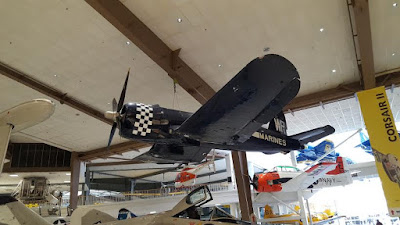
The Vought F4U Corsair is an American fighter aircraft that saw service primarily in World War II and the Korean War. Demand for the aircraft soon overwhelmed Vought's manufacturing capability, resulting in production by Goodyear and Brewster: Goodyear-built Corsairs were designated FG and Brewster-built aircraft F3A. From the first prototype delivery to the U.S. Navy in 1940, to final delivery in 1953 to the French, 12,571 F4U Corsairs were manufactured by Vought, in 16 separate models, in the longest production run of any piston-engined fighter in U.S. history (1942–53).

    We also saw the 4 A-4's that comprised the Blue Angels..The A-4's served with the Blue Angels for about 10 years.
This was the distance the Blue Angels were separated by in the formation flying, Old NFO mentioned that to me.  it shows the skills and balls to fly that close.

Regular A-4 in "Fleet Color"

The Douglas A-4 Skyhawk is a single seat carrier-capable attack aircraft developed for the United States Navy and United States Marine Corps. The delta winged, single-engined Skyhawk was designed and produced by Douglas Aircraft Company, and later by McDonnell Douglas. It was originally designated A4D under the U.S. Navy's pre-1962 designation system.
The Skyhawk is a lightweight aircraft with a maximum takeoff weight of 24,500 pounds (11,100 kg) and has a top speed of more than 670 miles per hour (1,080 km/h). The aircraft's five hardpoints support a variety of missiles, bombs and other munitions. It was capable of carrying a bomb load equivalent to that of a World War II-vintage Boeing B-17 bomber, and could deliver nuclear weapons using a low altitude bombing system and a "loft" delivery technique. The A-4 was originally powered by the Wright J65 turbojet engine; from the A-4E onwards, the Pratt & Whitney J52 was used.
Skyhawks played key roles in the Vietnam War, the Yom Kippur War, and the Falklands War. Sixty years after the aircraft's first flight, some of the nearly 3,000 produced remain in service with several air arms around the world, including from the Brazilian Navy's aircraft carrier, São Paulo.