Webster

The Constitution was made to guard the people against the dangers of good intentions." --American Statesman Daniel Webster (1782-1852)


Showing posts with label airplane tech. airplane stuff. Show all posts

Monday, March 25, 2024

Emergency Doors...What you may not have known.

 When I worked on slides and Emergency doors, I followed the maintenance manual religiosly, having a slide deploy is not a thing that I want to happen.  Also something else that most don't know is that the standard to empty an airplane of all passengers and crew, and get everyone out is 45 seconds.  The standard was set because of an accident on a "Boeing 737" that during a takeoff, one of the engines decided to "FOD itself" and punctured fuel tanks and the resulting fumes, not the fire killed almost half of the passengers.  The resulting investigation made huge changes in safety and training and the making of material inside of the aircraft to minimize fumes.  A little over 20 years later, another B737 had another engine fire and "Everyone escaped with 4 people having minor injuries."  No I am not disparaging the B737, she is a damm good plane.  Both instances were not the planes fault, but the engines.


I saw this article and I thought it was worth "clipping"


Two people working on emergency doors at factory

Latecoere has aimed to simplify door opening and positioning to speed up evacuation times.

Credit: Latecoere

In the rare event of an emergency cabin evacuation, successful egress depends on how well the exit doors and their built-in escape slides and actuators perform.

A quick emergency exit from an aircraft depends on two categories of doors, explains Thierry Eftymiades, senior vice president for engineering at Toulouse-based Latecoere, a manufacturer of cabin doors for commercial airliners and business jets. The first category consists of passenger-entry and service doors, which are opened and closed during regular aircraft cycles. The second category applies only to emergency-use doors, including cockpit escape and overwing emergency-exit doors (OWEED).

Eftymiades says Latecoere uses “functional and customer analyses” to define and specify in detail customer expectations for each door.

“These analyses help to optimize the design and manufacturing technologies as well as the development process to reduce recurring and nonrecurring costs,” he explains. “Design trends are focused on composites, specifically thermoset and thermoplastics from our composite development center.”

Worker inspecting escape slides on doorMajor inspections of escape slides are performed every 3-5 years. Credit: AJW Technique

Another Latecoere design trend involves the “kinematics” on new types of mechanisms, Eftymiades says. “That has been driven by the regulations, which continue to evolve, while taking into consideration the events faced in real-life emergency landing conditions,” he notes. “In that regard, we have been granted specific patents to simplify the mechanisms’ actuation.”

Eftymiades cites, for example, simplified door opening and positioning that clears the way for outboarding passengers within an evacuation target of less than 90 sec. “The common objective is to make the opening as obvious and easy to use as possible,” he says.

Ease of activation is particularly important under adverse conditions that can make opening doors more challenging, Eftymiades stresses. Those conditions include high winds, fuselage icing and an awkward position of the aircraft due to collapsed landing gear or a side crash.

“[The] current development and innovation focus is on increasing robustness and decreasing costs through specific simple but high-efficiency design items taking into consideration these kinds of adverse conditions,” he says. “These design items can be selected as building blocks while defining the door baseline architecture.”

Inflated escape door slidesEscape slides must be inflated to carry out leak and pressure tests on the tubes. Credit: AJW Technique

Despite evolving requirements and greater system complexity, aircraft doors are becoming lighter, Eftymiades points out.

“Doors are complex systems with multiple and contradictory requirements,” he says. “They need to stay closed in flight but opened safely under all conditions, leading to optimized choices to be made. Door weight optimization can be provided for at all project stages, from concept to detail design generation.”

Eftymiades adds that during an emergency cabin evacuation, three subsystems come into play: the door, an ejector that assists emergency opening by pushing the door open and the slide. He emphasizes that during the design phase, discussions take place with the slide supplier to decide on the quality of the interfaces among the subsystems; Latecoere does not manufacture slides.

“Generally, for a passenger door, there are four types of interfaces with the slide,” he says. “They are the structural attachment of the panel holding the slide to the bottom of the door; the panel between the slide and the door lining; the laces between the slide and the bar holding the slide with the door open; and the controlled door ejection speed component, allowing the slide to be deployed safely, especially under adverse conditions.”

OWEEDs are smaller than passenger entry and service doors and do not contain the slide, which is often located at a distant nonpressurized part of the fuselage, Eftymiades explains. “This requires defining the triggering subsystem—electrical or mechanical—-that will inflate the slide on the wing,” he says.

Fuselage-installed slides deploy on pilot command, saving the cabin crew the task of arming and disarming them. In contrast, cabin-door-mounted slides automatically deploy when the door is opened if they are not disarmed.

“Usually for overwing exits, the slide pack is located at the corner between the wing leading edge and the fuselage,” Eftymiades says. “During an emergency opening, the passenger has to walk on the wing to reach the slide location to evacuate.”

It generally takes 4-5 years and as many as 20-100 engineers, depending on the scope of the project, to bring a new door and escape system on stream, taking into account design, simulation and prototype tests, according to Eftymiades. The process also involves hundreds of stress analysis reports as well as test plans and reports, especially given the number of parts.

“For a regional airliner, there are about 500 part numbers for one passenger door and usually four doors per aircraft, plus 2-4 overwing exits,” Eftymiades notes. “For large commercial aircraft, the part numbers are 800 per door, with eight doors per aircraft. For the ejector—the emergency door-opening system—that is an additional 70 part numbers.”

Two other major aircraft door OEMs, Airbus and Collins Aerospace, declined to share their insights into door and escape system developments for this article. Airbus cited the recent Alaska Airlines inflight door-plug loss as to why; Collins did not provide a specific reason.

MAINTENANCE CONCERNS

Today’s escape slides are much lighter but more complex due to incorporation of additional features, according to Andy Wheeler, divisional vice president and managing director at AEM Ametek MRO. The UK-based company has facilities at Luton, Ramsgate and Stansted in England.

Some slides have pressure indicators that connect to the cockpit, for instance, while others contain gas generators and several are fitted with pneumatic door release components, Wheeler tells Inside MRO. “The main benefits are quicker actuation, fewer accidental deployments and improved safety features,” he notes, adding that some slides also incorporate lighting systems that are now brighter, lower energy and more efficient.

Wheeler reports that advancements in materials and design have led to better deployment, improved durability and lighter weight. “For instance, the slides used to be made of neoprene and are now polyurethane,” he says. “When lighting systems were introduced, they were chemical. Now they’re LED-battery-powered. Also, on newer aircraft, the inflation cylinders are composite instead of steel, and the slide’s enclosure—the packboards—fit into the fuselage rather than the doors.”

Wheeler stresses that regular maintenance and inspection of escape slide systems are essential to identify and address potential issues before they become problematic.

“The slides have to be maintained in accordance with the OEM component maintenance manual,” he stresses. “They require inflation to carry out leak and pressure tests on the tubes. The inflation cylinder must be hydrostatically tested and the valve overhauled and flow regulation adjustments made as necessary.”

Asked about the kinds of problems those inspections often reveal, Wheeler cites damaged light systems and low-pressure gauge indications as typical as well as cracks in the packboards from mishandling.

Louis Philippe Mallette, senior vice president of operations at AJW Technique in Montreal, reports that while “the fundamental design concept” of emergency cabin evacuation systems has remained largely consistent across newer aircraft, there have been some improvements, primarily involving materials and weight reduction.

“Advancements in material technology have led to lighter systems and quicker deployment during emergencies,” he says. “This is allowing manufacturers in some cases to extend maintenance intervals to five years while still demonstrating the required reliability over that period, thereby reducing operators’ costs.”

Despite these advancements, he says, “the interface between components and the main and over-wing exits” has remained similar to traditional designs. “Typically, the evacuation slide is still located on the door, maintaining consistency across generations of aircraft.”

Mallette stresses that as long as the slides are undisturbed, the evacuation systems are traditionally very reliable and will typically stay on wing for their full scheduled overhaul life of 3-5 years. “Where we do see issues is when they are disturbed for some reason by people servicing the aircraft, which is very often the case with front door systems and may result in an unplanned deployment,” he says.

Mallette adds that door-mounted packboards and slide actuators can be vulnerable to damage during scheduled airframe inspections, especially if technicians are careless. Accidental deployment during aircraft maintenance can also occur if the system is improperly handled or installed.

“The airframers have taken steps to reduce potential damage by providing comprehensive training and documentation for technicians on proper handling and installation procedures, implementing stringent quality control measures during maintenance and ensuring release mechanisms are protected from accidental activation,” Mallette says.

Given the risks he describes, Mallette was asked if the packboards and actuation components could be trending toward fuselage installations and away from the exit doors.

“No,” he says. “The current [design] remains consistent, with the slides in the packboard mounted on the door. One notable deviation from this pattern is observed with overwing slides, where the exit doors are physically smaller and have insufficient space for a door-mounted slide. Often the slide is airframe-mounted with a separate cylinder assembly also mounted within the fuselage. But this approach is limited to overwing slides at this point and from our experience hasn’t been extended to the main door slides.”

Mallette cites two main components as the focus of an evacuation system inspection: the inflatable slide and the air system that houses the cylinder containing the compressed gas and aspirators. “During scheduled maintenance, AJW will perform an inspection and overhaul of the cylinder assembly to ensure the regulator and the reservoir are still serviceable and functional,” he says. “Part of this process involves hydrostatic testing, which is a critical process used to evaluate the integrity of pressure vessels such as cylinders, and to detect any potential leaks or structural weaknesses.”

For the slide, the inspection focuses on its general condition—in particular looking for porosity, tears and leakages—including conducting an overpressure test.

“What we tend to see on aging slides are small tears at the folds, the buildup of porosity and weakness at the seams, all of which may result in a failure to maintain the pressure over a period,” Mallette says. “Minor tears can be repaired; however, with the older slides, we need to replace the full inflatable system.”


Thursday, July 21, 2022

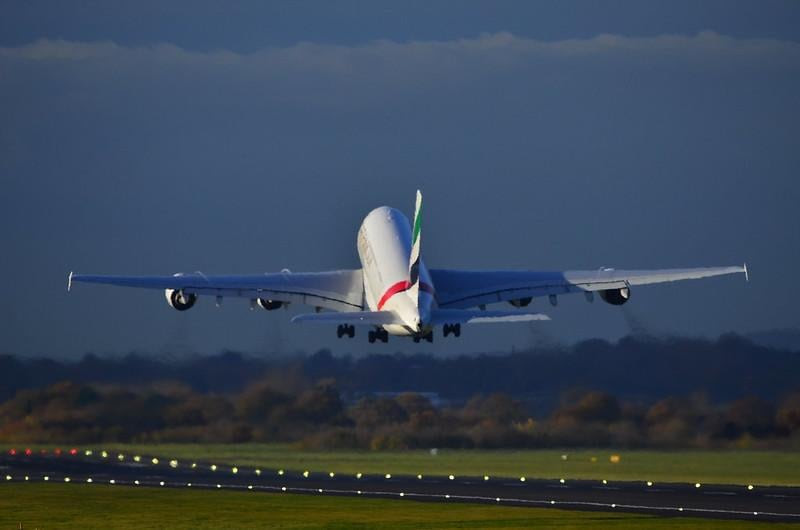
Emirates Airlines is asking for larger widebody airplanes..


I saw this in my email.  Emirates is asking for a bigger plane and they are targeting Airbus.  Boeing just shut down the 747 line and Airbus quit making the A380 because it was a money loss for them.  Most airlines can't or won't afford super widebodies, the routes don't support them. Emirates and the other Middle Eastern Airlines are heavily subsidized by their host countries so they can afford to buy big airplanes whereas the United States and to a lesser extent the European airlines are not subsidized by their host countries nor the Asian Airlines.

Emirates A380
Credit: Nigel Howarth / Aviation Week

FARNBOROUGH—Emirates president Tim Clark has again called on Airbus to develop an aircraft larger than the A350.

With large-capacity widebodies such as the A380A340-600 and Boeing 747-400 out of production, rising passenger numbers demand a new twin-aisle design, Clark said at the Airline Leaders Summit on the sidelines of the Farnborough Airshow.

“I’m hoping Airbus will be a little bit braver,” he said.

Airbus and Boeing seem largely focused on narrowbodies, to the exclusion of new widebody designs, he said. “To say it’s all about the A320/321 and the MAX, in my view, is not that smart.”

IATA director general Willie Walsh, who also spoke at the summit, agreed there were parts of the world where a 350-seat, four-class aircraft would be needed in future.

The two executives also took shots at Airbus and Boeing over how they leverage their duopoly.

“We’re customers, and I don’t feel we’re always treated as customers,” Walsh said, noting that Bombardier built “a good aeroplane” with the CSeries, but was unable to compete against Airbus and Boeing. Ultimately, Airbus bought the CSeries program and renamed the aircraft the A220, which is selling well as an Airbus.

Walsh said that China’s COMAC C919 would eventually become a competitor, “but I think it’s a long way away.” And while China could design airframes satisfactorily, engine development remained a problem, which meant that for the foreseeable future, China would continue to depend on western engine manufacturers.

Sunday, January 9, 2022

Boeing is trying a revolutionary a Revolutionary airplane design.


I snagged this from one of the articles I get in my email from work that talks about Aviation, and I thought it was facinating concept and the thought of them "using a MD80's series tail or a B 717 to finish the design  is what caught my eye.


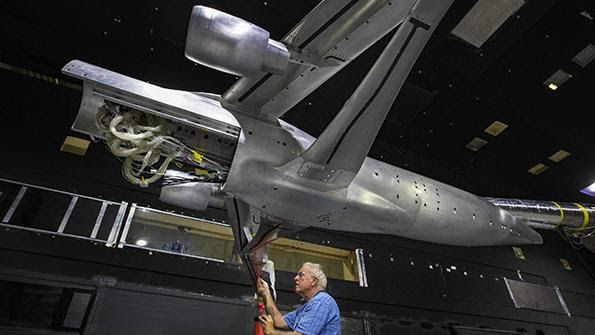
TTBW high lift tests, NASA Langley Research Center, Hampton, Virginia

Researchers completed TTBW high-lift tests, including stability and control checks and ground-effects evaluations, in September at NASA Langley Research Center’s 14 X 22-ft. subsonic wind tunnel in Hampton, Virginia.

Seventy years ago, Boeing was secretly preparing to gamble on whether to spend two-thirds of its post-war net profits on a radical new jet-powered long-range transport demonstrator—the Model 367-80.

The company’s May 1952 decision to approve the project, dubbed the Dash 80, became a defining moment in aviation history. Targeting the airline and military air tanker markets, the turbojet-powered aircraft would evolve into the 707/KC-135, establishing the blueprint for virtually every modern swept-wing transport with podded engines developed to this day as well as laying the foundation for Boeing’s 700-series jet airliner dynasty.

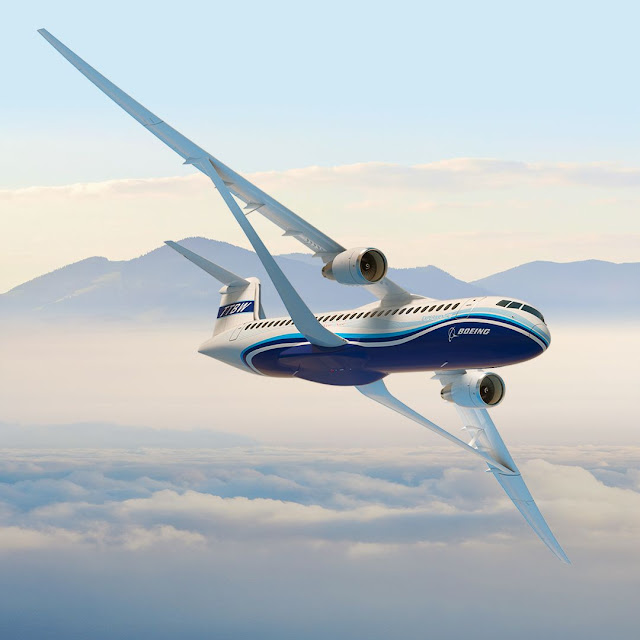
Fast-forward to early 2022 and Boeing is once more preparing to propose a new, potentially game-changing configuration. Although the concept is not yet aimed specifically at a new product, the high-aspect-ratio transonic truss-braced wing (TTBW) is targeted instead at a NASA demonstrator X-plane intended to prove airframe technology for a future highly efficient single-aisle airliner by the mid-2030s.

While other advanced configurations, such as the blended wing body (BWB), are in the frame for the X-plane—also known as the sustainable flight demonstrator (SFD)—Boeing’s TTBW proposal is widely expected to be the front-runner. Not only has Boeing been working on the configuration with NASA for more than a decade, but it is also actively soliciting suppliers to bolster broader industry participation in its bid.

For Boeing, the timing of the competition for the X-plane has assumed even more importance than the research opportunity it presents. Hit by the 737 MAX groundings, the market downturn caused by the COVID-19 pandemic and delays to deliveries of the 787 and 777X, Boeing has had to put near-term plans for all-new commercial aircraft development projects on the back burner. The X-plane therefore offers a chance to continue with tests of key technologies that could play a role in future single-aisle programs semi-independently of the company’s market-driven product-development strategy.

But as Boeing deliberates over its next market moves, ranging from long-term 737 replacements to a potential twin-aisle midsize family, the competition is stirring. The SFD has become increasingly timely in the face of Airbus’ plans to develop an all-new sustainable 100-plus-seat airliner in the 2030s.

TTBW showing areas of reduced drag indicated in areas of green and blueGreen- and blue-colored areas indicate areas of reduced drag in this computational fluid dynamic flow simulation of the TTBW conducted by NASA and Boeing in early 2021

 If all goes according to plan, the new X-plane—which likely will be the largest purpose-built experimental aircraft in the seven-decade-old X series—is expected to begin flight tests in late 2026 and will help mature design, structures and systems technology timed for full-scale development in the early 2030s. The X-plane also forms a key part of NASA’s Sustainable Flight National Partnership (SFNP) plan with industry, researchers and academia, which will support the push toward new airliner technology across a broader front that includes developments in smaller engine cores, electrified aircraft propulsion and high-rate composite aircraft manufacturing.


“In 2022, we expect to put out a request for proposal [RFP] for the design and build of the flight demonstrator, and this is really a big, big deal,” says Rich Wahls, strategic technical advisor for the Advanced Air Vehicles Program at NASA’s Aeronautics Research Mission Directorate. “When was the last time we did a transport-class [aircraft-level] architecture change?” he asks. “My mind goes back to when Boeing did the Dash 80 with swept wings and underslung jet engines. That’s what we’re looking at here—a large-scale honest-to-God, prove-it kind of aircraft that would demonstrate key aspects that you can only do in flight.”

In the run-up to the RFP, NASA awarded study contracts for demonstrator plans to five unidentified companies and is working in parallel with two others on risk-reduction studies—one for the BWB and another with Boeing on the TTBW. “We’ve had wind tunnel tests [of the TTBW] that have gone on since 2013, and there have been aeroelastic tests, high-speed performance tests and low-speed integration tests,” Wahls says. “Often you take these concepts, and as you dig down to the next layer of detail, the benefit goes away. So far, it’s not going away on the truss-braced wing or really on the blended wing. We haven’t found that thing that completely stops either yet.”

Clarifying NASA’s role in the further advancement of sustainable concepts, Wahls adds: “We’re not about product development and doing the next airplane. Industry has their next baseline airplanes on their drawing boards. We’re trying to identify those technologies that are just beyond their risk threshold, both financially and technically, then use those as demonstrations. If successful, we bring them forward into that next generation. If they had enough confidence to put them on the next airplane, then we would have to start looking beyond that. So we’re trying to accelerate insertion of advanced technology into these game-changing architectures across all these projects we’re doing.”

Following a planned first flight in late 2026, NASA says the SFD research campaign will last six months and be completed in 2027. Design, ground test and flight research data from the SFD will be used to measure the winning contractor’s “vision system” performance relative to a set of midterm performance objectives set out by NASA for future subsonic transport aircraft in the 2025-35 time frame.

These targets call for technology readiness levels of 5 to 6 (ready to transition to production development) for an aircraft capable of cumulative noise levels of 32-42 dB below Stage 4 and landing and takeoff nitrogen oxide (NOx) emissions 80% below the International Civil Aviation Organization’s CAEP/6 standards. The requirements also call for cruise NOx emissions to be 80% lower relative to a 2005 best-in-class benchmark, and aircraft fuel and energy consumption levels to be 50-60% lower relative to the same 2005 standard.

As its name suggests, the TTBW configuration is all about maximizing wing efficiency and at the same time opening the aperture for a wide variety of potential future propulsion options, ranging from advanced turbofans and open rotors to hybrid engines and even a tail-mounted boundary-layer-ingesting fan. First developed in 2010 under the Boeing and NASA Subsonic Ultra Green Aircraft Research program to study ultraefficient airliner concepts for the 2035 time frame, the TTBW has continued to evolve into a flexible and practical configuration.

Despite many tweaks over the past decade, the design continues to hinge on the benefits of a high-aspect-ratio wing to minimize drag. The increased span lowers lift-induced drag because the wing is slender, while its reduced thickness ratio decreases profile and transonic drag due to its thinness. The wing is braced by trusses to minimize the weight penalty of the longer span.

The X-plane was originally designed with an unswept wing to cruise at a fuel-saving speed of Mach 0.75, but Boeing is basing its X-plane proposal on a revised wing configuration revealed in early 2019. The newer design is optimized around a 20-deg. swept wing to enable a higher Mach 0.8 cruise speed more typical of current jet airliners. The increase in sweep angle necessitated a redesign of the truss, which has increased chord at the fuselage and forward sweep at the trailing edge and tapers toward the junction with the wing. A small jury strut that connects the truss to the wing has also been moved farther outboard and closer to its junction with the wing. The changes have allowed the truss to generate lift, further maximizing performance.


With an aspect ratio of 19.6, the 170-ft.-span wing of any production TTBW version also will incorporate a 777X-like wing-fold feature. The fold, which is positioned outboard of the truss attachment point, is designed to enable the TTBW to use smaller gates, like those used by the 118-ft.-span 737. For the SFD bid, Boeing expects to modify the fuselage of a donor MD-80 or 717, but it is unclear if these precise wingspan dimensions will be reproduced for the demonstrator, which is also unlikely to include the folding feature.

Boeing is, meanwhile, canvassing industry for potential risk-share involvement in the modification of the T-tail fuselage into the X-plane. The company declined to comment on details of the plan, saying it would be premature to discuss its proposal prior to NASA’s RFP. Boeing did add, however, that it “enthusiastically supports NASA’s vision for a public-private partnership to enhance aviation sustainability under the umbrella of the Sustainable Flight National Partnership, which focuses industry and government on the critical challenges for products being introduced in the 2030s.”

Details of the proposed modification plan seen by Aviation Week show that a significant number of changes and additional systems and structure will be required to transform a McDonnell Douglas-heritage fuselage into the basis for the new X-plane. The biggest of these will involve the design and build of a composite wing with full-span slats and single-slotted flaps. The wing, which will be joined at the centerline above the fuselage, also will incorporate low- and high-speed ailerons.

To meet the required design length of the demonstrator, Boeing plans to remove an unspecified number of fuselage frames as well. This suggests the preferred donor fuselage may be from an MD-80 rather than the shorter DC-9-30-series-size 717. The fuselage will be reinforced with internal bracing from the wing to the existing structure, too, and will utilize the in situ carry-through torque boxes for the nose and main landing gears. The existing gear will be supported by a new pylon and enclosed in a new fairing.

Other changes will include the relocation of the tail-mounted engines to an inboard underwing mounting, where they will be attached with a new pylon and enclosed in purpose-built nacelles and inlets. The engine’s existing thrust reversers will be locked out while the nacelle will feature a purpose-designed anti-ice system.

Several key system changes also will be required, including the development of a fly-by-wire flight control system for the wing-control surfaces. Flight control functions will be hosted in a triplex vehicle management system controlled from a two-crew flight deck that will be modified with an additional flight control computer interface. Among the system changes will be the rerouting of the engine bleed air ducts through the fuselage to the environmental control system packs and the addition of an extra central hydraulic system to augment the existing configuration.

Changes to the interior will include installation of a full flight-test instrumentation suite and accommodation for flight-test personnel as well as provision for a set of pallets for center of gravity ballast.


 It will be interesting if Boeing is able to pull this off, I have seen one of their X planes,not this one mind you, but a different kind when I was in California, she was in Storage.  I want Boeing to pull this off because it can revolutionize the aviation industry...again.


Tuesday, November 9, 2021

America Launched an ICBM from a C5 Galaxy


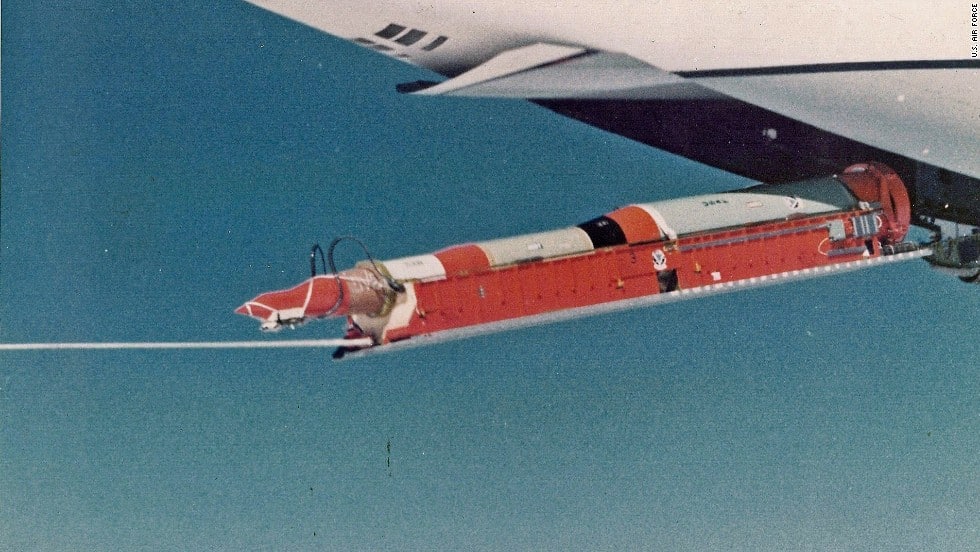
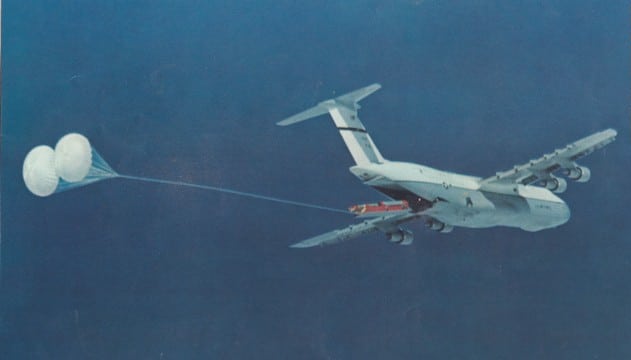
The Minuteman I ICBM, or intercontinental ballistic missile, was a globe-spanning weapon with nearly ten times the destructive capacity of the atomic bomb dropped on Hiroshima at the end of World War II, and in 1974, America successfully launched one out of the back of an airborne C-5 Galaxy.


As if lobbing an 87,000-pound nuclear payload out the back of an aircraft in flight wasn’t a dramatic enough undertaking in itself, the team responsible for history’s only air-launched ICBM were also under a strict deadline and potentially apocalyptic pressure. While their efforts could have resulted in a new approach to leveraging America’s nuclear arsenal, actually fielding a new capability may not have been the real aim of the program. Instead, the entire effort may have really been about sending a message to the Soviet Union before entering into a new round of disarmament talks.

c-5 icbm
An 87,000-pound message. (U.S. Air Force)

In July of 1945, the United States conducted the first-ever atomic bomb test explosion, ushering in the nuclear age with a blast equivalent to 25,000 tons of dynamite. Four years later, in 1949, the Soviet Union would follow suit, shifting the balance of power around the globe, and setting the stage for a decades-long nuclear staring contest that, to some extent, would survive even the collapse of the Soviet Union itself.

Nuclear posturing had become an integral facet of the ideological conflict between the American and Soviet governments by 1974, with each nation working tirelessly to field new means of leveraging or delivering atomic, and then thermonuclear, weapons. The United States took the technological lead, fielding a massive arsenal of advanced weapons for their time, but what the Soviet juggernaut lacked in scientific accomplishment, it made up for in volume. By 1974, the Soviet Union had all but eliminated America’s technological advantage by simply fielding more of their slightly less advanced weapons.

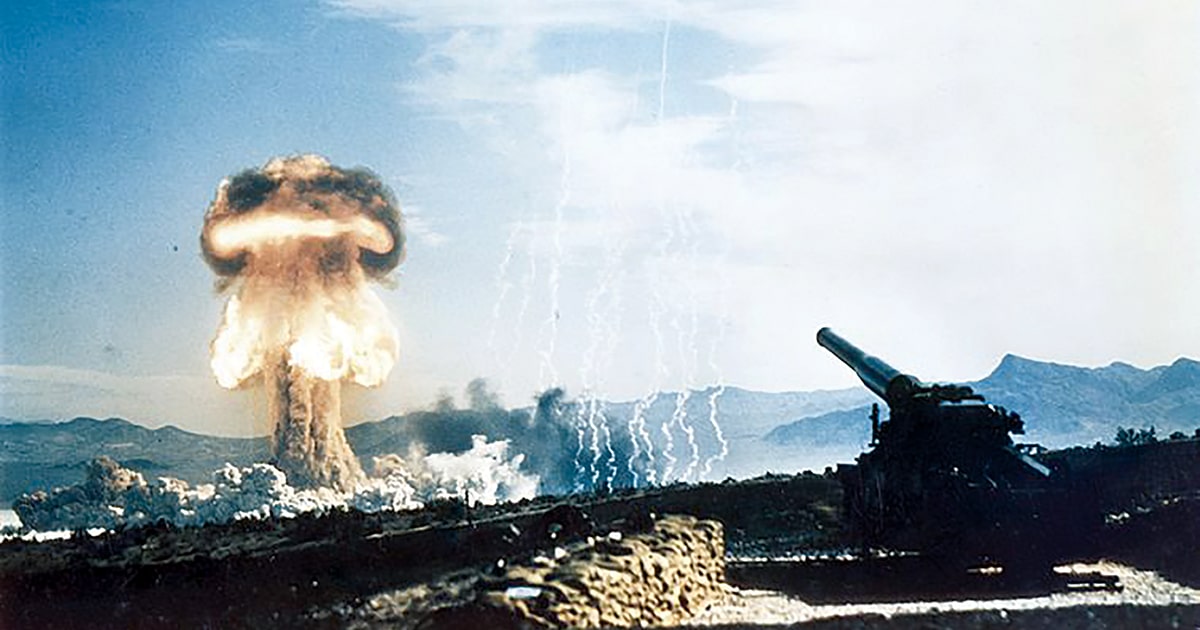
A 15-kiloton nuclear artillery round is fired from a 280-mm cannon 25 May 1953 at the Nevada Proving Grounds. (Photo courtesy of the National Nuclear Security Administration/Nevada Field Office)

The truth is, the number of warheads in each nation’s armories was a largely moot point by the time Secretary of State Henry Kissinger began coordinating with his Soviet counterpart for 1974’s Strategic Arms Limitations talks. If America and the Soviet Union were to go to war, the collective onslaught of the two nation’s arsenals would be enough to destroy all life as we knew it. This understanding, known as Mutually Assured Destruction, has been credited by some as the selfish cynicism that has–thus far–saved the world, with each nation knowing that to incite a nuclear war would be to invite one’s own destruction.

But MAD (as the concept is sometimes derisively known) is predicated on maintaining that destructive balance between states, and in the 1970s, the United States had grown seriously concerned that MAD’s equilibrium was beginning to give way. America had long since transitioned to leaning on ICBMs as their primary means of nuclear weapons delivery, but America’s Minuteman ICBM silos were stationary targets with known locations the Soviets could intentionally target in a first-strike offensive.

c-5 icbm
Despite being hardened underground facilities, America’s ICBM silos were not impervious to direct nuclear strike. (Boeing photo)

The Soviets, on the other hand, often leveraged mobile missile launchers, ICBM-firing trains, and even experimented with using giant helicopters to relocate their missiles quickly, to prevent the U.S. from finding and targeting them.

So as Kissinger prepared the meeting with General Secretary of the Communist Party of the Soviet Union, Leonid I. Brezhnev, to discuss a joint reduction in arms, he was facing the uncomfortable reality that his opponent had the upper hand. If the Soviets managed to wipe out America’s silo-based nuclear arsenal, it would be extremely difficult to hold up the “mutual” part of the world’s assured destruction with the nation’s nuclear bombs and still fairly-new submarine-launched ballistic missiles.

Kissinger needed to re-balance the nuclear scales before the meeting with Brezhnev, and it fell to the men of the Aeronautical Systems Division at Wright-Patterson Air Force Base to do it.

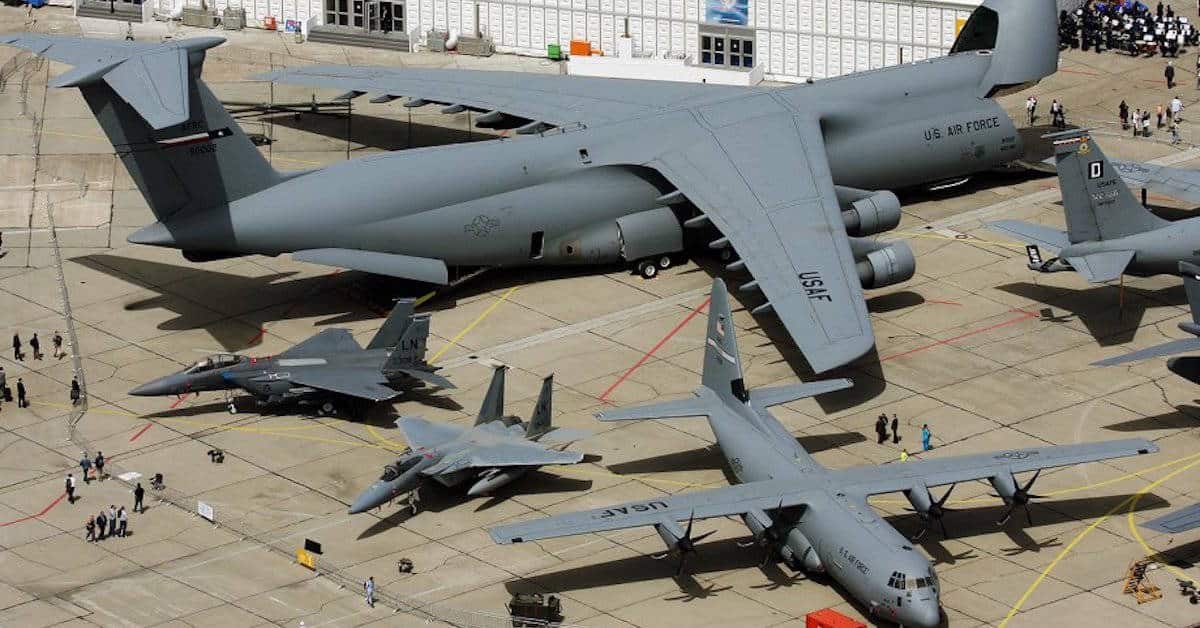
A C-5 Galaxy next to an F-15E Strike Eagle, F-15 Eagle, and C-130 Hercules. (U.S. Air Force photo)

If the Soviets knew where America’s Minuteman ICBM silos were, the Pentagon decided they needed to find a way to keep the missiles on the move, but merely moving the nukes wasn’t enough. They had to be able to launch them from new locations as well. With multiple options on the table, it wasn’t long before the idea of launching an ICBM from the back of America’s massive new cargo transport, the C-5 Galaxy, bubbled to surface. It was indeed crazy, but crazy wasn’t at all uncommon throughout the Cold War.

Carrying massive payloads was quite literally baked into the C-5’s DNA right from the start of its development. It was born out of the Air Force’s CX-LHS program aimed at fielding an aircraft large and powerful enough to carry America’s newest tanks at the time, the 30-foot long, 50-ton M60 Patton. When they were done, they had an aircraft that could carry two of them 5,300 miles without refueling. The aircraft offers an astonishing 34,734 cubic feet of cargo space, with the cargo bay itself stretching further than the distance of the Wright brother’s entire first flight, at 121 feet.

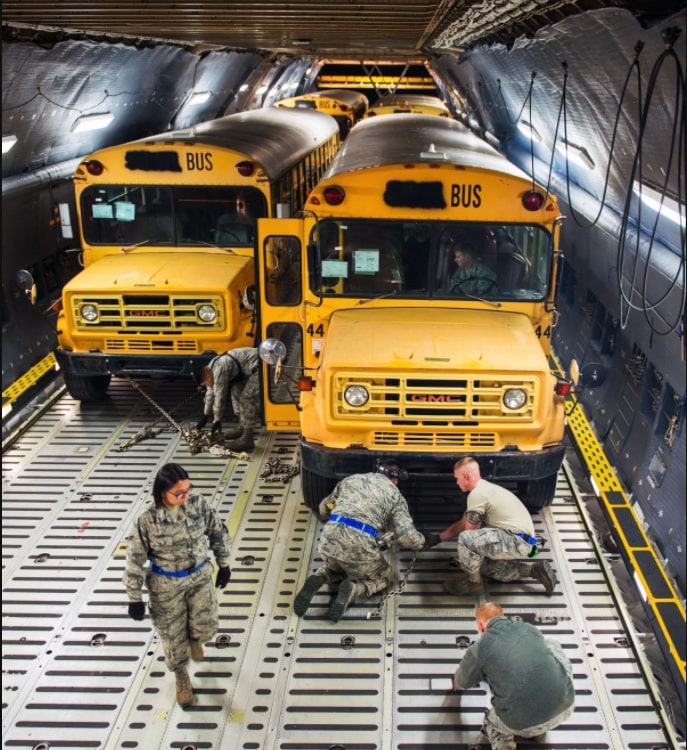
Airmen load school busses into a C-5M Super Galaxy (U.S. Air Force photo)


Perhaps most astonishing of all, the C-5 could carry more than 120,000 pounds inside that massive cavity and still get off the ground. That’s nearly twice the payload capacity of the massive B-52 Bomber or three times that of America’s stealth heavy payload bomber, the B-2 Spirit.

Technically speaking then, the 87,000 pounds of intercontinental ballistic missile and its accompanying gear would be a walk in the park for the mighty Galaxy, but there was more to it than simply getting off the ground. In order to give Kissinger the edge he needed, they had to prove the missile could really launch after the cargo plane released it.


U.S. Air Force photo

With just 90 days before the Strategic Arms Limitation Talks were set to begin, the Air Force’s Space and Missile Systems Office (SAMSO) quickly gathered a slew of engineers, aviators, and other subject matter experts from within the military and beyond. The group immediately set to work, pouring over the C-5 Galaxy and LGM-30 Minuteman 1 schematics, looking for reasons the concept could work, or why it couldn’t.

“A couple of our engineers got called to the Pentagon on a Saturday and were asked if it could be done,” Pat O’Brien, an engineer who worked on the program at Wright-Patterson Air Base later recounted.

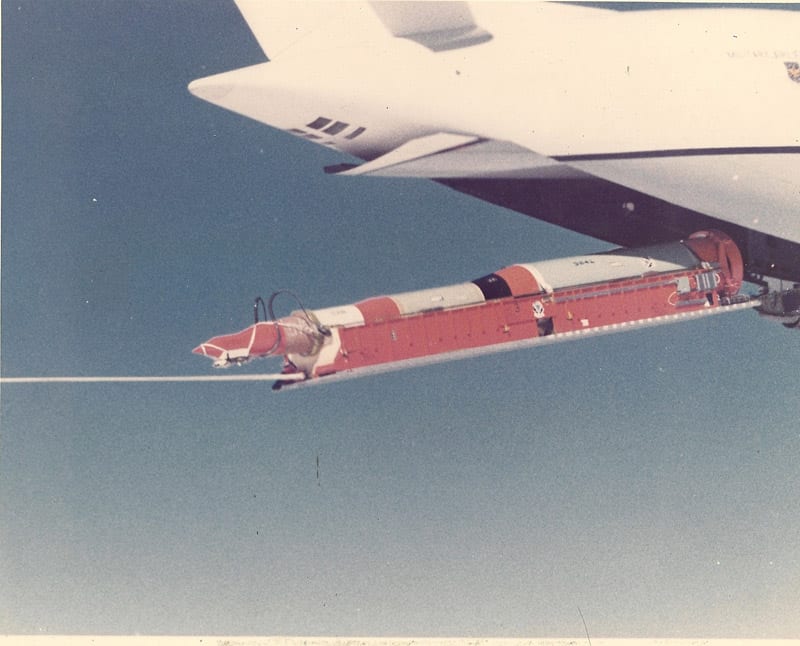
The most conspicuous challenge was the drop itself. While the C-5 had successfully dropped loads as heavy as 164,000 pounds in the past, the loads had always been divided into four drops, limiting each to around 41,000 pounds. Each drop was conducted by opening the rear doors and deploying drag parachutes out the back of the payload. The sled carrying the load is then unlocked, allowing the parachutes to pull the load safely straight out the back of the plane.

An LGM-30 Minuteman I ICBM when not being dropped by a C-5 Galaxy (U.S. Air Force photo)

While a large drop might measure 28 feet under normal circumstances, the 87,000-pound Minuteman 1 payload (including its sled), with its three-stage rocket engines, guidance control section, and reentry vehicle stretched over 57 feet. If the chutes failed to successfully drag the load all the way out of the aircraft, the C-5 would become unbalanced and uncontrollable, resulting in a crash. If the nose of the missile tipped too far downward on its way out, the back of the missile would catch the top of the C-5, trapping it and, again, causing a crash. The only way it could work is if everything went exactly according to plan.

“The assessment was that there was a risk, a moderate technical risk, but that we could do it,” O’brien added.

Under normal circumstances, such a dangerous enterprise would have called for a slower, more methodical approach, but there wasn’t time for that. In fact, as testing began and failures started to occur… the program pushed ahead anyway.

“We didn’t realize at the time it was for the SALT talks [Strategic Arms Limitation Talks], but we knew they wanted it done in a certain number of days,” O’brien said.


c-5 icbm
(U.S. Air Force)

A total of ten test flights were planned, with the first seven dedicated to deploying increasingly heavier and longer payloads and the final three with real missiles; only the last of which would actually ignite its first stage engine. Two C-5 Galaxies were assigned the task of carrying out these flights, one with the registration number 69-0027 would deploy test loads and provide backup for another C-5, registration number 69-0014, which would deploy the live missile in the final test.

While none of the dropped missiles would be carrying a nuclear warhead, the task was nonetheless fraught with danger. Dropping 87,000 pounds from an C-5 would rapidly shift its center of gravity and send the plane lurching upward and forward almost instantly. If the pilots failed to retain control, even a successful drop could result in catastrophe. And the danger for the crew in the unpressurized rear-cabin, riding alongside 43,500 tons of armageddon, was even greater. In fact, they had to wear personal oxygen tanks to withstand the thin air as they prepared the payloads for deployment and, at least once, had to resort to emergency measures to do so.

In order to ensure the C-5 survived launching the ICBM, it would deploy the weapon at an altitude of 20,000 feet using parachutes attached to its nose to orient it upwards. As the missile left the aircraft, a timed fuse on the first stage motor would begin the countdown, igniting the missile’s engine as it fell to 8,000 feet, arresting its downward momentum and sending the continent-spanning weapon off to its far-flung target. For the purposes of the test, however, only the first stage engine would fire as a proof of concept.


(Edwards AFB History Office photo)

On September 6, 1974, the first test drop of a 45,000-pound payload was successful, with a second success just four days later. The following test, which successfully dropped a 54,650-pound payload set a world record for a single drop, though the record would only last until their next test with a 66,000-pound drop.

That test, however, would end in failure, as the payload’s platform tore through the recovery parachutes, allowing the load to free-fall to the ground. The issue was resolved for the following test, switching to a platform that would hang vertically, more like the missile would.

From there they moved up to an 87,320-pound platform payload–a total weight even greater than the missile and platform to come, and for a time to come, the heaviest single payload ever dropped by an aircraft. The test was essential to proving the efficacy of the concept… and unfortunately, the test was nearly a catastrophic failure.

c-5 icbm
Actual image from the failed 87,320-lb platform drop test (U.S. Air Force)
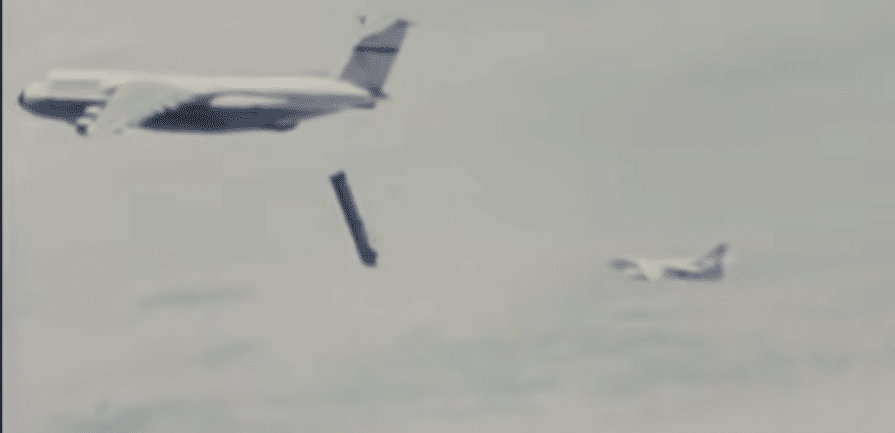
The payload coming apart after leaving the C-5’s cargo bay. (U.S. Air Force)

The single 32-foot extraction parachute failed to pull the load cleanly from the aircraft, leaving it not quite stuck, but moving very slowly out the back, creating exactly the sort of dangerous situation the aircrew knew could lead to a crash. Fortunately, the payload eventually fell clear, but it had been the second failure in just six drops. A 33% failure rate, with one of those failures during the only test with a similarly weighted payload to a real missile, might have been enough to prompt further testing in most programs, but time was running out.

The team decided to move forward to missile testing, adding a second 32-foot extraction parachute to hopefully resolve the problem.

c-5 icbm

On October 24, 1974, one month before the Vladivostok Summit and continued arms control talks were to take place and one month after the nearly disastrous payload test, the C-5 numbered 69-0014 left the runway at Hill Air Force base with thirteen men and one live LGM-30 Minuteman I intercontinental ballistic missile onboard. The group included Lockheed’s test pilots, a flight engineer, two flight test engineers, a pilot from the Air Force Test Pilot Center, two men from 6511th Parachute Test Group, another engineer responsible for the missile guidance system, and a representative from the Minuteman’s manufacturer, Boeing.

In the back, Chief Master Sergeant Elmer Hardin and Senior Master Sergeant Jim Sims wore their personal oxygen tanks and sat on either side of the 56-foot missile as the C-5 soared out over the Pacific.

“We were checking the rails to make sure the locks were out, and we had a 10-minute warning to make sure the extraction chute was hooked up properly and that the safety line ran through the extraction cable mechanism,” Hardin recalled.

At eight minutes before the drop, the rear cargo-bay doors opened, exposing the nose of the missile to the high altitude Pacific air. Sims pulled the safety plug from the Minuteman and replaced it with a green one to indicate that the weapon was armed to fire. As the countdown approached zero, he armed the locks that would release the missile from its sled-like cradle just as it prepared to ignite its engines.

c-5 icbm

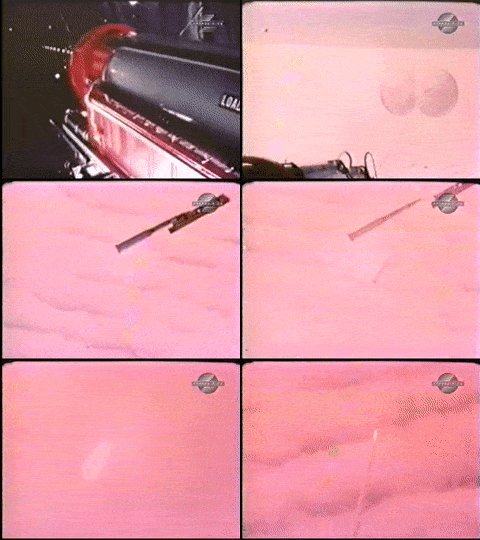
When the clock hit zero, the two 32-foot parachutes deployed, and smooth as could be, pulled the 87,000 pound ICBM and sled from the C-5 as though it was what the aircraft was always meant to do.

“We just did a checklist, opened the doors in flight and away she went,” Sims recalled. “It was picture perfect.”

The C-5 was traveling at around 180 miles per hour when the ICBM dropped, and the sudden shift in weight sent the plane lurching upward and forward, now suddenly producing much more thrust and lift than was required for the C-5 to hold its course. The pilots expertly countered the shift, keeping the aircraft steady.

“It was like dumping out a wheelbarrow full of water,” Sims said. “We gained some forward motion, but [the pilots] had control of that. It was very smooth.”

c-5 icbm

The two men walked to the edge of the loading ramp, watching the massive missile drop, held upright by a bouquet of parachutes struggling against its immense weight. For an instant, they worried that the missile’s engine wouldn’t fire as it continued to fall some 12,000 feet. Then they saw a flash of light emerge from beneath the ICBM.

“I saw it fire. All at once there was this big ball of fire. That burn stopped the missile from falling and it came straight up,” Hardin recalled.

“We were at 20,000 feet and it passed us. It looked like a giant pencil. It was a pretty amazing thing to see.”

The first stage engine of the Minuteman I screamed through the sky to 30,000 feet, ten thousand feet above the C-5 as it flew away. Then, when the missile’s second stage would usually fire to continue the weapon’s trajectory, the burn ended, and the missile fell safely into the Pacific.

They had done it, and according to Sims and Hardin, they were even briefed that Kissinger felt he’d been given the advantage he needed as he went into talks with the Soviets. That assertion was later substantiated by a Federation of American Scientists report on air launched ballistic missiles, released many years later.


c-5 icbm

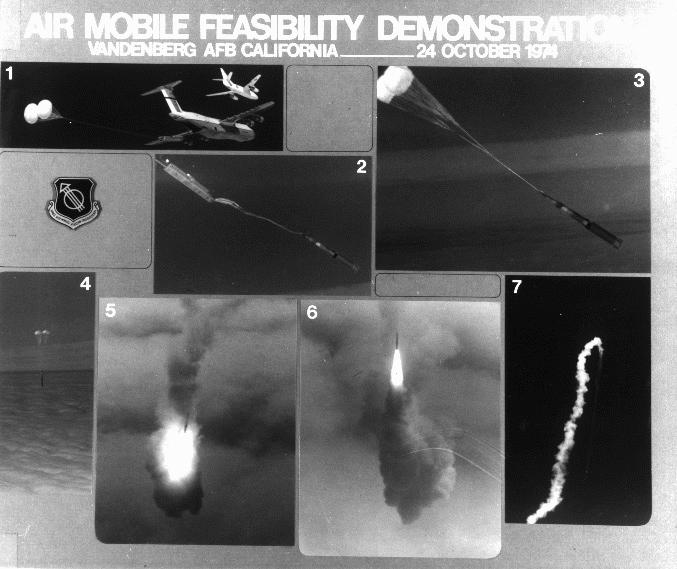
The effort to launch an ICBM from a C-5 Galaxy was anything but discreet. While the U.S. Air Force had often been tight-lipped about nuclear weapons programs, officials were happy to discuss the Air Mobile Feasibility Demonstration. One could contend that the openness was intentional to ensure Brezhnev and the rest of the Soviet government were aware of what was a genuinely monumental strategic shift between the nuclear powers.

Not only did the United States have more advanced nuclear weapons than the Soviet Union, but now they could deploy ICBMs from practically anywhere. Intercepting an ICBM means doing hihgly complex math based on launch location and trajectory to deploy a kinetic interceptor. With no way to pinpoint launch location, not only could the Soviets not take out these ICBMs in a Soveit first strike, but they also couldn’t stop them if America were to choose to take on the role of the aggressor themselves.

In an academic paper submitted to the Aerodynamic Deceleration Systems Conference in November 1975, one year after the tests, two officials from the Air Forces Aeronautical Systems Division, Daniel J. Kolega and James E. Leger, used the data collected from the tests to confirm the viability of air-launched ballistic missiles, including intercontinental ones.

Even more astonishing, they claimed the C-5A could potential launch multiple missiles in a single flight, which could be possible considering the aircraft’s massive payload capabilities.

c-5 icbm
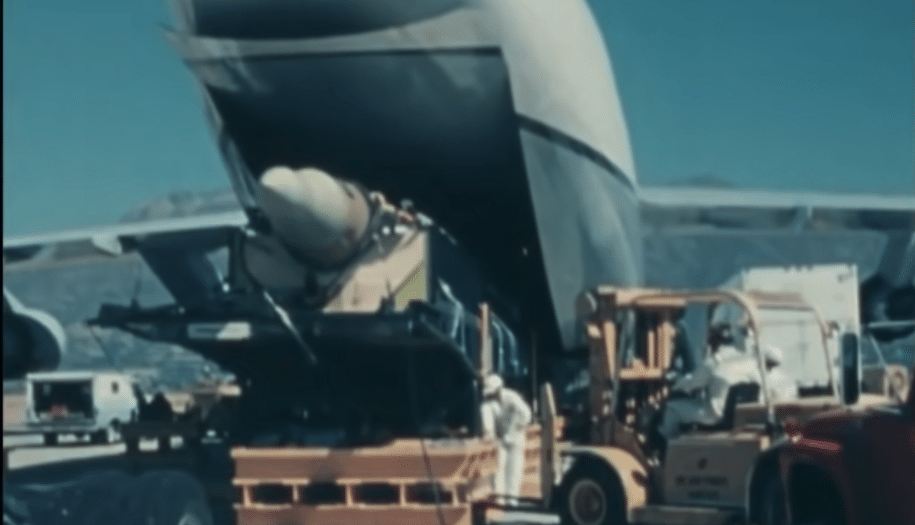
The C-5 was actually lifted to match the ballistic missile trailer height to load the ICBM. (U.S. Air Force)

“The tests also indicated that the C-5A has the capability of launching a missile that is
significantly heavier that the Minuteman I and that multiple Minuteman I airdrops are also possible,” they wrote.

Today’s C-5M Super Galaxy, in fact, can carry payloads of upwards of 285,000 pounds, more than enough to carry three modern Minuteman III ICBMs at once… if this concept were ever put into service, that is.

But that might actually be why this program, despite being considered a success, was quietly shelved after the conclusion of the 1974 summit. What was meant by the Americans to be a second-strike fail-safe to eliminate a Soviet advantage had also produced an incredibly daunting first-strike capability.

Introducing this new un-answerable first-strike capability into the delicate nuclear ecosystem of mutually assured destruction could have been enough to destabilize the balance between nations, and in a worst-case scenario, could even prompt the Soviets to initiate an attack while the U.S. was still vulnerable.

Or maybe all this effort was ever about was giving Henry Kissinger the edge he needed when meeting with his Soviet counterpart


Friday, August 27, 2021

My impressions of California.


When I went to the "Left" cost, I made jokes to my friends that if I came back porporting to supporting Xiden or backing Newsome in his recall, it means that I was caught and brainwashed.  Well anyway We flew in to LAX and went to get the rental car.  While we were there waiting for the car, I was looking around and taking a few pictures.

    The trees looked like the TV shows and the movies that I remembered seeing.

   Holy Sh!t, the Gas prices......dang....I complained about the $2.95 I pay here in Georgia .    We hit the road and I started seeing signs that I remembered from the TV and movies.

     We stopped at the In-N-Out Burger, it is the first time I ever ate at one.

   The Scenery was beautiful that I saw, it was different than I was used to, California is a beautiful state,


       That being said, I have been other places in the world, I have been in the middle east, north Africa and Mexico and the Caribbean, plus Europe, East and West.  The joys of being in the service, I suppose.

      California reminded me of a 3rd world country, the infrastructure looked run down, everywhere that had concrete was tagged with gang graffiti or just graffiti.  

One of the many homeless people I saw.  They had a lot of them, we would be accosted by them when we left restaurants after eating our dinner, and when we would go to Carl Jr in the morning to get our coffee, we would see then sleeping on the sidewalk.  They had camps in the deserts between the houses and in the ditches.  The houses that were upper middle class had walls around them, like what I would see in the middle east or in Mexico or in South America, I wondered if there was broken glass embedded in the top of the wall to discourage climbers.  I had spoken to a utility guy from LA, he and his crew was there working a project and he told me that it was worse in LA and especially in the wilshire area.  he told me that the Police will not interfere with them, they won't move and get in the way of all the utility projects, and they are encouraged to stay by the actions of the city fathers.  I replied "dang"  he them asked me what did I think of California, and I replied "it is a beautiful state, but it reminds me of a 3rd world country, I hate to say".  He agreed with me and commented that the assholes in Sacramento have ruined the state and as soon as he retires he is moving to Tennessee.


  Actually saw an "Eastern" plane, and you could see the "Hockey Stick"on the tail.


    This our plane taking off...Finally.    I will include more pics.