Stuka, The Dive Bomber That Terrified the Allies – Perhaps no weapon was as closely associated with the Nazi German in early in World War II as the Stuka dive bomber, infamous for howling, near-vertical dive attacks on warships, battlefield targets, and defenseless civilian communities like merciless birds of prey.
However, the Stuka’s reputation did not survive the war it helped
kick-off as it proved less and less survivable in the face of capable
opposition.
The dive bomber was a solution to a timeless challenge in military
aviation: how to ensure weapons dropped by fast-moving aircraft land
anywhere near a point target like a warship, artillery battery or
fortification. Precision was an especially big problem in an era where
tactical aircraft could carry only light, unguided bombs.
In the early 1930s, German World War I ace and stuntmen Ernst
Udet was impressed by American F11C Goshawk fighters he saw perform
steep dive-bombing attacks. Upon joining the Nazi Party in 1933 he
imported two Goshawks for test-flying and insisted the fledgling
Luftwaffe develop a specialized dive bomber—an aircraft that could
withstand the strain of pulling out of steep dives without smashing into
the ground or ripping its wings off
Engineer Hermann Pohlmann of the Junkers company devised a two-seat
monoplane with fixed landing gear covered by spiffy ‘spats’ and
distinctive inverted gull-wings that helped lift the fuselage high
enough off the ground to accommodate its large propeller. In addition to
two rifle-caliber machineguns in the wings, the radio operator had a
rearward-facing gun to protect against enemy fighters.
Powered by a Jumo 211 engine, the Ju 87 beat out competing models
in an aircraft design competition and saw initial combat-testing in the
Spanish Civil War in 1938-1939. The Stuka was slow with a maximum speed
of 200-240 miles per hour in level flight and had a short combat radius
of only 245 miles. It typically carried a single 551-pound bomb under
the fuselage (released by a crutch-like dispenser to avoid hitting the
propeller) and four 110-pound bombs under the wings.
Stuka pilots spotted targets through a floor window, then rolled
their aircraft completely around into a dive as steep as 90 degrees.
Underwing dive brakes would extend automatically, controlling diving
speed to just over 350 miles per hour, buying the pilot time to line up
his attack using controls switched to ‘dive mode’ and lines etched into
canopy side to judge his dive angle.
Special propeller-sirens on their landing gear called Trumpets of Jericho produced an infamous howling sound intended to terrorize bystanders on the ground. However, the sirens were later removed as they reduced speed by 5-10%.
Pilots typically released bombs at just 1,500 feet and then
engaged an automated system to yank the Stuka upwards. This was vital,
as such dives exerted five to six times the force of gravity on the
pilot, constraining blood flow to the brain and causing temporary
“grey-outs.”
Even the purpose-built Stuka was not immune to the dangers of
this method of attacks. Two weeks prior to the invasion of Poland,
thirteen Stukas and their crews were lost in training at Neuhammer when
fog caused them to misjudge a dive.
The Luftwaffe fielded 336 Stukas at the onset of World War II and
lost only 31 in the Polish campaign. They launched the first strikes of
World War II and claimed the first air-to-air kill when a Stuka pounced
on a Polish P.11 fighter taking off. When Polish forces counterattacked at the River Bzura with some success, Stukas and Panzers reacted swiftly to crush the threat.
The Ju 87B was the primary early-war model, but there were also
folding-wing Ju 87C torpedo/dive bombers for the never-completed
carrier Graf Zeppelin, and longer-range Ju 87Rs.
The Stuka’s precision made it a deadly anti-ship weapon. Stukas
sank most of the Polish Navy, crippled two cruisers and destroyed
several Allied destroyers and sloops and during the invasion of Norway,
and harried vessels evacuating Allied troops at Dunkirk.
Over 400 Stukas served as ‘flying artillery’ in the Battle of
France and the Low Countries, helping forward units beyond the reach of
artillery support, such as German paratroopers and fast-moving Panzer
divisions, by knocking out artillery concentration, heavy British and French tanks units, and fortifications like Belgium’s Ebe- Emael that could impede their advance.
Despite the Stukas’ tactical utility, they were also associated
early on with terror attacks on civilians. In 1938, three pre-production
Ju-87A models were ‘combat tested’ in Spain by attacking villages of no
military value, killing 38 civilians. Over Poland, Stukas obliterated 70% of the buildings in the town of Wielun despite
it being devoid of military targets. In France, Stukas notoriously
strafed columns of refugees, driving them into the path of Allied
columns.
However, dive bombers are extremely slow and vulnerable when
pulling out of a dive. Stuka losses were initially tolerable because
German fighters had achieved air superiority over their foes. Even then, roughly 120 Stukas were lost over France and the Low Countries.
The Stuka’s limitations caught up with it during the ensuing Battle of Britain—the campaign to destroy the Royal Air Force in preparation for a German amphibious landing. Stuka units were tasked with knocking out British Chain Home early warning radars, and coastal convoys and airfields.
But the RAF’s modern Spitfire and Hurricane fighters were tough
adversaries on their home turf, assisted by radar and the buffer of the
English Channel. In just three weeks in August, the Luftwaffe lost 51
Ju 87s—including 16 in one day. The Stuka had to be withdrawn from the
fight.
Battle for the Eastern Front:
Still, the Ju 87 remained successful in theaters where aerial
opposition was weak, such as the Balkans, Mediterranean and Russia in
1941-1942. Stukas ravaged Allied forces in Yugoslavia, sank numerous
British warships off Crete, destroyed much of the Soviet air force on
the ground in June 1941, and blunted counterattacks by heavier Russia tanks. Germany also exported Stukas to allies including Bulgaria, Italy and Romania.
By early 1942 the improved Ju-87D model phased in boasting a more
powerful Jumo 211J engine boosting range, speed and bombload. It also
featured a streamlined canopy and nose, a twin-barrel MG-81Z tail gun,
and additional armor plates.
To stem the thousands of tanks pouring out of Soviet factories,
in 1943 there followed the tank-busting Ju-87G model, armed with a
long-barreled 37-millimeter automatic cannon pod under each wing with a
magazine of six tungsten high-velocity shells. These could penetrate
Allied tanks if they struck the vulnerable top or rear armor.
Pilot Hans-Ulrich Rudel claimed in his memoire Stuka Pilot to have destroyed 519 tanks, sunk the battleship Marat, and shot down 52 aircraft mostly while flying a Stuka. While Rudel’s claims are surely exaggerated given the tendency for tremendous over-claiming of air-to-ground kills during World War II, another statistic is equally telling: Rudel was shot down or crash landed 32 separate times.
The swan song of the Stuka came in July 1943 at the titanic tank
battle at Kursk. Stuka Geschwaders 1, 2 and 3—half equipped with
cannons—launched massive airstrikes on Soviet tank units alongside Fw-190 fighter bombers and Hs-129 anti-tank aircraft.
However, Soviet Il-2 Shturmovik bombers also
claimed huge successes against German tanks at Kursk. Though
superficially similar to the Ju 87, the Shturmovik was more heavily
armored and had forward-facing cannons, ad even acquired a reputation
for hunting Stukas.
Demise of the Dive Bomber:
Growing Allied air superiority made Stuka operations more and
more perilous. Even American fighter pilots seeing their first action shot down dozens of Stukas over North Africa and Italy.
By 1944, the dive-bomber was largely replaced by far more survivable and hard-hitting ‘jabos’: robust, high-speed fighter bombers like the Fw-190F with maximum speeds exceeding 300 or 400 miles per hour.
While their high-speed, low-altitude attacks were not as precise a
dive-bombing, late-war fighter bombers had punchier rockets and
forward-firing cannons or .50-caliber machineguns to strike point
targets and could carry heavier bombs to blast area targets. Most
importantly, they weren’t sitting ducks when enemy fighters showed up.
By 1945, the Luftwaffe had only 100 operational Stukas out of
around 6,000 built. These continued to harry Russian armies entering
Germany, scoring occasional successes due lapses in Soviet air
superiority. Only three intact Ju 87s survive today.
The Stuka played an important role in the Wehrmacht’s early
campaigns, knocking out obstacles to the relentless advance of German
Panzer divisions with precision strikes. But white-knuckle dive-bombing
tactics proved a dead end when facing significant aerial
opposition. Though the Stuka led a respectable second career as a
cannon-armed tank buster, the infamous warplane was doomed to be
replaced by more versatile and survivable fighter-bombers.
By the end of 1944, the Soviet Red Army had surrounded the Hungarian
capital of Budapest and established strong defensive positions running
from Esztergom on the Danube to Lake Balaton. On the last day of the
year, the provisional government set up by the Soviets in those parts of
Hungary occupied by the Red Army threw in its lot with the Allies and
declared war on Germany.
Hungary, the last of Hitler’s partners in his European Axis, had
deserted him—but not the Hungarian Army. In order to protect the country
from the Bolsheviks, whom they feared and hated, what was left of the
Hungarian Army continued to fight alongside the Germans.
On New Year’s Day 1945, the only sizable German reserves on the
Eastern Front launched an offensive, code-named Konrad, to relieve
Budapest and secure the southern Hungarian oil reserves. By January 6,
General Herbert Otto Gille’s IV SS Panzer Corps had come within 25
kilometers of the Hungarian capital, but then, in the face of rapidly
redeployed Soviet units, the attack stalled. On the same day, the
Russians launched an attack across the Gran River, north of the Danube,
with the equivalent of two tank divisions and four infantry divisions.
Designed to disrupt the German offensive, the attack was successful and
had advanced some 50 kilometers by the 8th.
German countermeasures succeeded in halting the attack, and by the
14th the Russians had lost half their gains and some 200 tanks;
nevertheless, they still held a sizable bridgehead west of the Gran
River.
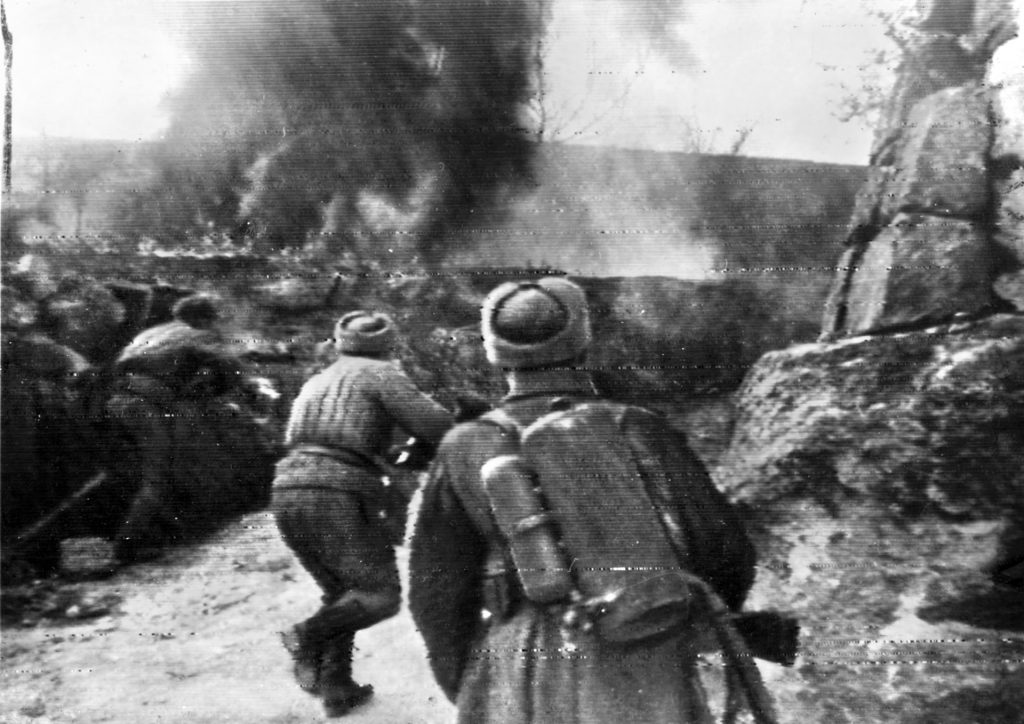
Red
Army troops advance toward Budapest, the capitol of Hungary, in an
effort to halt the February 1945 German offensive known as South Wind,
an operation designed to block the Soviet advance toward Vienna.
In the meantime, Gille’s IV SS Panzer Corps had renewed its attack on
January 10, and, after taking the Soviets completely by surprise, had
advanced to within 21 kilometers of Budapest by the 13th. Then, despite
Gille’s assurance that he was on the verge of a breakthrough,
Headquarters Army Group South inexplicably called a halt.
SS Lieutenant Colonel Fritz Darges, commanding the 5th SS Panzer
Division’s Panzer Regiment said later, “The head of our assault unit
could see the panorama of the city in their binoculars. We were
disappointed and we could not believe the attack was stopped. Our morale
was excellent and we knew we could free our comrades the next day.”
Be that as it may, Hitler and the high command had other plans. On January 16, Field Marshal Gerd von Rundstedt,
commander of German forces more than 1,000 kilometers away on the
Western Front, received the following order: “CinC West is to withdraw
the following formations from operations immediately and refit them: I
SS Panzer Corps with 1st SS Panzer Division LAH [Liebstandarte Adolf
Hitler] and 12th SS Panzer Division HJ [Hitler Youth]; II SS Panzer
Corps with 2nd SS Panzer Division DR [Das Reich] and 9th SS Panzer
Division. Last day of refitting is 30th January.”
Also at this time Hitler sent his personal adjutant, SS Major Otto
Günsche, to warn the Sixth Panzer Army Corps commander, SS General Sepp
Dietrich, that within a month he would be required to move his army to
the Eastern Front to launch a new offensive designed to secure the vital
oil deposits in southern Hungary and perhaps even regain the oil of
Rumania. Both Dietrich and General Heinz Guderian,
the army group chief of staff, had wanted the Sixth Panzer Army
deployed behind the Oder River to protect Berlin and northern Germany,
but Hitler would have none of it. The only natural oil deposits in
German-controlled territory were those around Nagykanizsa in southern
Hungary, and, with Allied air attacks disrupting and often neutralizing
the synthetic gasoline production sites for long periods, it was
essential to protect them. Without this crude oil, the battle could not
be continued. Dietrich and the trusted divisions of the Waffen SS were
to be given responsibility for this new offensive, code-named Spring
Awakening.
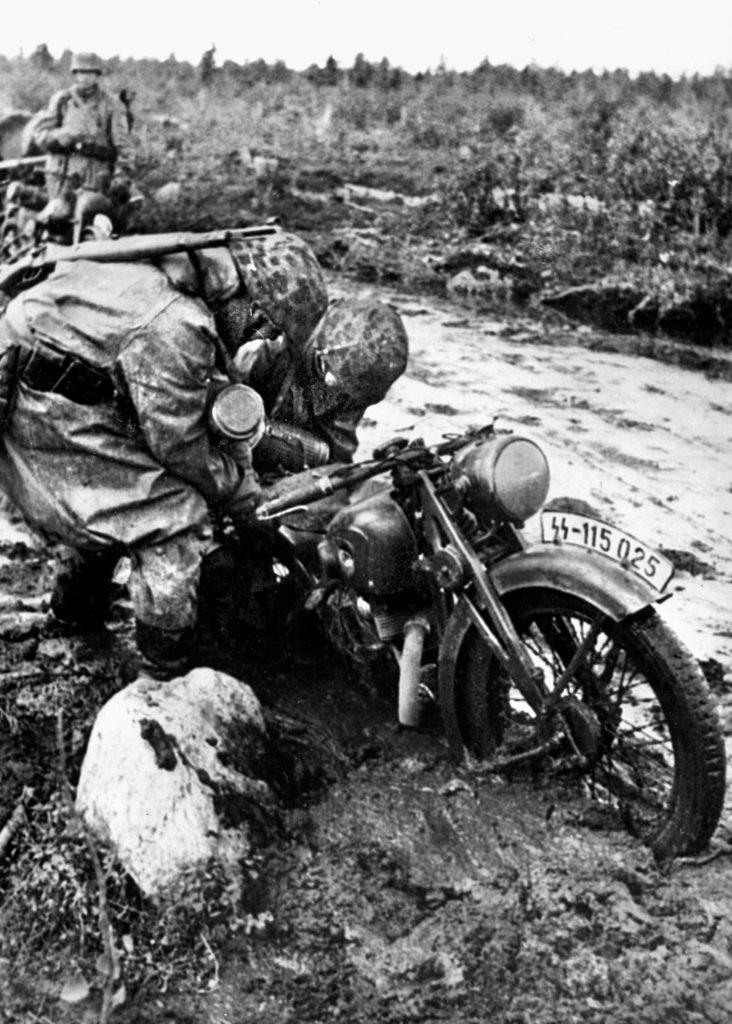
During
the winter of 1945, heavy rains on the Eastern Front turned dirt roads
into seas of thick mud. Here, SS soldiers struggle to free a motorcycle.
In view of the time needed to refit and move the Sixth Panzer Army to
the Eastern Front and secure the ground west of the Danube for the new
offensive, Hitler ordered a third attack in Hungary on January 18, using
much- larger forces. This was designed primarily to cut off and destroy
all Soviet troops north of a line drawn from Lake Balaton, through
Székesfehérvar, to Budapest, and secondarily to liberate that city. The
Pest garrison had in fact withdrawn across the Danube to the hills of
Buda the night before.
Since the Russians had depleted their defenses in this area to meet
the previous German attacks in the north, the new offensive was
initially very successful. Within three days a large section of the west
bank of the Danube had been secured 35 kilometers south of Budapest,
and the Germans then turned north and northwest, threatening to link up
with other forces attacking in the north and cut off an entire Soviet
Front.
By the 26th, however, with their forces in the south only 20
kilometers from Buda and in the north half that distance, the Germans
were exhausted, and this was the moment when Marshal Rodion Y.
Malinovsky went over to the attack. Although the Germans continued to
hold Székesfehérvar and the ground between it and Lake Balaton, by
February 3 they were more or less back to their original positions. Buda
fell finally on February 14. The siege had lasted 51 days and had cost
the Axis over 70,000 men.
Meanwhile, Marshal Georgi Zhukov’s
and Marshal Ivan Konev’s offensives in the north had advanced over 150
kilometers; Warsaw, Lodz, and Cracow had fallen, and a Soviet Army had
entered East Prussia. The Red Army was now a mere 200 kilometers from
Prague and, worst of all for the German people, it had crossed the Oder
River and was only 70 kilometers from Berlin.
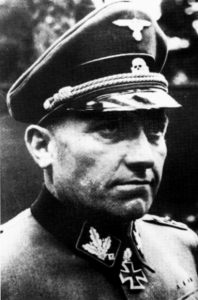
General Hermann Priess commanded the 1st SS Panzer Division in the Ardennes and Hungary.
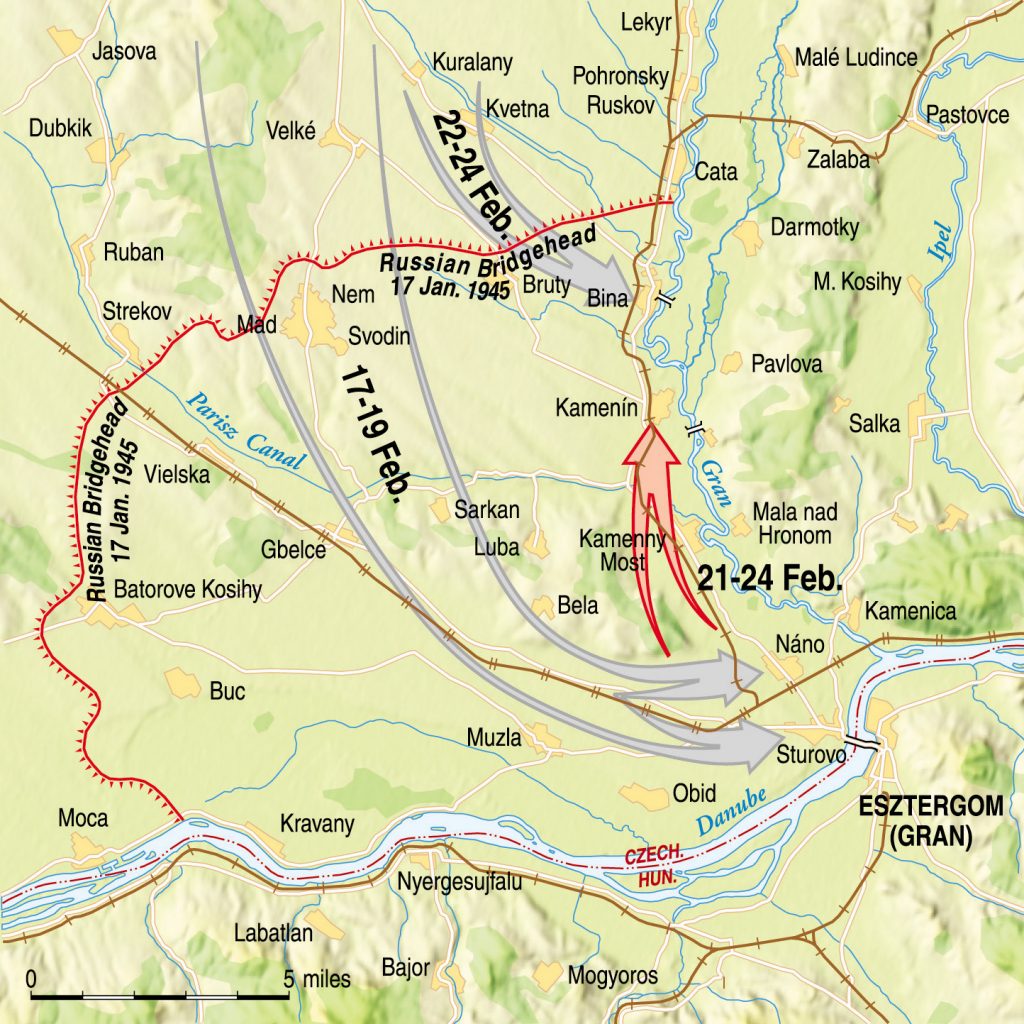
The Germans saw the Soviet bridgehead over the Gran River north of
Esztergom as a potential assembly area for a major Red Army thrust
toward Vienna, and as such it had to be eliminated before they could
launch their own Operation Spring Awakening. Therefore, on February 13,
Headquarters Army Group South ordered the commander of the German Eighth
Army “to attack, concentrating all available infantry and armored
forces, and accepting the consequent weakening of other front sectors,
with the newly arrived I SS Panzer Corps…after a short artillery
preparation, to thrust from the north, to destroy the enemy in the Gran
bridgehead.”
The operation was given the code-name South Wind.
Although the bridgehead had existed for over a month, the Germans had
no detailed intelligence of Soviet strength or dispositions within it.
The operation order issued on February 13 merely stated that aerial
photography and ground observation indicated that the Soviets were in a
defensive posture. It also noted that a mechanized division was
positioned in the center of the bridgehead, a guards mechanized corps
and a guards tank corps “with the attached Sixth Guards Tank Army are
probably located in the refitting area east of the Gran.” These units
could be expected to reinforce the bridgehead if necessary.
The order added that there were known to be antitank blocking
positions, supported by mortars to the west of Bruty, a continuous
“fighting trench” running from Obid in the south through Muzla and
Gbelce to just south of Bruty. The Parizs canal formed a considerable
obstacle due to flooding, and although the roads and tracks were
beginning to thaw out, they were not yet soft. Single bridges across the
Gran existed at Bina and Kamenin, and there were two more near Nana.
In fact, the Soviets were much stronger than the Germans realized. In
addition to the guards mechanized corps already mentioned, which
provided a centrally located mobile reserve, there were two guards rifle
corps in the bridgehead with a total of seven rifle divisions. Five of
the rifle divisions were in perimeter defense, while the other two
provided second echelon defense in depth. Even if these divisions were
below strength, this would still mean that the Germans were up against
well over 60,000 men with 100 to 230 tanks and self-propelled tank
destroyers, over 100 antitank guns, some 200 heavy mortars, and over 200
guns and howitzers.
Containing the Soviet bridgehead before the opening of the German
offensive were three German infantry divisions with one Hungarian
infantry division and parts of another, supported by elements of a
German panzer division.
The Germans were correct in their appreciation that the Soviet forces
were in a defensive posture. Although a new offensive was being
planned, this would not take place until mid-March, and in the meantime
the troops west of the Gran were clearly vulnerable. The bridgehead was
only 20 kilometers deep and 20 kilometers wide and, with a 30 to
40-meter-wide river behind them, it was clearly going to be difficult to
reinforce the Soviet troops in the bridgehead or, in the worse case,
withdraw them.
From the German point of view, the forthcoming battle was not without
its problems. Mounting the main attack from the south across the Danube
was obviously out of the question, and an attack from the west would
run against the grain of the country. The Germans therefore chose to
attack from the north. Even this had its difficulties. The Parizs Canal
was a major obstacle due to the early thawing of the winter snows, and
in the final stages of the advance the assault force would be compressed
into a narrow corridor, less than 10 kilometers wide, by a ridge to the
south of Luba and the Danube River.
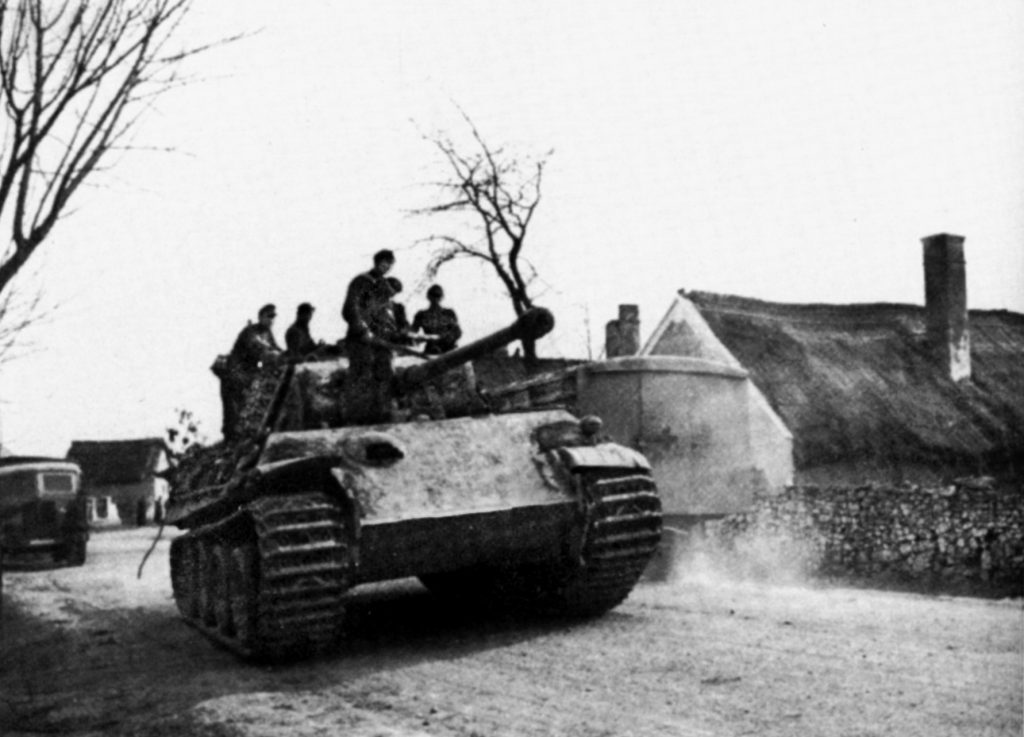
Members of the 12th SS Panzer Division hitch a ride on a tank as they move through a village on the Eastern Front.
Operation South Wind was to be led by Panzer Corps Feldherrnhalle.
This corps consisted of three infantry divisions and an armored group of
some 25 tanks. Its initial task was to seize the high ground,
particularly Point 190, to the south of Svodin, but the villages of
Svodin and Bruty were to be taken from the rear and any fighting there
was not to be allowed to interfere with the general advance south. SS
General Hermann Priess’s I SS Panzer Corps was to follow closely behind
the Feldherrnhalle and, after crossing the Parizs Canal, was to capture
the ridge running east from Gbelce before pushing on toward the Danube
at Sturovo. A reinforced regimental group from the Sixth Army south of
the Danube, known as the Hupe Regimental Group, was to establish a
bridgehead across the river near Obid in the early phases of the
offensive and cooperate with Priess’s men attacking from the north.
The Luftwaffe was tasked with supporting South Wind by attacking
known antitank defenses south of Svodin and Bruty and in the Muzla-Luba
sector, as well as delaying and destroying any Soviet reinforcements
attempting to cross the Gran River.
From February 12-15, I SS Panzer Corps moved to a staging area around
Nové-Zamky. Tracked vehicles moved by rail and those with wheels by
road. A platoon commander in the 9th SS Panzer Pioneer Company recalled,
“Rations were excellent. We learned from the civilian population the
various uses of paprika. The people were very friendly. They recounted
to us the good old days—Germany, Austria, Hungary. During the evenings
we drove to see films in Nové-Zamky.”
Then, on the night of the 16th, the 1st SS Panzer Division
Leibstandarte Adolf Hitler (LAH) and the 12th SS Panzer Division
Hitlerjugend (HJ) moved again into a final assembly area behind the
Feldherrnhalle. The latter’s infantry divisions were located in and
around the villages of Ruban, Dubnik, Velk‚ and Kvetna, and the armored
group near Farna. This was an ideal place to assemble with rolling hills
and plenty of cover.
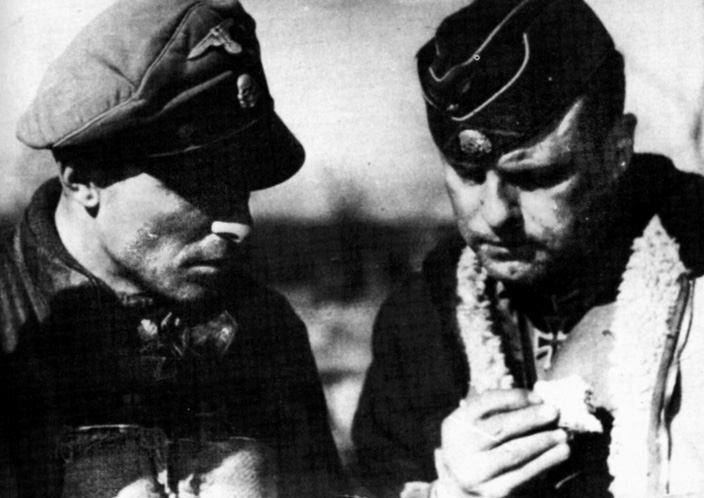
In readiness for the attack, SS Maj. Gen. Otto Kumm, who had only
assumed command of the LAH on February 15, divided the available parts
of his division into a Panzergrenadier Group under the command of SS Lt.
Col. Max Hansen, Kampfgruppe (KG) Hansen, and a Panzer KG under SS Lt.
Col. Jochen Peiper—soon to become infamous for his part in the “Malmedy
Massacre.”
During
the winter of 1945, SS units inflicted heavy losses on the Red Army and
took back large amounts of territory near the vicinity of the Gran
Bridgehead.
The former consisted of parts of the 1st and 2nd SS Panzergrenadier
Regiments, a detachment from the 1st SS Reconnaissance Battalion, the
1st Company of the 1st SS Panzerjäger Battalion, and two 37mm flak
batteries. Kampfgruppe Peiper was made up of 25 Panther and 21 Mk IV
medium tanks in one panzer battalion under SS Major Werner Poetschke, 19
Tiger IIs of SS Lt. Col. Hein von Westernhagen’s 501st SS Heavy Panzer
Battalion, the 3rd SS Mechanized Panzergrenadier Battalion, and part of
the 1st SS Panzer Artillery Battalion. According to the divisional chief
of staff, Ralf Tiemann, the rest of the division was still in transit
to the new battle area when the offensive began.
Hubert Meyer, the chief of staff of the HJ, has stated that the 12th
SS Panzer Division was more or less complete for South Wind and fought
in its conventional groupings. He claims 38 Mk IVs, 44 Panthers, and 13
Jagdpanzer IVs were operational just before the attack. The only combat
unit not mentioned in his account of the Gran bridgehead fighting is the
560th Heavy Panzerjäger Battalion. If, therefore, we exclude this
latter unit, we have a figure of 160 operational tanks and Jagdpanzers
in I SS Panzer Corps at the beginning of Operation South Wind, only 66
percent of its authorized holdings.
Despite the widespread flooding and poor road conditions caused by
the early thaw, Operation South Wind began at 0500 hours on February 17.
Leaving high ground on their right flank and with the Gran River on
their left, the Germans attacked across open, rolling, agricultural land
with few villages and no serious obstacles.
The artillery of I SS Panzer Corps joined in an opening barrage by
the guns of Panzer Corps Feldherrnhalle, and in the most critical area
of the attack, the center, the Russians were taken by surprise. By 0900
hours the leading elements of the 46th Infantry Division were near Point
190, having penetrated the Soviet defenses between Svodin and Bruty,
but there they ran into an antitank screen and a few individual T-34 tanks.
After calling for support from the LAH, a successful attack was
launched at 1140 hours, and by 1700 hours elements of both the LAH and
46th Infantry Divisions had reached the Parizs Canal in the area of
Sarkan only to find the bridges there destroyed.
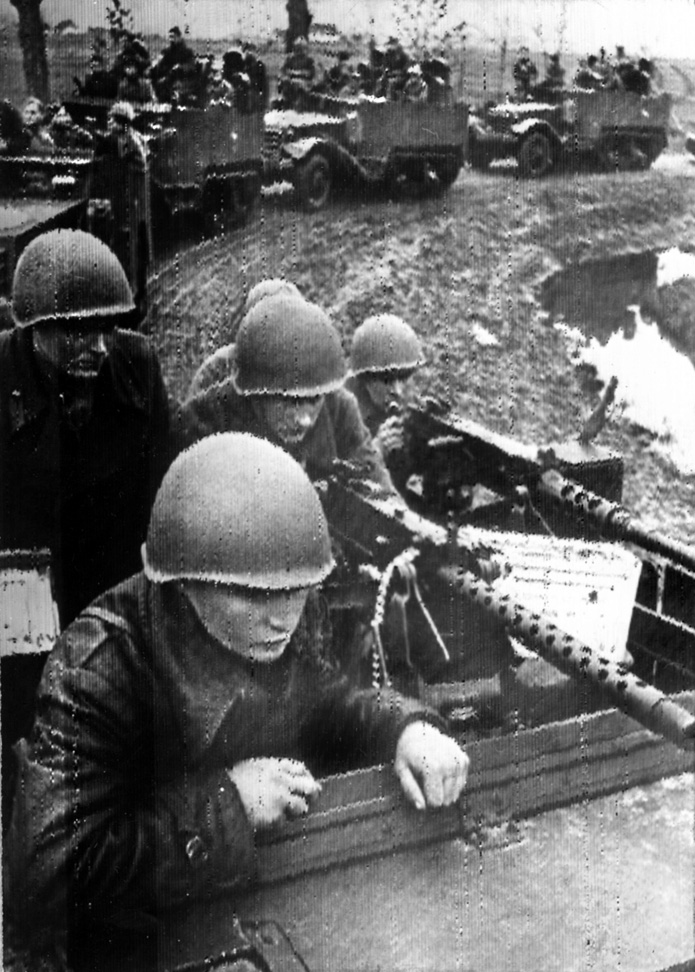
Driving American halftracks and armed with U.S. American machine guns, Soviet troops roll toward the front, January 1945.
A loader in one of Peiper’s tanks later remembered, “Peiper ordered
five King Tigers to drive over the hill. What a sight! As on a silver
platter, they appeared on the hill and immediately began taking fire
from the Russian antitank guns. We saw the shells bounce off the front
of the Tigers. That must have been a shock for the Russians, especially
since the Tigers destroyed one antitank gun after another.… Peiper
immediately gave the order: ‘Panzers—march!’ A hurricane of fire was
released as the KG drove over the hill in formation.… The tanks and APCs
drove at full speed, firing all barrels.… There was only one thing for
the Russians to do—clear out.… KG Peiper suffered no losses.”
During the early part of the night, a small infantry bridgehead was
established by KG Hansen, but no vehicles could cross. Nevertheless, it
had been a good day for the LAH and its associated 46th Infantry
Division. They had broken through the Soviet defenses and advanced
nearly 10 kilometers.
On the left flank things did not go nearly so well, and the 211th
Infantry Division of the Feldherrnhalle was stopped in front of Bruty by
a guards rifle division in fortified positions supported by antitank
guns, mortars and artillery.
Similarly on the right flank, the 44th Infantry Division of the
Feldherrnhalle ran into strong opposition from the 6th Guards Airborne
Division between Strekov and Svodin, and it was only after tanks joined
in the attack that further progress could be made. By 1700 hours, Svodin
had been captured and the advance continued toward the canal and
Vieska.
What of the Hitlerjugend Division? It had followed behind the LAH,
and during the afternoon the 26th SS Panzergrenadier Regiment was
committed on the right flank of its sister division to secure a crossing
of the Parizs Canal. The 1st Battalion of the 26th Regiment managed to
make a crossing just to the north of the large village of Gbelce by
about 2100 hours, and the 2nd Battalion followed into the shallow
bridgehead. Soon after midnight, the 2nd Battalion had reached the road
junction 1,500 meters northeast of Gbelce, and both battalions then went
firm. A small canal crossing, capable of taking wheeled vehicles, was
discovered in the same area. During the night the Russians
counterattacked with a battalion of infantry and at least two T-34s, but
were beaten off.
The commander of Army Group South, General Otto Wöhler, was anxious
that the Soviets should not be allowed to recover their balance and
build up a second defensive line to the south of the canal. To prevent
this from happening, the Hupe Regimental Group from south of the Danube
was ordered to cross the river that same night. This was achieved
without opposition.
In the early hours of the 18th, KG Hansen expanded its small
bridgehead, and Leibstandarte Pioneers (engineers) were able to bridge
the Parizs Canal. Four T-34s were claimed by Hansen’s 6th SS
Panzergrenadier Company during this fighting. Mines caused some further
delay, but soon after midday the first of Poetschke’s Mk IVs and
Panthers crossed the canal, and, despite an air attack by Soviet fighter
bombers, by early evening KG Peiper had reached the Gbelce-Nana railway
line, 3 kilometers north of Muzla.
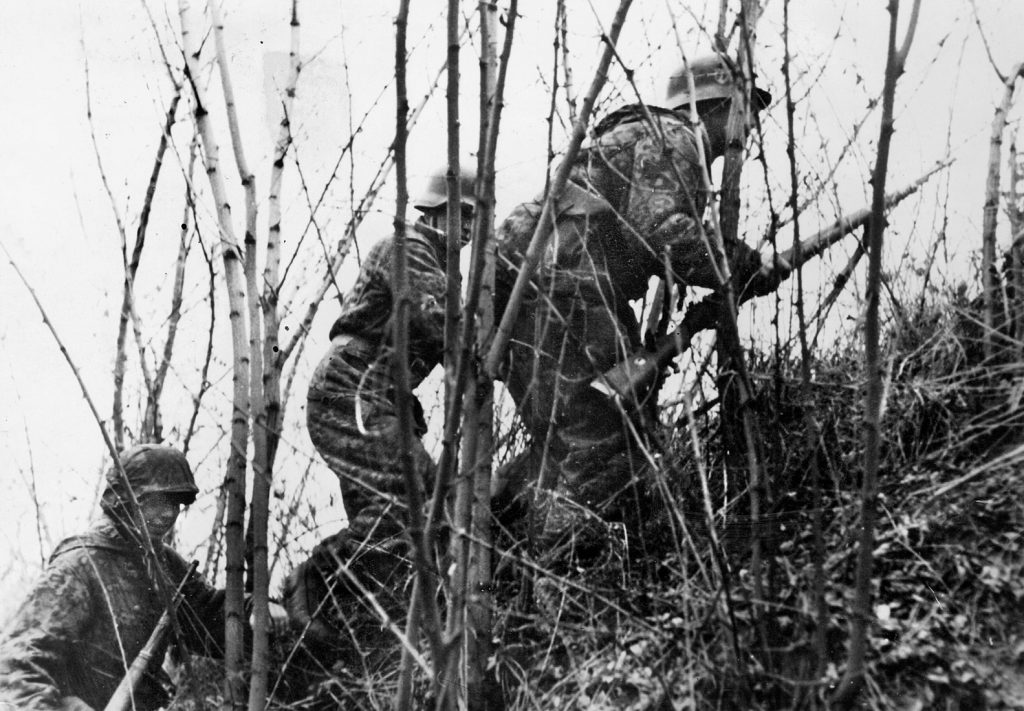
Men of the Waffen SS pick their way through the underbrush of a Hungarian hillside during their winter 1945 offensive.
Meanwhile, to the west of the LAH, the Feldherrnhalle’s 44th Infantry
Division had forced a passage over the Parizs Canal near Vieska, and in
the early afternoon its tanks were able cross. Then, in conjunction
with the 26th SS Panzergrenadier Regiment, a joint attack was launched
on Gbelce. The Feldherrnhalle Group was joined by SS Major Hermann
Brand’s 3rd SS Mechanized Panzergrenadier Battalion, and they took the
western part of the town. The 1st Battalion captured the eastern sector,
and the 2nd Battalion went on to secure the high ground 2 kilometers
further east. By evening, infantry and armor of the Feldherrnhalle were
in possession of Point 129, 3 kilometers south of Gbelce, and in contact
with the Leibstandarte.
On the 19th, the weather improved, and at 0530 hours I SS Panzer
Corps resumed its attack. KG Hansen of the Leibstandarte was given the
task of clearing the enemy from the vine-covered ridge south of Point
250, while KG Peiper resumed its advance on the north side of the
Gbelce-Nana railway. It was by no means an easy advance.
SS Lieutenant Rolf Reiser later described the action: “In the early morning our assembly was considerably delayed by
a Russian fighter bomber attack; we suffered the loss of several
tanks and wounded.…We set out astride the road with seven tanks of the
1st Company. I advanced … between the road and railway line with the
three Panthers of my Platoon.… Ivan attacked our open right flank at
short range with tanks from behind the cover of the railway embankment.
One of the Panthers … was hit and stalled.… SS Senior Sergeant Strelow,
the 3rd Platoon leader, set up to the right of me. Then there was a
detonation a short distance away and his tank was ablaze. I drove behind
a shed and slowly probed the other side until I had the T-34 broad-side
in front of me—no more than 50 meters away.…He burst into flames on the
first shot, the turret flew off after the second! Then the Tigers and
Panthers of the 2nd Company caught up and joined in the armored battle.
Two more enemy tanks were destroyed.”
Farther to the west, SS Captain Hans Siegel’s 2nd SS Panzer Battalion
of the Hitlerjugend, with Brand’s 3rd Mechanized SS Panzergrenadier
Battalion attached, had formed up during the night to the south of
Gbelce protected by the 25th and 26th SS Panzergrenadier Regiments. It
too advanced at 0530 hours with grenadiers leading the way on both sides
of the Sturovo road in case of mines and the tanks on the road itself.
Shortly before daybreak, KG Siegel came under artillery and antitank
gunfire from Muzla, but a quick attack, led by SS Lieutenant Helmut
Gaede’s 1st SS Panzer Company, took the village, and the surrounding
area was soon cleared by the 1st and 2nd Battalions of the 26th
Regiment.
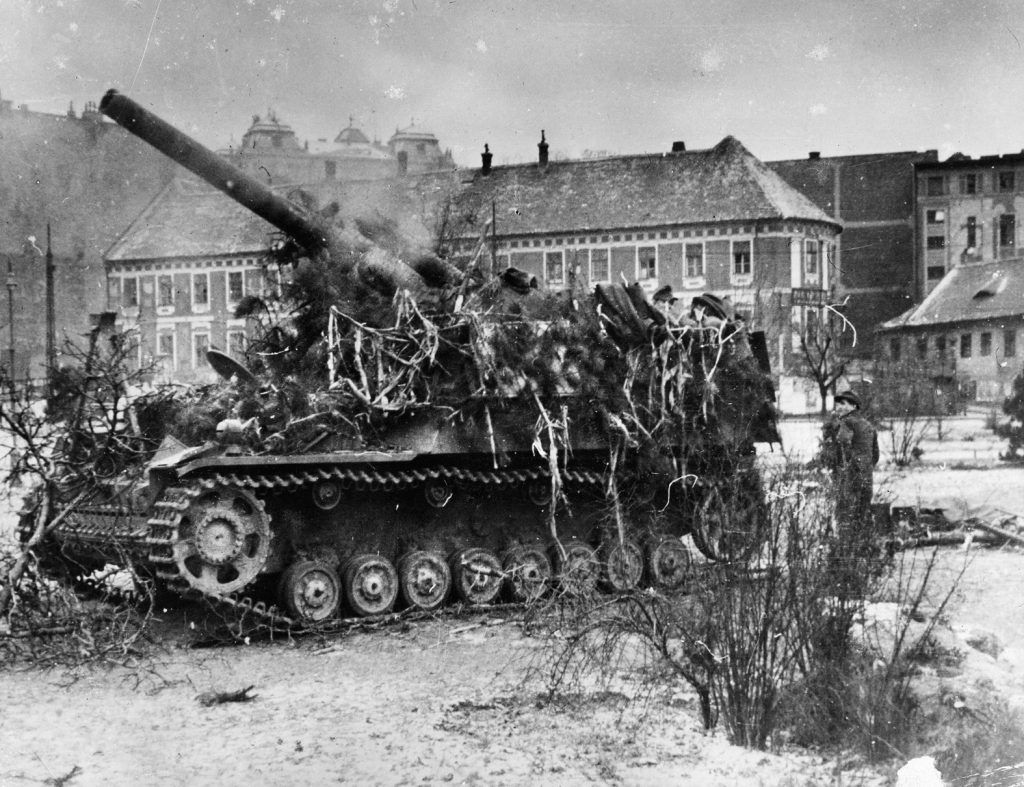
The German tracked howitzer “Hummel” opens fire on attacking Soviet forces near Budapest.
While the HJ was preparing to resume its advance on Sturovo on the
south side of the Muzla-Sturovo road by way of Obid, the division
suffered a serious loss. SS Lt. Col. Bernhard “Papa” Krause was killed
in a surprise rocket attack. He had been a stalwart of the HJ since its
foundation and was revered by all its members.
The advance began again soon after midday, with the HJ moving on
Sturovo from the southwest and KG Peiper of the Leibstandarte from the
northwest. At about 1300 hours, when they were some 3 kilometers short
of Sturovo, the infantry element of KG Peiper, the 3rd SS Mechanized
Panzergrenadier Battalion, swung northeast to attack Nana. Poetschke’s
Mk IVs and Panthers and von Westernhagen’s Tiger IIs were joined by 20
Sturmgeschutze armored vehicles and infantry of the Hupe Regimental
Group from the Obid area for the assault on Sturovo.
In his citation for the oakleaves to Poetschke’s Knight’s Cross,
Peiper wrote, “Rushing headlong and firing wildly, his tanks overran the
antitank nets in front of Muzla and Sturovo, and after making contact
with the Southern Group [Hupe], which had been ferried over the Danube
in assault boats … pushed through to Esztergom.”
At the same time, an assault group from an infantry division holding
Esztergom crossed the Danube and joined in the attack. The Russians had
no chance in this vulnerable corner of their bridgehead, and before last
light the men of I SS Panzer Corps were gazing at Esztergom cathedral,
standing like a sentinel above the far bank of the mighty Danube. They
knew they had completed the hardest part of their task. Nana and Sturovo
were in the hands of the Leibstandarte and Hitlerjugend.
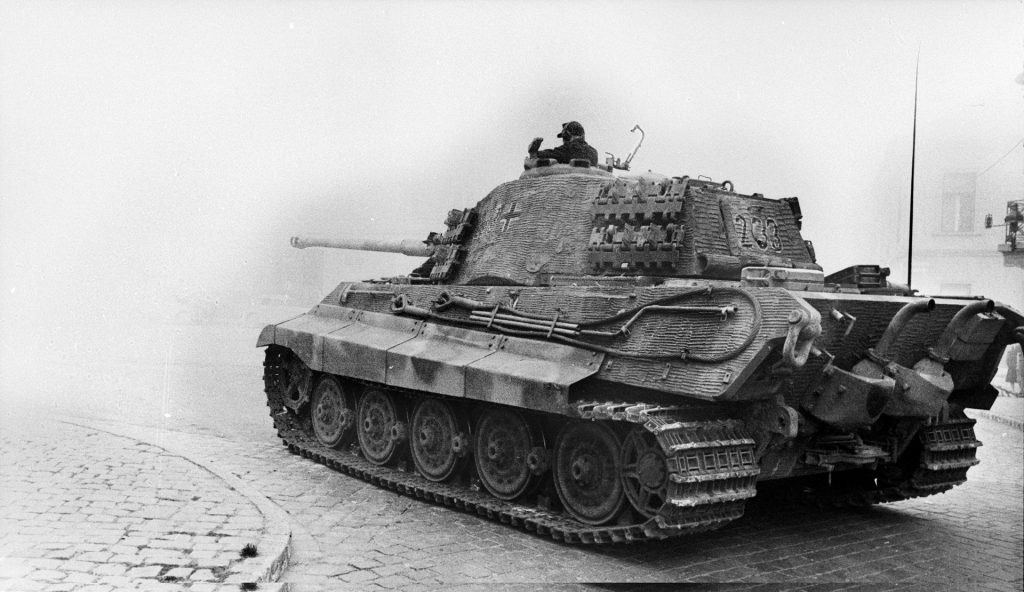
A
Panzer VI “Tiger II” (King Tiger) takes up position on a cobbled street
corner “somewhere in Hungary” during Operation South Wind. The Germans
deployed hundreds of tanks, as did the Red Army.
In other relevant actions on February 19, Batorove Kosihy and Buc
were occupied by a KG of Army Group South following their evacuation by
the Russians, and the 44th Infantry Division of the Feldherrnhalle
captured Kravany on the Danube and the forest to its east. In the
eastern part of the bridgehead, the 46th Infantry Division, with armored
support, had cleared the wooded, hilly area just to the west of Kamenny
Most, but, north of the Parizs Canal other elements of the division
were repulsed by a Soviet counterattack 2 kilometers short of Kamenin.
In the north, Bruty remained firmly in Russian hands.
From the outset of Operation South Wind, the Germans had been worried
that the Soviets would attempt to reinforce their bridgehead. They had
correctly identified parts of the IV Guards Mechanized Corp in the
northern part of the bridgehead, but they were particularly worried
about the whereabouts of the Sixth Guards Tank Army, and when aerial
reconnaissance reported 3,000 vehicles moving north from the Budapest
area, they became alarmed. Orders were issued for immediate night
attacks on Kamenny Most and Kamenin. Leaving the bulk of the LAH armored
group in Sturovo to replenish ammunition and supplies, the Mk IVs of KG
Peiper, with part of the 46th Division, attacked from Nana along the
Kamenny Most road. Another part of the 46th Division advanced north of
the Parizs Canal on Kamenin. Both attacks failed, and Soviet air
superiority and artillery fire from east of the Gran precluded any
further attempts during daylight on the 20th.
A two-phase operation was then ordered. In the first phase, the LAH
and 46th Infantry Division were to take Kamenny Most in the south of the
remaining bridgehead, while the HJ, with support from the 211th
Volksgrenadier Division (VGD), was to secure Bruty in the north. In a
second and final phase, the twin divisions of I SS Panzer Corps would
clear Kamenin and Bina, respectively.
Parts of KGs Peiper and Hansen, with support from the 46th Division,
successfully entered Kamenny Most during the night of the 21st, but soon
after dawn they were forced on to the defensive by Soviet artillery
fire and continuous air attacks.
Rolf Reiser recalled, “Peiper had decided upon a night attack because
we were covered by massive fire during the daytime from enemy artillery
positions on the raised eastern bank of the Gran.…We rapidly crossed
the softly rolling terrain directly under the chain of hills that ran
west of the road and railway line.…We turned east … in order to
penetrate frontally. Then massive Russian artillery fire was initiated. A
curtain of iron and fire hung before us. Flares and tracers illuminated
the night and showed us the way to the enemy positions…. We rattled
across the railway—then there was a crack and flash of light. We were
hit!… We caught fire immediately.… My gunner followed me as the last one
out of the turret. We landed in a trench with Ivan, who was as
surprised as we were. Armed only with pistols and bare fists, we
defended ourselves…. We finished off the Soviets in the cover of the
burning tank and the exploding ammunition.”
The assault was resumed with the coming of darkness, and by 2100 hours the last Russians had withdrawn from Kamenny Most.
Meanwhile, during the 20th and 21st, the Hitlerjugend was relieved by
the 44th Infantry Division and moved to a new assembly area southeast
of Farna in readiness for its assault on Bruty. The I SS Panzer Corps
was thus poised for its final battles west of the Gran River. With
aerial reconnaissance and other intelligence sources confirming that the
IV Guards Mechanized Corps had withdrawn across the Gran and other
troop movements toward the river had apparently halted, Hermann Priess
and his men had every reason to be confident of success.
Headquarters Army Group South concluded that the Soviets must be
expecting a German assault across the Gran. Therefore, defensive
positions on the east bank were being prepared with all available
reinforcements. In fact, Hitler had forbidden any such assault and
demanded that his Leibstandarte Corps be freed as soon as possible for
his new offensive, Spring Awakening, in the Lake Balaton area.
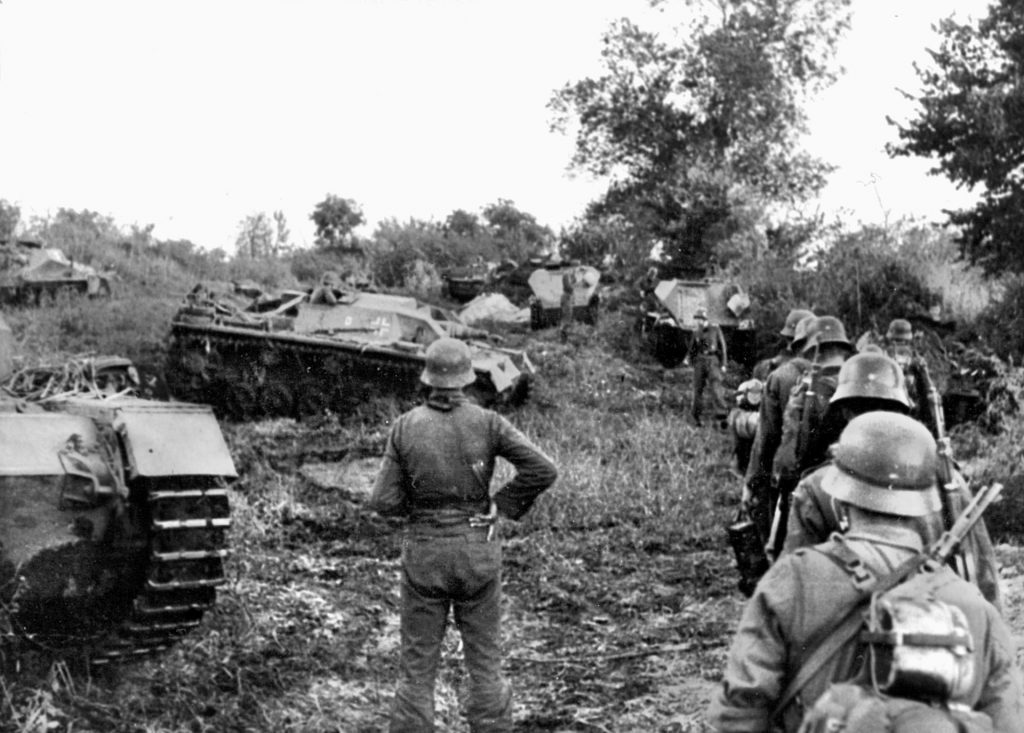
German
infantry and armored vehicles move through the countryside of Hungary
as they attempt to stem the tide of the Russian advance toward their own
borders. .
In preparation for its attack on Bruty, the HJ had to rely mainly on
aerial reconnaissance and on information provided by the 211th VGD,
which had already failed to take the village. This revealed that the
area was heavily fortified, with minefields backed by large numbers of
machine guns, mortars, and antitank guns in considerable depth. Since
the ground was completely open, the decision was made to undertake a
night operation.
The preliminary phases of the attack were marred by a number of
unfortunate incidents. The 25th SS Panzergrenadier Regiment, on the
right flank, failed to reach its starting line in time for the assault,
and, in the darkness, some of Siegel’s tanks failed to recognize the
Panzergrenadiers who were leading the attack on the left and opened fire
on them. Five men were killed, including a company commander, and
another eight wounded. This second disaster alerted the Russians, who
opened fire with machine guns and mortars.
Despite these problems, Siegel’s tanks began their attack at about
0445 hours in the wake of a bombardment by artillery, mortars, and
rocket launchers. Within minutes, however, the leading tanks ran into a
minefield, and several, including Siegel’s, were immobilized. These were
repaired under fire, and the tanks then withdrew behind a reverse slope
from where they supported the attack of the 9th Mechanized
Panzergrenadier Company, led by SS Lieutenant Dieter Schmidt. This
company was on the left flank of the attack and outside the minefield.
Although some of its APCs floundered in the soft ground of a streambed,
the rest managed to break through the defenders and reach the southern
edge of the village.
In the meantime, the 25th Regiment had joined in the attack, and
together with the other two battalions of Braun’s 26th Regiment took the
western and lower sectors of the village.
An SS Sergeant Burdack of the mechanized battalion later described
the scene: “The village was choked with enemy vehicles.…Several T-34s
and T-43s [light tanks], still inside the village, forced the APCs to
take cover.…The Russian tanks, without the protection of infantry,
left…in the direction of Bina.”
An SS officer remembered: “Fire from our heavy weapons had badly
damaged most of the buildings. Roofs had been stripped off; walls had
crumbled. During the pitched battle, civilians came out of the ruins of
their houses…unconcerned with what was going on around them…They were
obviously happy beyond measure to be liberated again from their
‘liberators.’”
Later that morning, Bruty was finally cleared by the 25th Regiment in
conjunction with troops of the 211th VGD who had advanced on the right
flank of the HJ and entered the village from the south. Eighty prisoners
were taken and a large number of antitank guns and mortars, two
undamaged T-34s, and six large caliber howitzers were found in the area.
Bruty was in German hands, but the cost had been high—particularly in
the 25th Regiment.
In the meantime, in preparation for the assault on Kamenin, elements
of KG Peiper had secured the road junction immediately north of Kamenny
Most.
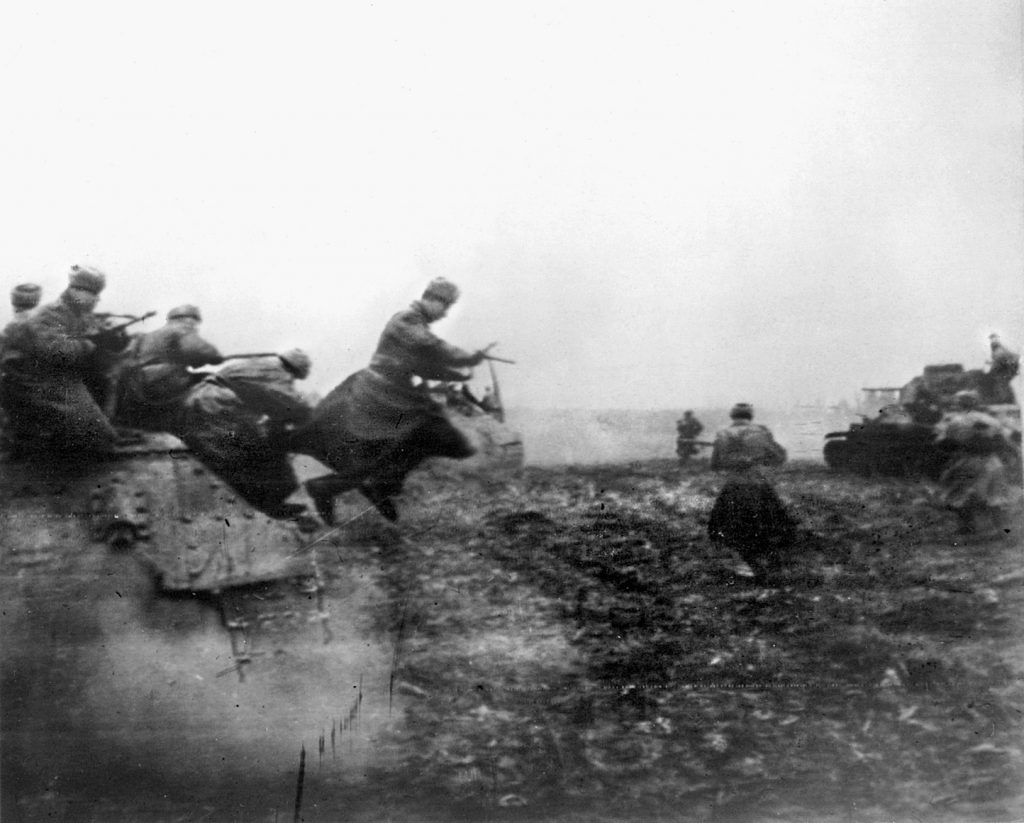
A
squad of Red Army machine gunners leap from tanks in an effort to halt
the German advance. Soviet losses were heavy but Hitler soon called a
halt to the successful Operation South Wind to mount another—Operation
Spring Awakening—an attempt to secure vital oil reserves in Hungary that
proved to be a failure.
The I SS Panzer Corps spent February 23 preparing for its final
assaults on Kamenin and Bina. The Leibstandarte, with elements of the
46th Infantry Division, was to attack the former, and the Hitlerjugend,
still with support from the 211th VGD, was to secure Bina and its bridge
across the Gran. Intelligence sources indicated that there were
elements of two motorized mechanized brigades still in the bridgehead.
H-hour was set for 0200 hours on the 24th.
In the HJ sector the most bitter fighting occurred in the area of the
railway line which runs north-south just to the west of Bina. This had
been heavily fortified, as had some of the flood dikes, but by using the
main Kvetna-Bina road as their axis and taking advantage of the gently
sloping ground, which dropped some 30 meters down to the village, the
tanks and SS Panzergrenadiers soon overcame all resistance. By 0830
hours the village had fallen. The last Russians blew the Gran bridge as
they withdrew.
In the southern part of the bridgehead, elements of the 46th Infantry
Division moved on Kamenin from the west, while the LAH attacked from
due south. The Mk IVs, Panthers, and Tigers of KG Peiper used the main
road as their axis and soon encountered a screen of 37 antitank guns
sited on the dominating ground to the south of the village.
Nevertheless, the attack was pressed home without regard to possible
casualties, and the sheer power of the armored assault was too much for
the Russians, who abandoned their guns and fled. Panzergrenadiers
followed up, and after some bitter house-to-house fighting the defense
was broken. By late afternoon, the Gran bridgehead had been eliminated.
The Germans claimed 71 tanks; 179 guns, howitzers, and antitank guns;
537 prisoners; and 2,069 Russian dead in the fighting upto February 22.
Of these, Peiper credits Werner Poetschke’s mixed SS Panzer Battalion
with 23 T-34s destroyed; 30 Hungarian, Italian-, British-, and
German-built tanks captured, and 280 enemy killed. According to a return
signed by Fritz Kraemer, the chief of staff of the Sixth Panzer Army, I
SS Panzer Corps suffered 2,989 casualties, including 413 killed in the
same period and, rather surprisingly, only three Mk IVs, six Panthers,
and two Tigers lost or in need of long-term repair. Figures quoted in
the histories of the LAH and HJ would indicate that this is a major
understatement.
Operation South Wind was, without doubt, a brilliant success. In
eight days, I SS Panzer Corps, admittedly with valuable assistance from
Panzer Corps Feldherrnhalle, had recaptured over 400 square kilometers
of territory, inflicted 8,800 casualties on the Red Army, and cleared
seven infantry divisions and a guards mechanized corps from west of the
Gran. It is remarkable that such an effective fighting machine could
have been produced within a month of the Battle of the Bulge disaster,
and it is even more so when one takes into account that many of men
involved had received only minimal training.
As Otto Kumm described the Leibstandarte, “The Division was in
miserable shape, only a shadow of its former self. After the heavy
losses in Normandy and during the Ardennes offensive, it had only
recently been refitted with personnel who were poorly trained former
members of the Army, Navy, Air Force, labor service and police.”
The performance of both the LAH and the HJ in South Wind can be
explained only by superb leadership, high morale and fighting spirit,
and a brilliant reinforcement and replacement system. That said, the
question arises as to whether this elite SS panzer corps should have
been used in this operation at all.
Despite all the measures taken to disguise the arrival of the Sixth
Panzer Army on the Hungarian front, units of I SS Panzer Corps were soon
detected in the Gran bridgehead operation. Its commitment there, rather
than in the northern part of the Eastern Front, and the knowledge that a
second SS Panzer Corps had arrived in Hungary, immediately alerted the
Soviets to the possibility of a German offensive. It is also obvious
that the premature use of the corps interrupted the proper refitting of
the two SS panzer divisions and, indeed, actually ensured that their
effectiveness in Operation Spring Awakening would be reduced.
Taken together, these facts indicate that the use of I SS Panzer
Corps in Operation South Wind was a serious mistake. The chief
operations officer of the Sixth Panzer Army, SS Lt. Col. Georg Maier,
expressed similar thoughts in his book Drama Between Budapest and
Vienna, published in 1975.
Why did Germany’s epic battleship Bismarck fail so quickly? Was it inevitable that such a creation would be an immediate lightning rod for all of the Allied forces?
Despite being the largest battleship that the Germans had ever built, the Bismarck’s failure was expected by many. The ship itself was built to manifest German greatness in the eyes of the Führer and to act as a motivational tool for the German public.
The British Royal Navy boasted the world’s greatest navy entering World War 2 and despite losing over 50,000 sailors to the Germans, had a considerable upper hand on the German navy throughout World War II. Bismarck was an attempt by Germany to try and match the greatness of the Royal Navy.
If we analyze the situation that Bismarck faced, we might find some internal reasons regarding the Germans that led to the failure of the famous battleship. In the following paragraphs, we will discuss some of the mistakes that the Germans made which ultimately sealed the fate of Bismarck.
A significant factor of the failure was that the Germans made crucial mistakes when designing the battleship.
Because the German battleship designers lacked experience, they followed outdated design philosophies that were used in battleships during World War I.
Consequently, the design of Bismarck had inferior defensive capabilities. For example, its main belt armor was thin and installed vertically, decreasing its horizontal defensive ability. Similarly, the Bismarck’s upper and main armored decks were not strong enough, as evidenced by the lack of protection on its turrets.
Moreover, likely due to the anachronistic designs, its defenses against air combatants was subpar, leaving it open to Allied air strikes. Therefore, even with an advanced manufacturing process, the Germans were not able to produce a battleship that was powerful enough because of their outdated design.
On the other hand, the Royal Navy had only built 2 battleships, HMS Rodney and HMS Nelson, and no battlecruisers between 1918 – 1939, thus their fleet was almost all WW1 vintage.
The HMS Rodney was built in 1927, while only the HMS Prince of Wales was in any sense modern. However, the Prince of Wales was still so fresh that in fact she still had dockyard workers on board. The Royal Navy hardly possessed an elite and modern battlecruiser unit.
In addition to the outdated design of Bismarck, the Germans had not realized that battleships were no longer the preeminent weapon.
The importance of the air force increased exponentially during World War II. On May 22nd 1941, the Royal Air Force spotted that German battleships had left the harbor.
Multiple days later on May 26th, more aircraft had found and tracked the Bismarck, something that traditional vessels would not be able to do.
During the final battle, the aircraft dealt the nail in the coffin for the mighty German vessel. The skies were now where wars were won due to wartime innovation, and the British had caught on to this trend, manufacturing two aircraft carriers to assist in the war effort and ultimately proving that they were superior to traditional approaches.
As a result, aircraft carriers would become the overlord of the sea.
Another serious mistake was that the German military did not emphasize the importance of information security. Prior to the sinking of Bismarck, during the Rhine Exercise, the British military had already deciphered Germany’s military codes and destroyed several German replenishment oilers. This had ruined Germans’ Rhine Exercise.
Then, on May 25th 1941, after Bismarck was damaged and on its way back to the harbor, a German admiral on the ship, Johann Günther Lütjens, sent a telegram out from the ship to the military command. Even though Johann Günther Lütjens’ tactics were successful and created opportunities for Bismarck to retreat, his decision of sending this telegram was the most serious mistake he had ever made. It was so deadly that it finally led to Bismarck’s sinking and his own death.
When the admiral sent out the telegram, he was too confident that Bismarck had already escaped from the Royal Navy.
However, the Royal Navy captured this and successfully captured Bismarck’s location. Had the admiral never sent this, the British military would have resorted to searching blindly on the sea by navy and air force for the Bismarck. Then, Bismarck may have been able to have retreated safely.
But, was retreating really an option? We must also remember that Lütjens was under orders to attack British shipping, so he wouldn’t have wanted to retreat. His signal gave his general location, but it was patrolling aircraft that located Bismarck.
Had Bismarck retreated, HMS Hood, the largest battlecruiser in the British Navy, would have been spared being sunk by the Bismarck on May 24, 1941. Hood was sunk in a matter of minutes, losing all but 3 of its 1,418 crewmembers. The legendary battle between Hood & Bismarck was chronicled in Theodore Taylor’s book, H.M.S. Hood Vs Bismark: The Battleship Battle.
One more important mistake that the Germans made was regarding Bismarck’s fuel. At that time, Bismarck was designed with a maximum speed faster than most of the British ships. In addition, Bismarck’s fuel capacity was designed for an eight-day sailing while maintaining its maximum speed. Therefore, even if Bismarck had lost the battle, it would still have had the ability to retreat safely.
Bismarck under construction by Blohm & Voss in Hamburg, 1938
Lütjens’ signal was instrumental in helping the Royal Navy locate Bismarck, and the damage received from the Prince of Wales was significant, but it was the airstrike that damaged the screws and the rudders that was the decisively fatal blow in the end. Once Ark Royal’s aircraft (open cockpit biplanes) had hit, Bismarck needed repairs, and there was only one dock she could go to in France. The Royal Navy then had a good idea of her course and intercepted her as a result.
Moreover, after deciding to retreat, Bismarck had been sailing with high speed for three days. As a result, when it was found by the Royal Navy, there was not much left in its fuel stores. So that maintaining high-speed sailing was not possible even if the crew had been able to repair the broken rudder.
The significant factor wasn’t Bismarck’s fuel state, but the ship’s inability to maneuver, which doomed her. Ark Royal’s airstrike damaged the rudders and in the sea state it proved too difficult to steer by engines.
This left her vulnerable to Rodney and King George V and their attendant cruisers and destroyers. At the end, Rodney closed to 3000 yards (point blank range for 16 inch guns) to finish off Bismarck. ‘After the sinking, Admiral John Tovey said, “The Bismarck had put up a most gallant fight against impossible odds worthy of the old days of the Imperial German Navy, and she went down with her colours flying.”‘ (wiki) Bismarck’s great threat to the British nation was her great power.
Had she escaped into the North Atlantic she and her consort, the heavy cruiser Prinz Eugen, would have been free to savage the vital convoy routes between North America and the UK.
HMS Rodney firing on Bismarck, which can be seen burning in the distance
In fact after close observation by the explorer Robert Ballard when he found Bismarck at the bottom of the sea in 1989 it was discovered that despite being bombarded at close range Bismarck was mostly intact. “A detailed underwater survey of the wreck in 2002 showed that the sustained close-range shelling was largely ineffective in the effort to sink the ship, the many torpedoes launched at Bismarck were also almost completely ineffective, and the massive plating of the armour deck was also found to be virtually intact.” (Wiki)
Both ships were vastly faster and vastly better armed than convoy escorts, which would have fought gallantly and died futilely defending their convoys. The scattering merchant ships themselves would have been easy prey to the battleship and her heavy cruiser attendant. U-boat henchmen lurking nearby would have completed the destruction – PQ17 is evidence enough of that.
HMS Dorsetshire picking up survivors
Small wonder then that the Royal Navy mobilized every available capital ship north of Gibraltar to deal with the menace. In addition continued to devote disproportionate levels of effort to counter Bismarck’s sister, Tirpitz until she too sunk. The British Admiralty has known since the days of Pepys that command of the sea is what kept Britain safe from invasion and was the anvil of victory over oppression in the 18th, 19th and 20th Centuries.
Some background, I have blogged quite a bit about WWII and Germans and the Prewar and postwar era of Germany, I was stationed there in the mid 80's for 5 years and returned "Back to the World in 1991" after the Gulf War. Germany at the point of WWII was losing and losing badly, they had suffered reverses on all battlefields and they had lost a lot of resources that was recaptured or flat out captured by the various allies and raw material was getting more difficult to get. Manpower was also an issue, by this stage of the war, Germany was scraping the bottom of the manpower barrel, they had lost millions of their men in war, plus they had a huge number of their men captured by the allies and with the case of the Soviets, few would ever return from the Gulag system in the mid 50's. The Nazi government decided to form the "Volksturm" or Peoples Army as a last ditch effort to fight off the Allies closing in on the homeland, it also goes in with the Nazi belief in "Gotterdammerung" the end of the world according to Nordic belief. Remember the Volksturm was formed by the Nazi Party, not the German Military and this ties in their mythos and belief system. I snagged the following article off "American Rifleman", it is a damm good article and it had some good info in it,
The Iconic picture of the "Volksturm" or German Militia going to defend Berlin as the Soviets approach, You notice at this point, most of them wore "Civilian Clothes" and all they got was an "Armband" to signify that they were in the "Volksturm" that was worn on the coat of their left arm on the lower part of the sleeve a few inches above the cuff.
The military firearms produced for the government of the Third Reich
are generally recognized as being some of the finest of World War II. On
the one hand, that is certainly true when you consider German
innovations like the general-purpose machine gun, the intermediate
cartridge, and the roller-delayed blowback operating system. But when
the demand for resources began to outpace the available supply, Germany
eventually had to cut corners like everybody else.
The ongoing development of small arms over the course of the conflict
therefore became a process of not just building better guns, but also
building them as economically as possible. By late 1944, the Third Reich
had to confront certain emerging realities about manpower as well.
After staggering battlefield setbacks in North Africa and the Soviet
Union in 1943, and the retreat on all fronts that began during the
summer of 1944, the time had come to mobilize the element of Germany’s
male population that was not already in uniform.
Left-side view of Gustloff-Werke VG1-5 Th 8895. Photograph by Jeff Hallinan of Collectors Firearms in Houston, Tex.
Accordingly, in September 1944, Adolf Hitler authorized the establishment of a national militia called the Volkssturm,
and he did it just as the U.S. 12th Army Group began its attack on the
Siegfried Line. German boys and men between the ages of 16 and 60 years
were conscripted into the Volkssturm–some of them having been
previously rejected for military service, and many of them being
convalescent veterans. They were organized into battalions and lightly
armed with the infamous Panzerfaust to fight Allied armor and an assortment of substitute standard small arms to fight Allied infantry.
A closer left-side view of Gustloff-Werke VG1-5 Th 8895. Photograph by Jeff Hallinan of Collectors Firearms in Houston, Tex.
Although Germany maintained a significant stockpile of older service rifles like the Gew 98, as well as battlefield-captured foreign rifles, a need still existed to arm Volkssturm troops, so the Primitiv-Waffen-Programm
was created. This program developed the kind of simplified firearms
needed at this late stage of the war, including a German copy of the STEN submachine gun designated MP3008 Volksmaschinenpistole. In addition to conventional “last ditch” type bolt-action rifles, the Primitiv-Waffen-Programm also introduced a decidedly unconventional self-loading rifle designated the VG1-5.
Right-side view of Gustloff-Werke VG1-5 Th 8895. Photograph by Jeff Hallinan of Collectors Firearms in Houston, Tex.
Designed by Karl Barnitzke of Gustloff-Werke in Suhl, Thuringia, the Volkssturmgewehr
1-5 was assembled using just 39 metal parts, only 12 of which required
milling. Aside from a few rivets and screws, everything else on the gun
was either sheet metal or springs, and that made it comparatively
inexpensive and simple for a self-loading rifle. What makes Barnitzke’s
design unconventional though is the use of a delayed-blowback action,
whereby gas pressure vented into the operating slide briefly delays its
rearward movement just long enough for the bullet to leave the 14.9"
barrel.
A closer right-side view of Gustloff-Werke VG1-5 Th 8895. Photograph by Jeff Hallinan of Collectors Firearms in Houston, Tex.
Once that has happened, residual gas pressure eventually overcomes
the mass of the slide, sending it rearward into an operating cycle that
extracts the spent cartridge case, ejects it and then feeds a fresh
cartridge out of the magazine. The gun’s chamber is fluted to assist
with extraction. This system only works in the VG1-5, because it is
chambered for the intermediate 7.92x33 mm Kurz cartridge – the same cartridge used in the MP44 Sturmgewehr. Such an operating system would never work with the 7.92x57 mm Mauser cartridge, but with the less powerful 7.92 mm Kurz, everything is in balance.
Top view of Gustloff-Werke VG1-5 Th 8895. Photograph by Jeff Hallinan of Collectors Firearms in Houston, Tex.
A further economizing practicality of the Volkssturmgewehr
design is that it uses the same detachable box magazine as the MKb42,
MP43 and MP44 – an important part of the weapon system already in
operational use when VG1-5 production began in late 1944. With a mass of
just over 10 lbs., its weight is about the same as the Sturmgewehr,
but the similarities end there. The two guns produce totally different
recoil impulses because of their different operating systems, and they
feature very different sighting systems.
Bottom view of Gustloff-Werke VG1-5 Th 8895. Photograph by Jeff Hallinan of Collectors Firearms in Houston, Tex.
While the MP44 is equipped with a rear sight assembly adjustable out
to 800 meters and a drift-adjustable front sight, the VG1-5 is equipped
with a fixed U-notch rear sight set for 100 meters and a simple post
front sight. Another big difference is that the Sturmgewehr is select-fire, while the Volkssturmgewehr
is capable of semi-automatic fire only. Anyone with an interest in
German small arms from World War II will stop and take notice if they
ever encounter a VG1-5, but they will also quickly observe that
something is conspicuously missing.
View
of the serial number markings of Gustloff-Werke VG1-5 Th 8895.
Photograph by Jeff Hallinan of Collectors Firearms in Houston, Tex.
Since the German military did not adopt the Volkssturmgewehr, there are no Waffenamt
acceptance marks on it. For that matter, there is not even a model
designation roll stamped on the receiver. In fact, the only markings to
be seen on the gun will be a serial number on the left side of the
beechwood buttstock with the letters “Th” as a prefix. Since the Gauleiter of the state of Thüringia
ordered the guns, not the Wehrmacht, the “Th” constitutes the only
indication that the government of the Third Reich had anything to do
with them.
Volkssturm
soldiers in an emplacement along the Oder River on Feb. 12, 1945. The
man on the left is armed with a Gustloff Volkssturmgewehr. Bundesarchiv,
Bild 183-J28787 / CC-BY-SA.
With a dull phosphate finish on its metallic parts and an overall
crude appearance, the VG1-5 is not an elegant-looking firearm, but it
was never intended to be that. It was intended to be functional, and
that is well-illustrated by several of its design features: the forward
handguard and buttstock are permanently riveted to the receiver, a
webbed gas-mask canister strap attached to them functions as a sling,
the gun’s safety selector also serves as one of its two disassembly
pins, the cocking handle is a strip of sheet metal bent into the shape
of a hook, and the trigger group’s stamped dust cover also secures the
rear end of the operating slide to the receiver.
It is utilitarianism in its purest form, and it is the culmination of
the same industrial design considerations that also produced the U.S. M3 "Grease Gun." In the end, Gustloff-Werke produced only 10,000 examples of the Volkssturmgewehr
and, although it was a clever design for its time, it did not
meaningfully influence the outcome of the war. Neither did the
battalions of Volkssturm militiamen who carried it in combat during the closing months of the "thousand-year Reich."
I ran across this on Qoura and it was a pretty good article, I figured that Switzerland would have been a difficult nut for the nazi's to crack, their Military was top notch and they would have fought a guerilla war in the alps and bled the Germans dry worse than the Yugoslavians did under Tito.
The Germans actually made plans to conquer Switzerland ( Operation Tannenbaum "Fir Tree"). Hitler repeatedly assured the Swiss that he would respect their neutrality, this however was all a ruse. He secretly despised Switzerland & wished to bring it into the Reich one day:
"Switzerland possessed the most disgusting and miserable people and political system. The Swiss were the mortal enemies of the new Germany."-Adolf Hitler
The Swiss however were no idiots, they gradually increased their defense spending & worked to modernize their military during the 1930’s. The Swiss standard issue K31 Rifle for example was superior to the German Kar98 rifle in terms of ease of use, accuracy, & weight. Fortifications & defensive works were also increased or updated to meet the rising German threat.
(K-31 Rifle)
The conquest of Poland (1939) caused the Swiss military to mobilize its population for war & to implement contingency plans for a possible conflict. The surrender of France & the expulsion of the British Expeditionary Force (1940) however left Switzerland alone & surrounded. The day France surrender Hitler immediately ordered plans be drawn up for the conquest of Switzerland, the Wehrmacht prepared for its next conflict.
(German troops march through Paris)
(German troops marching through Warsaw)
What Hitler’s inner circle hoped for however was a bloodless Anschluss, as what Germany did with Austria. Nonetheless this never materialized, although a democratic & diverse country, many Swiss citizens ( foreign born & domestic ) were firmly anchored with the Swiss Government & loyal to Switzerland.
(Austrian citizens welcome German troops)
Switzerland’s population and military hunkered down & waited for the impending invasion. The Swiss plan was a little controversial, they would fight a war of attrition. The military would hold their fortresses & inflict maximum casualties until they had to retreat. The mountainous terrain of the Swiss Alps created excellent defensive positions & were peppered with trenches, bunkers, pillboxes, etc. The economic & population centers however were to be sacrificed, they were vulnerable & not worth the resources to defended. The Swiss military knew they couldn’t stop a German invasion, they wanted to maximize their military as much as possible ( better to fight at their defenses in The Alps than the city streets, which would eventually be overrun by the Germans ).
(Swiss soldiers on patrol)
(Modern day remains of Swiss fortifications)
So why didn’t the Germans invade? They definitely could’ve suppressed Switzerland (eventually) with their superior military, plus they had the Italians (who would’ve invaded from the South). Well nobody knows exactly. Hitler for whatever reason never gave the go-ahead to the invasion plans. Some think it was Switzerland’s military deterrence & economic concessions that did it, but we’ll never know for sure why Hitler never gave the go. Setbacks in other theaters ( Reverse of fortune on the Eastern Front, defeat in North Africa, D-Day, etc ) eventually shifted German priorities elsewhere. Thus Switzerland survived through a combination of smart politics, military deterrence, & luck.
(Swiss & German soldier at the border)
Nazi Germany always intended to end Switzerland's independence after it had defeated its main enemies on the continent first.
Fortunately for the Swiss, that didn't happen, with the U.K. winning the Battle of Britain, and the Soviet Union not surrendering to Nazi Germany. If that had happen, Switzerland would have been a simple clean-up operation for Germany.
With the U.K. to win, and Operation Barbarossa, German didn't really have the spare units in the size needed to take Switzerland! For the invasion of Switzerland, Germany thought it needed somewhere between 300,000 and 500,000 men. Between the Western Wall, Russian front, and the fighting in North Africa and Italy, the Germans couldn't waste units to take Switzerland!
Switzerland was going to be a tough nut to capture, but not impossible at all.
The rest of the allies were a big reason why Switzerland wasn't invaded. The Swiss made it expensive enough to take their nation, that with the pressure the allies were putting on Germany, it wasn't worth it.




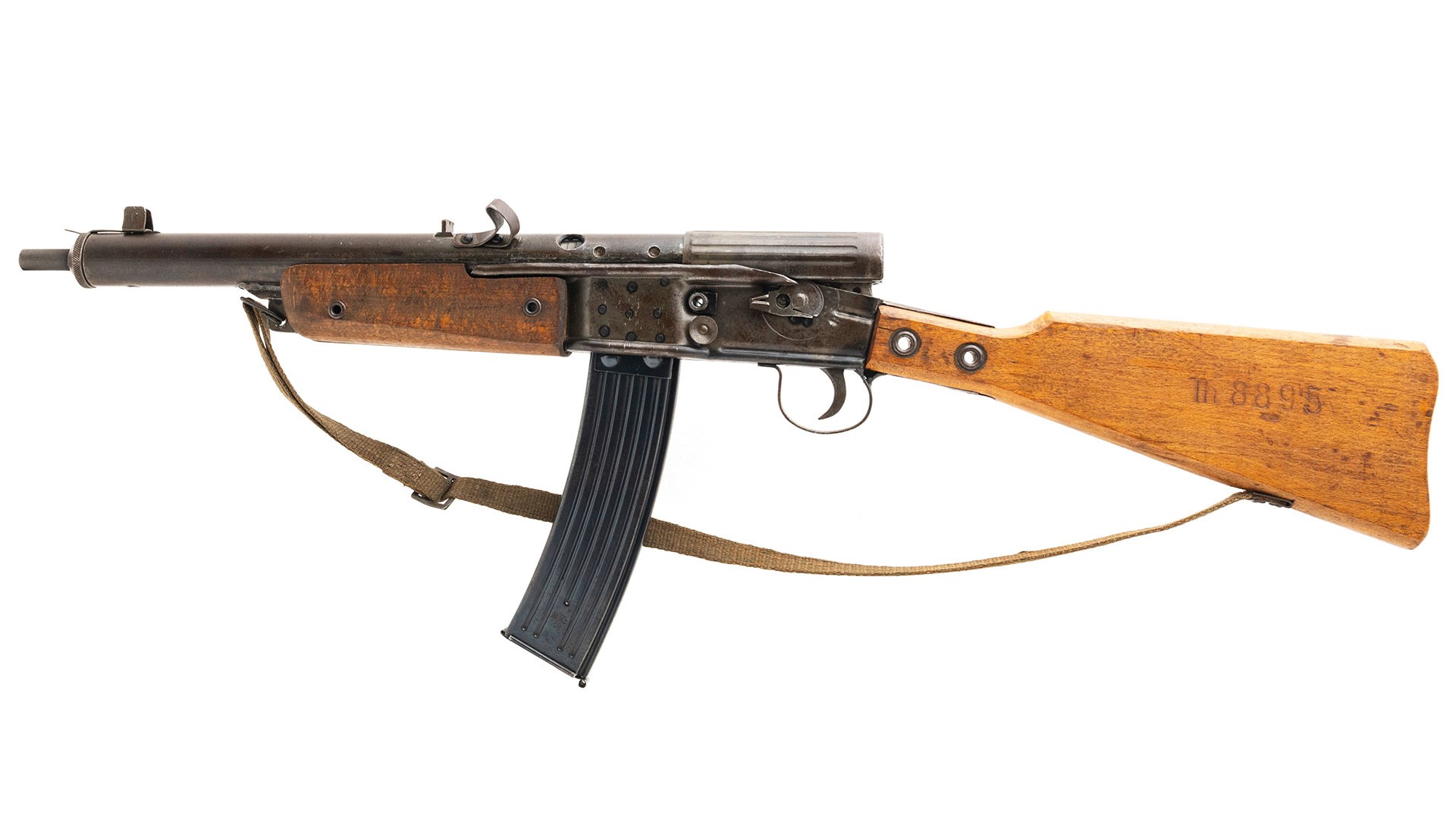 Left-side view of Gustloff-Werke VG1-5 Th 8895. Photograph by Jeff Hallinan of Collectors Firearms in Houston, Tex.
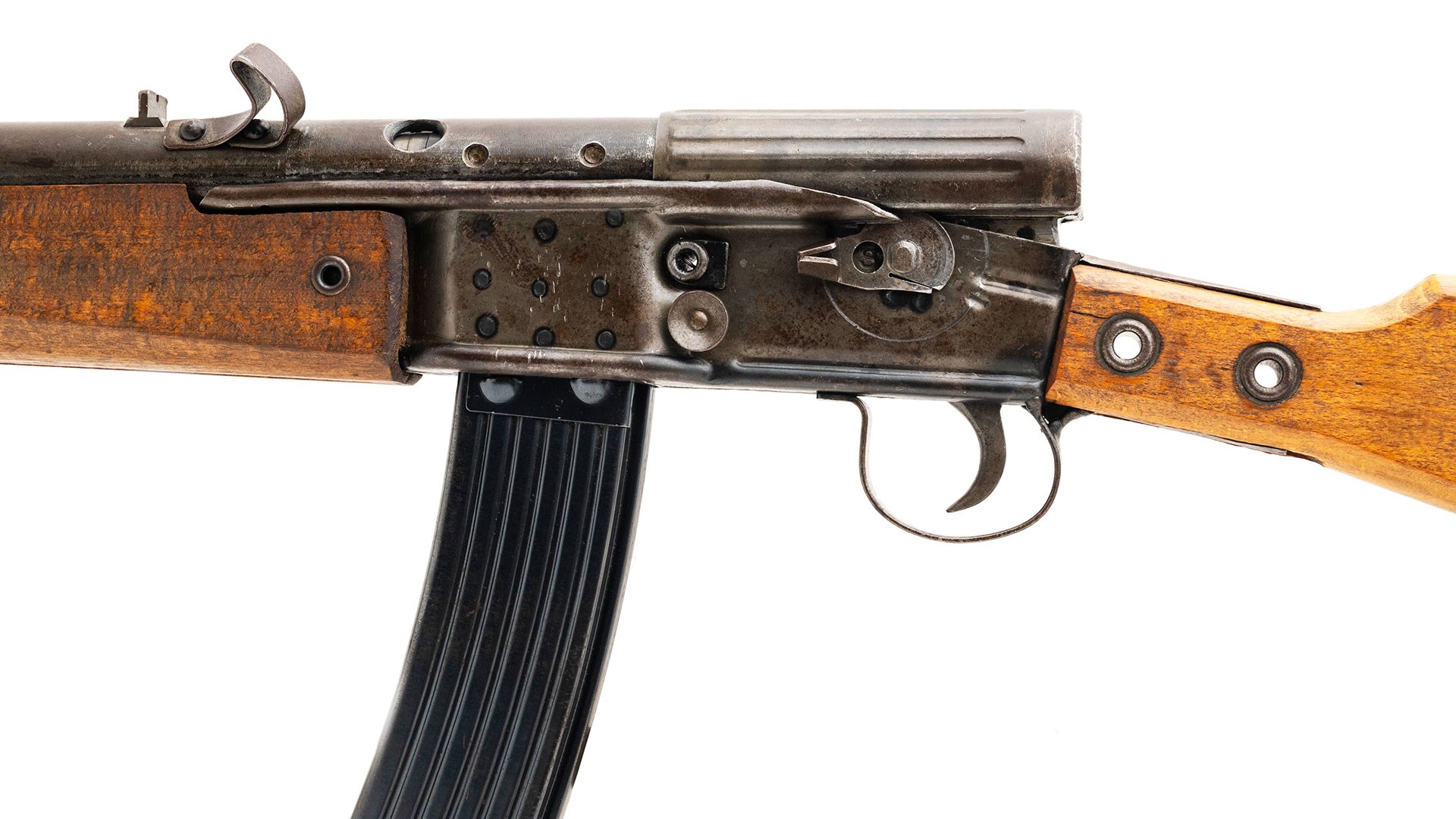 A closer left-side view of Gustloff-Werke VG1-5 Th 8895. Photograph by Jeff Hallinan of Collectors Firearms in Houston, Tex.
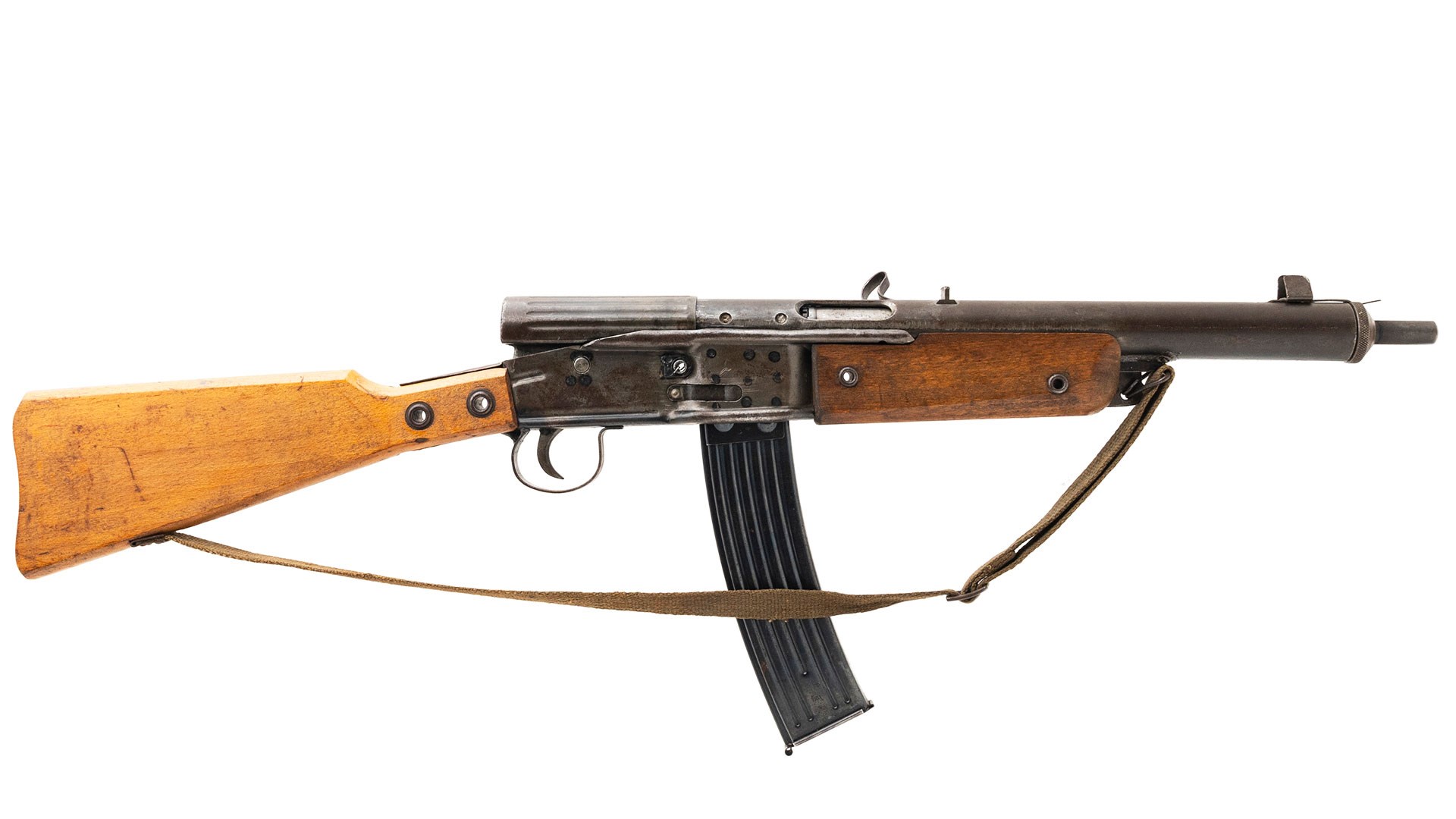 Right-side view of Gustloff-Werke VG1-5 Th 8895. Photograph by Jeff Hallinan of Collectors Firearms in Houston, Tex.
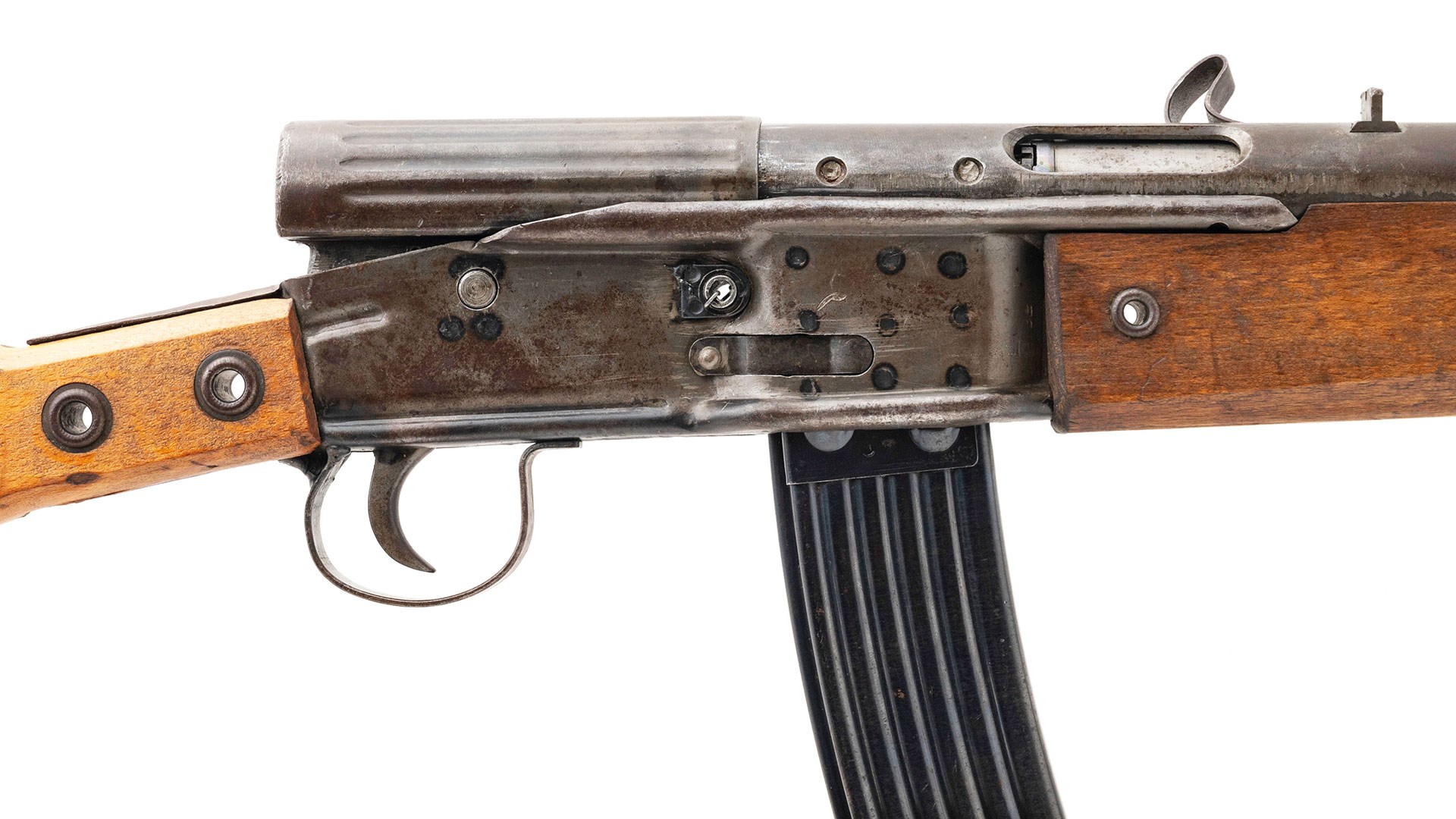 A closer right-side view of Gustloff-Werke VG1-5 Th 8895. Photograph by Jeff Hallinan of Collectors Firearms in Houston, Tex.
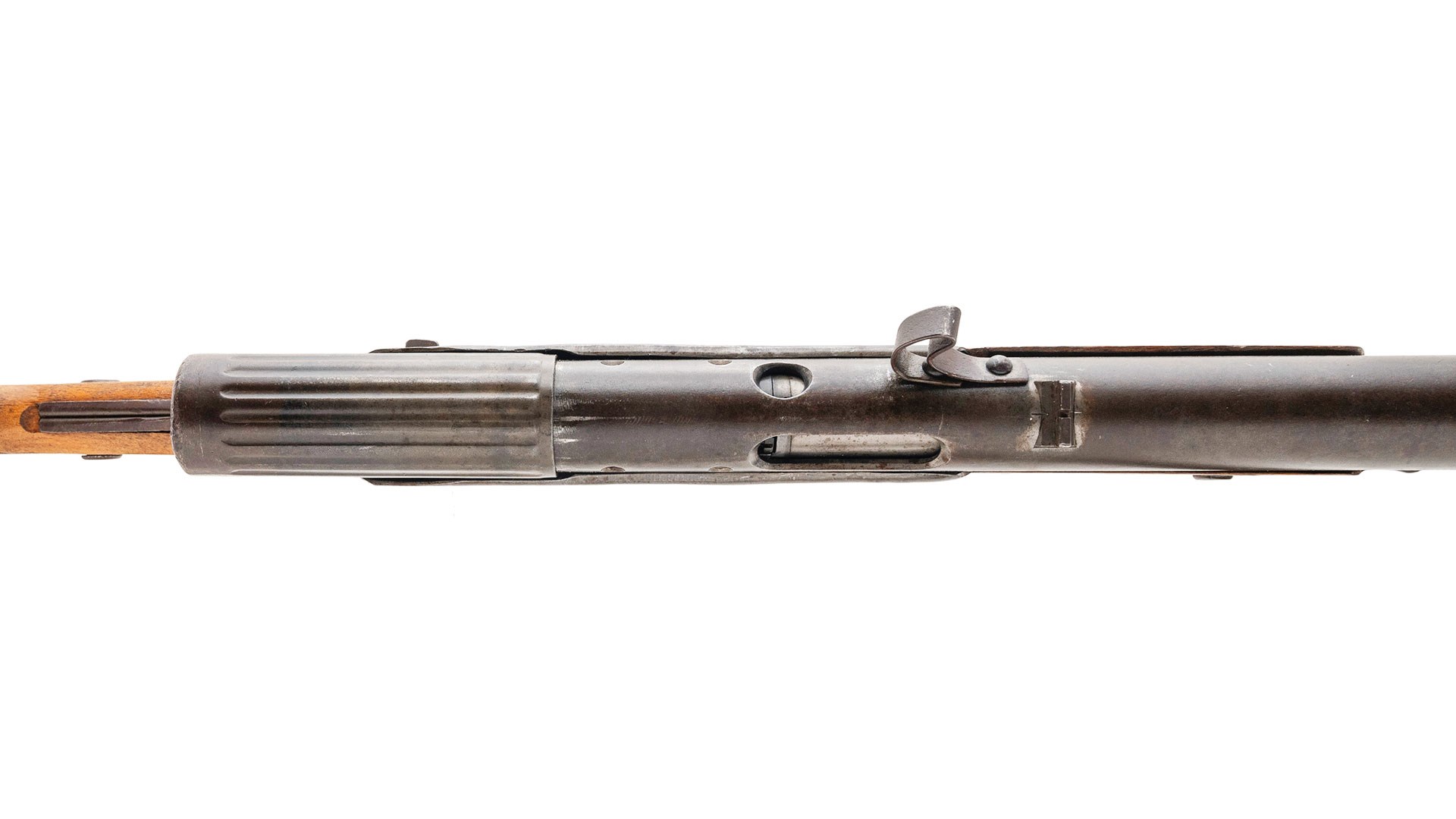 Top view of Gustloff-Werke VG1-5 Th 8895. Photograph by Jeff Hallinan of Collectors Firearms in Houston, Tex.
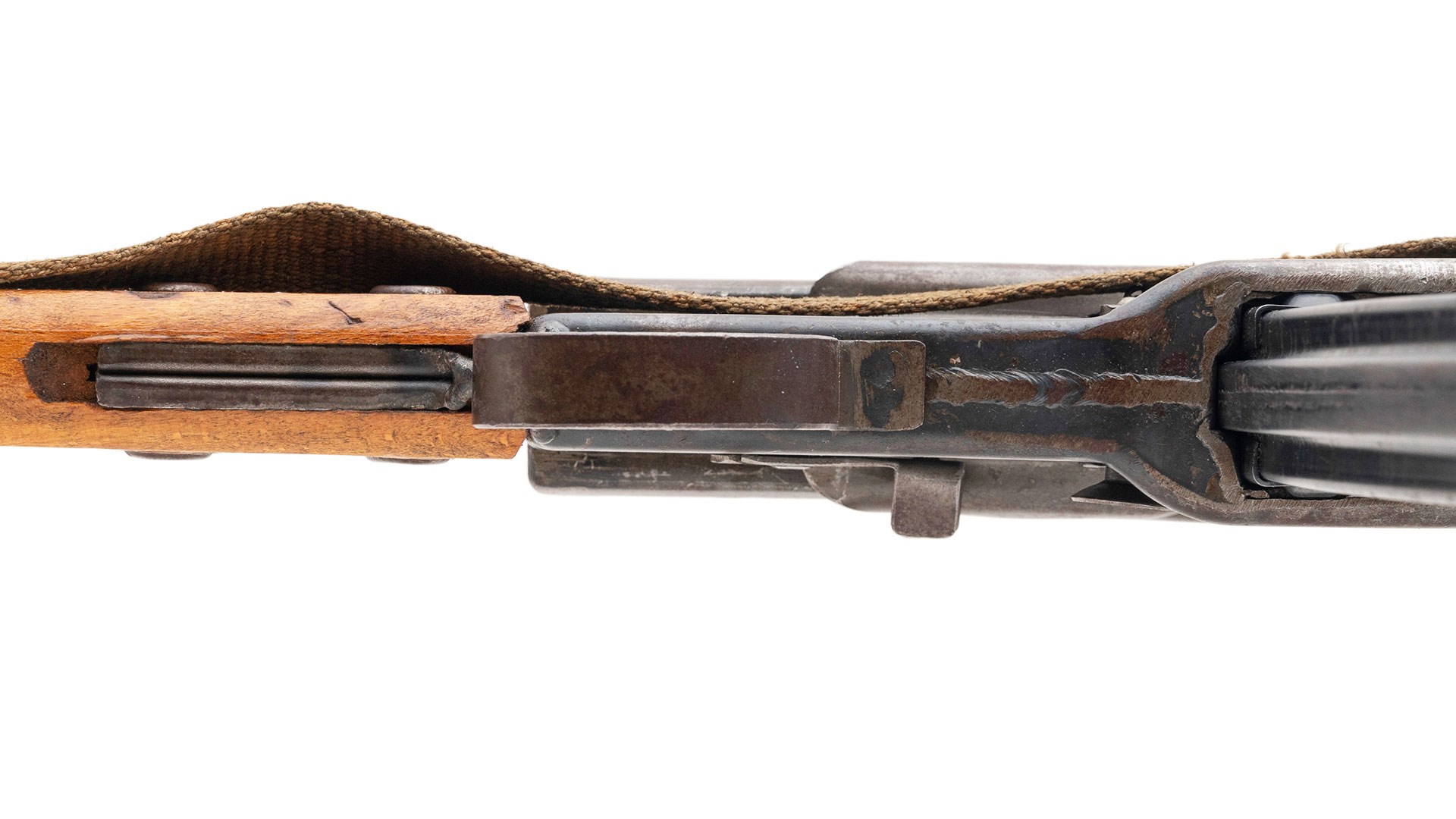 Bottom view of Gustloff-Werke VG1-5 Th 8895. Photograph by Jeff Hallinan of Collectors Firearms in Houston, Tex.
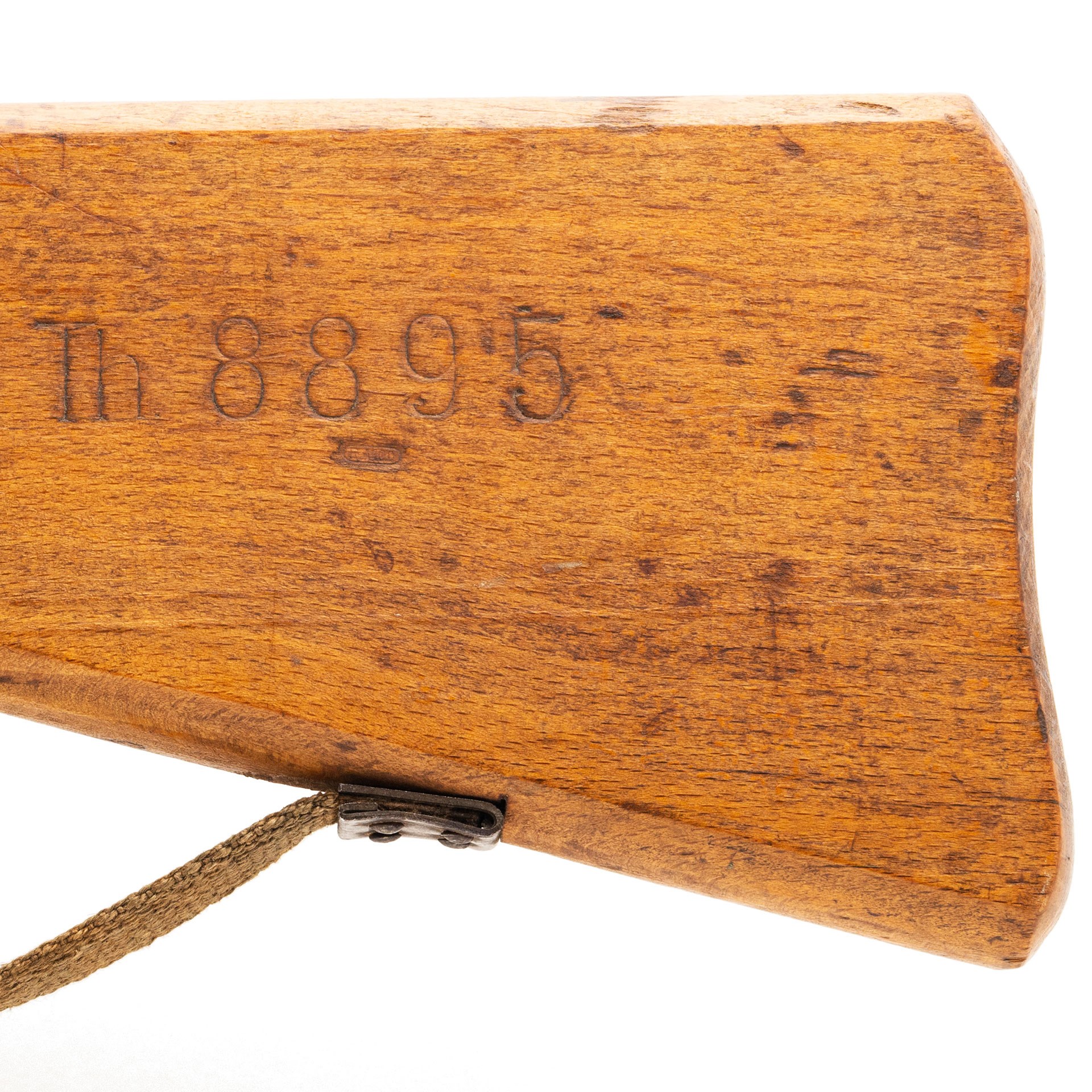 View
of the serial number markings of Gustloff-Werke VG1-5 Th 8895.
Photograph by Jeff Hallinan of Collectors Firearms in Houston, Tex.
View
of the serial number markings of Gustloff-Werke VG1-5 Th 8895.
Photograph by Jeff Hallinan of Collectors Firearms in Houston, Tex.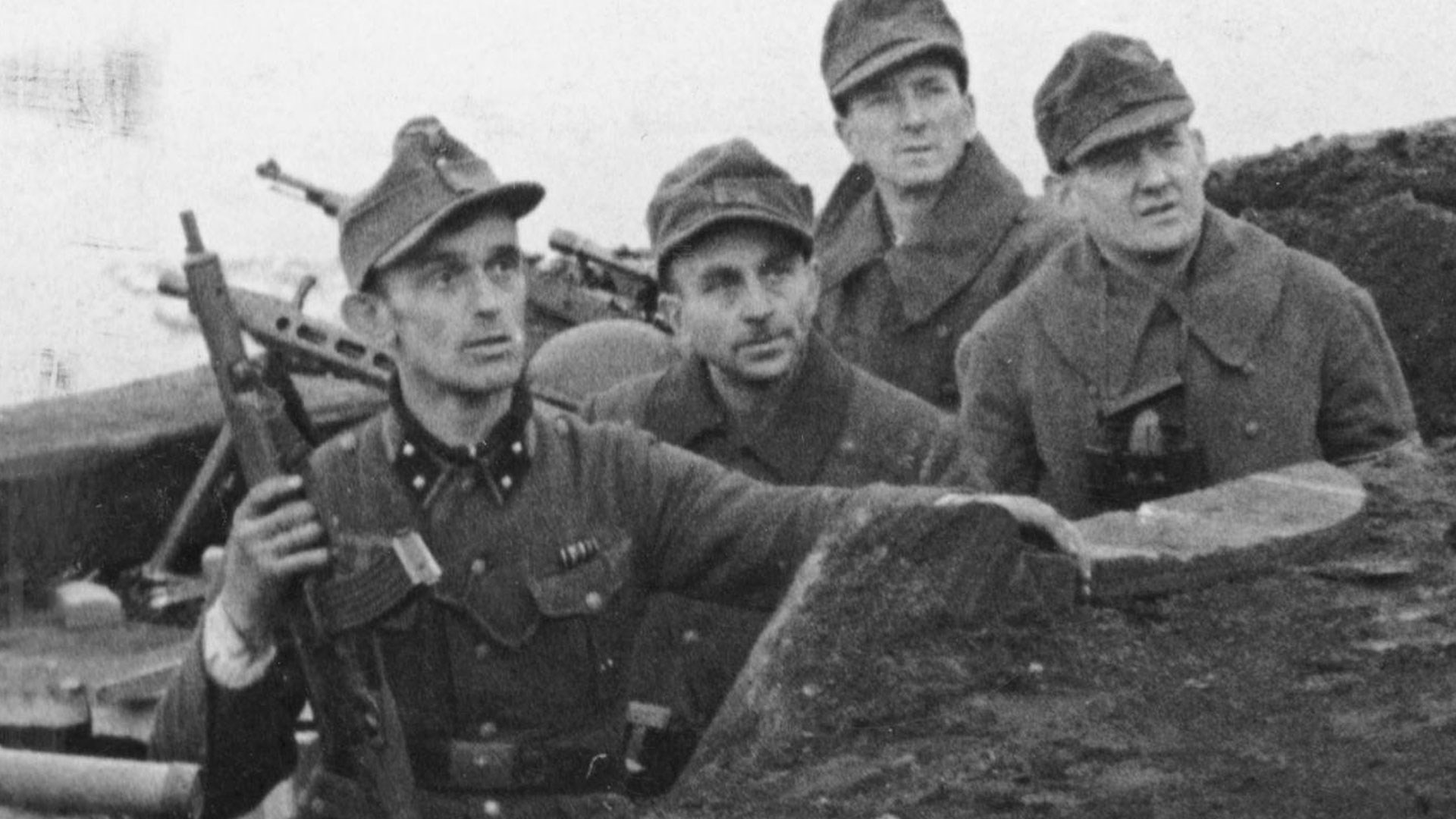 Volkssturm
soldiers in an emplacement along the Oder River on Feb. 12, 1945. The
man on the left is armed with a Gustloff Volkssturmgewehr. Bundesarchiv,
Bild 183-J28787 / CC-BY-SA.
Volkssturm
soldiers in an emplacement along the Oder River on Feb. 12, 1945. The
man on the left is armed with a Gustloff Volkssturmgewehr. Bundesarchiv,
Bild 183-J28787 / CC-BY-SA.