Webster

The Constitution was made to guard the people against the dangers of good intentions." --American Statesman Daniel Webster (1782-1852)


Showing posts with label aviation news. Show all posts

Saturday, September 12, 2026

GA ASI Reveals First Wildfire UAS Renderings


I shamelessly clipped this from "Aviation week"..   I'm wondering how much AI is having an effect on drone and UAS operation. 

Credit: GA-ASI

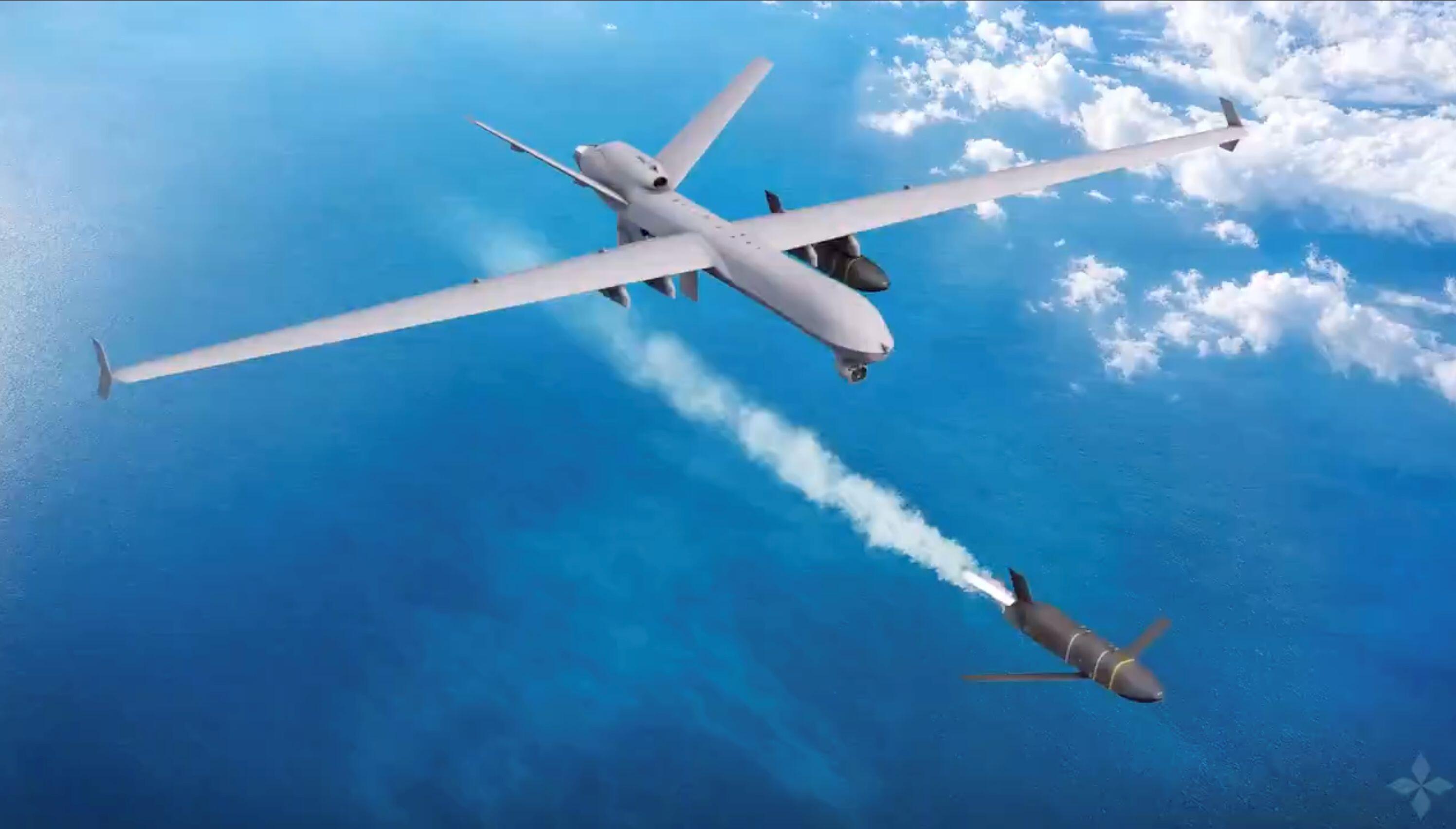
A Wildfire UAS Fires a one of potentially 4 AGM-158c's

General Atomics Aeronautical Systems Inc. (GA-ASI) released the first renderings of the proposed Wildfire uncrewed aircraft system (UAS) on Sept. 9, revealing a configuration that the company hopes will gain support from the U.S. Air Force amid a pending competition to replace the MQ-9A Reaper fleet.

Three renderings released on social media reveal a fuselage shape that for the first time lacks the familiar, upside-down-spoon profile of the satellite communications radome common to the company’s Predator A/B series.

But the renderings released on the eve of the Air, Space and Cyber convention next week also show off the full weapons capacity of the Wildfire design. One image shows the aircraft potentially equipped with up to two Lockheed Martin AGM-158C Long-Range Anti-Ship (LRASM) cruise missiles, each weighing nearly 2,800 lb. for a maximum payload weight of 5,600 lb.

Two other renderings present the aircraft with four Kongsberg Joint Strike Missiles, a 900-lb. anti-ship cruise missile.

Credit: GA-ASI
GA-ASI shows the Wildfire UAS launching anti-ship cruise missiles at a distant naval fleet.

A GA-ASI spokesman previously said that other features being considered for the Wildfire UAS are a 10,000-nm ferry range, and an ability to swarm 100 of the aircraft together at the same time. One rendering appears to show an attack by a swarm of Wildfire UAS on a fleet of naval ships.

The renderings have been released as the Air Force looks for an affordable Massed Modular Aircraft (MMA) to backfill a dwindling supply of Reapers, which have sustained dozens of losses in combat operations against Iran and Yemen since 2024. For the first time, the MMA program threatens GA-ASI’s grip on the Air Force’s hunter-killer mission that was largely defined by the Reaper over the last 20 years. A new group of startup companies, including Swarm Aero, are likely to propose new aircraft to meet the Air Force’s goal for a $10 million MMA that still offers a hefty payload and range.

Thursday, January 4, 2024

JAL crash at Haneda.


I pulled this off my 3rd party email from work, I am amazed that they got all the passengers and crew off the A350 with no fatalities.

JAL A350-900 Haneda incursion burning

JAL Airbus A350-900, Tokyo Haneda Jan. 2, 2024

Credit: STR/JIJI PRESS/AFP via Getty Images

A Japan Airlines (JAL) Airbus A350-900 and a Japanese Coast Guard De Havilland Canada Dash 8 have been completely destroyed in a ground collision at Tokyo’s Haneda airport shortly after the JAL aircraft’s touch-down.

All 367 passengers and 12 crew members on board the A350 managed to escape the burning aircraft, but five of the six on board the Coast Guard aircraft have died. JAL said 13 passengers required medical attention. The airline also said the total passenger count included eight infants.

The accident is the first ever A350 hull-loss and Japan Airlines’ first accident since 1985.

JAL stated “[Flight] JL516 was involved in a collision with a Japan Coast Guard aircraft during its landing at Haneda Airport, resulting in a fire on the runway,” adding, “our thoughts and prayers are with the deceased members of the Japan Coast Guard. We want to assure you that all passengers and crew on our flight were safely evacuated.”

The carrier said it will “provide our full cooperation in the investigation of this unfortunate event.”

Airbus said, “In line with International Civil Aviation Organization (ICAO) Annex 13 recommendations, Airbus will provide technical assistance to the Bureau d’EnquĂȘtes et d’Analyses (BEA) of France and to the Japan Transport Safety Board (JTSB) in charge of the investigation. For this purpose, Airbus is presently dispatching a team of specialists to assist the authorities.”

The aircraft manufacturer stated that “the exact circumstances of the event are still unknown.”

The A350 was operating flight JL516 from Sapporo with 367 passengers and 12 crew members and was landing at Haneda’s runway 34R at 5:47 p.m. local time, about 12 min. later than scheduled.

“The aircraft did not experience any issues or irregularities during its departure from New Chitose Airport or throughout the flight,” JAL said in a second statement. The A350’s pilots “acknowledged and repeated the landing permission from air traffic control, and then proceeded with the approach and landing procedures,” the airline added.

According to Flightradar24 data, the aircraft was crossing the runway threshold at a normal approach speed of 122 kt. and touched the ground shortly thereafter. Airport video footage shows how the aircraft was travelling down the initial part of the runway, when suddenly it appeared to hit an obstacle with large flames erupting. With its nose gear collapsed, the aircraft continued sliding down the runway and came to rest close to the end and to the right of it, not far from the airport perimeter fence on the edge of Tokyo Bay. A picture taken by one passenger shortly after having evacuated the aircraft, shows substantial impact damage to the nose of the aircraft and the nose gear missing.

The Coast Guard aircraft had reportedly loaded aid for support victims of Monday’s earthquake on the Noto Peninsula and was understood to be preparing to take off for a flight to Niigata Air Base.

Pictures of the A350 also show that escape slides had been deployed at the two front doors and the left rear door. Passengers appeared to not use the right rear door. While emergency services attempted to extinguish the fire, the aircraft ultimately burnt down completely.

“The aircraft’s announcement system malfunctioned during the evacuation, so cabin crew members conducted instructions using a megaphone and their voices,” JAL said. “Cabin crew members determined safe exits for evacuation, and all passengers and crew members evacuated through three emergency exits.”

According to the Aviation Week Network Fleet Discovery database, the aircraft registered JA13XJ (MSN 538) was delivered to JAL on Nov. 10, 2021. It had since accumulated 4,421 flight hrs. in 3,220 cycles. The aircraft was equipped in the high-density 367-seat configuration JAL has installed for domestic and short-haul flights. These include 12 seats in first, 94 in business and 263 in economy. The Coast Guard aircraft was a Dash 8-315Q registered JA722A. It has been delivered on Feb. 26, 2008. The aircraft had 7,573 hrs. and 2,700 cycles.

Haneda, one of Tokyo’s two international airports, stopped all take-offs or landings temporarily. According to Flightradar24, 110 flights scheduled to land at Haneda on the evening of Jan. 2 were either canceled or diverted to other airports including Tokyo-Narita.

Composite Structure Flammability

JL516 is the first A350 completely destroyed in an accident. The investigation could provide valuable insight into the flammability of large composite aircraft structures based on in-service experience that have so far been unavailable. In July 2013, an Ethiopian Airlines Boeing 787 suffered substantial, but much smaller, fire damage caused by a thermal runaway of the emergency locator transmitter (ELT) battery when on the ground at London Heathrow.

Flammability experts know composite-skinned airframes burn “inherently differently” than their aluminum counterparts, a 2012 U.S. Air Force Research Laboratory study on the subject noted. Aircraft composite material is a beneficial insulator that can help resist heat from nearby sources, such as an external fire, the study said. But those same properties make it difficult to cool down once it has heated up and present challenges for extinguishing parts of a fire that are hidden from firefighters.

Informal Boeing guidance on fighting composite aircraft fires issued after the 787 was introduced does not recommend “any major changes” from standard protocol.

“Extensive testing has been conducted in regards to combustibility and toxicity related to the composite structure,” the document, last updated in 2022, said. “This design not only adds to the strength of the product, but also makes it a good barrier to fire and heat. The structure does not aid in the spread of fire and acts as a barrier creating greater difficulty for an exterior fire to penetrate an intact fuselage. From a toxicity perspective, the composite structure during fire testing poses no greater hazard than an aluminum fuselage aircraft. Also, note that the burn through time on the composite structure is significantly longer than with the aluminum fuselage which may inherently provide greater safety to both the rescue fire responders and passengers in some scenarios.”

The accident will add to learnings from recent passenger evacuation and broader cabin safety improvement efforts. While the exact sequence of the evacuation will form part of the accident investigation, it is clear that all 389 people on board a densely configured widebody managed to escape the aircraft with only three of the four main slides being used.

JAL’s last hull-loss occurred on Aug 12, 1985, when a Boeing 747SR crashed into a mountain en route from Haneda to Osaka. The aircraft’s hydraulic systems ruptured after a violent failure of the rear pressure bulkhead. In one of the worst accidents in commercial aviation history, all 520 people on board died.

     This came in the next day, 

The Coast Guard Plane entered the Runway despite being told to "hold" by the tower.

Wreckage of Japan Coast Guard Dash 8 at Tokyo Haneda Airport, Jan. 3, 2024

Credit: Richard A. Brooks/AFP via Getty Images

WASHINGTON and SINGAPORE—The Japan Coast Guard De Havilland Canada Dash 8 struck by an arriving Japan Airlines (JAL) Airbus A350 at Tokyo International Airport Jan. 3 was on the runway despite air traffic control (ATC) instructions to hold short on an intersecting taxiway—directions that one of the Dash 8 pilots read back correctly, a transcript released by Japan’s Ministry of Land, Infrastructure, Transport and Tourism (MLIT) shows.

“Tower, JA722A C,” someone from the Japan Coast Guard (JCG) Dash 8-300 radioed to Tokyo Haneda (HND) tower ATC, indicating the aircraft is checking in from Taxiway C with its tail number as a call sign, according to the transcript.

“JA722A, Tokyo tower good evening,” a controller responded. “Number one, taxi to holding point C5.”

The “number one” suggests the aircraft is next in line to depart. The rest is clear: Move to the marked stopping point on taxiway C5, which connects to HND’s Runway 34 Right (34R).

“Taxi to holding point C5 JA722A, number one, thank you,” someone on the JCG Dash 8 said.

But instead of stopping at the hold-short line on C5, the Dash 8 taxied onto the runway.

Ten seconds before the exchange began, ATC cleared JAL Flight 516 (JAL516), the inbound A350-900, to land on 34R.

Surveillance video shows the Dash 8 moved onto 34R and stopped—something a pilot would do if executing a “line up and wait” ATC command that gives an aircraft permission to enter the runway but not depart.

Nearly 50 sec. after the Dash 8 stopped, the A350, which touched down seconds before closer to the runway end, struck the national guard aircraft. Five of the six Dash 8 occupants died, while all 379 onboard JAL516 evacuated safely once the widebody came to rest.

According to a transcript excerpt released by MLIT, JAL516 contacted Tokyo Tower at 5:43:02 p.m. local time, and was instructed by tower controller to continue its approach to runway 34R. JAL516, first in line to land, read back ATC’s instructions.

JAL516 was then cleared to land at 5:44:56 p.m. and a pilot read back the instructions.

At 5:45:11 p.m., JA722A called into tower frequency notifying of its position on taxiway C. ATC gave the instructions to proceed to the C5 hold line, which JA722A confirmed eight seconds later.

Communications from several other aircraft are detailed in the transcript excerpt, including departing Delta Air Lines and JAL flights told to hold short at C1 as well as another arriving JAL flight.

The transcript ends before the collision. A JAL statement puts JAL516’s arrival time at 5:47 p.m.

The exchange suggests how ATC instructions were given and followed will be one of the key focus areas for investigators as they work to piece together the accident’s chain of events.

Also of interest will be the status and condition of airfield lighting and safety aids. A Notice to Air Missions (NOTAM) issued Dec. 27, 2023, and effective through late February lists several airfield aids at HND as out of service. Among them: lights that illuminate stop bars along the connections between Taxiway C to the accident runway, including C5. Runway 34L centerline lights were also listed as inoperative. It is not clear if the C5 stop bar lights or centerline lights were working at the time of the accident.

Investigators will also look closely at how an aircraft could be on an active HND runway for nearly 1 min. without being detected, even in the dark. An ICAO document shows HND is one of many airports that uses surface movement radar—a long-used method of supplementing the visual view of the airfield controllers have. The system’s performance and controllers’ familiarity with it are other likely topics investigators will probe.

The Japan Safety Transport Board (JTSB) is leading the accident investigation with assistance from several organizations, including Airbus and investigators from France’s Bureau of Enquiry and Analysis for Civil Aviation Safety (BEA). JTSB has recovered the Dash 8 cockpit voice recorder.

The accident caused the cancellation of 137 domestic and four international flights from HND on Jan. 3, MLIT said.
Thursday, October 26, 2023

CEO AkBar Al Baker of Qater Airlines is out. The end of an era.

 *note* I had to change the comment posting requirements due to a spammer.  I hope to keep it there for only a short time.  I also hope it leaves.

I had "Blogged" Qatar Airlines and their "Feuding" with Airbus about their composite coating flaking.  Apparently, he is a casualty of the feuding.

Akbar Al Baker

Qatar Airways CEO Akbar Al Baker is leaving his role after 27 years in post.

Credit: Nikku/Xinhua/Alamy Live News

On February 1, 2023, it was finally over. Qatar Airways and Airbus announced an “amicable” settlement of their unprecedented legal dispute. The airline had sued the manufacturer over surface degradation issues on many of the carrier’s Airbus A350s. 

Similar issues had been seen by other airlines and were dealt with quietly. Not in this case: Qatar Airways CEO Akbar Al Baker, known for rejecting aircraft deliveries over tiny cabin imperfections, would not have it. Airbus was going to fix this or pay dearly. He stopped taking more A350s and brought the case in front of a London court while the Qatari Civil Aviation Authority grounded the affected aircraft. More escalation? Impossible.

As it turned out, the dispute was the last public drama of an exciting career spanning 27 years as CEO at the airline. Eight months later, the airline announced “the appointment of a new group chief executive," frankly, someone even insiders did not know: Badr Mohammed Al Meer, so far chief operating officer of Doha’s Hamad International Airport. In other words: Akbar will be gone very soon. The change will become effective on Nov. 5, though industry sources say the leadership transition will continue until the beginning of next year.

Al Baker, 62, is the longest-lasting current CEO of a major airline. It was also him who made Qatar Airways into a major airline in the first place, having taken it over with only a few aircraft in its fleet. Al Baker turned Qatar into a second Emirates—similar, but different. The airline is operating a large hub connecting long-haul services to long-haul. 

Unlike Emirates, it also has a narrowbody fleet and is a member of one of the global alliances, Oneworld, and has stakes in several carriers abroad—among them Cathay Pacific, China Southern Airlines, International Airlines Group and LATAM Airlines.

Qatar Airways' status of one of the most important buyers of aircraft, connected with its shareholdings, made Al Baker one of the most powerful figures in the industry. His departure likely marks the beginning of fundamental change for the airline.

According to industry sources, Al Baker did not leave voluntarily at this time. People who know him well say he would have liked to continue for longer and would have been very interested in becoming chairman of the airline. But his superiors, mainly Chairman Saad Sherida Al Kaabi—a powerful figure who is also Qatar’s energy minister—thought otherwise.

To this day, Al Baker micromanaged essentially everything of relevance at Qatar Airways. When his airline hosted the IATA annual general assembly in 2014, he would personally drive CEOs of other airlines around in a golf cart through the airport terminal, making sure they arrived at their gates comfortably in the middle of the night. A few days before, he had broken his arm in a car accident. But he simply would not delegate anything.

Corporate governance was simple: Al Baker would decide everything. This was not what Al Kaabi wanted for the future, the sources said. The chairman wanted to establish a new governance structure that was not 100%-focused on Al Baker, with stronger checks and balances. No middle ground could be found.

The A350 case is a good example of where the airline’s weaknesses lie. In Toulouse, key Airbus executives do not to this day understand how things went so badly wrong with Al Baker after the first paint deficiencies were discovered. In Doha, members of Al Baker’s management team tried desperately to gently steer him toward compromise. After all, an airline the size of Qatar Airways cannot operate without a relationship with one of the two big manufacturers. The higher-ups in Doha noticed, too, and it is said that the settlement was the result of talks between the state of Qatar and France.

It is sadly ironic that the conflict in which Al Baker wanted to demonstrate his powers may have contributed to his departure.

Compromise was never his thing, as many others in the industry including Boeing and numerous airline colleagues can recollect. And it did not get better: When Al Baker hosted another IATA meeting in 2022, he stated in some of his speeches that many airlines let their customers down during the pandemic—not so Qatar Airways, of course. Many colleagues were outraged that he misused the stage he was given by the association in such a way. Some of his peers simply stood up and left. Emirates Airline President Tim Clark stopped talking with him some time ago.

Al Baker was often brutally honest about what he really thought. When asked at an IATA event whether a woman could do his job, he said no. A woman could not do his job, he said, because his job was so difficult. That did not go down well, to put it mildly.

As much as people were offended and afraid, many also admired his achievements.

Following the departure of such a powerful figure, Qatar Airways will have to reinvent itself. A new corporate governance has to be established—along with a management team that is actually empowered, with Al Meer at the top. His experience as an airport manager will help, but the key will be the transformation of the airline into a more normal company.

What is unlikely to change is Qatar Airways' positioning as a major player in the industry—this mandate given by its government has not wavered.

Saturday, October 21, 2023

Low Cost Carriers are struggling in todays market.

 I snagged this from a 3rd party report I get in my email at work, I have been very busy and unable to post like I want, I hope things will slow down so I can blog, and sleep, LOL..well sleep first.


United and Spirit Newark

Credit: Gary Hershorn/Getty Images

Although United Airlines is battling near-term cost headwinds, the carrier remains steadfast in its belief that a significant shift has occurred in the U.S. industry resulting in diminished viability of the ULCC model.  

Chicago-based United has been outspoken on the trend for quite some time, and maintains that cost convergence, and its broad range of product offerings will only strengthen its competitive advantage going forward.

With labor costs at all U.S. airlines rising rapidly, United Chief Commercial Officer Andrew Nocella during an Oct. 18 earnings discussion described the LCC tendency to operate with larger gauge aircraft as a constraint for those carriers in being able to drive costs materially lower. ULCCs Frontier and Spirit have already forecasted negative pre-tax and operating margins, respectively, for the 2023 third quarter (Q3).

Additionally, “market saturation of the low-cost business model in certain regions is creating very low marginal RASM [revenue per available seat mile] for some of our competitors, in fact, many of our competitors have marginal revenues that are negative,” Nocella explained. There are only so many seats that Las Vegas, Florida, or Cancun can support in such a short period of time, he said.

Those operators use larger gauge equipment to gain lower costs without the benefit of connectivity garnered by the hub and spoke business model, Nocella said. “Expansion of the low-cost model into smaller and medium sized markets with these very large jets lacking connectivity just creates low marginal RASM.”

“The other factor is the percentage of ASMs [available seat miles] that these airlines have in new markets,” Nocella said, explaining that very fast growth rates create a higher percentage of new capacity, which in the best of times is below average. United is deploying less than 1% of its capacity into new markets during the fourth quarter, he said.

Capacity growth as a strategy to maintain low costs without revenue accretive markets can cause “the entire business model [to] break,” Nocella concluded. “And that is what we think is happening right now.”

United CEO Scott Kirby told investors his airline and another carrier are expected to account for 98% of the total U.S. industry revenue growth in Q3 and more than 90% of total pre-tax profitability.

The company’s business model can support dramatically higher gauge and once that occurs the airline spills less traffic to competitors, Nocella explained. Previously, United has said that its average seats per departure in 2019 averaged 104, and the company expects that number to jump more than 40% to over 145 by 2027.

United also believes its complexity and range of product offerings is far from a disadvantage, rather “there’s a structural advantage that generates more than the costs it creates by the complexity and just cannot be replicated.”

Its product offering ranges from Basic Economy to First Class; during Q3 revenue for its Basic Economy offering grew 50% year-over-year. Kirby explained one thing that has changed for United over the last year is “we finally started to get the gauge right; we couldn’t make this work when we were flying 650 regional jets around the country.” Basic Economy is a better product for United, he explained. “We’ve figured out how to make it work, but we now have the gauge to be able to sell the product.”

The airline’s total revenue in Q3 increased 12.5% year-over-year to $14.5 billion, and the company’s operating expenses grew 11.6% to $12.7 billion. United’s Q3 net income grew from $942 million last year to $1.1 billion, and its pre-tax margin was 10.8%.

But United is facing cost challenges in the fourth quarter, driven by numerous issues. It recently suspended flights to Tel Aviv following Hamas’ attack on Israel. If the airline resumes service to Tel Aviv after October, its unit costs excluding fuel (CASM-ex) will grow 3.5% year-over-year; but if flights remain suspended until year-end, CASM-ex will grow 5%. Service to Tel Aviv represents around 2% of United’s capacity.

United’s CFO Mike Leskinen explained the carrier’s capacity in the fourth quarter will be roughly three points lower than it planned three months ago. Two points is attributed to Captain upgrade issues and the remaining one point is driven by the suspension of service to Tel Aviv.

“The industry is facing other issues, but that’s what happened here at United, and we expect to mitigate that in 2024 and beyond,” Leskinen said.

United’s CFO said another issue the carrier is facing is maintenance costs, explaining he was not certain how persistent the challenge will be. “Maintenance costs throughout the years have been higher than we expected, and for United the big piece has been an increased need for spare parts,” Leskinen said, “particularly on engines as the work scope has been larger than we expected.”

Some of the spare parts challenges are stemming from supply chain issues, “and it’s difficult to see where that ends,” Leskinen said. United is not giving cost guidance for 2024 at the moment, citing inflationary, labor and maintenance cost pressures persistent in the industry.

“What I will commit to today, is that United will be industry leading in how we manage our costs,” Leskinen said. “Cost convergence is a structural trend; it is what is causing the lower cost carriers ... to struggle.”

Tuesday, December 20, 2022

Inside the U.S Army's Newest Surveillance Plane

 I saw this article and it caught my attention, when I was in the U.S. Army, one of the platforms used by soldiers in my unit was the "RC-12 Guardrail V System", so this is basically a replacement for that system.  The Guardrail system has been around for a long time and I was wondering if they were going to keep upgrading the system or go move toward a different platform.


From a distance, the all-white business jet parked neatly in a hangar underneath a giant American flag looks a lot like the other sleek, luxurious private planes arriving and departing from this Virginia airport. But inside, this plane is far more working class.

The cabin, full of server racks, looks more like an IT closet than an executive aircraft. The seats are cloth and two computer consoles are connected to a dozen or so antennas protruding from the plane’s belly.

To the U.S. Army, this plane—or something like it—is a ticket to the future of warfare, built to monitor the complex communications of an adversary nation-state from standoff distance, rather than the simpler chatter of insurgents right below.

Called ARTEMIS, the plane uses its antennas and computers to intercept and decipher enemy communications. The aircraft itself is made by Bombardier, but the specialized modifications are made by Virginia-based defense and technology firm Leidos. 

“These [planes] can see very far when operating at 40,000 feet,” Mike Chagnon, deputy group president of Leidos Defense Group, said in an interview.

It’s the second Challenger 650 that Leidos has modified like this for the Army as part of a technology demonstration. L3Harris Technologies are also developing similar business jet intelligence planes, which it calls ARES.


The Leidos and L3Harris planes are helping the Army figure out its long-term plans for new, high-flying intelligence planes, an effort called High Accuracy Detection and Exploitation System or HADES. Those planes will replace the turboprops heavily used to survey the battlefields over Iraq and Afghanistan for insurgents and roadside bombs.

“They want a multi-layer sensing capabilities from space to mud,” Chagnon said. “This is the airborne layer.”

Defense One was invited to see the Leidos aircraft shortly before it was put under the Army’s control and agreed not to share the location of the plane's home base. The extra aircraft will allow the Army to deploy to different locations or participate in more exercises and experiments, Chagnon said.

In November 2021, the first ARTEMIS aircraft was pulled from an Army exercise in the United States and deployed to Europe to be part of the NATO effort to monitor Russian forces near the Ukraine border. Over 10 days, the plane flew from Arizona to Virginia where it received some upgrades before flying to Europe, Chagnon said.

“It really hasn’t been home since,” he said.

As of Dec. 1, the first plane has flown more than 370 missions, racking up more than 3,200 flight hours for combatant commanders around the world, Leidos CEO Roger Krone said at the small turnover ceremony in the hangar. 

“You're flying basically in...a mow-the-lawn-type pattern for 10 hours [and] you're collecting massive amounts of data,” Chagnon said.

The deployed aircraft flies an average of six days per week for nine to 10 hours per day, Chagnon said. The planes are unarmed and don’t fly in so-called “contested” airspace that’s defended by surface-to-air missiles and fighter jets.

“We're not going into the contested environment,” he said. “We're looking inside a contested environment from an altitude and a standoff, whereas our counterinsurgency aircraft were flying in, just looking down, in an uncontested environment.”

As much as the aircraft represents a new generation of conflict, it could also represent a new way of buying weapons.

The planes are owned, operated, and maintained by Leidos employees, not the Army. But, through satellites, Army officials stateside are able to connect to the plane’s sensors remotely, Chagnon said. The Army essentially pays Leidos a by-the-hour fee.

“It benefits the government and it benefits the country,” Chagnon said. “We're responsible for keeping the aircraft in the air. And they [the Army] no longer have to have that long logistics tail, which is sometimes the most expensive part of a government program. 

“They can turn the spigot off on these anytime they want,” he continued. “So, we're incentivized to continue to innovate on these [planes and] make them more useful, and…find as many efficiencies as we can to keep the mission-capability rate high. The first ARTEMIS plane took Leidos about 18 months, from concept to delivery, and the second is on track to be delivered ahead of schedule in just five months from contract signing, Krone said.

Krone, several times, noted that the company and the Army had put “skin in the game” to be able to buy and convert the business jets into militarized intelligence planes. 

“This delivery is the culmination of a lot of really hard work [and] a lot of sharing of the risk,” he said.

The technology is open, so different types of sensors made by different companies can be installed. Some of the sensors are government-owned, others purchased by Leidos.

Leidos has also purchased two larger Bombardier Global 6500 aircraft that it intends to convert into intelligence planes for another Army spy-jet competition called ATHENA-R. It’s competing against an L3Harris and MAG Aerospace team and Sierra Nevada. Those companies are also offering modified Global 6500 aircraft. ATHENA-R aircraft will also be owned and operated by contractors and will be a bridge to the HADES program.

For Leidos, a government contractor better known for its IT and government services, ARTEMIS represents efforts to diversify its portfolio. In 2020, the company purchased Alabama-based Dynetics, a company that specializes in directed energy, space, drone, and hypersonic technology.

“We are a people company,” Krone said. “This is very unusual” that “there's something I can point to.”

Sunday, October 9, 2022

Opinion: Farewell To Fast Air Travel Growth

 I clipped this from  my work email, What he commented on especially with the slowing or negative Chinese population growth of the Chinese is something to make note of and a lot of people are glossing over that, especially the CCP.  I thought  had blogged about the problems at some of the European airports especially AMS(Amsterdam) choking down passenger travel during the farmer protest earlier this year in the name of climate change and this is still an ongoing problem, because it causes ripples through the EU because it forces passengers to go to other airports then ride the rail to get to whatever they are going.  I discovered I never published that story, it was buried in my emails (Bad MrG, Bad, Bad, Bad) well anyway I saw this and this ties in with the other disruptions that our "betters" are trying to start foisting in on us in their attempts to "make us mind" and know our place.


Chinese airliner

Travel on Chinese airlines was slowing before the COVID-19 pandemic as its population declines.

Credit: joepriesaviation.net

A decade ago, my colleague Jonas Murby and I gave a speech with a contrarian argument that air travel (as measured by revenue passenger kilometers) could not grow at a 4-5% rate forever and eventually would slow. We argued that the imperative for emissions reduction, the growth of high-speed rail, infrastructure constraints, and air travel maturation in key markets would all contribute to the slowdown. The audience’s reaction to the speech was hardly enthusiastic.

While aviation focused on recovery from the COVID-19 pandemic and malfunctioning supply chains over the last several years, something significant occurred in industry’s long-term growth forecasts: they slowed considerably. Boeing’s 2019-41 forecast calls for 3.8% growth, while Airbus’ posits 3.6% growth. My company’s own forecast is also 3.6%. Why did this happen, and what does it mean for stakeholders?

Market maturity is an important factor. A good rule of thumb is that air travel grows at twice the rate of GDP in emerging economies and is closer to GDP growth in advanced countries. AeroDynamic Advisory forecasts 2.5% growth in North America, 2.3% in Europe, and just 1.5% in Northeast Asia for the 2019-39 time frame.

What has changed in recent years is the realization that the Chinese market is slowing. Air travel in China was slowing before the crisis. The country’s population is peaking and entering a period of long-term decline. A recent estimate by Wei Chen, a Chinese demographer, forecasts that it could lose 100 million people by 2050. The outlook for the economy also faces challenges as President Xi Jinping is making private companies subservient to the needs of the state and government-owned enterprises and vilifying private wealth. Economic decoupling from the West will not help either. Economists remind us that GDP growth is a function of two factors: population growth and productivity growth; in China, both are trending in the wrong direction. AeroDynamic’s 20-year growth forecast is 4.4%—a far cry from the double-digit growth of past years.

Another change is the effect of aviation’s zero-emissions imperative. Europe recently imposed mandates for sustainable aviation fuel (SAF) usage. Beginning in 2025, operators will be obligated to use 2% SAF, increasing to 5% by 2030, 32% by 2040, and 63% by 2050. The Biden administration is also pursuing a dramatic increase. With cost of SAF at least three times higher than kerosene, the price of aviation fuel—and air travel—will therefore increase in some regions. Airbus took regional variations in anticipated fuel and CO2 prices into account for the first time in its most recent forecast. Intra-Western Europe travel—the epicenter of sustainable aviation—will grow at a sluggish 1.6% rate.


Demand for New Aircraft

Image
 

Another type of mandate is emerging—airport capacity limits. The Dutch government recently announced annual movement limits at Amsterdam Schiphol Airport of 440,000 movements per year—well below the 500,000 movements each in 2018 and 2019. Aviation emissions reduction is a prime motivator for the new policy. While this type of draconian measure has yet to be implemented by other major hubs, it is a harbinger of what could unfold in Europe and parts of North America. There are also growing limits for short-haul European flights. Norway established a quixotic goal that all domestic flights must be electrified by 2040. In France, domestic flights that compete with high-speed rail are forbidden. As a result, European flights of less than 400 km (250 mi.) will likely decrease in the future.

These negative trends do not mean jetliner production will drop off a cliff anytime soon. On the contrary, the focus on emissions reduction means retirements will grow. Airbus projects demand for about 39,000 jetliners through 2041, with replacements for retiring jets comprising 40% of demand. Boeing believes retirements will drive nearly half its projected demand for about 40,000 jetliners from 2019-41. Traditionally retirements drove 30% of demand.

One point is abundantly clear: The days of easy, consistent 5% air travel growth are over. Aviation stakeholders—including governments, airports, airlines, suppliers and investors—would be wise to take note.

The views expressed are not necessarily those of Aviation Week.

Kevin Michaels

Contributing columnist Kevin Michaels is managing director of AeroDynamic Advisory in Ann Arbor, Michigan.


Friday, September 9, 2022

United Threatens to pull out of JFK

 My apologies, Real life got in the way again....Between work and sleep, Next week I am hoping that it will ease up next week, I am in school net week and on day shift, I will 'splain the class details next week.  I got this from my email from a 3rd party report I get.

I'm not sure what to make of this unless the FAA(Friends Against Aviation) to appease United, they  strips some slots from another carrier, so it remains to be seen what they do here.  JFK is more international and LGA(Laguardia) is mostly domestic so I am not sure how heavy and how much international traffic United actually gets from the International routes.  Remember we in the United States don't have a "National Carrier" or a flag carrier unlike other countries, the flag carrier gets preferential treatment from their home country from gate assignments and fees and other things.  The closest we ever had to a flag carrier was "Pan-Am"

United Airlines at JFK
Credit: Karin Pezo / Alamy Stock Photo

United Airlines said it will permanently exit New York’s John F. Kennedy International Airport (JFK) by the end of October, unless the FAA offers up additional slot pairs at the crowded airport.

United’s current JFK service consists of just four daily flights—two transcon routes per day to both Los Angeles International (LAX) and San Francisco International (SFO), according to a spokeswoman. The company was able to obtain some additional slots on an interim basis from other carriers after resuming service in February 2021 but has since returned those slots as demand surged back to pre-crisis levels.

Since resuming JFK service, the Chicago-based carrier has made “repeated requests” to the FAA for additional permanent slots, while also pursuing commercial agreements to acquire slots from other airlines, but its efforts have all been unsuccessful, CEO Scott Kirby wrote in a Sept. 6 letter to employees, viewed by Aviation Daily. 

Now, the airline is making a last-ditch effort to secure an interim multi-season slot allocation from the FAA, outlined in a separate letter sent by Kirby to Acting FAA Administrator Billy Nolen last week.

If that request is granted, Kirby said United is “prepared to expand” its service at JFK. But if the carrier cannot secure additional allocations for multiple seasons, it will need to suspend service at the airport by the end of October, he warned.

“That would obviously be a tough and frustrating step to take and one that we have worked really hard to prevent,” Kirby wrote.

JFK has four runways—consisting of two pairs of parallel runways—with the ability to shift between two arrival or two departure runways to accommodate demand spikes, compared to three runways at Newark Liberty (EWR), Kirby noted. But despite having an extra runway, JFK’s capacity has remained capped at 81 runway movements per hour since 2008, just two more movements than EWR’s maximum of 79 per hour, Kirby noted. 

The United CEO lamented that JFK’s capacity caps have not been lifted in nearly 15 years despite substantial infrastructure improvements over that period, including “the widening of runways, construction of multi-entrance taxiways and the creation of aligned high-speed turnoffs.”

“A comparison to Newark makes it clear that there is additional capacity at JFK, especially given the airport’s current slot availability has not been reassessed since substantial improvements have been made to the airport,” Kirby wrote. “United believes it is in the traveling public’s best interest for the FAA to quantify and permanently allocate the unused capacity that exists at JFK.”

The FAA said in a statement that it “continually looks for ways to increase the efficiency of airspace in busy metropolitan areas safely,” and that any additional slot pairs at JFK must be “distributed fairly.” The agency also said it must “consider airspace capacity and runway capacity to assess how changes would affect flights at nearby airports” when making decisions about JFK’s capacity caps.

Airline consultant Bob Mann of R.W. Mann & Co. told Aviation Daily that United needs to increase its level of service at JFK in order to justify being there, otherwise “it really doesn’t make economic sense” to maintain a presence with just a couple routes. But he also called it “galling” that United is complaining about lack of capacity at JFK, while at the same time urging the FAA to further reduce capacity at its main Northeastern hub in Newark.

“It’s kind of ironic how they’re complaining about the few operations that JetBlue and Spirit have in Newark ... and here they are saying they need more unavailable slots at JFK where it’s already congested,” Mann said.

Tuesday, March 22, 2022

Major Changes to Schools training new Aviation Maintenance Technicians.

 I ran across this and I know that my industry has been clamoring for changes for years, New A&P mechanics are coming out of schools and getting hired on the commercial side of the house and the FAR 147 schools stress mostly general aviation aircraft and maintenance.  As part of my getting my A&P I had to learn how to work dope and fiber and time magneto's and so forth but I am a commercial Aviation Mechanic and most of what is taught in the schools are tailored for general aviation and reciprocation engines.  It takes an average of 5 years to get a mechanic comfortable with our manuals and processes, that is part of the reason for the length of time it takes for "Top Out Pay".  And as I understand it, it is the same with other commercial carriers.  I do know that we call the A&P license a "License to Learn".  The industry is expanding and if you wish to make a good living, it is a way to go, a Commercial A&P mechanic at one of the major carriers and at Fedex or at UPS at top pay make excess of 6 figures, granted the work is hard, but we are compensated well for it.  The responsibility is daunting for us because we have the job of safeguarding the flying public and we do everything we can to make sure that the planes are as safe as we can make them.


maintenance technicians repairing overhead bin

WASHINGTON—A major revamp to the rules that spell out how U.S. schools teach aspiring aviation mechanics is inching toward completion, with a few key steps remaining before new standards come into force. 

The FAA on March 10 published on its website the proposed text of an interim final rule modifying Part 147, the regulations that set aviation technician education school standards. The agency called attention to the rule, alerting key congressional leaders and staffers that the regulations—which lawmakers have been pressing the agency to complete—were done. 

But the rule has not made it through the Federal Register and is not yet officially in place. Several days after it was posted online, the FAA-amended document clarified that the rule’s text is not quite set in stone. 

“Please be advised that the published document may contain minor changes due to formatting and editorial requirements,” the agency said. 

Industry sources with knowledge of the situation told Aviation Week that any changes are expected to be minor. However, several key pieces required to implement the new rules, including an advisory circular and the finalized mechanic airman certification standards (ACS), which are replacing current practical test standards and will provide the framework for all Part 147 mechanic testing.  

The ACS is made up of general subjects, such as Cleaning and Corrosion Control, with related subtopics, such as corrosion identification and inspection. Both the AC and the ACS are expected to be added to the docket as part of the rule finalization process. 

The final rule’s effective date will be 120 days after publication in the Federal Register, which the FAA said will be sometime “this spring.” 

A Part 147 revamp has been in the works for years. Unlike the aircraft, engines and components that mechanics work on every day, the current standards have changed little since 1970. Proponents of the revamp are confident that the new standards will produce better-qualified certificated mechanics that need less on-the-job training once they are hired. Getting mechanics qualified quickly and effectively is seen as key to meeting future demand, which is expected to be strong as the industry shifts from recovery to growth mode in the coming years.  

A lobbying effort succeeded in getting Congress to order the FAA to wrap up the rulemaking—even if the next step needs further revamping—as part of the massive Consolidated Appropriates Act of 2021 omnibus bill that also ordered changes the FAA’s aircraft certification process. 

“These improvements will help us educate the future workforce and meet the demands of the evolving aviation community,” the FAA said when the interim rule was posted. “Under the new rule, technical schools will update curriculum and incorporate technical training that aligns with the current industry standards.”