Yeah I know that there were some some inaccuracies in the movie, but overall I thought it was a good movie and the Actors they had mirrored the real life people pretty good, Woody Harrelson even Played a good Admiral Nimitz. There was one person that I heard a bit about a long time ago in a book I read then I forgot about it, until I saw it in the Movie, was the Machinist Mate running into the back of a Dauntlass and shooting down a twin engine bomber and it missed the carrier and tore the tail off his plane. Then I saw it in the movie.
Disregard the Cheesy Music, was the only clip I could find on youtube that wasn't tied up in trailers.
On 1 February 1942, five Japanese twin-engine bombers made it through the USS Enterprise (CV-6)
combat air patrol (fighters) defenses following the U.S. carrier raid
on the Japanese-held Marshall Islands. All the bombers missed and
turned away, except the badly damaged lead plane, piloted by Lieutenant
Kazuo Nakai, which turned back in an attempt to crash on the
Enterprise. As the aircraft neared the ship and anti-aircraft fire
seemed ineffective, Aviation Machinist Mate Third Class (AMM3/C) Bruno
Gaido leaped out of the catwalk, climbed into the back seat of a parked SBD Dauntless dive bomber
(his normal position as radioman-gunner when the plane was airborne),
and swiveled the plane’s aft twin .30 caliber machine guns and opened
fire, standing while pouring accurate fire down into the low-flying
bomber’s cockpit, causing it to lose control. The bomber barely missed
the flight deck, its wingtip cutting the tail off the SBD Gaido was in
and spinning the parked aircraft. Gaido continued firing on the bomber
throughout, until it crashed in the water on the opposite side of the
ship. Gaido then calmly grabbed the fire bottle from the SBD and
extinguished a pool of flaming gasoline on the flight deck left over
from the crashed bomber. Thereafter, he disappeared into the ship,
worried that he would get in trouble for leaving his watch station. Vice
Admiral William F. Halsey, the task group commander, ordered that the
unidentified gunner be found. A search party eventually located Gaido
and brought him to the bridge, whereupon Halsey spot-promoted him to
First Class, as everyone who observed the event credited Gaido with
keeping the Enterprise from being hit in the extremely close call.
USS ENTERPRISE (CV-6) flight
deck scene, 1 February 1942, during the raids against the Japanese-held
Marshall Islands. Note belts of .50 caliber ammunition being carried
around by the crewman in the foreground. The aircraft in the background
are part of the carrier’s air group Douglass SBD-3 Dauntlesses.
A
damaged U.S. Navy Douglas SBD-2 Dauntless of bombing squadron VB-6 on
the flight deck of the aircraft carrier USS Enterprise (CV-6), 1
February 1942. With the date of the pic and the missing tail, I surmise that this is the actual plane that Gaido used.
Gaido already had a reputation on Enterprise for his mental and
physical toughness. In June 1941, newly reported pilot Lieutenant
Junior Grade Dusty Kleiss got into his SBD to make his first carrier
landing, expecting to fly solo, only to find Gaido, who identified
himself as Kleiss’s radioman-gunner, sitting in the gunner’s seat
instead of the usual pile of sandbags for initial carrier qualification
flights. Kleiss tried to talk Gaido into getting out of the aircraft for
his own safety, but Gaido persisted, responding, “You got wings, don’t
ya?” Buoyed by Gaido’s confidence, Kleiss made several perfect landings
with Gaido as a passenger.
At the subsequent battle of Midway on 4 June 1942, Gaido was a gunner in an SBD piloted by Ensign Frank O’Flaherty,
one of 28 planes that dive-bombed the Japanese carrier IJN Kaga (the
bomb just missed, possibly because smoke and flames from four previous
hits obscured the target). While returning to the Enterprise in a group
of a six stragglers led by Lieutenant Charles Ware, the flight was
jumped by six Japanese “Zero” fighters that broke away from Japanese
carrier IJN Hiryu’s dive-bomber counterstrike that was heading toward
the carrier USS Yorktown (CV-5).
Ware had earlier improvised a tactic of turning into the attacking
Japanese Zeros, and did so again, creating an arc with the trailing
SBD’s that enabled all rear seat gunners to concentrate their fire on
the leading Zeros. Two Zeros were so badly shot up they had to return to
Hiryu; one ditched en route and the other barely made it to the
carrier. Although it is impossible to tell which SBD gunners did the
damage, given Gaido’s previous history of accuracy, it is possible he
did his fair share. The remaining four chastened Zeros broke off, but
were unable to catch up with Hiryu’s dive bombers before they were
intercepted by F-4F Wildcat fighters from the Yorktown, which shot down
most of the undefended dive bombers (the seven bombers that got through
scored three severe direct hits and two damaging near-misses on
Yorktown, so every Japanese plane lost was critical to Yorktown’s
survival at that point in the battle.)
Unfortunately, Gaido’s plane had been holed in the wing during that
or an earlier encounter with the Zeros, and was losing fuel. O’Flaherty
had to ditch in the open sea. Of the other five SBD’s, one was able to
ditch near the Yorktown for rescue, but the other four, including
Ware’s, missed the U.S. carriers and disappeared without a trace into
the Pacific. O’Flaherty and Gaido were picked up by the Japanese
destroyer IJN Makigumo, interrogated and probably tortured. The Japanese
claimed to have gotten useful information from them about the defenses
of Midway Island, but the two provided nothing of value regarding the
U.S. carriers. However, neither had been to Midway Island so neither had
any way of knowing what was on the island (even the skipper of USS
Hornet’s torpedo bomber squadron did not know that a detachment from his
own squadron, which had been left behind in Norfolk to transition to
the new TBF Avenger, had arrived on the island). My assessment is that
O’Flaherty and Gaido, under torture, gave up plausible but phony
information. Certainly everyone who knew Gaido adamantly believed that
he would not have cracked. However, on 15 June 1942, the Japanese
decided the two aircrewmen were no longer of use. Weights were tied to
both and they were thrown over the side to drown. Japanese accounts
state that both met their end with stoic and dignified defiance. Gaido’s
fate was not known by the U.S. until after the war. None of the
responsible Japanese officers survived the war, so there was no war
crime prosecution. Gaido was subsequently posthumously awarded the
Distinguished Flying Cross.
Overall I was impressed, I know a lot about the battle, I have blogged about "Midway" a lot in the past. The Movie did touch on how out classed the TBD "Devastator" was against the Japanese and how bad the torpedo's we had. It wasn't just the Aerial Torpedo's that were bad, the Submarine Torpedo's sucked just as bad. It was a group of Submariners taking one of their torpedo's and hoisting it on a crane and dropping the torpedo straight down on the warhead contact .After the non explosion of the torpedo, it finally proved to the ordinance dept that the torpedo's were faulty. The Movie also touched on the conflict that the Japanese General Staff had, you had the Army that was worried about Russia and China and the Navy was concerned about the United States.
The General Staff was locked until the Doolittle raid shook up the Japanese Psyche.
Here is a technical analysis of the Movie. Sure it had technical inaccuracies but it was accurate in a lot of things and it is worth seeing with a bag of popcorn and watch the movie. I will be adding the blue-ray version to my collection.
I am out of the country on a cruise, I don't post stuff like this on Facebook, call me paranoid. Only a few people know who I actually am in "Meatspace". I m using my "Baby Laptop" for this post.
First off a musing, Granted I am at sea, I have blogged many times about the Battle of Midway, One of two significant events during WWII
To me it was a strategic battle of huge significance. I even debated the great Tom Kratman on this subject, He had posted a question, "Did the U.S. Navy have a strategic battle on par with the "Spanish Armada". Many used the Battle of the Philippine sea because of the number of ships involved. I used the "Battle of Midway" as my argument, Sure the Battle of the Philippine Sea was much bigger, but strategically like the Spanish Armada the Battle of Midway determined the destiny of the battle of the Pacific. My Argument was that after the loss of their 4 first line carriers and more so, the loss of their experienced aircrews, the Japanese never recovered. We had some close calls and the War in the Pacific still swung in the balance especially during the fighting around Guadalcanal, but the Japanese were on the defensive from that point on. They had to respond to us, we had the initiative. Tom disagreed with my assertion that the U.S. Navy ever had a significant battle on par with the "Armada". The War of 1812 was mentioned not by me and I disagreed with that one, sure the U.S Navy had some victories in the War of 1812, the U.S. Navy was too small to challenge the British Fleet. Considering his chops as they were, that I was even able to debate Tom and not be called an "Idiot" to me was a victory. :)
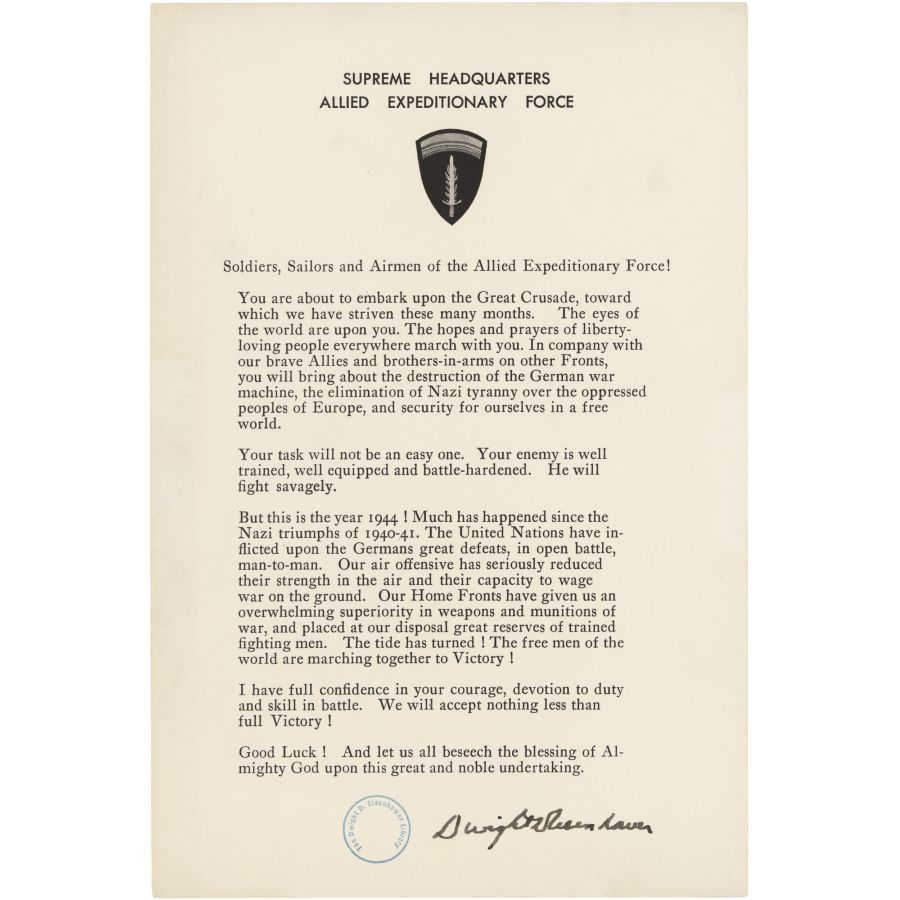
Also in 1944 Operation "Overlord" commenced to free Europe from the Germans,
General
Dwight D. Eisenhower's Order of the Day encouraged Allied soldiers,
sailors, and airmen taking part in the D-day invasion. It was handed to
Allied troops stepping onto their transports in early June 1944. As
Commander of the Supreme Headquarters, Allied Expeditionary Force,
Eisenhower provided hope for those about to liberate the European
continent from Nazi tyranny.
Almost immediately after France fell
to the Nazis in 1940, the Allies planned a cross-Channel assault on the
German occupying forces. At the Quebec Conference in August 1943,
Winston Churchill and Franklin Roosevelt reaffirmed the plan, which was
code-named Overlord. Although Churchill acceded begrudgingly to the
operation, historians note that the British still harbored persistent
doubts about whether Overlord would succeed.
The decision to
mount the invasion was cemented at the Teheran Conference held in
November and December 1943. Joseph Stalin, on his first trip outside the
Soviet Union since 1912, pressed Roosevelt and Churchill for details
about the plan, particularly the identity of the supreme commander of
Overlord. Churchill and Roosevelt told Stalin that the invasion "would
be possible" by August 1, 1944, but that no decision had yet been made
to name a supreme commander. Stalin commented: "Then nothing will come
of these operations. Who carries the moral and technical responsibility
for this operation?" Churchill and Roosevelt acknowledged the need to
name the commander without further delay. Shortly after the conference
ended, Roosevelt appointed Gen. Dwight David Eisenhower to that
position.
By May 1944, 2,876,000 Allied troops were amassed in
southern England. While awaiting deployment orders, they prepared for
the assault by practicing with live ammunition. The largest armada in
history, made up of more than 4,000 American, British, and Canadian
ships, lay in wait. More that 1,200 planes stood ready to deliver
seasoned airborne troops behind enemy lines, to silence German ground
resistance as best they could, and to dominate the skies of the
impending battle theater.
Against a tense backdrop of uncertain weather forecasts,
disagreements in strategy, and related timing dilemmas predicated on the
need for optimal tidal conditions, Eisenhower decided before dawn on
June 5 to proceed with Overlord. Later that same afternoon, he scribbled a note
intended for release, accepting responsibility for the decision to
launch the invasion and full blame should the effort to create a
beachhead on the Normandy coast fail.
Much more polished is this printed Order of the Day for June 6, 1944, which Eisenhower began drafting in February. The order was distributed to the 175,000-member expeditionary force on the eve of the invasion.
We Students of History and us who served or still serve, honor those from back then for the courage displayed to step off into the unknown.
Well to my cruise...we left the city of JAX
As we sailed, I saw a container ship being unloaded, I knew how they did it, but it still was fascinating to watch..
Then we approached a bridge...
It got closer....
and closer............
And really Close.........
is it gonna "scratch"...?
Looks like we cleared......lol
As we neared the mouth of the Harbor, we had a seahawk buzz us...probably looking for "Free Range Boobies". Hey I was a G.I. at one time, I know.....
Followed by the View of some of the big gray canoe's that the U.S. Navy is known for...
And a LHD-7 U.S.S Iwo Jima, the silhouette doesn't exactly match what I saw in "Wiki", the Big white then is covering the aft Antenna mount on the island. I don't know if the ship is being in for maintenance, storage or overhaul. Still it is a cool pic...
And some humor.....with truth attached to it for us that work the aviation field.
Until this
point the Japanese had free range in the pacific, with the inconclusive
battle fought in the Coral Sea in may, the advantage and experience still lay with the Japanese. Here is a link for the battle of Midway.
I also have a link for the plane that is immortalized in that battle that I had posted a while back.
I am a student of history and what got me interested in history was the
battle of midway, it lasted from June the 4 1942 until June 6 1942. I
will not post any major details except when it was done, the power has
shifted in the pacific war. After Midway Japan never had a victory
until the end of the war. The biggest loss for the Japanese besides 4
first line carriers was the loss to her aviation arm, the level of
experience that went down when those carriers sank, they never
recovered.
The events that transpired on those fateful days swung the balance of power in the pacific to the end of the war. Before June 4 1942, the Japanese ran rampant through the Pacific, from bombing Pearl Harbor to the capture of the Philippines to the capture of the Dutch East Indies and the capture of the British Fortress of Singapore.The capture of Guam and Wake Island. The Japanese started suffering from "Victory Disease" as Admiral Yamamoto called it. The Allies found themselves fighting a much superior force than they expected from prewar intelligence. The only hiccup was the Doolittle raid...
The Doolittle Raid so traumatized the Japanese that they started planning the Midway operation before their Port Moresby operation was complete. The Japanese made a move toward Australia and Port Moresby and the battle of Coral Sea. Coral Sea was the first battle where the ships fought and they never saw each other. The battle was fought by carrier airplanes. The battle was inconclusive, but we lost the Lady Lex and a fleet oiler. The Japanese lost the light carrier Shoho but their 2 fleet carriers Shokaku and Zuikaku suffered heavy losses and the Shokaku was damaged. This was why the Japanese didn't have those 2 carriers for the Midway operation. The U.S.S. Yorktown was heavily damaged but they preformed a 72 hour miracle at Pearl Harbor and Yorktown joined her 2 sisters, Hornet and Enterprise.
On that fateful day LtCmr Wade McClusky was leading a group of Dauntless Dive bombers from the U.S.S Enterprise and they followed a Japanese Destroyer that unsuccessfully depth charged an American Submarine and was rushing to catch up with her picket duties. The 12 minutes that followed shattered the Japanese Naval Aviation and destroyed the aura of invincibility that the Japanese had.
We lost the U.S.S. Yorktown and a destroyer The U.S.S. Hammond that
was tied up alongside to aid in the firefighting effort when a Japanese
Submarine put a torpedo into her going for the Yorktown.
.
My favorite movie was of Midway with Charlton Heston, it was a good
story and they used a lot of WWII movie cuts for the movie. In the end there was a clip showing Admiral Nimitz played by Henry Fonda "Were we better than the Japanese?...Or just Luckier". This battle showed a lot of luck for the Americans, from the Intelligence and the location of the carriers. From the experience and power of the ships, the Japanese should have prevailed but luck was on the side of the Americans.
Last week I had visited Eglin AFB and Checked Out the Armaments museum and they had a B25B in the mockup of the B25B that bombed Tokyo, so I decided to do a bit of research on the raid, I already knew a bunch about the raid because the Doolittle raid pushed the events that lead to the Battle of Midway that ended the dreams of Japanese domination in the Pacific War.
The
Doolittle raid is one of the most famous air attacks of WWII. The first
American attack on the Japanese Home Islands, it was achieved through
careful planning. Although its practical impact was minimal, it was a
powerful symbolic moment that boosted American morale and shook the
Japanese.
On December 21, 1941, two weeks after the Japanese attack on Pearl
Harbor, US President Franklin D. Roosevelt told the American chiefs of
staff he wanted Japan bombed as soon as possible. Following the shock of
Pearl Harbor, American morale needed a boost. It would also be good to
shake the Japanese faith in their leaders’ ability to protect them.
In January, Captain Francis Low came up with the concept for what
would become the Doolittle Raid. Having observed Army bombers, he
believed they could be launched from aircraft carriers. It would enable a
bomb load to reach Japan from a long distance away from the American
fleet.
The raid was planned and led by Lieutenant Colonel James “Jimmy”
Doolittle. A pioneering aviator, Doolittle had made tremendous
contributions to instrument-based flying. He instigated moving away from
the limitations imposed by using human senses in high-speed aerial
combat.
Another one of my Pics, That airplane was "Skinny" and wasn't as big as I thought. For the first time I really noticed the size of the airplane.
This from Wiki
TB-25J-25-NC Mitchell, 44-30854, the last B-25 in the USAF inventory, assigned at March AFB, California as of March 1960, was flown to Eglin AFB, Florida, from Turner Air Force Base, Georgia, on 21 May 1960, the last flight by a USAF B-25, and presented by Brigadier General A. J. Russell, Commander of SAC's 822d Air Division
at Turner AFB, to the Air Proving Ground Center Commander, Brigadier
General Robert H. Warren, who in turn presented the bomber to Valparaiso, Florida Mayor Randall Roberts on behalf of the Niceville-Valparaiso Chamber of Commerce. Four of the original Tokyo Raiders were present for the ceremony, Colonel (later Major General) David Jones, Colonel Jack Simms, Lieutenant Colonel Joseph Manske, and retired Master Sergeant Edwin W. Horton. It was donated back to the Air Force Armament Museum c. 1974 and marked as Doolittle's 40-2344
The B-25B Mitchell medium bomber was chosen for the mission. The best
aircraft for the job, the B-25B needed to be fitted with extra fuel
tanks for the unusual long-range mission. Other modifications included
removing a gun turret, adding de-icers for the long high-altitude
flight, and adding extra blast plates.
Lieutenant Colonel Doolittle wires a Japanese medal to a bomb, for “return” to its originators.
On April 1, the 16 modified bombers, each with a five-man crew, and their support staff were loaded on board the USS Hornet. The next day, the Hornet and its accompanying task-force set out. On the 17th,
the ships received the last load of fuel from slow tankers, then raced
west at 20 knots toward their launch point in enemy-controlled waters.
On the morning of the 18th, a Japanese picket boat spotted
the American task force and radioed an attack warning. The American
ships quickly destroyed the vessel.
Rather than let the Japanese make use of their warning, Doolittle
decided to launch the raid ten hours early. It meant flying an extra 170
nautical miles.
The planes had never taken off from a ship before, but every pilot succeeded. By 0920, all 16 were in the air.
Flying first in groups, then individually and low over the sea to avoid detection, the planes sped toward Japan.
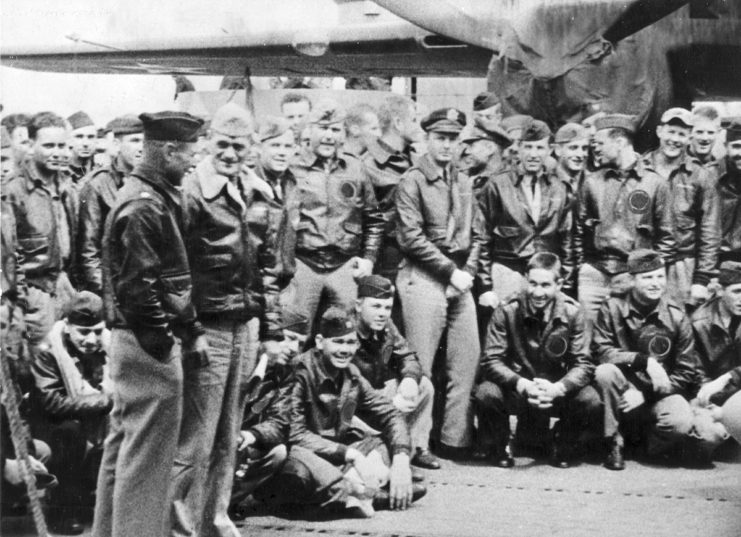
Orders
in hand, Navy Capt. Marc A. Mitscher, skipper of the USS Hornet (CV-8)
chats with Lt. Col. James Doolittle, leader of the Army Air Forces
attack group. This group of fliers carried the battle of the Pacific to
the heart of the Japanese empire with a daring raid on military targets
in major Japanese cities. It was the result of coordination between the
two services. The USS Hornet carried the 16 North American B-25 bombers
to within take-off distances of the Japanese Islands. (U.S.Navy photo)The Attack
It was noon in Tokyo when the planes arrived. Although the Japanese
had carried out air raid drills, they had never been seriously
threatened by Chinese planes in a decade of sporadic war. That was about
to change.
Anti-aircraft fire and fighter planes greeted the bombers. However,
the aerial defenses of Tokyo were light, and the city was unprepared for
a real attack. The crew of the B-25 Whirling Dervish shot down one fighter. The crew of the Hari Kari-er
got two more. Some of the weaponry had been removed from the planes to
make them lighter, but they had fake guns in the tail cones, which
dissuaded the Japanese from attacking them from below.
The Fake guns on the B25B, This was my pic from last week
One B-25 received slight damage from anti-aircraft fire. Another
dropped its bombs early to avoid being hit. None of them were shot down.
The bombers dropped their loads on 16 industrial and military
targets, most of them in Tokyo. They also used their guns to strafe
military positions.
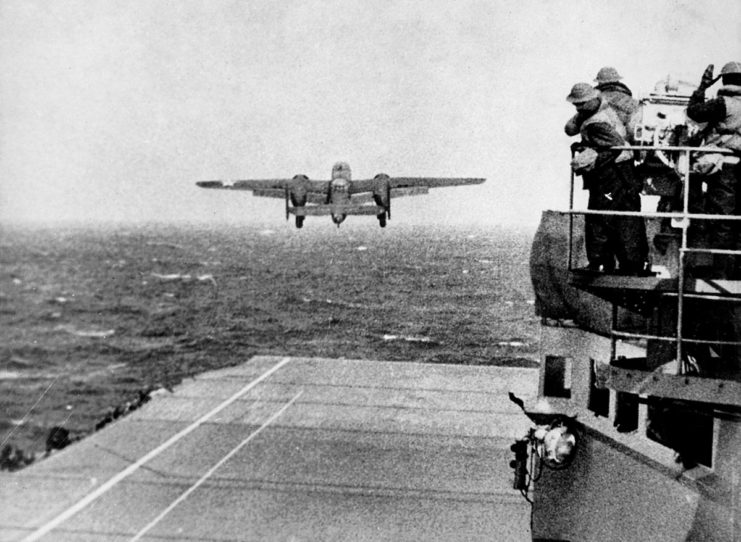
A
U.S. Army Air Forces North American B-25B Mitchell bomber takes off
from the aircraft carrier USS Hornet (CV-8) during the “Doolittle Raid”.Leaving Japan
Having dropped their bombs, the planes were to fly southwest, toward
landing fields in China. There, they were to refuel before heading home.
One of the planes was too low on fuel. Instead, it headed for the
Soviet Union and landed at an air base 40 miles from Vladivostok. The
Russians were not at war with the Japanese. Under the terms of their
neutrality pact, the Russians were obliged to intern the American crew.
They were imprisoned near the Iranian border. Eventually, they bribed a
smuggler to get them out and across the border, reaching the British
consulate in May 1943. It later emerged that their escape had been
engineered by the Russians to get around an awkward diplomatic issue.
The other 15 planes headed for China as planned. The early launch of
the mission had also left them low on fuel. As bad weather descended, it
became evident they would not make it to their landing fields before
they ran out of fuel. They would have to abandon their planes when they
reached the coast of China.
All fifteen crew members successfully abandoned their aircraft. Three
of the B-25s were ditched at sea. The rest crashed on land. Only three
men died in the crashes.
Japanese troops captured eight of the crewmen. Of them, three were
executed, and one died in captivity. The rest escaped, with the help of
Chinese soldiers and civilians. Many of the civilians risked their lives
to do it and were punished by the occupying Japanese.
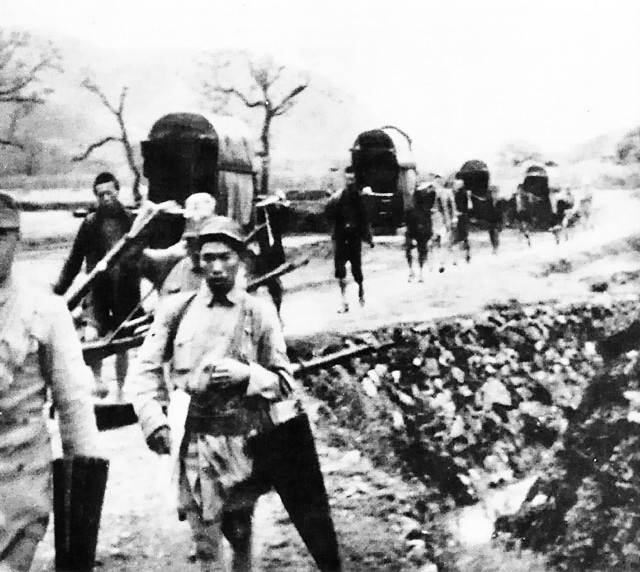
Chinese troops evacuating downed Doolittle Raiders, somewhere on the Chinese coast, April 1942.
Doolittle expected to get into trouble for the outcome of the attack.
Although they had reached Tokyo, he had lost 16 valuable planes in the
process.
The public reaction, however, proved that for Americans, the outcome
was worth the cost. The Doolittle Raid was a huge boost to public
morale. Doolittle was promoted straight to brigadier general, skipping
the rank of colonel. Every man who took part in the raid was awarded the
Distinguished Flying Cross. Doolittle was given the Medal of Honor.
The raid killed 87 people in Tokyo and injured 462. Some of the casualties were children, enraging the Japanese public.
Fearful of another strike against their cities, the Japanese determined to seize Midway Island. They were defeated.
The Doolittle raid had done its job. American spirits had been
lifted. Japanese nerves were shaken. The Empire of Japan lay vulnerable
at last.
Intro to the Movie "Midway" that showed the Doolittle Raid
When I was in the 5th grade in Germany in Frankfurt Germany, I got interested in the Pacific war, this book had caught my attention, and it had this cover on it.
I stated reading more and more and it expanded my interest and I start reading even more about it. and a movie came out in 1976 called "Midway" with Charlton Heston and it became my favorite movie, even now it is in my top 5 and this was many years later. I remembered a scene played by "Christopher George" as Lieutenant Commander C. Wade McClusky and he was looking for the Japanese carriers and they were lost and he saw a Japanese destroyer that was catching up with the Japanese fleet after trying to depth charge an American Submarine. The 6 minutes that followed changed the course of the War, the Japanese lost 4 of their front line carriers and more importantly they lost over 300 of their best trained and experienced pilots and that tore the guts out of Japanese Naval aviation and they never recovered from that loss.
The pics are compliments of "Google" and the movie clip is from "Youtube"
ALBANY, N.Y. (AP) - C. Wade McClusky Jr. faced a tough
decision on June 4, 1942: turn his low-on-fuel U.S. Navy air squadron
around or keep searching for the Japanese fleet headed for Midway. He
decided to go on and wound up changing history.
The dive
bombers McClusky led that day in the Battle of Midway helped to gut the
Imperial Japanese Navy and turned the tide of the war in the Pacific in
the Allies' favor after a string of defeats following the attack on
Pearl Harbor.
On
Sunday, 75 years to the day of his heroics, a clay model of a planned
bronze statue of McClusky is being unveiled in his hometown of Buffalo,
New York, as part of a new public memorial dedicated to local war
heroes. McClusky, who died in 1976, is depicted as he looked after
returning from the June 4, 1942, attack, still wearing his flight suit,
flying helmet and goggles.
"Wade McClusky finally
will be getting his due recognition," said Lee Simonson, one of the
organizers behind the event and the fundraising effort for the new
memorial. "He's one of the greatest heroes in American history."
McClusky, born in
Buffalo in 1902, graduated from the U.S. Naval Academy in 1926 and
earned his pilot's wings a few years later. When the Japanese attack on
Pearl Harbor drew America into the war, he was a lieutenant commander in
charge of the air squadron aboard the USS Enterprise, which escaped
harm on Dec. 7, 1941, because it was at sea with the other U.S.
carriers.
In late May 1942, a
large Japanese fleet was steaming toward the U.S. sea and air bases on
Midway atoll, located about 1,300 miles (2,092 kilometers) northwest of
Honolulu. Midway could provide the Japanese with a jumping-off point for
more assaults on Hawaii, and possibly the West Coast.
The U.S. Navy, tipped
off to the Japanese plans thanks to its breaking of the enemy's naval
codes, ordered its only three aircraft carriers in the Pacific -
Yorktown, Hornet and Enterprise - to head off the attack. McClusky's air
squadron was tasked with finding the Japanese warships and sinking
them. Despite the inside information, the planes initially were sent in
the wrong direction after they took off on the morning of June 4.
More time - and fuel -
was wasted as McClusky's group circled while waiting for other
carrier-based planes that didn't show up. About two hours into the
search and running low on gas, McClusky was faced with a choice: return
to the Enterprise or keep searching, with the realization that most of
his planes would have to ditch in the ocean. He kept going.
According to the U.S.
Navy's official account of the battle, McClusky soon spotted a Japanese
destroyer and correctly surmised it was headed toward the main Japanese
fleet. Around 10:20 a.m., he led 30 other Douglas SBD Dauntless dive
bombers into the attack against the Japanese aircraft carriers.
When the day was over,
the fliers from the Enterprise and Yorktown had sunk three carriers and
mortally damaged a fourth. McClusky, wounded in the initial attack,
made it back to his carrier with less than five gallons of fuel in his
tank. Some of the other surviving two-man planes had even less. Ten
planes in his squadron had to ditch in the sea and their crews were
never found.
"This small group of
people who did such a dynamite job at Midway should be lofted up as
icons in American history, but for the most part their names go mostly
forgotten," said Timothy Orr, who along with his wife Laura co-authored a
recently published autobiography by N. Jack "Dusty" Kleiss, a member of
McClusky's squadron who helped sink three Japanese warships at Midway.
Kleiss was the last surviving Midway dive bomber pilot when he died last
year at 100.
For his actions at
Midway, McClusky was awarded the Navy Cross, one of the U.S. military's
highest decorations. He retired as a rear admiral in 1956. McClusky
never lived in Buffalo after entering the Navy and has no family living
there.
According to his son, Phil, the Buffalo tribute is something the Navy hero would've never sought for himself.
"He was a quiet guy.
He was not a big talker," said the son, 63, who lives outside Baltimore
and plans to attend Sunday's ceremony. "He was a professional naval
officer."
What I am referring to are the D-Day invasion of Western Europe in 1944, it was the first direct attack on Western Europe and "Festung Europa", after the aborted attack on Dieppe in 1942. Some believed that this was a practice run on the Germans to see how they reacted. The British left a lot of material behind and a lot of casualties and prisoners from that raid. The Canadians were not happy about the results. But 2 years later the Allies tried again with much different results than the ill-fated raid.
On June 6th, the allies struck in Normandy on 5 beaches, Gold, Sword,Juno,Utah and Omaha, after a major bombardment with aircraft, battleships, destroyers, cruisers and the French resistance and more aircraft attacking the rear areas including railroad marshaling yards, bridges and other gathering points, they kept the Germans from reinforcing the bridgehead. Also a major factor was Adolph Hitler who refused to release the reserves because he believed that the main attack would come at Calais instead. This belief was reinforced by a major misinformation campaign by the allies to keep the Germans pinned at Calais and not reinforcing the embattled Germans at Normandy.
Some facts about D-day:
The D-Day Invasion at Normandy – June 6, 1944
Invasion Date
June 6, 1944 – The D in D-Day stands for “day” since the final invasion date was unknown and weather dependent Allied Forces
156,000 Allied troops from The United States, The United Kingdom, Canada,Free France and Norway Invasion Location
The Allied code names for the beaches along the 50-mile
stretch of Normandy coast targeted for landing were Utah, Omaha, Gold,
Juno and Sword. Omaha was the costliest beach in terms of Allied
casualties. The Armada
5,000 ships and landing craft
50,000 vehicles
11,000 planes The Commanders
United States – Dwight D. Eisenhower, Omar Bradley
The United Kingdom – Bernard Law Montgomery, Trafford Leigh-Mallory, Arthur Tedder, Miles Dempsey, Bertram Ramsay
Germany – Erwin Rommel, Gerd von Rundstedt, Friedrich Dollmann
Casualties
Numbers represent total killed, wounded, missing or captured
United States – 6,603 (1,465 killed)
United Kingdom – 2,700
Canada – 1,074 (359 fatal)Germany – Estimated between 4,000 – 9,000 Results
By June 11, with the beachheads firmly secured, more
than 326,000 troops had crossed with more than 100,000 tons of military
equipment. Paris was liberated on August 25. Germany surrendered on May
8, 1945.
As a treat, a couple of weeks ago when we were at work, there was our annual AMT appreciation day at the hanger, we had some free food, the tool vendors were out in force and we got some cool stuff. we had some airplanes show up in the hanger:
This P51D is sporting the Stripes on the fuselage and wings that the allies had painted to make Identification easier so there would be less friendly fire incidents.
Here is a better look at the P51D. It is the iconic fighter from WWII for the allies. This plane protected the B-17's and B-24's all the way to Berlin and back. This plane made the Strategic bombing strategy a success, as far as enabling the bombers to make it to their targets. Schweinfurt in 1943 was very costly to allied bombing efforts. This showed the folly of sending bombers unescorted against Luftwaffe fighters. Hermann Goering commented later when he saw a crashed P51 near Berlin, he "Knew the jig was up".
After being invaded on both sides by the allies, with most of Germany occupied, Hitler committed suicide in his bunker as Russian guns blasted Berlin. 11 months later, the Germans surrendered unconditionally to the allies. and the War in Europe was over.
Also on the other side of the world, in 1942 from June 4 through June 6 the Americans fought the Japanese at the battle of Midway. At the end, the Japanese lost 4 carriers, 1 cruiser and 300+ airplanes and worse than that, they lost the creme of their aviation strike force. the Japanese never recovered from that loss. We lost 1 carrier, 1 destroyer and 100+ airplanes. The details that started this in motion was the Doolittle Raid , this overrode Admiral Yamamoto caution in dealing with the United States. After the raid he pushed through operation MI, the invasion of Midway island, which he believed would force the Americans to leave their Pearl Harbor base to save their last remaining outpost in the Pacific. The Japanese Navy had to deal with the Americans at the Battle of the Coral Sea which they lost a light carrier Shoho a light carrier, but the dive bombing and torpedo planes of the Shokaku and the Zuikuku were savaged and the Shokaku was heavily damaged. This forced the Japanese to use their other 4 heavy or fleet carriers. the 6 carriers total, the Shokaku, Zuikaku, Akaki,Soryo,Hiryo and Kaga were the 6 carriers that attacked Pearl Harbor. They represented the creme of Japanese Naval Aviation. With Zuikaku depleted in their air arm and the Shokaku heavily damaged, both were sidelined on the next battle. The Americans lost the Lexington, a Destroyer U.S.S. Sims and many aircraft. Also the U.S.S. Yorktown was damaged. The Americans got her to Pearl Harbor and in 3 days got her repaired enough for combat operations to join the Enterprise and Hornet to defend Midway Island. The American Cryptographers under Joe Rochefort were able to break the Japanese JN-25 imperial naval code which gave the Americans the plans of the Japanese to attack Midway Island. The Japanese believed that the Americans only had 2 carriers, the Enterprise and Hornet, they believed that the Yorktown was sunk at Coral Sea. The Americans met the Japanese at what was called the battle of Midway. The end results was that the Japanese lost 4 of their fleet carriers, the creme of their naval aviation, and they never recovered from the blow. It took 3 more years of hard fighting before the Japanese surrendered to the Americans on the deck of the U.S.S. Missouri.
The Plane that devastated the Japanese at Midway was the SBD Dauntlass, this plane was responsible the the destruction of the Japanese carriers at Midway.
The diving brakes are evident in this picture. of a Dauntlass diving on a Japanese carrier.
We got a treat along with the P51D we had visit, we also had a SBD Dauntlass visit us also.
The diving brakes that made her so devastating are shown here retracted. Here is another pic
of her from the other side.
I was very excited to see icons of American aviation in person. I explained the significance of these planes to the other mechanics...especially the younger ones. I wanted to crawl inside of them but I didn't want to insult the CAF by crawling all over their airplanes without permission.
The number of remaining D-Day vets is estimated anywhere
between 8,000 and 60,000. The Veterans Administration has detailed
numbers on total WWII vets remaining available at www.nationalww2museum.org/the-greatest-generation
PEARL HARBOR, Hawaii (AP) — Six months after the devastating attack on Pearl Harbor, Japan sent four aircraft carriers to the tiny Pacific atoll of Midway to draw out and destroy what remained of the U.S. Pacific Fleet.
But
this time the U.S. knew about Japan's plans. U.S. cryptologists had
cracked Japanese communications codes, giving Fleet Commander Adm. Chester Nimitz notice of where Japan would strike, the day and time of the attack, and what ships the enemy would bring to the fight.
The
U.S. was badly outnumbered and its pilots less experienced than
Japan's. Even so, it sank four Japanese aircraft carriers the first day
of the three-day battle and put Japan on the defensive, greatly
diminishing its ability to project air power as it had in the attack on
Hawaii.
On Monday, current Pacific Fleet commander, Adm. Cecil
Haney and other officials flew 1,300 miles northwest from Oahu to Midway
to mark the 70th anniversary of the pivotal battle that changed the
course of the Pacific war.
Midway is now a National Wildlife
Refuge hosting more than one million seabirds. Navy photos of the
ceremony show an honor guard standing at attention next to a field of
ground-nesting Laysan albatross and other seabirds.
"After the
battle of Midway we always maintained the initiative and for the
remaining three years of the war, the Japanese reacted to us," Vice Adm.
Michael Rogers, commander of the U.S. Fleet Cyber Command, told a crowd
gathered outside Nimitz's old office at Pearl Harbor on Friday to
commemorate the role naval intelligence played in the events of June
4-7, 1942.
"It all started really in May of 1942 with station Hypo
(the Combat Intelligence Unit at Pearl Harbor) and the work of some
great people working together to try to understand what were the
Japanese thinking, what were they going to do," Rogers said Friday.
Intelligence wasn't the only reason for U.S. victory.
The
brave heroics by dive bomber pilots, Japanese mistakes and luck all
played a role. But Nimitz himself observed that the code-breaking was
critical to the outcome, said retired Rear Adm. Mac Showers, the last
surviving member of the intelligence team that deciphered Japanese
messages.
"His statement a few days later was 'had it not been for
the excellent intelligence that was provided, we would have read about
the capture of Midway in the morning newspaper,'" said Showers said in
an interview.
Japan's vessels outnumbered U.S. ships 4-to-1,
Japan's aviators had more experience, and its Zero fighter planes could
easily outmaneuver U.S. aircraft.
But Japan, unlike the U.S., had little knowledge of what its enemy was doing.
Japanese
commanders believed a U.S. task force was far away in the Solomon
Islands. Then, as June 4 neared and Nimitz prepared his troops, Japanese
commanders failed to recognize signs of increased military activity
around Hawaii as an indication the U.S. had uncovered their plans to
attack Midway, the site of a small U.S. base.
The U.S. lost one
carrier, 145 planes and 307 men. Japan lost four aircraft carriers, a
heavy cruiser, 291 planes and 4,800 men, according to the U.S. Navy and
to an account by former Japanese naval officers in "Midway: The Battle
That Doomed Japan, the Japanese Navy's Story."
The defeat was so
overwhelming that the Japanese navy kept the details a closely guarded
secret and most Japanese never heard of the battle until after the war.
Nimitz
got his intelligence from Showers and a few dozen others relentlessly
analyzing Japanese code in the basement of a Pearl Harbor administrative
building.
Japanese messages were written using 45,000 five-digit numbers representing phrases and words.
The cryptographers had to figure out what the numbers said without the aid of computers.
"In
order to read the messages, we had to recover the meaning of each one
of those code groups. The main story of our work was recovering code
group meanings one-by-painful-one," Showers said.
At the time of
the Dec. 7, 1941, attack on Pearl Harbor, they understood a small
fraction of the messages. By May 1942, they could make educated guesses.
A key breakthrough came when they determined Japan was using the letters "AF" to refer to Midway.
Showers
said Cmdr. Joseph Rochefort, the team's leader, and Nimitz were
confident the letters referred to the atoll. But Adm. Ernest King, the
Navy's top commander, wanted to be sure before he allowed Nimitz to send
the precious few U.S. aircraft carriers out to battle.
So Nimitz
had the patrol base at Midway send a message to Oahu saying the island's
distillation plant was down, and it urgently needed fresh water. Soon
after, both an intelligence team in Australia and Rochefort's unit
picked up a Japanese message saying "AF" had a water shortage.
Showers
was an ensign in the office, having just joined the Navy. He analyzed
code deciphered by cryptographers, plotted ships on maps of the Pacific,
and filed information.
Now 92 and living in Arlington, Va., the
Iowa City, Iowa, native went on to a career in intelligence. He served
on Nimitz's staff on Guam toward the end of the war, and returned later
to Pearl Harbor for stints leading the Pacific Fleet's intelligence
effort. After the Navy, he worked for the Central Intelligence Agency.
Showers
said commanders weren't always as open to using intelligence to plan
their course of attack the way Nimitz was. Some were suspicious of it.
But Midway changed that.
"It
used to be a lot of people thought intelligence was something
mysterious and they didn't believe in it and they didn't have to pay
attention to it. Admiral Nimitz was fortunately what we call
intelligence-friendly," Showers said.
70 years ago, a decisive battle was fought in the pacific. Until this point the Japanese had free range in the pacific, with the inconclusive battle fought in the Coral Sea in may, the advantage and experience still lay with the Japanese. Here is a link for the battle of Midway.
I also have a link for the plane that is immortalized in that battle that I had posted a while back.
I am a student of history and what got me interested in history was the
battle of midway, it lasted from June the 4 1942 until June 6 1942. I
will not post any major details except when it was done, the power has
shifted in the pacific war. After Midway Japan never had a victory
until the end of the war. The biggest loss for the japanese besides 4
first line carriers was the loss to her aviation arm, the level of
experience that went down when those carriers sank, they never
recovered.
We lost the U.S.S. Yorktown and a destroyer The U.S.S. Hammond that
was tied up alongside to aid in the firefighting effort when a Japanese
Submarine put a torpedo into her going for the Yorktown.
.
My favorite movie was of Midway with Charlton Heston, it was a good
story and they used a lot of WWII movie cuts for the movie.
 Yeah I know that there were some some inaccuracies in the movie, but overall I thought it was a good movie and the Actors they had mirrored the real life people pretty good, Woody Harrelson even Played a good Admiral Nimitz. There was one person that I heard a bit about a long time ago in a book I read then I forgot about it, until I saw it in the Movie, was the Machinist Mate running into the back of a Dauntlass and shooting down a twin engine bomber and it missed the carrier and tore the tail off his plane. Then I saw it in the movie.