Webster

The Constitution was made to guard the people against the dangers of good intentions." --American Statesman Daniel Webster (1782-1852)


Showing posts with label Taiwan. Show all posts

Tuesday, April 22, 2025

Taiwan Increases Drone Production and fortifies supply chain.

Taiwan is preparing for things to get *sporty* with the PRC. They are preparing their supply chains for interruptions and knowing that the Communist Chinese are having internal issues have been casting a baleful eye at what they consider their *Breakaway Provence* .  Traditionally the Security of Taiwan was guaranteed by the U.S. 7th Fleet but with the weakness in the U.S. Military that is present right now and the present Administration is behind the power curve to correct it, I don't blame the Taiwanese for being concerned. 

     Taiwan is taking lessons from the Russia Ukraine Kerfluffle and the effectiveness of the drones on both sides.  THey are hoping that it will forstall the "PLAN" and their attempt to conquer the island, remember Mainland China has an export economy, and a large youth unemployment problem, and the tariff war with the United States is causing the Chinese a lot of heartburn.

    I shamelessly clipped this from *Aviation Weekly* 


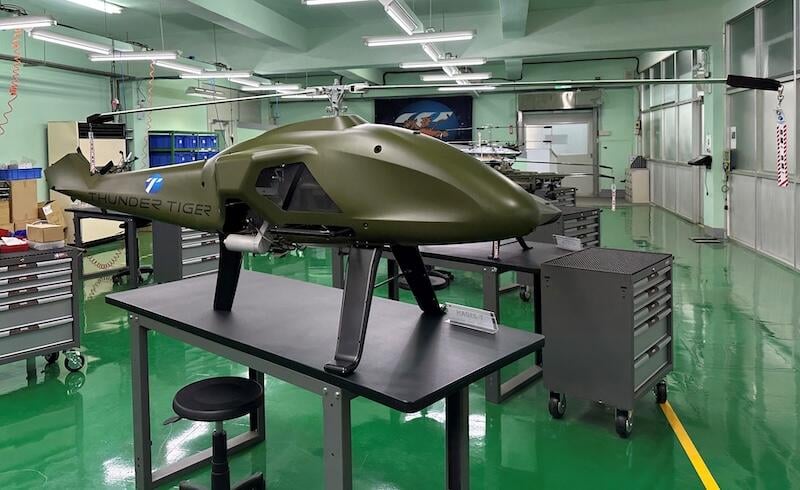
A T250AH Raptor autonomous helicopter

A T250AH Raptor autonomous helicopter manufactured by Thunder Tiger, which is a member of the Taiwan Excellence Drone International Business Opportunities Alliance.

Credit: Matthew Fulco/Aviation Week Network

TAIPEI, Taiwan—Taiwan’s state-backed drone industry alliance has grown from 50 members at its September 2024 inception to more than 200 today and is expeditiously decoupling from China-based supply chains, Chairman Hu Kai-Hung tells Aviation Week.

Hu, who also serves as the chairman of Taiwan’s Aerospace Industrial Development Corporation (AIDC), says that the drone alliance is laser-focused on creating a “non-red supply chain”—the red referring to China—to align with the requirements of the U.S., which has flagged the security threats posed by Chinese drones.

Members of the Taiwan Excellence Drone International Business Opportunities Alliance (Tediboa) are required to prove the origin of their components, Hu says.

The alliance includes the largest Taiwanese drone manufacturers, like Geosat Aerospace and Thunder Tiger, as well as many smaller companies that specialize in the production of specific uncrewed aircraft system (UAS) components.

Hu acknowledges that Taiwan faces considerable challenges breaking into an industry dominated by China. Shenzhen-based DJI alone has an estimated 70% share of the global UAS market. “Taiwan is a latecomer to the drone sector, but it can leverage its advanced technology and manufacturing capabilities to cooperate with the growing number of countries that want a reliable alternative to China,” he says.

In addition to the U.S., Tediboa has made inroads in Eastern Europe, signing agreements with Estonia, Latvia, Lithuania and Poland. They make ideal partners for Taiwan because of their experience supporting Ukraine—including with autonomous technologies—as it defends itself against Russia’s full-scale invasion, and their antipathy toward authoritarian expansionism, Hu says.

Most recently, Tediboa has stepped up cooperation with Asian countries, including Japan and India—both of which are intensifying efforts to reduce dependence on Chinese drone suppliers. Japan said in February it would expand its supply of domestically produced UAS to partner countries in the Indo-Pacific beginning in the 2025 fiscal year. India has canceled three orders totaling 400 military UAS due to security concerns about China-made components.

While Tediboa feels increasingly confident about the integrity of its supply chain, there is one area which Hu sees as high risk. “We are worried about the reliability of access to rare earths and other critical minerals dominated by China,” he says, noting how Beijing has weaponized its control of those supply chains in its trade war with the U.S. “These are crucial for certain drone components, and we don’t have an easy replacement if China cuts off supply to Taiwan.”

Thursday, September 28, 2023

Creating a "hellscape if China invades Taiwan.

 I pulled this from a 3rd party email...I was surprised that this information was freely available, I kinda thought they would not tip their hand to a potential adversary, unless they are going to try to "warn them off".

RQ-28 drone

The U.S. Army has ordered 1,000 RQ-28 drones from Skydio and plans to award a competitive follow-on contract next spring for thousands more.

Credit: Defense Innovation Unit

A new operational concept within the U.S. Indo-Pacific Command proposes to use a horde of drones to turn the Taiwan Strait into a “hellscape” if China attempts to invade Taiwan.

To realize that vision, the Defense Department has created several new efforts to solve the industrial, bureaucratic and command-and-control issues posed by unleashing thousands of drones simultaneously into the air, water and land around the roughly 100-nm channel between mainland China and Taiwan.

  • The concept’s plans draw on Ukraine lessons
  • DARPA supports Replicator with new autonomy program

The multiple projects, including the Pentagon’s recently announced Replicator and DARPA’s Rapid Experimental Missionized Autonomy (REMA) programs, seek to enhance and accelerate the programs of record already underway by each of the armed services to field tens of thousands of drones—including uncrewed air vehicles (UAV), uncrewed surface vessels (USV) and uncrewed ground vehicles—in the next several years.

As the Army leadership prepares to address the Association of the U.S. Army’s Annual Meeting that begins Oct. 9, the service’s acquisition officials are working behind the scenes to offer several ongoing drone acquisition programs for the Pentagon’s new fast-tracking and capability upgrade efforts, such as Replicator and REMA.

Speaking to reporters on Sept. 20, Doug Bush, the Army’s assistant secretary for acquisition, logistics and technology, said the service is working with the Office of the Secretary of Defense to understand how the existing programs could be included in the Replicator effort, but added that he hopes such a move would result in additional funding for the ongoing programs.

“In the unmanned aircraft space—[which is] especially where I think we could go faster—we’re limited by funding at this point,” Bush said. “But I think we’ve got some good systems that with more funding and some help on accelerating the process, the Army absolutely could contribute to the overall Replicator efforts.”

Heeding lessons from the Russia--Ukraine war, the Army already plans to award a contract next spring for up to 12,000 small quadcopter drones under the Short-Range Reconnaissance (SRR) program. Meanwhile, efforts continue to field thousands of Air-Launched Effects (ALE) as part of the Future Attack Reconnaissance Aircraft ecosystem of sensors and munitions. That ecosystem includes the tube-launched ALE-Small, which includes uncrewed aircraft systems (UAS) such as the Anduril Altius, and ALE-Large, a more secretive project that is known to involve at least UAS such as the L3Harris Technologies Red Wolf.

The Army programs would add to thousands of more drones of all sizes and performance levels in development or production across the U.S. military. In the conflicts in Iraq and Afghanistan of the last two decades, only dozens of uncrewed systems were in operation at any single time. In the decade ahead, thousands of drones could perform missions simultaneously. The transition is being informed by ongoing experiments such as the Navy’s Task Force 59 and the Air Force’s Task Force 99.

Lessons from those experiments have been folded into Hellscape, an operating concept developed over several years in secret. Adm. John Aquilino, commander of Indo-Pacific Command, revealed the idea in cryptic fashion on Aug. 28 at the Emerging Technologies for Defense Conference and Exhibition.

“The components in Indo-Pacom have been experimenting for the past 5-10 years with many of those unmanned capabilities. Those will be an asymmetric advantage,” Aquilino said. “So operational concepts that we’re working through are going to help amplify our advantages in this theater. There is a term, ‘Hellscape,’ that we use.”

The concept appears to mark a departure from operating concepts focused on employing limited numbers of expensive and exquisite weapon systems against an array of enemy targets. Naval attacks by Ukraine’s military have shown the power of weaponizing thousands of disposable, commercial drones against enemy formations, as well as targeting enemy ships in the Black Sea with large numbers of crude USVs that function like an overwhelming salvo of guided torpedoes.

Any invasion of Taiwan by China would require transporting an amphibious invasion force across the strait. The transit would expose dozens or even hundreds of large ships to drone attacks from the time they are loaded in port until the troops attempt to disembark along the Taiwanese coast. Modern naval ships are equipped with a range of defensive countermeasures to thwart a limited number of attacks from drones, torpedoes and anti-ship missiles. But the Hellscape concept proposes a way to overwhelm those countermeasures with dozens or hundreds of simultaneous drone attacks.

uncrewed surface vesselThousands of commercial drones, including such uncrewed surface vessels as the Saildrone Explorer, that share a common autonomy “brain” are envisioned by the newly unveiled Replicator concept. Credit: Petty Officer 2nd Class Jeremy Boan/U.S. Navy

“I think [Hellscape] is creating a chaotic, unpredictable situation in the Taiwan Strait using unmanned systems—mostly surface systems, but maybe also some undersea systems and ones that are relatively inexpensive,” Bryan Clark, a former Navy submariner and now the director of the Center for Defense Concepts and Technology at the Hudson Institute, told Aviation Week.

“They’re taking the cue . . . from what the Ukrainians have done and [asking], ‘Can we apply that model in the Taiwan Strait?’ Because you’ve got a similar, kind of, fish-in-a-barrel sort of opportunity,” Clark added.

The concept may not be unique to the Indo-Pacific Command. Seeking to bolster asymmetric defensive capabilities against a Chinese amphibious invasion, the 2023 National Defense Report published on Sept. 12 by Taiwan’s defense ministry calls for buying 7,000 commercial drones and 700 military-grade UAVs in the next five years.

Similarly, the U.S. Defense Department unveiled the Replicator concept in late August, calling for fielding thousands of “attritable” drones across all domains within 18-24 months. Many details of the concept are still being worked out, but early descriptions by defense officials suggest  the concept’s purpose is not about creating a new program of record. Instead, the goal is to create a new acquisition process that can support the speed and flexibility needed to make Indo-Pacific Command’s Hellscape possible.

“Let’s be crystal clear: Replicator is not a new program of record. We’re not creating a new bureaucracy,” Deputy Defense Secretary Kathleen Hicks said on Sept. 6 at the Defense News Conference. “And we will not be asking for new money in [fiscal 2024]. Not all problems need new money; we are problem solvers, and we intend to self-solve.”

The first priority for Replicator is to develop a new software platform. To overcome the Chinese military’s advantage in numbers, Replicator aims to focus initially on developing a capability for all-domain, attritable autonomy (ADA2), Hicks said. Details remain scarce, but her comments indicate that such a common software suite could be rapidly integrated on different types of drones, whether they are designed to fly, float or drive.

Two weeks after Hicks unveiled the Replicator concept, DARPA revealed a new program with goals similar to the ADA2 effort. REMA, launched on Sept. 12, proposes to develop a hardware adapter for different types of commercial drones and create a common mission autonomy suite that can be hosted on that adapter. Moreover, the goal of the REMA program is to produce the initial version of adapter and software system within 18 months, which aligns with the schedule for fielding the Replicator concept.

The drones that are equipped with the REMA software would have special abilities unavailable on standard commercial drones. If a control or communications link to the drone is lost, the REMA autonomy software would allow them to continue performing some aspects of their mission by making their own decisions. Software updates and upgrades could be developed, tested and released to all of the REMA adapter-equipped drones in monthly cycles.

“REMA sounds like it’s pretty much aligned with this idea,” Clark said. “We want to make the [Replicator] vehicles as commoditized as possible, and we’re going to focus our technology development effort on the application layer that rides on top of their control software.”

Meanwhile, the armed services are continuing to develop military-grade drones. The SRR program awarded a contract to Skydio last year to deliver 1,000 RQ-28A quadcopters. A follow-on award is expected next spring for up to 12,000 more drones, with Skydio, Teal and Vantage Robotics competing for the order.
Thursday, November 17, 2022

How China May Resurrect a 1950's fighter as a UCAV

 I have been busy with work and "Meatspace" so I wasn't able to post like I wanted to.  So y'all are getting another aviation related post.  I read this and I figured that the Chinese are watching the current dustup in the Ukraine and the effect that Drones and remotely piloted vehicles are having and when they finally decide to pull the trigger and invade Taiwan, I can see a lot of remotely piloted vehicles and aircraft being utilized to absorb the ordinance that the Taiwanese will throw at the Red Chinese to thwart the invasion and remain free.

Here is the information on the "Shenyang J-6"

The heyday of the Shenyang J-6 Farmer – a Chinese copy of the MiG-19, the first mass-produced supersonic fighter – appeared to expire decades ago, as the People’s Liberation Army Air Force (PLAAF) began restocking with hundreds of fourth- and fifth-generation fighters. 

But some military analysts now think the J-6 – and contemporaries such as the MiG-21-derived J-7 and the indigenous J-8 and Q-5 fighters – still may play a critical role in a Taiwan conflict, but this time in a theorized role as a cheap, potentially reusable vanguard of uncrewed combat air vehicles (UCAVs). 

For several years, the U.S. Air Force has been experimenting and demonstrating different concepts for low-cost, attritable aircraft, ranging from artificial intelligence-piloted Kratos XQ-58 UCAVs to missionized versions of Boeing QF-16 target drones. China, however, arguably invented the concept in the early 1960s, fashioning a “disposable" 100-flight-hour design for the J-6, which would then require a depot maintenance cycle to remain airworthy.

The concept may have reflected the limits of China’s nascent aerospace manufacturing capability in the 1960s and 1970s, but it appears to have come full circle as part of a new warfighting concept that prizes quantity in some cases as much as quality. 

The theory that China could use expired, second-generation jet fighters as armed drones has been going around in defense circles for several years, but new research by an analyst at the Mitchell Institute for Aerospace Studies may reveal where and how the PLAAF’s horde of converted UCAVs could be employed in a Taiwan scenario. 

Media reports already had identified 32 hardened shelters at three bases on China’s east coast across from Taiwan. In fact, China has constructed another 94 hardened shelters at a total of five bases within range of Taiwan, Daniel Rice, a Mitchell Institute non-resident fellow, writes in a newly published paper. The additional 94 shelters are sized to house as many as three UCAVs each, or up to 294 converted fighters.

In addition to the shelters at all five bases (namely, Longtian, Luocheng/Huian, Shantou, Shuiman and Zhangzhou), satellite imagery indicates significant new infrastructure, including the construction of buried fuel depots and hardened storage facilities, Rice says. 

“With the large number of seemingly unused hardened, underground and concealed shelters identified at the airfields, it is possible that the PLAAF could pre-position a variety of UCAVS in operation against Taiwan,” Rice writes. 

Requiring less maintenance than crewed fighters, a fleet of hundreds of converted UCAVs can be stored inside the hardened shelters for long periods. In the event of a conflict with Taiwan, the PLAAF can roll them out to execute an initial assault on Taiwan. All five bases lie within the combat radius of the Q-5, J-6, J-7 and J-8. 

“UCAVs make it possible for the PLAAF to use relatively cheap, capable, low-risk airframes as a first-in asset to either strike or soften Taiwan’s air defense systems,” Rice says. 

Operating reusable UCAVs also may address persistent PLAAF concerns about the risk of pilot defections. “In more recent years, concerns over defections and a lack of trust between PLAAF commanders and pilots may be one of the reasons why incursions into Taiwan’s [air defense identification zone] have occurred only infrequently toward the centerline with Taiwan,” Rice writes. 

A strategy of concealment creates operational opportunities. During large-scale exercises in 1996, the PLAAF deployed fighters based elsewhere to front-line bases. After the converted UCAVs complete the initial assault on Taiwan’s air defense, a second wave of crewed fighters could re-occupy the hardened shelters, allowing the PLAAF to carry out sustained attacks with 4.5- and 5th-generation fighters, Rice says, referring to this strategy as the “Cicada concept.” 

Counters emerge to any new technology. Hardened shelters can be targeted with penetrating missiles. Runways can be deactivated with well-placed precision munitions. But Rice notes that runways also can be repaired within hours, and defeating 126 hardened shelters may consume a significant portion of Taiwanese or allied missile stocks. Moreover, the Chinese may have constructed other hidden facilities, in addition to the five bases identified by Rice. 

“This implies more [U.S.] strike capacity may be needed than is currently planned,” Rice concludes. 

Sunday, November 25, 2012

China Lands new fighter jet on Chinese carrier

This will cause problems for our navy, Our carrier striking force has served our interest and kept the peace for many years, now we have a resurgent China and they would love for us to leave the Pacific and let them spread their influence, threaten Taiwan, the Philippines, we have spilled blood together with them, and other nations up to and including Australia.


  • A carrier-borne J-15 fighter jet takes off from the Liaoning, China's first aircraft carrier, in this undated handout photo released November 25, 2012. China has successfully conducted flight landing on its first aircraft carrier, the Liaoning, after its delivery to the People's Liberation Army (PLA) Navy on September 25, 2012, according to Xinhua News Agency. REUTERS/Xinhua/Zha Chunming
    A carrier-borne J-15 fighter jet …

SHANGHAI (Reuters) - China has carried out its first successful landing of a fighter jet on its first aircraft carrier, state media said on Sunday, a symbolically significant development as Asian neighbors fret about the world's most populous country's military ambitions.
The home-built J-15 fighter jet took off from and landed on the Liaoning, a reconditioned Soviet-era vessel from Ukraine which only came into service in September this year.
China ushered in a new generation of leaders this month at the 18th Communist Party Congress in Beijing, with outgoing President Hu Jintao making a pointed reference to strengthening China's naval forces, protecting maritime interests and the need to "win local war".
China is embroiled in disputes with the Philippines and Vietnam over South China Sea islands believed to be surrounded by waters rich in natural gas. It has a similar dispute with Japan over islands in the East China Sea.
It has also warned the United States, with President Barack Obama's "pivot" to Asia, not to get involved.
"We should make active planning for the use of military forces in peacetime, expand and intensify military preparedness, and enhance the capability to accomplish a wide range of military tasks, the most important of which is to win local war in an information age," Hu said.
China has advertised its long-term military ambitions with shows of new hardware, including its first test flight of a stealth fighter jet in early 2011, an elite helicopter unit and the launch of the aircraft carrier.
China is boosting military spending by 11.2 percent this year, bringing official outlays on the People's Liberation Army to 670.3 billion yuan ($100 billion) for 2012, after a 12.7 percent increase last year and a near-unbroken string of double-digit rises across two decades.
Beijing's public budget is widely thought by foreign experts to undercount its real spending on military modernization, which has drawn repeated calls from the United States for China to share more about its intentions.
China's state-run Xinhua news portal said the J-15 - which can carry multi-type anti-ship, air-to-air, and air-to-ground missiles - is comparable to the Russian Su-33 jet and the U.S. F-18. It did not say when the landing on the carrier took place.
(Reporting by Shanghai Newsroom; Editing by Nick Macfie)

Wednesday, May 30, 2012

R.O.C Wants to purchase F-35's

   With Obungler and his administration fearing to upset the Red Chinese because of the massive debt that we owe the Chinese, they are stalling on selling the Taiwanese more advanced weapons to preclude a Chinese attack on what they call their breakaway province  an internal matter is what Obungler will justify the United States not coming to their aid as called by treaty obligations.  The Red Chinese have stealth fighters in their inventory, I remember the Chinese running all over Bosnia buying up the pieces of that F117 stealth fighter that was shot down in the late 90's.  Why we didn't drop a cluster bomb on the wreckage to vaporize it I don't know...but wait, we had a democratic president in charge back then.  This demonstrates the international problems of the massive debts that we have accrued, this debt hampers the ability of the United States on the international stage, it also doesn't help that we have a vacillating president on the stage representing us.  The Taiwanese government believes that the F-35 will achieve parity with the Chinese J-20 that is believed to be parity to the United States F-22 Raptor


F-35 fighters best suit Taiwan's air defense needs: official

ROC Central News Agency
2012/05/29 15:23:29
Taipei, May 29 (CNA) F-35 stealth fighters are the new-generation combat aircraft that best serve Taiwan's air defense needs, a military official said Tuesday, the latest hint that the government may not be as keen to acquire advanced F-16 C/D fighters as once thought.
The F-35s, with their short takeoff capability, would bolster the country's defense capabilities, as airports are likely to be destroyed by enemy forces in the event of war, the official said on condition of anonymity because of the sensitivity of the issue.
The official's remarks came after the U.S. House of Representatives voted earlier this month in favor of the U.S. government selling 66 F-16 C/Ds to Taiwan to help the island close its military gap with China.
Taiwan has long lobbied Washington to sell it the advanced fighters, but the Obama administration decided last year to offer Taiwan a retrofit package for its aging F-16 A/B fleet rather than new F-16 C/Ds.
Since then, the U.S. Congress has pushed the government to also sell Taiwan the more advanced fighters, and following the House vote, the Ministry of National Defense issued a statement thanking it for its support.
But it also noted that Taiwan was reassessing its need for more advanced jet fighters because some of the functions of the upgraded F-16 A/Bs were better than those of the F-16 C/Ds, and it said that Taiwan, like Japan and Australia, would pursue the purchase of new-generation combat aircraft.
Because Japan and Australia have announced plans to buy F-35s, the statement triggered speculation that Taiwan's interest in the F-16 C/D fighters had cooled.
Asked about the issue, the official said the ministry will make an overall assessment of foreign purchases of military aircraft and make sure the defense budget is well spent.
"There are many options on the table," the official said. "These include cutting the number of F-16 C/Ds we have requested."
In an interview with CNA, ministry spokesman Maj. Gen. Luo Shou-he reiterated Taiwan's gratitude for U.S. support and urged Washington to continue selling Taiwan defensive weapons based on the Taiwan Relations Act (TRA).
The TRA, enacted in 1979 when Washington and Taipei severed ties, obliges the U.S. to help Taiwan defend itself.
In September 2011, the U.S. approved the sale of a retrofit package for F-16 A/B fighters and related training at an estimated cost of US$5.85 billion.
(By Elaine Hou)
ENDITEM/ls