Webster

The Constitution was made to guard the people against the dangers of good intentions." --American Statesman Daniel Webster (1782-1852)


Showing posts with label spacecraft. Show all posts

Sunday, July 21, 2013

Apollo 11 engines located off Florida

This NASA file photo shows the first stage of the mighty Saturn V rocket used to launch the historic Apollo 11 moon landing mission in 1969 as the booster was being built. The five huge F-1 rocket engines were discarded into the Atlantic Ocean after the J
This NASA file photo shows the first stage of the mighty Saturn V rocket used to launch the historic Apollo 11 moon landing mission in 1969 as the booster was being built. The five huge F-1 rocket engines were discarded into the Atlantic Ocean after the July 16, 1969 launch.
Credit: NASA
When NASA's mighty Saturn V rocket launched the historic Apollo 11 mission to land the first men on the moon in 1969, the five powerful engines that powered the booster's first stage dropped into the Atlantic Ocean and were lost forever.
Lost, that is, until now.
A private expedition financed by Amazon.com founder and billionaire Jeff Bezos has discovered the five F-1 rocket engines used to launch Apollo 11 into space on July 16, 1969 and is drawing up plans to retrieve one or more so they can be publicly displayed.
- See more at: http://www.space.com/15075-apollo-11-moon-rocket-engines-discovered.html#sthash.QnqecjjH.dpuf
This NASA file photo shows the first stage of the mighty Saturn V rocket used to launch the historic Apollo 11 moon landing mission in 1969 as the booster was being built. The five huge F-1 rocket engines were discarded into the Atlantic Ocean after the J
This NASA file photo shows the first stage of the mighty Saturn V rocket used to launch the historic Apollo 11 moon landing mission in 1969 as the booster was being built. The five huge F-1 rocket engines were discarded into the Atlantic Ocean after the July 16, 1969 launch.
Credit: NASA
When NASA's mighty Saturn V rocket launched the historic Apollo 11 mission to land the first men on the moon in 1969, the five powerful engines that powered the booster's first stage dropped into the Atlantic Ocean and were lost forever.
Lost, that is, until now.
A private expedition financed by Amazon.com founder and billionaire Jeff Bezos has discovered the five F-1 rocket engines used to launch Apollo 11 into space on July 16, 1969 and is drawing up plans to retrieve one or more so they can be publicly displayed.
- See more at: http://www.space.com/15075-apollo-11-moon-rocket-engines-discovered.html#sthash.QnqecjjH.dpuf
Sorry for the lack of Postings, I am working a lot of overtime$$$ and pushing airplanes out is more important than blogging.   I like blogging, but fixing airplanes is what pays the bills and my kid likes to eat and wear clothing.  I am expecting overtime to last until labor day when the summer push slows down.  All the airlines have as many planes in the air as possible to handle the summer demand, we in the maintenance field just enjoy the overtime and the long hours until it slows down.   

   I being a space nut saw this in the news a couple of days ago and was very excited.  I consider the Apollo program the Zenith of the American space program.   I do like the shuttles but the Apollo program put us on another planet.  I vaguely remember the Apollo program( what can I say...I was young)  I did have an Apollo/Saturn plastic model that was my favorite toy.  I liked being able to take it apart and pretend that I traveled to another planet.  Apollo was back when we as a nation could believe that we could do anything that we set our mind to.  After Apollo we were supposed to start planning trips to mars and even further out.  Unfortunately Space program took a backseat to the "Guns vs butter" debate.  Many people criticized the cost saying that we could feed the world for what it cost for us to do "space".  They forgot the point of Space travel, to feed and nurture the spirit and the mind and the quest of knowledge.  Instead we ushered in the malaise of the 70's when big brother 1.0 started with the government interference in industry, regulations and other intrusions and the socialist started the inroads into our education systems.  I hope to one day see us in space again...in American Spaceships....not Russian or Chinese for that matter.


A conservator has confirmed that one of the F-1 rocket engines that Amazon magnate Jeff Bezos's salvage team recovered from the ocean floor is in fact from Apollo 11, the first manned mission to the Moon.
Photo of a recovered Saturn V engine showing the serial number Beneath all the muck, the serial number reveals the rocket's historic heritage
Bezos – who is funding the salvage effort privately – announced in March that his crew had pulled up enough turbines, heat exchangers, fuel manifolds, and other rocket parts to build two complete engines, five of which powered each Saturn V rocket used in the Apollo program.
Confirming just which Apollo mission the parts had come from, however, was another matter. Having spent the last 44 years some 14,000 feet under the sea, the wreckage was understandably somewhat worse for wear, and heavy corrosion of the metal made looking for serial numbers or other identifying marks a difficult task.
But on Friday, Bezos blogged that one of the conservators at the Kansas Cosmosphere & Space Center in Hutchinson, Kansas had made a breakthrough. By scanning one of the recovered thrust chambers with an ultraviolet light and a special lens filter, the researcher was able to make out the number "2044" stenciled in black paint on the side of the object.
Encouraged, the conservator set about removing corrosion from the base of the thrust chamber and was eventually able to uncover the same number stamped into the metal itself. That information was all the team needed to confirm the object's source.
Photo showing the rocket's serial number revealed using UV light Black light to reveal black paint: the fateful serial number uncovered
According to Bezos, 2044 is the Rocketdyne serial number that corresponds to the NASA serial number for F-1 Engine #5 from the very Saturn V rocket that hurled Apollo 11 into space on July 16, 1969.
"44 years ago tomorrow Neil Armstrong stepped onto the moon, and now we have recovered a critical technological marvel that made it all possible," Bezos wrote.
Of course, lots more work needs to be done to restore the engines to a condition where they can be viewed by the public, and their ultimate fate remains unknown. The wreckage is still technically the property of NASA, so the space agency gets the final say on what to do with the restored engines.
Bezos says he expects NASA will want one to be put on display at the Smithsonian National Air and Space Museum in Washington, DC. Since his team was able to recover two engines, however, he says he has asked if the second one can be displayed at the Museum of Flight in Seattle, near Amazon's headquarters. ®
The crew of Apollo 11:     Neil Armstrong, Buzz Aldrin and Michael Collins.

 Showing the Saturn flying through a condensation ring.....Very nice Pic

Tuesday, January 1, 2013

Private Space Travel to increase


Private Space Travel to Make Giant Leaps in 2013

Private companies building new spaceships to soar through orbital and suborbital space are looking forward to an action-packed year in 2013, with new flight tests, launches, wind tunnel tests and rocket technology trials all planned during the new year.  
Of the many spacecraft being developed only one has already flown in space, the Dragon capsule built by Space Exploration Technologies (SpaceX) in Hawthorne, Calif.The unmanned cargo ship has flown in space three times so far, and carried supplies to the International Space Station twice in 2012 — first in May during a test and then again October.
SpaceX’s next cargo flight to the station is set for May 2013. But a new astronaut-carrying version of Dragon is also in the works. The crewed capsule will be different from its robotic predecessor in several key areas, with SpaceX set to advancing technology for the new ship in 2013.

SpaceX’s new Dragon
“Dragon Version 2 won’t look like [today’s Dragon]. I think it looks pretty cool. Dragon one, we didn’t really know what we were doing so that’s why Dragon looks similar to things that have happened in the past,” SpaceX founder Elon Musk told an audience during a talk at the UK’s Royal Aeronautical Society in London on Nov. 21. Musk described Dragon version 2 as having “legs that pop out” and added that it uses parachutes and its eight SuperDraco thrusters for a “propulsive landing”. [SpaceX’s Dragon at the Space Station (Photos)]
The SuperDraco thrusters, located around the base of the Dragon, also act as the pusher launch abort system to move the capsule (and crew) clear of its rocket during a launch emergency.
While Musk was unavailable for to discuss SpaceX’s plans for 2013, company officials did provide SPACE.com details on its expected activities.
In March the company will review its Dragon pad abort test that is planned for later in the year December; in May SpaceX will perform its human certification plan review for the capsule; in June the crewed Dragon on-orbit and entry design review is expected to occur; July would then see an in-flight abort test review;
A safety review is slated for October; and before the December pad abort test, November will see a flight review of an upgraded version of SpaceX’s Falcon 9 rocket, which launches Dragon capsules into orbit.
NASA needs private space taxis
SpaceX is developing the seven-person Dragon 2 capsule to compete for NASA’s International Space Station (ISS) crew transportation contract. NASA’s commercial crew program is helping industry develop competing space transportation systems to win this ISS contract. Ed Mango is the commercial crew program manager.
“2013 will be a huge year for us. In the first couple of months we’ll kick off work for our certification contract and we’ll award that shortly,” Mango told SPACE.com.
Companies selected for the certification contract will get $10 million each and have 15 months to demonstrate, with data, that their rockets and spacecraft can be considered for the space station transport mission. “The [contract winners] are not just making spacecraft and launch vehicles they are also doing it to meet a NASA mission, our mission to the [ISS],” Mango said. [NASA’s Private Space Taxi Plan (Video)]
In the second half of 2013, NASA will start the bidding process for its commercial crew contract that will lead to the certification of one transportation system to take astronauts to the space station. That contract will not be awarded until early 2014, and a few years later NASA astronauts could travel to the station on the successful launch system.

Private spaceship contenders
In theory, while any U.S.company can bid for those two contracts, Mango suggested that the three companies that have won funded space act agreements under the commercial crew program will be the likely contenders. Those three companies are: SpaceX; Boeing; and Sierra Nevada Corporation.
Boeing’s spacecraft is the Commercial Space Transportation 100 (CST-100) capsule and is designed to launch atop the Atlas 5 rockets built by the United Launch Alliance’s (ULA). The CST-100 capsule can carry up to seven astronauts and, like Dragon 2, it is expected to land on land. Its design includes airbags to cushion landing, as well as a pusher abort system.
Sierra Nevada’s Dream Chaser space plane is based on NASA’s HL-20, a spacecraft the agency studied 25 years ago. It is also designed to launch on an Atlas 5 rocket.
In 2012 a Dream Chase prototype was used for a captive carry flight test using a helicopter. In the first half of 2013 an unmanned Dream Chaser will fly low speed approaches and landing tests at NASA's DrydenFlightResearchCenterin California. [Dream Chaser Space Plane in Photos]
“These flight tests are similar to the approach and landing tests that NASA conducted on the Space Shuttle prior to the first launch of the Shuttle.  The [Dream Chaser] program is also continuing significant hardware testing throughout 2013 to continue to advance the design of our subsystems," John Roth, Sierra Nevada Space Systems vice president of business development told SPACE.com.
Because the Atlas 5 is the launcher for CST-100 and Dream Chaser, the rocket’s provider ULA is heavily involved with the Boeing and Sierra Nevada work.
“We’re contracted to support Boeing and Sierra Nevadato support their milestones, we’re directly supporting almost all of them,” George Sower, ULA’s Human launch Services vice president, said in an interview.
In 2013, ULA will be continuing to develop the dual engine Centaur upper stage its Atlas 5 needs for launching these manned spacecraft. For satellite launches, the unmanned Atlas 5 has only used a single engine powered Centaur. In April and May, ULA will test ducting to provide propellant for the new Centaur’s two engines. ULA is also planning wind tunnel tests to understand the different aerodynamics of having Boeing’s capsule and Sierra’s winged Dream Chaser on top of the Atlas 5.
Rise of suborbital space planes
While the orbital commercial human spaceflight providers are aiming for operational missions after 2015, the suborbital tourism companies are seeking revenue flights well before then. These suborbital spacecraft are designed to launch beyond the Earth’s atmosphere, but not to enter orbit around the planet. Instead, they will return to Earth to be readied to fly again.
In 2013, XCOR Aerospace is building its Lynx I, which will not fly beyond the 62-mile (100 kilometers) border line between the atmosphere and space. This Lynx rocket plane is a prototype for the planned Lynx Mark 2, which will fly into suborbital space.

“We’re looking at 2013 as the time for our test flight program and in early 2013 we’ll get started. For the Lynx Mark 1, our prototype craft, we’ll be doing test fights throughout the year from early 2013 and then go into commercial flights,” XCOR spokesman Bryan Campen told SPACE.com.
After 2013, the Lynx Mark 2, which will fly higher than 62 miles, will be manufactured in Floridaat or near the KennedySpaceCenter, XCOR officials said. The company is also setting up its new headquarters and research center in Midland, Texas.
Virgin Galactic’s SpaceShipTwo
After 22 gliding tests between October 2010 and August 2012, Virgin Galactic’s SpaceShipTwo has been edging closer to having its hybrid solid rocket motor added and making its first rocket powered flight. In May 2012 Virgin Galactic was awarded an experimental launch permit by the U.S. Federal Aviation Administration, which oversees commercial human spaceflight. At the time Virgin Galactic was anticipating a rocket-powered SpaceShipTwo flight by the end of the year.
By Sept. 20, the SpaceShipTwo rocket motor had been fired on the ground 17 times. On Oct. 19, Virgin Galactic released an image of the oxidizer tank being fitted to the first SpaceShipTwo, called the VSS Enterprise.
The oxidizer flows through the hollow center of the solid fuel rocket and when ignited will burn with the fuel to generate thrust. The first rocket-powered SpaceShipTwo flight is now expected in 2013.

Monday, December 17, 2012

NASA's Ebb and Flow will crash into the moon.


LOS ANGELES (AP) — Ebb and Flow chased each other around the moon for nearly a year, peering into the interior. With dwindling fuel supplies, the twin NASA spacecraft are ready for a dramatic finish.
On Monday, they will plunge — seconds apart — into a mountain near the moon's north pole. It's a carefully choreographed ending so that they don't end up crashing into the Apollo landing sites or any other place on the moon with special importance.
Skywatchers on Earth won't be able to view the double impacts since they will occur in the dark.
"We're not putting out an all-points bulletin to amateur astronomers to get their telescopes out," said mission chief scientist Maria Zuber of the Massachusetts Institute of Technology.
Earthlings may be shut out of the spectacle, but the Lunar Reconnaissance Orbiter circling the moon will pass over the crash site and attempt to photograph the skid marks left by the washing machine sized-spacecraft as they slam into the surface at 3,800 mph.
After rocketing off the launch pad in September 2011, Ebb and Flow took a roundabout journey to the moon, arriving over the New Year's holiday.
More than 100 missions have been flung to Earth's nearest neighbor since the dawn of the Space Age including NASA's six Apollo moon landings that put 12 astronauts on the surface.
The imminent demise of Ebb and Flow comes on the same month as the 40th launch anniversary of Apollo 17, the last manned mission to the moon.
Ebb and Flow focused exclusively on measuring the moon's lumpy gravity field in a bid to learn more about its interior and early history. After flying in formation for months, they produced the most detailed gravity maps of any body in the solar system.
Secrets long held by the moon are spilling out. Ebb and Flow discovered that the lunar crust is much thinner than scientists had imagined. And it was severely battered by asteroids and comets in the early years of the solar system — more than previously realized.
Data so far also appeared to quash the theory that Earth once had two moons that collided and melded into the one we see today.
Besides a scientific return, the mission allowed students to take their own pictures of craters and other lunar features as part of collaboration with a science education company founded by Sally Ride. Ride, the first American woman in space, died of pancreatic cancer in July at age 61.
Scientists expect to sift through data from the $487 million mission for years.
Obtaining precise gravity calculations required the twins to circle low over the moon, which consumes a lot of fuel. During the primary mission, they flew about 35 miles above the lunar surface. After getting bonus data-collecting time, they lowered their altitude to 14 miles above the surface.
With their fuel tanks almost on empty, NASA devised a controlled crash to avoid contacting any of the treasured sites on the moon.
The last time the space agency intentionally fired manmade objects at the moon was in 2009, but it was for the sake of science. The crash was a public relations dud — spectators barely saw a faint flash — but the experiment proved that the moon contained water

Monday, June 25, 2012

The success of Space X is a boon to commercial aviation


The travel to space may be come a commercial venture.  Since the grounding of America's shuttle fleet, the commercial sector is moving ahead.  that is good for the country.  The skills of spaceflight will not be lost and more people will do it, that makes for more opportunities for the companies willing to take a chance and prosper.

June 18, 2012
Rep. Steven Palazzo wants to set the record straight, after Presidential Science Adviser John Holdren declared that the Obama administration made possible the successful flight of the SpaceX Dragon cargo capsule to the International Space Station and back. “The Commercial Orbital Transportation Services program was proposed by the Bush administration in 2005 and authorized by Congress,” says Palazzo, the Mississippi Republican freshman who chairs the House Science space and aeronautics subcommittee. “The COTS contract that funded the SpaceX mission was awarded in 2006. The Commercial Resupply Services contract won by SpaceX and Orbital was announced at the end of 2008. Let the record be clear.”
Palazzo is right, of course. But now that SpaceX has demonstrated it can fly to the space station with pressurized and unpressurized cargo, and bring pressurized cargo back to Earth, there is plenty of credit to go around. Even Michael Griffin, who headed NASA during the Bush administration and conceived and funded the COTS federal seed money program that got Dragon off the ground, acknowledges that President Barack Obama upped the ante to $500 million a year from $500 million total funding (AW&ST May 38, p. 27).
More important is what the SpaceX flight means for commercial spaceflight in the future, both the cargo missions COTS funded for SpaceX and Orbital Sciences Corp. (which plans to fly its first Antares/Cygnus stack this year), and possible human missions under NASA's commercial crew development (CCDev) effort. There was an immediate, practical impact on Capitol Hill, where the Republican-led House has adopted language “directing” NASA to pick a single CCDev vehicle to save development money. The same day that the Dragon splashed down in the Pacific, Rep. Frank Wolf (R-Va.), who chairs the House Appropriations subcommittee that handles NASA funding, agreed to soften the House position in conference committee negotiations with the Senate. In a deal negotiated with Administrator Charles Bolden, Wolf agreed to let the U.S. space agency pick “2.5 program partners”—two proposals for a full share of federal seed money to develop commercial crew vehicles, plus another company that will receive a “partial award.” Wolf also accepted the Senate funding level for commercial spaceflight in fiscal 2013—$525 million—but not the $836 million NASA requested. The agreement also formalized NASA's plans to use a Federal Acquisition Regulation procurement for the integrated commercial crew systems the agency picks, instead of the less restrictive Space Act Agreements now in force.
For SpaceX itself, the successful flight meant some new business right off the bat. At one end of the spectrum, Intelsat contracted to be the first customer for the Falcon Heavy follow-on to the Falcon 9. And Spaceflight Inc., a Seattle-based startup founded by Andrews Space CEO Jason Andrews, signed up to use the Falcon for its planned secondary-payload business on missions with excess lift capacity.
“SpaceX is very proud to have the confidence of Intelsat, a leader in the satellite communication services industry,” says SpaceX founder Elon Musk, who has said he plans to take his company public this year. “The Falcon Heavy has more than twice the power of the next largest rocket in the world. With this new vehicle, SpaceX launch systems now cover the entire spectrum of the launch needs for commercial, civil and national security customers.”
Musk makes no secret of his desire to take over the market for launching cargo and crews to Earth orbit. The Dragon had been scarred from the beginning for commercial crew operations, and the successful rendezvous and grappling with the ISS probably gives it a leg up in the coming NASA downselect for the next round of commercial crew development support. One flight isn't going to win this space race, and Musk must be hearing the footsteps behind him as he circles the track.
Sierra Nevada Corp., which has received $100 million in CCDev funding to convert NASA's HL-20 lifting body into a hybrid-propellant commercial crew vehicle called Dream Chaser, has completed preliminary design review on the vertical-takeoff, horizontal-landing spaceplane. The review set the basic parameters of the design, architecture and performance of the integrated system, which includes its compatibility with the United Launch Alliance Atlas V that would take it to orbit. Sierra Nevada plans helicopter drop tests of the Dream Chaser, with autonomous approach and landing at Edwards AFB, this summer (AW&ST June 4/11, p. 14).

Sunday, June 17, 2012

Unmanned Airforce plane returns earth after 15 months in space.


I am glad to know that we do have a capability to launch something if we need it since the shuttle is "retired".  Having to depend on the Russians to launch anything if we need it is asking for trouble.
LOS ANGELES (AP) — An unmanned Air Force space plane steered itself to a landing early Saturday at a California military base, capping a 15-month clandestine mission.
The spacecraft, which was launched from Cape Canaveral Air Force Station in Florida in March 2011, conducted in-orbit experiments during the mission, officials said. It was the second such autonomous landing at the Vandenberg Air Force Base, 130 miles northwest of Los Angeles. In 2010, an identical unmanned spacecraft returned to Earth after seven months and 91 million miles in orbit.
The latest homecoming was set in motion when the stubby-winged robotic X-37B fired its engine to slip out of orbit, then pierced through the atmosphere and glided down the runway like an airplane.
"With the retirement of the Space Shuttle fleet, the X-37B OTV program brings a singular capability to space technology development," said Lt. Col. Tom McIntyre, the X-37B's program manager. "The return capability allows the Air Force to test new technologies without the same risk commitment faced by other programs. We're proud of the entire team's successful efforts to bring this mission to an outstanding conclusion."
With the second X-37B on the ground, the Air Force planned to launch the first one again in the fall. An exact date has not been set.
The twin X-37B vehicles are part of a military program testing robotically controlled reusable spacecraft technologies. Though the Air Force has emphasized the goal is to test the space plane itself, there's a classified payload on board — a detail that has led to much speculation about the mission's ultimate purpose.
Some amateur trackers think the craft carried an experimental spy satellite sensor judging by its low orbit and inclination, suggesting reconnaissance or intelligence gathering rather than communications.
Harvard astrophysicist Jonathan McDowell, who runs Jonathan's Space Report, which tracks the world's space launches and satellites, said it's possible it was testing some form of new imaging.
The latest X-37B was boosted into orbit atop an Atlas 5 rocket. It was designed to stay aloft for nine months, but the Air Force wanted to test its endurance. After determining the space plane was performing well, the military decided in December to extend the mission.
Little has been said publicly about the second X-37B flight and operations. At a budget hearing before the Senate Armed Services subcommittee in March, William Shelton, head of the Air Force Space Command, made a passing mention.
That the second X-37B has stayed longer in space than the first shows "the flexibility of this unique system," he told lawmakers.
Defense analysts are divided over its usefulness.
Joan Johnson-Freese, professor of national security affairs at the Naval War College, said such a craft could give the U.S. "eyes" over conflict regions faster than a satellite.
"Having a vehicle with a broad range of capabilities that can get into space quickly is a very good thing," she said.
Yousaf Butt, a nuclear physicist and scientific consultant for the Federation of American Scientists, thinks the capabilities of the X-37B could be done more cheaply with a disposable spacecraft.
"I believe one of the reasons that the mission is still around is institutional inertia," he said.
The arc of the X-37 program spans back to 1999 and has changed hands several times. Originally a NASA project, the space agency in 2004 transferred it to the Pentagon's research and development arm, DARPA, and then to the secretive Air Force Rapid Capabilities Office. Hundreds of millions of dollars have been poured into development, but the current total spent remains a secret.
Built by Boeing Government Space Systems, a unit of the company's satellite manufacturing area, the 11,000-pound space plane stands 9 1/2 feet tall and is just over 29 feet long, with a wingspan of less than 15 feet. It possesses two angled tail fins rather than a single vertical stabilizer. Once in orbit, it has solar panels that unfurl to charge batteries for electrical power.
McDowell of the Jonathan's Space Report sees a downside. He noted it'll be tough for the Air Force to send up such planes on short notice if it has to rely on the Atlas V rocket, which requires lengthy preparations.
"The requirement to go on Atlas V is a problem; they may need to look at a new launch vehicle that would be ready to go more quickly," he said

Friday, April 13, 2012

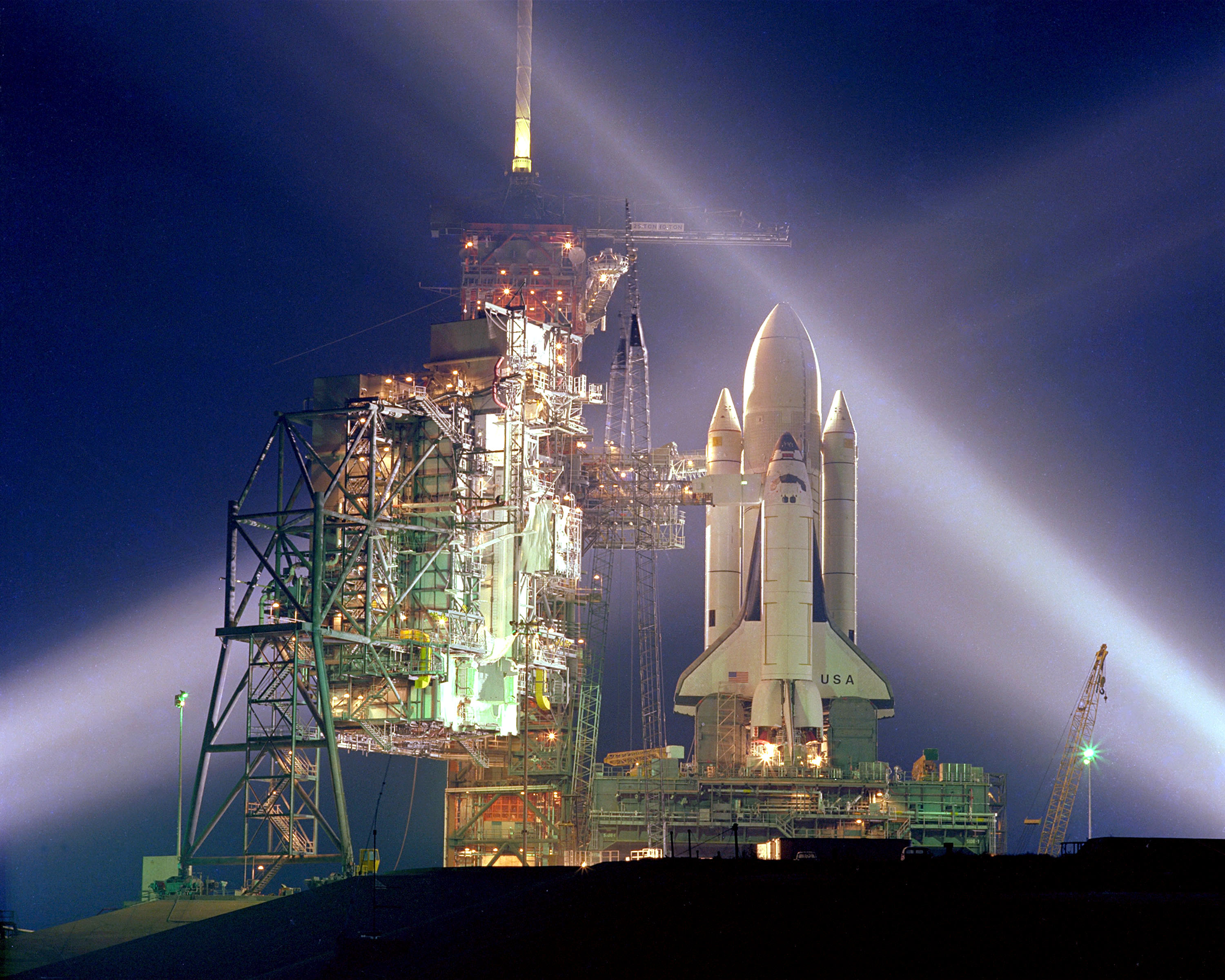
First Shuttle Launch, APRIL 12 1981 until 2011 We flew in Space

This article was done back in 2001.  April 12  The end of an era, Now we catch rides with the Russians and pay the arm and leg prices to get our Astronauts to the International Space Station.

See Explanation.  Clicking on the picture will download 
 the highest resolution version available.
STS-1: First Shuttle Launch
Credit: KSC, NASA
Explanation: On April 12, 1981, twenty years ago today, the space shuttle orbiter Columbia became the first shuttle to orbit the Earth. In this gorgeous time exposure, flood lights play on the Columbia and service structures (left) as it rests atop Complex 39's Pad A at Kennedy Space Center in preparation for first launch. Flown by Commander John W. Young and Pilot Robert L. Crippen, Columbia spent 2 days aloft on its check-out mission, STS-1, which ended in a smooth landing, airplane-style, at Edwards Air Force Base in California. Ferried back to Kennedy by a modified Boeing 747, Columbia was launched again seven months later on STS-2, becoming the first piloted reuseable orbiter. The oldest operating shuttle orbiter, Columbia's 1981 debut was followed by Challenger in 1982 (destroyed in 1986), Discovery in 1983, Atlantis in 1985, and Challenger's replacement Endeavour in 1991. This shuttle orbiter fleet has now accomplished over 100 orbital missions. Today also marks the 40th anniversary of the first human in space, Yuri Gagarin.

Thursday, March 29, 2012

Apollo Boosters founbd by Amazon's Founder

This is really cool, It would be interesting to see the condition of the boosters.

Apollo 11 Booster Found by Amazon's Jeff Bezos

Apollo 11 leaves for the moon, July 16, 1969. AFP/Getty Images
"Eleven, ten, nine, ignition sequence start. …"
It remains as one of the defining events of the last century: Apollo 11, on a pillar of fire from its five F-1 rocket engines, leaving for the moon in July 1969.
"… Three, two, one - all engines running - and liftoff on Apollo 11…."
The Saturn V booster generated 7.5 million pounds of thrust. The rocket lumbered into the sky. Two minutes later, as scheduled, its first stage dropped off and went tumbling into the Atlantic.
Among the hundreds of millions of people affected by Apollo 11 was a 5-year-old boy named Jeff Bezos - yes, the Jeff Bezos who grew up to found Amazon.com, one of the Internet's great success stories.
Now, he says, an expedition he funded has found the five booster engines with sonar lying in 14,000 feet of water off the Florida coast. He'd like to bring them back up, he says in a blog post; they belong in a museum.
"We don't know yet what condition these engines might be in - they hit the ocean at high velocity and have been in salt water for more than 40 years," Bezos writes. "On the other hand, they're made of tough stuff, so we'll see."
Bezos, who went to Wall Street before starting Amazon, remained, all the while, a space enthusiast. With Amazon humming along, he used some of his profits to start a company called Blue Origin. He's said very little about it, but it is one of the many companies competing to bring the efficiencies of private enterprise to space travel, "so that many people can afford to go and so that we humans can better continue exploring the solar system."
Amazon and Blue Origin may be hard-headed businesses, but Bezos admitted to sentimentality in his effort to recover the booster engines of Apollo 11.
"NASA is one of the few institutions I know that can inspire 5-year-olds," he wrote.  "It sure inspired me, and with this endeavor, maybe we can inspire a few more youth to invent and explore.

Thursday, February 16, 2012

50 years ago, America's first flight into space.

I liked John Glenn, he came along when we needed heroes.Climbing into a unreliable booster and strapping on a tincan took faith and a huge helping of guts.  He has been a sterling character since..although I wonder if he sold his vote to go on the shuttle during Clintons impeachment hearing.

The world was such a scary place in 1962 that there were actually Americans who volunteered to leave it.
The Cold War was at its most chilling. The United States had been embarrassed by the first Soviet satellite and the first Soviet cosmonaut. President John F. Kennedy asked his aides if there was something -- anything -- America could do to beat the Russians in space. NASA tried, but the Atlantic floor off Cape Canaveral was littered with the wreckage of failed rockets.
America did not just need better boosters, it needed bigger heroes. It found seven, the original Mercury astronauts. And the one with whom it most fell in love was John Glenn.
Fifty years ago, on Feb. 20, 1962, Glenn squeezed into his Friendship 7 capsule, circled the earth three times in five hours and became a national hero.
"Zero-G and I feel fine," he said from his spacecraft. "Man, that view is tremendous."
Historians' descriptions of the time describe a mood that seems almost alien now: a nation of people fearful of Soviet attack (the Cuban missile crisis would happen eight months later), glued to their black-and-white TV sets, watching a man in a silver spacesuit climb into a tiny capsule and disappear into the sky.
It was likened to single combat. The Soviets were Goliath. Glenn was David.
"We hadn't really thought that any nation could even touch us technically," Glenn said in a 1998 interview with ABC News. "And all at once, here was this bunch of Soviets over there, for heaven's sake, outdoing the United States of America in technical and scientific things."
After the flight of the Soviet cosmonaut Yuri Gagarin in May 1961, Kennedy had committed the United States to landing a man on the moon by the end of the decade. Glenn later said he wondered at the time how NASA would pull it off.
The Atlas rocket that would launch his Mercury capsule was famously unreliable; it had blown up on several test flights. The astronauts had volunteered to leave Earth, but they also planned to return.
Glenn named his spacecraft Friendship 7, honoring his fellow astronauts. He would make three orbits of the earth. His launch was scheduled and scrubbed no fewer than 10 times in four months.
The Flight of Friendship 7
And then it was launch day -- Feb. 20, 1962. Glenn woke early, had breakfast, put on his pressure suit and climbed into Friendship 7 before dawn. The countdown moved toward zero. In the control center, Glenn's backup pilot, Scott Carpenter, keyed a microphone and said, "Godspeed, John Glenn."
Glenn did not hear him; Carpenter was not on his radio link. Instead, he felt a jolt as the rocket left the launch pad. "Roger, liftoff, and the clock is running. We're under way."

John Glenn, the first American to orbit the Earth.
The Atlas did not fail. Five minutes later, he was in orbit.
The nation hung on every moment of his flight, one man, alone in the void, in a capsule so small (6 feet in diameter at the base) that he could not stretch out his arms. He reported that weightlessness was pleasant. He marveled at the "fireflies" -- later determined to be flecks of frost -- that drifted away from Friendship 7 when he rapped on the hull of the spacecraft.

John Glenn's Friendship 7 Spaceflight, 50 Years Later

Glenn was having a wonderful time. But then, trouble. As he began his second orbit, Mission Control received a signal suggesting that the heat shield, designed to prevent the capsule from burning up during reentry, had come loose. Worried controllers feared they might lose Glenn. They ordered him not to jettison the capsule's retro rockets, strapped on over the heat shield, after he fired them to descend from orbit.
The outside of the capsule heated to 3,000 degrees as the atmosphere slowed it. Glenn watched as chunks of debris flew past the window and wondered whether it was the retro pack breaking up, or the heat shield.
It held. He splashed down safely in the Atlantic Ocean. America had probably seen nothing so daring since the transatlantic flight of Charles Lindbergh.
Crowds mobbed him at a ticker-tape parade in New York. Kennedy, who saw Glenn's star power, welcomed him at the White House. He returned to work at NASA and lobbied for another flight, but the Kennedy administration had quietly let his bosses know he was too much of a national icon to risk in space again.
The Americans would gradually overtake the Soviets in space. Neil Armstrong walked on the moon in 1969. But we no longer live in the space age. Glenn has complained publicly that since the space shuttles were retired last year, America has not had a way to launch its own astronauts into orbit. And Glenn's mantle as hero has only taken him so far; a run for president in 1984 left him in debt for years.
John Glenn is 90 now, dividing his time between Washington and Ohio after a long career in the U.S. Senate. He and his wife Annie have been married for 69 years, slowed only by the inevitable maladies of age.
Glenn did, after years of lobbying, get to fly on a space shuttle mission in 1998. He was 77 by then, arguing that the effects of weightlessness -- bone and muscle loss -- are similar to the effects of aging. While he was in orbit he said he was having such a good time that he might like another flight after that, but Annie, visibly angry, put a quick stop to that.
"One thing I promised Annie the day we were married," he once said, "is I would do everything I could to keep life from being boring.

Friday, January 27, 2012

Apollo 1, The fire that shocked NASA,

This article was from Scientific American, Today was the 45 Anniversary of the fire that killed the crew of Apollo 1.  As an aviation junkie and space nut, this was a subject that in my younger years was hard to get information on.  There was scads of information on Apollo 11, a lot of info on Apollo 13 (and a movie) but little was known about Apollo 1.  Apollo 13 the movie with Tom Hanks did mention the crew and it was discussed a bit.  This was the first real mention of the Apollo 1 fire.

GPN-2003-00057
The Apollo 1 Command Module after the fire that claimed the lives of Gus Grissom, Ed White, and Roger Chaffee. Credit: NASA.
NASA s Apollo program began with one of the worst disasters the organization has ever faced. A routine prelaunch test turned fatal when a fire ripped through the spacecraft s crew cabin killing all three astronauts. Today marks the 45th anniversary of the Apollo 1 fire, a tragic and preventable accident. There were warning signs, similar accidents that had claimed lives both in the United States and abroad. The Apollo 1 crew could have been saved from a gruesome death.
Plugs Out
Gallery_Image_6447
L-R: Roger Chaffee, Ed White, and Gus Grissom training for their Apollo 1 flight. Credit: NASA.
The commander for Apollo 1 was Gus Grissom, one of the original Mercury astronauts whose first spaceflight was marred by his capsule s sinking after splashdown. He flew again in Gemini in a spacecraft he named Molly Brown. Senior pilot on the Apollo 1 crew was Ed White, a Gemini veteran who made America s first spacewalk in 1965. Rounding out the crew was pilot Roger Chaffee, a talented rookie more than capable of holding his own with his experienced crew mates. He was a notoriously good guy who took pains to thank everyone for their contributions to Apollo right down to the janitors.
By the end of January 1967, the crew was going through their final prelaunch tests; barring some major setback, they would make the first manned Apollo flight on February 21. One routine test NASA had done since Mercury was the plugs out test, a final check of the spacecraft s systems.
Apollo_One_CM_arrival_KSC
The spacecraft - Command Module 12 - arrives at the Kennedy Spaceflight Centre clearly destined for Apollo 1. Credit: NASA.
The spacecraft was fully assembled and stacked on top of its unfuelled Saturn IB launch vehicle on pad 34. The umbilical power cords that usually supplied power were removed the plugs were out and the spacecraft switched over to battery power. The cabin was pressurized with 16.7 pounds per square inch (psi) of 100 percent oxygen, a pressure slightly greater than one atmosphere. With everything just as it would be on February 21, the crew went through a full simulation of countdown and launch.
A full launch-day staff of engineers in mission control also went through the simulation. The White Room, the room through which the astronauts entered the spacecraft, remained pressed next to the vehicle. A crew of engineers monitored the spacecraft and were just feet away from the astronauts.
Bondarenko_valentin
Grissom, White, and Chaffee suited up and entered the Apollo 1 command module at 1pm and hooked into the spacecraft s oxygen and communications systems. For the next five and a half hours, the test proceeded with only minor interruptions. Grissom s complaint of a smell like sour buttermilk in the oxygen circulating through his suit was resolved after a short hold, and a high oxygen flow through the astronauts suits tripped an alarm. But these were minor problems and didn t raise any red flags in mission control.
The real problem was communication. Static made it impossible for the crew and mission control to hear one another. An increasingly frustrated Grissom began to question how they were expected to get to the Moon if they couldn t talk between a few buildings.
GPN-2000-001159
The Apollo 1 official crew portrait. L-R: Ed White, Gus Grissom, Roger Chaffee. Credit: NASA.
Just after 6:31 that evening, the routine test took a turn. Engineers in mission control saw an increase in oxygen flow and pressure inside the cabin. The telemetry was accompanied by a garbled transmission that sounded like fire. The official record reflects the communications problem. The transmission was unclear, but the panic was obvious as an astronaut yelled something like they re fighting a bad fire let s get out. Open er up or we ve got a bad fire let s get out. We re burning up. The static made it impossible to hear the exact words or even distinguish who was speaking.
But flames visible through the command module s small porthole window left no doubt about what the crew had said. Engineers in the White Room tried to get the hatch open but couldn t. It was an inward opening design, and neither engineers outside the spacecraft nor the astronauts inside were strong enough to force it open. The men in mission control watched helplessly as the scene played out on the live video feed.
S66-24522
The Apollo 1 crew in a less formal setting. L-R: Gus Grissom, Ed White, Roger Chaffee. Credit: NASA.
Just three seconds after the crew s garbled report of a fire, the pressure inside the cabin became so great that the hull ruptured. Men wrestling with the hatch were thrown across the room as flames and smoke spilled into the White Room. Many continued to fight their way towards the spacecraft but were forced to retreat as the smoke grew too thick to see through. In mission control, the telemetry and voice communication from Apollo 1 went completely silent.
An hour and a half later, firemen and emergency personnel succeeded in removing the bodies; Ed White was turned around on his couch reaching for the hatch. Over the next two months, the spacecraft was disassembled piece by piece in an attempt to isolate the cause of the fire. The full investigation lasted a year.
Apollo 1 recovery training
The Apollo 1 crew floats around during water egress training. Credit: NASA.
The Apollo 1 accident review board determined that a wire over the piping from the urine collection system had arced. The fire started below the crew s feet, so from their supine positions on their couches they wouldn t have seen it in time to react. Everything in the cabin had been soaking in pure oxygen for hours, and flammable material near the wire caught fire immediately. From there, it took ten seconds for spacecraft to fill with flames.
The crew s official cause of death was asphyxiation from smoke inhalation. Once their oxygen hoses were severed they began breathing in toxic gases. All three astronauts died in less than a minute. Many who had tried to save them were treated for smoke inhalation.
The Chamber of Silence
9600918
Astronaut Frank Borman's official Gemini era portrait. Borman was the astronaut's representative on the Apollo 1 accident review board. Credit: NASA.
The fire that claimed the lives of Grissom, White, and Chaffee is eerily similar to one that killed cosmonaut Valentin Bondarenko in 1961. Bondarenko was known to his colleagues as a congenial and giving man with great athletic prowess who worked tirelessly to prove he deserved the honour of flying in space.
Part of the cosmonauts training was done in an isolation chamber designed to mimic the mental stresses spaceflight. The room, which the men called the Chamber of Silence, was spartan to say the least. It was furnished with a steel bed, a wooden table, a seat identical to what they would have in the Vostok capsule, minimal toilet facilities, an open-coil hot plate for warming meals, and a limited amount of water for washing and cooking. The chamber was pressurized to mimic the capsule s environment in space. In this case, the oxygen concentration was 68 percent.
07pd0180
Ed White III touches his father's name on the Apollo 1 panel of the Space Mirror Memorial at the Kennedy Space Centre visitor complex. Credit: NASA.
During the test, cosmonauts would exercise mental agility with memory games using a wall chart with coloured squares. They would keep busy by reading or colouring subjects were supplied with some leisure material. The silence was frequently interrupted by classical music to see how the subjects reacted to a pleasurable shock. Aside from these distractions, sensory deprivation inside the chamber was absolute. The room was mounted on thick rubber shock absorbers that muffled any vibrations from movement outside, and the 16-inch thick walls absorbed any sound. The cosmonauts communicated with doctors by lights. A light told the subject to apply medical sensors to his body, and a light outside the chamber signaled to doctors that they could begin their tests. A different light would signal the end of the isolation test.
The environment was designed to challenge the cosmonauts mental stability and adaptability. But the hardest part was that no subject knew beforehand how long his test would last. It could run anywhere from a few hours to weeks.
070127_apollo1_crew_02
The Apollo 1 crew walks across the gantry before entering the spacecraft on January 27. Credit: NASA.
Bondarenko was the 17th cosmonaut to go into the Chamber of Silence and on March 23, his ten day test came to an end. A light signaled that technicians outside had started depressurizing the chamber to match the atmosphere outside. It was a routine part of the test, but this time it was interrupted by a fire alarm.
While he waited to leave the chamber, Bondarenko removed his biomedical sensors and wiped the adhesive off with rubbing alcohol on a cotton pad. In his haste to leave, and exhibiting the lack of concentration expected after ten days of mental testing, he didn t look where he threw the pad. It landed on the hot plate s coil. Cosmonaut Pavel Popovich theorized that he had been standing next to it at the time. Many subjects left the small heater on all the time to warm up the chilly room.
Dummy in Vostok seat Associated PressA dummy rides in a Vostok capsule seat. Credit: Associated Press.
A fire sparked and spread in an instant; everything, including Bondarenko, was saturated with a high concentration of oxygen. Technicians wrenched the door open and exposed the chamber to air, killing the fire instantly, but the damage was done. Doctors pulled a huddled and severely burnt Bondarenko from the room. It s my fault, he whispered when doctors reached him, I m so sorry no one else is to blame. The severity of the fire was immediately obvious. Bondarenko s wool clothes had melted onto his body and the skin underneath had burned away. His hair had caught fire. His eyes were swollen and melted shut.
In Moscow, surgeon and traumatologist Vladimir Julievich Golyakhovsky got a frantic call at his office; the severely burned patient was on his way. Ten minutes later, a team of men in military uniforms arrived carrying the blanket-wrapped cosmonaut. They were accompanied, Golyakhovsky later recalled, by an overwhelming smell of burnt flesh.
GPN-2000-001834
The damage to the Apollo 1 crew cabin, after the bodies were removed and before the disassembly began. Credit: NASA.
Bondarenko pleaded for something to kill the pain. Golyakhovsky obliged and gave the patient a shot of morphine in the soles of his feet. It was the one unscathed part of his body thanks to his heavy boots, and the only place the doctor could find a vein. There was nothing he could do to save the man s life. Bondarenko died the next morning. The official cause was shock and severe burns.
Lessons at Home
Parallels between the Apollo 1 crew s and Bondarenko s deaths are obvious, but how each space agency dealt with the deaths was very different. Grissom, White, and Chaffee were each given very public funerals in accordance with their respective military traditions. Bondarenko s death was kept secret, his identity covered by a pseudonym. Not until 1986 did the world hear the true story of his death. This has bred speculation that had the Soviet system been more open, NASA would have know about the dangers of training in a pressurized pure oxygen environment and could have saved the Apollo 1 crew. Former cosmonaut Alexei Leonov even suggested that the CIA knew about Bondarenko since the US had pierced the Iron Curtain before the accident.
But this is unlikely. And besides, NASA wouldn t need to look to the Soviet Union to know the dangers of testing in a pressurized oxygen environment. There were enough incidents in the US to make the danger very clear. Four oxygen fires in the five years before the Apollo 1 accident were proof enough.
ap1-apollo_1_noID_mc800x666
The Apollo 1 spacecraft nearing the end of the disassembly. Sometime towards the end of March, 1967. Credit: NASA.
On September 9, 1962, a fire broke out in a simulated spacecraft cabin at Brooks Air Force Base. The cabin was pressurized to 5psi with pure oxygen. Both subjects were protected by pressure suits. Neither sustained burns, but both were treated for smoke inhalation.
Two months later on November 16, four men had been inside the US Navy s Air Crew Equipment Laboratory for 17 days in an environment pressurized to 5psi of 100 percent oxygen when an exposed wire arced and started a fire. It spread rapidly over the men s clothing and hands for 40 seconds before they were rescued. All were treated for severe burns, and this was the only instance in which the source of the fire was identified.
Two Navy divers were killed on February 16, 1965 in a test of the Navy s Experimental Diving Unit, which was pressurized to 55.6psi to mimic conditions at a depth of 92 feet. It was a multi-gas environment: 28 percent oxygen, 36 percent nitrogen, and 36 percent helium. Somehow, the carbon dioxide scrubbers that were designed to remove the toxic gas from the air caught fire. Pressure inside the chamber rose making it impossible for technicians outside to open the door and remove the men.
funeral
Gus Grissom's funeral procession. Credit: NASA.
A 1966 oxygen environment fire came frighteningly close to anticipating the Apollo 1 accident. A fire broke out during an unmanned qualification test of the Apollo Environmental Control System on April 28. The cabin was pressurized to 5psi of 100 percent oxygen, just like the spacecraft would be in flight. The fire was blamed on a commercial grade strip heater inside the cabin and the incident was consequently dismissed. The commercial material would not be onboard any manned flights. The board that investigated the accident made no mention of the hazardous environment.
A Lack of Imagination
Apollo_1_patch
The Apollo 1 mission patch. Credit: NASA.
These accidents weren t secret. NASA knew the dangers of a pressurized oxygen environment, which has prompted conspiracy theorists to suggest that the space agency intentionally put the Apollo 1 crew in danger. But this was hardly the case. In truth, no one at NASA gave much thought to a fire in the spacecraft.
In the early 1960s when Apollo was in its preliminary stages, a dual gas system (likely oxygen and nitrogen) was proposed for the crew cabin. This would have been safer in the event of fire, but more difficult overall. A mixed gas environment requires more piping and wiring, which in turn adds weight. Pure oxygen was simpler, lighter, and was already familiar to NASA. The dual-gas idea was scratched.
NASA did address the possibility of a fire in the spacecraft, but only developed procedures for an event in space when the nearest fire station was 180 miles away. Apollo, like Mercury and Gemini, had no specific fire fighting system on board. The 5psi of oxygen in space was considered too thin to feed a significant fire. Anything that could spark in that environment could be taken care of with a few well aimed blasts from the astronauts water pistol.
grissom-funeral-life-cover-1967
Grissom's, White's, and Chaffee's death are the cover story of Life Magazine's February 10 issue. Credit: Life.
There was no procedure for a fire on the ground. With so many engineers on hand for every test, it was assumed that the astronauts would safe so long as fire extinguishers were nearby. But more importantly in the case of Apollo 1 is the plugs out test s status: it wasn t classified as dangerous.
Frank Borman, a Gemini veteran who would go to the Moon on Apollo 8, served as the astronaut s representative to the Apollo 1 accident investigation board. He made this point about the plugs out test s status abundantly clear. I don t believe that any of us recognized that the test conditions for this test were hazardous, he said on record. Without fuel in the launch vehicle and all the pyrotechnic bolts unarmed, no one imagined a fire could start let alone thrive. Borman himself hadn t thought twice when he went through the plugs out test before his Gemini 7 mission. He was confident in NASA and its engineers and stated on record that he would have gone through the Apollo 1 test had he been on the crew.
A1prayer
The Apollo 1 crew expressed their concerns over the Apollo spacecraft in a joke crew portrait. They said a little prayer, and gave the picture to the manager of the Apollo Spacecraft Program Office Joe Shea in 1966. Credit: NASA.
Borman alluded to the Apollo 1 crew s shared confidence. There had been problems with Apollo w development, and every astronaut had the right to refuse to enter a spacecraft. Although there are sometimes romantic silk-scarf attitudes attributed to this type of business, in the final analysis we are professionals and will accept risk but not undue risks, explained Borman. The Apollo 1 crew felt the dangers were minimal.
With that statement, Borman identified what he considered the crux of the problem and the real reason, however indirect, behind the death of the crew. We did not think, he said, and this is a failing on my part and on everyone associated with us; we did not recognize the fact that we had the three essentials, an ignition source, extensive fuel and, of course, we knew we had oxygen.
LC34plaque2A plaque commemorating the Apollo 1 crew on what's left of launch pad 34. Credit: Christopher K. Davis (via Wikipedia).
Gus Grissom serendipitously wrote his memoirs during the Gemini program. He addresses the inherent risk of spaceflight in the book s final passage. There will be risks, as there are in any experimental program, and sooner or later, inevitably, we re going to run head-on into the law of averages and lose somebody. I hope this never happens but if it does, I hope the American people won t feel it s too high a price to pay for our space program. None of us was ordered into manned spaceflight. We flew with the knowledge that if something really went wrong up there, there wasn t the slightest hope of rescue. We could do it because we had complete confidence in the scientists and engineers who designed and built our spacecraft and operated our Mission Control Centre… Now for the moon.
Though tragic, their deaths were not in vain. The substantial redesigns made to the Apollo command module after the fire yielded a safer and more capable spacecraft that played no small role in NASA reaching the moon before the end of the decade. It is a fitting tribute to the crew that the plaque on the pad where they perished reads ad astra per aspera a rough road to the stars.