I get news from commercial airplane incidents from a 3rd party source. No, I am NOT picking on American Airlines, this could have happened to any of them. The crew did a bang up job handling it quickly and professionally, hats off to them. I will see if I can get a more detailed report in several months. I grabbed this for educational purposes only.
Lithium batteries, which power everyday devices, can catch fire if damaged or if battery terminals are short-circuited. Devices containing lithium metal batteries or lithium-ion batteries, including – but not limited to – smartphones, tablets, cameras, and laptops, should be kept in accessible carry-on baggage. If these devices are packed in checked baggage, they should be turned completely off, protected from accidental activation, and packed so they are protected from damage. Requirements vary based on the type of device and size of battery, and on the air carrier’s restrictions.
Spare (uninstalled) lithium metal batteries and lithium-ion batteries, portable rechargers, electronic cigarettes, and vaping devices are prohibited in checked baggage. They must be carried with the passenger in carry-on baggage and remain accessible. Smoke and fire incidents involving lithium batteries can be mitigated by the cabin crew and passengers inside the aircraft cabin.
If carry-on baggage is checked at the gate or planeside, spare lithium batteries, portable rechargers or power banks, electronic cigarettes, and vaping devices must be removed from the baggage and kept with the passenger in the aircraft cabin. Even in carry-on baggage, these items should remain accessible and be protected from damage, accidental activation and short circuits. Battery terminals should be protected by manufacturer’s packaging or covered with tape and placed in separate bags to prevent short circuits.
Damaged, defective, or recalled lithium batteries, or recalled devices containing lithium batteries, must not be carried in carry-on or checked baggage as they are likely to be a safety concern by overheating or catching on fire.
When in doubt, leave it out.
Check the FAA’s Pack Safe website for the rules on carrying different types of battery-powered devices, such as luggage trackers, mobility aids, or personal electronics, and other dangerous goods in baggage.
On our planes we have special bags above the first aid/AED kits for the "runaways" The crew places the device in the bag and seal it to cut off the oxygen and handle it in a similar manner.
American A319 at Atlanta on
Sep 29th 2026, laptop and cell phone caught fire
Last Update: October 2, 2026 / 19:51:22 GMT/Zulu time
An American Airlines Airbus
A319-100, registration N749US performing flight AA-1400 from Miami,FL to
Atlanta,GA (USA), was descending through 15000 feet towards Atlanta when the
crew declared emergency reporting a laptop and a cell phone had caught fire in
the cabin. Cabin crew contained the devices in a galley cart, the flight crew
requested emergency services to meet the aircraft in case the device
re-ignited. The aircraft landed on runway 09R about 15 minutes later.
The aircraft returned to service about 10 hours after landing.
Before covid, I was part of a study group with my employer and they had realized that 1/3 of the technicians we had would be eligible to retire in the next 5 years, and that was a scary proposition to an airline that had developed a reputation for a topnotch maintenance facility in the commercial airline world as well in the MRO world. So we had started putting feelers to all the aviation schools in the southeast and near our feeder hubs. We had learned it takes 5 years for a AMT to get totally qualified in our processes and procedures, go through our airplane schools and get qualified in each type we have in our fleet. so we started preparing for the future exodus.....then Covid happened and a lot of people took the very generous package to get off our payroll. so a lot of experience walked out the door, we had set the groundwork but the scarcity of AMT's (Aviation Maintenance Technicians) in the industry is a thing, Not only were we scrambling to refill the pipeline, so was everyone else. We have high standards., lawndarts are bad for company stock ya know. Not only do you have to have an A&P license to work here as an AMT, you also have to pass mechanical aptitude test, and believe it or not, not every A&P mechanic passes those....and the ever popular *Pee in a cup* test, you won't believe the number of people flunk that little item too.
So yeah it is hard rebuilding, and it didn't help that for years the kids were told, "go to college, get a degree," so a lot of kids are sucked into the educational industrial complex and a a lot of them quit, because they might have been better off going to a tech school, but a lot of guidance counselors view "blue collar" type of jobs with distain and derision. Yeah a lot of those blue collar jobs pay 6 figure salaries if you don't mind getting your hands dirty. I have made a hell of a good living for myself and my family working a blue collar job and the knowledge can't be done by robots or A.I. certain jobs have to be done by people.
I snagged this from Aviation week.
The growth rate of newly trained aviation maintenance professionals shows that the industry’s efforts to attract talent are paying off, but looming retirements and projected industry expansion continue to pressure the technical workforce pipeline, a new report concludes
Leading the list of positive signs was the 11,103 new FAA airframe and powerplant (A&P) mechanic certificates issued in 2025, according to the latest Pipeline Report, jointly produced by Aviation Technician Education Council (ATEC) and Oliver Wyman. The figure is both a record and a 23% jump over 2024’s figure.
Part 147 aviation maintenance technician schools (AMTS) drove much of the growth, generating 7,496 of the new A&Ps—a 27% jump over 2024 and also a new annual high, the report said. Enrollment was up 13%, it added.
“The overall growth trend and underlying drivers are encouraging signs that industry is making progress in its effort to expand and diversify the technical workforce pipeline,” said ATEC Executive Director Crystal Maguire. “We need to continue building momentum to meet both near-term and long-term demand needs, and that includes ensuring we’re attracting sufficient resources as well as workforce candidates.”
While the growth rates are strong, they are not enough to close the projected workforce gap. Oliver Wyman forecasts demand for 25,000 more North American aviation technical personnel than the industry will have, including 9,100 certificated mechanics. By 2030, the certificated mechanic deficit is projected to reach approximately 20,000, or 12% of anticipated demand.
Industry efforts to attract more candidates focus on driving up Part 147 school throughput, increasing military-to-civilian transitions and exposing more high school students to aviation career paths.
The Part 147 success has fostered new challenges, such as convincing enough qualified instructors to teach instead of working in the industry or staying retired, a survey completed as part of the report’s data-gathering found. Funding for required equipment necessary to teach and test students is also an issue, respondents said.
Military transitions into an FAA A&P license increased 5% to 1,375, but still fall well short of the estimated 20,000 qualified candidates that leave the armed forces each year.
Programs targeting high school students are growing as well. A recent Government Accountability Office report identified 43 high schools that offer aviation maintenance coursework, including 37 that are part of Choose Aerospace, the ATEC sister organization that developed an FAA standards-based high school curriculum.
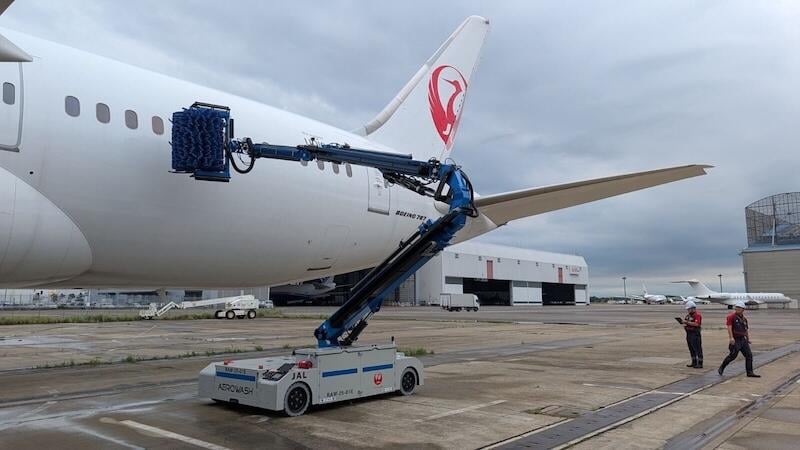
As a person that has scrubbed many airplanes early in my career as a Aviation Painter and as an "Chemtrail Technician" I can see the advantages, from a consistent quality to a dirth of injuries from repetitive motion because scrubbing an airplane is hard work and usually the people that normally get that kinda job are not "Mensa Candidates" I can see it spreading to other airlines as it matures and the track records is proven.
I got this from "MRO Digest"
Credit: Japan Airlines
SINGAPORE—Japan Airlines (JAL) has introduced a robotic aircraft-washing system at Tokyo Narita International Airport, seeking to improve washing efficiency and reduce water consumption.
The remote-controlled aircraft-washing robot, called AW3, was developed by Swedish company Aerowash and is undergoing operator training. It is scheduled
to enter into full service by the end of 2026. It is the first deployment of the system in Japan.
The AW3 can be used on a range of narrowbody and widebody aircraft, including the Boeing 737, 767 and 787, as well as the Airbus A350. The system uses preprogrammed coordinates for different aircraft types, allowing its robotic arm to autonomously move to designated areas of the airframe, including the main wings and tail sections.
Aerowash says the system can reduce aircraft washing time by up to 40% compared with conventional manual methods, while cutting water consumption by as much as 50% per aircraft.
JAL currently conducts aircraft washing manually at night, using long-handled mops and specialized chemical agents. The airline previously tested a wired remote-controlled washing system in the 1990s, but said technical limitations prevented it from being introduced into regular operations.
damm, forgot to put a title on this one.....was rushed.
Some Background, the "ATR Series" of aircraft is a regional turboprop built in France/Italy and utilized around the world for regional service and has a good reputation for reliability and safety.
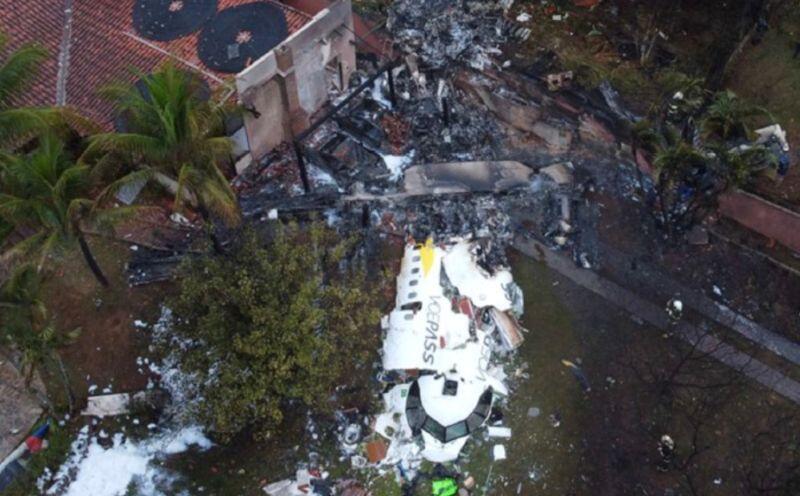
Here is the "WIKI" details on the flight in question."VOEPASS Flight 2283" We in the aviation industry study all accidents to ensure that the accidents and incidents improve the industry and makes it more difficult for the next accident to happen. The statistics bear it out. Flying is safer than driving.
Credit: CENIPA
LYON—All 62 occupants of a Voepass Linhas Aereas-operated ATR 72-500 died on Aug. 9, 2024, because of reckless behavior by the carrier’s managers, maintenance technicians and pilots, Brazil’s air accident investigation bureau has determined.
In its final report on the accident, Brazil’s Aeronautical Accidents Investigation and Prevention Center (CENIPA) found abundant evidence of safety lapses within the company, which it described as contrary to the safety standards upheld by the air transport industry.
Brazil’s national civil aviation agency (ANAC) suspended Voepass’ operations in March 2025, after it noted persistent problems at the regional turboprop operator. ANAC permanently revoked Voepass’ air operator certificate in June 2025. CENIPA’s recommendations target ANAC, as the supervising body for air transport in Brazil, and the European Union Aviation Safety Agency (EASA), and suggests improvements to ATR aircraft.
The final report says the crew knowingly flew the aircraft into severe icing conditions, although it was not certified for such circumstances and the airframe deicing system was inoperative. The resulting ice accretion increased drag, triggered alerts and eventually caused a stall. Voepass Flight 2283 originated in Cascavel, in the state of Parana, and was bound for Guarulhos, in the state of Sao Paulo. The crash took place in Vinhedo, in Sao Paulo state. None of the four crew members or 58 passengers survived.
The report describes the widespread violations of safety rules and common-sense obligations in maintenance activities as “jaw-dropping” for a company that operated 15 commercial turboprops.
“At some secondary bases, limitations in maintenance resources were identified, as well as ... restrictions on access to the aerodrome apron due to the lack of airport credentials,” CENIPA says, noting the mechanics had only a few hours, usually during the night-shift period, to perform corrective and preventive maintenance on the aircraft.
CENIPA says technicians performed maintenance in a superficial manner, without completing the required documentation and delegating critical activities to assistants without proper oversight. Some of them did not have the right qualifications to understand a manual’s content, the report says.
Standard Practices
Aircraft may be dispatched with inoperative systems, as long as they comply with their minimum equipment list (MEL). CENIPA points out that at Voepass, this was standard practice, not the exception, adding that some malfunctions were recorded as resolved, without the corrective action being performed.
“There was also the practice of replacing an inoperative component with another known to be malfunctioning and dispatching the aircraft for flight,” CENIPA’s investigators said. “As a consequence, a new malfunction entry would be recorded on the subsequent flight, allowing a new dispatch based on the MEL.”
The investigation found deficiencies in flight crew and managerial behaviors in which pilots routinely did not report malfunctions in the technical logbook, a deviation encouraged by the company. That was the case with the accident aircraft’s airframe deicing system, the investigators noted. Pilots and maintenance technicians just communicated verbally—another aspect of an organizational culture the investigators describe as permissive.
Between 2022-24, ANAC issued notices of irregular condition to Voepass and suspended several aircraft from flight. CENIPA investigators determined ANAC’s risk management process was insufficient for the strategic decisions that would have been necessary, and the agency’s report recommends a revision of ANAC’s methods.
The CENIPA report also says Voepass’ managers, including those in charge of safety, failed to use flight data monitoring. The ATR 72’s aircraft performance monitoring (APM) system issues three levels of advisories when it detects the effects of icing: Cruise Speed Low, Degraded Performance and Increase Speed. Those alerts indicate a performance degradation due to ice accumulation on the aircraft’s surfaces. CENIPA compared Voepass’ data with that of five other ATR 72 operators and found Voepass had significantly more frequent occurrences of such alerts than its counterparts. Pilots did not always activate protection systems after ice was detected, they add.
The day before the crash, the aircraft’s airframe deicing system malfunctioned and the crew attempted three resets, without success. “After the first system reset and the occurrence of a new failure, the flight crew should have followed the deicing airframe fault procedure, which instructed the crew to exit icing conditions, avoid them and turn off the system,” CENIPA investigators said. The pilots informed the maintenance team verbally, which did not check or repair the system.
Accident Sequence
The system failed again on the day of the accident, during the two flights that preceded the accident. Fault messages were displayed accordingly. The crews, including the one operating the accident flight, did not follow the deicing airframe fault procedure. Faced with speed alerts (Degraded Performance and Increase Speed), the crew who would later operate the accident flight only requested a descent to FL140 (approximately 14,000 ft.), from FL160. Air traffic control approved the request, and the speed alert warnings eventually disappeared. The crew’s response, however, did not comply with the standard procedure, which includes increasing airspeed, the report says.
Before the accident, the flight crew and Voepass’ operations control center had access to a weather forecast of severe icing along the planned flight route. They took off despite the predicted conditions and the airframe deicing system’s known malfunction, which stemmed from the right wing boots. During the climb, crossing FL130, the aircraft’s electronic ice detector indicated ice accumulation. The pilots did not follow the prescribed procedures for the deicing system’s fault or the three successive speed alerts from the APM system. The recommendation was to exit the likely severe icing conditions immediately, since aircraft performance and maneuverability would be severely affected after only a few minutes of exposure. After a stall warning, the crew did not follow the stall recovery procedure and lost control.
CENIPA recommends that EASA engage with ATR and consider an improvement in the Degraded Performance speed alert procedure. Speed should be increased by a greater margin above the minimum maneuvering speed in icing conditions. Moreover, ATR could extend the use of the Low Bank mode, which prevents the increase in stall speed due to aircraft bank angle, the investigators suggest. The flight data recorder should register more parameters, including deicing system failure. The Increase Speed alert should be upgraded to a Warning message, up from Caution, the investigators add.
Since the accident, ATR has designed a new version of the APM system software, which EASA certified in June 2025. Speed alerts are now based on the airspeed margins relative to the minimum maneuvering speed in icing conditions, rather than the theoretical airspeed values, CENIPA says. In a simulation, the last Degraded Performance alert was activated 31 seconds earlier than in the accident flight.
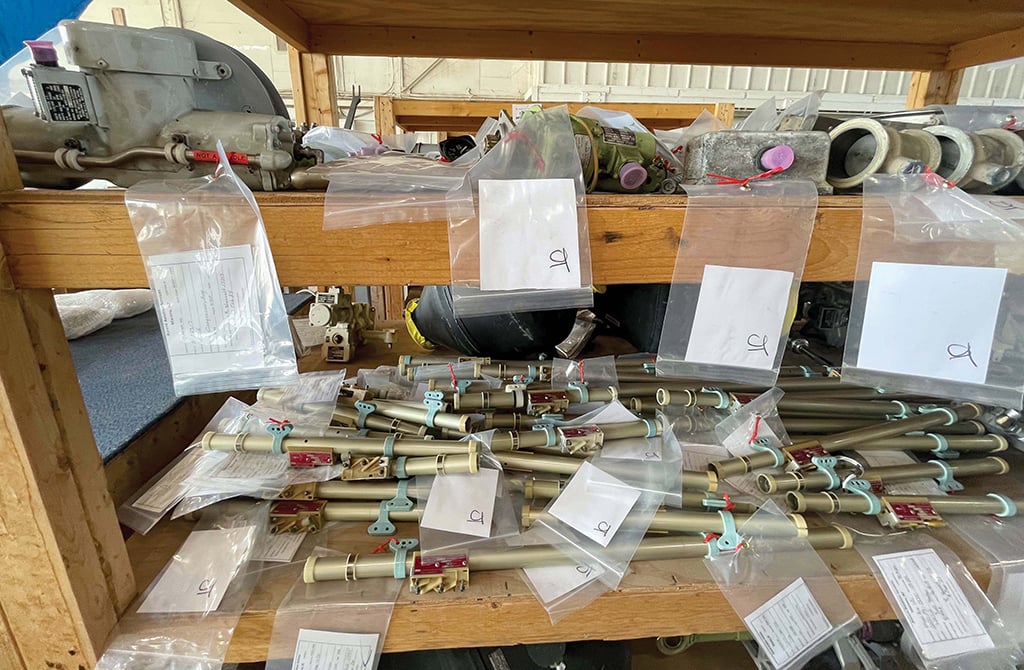
I had "blogged" several times about fake parts in the MRO supply system in the commercial aviation world, to put a part on a plane and have the repair recognized as "Legal" by the FAA and the EASA and other aviation regulatory bodies that control the commercial fleet of their respective countries, but they have reciprotive agreements across borders, like for example an "8130" is recognized around the world and is accepted. EASA has their own versions and it also carries the same weight. So if a part has that serviceable tag on it, it is considered "good to go" and meets the strict standards of the aviation world and is "airworthy" and safe to use and put on a plane that will carry passengers. The parts are engineered to last literally years under normal use unless the manufacture has a scheduled maintenance check on the part where it is removed and sent to a shop to be tested and most of the time routed to inventory for the next plane or sometimes it has to be repaired. The standards are strict for a reason and the parts are expensive. and the airlines accept it as the cost of doing business. Now you get some unscrupulous dirtbag that get bad parts make fake tags, cleans the parts up so they look like new and sells them as "repaired" or "overhauled", the profit margins are huge, almost like drug cartel huge. Hence the attraction. Now a lot of the bad parts are sold to 3rd world airlines where oversite is far less stringent and "under the table remuneration is a way of life".
I pulled this from "Aviationweek"
Airlines and MRO providers should be on the lookout for non-airworthy engine parts after 12 containers were fraudulently redirected from their intended destination, the European Union Aviation Safety Agency (EASA) has warned.
Spain’s National Aviation Authority informed EASA that a consignment of formally
declared non-airworthy turbofan parts was rerouted in late January 2026 from its destination.
The shipment consisted of 12 containers of engine parts, three of which contained critical or life-limited parts. These parts had not been rendered unairworthy by the contracted mutilation provider.
The theft covered more than 600 parts across four engine families: the CFM International CFM56, the IAE V2500, the Pratt & Whitney PW1100G, and the Rolls-Royce RB211.
EASA warned that the scale and method of the theft indicated the parts may be offered for sale on the open market.
It encouraged owners, operators and maintenance organizations to inspect their aircraft and inventories for the referenced part numbers and corresponding serial numbers; if any are found they should be removed and quarantined.
The notice appeared roughly a month after former techno DJ Jose Zamora-Yrala was jailed for four years by a British court for trading 60,000 parts with falsified documentation through his company, AOG Technics.
Airlines were forced to ground aircraft with AOG parts installed. While no in-service incidents were linked to the suspect parts, the disruption cost operators an estimated $53 million, the UK Serious Fraud office said.
The recent theft shows several similarities to that case, with low-value parts like bearings and seals targeted as well as an extensive array of serial numbers from the world’s most popular engines: the CFM56-5B and -7B.
Given tight supply and elevated pricing for legitimate parts, incentives exist for criminal activity in the aftermarket, although the industry will hope to avoid a repeat of the disruption and negative publicity generated by the AOG Technics case.
That case led to the creation of Aviation Supply Chain Integrity Coalition, an industry body that has recommended more investment in digital records, and wider adoption of electronic authorized release certificates (eARCs).
I have been super busy, and I still have a rant percolating, especially about those brain dead college student and their "professional Activist" handlers.
I wanted to get a post up last Sunday but I wound up sleeping 13 hours...I guess I am was tired.
These fake parts are a big deal, this is how we keep our "Airworthiness" Certificate on our airframes and engines. Several airlines got bit hard by these fake parts and it causes problems, especially when the cost of parts go up and there are supply chain issues so airlines are looking for parts wherever they can to keep their planes flying.
Forged paperwork helped AOG Technics pass off thousands of apparently used CFM56 parts as new.
Credit: Sean Broderick/AW&ST
The Canadian regional jet operator’s emailed request was routine—the airline needed six check valves. Florida-based parts broker Sofly Aviation Services went to work, soliciting quotes from other vendors. The distributor also went looking for valves in “as-removed” condition, meaning they have not been inspected or tested.
Sofly soon received a quote for new valves at $3,850 per valve. The quote included an FAA 8130-3 airworthiness approval document, or tag, issued by the part’s Arizona-based supplier indicating the valves were new—a common move to reassure would-be parts purchasers before they buy. Sofly also found a source for as-removed valves.
Sofly had everything it needed. The vendor bought as-removed valves for $300 each. It then relabeled them as new and sold them to the Canadian carrier—at new-part prices—supplying the 8130-3 tag from the new-part quote to back the deal.
The fraudulent transaction, one of several that took place over seven years, helped set the stage for guilty pleas by two Sofly executives in a case brought by the U.S. Justice Department, court filings show. The case against Sofly, which ended in the March 2024 pleas, underscores the challenging—some would argue impossible—task facing a recently formed supply chain integrity coalition.
Engine manufacturers GE Aerospace and Safran and their CFM International joint venture spearheaded formation of the Aviation Supply Chain Integrity Coalition (ASCIC) in February. Airbus, American Airlines, Boeing, Delta Air Lines, StandardAero and United Airlines are also part of the group.
The effort is a direct response to a more well-known records falsification scandal. UK-based distributor AOG Technics sold thousands of engine parts with forged regulatory approvals—8130-3s and European Union Aviation Safety Agency (EASA) Form 1s—until one customer caught on last summer (Inside MRO November 2023, p. MRO20).
Much like the Sofly case, forged mandatory paperwork appears to have been the key to AOG Technics’ fraud.
The scandal came to light last July when technicians at TAP Maintenance & Engineering flagged some GE CF6 bushings purchased from AOG Technics. Paperwork shipped with the parts suggested they were new, but the TAP mechanics suspected otherwise.
GE confirmed that documentation provided with the parts was fraudulent, and a subsequent FAA notice detailed some of the findings. The document listed the part as a “bushing.” But GE’s common terminology for the form is “bushing shrd (IGV),” states the FAA notice sent last September. Language also was missing from the form’s “user/installer responsibilities” block. “GE does not remove boilerplate language from the FAA Form 8130-3,” the FAA notice adds. The FAA also flagged boxes not grayed out on the CF6 forms that should be grayed out “for new articles.”
TAP soon found more AOG-supplied parts with forged documents.
CFM, GE and Safran alerted customers and regulators immediately, and both EASA and the UK Civil Aviation Authority issued notices in early August. A month later, the companies—eager to identify the issue’s scope and receiving little assistance from the authorities—filed suit against AOG, demanding transaction records and other possible pieces of evidence.
In all, some 200 forged documents shipped with thousands of otherwise legitimate parts, ranging from nonserialized fasteners to turbine blades, were discovered in the supply chain. Some made it into engines.
The UK Serious Fraud Office in early December opened a criminal investigation and raided AOG Technics’ London offices.
While hardly the first instance of criminal activity related to aviation parts, the AOG Technics case grabbed global headlines—and caught suppliers’ attention. CFM pledged last fall to dig into what, if anything, industry can do to reduce opportunities for parts fraud. The coalition was formed to lead that effort.
Companies are expected to follow a specific process to ensure used parts are properly tested and cataloged. Credit: Lindsay Bjerregaard/AW&ST
Coalition representatives meet every other week. In between, they seek input from other subject matter experts—a list that has been growing—coalition co-chair and former NTSB Chair Robert Sumwalt says.
“As we learn of other entities and organizations that can provide value, we’re bringing them in,” he says. “There has been a lot of interest from people in the industry that are coming to us saying that they’ve got something to offer.”
One source providing input is the Aviation Suppliers Association (ASA). Aside from serving as the primary industry voice for parts providers and distributors, the ASA also developed a standard, ASA-100, and a related audit program for companies that choose to comply with the FAA’s voluntary industry distributor accreditation laid out in Advisory Circular (AC) 00-56B.
Introduced in 1996 via the original AC 00-56, the FAA’s program was industry’s response to a wave of concern over unapproved—then often called “bogus”—parts. The ASA followed with ASA-100, providing a standard, third-party program to match.
More than 760 companies are ASA-100 certified. Other regulators, including EASA and the Civil Aviation Administration of China, have similar, voluntary programs. While they can add a level of legitimacy to a distributor’s resume, such programs cannot prevent crime.
“We will always have fraud,” ASA President Michele Dickstein says. “We need to make sure that we have increased the safeguards to protect against fraud and that we have the reaction skills to bring it to light very quickly if it happens.”
Sarah MacLeod, executive director of the Aeronautical Repair Station Association, sees the AOG Technics case as instructive. Forged paperwork got suspect parts to MRO shop floors, but calling a used part new did not fool a technician’s wary eye.
“A knowledgeable technician can pick up a part and go through a technical evaluation of whether or not it is any good,” MacLeod says. “We have agencies that are hell-bent on having their pieces of paper and only their pieces of paper. That opens another avenue for criminal activity and makes it easier for them, because we’re looking for paperwork. A piece of paper doesn’t make a part airworthy.”
Airworthiness is determined not by some approved manufacturing or repair process backed by documentation but rather by a combination of circumstances, she adds. For example, one airworthiness directive (AD) can render a new, genuine engine part sitting on a shelf with proper paperwork unusable.
“I can have the best paperwork in the world, and the FAA issues an AD against the part. Guess what? I’ve got an approved part that I can’t install,” she says. “So what can we do? Educate people to look beyond the paperwork. Educate them on what they are doing, why they are doing it and the cost of failure.”
While preventing individuals from committing fraud is a high bar, the coalition is confident that it can help strengthen parts distribution protocols.
“I think everybody is aligned with the notion that what happened with AOG Technics is totally unacceptable and cannot be allowed to happen again,” Sumwalt says.
Both Sumwalt and ASCIC co-chair John Porcari emphasize that their main goal is to balance thoroughness with expediency. Understanding how the aircraft supply chain and programs such as the FAA’s voluntary distributor accreditation program works is the first step.
“It’s fair to say we’re deep into the research phase at this point,” says Porcari, a former U.S. Transportation Department deputy secretary.
From there, “we’re going to let the facts drive where we go,” Sumwalt says. “We want to learn the issues.
“The next phase will be to draft a report,” he adds. “We’re going to take our time and do it right. That said, we’ve got an aggressive time frame to make sure that we get these recommendations out in a timely manner.”
The coalition plans to have a report ready by year-end.
“The common goal is meaningful, actionable measures that can come out of this,” Porcari says. “This is a coalition of the committed. On the safety and quality assurance side, there’s always more work you can do. I think this is an acknowledgement of that.”
Similar issues had been seen by other airlines and were dealt with quietly. Not in this case: Qatar Airways CEO Akbar Al Baker, known for rejecting aircraft deliveries over tiny cabin imperfections, would not have it. Airbus was going to fix this or pay dearly. He stopped taking more A350s and brought the case in front of a London court while the Qatari Civil Aviation Authority grounded the affected aircraft. More escalation? Impossible.
As it turned out, the dispute was the last public drama of an exciting career spanning 27 years as CEO at the airline. Eight months later, the airline announced “the appointment of a new group chief executive," frankly, someone even insiders did not know: Badr Mohammed Al Meer, so far chief operating officer of Doha’s Hamad International Airport. In other words: Akbar will be gone very soon. The change will become effective on Nov. 5, though industry sources say the leadership transition will continue until the beginning of next year.
Al Baker, 62, is the longest-lasting current CEO of a major airline. It was also him who made Qatar Airways into a major airline in the first place, having taken it over with only a few aircraft in its fleet. Al Baker turned Qatar into a second Emirates—similar, but different. The airline is operating a large hub connecting long-haul services to long-haul.
Unlike Emirates, it also has a narrowbody fleet and is a member of one of the global alliances, Oneworld, and has stakes in several carriers abroad—among them Cathay Pacific, China Southern Airlines, International Airlines Group and LATAM Airlines.
Qatar Airways' status of one of the most important buyers of aircraft, connected with its shareholdings, made Al Baker one of the most powerful figures in the industry. His departure likely marks the beginning of fundamental change for the airline.
According to industry sources, Al Baker did not leave voluntarily at this time. People who know him well say he would have liked to continue for longer and would have been very interested in becoming chairman of the airline. But his superiors, mainly Chairman Saad Sherida Al Kaabi—a powerful figure who is also Qatar’s energy minister—thought otherwise.
To this day, Al Baker micromanaged essentially everything of relevance at Qatar Airways. When his airline hosted the IATA annual general assembly in 2014, he would personally drive CEOs of other airlines around in a golf cart through the airport terminal, making sure they arrived at their gates comfortably in the middle of the night. A few days before, he had broken his arm in a car accident. But he simply would not delegate anything.
Corporate governance was simple: Al Baker would decide everything. This was not what Al Kaabi wanted for the future, the sources said. The chairman wanted to establish a new governance structure that was not 100%-focused on Al Baker, with stronger checks and balances. No middle ground could be found.
The A350 case is a good example of where the airline’s weaknesses lie. In Toulouse, key Airbus executives do not to this day understand how things went so badly wrong with Al Baker after the first paint deficiencies were discovered. In Doha, members of Al Baker’s management team tried desperately to gently steer him toward compromise. After all, an airline the size of Qatar Airways cannot operate without a relationship with one of the two big manufacturers. The higher-ups in Doha noticed, too, and it is said that the settlement was the result of talks between the state of Qatar and France.
It is sadly ironic that the conflict in which Al Baker wanted to demonstrate his powers may have contributed to his departure.
Compromise was never his thing, as many others in the industry including Boeing and numerous airline colleagues can recollect. And it did not get better: When Al Baker hosted another IATA meeting in 2022, he stated in some of his speeches that many airlines let their customers down during the pandemic—not so Qatar Airways, of course. Many colleagues were outraged that he misused the stage he was given by the association in such a way. Some of his peers simply stood up and left. Emirates Airline President Tim Clark stopped talking with him some time ago.
Al Baker was often brutally honest about what he really thought. When asked at an IATA event whether a woman could do his job, he said no. A woman could not do his job, he said, because his job was so difficult. That did not go down well, to put it mildly.
As much as people were offended and afraid, many also admired his achievements.
Following the departure of such a powerful figure, Qatar Airways will have to reinvent itself. A new corporate governance has to be established—along with a management team that is actually empowered, with Al Meer at the top. His experience as an airport manager will help, but the key will be the transformation of the airline into a more normal company.
What is unlikely to change is Qatar Airways' positioning as a major player in the industry—this mandate given by its government has not wavered.
I thought this was interesting, the Mad Mullah's are really flexing their muscles on the region especially that they perceive as the United States as weak and divided(And we are ) this will embolden them to continue to be the bully of the region.
Credit: Nigel Howarth/AWST
Iran is likely the source of a recent uptick in navigation failures caused by spoofing of GPS receivers in commercial aircraft near its borders, the head of U.S. Air Forces in the region said on Oct. 4.
“The closer you get to Iran, the more clear it is to me that it’s probably the Iranians who are responsible for that,” Lt. Gen. Alexus Grynkewich told reporters. “As to the particular element in Iran [who is responsible], I wouldn't be sure.”
The FAA released a warning to operators last week after receiving reports of higher GPS spoofing activity affecting commercial aircraft on airways near the Iranian border in Iraq and the Caucasus region.
Other reports received by Ops Group, a flight information service, said that some flight crews also saw their inertial reference systems malfunction on the same corridors.
Grynkewich, the commander of U.S. Air Forces in Central Command, said that U.S. military aircraft flying over Syria routinely encounter electromagnetic interference that affects their navigation and communication systems.
“Depending on the platform that is operating, we've got a variety of tactics, techniques and procedures to mitigate it, whether it's changing a frequency or changing an altitude or upgrading to a different antenna for the GPS,” he said.
The region’s airspace ranks among the most contested in the world in the electromagnetic spectrum, he added. In Syria, so many factions are engaged in electromagnetic sparring that it is often difficult to know the source of the attack.
“It's really hard to establish attribution in Syria, in particular, with a number of actors that are there,” Grynkewich said. “There's probably a lot of people that are doing it.”
I am still working scads of overtime and it will continue until late October so bear with me.
The Russians are pulling out of the "CR929" program...I wonder how the plane will perform compared to Boeing and Airbus. My gut feeling is that the plane will be much cheaper, but not as reliable as the Boeing and Airbus offerings...but 3rd world airlines will buy it trying to get something on the cheep and those countries that are beholdin to the Red Chinese will buy them also.
Russia has confirmed it is exiting its CR929 joint venture with China.
Credit: Imaginechina Limited/Alamy
When Russia invaded Ukraine 18 months ago, Russia’s aviation industry was immediately identified as a target for Western sanctions: Flight connections were cut, and support and parts supply stopped. Moscow refused to return hundreds of commercial aircraft that Western lessors wanted back.
Although it is difficult to obtain much reliable information about the true state of spares supply and the safety of in-service aircraft, details that have been leaked are worrying and show that keeping Russia’s airliner fleet safely operational is becoming more challenging by the day. The long-term structural consequences of Russia’s isolation are also reverberating across commercial aircraft programs that involve some international cooperation. The latest victim is the CR929 widebody project with China.
Western sanctions are impeding Russia's capabilities
Further delays affect the MC-21 and Superjet programs
United Aircraft Corp. (UAC) CEO Yury Slyusar earlier this month confirmed for the first time that UAC is no longer a partner in the CR929 joint venture. Although the decision has been made, undoing the joint venture will likely take considerable time, since it involves changing agreements between the governments of China and Russia.
Beijing has not commented on the change of plans. The CR929 has accumulated years of delays and is not expected to enter service until well after 2030 due to lengthy negotiations about sharing work and intellectual property. For months, reports indicated that China had decided to pursue the widebody on its own. Keeping a sanctions-ravaged partner on board would make the project even more difficult.
Russia still hopes to remain involved. Slyusar says Russian industry plans to continue with the program as a normal supplier and builder of the composite wing, PD-35 engines and other subsystems for the aircraft. Although China is not participating in international sanctions against Russia—Comac could, in theory, engage in an industrial partnership with a Russian aerospace company—it is unclear how Western suppliers could take part, given the level of integration work, cooperation and information-sharing in aircraft programs. Potential Western suppliers affected include Eaton, Honeywell, Liebherr, RTX, Safran, Thales, Zodiac Aerospace and an engine manufacturer. In addition to the Russian PD-35, China plans to use the indigenous Aero Engine Corp. of China CJ-2000 engine in development. For many systems, the CR929 would initially rely on Western specialists.
China and Russia formed the China-Russia Commercial Aircraft International Corp. (CRAIC) in 2017, following years of preparatory work. The aircraft is to be offered in three versions, seating between 250 and 320 passengers in typical configurations.
Separately, deliveries of Yakovlev’s Irkut MC-21 will slip further than expected by the Russian government, which is financing the program. “We hope that the first six aircraft will be handed over to Aeroflot in the beginning of 2025,” Anatoly Gaidansky, Yakovlev’s first deputy general director, acknowledged in a podcast with the Moscow Aviation Institute on Aug 13.
Under production plans that Moscow approved in mid-2022, Yakovlev was expected to hand over the MC-21s in 2024 and roll out 270 of them through 2030.
These six MC-21s were initially scheduled to arrive at Aeroflot subsidiary Rossiya Airlines by the end of 2022. The government has extended the deadline for two more years to give the manufacturer additional time to substitute imported components after Western suppliers withdrew from the program.
The MC-21 program gained approval for the Russian PD-14 turbofans and a Russian-made composite wing in December 2022 but still needs to replace many other Western systems, including actuators, avionics and air conditioning, Gaidansky explained.
He said the MC-21 prototype with 70% substituted Western-made equipment would fly beginning in December 2023. The fully import-substituted version, dubbed MC-21-310RUS, is to make its first flight in April 2024 and then receive its supplemental type certificate by the end of that year.
Meanwhile, Aeroflot CEO Sergey Alexandrovsky confirmed in an interview to Russia’s Vedomosti daily newspaper that the airline plans to firm up orders for the first 18 MC-21-310RUS and 34 import-substituted Sukhoi Superjet New (SJ-100) regional jets in September through the Avia Capital Service leasing company. Aeroflot Group placed a preliminary order for 89 SJ-100s, 210 MC-21s and 40 Tupolev Tu-214 aircraft last September.
The group expects to receive the first two SJ-100s by year-end, but those deliveries are also at risk due to the protracted certification process. According to UAC’s Slyusar, deliveries might not start until 2024, which means the manufacturer needs more time to complete the SJ-100 development. The first partially substituted SJ-100 is expected to fly in September. It should be followed by another prototype that will test only Russian-made PD-8 engines and another aircraft in a fully Russian-made configuration. The SJ-100 is planned to be certified before year-end.
I have been super busy with Overtime and have been unable to blog, sleeping is been more my interest since returning from Florida.
The War in the Ukraine has raised havoc with the Russian Commercial Aviation Industry, and they have bent the rules like a pretzel trying to keep flying.
Credit: Sipa US/Alamy Live News
Russia’s two largest airline groups—government-controlled Aeroflot Group and privately owned S7
Airlines—are calling on Moscow to legalize wet leasing in the country.
Wet
leasing—when one airline provides an aircraft with crew, maintenance
and insurance to another airline, which pays by hours operated—is
prohibited in Russia.
“An
airline can’t use an aircraft of another carrier for its flight now
unless it has a codeshare agreement for this particular route,” Fyodor
Borisov, a senior expert at the
Institute of Transport Economics and Transport Policy Studies at
Moscow’s HSE University, tells Aviation Week.
Russia’s
Federal Air Transport Agency, or Rosaviatsiya, banned wet leasing at
one time because it misinterpreted ICAO recommendations on safety
threats in operational leasing,
of which wet leasing is a variant, Borisov says. “But the ICAO document
explicitly states that, given the liberalization in the aviation
transport sector, the volumes of operational leasing will increase, and
this should be taken into account when developing
national requirements,” Borisov continues. To legalize wet leasing,
amendments would need to be made to existing federal aviation
regulations.
Speaking
at the St. Petersburg International Legal Forum (SPBILF 2023) earlier
in May, Anna Khomyakova, the head of Aeroflot’s legal department,
advocated in favor of legalizing
wet leasing. She argued it could open up options to carriers which have
taken financial hits due to external factors, such as Western sanctions
and the pandemic. Wet leasing aircraft out would help maintain fleets
and workforce, providing stability for a certain
period due to a guaranteed flow of lease payments, she said.
“There
is [also] an opportunity for the lessee to make up for the shortage of
the aircraft [in its] fleet when new destinations appear and passenger
traffic grows,” Khomyakova
added.
Maxim
Astafiev, deputy general director for legal support of the S7 group,
backed rival Aeroflot’s position. “Today this form of contractual
relations is in high demand,” Astafiev
says.
Borisov
says both Aeroflot and S7 would benefit from the legalization of wet
leasing as it would allow them to redistribute aircraft more freely
between their AOCs, which they
are currently doing on dry lease—minus crew.
In
the event of legalization, aircraft could be wet leased outside of
airline groups as well, which could mitigate against the gradually
shrinking number of airworthy aircraft
within Russia due to the shortage of spare parts and maintenance
services. Despite the problems the country’s airlines are contending
with, the Russian government expects carriers to maintain services and
increase passenger traffic by 6%, up to 101.2 million
people, in 2023.
As
Russian airlines struggle to maintain their fleets, “there is a risk
that more countries, including such popular destinations with Russian
leisure and business travelers like
Turkey and the UAE, may not allow Russian operators’ flights into their
airspace due to the unknown airworthiness condition of their aircraft,”
warns Seattle-based aviation consultant Boris Rybak. A recent white
paper from the Flight Safety Foundation (FSF)
called on states not to allow Russian flights into their airspace if
they could not provide adequate safety oversight of Russian-operated
aircraft.
The
Russian government is working to expand the country’s international air
service beyond the 22 countries where Russian airlines can currently
fly to, and in May opened up service
to Georgia. Further expansion is limited as long as airspace over
Europe, the U.S. and Canada remains closed to Russian carriers, while
the use of Russian-operated commercial aircraft outside the country is
restricted either by western sanctions or because
of their dual registration.
Legalizing
wet leasing could help Russian carriers keep international operations,
Rybak suggests. Wet leasing has been used in the past by other nations
placed under sanctions
or which have experienced airworthiness problems. Iran used to operate
Tu-154 and Il-62 passenger aircraft wet leased from Russia and other
post-Soviet states until the end of the 2000s. And in Cuba, Cubana de
Aviacion still attracts foreign aircraft under
wet lease contracts to operate international flights when it runs out
of airworthy airliners.
However,
the sources of wet leased aircraft for Russia are particularly limited.
A European leasing expert tells Aviation Week that European companies
would not risk providing
their aircraft to Russian operators due to the risk of secondary
sanctions. “Everything which involves Russian money is toxic,” he says.
Rybak
says the aircraft needed for Russian international services are likely
to be wet leased from friendly states with proven airworthiness.
Relationships like this have already
formed on the maintenance side. In April, Aeroflot sent one of its Airbus A330-300 widebody airliners to Iran for technical maintenance for the first time
I had "Blogged" about Russian aviation sending their commercial aviation assets to Iran for heavy maintenance, as Russia tries to keep their western based planes flying. The longer this goes on the harder it will be to reconcile the planes with the manufacturer and the recommended maintenance schedule. I'm pretty sure those plane will wound up being scrapped,
Any hope of a quick resolution in the Russia-Ukraine war is long gone.
Nearly 15 months and counting since Russia invaded its neighbor, the
idea that anything affected can be easily reset to its pre-war status is
gone, too. That includes the war’s ramifications on commercial
aviation.
The wave of sanctions that Russia’s invasion triggered had immediate
consequences for the country’s airline industry. Belarus, which served
as a base for the invasion, has been hit, too.
Forget adding new or used Western-built aircraft to the Russian or
Belarussian fleets. Everything from spare parts to airworthiness
directives are no longer available legally for the existing fleets.
This means hundreds of aircraft—the backbone of Russia’s commercial
fleet—could no longer be maintained to internationally agreed-upon
standards. The restrictions extend to some Russian-built aircraft
because of theirreliance
on Western suppliers.
The sanctions came with flight bans that have gutted Russia’s route
networks. Russian carriers moved 25% fewer people in 2022 than 2019, a
recent Carnegie Endowment analysis found. The share of international
traffic has fallen from 43% to 10%—a direct result
of the sanctions.
As the figures show, however, the sanctions, while damaging, have hardly put Russia on acommercial
aviation island. Aeroflot’s website shows flights to a handful
countries beyond Russia’s borders, including China, Egypt, India,
Thailand, Turkey, and the United ArabEmirates.
As a recent white paper from the Flight Safety Foundation (FSF) points
out, permitting Russian carriers—or any carrier, for that matter—to fly
into your airspace is far more than a political decision. It’s a
regulatory one, with ramifications.
“State regulators have an obligation to carry out effective oversight
over foreign operators flying in their territory, with closer scrutiny
on aircraft registered in sanctioned states,” FSF noted.
The reasons are simple. Without access to spare parts and technical support, sanctioned carriers are forcedto
get creative.
“The disrupted supply of components may result in affected air operators
from Russia and Belarus stripping parts from parked planes or being
tempted to explore alternative unapproved sources or parts in order to
continue flying,” FSF said. “Parts may even be
swapped out and find their way to the [maintenance] facilities,
possibly being accepted by regulators with weak oversight or those that
lack the engineering competence to further scrutinize the paperwork.”
Software updates, which are fairly common on today’s advanced air
transports, are no longer available. Russia’s official response? Permit
aircraft on its registry to operate without them.
It’s not clear how regulators in the countries Russian carriers are
still permitted to operate are handling their oversight obligations.
FSF sees little room for error.
“With the large number of prolonged sanctions, as well as U.S. Export
Controls currently in place on Belarus and Russia, state regulators
worldwide need to be fully aware of the current international sanctions
in effect and their implications on aviation safety,”
the foundation said. “States unable to adequately ensure safety and
provide adequate safety oversight—particularly of aircraft registered in
sanctioned states—should not allow these flights into their airspace.