Webster

The Constitution was made to guard the people against the dangers of good intentions." --American Statesman Daniel Webster (1782-1852)


Showing posts with label WWI. Show all posts

Wednesday, April 5, 2023

5 WWI Machine Guns that Changed Warfare Forever.

 I saw this article and snagged it while reading another one.  I will post that one tomorrow.  


   I used the "Sand Pebbles" image, besides using The Sand Pebbles image, I loved that movie.  I had adopted a quote from that movie The "Cup of Rice" explanation, you have to watch the movie to understand the reference.  but I remember Steve McQueen's character using the "BAR" like a bad ass.

 At the outbreak of the First World War, most of the machine guns employed by the major powers were large and heavy. Ideally suited to defense, few were actually light enough to be used in an offensive advance.

The weight of such small arms, and the fact that many were water-cooled to keep the barrel from overheating, made these impractical in an assault. However, military planners quickly considered ways to provide greater mobility along with sustained fire.

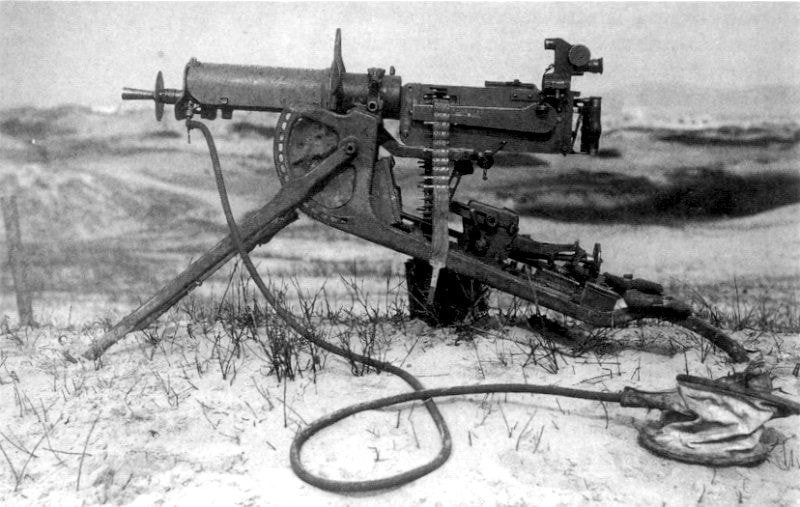
Germany: MG08/15 Machine Gun

Image: Creative Commons.

The Germans saw the effectiveness of their MG08 machine gun and in 1915 developed a version for offensive use. The MG08/15 replaced the rear spade grips with a pistol grip and wooden buttstock. It also featured a short bipod rather than the heavy four-legged sled mount. However, it retained the bulky water jacket, which resulted in a weapon that weighed nearly 40 pounds and that was without water in the jacket or ammunition.

While it wouldn’t be considered “lightweight” it did provide far greater mobility than the MG08. It first saw widespread use during the Second Battle of Aisne in April 1917.


Despite its shortcomings, it was the most common German machine gun deployed during the war with more than four times the number of MG08/15s than the original MG08. An air-cooled version was tested during the final months of the war, but because the barrel couldn’t be quick-changed it overheated quickly.

Germany: Bergmann MP18


Image: Creative Commons.

It took until the final months of the war for Germany to actually introduce a more compact weapon, but in the process the Germans also created a new category of small arm: the submachine gun. Designed by noted firearms pioneer Theodor Bergmann, the Maschinenpistole 18/I fired the 9x19mm Parabellum pistol round, originally from a 32 round Luger drum magazine. It had a rate of fire from 350-500 round per minute, making it an ideal weapon for trench assaults.

The weapon proved ideal for the Germany’s late war strategy, which sought to break the enemy lines. The MP18 was widely employed in the Kaiserschlacht offensive. More than 25,000 were produced and most were issued to the newly formed companies of “Sturmtruppen” (“Storm Troopers”), who were charged with smashing an enemy position to allow the regular infantry to then overwhelm the defenders.

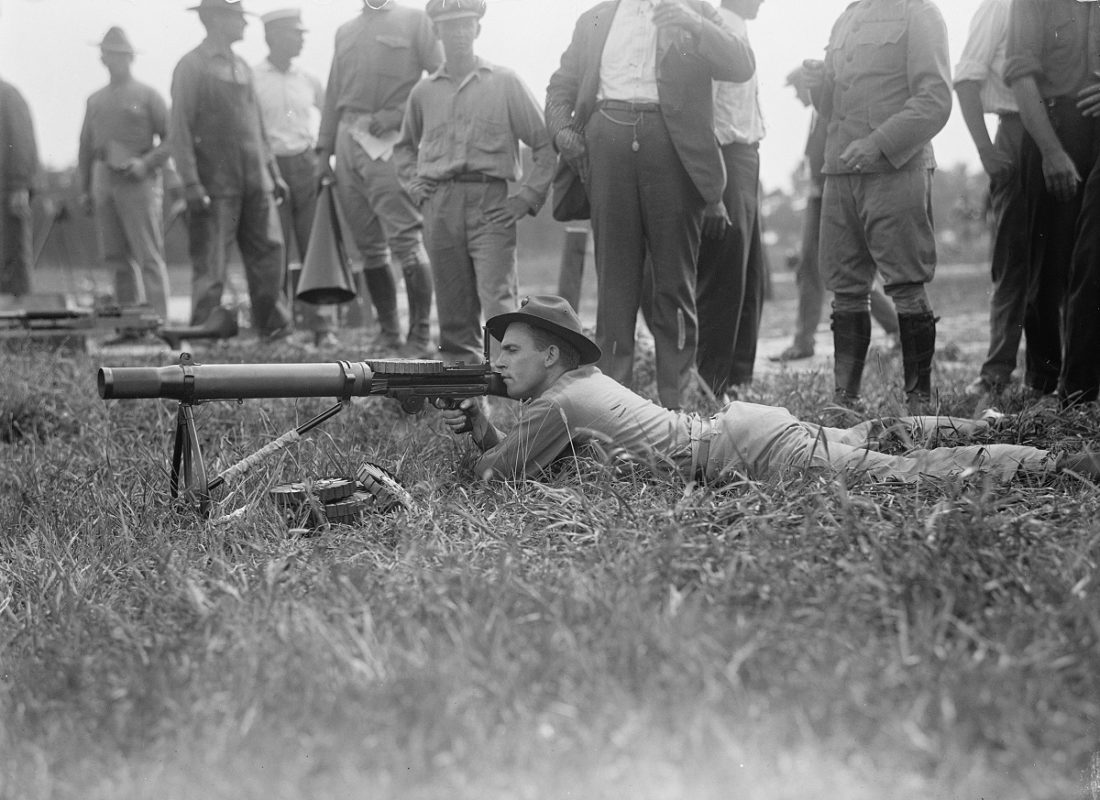
Great Britain: Lewis Gun


Star Wars Guns

U.S. Marines field tested the Lewis machine gun in 1917.

The Lewis Gun has become an almost iconic British machine gun, which is actually a bit ironic as it was designed by the United States before the war broke out. It was passed over by the U.S. Army largely for political reasons, but the U.S. Army’s loss was a gain for the British, which saw the potential with the portable machine gun.

The gas-operated machine gun features the unique “pan” magazine mounted on the top, and was able to maintain a sustained rate of fire of 500-600 rounds per minute. The Lewis Gun had an effective range of up to 800 meters and a maximum range of 3,200 meters. At 28 pounds it was a bit lighter than the German MG08/15. One reason for the lighter weight is that didn’t feature a water jacket – rather the barrel-shroud was designed to draw in air while radial fins acted as a heat sink.

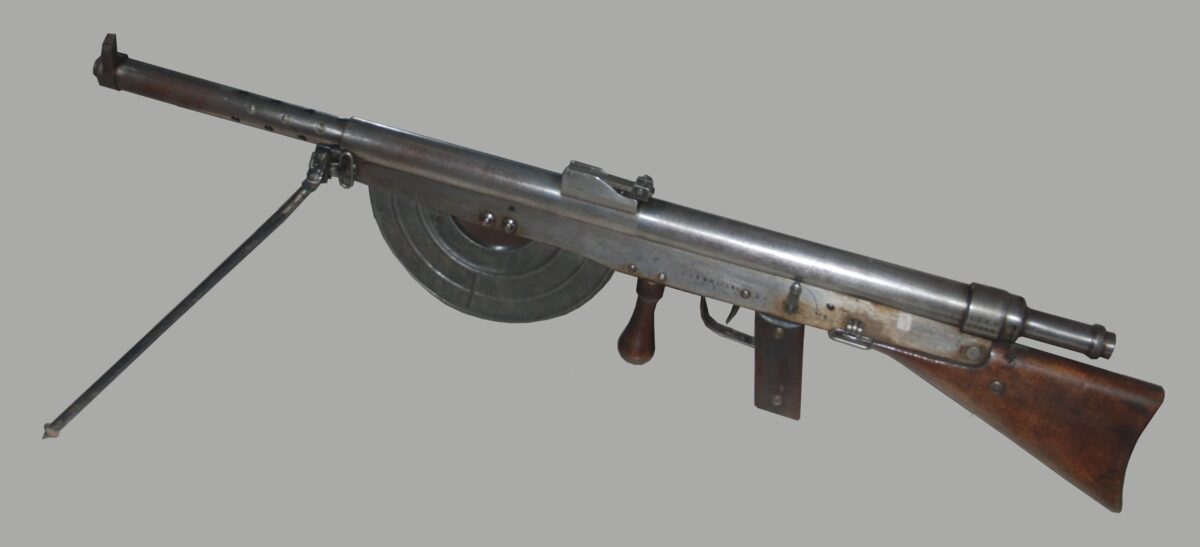
France: Fusil Mitrailleur Modele 1915 CSRG – Chauchat

Image: Creative Commons.

This weapon has earned the reputation of being “the worst machine gun ever made,” but its critics typically highlight the weapon’s shortcomings and overlook its innovative features. When it was introduced in 1915 it became the first successful squad automatic rifle, and provided a rate of fire of 240 rounds per minute while it weighed in at just over 20 pounds. It was among the first automatic weapons to utilize a pistol grip and forward grip – features now common in modern assault rifles. If anything the Chauchat was a bit ahead of its time, and a weapon that needed a bit more refinement.

Likewise, it is true the open magazine allowed dirt and grime to foul the action, but this was common with many belt-fed weapons. The assessment that it was a bad design may be owned to American soldiers who criticized the weapon, but this was due in part to the fact that the version adopted by the U.S. military was chambered for the.30-06 cartridge, which caused performance issues.

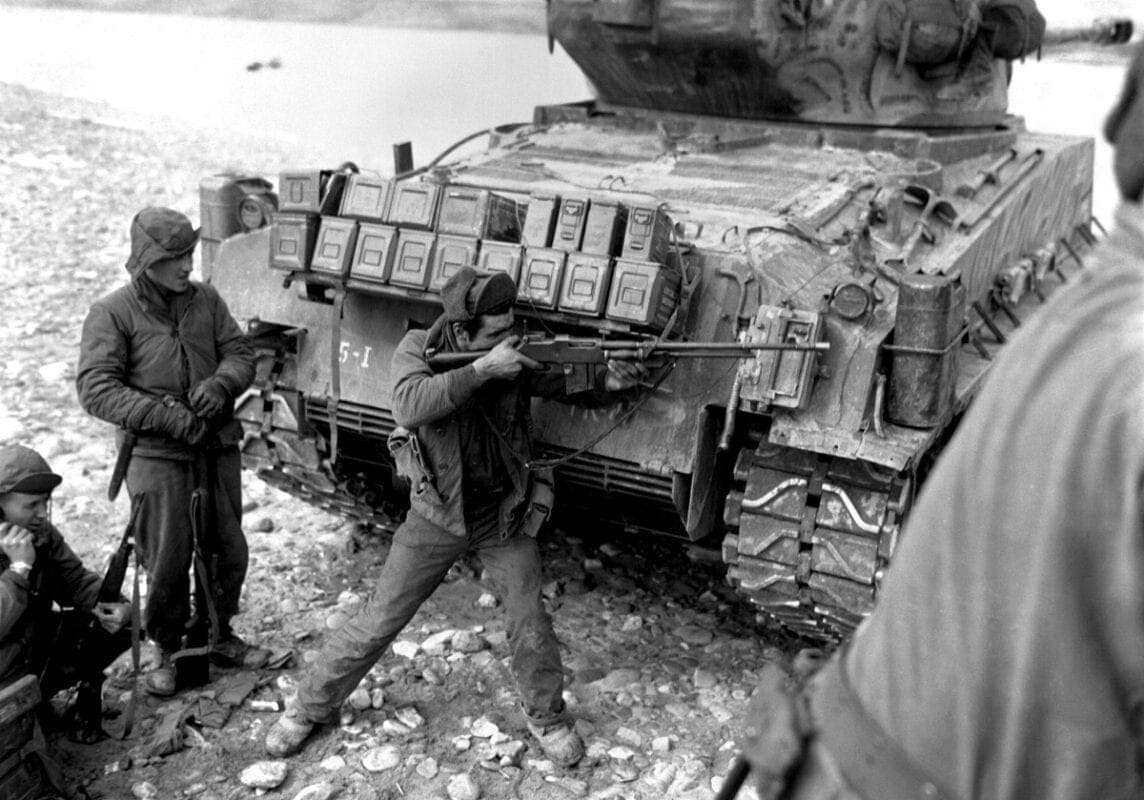
United States: M1918 Browning Automatic Rifle


Taking cover behind their tank escort, one man of this ranger patrol of the 5th RCT, U.S. 24th Infantry Division, uses his BAR to return the heavy Chinese Communist small arms and mortar fire which has them pinned down on the bank of the Han River. At left another soldier uses a field radio to report the situation to headquarters. NARA FILE#: 111-SC-358782

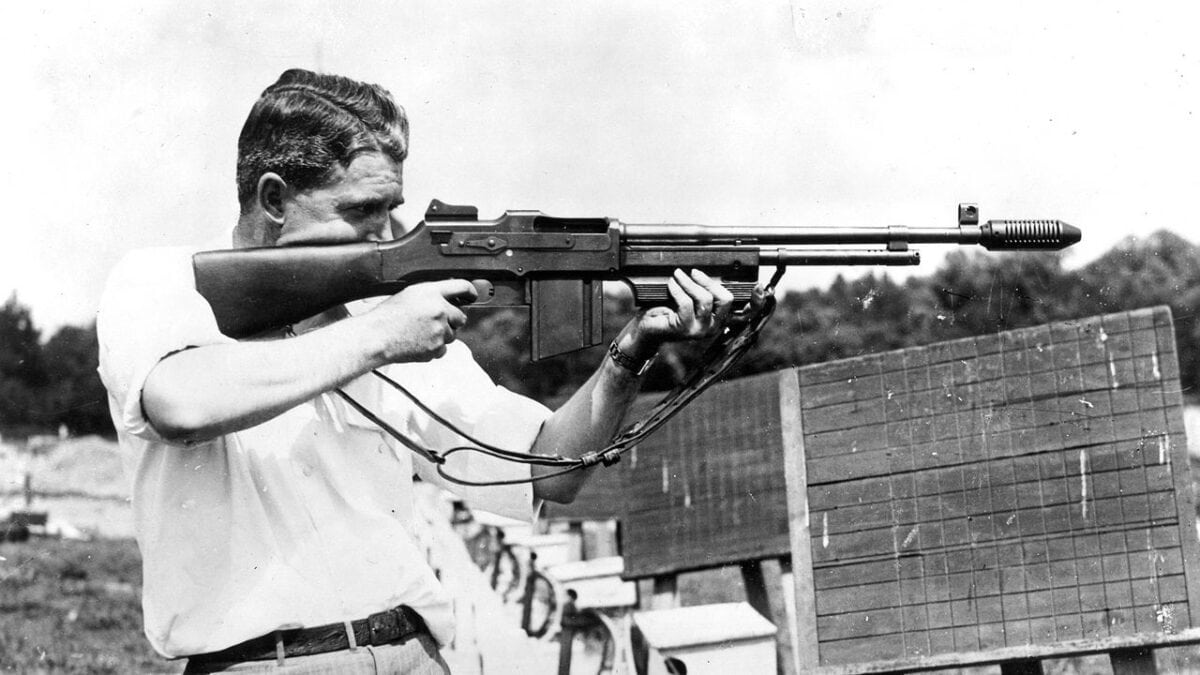
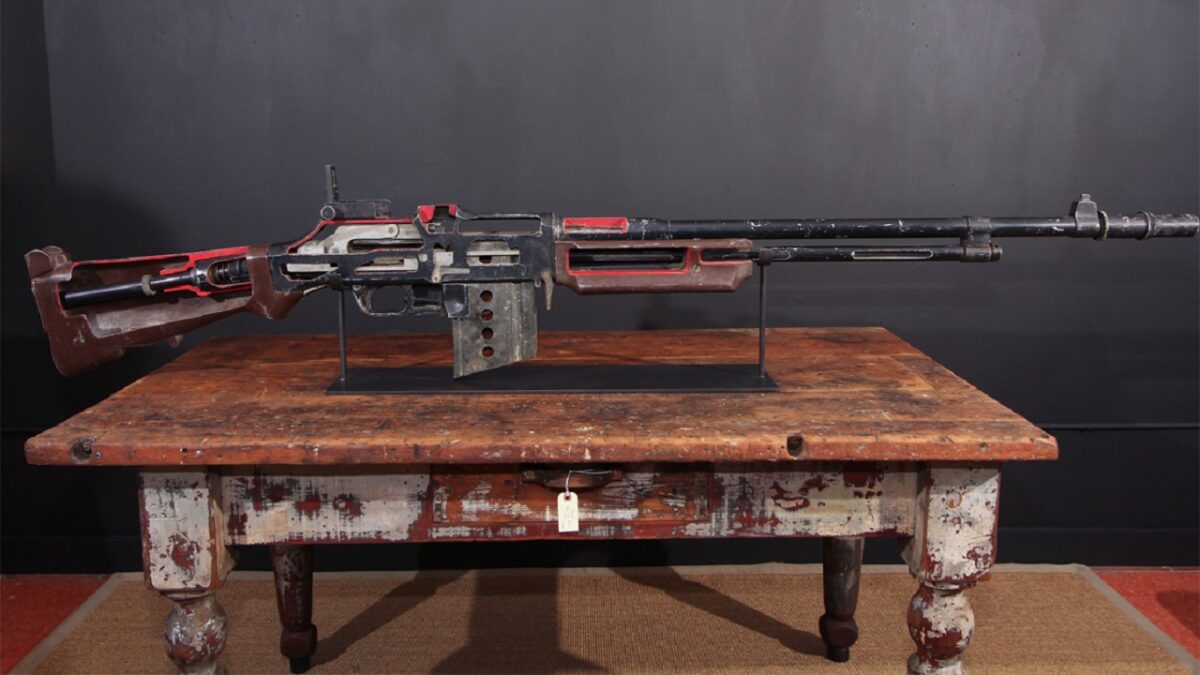
In addition to designing the M1917 machine gun, which greatly improved upon the Maxim design, prolific firearms designer John Browning also created what was arguably the best automatic rifle of the era, the BAR or Browning Automatic Rifle.

An American civilian wanting to own a genuine full-auto Browning Automatic Rifle will have to bring a bankbook to purchase one

An American civilian wanting to own a genuine full-auto Browning Automatic Rifle will have to

 bring a bankbook to purchase one.

Browning Automatic Rifle

Browning Automatic Rifle. Image Credit: Creative Commons.

It successfully provided an infantryman with walking fire during an assault and it was considered so revolutionary that the American military actually held back its use in fears that the Germans might capture one and copy it. For that reason, the BAR didn’t become standard issue until 1938 when it was issued as a portable light machine gun.

The gas operated automatic rifle could provide a rate of fire of 500-600 rounds per minute and had an effective range of 1,300 meters. Had the First World War dragged out into 1919 and beyond there is little doubt the U.S. military would have deemed it necessary to bring the BAR to the front in mass. There were almost 52,000 BARs on hand for the spring offensive that never came, but the BAR went on to serve in World War II, the Korean War and even the early stages of the war in Vietnam.


Saturday, December 31, 2022

How Did The M1917 Enfield Compare to the 1903 Springfield?

 I ran across this article, There is something about Old school Battle Rifles, Sure I like the Plastic Fantastics, Or I did until that durn Canoe accident....But there is something about an old school Battle Rifle.  The History I suppose and if those Rifles could talk, the stories they could tell.  I own a Springfield 03 or I did before that durn Kayak and I can see the attraction, it is considered the epitome of an excellent Rifle.


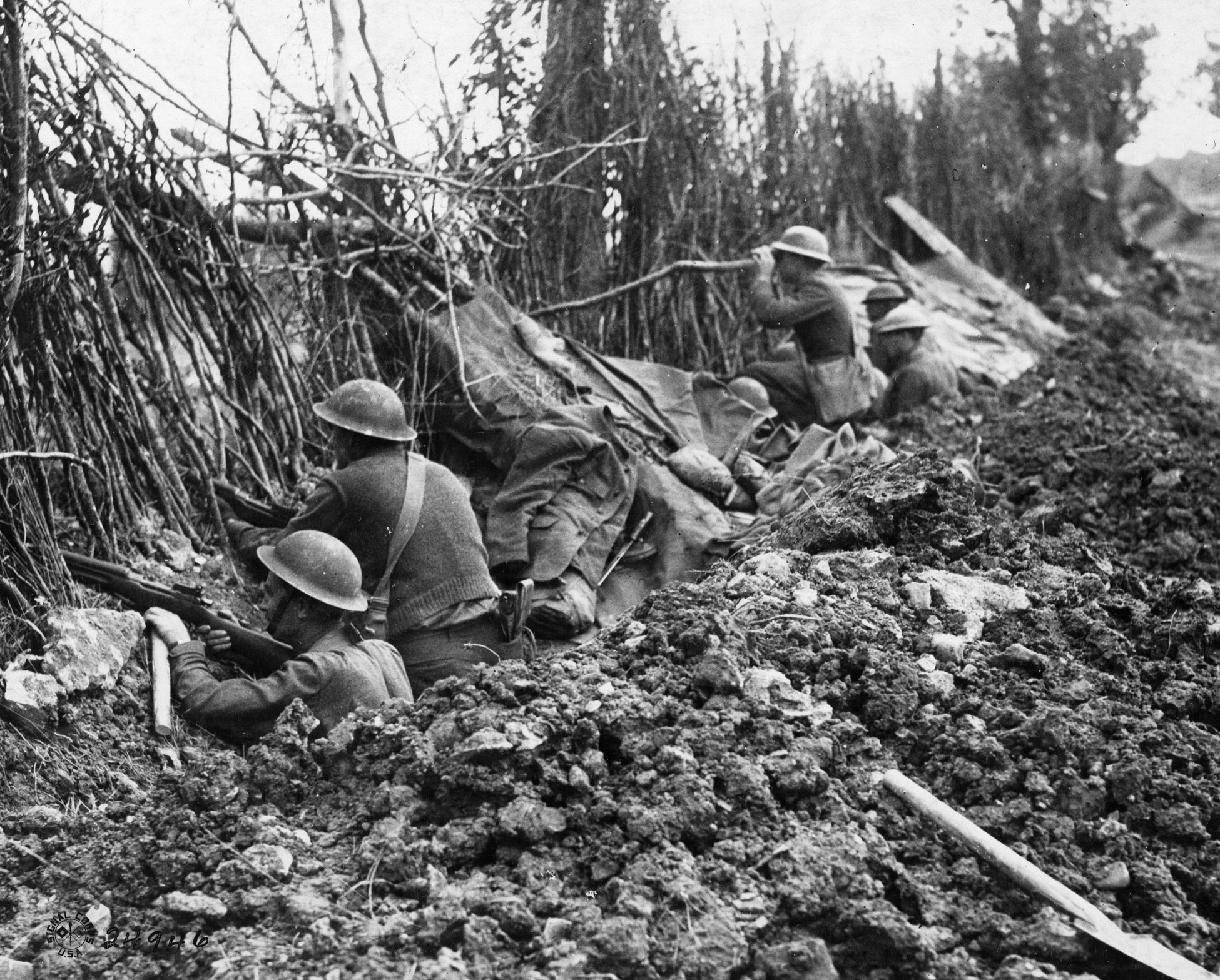
 American soldiers, armed with Model 1917 Enfield rifles, attack during the Second Battle of the Marne, in July 1918.

In director Howard Hawks’s 1941 film classic, Sergeant York, then-Corporal Alvin York, portrayed by Gary Cooper, single-handedly knocks out more than 30 German machine-gun nests and, with little assistance, captures 132 enemy soldiers. In the process, the former conscientious objector from Tennessee drops 25 Germans with 25 shots, many fired from his trusty 1903 U.S. Springfield rifle. The movie’s climactic scene helped cement the Springfield’s mystique with generations of military firearms collectors, history buffs, and re-enactors. Sleek and accurate, the Springfield seemed the perfect weapon for an iconic American hero.

Inspiring as the film was, York probably did not use a Springfield rifle on that October day in 1918 during the Meuse-Argonne offensive. It seems more likely that York achieved his stunning feat of arms carrying the less-well-known but more widely issued U.S. Rifle Model 1917. Although some confusion persists about which rifle York carried during the battle, in his diary he wrote: “We got to France at Le Havre. There we turned in our guns and got British guns. I had taken a liking to my gun by this time. I had taken it apart and cleaned it enough to learn every piece and I could almost put it back together with my eyes shut. I didn’t like the British guns so well. I don’t think they were as accurate as our American rifles.”

How did York wind up with a British gun? The explanation involves American ingenuity, productive capacity, and lack of preparedness for entry into the Great War. Having concluded that the Krag-Jorgensen rifles used by U.S. Army troops in the Spanish-American War were inferior to the 1893 Mauser rifles that the Spanish troops carried, the Army adopted the U.S. Magazine Rifle of 1903, commonly called the Springfield because it was  manufactured at the U.S. armory in Springfield, Massachusetts. Based on Peter Paul Mauser’s bolt-action rifle design, the Springfield proved short enough for cavalry use and long enough for infantry use, and fired the new 30.06 service cartridge that matched or surpassed the performance of any standard military cartridge in the world. American troops instantly loved the rifle for its butter-smooth action and tack-driving accuracy.

Even so, the Springfield suffered from one serious weakness: limited production. Before the United States entered World War I, this mattered little. In 1917, the U.S. Army mustered roughly 127,500 officers and men, fewer men than Portugal’s army. When Congress declared war on the Central Powers on April 6 and later implemented military conscription, the U.S. Army embarked on a 30-fold expansion, growing to roughly four million soldiers in just over a year.

Training and equipping so large a force quickly enough to enter the war before Germany overran the French and the British appeared insurmountable even for the United States. Lack of sufficient quantities of war materiel in general and infantry weapons in particular hampered preparations. The U.S. Army had 600,000 of its superb Springfield rifles in 1917. Another 160,000 of the old Krags in .30-caliber also remained available. For training purposes, the Army purchased 1891 Russian Mosin-Nagant rifles in 7.62 X 54 mm and roughly 20,000 .303-caliber Canadian Ross rifles that, if improperly assembled, occasionally launched their bolts into the shooter’s face. Even if these weapons were suitable for combat, their incompatible parts and calibers created a logistical nightmare.

World War I-era arms, left to right, include the 12-gauge shotgun with bayonet attached, American Enfield, and Springfield rifles.

The Army clearly preferred the 1903 Springfields, but only two factories had ever produced the rifle. The Springfield Armory, the larger of the two facilities, quickly maximized its production. The other facility, the Rock Island Arsenal in Illinois, also possessed the machinery necessary to produce Springfields, but the War Department had closed the plant in February 1914. As tensions mounted between the United States and Germany, the Rock Island Arsenal reopened two months prior to the American declaration of war. Unfortunately, much of the arsenal’s skilled work force had found employment elsewhere, delaying the plant’s return to full production capacity. The United States was fast creating an army without rifles.

The War Department considered issuing contracts to commercial firearms companies to produce the Springfields, but quickly rejected the idea. It would require far too much time to re-equip and retool plants and train the work force necessary to produce the rifles. A better option appeared when fully equipped factories with trained workers became available at exactly the right moment, though not for producing Springfields. In 1913, Great Britain had begun experimenting with a weapon to replace the Short Magazine Lee Enfield (SMLE) rifles issued to their army. Affectionately nicknamed “smellies” by British troops, the Mark III Lee Enfields, first issued in 1907, were chambered for the .303-caliber, rimmed, smokeless cartridge that had served the Royal Army as standard issue since the 1880s. Germany had long used the rimless 7.92mm in its service rifles, and the American adoption of its rimless 30.06 inspired Great Britain to consider replacing the SMLE with a stronger bolt-action rifle chambered for a more modern, more powerful cartridge. The British based their experimental rifle on the Mauser action, just as the Americans had, and developed a high-velocity, high-pressure .276-caliber rimless cartridge for the weapon.

The Royal Small Arms Factory at Enfield Lock produced 1,000 of the new rifles for tests, but abandoned the project when Britain entered the Great War. Britain faced the same problem the United States would confront three years later, expanding its small peacetime army, equipping it, and deploying it on the battlefield in time to defeat Germany. Adopting a new infantry rifle and cartridge seemed an impractical use of Great Britain’s limited resources. Worse yet, the new .276-caliber cartridge posed problems of rapid barrel erosion, exceptionally loud report, and bright muzzle flash. For the time being, the old “smellies” would have to do, but the British government doubted its ability to produce these in sufficient numbers. The solution was a compromise that permitted continued development of the new rifle, but in the old .303-caliber. To this end, Great Britain turned to the United States’ surplus manufacturing capacity.

The British government issued contracts for the production of the new rifle, designated the Pattern 1914, at three American plants: Winchester Repeating Arms of New Haven, Connecticut; Remington Arms Company at Ilion, New York; and Remington’s plant at Eddy-stone, Pennsylvania. The Pattern 14s differed little from their experimental predecessors aside from their .303 chambering. Despite rising production costs and delays occasioned by on-site British quality inspectors, the U.S. plants produced nearly 1,900,000 Pattern 14s, with Eddystone producing the greatest number and Winchester the least.

Just when Great Britain seemed poised to replace the SMLE rifle with the Pattern 14, the smellies, despite their supposed obsolescence, performed admirably in the trenches. The .303 cartridge proved perfectly adequate for modern warfare, and the standard Mark III Enfield not only functioned reliably but also held twice as many rounds in its detachable box magazine as Germany’s 1898 Mauser. More importantly, Britain’s accelerated SMLE production satisfied the Royal Army’s needs. American production of the Pattern 14 became unnecessary, and the British government canceled the American contracts. Production ended in July 1917, just as the United States mobilized for its own entry into the war.

The cancellation could not have come at a better time for the United States. The Ordnance Department had already considered adopting the Pattern 14 as an alternate infantry rifle to supplement the Springfield, but did not want a rifle in the .303-caliber British model. Now the United States found itself with three fully operational factories capable of producing a modern infantry rifle and seeking a buyer for their goods. War mobilization forced a quick decision. Rather than retool commercial firms and train a workforce to manufacture Springfields, a lengthy task at best, the Ordnance Department decided to purchase American-made Pattern 14s with one key modification. The otherwise identical rifles would be chambered for the 30.06 cartridge and the new rifle adopted as the U.S. Rifle Model 1917. With one brilliant administrative decision, the Ordnance Department solved the Army’s rifle shortage—or so it seemed.

American troops armed with the new Enfields practice bayonet tactics in France under the eyes of stern-faced instructor.

Modifying the Pattern 14 to fire the 30.06 cartridge proved simple enough. Built with the potent .276 cartridge in mind, the Pattern 14 boasted an exceptionally strong action perfectly capable of accommodating the high-pressure American cartridge. The only real difficulty involved parts interchangeability. Tests revealed that Pattern 14 parts were built to comparatively loose tolerances and often required time-consuming hand fitting. This threatened delivery schedules and complicated repair, but desperate for weapons, the War Department issued contracts for the new rifle’s production. Although the initial runs of 1917 rifles from Winchester suffered from this problem, the rifles eventually enjoyed 95 percent interchangeability, a satisfactory rate during wartime.

By February 1918, the three plants combined produced over 7,000 of the 1917 Enfield rifles daily for the princely sum of $26 per copy, half of what the P-14s had cost to produce. By war’s end, 75 percent of the doughboys carried the “U.S. Enfield,” as it was often called. The Marine Corps received 61,000 and the Navy received 604 1917s.

Although the 1917 rifle solved the War Department’s rifle supply problems, many American soldiers shared Alvin York’s preference for the Springfield. They complained about the new rifle’s weight, nearly a pound heavier than the Springfield, and its length, two inches longer. Some also disliked the fact that the 1917’s bolt cocked on closing, whereas the Springfield cocked on opening. Soldiers objected to the American Enfield’s lack of magazine cutoff. Because of this, the bolt could not be closed on an empty magazine unless the soldier depressed the magazine follower with his thumb or inserted a coin on top of it. Many also shared York’s opinion that the Springfield performed more accurately than the 1917. The 1917s sights lacked any device for windage adjustment, an omission that riled competitive shooters. A few soldiers even objected that the rifle’s sight protectors would distract the shooter from acquiring an adequate sight picture.

Despite the doughboys’ objections, the Enfield had definite advantages over the Springfield. Although the Enfield sights lacked windage adjustment, the Enfield’s aperture rear sight lay closer to the shooter’s eye and could be much more easily acquired in combat conditions. The 1917’s sights rested safely between protective “ears” that shielded them from abuse. Accuracy proved better than the rifle’s critics expected. In 1918, Marine Corporal F.L. Branson, using a 1917 rifle, won the 1,000-yard competition at the national matches at Camp Perry, Ohio.

The Enfield’s box magazine originally accommodated five .303 cartridges, but the 30.06 cartridge’s smaller-diameter rimless head occupied less space, giving the 1917 Enfield a six-round capacity compared to the Springfield’s five. Unfortunately, the Army still issued only five-round stripper clips, which undermined the advantage. Finally, the Enfield adapted readily to the French Viven-Bessiere grenade launcher. Equipped with such accessories as a 22-inch bayonet designed for the P-14, the 1917 proved itself equal or superior to any infantry rifle issued in the Great War.

By the time of the Armistice in November 1918, the Remington, Winchester, and Eddy-stone plants had produced 2,193,429 1917 rifles, so many that the War Department considered adopting them to replace the Springfields. In the end, the Springfield won the battle, partly because match shooters preferred its sights for competitive shooting. During the postwar years, the Army refurbished its inventory of 1917 rifles. Some were sold to the Philippines, and a few found their way home to ROTC units for drill purposes. Most simply languished in storage.


Armed with Enfields, American doughboys man an abandoned German position in the Meuse Valley north of Verdun

World War II changed all that. After the British Expeditionary Force abandoned its weapons on the beaches at Dunkirk, the Royal Army faced a German cross-Channel invasion lacking equipment of every kind, especially infantry rifles. The British government appealed to civilians to volunteer their firearms for home defense use, but post-World War I legal restrictions on firearms ownership and the manufacture of automatic weapons made suitable firearms scarce in the British Isles. Although many British civilians turned in the few weapons they had, their contributions did little to alleviate the shortage. The British government bought advertising space in U.S. publications asking Americans to “Send a Gun to Defend a British Home.” American citizens shipped a vast assortment of personal firearms to the beleaguered nation to fill the gap.

Despite American generosity, Great Britain’s army desperately needed uniform modern battle rifles. Once again, the 1917 rifle came to the rescue. Roughly one million of the Americanized Enfields reached Britain through the Lend-Lease program. To avoid confusion with the .303 Pattern 14 rifles still in Royal Army inventories, the British marked the 30.06 1917 butt stocks with red paint. Nationalist China also received shipments of the rifles.

When the Japanese attack on Pearl Harbor thrust the United States into World War II in December 1941, the U.S. Army, while better prepared for war than it had been in 1917, once again suffered equipment shortages. Over 200,000 1917s were issued for training purposes within the United States. A few also turned up in the hands of artillery and mortar crews during the North African campaign in 1942.

By 1943, the Army’s infantry rifle shortages abated. Supplies of the U.S. Rifle Model 1903-A3, a Springfield modified for rapid manufacture, appeared in growing numbers, and the magnificent U.S. Rifle Caliber .30 M-1, called the Garand in honor of its designer, became available by the millions. By October 1945, the 1917 rifle had been declared obsolete. The military life of the American Enfield had passed.

The American Enfield lives on in civilian hands. After World War I, many returning doughboys’ wartime weapons experience whetted their appetite for bolt-action sporting rifles. Remington possessed large stocks of 1917 rifle parts, and from 1926 to 1940 the company produced a sporting version of the American Enfield designated the Model 30. Many surplus 1917s were sold to civilians after World War II. Their stout nickel-steel actions made them suitable for conversion to powerful sporting cartridges, and many were converted into sport rifles. Today, unaltered 1917s have become increasingly scarce and collectible.

While it never developed the mystique associated with the Springfield rifle, , it was the American Enfield that Alvin York and most of his brothers in arms carried to victory in World War I.


Thursday, October 6, 2022

The Last Warship...of Sail.

 I ran across this story and thought it was interesting, did some research and dug up a lot more information.


The year is 1916 and Germany is looking to revive its commerce raider campaign.

At the start of the war, Germany had used a few merchant ships armed with intent to prey on Entente shipping ( the understanding between Britain and France reached in 1904, forming the basis of Anglo-French cooperation in World War I). Albeit they were not exactly successful in terms of sunk tonnage, they did tie up considerable Entente naval assets searching for them. By 1915 most were either sunk, captured, or interned in neutral ports.

The problems of German commerce raiders was a complete Entente supremacy on the sea. Even if successful, they were inevitably found and sunk by Entente forces, especially since they were dependent on coal, leading many to be caught during or near neutral ports or be blockaded and interned there.

So, in order to solve the little problem of coal, Germans decided to use the strikingly creative, brand new innovation of… sails.

They took the three-masted sailship Pass of Balmaha, in German hands since its capture by an U-boat in the previous year, added an auxiliary engine(so the ship would not be crippled by unsuitable winds), two hidden 105mm cannons, two hidden machine guns, and an armory of rifles, all so ingeniously hidden to avoid breaking the masquerade of being a definite noncombatant. The Pass of Balmaha was commissioned in the Imperial German Navy as SMS Seeadler, and on 21 December 1916 she set sail under the command of Kapitänleutnant Felix Graf von Luckner, the man who had the biggest balls in the Imperial German Navy without a doubt.


Now, Herr von Luckner was already adventurous to the point of insanity by that point. From a long line of Prussian soldiers, he had stolen his father’s pistol and run off from the house at the age of thirteen, volunteered to work as a cabin boy in a Russian sail ship, fell over and almost drowned in a storm, and understandably quit first chance, at Australia, since the captain of the ship explicitly forbid rescuing him during the aforementioned storm. Over the next seven years he worked as a boxer, bartender, tavern-keeper, pig-stealer(he served time in prison in Chile for a while because of that), a circus worker, a kangaroo hunter, an assistant lighthouse keeper(which he had to abandon after being caught by his hotelkeeper while sleeping with his daughter), a fisherman, a railway worker, a sailor, and a Mexican Army soldier in President Diaz’s own guard, before returning home,after which he got a degree in navigation and then joined the Navy in 1912. So, fresh from the end of his tenure as a gun turret commander aboard SMS Kronprinz, with which he had been in Jutland, Luckner was the perfect man for the insanity it must have been to commit sailship piracy in the era of the dreadnought.

After first bluffing their way past the British blockade by pretending to be Norwegian whalers and successfully fooling a boarding party from the HMS Avenger, Luckner and his Die Piraten des Kaisers, as they would soon come to be called, began to hammer shipping across the Atlantic mercilessly. Basically, he would bring close his select prey by a variety of ruses, hoist the Imperial German Naval Ensign, jam the 105mm guns in the enemy’s face, demand surrender, take the crew prisoner, plunder the cargo, sink the ship, and merrily sail away in search of more prey.

For months he smashed Entente shipping left and right, and lamented that the Dutch were not at war with Germany; they were almost always laden with goods he was not allowed to plunder! He sunk fifteen Entente ships totaling well over thirty thousand tons in tonnage, and managed to do the whole thing without killing anyone. The only casualty of his campaign would be a single British sailor aboard the 3600 ton steamer Horngarth who died from a burst pipe as the ship tried to flee. When his prisoners became too many, he tore most of the sails off the next ship he captured(French barque Cambronne) off the coast of Brazil, put all his prisoners in it, and let them sail the ship into Rio.

Seeadler’s Imperial German Naval Ensign, currently on display in Auckland War Memorial Museum

Seeadler’s rampage came to an end in 2 August 1917, when a tsunami hit her while anchored outside the lagoon of Mopelia, where Luckner had stopped to scrape the hull clean, a necessary procedure for sailships. The ship sunk, even though the Germans managed to salvage almost all of their supplies and two long boats. Not giving up, Luckner took one of the boats, rigged it as a sloop, and took basically a modified rowboat over open ocean all the way to Fiji, nearly four thousand kilometers, over a month, leaving his crew and 46 prisoners on Mopelia intending to return. However, he was caught by the police, and was interred on a PoW camp on Motuihe Island.


Luckner’s men made their way out on 4 October when the French sloop Lutece anchored off Mopelia and was attacked and taken over by the Germans, making Die Piraten des Kaisers one of the few pirate gangs who could keep pirating without a ship. Renaming it Fortuna, they sailed for South America, where they struck rocks off Easter Island and were interned by Chile.

Meanwhile, thousands of kilometers to the west and unaware of his crew’s survival, Luckner refused to give up. Faking setting a play for Christmas, Luckner and other prisoners broke out on 13 December using provisions for the ‘play’, and stole the camp commandant’s personal motorboat, now flying a homemade Imperial German ensign fashioned from a bedsheet and an empty bag of flour. Next day they took over the New Zealander fishing ship Moa by jamming a pistol in the captain’s face. Luckner’s plan was to sail for Kermadec Islands, a New Zealand supply station, raid the depots, load up on gear and return to Mopelia to pick up his crew, but before he could continue the second phase of his insane prison break the Moa was caught by a pursuing New Zealander warship off Kermadec, on 21 December.

Exactly one year after its start, Luckner’s mission ended, and with it the story of the last sailship used in warfare.


Wednesday, May 25, 2022

The Prototype "Trench Guns" of WWI

 I will wait 72 hours to comment on the Elementary School shooting, before I rant away.  I want to get some more facts together first, and wait unlike President Xiden and the Media that immediately jumped on the "Gun Control" bandwagon before all the facts were in. Hey You Can let a crisis go to waste you know.

    I shamelessly snagged this off "American Rifleman",  When I deployed to the Gulf, I already owned a "Remington 870 "Police", and from my history, Shotguns are very nasty weapons, especially in close quarters. I wanted to take it with me along with my issued M16.  Well my chain of command said "Nope".  Oh Well


“Trench Guns” Of World War I

When the United States became actively involved in the First World War during the spring of 1917, our troops deployed to France soon found themselves in the unfamiliar environment of trench warfare. Since an important component of such fighting was periodic raids on enemy trenches, guns that were capable of being effectively wielded in close confines were particularly valuable. Handguns weren’t sufficiently powerful, and the standard Model of 1903 and Model of 1917 rifles were too long, cumbersome and slow- firing to be truly effective in such situations. Clearly, another type of arm was needed, but there was some debate as to just what it should be.

When deciding on what type of trench-fighting gun would be most efficacious, some senior Army officers, including Gen. John J. Pershing, then commander of the American Expeditionary Forces, remembered their experiences in the Philippines almost two decades earlier. When the United States gained possession of the Philippines from Spain following the Spanish-American War of 1898, our troops were faced with the unpleasant task of battling several indigenous groups who had fought the Spanish for decades and looked upon the Americans as just another occupying force. Foremost among these were the fierce Moro tribesmen who exacted a deadly toll on American troops in close-quarters combat. The standardized .30-40 Krag rifles and .38 Long Colt revolvers proved to be unequal to the task, and a more effective arm was sorely needed.  Circa 1900, the U.S. Army purchased some 200 of the newly introduced Winchester Model of 1897 short-barrel, slide-action shotguns for use in the ongoing “pacification” campaigns in the Philippines. These “sawed-off” shotguns proved to be devastatingly effective close-quarters guns and were instrumental in eventually helping to quell the bloody uprisings.

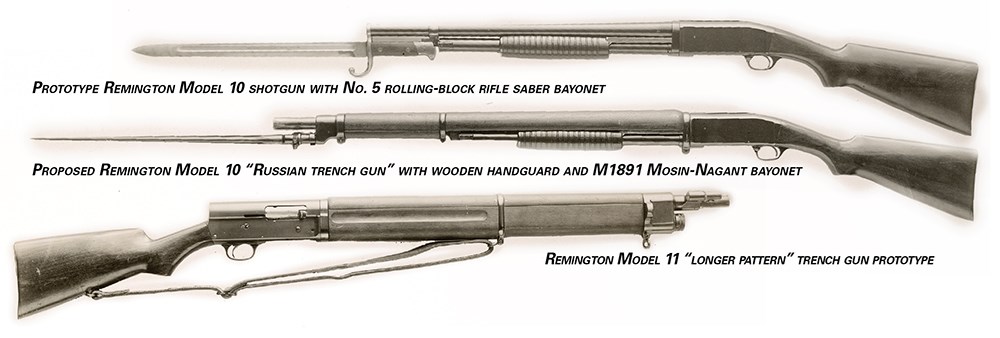
Prototype Remington Model 10 shotgun with No. 5 rolling-block rifle saber bayonet

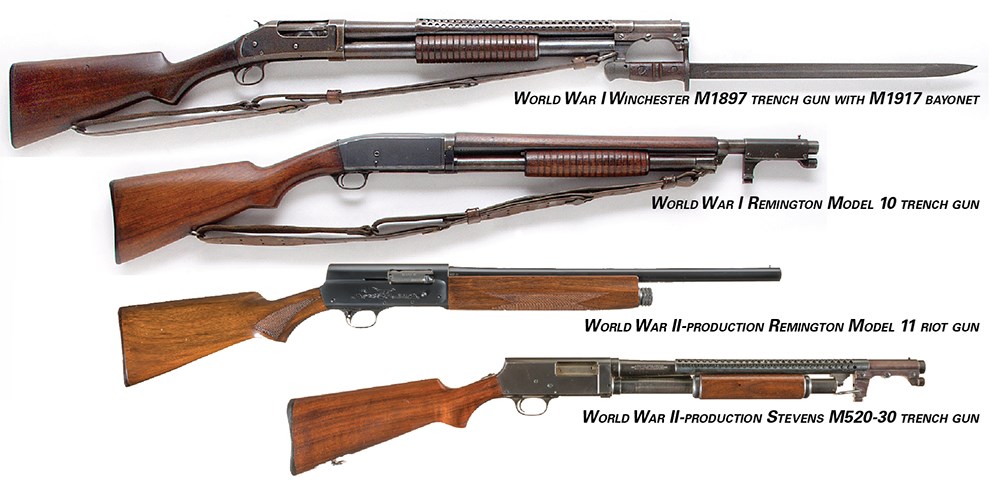
Given the effectiveness of shotguns in the Philippines, it was recognized that a short-barrel, 12-ga. repeating shotgun loaded with 00 buckshot would also be a formidable tool in the trenches of France. It was decided to develop a shotgun specifically modified for trench warfare. It was logical to base the new weapon on the tried and proven M1897 shotgun, but the War Dept. stipulated that the gun must be capable of mounting a bayonet. The M1897s previously used in the Philippines were standard commercial-production, plain-barrel “riot guns,” so a method of mounting a bayonet on the proposed shotgun had to be devised. Working in conjunction with Springfield Armory, Winchester developed a metal one-piece bayonet adapter/handguard assembly. Since it would be necessary to grip the barrel to properly wield a bayonet-equipped shotgun, the assembly had a ventilated metal handguard for protection from a hot barrel. The adapter was designed for use with the M1917 bayonet as used with the M1917 rifle. The new combat shotgun was soon dubbed the “trench gun,” although this was not official nomenclature. Production contracts were given to Winchester for the new firearm.

Since it was believed the new “trench gun” would be a valuable addition to our Doughboys’ arsenal, the Ordnance Dept. solicited proposals from other manufacturers for bayonet-equipped versions of their repeating shotguns.  Remington Arms Co. submitted a “trench-gun” variant of its Model 10 slide-action repeating shotgun. Rather than the all-metal one-piece handguard/bayonet adapter used with the Winchester gun, the Remington Model 10 design featured a wooden handguard and separate bayonet lug, also adapted for the M1917 bayonet. The modified Remington Model 10 was adopted and put into production. The U.S. Army now had two standardized “trench guns,” but other models continued to be evaluated.

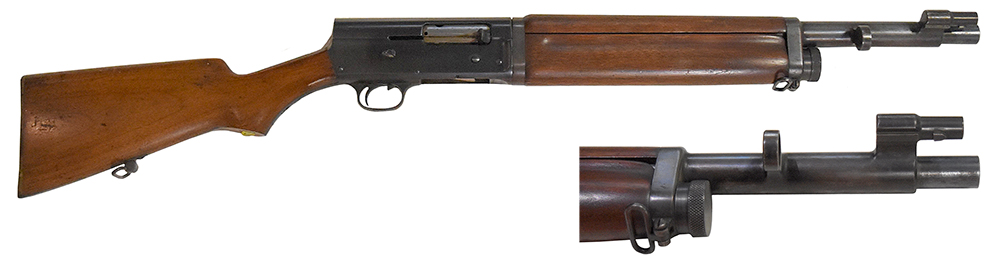
Remington Model 11 “short pattern” trench gun prototype


Although Remington had accepted large contracts for arms from other nations—chiefly Pattern 1914 rifles for Great Britain and M1891 Mosin-Nagant rifles for Russia— the company was still looking for additional business. Since the American government had adopted the Model 10 trench gun, the company believed that such guns might appeal to other nations but recognized that these potential purchasers likely wouldn’t be interested in a shotgun designed to use the U.S. M1917 rifle bayonet. Remington had a rather large number of “saber” bayonets for its No. 5 rolling-block rifles left over from previous South American contracts. The company submitted a standard Model 10 shotgun with a metal bayonet lug brazed to the underside of the barrel. However, no type of protective handguard was provided, which obviously limited the gun’s effectiveness in bayonet fighting. A prototype was submitted to the Ordnance Dept. for review, but little interest was shown, and it was rejected.

Undeterred, Remington turned its attention to the Russian government, which had placed large contracts for M1891 Mosin-Nagant rifles and bayonets. The Russian bayonet was an all-metal socket design with a cruciform blade. Having learned from the previous unsuccessful submission, the proposed “Russian trench gun” was equipped with a wooden handguard somewhat similar to that used on the U.S. Model 10 trench gun. The bayonet was locked into a metal flange and was not attached to the barrel as was the norm with most bayonets. Although it appeared to be a functional design, the fall of the Czarist government resulted in no real consideration being given to the gun, and it was discarded as well.

World War I Winchester M1897 trench gun with M1917 bayonet

After these two abortive modified Model 10 prototypes, Remington came up with one of the most novel ideas for a trench gun ever conceived. A popular gun in the company’s product line was the semi-automatic Model 11 shotgun designed by the legendary John Moses Browning. It was believed that such a gun would be ideal for trench warfare due to its impressive rate of fire. There was, however, one major problem: The Model 11’s recoil-operated mechanism required that the barrel move back and forth with each shot. Since Ordnance specifications for trench guns mandated that they be equipped with a bayonet, Remington engineers had to devise some method of overcoming this inherent problem. Mounting a bayonet on the barrel wouldn’t be feasible because the added weight would not allow the barrel to reciprocate properly. Also, if a barrel-mounted bayonet was thrust into an adversary, the barrel would move backward and could, at least partially, eject a chambered shell, resulting in a jam.

The problem was ingeniously addressed by mounting a metal sleeve (tube) to the front of the receiver into which the barrel was fitted. A bayonet lug could be attached to the sleeve that didn’t affect the reciprocal movement of the barrel. In order to permit the gun to be properly grasped for bayonet fighting, a wooden fore-end that served as a handguard was fitted. There were at least two variations of the design that differed primarily in length with a slightly greater tubular magazine capacity for the longer pattern. It appeared to be a rugged and functional arm that likely would have been quite effective for its intended purpose.

The prototype Model 11 trench guns were completed by the fall of 1918, around the time of the Armistice.  However, with the war ending, the Ordnance Dept. abandoned further consideration of the shotgun. The prototypes were shelved, and, perhaps surprisingly, the concept was never revisited. It is intriguing to think that if the gun had been available a year or so earlier, it might have been adopted. As events transpired, even though the Model 11 trench gun never made it past the prototype stage, large numbers of plain-barrel Model 11 riot guns (and long-barrel training guns) subsequently saw service during World War II.

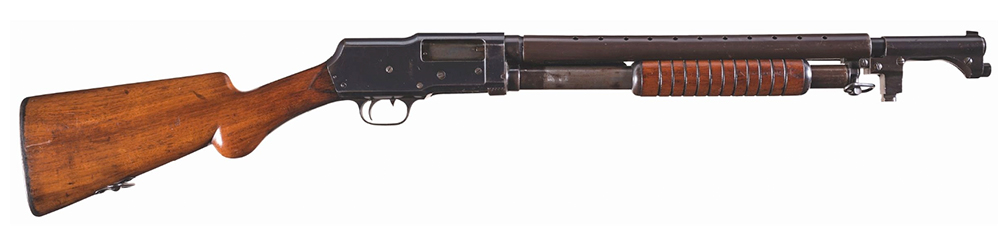
Stevens Model 520 trench gun prototype


In addition to the Remington designs, there was another proposed trench gun fabricated and submitted for testing in 1918. The J. Stevens Arms and Tool Co. developed a trench gun based on its Model 520 slide-action shotgun.  Rather than using a wooden handguard, like the Remington guns, or a one-piece metal handguard/bayonet adapter assembly, like Winchester, Stevens equipped its gun with a ventilated metal handguard and a separate bayonet lug on the barrel. The shotgun reportedly acquitted itself quite well in testing, and it is speculated that a small number may have been purchased, but this is unconfirmed. Unfortunately for Stevens, like the Remington Model 11 prototypes, the end of the war resulted in the cancellation of all pending contracts. Stevens had better luck with a trench-gun version of the Model 520-30 (an improved 520) during World War II when substantial numbers were procured and issued along with some Stevens M620A trench guns. 

If the First World War had lasted into 1919 as had been expected, it is possible that at least two additional trench guns, the Remington Model 11 and Stevens 520, could have found their way into the trenches. Instead, the only two trench guns to be issued during the war were the Winchester M1897 and the Remington Model 10.  Nevertheless, the efforts to develop innovative designs for a new type of combat arm, the “trench gun,” illustrate the resourcefulness and expertise of American gunmakers at a critical time in our history.

Tuesday, April 26, 2022

"A Gentlemans Rifle in the Trenches of WWI"

 I ran across this article reading my American Rifleman magazine, and I found it fascinating.  it is on my bucket list to visit this and the Imperial War Museum once all this Covid restrictions and other stupidity is relaxed.  I also want to check out the "HMS Belfast, she is a museum ship in the Thames River.  We will see though.


Holland and Holland rifle gun wood map ammunition binoculars
This .303 British Royal Grade Holland & Holland single-shot, serial No. 26069, was used by the Irish Guards as a sniping rifle during World War I. It is shown here with period trench maps, a German stick grenade, British binoculars and some German 8 mm Mauser cartridges.
Photo by Jonathan Green

It was London, it was September, it was raining.

Outside the Brigade of Guards Museum, near Buckingham Palace, the statue of Field Marshal Earl Alexander of Tunis stands 15' high—a tribute to Britain’s greatest field commander of the 20th century. His trademark sheepskin is faithfully reproduced in a half-ton of bronze, and even here he manages to wear it like a dinner jacket. England’s greatest combat soldier was also known as the best-dressed man in the regiment.

As the rain pelted harder, plastering the brown beech leaves to the paving stones and forming tiny waterfalls in the creases of the jacket, Alexander—or “Alex,” as he was known to all—took no notice. He kept his eye fixed firmly on the entrance to the museum, and suddenly that seemed like a heck of a good idea as the sky opened up and the cold rain came down in sheets.

The Guards regiments are among Britain’s most famous icons. They are the soldiers in red tunics and black bearskins who mount the guard on Buckingham Palace, among other places. What is less well-known is that they are also elite soldiers who have fought the king’s wars around the world for centuries. The oldest regiment is the Scots Guards, followed by the Grenadiers and the Coldstreams. The Irish Guards—Alexander’s regiment—and the Welsh are the youngest.

Inside the museum, one tableau after another depicts their exploits at Waterloo, Dunkirk, South Africa, Flanders. The displays, colorful at first, turn slowly sodden and muddy as all the gentility was wrung out of warfare, and red tunics were replaced by khaki (in South Africa) and brown service dress in the mud of Flanders. The display from the First World War includes bits of webbing, barbed wire, grenades, a bayonet. The stuff looks muddy even when it isn’t.

There is also a rifle. Not a Lee-Enfield, No. 1 Mk III, as might be expected, but a classic single-shot, break-action rifle of the type favored, before the war, for stalking stag in Scotland. It is of obviously fine pedigree, but has seen much hard use. The bluing is worn to a silver sheen and the stock is scratched and battered.

painting drawing soldier rifle

If you crouch down and peer closely, with the light exactly right, you can still read on the receiver “Holland & Holland.” It is an aristocrat among firearms, a “gentleman’s rifle”—a Royal Grade single-shot stocked in English walnut and finely checkered. At one time, the receiver displayed graceful engraving, although it is now worn almost completely away. Four years of trench warfare will do that.

The story of how H&H rifle No. 26069 journeyed from the Bruton Street showroom to the Guards Museum is really one of convergence of the great names in pre-war England, in the military, in literature and in gunmaking. It involves Harold Alexander, Britain’s greatest soldier of the 20th century, and Field Marshall Lord Roberts, one of its greatest of the 19th; it involves Rudyard Kipling, Poet Laureate of the Empire and winner of the Nobel Prize for Literature; and of course Holland & Holland, England’s greatest riflemaker.

The story begins with Lord Roberts in South Africa, fighting the Afrikaners in Britain’s first, and one of its bloodiest, military campaigns of the 20th century. There, Roberts renewed his acquaintance with Rudyard Kipling, an old friend from India.

Roberts was an Ulsterman, a gentleman of Anglo-Irish descent. For reasons no one has adequately explained, Ulster (Northern Ireland) has produced a disproportionate number of great British generals. The Duke of Wellington was an Ulsterman, as was Montgomery, among many others. In the South African campaign, the army’s Irish regiments performed spectacularly. To recognize their contribution, Queen Victoria ordered—on Roberts’ advice—the formation of a regiment of Irish Guards to join the Scots, Grenadiers and Coldstreams.

When he heard the news, Harold Alexander (also from Ulster) was 9 years old. He immediately decided that his future would lie with the Irish Guards. The son of the Earl of Caledon, he attended school at Harrow, went on to the military academy at Sandhurst, and joined his new regiment in London in 1911. He was a 22-year-old first lieutenant when the war broke out in 1914.

One of his fellow officers was the Earl of Kingston, and they shipped off to France together. In the Earl’s kit was the H&H rifle. It came to be there in a rather convoluted way.

As war in Europe approached, many Germans made last-minute visits to London to order rifles from the English gunmakers. One ordered a stalking rifle, and even provided a fine Voigtlander scope to be mounted on it. Ordered in 1913, it was barely finished when the Germans marched into Belgium. H&H could not ship a rifle to an enemy country, so the firm re-barreled the rifle to .303 British and fitted it out as a sniper rifle. A member of Parliament, Colonel Hall Walker, bought it and passed it on to Lieutenant the Earl of Kingston of the Irish Guards.

Recruit No. 26069 was in the quartermaster’s stores when the regiment went into action for the first time and was still there, amid the chaos of retreat, advance and retreat, before the war settled down to the hell of the trenches. By that time, the Earl of Kingston had been wounded and invalided back to England. Alexander fought with the regiment through the Retreat to Mons, was wounded in the First Battle of Ypres and returned home to convalesce. What happened then can be pieced together from scraps of information that have survived.

From the hospital, Kingston wrote to the commander of the battalion, Jack Trefusis, inquiring about his rifle. On January 6, 1915, Trefusis replied:

“My dear K.

It has been in QM Stores for ever so long and I have only just this moment heard of it. It was a thing we have wanted badly for a long time, and if we had only known of it in the last trenches we were in I have no doubt we should have accounted for a platoon of Germans. However we go back into the trenches on Friday and the rifle will be put into the most skillful hands I can find and a careful account of the bag that is made with it which I will report to you occasionally ... .”

The war was then barely four months old and Trefusis’s last paragraph is chilling:

“There is no officer here who was here with you except myself and Antrobus, and very few men. Poor Eric Gough was the last and he was killed last week.

“P.S.: I see I have never actually thanked you for letting us have the rifle, but I do enormously, it will put us on a more equal footing with those damned snipers, who are just as bad here as ever they were.”

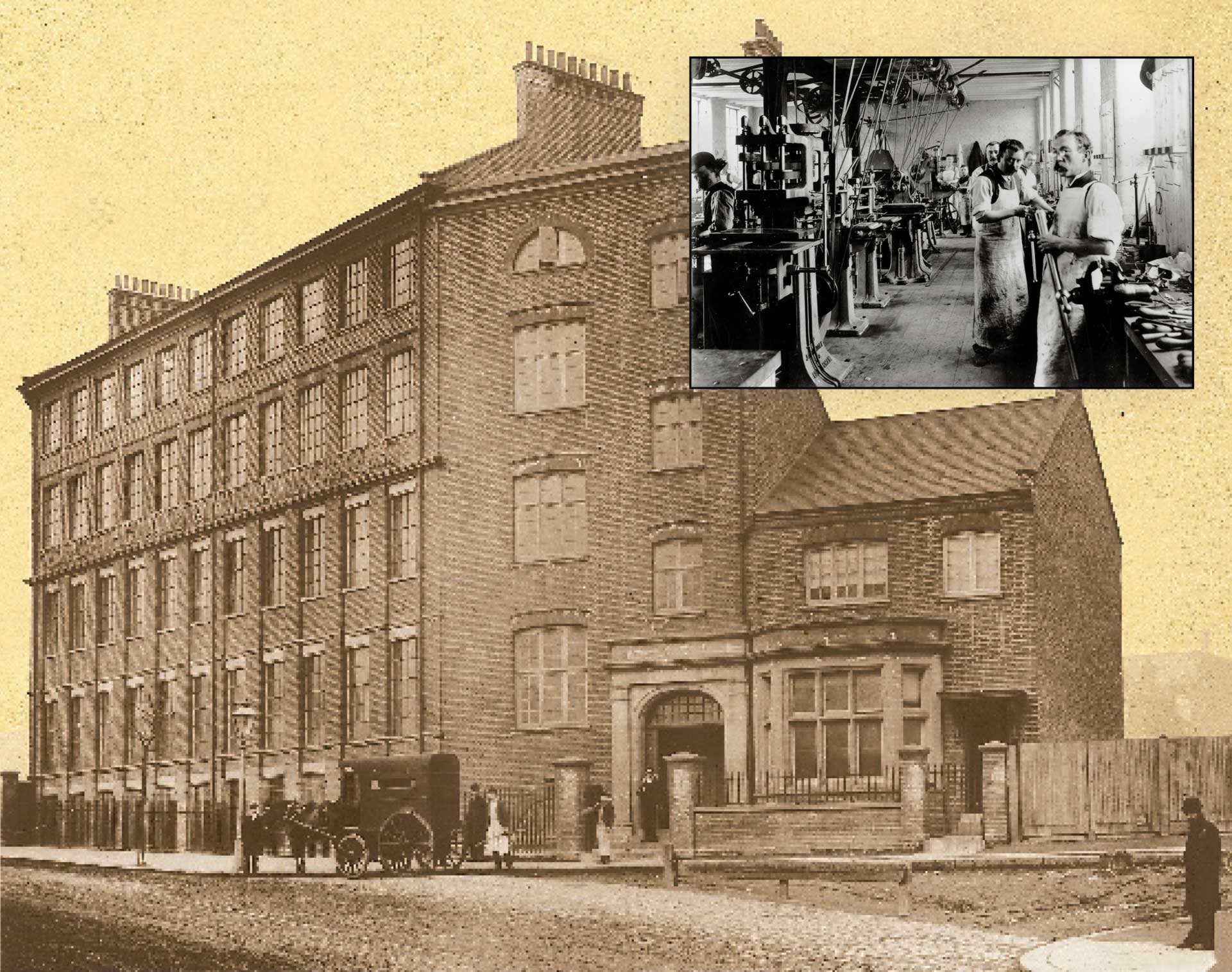
holland and holland factory brick building vintage workers machines guns rifles shotguns
Photos courtesy of Holland & Holland


As a military art form, sniping goes back several centuries, but it really flowered during the American Civil War. Not by coincidence, this was the first large-scale conflict in which trenches were used; trenches and snipers go together like coffee and cream. In the case of the British Army, through the late 19th century it fought mostly wars of movement until encountering the Boers in South Africa in 1899. Sniping was not a major factor, and while the British Army underwent a drastic reformation as a result, and became the best army of its size in the world, it still paid scant attention to sniping as it went to war in 1914.

Not so the Germans. When the German Army invaded Belgium, it had an estimated 20,000 sniping units ready to go. The Mauser Model 98 made an ideal sniper rifle; as well, when hostilities began the Germans collected thousands more accurate sporting rifles and sent them to the front. The British had but a handful of trained snipers, and few rifles with which to snipe. The German Army very quickly dominated “No Man’s Land” and the forward British trench lines. Trefusis’s rueful letter to the Earl of Kingston gives an idea of the havoc wrought by the German snipers.

When H&H rifle No. 26069 went into service with the Irish Guards and began to take its toll on the Germans, the call went out for more of the same. The War Office in London turned to H&H and the other fine rifle makers with orders for sniper rifles.

At the time, British gunmakers made three types of rifle: doubles, single-shots and bolt-actions. The doubles were mostly big-game rifles for Africa and India; bolt-actions went to the colonies, while single-shots—both break-action and falling block—were the classic stalking rifles for stag in the Scottish Highlands. As such, they were built to be accurate. Since the supply of Oberndorf Mauser actions had dried up for the British, they naturally built their sniping rifles to patterns like No. 26069.

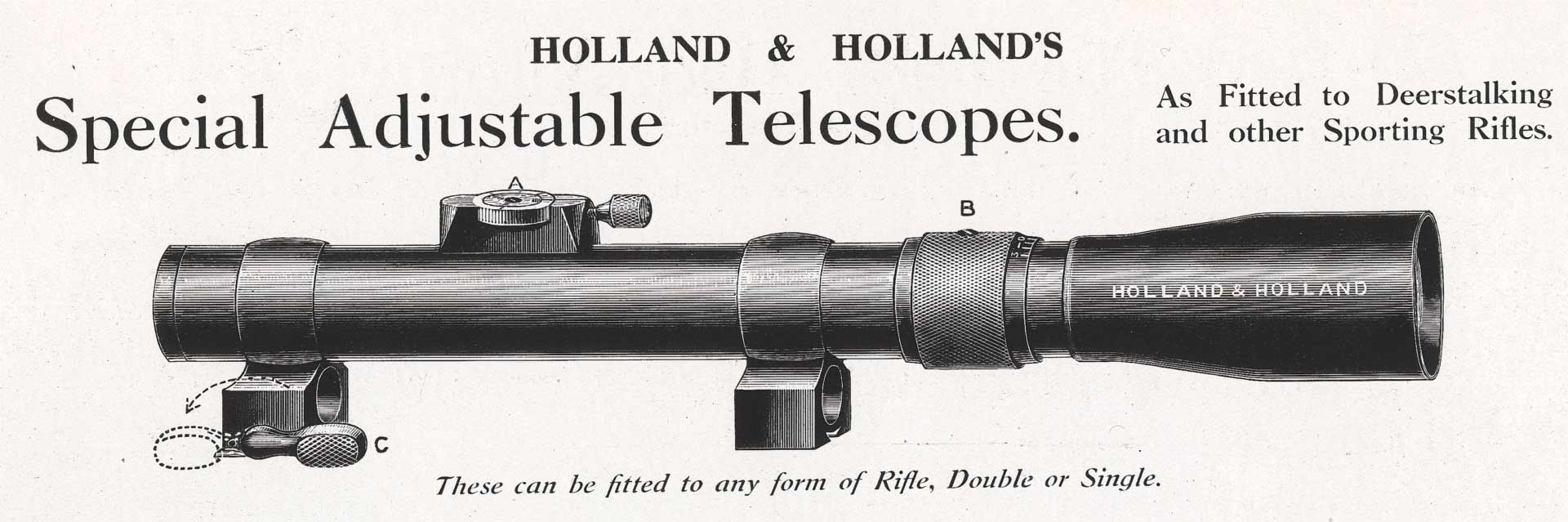
holland and holland riflescope art drawing black and white advertisement
This pre-World War I scope from a Holland & Holland catalog is of German origin. Riflescopes were a problem for the British early in the war, and No. 26069 bears a German Voigtlander supplied by the German customer who ordered the rifle.


A major problem was the supply of telescopic sights, and here the Germans, with their advanced optics industry, had a huge advantage. The War Office went so far as to try to smuggle scopes out of Germany by various underhanded means, but without notable success. This remained a problem until 1916, when British companies, like Aldis (of rangefinder fame), became capable of supplying telescopic sights in reasonable quantities. Until then, the gunmakers made do with whatever they had in inventory or obtained from civilian sportsmen.

The work went slowly at first, and by July 1915, H&H had fitted out only 10 more sniper rifles. Gradually, however, the pace picked up.

Another problem facing troops on the Western Front was the fact that German snipers concealed themselves behind pieces of armor plate. Early in the war there was little in the way of armor-piercing ammunition for standard rifles, and, again, the War Office turned to the London gunmakers. Figuring that any gun that could handle a Cape buffalo would punch through armor plate, Holland’s and the others shipped over 2,000 so-called “elephant guns.” These were a mixed blessing. While they demolished the armor well enough, the loud report combined with the smoke and belching flame revealed the shooter’s position to the enemy and brought down a rain of return fire.

Meanwhile, as H&H et al worked behind the scenes, rifle No. 26069 slogged on, killing Germans. Two weeks after his first letter to the Earl of Kingston, Jack Trefusis wrote again:

“The rifle has been an immense success and every Commander from C-in-C downwards has sent down to ask me about it, with the result that two are to be issued to each battalion.

“The sergeant major uses it and the score of Germans is for certain four killed and eight wounded in three days use ... . Those who were killed or wounded were fired at from a range of 800 yards. So it has been a great success.”

In March 1915, recovered from his wound, Lt. Alexander was promoted to captain, helped to form a second battalion of Irish Guards and returned to France commanding its No. 1 company. One of his officers was a subaltern named John Kipling.

Lt. Kipling was Rudyard’s son. Denied a commission because of his poor eyesight, the novelist appealed to his old friend Lord Roberts, who was now Colonel of the Regiment of the Irish Guards. Roberts’ influence was still immense, and he obtained a commission for the boy. Within a month, the battalion went into action at the Battle of Loos, where 800,000 men were ordered to breach a German position after a four-day bombardment by 1,000 guns. Five days and 45,000 casualties later, the attack was called off.

The unit that penetrated deepest into German territory was No. 1 Company of the 2nd Irish Guards under Captain Harold Alexander. When they withdrew, they left the body of Lt. John Kipling, shot through the head. He was one of 10,000 British soldiers whose bodies were never recovered from the all-swallowing mud of that battlefield.

In deep sorrow, and as a memorial for his son, Rudyard Kipling, Britain’s foremost author, agreed to write the official history of the regiment, The Irish Guards in the Great War, and the “telescope rifle” found its way into literature:

“Casualties from small-arm fire had been increasing owing to the sodden state of the parapets; but the Battalion retaliated a little from one ‘telescopic-sighted rifle’ sent up by Lieutenant the Earl of Kingston, with which Drill-Sergeant Bracken ‘certainly’ accounted for three killed and four wounded of the enemy. The Diary, mercifully blind to the dreadful years to come, thinks, ‘There should be many of these rifles used as long as the army is sitting in the trenches.’ Many of them were so used: this, the father of them all, now hangs in the Regimental Mess.”

holland and holland logo name text gun and rifle makers


Alexander and the Irish Guards also saw action at the Somme and Passchendaele, Cambrai, the retreat from Arras and, finally, Hazebrouk. In this battle, Alexander commanded the second battalion and helped save the channel ports from German attack, but the battalion was annihilated as a fighting force.

Rifle No. 26069 soldiered on with the 1st Battalion, accounting for who knows how many German soldiers. It helped win the sniping war, and the men of the Irish Guards came to love the trim little “gentleman’s rifle” because it saved so many of their lives. In 1918, it was retired from active service and given a place of honor in the regimental officers’ mess before being turned over to the Guards Museum.

There, it became part of a permanent display depicting the valor and the unspeakable horror of the war on the Western Front. And there it was, that rainy morning in September, when I took refuge from the London weather by ducking into the museum. When I emerged after a couple of hours, the weather had cleared and it was breezy and cool. Alexander’s statue, so stern in the rain, now appeared to be smiling in the sunshine.

During the Second World War, when he rose to the rank of field marshall and commanded the Allied advance up through Italy, Alex was always cheerful, always a gentleman, no matter how bad things became. When you have men like George Patton under your command, I expect good humor is invaluable. The plaque on the statue describes him as Britain’s finest battle commander of that war. Montgomery would have disagreed, but Alexander would have smiled and shrugged. His tombstone reads merely “Alex”; longer names are for lesser men.

I strolled along Bird Cage Walk, through St. James’s Park and up toward Mayfair. It is a pleasant walk up to Berkeley Square and 31-33 Bruton Street, home of Holland & Holland. The former director of the firm, David Winks, was waiting for me on an upper floor where the company’s own collection of classic guns resides.

Winks was in charge when the curator of the Guards Museum approached H&H in 1992 and asked them if they would take rifle No. 26069, much battered by the war and deteriorated after 75 years of benign neglect, and return it to its former glory.

David Winks agreed to clean it up but flatly refused to return it to pristine condition, although it could easily have been done.

“Those are honorable scars, honorably earned,” Winks told me.

“It would have been wrong to touch it.”

Friday, January 7, 2022

The Forgotten U.S. Infantry Rifles of WWI


I ran across this article on American Rifleman and it was very informative, I knew about the "American
Mausers" and they were used by the "Polar Bears" , but not about the other rifles.  I thought it was a heck of a good article.


The American Doughboy, immortalized in photo, film and statuary, is almost exclusively depicted wielding either the classic M1903 Springfield or the quickly adopted and fielded M1917 bolt-action rifles. While other iconic weapons of the era certainly loom large in the American consciousness, such as the M1911 pistol and M1897 shotgun, the two rifles have a special place in the hearts of historians, collectors and sportsmen the world over. This is perhaps because World War I was arguably the last rifleman’s war, during which the rifle’s place as the most lethal arm on the battlefield was completely eclipsed by artillery, machine guns and all manner of other technological contraptions.

While the M1903’s total production numbers reached 914,625 by Nov. 30, 1918, the 587,468  M1903 rifles on hand when hostilities started (as tallied by the Ordnance Department after the war) were woefully inadequate to supply the vast number of men that would eventually be drawn into service during the war. Famously, this caused Brig. Gen. William Crozier, the U.S. Army’s Chief of Ordnance, to request authority to being the “[e]mergency procurement of small arms other than of U.S. design." This led to the adoption of a slightly modified British P14 Enfield rifle, re-chambered for the U.S. standard Model 1906 cartridge (.30-'06 Sprg.) and designated the Model of 1917.
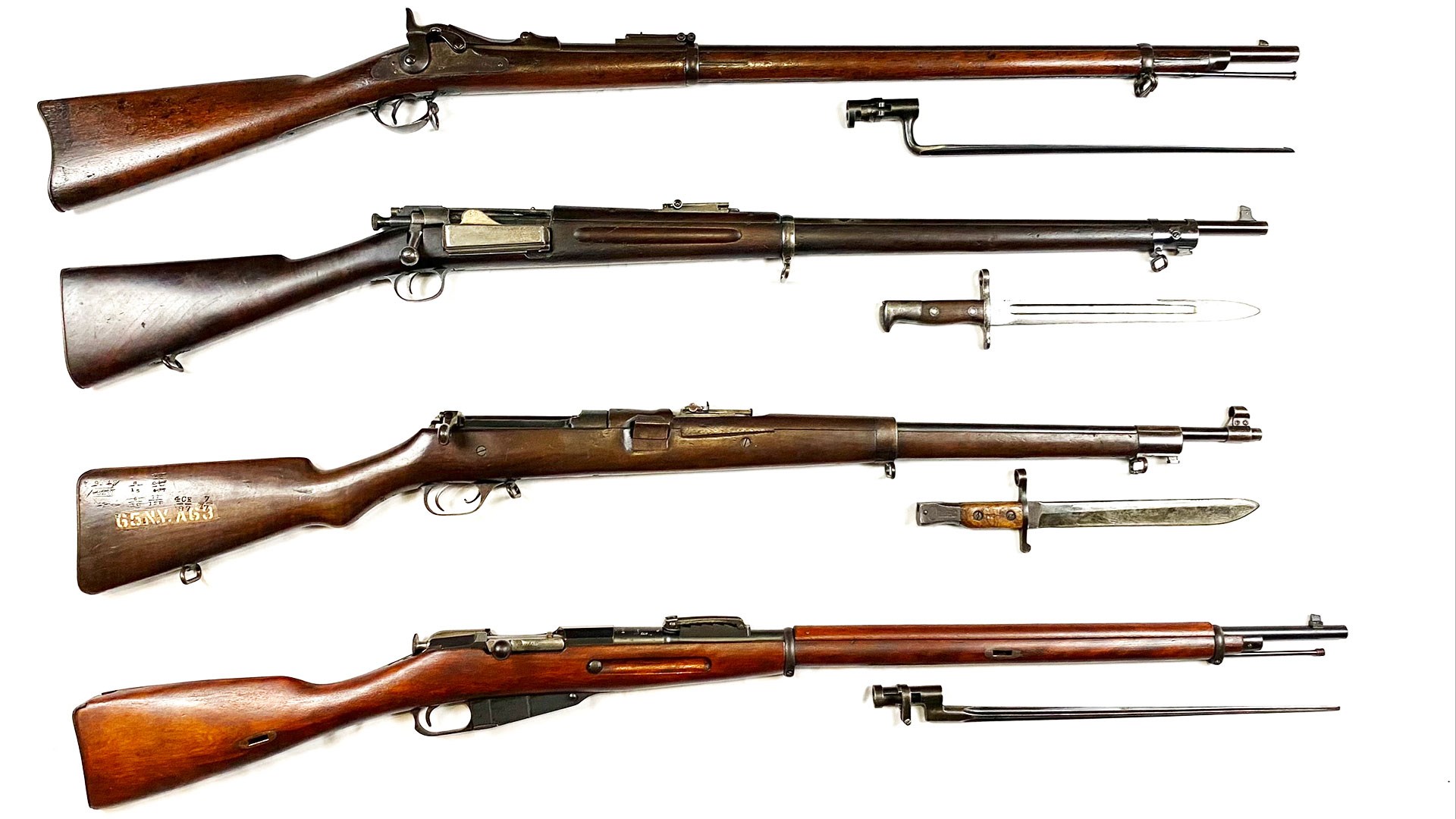
Four largely forgotten infantry rifles that were used in some capacity by the U.S. during World War I. From top to bottom: Springfield Trapdoor, Krag-Jorgenson, Ross Mk II*** and an American-made M1891 Mosin-Nagant rifle.

But this was not a painless or fast process, and between military and bureaucratic tangles along with serious parts interchangeability issues, the first production rifles didn’t start rolling off the line until September – approximately five months after both the decision was made to adopt it and the official US entry into the war. While the fielding of the M1917 is rightly regarded as an impressive industrial feat by the three commercial factories tasked with its production (indeed more M1917s saw field service than M1903s), the fact remained that in the meantime more rifles were still desperately needed to train recruits, guard stateside infrastructure and even deploy overseas.

“Very serviceable weapons, although not of the present standard model for the United States Army”

The first and most obvious choice to supplement the shortfall of “modern” rifles was the Krag-Jorgenson pattern of rifles, produced between 1894 and 1903 by Springfield Armory. While not quite as excellent as the M1903 that replaced them (the Krag lacks a charger loading system, utilizes a ballistically inferior cartridge and is overall longer), they were still very suitable weapons for use by an early 20th century military, as they fit the mold of small-bore and smokeless powder that had become the practical requirement.

After the adoption of the M1903s, Krag rifles remained the primary arm of many state military units as the M1903s slowly trickled out to the entire force. In addition, many were disbursed to various organizations that had a need for a recently obsolete military rifle for marksmanship training, drill practice or ceremonial use. A majority, however, were simply recalled to and stored in government arsenals awaiting either future use or disposition.  
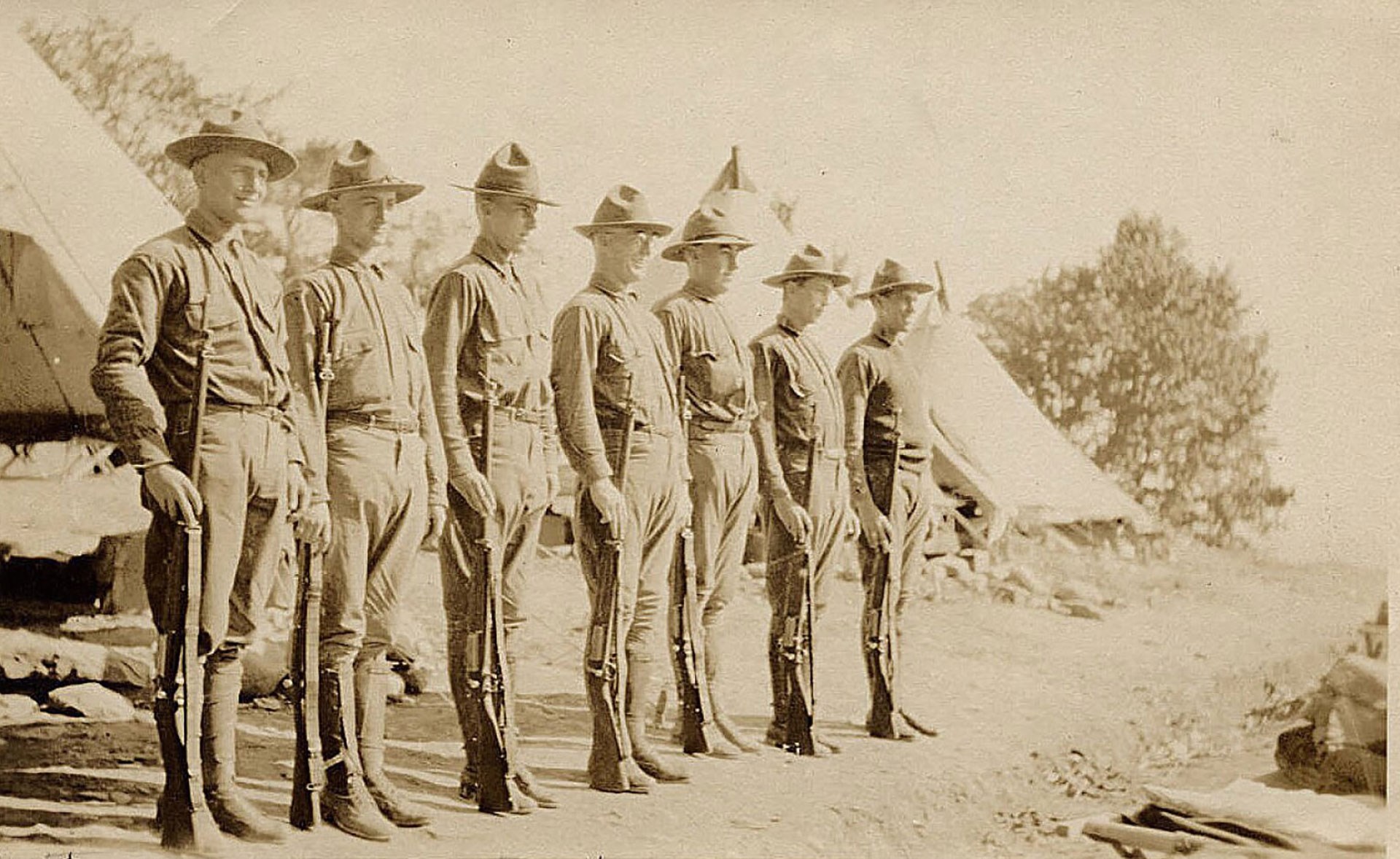
Men of the New York Guard standing at attention with their Krag-Jorgenson rifles.

In a May 17, 1917, memorandum from the Office of the Chief of Ordnance, they report that, “there are in in the possession of Educational Institutions 44,708 Krags and in the possession of Rifle Clubs 7,421." Because the shortage of rifles was apparent early on, Brig. Gen. Crozier stated that even though “it is not necessary that troops shall go into campaign armed with the [Krag] rifle, it is possible that some of these rifles may be required for drill and target practice," and he recommended that the issue of Krag rifles to groups “other than federal forces be suspended." Almost certainly acting under this advisement, the Secretary of War cut off rifle clubs, schools and colleges in an order dated May 9, 1917.

One would think that the rifles held by the federal government would be the easiest to put into immediate service, since they just needed to be brought out of storage – yet they weren’t always in “fighting ready” condition. In the same May 17 memorandum, the Ordnance Department reported that, “There are on hand approximately 210,000 Krag rifles and carbines, of which 102,000 are serviceable," and that, “The unserviceable guns and ammunition require overhauling and putting in shape." 
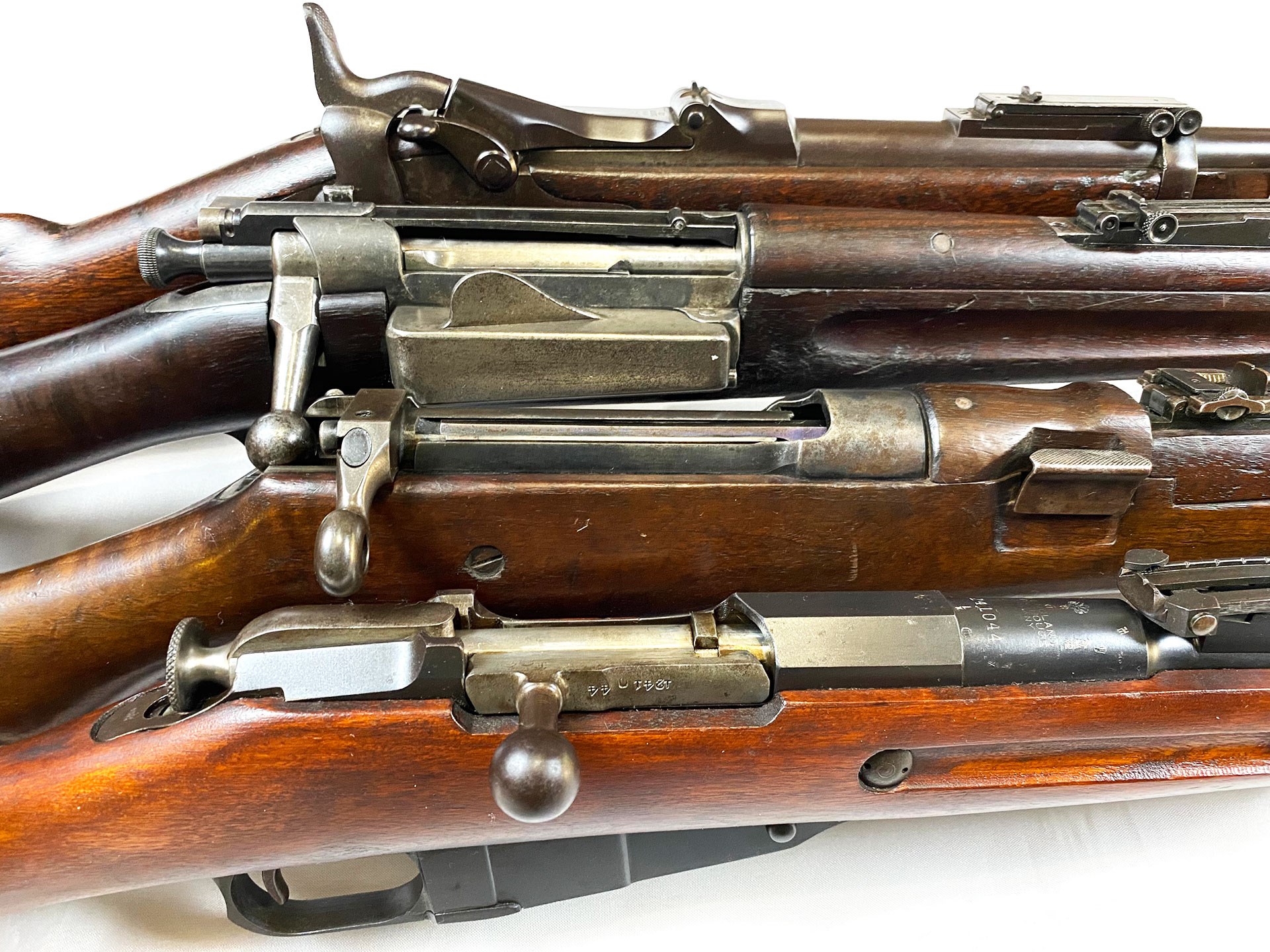
A comparison between the four rifles' actions.

A rapid series of messages back and forth between the Ordnance Office, and the commanders of both Springfield Armory and Watervliet Arsenal details some of this process. In the correspondence, the three parties work out the particulars of sending some 88,952 unserviceable Krag rifles and carbines, along with Springfield’s supply of spare parts, to Watervliet for overhaul. This included not only the M1898 rifles, but also approximately 2,500 M1892 and M1896 rifles as well as "bayonets and appendages."

As discussed above, and as envisioned by Ordnance officials at the time, the Krag saw heavy use training the ever-growing body of American fighting men as they prepared to deploy to Europe. The broader population had become aware of the rifle shortage, however, and many wrote to their elected officials to express their concern that their sons might be forced to drill with broomsticks or wooden rifles. The Krag was often used to allay these fears, with Brig. Gen. Crozier pointing out to one worried mother that, "There have been for some time at each cantonment of the National Army 55,000 Krag Jorgenson rifles for training; these were soon after their supply followed by an additional 2,000 of these rifles, which are very serviceable weapons, although not of the present standard model for the United States Army."
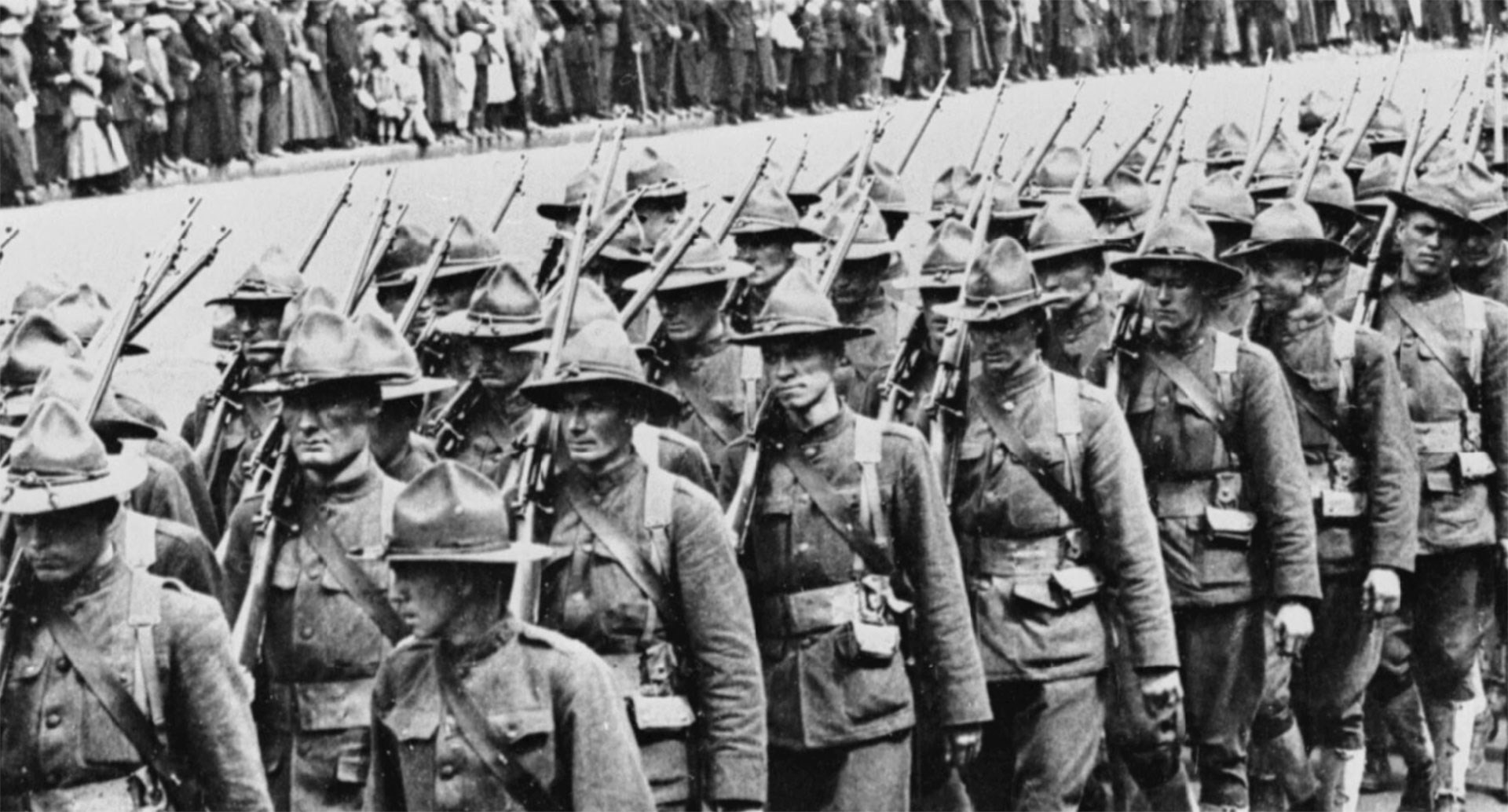
Krag rifles being carried by men of the American Expeditionary Force during World War I.

Some Krags did see limited service overseas during the war, with at least the 14th United States Engineers carrying them all the way into France. By July 1918 however, they had been switched out for M1903 rifles and the II Corps Ordnance Officer reported disbursing 1,157 M1903s in exchange for at least 972 Krag rifles. The stated reason for the switch was to ensure ammunition standardization in whatever area the unit was assigned to.

“When will they be put on Flintlocks”?

Even older US military rifles were brought back into service to help alleviate the acute shortage of functional weaponry. On Aug. 23, 1917, an officer from the Small Arms Division of the Ordnance Department instructed the commanding officer of the Rock Island Arsenal to "put into good condition" the 2,927 unserviceable Trapdoor Springfield rifles on hand at the arsenal. This action, along with the work on Krag rifles and carbines, earned the scorn of some of the workers – as reflected in one anonymous complaint written to U.S. Senator G.M. Hitchcock and forwarded to the Chief of Ordnance:

Dear Sir:

Of my own personal knowledge I know that there is a force of men at work at R. I. A. on worn-out Krag-Jorgenson rifles used in the Philippine campaign of ’99 and 1900 – also another force on caliber .45 Springfields discarded at that time.

It’s a standing joke among these employees as to when they will be put on Flintlocks.

Now I don’t know if this will put me in jail, but I think it should be asked of Mr. Baker [the Secretary of War] if this can in any way assist in arming our men to defeat the Huns.

Despite this anonymous worker’s skepticism about the usefulness of Trapdoors to the war effort, they were actually in high demand by a number of states which wanted rifles for stateside security use. New York in particular, while angling to acquire more modern arms from Canadian sources, articulated a need to guard "lines of transportation and communication over which are sent Federal Supplies" and that the "Prospect of [a] shipping strike on water front N.Y. makes [the shortage of rifles] serious." Brig. Gen. Crozier, somewhat tersely, reminded the writer that "the governor of the State of New York was authorized to requisition guns from educational institutions and rifles clubs of New York," and that he had not drawn all that he was able.
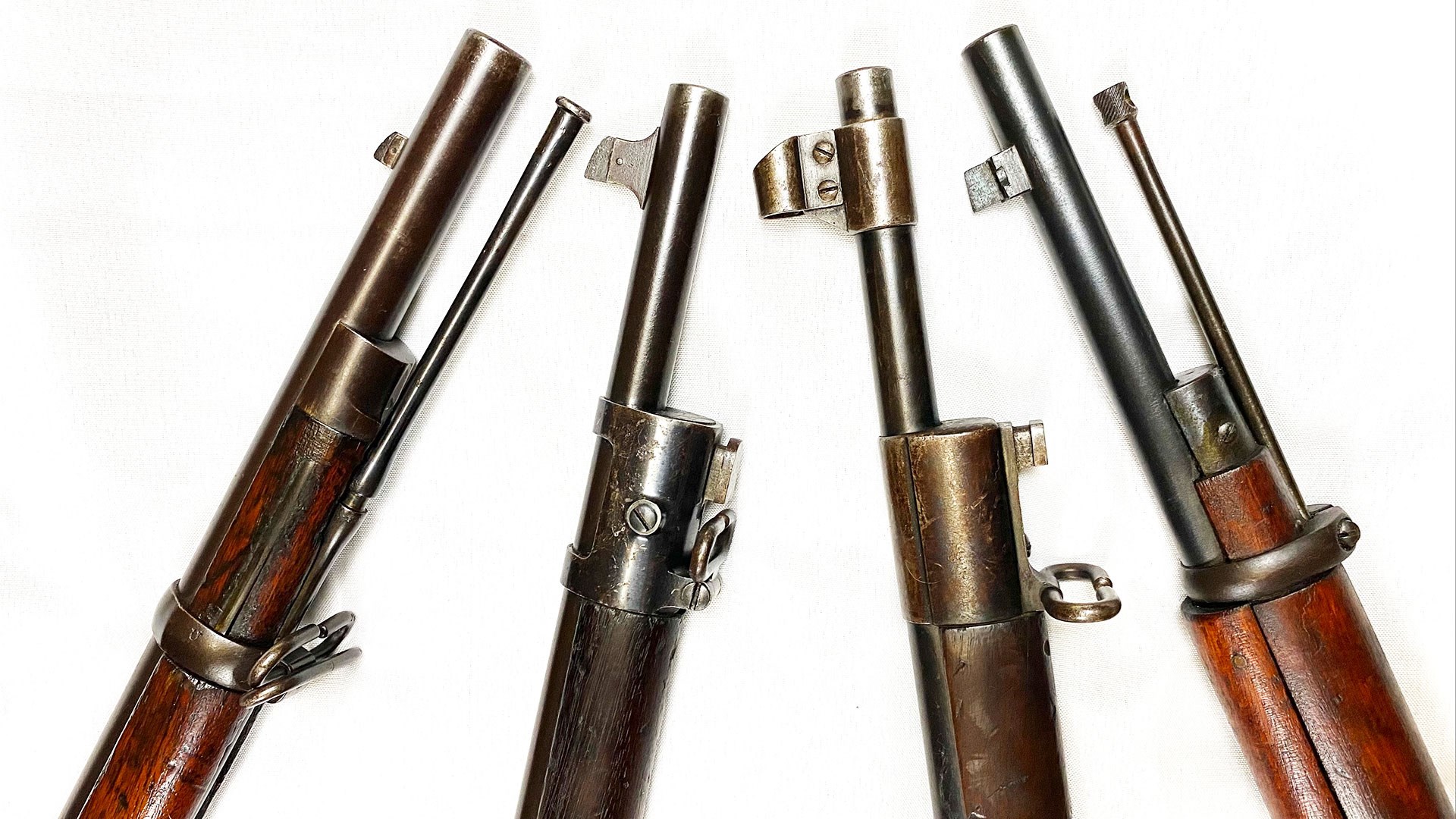
The muzzles of the four rifles compared. From left to right: Springfield Trapdoor, Krag-Jorgenson, Ross Mk II*** and an American-made M1891 Mosin-Nagant rifle.

Additionally, he stated that the governor was issued 500 Trapdoor Springfields on Aug. 11, 1917, and that, "There are on hand, not already allotted to state organizations, 7,979 rifles of caliber .45. The demand is very heavy for this character of equipment for use of home guard organizations; about 30 states have not as yet been supplied, and no more rifles can properly be issued to this state. The former Adjutant General was fully advised as to this."

So even though the Trapdoor was thoroughly out of modern military fashion by 1917, being not only a single-shot breechloader, but also blackpowder and large bore; thousands of them still played a role in the process of getting American fighting men and their equipment safely across the country and loaded onto ships bound for France.

“War Department has no objection to State of New York purchasing rifles from Dominion Government”

While Trapdoors were useful in certain roles, there still existed a stateside need for “modern” rifles more akin to the M1903 and M1917 rifles that were to be used against the Hun (and the RIA workers were, after all, not going to be tasked with refurbishing flintlocks). As mentioned above, New York was especially interested in obtaining additional rifles, particularly since its harbors were a key point of embarkation. Fortunately, America’s neighbor to the north had a number of older pattern Ross Rifles that they were willing to sell across the border to help Uncle Sam.
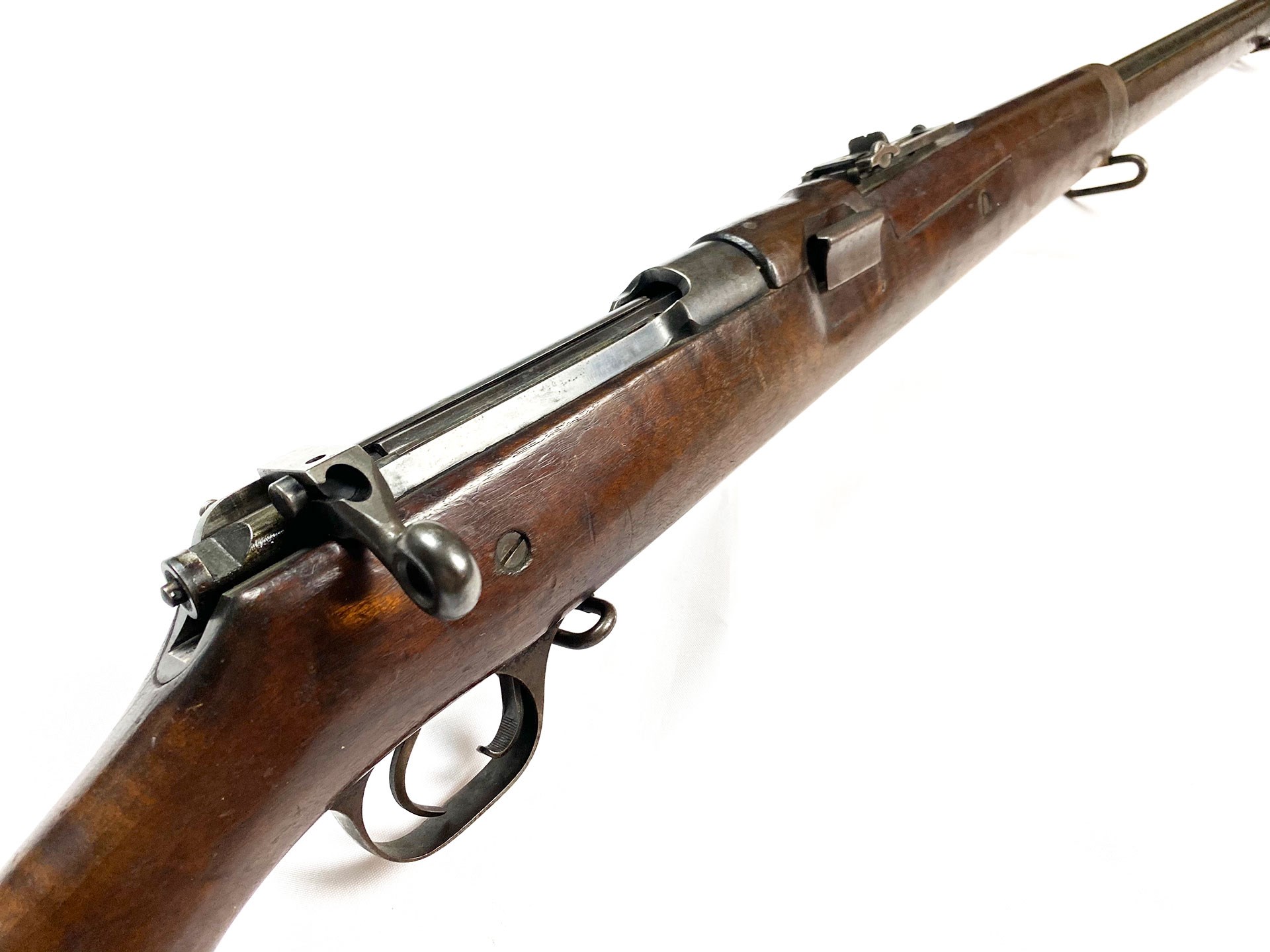
A closer look at the features of the action on the Ross Mk II*** rifle.

These took the form of Ross Mk II*** rifles, also known as the Model 1905. Featuring a straight-pull action, the Ross fires the .303 British cartridge from an internal magazine. While the later Ross Rifles were charger fed, the Mk II*** featured a follower depressing lever on the side of the rifle that allows the user to “dump” the cartridges into the rifle, instead of inserting them singly. Even though the Mk II*** was already obsolete by Canadian standards, Ross Rifles as a species also ran into problems in the harsh fighting conditions of the trenches. This, combined with tight tolerances better suited for a target rifle and loose British ammunition tolerances, resulted in a majority of Ross Rifles being withdrawn from frontline service in Europe and replaced by the Short, Magazine Lee-Enfield.

Despite these issues, the rifles were certainly suitable for stateside use, and more importantly, were actually available for transfer south in September 1917. New York was so eager to get their hands on these rifles that they actually started negotiations directly with Canada and secured the ability to purchase 15,000 Ross Rifles and ammunition for them, with the purchase price recorded as being $12.50 for the rifle, bayonet and scabbard. Their plans hit a snag however, as the rifles would be subject to an import duty of 35 percent, making a relatively good deal suddenly less appealing.
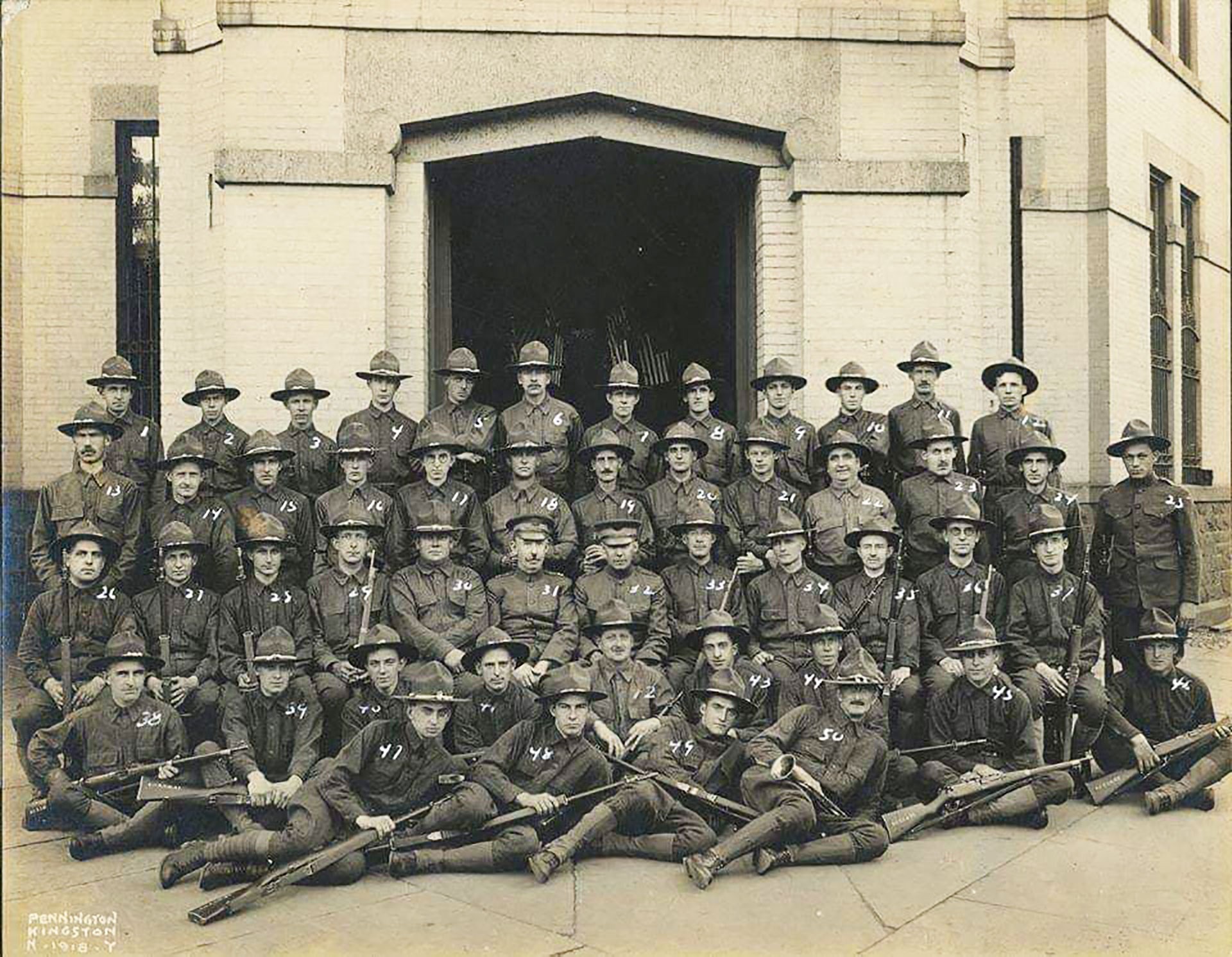
Men of the New York Guard armed with Ross Rifles. 

New York requested either an exemption to the tax, or reimbursement for the fee through the federal government. Instead, Brig. Gen. Crozier informed the Adjutant General for New York that he was already in talks with the Canadians for rifles, and that he would be able to sell some quantity of the procured rifles to the state. In the end, the ordnance department was able to procure some 20,000 Ross Rifles for use, with 10,000 of them going to New York and the difference being used for training troops in federal service.

The rifles acquired under this contract are identified by a “U.S.” stamping on the underside of the wrist, and “flaming bomb” stamps in the wood both fore and aft of the trigger guard and magazine assembly. Additionally, a new inventory or serial number was also added to the underside of the wrist. This broke from the Canadian practice of marking model, serial number, and unit assignment on the right side of the buttstock, and many of the rifles feature multiple struck through markings denoting the rifle changing hands.
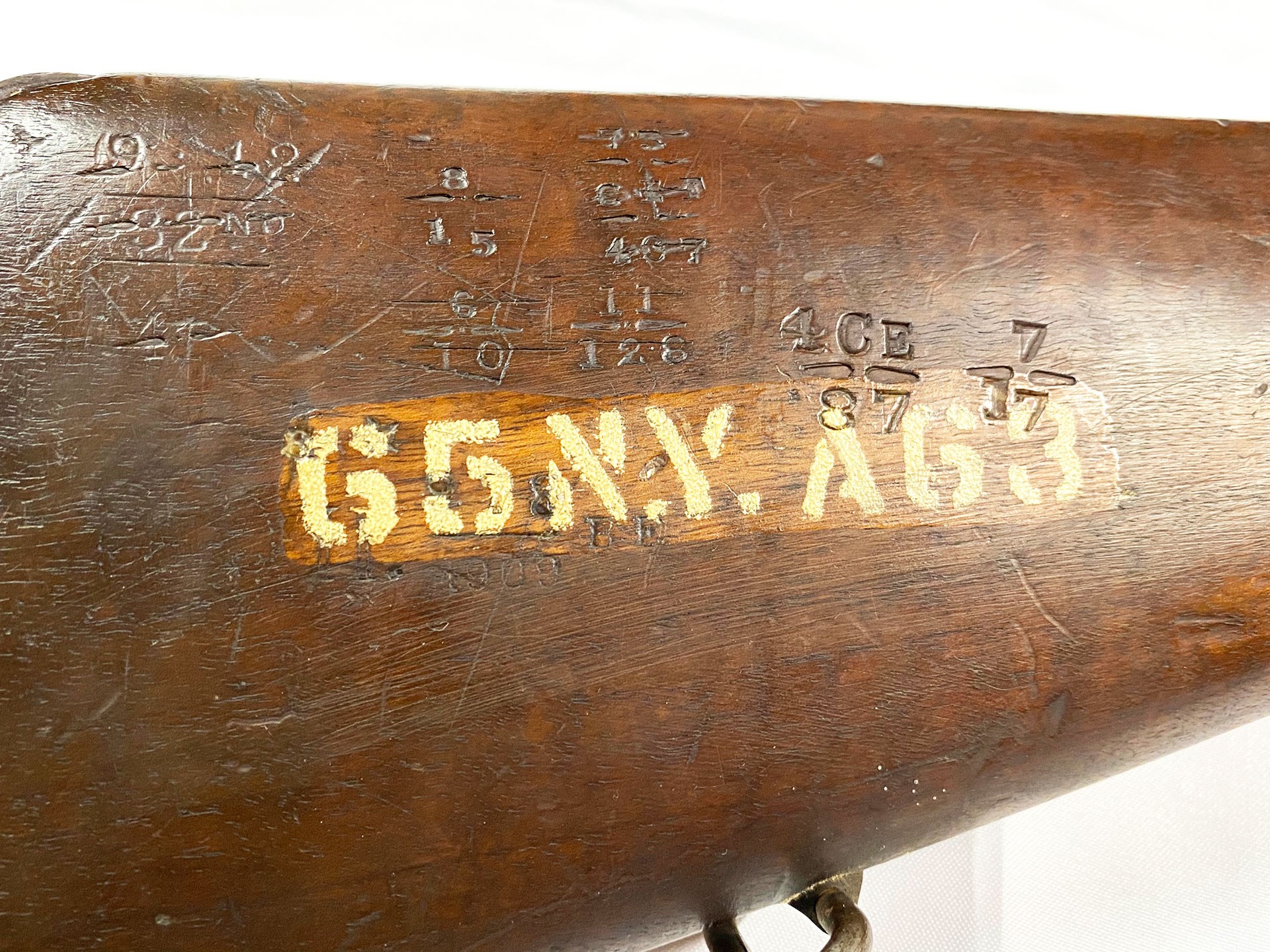
New York Guard markings painted over older Canadian service stamps on a Ross Mk II*** rifle.

The rifles that made it to New York primarily found themselves in the hands of the New York Guard (not to be confused with the New York National Guard). Since the New York Guard was a purely state organization, it was not subject to being called into federal service and was used by the state for protecting infrastructure and other critical internal security roles. As the pictured rifle and period unit photograph shows, rifles distributed to the NYG often received painted on unit markings done right over top of the original Canadian stampings.

“The rifle will be known as the Russian 3 Line Rifle”

While the government looked across its northern border for the Ross rifle, they didn’t have to look nearly as far for another foreign service rifle to supplement their supply of rifles. That is because two U.S. firearm makers – the New Remington Rifle Company in Bridgeport, Conn., and New England Westinghouse in East Springfield, Mass. – had been hard at work producing Model 1891 Mosin-Nagant rifles. Both of the companies were subsidiary organizations to their more famous parent companies, and had been designed almost exclusively to handle the massive Russian contracts.

On June 6, 1917, the vice president of Westinghouse Electric and Manufacturing Company wrote to the Ordnance Department with a proposal. The company had "been successful in adapting the Russian type of military rifle to the use of U.S. ammunition, with very slight changes." All of the existing forgings could be used, with the goal to "develop a military rifle of about the same length as the Springfield rifle and one which [the company] experts feel could in an emergency be usefully employed by our own troops." Ten days later, a polite but lukewarm response was composed by a major from the Small Arms Division, stating that "it is not deemed advisable to have a third model of rifle in the service, at the present time," although he did suggest that the rifle could be sent to Springfield Armory for further evaluation.
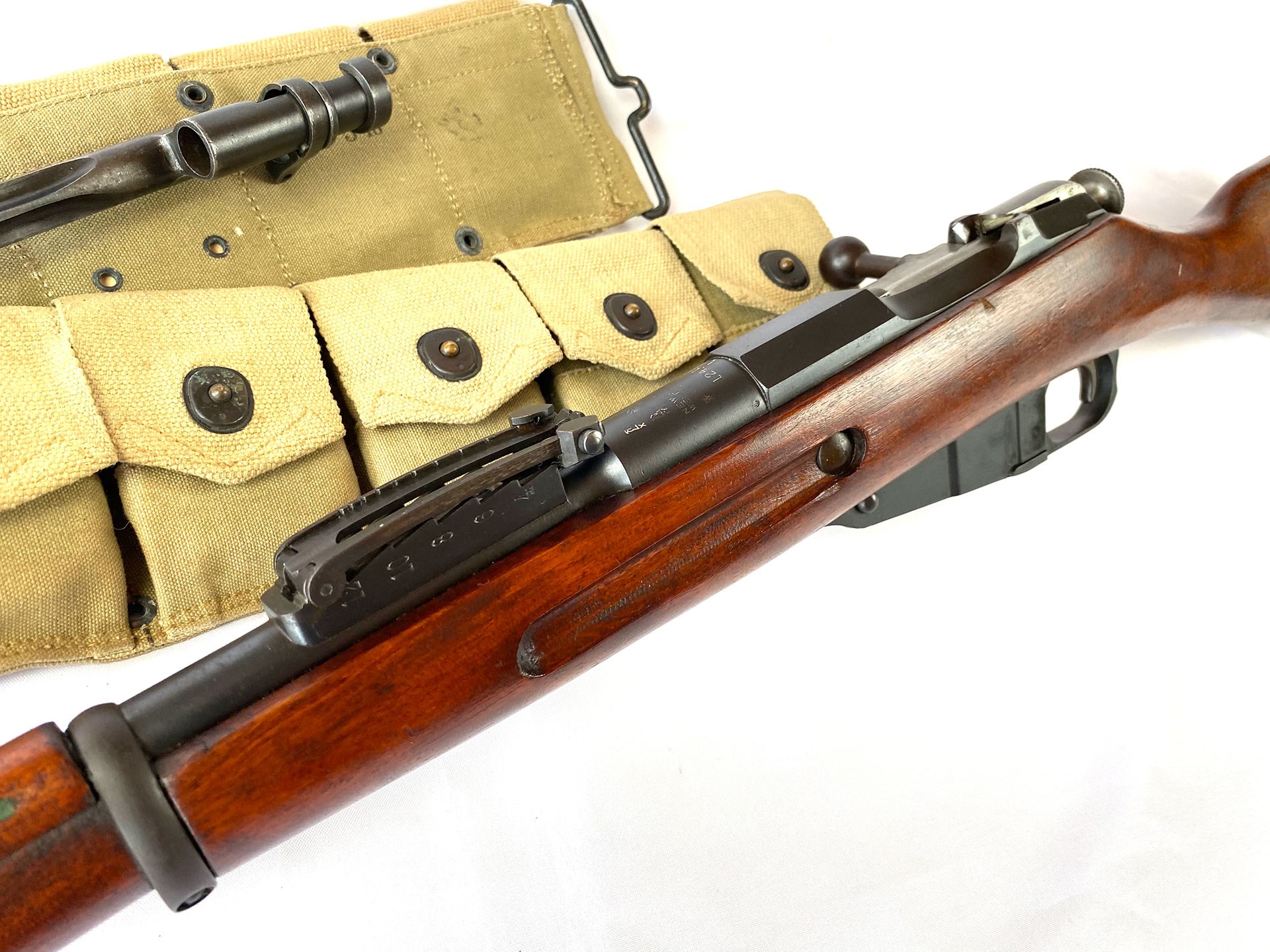
A left-side view of a New England Westinghouse manufactured Model 1891 Mosin-Nagant rifle, which was commonly referred to as the "Russian rifle."  

In the closing days of 1917, however, the War Department circled back to the idea of using the Russian rifles – albeit in their original caliber of 7.62x54 mm R. The new Soviet government had entered into an armistice with the Central Powers on Dec. 15, 1917, and began formal peace negotiations on December 22 at Brest-Litovsk in Ukraine. It was likely at this point that American War Department and Ordnance officials felt safe in assuming that the new Russian government’s demand (and willingness to pay) for the rifles would be greatly reduced as they exited the war and turned their attentions inward.

The loss of this contract would economically harm the companies of course, as they had been created almost exclusively to handle the Russian contracts. The U.S. decision to order Russian rifles has sometimes been framed solely as a “too big to fail” bail out of sorts, designed to prop up floundering US companies. However, primary source documents from the era reveal a bit more nuance and show that there were serious war material production concerns at stake as well. The New England Westinghouse Contract is particularly interesting, because the ultimate plan was to convert the factory over for the production of 15,000 heavy machine guns — something indispensable on the modern battlefield. 
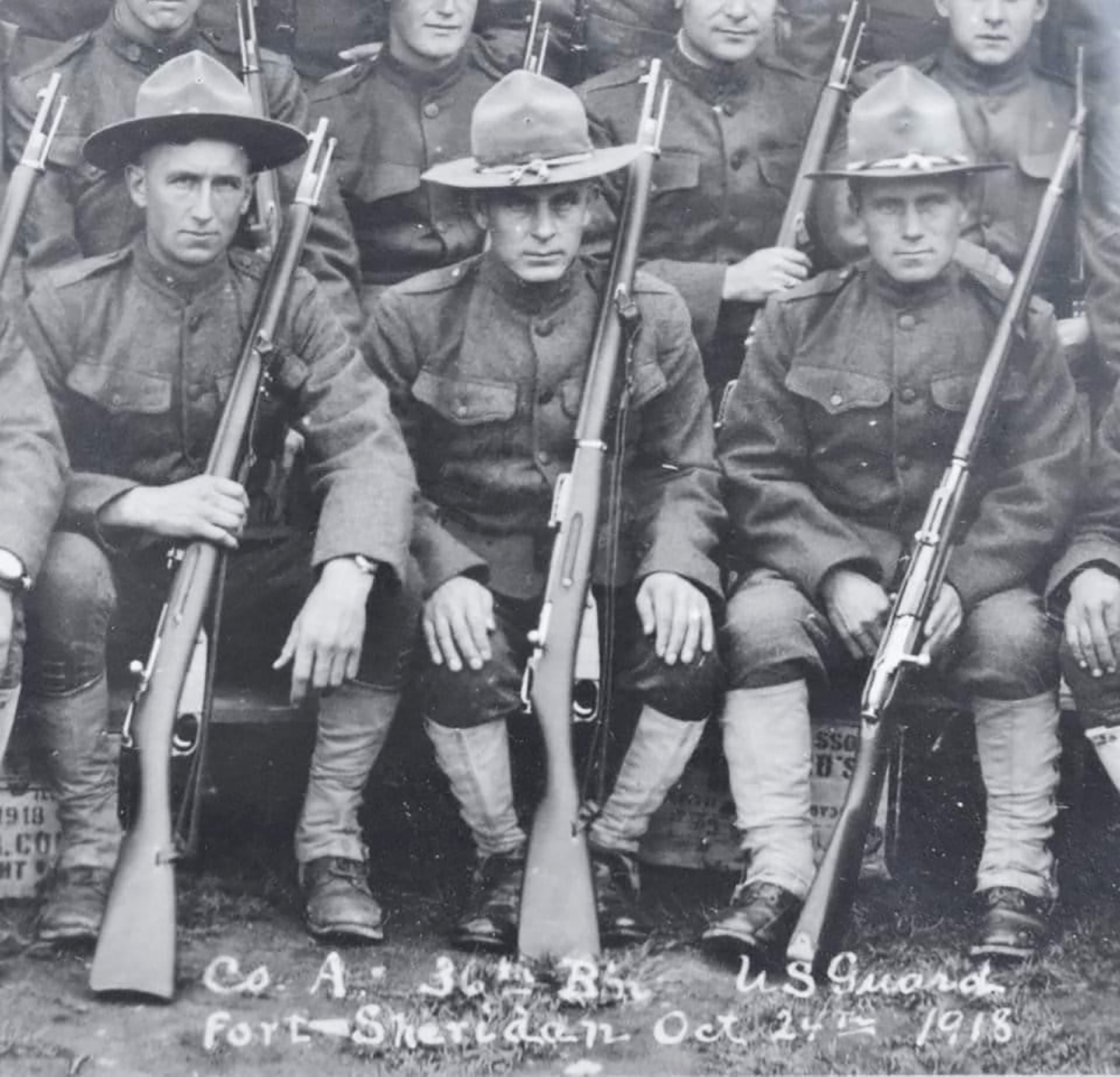
Men of the U.S. Guards armed with Model 1891 rifles.

In order to, "insure production it was found necessary to provide means of preserving the organization of [N.E.W.] until such a time as the manufacture of the machine guns could be started." As one could imagine, the loss of skilled laborers, managers and inspectors would have an extremely harmful effect on the ability of the company to transition over to an entirely new set of weapons. While the companies certainly benefited from government picking up their contract for Russian rifles, the government war effort was at least an equal beneficiary.

Losing no further time, the Secretary of War placed an order with the New England Westinghouse Company of Springfield Massachusetts on Dec. 29, 1917, for "the manufacture of 200,000 Russian rifles on the basis of cost without profit to [the] company," which equated a contract price of $15 per rifle. Hedging their bets a little bit, it was "stated that an option was given to the Russian Government until May 1, 1918, to purchase such Russian rifles as [produced by N.E.W.]." The plan was that the company would continue manufacturing the Russian rifles, and the government would pay New England Westinghouse $600,000 per-month until May 1918, at which time $3 million would be expended and the machine gun production lines were scheduled to be operational.
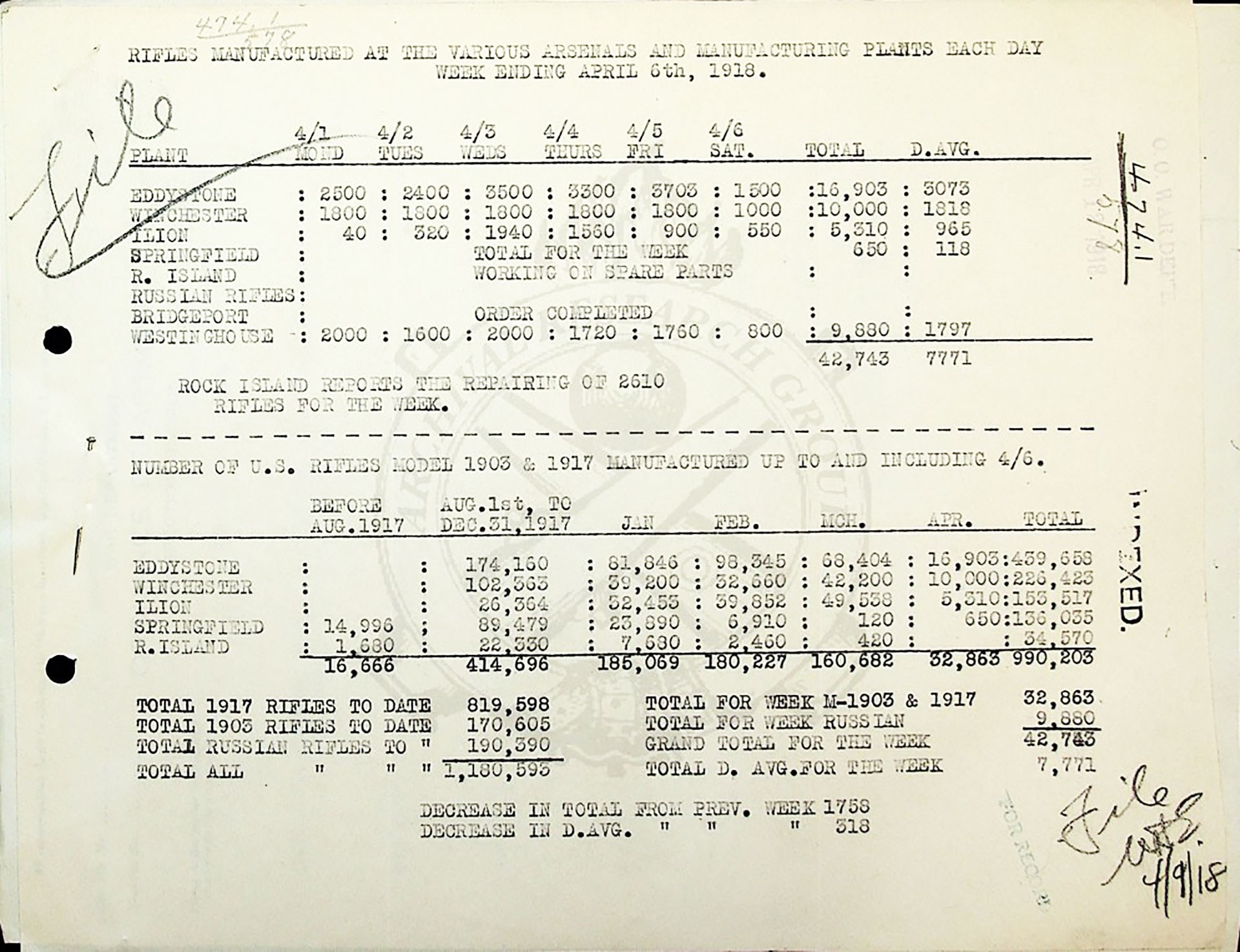
A document comparing production numbers of the M1903, M1917 and M1891 rifles from their various manufacturers. Photo courtesy of Archival Research Group.

The New Remington Rifle Company of Bridgeport, Conn., wasn’t far behind, with the Acting Chief of Ordnance placing an order on Jan. 7, 1918 for 78,950 already produced rifles. The cost would be set at $30 per rifle, for a total contract price of "$2,368,500 to be paid […] upon delivery and acceptance of said rifles." Remington did continue to make rifles for the Russian government as well, but downward adjustments to the contract by the Russians caused Remington to reduce the number of men on the job. As in the case of New England Westinghouse, the purchases made by the U.S. government appear to have been made to allow the company "to keep a substantial portion of its organization together until it can be gradually diverted from work on the Russian rifles to work on the United States Government’s orders."

Regarding nomenclature, there seems to have been some attempt by the Ordnance Department to give the M1891 in U.S. service the name “Russian 3 Line Rifle,” although in the vast majority of official correspondence they are simply referred to as “Russian rifles." When it comes to weapons produced primarily for U.S. service, you perhaps would think that rifles of the same type would have the same inspection process when it came time to certifying their suitability for use. This was not the case with the Russian rifles.
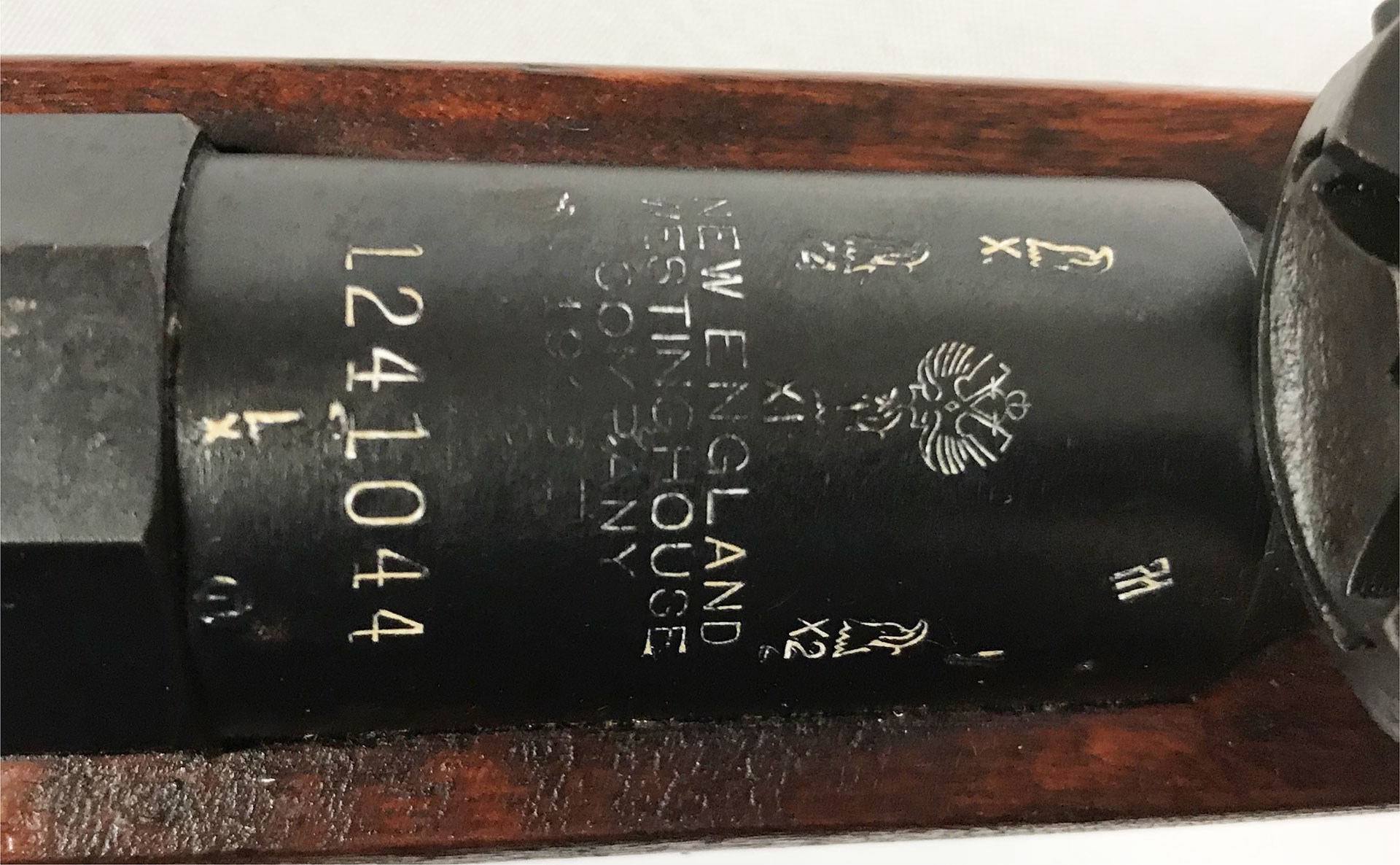
A closer look at the receiver markings of a Westinghouse manufactured M1891 rifle.

In general, Remington took a relatively minimalist approach and usually chose to simply stamp a flaming ordnance bomb and maybe an eagle head over “U.S.” on the bottom of the stock, just forward of the magazine. The inspection team at New England Westinghouse, on the other hand, must have decided to put their inspectors to work, as the rifles produced during this contract run are covered by a bevy of eagle head stampings on both the wood and the metal.

Documents drafted shortly after the war indicate that many thousands of these rifles were shipped across the United States for use as training weapons and stateside guard duty, with 12,954 being issued to the National Guard, 41,705 to various Home Guard organizations and approximately 25,000 to the U.S. Guards (a Federal military internal security organization composed of men aged between 31 and 40). On Governor’s Island in the New York Harbor for instance, the 300 men of the 9th U.S. Guards stationed at that post were armed exclusively with “266 Russian type rifles.” Post-war, Camp Logan, Texas, reported it had “532 Rifles, Russian”, along with an equal number of M1898 Krags that it wanted to divest itself of.
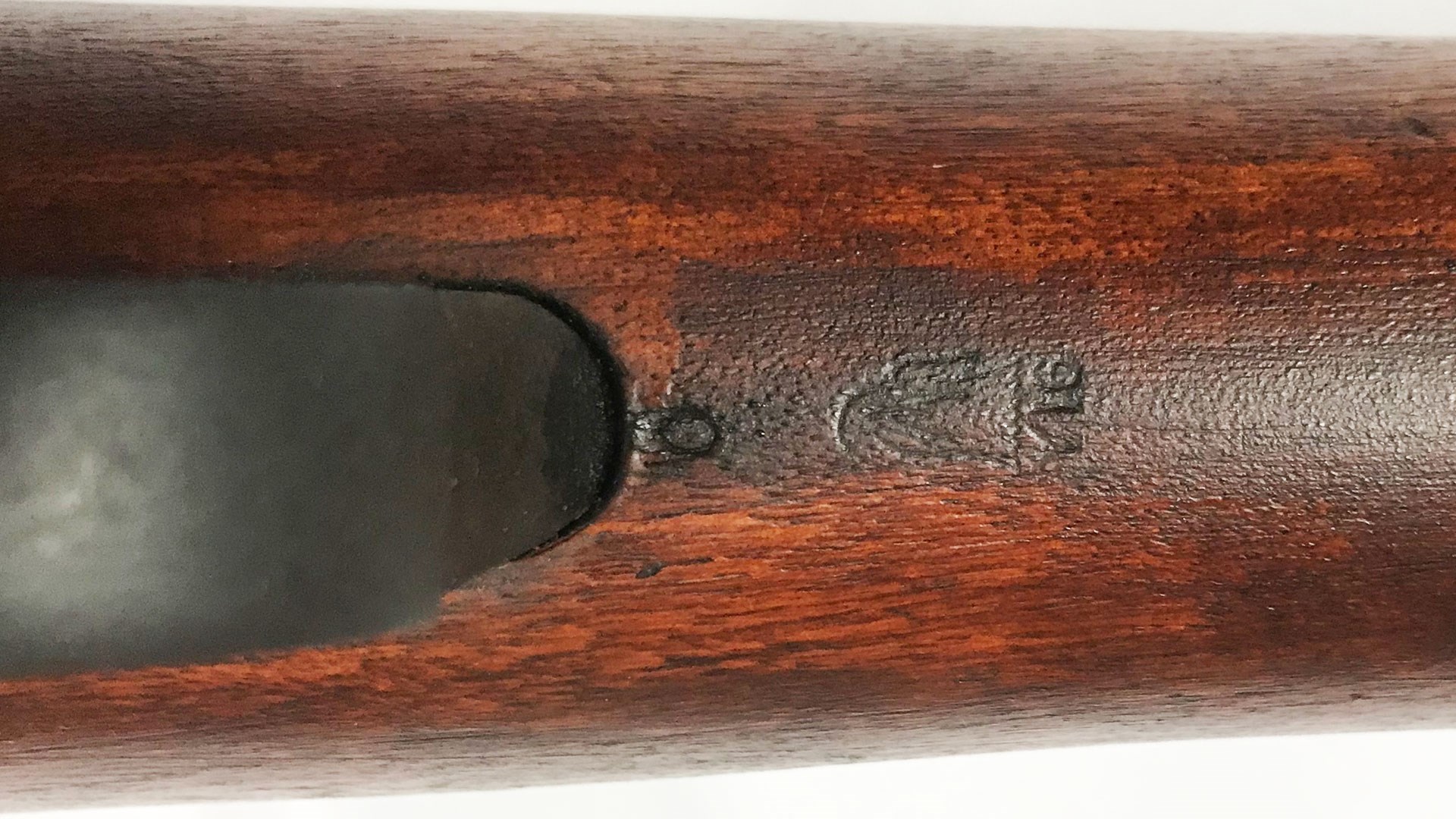
An eagle head inspection stamp in the wood of the Westinghouse manufactured M1891.

The largest number of Russian rifles were shipped to schools and colleges with programs of military instruction. Many of these had been forced to give up their Krags or other weapons during the early days following the U.S. entry into the war, and would likely have welcomed brand new (although non-standard) firearms into their arms rooms. Student Army Training Corps (S.A.T.C.) detachments received a staggering 109,700 rifles, while Reserve Officer Training Corps (R.O.T.C.) programs received 5,597.

That’s not to say they were always received with open arms however, and the Commanding Officer of the 5th Battalion, U.S. Guards stationed at Fort Robinson, Neb., had some critiques:

Subject: Russian Rifles

Stating a few apparent defects in the construction of Russian rifle, due perhaps to lack of knowledge of its nomenclature:

Can be safety locked only by pulling back knob of cocking piece with fingers and turning it to the left which makes it impossible to pull trigger or open chamber.

Examination has failed to reveal a cut off.

Apparently there is no provision for stacking arms.
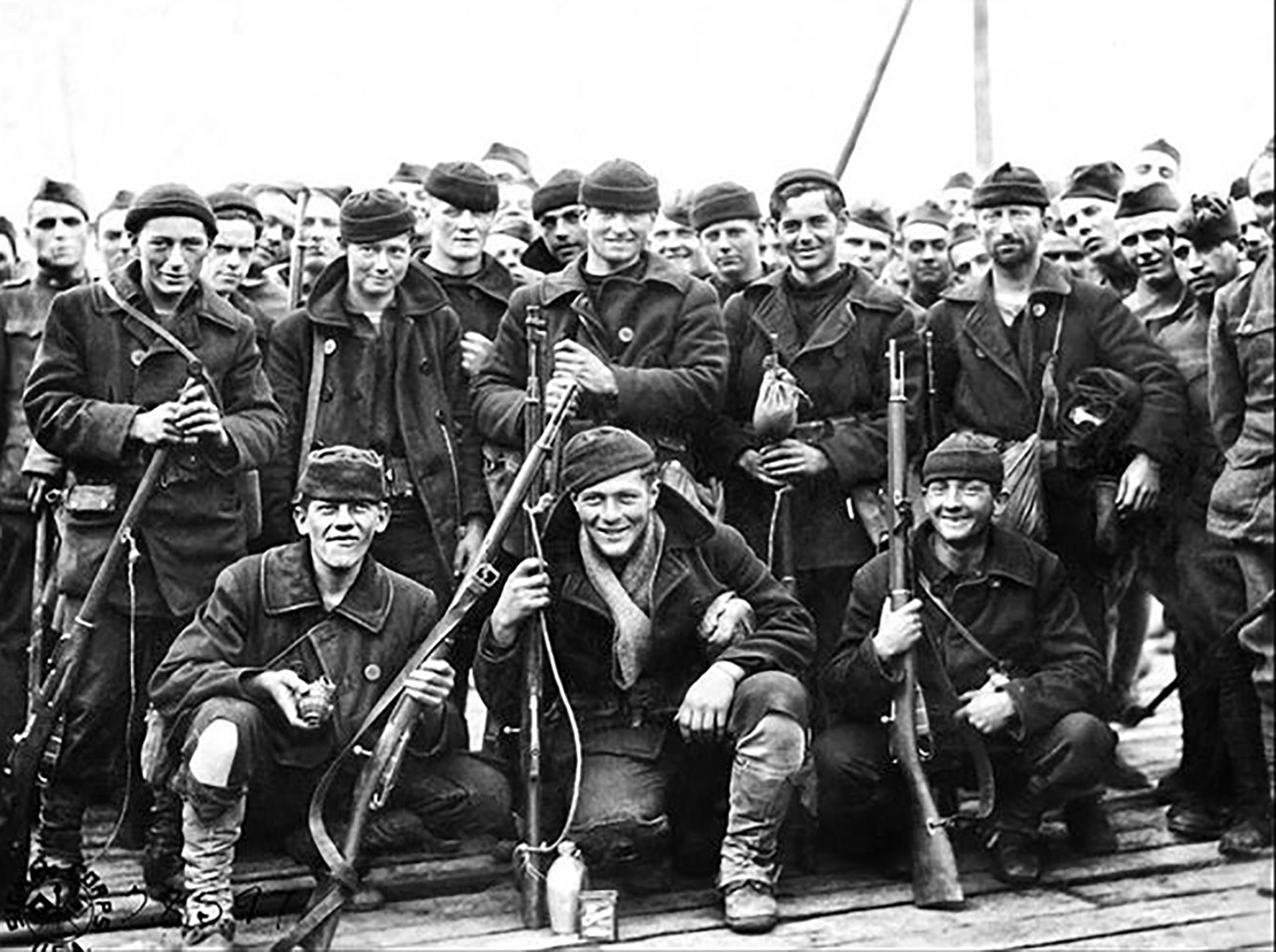
Sailors from the U.S.S. Olympia's shore party armed with M1891 rifles during the U.S. intervention in the Russian civil war in September 1918.

Despite its inferiority to the M1903 and M1917, the Russian rifles did actually see combat service with the United States military. A large portion of the U.S. soldiers and sailors tasked with the controversial intervention in the Russian Civil War were armed with American made Mosin-Nagants, something that undoubtedly simplified logistics when it came to spare parts and ammunition. Those rifles didn’t sail home with the troops in June 1919, however, as a telegram from Brig. Gen. Wilds P. Richardson, the man tasked with organizing the withdrawal of U.S. forces from Russia, reported that the Russian rifles had been turned over to the British by the departing “Polar Bear” personnel.

All Pulling for Victory

Although not designed as a military rifle like the others, an honorable mention should also go to the 1,800 Winchester Model 1894 lever action rifles chambered in .30 W.C.F. that were put into service in the Pacific Northwest guarding the pine forests. These so called “Spruce Guns” were used by the U.S. Army Signal Corps to secure this critical national resource from possible work stoppages or sabotage.

Although the vast majority of the non-standard rifles detailed above did not see overseas service, they did free up a staggering number of M1903s and M1917s for service abroad. They further provided security for the home front, not only guarding physical places and things, but also providing peace of mind to a nation newly at war. While they may not be enshrined in small town statues or immortalized in film being held by the square-jawed doughboy, they allowed the United States to quickly mass critical resources overseas and help bring about the end of World War I.

A special thanks is owed to Archival Research Group for providing high quality scans of the primary source documents used to write this article.