I shamelessly clipped this from "Military.blog", The material would have augmented my "Red Storm Rising Post" I did back in 2017 and I enjoyed doing that one immensely because it is my favorite Tom Clancy book.
Modified T-62 with reactive armor.
In the annals of military history, the T-62 stands out as a remarkable symbol of Soviet engineering. Introduced in 1961, this main battle tank was the successor to the T-55
and the final tank design under the aegis of Joseph Stalin. The T-62
was a global presence, exported widely and participating in several
wars, including the Yom Kippur War, the Soviet-Afghan War, and the Gulf
War. Its last combat use by the Soviet Union was during the invasion of
Czechoslovakia in 1968.
The T-62 was a significant upgrade from the T-55, boasting the first
Soviet tank to be equipped with a smoke grenade launcher. Its higher
hull and improved armour made it resilient against anti-tank missiles.
However, the absence of a Turret Basket posed a challenge in reloading
the main gun.
The T-62: A Symbol of Soviet Military Might
The T-62 was a testament to Soviet engineering prowess and played a
crucial role in the Soviet Union’s military strength. It was an integral
part of the Soviet strategy of using tanks in mass formations to
overpower adversaries. The T-62 was designed to be more potent and
sophisticated than the T-55, the mainstay of the Soviet tank fleet. It
featured a 115mm gun, improved armor, and tracks, and a new diesel
engine that was more fuel-efficient than the T-55’s petrol engine.
View of Soviet main battle tank T-62, Kislovodsk, Russia
The T-62: Keeping Pace with Technological Advancements
When the T-62 was launched in the 1960s, it was a state-of-the-art
tank that helped the Soviet Union stay abreast with the latest in tank
technology. The T-62 was significantly different from the previous
generation of Soviet tanks, most notably in its use of a 115mm
smoothbore gun. This gun, designed by Mikhail Kalashnikov, was capable
of firing both conventional shells and anti-tank guided missiles, making
the T-62 a versatile and formidable tank.
The T-62: Reliable and Rugged
The T-62 was one of the most reliable tanks produced by the Soviet
Union. It was rugged and easy to maintain, making it a favorite of
Soviet tank crews. The T-62 was used extensively in the Soviet military
campaigns in Afghanistan and Chechnya. It proved to be a capable and
reliable tank in both mountain and urban warfare.
The T-62: A Formidable Force on the Battlefield
The T-62 was armed with a powerful 100mm gun that could destroy most
enemy tanks. The 100mm gun was the most powerful tank gun in the world
at the time and could penetrate the armor of any tank. The T-62 was also
equipped with a 12.7mm machine gun which was effective against lightly
armored vehicles and infantry. The T-62 was one of the most feared tanks
in the world and played a major role in the defeat of the Western
forces in the Gulf War.
The T-62: A Mainstay of the Soviet Tank Fleet
The T-62 was a mainstay of the Soviet tank fleet for over two decades
and saw action in a number of wars, including the Soviet-Afghan War.
Even today, the T-62 remains in service in several countries and
continues to be a formidable force on the battlefield.
The T-62 was a defining tank for the Soviet Union and a symbol of
their military might during the Cold War. It was a reliable and
effective tank that saw action in numerous conflicts, including the
Soviet-Afghan War. The T-62 was a Soviet triumph, and a key part of
their tank fleet for over two decades.
I knew that the Soviets got the Shermans during WWII because of "Lend-Lease", and I recall that they liked the Sherman a lot. I was surprised that they didn't use them in Korea in a false flag incident or something because the Soviets don't throw nothing away. They still had equipment from WWII in warehouses in Siberia at the fall of the Soviet Union. I ran across this article on "Quora" where I am a contributor and I thought it was "Pretty Neat".
Soviet Shermans: The USSR Was a Big Sherman User, and They Liked it
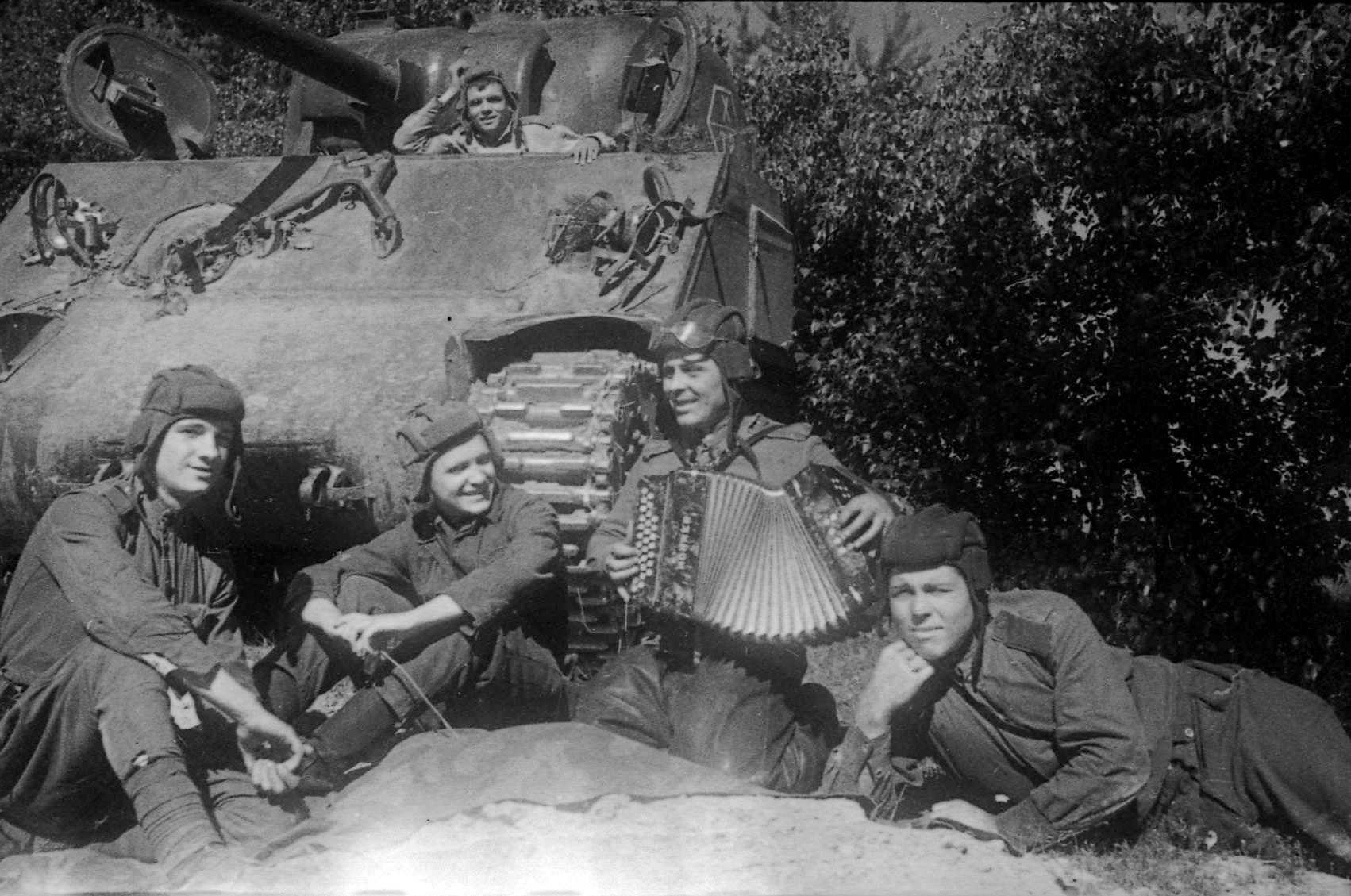
Soviet crew posing in front of their large hatch hull, M4A2 75 dry, tank.
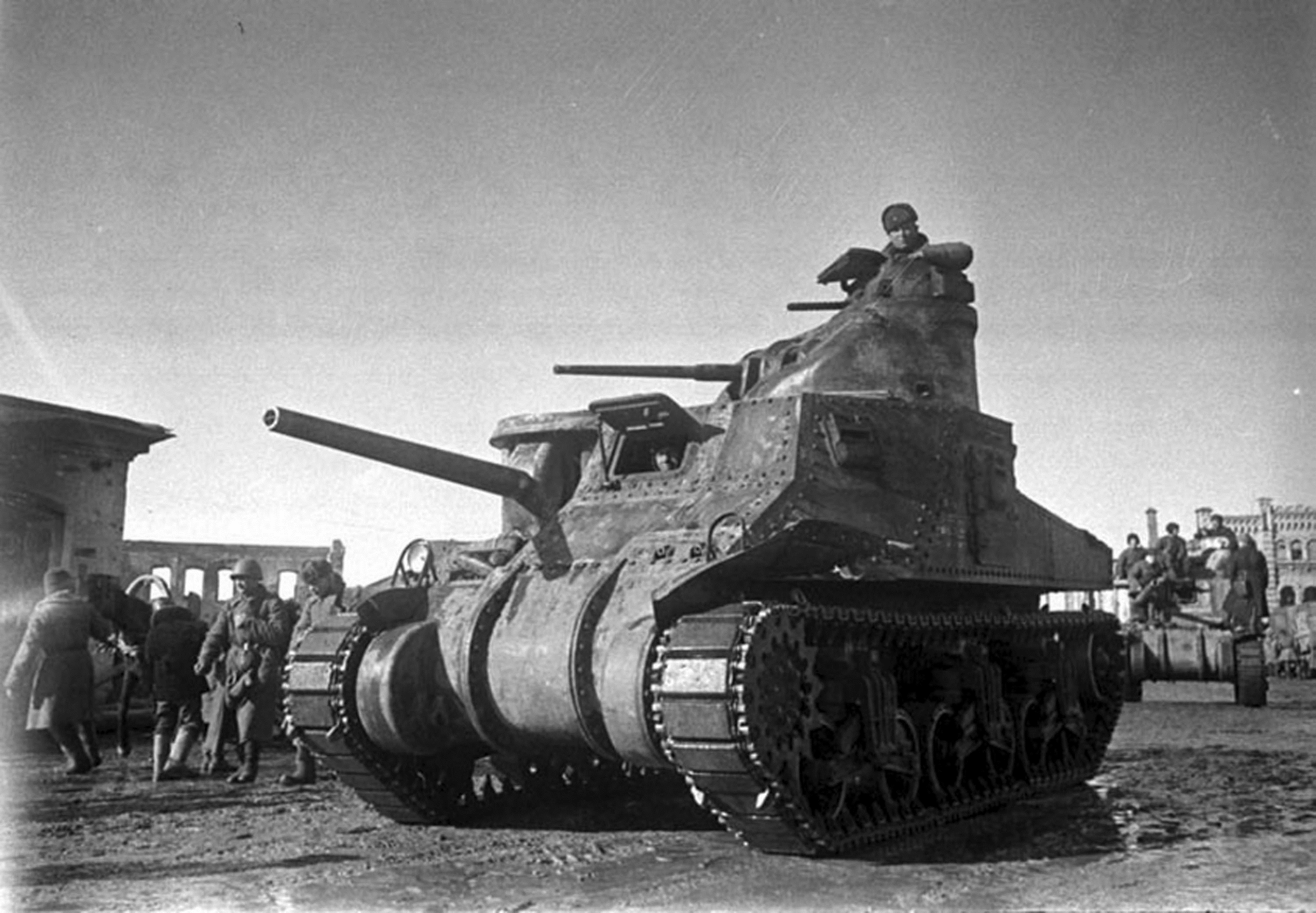
The Soviet Union received three American Medium tank
types in large numbers. They received the Lee, and M4A2 75 and 76
tanks. Only the UK would use more M4A2 tanks, though they received only
five armed with the 76mm gun, they got far more of the 75mm armed M4A2s.
The Soviets also received a pair of M4A4 tanks for evaluation but
rejected them because of the motor. My impression from the things I’ve
read says, they liked the all of them, well not the A4, but liked the
Shermans more than the Lee.
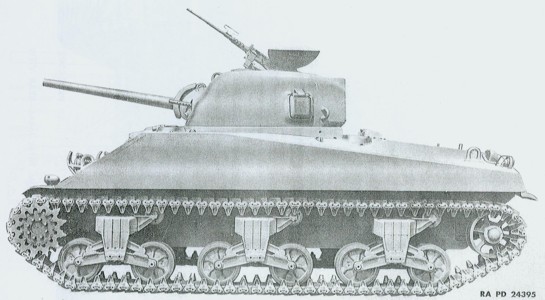
M4A2 76w, late production, with an M1A2 gun.
Now let’s cover each tank model.
M3 Lee: The Basic Lee
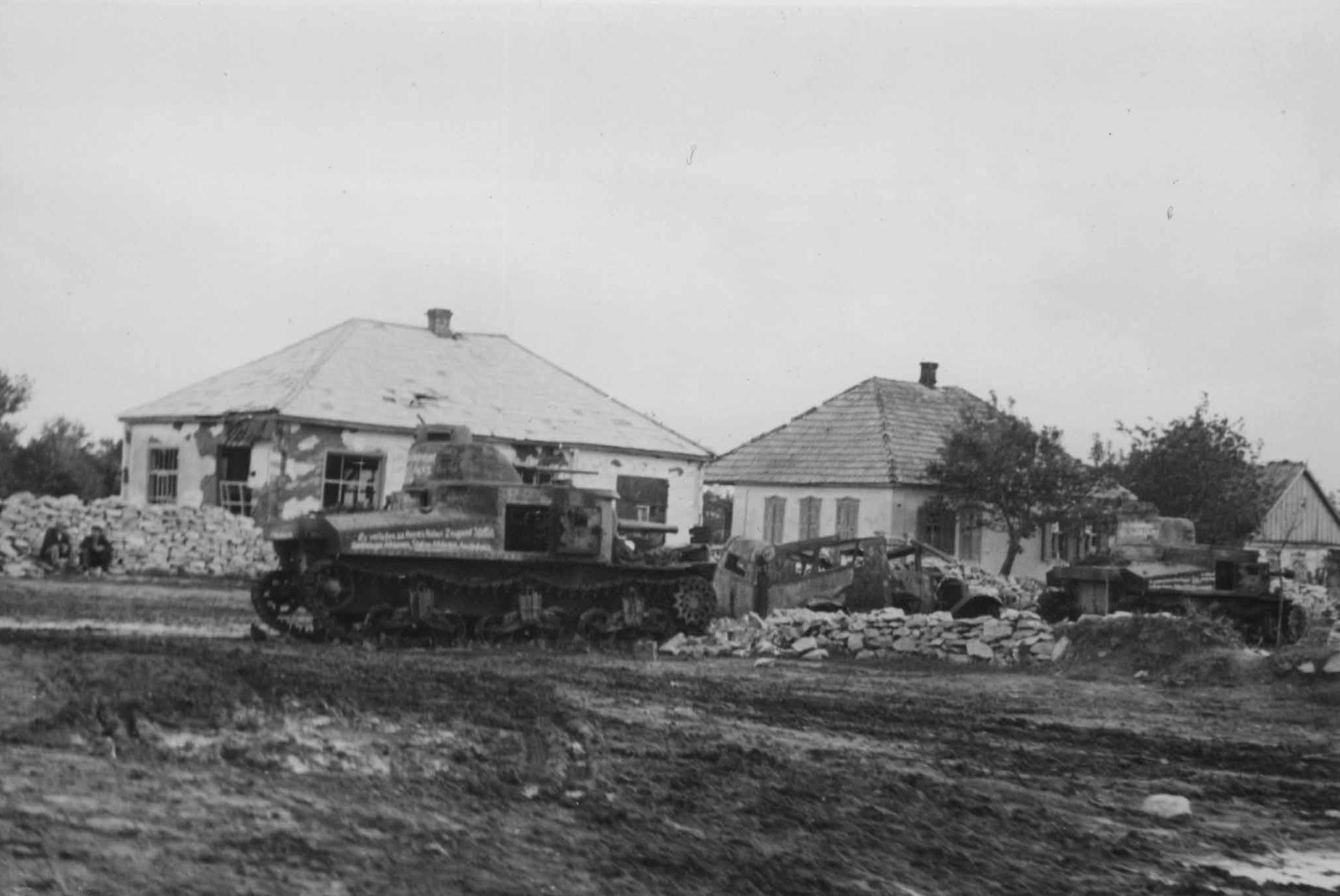
Knocked out Soviet M3 Lee tanks
The Lee was not considered a very good design by the Soviet Union, you can read their evaluation here, on Archive Awareness,
but it was not all negative. They liked the transmission, differential
and final drives, and in particular the steering and brake mechanism.
They felt the R975 air-cooled motor was not a great fit for tanks, for
all the reasons they are not fit for tanks, mainly the size limitations
they put on the tank, and as gasoline AC engines, they don’t have good
low-end torque, make driving harder. They disliked the position of the
75mm gun, and lack of sites on the machine guns.
Soviet M3 Lee, If you look closely you can see grousers installed on the tracks
One thing I found very interesting, is in the
summer, they could pack up to 10 SMG infantry into the Lee, along with
the regular 7 man crew, making it into a makeshift APC. The thing would
be packed full of people though. The report says all weapons could be
fired on the tank while those 10 men were stuffed in, so I guess the US
Army or Brits didn’t try this because they liked comfort or something.
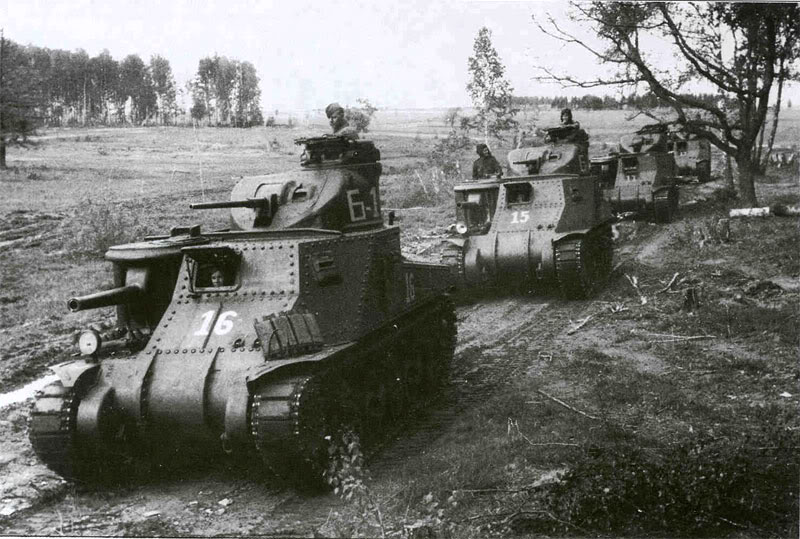
A column of Soviet M3 Lee tanks.
The Lee did not fare well against the upgraded
Panzer IV with long 75, and they lost a lot of them, but they never
stopped using them, they just did what the British did and sent them off
to secondary theaters, where tanks were still useful, and no enemy
tanks were around. Against poorly equipped, in AT weapon, Infantry, the
M3 Lee was a monster of a tank. The 75mm had a great HE round, it was
packed with machine guns, and had a 37mm that could sling canister. The
Soviets received 1386 M3 Lee tanks.
M4A2 75 dry: Early Small Hatch 75mm Shermans with Drivers Hoods
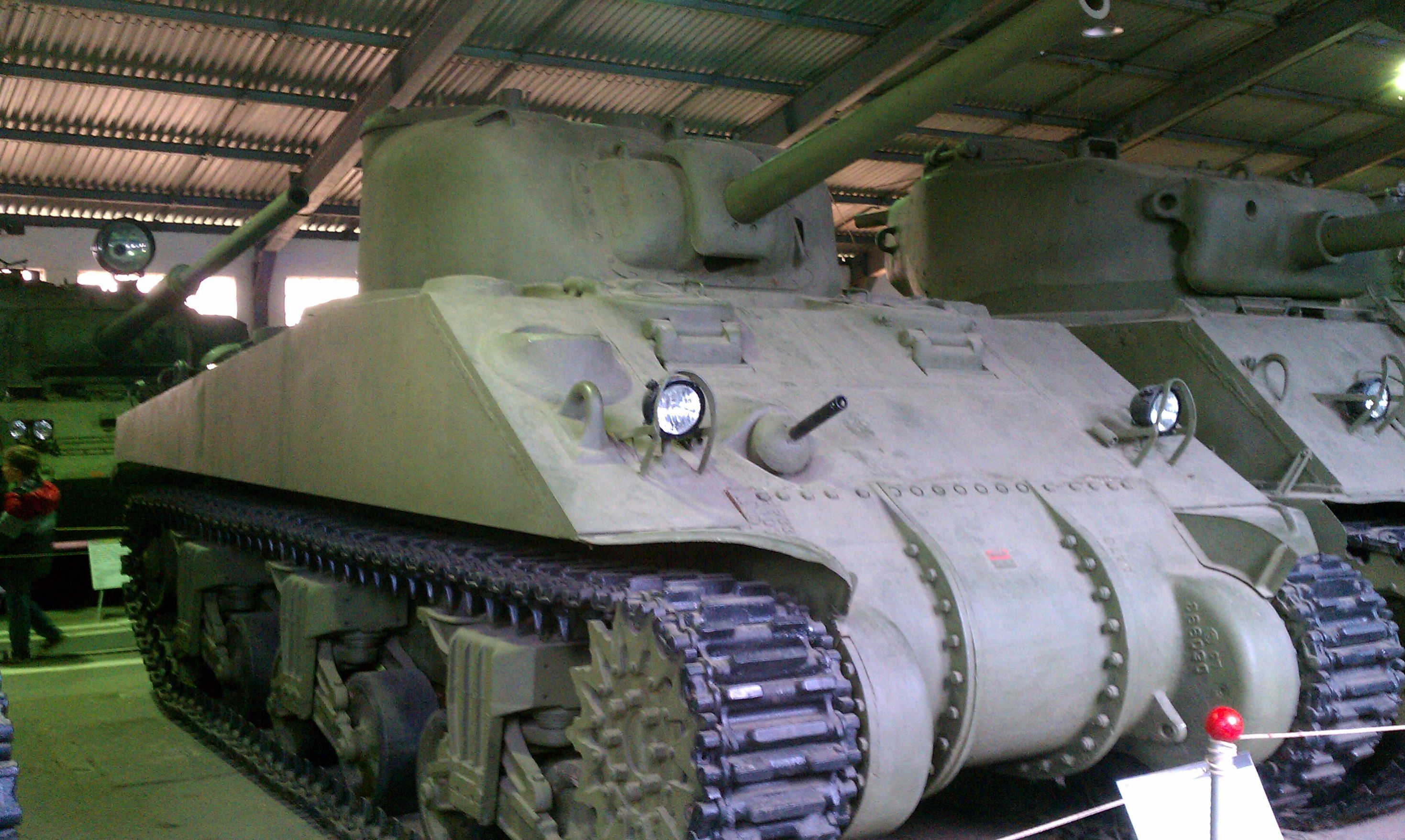
Early M4A4 with DV ports in Russian Museum. One of two sent to the USSR for testing.
The Soviets received 1990 M3 75mm gun armed M4A2
Shermans. I don’t have a list of who made the early M4A2 tanks they got.
They were competing with the Marine Corps and the French and Brits on
priority for these tanks, and most went to the Brits. I’ve looked
through a lot of pictures of Soviet M4 tanks, or “Emcha” as they seemed
to call them, the small hatch 75 tanks seem rarer than the large hatch
75 and 76 tanks.
This Post on Archive Awareness indicates,
they received several hundred very early M4A2 tanks. One of the big
indicators of this is the section where they talk about the suspension
having the Lee style top mounted return roller, which could be jammed
with mud, but then they received later models, where this return roller
was moved to bracket mounted to the side of the suspension unit.
Another interesting part of that document is the
problems they had with injectors and lubrication problems with the
pistons. The Army reported similar problems with early model M4A2s,
with the Air cleaners, cooling system, and clutches, but nothing about
the injectors. This post on AA
also indicates injector issues but was overall positive on the M4A2.
Maybe the Soviets used low-quality diesel and the injectors didn’t like
it. At any rate, these issues would have been worked out by the time
they started getting improved models.
M4A2 large hatch Dry: Late Model 75mm, 47-degree Large Hatch Hulls, but with Dry Ammo Racks
M4A2 75 dry large hatch tanks in action
By late 1943 a new version of the M4A2 was going
into production, and it had the improved 47-degree, single piece front
armor plate, with large driver and co-drivers hatches. These would be
the first tanks to get this improvement. By the time this model went
into production, priority for diesel-powered Shermans was going to the
Soviets, since that was the only model they wanted, and the Brits would
take the M4A4.
An final production M4A2 75 dry tank
These improved large hatch hulls still used the dry
ammunition rack setup of the early small hatch hulls, but they had the
applique armor applied at the factory, and the 75mm turrets had an
improved casting thickening the area that had required welded on
additional armor on the older turrets. The Turrets had a oval loaders
hatch and a pistol port as well, though the commander still got the
older split hatch cupola with the 50 caliber mount built into it.
These tanks seemed to have been photographed much
more than the small hatch 75 tanks, but I do not have a lot of photos of
either. By the time these tanks were being produced, all the major
reliability issues would have been worked out.
M4A2 76W: The Soviets were the Second Biggest User of 76mm Shermans
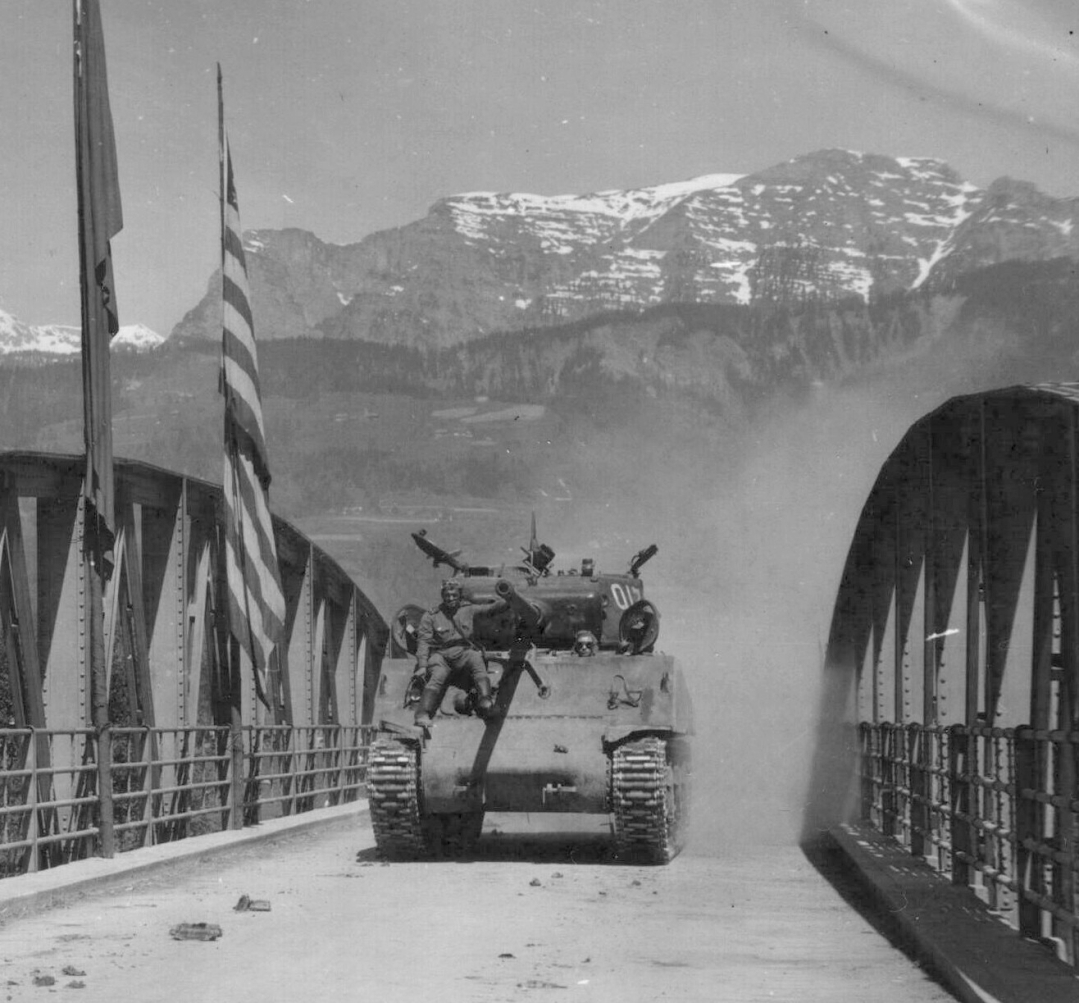
Soviet M4A2 76w with a split loaders hatch somewhere in Germany or Austria
Production of the 75mm armed Sherman was reduced, as Sherman
production was streamlined down from the 10 factories that were
producing it, to the three that would finish it off, Fisher, Chrysler,
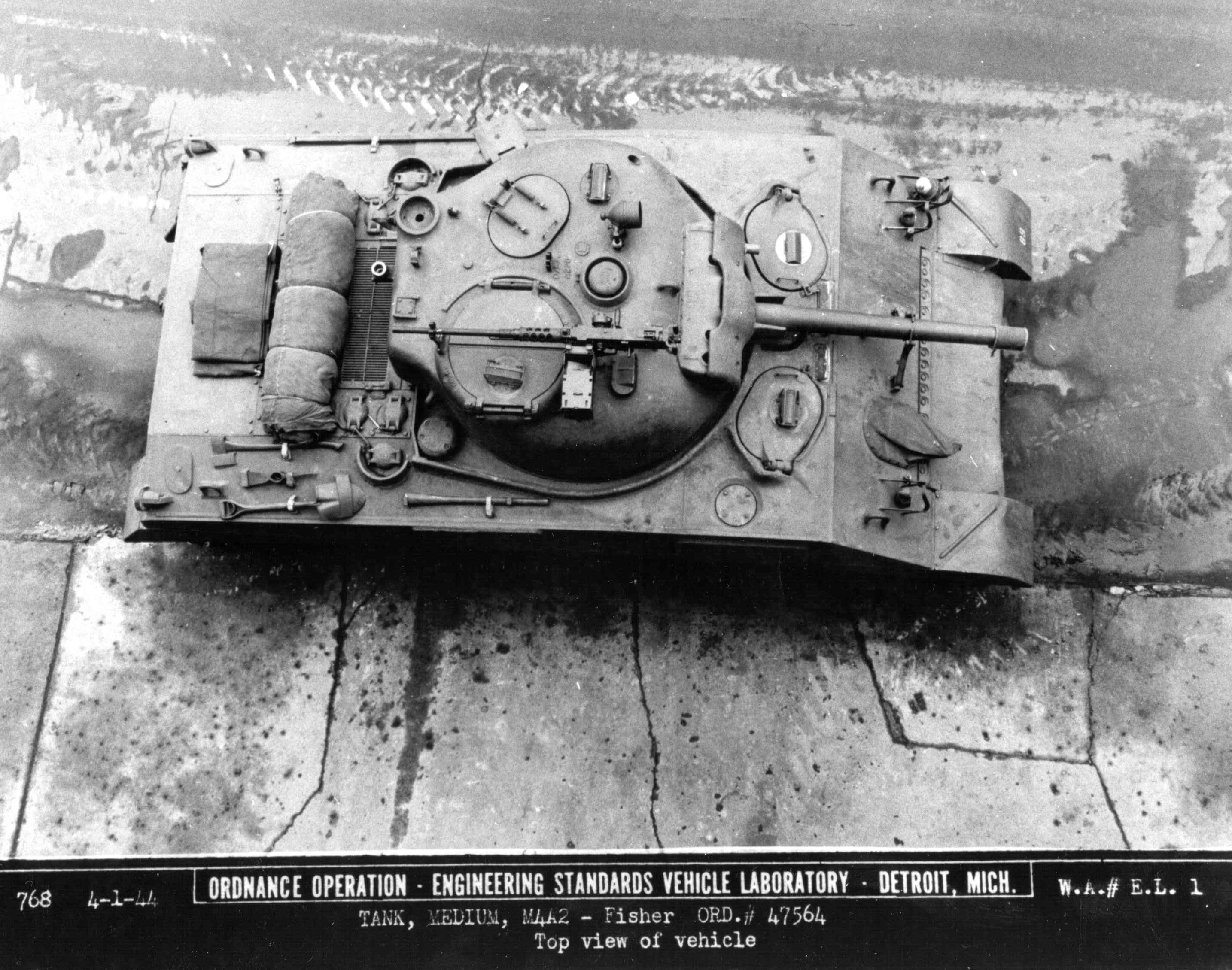
and Pressed Steel Car. The Soviet Union received 2073 M4A2 tanks with
the 76mm M1A1 gun. This was just about Fishers whole production run on
the 76mm armed M4A2.
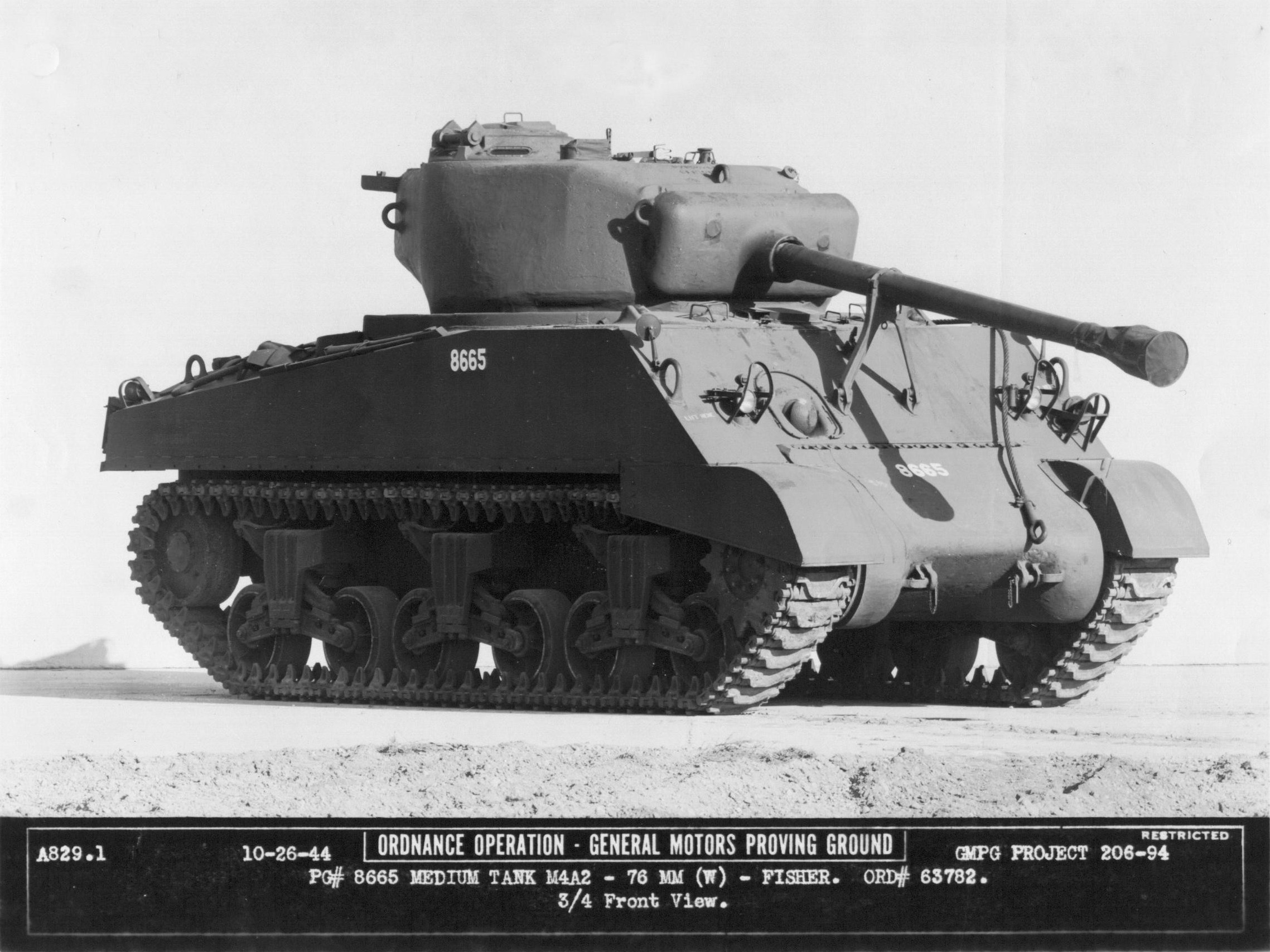
Shot of a factory fresh M4A2 76w tank at the General Motors Proving Ground
These tanks would have started out with wet racks, all around vision
cupolas, a split loaders hatch and an M1A1 76mm gun without a barrel
threaded for a muzzle brake. A few may have even had T23 turrets
without the ventilator on the rear. These would quickly be replaced with
M1A1C guns with threaded barrels with a protective cap over the
threads, and the split loaders hatch would be replaced with the smaller
oval hatch. These tanks would eventually be produced in the “Ultimate”
configuration, with the M1A2 gun, and HVSS suspension.
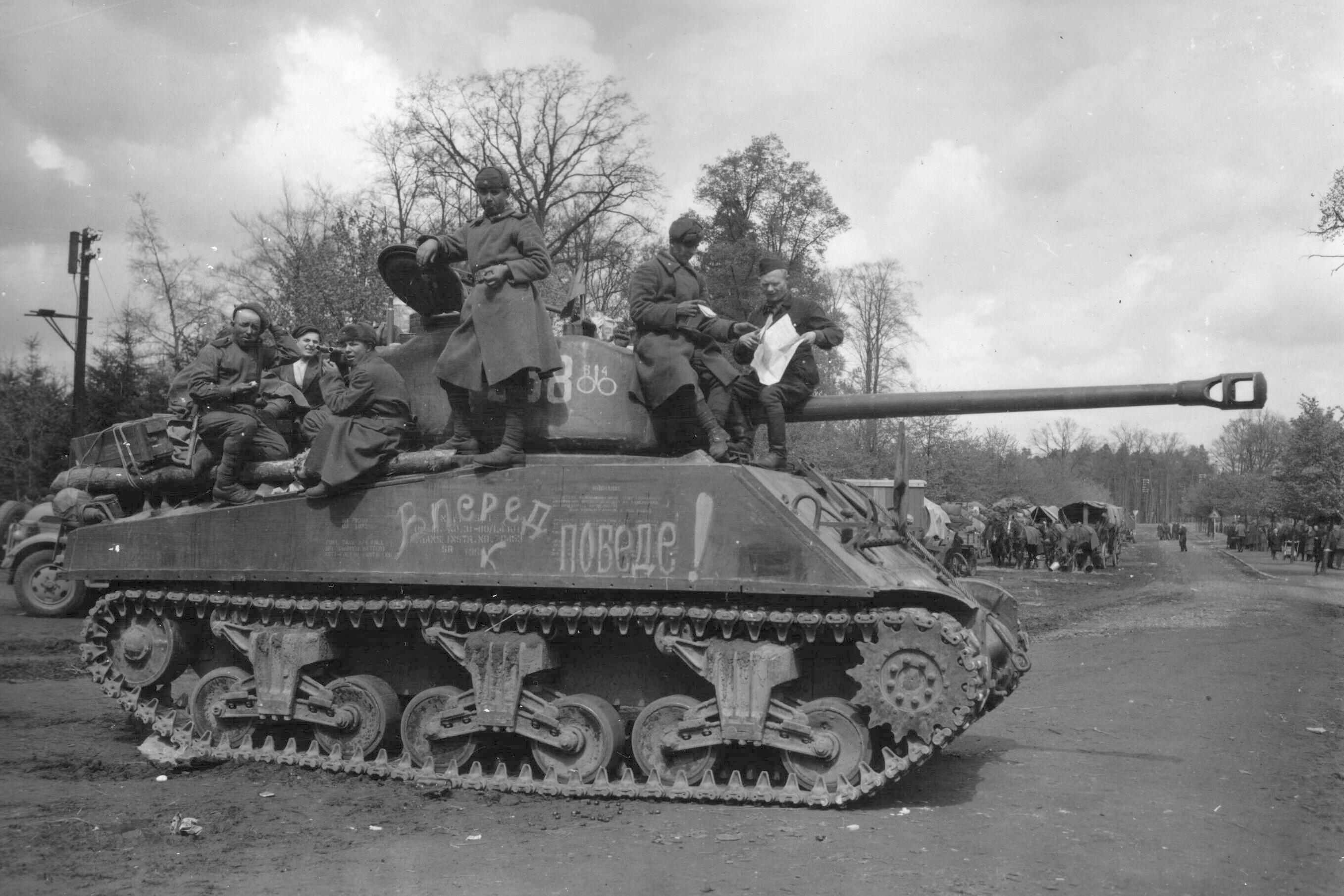
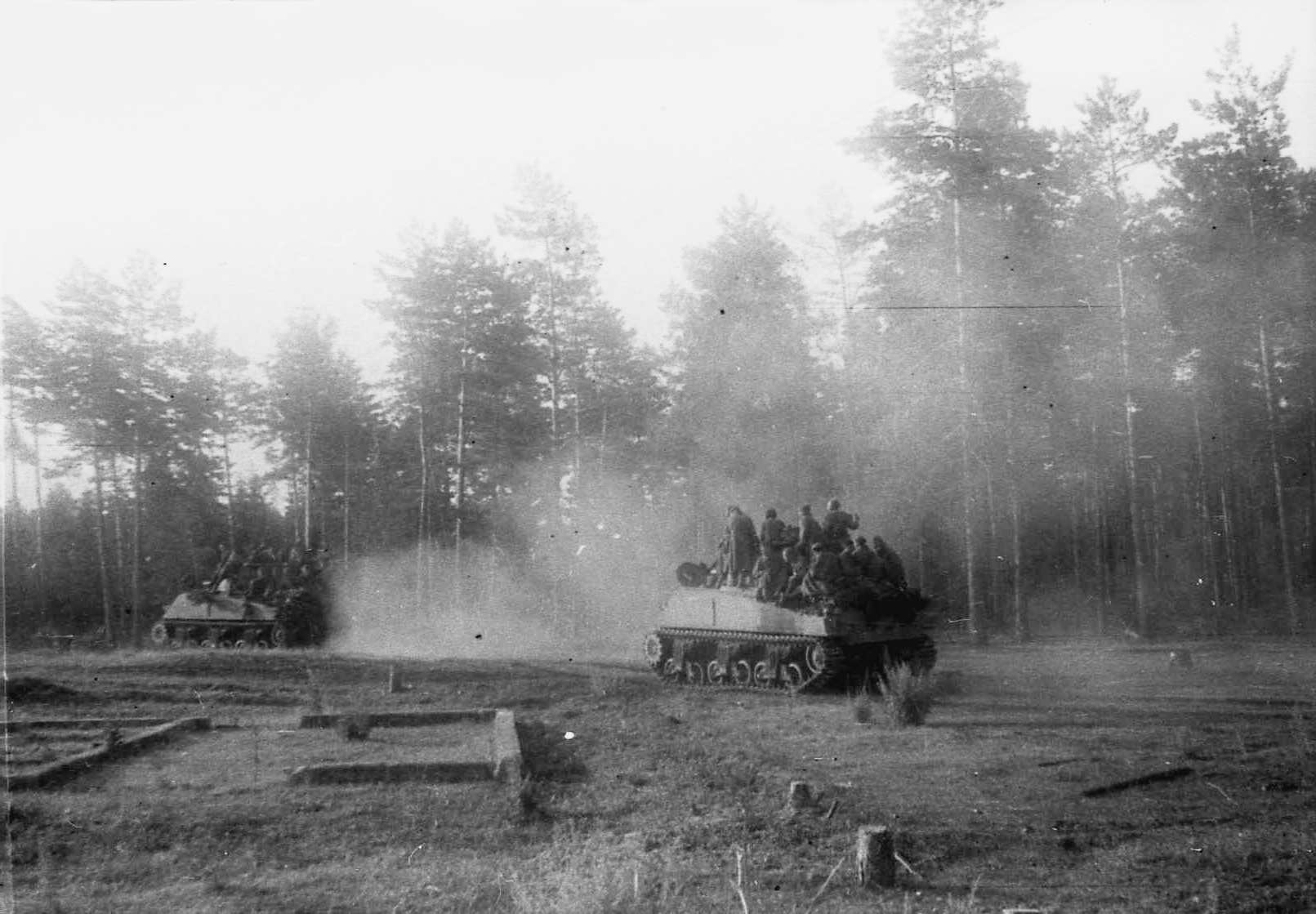
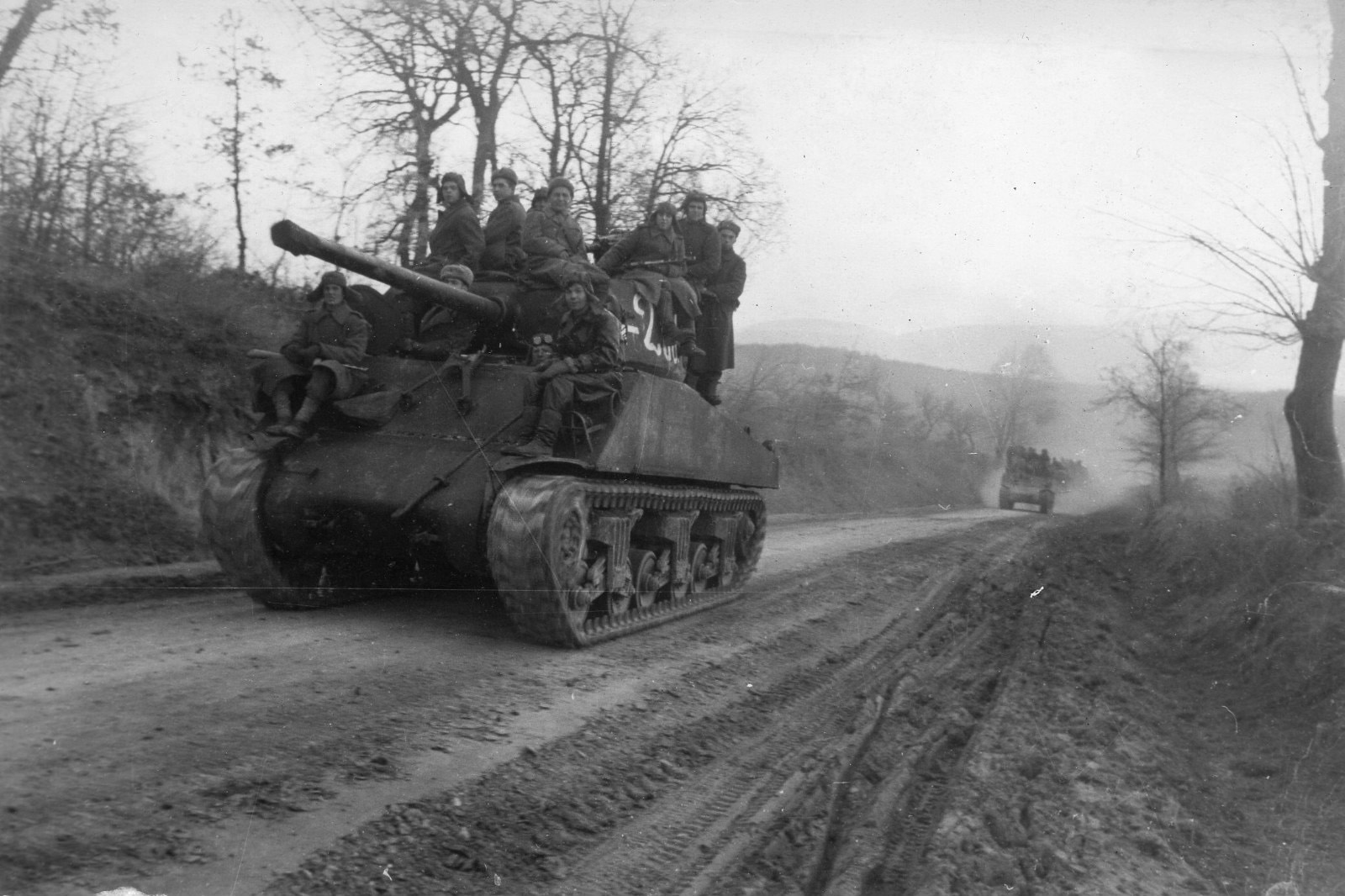
M4A2 76w with Russian Infantry loaded aboard.
These thanks saw extensive combat use with the Soviet Union, use with
Guards units. My understanding is the Russians liked the M4A2 76w tanks
just fine, and used them in elite units, but this has no reflection on
their feelings about the tank compared to their own T-34-85 tanks. T-34s were used in Guards units as well, and some units had both, as we can see from this AA post. By that point in the war the Sherman and T-34 were pretty close in abilities.
M4A4: They Received Two, and that was Enough to Convince them, They Wanted No More
After being given a chance to drive the M4A4 on the proving grounds
and being given lectures and demonstrations of its A57 gas motor, the
Soviets decided that the M4A4 was better than the M3 Lee, but inferior
to the M4A2 with GM Diesel they were already receiving through lend
lease. They decided the factory was impressive, but really not producing
a very good tank.
Even though the Soviets showed little interest in the M4A4 tanks, two were sent to them for evaluation anyway. You can read their impressions here, but as before when they tested it in the US, they felt the motor was to complicated to be reliable.
Dmitriy Fedorovich, on which American tanks did you fight?
On Shermans. We called them “Emchas”, from M4 [in Russian, em
chetyrye]. Initially they had the short main gun, and later they began
to arrive with the long gun and muzzle brake. On the front slope armor
there was a travel lock for securing the barrel during road marches. The
main gun was quite long. Overall, this was a good vehicle but, as with
any tank, it had its pluses and minuses. When someone says to me that
this was a bad tank, I respond, “Excuse me!” One cannot say that this
was a bad tank. Bad as compared to what?
Dmitriy Fedorovich, did you have just American tanks in your unit?
Our 6th Guards Tank Army (yes, we had six of them) fought in
Ukraine, Romania, Hungary, Czechoslovakia, and Austria. We ended the war
for us in Czechoslovakia. Then they rushed us to the Far East and we
fought against Japan. I briefly remind you that the army consisted of
two corps: 5th Guards Tank Stalingrad Corps on our own T-34s and 5th
Mechanized Corps, in which I fought. For the first time this corps had
British Matildas, Valentines, and Churchills.
They delivered the Churchill later.
Yes, a bit later. After 1943 we largely declined British tanks
because they had significant deficiencies. In particular, they had 12-14
h.p. per ton of weight at a time when good tanks had 18-20 h.p. per
ton. Of these three British tanks, the best was the Valentine produced
in Canada. Its armor was streamlined but more importantly, it featured a
long-barreled 57mm main gun. My unit switched over to American Shermans
at the end of 1943. After the Kishinev Operation our corps became the
9th Guards Mechanized Corps. I missed to tell you that every corps
consisted of four brigades. Our mechanized corps had three mechanized
brigades and one tank brigade, in which I fought. A tank corps had three
tank brigades and one mechanized brigade. Yes, we had Shermans in our
brigade at the end of 1943.
But the British tanks were
not withdrawn from service, so they fought until they were gone. Wasn’t
there a period when your corps had a mixture of tanks, both American
and British? Were there any problems associated with the presence of
such a broad variety of vehicles from different countries? For example,
with supply and maintenance?
Well, there were always problems. In general, the Matilda was an
unbelievably worthless tank! I will tell you about one of the Matilda’s
deficiencies that caused us a great deal of trouble. Some fool in the
General Staff planned an operation and sent our corps to the area of
Yelnya, Smolensk, and Roslavl. The terrain there was forested swamp. The
Matilda had skirts along the sides. The tank was developed primarily
for operations in the desert. These skirts worked well in the desert-the
sand passed through the rectangular slots in them. But in the forested
swamps of Russia the mud packed into the space between the tracks and
these side skirts. The Matilda transmission had a servomechanism for
ease of shifting. In our conditions this component was weak, constantly
overheated, and then failed. This was fine for the British. By 1943 they
had developed a replacement unit that could be installed simply by
unscrewing four mounting bolts, pulling out the old unit, and installing
the new unit. It did not always work this way for us. In my battalion
we had Senior Sergeant (Starshina) Nesterov, a former kolkhoz tractor
driver (Kolkhoz is sort of farm – Valeri), in the position of battalion
mechanic. In general each of our tank companies had a mechanic and
Nesterov was it for the battalion. At our corps level we had a
representative (whose name I have forgotten) of the British firm that
produced these tanks. At one time I had it written down, but when my
tank was hit everything I had in it burned up -photographs, documents,
and notebook. We were forbidden to keep notes at the front, but I did it
on the sly. Anyway, this British representative constantly interfered
with our efforts to repair separate components of the tank. He said,
“This has a factory seal. You should not tinker with it!” We were
supposed to take out a component and install a new one. Nesterov made a
simple repair to all these transmissions. One time the British
representative came up to Nesterov and asked him, “At which university
did you study?” And Nesterov replied, “At the kolkhoz!”
The Sherman was light years better in this regard.
Did you know that one of the designers of the Sherman was a Russian
engineer named Timoshenko? He was some shirt tail relative of Marshal S.
K. Timoshenko.
The Sherman had its weaknesses, the greatest of which was its
high center of gravity. The tank frequently tipped over on its side,
like a Matryoshka doll (a wooden stacking doll). But I am alive today
thanks to this deficiency. We were fighting in Hungary in December 1944.
I was leading the battalion and on a turn my driver-mechanic clipped a
curb. My tank went over on its side. We were thrown around, of course,
but we survived the experience. Meanwhile the other four of my tanks
went ahead and drove into an ambush. They were all destroyed.
Dmitriy Fedorovich, the
Sherman had a rubber-coated metal track. Some contemporary authors point
to this as a deficiency, since in combat the rubber might be set on
fire. With the track thus stripped bare, the tank is disabled. What can
you say in this regard?
On the one hand this rubber-coated track was a big plus. In the
first place, this track had a service life approximately twice that of
steel track. I might be mistaken, but I believe that the service life of
the T-34 track was 2500 kilometers. The service life of the Sherman
track was in excess of 5000 kilometers. Secondly, The Sherman drove like
a car on hard surfaces, and our T-34 made so much noise that only the
devil knows how many kilometers away it could be heard. What was the bad
side of the Sherman track? In my book, Commanding the Red Army’s
Sherman Tanks, there is a chapter entitled “Barefooted”. There I wrote
about an incident that occurred in August 1944 in Romania, during the
Jassy-Kishinev Operation. The heat was fearsome, somewhere around 30° C.
We had driven approximately 100 km along a highway in a single day. The
rubber linings on our support rollers got so hot that the rubber
separated and peeled off in long pieces. Our corps paused not far from
Bucharest. The rubber was flying around, the rollers had begun to jam
up, the noise was terrible, and in the end we had been stopped. This was
immediately reported to Moscow. Was this some kind of joke, an entire
corps had halted? To our surprise, they brought new support rollers to
us quickly and we spent three days installing them. I still don’t know
where they found so many support rollers in such a short time. There was
yet another minus of rubber track. Even on a slightly icy surface the
tank slid around like a fat cow. When this happened we had to tie barbed
wire around the track or make grousers out of chains or bolts, anything
to give us traction. But this was with the first shipment of tanks.
Having seen this, the American representative reported to his company
and the next shipment of tanks was accompanied by additional track
blocks with grousers and spikes. If I recall, there were up to seven
blocks for each track, for a total of fourteen per tank. We carried them
in our parts bin. In general the American representative worked
efficiently. Any deficiency that he observed and reported was quickly
and effectively corrected.
One more shortcoming of the Sherman was the construction of the
driver’s hatch. The hatch on the first shipment of Shermans was located
in the roof of the hull and simply opened upward. Frequently the
driver-mechanic opened it and raised his head in order to see better.
There were several occasions when during the rotation of the turret the
main gun struck this hatch and knocked it into the driver’s head. We had
this happen once or twice in my own unit. Later the Americans corrected
this deficiency. Now the hatch rose up and simply moved to the side,
like on modern tanks.
Still one great plus of the Sherman was in the charging of its
batteries. On our T-34 it was necessary to run the engine, all 500
horsepower of it, in order to charge batteries. In the crew compartment
of the Sherman was an auxiliary gasoline engine, small like a
motorcycle’s one. Start it up and it charged the batteries. This was a
big deal to us!
For a long time after the war I sought an answer to one question.
If a T-34 started burning, we tried to get as far away from it as
possible, even though this was forbidden. The on-board ammunition
exploded. For a brief period of time, perhaps six weeks, I fought on a
T-34 around Smolensk. The commander of one of our companies was hit in
his tank. The crew jumped out of the tank but were unable to run away
from it because the Germans were pinning them down with machine gun
fire. They lay there in the wheat field as the tank burned and blew up.
By evening, when the battle had waned, we went to them. I found the
company commander lying on the ground with a large piece of armor
sticking out of his head. When a Sherman burned, the main gun ammunition
did not explode. Why was this?
Such a case occurred once in Ukraine. Our tank was hit. We jumped
out of it but the Germans were dropping mortar rounds around us. We lay
under the tank as it burned. We laid there a long time with nowhere to
go. The Germans were covering the empty field around the tank with
machine gun and mortar fires. We lay there. The uniform on my back was
beginning heating up from the burning tank. We thought we were finished!
We would hear a big bang and it would all be over! A brother’s grave!
We heard many loud thumps coming from the turret. This was the
armor-piercing rounds being blown out of their cases. Next the fire
would reach the high explosive rounds and all hell would break loose!
But nothing happened. Why not? Because our high explosive rounds
detonated and the American rounds did not? In the end it was because the
American ammunition had more refined explosives. Ours was some kind of
component that increased the force of the explosion one and one-half
times, at the same time increasing the risk of detonation of the
ammunition.
It is considered noteworthy that the Sherman was very well appointed on the inside. Was this true?
It was true. These are not just words! They were beautiful! For
us then this was something. As they say now, “Euro-repair”! This was
some kind of European picture! In the first place, it was painted
beautifully. Secondly, the seats were comfortable, covered with some
kind of remarkable special artificial leather. If a tank was knocked out
or damaged, then if it was left unguarded literally for just several
minutes the infantry would strip out all this upholstery. It made
excellent boots! Simply beautiful!
In your book “Commanding
the Red Army’s Sherman Tanks” you wrote that the 233rd Tank Brigade’s
M4A2 Shermans were armed not with the short-barreled 75mm but the
long-barreled 76mm main gun in January 1944. Wasn’t this a bit early?
Didn’t these tanks appear later? Explain one more time which main guns
were mounted on the Shermans of the 233rd Tank Brigade.
Hmm, I don’t know. We had very few Shermans with the
short-barreled main gun. On the whole, ours had long-barrels. Not just
our brigade fought on Shermans. Perhaps these were in other brigades.
Somewhere in the corps I saw such tanks, but we had the tanks with the
long barrels.
Dmitriy Fedorovich, there
were personal weapons in each Sherman that arrived in the USSR, Thompson
submachine guns (also known as the Tommy gun). I read that rear area
personnel stole these weapons and that few tanks arrived in units still
equipped with them. What kind of weapons did you have, American or
Soviet?
Each Sherman came with two Thompson submachine guns, in caliber
11.43mm (.45 cal), a healthy cartridge indeed! But the submachine gun
was worthless. We had several bad experiences with it. A few of our men
who got into an argument were wearing padded jackets. It turned out that
they fired at each other and the bullet buried itself in the padded
jacket. So much for the worthless submachine gun. Take a German
submachine gun with folding stock (MP-40 SMG by Erma -Valeri). We loved
it for its compactness. The Thompson was big. You couldn’t turn around
in the tank holding it.
The Sherman had an antiaircraft machine gun Browning M2 .50 caliber. Did you use it often?
I don’t know why, but one shipment of tanks arrived with machine
guns, and another without them. We used this machine gun against both
aircraft and ground targets. We used it less frequently against air
targets because the Germans were not fools. They bombed either from
altitude or from a steep dive. The machine gun was good to 400-600
meters in the vertical. The Germans would drop their bombs from say, 800
meters or higher. He dropped his bomb and departed quickly. Try to
shoot the bastard down! So yes, we used it, but it was not very
effective. We even used our main gun against aircraft. We placed the
tank on the upslope of a hill and fired. But our general impression of
the machine gun was good. These machine guns were of great use to us in
the war with Japan, against kamikazes. We fired them so much that they
got red hot and began to cook off. To this day I have a piece of
shrapnel in my head from an antiaircraft machine gun.
Did German aircraft inflict significant losses on your equipment? In particular, what can you say about the Henschel Hs-129?
Not every time, but it did happen. I don’t remember the Henschel;
perhaps there was such an airplane. Sometimes we were able to avoid
bombs. You could see them coming at you, you know. We opened our
hatches, stuck out our heads, and instructed our drivers over the
intercom: “The bomb will fall in front of us”. But in general there were
cases when tanks were hit and set on fire. Losses from these attacks
did not exceed 3-5 tanks in the battalion. It was more common for a
single tank to be damaged or destroyed. We faced much greater danger
from panzerfaust gunners in built-up areas. In Hungary I recall that I
was so tired that I told my deputy to lead the battalion while I slept. I
went to sleep right there in the fighting compartment of my Sherman.
Around Beltsy they had dropped ammunition to us by parachute. We took
one parachute for ourselves. I used this parachute for my pillow. The
parachute was made from silk and didn’t let the lice in. And I was sound
asleep! Suddenly I woke up. Why? I awoke from the silence. Why the
silence? It turns out that attacking aircraft had set two tanks on fire.
During the march many things were piled up on the tanks: crates,
tarpaulin. The battalion had halted, shut off engines, and it had become
silent. And I woke up.
Did you lock your hatches during combat in built-up areas?
We absolutely locked our hatches from the inside. In my own
experience, when we burst into Vienna, they were throwing grenades at us
from the upper floors of buildings. I ordered all the tanks to be
parked under the archways of buildings and bridges. From time to time I
had to pull my tank out into the open to extend a whip antenna and send
and receive communications from my higher commander. On one occasion, a
radio operator and driver-mechanic were doing something inside their
tank and left the hatch open. Someone dropped a grenade through the
hatch from above. It struck the back of the radio operator and
detonated. Both were killed. Thus we most certainly locked our hatches
when we were in built-up areas.
The primary defeating
mechanism of HEAT (hollow-charge) ammunition, of which the panzerfaust
was one type, is the high pressure in the tank, which disables the crew.
If the hatches were kept slightly open, would this not provide some
degree of protection? A special order was issued before our forces
entered Germany.
This is true, but just the same we kept our hatches locked. It
might have been different in other units. The panzerfaust gunners most
often fired at the engine compartment. If they were able to set the tank
on fire, like it or not the crew had to get out. And then the Germans
shot at the crew with a machine gun.
What were the chances of survival if your tank was hit?
My tank was hit on 19 April 1945 in Austria. A Tiger put a round
straight through us. The projectile passed through the entire fighting
compartment and then the engine compartment. There were three officers
in the tank: I as the battalion commander, the company commander Sasha
Ionov (whose own tank had already been hit), and the tank commander.
Three officers, a driver-mechanic, and a radio operator. When the Tiger
hit us, the driver-mechanic was killed outright. My entire left leg was
wounded; to my right, Sasha Ionov suffered a traumatic amputation of his
right leg. The tank commander was wounded, and below me sat the gunner,
Lesha Romashkin. Both of his legs were blown off. A short time before
this battle, we were sitting around at a meal and Lesha said to me, “If I
lose my legs I will shoot myself. Who will need me?” He was an orphan
and had no known relatives. In a strange twist of fate, this is what
happened to him. We pulled Sasha out of the tank and then Lesha, and
were beginning to assist in the evacuation of the others. At this moment
Lesha shot himself.
In general, one or two men were always wounded or killed. It depended where the shell struck.
How did you co-operate with the infantry during combat?
By TOE the tank brigade had three tank battalions of 21 tanks
each and a battalion of submachine gunners. A submachine gun battalion
had three companies, one for each tank battalion. We had this
three-battalion structure only in late 1943 and early 1944. All the rest
of the time we had two tank battalions in the brigade. Our submachine
gunners were like brothers to us. On the march they sat on our tanks.
They kept warm there, dried their things, and slept. We drove along and
then stopped somewhere. The tankers could sleep and our submachine
gunners protected our tanks and us. Over the course of time many
submachine gunners became members of our crews, initially as loaders and
later as radio operators. We divided our trophies equally: they with us
and we with them. Therefore they had an easier time of it than ordinary
infantrymen.
During combat they sat on the tanks until the firing started. As
soon as the Germans opened fire on our tanks, they jumped off and ran
behind the tanks, frequently protected by its armor from enemy light
machine gun fire.
If it happened that the tanks were limited in maneuver and speed, did you maneuver your infantry or halt them?
Nothing like that. We did not pay any attention to them. We
maneuvered and they maneuvered themselves behind us. There were no
problems. It would have been worse for them if we had been knocked out,
so let them run behind us.
Was the tank’s speed limited in the attack? By what?
Of course! We must been fire!
How did you fire, from short halts or on the move?
Both ways. If we fired on the move, the speed of the tank did not
exceed 12 km/h. But we rarely fired on the move, only in order to
incite panic in the enemy ranks. Primarily we fired from short halts. We
rushed into a position, stopped for a second, fired, and moved ahead.
What would you like to say about the German Tiger?
It was an extremely heavy vehicle. The Sherman could never defeat
a Tiger with a frontal shot. We had to force the Tiger to expose its
flank. If we were defending and the Germans were attacking, we had a
special tactic. Two Shermans were designated for each Tiger. The first
Sherman fired at the track and broke it. For a brief space of time the
heavy vehicle still moved forward on one track, which caused it to turn.
At this moment the second Sherman shot it in the side, trying to hit
the fuel cell. This is how we did it. One German tank was defeated by
two of ours, therefore the victory was credited to both crews. There is a
story about this entitled “Hunting With Borzois” in my book.
The muzzle brake has one
significant shortcoming: a cloud of dust is raised during firing from a
weapon thus equipped, giving away one’s position. Some artillerymen
attempted to counter this, for example, by wetting down the ground in
front of their cannons. What countermeasures did you employ?
You’re correct! We might have packed the ground and covered it with our tarpaulins. I don’t recall any special problems.
Were your tank sights blinded by dust, dirt, or snow?
There were no special difficulties. Snow, of course, could blind
us. But not dust. The sight on the Sherman did not protrude. On the
contrary, it was recessed into the turret. Therefore it was well
protected against the elements.
Dmitriy Fedorovich, our
tankers who fought on the British Churchills pointed out the weak heater
in the crew compartment as a deficiency. The standard electric heater
was inadequate for the conditions of the Russian winter. How was the
Sherman equipped in this regard?
The Sherman had two engines connected by a coupling joint. This
was both good and bad. There were cases when one of these motors was
disabled in battle. Then the coupling joint could be disengaged from the
crew compartment and the tank could crawl away from the fight on one
engine. On the other hand, there were powerful fans located above both
engines. We used to say, “Open your mouth and the wind came out your
ass!” How the hell could we get warm? There were such strong drafts of
air! Perhaps there was heat coming from the engines, but I will not tell
you that it was warm. When we halted, we immediately covered the engine
compartment with our tarpaulin. Then it stayed warm in the tank for
several hours; we slept in the tank. Not for nothing did the Americans
give us fleece-lined coveralls.
Were there norms of ammunition consumption for the tank?
Yes there were. In the first place, we took one basic load (BK
-boekomplekt -a full set of ammo. For example the IS-2’s BK = 28 shells.
-Valeri) with us going into battle. We took an additional BK on the
outside of our tanks during long raids. When I raced into Vienna, for
example, my commander personally ordered us to take two BK: the normal
load inside and the second on the armor. In addition, we carried up to
two cases of trophy chocolate on each tank and found additional
provisions for ourselves. We were “on our own”, so to speak. This meant
that if we had to conduct a raid somewhere deep in the rear, we
offloaded rations and in their place took ammunition. All of our wheeled
supply vehicles were American 2 ?-ton Studebakers. They always brought
the ammunition forward to the battalion.
There is one other thing I want to say. How did we preserve our
(Soviet) ammunition? Several rounds covered by a thin layer of grease,
in wooden crates. One had to sit for hours and clean this grease off the
rounds. American ammunition was packed in cardboard tube containers,
three rounds banded together. The rounds were shiny clean inside their
protective tubes! We took them out and immediately stowed them in the
tank.
What kind of rounds did you carry in the tank?
Armor-piercing and high explosive. There was nothing else. The ratio was approximately one-third HE and two-thirds AP.
Did the crew receive a concussion when a round hit the tank, even if it did not penetrate the armor?
Generally, no. It depended on where the round hit. Let’s say that
I was sitting in the left side of the turret and a round struck near
me. I heard this hit but it did not harm me. If it struck somewhere on
the hull, I might not hear it at all. This happened several times. We
would come out of an engagement and inspect the tank. In several places
the armor would show an impact, like a hot knife that had cut through
butter. But I did not hear the round impacts. Sometimes the driver would
shout, “They’re shooting from the left!” But there was no overwhelming
sound. Of course, if such a powerful gun as the JSU-152 hit you, you
heard it! And it would take off your head along with the turret.
I want also to add that the Sherman’s armor was tough. There were
cases on our T-34 when a round struck and did not penetrate. But the
crew was wounded because pieces of armor flew off the inside wall and
struck the crewmen in the hands and eyes. This never happened on the
Sherman.
What did you consider the most dangerous opponent? A cannon? A tank? An airplane?
They were all dangerous until the first round was fired. But in
general, the antitank cannons were the most dangerous. They were very
difficult to distinguish and defeat. The artillerymen dug them in so
that their barrels literally were laying on the ground. You could see
only several centimeters of their gun shield. The cannon fired. It was a
good thing if it had a muzzle brake and dust was kicked up! But if it
was winter or raining, what then?
Were there cases when you
did not see from your tank where the fire was coming from, but your SMG
infantry did see? How did they guide you to the source of the fire?
Sometimes they pounded on the turret and shouted. Sometimes they
began to fire in the direction with tracer bullets or fired a signal
rocket in that direction. And then, you know, when we went into the
attack, the commander often looked around from the turret. None of the
periscopes, even in the commander’s cupola, gave us good visibility.
How did you maintain communications with your commander and other tanks?
By radio. The Sherman had two radio sets, HF and UHF [high
frequency and ultra high frequency], of very good quality. We used the
HF for communications with our higher commander, with brigade, and the
UHF for communications within the company and battalion. For
conversation inside the tank we used the tank intercom system. It worked
great! But as soon as the tank was hit, the tankers first action was to
throw off his helmet and throat microphone. If he forgot and began to
jump out of the tank, he would get hung up.
At the outbreak of WWII, the German Armored Divisions seemed
invincible. Using their “Blitzkrieg” tactics which relied heavily on
fast, maneuverable armored divisions they were able to punch through or
circumvent enemy defenses quickly.
During Operation Barbarossa in 1941, the Germans again seemed to be
unstoppable, but the Soviets did possess one item in their armored
arsenal that proved to be a thorn in the side for many German commands,
at least at the tactical level – The Soviet KV Heavy Tank. It was
quickly dubbed the “Russian Colossus”. KV-1S Great Patriotic War Museum -
Named after the Soviet Defense Minister, Kliment Voroshilov, the KV
was much different than it’s German adversaries in that it was
enormously heavy (45 tons) with extremely thick frontal armor (90mm) as
well as good side and rear protection (70mm armor). KV-1 1939 Design Model
Nothing in the German arsenal could penetrate it except for the
German 88’s. The 37mm and 50mm cannons of the Panzer III and Panzer IV
simply “bounced” and only carefully placed explosives or point blank
ranged artillery had any chances of success in immobilizing the
behemoths.
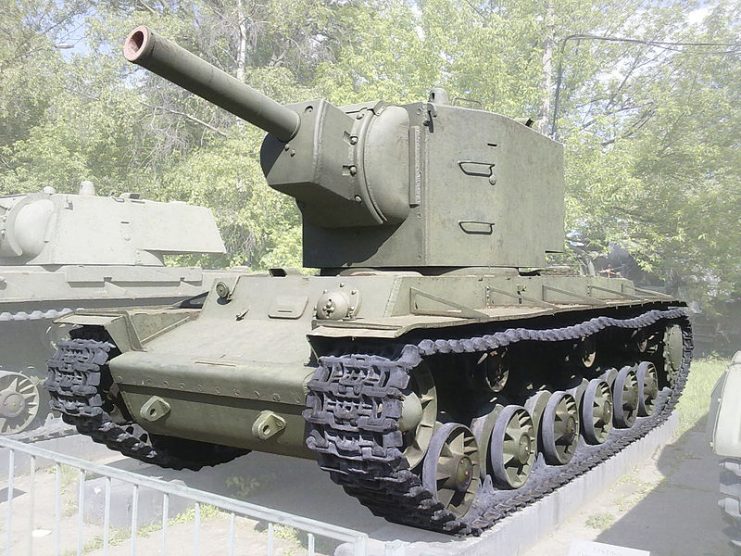
The KV’s carried a crew of 5 and sported various armaments in it’s
many different models ranging from a 76.2 mm gun in early models to even
a 152mm howitzer in the KV-2. KW-2_1940 with 152 mm Howitzer
Additionally, it carried 3 machine guns initially: one coaxial gun in
the turret, one ball mount in the rear turret and one ball mount in the
front of the hull. An additional AA gun was mounted on the turret in
later models.
Additionally, despite its weight, the KV torsion bar suspension and
wide tracks allowed it to maneuver in mud and soft earth. It’s tracks
and wheel system were remarkably durable and suited to its
classification as a heavy tank. Finnish KV-1 Captured in 1942 from the Soviets –
Unfortunately for the Soviets, the KV’s had a plethora of drawbacks
as a combat tank. For one, it’s engine and transmission couldn’t handle
the weight and the tank was not only extremely slow, but it was hard to
maneuver. It could easily be outflanked by both infantry and its armored
German adversaries. However, it was tank that sometimes just wouldn’t
die. KV 2 Moscow –
A battle involving a lone KV-1 in Raseiniai is possibly the best
example. One KV and it’s crew were able to halt the advance of the
entire German 6th Panzer Division for a day until the beleaguered tank
ran out of ammunition an fuel and the crew was eventually killed. Old AFSargeBlogged about the incident, it is a very good story.
Other stories from German soldiers speak of the countless rounds of
armor piercing shells proving ineffective at stopping the KV and some
noted that when out of ammunition, many of the Soviet tank crews would
simply run over Anti-Tank batteries. KV Tank Variations – Marcus Burns
However, the flaws of the KV included more than it’s slow moving
bulk. It was extremely expensive to build and the much cheaper T-34 with
the same offensive firepower could be produced at more than half the
cost. Additionally, as the war went on, Germany began to field armor and
guns with more firepower, which reduced the KV’s appeal even more as
its thick armor became obsolete.
KV1B Heavy Tank at the Tank Museum, Bovington
Although the KV’s remained in the Soviet Army throughout the entire
war, there production dwindled and by 1944 they had been replaced with
newer, more versatile heavy tanks such as the IS series. These colossal
beasts had seen their day come and go and were now obsolete. Destroyed KV-1 near Voronezh – 1942 – Bundesarchiv, Bild
Still, the KV remains a symbol of the tough, never give up mentality of the Soviet Army during World War II.
One of the most important weapons in the Second World War, the T-34
medium tank was also one of the most influential designs in the history
of tanks.
Tanks were critical to combat in the Second World War, and all the
combatant nations worked on developing better versions. The Soviets,
with their massive program of mechanization, had been able to experiment
with a wide array of designs in the 1930s. This taught the Soviet
designers what did and didn’t work, leading to the T-34.
The "Christie" Tank, an American design that the Soviets used and copied.
The design work that led to the T-34 began in 1936. Engineers began
from the basis of the BT-7, a capable light tank that had gone through
repeated modifications as designers sought ways to improve it. For the
T-34, the designers enlarged the hull, added an extra roadwheel,
lengthened the suspension, and improved both engine and armament.
T-34/76 medium tank.
Pilot models of the T-34 were created at the Komintern Factory at
Kharkov. Many other factories would be involved when it went into mass
production.
The T-34 went into production in May 1940. It continued in use throughout World War Two and beyond.
T-34/76 tank in color.
During the war, the Soviets relied on massing forces to defend their
homeland and eventually overwhelm the Germans. The T-34 was perfect for
mass production and huge numbers were produced – 39,698 in total. When the German invaded and they ran into the T-34, they were unpleasantly surprised, the T-34 was better than what the Germans had, but what helped the Germans was the training and the close air support of the Luftwaffe especially the Stuka.
However, production was almost stopped in the early days of the war
on the Eastern Front. The German advance into Russia was so swift and
decisive that it overran the tank arsenals. Through an incredible
application of labor, the Soviets managed to evacuate every movable
machine part from these factories, transporting them by rail deeper into
the USSR.
There they set up new tank production lines, including the
Uralmashzavod (Ural machine factory) at Nizhni Tagil. This factory
churned out thousands of T-34s, keeping up the supply of tanks the Red
Army needed
Soviet Tank T-34 76 model 1940 abandoned by the Red Army.
By 1943, there were 43 factories producing just two types of tanks – the T-34 and the heavier KV.
One of the T-34’s most important features was its engine. This was a
high-powered diesel design that was created at the Kharkov Locomotive
Works. It was the result of five years of research and development all
focused on the creation of one engine. It was both reliable and
resistant to fire, making the tank better able to survive being hit.
T-34/76 soviet tank, turret with additional armor.
Many previous tanks had riveted armor. However, fighting in the
Spanish Civil War and in border conflicts between China and Japan had
tested the limits of this design and proven the vulnerability of a
riveted tank. So instead of riveting, the T-34’s armor was joined by
welding, to make it tougher.
The angle of the armor was also re-thought. It was carefully sloped,
to avoid presenting a face at right angles to the trajectory of a shot
against the tank. This made it far more likely that enemy shells would
be deflected off.
Alongside its improved engine and armor, the T-34 carried a powerful weapon for a tank of its size – a high-velocity 76mm gun.
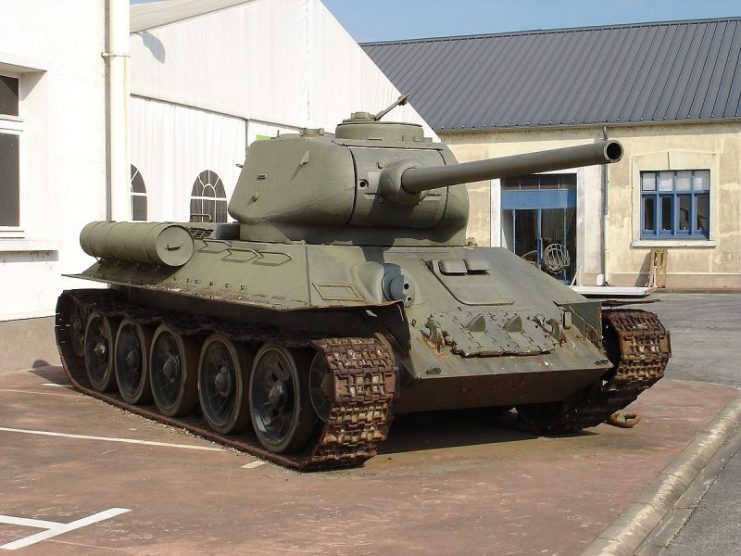
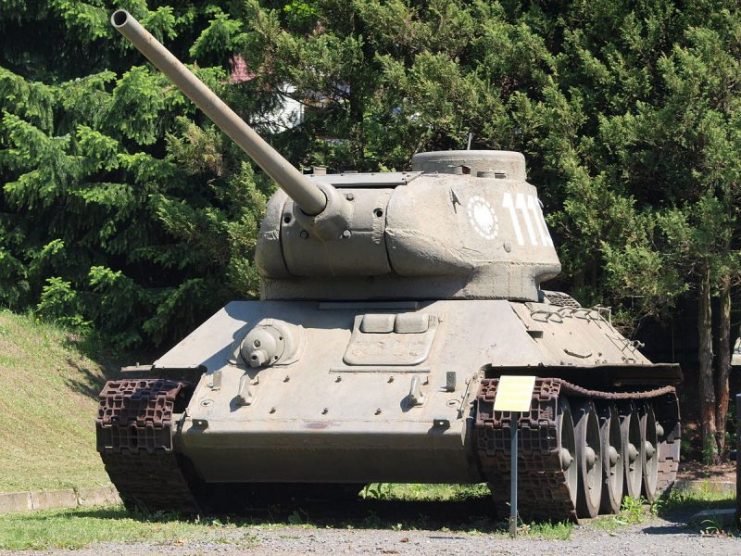
T 34/85 at the Saumur Armored Museum. Photo:
As the war progressed and German tanks improved, a heavier weapon was
needed to penetrate their armor. The 76mm weapon was replaced with the
D-5T 85mm anti-aircraft gun, which would prove as effective against
tanks as it was against planes. At the time, the T-34/85 was one of the
most powerful tanks in the world.
As well as its main gun, the T-34 was equipped with two 7.62mm
Degtyarev machine guns. One of these was mounted coaxially with the main
gun, The other was fitted in the front right-hand side of the hull.
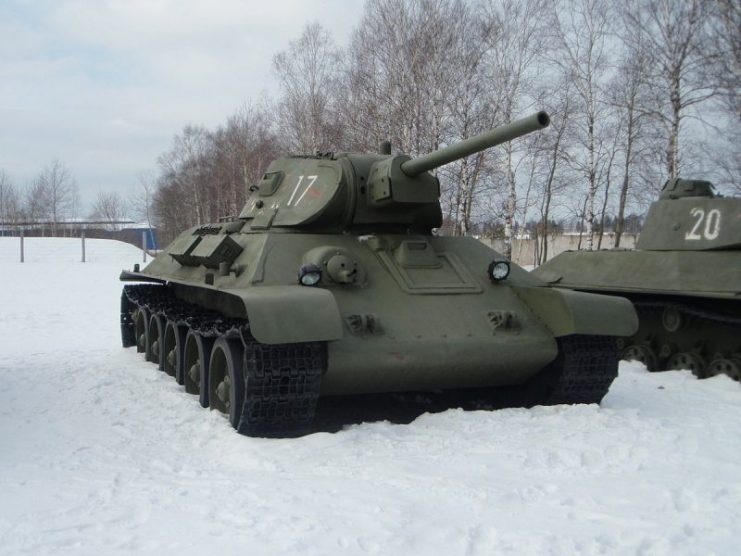
T-34/76 model 1941 in the Tank Museum, Kubinka.
The turret on the first T-34 was cramped and limited in how far it
could depress its gun. Like many features of the tank, it went through
continual improvements over the course of service, creating a more
spacious and better-protected turret.
T-34/76 model 1943 soviet tank.
The importance of being able to function in bad weather had been
proved to the Soviets when they invaded Finland in 1939 and many of
their vehicles stopped working in the snow. While conditions in the USSR
were seldom as trying as in the Finnish winter, the Soviet winter could
also be grueling, and a tank needed to be able to get across mud and
snow. The wide tracks of the T-34 were designed for this purpose.
During the Cold War, the Soviets exported the T-34 tank to their
Warsaw Pact allies. The Czechs started producing their own T-34s in 1951
and the Poles did the same in 1953. The Polish vehicle incorporated
several improvements not seen in the Russian model.
T-34/85 Tank in Poland at the Open Air Exhibition of the Armament of the Polish Armed Forces.
The T-34 saw many adaptations to its design over the course of its
long career. It also became the foundation stone upon which a variety of
other vehicles were built, by both the Soviets and their allies. These
include at least six different armored recovery vehicles, built in the
USSR, Czechoslovakia, East Germany, and Poland.
Like the BT-7 before it, the T-34 became the basis for designing
other, more advanced tanks. The Soviet T-44 tank was based on the T-34,
and in turn became the starting point for the T-54.
T-34-76 (Model 1941).
The effectiveness of the T-34 was such that it remained a mainstay of
the Soviet army for a decade after the war. But by the mid-1950s, it
had been surpassed by its descendant the T-54, and the Red Army began
phasing it out in favor of that tank, with T-34s finally leaving Soviet
service in the 1960s. It continued in service in other Communist
countries for decades afterward, a testament to the enduring quality of
this most influential of tanks.
Additional Photos –
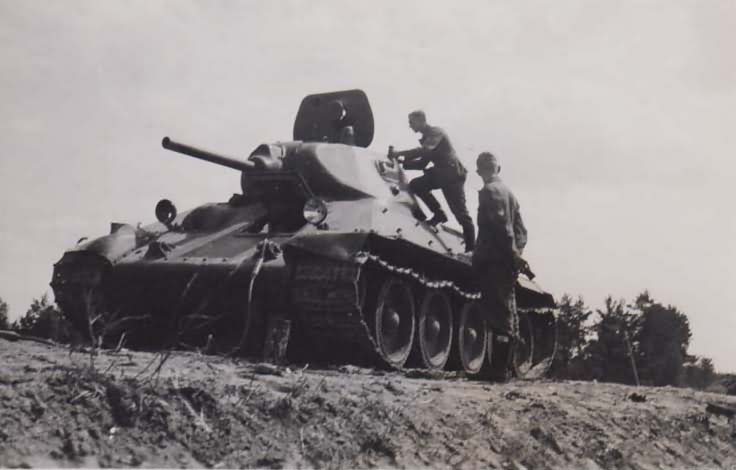
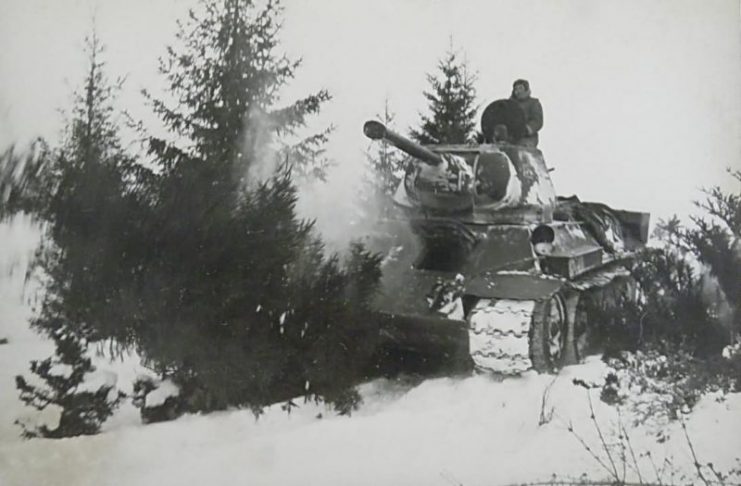
T-34 winter camo turret number 54.
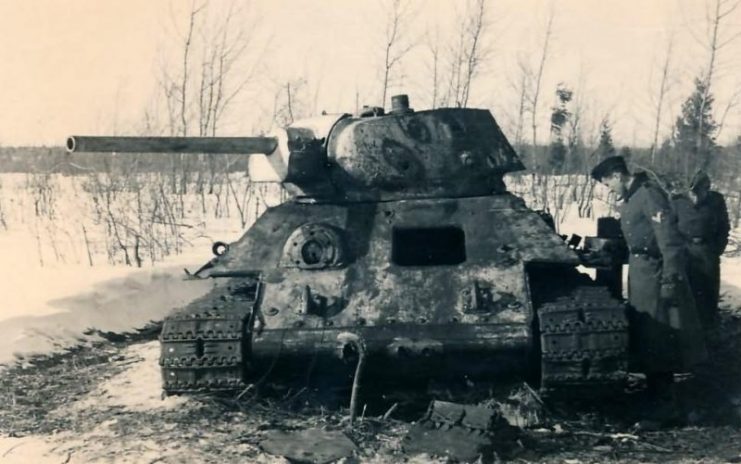
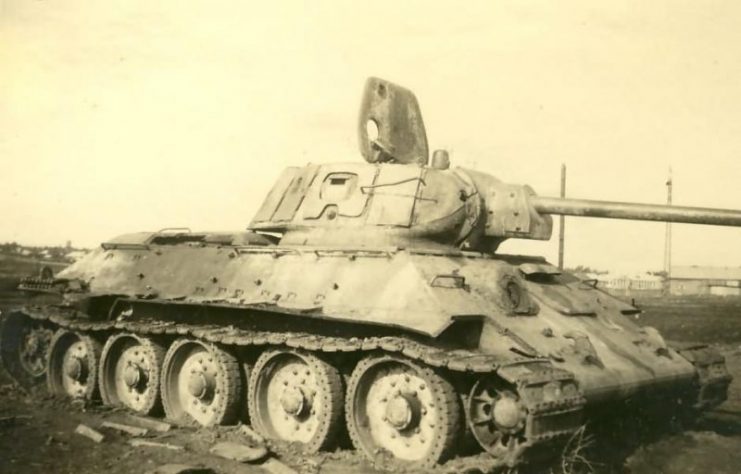
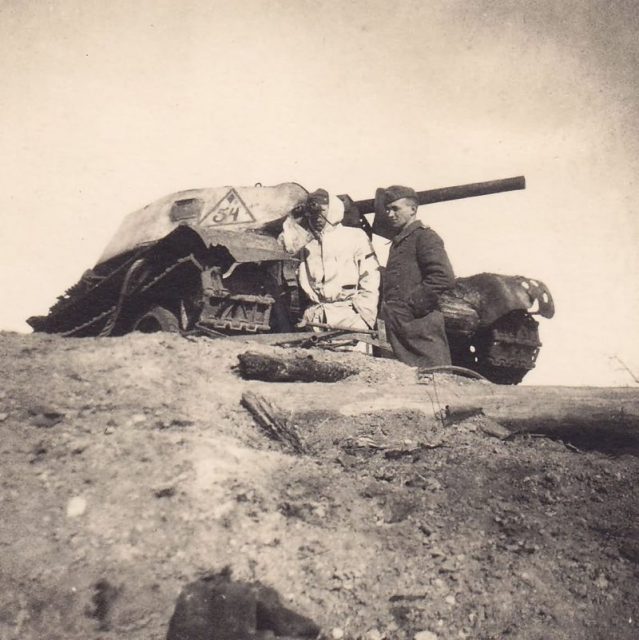
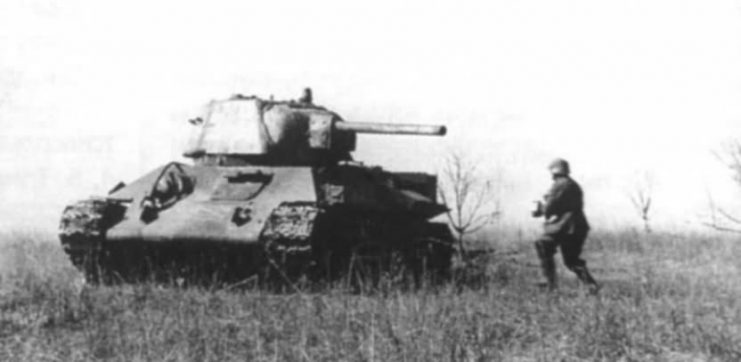
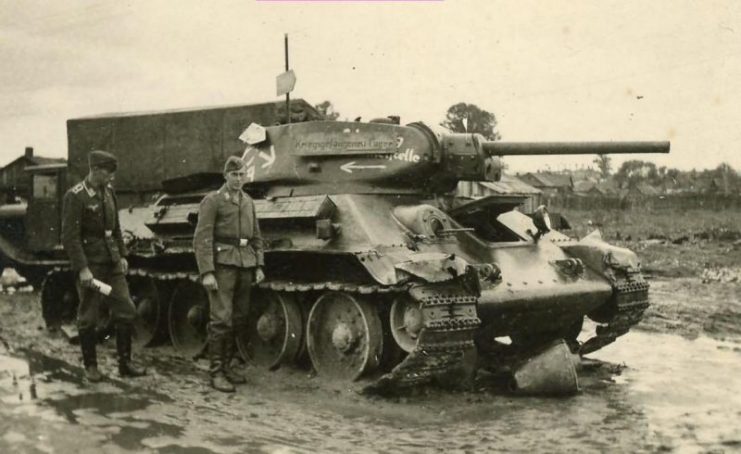
Abandoned T-34/76 with German soldier approaching.
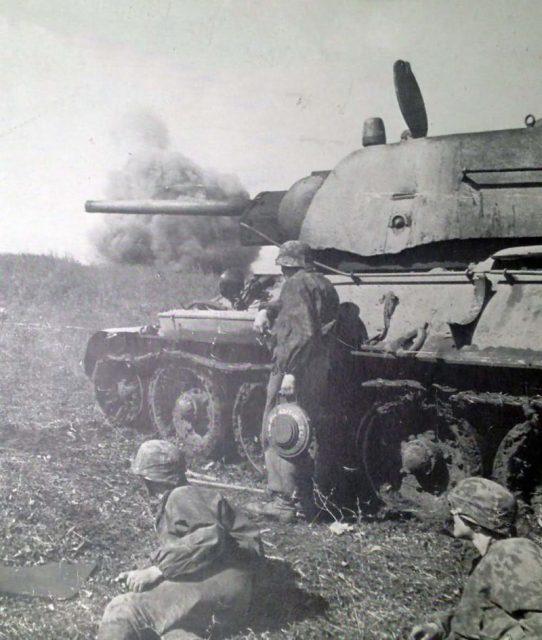
Abandoned T-34/76 with the Uralmash Turret. Panzer Grenadiers in foreground.
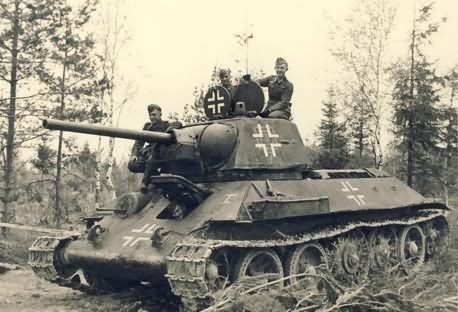
Captured T-34/76 used by the German army.
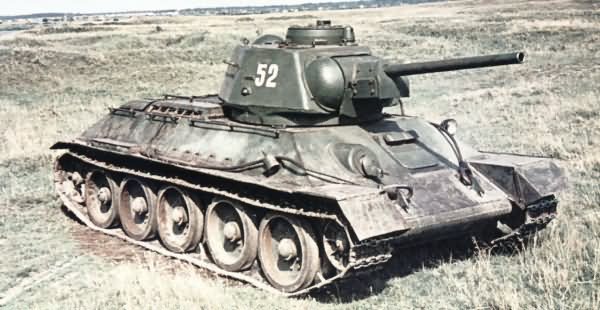
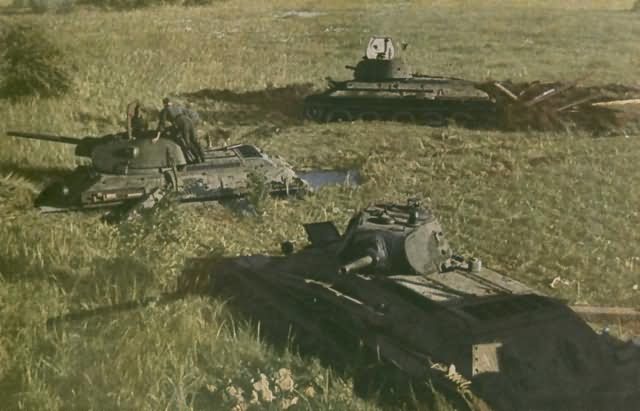
Another Captured T-34/76 used by the German Army.Color Photo of T-34/76 models 1940 and 1941.
Column of Soviet Troops including several T-34s. look like T-34/85 models, you can tell by the gun mantle and the longer barrel
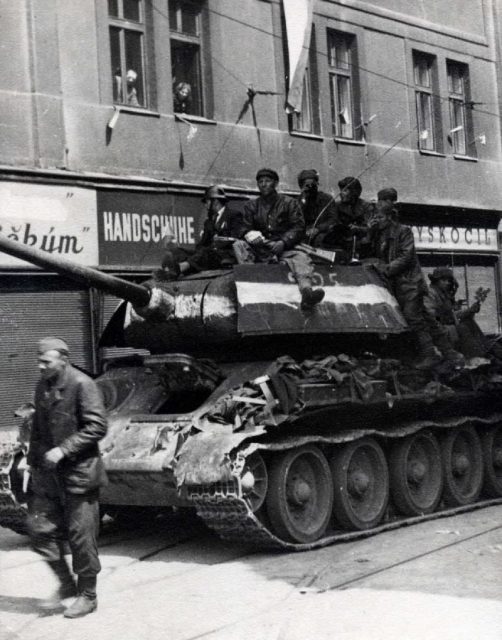
T-34/85 with additional armor in Czechoslovakia 1945.
Here is a movie"White Tiger", it is a Russian movie with english subtitles, the movie tried to be accurate as far as kitting out of the gear, except they had to use a modified JS-3 as the "Tiger Tank" I thought the movie was pretty good, I was telling Mack about the movie while we were returning from Alabama after buying my Garand