I set to post this on the scheduler thingie to drop on Sept 11, 2019. I wrote this post back in November of 2018, I have blogged before about Rick Rescorla, to me he went to Valhalla on the wings of Valkyries. To use a phrase that isn't used much anymore, "He died Well". Everyone dies, that is the truth of our existence, but some choose to run forward despite the almost certainty of death to make a difference.
The Battle of la Drang Valley was the first major battle in the
Vietnam War. 36 years later, the first major battle of the War on Terror
was the bombing of the Twin Towers.There are many people who remember both events, but Rick Rescorla is the only person who was at the heart of both.
Rick
Rescorla was born in Cornwall, United Kingdom, but was one of the most
distinguished heroes in the initial battle of Vietnam. He gave his life
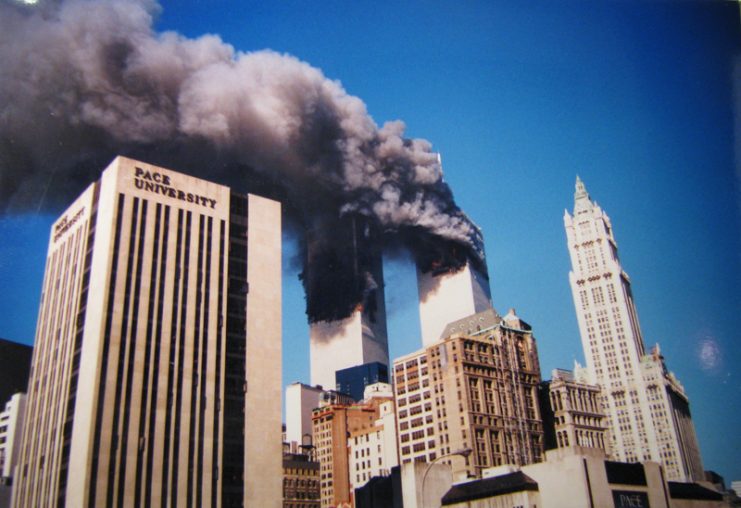
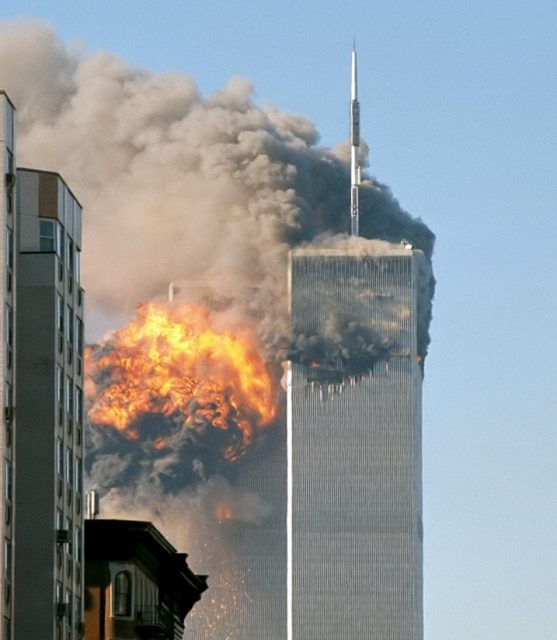
on September 11, 2001. Just
before the collapse of WTC 2. You can see all floors fully involved
with fire and structural failure is imminent
Rescorla’s career in the military started at the age of 17 when he
joined the British military. There he trained as a paratrooper and would
later serve in Cyprus. At the end of his Short-Service Commission, he
joined the Northern Rhodesia police before returning to London to join
the Metropolitan Police Service.
Rescorla’s tenure with the Met police was short-lived and he soon
emigrated to the United States where he lived in a hostel in Brooklyn.
He stayed there until he was able to enlist in the United States Army.
He completed basic training at Fort Dix.
After basic training, he completed Officer Candidate School and
airborne training, graduating with the assignment of platoon leader.
He became infantry leader of Company B, 2nd Battalion, 7th Cavalry
Regiment, 1st Cavalry Division. Rescorla and his men were one of the
first combat units on the ground in Vietnam.
In November 1965, he and his unit were involved in the battles in the
la Drang Valley. One of the moments from these battles was captured by a
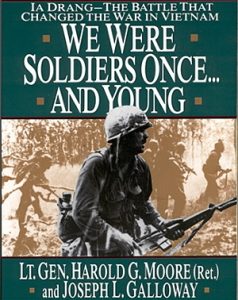
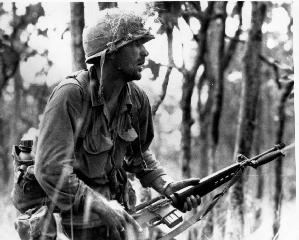
war correspondent and appears on the cover of We Were Soldiers Once And Young. This iconic image is of Rick Rescorla holding his rifle with bayonet attached and marching forward into battle.
Rick Rescorla during the war, 1965
Rescorla and his unit fought at Landing Zone X-Ray before being
extracted and provided with a brief rest. They were then instructed to
return to the valley and reinforce another unit. The battles lasted
three days, during which time the companies faced superior numbers but
were able to hold off and drive the enemy forces back.
For his part in the war, Rescorla was honored with the Vietnamese
Cross of Gallantry, a Purple Heart, a Silver Star, and the Bronze Star
with Oak Leaf Cluster.
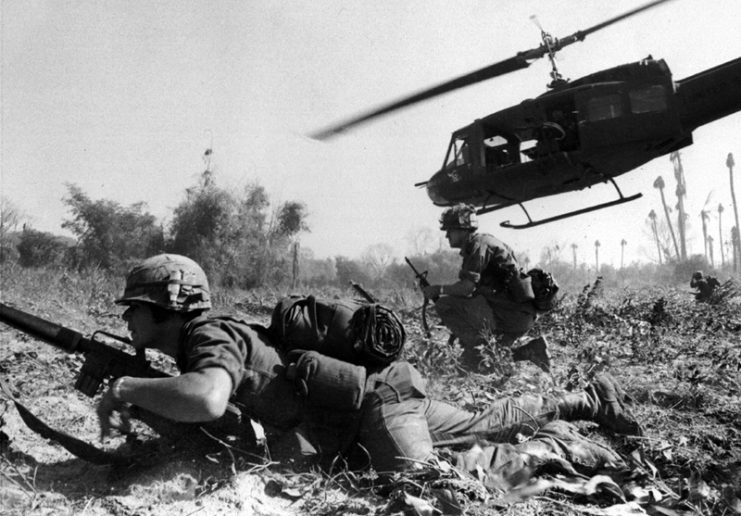
Some U.S. Army soldiers air-lifted into LZ X-Ray.
After leaving active duty, Rescorla remained a reserve, retiring with
the rank of colonel. He used his military benefits to study creative
writing and eventually earned a law degree from the Oklahoma City
University School of Law.
He would go on to teach criminal justice for three years and publish a textbook on the subject.
His teaching career was short-lived and he moved on to the world of
corporate security, joining Dean Witter Reynolds at their office in the
World Trade Center.
It was during his time there that Rescorla became concerned with the
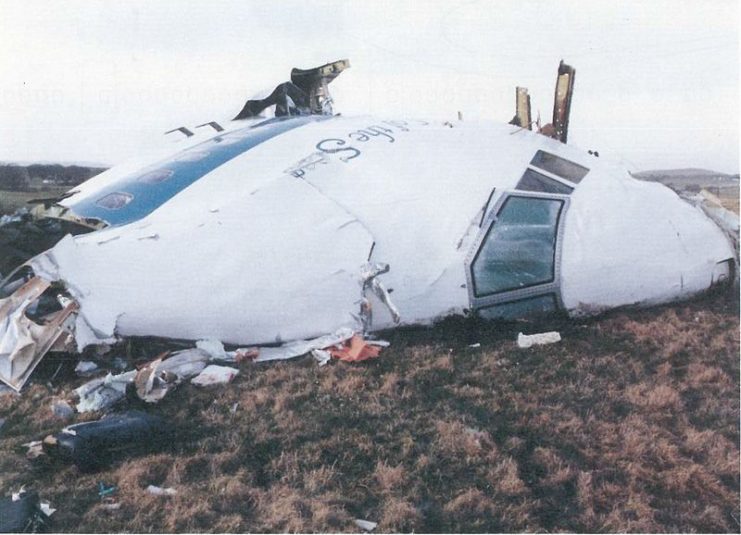
security of the towers. This was prompted by the 1988 bombing of Pan Am
Flight 103 over Lockerbie in Scotland.
The
remains of the forward section from Clipper Maid of the Seas (Pan Am
Flight 103) on Tundergarth Hill, Lockerbie Scotland, 21 December 1988
The bombing pushed Rescorla to invite his old friend, Daniel Hill, to
assess the security of the World Trade Center. Hill was trained in
counterterrorism and determined that the basement would be the easiest
target for a terror attack.
The two of them used the findings to write a report to the Port
Authority of New York and New Jersey insisting that more security be
added to the parking garage. Their recommendations were ignored due to
the costs, leaving the building open to the 1993 terrorist attack.
During the 1993 attack, Rescorla was upset by the poor evacuation of
the building and vowed that it would never happen again. In 1997, he
became the director of security for Dean Witter/Morgan Stanley and was
able to make some of the changes he wanted.
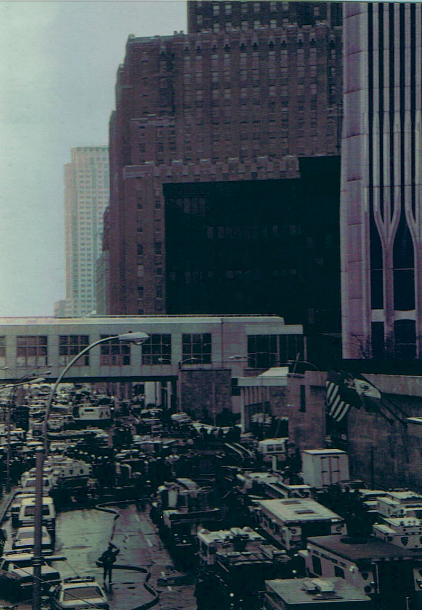
Procession
of emergency vehicles at the World Trade Center bombing on February 26,
1993. The Tower is on the far right of the frame. Photo taken by Eric
Ascalon from an adjacent pedestrian walkway.
Rescorla did recommend that the company find different office space
due to the vulnerability of the building, but lease obligations made
this impossible. This left Rescorla to create an emergency evacuation
plan that all employees had to practice again and again.
The emergency plan ensured that Morgan Stanley employees were ready
for any attacks. On the morning of September 11, 2001, Rescorla heard
the explosion from the North Tower and saw it burning from his office
window on the 44th floor of the South Tower.
An announcement from Port Authority came over the PA system telling
people to remain at their desks. Rescorla ignored the announcement,
grabbed his bullhorn and ordered Morgan Stanley employees to start
evacuating.
The
north face of Two World Trade Center (south tower) immediately after
being struck by United Airlines Flight 175
He directed the employees down the staircase and continued to
encourage them when the building lurched as the second plane hit. To
keep everyone calm, Rescorla started to sing as he had done for his
platoon in Vietnam.
Rick pushing people out of the building in Sept 11, 2001 saving their lives, this was the last pic that was taken of that man.
2,687 employees of Morgan Stanley owe their lives to Rick Rescorla as
they were successfully evacuated. After seeing to this, Rescorla
returned to the South Tower to ensure that everyone was out.
He was last seen on the 10th floor heading up shortly before the
tower collapsed. His remains were never found and he was declared dead
three weeks later.
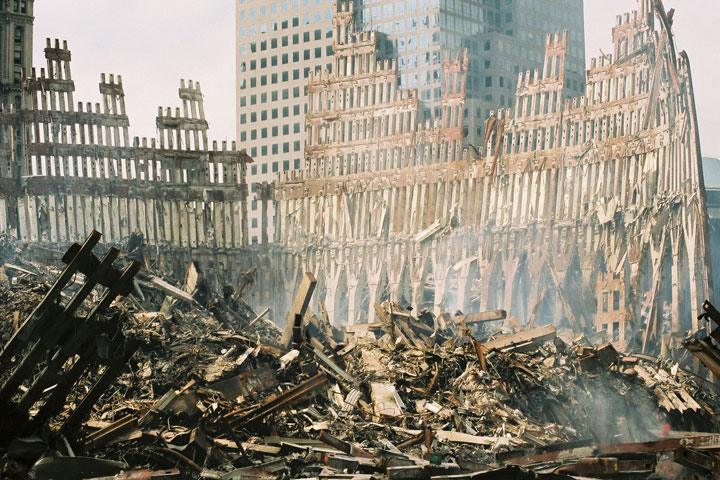
The exterior support columns from the lower level of the South Tower remain standing after the collapse of the building.
Rick Rescorla was a man who saw battle with two armies and the start of
the War on Terror. All but 13 employees of Morgan Stanley were able to
exit the South Tower safely because of his leadership and foresight.
I am working a lot of overtime during the summer push and sleep is an issue, so I am blogging light until the weekdays get here.
I read this posting from Old NFO and it talked about heroes and the lionization of the WWII generation. and somehow it gave a pass to the next generation that was my Dads generation. Here is a blurb:
What is a hero? My heroes are the young
men who faced the issues of war and possible death, and then weighed
those concerns against obligations to their country. Citizen-soldiers
who interrupted their personal and professional lives at their most
formative stage, in the timeless phrase of the Confederate Memorial in
Arlington National Cemetery, “not for fame of reward, not for place or
for rank, but in simple obedience to duty, as they understood it.” Who
suffered loneliness, disease, and wounds with an often-contagious élan.
And who deserve a far better place in history than that now offered them
by the so-called spokesmen of our so-called generation.
I remember my Dad coming home from his second tour and I was 7 years old in 1972. The war was winding down. I also remember my Dad watching the news intently on April 30 1975 when South Vietnam fell to the communist North. I remember the disdain that he was treated in the 70's when he did wear his uniform off post by certain people. I contrast that with the way we were treated in the first Gulf War when it was like some great crusade to free Kuwait. I am happy that the American Public with few exceptions treat the GI's better and don't blame them if they do not agree with the war. The Vietnam veterans were treated like crap from the peers of their generation and the same people that stayed in college and hid behind deferments and protested against the war and supported the Communist North and the Viet Cong. Now they are professors and am poisoning the new generation of young people in college. Now you don't go to college to get an education, you go to college to get indoctrinated in groupthink. Again I say, go follow the Link and read the article.
George L. Fox, Alexander D. Goode
Clark V. Poling, John P. Washington
I had gone to church this morning and the Pastor had told a joke about a ship going down and the captain stating that "going down with the ship is for the birds, and he will be on the 3 man raft. Now one of the seaman will have to remain with the sinking ship. Now to arrive at that decision, he will ask them a question and the one that fails the question will stay with the ship." The 3 seaman looked at each other as the Captain asked the first question." What unsinkable ship struck an iceburg and sank?" The first seaman replied" Titanic" The Captain nodded in affirmation, looked at the 2nd seaman and asked him" How many people died on that ship?" The second seaman replied "1517". The Captain nodded in affirmation, looked at the 3rd one and asked" name them". I know that this was a joke but it jogged my memory of an event that I read about in WWII about 4 Chaplains that gave their lives in a sinking. So when I came home, I did a bit of research and this is what I ran across.
The Four Chaplains, also sometimes referred to as the "Immortal Chaplains," were four United States Armychaplains who gave their lives to save other civilian and military personnel during the sinking of the troop ship USAT Dorchester on February 3, 1943, during World War II. They helped other soldiers board lifeboats and gave up their own life jackets when the supply ran out.[1] The chaplains joined arms, said prayers, and sang hymns as they went down with the ship.
George L. Fox was born March 15, 1900 in Lewistown, Pennsylvania, the eldest of 8 children. When he was 17, he left school and lied about his age in order to join the Army to serve in World War I. He joined the ambulance corps in 1917, assigned to Camp Newton D. Baker in Texas. On December 3, 1917, George embarked from Camp Merritt, New Jersey, and boarded the USS Huron en route to France. As a medical corps assistant, he was highly decorated for bravery and was awarded the Silver Star, Purple Heart and the French Croix de Guerre. Upon his discharge, he returned home to Altoona, where he completed High School. He entered Moody Bible Institute
in Illinois in 1923. He and Isadore G. Hurlbut of Vermont were married
in 1923, when he began his religious career as an itinerant preacher in
the Methodist faith. He later graduated from Illinois Wesleyan University in Bloomington, served as a student pupil in Rye, New Hampshire, and then studied at the Boston University School of Theology, where he was ordained a Methodist minister on June 10, 1934. He served parishes in Union Village and Gilman, Vermont, and was appointed state chaplain and historian for the American Legion in Vermont.
In 1942, Fox volunteered to serve as an Army Chaplain, accepting his
appointment July 24, 1942. He began active duty August 8, 1942, the same
day his son Wyatt enlisted in the Marine Corps. After Army Chaplains
school at Harvard, he reported to the 411th Coast Artillery Battalion at
Camp Davis. He was then united with Chaplains Goode, Poling and Washington at Camp Myles Standish in Taunton, Massachusetts, where they prepared to depart for Europe on board the USAT Dorchester.[3]
Rabbi Alexander D. Goode was born in Brooklyn, New York on May 10,
1911, the son of Rabbi Hyman Goodekowitz. He was raised in Washington,
D.C., attending Eastern High School, eventually deciding to follow his
father's footsteps by studying for the rabbinate himself, at Hebrew Union College (HUC), where he graduated with a B.H. degree in 1937. He later received his Ph.D. from Johns Hopkins University in 1940. While studying for the rabbinate at HUC, he worked at the Washington Hebrew Congregation during summer breaks.[4]
He originally applied to become a Navy chaplain in January 1941, but was not accepted. After Pearl Harbor
was attacked in 1941, he applied to the Army, receiving his appointment
as a chaplain on July 21, 1942. Chaplain Goode went on active duty on
August 9, 1942 and he was selected for the Chaplains School at Harvard.
He had courses in map reading, first aid, law, and chemical warfare.
Chaplain Goode was then assigned to the 333rd Airbase Squadron in
Goldsboro, North Carolina. In October 1942, he was transferred to Camp
Myles Standish in Taunton, Massachusetts and reunited with Chaplains
Fox, Poling and Washington, who were classmates at Harvard.[5]
Clark V. Poling was born August 7, 1910 in Columbus, Ohio, the son of
Evangelical Minister Dan Poling, who was rebaptized in 1936 as a
Baptist minister. Clark Poling studied at Yale University's Divinity School
in New Haven, Connecticut and graduated with his B.D. degree in 1936.
He was ordained in the Reformed Church in America, and served first in
the First Church of Christ, New London, Connecticut, and then as Pastor
of the First Reformed Church in Schenectady, New York. He married Betty
Jung.
With the outbreak of World War II, Poling decided to enter the Army,
wanting to face the same danger as others. His father, who had served as
a World War I chaplain, told him chaplains risk and give their lives,
too—and with that knowledge, he applied to serve as an Army Chaplain,
accepting an appointment on June 10, 1942 as a chaplain with the 131st
Quartermaster Truck Regiment, reporting to Camp Shelby, Hattiesburg,
Mississippi, on June 25. Later he reported to Army Chaplains School at
Harvard where he would meet Chaplains Fox, Goode, and Washington.[6]
John P. Washington was born in Newark, New Jersey on July 18, 1908.
He studied at Seton Hall in South Orange, New Jersey to complete his
high school and college courses in preparation for the Catholic
priesthood. He graduated in 1931 with an A.B. degree, entering
Immaculate Conception Seminary in Darlington, New Jersey, where he
received his minor orders on May 26, 1933. He served as a subdeacon at
all the solemn masses, and later became a deacon on December 25, 1934.
He was elected prefect of his class and was ordained a priest on June
15, 1935.
Father Washington's first parish was at St. Genevieve's in Elizabeth,
New Jersey, later serving at St. Venantius for a year. In 1938, he was
assigned to St. Stephen's in Kearny, New Jersey. Shortly after the Pearl
Harbor attack of December 7, 1941, he received his appointment as a
chaplain in the United States Army, reporting for active duty May 9,
1942. He was named Chief of the Chaplains Reserve Pool, in Ft. Benjamin
Harrison, Indiana, and in June 1942, he was assigned to the 76th
Infantry Division in Ft. George Meade, Maryland. In November 1942, he
reported to Camp Myles Standish in Taunton, Massachusetts and met
Chaplains Fox, Goode and Poling at Chaplains School at Harvard.[7]
The Dorchester left New York on January 23, 1943, en route to
Greenland, carrying the four chaplains and approximately 900 others, as
part of a convoy of three ships (SG-19 convoy). Most of the military
personnel were not told the ship's ultimate destination. The convoy was
escorted by Coast Guard Cutters Tampa, Escanaba, and Comanche.[11]
The ship's captain, Hans J. Danielsen, had been alerted that Coast
Guard sonar had detected a submarine. Because German U-boats were
monitoring sea lanes and had attacked and sunk ships earlier during the
war, Captain Danielsen had the ship's crew on a state of high alert even
before he received that information, ordering the men to sleep in their
clothing and keep their life jackets on. "Many soldiers sleeping deep
in the ship's hold disregarded the order because of the engine's heat.
Others ignored it because the life jackets were uncomfortable."[9]
During the early morning hours of February 3, 1943, at 12:55 a.m., the vessel was torpedoed by the German submarine U-223 off Newfoundland in the North Atlantic.[12]
The torpedo knocked out the Dorchester's electrical system,
leaving the ship dark. Panic set in among the men on board, many of them
trapped below decks. The chaplains sought to calm the men and organize
an orderly evacuation of the ship, and helped guide wounded men to
safety. As life jackets were passed out to the men, the supply ran out
before each man had one. The chaplains removed their own life jackets
and gave them to others. They helped as many men as they could into
lifeboats, and then linked arms and, saying prayers and singing hymns,
went down with the ship.[12]
As I swam away from the ship, I looked back. The flares had lighted everything. The bow
came up high and she slid under. The last thing I saw, the Four
Chaplains were up there praying for the safety of the men. They had done
everything they could. I did not see them again. They themselves did
not have a chance without their life jackets.
My son was on fall break so I took some time to head to several places that I thought were "neat" First we went to visit my brother at Fort Rucker, then headed to the U.S.S. Alabama. That was a real neat visit, Both of us really enjoyed that trip. It was awesome actually seeing an actual battleship. Age wise the ship only had an operational life of 4 years. I kinda wondered if it would be difficult to bring the ship to operational duty if necessary.
We walked around the ship and saw a bunch of cool stuff, I will have to find a way to create a link to photobucket or something like that While we were there, I saw a gentleman doing a book signing , His name is Glenn Frazier, he is a survivor of the Bataan Death March. He has a website Here
Speaking to him, I was humbled, here was a person that lived through something that most people didn't survive and was a pleasure to talk to. Here was an embodiment of the greatest generation. I have a copy of his book and finished reading it, now my son is reading it.
I was surfing through blogs that I check out everyday...the ones on my blogroll and I visited Stormbringer's blog and I saw this. It reminded me of the guys at Roarks drift in the movie Zulu
or in the 13th warrior when the Norsemen recited this:
"Lo there do I see my father. Lo there do I see my mother and my sisters
and my brothers. Lo there do I see the line of my people, back to the
beginning. Lo, they do call to me, they bid me take my place among them,
in the Halls of Valhalla, where the brave may live forever."
Basically there is a quote that I have heard a long time ago, " a coward dies many deaths before he dies....a brave man dies but once"
“So live your life that the fear of death can never enter your heart.
Trouble no one about their religion; respect others in their view, and
demand that they respect yours. Love your life, perfect your life,
beautify all things in your life. Seek to make your life long and its
purpose in the service of your people. Prepare a noble death song for
the day when you go over the great divide.
Always give a word or a sign of salute when meeting or passing a friend,
even a stranger, when in a lonely place. Show respect to all people and
grovel to none.
When you arise in the morning give thanks for the food and for the joy
of living. If you see no reason for giving thanks, the fault lies only
in yourself. Abuse no one and no thing, for abuse turns the wise ones to
fools and robs the spirit of its vision.
When it comes your time to die, be not like those whose hearts are
filled with the fear of death, so that when their time comes they weep
and pray for a little more time to live their lives over again in a
different way. Sing your death song and die like a hero going home.”
While surfing youtube looking for more video's for my monday music that I like to post on... monday
I ran across this video from NATGEO. I still an affected by 9-11, there has been an innocence lost for a new generation.
I did a posting back in may, I had labled it "heroes" We have the 10th anniversary of 9-11 coming up, so I figured I would repost a post I did on a person that was killed by the attack on 9-11.
Here is an exerpt of my post, followed by a link to the rest of the post.
"A coward dies a thousand times whereas a brave man dies only once."
I figured that I would do a posting on heroes, people who by action would warrant what I call " Entry to Vahalla" where the vikings would welcome their own kindred spirit and lift up the mead glasses and Yell welcome. One of the people that I admire is a person named Rick Rescorla. Most people don't know his name but they would recognize a picture of Rick from Vietnam
Lt Rick Rescorla 2/7th Cavalry Ia Drang Valley 1965
Pic Of The Day: Dog Keeps Watch Over Fallen SEAL’s Casket During Funeral…
If this doesn’t tug at your heart strings then you’re not human (or a liberal).
(Blaze) — Petty Officer Jon T. Tumilson was laid to rest Friday in Rockford, Iowa, where an estimated 1,500 mourners came to pay respects for the fallen Navy SEAL, including his dog Hawkeye. In fact, Hakeye’s loyalty to his owner at the funeral was visible, creating a heart-wrenching image as he laid down by the casket of his owner during the entire service.
The 35-year-old Tumilson died Aug. 6, when a rocket-propelled grenade disabled the helicopter he was in. It crashed, killing 30 Americans and eight Afghans. Fellow Navy SEALS told KIMT-TVthat Jon was someone with unmatched work ethic and character. more here
"A coward dies a thousand times whereas a brave man dies only once."
I figured that I would do a posting on heroes, people who by action would warrant what I call " Entry to Vahalla" where the vikings would welcome their own kindred spirit and lift up the mead glasses and Yell welcome. One of the people that I admire is a person named Rick Rescorla. Most people don't know his name but they would recognize a picture of Rick from Vietnam
Lt Rick Rescorla
2/7th Cavalry Ia Drang Valley 1965
I got information from this Link
Rick Rescorla predicted 9-11. He also predicted the 1993 World Trade Center bombing. It is a matter of record. Rescorla was the Vice President for Security for Dean Witter Corporation when he foresaw the coming bombing of the World Trade Center in 1993. Two years before this first attack, he predicted it would be a truck bomb exploding in the unsecured basement parking area. He went to the New York/New Jersey Port Authority with his warnings and was told to "be concerned with the security of the 40 floors that Dean Witter leases from us and leave the rest to us." Dean Witter/Morgan Stanley received about one quarter billion dollars in settlement fees for the Port Authority's negligence in failing to heed the informed warnings of the coming 1993 attack.
Still ignorant, arrogant, and flat out stupid, the Port Authority and Dean Witter/Morgan Stanley refused to heed Rescorla’s second warning -- a very specific warning -- that another attack was coming -- this time from the air -- in the form of commercial aircraft. Rescorla was a hair off. He thought it would be cargo aircraft out of Europe or the Middle East loaded with explosives (not far off the historic happening).
Asked by his superiors "What can be done to prevent such an attack?"Rescorla replied "Nothing. Get out of this building. It’s nothing but a big soft target. And they intend to hit us again. Move across the river to New Jersey. Build, buy, or rent a group of low-rise buildings. Spread out.into smaller targets. In this computer age we could do our business from the middle of North Dakota. We don't need Wall Street anymore."
How does a man come to possess this ability to so accurately predict future events? He had no crystal ball. He was not clairvoyant. He was a professional in the arts of intelligence, security, and counter-guerrilla warfare. He had spent his entire life centered on these things. Over a lifetime, Rescorla accumulated knowledge and experience that allowed him to know the how, when, why, and where his enemy would strike.
Rescorla was born in May 1939 in Hayle, Cornwall, England. His childhood memories were of commando raids by British forces, OSS operations, and the French resistance. As a youth he read about these events, studied them, analyzed them, criticized them -- like a Monday morning quarterback. He was virtually nurtured at the tit of war and special operations.
In his teens he joined the British army, became a paratrooper, then went into intelligence and led a unit fighting guerrillas and insurgents in Cyprus. Then he went to Africa -- Northern Rhodesia (now Zambia) where he fought more guerrillas and insurgents. After that, he joined the London police force as a member of the Scotland Yard Flying Squad where he was much involved in anti-IRA operations. In 1963, he came here to the United States and enlisted in the American Army as a private. In April 1965 he was commissioned as United States Officer of Infantry out of the OCS course at Fort Benning, Georgia. Five months later he was commanding a platoon of 44 men in Vietnam with the 2/7th Cavalry battalion of the 1st Air Cavalry Division. Two months after that he was one of the most distinguished heroes of the battle of Ia. Drang Valley (see the Joe Galloway/Lieutenant General Hal Moore book We Were Soldiers Once -- And Young). and the movie By Mel Gibson
After the war, Rescorla left active army service (although he stayed in the National Guard until he retired as a Colonel). In 1967 he became an American citizen. He had paid his dues. He went to college at the University of Oklahoma where he studied literature and writing. Then he went to law school and became a lawyer. He taught criminal justice at the University of South Carolina in Columbia for awhile, but the academic life was too tame for him.He went into the banking/financial security business, and quickly advanced to the top ranks of his profession.
Over the course of his life, Rescorla developed a corps of men he could rely upon -- thinkers -- soldiers -- politicians -- writers -- law enforcement officials -- second class, politically incorrect, belligerent men -- men who saw things as they actually were and not what they seem to be. From these he developed his own brain trust -- his own intelligence unit -- his own staff and group of counselors. He kept in contact with them by telephone.He posed questions -- hypothetical situations concerning international developments and problems. He collected, consolidated, and analyzed the input from this net of agents and thus came to logical conclusions. Some he hired for short periods as consultants. One -- a natural insurgent/guerrilla/warrior -- he brought to New York to make an estimate of the situation and the likely plan of attack upon the World Trade Center. In 1990-91, all this produced the prediction of the 1993 bombing. In 1995-96, it predicted the 2001 air attack.
See? No horoscope -- no crystal ball -- no tarot cards -- just plain and simple intelligence and professional expertise and logical projection, i.e., "If you want to know what a terrorist is likely to do, just ask a terrorist -- or one whose mind works like that of a terrorist.”
Now -- go back to why Rick Rescorla was a hero on 9-11.
Answer: Because after being told by Dean Witter/Morgan Stanley that they could not relocate -- that their lease ran to 2005 and maybe after that the move was possible -- Rescorla planned and drilled the Dean Witter/Morgan Stanley staff and employees in the evacuation of the World Trade Center offices that they occupied.
Despite criticism and intimidation, despite ridicule and denigration, Rescorla forced his people to drill. Without warning, he’d sound an alarm and then lead the entire company through a mandatory, rapid, efficient, and safe evacuation practice. They grumbled and they griped, but they did it.
Rescorla installed generators and stair lighting in the event of power failure (which came to be). He assigned office and floor wardens to insure control and accountability of personnel and evacuating. Rescorla insisted on buddy teams – people were to go two-by-two down the stairs in an orderly and rapid manner. Rescorla made sure that elderly and handicapped persons had three or four others to assist them. And he drilled them -- over and over -- again and again -- until it became a conditioned response.As Rescorla said "like a soldier going into an anti-ambush drill."
On the day of the crisis, when the first tower was hit, the Port Authority ordered everyone in the second tower to stay at their desks. Rescorla made a command decision to countermand that order. “Bugger that!” he said. And then he initiated his conditioned response plan. Evacuation began immediately.
Trained -- conditioned -- the Dean Witter/Morgan Stanley employees responded. They implemented Rescorla's plan. 2700 people followed Rescorla's drill. Rescorla was everywhere – the halls – the stairwells -- from the 10th to 70th floors. His voice could be heard above the near mayhem, keeping them calm, responsive, moving in a controlled and orderly manner. At times he sang to them over his megaphone. He sang God Bless America in that booming deep baritone of his. And he sang the defiant Men of Harlech, just as he’d done when the 7th Cavalry was surrounded in the Ia Drang Valley, just as the British Army had done when surrounded by the Zulus at Rourke’s Drift.
Men of Cornwall stop your dreaming; Can't you see their spearpoints gleaming? See their warriors' pennants streaming To this battlefield. Men of Cornwall stand ye steady; It cannot be ever said ye for the battle were not ready; Stand and never yield!
All but six of Dean Witter/Morgan Stanley’s employees survived. They got out – alive. They live today. They live because Rescorla was watching out for them.
Dean Witter/Morgan Stanley was not comprised of its equipment, computers, files, fixtures, furnishings, nor potted plants. It was comprised of its people -- those 2700 individuals, their minds and talents and experience. When Rescorla saved their lives through his foresight and actions, he also saved the largest financial institution in the nation -- in the world -- on this earth.
But Rescorla did not survive. After shepherding the 2700 out of the building, Rescorla knew there were still a few left above -- the confused -- the disoriented -- the injured. And as everyone who knew Rescorla knows, he would leave no man behind.
And so he went up into that tower of death in an attempt to save them. He knew it was a forlorn hope. He knew that he would probably die in his attempt. But Rescorla was a man that could never live with himself in the future if he did not try to save those few that were left. So he went up. And the tower came down. And Rescorla is no more.
I know this is true. I was Rescorla's best friend, confidante, and comrade-in-arms throughout our entire adult lives. I fought with him in Africa, went through OCS at the same time he did, fought in Vietnam with him. I am the guerrilla/insurgent/terrorist-at-heart he hired as a consultant. My children called him “Uncle Rick.” My wife thought of him as the brother and sibling she'd never really had. I was best man at both of his weddings. From 1970 until his death, we spoke on the telephone three or four times a week. His children called me “Uncle Dan.” Not by blood or birth but by choice, we were brothers. (For a full account of Rescorla and Hill’s legendary exploits and amazing friendship read Heart Of A Soldier by James B. Stewart)
On 9-11, as he went through that trial, we spoke over the cell phone as things progressed from the initial aircraft hit until he went up looking for the few survivors that may have been left behind. After he started up he called his wife, Susan. His last words to her were “You made my life.” Susan and I were both watching our TV when Rick's tower went down, taking him and his life with it.
I have wept only one time over the loss of my one true friend, brother, and companion - and that, unfortunately, was on national television while being interviewed by Jane Pauley. She asked me then if that was the first time I had cried over Rick. I replied, "Yeah. I've been too busy being proud of him. I've been too busy cheering."
I have vowed to never again cry over Rick Rescorla and his death. It was not an event to weep over. It was a noble ending for a noble man. I choose to rejoice in that. I will continue to cheer.
Such magnificent men are rare. They appear every few eons or so, and they are a gift to mankind.
Rescorla died the death for which he was destined -- standing for the principles of honor, integrity, and valor. He was a man who considered everyman to be as important as himself. From bush natives in Africa to the barons of Wall Street, he considered every life as valuable as his own. In the end, he died as he lived -- in service to his fellow man. Like the Good Book says: "Greater love hath no man than this, that a man lay down his life for his friends.” (John 15:13).
There was no better man in history. There probably never will be better. I give you 2700 survivors of the 9-11 World Trade Center disaster as witnesses.
If life is a battle, then my inner scars are medals for valor, for swiftness, for courage, for passion. Evil is the dark-haired brother of Good; they walk hand in hand–always.Calanthe - Wraeththu
What is Chivalry? A knight was expected to have not only the strength and skills to face combat in the violent Middle Ages but was also expected to temper this aggressive side of a fighter with a chivalrous side to his nature. There was not an authentic Knights Code of Chivalry as a prescribed document - it was a moral system which went beyond rules of combat and introduced the concept of Chivalrous conduct - qualities such as bravery, courtesy, honor, and gallantry toward women. Documented in 'The Song of Roland' in the Middle Ages Knights period of William the Conqueror who ruled England from 1066, it consisted of these tenents -To fear God and maintain His Church
To serve the liege lord in valour and faith
To protect the weak and defenceless
To give succour to widows and orphans
To refrain from the wanton giving of offence
To live by honour and for glory
To despise pecuniary reward
To fight for the welfare of all
To obey those placed in authority
To guard the honour of fellow knights
To eschew unfairness, meanness and deceit
To keep faith
At all times to speak the truth
To persevere to the end in any enterprise begun
To respect the honour of women
Never to refuse a challenge from an equal
Never to turn the back upon a foe
The "code" is written in slightly different form in different pieces of literature, but it all has these things in common - courage, loyalty, respect, honor, finishing everything you start and never refusing a necessary battle regardless of the odds.
Widows and orphans were cared for. In days of old, the helpless were looked after, but you worked or you did not eat. There were three orders in society: oratores (those who pray), bellatores (those who fight), and laborares (those who work). Those that prayed, lived beyond simply, not riding around in limos in $1500 suits while telling their followers on national TV to "send more money". The welfare class, that's rapidly becoming a huge chunk of our "modern" society, didn't exist. If you were physically capable, you pulled your weight. Or you died. The knight did not fight for the lazy, but for those who by station, age, or gender were not able to fight for themselves.
There was faith in a higher power, but not so heavenly driven, that a man was useless on earth.
A sword was a tool, to defend and protect. Lesser weapons were considered dishonorable. The dagger was considered a weapon of a sneaky assassin and an arbalest (fired from a distance) was a brutal weapon used by the untrained. A knight's code of chivalry demanded that he face his enemy openly, honestly and with skill - it was a "let the best man win" situation. Battle was more than the desire to pursue and kill, but endurance, the conviction and longing to endure beyond all imaginable limits of the flesh to protect and preserve.
There was a difference between aggression and self defense, a difference between being devoted to justice and being a school yard bully. It is a self-awareness and self-restraint and differs as night and day from apathy, the concept of which Christians might refer to as meekness, a trait often associated with Christ, and clearly as misunderstood.
There was the ability to think before one speaks, to consider the gravity of words and actions; and even to know when inaction or silence is the best avenue. Such things, many, including myself, have failed at. Such things we can still strive for. There was bravely standing up for friends, not just ourselves.
The dictates of chivalry are not some formal guide to etiquette. I hope I die before I see a "Chivalry for Dummies" book. It's not a checklist, it's an understanding of things for which a man needs no checklist. It's not bowing before your nation's enemy, it's never turning your backs on them. It's not holding the door open for a women because she's weak and lesser than you, but as a sign of courtesy. It's a way of thinking, not an era or a specific rule.
I've written on this blog more than once about the wimpification of the modern male. But being a strong man does not mean you are completely closed off to emotion, treating sex like an oil change, and a woman as a somewhat lesser accessory. The strongest man I know can convey in one look, one touch, what I mean to him. But one can understand where the mixed signals come from. The view from the media is one of abject consumerism, relationships that manipulate, sex as control and the worst "if there's a man involved, it's his fault". Our nation has more material comforts than the knights could ever imagine, but for many people, it's prosperity without purpose, it's passion without principles.
People espouse the Middle Ages as being little more than Pestilence, Black Death and no YouTube with the concepts of that day being outdated, or worse, by their own basis, misogynistic. What do we have now to replace it? Materialism without ethics or effort, and baby daddy's, greedy trophy wives, teen moms, and uncouth, plastic infused bimbos who get their own reality TV shows without any bit of skill or talent. This is our alternative to "the Dark Ages", a generation of people who fail to understand the difference between "can" and "should"?
Epictetus said it best "for it is better to die of hunger, exempt from fear and guilt, than to live in affluence with perturbation."
But the spirit of chivalry has not been entirely eradicated from the human heart, even in our pacifist, feminist, age. A chivalrous man today is a warrior with something to live for - and is willing to sacrifice his life either to protect or further it. Being a warrior does not not necessarily make him a man of war, but a man prepared to do battle for that which he loves. The battle can be one of ideology, not weapons, his life simply marked by preparation for something worthwhile, and thus is lived pursuing those ideals and interests which for him hold true value.
If this man is willing to die for something he loves, it is because he loves deeply and with great passion. Romantic love may well make the short list, but it's not the sole occupant of his soul, there are other causes and objects of a man's passion, that make him truly rounded.
Chivalry is not dead, it is simply dormant in many, for all things that are excellence can be as difficult as they are rare. In my writing I've referred to the knight as he, for it was a manly profession. Yet the ideas that define chivalry know no gender; it's a way of thinking expressed in form by both men and women who hold true these concepts of defense and accountability.
Some will call me hopefully old fashioned. Feminist and those more liberal minded will decry it as a way of life that is simply bloodshed, war and women seen as a possession. It's not. A chivalrous man, has no desire to control and direct a woman's thoughts, but to allow her to live without constraint, loved unconditionally, free from pesky dragons and telemarketers. He will not only arm himself with the tools he as to protect her, he will smile when she takes up her own. He will fight for her. He will fight with her.
Chivalry is NOT dead. Look at our military personnel, look at those people who responded after the terror attacks. Firemen, EMT's, the police. Nurses, doctors. A post-September 11 nation's no place for milquetoasts. We are living in a fallen world with entire societies that wish us harm, religions of "peace" that dictate to embrace them or die. This is not a time to sit home watching reality television, when the dragons aren't just bigger, they're almost nuclear ready.
It's a time for heroes. Big Damn Heroes.In the Battle of Maldon, a few Englishmen have been attacked by a fierce army of Viking invaders. Although the Vikings are between two branches of the river and thus separated from launching their full strength at the Anglo-Saxon army, Beortnoth nobly allows them free passage to do battle on equal terms. Vastly outnumbered, Beortnoth and his brave men are slain until only a small, unflinching band of warriors remain:
“Byorthwold spoke; he grasped his shield; he was an old companion; he shook his ash spear; full boldly he exhorted the warriors: 'Thought shall be the harder, heart the keener, courage the greater, as our might lessens. Here lies our leader all hewn down, the valiant man in the dust; may he lament for ever who thinks now to turn from this war-play. I am old in age; I will not hence, but I purpose to lie by the side of my lord. . ."
In these few words, a better description of heroism, of unwavering dedication and loyalty I've not read in a while. The lines “Thought shall be the harder, heart the keener, courage the greater, as our might lessens" are a thousand years old, a pre Christian heroic spirit which author J.R. Tolkien, a crafter of worlds where chivalry roared, himself called "Northernness".
Chivalry exists, and heroism stands. Look at the people who serve in hard times, hard areas, death a shadow on the wall, so the masses can be safe. But you don't have to be a member of the military or a protector of the weak to embrace these concepts. Chivalry gives us something to strive for, something to hold up as an ideal and an understanding that throughout history there are those who have risen above the standards of the day to truly be called brave.
The year could be 1066, it could be 2001, it could be today. A hand on a rough shovel, flinging the dirt with an effortless fury, the mound of soil rising of its own volition, not crafted by man but as if flung forth by the earth itself, until the grave is readied. A warrior has fallen, medals scribed on ore or heart, small things insignificant to the view, but mute with profound meaning. The earth waits but a moment. Shadows fall with the moon's curve, no sound but the labored breath of form of one who engaged without arms, this single combat. Laying a warrior to rest.There is now but a shield to be picked up and carried on. So, man or woman, we never forget.



 One of my favorite pics, it shows the indomitable spirit of the American People.
 9-11-2002


