Webster

The Constitution was made to guard the people against the dangers of good intentions." --American Statesman Daniel Webster (1782-1852)


Showing posts with label Historical movie. WWII. Show all posts

Tuesday, January 24, 2023

The 5.8 Million Dollar Lufthansa in 1978 that actually inspired the movie "GoodFellas"


 I read about this and it caught me eye and I recall this hitting the news back in 1978 and it was a big deal because of the amount of money that was snagged.

On December 11, 1978, six masked, armed men burst into the Lufthansa Airlines cargo terminal at New York’s John F. Kennedy International Airport during a graveyard shift and robbed $5.8 million in cash and jewels, the largest heist in U.S. history at the time.

No shots were fired. No one was seriously hurt or killed. It took just 64 minutes for a crew of low-level crooks linked to the Lucchese crime family to steal $5 million in untraceable bills (worth $22.4 million in 2022) and $800,000 in jewels (worth 3.6 million in 2022).

It seemed like the perfect crime—until it wasn’t. Authorities never recovered the cash or the jewels, but a trail of at least a dozen bodies and disappearances of people tied to the heist kept them busy. Some were shot in the head, execution style. Another’s hogtied frozen body was found in a meat refrigeration truck. A woman’s headless torso washed ashore in New Jersey.

After a decades-long investigation, only one person was ever convicted in the heist. The story of the crew that pulled it off inspired Martin Scorsese’s 1990 film Goodfellas. Two mob figures who led the caper—and the subsequent killing spree aimed at muzzling those involved—ended up in prison for other crimes and died behind bars.

The idea for the huge heist came from a pudgy Lufthansa cargo supervisor named Louis Werner, who ultimately served as the inside man on the job. Sweating a $20,000 gambling debt, Werner approached bookmaker and wig shop owner Martin Krugman about the huge stacks of untraceable bills frequently flown in from Germany and temporarily stored at the airline’s JFK vault. Werner asked Krugman to shop around for men who could pull off the heist.

Krugman passed the tip to mid-level drug-dealing gangster Henry Hill, who pulled in his mentor Jimmy “the Gent” Burke, whose crew was known for hijacking and robbing cargo trucks coming from the airport. Burke answered to Paul Vario, a fearsome capo of the Lucchese crime family. Vario, who needed cash quick after losing a cocaine shipment to authorities, greenlit the Lufthansa caper.

According to Wiseguy, Nicholas Pileggi’s book about Hill that inspired Scorsese’s movie, Hill said he helped Burke plan the heist in Robert’s Lounge, Burke’s gambling and criminal hangout in the Ozone park section of Queens. As they pored over cargo warehouse floor plans and sized up inside information, Burke assembled the crew of hijackers, killers, loan sharks and thieves who would pull off the heist.

A Brink's truck seen parked outside the Lufthansa cargo terminal, near the pickup and delivery platform, at JFK Airport the day after the heist. On the Friday before the crime, a Brink's truck was to have picked up a large sum of cash at the building, but the driver left the money behind when he was informed that a Lufthansa foreman he was supposed to meet was busy, police said. On 12/11, a band of masked raiders stormed into the cargo terminal and bagged a reported $5.8 million. The U.S. currency, all used bills for which authorities have no serial numbers, was being shipped to the Chase Manhattan Bank in New York from Commerz Bank in Frankfurt, West Germany.

A Brink's truck seen parked outside the Lufthansa cargo terminal at JFK Airport the day after the heist. On the Friday before the crime, a Brink's truck was to have picked up a large sum of cash at the building, but the driver left the money behind when he was informed that a Lufthansa foreman he was supposed to meet was busy, police said. On 12/11, a band of masked raiders stormed into the cargo terminal and bagged a reported $5 million. The U.S. currency, all used bills for which authorities have no serial numbers, was being shipped to the Chase Manhattan Bank in New York from Commerz Bank in Frankfurt, West Germany.

According to court documents, Werner alerted the crew that a large shipment of cash had arrived on Friday, December 9 and would be in cargo storage all weekend because he kept the cash from being transferred to the bank right away via the Brinks armored trucks. At 3 a.m. on Monday the 11th, six men in ski masks pulled up to the Lufthansa cargo warehouse in a black Ford Econoline 150 van. The crew sliced the gate padlock with bolt cutters, and some of the six went in.

After herding employees to the break room at gunpoint, the thieves forced the night shift manager to disable the alarm and open the double-door storage vault, which their inside contact had told them how to operate. They hauled forty 15-pound cartons of cash and jewels into the van, and two of the thieves got in. The others got into a waiting Buick, and they all zoomed away at 4:21 a.m. Employees were told not to call for help until 4:30 a.m., when police got the first call. The whole caper took just 64 minutes.

The thieves met Burke and transferred the loot to the trunks of two other cars at a warehouse owned by John Gotti, a captain of the Gambino crime family that shared the airport turf with the Lucchese family. In Wiseguy, Hill said Gotti also offered to have the black getaway van crushed at an auto salvage yard he controlled in Brooklyn.

But that didn’t happen, giving authorities their first break in the case. Two days after the heist, police found the black van parked at a fire hydrant in Brooklyn’s Canarsie neighborhood. Parnell “Stacks” Edwards, a longtime gofer for Burke’s crew, failed to take the van to the Gotti-controlled junkyard.

Afraid the van could lead police to Edwards and then to him, Burke, with Vario’s blessing, decided Edwards had to go. On his orders, two experienced killers in the heist crew, Tommy “Two Guns” DeSimone and Angelo Sepe, shot Edwards in the head in the middle of dinner with a piece of chicken still in his mouth.

Edwards was the first victim in Burke’s violent push for silence. By the summer of 1979, seven months after the robbery, Burke had carried out or ordered the execution of nine people, all of whom were either at the heist, laundered heist money or were at the wrong place at the wrong time.

“Rather than give everyone $400,000 or $500,000 apiece, it was easier to put a quarter bullet in their head,” Hill said in a History Channel documentary. “So, he started eliminating everyone at that point.”

Krugman, the bookie who first approached Hill with the heist idea, complained too loudly and too often that he needed a large cut of the stolen cash. Hill said Burke and Sepe killed and dismembered Krugman a month after the robbery, fearing he would squeal. His body was never found.

James (Jimmy the Gent) Burke, arrested and taken to Federal Court

James (Jimmy the Gent) Burke, arrested and taken to Federal Court—but not for the Lufthansa crime.

At the end of February, Werner, the inside man, was the only person convicted in the Lufthansa affair and was sentenced to 15 years in prison. That spiked Burke’s paranoia.

Weeks later, Burke targeted his former cellmate, 300-pound Louis "Roast Beef" Cafora, who was laundering heist money through his Brooklyn parking lot business. Told to lay low, Cafora instead bought his wife Joanna a custom pink Cadillac, drove it near the JFK cargo area where the FBI was investigating, and told her about the heist and other mob business. They disappeared, and their bodies were never found.

Robert McMahon and Joe “Buddha” Manri, both cargo thieves who worked for Air France at JFK, refused to cooperate with the FBI in exchange for witness protection. In May, both were found shot in the back of the head, execution style, sitting together in a parked car.

A month later, the burned, naked and bullet-riddled corpse of Sicilian drug trafficker Paolo LiCastri was found on a burning trash heap in Brooklyn. LiCastri oversaw the caper for the Gambino crime family and was tasked with ensuring they got a $200,000 cut.

Also murdered: Florida restaurant and club owners Richard Eaton and Tom Monteleone, accused of skimming from the heist cash laundered through their businesses. Children discovered Eaton’s hogtied, frozen body in a refrigerated meat truck. The headless torso of Theresa Ferrara, the occasional mistress of some in Burke’s crew who was accused of being in on the skimming scheme, washed ashore in New Jersey.

Two others in the heist died for breaking crime family code. The hothead DeSimone, nicknamed “Tommy Two Guns” for his matching pearl-handled pistols, was shot in the head by Gotti in retaliation for murdering two Gambino crime family members without permission. In July 1984, more than five years after the robbery, Sepe’s own Lucchese crime family killed him for stealing thousands of dollars in cash and cocaine from a Lucchese-affiliated drug dealer.

Convinced by Burke’s wiretapped conversation that he was “going to get whacked,” Hill entered witness protection with his family. In exchange, he ratted on dozens of crimes by mob associates, including his gangster mentors Burke and Vario.


Burke was convicted for Eaton’s murder and a scandalous Boston College point-shaving scheme. Vario was jailed for extortion of freight companies. Both died of lung cancer while in jail.

“Little by little, the more people got killed,” said Hill in the documentary, “the more I started to realize that I just might be one of them eventually.”


Sunday, March 29, 2020

I got the movie I was waiting for from Amazon...
Yeah I know that there were some some inaccuracies in the movie, but overall I thought it was a good movie and the Actors they had mirrored the real life people pretty good, Woody Harrelson even Played a good Admiral Nimitz.  There was one person that I heard a bit about a  long time ago in a book I read then I forgot about it, until I saw it in the Movie, was the Machinist Mate running into the back of a Dauntlass and shooting down a twin engine bomber and it missed the carrier and tore the tail off his plane.  Then I saw it in the movie.
Disregard the Cheesy Music, was the only clip I could find on youtube that wasn't tied up in trailers.

On 1 February  1942, five Japanese twin-engine bombers made it through the USS Enterprise (CV-6) combat air patrol (fighters) defenses following the U.S. carrier raid on the Japanese-held Marshall Islands.  All the bombers missed and turned away, except the badly damaged lead plane, piloted by Lieutenant Kazuo Nakai, which turned back in an attempt to crash on the Enterprise.  As the aircraft neared the ship and anti-aircraft fire seemed ineffective, Aviation Machinist Mate Third Class (AMM3/C) Bruno Gaido leaped out of the catwalk, climbed into the back seat of a parked SBD Dauntless dive bomber (his normal position as radioman-gunner when the plane was airborne), and swiveled the plane’s aft twin .30 caliber machine guns and opened fire, standing while pouring accurate fire down into the low-flying bomber’s cockpit, causing it to lose control. The bomber barely missed the flight deck, its wingtip cutting the tail off the SBD Gaido was in and spinning the parked aircraft. Gaido continued firing on the bomber throughout, until it crashed in the water on the opposite side of the ship. Gaido then calmly grabbed the fire bottle from the SBD and extinguished a pool of flaming gasoline on the flight deck left over from the crashed bomber.  Thereafter, he disappeared into the ship, worried that he would get in trouble for leaving his watch station. Vice Admiral William F. Halsey, the task group commander, ordered that the unidentified gunner be found. A search party eventually located Gaido and brought him to the bridge, whereupon Halsey spot-promoted him to First Class, as everyone who observed the event credited Gaido with keeping the Enterprise from being hit in the extremely close call.

USS ENTERPRISE (CV-6) flight deck scene, 1 February 1942, during the raids against the Japanese-held Marshall Islands. Note belts of .50 caliber ammunition being carried around by the crewman in the foreground. The aircraft in the background are part of the carrier's air group Douglass SBD-3 Dauntlesses.
USS ENTERPRISE (CV-6)
flight deck scene, 1 February 1942, during the raids against the Japanese-held Marshall Islands. Note belts of .50 caliber ammunition being carried around by the crewman in the foreground. The aircraft in the background are part of the carrier’s air group Douglass SBD-3 Dauntlesses.


A damaged U.S. Navy Douglas SBD-2 Dauntless of bombing squadron VB-6 on the flight deck of the aircraft carrier USS Enterprise (CV-6), 1 February 1942.
A damaged U.S. Navy Douglas SBD-2 Dauntless of bombing squadron VB-6 on the flight deck of the aircraft carrier USS Enterprise (CV-6), 1 February 1942.  With the date of the pic and the missing tail, I surmise that this is the actual plane that Gaido used.

Gaido already had a reputation on Enterprise for his mental and physical toughness.  In June 1941, newly reported pilot Lieutenant Junior Grade Dusty Kleiss got into his SBD to make his first carrier landing, expecting to fly solo, only to find Gaido, who identified himself as Kleiss’s radioman-gunner,  sitting in the gunner’s seat instead of the usual pile of sandbags for initial carrier qualification flights. Kleiss tried to talk Gaido into getting out of the aircraft for his own safety, but Gaido persisted, responding, “You got wings, don’t ya?” Buoyed by Gaido’s confidence, Kleiss made several perfect landings with Gaido as a passenger.
At the subsequent battle of Midway on 4 June 1942, Gaido was a gunner in an SBD piloted by Ensign Frank O’Flaherty, one of 28 planes that dive-bombed the Japanese carrier IJN Kaga (the bomb just missed, possibly because smoke and flames from four previous hits obscured the target). While returning to the Enterprise in a group of a six stragglers led by Lieutenant Charles Ware, the flight was jumped by six Japanese “Zero” fighters that broke away from Japanese carrier IJN Hiryu’s dive-bomber counterstrike that was heading toward the carrier USS Yorktown (CV-5). Ware had earlier improvised a tactic of turning into the attacking Japanese Zeros, and did so again, creating an arc with the trailing SBD’s that enabled all rear seat gunners to concentrate their fire on the leading Zeros. Two Zeros were so badly shot up they had to return to Hiryu; one ditched en route and the other barely made it to the carrier. Although it is impossible to tell which SBD gunners did the damage, given Gaido’s previous history of accuracy, it is possible he did his fair share. The remaining four chastened Zeros broke off, but were unable to catch up with Hiryu’s dive bombers before they were intercepted by F-4F Wildcat fighters from the Yorktown, which shot down most of the undefended dive bombers (the seven bombers that got through scored three severe direct hits and two damaging near-misses on Yorktown, so every Japanese plane lost was critical to Yorktown’s survival at that point in the battle.)
Unfortunately, Gaido’s plane had been holed in the wing during that or an earlier encounter with the Zeros, and was losing fuel. O’Flaherty had to ditch in the open sea. Of the other five SBD’s, one was able to ditch near the Yorktown for rescue, but the other four, including Ware’s, missed the U.S. carriers and disappeared without a trace into the Pacific. O’Flaherty and Gaido were picked up by the Japanese destroyer IJN Makigumo, interrogated and probably tortured. The Japanese claimed to have gotten useful information from them about the defenses of Midway Island, but the two provided nothing of value regarding the U.S. carriers. However, neither had been to Midway Island so neither had any way of knowing what was on the island (even the skipper of USS Hornet’s torpedo bomber squadron did not know that a detachment from his own squadron, which had been left behind in Norfolk to transition to the new TBF Avenger, had arrived on the island). My assessment is that O’Flaherty and Gaido, under torture, gave up plausible but phony information. Certainly everyone who knew Gaido adamantly believed that he would not have cracked. However, on 15 June 1942, the Japanese decided the two aircrewmen were no longer of use. Weights were tied to both and they were thrown over the side to drown. Japanese accounts state that both met their end with stoic and dignified defiance. Gaido’s fate was not known by the U.S. until after the war. None of the responsible Japanese officers survived the war, so there was no war crime prosecution. Gaido was subsequently posthumously awarded the Distinguished Flying Cross.

Saturday, May 18, 2019

U-boat 96, the inspiration for the movie "Das Boot"


I remembered watching this movie for the first time in the barracks in Germany where I was stationed.  It was 1988 and someone had gone to the Video store near Nellingen Barracks and rented this movie.   We were blown away by the portrayal of the sub.  It was totally different than the movies we had seen before.  The movies we had seen were American movies and they were based in the pacific and they were made during the war and shortly afterwards.
My Copy of the movie in DVD.
    The only movie that I like better was "The Enemy Below" but that is another story.

“We all wanted the boat to be successful and to sink as much as possible, regardless of our losses,”
The myth of U-96 lives on to this day. Only a single living witness knows the truth of what happened, such was the danger of life on a Nazi submarine during the Second World War. At 103 years old, Friedrich Grade is the last living survivor of the crew of this legendary submarine.
His experience would have been useful material for the traveling war correspondent Lothar-Günther Buchheim’s novel Das Boot that was published in 1973 and which inspired Wolfgang Petersen’s feature film bearing the same name in 1981.
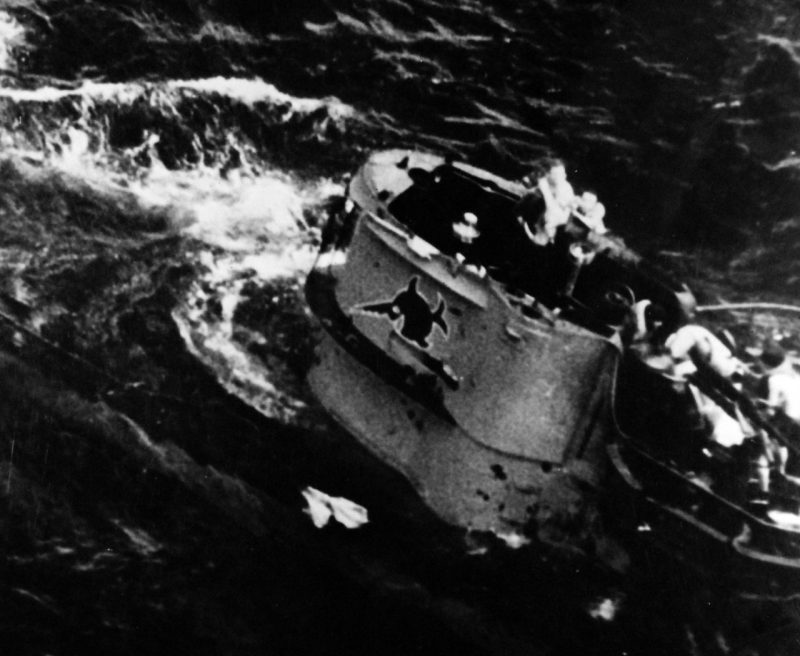
Caption: Air Attacks on German U-boats, WWII. Crew of German U-boat, U-664, prepare to go over side of ship during attack by two Avenger aircraft from USS Card (CVE-11), August 9, 1943. Note, the laughing sawfish insignia on the conning tower of the 9th U-boat Flotilla. Incident #3992. Official U.S. Navy Photograph, now in the collections of the National Archives. (2015/8/18

Caption: Air Attacks on German U-boats, WWII. Crew of German U-boat, U-664, prepare to go over side of ship during attack by two Avenger aircraft from USS Card (CVE-11), August 9, 1943. Note, the laughing sawfish insignia on the conning tower of the 9th U-boat Flotilla. Incident #3992. Official U.S. Navy Photograph, now in the collections of the National Archives. (2015/8/18
 
 
Grade was offered a role in the making of the movie, but instead, he chose to stay on the sidelines. His valuable knowledge, and, more importantly, his journal, would remain a secret for many more years.
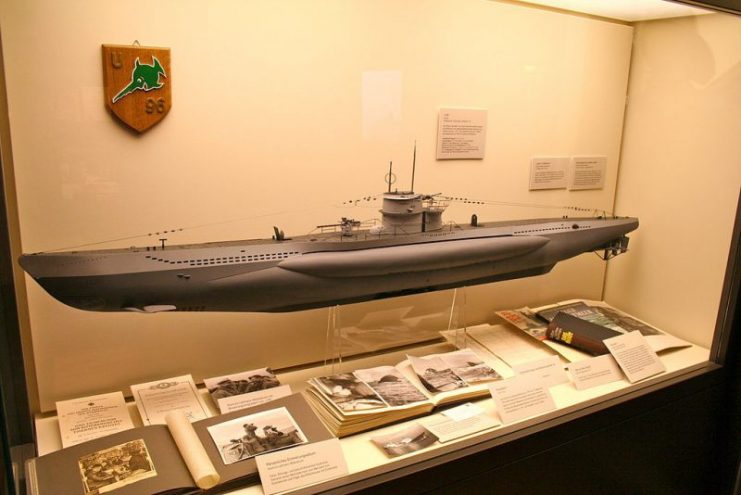
Scale model of U-96.Photo: Andrey Belenko CC BY 2.0
                                                              Scale model of U-96.


In the early years of WW2, the success of German U-boats was initially very impressive.
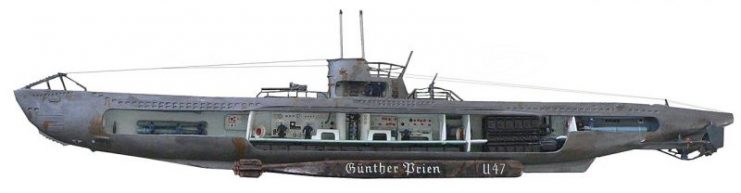
One example is that of U-47, under the command of Günther Prien. The sub stealthily penetrated the British naval base at Scapa Flow during the night of October 13/14, 1939. It launched a torpedo, sinking the British battleship Royal Oak, then left the port unmolested.
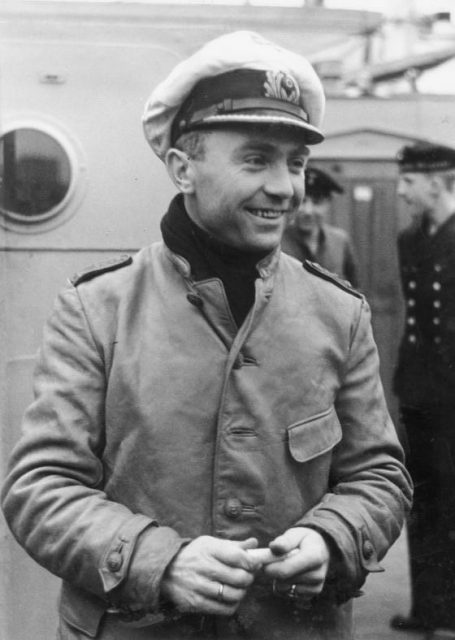
Kriegsmarine U-boat commander Günther Prien. Bundesarchiv, Bild 183-2006-1130-500 / Schulze, Annelise (Mauritius) / CC-BY-SA 3.0
Kriegsmarine U-boat commander Günther Prien.
HMS Royal Oak floundered, and 833 crew members perished. Prien and his crew were celebrated as heroes by Nazi propaganda.

 HMS Royal Oak
 Prien even spoke at the Berlin Sports Palace and was photographed with Adolf Hitler. Magazines printed stories with the families of the German submarine commanders.
Actually, the Kriegsmarine (German Navy) had very little to oppose the formidable Royal Navy, but their U-boats were enormously successful.
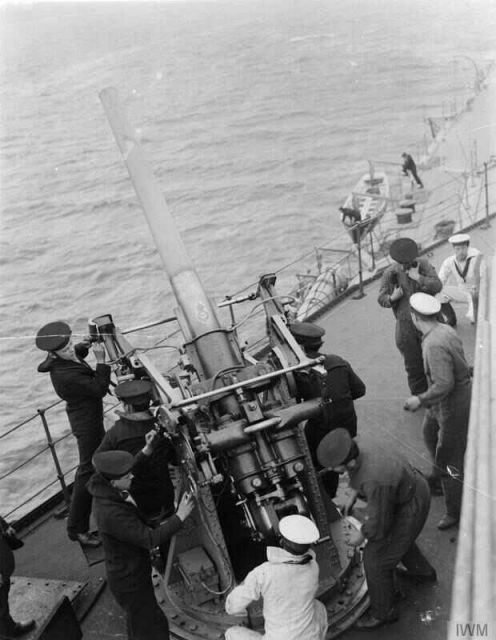
A 3 inch anti-aircraft gun in action on board the British battleship HMS Royal Oak
Massive submarine bunkers popped up all along the Norwegian and French coasts. In a short time, the submarine fleet had sunk Allied merchant ships amounting to 4.5 million gross registered tons. Great Britain’s supply of military equipment and raw materials was at the mercy of these Nazi Wolf Packs.
A model of German Submarine U-47 viewed from the side.Photo: Rama CC BY-SA 2.0
A model of German Submarine U-47 viewed from the side.
U-96 entered service in September 1940. In December of that same year, Friedrich Grade joined the crew as Chief Engineer. The famed U-Boat departed on 11 missions, sinking at least 28 ships and causing about 1,300 fatalities until early 1943.
“An indescribably beautiful feeling, from a distance three torpedoes = three hits,” Grade noted on April 28, 1941, in his diary.
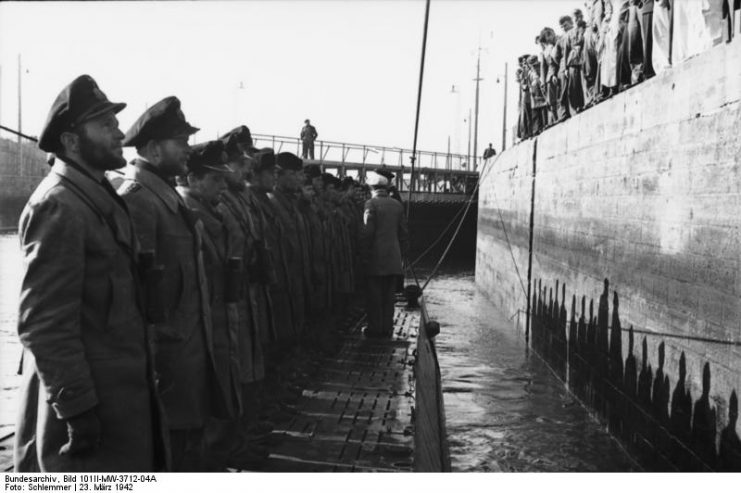
U-96 entering St. Nazaire, crew on deck.Photo: Bundesarchiv, Bild 101II-MW-3712-04A : Schlemmer : CC-BY-SA 3.0
U-96 entering St. Nazaire, crew on deck.
If these words had been discovered, it would have been the end for Grade for breach of secrecy. However, not even Grade’s wife knew about his journal. It remained hidden in the attic for 75 years, collecting dust.
That day, U-96 sank two tankers and a steamer, causing 60 fatalities. “We all wanted the boat to be successful and to sink as much as possible, regardless of our losses,” said Grade in a TV interview. Nevertheless, he emphasized: “We were not animated by heroism or any other strange thoughts.”
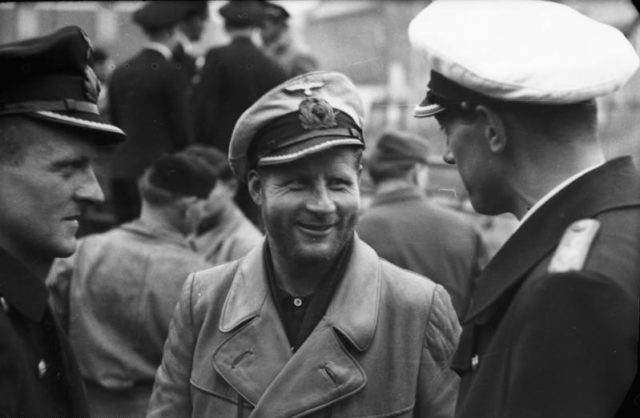
Captain Heinrich Lehmann-Willenbrock, commander of U-96.Photo: Bundesarchiv, Bild 101II-MW-3483-05 / Schwich / CC-BY-SA 3.0
Captain Heinrich Lehmann-Willenbrock, commander of U-96.Photo:
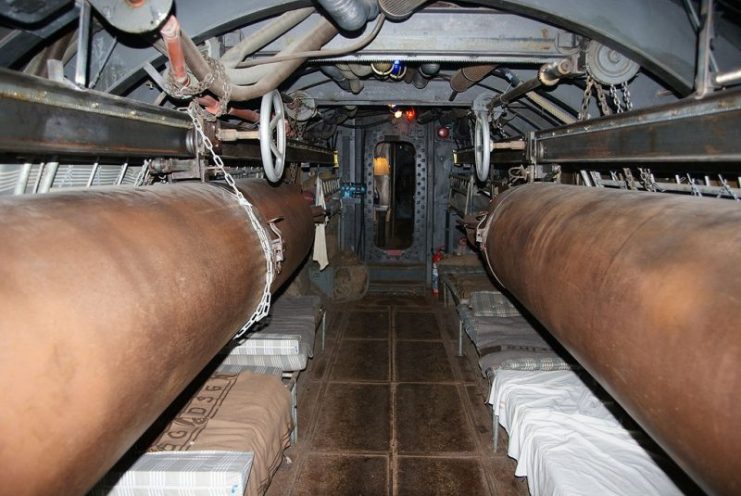
Grade also explained in his journal what it was like to live on U-96 where there were 45 men crowded into confined spaces and the hygienic conditions were catastrophic. “The air stinks of diesel and is alternately hot, cold and damp. Clothes are almost always stuck to the body.”
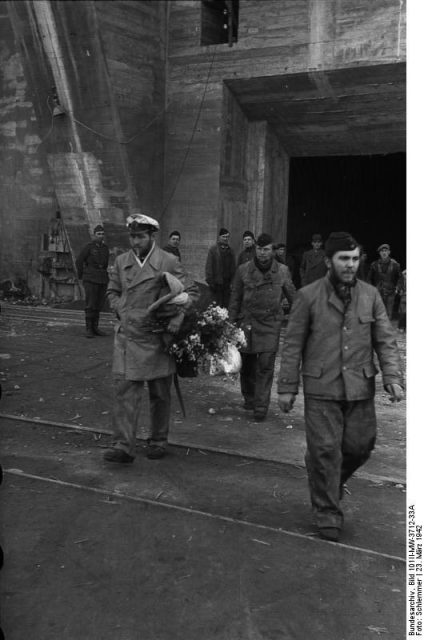
Positiv: “St. Nazaire”, März 1942, U 96, Kptlt. Lehmann-Willenbrock. Photo: Bundesarchiv, Bild 101II-MW-3712-33A CC-BY-SA 3.0 de
Positiv: “St. Nazaire”, März 1942, U 96, Kptlt. Lehmann-Willenbrock.


 "Das Boot" the convoy hunt

Klaus Wennemann acts as the nameless chief engineer (“LI” for short) in Wolfgang Petersen’s movie. It was Wennemann’s breakthrough role as an actor. Grade thought that the resemblance with himself was excellent.
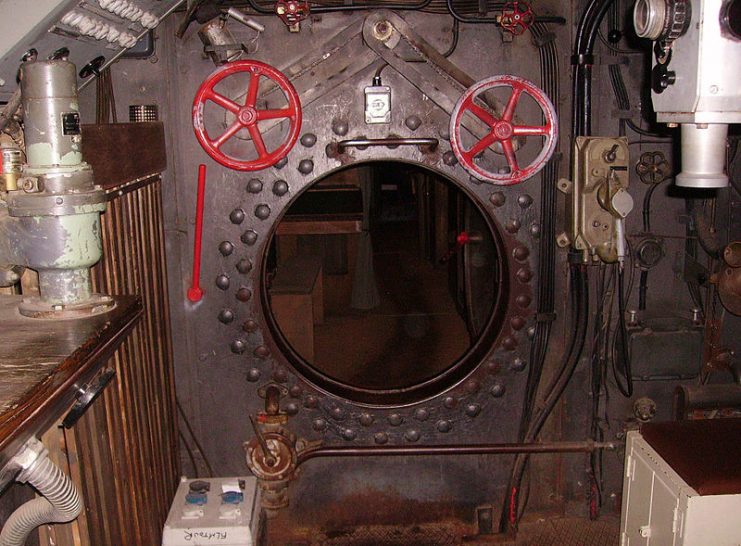
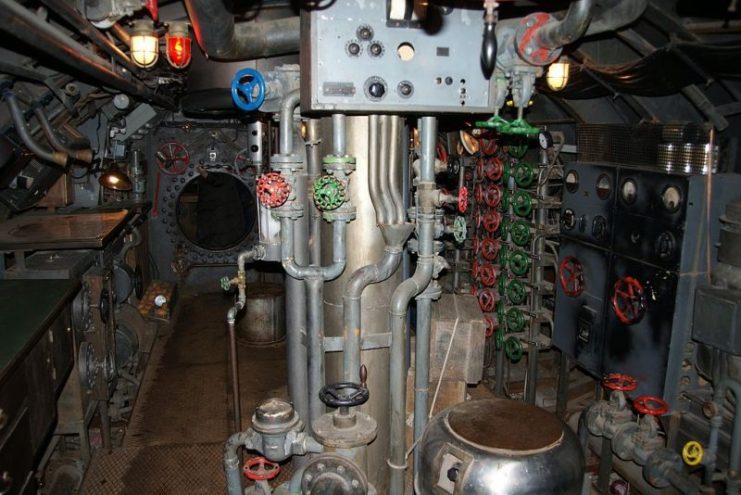
Film set of Das Boot at the Bavaria Film Studios
Only the vulgar tone between the protagonists as portrayed by the author Buchheim, who passed away in 2007, bothered Grade. He never liked the man, who joined the crew of  U-96 in the autumn of 1941 to take photographs of the U-boat in action.
Film set of Das Boot at the Bavaria Film Studios.Photo: Aconcagua CC BY-SA 3.0
Film set of Das Boot at the Bavaria Film Studios.Photo:
The movie does an outstanding job of showing the grubbiness of the men’s attire and appearance. Seeing Jürgen Prochnow, the German actor playing the submarine commandant, with his greasy dark beard and dirty shirt is an excellent portrayal of what the crew might have looked like.
Film set of Das Boot at the Bavaria Film Studios.Photo: Aconcagua CC BY-SA 3.0
Film set of Das Boot at the Bavaria Film Studios.Photo:
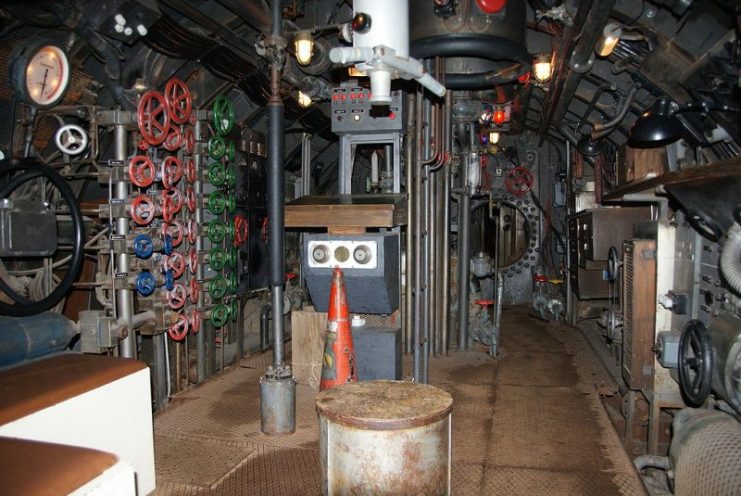
Having said that, the film mainly focuses on scenes that involve action. Like, for example, the torpedoing of a merchant ship and the ensuing flight from the escort destroyer. It is a scene that lasts for many minutes and illustrates the sheer fright of the crew suffering under a heavy barrage of depth charges.
Film set of Das Boot at the Bavaria Film Studios.Photo: Aconcagua CC BY-SA 3.0
Film set of Das Boot at the Bavaria Film Studios.Photo:
The audience cannot help but empathize with the crew of U-96 when the submarine shudders at every explosion. The destroyer is relentless. It never stops its search, harassing the Germans that are the heroes of the film in this particular moment.
Then comes the silence when the explosions stop. Water is leaking from up above, the sonar pings that had harassed the submarine are no more. The men of U-96 wait and wait until they finally surface, revealing an empty sea. They have survived.
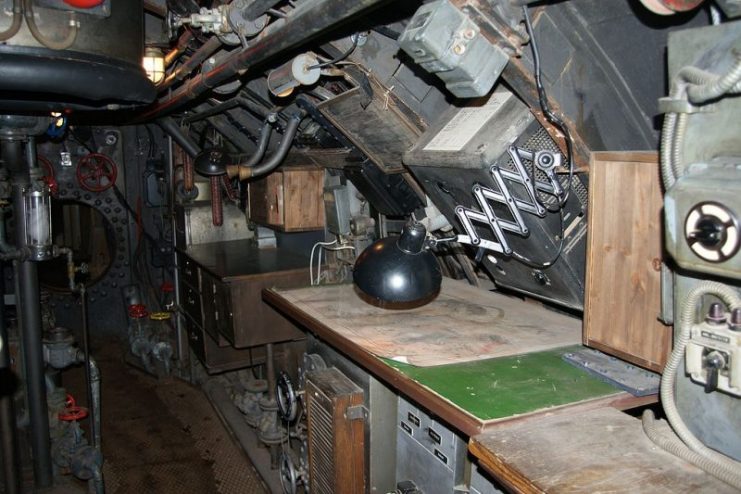
Film set of Das Boot at the Bavaria Film Studios.Photo: Aconcagua CC BY-SA 3.0
Film set of Das Boot at the Bavaria Film Studios.Photo:
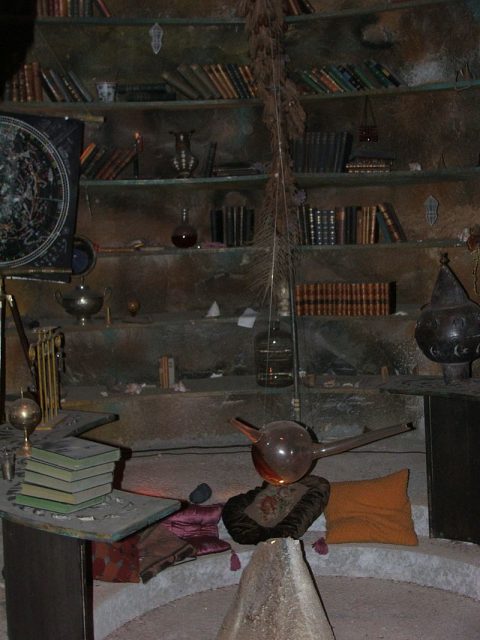
But life on a German U-boat during the Second World War was not all about the relentless pursuit of enemy destroyers.
Film set of Das Boot at the Bavaria Film Studios.Photo: Aconcagua CC BY-SA 3.0
Film set of Das Boot at the Bavaria Film Studios.Photo:
For the most part, the crew pursued a life of extreme monotony consisting of equipment maintenance, checking the torpedo weaponry, general upkeep activities, and other essential functions that maintained discipline and kept the men alive for as long as possible.
Bavaria Filmstadt, Munich, Bavaria, Germany.Photo: Michael Kleinhenz CC BY-SA 2.0
Bavaria Filmstadt, Munich, Bavaria, Germany.
In the end, Das Boot was nominated for six Academy Awards with the director, Wolfgang Petersen, winning the accolade as Best Director and Best Adapted Screenplay. The movie was an excellent effort, to say the least.
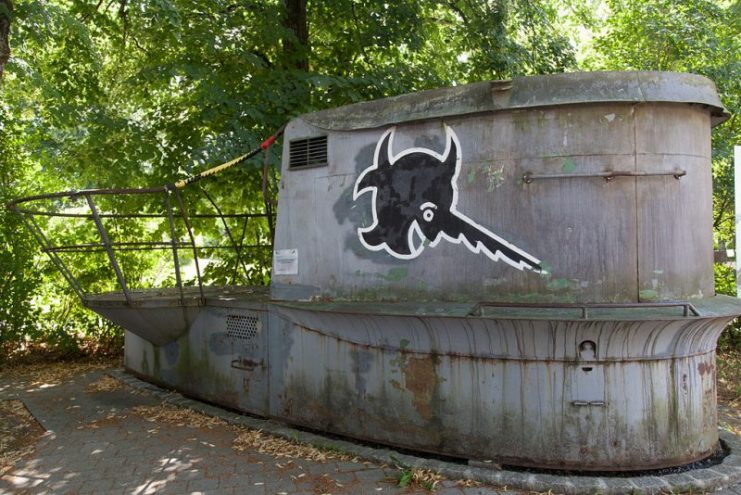
Das Boot – submarine turret, Bavaria Filmstadt.Photo: Emmanouil Kampitakis CC BY-SA 3.0
Das Boot – submarine turret, Bavaria Filmstadt

A new German TV series produced for Sky Atlantic which is based on the book and the movie was released in November 2018.

Even though the series portrays the heroes of U-96 as more refined and cleaner, it is still an entertaining take on this famous story. Besides, it would be almost impossible to recreate Wolfgang Petersen’s unnerving and grimy ambiance.


Sunday, April 29, 2018

The Bailey Bridge

I remembered watching a WWII movie in 1977 called "A Bridge Too Far"  I really liked the movie and the sound track was awesome.  I Still hum the soundtrack every once and a while.   I considered a very accurate telling of a battle told in a movie format.  It was neat seeing all these big name movie stars in the movie and I was living in Europe during the time this movie was filmed, I could relate to what I had seen on the screen.  To me this movie was underrated and next to the film "Midway" is one of my favorite WWII movies.

The film tells the story of the failure of Operation Market Garden during World War II. The operation was intended to allow the Allies to break through German lines and seize several bridges in the occupied Netherlands, including one at Arnhem, with the main objective of outflanking German defenses in order to end the war by Christmas of 1944.
The name for the film comes from an unconfirmed comment attributed to British Lieutenant-General Frederick Browning, deputy commander of the First Allied Airborne Army, who told Field Marshal Bernard Montgomery, the operation's architect, before the operation: "I think we may be going a bridge too far", in reference to the intention of seizing the Arnhem bridgehead over the Rhine river.
The ensemble cast includes Dirk Bogarde, James Caan, Michael Caine, Sean Connery, Edward Fox, Elliott Gould, Gene Hackman, Anthony Hopkins, Hardy Krüger, Laurence Olivier, Ryan O'Neal, Robert Redford, Maximilian Schell and Liv Ullmann. The music was scored by John Addison, who had served in the British XXX Corps during Market Garden.

    Well the movie made mention of a "Bailey Bridge", and I never knew what it really was..Here is a clip of the bridge mentioned from the Actors "Elliot Gould" and "Michael Caine"

"Bailey Bridge mentioned"

Building the Bailey Bridge over the River Son
 This actually showed one being build.

Picture an Allied tank commander in Europe, during Autumn, 1944. Advancing for days, destroying the German resistance. Nothing has been able to stop the invasion; except a blown bridge. Luckily, somewhere back in the supply columns which keep the army going, is a Bailey Bridge.
Donald Bailey, the designer of the Bailey Bridge, was born in Rotherham, in 1901. He received his BA in Engineering from the University of Sheffield in 1923. After graduating, he helped design railway bridges in the 1930s, but by 1940 he was working for the War Department.
In Christchurch, Southern England he and a group of other engineers, comprised MEXE (Military Experimental Establishment). They were designing and testing new engineering equipment for the British Army.

The Army at the time was facing a dilemma. They knew they would be required to fight in Europe, with its various canals, rivers, streams, and lakes. Any one of these could stop an army advancing, and they needed a foolproof way to cross them.
Collapsible and portable bridges had been around for hundreds of years, in various forms. By 1940, however, British weapons were outstripping engineering equipment.
Their tanks weighed more than 40 tons, but the heaviest portable bridge could hold only 26 tons. The Allies would be bogged down and delayed as engineers worked to repair existing bridges or build more permanent ones.


A Bailey Bridge like this had to be constructed over the Son. This took precious time, but was eventually able to allow XXX Corps to continue their advance.
A Bailey Bridge like this had to be contructed to cross rivers. This took precious time but was eventually able to allow XXX Corps to continue their advance.

Donald Bailey was being driven back to his headquarters building after a failed bridge test. The world seemed to be collapsing around England, and everything they tried seemed to fail. The War Department was desperate for a reliable bridge. Suddenly, Bailey had an idea. He began sketching it out on the back of an envelope.


Engineers slide a Bailey Bridge section into place, almost every part of the bridge construction was done by hand. The only time heavy equipment was used was to lift pieces into high places. Image Source:
Engineers slide a Bailey Bridge section into place, almost every part of the bridge construction was done by hand. The only time heavy equipment was used was to lift pieces into high places.
It was an amazingly simple design. Prefabricated panels each made up of internal trusses. These were joined by pegs, with large beams running across the bridge’s width. This gave them not only the rigidity needed to span a large area, but they could be assembled with simple tools: sledgehammers, rollers, and wrenches.


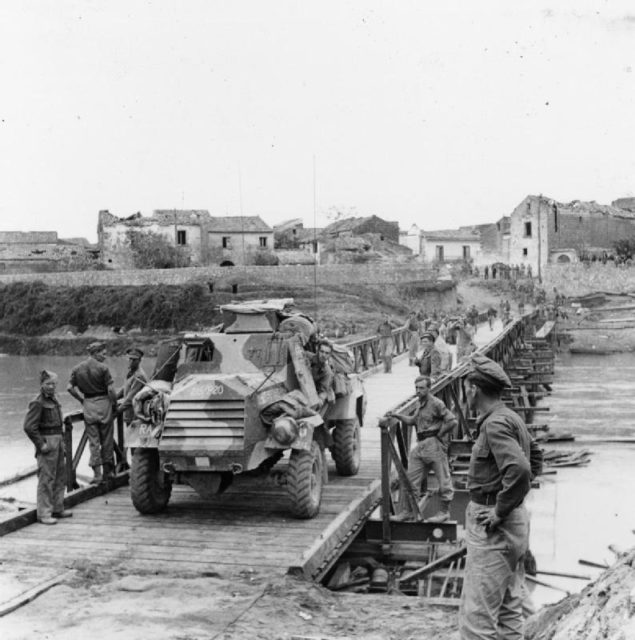
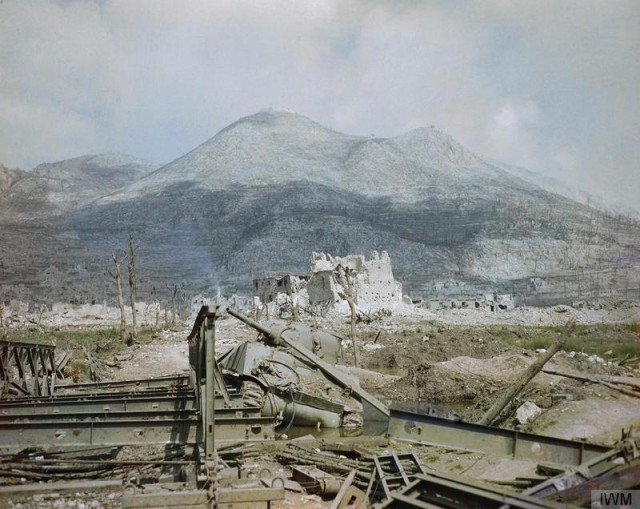
A destroyed Bailey Bridge and tank in Italy. While not indestructible, the bridges were easily replaced and cheap. They proved sturdy enough to stand up to almost any stress, but quick and cheap enough to be disposable.
A destroyed Bailey Bridge and Sherman tank in Italy. While not indestructible, the bridges were easily replaced and cheap. They proved sturdy enough to stand up to almost any stress but quick and cheap enough to be disposable.
Equally important, they were straightforward and cheap to produce. Almost any industrial fabricator could make the panels and pieces necessary, and mass production was a definite possibility. The Bailey Bridge had been born.


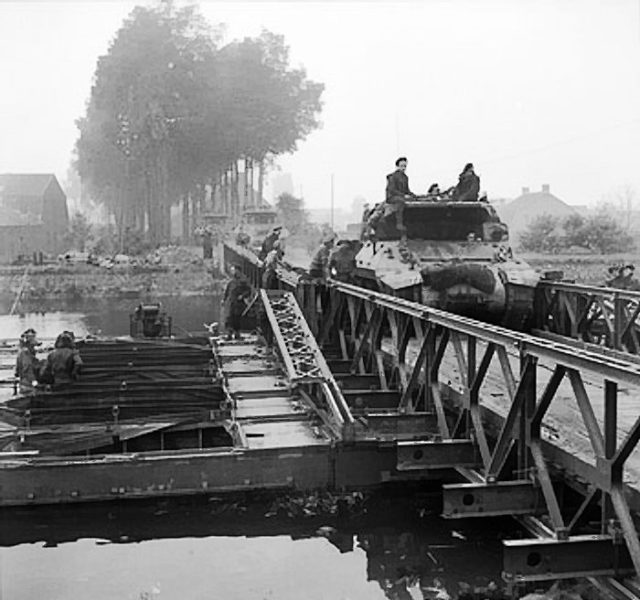
An M10 tank destroyer crosses the bailey bridge near Son.
An M10 tank destroyer crosses the Bailey Bridge.
In the battlefield these bridges proved indispensable. Field Marshal Montgomery said they were necessary to the speed of the Allied advance during the war. In Italy and Sicily, over 55 miles of bridges were built, spanning everything from stream beds, to the 1,126 ft. Bridge over the Sangro River. The longest, which spanned the Chindwin River in Burma, was 1,154 ft.
After D-day, in France, the low countries, and Germany, Bailey Bridges were consistently used to replace many of the bridges destroyed by the retreating Germans. Famously, the Son bridge was replaced with one during Operation Market Garden, in September 1944; eventually allowing Allied armor to press forward and help seize Nijmegen.


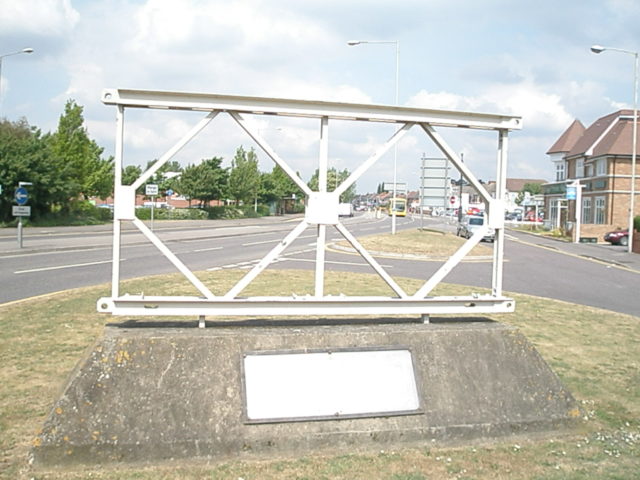
A bailey section in a memorial in Christchurch. The local proving grounds in the Stanpit Marshes saw the development of much of the engineering equipment of WW2.
A Bailey section in a memorial in Christchurch. The local Stanpit Marshes saw the development of much of the engineering equipment of WW2.
Today Bailey style bridges are a fixture of almost any modern military. The materials have been upgraded, but the basic design, prefabricated, interlocking sections which can be put together a myriad of ways, has not changed.
Their use has expanded to the civilian life, where they are often used for disaster relief and are permanent fixtures in some areas. Bailey might not be the best-known hero from World War 2, but his contribution to the war effort was immense, and his memory, and legacy, can not be forgotten.

Tuesday, August 11, 2015

Watched a Movie through Netflix "Emperor"

I have recently gotten "netflix" and I like to watch historical movies,   Over a year ago I had watched a movie called Yamato.  Now I had a movie called "Emperor" showed up in my que...and I watched it and it was to me pretty good.  Sure it is fictionalized to an extent but the background was excellently done as were the background actors.  It did mention the attempted coup against the emperor Hirohito when he wanted to make peace with the Allies.  there was a lot of history in the background and to me is worthy on that alone.  If you are in historical movies, and have a couple of hours to kill, it is a good move.  


In the largely unexplored world of the early days of the American Occupation following Japan's catastrophic defeat, Emperor tells a fictionalized account based on the real life story of US Army Brigadier General Bonner Frank Fellers (Mathew Fox) who served under General Douglas MacArthur (Tommy Lee Jones). Fellers is given the impossible task to investigate the Emperor's role in the lead-up to war, most specifically his involvement in the decision to attack Pearl Harbor within ten days. This is a great responsibility to which Fellers, a known Japan aficionado who had spent time in Japan before the war, must handle delicately, or risk a general uprising or worse. He will question the accused Class -A War Criminals such as Wartime Prime Minister Hideki Tojo, Former Prime Minister Konoe, and Koichi Kido while confronting prejudice from a resentful populace and other American soldiers. Complicating this task is General Richter (Colin Moy) who is bent on derailing Fellers' investigation in order to justify revenge upon the Emperor. As Richter conveys the American Public's demand for revenge, "Revenge is not Justice" argues Fellers. To conduct his investigation, Fellers is assigned a staff and further assisted by Takahashi (Haneda Masayoshi) who is assigned to him as both interpreter and driver who serves diligently without reservation. Takahashi is initially treated with cold indifference by Fellers who is both under the strain of his investigation and his preoccupation with finding his pre-war love interest Aya Shimada (Hatsune Eriko) to which Fellers deliberately steered bombing missions away from her home, Richter will attempt to use this information against him. Post-War tensions, dramatic sets, period costume, and an all star international cast make Emperor a most revealing riveting drama of the Post-War Era.