I ran across this article reading my American Rifleman magazine, and I found it fascinating. it is on my bucket list to visit this and the Imperial War Museum once all this Covid restrictions and other stupidity is relaxed. I also want to check out the "HMS Belfast, she is a museum ship in the Thames River. We will see though.
This .303 British Royal Grade Holland & Holland single-shot, serial No. 26069, was used by the Irish Guards as a sniping rifle during World War I. It is shown here with period trench maps, a German stick grenade, British binoculars and some German 8 mm Mauser cartridges.
Photo by Jonathan Green
It was London, it was September, it was raining.
Outside the Brigade of Guards Museum, near Buckingham Palace, the statue of Field Marshal Earl Alexander of Tunis stands 15' high—a tribute to Britain’s greatest field commander of the 20th century. His trademark sheepskin is faithfully reproduced in a half-ton of bronze, and even here he manages to wear it like a dinner jacket. England’s greatest combat soldier was also known as the best-dressed man in the regiment.
As the rain pelted harder, plastering the brown beech leaves to the paving stones and forming tiny waterfalls in the creases of the jacket, Alexander—or “Alex,” as he was known to all—took no notice. He kept his eye fixed firmly on the entrance to the museum, and suddenly that seemed like a heck of a good idea as the sky opened up and the cold rain came down in sheets.
The Guards regiments are among Britain’s most famous icons. They are the soldiers in red tunics and black bearskins who mount the guard on Buckingham Palace, among other places. What is less well-known is that they are also elite soldiers who have fought the king’s wars around the world for centuries. The oldest regiment is the Scots Guards, followed by the Grenadiers and the Coldstreams. The Irish Guards—Alexander’s regiment—and the Welsh are the youngest.
Inside the museum, one tableau after another depicts their exploits at Waterloo, Dunkirk, South Africa, Flanders. The displays, colorful at first, turn slowly sodden and muddy as all the gentility was wrung out of warfare, and red tunics were replaced by khaki (in South Africa) and brown service dress in the mud of Flanders. The display from the First World War includes bits of webbing, barbed wire, grenades, a bayonet. The stuff looks muddy even when it isn’t.
There is also a rifle. Not a Lee-Enfield, No. 1 Mk III, as might be expected, but a classic single-shot, break-action rifle of the type favored, before the war, for stalking stag in Scotland. It is of obviously fine pedigree, but has seen much hard use. The bluing is worn to a silver sheen and the stock is scratched and battered.
If you crouch down and peer closely, with the light exactly right, you can still read on the receiver “Holland & Holland.” It is an aristocrat among firearms, a “gentleman’s rifle”—a Royal Grade single-shot stocked in English walnut and finely checkered. At one time, the receiver displayed graceful engraving, although it is now worn almost completely away. Four years of trench warfare will do that.
The story of how H&H rifle No. 26069 journeyed from the Bruton Street showroom to the Guards Museum is really one of convergence of the great names in pre-war England, in the military, in literature and in gunmaking. It involves Harold Alexander, Britain’s greatest soldier of the 20th century, and Field Marshall Lord Roberts, one of its greatest of the 19th; it involves Rudyard Kipling, Poet Laureate of the Empire and winner of the Nobel Prize for Literature; and of course Holland & Holland, England’s greatest riflemaker.
The story begins with Lord Roberts in South Africa, fighting the Afrikaners in Britain’s first, and one of its bloodiest, military campaigns of the 20th century. There, Roberts renewed his acquaintance with Rudyard Kipling, an old friend from India.
Roberts was an Ulsterman, a gentleman of Anglo-Irish descent. For reasons no one has adequately explained, Ulster (Northern Ireland) has produced a disproportionate number of great British generals. The Duke of Wellington was an Ulsterman, as was Montgomery, among many others. In the South African campaign, the army’s Irish regiments performed spectacularly. To recognize their contribution, Queen Victoria ordered—on Roberts’ advice—the formation of a regiment of Irish Guards to join the Scots, Grenadiers and Coldstreams.
When he heard the news, Harold Alexander (also from Ulster) was 9 years old. He immediately decided that his future would lie with the Irish Guards. The son of the Earl of Caledon, he attended school at Harrow, went on to the military academy at Sandhurst, and joined his new regiment in London in 1911. He was a 22-year-old first lieutenant when the war broke out in 1914.
One of his fellow officers was the Earl of Kingston, and they shipped off to France together. In the Earl’s kit was the H&H rifle. It came to be there in a rather convoluted way.
As war in Europe approached, many Germans made last-minute visits to London to order rifles from the English gunmakers. One ordered a stalking rifle, and even provided a fine Voigtlander scope to be mounted on it. Ordered in 1913, it was barely finished when the Germans marched into Belgium. H&H could not ship a rifle to an enemy country, so the firm re-barreled the rifle to .303 British and fitted it out as a sniper rifle. A member of Parliament, Colonel Hall Walker, bought it and passed it on to Lieutenant the Earl of Kingston of the Irish Guards.
Recruit No. 26069 was in the quartermaster’s stores when the regiment went into action for the first time and was still there, amid the chaos of retreat, advance and retreat, before the war settled down to the hell of the trenches. By that time, the Earl of Kingston had been wounded and invalided back to England. Alexander fought with the regiment through the Retreat to Mons, was wounded in the First Battle of Ypres and returned home to convalesce. What happened then can be pieced together from scraps of information that have survived.
From the hospital, Kingston wrote to the commander of the battalion, Jack Trefusis, inquiring about his rifle. On January 6, 1915, Trefusis replied:
“My dear K.
It has been in QM Stores for ever so long and I have only just this moment heard of it. It was a thing we have wanted badly for a long time, and if we had only known of it in the last trenches we were in I have no doubt we should have accounted for a platoon of Germans. However we go back into the trenches on Friday and the rifle will be put into the most skillful hands I can find and a careful account of the bag that is made with it which I will report to you occasionally ... .”
The war was then barely four months old and Trefusis’s last paragraph is chilling:
“There is no officer here who was here with you except myself and Antrobus, and very few men. Poor Eric Gough was the last and he was killed last week.
“P.S.: I see I have never actually thanked you for letting us have the rifle, but I do enormously, it will put us on a more equal footing with those damned snipers, who are just as bad here as ever they were.”
Photos courtesy of Holland & Holland
As a military art form, sniping goes back several centuries, but it really flowered during the American Civil War. Not by coincidence, this was the first large-scale conflict in which trenches were used; trenches and snipers go together like coffee and cream. In the case of the British Army, through the late 19th century it fought mostly wars of movement until encountering the Boers in South Africa in 1899. Sniping was not a major factor, and while the British Army underwent a drastic reformation as a result, and became the best army of its size in the world, it still paid scant attention to sniping as it went to war in 1914.
Not so the Germans. When the German Army invaded Belgium, it had an estimated 20,000 sniping units ready to go. The Mauser Model 98 made an ideal sniper rifle; as well, when hostilities began the Germans collected thousands more accurate sporting rifles and sent them to the front. The British had but a handful of trained snipers, and few rifles with which to snipe. The German Army very quickly dominated “No Man’s Land” and the forward British trench lines. Trefusis’s rueful letter to the Earl of Kingston gives an idea of the havoc wrought by the German snipers.
When H&H rifle No. 26069 went into service with the Irish Guards and began to take its toll on the Germans, the call went out for more of the same. The War Office in London turned to H&H and the other fine rifle makers with orders for sniper rifles.
At the time, British gunmakers made three types of rifle: doubles, single-shots and bolt-actions. The doubles were mostly big-game rifles for Africa and India; bolt-actions went to the colonies, while single-shots—both break-action and falling block—were the classic stalking rifles for stag in the Scottish Highlands. As such, they were built to be accurate. Since the supply of Oberndorf Mauser actions had dried up for the British, they naturally built their sniping rifles to patterns like No. 26069.
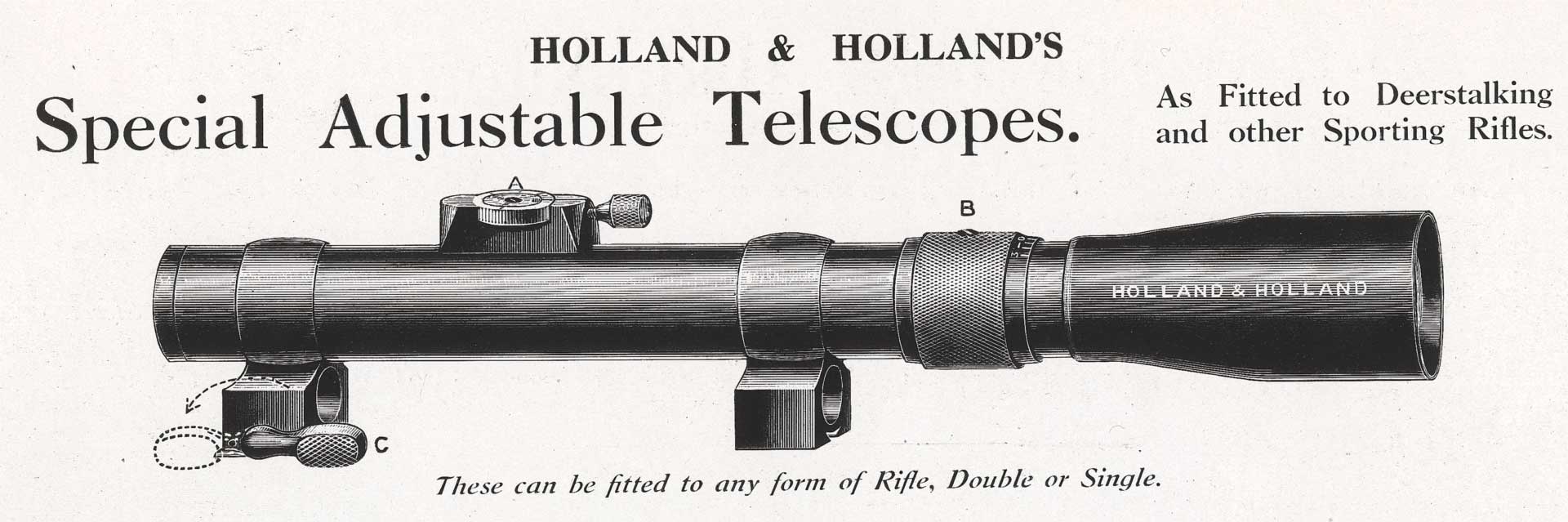
This pre-World War I scope from a Holland & Holland catalog is of German origin. Riflescopes were a problem for the British early in the war, and No. 26069 bears a German Voigtlander supplied by the German customer who ordered the rifle.
A major problem was the supply of telescopic sights, and here the Germans, with their advanced optics industry, had a huge advantage. The War Office went so far as to try to smuggle scopes out of Germany by various underhanded means, but without notable success. This remained a problem until 1916, when British companies, like Aldis (of rangefinder fame), became capable of supplying telescopic sights in reasonable quantities. Until then, the gunmakers made do with whatever they had in inventory or obtained from civilian sportsmen.
The work went slowly at first, and by July 1915, H&H had fitted out only 10 more sniper rifles. Gradually, however, the pace picked up.
Another problem facing troops on the Western Front was the fact that German snipers concealed themselves behind pieces of armor plate. Early in the war there was little in the way of armor-piercing ammunition for standard rifles, and, again, the War Office turned to the London gunmakers. Figuring that any gun that could handle a Cape buffalo would punch through armor plate, Holland’s and the others shipped over 2,000 so-called “elephant guns.” These were a mixed blessing. While they demolished the armor well enough, the loud report combined with the smoke and belching flame revealed the shooter’s position to the enemy and brought down a rain of return fire.
Meanwhile, as H&H et al worked behind the scenes, rifle No. 26069 slogged on, killing Germans. Two weeks after his first letter to the Earl of Kingston, Jack Trefusis wrote again:
“The rifle has been an immense success and every Commander from C-in-C downwards has sent down to ask me about it, with the result that two are to be issued to each battalion.
“The sergeant major uses it and the score of Germans is for certain four killed and eight wounded in three days use ... . Those who were killed or wounded were fired at from a range of 800 yards. So it has been a great success.”
In March 1915, recovered from his wound, Lt. Alexander was promoted to captain, helped to form a second battalion of Irish Guards and returned to France commanding its No. 1 company. One of his officers was a subaltern named John Kipling.
Lt. Kipling was Rudyard’s son. Denied a commission because of his poor eyesight, the novelist appealed to his old friend Lord Roberts, who was now Colonel of the Regiment of the Irish Guards. Roberts’ influence was still immense, and he obtained a commission for the boy. Within a month, the battalion went into action at the Battle of Loos, where 800,000 men were ordered to breach a German position after a four-day bombardment by 1,000 guns. Five days and 45,000 casualties later, the attack was called off.
The unit that penetrated deepest into German territory was No. 1 Company of the 2nd Irish Guards under Captain Harold Alexander. When they withdrew, they left the body of Lt. John Kipling, shot through the head. He was one of 10,000 British soldiers whose bodies were never recovered from the all-swallowing mud of that battlefield.
In deep sorrow, and as a memorial for his son, Rudyard Kipling, Britain’s foremost author, agreed to write the official history of the regiment, The Irish Guards in the Great War, and the “telescope rifle” found its way into literature:
“Casualties from small-arm fire had been increasing owing to the sodden state of the parapets; but the Battalion retaliated a little from one ‘telescopic-sighted rifle’ sent up by Lieutenant the Earl of Kingston, with which Drill-Sergeant Bracken ‘certainly’ accounted for three killed and four wounded of the enemy. The Diary, mercifully blind to the dreadful years to come, thinks, ‘There should be many of these rifles used as long as the army is sitting in the trenches.’ Many of them were so used: this, the father of them all, now hangs in the Regimental Mess.”
Alexander and the Irish Guards also saw action at the Somme and Passchendaele, Cambrai, the retreat from Arras and, finally, Hazebrouk. In this battle, Alexander commanded the second battalion and helped save the channel ports from German attack, but the battalion was annihilated as a fighting force.
Rifle No. 26069 soldiered on with the 1st Battalion, accounting for who knows how many German soldiers. It helped win the sniping war, and the men of the Irish Guards came to love the trim little “gentleman’s rifle” because it saved so many of their lives. In 1918, it was retired from active service and given a place of honor in the regimental officers’ mess before being turned over to the Guards Museum.
There, it became part of a permanent display depicting the valor and the unspeakable horror of the war on the Western Front. And there it was, that rainy morning in September, when I took refuge from the London weather by ducking into the museum. When I emerged after a couple of hours, the weather had cleared and it was breezy and cool. Alexander’s statue, so stern in the rain, now appeared to be smiling in the sunshine.
During the Second World War, when he rose to the rank of field marshall and commanded the Allied advance up through Italy, Alex was always cheerful, always a gentleman, no matter how bad things became. When you have men like George Patton under your command, I expect good humor is invaluable. The plaque on the statue describes him as Britain’s finest battle commander of that war. Montgomery would have disagreed, but Alexander would have smiled and shrugged. His tombstone reads merely “Alex”; longer names are for lesser men.
I strolled along Bird Cage Walk, through St. James’s Park and up toward Mayfair. It is a pleasant walk up to Berkeley Square and 31-33 Bruton Street, home of Holland & Holland. The former director of the firm, David Winks, was waiting for me on an upper floor where the company’s own collection of classic guns resides.
Winks was in charge when the curator of the Guards Museum approached H&H in 1992 and asked them if they would take rifle No. 26069, much battered by the war and deteriorated after 75 years of benign neglect, and return it to its former glory.
David Winks agreed to clean it up but flatly refused to return it to pristine condition, although it could easily have been done.
“Those are honorable scars, honorably earned,” Winks told me.
This was a fun post for me, I have blogged before about RADAR , I dealt with ELINT while I was in the service and my specialty was the Soviet Army and East Germans, those were who our threats were. I don't do that stuff anymore and haven't for a very long time, but I did enjoy it immensely while I did it.
Detecting and locating the approaching enemy aircraft during a war is
integral in making sure that the troops are prepared in case of enemy
assault, regardless of what they had with them— bombs, chemical weapons,
maybe paratroopers. It’s great that radar (radio detection and ranging)
was invented, thus, making it easier for soldiers to locate exactly
where these planes are. Before it was made, however, people had to rely
on what was available for us to use: eyes and ears. Just like any other
primitive ways that our ancestors used in their time, experiments were
done, too, to enable humans to do beyond what our bodies allowed us.
Human Spotters
Before
radar and all the other machinery inventions before it, the capability
of detecting aircraft during the times of war was the responsibility of
human spotters. They were often positioned in open fields, shorelines,
rooftops of tall buildings, and hills so they could monitor and spot
approaching enemy aircraft and send warnings. However, the effectiveness
of this method was reliant on many parameters: the eyesight and hearing
quality of the observers, their alertness, the visibility of the
surrounding atmosphere (if it was raining or foggy), the level of light,
as well as the size, color, configuration, and noise level of the
aircraft.
Assuming it was the perfect and most ideal conditions
and the human spotter was able to detect the aircraft as soon as humanly
possible, it would only allow a few minutes for the soldiers to prepare
a response before the plane reached their position. Usually, observer
networks were placed up far in advance, and information was transmitted
through a radio relay network, but the method was still not always
reliable.
Acoustic Location
From mid-World War I until
the early years of World War II, the acoustic location was used for
passive detection's of aircraft by picking up the noise of their engines.
How passive acoustic location worked was that sound or vibrations
created by the detected object were analyzed to determine its location.
At the same time, horns were used to increase the observer’s ability to
localize the direction of the sound. These techniques, during that time,
had the advantage as sound refraction allowed them to “see” around
corners and over hills.
One of the experimental ‘personal sound locators’ tested by the Dutch military research station at Waalsdorp.
According
to the reports, Commander Alfred Rawlinson of the Royal Naval Volunteer
Reserve first used the equipment as he needed a means of locating the
German Zeppelins during cloudy days. He improvised an apparatus made
from a pair of gramophone horns that he mounted on a rotating pole.
The
instruments were usually made of large horns or microphones connected
to the operators’ ears through a tube. Imagine a stethoscope but
supersize it. From there, an extensive network of sound mirrors that
were used from World War I through the Second World War was developed.
These sound mirrors worked with a combination of microphones that had to
be moved to find the angle that maximizes the amplitude of the sound.
Two sound mirrors at different positions were usually set up to generate
two different bearings, allowing the operator to use triangulation to
point out the direction of the sound source.
The height-locating half of the Czech four-horn acoustic locator.
Although
the equipment seemed crude by today’s standards, they were able to
provide a fairly accurate fix on the approaching planes so guns could be
directed at them before they arrived or even when they were out of
sight due to low visibility.
Dover Radar Station during WWII
During the half part of World War II, radar became an alternative to
these acoustic location techniques and equipment. Both the United
Kingdom and Germany knew that they were working on radio navigation and
its countermeasures, known as the Battle of the Beams. Their interest in
radio-based detection and tracking led to the use of radar. Britain,
however, never really admitted that they were using radar and showed
publicly that they were using acoustic location.
The Swingate transmitting station is a facility for FM-transmission in the village of Swingate, near Dover, Kent (grid referenceTR334429). For many years there were three lattice towers with a height of 111 metres (364 ft). This station was one of the first 5 Chain Home Radar stations completed in 1936 and was originally designated AMES (Air Ministry Experimental Station) 04 Dover. The FM transmitting antennas are attached to what was the middle tower; microwave link dishes and mobile telephone antennas were spread across all three towers. The south tower was dismantled in March 2010, as a result, only two remain. The Swingate towers no longer have the three cantilever platforms that were fitted originally.
The Sparse construction made it difficult for the Germans to strike the towers and cause any real damage despite the accuracy of their bombers due to the fierce resistance by the RAF and the huge cost that is incurred every time the Germans went after the towers.
In the Battle of
Britain, both sides were already using radars and control stations to
up their air defense capability. At the same time, the United States,
the Soviet Union, and Japan were also developing their own detecting
systems. The acronym “RADAR” was not used until 1940, when the US Navy
coined the term as an acronym meaning Radio Direction And Ranging. Even
after this innovation, the acoustic location stations did not cease
operation and acted as a backup to radar. After the war, radar has been
so developed that audio aircraft detection equipment was totally
obsolete.
At the same time, using sound to accurately detect
objects moved from the air to beneath the waves become SONAR, or Sound
Navigation And Ranging for submarines and surface vessels to navigate
and find targets.
I remember reading about the "Zimmerman" telegram when I was about 10 or 12 I guess, My Dad had a series of books called "Crime and Punishment" and this was mentioned in it. Somehow the History books at my school didn't mention the Telegram, but the Sinking of the Lusitania that got the Americans into WWI. I mentioned the Zimmerman telegram to my teacher and she was clueless, so I had to explain to her and the class the impact of the telegram to the Americans and how they inflamed them. I made the comment, "you know how we were angry about Pearl Harbor?, Well the Telegram had a similar effect, to have another country plan to attack our country and then take several states away from us as "Prizes" made the Americans really mad". I got an "A" as I recall. It also taught me an important lesson that the school information wasn't always encompassing. I had already spotted mistakes in a science book having to do with science and adhesive and cohesive properties. This was by a 7th grader if memory serves.
It is believed today that few decoded messages have had the global and historical impact that the Zimmermann Telegram had in 1917. This single telegram gave the U.S. the boost it needed to join the First World War in Europe, leading to the end of the war and the aftermath that would lead the world into the even more destructive Second World War.
The telegram was the culmination of a years-long effort by Germany to start a war between Mexico and the U.S. Germany hoped that with America fighting a war with Mexico, they would have limited capacity to join the war or provide resources to the Allied armies in Europe. At one point, Germany even sent a Mexican military official a sum of well over $10 million dollars to begin a war with the U.S.
Keeping the U.S. and its crucial exports away from Europe was massively important to the Central Powers, as at the time Germany believed they could achieve victory in Europe as long as America was not on the scene.
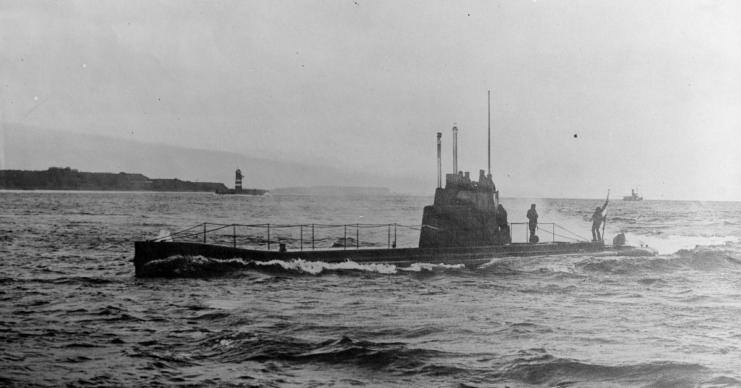
German U-boat circa 1915.
Earlier in the war, Germany was stopping U.S. exports by attacking merchant shipping in the Atlantic with their terrifying submarine fleet. In 1915, Germany began employing tactics close to unrestricted submarine warfare, attacking any ships that came into a specified area. This limited the imports arriving in the U.K. by sinking them before they could make land, and it affected the number of ships sent, due to fears of their destruction. This became so brutally effective that the U.S. (who at this point was not actively involved in WWI) demanded that Germany stop. Thankfully, they did, for a while at least. By 1917, Germany planned to begin unrestricted submarine warfare once again in a last-ditch effort to starve the British. This would begin on February 1, 1917. They knew that an all-out assault on U.S. merchant shipping would bring America into the war, but estimated that if they could delay the U.S.’s involvement, they could beat the starved British and French in Europe before they arrived. This is what the Zimmermann Telegram was for. The Zimmermann Telegram was sent on January 17, 1917, by Arthur Zimmermann from the German Foreign Office, to Heinrich von Eckardt, Germany’s ambassador to Mexico. The telegram would inform him that if, after Germany resumed their submarine attacks on Atlantic shipping, America looked poised to enter the war, he would present Mexico with an offer to declare war on the U.S., with German funding.
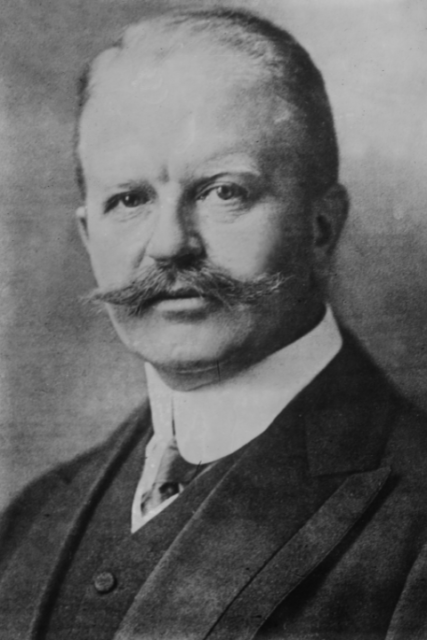
Arthur Zimmermann, State Secretary for Foreign Affairs.
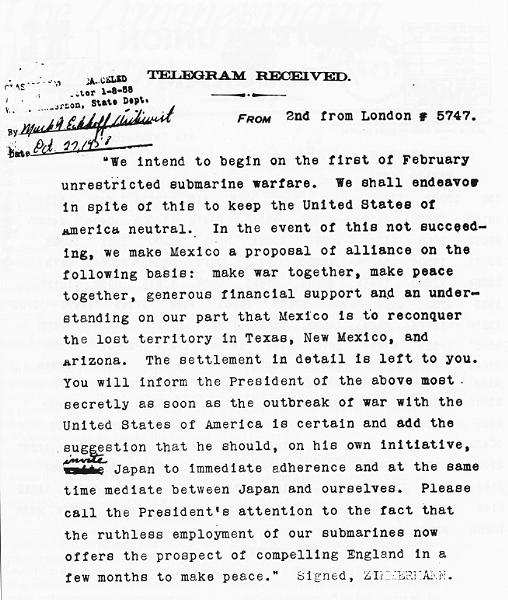
“We intend to begin on the first of February unrestricted submarine warfare. We shall endeavor in spite of this to keep the United States of America neutral. In the event of this not succeeding, we make Mexico a proposal of alliance on the following basis: make war together, make peace together, generous financial support and an understanding on our part that Mexico is to reconquer the lost territory in Texas, New Mexico, and Arizona.
“The settlement in detail is left to you. You will inform the President of the above most secretly as soon as the outbreak of war with the United States of America is certain, and add the suggestion that he should, on his own initiative, invite Japan to immediate adherence and at the same time mediate between Japan and ourselves. Please call the President’s attention to the fact that the ruthless employment of our submarines now offers the prospect of compelling England in a few months to make peace.
“Signed, ZIMMERMANN.”
Translation of the decoded Zimmermann Telegram.
The Zimmermann Telegram, as it became known, was sent through U.S. communication cables that ran through England, and unknown to the Germans and even the U.S. at the time, every message that passed through was monitored by the British. The telegram was intercepted by the British and sent to their codebreakers. They managed to decipher the coded message in a short amount of time, thanks to secretly cracking German codes long beforehand. Once decoded, the British were alarmed at the message. As they had been trying for a long time to bring America into the war, and they knew they had the perfect opportunity to make this happen. However, by announcing the telegram to the American public, Germany would discover their codes had been broken and the U.S. would realize the British were listening to their communications. To solve this, the British devised a plan where an agent would obtain a copy of the message in Mexico, which would then be shown to the Americans. The message that arrived here was encoded in an older code, one that the British deemed worthy of the Germans finding out they had cracked in exchange for the U.S. joining the war. With both the main problems solved, the British presented the message to the U.S. The message, combined with Germany restarting unrestricted submarine warfare, enraged the American people, who switched gears from opposing involvement in WWI to actively seeking it. Just three months after the Zimmermann Telegram was first sent from Germany, the U.S. officially joined the war. A little over 18 months later, the war ended with Germany’s defeat. While the U.S. response is the most impactful, the Mexican response is perhaps the most ironic. After receiving the message, Mexican President Venustiano Carranza sought the opinions of his military officials on Germany’s offer. They concluded that a German-backed war with the U.S. was not in Mexico’s best interests, thanks to political instability, a vastly inferior army, and wanting to avoid upsetting relations with South American nations. So, the Zimmermann Telegram was intended as a way to make sure America stayed out of the war and to guarantee a German victory in Europe. Instead, it caused the immediate and nationally supported declaration of war by the U.S., mobilizing troops and reinforcing the Allies in Europe, leading to Germany’s eventual downfall
I never thought one way or another about chickens, except they taste good and definitely not as a weapon of war. The first time I saw a chicken in a wartime setting was in the Gulf War, We were getting ready to go up against Saddam Hussain and the 4th largest Army in the world. We were there from Germany and our stuff was green. You could tell the Stateside Army and the European Army apart, the Stateside Americans had the "Chocochip DCU's" and we had the "Forest Green BDU's". We never got the desert stuff until after the war was over. Well anyway we were gearing up and Biological and chemical attack was a real concern and we as GI's really didn't have faith in our NBC gear, sure the MOPP suits would work, but the detection gear was shall we say "really Old" I surmise that the detection stuff was based on the 1950's and early 1960's technology. Face it, NBC isn't sexy so it doesn't get the big defense dollars or supporters on capital hill. Perhaps it is different now, but back then, that was the feeling. Well anyway We were part of the coalition to get Saddam out of Kuwait, The Czech's being former "Warsaw Pact" knew the ins and out of the Soviet pattern chemicals and delivery systems and they were prepared accordingly and they send all of their "Fuches" or "Fox" NBC detection equipment to assist.
Well to further help us, we got a Chicken.....yep a live chicken...the logic was that the bird being more susceptible to chemicals and biologicals would keel over first giving us additional warming along with the M-8 Chemical alarms we had....Funny about that chicken, after the ground war started, the chicken "vanished". and I had nothing to do with it, someone else beat us to the chicken., dangit, LOL
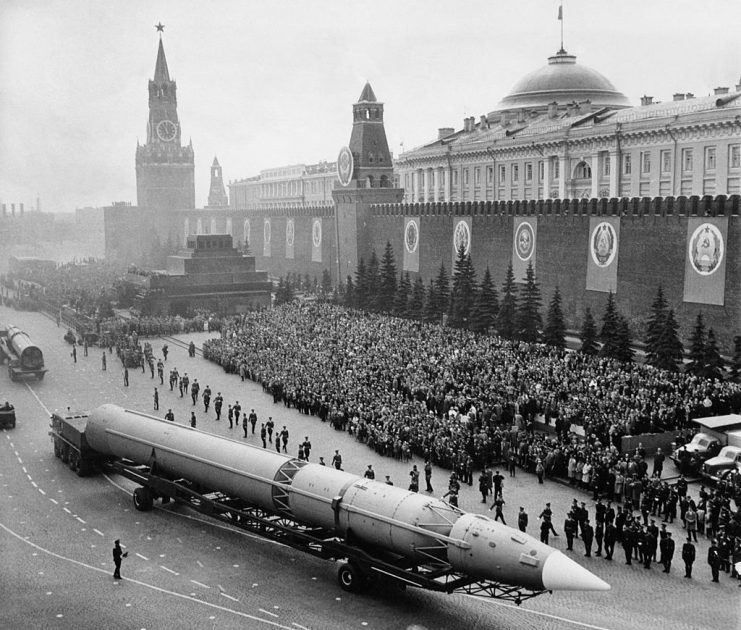
Landmine: The Cold War was a tense time for Europeans, caught as they
were between the military behemoths of the USSR and the USA.
Both superpowers lined their missiles up from the frozen North to the sunny South waiting for curtain-up in this theatre of war.
But the Russians and the Americans were not the only nuclear powers
in the region. The French and the British were also players in the game
and devised their own, home-grown deterrents to invasion by the Soviet
threat.
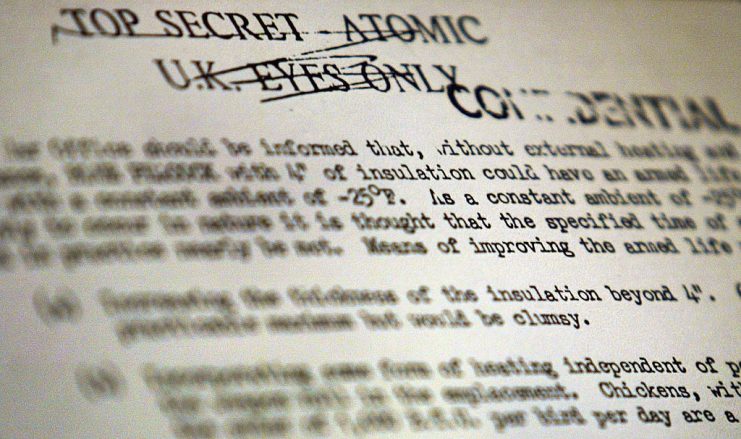
A top secret document from 1957 discussing the nuclear land mine plansThe
British had already made their name for warfighting engineering
expertise in the Second World War with successful bouncing bombs and
super-fast spitfire fighter planes.
The threats during the Cold War were entirely different.
Facing weapons of mass destruction and the vast military might of the
USSR’s armed forces plucky Brits came up with a wide range of ideas
that were designed to stop the enemy advance in its tracks.
One such design, codenamed Operation Blue Peacock, was a nuclear
landmine. It was planned to be remotely triggered in order to inflict
maximum damage on advancing Soviet forces.
One problem that the designers could not manage out easily was that
the detonation could not occur if the device was too cold, and buried
underground in Germany’s northern plains, maintaining a temperature at
which the bombs’ electronics could be effective was difficult.
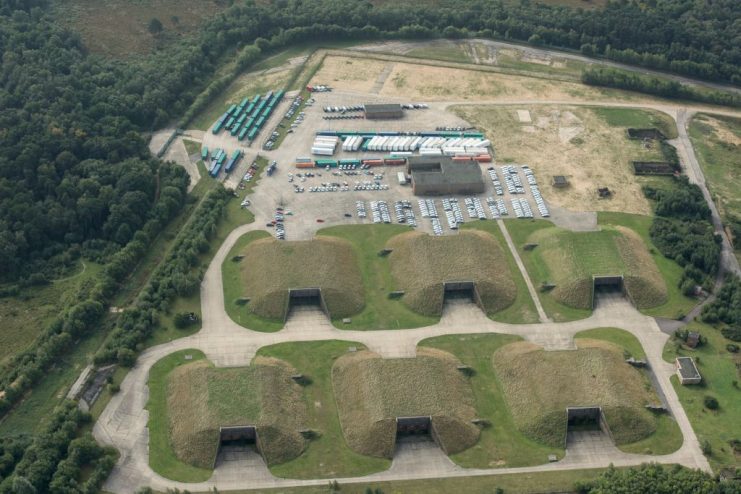
Bunker Complex(getty Image)
Even so, in July 1957 the British Army ordered ten nuclear landmines to be constructed and delivered to West Germany.
The story was that these were nuclear power units for use by the British military forces stationed in the country.
As the mines were to be left unattended, in the case of a retreat by British armed forces, there were anti-tamper devices built-in to the bombs.
The casings were pressurized, which meant that pressure and tilt
switches could be incorporated. Once the weapon was armed it would be
set off if moved, if the casing lost pressure or if it filled with
water.
It was also designed to be detonated remotely by wire from a distance of up to three miles or by an eight-day timer.
While this would work when the electronics were at operating
temperature, there was a very real risk that the harsh winters of the
region could render the weapons useless.
Developers tried and tested many ways to keep the bomb electronics
from freezing, ranging from wrapping the mines in insulating blankets to
the use of live chickens, whose body heat would be enough to maintain
the correct ambient temperature required.
Soviets were a real threat
The birds were expected to live for at least eight days inside the
bomb, which was considered long enough in the event of invasion.
The chickens would be given enough grain and water to sustain them
for the maximum window required for the timing mechanism should the full
term be needed, before starving to death.
The bombs were said to deliver a ten-kiloton explosion that would
result in a crater 375m wide and render a wide area out of bounds due to
contamination, causing considerable impediment to an advancing Red
Army.
Nevertheless, after the production of two prototypes the order was
cancelled amid fears of creating unacceptable levels of fallout in the
atmosphere so close to home.
There were also ethical and political issues concerned with the
installation underground of nuclear warheads in allied territory and so,
in 1958 the British Ministry of Defence cancelled the project.
Fast forward to 2004 and the documents relating to the nuclear
landmine project were declassified. It is not known who was responsible,
but the details of the chicken-powered bombs were released, quite
appropriately, on April 1st.
However, a spokesperson confirmed that this was not an April Fool but
had been a serious proposal, funded by the British government and
developed by the Royal Armament Research and Development Establishment
(RARDE).
The first time I heard of this airplane,was when I read a book called "Sink the Bismark" by CS Forester,
My copy was printed in 1976, I bought it from the Stars and Stripes bookstore in Frankfurt Germany where my Dad was stationed at.
The
Second World War was a period of greatly accelerated development in the
field of aviation: this was the first war in which jet fighters were
used, and bigger bombers than the world had ever seen rained down death
from the skies.
It is tempting to think that these types of airplane – the biggest,
fastest, most powerful, most technologically advanced models – were
solely responsible for winning the air war.
However, in focusing entirely on the flashiest, most impressive
planes, it’s easy to lose sight of the plainer, simpler and smaller
aircraft that played an equally important role in the Allied victory.
One of these models was the Fairey Swordfish, nicknamed the “Stringbag,”
a basic torpedo bomber biplane used extensively by the Fleet Air Arm of
the Royal Navy during WWII.
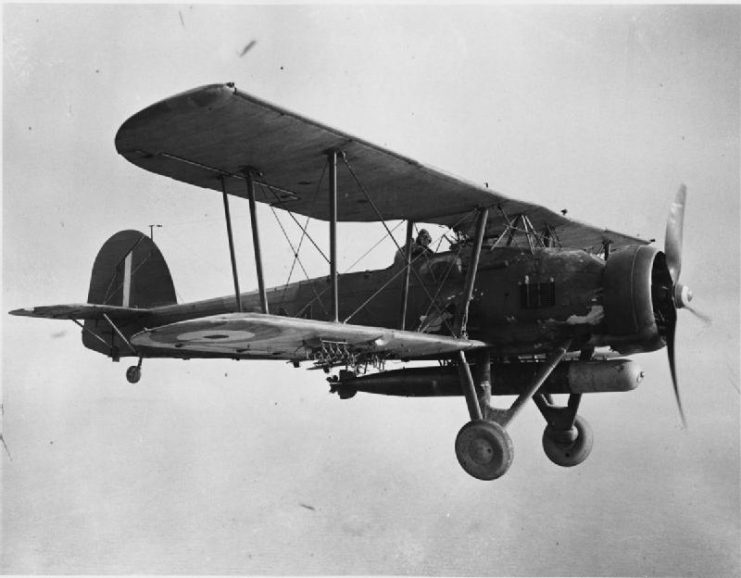
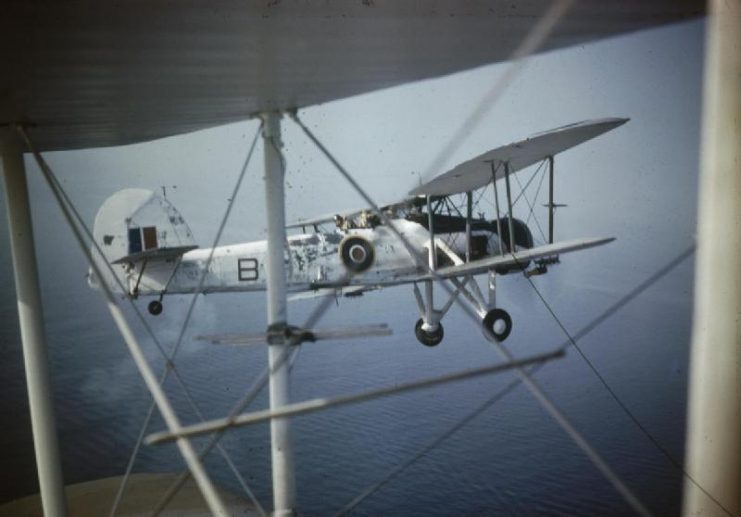
A Swordfish I during a training flight from RNAS Crail, circa 1939–1945
It was one of these humble planes that, reminiscent of Luke Skywalker taking out the Death Star in Star Wars,
managed to disable one of the German Kriegsmarine’s most gigantic
ships. Another Stringbag was also the first Allied plane to sink a
German U-boat, and then later yet another of these unassuming airplanes
was the first to sink a U-boat at night.
Stringbags also relentlessly harried the Axis shipping fleet in the
Mediterranean, accounting for over a million tons sunk by the end of the
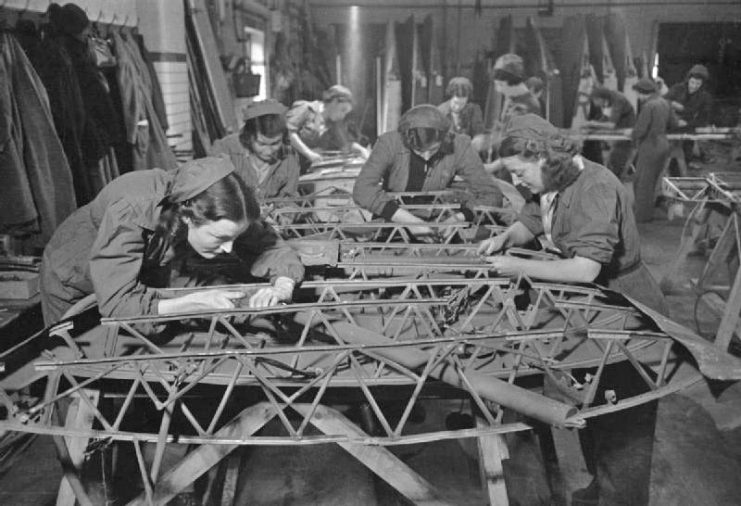
war – not a bad tally for an outdated biplane! Workers carrying out salvage and repair work on a wing of a SwordfishLooks and performance-wise, the Fairey Swordfish bore a much closer
resemblance to the airplanes of the First World War rather than those of
the Second. With its open cockpit, fixed landing gear and its pair of
stacked wings, by no stretch of one’s imagination could this humble
plane have been described as “cutting edge” even in 1933, when the first
prototype was built.
However, despite its outdated design, it was no less important to the
Allied war effort than its more technologically-advanced compatriots.
Indeed, the Swordfish’s antiquated appearance was deceptive – not so
much in terms of its flat-out performance, but rather in terms of the
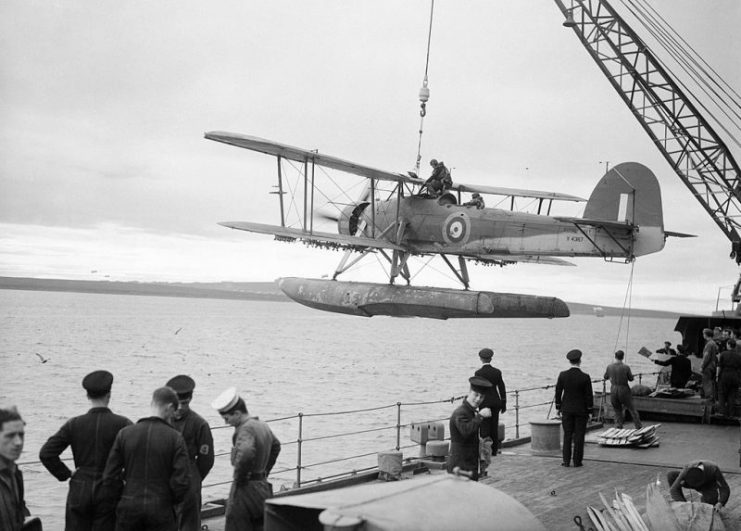
roles it was able to perform. A Fairey Swordfish floatplane being hoisted aboard the battleship HMS Malaya in October 1941
In addition to being armed with two basic but reliable 7.7mm machine
guns, one fixed in position for the pilot in the front and one trainable
at the rear for the gunner, the Swordfish was able to carry a wide
variety of ordnance: anti-ship mines, depth charges, bombs, flares, or a
ship-sinking 1,610-pound torpedo.
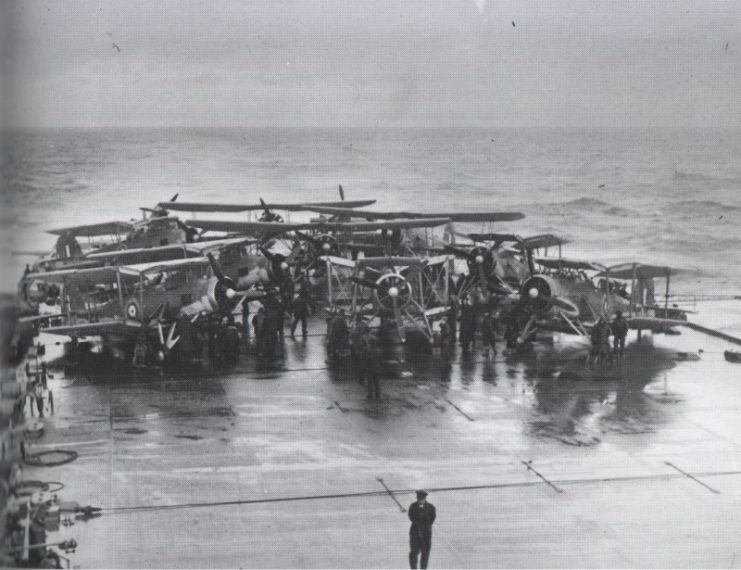
The plane was also used for a variety of roles, including reconnaissance, bombing, escort duty, or naval artillery spotting. Swordfish on the after deck of HMS Victorious, 24 May 1941. The next day, nine Swordfish from Victorious attacked Bismarck.
Because of the variety of ordnance the Swordfish could carry and the
diversity of its roles, it was given the nickname “Stringbag,” likening
the plane to a popular style in women’s handbags at the time. Humorous
as it was, the nickname was apt and it stuck.
As a basic three-seater biplane with a simple Bristol Pegasus motor
that cranked out 690-odd horsepower, the Stringbag wasn’t going to be
breaking any speed records in the air. However, the simple design meant
that maintenance of the aircraft was easy, and that the planes were
reliable. A Swordfish, circa 1943–1944
The twin wings meant that the Stringbag had an excellent lift and
could take off or land on a relatively short strip of land. This made
Stringbags perfect for use on naval aircraft carriers, with their very
limited landing and takeoff space.
Stringbags were also extraordinarily maneuverable, making up for
their slow speed with excellent agility. Their fabric-covered, all-metal under-structures were sturdy enough to deal with harsh landings, and
this meant that they were ideal for night use – an excellent advantage,
when they could fly all but invisible to Axis ships or other targets
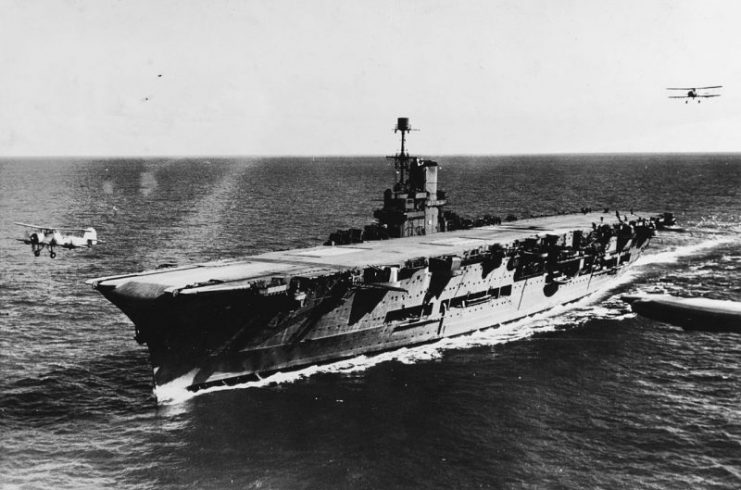
below. A Swordfish taking off from the aircraft carrier HMS Ark Royal, with another passing by astern, circa 1939
These planes weren’t without their disadvantages, of course. They
were at a severe disadvantage when it came to air-to-air combat against
Axis fighter planes, and the open cockpit meant that the men in the
plane would suffer immensely in the cold. Early in the war, Stringbags
didn’t have communication radios, so they had to rely on hand-held
signalling devices.
Nonetheless their advantages generally outweighed their
disadvantages, and Stringbags saw extensive use throughout the war. In
one of the most famous incidents in which they were involved, a
Stringbag was instrumental in the sinking of one of the Kriegsmarine’s
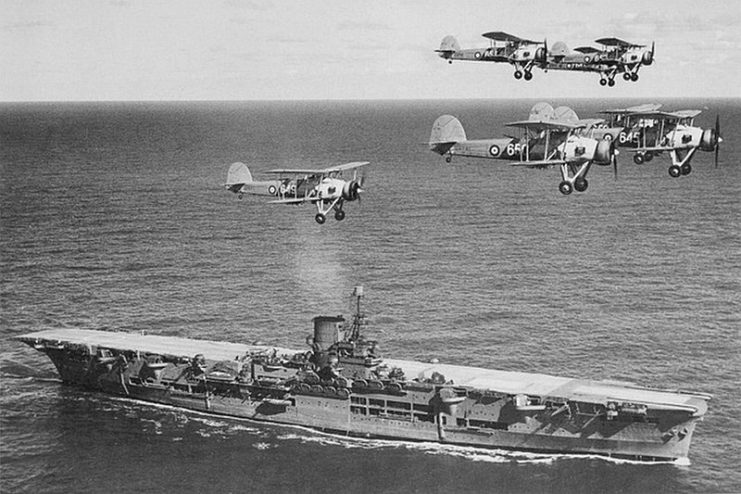
mightiest ships, the battleship Bismarck. The
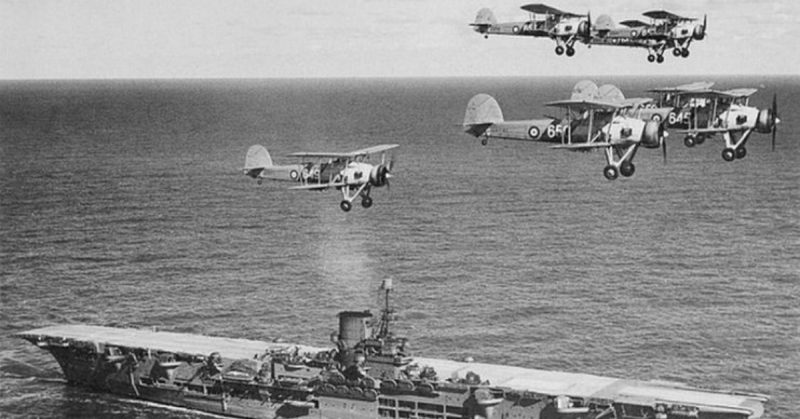
Royal Navy’s HMS Ark Royal in 1939, with Swordfish biplane fighters
passing overhead. The British aircraft carrier was involved in the
crippling of the German battleship Bismarck in May 1941
The Bismarck was, at the time of its production, the most
powerful warship ever made. In a sortie into the Atlantic aimed at
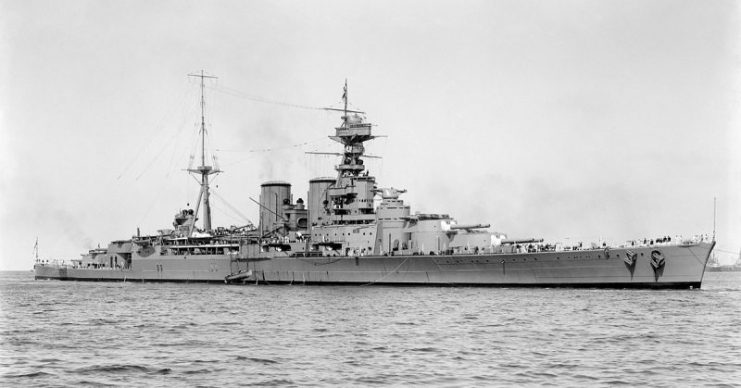
crippling Britain’s crucial supply lines, the Bismarck battled and sank the British battle cruiser HMS Hood.
Realizing the Bismarck had to be stopped, Britain launched a pursuit, but the Bismarck managed to evade her pursuers. The only ship close enough to have a chance of disabling the giant was HMS Ark Royal,
which had a few Stringbags equipped with torpedoes aboard. The
Stringbags took off an hour before sunset on May 26, 1941 to take on the
German behemoth.
H.M.S. Hood
As the Stringbags, each carrying a single torpedo, approached the Bismarck
they dived low, hoping to evade the flak that filled the air from the
ship’s anti-aircraft guns. One Stringbag, piloted by Lieutenant
Commander John Moffat, got the Bismarck in its sights.
Moffat and his observer, Flight Lieutenant JD Miller, had to time the
release of their torpedo with extreme precision. They only had one
chance to do this, and if they missed or the torpedo hit the crest of a
wave in the extremely choppy sea, it was mission over. With flak flying
all around them, and Miller waiting for the exact moment, Moffat’s hands
were surely sweating on those controls. A
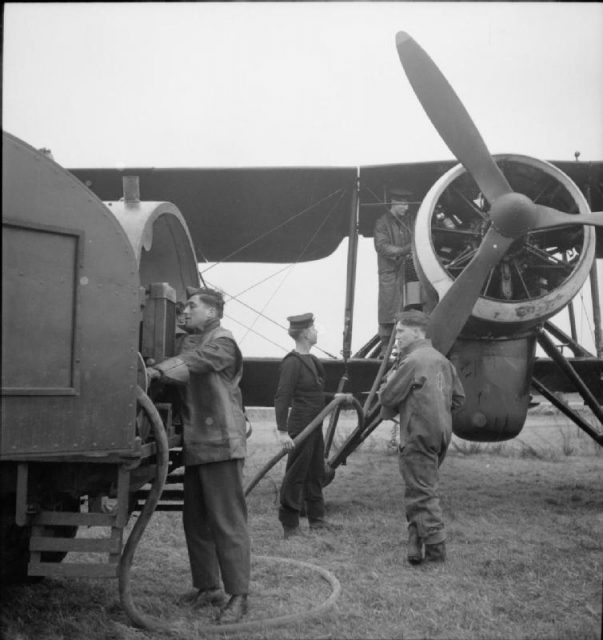
Swordfish III of RAF 119 Squadron being refueled at Maldegem, Belgium,
(1944–1945). The fairing of the aircraft’s centimetric radar can be seen
below the engine
Finally, the moment came, and the torpedo was dropped. Against all
odds it hit home, striking the mighty battleship in a small area of
vulnerability: the rudder, which the torpedo succeeded in jamming
mid-turn.
With her rudder jammed to port, and thus unable to move in anything but endless circles, the Bismarck became a sitting duck. British naval ships later surrounded the Bismarck and eventually sank her after extensive bombardment.
Stringbags also played a key role in the night attack on Italy’s
Taranto naval base. Two waves of Stringbags launched a surprise attack
on the naval base on the night of November 11, 1940, and succeeded in
destroying or disabling the bulk of Italy’s naval fleet – an attack that
would be carefully studied by the Japanese, who would use similar
tactics to attack Pearl Harbor.
Stringbags also saw extensive use in taking out Axis shipping lines,
especially in the Mediterranean, where they sunk over a million tons
throughout the war. All in all, this humble airplane proved its worth to
the British Royal Navy many times over during the course of WWII.
I have Blogged many times about the Boer War and the indifferent British commanders that were in the Army at the time. I had commented that the British Soldiers were unmatched but their commanders were with few exceptions unremarkable to put it politely.
I bought a book in the early 90's called "The Zulu Wars" and a bit later
a book called "The khaki and the Red". These books were fascinating to
read the different history and battles that the Victorian era British
army faced in defending the empire and "PAX BRITANNIA". Those books
along with a book I used in college called "The Defense of Duffers Drift"
which talked about small unit tactics during the Boer war. Some of the
stuff was no longer relevant but it encouraged critical thinking. One
of my favorite movies is "Zulu", having the British soldiers stand and
fight the word I remember from the movie was "Get some good pikeman",
for the use of the bayonet would be needed.
As I recall part of the British soldier to deal and adapt was part of
the Victorian heritage that was prevalent at the time, the British
soldiers and the culture believed that they were superior to everyone
because they were British, it was part of the DNA. For this reason they
pushed the sphere of influence to a point where it was said that "The Sun never sets on the British Empire". Also I remembered another movie with Michael Caine and Sean Connery "The man who would be King"
The Movie "The Man who would be King" was written by Rutyard Kipling, the same person that wrote the "Jungle Book" and he wrote ""Tommie" and many other things.
I ran across this article and I figured that it would tie on good with stuff that I had written.
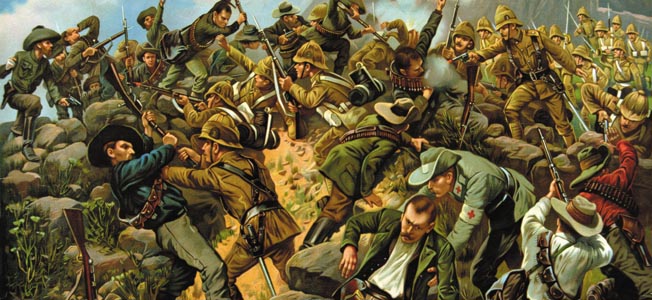
During the Second Boer War's
Battle of Spion Kop, the British Empire came face to face with an
indigenous enemy that easily matched it in ferocity.
by Herman T. Voelkner
The century of conflict that would introduce the concept of total war
to the world had its bloody roots on an obscure hilltop in the remote
South African veldt. The Boer War, the last imperial struggle of the
British Empire, would serve as the dividing line between the era of
small, localized wars fought largely at the speed of hoof and foot and
the global, mechanized slaughter that would follow. It would also
prefigure the dismaying pattern of conflicts to come—the use of barbed
wire, the introduction of concentration camps to contain Boer prisoners
and their families, and industrial-age innovations in human-killing
weapons. “War, which was once cruel and glorious, has become cruel and
sordid,” globetrotting adventurer Winston Churchill would complain after
observing the short, sharp conflict between his nation and the Republic
of South Africa. It was—literally and figuratively—the beginning of the
20th century.
The war had a golden pedigree. When the precious metal was discovered
in enormous quantities in the Transvaal region of South Africa in the
1880s, it roiled an already troubled situation. The Boers, itinerant
Dutch-descended farmers, already had voted with their feet 60 years
earlier in the “Great Trek” northward away from the growing British
presence in the south. Now they were growing increasingly restive.
Fiercely independent, they wanted no part of British intrusion into
their public and private affairs, particularly the accompanying moral
lectures on the burghers’ need for kinder, gentler relations with their
slaves and servants. In 1881, Boer militia had ended the first armed
conflict with Great Britain by hacking to pieces a British force at
Majuba Hill. Humiliated, the British government acceded to
self-government in the Boer republics of Transvaal and the Orange Free
State. (The South African colonies of Natal and Cape Colony continued to
fly the Union Jack.) Two decades of uneasy peace followed.
Gold Rush Leads to War
The ensuing gold rush into the Witwatersrand upset the delicate
political balance, bringing an unwanted influx of English prospectors
into the heart of the Transvaal. These “Uitlanders,” as they were
called, were close to forming a majority in the region. During an era
when the world’s economy ran on gold, Great Britain saw in the large
expatriate presence a heaven-sent opportunity for expanding its
influence in its former territories. The Boers were well aware of the
demographic danger. A clear indication of that danger came in the
notorious Jameson Raid of 1895. Instigated by Cape Colony Prime Minister
Cecil Rhodes—creator of the DeBeers diamond fortune—the raid began when
Rhodes protégé Starr Z. Jameson led a force of Cape Colony volunteers
into the Transvaal to coordinate an attack with restive Uitlanders in
the boomtown of Johannesburg. The plan went disastrously awry when the
rebellion did not spread as expected—opposition to Boer rule had been
overestimated. Jameson and his men were quickly rounded up and handed
over to British authorities, who gave them a mere slap on the wrist,
further outraging Boer sensibilities.
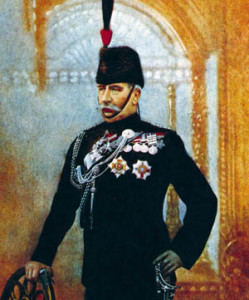
General Sir Redvers Buller was the commander-in-chief of British forces in South Africa.
Weapons and ammunition poured into the Boer republic from the
Netherlands and Germany, which was eager to see Britain humbled again by
the Boers. Old Martini-Henry rifles were replaced with modern
German-made Mausers, and “God and the Mauser” quickly became the Boer
war cry. Meanwhile, Transvaal President Paul Kruger roughly suppressed
the Uitlanders, refusing them the right to vote and resisting intense
British diplomatic pressure. Diplomatic entreaties might be ignored, but
as Kruger and his countrymen gazed across the border, they saw
something they could not control: shiploads of British Army
reinforcements steadily disembarking in Cape Colony and Natal. The Boers
must act or face a swelling tide of British soldiers. Kruger issued an
ultimatum: Unless the British buildup ceased and its forces withdrew
from the frontier, the Transvaal would fight. On October 11, 1899, the
ultimatum expired, and war for control of the fabulously wealthy region
began. The words Kruger had spoken to his countrymen after the discovery
of Transvaal gold—“Instead of rejoicing you would do better to weep,
for this gold will cause our country to be soaked in blood”—were now
sadly prophetic.
The Natal-based garrison at Ladysmith, where colonial governor Sir
George White was in residence, was one of the keys to the British
defense; Kimberly and Mafeking were the others. The three cities ringed
the perimeter of the Boer republics. The Boers understood this and took
immediate steps to forestall any offensive moves by the British.
Kimberly and Mafeking were surrounded. (In the latter township, Lord
Baden Powell would organize the boys of the town into the first troops
of Boy Scouts.) In the British cantonment at Ladysmith, White and 12,000
troops were under imminent threat of capture. A British general of
great renown, Sir William Penn Symons, already had been killed by a Boer
sniper; his infantry brigade, reeling back from the extreme north of
Natal, was now retreating toward Ladysmith. Feeling that destiny was on
their side, the Boer inhabitants of the two British colonies were now
rising in rebellion, turning the preexisting political demographic on
its head.
For the British, the news everywhere was grim. Winston Churchill, who
sailed over to Cape Town from England with General Sir Redvers Buller,
the commander-in-chief of British forces in South Africa, reported back
caustically that the British could “for the moment, be sure of nothing
beyond the gunshot of the Navy.” It was far from clear that Buller was
the right man for the job. Although he had four decades of military
experience behind him, as well as a Victoria Cross, Buller was unused to
fighting any enemy with a level of sophistication higher than that of
the Zulus. Engaging him now was a highly motivated mounted force both
nimble and armed with modern weapons. In a moment of candid
self-appraisal before the war, Buller had said, “I have always
considered that I was better as second in command in a complex military
affair that as an officer in chief command.” This was the man who now
faced the daunting military task, defending the two British colonies in
South Africa from a determined and resourceful enemy equally at home on
the veldt or in the mountains.
Churchill Travels to the Front and Gets Caught
Winston Churchill in South Africa.
While Buller remained at Cape Town to sort things out, an impatient
Churchill teamed with journalistic colleague John B. Atkins of the Manchester Guardian
to go to the front at Ladysmith before other journalists could do so.
The two took a 700-mile train ride on an undefended rail line that
brushed against Boer strongpoints along the way. They then boarded a
small steamer bound for Durban and immediately sailed into the teeth of
an Indian Ocean storm. After several harrowing and wretchedly seasick
days, the pair arrived at Durban to learn that Ladysmith was completely
surrounded by Boers. Still determined to get to the fighting, Churchill
and Atkins made another dangerous train ride of 60 miles that brought
them to the end of the line at Estcourt. From there, they could hear the
cannonfire at Ladysmith reverberating in the distance against
tin-roofed shacks.
On November 14, Churchill was invited to participate in a
reconnaissance by armored train, a dubious venture vulnerable to the
simplest of countermeasures—a blocked track, a disturbed rail, or a
blown bridge. The Boers, under their new commander, Louis Botha—two
months earlier a Boer private—speedily obliged. A blockade sufficed; the
train rammed boulders strewn along the track. Heavy rifle fire and
shrapnel rained down from the hills. For over an hour the train was
under fire as Churchill assisted in the defense and attempted escape. “I
was very lucky in the hour that followed not to be hit,” he recounted
later. “It was necessary for me to be almost continuously moving up and
down the train or standing in the open, telling the engine-driver what
to do.”
Churchill personally directed the recoupling of the cars in an
attempt to ram the blockade, and when that failed, he led a group of
wounded soldiers to relative safety beyond a nearby trestle. He was
returning to lead more away from danger when he met some figures clad in
slouched hats—Boers, he realized—leveling their rifles at him from a
hundred yards away. He turned and ran in the other direction, bullets
striking all around him. Minutes later a horseman appeared and pointed
his rifle at the Englishman, who automatically reached for his pistol,
only to find that he had left it on the train. He was taken prisoner
after managing at the last second to discard two magazines of prohibited
dum-dum bullets. With that, England’s preeminent warrior-journalist was
led away to prison, his slyly discarded magazines very likely saving
him from drumhead execution.
‘Black Week’ for the British Forces
While Churchill languished in Boer custody, depressing news filled
the grim dispatches from South Africa to England. In the space of one
week—December 10-15—the British suffered consecutive defeats at
Stormberg, Magersfontein, and Colenso. From Buckingham Palace, a vexed
Queen Victoria announced, “We are not interested in the possibilities of
defeat; they do not exist.” But bold pronouncements could not obscure
the truth arriving from the outer reaches of the Empire. The British had
suffered their worst losses since the Crimean War a half-century
earlier. All too clearly, the innate conservatism of the British
military establishment had begun to take its toll. The cavalry had
hitherto despised the carbine in favor of the sword—this in the dawning
age of magazine-fed rifles and quick-firing guns. Few senior British
officers realized that the old ways of open-order drill and carrying the
day with regimental discipline and esprit de corps alone were now a
prescription for outright slaughter.
At Stormberg, an attempt to wrest control of a railway junction from
the Boers miscarried when the British forces were purposely misled by a
native guide during a night march. Seven hundred British soldiers were
missing or captured. Magersfontein was even worse. The much-vaunted
Highland Brigade made an assault across an open plain in virtual parade
formation against an enemy whose positions were hidden behind
undiscovered barbed wire. The Boers had devised a new battlefield
tactic: digging trenches dug down the front of a hill, known as the
military crest, rather than at the top. By the time the attempt at
Magersfontein to relieve the garrison at Kimberley was called off, 900
dead and wounded members of the Black Watch littered the battlefield.
Lt.
Gen. Charles Warren wanted to bombard Boer positions on Tabanyama Ridge
before launching his main assault. He was overruled by General Sir
Redvers Buller who was stationed several miles to the rear.
At Colenso, Buller’s attempt to relieve Ladysmith also failed. The
Irish Brigade, which was to have crossed the Tugela (“Terrible”) River
three miles away, was misled by another guide, this time into a bend of
the river where they were enfiladed from all sides by Boer riflemen. To
make matters worse, Buller had deployed 12 field guns at Colenso without
an infantry screen. In the face of withering rifle fire, the guns had
to be abandoned. A handful of heroic British volunteers tried to recover
them, but only two guns were brought back successfully. Casualties were
relatively light, in comparison to the earlier two battles—only 150
killed. Meanwhile, Ladysmith remained under siege, and the hard-pressed
British troops encircled there had begun to eat their horses and mules.
Until “Black Week,” as the English newspapers dubbed the six terrible
days in mid-December, the worst of Britain’s casualties in the region
had been suffered at Majuba nearly 20 years earlier, when fewer than 100
of her soldiers were killed. Now they were dying by the hundreds in
battle after futile battle. These were not the usual native combatants
on the fringes of the Empire—the Zulus, Pathans, or Dervishes. The Boers
knew the ground far better than their foe, and they also knew the value
of entrenching themselves within it. “Dig now, or they’ll dig your
grave later” was their watchword. They were fiercely determined and well
armed. A heavy Maxim gun firing one-inch shells, dubbed the “Pom-pom,”
ranked alongside German-built Krupp howitzers, 75mm field guns, 155mm
“Long Toms” firing 40-pound shrapnel shells, and the ubiquitous Mausers,
effectively shredding the serried British ranks. Slowly, it dawned on
the British that this was to be no “splendid little war” such as the
United States had enjoyed against Spain the year before, but a grinding
fight to the death against a seriously underestimated enemy.
Buller Demoted; Roberts Takes Charge
Buller was badly shaken, wiring home the despairing judgment that “I
ought to let Ladysmith go.” He then sent a message to the encircled
White, ordering him to burn his ciphers, fire off his ammunition, and
seek whatever terms he could with the enemy “after giving me time to
fortify myself.” What happened instead was a change in leadership.
Buller was demoted, although he continued to command the forces in
Natal, and he was told to persist in trying to lift the siege at
Ladysmith. The new British commander-in-chief was retired Field Marshal
Lord Frederick Roberts, 67 years old when he was recalled to active
duty. Lord Horatio Herbert Kitchener—“Kitchener of Khartoum”—would serve
as Roberts’ chief of staff. Roberts had already had at least one
communication from Buller before he departed from London for his South
African command: “Your gallant son died today. Condolences, Buller.”
Such was the epistolary epitaph of the younger Roberts, who had been
killed trying to save Buller’s guns at Colenso.
While Roberts and Kitchener were taking charge of the overall
situation, Buller was reinforced in Natal by Lt. Gen. Charles Warren and
the 5th Infantry Division. Warren was an odd choice to aid Buller—the
older general despised him from Warren’s days as a commander in Malaya,
when he had bombarded Buller with demands and complaints while Buller
was serving as British adjutant general. (“For heaven’s sake, leave us
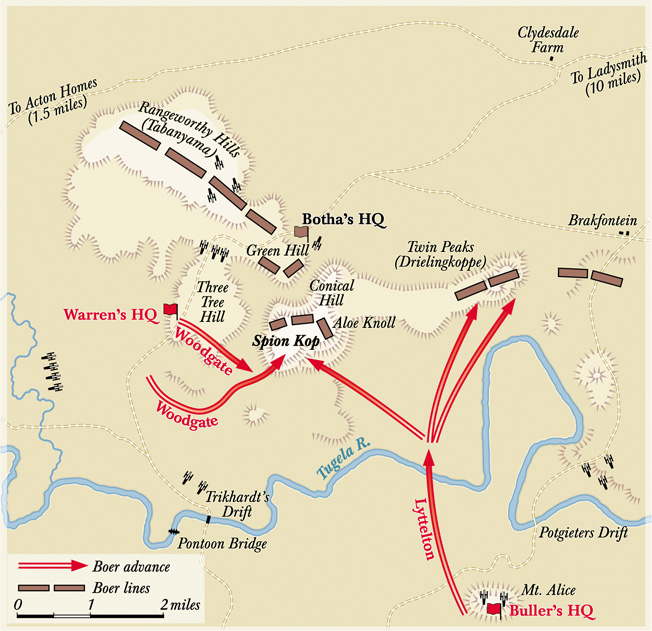
alone,” Buller had finally told Warren, in utter exasperation.) Now he
gave Warren the task of crossing the Tugela River and moving on the Boer
right at Tabanyama Ridge, 12 miles southwest of Ladysmith. Meanwhile,
Buller would attack the enemy center at Potgeiter’s Drift. Once through
the hills beyond the river, the two English columns would reunite for a
last-ditch drive across the open plains to Ladysmith.
Warren, who had spent much of his career excavating historical sites
in Palestine, had grown accustomed to the painstaking pace of
archaeology. Given two-thirds of Buller’s ponderous army to
command—11,000 infantrymen, 2,200 cavalry, and 36 field guns—he took the
better part of nine days to reach Trichardt’s Drift on the Tugela, the
jumping-off point for the coordinated attack. Another day was wasted
ferrying guns and supplies across the river.
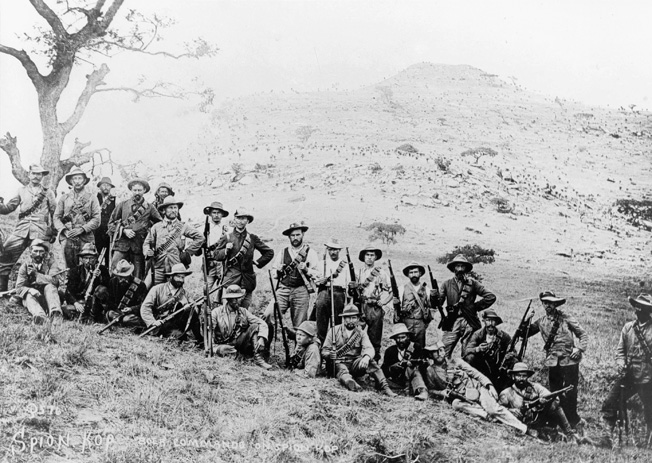
A
Boer commando unit poses for a photo in front of Spion Kop. Aside from
being skilled fighters, they also had intimate knowledge of South
African terrain.
The Boers, with their crack contingent of scouts, knew every move the
British were making. They responded by strengthening their defenses and
shifting troops from the siege of Ladysmith to the line of hills
overlooking the Tugela. Louis Botha was dispatched to take command of
the burghers’ defense. Reasoning correctly that the British always
attacked head-on, Botha paid particular attention to the large hill in
the center of his line—Spion Kop. Aptly named, the boulder-bedecked “Spy
Hill” rose to a height of over 1,400 feet, the centerpiece of several
hills that commanded the veldt and the approaches to Ladysmith north of
the river. Sixty years earlier, the first hardy voortrekkers had climbed
its prominence during the Great Trek northward. Then, as now, they were
fleeing the British, but this time they were better armed and better
fortified. When the time came, they would be ready.
On January 20, Warren finally attacked the Boer positions on
Tabanyama Ridge. The khaki-clad British troops managed to carry a hill
or two before halting amid a cyclone of Mauser fire. Ahead of them lay a
thousand yards of open grassland, more than enough distance to give
them pause, particularly in the face of the quick-firing Boers. Warren
wanted to conduct a leisurely bombardment before making another attack,
but he was overruled by Buller, who ordered him to attack again
immediately. The order came with an explicit “or else.” Buller
threatened to call off the entire campaign if Warren did not do as he
was told. Thinking quickly—or at least as quickly as he was capable of
thinking—Warren suggested an alternative plan. Instead of renewing his
attack on the Boer right, he would move on Spion Kop. Buller was not
appeased. “Of course you must take Spion Kop,” he told his hated
subordinate, but he neglected to supply him with any new troops or ideas
on how to accomplish it. It was going to be left to Warren alone, much
to the detriment of the men he commanded.
British Take Spion Kop
Lieutenant Colonel Alexander Thorneycroft, commanding a contingent of
mounted infantry, was selected to spearhead Warren’s attack. On the
evening of January 23, Thorneycroft and his men surreptitiously climbed
the slope on the near side of Spion Kop and seized the sere moonscape of
the summit, a flash of Lee-Enfields and total surprise winning them the
strategic position with very few casualties. Three cheers went up for
Queen Victoria—the prearranged signal for success—and the way to
Ladysmith lay before them at last. But first they must hold on to their
prize. Maj. Gen. Edward Woodgate, senior commander on the hill, quickly
got the men busy digging trenches in the moonlight, before the
eagle-eyed Boers could zero in on their position. He sent a note to
Warren informing him of the success, adding that he expected that Spion
Kop could be “held till Doomsday against all comers.”
After
taking Spion Kop, British forces made the ghastly discovery that they
were sitting ducks for the Boer sharpshooters above them.
The hill had been shrouded in fog, and when the mists slowly cleared
with the dawn it became all too evident to the British that they did not
hold the hilltop at all, but only a small, acre-wide plateau ringed on
three sides by higher hills that afforded the enemy perfectly sited,
boulder-protected firing positions. The Boers, who had watched the
leisurely progress of the British with tight-lipped satisfaction, were
even now creeping into those positions. Botha ordered his men to retake
the position before the British had time to move up their own heavy
guns. His burghers quickly poured devastating salvos into the densely
packed British troops. The Englishmen, hunkering down in shallow
trenches in a confined space comparable in size and dimension to
Trafalgar Square, had little cover. The Boers’ artillery, signaled by
heliograph, directed intense fire at Spion Kop from the surrounding
hills. Shells rained down on the British position at the rate of 10 per
minute. Meanwhile, the British heliograph had been knocked out, and they
had no comparable artillery support from their own crack gunners. The
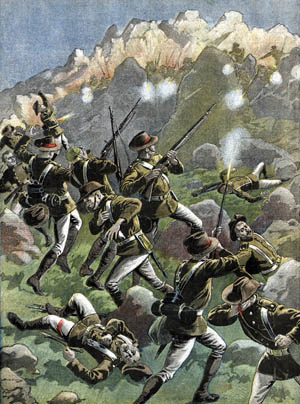
soldiers atop Spion Kop were on their own.
The Massacre Begins
Responding to Botha’s call for reinforcements, Commandant Henrik
Prinsloo led his 88-man Carolina Commando onto Aloe Knoll, 400 yards
east of the British position. From there, Prinsloo’s marksmen unleashed a
deadly fire on the unsuspecting men of the Lancashire Fusiliers, who
were on the extreme right flank of the British trench. The Khakis, as
the Boers called them, never knew what hit them. Seventy were later
found lying dead with bullet holes in the right side of their heads—they
had not even had time to turn around. Also struck dead was their
commanding general, Woodgate, who fell mortally wounded with a shell
splinter above his right eye. His replacement, Colonel Malby Crofton,
sent a hasty message down the hill to Warren: “Reinforce at once or all
lost. General dead.” Warren, unhelpful as always, signaled back: “You
must hold on to the last. No surrender.” His entire career depended on
it.
Grimly, the British held on to the 400-yard-wide battlefield. No one
on the British side had given much thought to what to do after seizing
Spion Kop; asked what his force should do next, Buller had answered
dogmatically, “It has got to stay there.” It stayed there all right,
stolid and immobile, absorbing a horrific beating. Many of the officers
were killed, victims of the Victorian-era code that prohibited a
gentleman from taking cover under fire. The men in the ranks, less
hidebound and conventional, squirmed into every square inch of cover
they could find in the rocky topsoil. It did little good. Boer artillery
shells dismembered entire files of soldiers where they lay, while those
foolish enough to raise their heads off the ground were immediately
shot dead by enemy snipers.
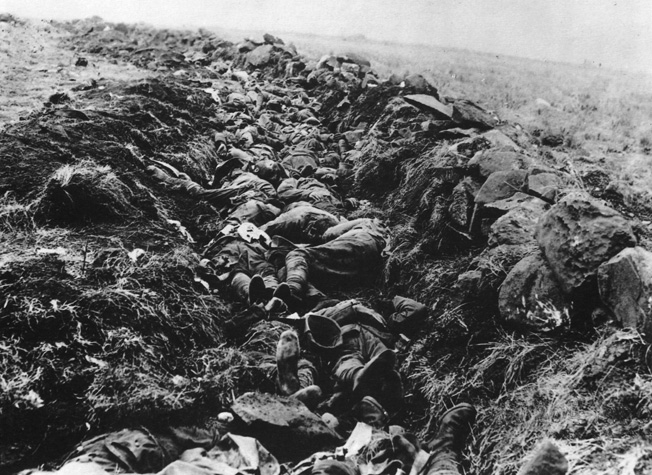
On
the morning after the bloody fighting at Spion Kop, a large trench
serves as a makeshift grave for some 400 dead soldiers who perished
there.
On the command level, all was chaos. At one time or another, four
separate senior British officers believed themselves to be in command.
In his only direct action of the day, Buller recommended to Warren that
he “put some really good hard fighting man in command on the top. I
suggest Thorneycroft.” Warren, glad for any assistance, promoted
Throneycroft to brigadier general and gave him operational control of
the battle. Thorneycroft’s first move was to countermand an attempt by
the Lancashire Fusiliers to surrender to the Boers who were bedeviling
them. “Take your men back to hell, sir!” Thorneycroft roared at the Boer
officer who had approached to accept the surrender under a white flag.
“I allow no surrender.” Shamefaced, some of the Fusiliers skulked back
to their own lines; others, having no wish to commit state-sanctioned
suicide, dashed into the Boer lines and surrendered.
Returning to the forefront now was Winston Churchill, who besides
bearing journalist’s credentials also carried a new commission in the
South African Light Horse given to him by Buller after Churchill’s
extraordinary escape from a Boer prison (see sidebar). Churchill climbed
Spion Kop and assayed the scene for himself, conveying it later in
words that would find their echo on the Western Front in Europe 15 years
later: “Corpses lay here and there. Many of the wounds were of a
horrible nature. The splinters and fragments of the shells had torn and
mutilated them. The shallow trenches were choked with dead and wounded.”
As Churchill climbed and re-climbed the hill, ferrying messages from
Buller’s camp, he was “continually under shell and rifle fire and once
the feather in my hat was cut through by a bullet. But in then end I
came serenely through.”
Little else was serene on the bloody hilltop. Boers and Britons faced
each other across a landscape of butchered bodies and heaped wreckage.
Battalions were hopelessly intermixed. Messages between the hilltop and
Buller, four miles away, were sporadic and confused, and several
messengers fell dead with vital information unread in their hands. No
one below knew the situation above. Some officers thought the hilltop
overcrowded, while others thought there was a vital need for
reinforcements. Thorneycroft, for his part, seemed dazed and utterly
exhausted. He sent another message to Warren, from whom he had not heard
in five long hours. “The troops which marched up here last night are
quite done in,” he reported. “They have had no water, and ammunition is
running short. It is impossible to permanently hold this place so long
as the enemy’s guns can play on the hill. It is all I can do to hold my
own. If casualties go on at the present rate I shall barely hold out the
night.”
Thorneycroft Orders a Total Wthdrawal
After a hurried conference with Crofton and Lt. Col. Ernest Cooke of
the newly arrived Scottish Rifles, Thorneycroft ordered a total
withdrawal. A last-second message from Warren promising that help was on
the way fell on deaf ears. “Better six good battalions safely down the
hill than a bloody mop-up in the morning,” Thorneycroft said. “I’ve done
all I can, and I’m not going back.” In vain, the upstart Lieutenant
Churchill argued the point, and the retreat began. Abandoning the
hard-won hill, the British survivors met their reinforcements massing at
the bottom, en route to assist them in consolidating their position. It
was too late—surely the Boers had already retaken the hilltop—and
Thorneycroft turned these troops around as well. Survivors and
reinforcements alike trudged back down the hillside.
Unknown to the British, the Boers had also lost the will to fight,
and they too had begun to melt away, in part because they were startled
by a sudden move across the Tugela by the King’s Royal Rifle Corps east
of Spion Kop at Acton Homes. Barely a handful of Boers remained on hand
to threaten the British. The hilltop so fiercely contested at such human
cost was discovered by two joyful Boer scouts to be empty. After the
British had spent 16 days and suffered almost 2,000 casualties on the
campaign, Botha’s burghers were atop Spion Kop once more as if nothing
had happened. Only the three-deep piles of British dead remained to
dispel that illusion. In soldierly admiration, a Boer doctor examined
the human carnage and said, “We Boers would not, could not, suffer like
this.”
Botha, returning to the hilltop the next morning, beheld “a gruesome,
sickening, hideous picture.” Some 400 dead British soldiers lay
sprawled in a shallow trench that would serve double-duty as their
grave; another 1,400 were wounded or in captivity. Boer losses were
considerably lower—58 dead and 140 wounded, including 55 of Prinsloo’s
88 hard-fighting Carolina Commando. Botha sent a humble telegram back to
President Kruger: “Battle over and by the grace of a God a magnificent
victory for us. The enemy driven out of their positions and their losses
are great. It breaks my heart to say that so many of our gallant heroes
have also been killed or wounded. It is incredible that such a small
handful of men, with the help of the Most High, could fight and
withstand the mighty Britain.”
British Numbers Finally Prevail
Finally, with his artillery in full support, Buller managed to throw a
pontoon bridge across the Tugela, and overwhelming British infantry
turned the key in the Ladysmith lock, seizing the last remaining hilltop
barring their way. The siege of the British forces there had lasted 118
days. It was lifted on February 27, 1900, ironically the anniversary of
the defeat the British had suffered at Majuba 19 years earlier.
Lord Roberts now took center stage as overall commander after the
protracted drama of Ladysmith. His forces totaled over 200,000 against
88,000 Boers. The latter began to abandon the Transvaal, retreating into
the hinterland in another Great Trek. Churchill, as ever marching to
the sound of the guns, carried by bicycle a crucial dispatch to Roberts
through a Johannesburg still occupied by Boers; the slightest challenge
by a wary burgher might have caused him to be executed as a spy. His
audacity endeared him to yet another commander-in-chief. As the Boers
withdrew to the east, yielding large parts of the Transvaal, Roberts
allowed Churchill to enter Pretoria at the front of the column. One of
Churchill’s singular pleasures was to hoist the Union Jack over the
place where he had been held as a prisoner of war.
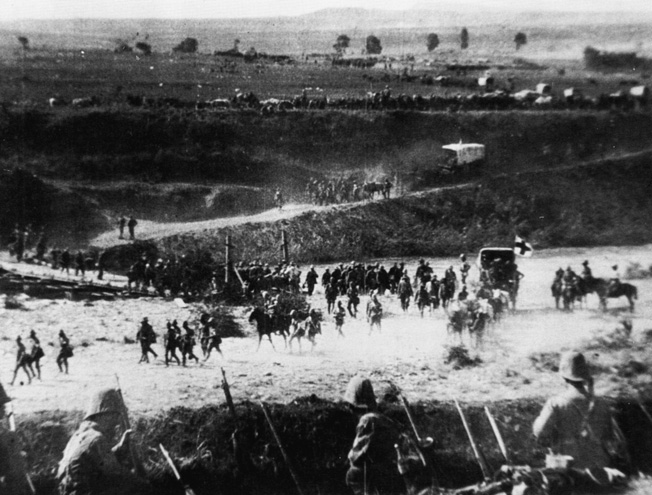
In
a still taken from a newsreel of the fighting at Spion Kop, Buller’s
shellshocked columns retreat over the Tugela River via pontoon bridge
after losing the Battle of Spion Kop.
Other combat followed in the form of desultory running fights with
the Boers who, despite having been defeated in the field, refused to
capitulate. Raiding deep into British territory, the Boers fought for
two more years in the newly developed irregular fashion called guerrilla
warfare—another dubious innovation bestowed on the newborn century.
Buller, for his part, had managed no such innovative thinking. He could
have followed up the British cavalry’s success at Acton Homes and
exploited its mobility to outflank the Boers and open the road to
Ladysmith, but he could not get his main force there quickly enough, and
thus had to fight a battle that grossly favored the enemy. Churchill’s
biting description of Buller’s traveling camp was apt: “Within striking
distance of a mobile enemy whom we wish to circumvent, every soldier has
canvas shelter. Rapidity of movement is out of the question. It is poor
economy to let a soldier live well for three days at the expense of
killing him on the fourth.”
The laborious and cumbersome movements doomed hundreds of regular
British soldiers to a Mauser bullet in the head at Spion Kop, and the
hidebound conventions of the Victorian era—sneering at the use of cover
and demanding an unflappable hauteur in the presence of the enemy—left
their bloody epitaph stitched across the chests of their gentlemanly
commanders. Few British survivors of Spion Kop would have disputed the
mordant words of Manchester Guardian correspondent John Atkins,
who was there that day and later summed up the battle as “that acre of
massacre, that complete shambles.” Indeed it was.