Capt. John Paul Jones hailing the British frigate Serapis during the action from the deck of the frigate Bon Homme Richard, 23 September 1779. (Lithograph by Hayes Lithographing Co., Buffalo, from a painting by Paul Moran, now in the collections of U.S. Naval History and Heritage Command)
When discussing the American Revolutionary War, it is easy to assume that all of the fighting took place on North American soil. While this true to some extent, there were some notable and strange battles that took place not only outside of America, but even on British soil. The raid on Whitehaven, led by John Paul Jones, is the only such attack to reach the British mainland.
A Continental Navy captain of the name John Paul Jones had made quite the name for himself, and in 1778, he wanted to stage a daring assault on British soil. Previously, he had been operating out of France, sailing up and down the Channel trying where he could to disrupt the British and help the war being fought across the Atlantic Ocean.
Venturing into the Irish Sea in the hopes of inflicting damage against merchant shipping, he concocted his plan to attack the British at their own doorstep. This was something that would have been considered impossible, thanks to the vast distances between the United Kingdom and the United States, and the incredible might of the Royal Navy.
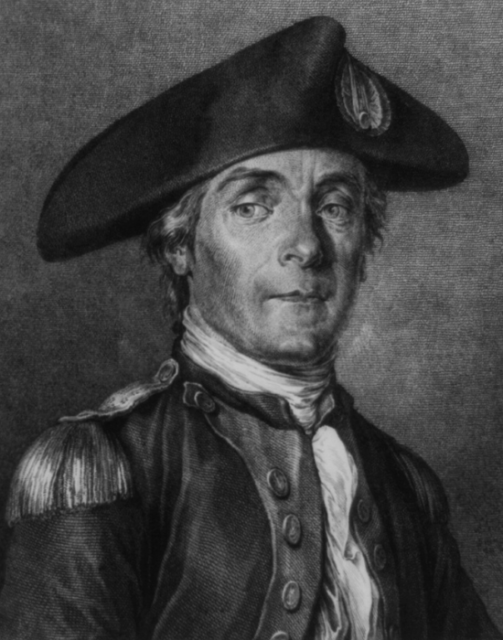
John Paul Jones,
At the time, the British Royal Navy was unrivaled in power and was capable of decimating any naval force brave enough to face them head-on. For this reason, John Paul Jones’s crew and other American ships adopted the tactic of harassment, striking supply lines and merchant shipping where possible. Jones was aware of the Royal Navy’s strength, so he wanted to strike with the element of surprise.
Jones was to strike at the port of Whitehaven on the coast of Cumbria. The plan of attack was to anchor his ship, the Ranger, out at sea and head into the port at night with 30 volunteers in two dinghies. One crew was to attack and silence a British fort guarding the harbor, while the other was to sabotage the town and set the 200 ships in the harbor alight.
Finally, the British would feel the heat of this war on their own turf.
Why Whitehaven? Was Whitehaven strategically important? No. Jones chose it because he was born and raised in the U.K. and began his sailing career from the port of Whitehaven. Because of this, he had intimate knowledge of its layout to help him find his way around at night.
His career started at the young age of 13, eventually becoming the captain of a merchant vessel at just 21 after the captain of the ship he was on suddenly died from yellow fever, leaving Jones to navigate the ship back. After commanding this ship for a while, his reputation took a dive for the worse when he flogged a member of his crew so severely that he died a few weeks later, causing him to be seen as overly cruel.
Jones left Scotland after this, captaining another vessel in Tobago for over a year before killing yet another member of his crew after a dispute. Fleeing from the potential legal repercussions, he relocated to Virginia in the U.S., a nation that from then on he would regard as his own.
Off the coast of Whitehaven, the Ranger‘s anchor was dropped, and the two crews set off for the port just after midnight on April 23, 1778. Immediately, they were faced with a strong wind and tides, slowing their journeys significantly.
Upon arrival, Jones’s crew made their way into the fort, successfully and quickly silencing its dangerous cannons. Jones had difficulty starting any fires, as the fuel for their torches had run out on the unexpectedly long journey to shore.
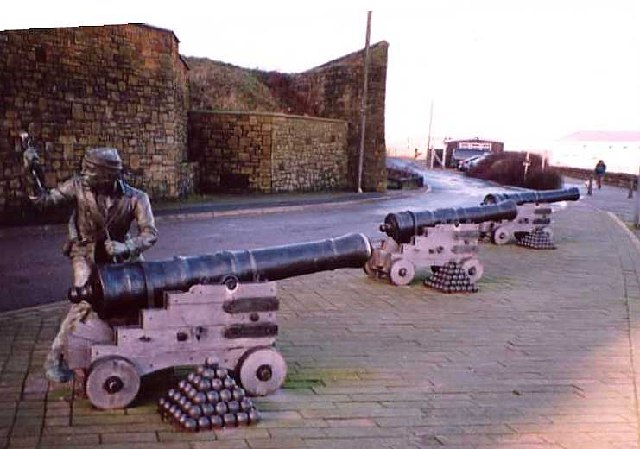
A sculpture in Whitehaven commemorates the raid.
Exiting the fort, Jones was greeted with a very noticeable lack of burning vessels in the harbor. Meanwhile, the other crew had also run out of fuel, forcing them to find their own in Whitehaven. On this hunt, they had conveniently entered a public house, and got caught up in more important matters, namely, having a drink!
By the time Jones linked up and rallied his men, they were drunk, and the sun was coming up, forcing them to abandon the goal of burning the entire port to the ground in exchange for claiming a single coal ship that they hoped would spread fire to other moored boats when ignited.
With success seeming impossible, the situation was made worse by a traitor in Jones’s own crew, running around the town to warn the townspeople of the attack. This traitor had only joined the Continental Navy for a free ticket back to the U.K.
Back in the port, Jones and his crew managed to successfully set the large coal ship alight, but thanks to the alerted townsfolk, the fire was quickly suppressed. Jones and his men jumped back into their dinghies and headed back to the Ranger in the morning light, well aware of their failure.
For a man like Jones, this failure was unbearable, so he set sail for Scotland hoping to kidnap the wealthy Earl of Selkirk to use him as a bargaining tool to retrieve captured Americans from the British.
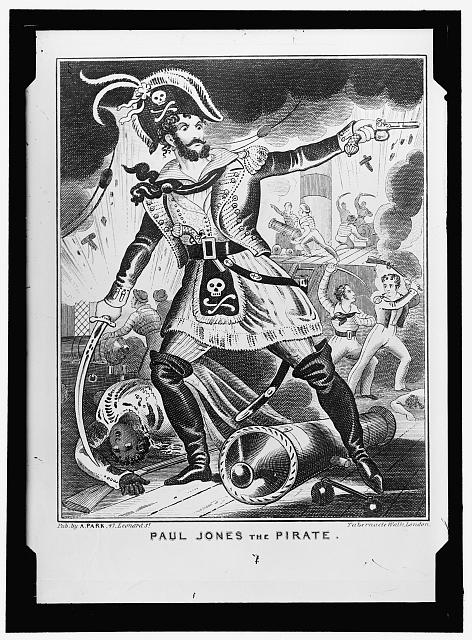
(Photo Credit: Library of Congress Prints and Photographs)
Gathering yet another crew, he rushed ashore, entering the stately home of the Earl. With another stroke of bad luck, Jones discovered the Earl was all the way down in London. Exhausted, deflated, and suffering yet another defeat, the crew opted to steal the Earl’s silverware.
Despite the total and utter failure of both of Jones’s plans, which nearly resulted in a mutiny, the attack did ruffle some feathers in Britain, which had previously insisted the mainland was safe from American attack.
Jones would take the Ranger to Ireland the next day to attack the Drake, a British warship. After engaging in combat, Jones successfully captured the ship, returning both it and the Ranger back to France.
This attack was the only one on British soil, and unlike the situation in North America, it didn’t end in the American’s favor. Jones would later go on to be remembered very differently in the two countries, as a hero in the U.S., but as a working-class pirate in the U.K.
John Paul Jones was Symbolically Pardoned by the town of Whitehaven in 1999.
I remember General Washington attacking the Hessians on Christmas day 1776, the revolutionary War wasn't going well, the Colonial Army had been pushed out in several battles with the British Army, and the Crown had hired Mercenaries, auxiliaries to the British Crown, Hessians from the German State of Hesse-Cassel and Hesse-Hanau. Apparently hiring out of troops was quite a cottage industry for the kingdom. Europe had a bunch of little wars and Hesse equipped their own troops, trained them and they were quite good by the standards of the day. it was cheaper for King George to hire them than bring in more troops from other colonies, they were there to augment the Kings war effort here. The Hessians were about 25% of the total manpower outlay in the 13 colonies. George Washington attacking the Hessians when he did pretty much saved the American Revolution, it gave us hope that we could win this thing, and it shocked the British and Germans that the Americans were no pushovers. Baron Von Steuben who was Prussian came to Valley Forge and Taught the ragtag American Army the drill and discipline necessary to stand up to the British and not break when they came at you with the bayonet.
A light rain had begun to fall out of a pewter grey sky, spattering dirt on the troops as they slowly made their way down the slippery trail toward the river. Each man had been ordered to pack sixty-rounds of ammunition and three-days rations, but few knew where they were bound. Most were dressed in rags, few had overcoats, many were shoeless. The sun was still a half-hour from setting, and already the treetops were beginning to slap and bend, a sure sign of foul weather on the wind
It was Christmas Day, December 25, 1776, the western bank of the Delaware River. Among the tattered, freezing troops at McConkey’s Ferry late that afternoon was General George Washington, architect of a planned strike against three regiments of Hessian troops wintering across the ice-choked river at Trenton, New Jersey.
It is said that genius and madness are at times virtually indistinguishable and, considering the state of the American Revolution at the time, a fair observation when weighing Washington’s chances of success, even now, from the distance of 300 years.
The operation was the offspring of pure desperation, a dreadful state-of-affairs, rapidly approaching implosion. The British and their Hessian auxiliaries were at full strength, for instance, the Continental Army a shadow of its former self. Due to repeated defeats, failures, and retreats, Continental currency was on the verge of collapse, credit nonexistent, food hard to come by.
The American public, its enthusiasm critical for the war effort, was nearing demoralization. On December 18 Washington had written his brother, Samuel, solemnly admitting that “if every nerve is not Straind to recruit the New Army with all possible Expedition, I fear the game is pretty near up.”
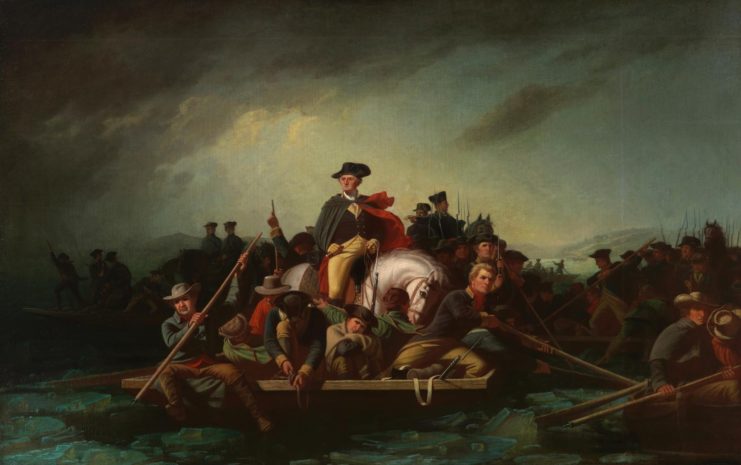
Washington Crossing the Delaware, by George Caleb Bingham, 1856–1871
True, since then Washington had been reinforced, bringing his effective strength up to 7,600, but most of those enlistments would be up by month’s end, hence the army a phantom by early January, if it still existed at all.
There are moments so grim that what previously seemed like lunacy suddenly makes perfect sense, the wildest option the only option still available. In that sense, on the 25th of December 1776, for General Washington the discerning finger of logic was pointing directly, and emphatically, across the river at Trenton.
To bring that logic to life, the general had opted for a sophisticated, three-pronged attack, a plan that even in good weather with well-trained troops might prove challenging, better yet in difficult winter conditions with men on the brink of starvation. Nevertheless, the plan was for three separate columns to converge on Trenton simultaneously, one of the most difficult things in warfare to accomplish.
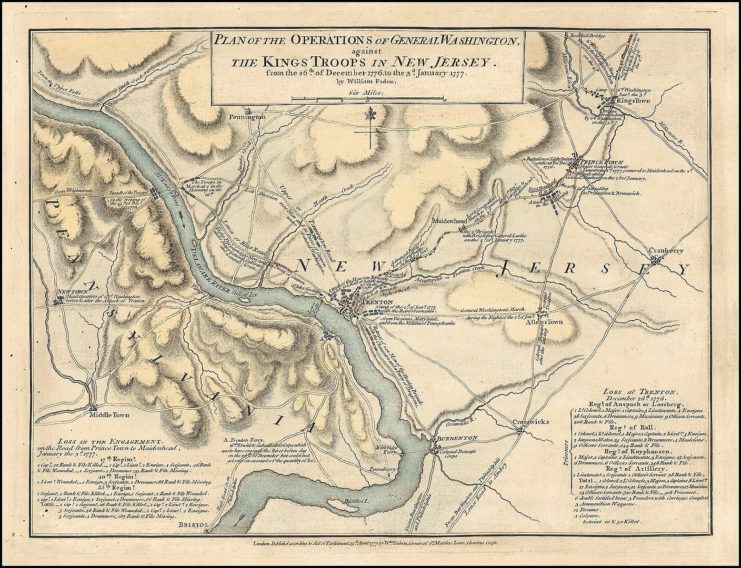
Map of Delaware River area depicting route George Washington and his Army made during the crossing by William Faden
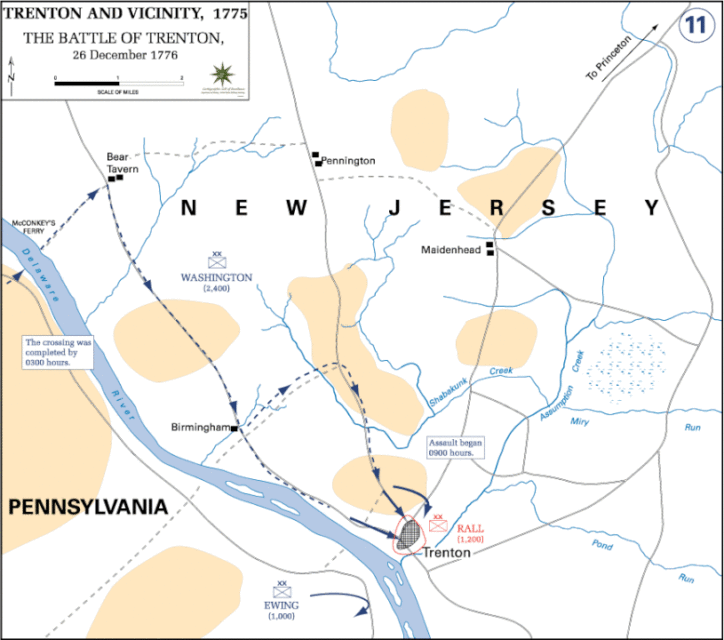
The main column – 2,400 men – was to crossover the Delaware at nightfall, be entirely across – artillery, horses, and all – by midnight, then march nine miles south to Trenton. At the village of Birmingham, north of Trenton, the main column was to split, one branch under General Sullivan continuing south along the River Road directly into town, the other under General Nathanael Greene, looping north and entering simultaneously from the opposite direction.
But hold on, there was more. Additionally, General Ewing was to cross the river directly opposite Trenton with 700 men and seize the bridge over Assunpink Creek south of town, preventing a Hessian retreat in that direction. Lastly, a force of 1500 men under General Cadwalader was to crossover farther south at Bristol, at once creating a diversion and blocking any British reinforcements advancing from Philadelphia.
The attack on Trenton proper was to step-off at first light, December 26. Indicative of the do-or-die nature of the mission, the password was “Victory or Death.”
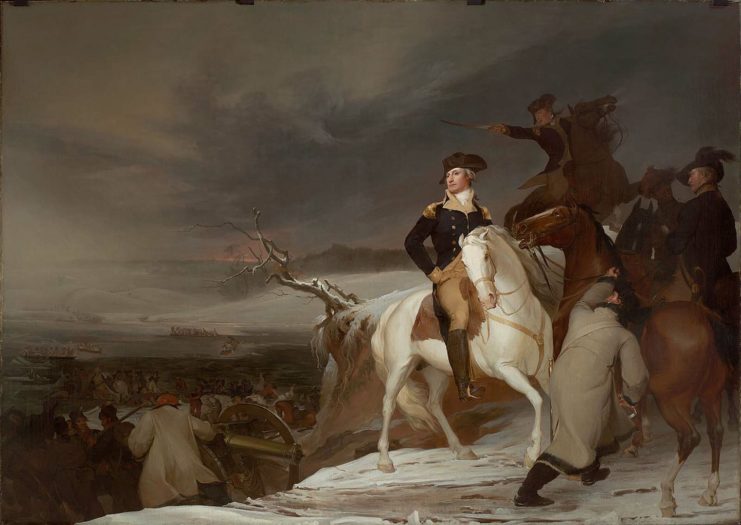
The Passage of the Delaware, by Thomas Sully, 1819
On paper the plan looked splendid, but war-plans often look splendid on paper. Unfortunately, due to the brutal winter storm then blowing-in and heavy ice-flows in the river, neither Ewing nor Cadwalader would fulfill their assignments. Unknown to Washington, he was on his own.
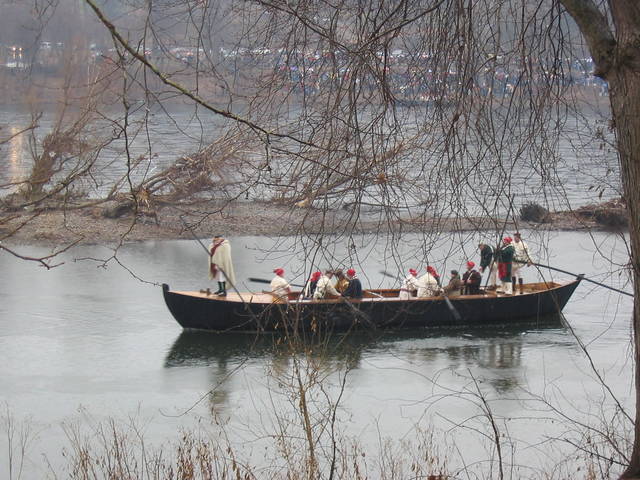
Typically, the crossing got started late. The troops were taken over in Durham boats from the nearby Durham Iron Works. Built to transport ore downriver, they were large, black boats, sixty-to-forty feet in length, with an exceedingly shallow draft – perfect for Washington’s mission.
The troops were poled over, often forty men standing, the artillery and horses on larger ferries. John Glover’s regiment of sturdy Marblehead fisherman supplied the knowhow and muscle, even so, the entire army was not across until 3:00 AM, dangerously behind schedule.
John Greenwood, a sixteen year old from Boston, was one of the first over, and recalled: “We had to wait for the rest and so began to pull down the fences and make fires to warm ourselves, for the storm was increasing rapidly. After a while it rained, hailed, snowed, and froze, and at the same time blew a perfect hurricane.
Through the howling winds and blinding snow of a true nor’easter, the column started toward Trenton, Washington riding the line, tirelessly encouraging his troops forward. As temperatures plummeted, bloody footprints marked the route southward. Two exhausted men staggered from the column and collapsed, only to be discovered later, frozen to death. Going was painfully slow, but somehow the column finally gained Birmingham where it divided, as planned.
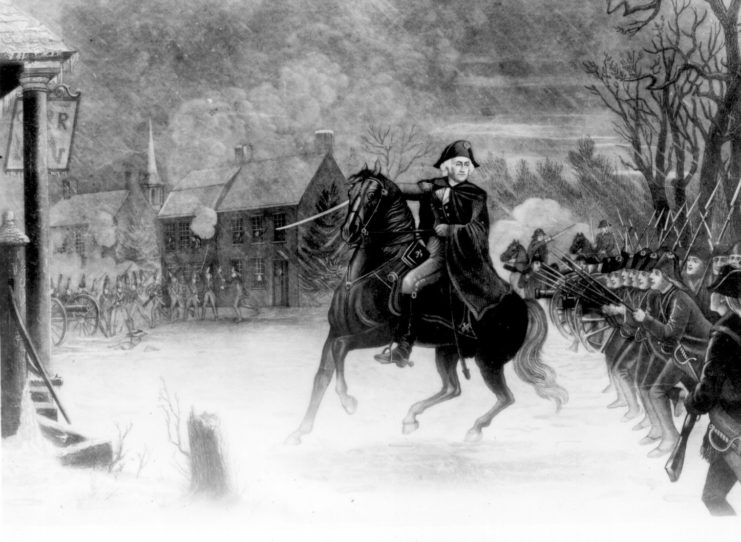
The engraving George Washington at the Battle of Trenton by the Illman Brothers in 1870
Washington rode north with Greene, as Sullivan continued along the River Road. It was well passed sunrise before both columns finally found Trenton. Somehow, almost amazingly, they had not been spotted, the raging storm having provided cover. Suddenly a rider appeared from General Sullivan, advising Washington that, due to the sloppy weather, his men’s muskets were inoperable. But retreat, now, was impossible. Fiercely determined, Washington told the courier to return and tell Sullivan: “Use the bayonet. I am resolved to take Trenton.”
Around 8:00 o’clock, just north of Trenton, Washington split Greene’s force into three attacking detachments and, on horseback, led the center attack forward himself. Heavy snow was still flying as a Hessian lookout spotted the approaching Americans and shouted, “Der Feind!” (the Enemy!).
Shots rang-out as Hessian infantry fired, then retreated before the weight of the American advance. More Hessian infantry rallied, attempting to repulse the Americans on the north side, momentarily leaving the River Road undefended. As Washington’s assault entered Trenton, the sound of cannon-fire became suddenly audible from the south – somehow, despite all the adversity, the twin attacks had coordinated almost perfectly, and Ewing’s boys were firing their artillery from across the river. Sullivan, after chasing-off a Hessian picket-post, advanced into Trenton unopposed.
The Battle of Trenton, December 26, 1776
Trenton was then a small town, about 100 houses – now mostly deserted of inhabitants – built on two central streets, King and Queen. Myth has it the Hessians had been drinking and partying heavily on Christmas, hence sleeping or hungover as Washington’s troops attacked, but this is folklore.
The three Hessian regiments – 1,500 combined strength – were under command of Colonel Johann Rall, a veteran commander with a sound, if uninspiring reputation. They had arrived on December 14, eschewed defensive fortifications, but had patrolled regularly on the lookout for raiding parties. The Hessians – fierce warriors with a reputation for barbarity from the German principality of Hesse-Cassel – had a low opinion of American fighters and leadership, hence they expected minor, aggravating raids, but hardly a major blow.
Now, faced with an overwhelming blow, near panic ensued.
American artillery quickly unlimbered at both ends of town and began sweeping the streets, as Continental troops advanced. Rall formed two of his regiments at the bottom of King Street, but they were quickly broken under intense artillery fire.
Fearing encirclement, the Hessian leader attempted to lead an advance, but this, too, was blown apart. Street fighting ensued, but the Hessian’s weapons fouled due to the snow, and many were cut down in the streets and alleyways. Rall eventually led two regiments to an orchard north of town where he tried to flank Washington’s troops. But this effort was spotted and shredded by enfilading musketry and artillery fire. Rall, riddled with bullets, tumbled from the saddle
Overwhelmed, many Hessians ran for the hills, but most were eventually surrounded and forced to surrender. It was all over in less than an hour.
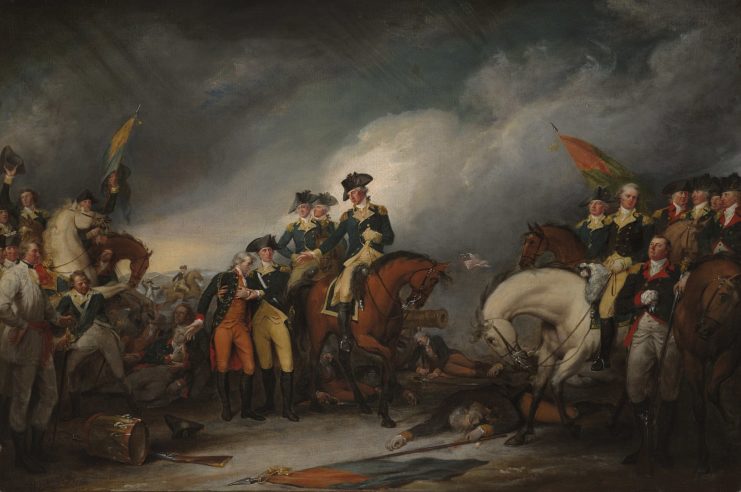
The painting The Capture of the Hessians at Trenton, December 26, 1776 by John Trumbull
The Hessians suffered 22 killed (including Rall), 83 wounded, and 896 taken captive, while the Americans suffered only 5 wounded and two dead – the two who had frozen to death on the march. Additionally, falling into American hands was over 2,000 small arms, barrels of ammunition, numerous cannon, horses, and the Hessian’s entire supply of food, drink, shoes, and clothing.
Amazing as these totals were, they fail to grasp in any meaningful sense the true impact the engagement had on the country. It would not be overstatement to suggest that news of Washington’s victory utterly electrified an American public previously benumbed by the war. Of Trenton, author Mercy Warren wrote: “From the state of mind bordering on despair, courage was invigorated, every countenance brightened.”
Reenactors cross the river in Durham boats.
Coupled with Washington’s return to Trenton less than a week later, his daring nighttime escape from Cornwallis’s clutches, then victory over the British at Princeton the following day, the American cause, like Lazarus rising from the dead, seemed virtually overnight to have returned from life-support to the land of the living. Indeed, Frederick The Great – who certainly knew something of war – called Washington’s campaign “the most brilliant of any recorded in the annals of military achievement.”
Yet perhaps the most insightful comment was delivered nearly a century later, when British historian, Sir George Otto Trevelyan wrote, “It may be doubted when so small a number of men ever employed so short a space of time with greater and more lasting effects upon the history of the world.” Unbeknownst to them at the time, George Washington, and his small band of starving, freezing, yet willing compatriots, had just changed the world.
The Battle of Bunker Hill or actually Breeds Hill but Bunkers Hill was the first large scale engagement between the British and the Colonist, who were still considering themselves part of the British Empire, the Declaration of Independence wasn't mentioned until July 4 1776. At this time Many were hoping that King George III and his ministers would see reason and back off on their unreasonable demands, but they doubled down and the die was cast.
On May 25, 1775 – as gulls squawked, circling overhead – the British frigate HMS Cerberas dropped anchor in Boston harbor. Onboard, generals William Howe, Henry Clinton, and John Burgoyne prepared to disembark after a lengthy trans-Atlantic passage. It would not take them long, however, to discover that his majesty’s forces and his colonial subjects were now locked in a virtual state of war around Boston, and that the colonists had seized control of all land access to and from the city.
Unbeknownst to the three generals, they had just dropped anchor in Chapter One of the American Revolution.
Relations between the Province of Massachusetts Bay and Great Britain had been spiraling downhill for quite some time. In response to a series of taxes and import duties placed on the colonies, in December of 1773 members of the Sons of Liberty boarded British merchant ships in Boston harbor, and dumped tons of tea into the water.
The king’s response to the Boston Tea Party had been the introduction of 4,000 British regulars into the city under command of General Thomas Gage, who had orders to promptly restore order.
But things did not go well, and in 1775 Gage found it necessary to close Boston’s port to merchant traffic, a punitive measure that caused both a serious financial and political crisis in the city. Then relations grew worse, and local militias began stockpiling weapons in various country locations.
On April 19, 1775 Gage sent a force of 700 regulars on a mission to collect or destroy what armaments and supplies they could locate in the villages of Lexington and Concord.
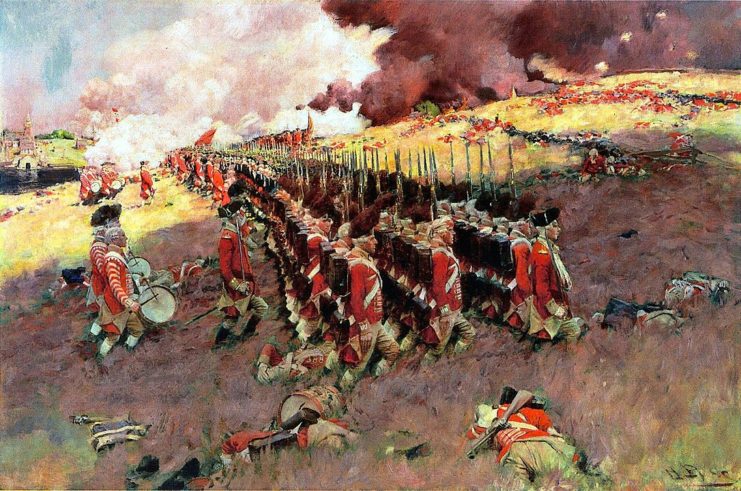
The Battle of Bunker Hill, by Howard Pyle, 1897
Local militias were promptly notified and gathered to oppose the British advance. Early that morning the first shots were fired at Lexington Green, and later a detachment of about 100 British regulars faced a determined collection of militias numbering about 400 at Concord Bridge. Shots were again exchanged, and the regulars, clearly outnumbered, began withdrawing toward Boston.
Additional militias then joined in the pursuit, and a running gunfight between Americans and Redcoats roared back-and-forth throughout the afternoon, all the way back to Boston. The militias then swarmed the city, cutting off land access. Since then, the British garrison had been reinforced by sea, increasing their numbers to approximately 6,000, but they remained besieged within the city’s limits.
This, then, was the basic situation as the Cerberas dropped anchor on May 25. Except that in the intervening month, militias from across New England had descended upon Boston like swarms of angry hornets, swelling the ranks of the encircling Americans to somewhere around 15,000, all of them now under command of General Artemas Ward. But angry militias are no more an army than are angry hornets, and while the colonists surely outnumbered the British, they lacked even the basics of organization, supply, and discipline required for effective campaigning – all significant shortcomings.
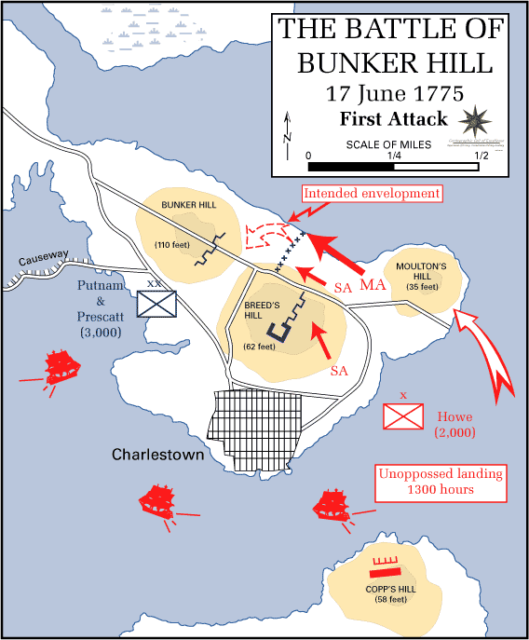
The first British attack on Bunker Hill; shaded areas are hills
Now well reinforced, and with the addition of three major generals for assistance, Gage began plotting a breakout. The British officer’s opinion of their American besiegers at the time was decidedly low, and this disdain certainly played into their planning.
Typifying this attitude was General “Gentleman Johnny” Burgoyne, who considered the Americans little more than a “rabble in arms.” Overconfident of success, he told Gage, “Ten thousand peasants keep 5,000 king’s troops shut up! Well, let us get in and we’ll soon find elbow room.”
The plan the generals devised was first to take back Dorchester Neck, south of Boston, then move upon Dorchester Heights, ultimately attacking the American militias occupying nearby Roxbury. Once that phase had been completed, the Redcoats planned to move on Charleston Heights and Cambridge simultaneously, shattering the American’s grip on the city. Execution of the plan was scheduled for June 18.
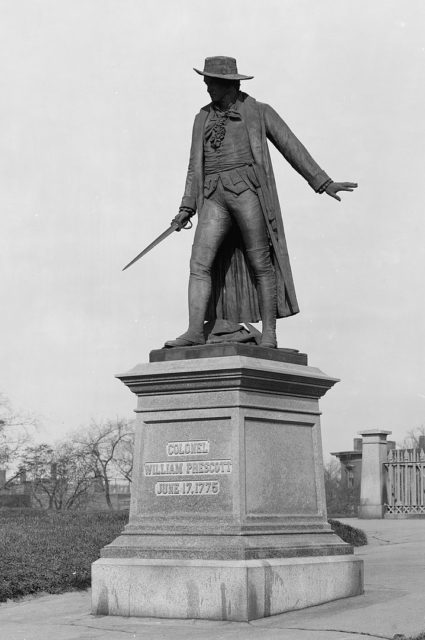
Statue of William Prescott in Charlestown, Massachusetts
But a New Hampshire gentleman, visiting Boston, had gotten wind of the plan, and the news was promptly relayed to the Massachusetts Provincial Congress. The Congress then ordered General Ward to erect appropriate defenses, and Ward directed General Israel Putnam to fortify Bunker Hill, a prominent elevation on the Charlestown Peninsula, just north of Boston.
During the evening hours of June 16/17, Colonel William Prescott, in command of several militia forces totaling about 1,200, began to erect the called-for fortifications. Some initial work was done on Bunker Hill, but the focus then shifted (for reasons still unclear) to Breeds Hill, which was lower, but closer to Boston than Bunker Hill. A square redoubt was constructed, about 130’ per side, with a firing platform erected inside.
This work-in-progress was quickly discovered by the British, however, and early the next morning their batteries opened-fire on the redoubt; but causing little in the way of damage. Watching as the fortifications were going-up, the British generals decided to immediately mobilize an attack against the Americans, both Howe and Burgoyne of the opinion that their troops would easily sweep over the “rabble” and put them at once to flight.
It would take the British hours, however, to accumulate the necessary force, and then additional time to ferry them across the water to the Charlestown Peninsula. At last, with the arrival of their marines, the British had finally amassed a force of 3,000 on the Peninsula, sufficient, it was thought, to disperse the colonists.
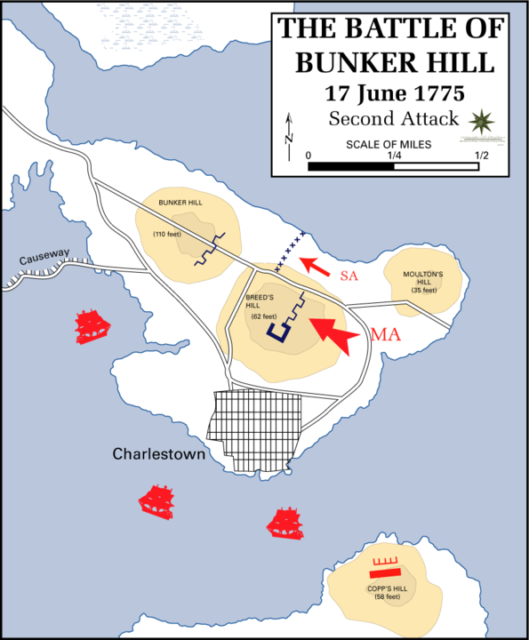
The second British attack on Bunker Hill
These British preparations hardly went unnoticed, however, and the Americans responded by marshalling additional men and hastily throwing-up fortifications across the width of the Peninsula. By 3 o’clock that afternoon, just as the British launched their initial assault, the American force had swelled to 2,400, manning a string of defenses of varying complexity.
But the American forces, while game, were in a state of disarray, still a conglomerate of militias with no real central planning, communications, or coherent leadership. Nevertheless, as time would tell, those individual militiamen who had come to the Charlestown Peninsula that day, had come to fight.
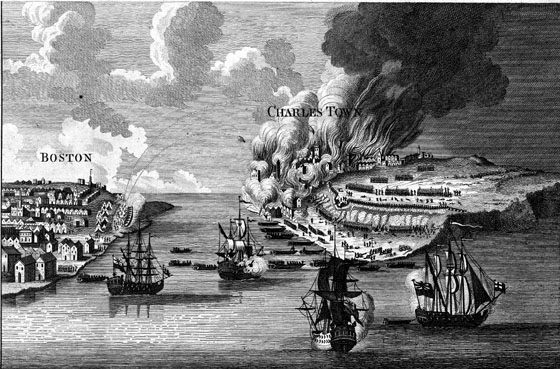
View of the Attack on Bunker’s Hill with the Burning of Charlestown, by Lodge
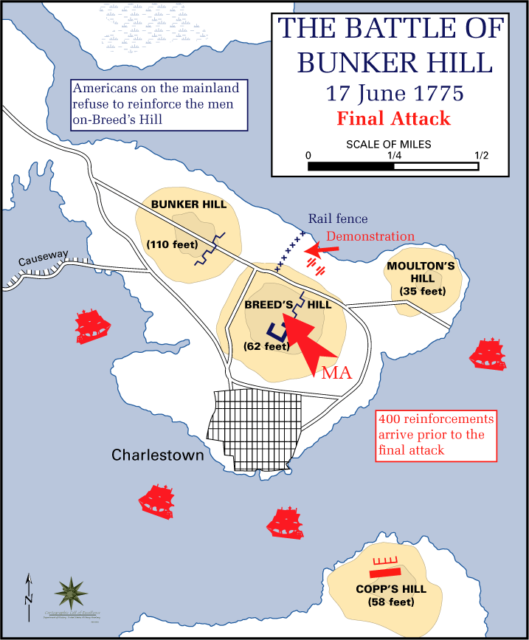
Taking fire from buildings in Charlestown on their left, the British opened the engagement by lofting artillery rounds into the town, then sending in troops to set fire to the buildings. As great, black funnels of smoke rose from the village, Howe – in field command, a servant at his side with a bottle of wine for his refreshment – sent a feint at the redoubt on Breeds Hill, while launching his major assault on the American left.
This attack was meant to dislodge the militia line established in front of Bunker Hill, then sweep behind the Americans on Breeds Hill, effectively cutting-them-
The assault on the left was led by Howe himself, and was comprised of both regular infantry and grenadiers. When the files of Redcoats marched into musket range, an unexpected explosion of smoke and fire erupted from the colonists positioned behind a line of rail fencing, instantly savaging the British ranks.
The Redcoats returned fire but, under a fusillade of accurate musketry, were forced to withdraw in some confusion. This, to say the least, was not what Howe or his officers had expected.
The British regrouped for a second try. This time Howe sent his troops on Breeds Hill directly at the redoubt, while he led another assault on the American left. Both attacks were handled roughly by the Americans, British troops gunned down in ghastly clusters before being forced to withdraw once again.
British losses were already appalling. “Most of our Grenadiers and Light-infantry,” said a British officer, “the moment of presenting themselves lost three-fourths, and many nine-tenths, of their men.”
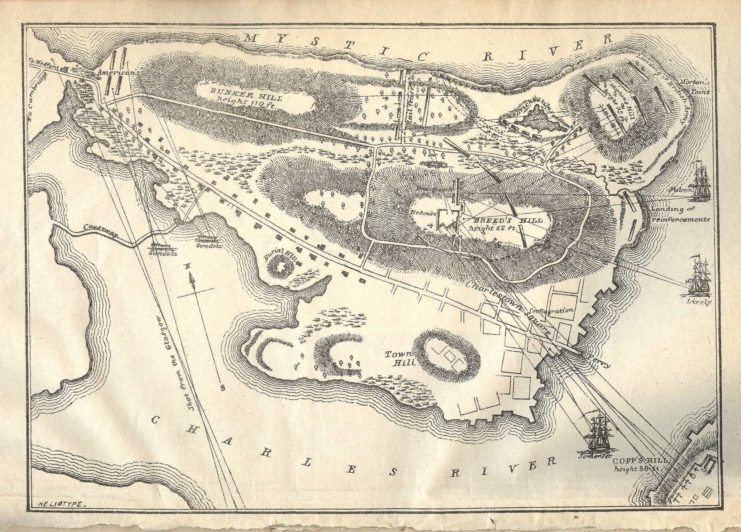
A historic map of Bunker Hill featuring military notes
While the American defense had held against both attacks, behind the colonist’s lines something approximating chaos reigned. General Putnam tried to shift troops to the endangered points, but his grasp of the battle, his troops, and British intentions was limited. Moreover, the American units remained disorganized, some following orders, some fighting on their own hook, others making for the rear.
With no true chain-of-command, the American’s response was precisely the jumble of confusion that had exemplified their siege since its inception. While individuals fought with great valor and distinction, tactical coherence, at the time, remained beyond their organizational capabilities.
Meanwhile, the British, although twice mauled, rose valiantly for yet another attempt at the American works, this time directed essentially at the redoubt on Breeds Hill. Initially, this assault appeared equally as doomed as the two that had preceded it – Redcoats tumbling in great numbers before volleys of musketry – but soon the American defenders ran out of powder and, with that, their defense quickly imploded.
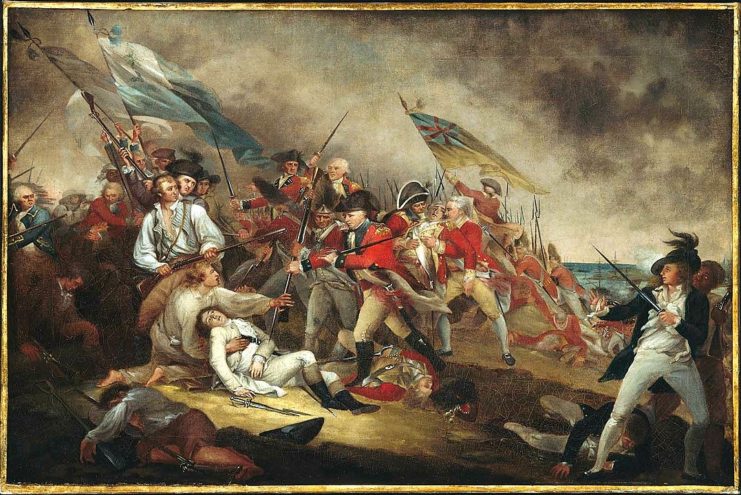
The Death of General Warren at the Battle of Bunker’s Hill
No longer able to hold the British advance at bay with musketry, the combat – as Redcoats poured into the redoubt – became one at close quarters, even hand-to-hand, the sort of fighting the British – trained fighters, armed with bayonets – were far more proficient at than the colonists. Fighting in the redoubt became desperate, soon hopeless, and the Americans were forced into retreat.
But the British, now hoping to drive home a decisive victory, were denied the opportunity of maneuver by a sensibly conceived and disciplined American withdrawal. While the American retreat was rapid, it never devolved into pandemonium, what might well have been expected from such a disorganized assemblage of militias. Despite leaving much artillery, ammunition, and tools on the field, most of the American defenders crossed over the Charlestown Neck in good order, later to redeploy at Cambridge.
The third and final British attack on Bunker Hill
Thus were the British left in command of the field, claiming a hard-won victory as a result, but it was a Pyric victory at best. British dead and wounded lay in mangled rows across the field in numbers far beyond what any of their commanders had ever imagined possible, the Charleston Peninsula a measly prize for the carnage.
The colonists had reformed elsewhere (as they would throughout the war), and, at days end, the cost suffered for moving them a few miles appeared wildly disproportionate to the price paid for moving them.
The British had suffered 1,054 casualties: 226 dead, 828 wounded. While those counts do not appear high by today’s modern standards, they were horrific by 18th Century norms, especially when compared to the “rabble’s” approximately 140 dead and 310 wounded, most of which were suffered during the retreat. It was one of the worst days for British arms during the entire course of the war.
Moreover, it was the British officer corps (commissioned and non-commissioned) that paid a particularly heavy price for the afternoon’s bloody adventure. In European warfare, where the officer corps were generally aristocratic, firing deliberately at officers in the field was unacceptable. But the Americans, untrained in the ways of Continental warfare – and watching as officers led their troops forward – were more-than-happy to gun them down.
Howe’s staff had been decimated, and the total included 100 dead and wounded commissioned officers, a significant percentage of their entire North American corps. At day’s end, the mood among the British generals was decidedly somber. Clinton later wrote: “A few more such victories would have shortly put an end to British dominion in America.”
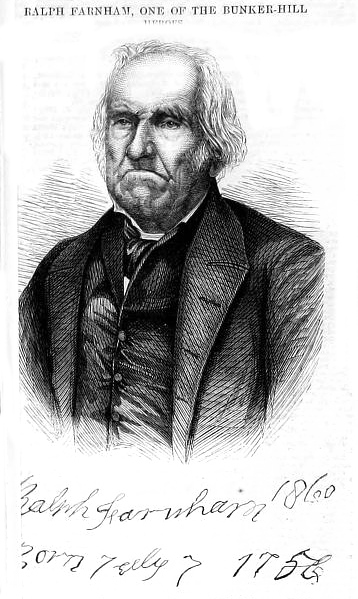
Ralph Farnham, one of the last survivors
The lessons drawn from the battle varied for each side, but each, in their own way served to lengthen the course of the war. The British, quite correctly, were forced to reevaluate (somewhat) their earlier dismissive attitude of American fighting capabilities and – with limited troops and an even more limited corps of officers – think twice about of launching costly frontal assaults against entrenched positions.
Howe, in command of the American campaign after Gates was recalled, became notorious for the almost glacial pace of his movements, and the specter of Bunker Hill has often been raised to account for this lack of zeal. Unfortunately, the British high command never lost entirely its scorn for the American fighter, a self-inflicted miscalculation that hobbled their war planning throughout the conflict.
The Americans, on the other hand, became convinced that Bunker Hill was proof positive that properly inspired militias could whip the British, and that a professional army was therefore uncalled for. While George Washington – the newly appointed commander of the “army” at Boston – knew otherwise, it would take him years to convince many in Congress to the contrary. Hence the war was delayed at its inception by these two interpretations and would ultimately drag on for six long years.
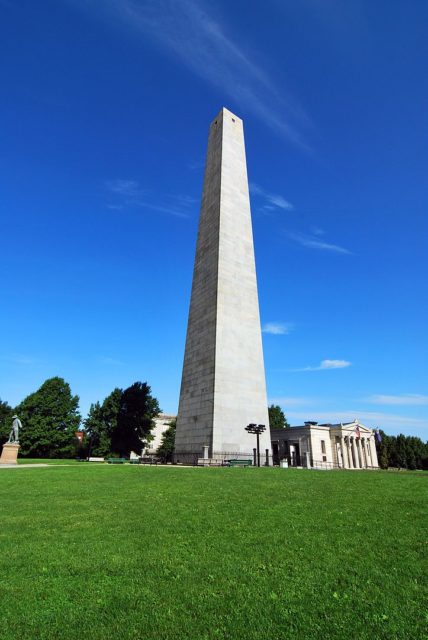
The Bunker Hill Monument.
But surely the most salient lesson to be gleaned from Bunker Hill was the fact that the colonists – while unquestionably disorganized, untrained, ill-supplied, and undisciplined – had nevertheless mauled two splendid British advances and, had their powder not runout, may well have inflicted a disastrous defeat on the king’s troops by day’s end.
That their powder did run out provided the British with victory, but that victory could in no way erase the fighting spirit displayed by individual American militiamen. “Our three generals,” a British officer later lamented, “expected rather to punish a mob than fight with troops that would look them in the face.”
Thus, as the smoke cleared late that June 17th – and as the British gathered their dead and wounded from the downslope of Breeds Hill – generals Clinton, Howe, Burgoyne, and Gage, may well have wondered if their collective futures now held something far more unpleasant than any of them had before considered.
For if American militias continued to fight with the same spirit and fury, the war in America might prove considerably more difficult, bloody, long, and potentially ruinous, than anyone on the other side of the Atlantic had ever dreamt.
On June 17, 1775, the rabble had risen seemingly en masse, and on a single furious afternoon had written an emphatic, almost deafening statement of collective resolve. Only time would tell if that statement was simply a fleeting aberration – a passing wisp of high passion – or something far more ominous.
/arc-anglerfish-arc2-prod-mco.s3.amazonaws.com/public/AEA7VSGAKBHL3AU4VMGGVT2KXQ.jpeg)