Webster

The Constitution was made to guard the people against the dangers of good intentions." --American Statesman Daniel Webster (1782-1852)


Showing posts with label Falkland War. Show all posts

Friday, November 13, 2020

The Battle of Goose Green and the BBC committing Treason.

I ran across this tidbit and did a bit of digging and got the  Article, Go to page 3 of the Article  and read it.  I had blogged before about the Falkland War several times,  I was in high school and I thought the British had a better claim to the island than the Argentinians did.  I still have that opinion now.  I had made the statement that if Argentina had waited 7 or 8 more months, Britain could have not mounted a force to retake the island, the new austerity measures that were being considered would have grounded her VSTOL aircraft Carriers HMS Hermes and HMS Invincible.  Another charge against the BBC was his autobiographical account of the Falklands War, Admiral Woodward blamed the BBC World Service for disclosing information that led the Argentines to change the retarding devices on the bombs. The World Service reported the lack of detonations after receiving a briefing on the matter from a Ministry of Defence official. He describes the BBC as being  In more concerned with being "fearless seekers after truth" than with the lives of British servicemen.


.

The Battle of Goose Green in 1982 was part of the Falklands War between Britain and Argentina. It was especially notable for two things – the high casualty rate and how the British Broadcasting Corporation (BBC) committed treason.

The Falkland Islands, South Georgia, and the South Sandwich Islands are British territory lying much closer to Antarctica than they are to Britain.

They are also closer to Argentina – which is why the Argentines claim them despite everyone else saying otherwise.

On April 2, 1982, they decided to do something about it by invading the Falkland Islands. The following day, South Georgia and the South Sandwich Islands were next – which made everyone go, “Huh!?”

The combined territory comes to barely 1,507 square miles. Being so close to Antarctica they barely habitable.

About the only people not scratching their heads were the British and the Argentines.


To understand this, here is a quick history lesson. Various European nations claimed them until Britain came along in 1690 and said, “Mine!” Spain did the same in 1713, but to make a long story short, their empire collapsed.

Among the territories they lost was Argentina. Though no longer Spanish, Argentines believe they are the successors of Spain’s claim. They were content to let things be till 1982. So why then?

It was because their military government needed a distraction. The country’s economy sucked. Ditto with its human rights record.

Solution? Distract the people with patriotism and do so before the upcoming so-called elections. But how? Hola, Falklands War!

While Britain was no push-over, the Argentine government gambled on three things: the islands have no strategic value; they have virtually no resources, and they are home to only a tiny population of mostly Brits.
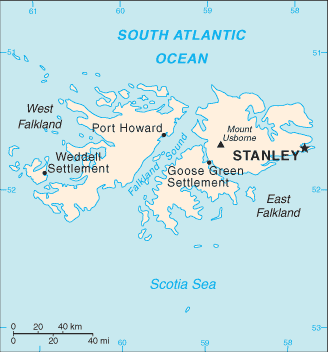
Goose Green
Goose Green

The government also considered the British economy. It was not doing too well in the early 1980s, so the hope was that the Brits would be too distracted and too tight-fisted to do anything about an invasion.

Sure, they would scream and stamp their feet, but that would be it.

The Argentines were not at all worried about the UN. The country was constantly being targeted for its human rights violations, so what was another ding from the international community? People would simply get used to it – just like they did with Tibet.

It did not turn out that way, of course. Britain responded quickly with amphibious landings in San Carlos Water on East Falkland on May 21.

Most of the Argentine forces were around Port Stanley, some 50 miles to the east, with others ensconced at Goose Green and Darwin – armed with machine guns, 35 mm cannons, mortars, and artillery.

Goose Green could be ignored. It is a tiny community in Lafonia in East Falkland along the Choiseul Sound. It was also too far away to threaten the ongoing landings at San Carlos – which were not going well.

                                                      Colonel Piaggi of the Argentinians. 


The British had lost a number of ships from aerial attacks, so they needed to fortify the positions they already held. What was meant to be a counter-invasion to take back the Falklands, had instead become a defensive maneuver.

While the Argentine government became popular with its people, things were different in Britain. Some of its population felt the Falklands were not worth fighting and dying for. Therefore to rally the nay-sayers, a bit of PR was needed.

British politicians were particularly worried because the UN Security Council was already talking about a cease-fire. If passed, British troops would be stuck as time and geography were not on their side. All Argentina had to do, on the other hand, was wait.

Britain could not. If it was to take the Falklands back quickly, it had to go on the offensive.

Suddenly, Goose Green looked attractive


                                                                Colonel H. Jones
              

If Britain could take that, it would have access to a large swathe of East Falkland. A ceasefire then would still be annoying, but at least Britain would have a bigger slice of the island with which to annoy Argentina.

Enter Brigadier Julian Howard Atherden Thompson, commander of 3 Commander Brigade. His job was to take on the Argentines around Goose Green and Darwin.

The area was protected by Task Force Mercedes under Lieutenant-Colonel Ítalo Ángel Piaggi, made up of the 12th Infantry Regiment (IR12) and 3rd Company. Defended by 20 mm Rheinmetalls, two radar-guided Oerlikon 35 mm anti-aircraft guns, and a battery of three OTO Melara Mod 56 105 mm pack Howitzers, Thompson’s job would not be easy.

To make it even more challenging, his men could not be flown in. Most of their helicopters had been aboard the Atlantic Conveyor – which was destroyed by Argentine missiles on May 25.

The plan, therefore, was to land troops at San Carlos Bay and have them walk for two days until they reached Goose Green.
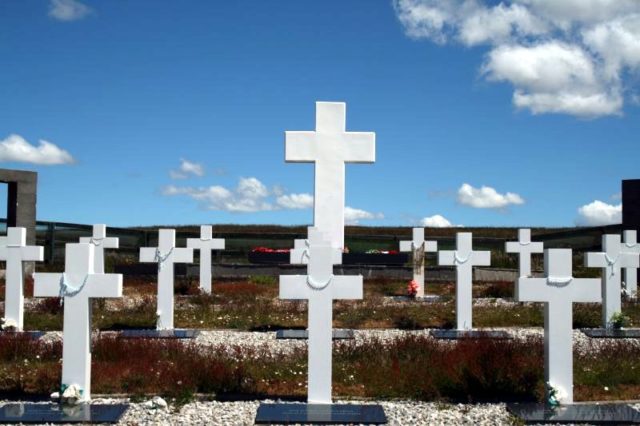
Cemetery north of Darwin where most Argentinian casualties of Goose Green are buried

On May 26, the 2nd Battalion of the Parachute Regiment (2 Para) under Lieutenant-Colonel Herbert Jones started to do just that. The Argentines were in for a surprise!

Or so Jones thought until he turned on his radio.

He had tuned into the BBC World Service, which was happily telling the world that the 2nd Para was poised to launch a surprise attack on Goose Green. So much for surprises!
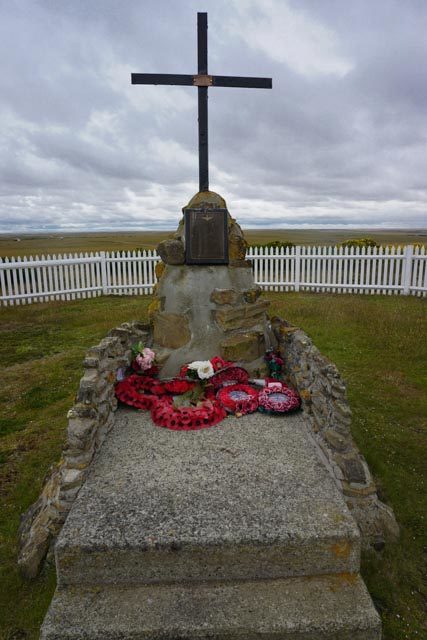
Memorial to 2 Para Group, west of Darwin
Memorial to 2 Para Group, west of Darwin Photo Credit

Now what!? The 2 Para knew they were greatly outnumbered. Their only advantage lay in surprise, but that clearly went the way of the dinosaurs.

After a healthy round of cussing, Jones vowed to sue the BBC for treason. Ditto with the War Cabinet. Oh, and the entire Thatcher government.

Piaggi was listening to the same broadcast and shook his head in disbelief. Did the British really think he was that stupid!? Hah!

They were obviously going to attack somewhere else and were using the announcement as a diversion. So he told his men to relax.
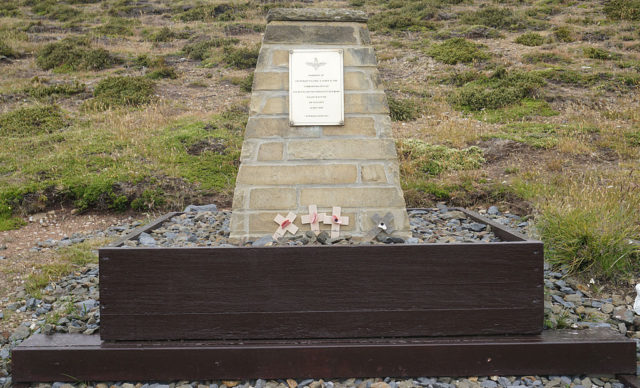
The spot where Lieutenant Colonel Herbert Jones died, now a memorial
The spot where Lieutenant Colonel Herbert Jones died, now a memorial 

They were still doing just that when 2 Para attacked. Jones had gambled that Piaggi would think as he did and it paid off.


Piaggi surrendered on May 29 – which, by an interesting coincidence, happens to be Argentine National Army Day.

Thus ended the Battle of Goose Green but it came at a hefty price.

Jones and 17 other Britons died at the cost of 45 to 55 Argentines.

Back in Britain, there was fury over the incident as politicians were rightly accused of wasting British lives for a propaganda stunt. 

Sunday, February 9, 2020

How France Helped Argentina during the Falkland War.

I ran across  this article on the Falkland war, I have blogged before about the Falkland war, and I knew that France had supplied many weapons to the Argentinians, including the Exocet that had a lethal reputation that was proven during the resulting Falkland war.  Even back then when I was a sophomore in High School during the Falkland War, I had a wishy washy image of the French and wondered if they were helping the Argentinians because the French have a history with the British and it wasn't sunshine and rainbows.  After reading this article it kinda confirmed the initial impressions.  I also had the same opinion because the French supplied the Iraqi's.  I wondered if they played both sides against the middle because it would help France if the United States was lessened by a bloody battle/war in the Persian Gulf against Saddam Hussain. Yes I know that the French had the Foreign legion here to help and they did exceedingly well from what I know.  But the French had sacrificed the legion before in Vietnam and the surrounding areas due to the Indochina War and Algeria due to politics. 


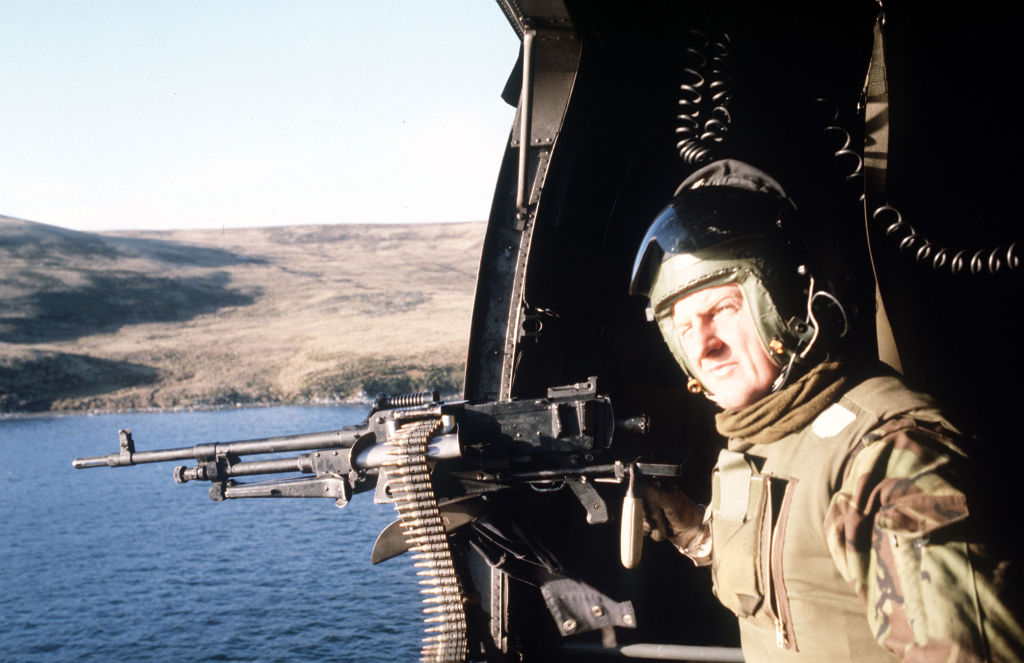
A crewman mans a General Purpose machine gun mounted in the hatchway of a helicopter on patrol over San Carlos Water during the Falklands conflict.   (Photo by PA Images via Getty Images)
A crewman mans a General Purpose machine gun mounted in the hatchway of a helicopter on patrol over San Carlos Water during the Falklands conflict. (Photo by PA Images via Getty Images)
During the 1982 Falklands War, the British were able to reclaim their territory from invading Argentinian forces.
During the war, the British received support from France but formerly secret documents show that the French may have been working both sides of the conflict.
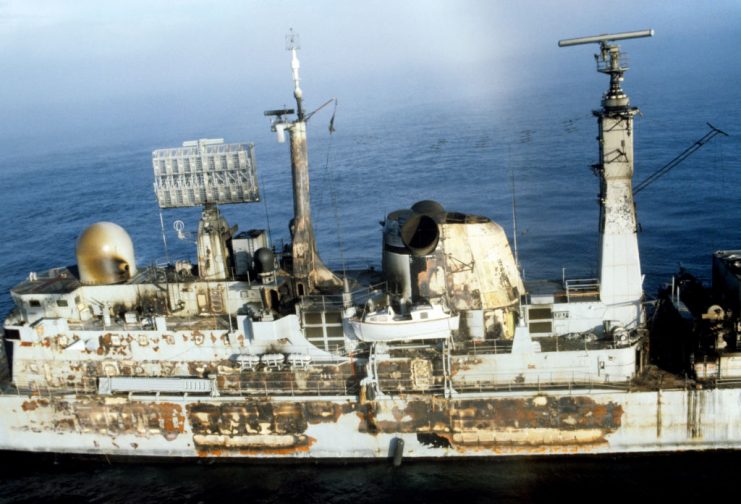
In May of that year, the Argentine forces used Exocet missiles during an airstrike that killed 32 people. The missiles were fired at the British ships HMS Sheffield and Atlantic Conveyor.


HMS Sheffield after being hit by an Argentine Exocet missile in the South Atlantic. (Photo by Martin Cleaver – PA Images/PA Images via Getty Images)
HMS Sheffield after being hit by an Argentine Exocet missile in the South Atlantic. 
The missiles were sold to Argentine by France prior to the war before it seemed likely the two countries would enter into combat with each other.
When the war began, France embargoed weapons sales and support for Argentina. They also allowed the British to use French ports in West Africa and provided them with information on the weapons and planes that they had sold to Argentina.
French President Francois Mitterrand made the decision to aid the British. While the UK’s Secretary of State for Defence Sir John Nott praised France as being the UK’s “greatest ally,” members of the French government were not pleased with their president’s decision.
The French ambassador to London, Emmanuel de Margerie, wrote a scathing description of Margaret Thatcher as “Victorian, imperialist, and obstinate” with a “tendency to get carried away by combative instincts.”
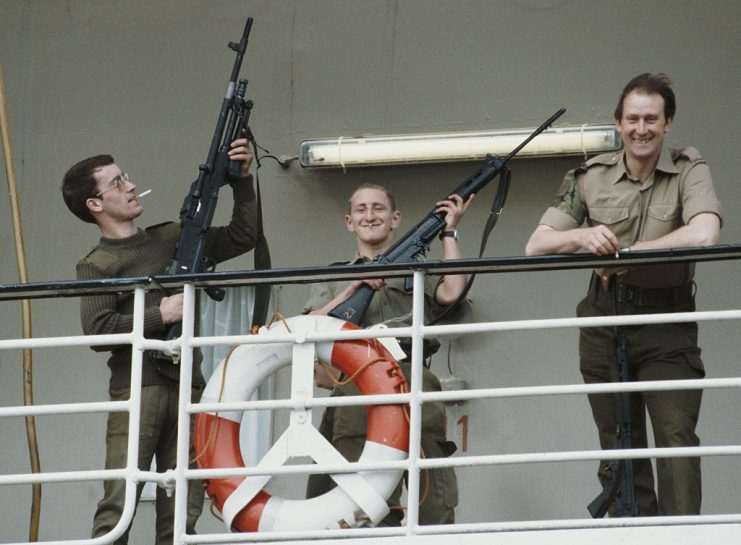
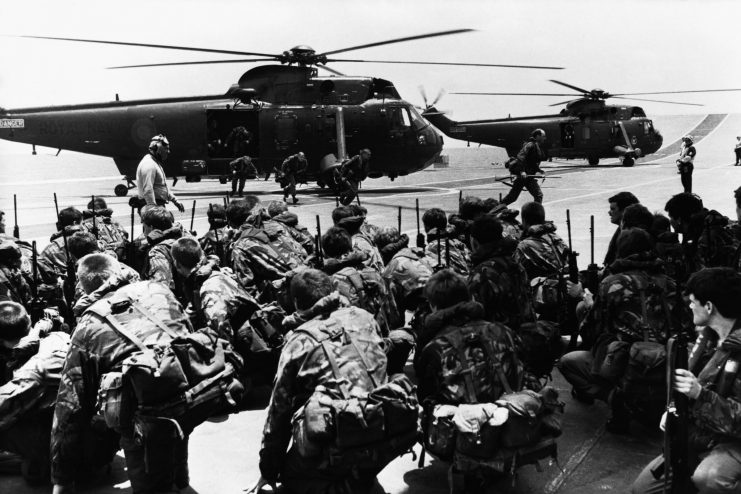
A group of British soldiers show of their rifles as they stand on the deck of the RMS Queen Elizabeth 2 (QE2) before the ship departs for the Falklands, from Southampton docks on Wednesday, May 12, 1982. The QE2 took part in the Falklands War during 1982, carrying troops and volunteer crew to the South Atlantic conflict, with her decks converted into three helicopter landing pads. (Photo by Bryn Colton/Getty Images)A group of British soldiers show of their rifles as they stand on the deck of the RMS Queen Elizabeth 2 (QE2) before the ship departs for the Falklands, from Southampton docks on Wednesday, May 12, 1982. The QE2 took part in the Falklands War during 1982, carrying troops and volunteer crew to the South Atlantic conflict, with her decks converted into three helicopter landing pads.French official Bernard Dorin decried Britain’s “superpower arrogance” and their “profound contempt for Latinos.” He made these claims in a document titled, “The Falklands: Lessons from a Fiasco.”
A BBC investigation has uncovered evidence that, even though the embargo was in place, a team from France worked with the Argentine troops in the Falklands during the war. The team allegedly tested the missile systems to ensure they would fire.

Three of the missiles failed and the team repaired the issue which allowed the missiles to be used against British troops.
During the war, 659 Argentinian and 253 British troops were killed.
The Falklands War began when Argentinian troops invaded the Falkland Islands on April 2, 1982. The Falklands are a British territory located in the southwest Atlantic Ocean off the coast of Argentina.
Argentina has long claimed rights to the islands, which they call Malvinas. Argentina inherited the islands from the Spanish crown in the early 1800s.

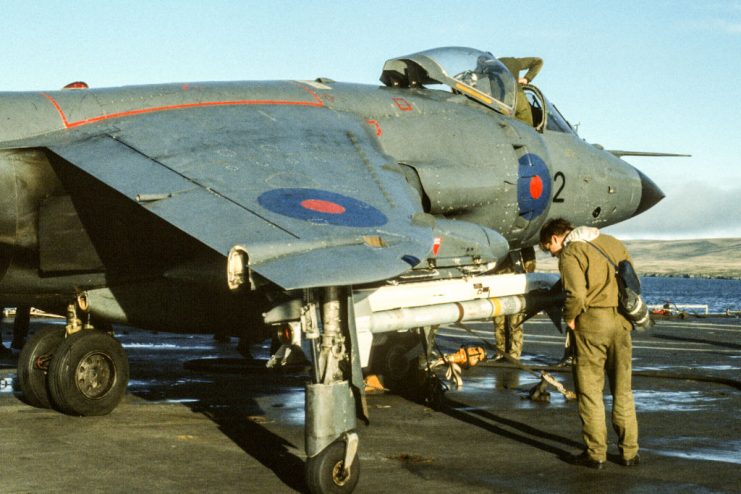
Sidewinder missile on an 800 squadron Sea Harrier aircraft landing on HMS Fearless L10 during the Falklands War 1982. It was unable to land at the damaged Sheathbill air strip, the pilot was Lt-Cdr Neil Thomas. (Photo by Terence Laheney/Getty Images)
Most of the residents of the Falklands are of British descent. Britain claims rights to the islands based on their long-term administration of them and on the principle of self-determination for the islanders.
Argentina did not believe that the UK would respond with force if they invaded the islands. But, despite being 8,000 miles away, British Prime Minister Margaret sent a force of warships and hastily refitted merchant ships to reclaim the British territory.

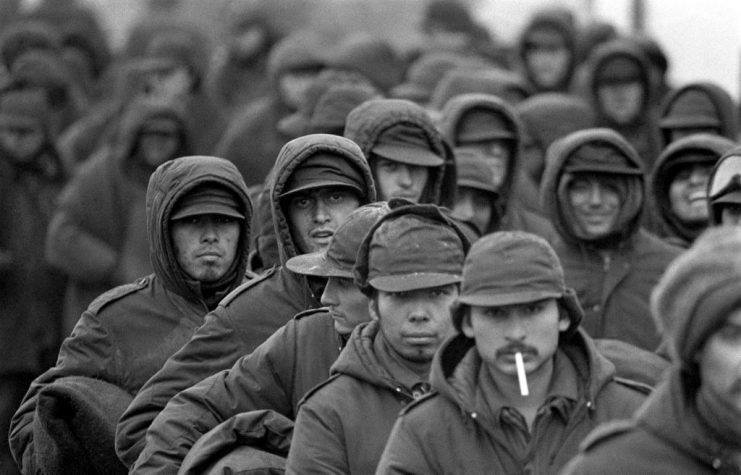
A hint of a smile on some of the faces of these Argentinian prisoners of war at Port Stanley, capital of the Falkland Islands, waiting to be repatriated via Montevideo. . (Photo by PA Images via Getty Images)
The British submarine HMS conqueror sank the Argentine cruiser General Belgrano on May 2, 1982. 300 crew were lost with the ship. After that, the Argentine military kept their ships in port.
But the Argentine air force was still a threat to the British. Their aircraft sank several British warships, including the HMS Sheffield with an Exocet Missile, whom the Frigate's Friend or Foe system wasn't updated to classify the Exocet as "Foe"

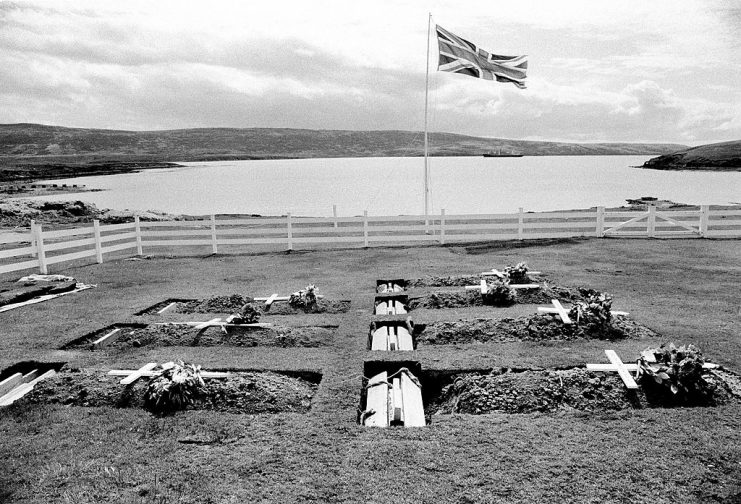
The Blue Beach War Cemetery in Port San Carlos in the Falkland Islands, October 1982. In the foreground (right) is the grave of Lieutenant-Colonel H. Jones (1940-1982), who was posthumously awarded the Victoria Cross. (Photo by Tom Stoddart/Getty Images)
Still, the British were able to land on the Falklands on May 21, 1982. The conscripted Argentinian troops had plenty of time to dig in and fortify their defenses but they were not trained well enough to defend against the oncoming British forces.
On June 11, 1982, the battle for the capital, Stanley, was underway and the Argentinians surrendered on June 14, 1982

Tuesday, October 31, 2017

I have Blogged several times in the past about the Falkland War, it was the first war to me that I really paid attention to.  I was a sophomore in High school and also in JROTC and we used the lessons of the Falklands as lessons, especially with logistics and what is called "The Intangibles" in this case morale and fighting spirit.  By all rights the British should have lost the war, they were operating on shoestring logistics string, their military was worn out by years of neglect because the British government had other priorities rather than their NATO commitment.  It was a malaise that had affected all of the west.  The United States had started to rearm under President Reagan after years of neglect and Britain had just elected Margaret Thatcher, the "Iron Lady", and she was trying to bring back the British after years of failed socialist policies. 


The Falklands War is looked back on by many as a foregone conclusion. Lasting only ten weeks, and it resulted in a clear British victory. But this war between Argentina and Britain could have gone either way. As Major-General John Jeremy Moore, commander of the British land forces in the war, put it, “It was a very close-run thing.”

Before the war, Britain was reducing its commitment to the Falklands and nearby South Atlantic territories. Many Falkland Islanders had lost their British citizenship in the 1981 British Nationality Act. More important militarily, British naval power was being withdrawn from the region. Ice-breaking ship HMS Endurance, the only Royal Navy ship permanently stationed in the South Atlantic, was about to be scrapped. Wider cuts, including the impending loss of two aircraft carriers, indicated a retreat by Britain’s navy.

Argentina had a huge advantage in manpower. During the initial invasion, the Argentines committed 600 ground troops against a British garrison of 85 Royal Marines, 25 members of the Falkland Islands Defence Force (FIDF), and around a dozen retired members of the FIDF.

With their homeland so much closer, the Argentines were more easily able to get troops into the combat zone.


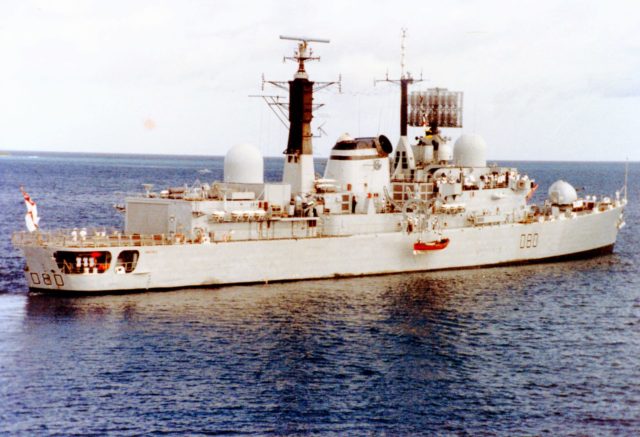
HMS Sheffield, which was sunk during the conflict. Wikipedia / NathalMad / CC BY 3.0
HMS Sheffield, which was sunk during the conflict. Nathalmad – CC BY 3.0

Faced with overwhelming odds, the British put up little defense. Sir Rex Hunt, the British Governor, negotiated a surrender within 12 hours of the invasion. Though a group of Royal Marines initially remained uncaptured, they destroyed their weapons and surrendered rather than risk civilian lives in a fruitless fight.
In less than a day, the Argentines had gained control of the islands, and so the advantage of holding defensive positions.

Given the distance from Britain to the Falklands, the Chiefs of Staff of both the British Army and the Royal Air Force believed that retaking the islands was unrealistic. Lack of political confidence could have led to an instant Argentine victory, if not for the strong views of others, in particular, British Prime Minister Margaret Thatcher.


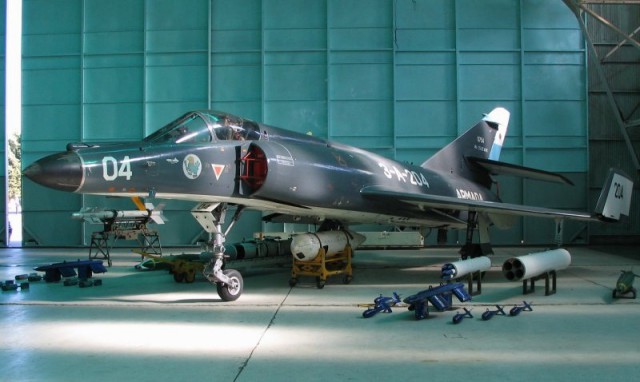
French-built Super Étendard of the Argentine Naval Aviation
French-built Super Étendard of the Argentine Naval Aviation. Martin Otero – CC BY 2.5
The Falklands War was enough of a conventional conflict for bombing raids to be important, against both enemy ships and land-based targets. Again, geography gave the advantage to the Argentine forces. Bombers could reach the Falklands from Argentina and hit their targets in a single run. Reaching the Falklands from the UK involved a complex refueling operation, in which around a dozen aircraft set out for every one that got as far as the target.

The British forces suffered several setbacks. An attempt to retake South Georgia, another of the islands seized by Argentina, led to failure on 21 April. Elite troops were landed, but had to be picked up again due to extreme weather, and two helicopters were lost in the operation.
Plans to attack the air base at Tierra del Fuego, on the Argentine mainland, were abandoned before they even began, and a similar mission led to a British helicopter crew surrendering themselves to Chilean authorities.


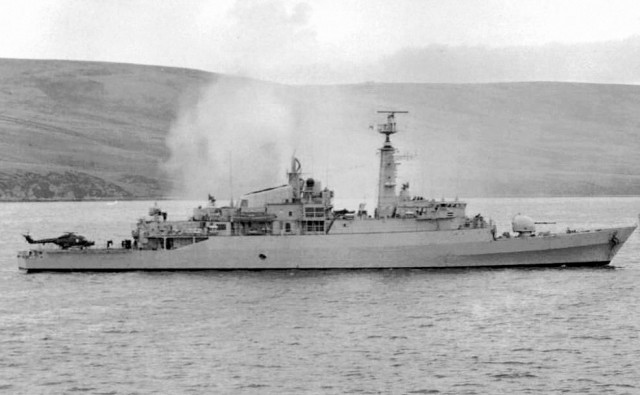
HMS_Antelope_1982
HMS Antelope smoking after being hit, 23 May 1982.
In the Falklands, the British Royal Navy suffered its first losses of ships since the Second World War, nearly four decades earlier. The HMS Sheffield was lost on 10 May, HMS Ardent on 21 May, HMS Antelope on 24 May, HMS Coventry and MV Atlantic Conveyor, a cargo vessel carrying helicopters and other important supplies, on 25 May. The loss of the Atlantic Conveyor was particularly significant, as it forced the army to advance on Port Stanley by foot.

Superior morale helped bring the British victory, but even in this, the sides were closer than expected. When the British attacked Mount Longdon on the night of 11 June, they expected little resistance due to poor morale.
The spirit of the Argentine defenders was strong, and instead of an easy victory the attackers faced a grueling twelve-hour battle, from which Brigadier Julian Thompson almost called the retreat.
The war was fierce and brutal, often fought at close quarters with bayonets and grenades. During the fighting at Two Sisters, Private Oscar Ismael Poltronieri held up a whole British company with gunfire, for which he won the Heroic Valour in Combat Cross, Argentina’s top medal for courage.

The Battle of Goose Green was the first major British victory of the war, but it was almost blown by a news report. The BBC World Service, hearing of plans for the attack, reported them to its global news audience. This almost led to the assault being called off. It could easily have led to stronger resistance at Goose Green, if not for the fact that the Argentinians believed the report was a British bluff.


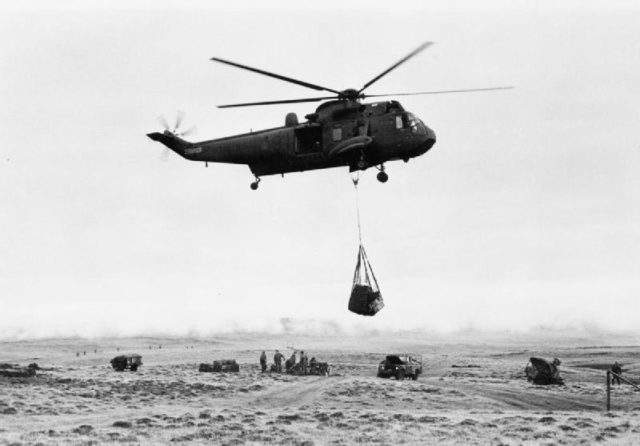
British Helicopter Dropping Supplies. Wikipedia / Public Domain
British Royal Marines arriving at Goose Green.

If the British were expecting an easy win at Goose Green, then they were mistaken. Argentine troops put up a strong defense, stalling the initial assault. The first attempt to give the attack fresh energy failed, and its leader, Lieutenant-Colonel “H” Jones, was killed in the fighting.

Conducting a war so far from home, the British could not easily be resupplied. By the end of the war, they were low on food and ammunition, many down to a handful of bullets. If the Argentine forces had held out a little longer, the British troops would have run out of resources with which to fight.

If not for a failure of discipline, the Argentine forces would have held out long enough to wear down the British. Their Army Code forbade surrender while they retained 50% of their men and 25% of their ammunition, and on 14 June they were specifically ordered not to surrender.
They surrendered that very day, rather than face the poorly supplied but fierce looking British.