I have said this before, My Wife has commented quite a few times, that I am a throwback from an earlier age where manners and "Chivalry" were expected in all things. I see how people act now and I am dismayed but I can only handle *me* I can't can't fix or correct other people, it is not my place. However when I read this article, there were things I even didn't know.
I got this one from the "Art of Manliness"
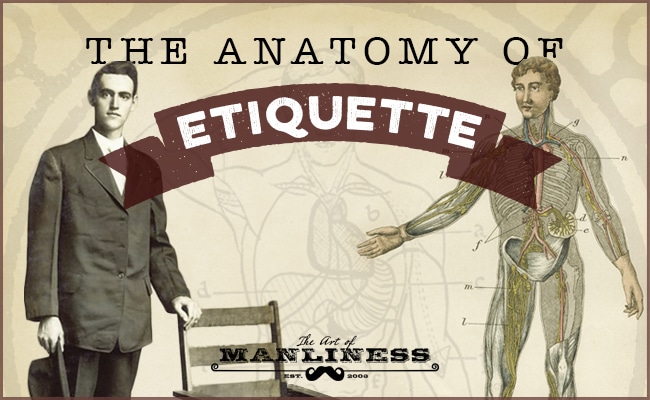
Editor’s note: There are a lot of ways to categorize the rules of etiquette: business, dinner, conversational, and so on. One of my favorite old etiquette books included another, most clever method: by your anatomy. In Esquire Etiquette, which was published in 1954 in Great Britain, there’s a section that breaks down a man’s essential manners by body part. It’s a little long, but a cheeky and very enjoyable read. And while some of the advice is quite old fashioned (not many men today wear a hat they can alternately tip and lift), much of it still remains relevant for those who aspire to be old school gentlemen.
“The Anatomy of Etiquette”
From Esquire Etiquette: A Guide to Business, Sports, and Social Conduct, 1954
Here are the bare essentials of everyday etiquette in everyday social intercourse – the firm skeleton which remains after all the impractical embellishments of other days have been stripped away:
Your Head
Take off your hat (civilian, that is) whenever you are indoors, except in a synagogue and except in places which are akin to public streets: lobbies, corridors, street conveyances, crowded elevators of non-residential public buildings (department stores, office buildings). Apartment house elevators and halls are classed as indoors, and so are eating places!
Take it off whenever you pray or witness a religious ceremony, as at a burial, outdoor wedding, dedication. Take it off whenever the flag goes by. And fergodsakes take it off when you have your photograph taken for the place of honor on her dressing table – and take it off before you kiss her!
Lift it momentarily as accompaniment to courtesies when hello, goodbye, how do you do, thank you, excuse me or you’re welcome are expressed or understood. The gesture is to grasp the front crown of a soft hat or the brim of a stiff one, thus to lift the hat slightly off and forward, and simultaneously to nod or bow your head as you say (or smile) your say.
Whenever you perform a service for a strange woman, or ask one—when, for example, you pick up something she has dropped on the sidewalk, or ask her (indirectly) to get her bundles the hell off that vacant bus-seat—you tip your hat to acknowledge her thanks or to give yours. Whenever you greet in passing or fall into step with a woman you know (your wife included), you tip your hat. In fact, the tip of the hat is a must for all brief exchanges with women, known or unknown.
A man rates your hat-lift, too, when he has performed some service for the woman you’re with—when he’s given his bus seat to your wife, for instance (in which case you should give him a card to your psychiatrist, as well). And also when he has been greeted by your woman companion, you tip your hat whether or not you know him. If she stops and if she introduces you, your hat comes off—but this is because you are standing and talking with a woman.
Ordinarily, you don’t lift your hat to and among men, when no women are present. It would be awkward to lift hat and shake hands, and men usually shake hands in greetings and goodbyes. A polite young man lifts his hat to an older man, however, and an abbreviated hat-tip (more like a loose salute) is always a friendly gesture from one man to another.
Your Feet
Hop to them whenever a woman enters a room where you are sitting, and stand on them until she sits or goes. An old school gentleman never sits unless and until all women in the room are also sitting; and then, unless he is in his own house, he sits only on invitation. A modern man adds a layer of good sense to that layer of good manners. He sits down at crowded cocktail parties when the standing women and the standing hostess are in groups apart. He only half-stands when, pinned behind a restaurant table, a woman pauses to say hello to anyone in his group. (To stand all the way would be more comfortable for him but less comfortable for the woman, because she would have to apologize for causing a big table-moving fuss.) He doesn’t hop up and down every time his wife passes through the room during a quiet evening at home. (But he does act the gentleman-in-good-standing when outsiders are present, or when he’s trying to set an example for his sons, or when she makes her first entrance or greeting.) And he probably has a separate, lesser set of manners for strange women in public places: he keeps his seat on the subway except for an old or pregnant or obviously overburdened woman (but he doesn’t knock even the youngest woman down in a race for the seat!) . . . he keeps his seat in public lobbies unless a woman greets him or speaks to him from on high . . . and he doesn’t interrupt his work to stand for non-social exchanges with women.
Stand up for men, too, for introductions, greetings, leave-takings. This “comes natural”; it’s not comfortable to shake hands from a sitting position, so you stand whenever a handshake is imminent.
Stand up when someone, man or woman, is trying to pass in front of you in a row of theatre seats. Only a very small child can squeeze between your knees and the next row of seats in the usual theatre, no matter how tight you think you’ve drawn yourself up.
Walk on the street-side of the sidewalk when you can do it gracefully. There are few run-away horses, these days, but there are still splashing puddles and other terrors of the street from which you can “protect” your woman companion. It is better, however, to walk on the inside than to convert a simple stroll into a ballet: don’t cross back and forth behind her or be forever running around end just to get into position. The rule is supposed to be for her comfort and her safety; she finds nothing comfortable about talking to a whirling dervish, and nothing particularly safe about leading the way through traffic while you’re running around her heels. Keep her on the inside and/or on your right if you can, but remember that it’s better to have her on your left and on the outside than to shift positions every ten feet, as strict observance of the rules might sometimes require.
Your Hands
Shake hands for all introductions and all goodbyes to men—but don’t ever offer your hand to a woman unless she extends hers first. When she holds out her hand, you’re supposed to do the shaking: two or three short up-and-down movements will do it—no pump, no crush, and no lingering. Try to remember that she probably has rings on her finger—even your junior bear-trap grip can turn her smile into a wince. (Your fellow-men are not too pleased with bone-crushing contests, either.) Don’t, of course, kiss a woman’s hand unless you are a Continental, and a not-too-far removed one at that. For anyone else, hand-kissing is an affectation. Besides, you might get it wrong and kiss a single-girl’s hand when the treatment is supposed to be for married women only.
Give your hand to a woman, palm up, as a kind of rest or ledge for her hand when you help her down from busses, out from cabs, down into boats, and so on. In these situations, you precede her so that you can be in a position to help and, naturally, you offer your hand first. But as soon as she has regained her balance, let go. Hand-holding comes later.
Put your hand under a woman’s elbow almost never. Modern women do not like to be steered; they hate this bastard version of offering your arm, and they find it more hindrance than help in stepping off curbs and crossing streets. Fastidious women are annoyed on another account: they do not like to be touched meaninglessly. The only time you can properly cup your hand under a woman’s elbow is when it is absolutely necessary to boost her upward—when she has begun an actual fall, for rare example. Caution: when the gesture seems most necessary, it will probably be most resented; the girl in the narrow skirt, trying to mount a high bus step, needs her hand for lifting the skirt—your unwelcome elbow-grip will really immobilize her!
The conventional form of offering your arm has just about gone out. You do it only at formal dinners or at the grand march for a costume ball. At such times, you offer your right arm, bent at the elbow and with forearm parallel to the floor. She links her arm loosely through yours and away you go. Once away from college campus or country beer party, you and your lady-fair seldom walk in public with arms linked.
Your hands are an important part of your dancing position. Your left or leading hand should hold hers lightly and naturally; contorted positions make bad manners as well as bad dancers. Your right or holding hand should be placed firmly yet loosely just about her waist—not grappling her neck, not sticking to her bare back and certainly not slid underneath her jacket. What you do with your hands when you’re off the floor is something else again, but while you’re dancing your manners matter—to onlookers and to your partner, if not to you.
Hands in repose belong in your lap at the dinner table, at your sides when walking or standing. It’s all right to put your hands in your pockets or fold your arms or clasp hands behind back sometimes, but watch out for the unconscious hand mannerisms which could be offensive to others or unbecoming to you: the sloppy look of a man whose hands are always buried in his pockets . . . the pompous look of the man who always talks over pressed-together fingertips . . . the barbershop look of the man who at any time in public picks at his ears or buffs his nails or pats his hair or strokes his chin.
The helping hand, the basis of most etiquette situations between men and women, is not so simple as it once was—perhaps because women are not so simple as they once were (or once pretended to be). As often as not, the modern woman forgets to give time for the correct or the courtly gesture: she opens the door because, preceding you, she reaches it first; she hops out of the car before you’ve had a chance to walk around and help her out; she slides into her coat before you know she’s ready to go. At such times, with such women, your insistence on the letter of etiquette will squelch her spirit; she’ll feel awkward, embarrassed at her own commendable casualness, if you make a Thing of your helping hand. But at other times, or with other women, hesitate and ye are lost. A nice sense of time and place is your greatest asset in this area. Here are the rules, but—caution: use only as expected:
1. It’s “ladies first,” except when your going first is in form of service to her. Thus, when there’s a waiter to lead you to a table or an usher to lead you to your seats, you fall back and let her precede you—but when there is no one else to perform the service involved, you go first in order to find the table or the seats. When the path is clear and unobstructed, ladies first; but when there’s a mob to be elbowed or a puddle to be forded or a steep step to be navigated, gentlemen first.
When you go first, however, be sure that the reason for it is apparent. You get off the bus first so you can help her down to the curb, not so you can be the first to reach the bar on the corner. You go first down the steep stadium steps so you can hand her down as you go, not so you can lose her in the crowd. If she’s behind you, keep her close behind and make it clear that you are helping her. If there can be any doubt in her mind as to the reason for your going first, say something like, “These stairs are pretty dark; maybe I’d better lead the way.”
2. Hold all doors for her. The classic maneuver requires some cooperation on her part, however, because “ladies first,” she arrives at the door before you. She steps slightly to one side, so that you can reach the doorknob and so that the door can open toward her without knocking her down. You open, she passes through, you follow—and on to the next door. If she doesn’t pause or step aside, if she grasps the doorknob herself, the best you can do is to pull further open the door which she has begun to open. That much you should attempt—and you should never let her stand holding the door as you pass through!—but let her set the pace by her approach to the door. That is, don’t knock her over to reach the door first, don’t brush her hand off the knob, don’t get into the “allow-me” type of conversational help, and, whatever the situation calls for, don’t make a Thing of it. One more don’t: don’t expect her to be consistent. Just because she opened the last three doors, foiling all your efforts to play the gallant, don’t be surprised if she waits expectantly before yon magic-eye door. Your job is to be ready and willing at every door, and to let her specific conduct be your guide at each one.
When the door pushes in, rather than opening out, you could correctly precede her through the door in order to hold it for her. More than likely, however, she will push ahead and you will have only to extend your arm over her head to take the door’s weight from her as she passes through. Try not to get into that ungainly position of standing at the sill, trying to hold a push-door in front of you and forcing her to duck under your arm. This is not the minuet or London Bridge, after all, but just a helping hand. When the door is revolving, reach out and slow it down so that she can step in, then give a push on the piece in front of her, so she can walk through without effort. (If you push on the piece behind her, you might unwittingly knock her off her feet; if that’s your aim, pick a better place than a revolving door.)
When the door, whatever type, is in a public or crowded place, remember that your duty is to your woman, not to the public at large. Follow her through the door. If you exaggerate your etiquette into holding the door for the next woman behind you, and the next and the next, your gal will be standing along and lonely in the lobby crowd. Look behind you as you pass through, of course—you don’t want to let the door fly in any face, male or female—but get on with it.
Car doors produce special problems, but only if you let them. When you are in the driver’s seat and she beside you, you are supposed to get out on your side, walk around the car, open her door for her, and then—if the step is steep or the exit otherwise difficult—offer your hand to help her out. This convention presupposes country roads and front-door parking, however; edit it to suit the circumstances when you’re in clogged traffic.
If you can’t park there long enough to give the full treatment, it’s all right to reach across her to open her door—explaining as you go. And if there’s a doorman to open her door, or if she opens it herself without ceremony, relax.
When you’re both passengers, and there’s no doorman, you should get out first—even if she’s closer to the door than you—so you can hold the door and help her to the curb. When the doorman is on the job, she goes first unless you’re closer—in which case you step to the street and either help her down or stand attentively as the doorman helps her. Even if you’re going on and are merely dropping her off, get out with your helping and your goodbyes. Unless you’re driving, and it is obvious that you can’t leave your car unattended in mid-traffic, you shouldn’t sit at ease while she alights and takes flight.
3. Hold all chairs for her, when she sits and when she rises. The idea of holding a chair for a sitting duckie, by the way, is not to trip her off her feet by jabbing the chair edge into the back of her knees. Nor is it to contribute to her sense of insecurity by letting her sit into space. Just pull the chair back as she steps into place in front of it, then push it under her (without touching her with it) as she bends her knees to sit. In reverse order, the technique is the same when she rises; don’t yank the chair back with her in it and don’t push it back under the table until she has stepped out of range.
Again, the gesture is what counts with an independent dame. She slides into a chair before you’ve had time to hold it for her, but she may still take it amiss if you then slide into yours; your best is always to walk around behind her chair, to help her off with her coat if not to make one final adjustment of the chair’s position. If you’re not going to do that, do nothing. The common practice of reaching across the table—in the vague direction of the back of her chair, which you couldn’t possibly reach—is ungainly and serves only to remind her of the larger gesture she might have let you make.
Needless to say, you don’t “hold” sofas, built-in wall seats or anything which cannot be moved out for easier seating. All you do, then, is see that she is seated before you sit.
4. Help her in and out of her coat. Again, the extent of your help is up to her, but even for the most determinedly helpless frail you should not fluff her hair outside her collar as if you were her lady’s maid, or reach under her coat and pull down her jacket as if you were a barbershop porter, or chase her flailing arms about with the coat as if you were roping a calf. Just hold the coat. Hold it right side up and in shape, so she doesn’t have to be an acrobat to get into it; hold it a little lower than shoulder height, so she doesn’t have to use a back stroke to reach the sleeves; pull it up onto her shoulders once her arms are started into the sleeves—but let her get into it herself. She doesn’t want you to dress her—not right now, anyway—so content yourself with being a coat rack, not a valet.
5. Man is a beast of burden, but he got a break during the war when it was widely understood that a man in uniform did not carry packages. No longer must you snatch every odd package from every woman you walk so much as two steps with. Let her carry her own junk, if she’s so graceless as to be toting on a date; she won’t be as uncomfortable under her light burden as she will be if you insist on looking like a dray horse when she’d rather be with a man. Of course, you should still relieve her of heavy things—suitcases, briefcases, books and magazines which give her too many things to carry. If she’s your wife, or if you’d be proud to have someone think so, you should carry the biggest bag of groceries and push the heavy baby carriage. If you think it’s safe, you can still make the gesture toward odd parcels, coats, umbrellas and model’s hat boxes. (“Is that too heavy for you?” is safer than “Here, let me carry that.”) But if there’s a chance she’ll say “yes,” rest in this peace: a man of good modern manners totes for milady only when his strength is needed, not when she could carry the stuff as effortlessly as he.
6. It’s the man who pays, but not necessarily for expenses which come up during a chance encounter with a woman. You’re not expected to pick up the check when you have only happened on to her at the drugstore lunch counter, nor to buy her train ticket if you find that you’re both going out of the same station. It’s not bad manners to make a move toward paying a small expense—her bus fare, say—but it is by no means necessary and, with modern women hipped on “independence,” it can make them sorry they saw you. They will be embarrassed, as well, if you come up with money for the cleaner, the shoe-repair man or the butcher when you catch them at their errands; they might like to be “kept” women, but not on that small and public scale! In any case, don’t protest if a woman says she has the money ready or otherwise indicates that she doesn’t want you to pay. The Big Scene over the Small Sum is especially silly when it stems from the mistaken idea of gallantry.
Your Ears
The man who believes everything every woman tells him needs more than an etiquette book to straighten him out, but these are the times which try men’s credulity. You want to take her at her word but it’s good manners not to when she says:
“Please don’t get up”—or, if you have already struggled to your feet, “Please sit down.” No matter what she says or how much she meant it, you gotta stand while she stands. If she really meant it she’d sit or leave, so you could relax.
“Don’t bother—I can manage.” She probably can, but if you stand by while she does it all herself, and it is a struggle for her, you’re going to look pretty silly to people who haven’t heard her protests.
“You go ahead; I’ll be all right.” This in all its variations is supposed to excuse your leaving her alone on the dance floor or letting her find her way home by herself or setting her free to free-lance in any situation where your firm duty is to take care of her. Nine times out of ten it doesn’t excuse you even in her mind (to say nothing of her parents’ or her friends’); she expects you to insist—in action, not words. The tenth time, when she really means it and it’s really impossible for you to live up to your normal good manners, you’ll know it’s all right to “go ahead.” Even so, you’ll follow up by telephone or otherwise check to make sure that she made it all right . . . even so, you’ll try to make it up to her later . . . even so, you’ll decide it would have been simpler all around to do your duty.
Your Mouth
When feeding your face, the idea is to do it neatly, quietly, and all but incidentally. If anything bothers you about table manners, put the question to those three tests. If the technique makes a mess or noise, or if it calls attention to the fact that you are determined to stuff yourself, it’s bad manners.
For a man, a fourth general “don’t” assumes equal importance: don’t be prissy. Don’t cock your little finger or pat-pat your pursed mouth daintily with your napkin.
The way you eat is a matter of habit. That’s 99 44/100 per cent fortunate, because you’d probably starve to death if you had to think about every muscle and every move involved in the intricate process of propelling food from plate to mouth. But it’s 56/100 per cent unfortunate, too: if your unconscious eating habits are unattractive, even your best friend won’t tell you.
But you can tell; watch yourself for these signs of the four scourges of the dining table.
1. The Slob
Ties his napkin around his neck or tucks it into his vest. The napkin belongs in your lap during a meal, loosely laid to the left of your place when you leave the table. Whether paper or damask, it should neither be folded for reuse nor blithely tossed into your plate.
Leaves a sample of every course on the rim of his drinking glass. He sins on two counts: he drinks when his mouth is not empty, and neglects to use his napkin before using the glass.
Makes every mouthful a full course in miniature (and not so miniature at that). Instead, he should take small bites, chewing and swallowing each bite before he takes the next.
Forms a bridge from table to plate with his knife and fork when they are not in use—handles on cloth, working ends propped on plate. In his less virulent form he lays knife and fork on plate, as is correct, but so close to the edge that they fall off when the plate is removed.
Talks with his mouth full.
Cleans his teeth at the table—with toothpick or fingernail or by running his tongue around his teeth, with grimaces.
Spits out anything he doesn’t like. (You don’t have to eat the inedible of course, and if you must remove something from your mouth, first be sure that it bears no resemblance to regurgitated food, then grasp and remove it with your fingers—that’s the quickest way. Correctly you could take it out on the same spoon or fork it went in on, but this maneuver is too acrobatic for grace in most instances, and it runs dangerously close to spitting. Actually, you can usually cut out bones and stones before they get into your mouth. And you can manfully swallow something that offends your palate.)
Breaks crackers into his soup. If they are meant to go into the soup, they are meant to go in whole. You spoon them directly into the soup if they are croutons; if they are oyster crackers you put them first on your butter plate or on the cloth, then drop them in whole, a few at a time.
Eats messy things with his fingers. The best way to decide when to pick food up in your fingers (if you’re not content to follow your hostess’ example) is to decide in advance whether you can do it neatly. Picnics are something else again of course, and some foods like lobster are messy whatever your modus operandi, but with neatness as your guide, you can’t go wrong. The guide works both ways: it’s neater to pick up an ear of corn than to watch it skitter across the plate as you try to cut it; it is neater to leave the hard stalk of asparagus if you can’t cut and eat it with the fork as you did the tips. And if an approach by hand seems indicated, as with a sandwich or a piece of fresh fruit, it is neater to cut it into manageable sections before you pick it up.
Blows on his food, instead of waiting quietly for it to cool enough to eat.
Bites off the ends of a forkful of spaghetti, usually in mid-air. If he can’t cut it on his plate, or twist it around his fork in a neat and manageable ball, he ought to order ravioli instead.
Gesticulates and points with his eating tools.
Puts solid silver on the table. If there is no saucer under the cup (but there always will be) leave the spoon in the cup rather than placing it on the tablecloth. And never do the dishwashing or silver polishing at the table: if the implement is really not clean, ignore it as you would ignore a hair in your soup. (In a restaurant, of course, you may ask for another fork or send the soup back.)
Puts his mouth into the food instead of the food into his mouth. You shouldn’t meet your food even halfway. You bring it up to your erect head; you don’t duck down to meet it coming up.
2. The Racket-eer
Chews with his mouth open, making no attempt to muffle the noise (or conceal the sight) of his cement-mixer mastication.
Clanks silver on silver, or silver on plate. When he stirs his coffee he does it fiendishly, like a witch standing over a boiling cauldron, and every revolution of the spoon sets up a racket. When he puts his knife and fork down, you wonder that the force does not smash the plate. He winds up by scraping his plate with his fork. And if he’s the “helpful” as well as noisy type, his final sin against the eardrums is to stack his dishes, crashingly.
Slurps his soup. Suction is superfluous—just put the side of the spoon to your mouth and sip quietly.
Drums on the table, or cracks his knuckles, or chews on the ice from his water glass, or otherwise sounds off between noisy bites.
Pushes away from the table at dinner’s end, with both hands shoving against the table edge and the chair screeching across the floor. Instead, you should reach down and lift the chair back as you rise slightly.
3. The Pig
Digs in the moment he’s served. He knows he doesn’t have to wait for the hostess, who will be served last, but he’s apparently too hungry to remember that he should wait until two or three others at the table have also been served.
Pushes his plate away from him when he’s finished, as if to say, “Well, that was good, now what do we eat?” Instead, he should sit quietly and without rearranging the table, without pushing or tilting his chair back, and without loosening his belt.
Uses pieces of bread, tightly gripped in his hand, to mop up every last drop of sauce, every last morsel of food. His plate then looks as if it had just come out of the dishwasher. If his favorite food is bread and gravy, he may break off a small piece of bread, drop it into the sauce, then eat the bread with his fork—but he shouldn’t scrub or mop or use an unbroken slice of bread.
Spreads the butter on his bread in mid-air and all at once, as if intended to eat the whole piece in one bite. Except in the case of tiny, hot biscuits, bread should be broken and buttered only as needed—in quarters or bite sizes. It should be held against the rim of the butter plate during the spreading, not waved all over the place or held chest high.
Gnaws at bones, as if he’s afraid to miss the tiniest morsel of meat.
Sucks his fingers, on the same sort of compulsion. If he is so messy as to get food on his fingers, he should use a finger bowl and/or the napkin, not his lips.
Cuts up his whole plateful of food at one time, as if he couldn’t bear to stop eating once he had begun. Unless he is under ten years old, he should cut his food only as he eats.
Tilts his soup bowl towards him. Properly, he would tip it away from him, just as—properly—he would spoon the soup away from him. But this is not the shortest distance between two points, and the pig is blatantly starving.
Elbows his way through the meal. When he cuts, his elbows are like flapping wings. When he eats, his spare arm serves as a prop, enabling him to eat much faster. Elbows on the table are “socially acceptable” when you’re not eating, but the safest course is to keep your spare hand in your lap. While you’re eating, your elbows should be as close to your body as in a good golf swing.
4. The Priss
Purses his lips when he eats—in exaggerated “refinement.” He couldn’t look less pleased if he were eating cyanide or castor oil.
Leaves a little of everything on his plate, in terror of appearing greedy. What a waste! If he doesn’t intend to eat it, he shouldn’t take it.
Is always saying that he doesn’t like or “can’t eat” certain food. If he is not blessed with a catholic taste, or a genuine enjoyment of all foods strange and familiar, he should pretend that he is. The very least he can do is keep quiet about his allergies and his prejudices.
Is a hesitant, obvious copy-cat, making everyone else as nervous as he over which fork to use. It’s not that important. If you can do it unobtrusively, it’s all very well to watch your hostess or more knowledgeable guests to see how they handle certain unfamiliar dishes. But if your concentration on the fine points of etiquette is going to make you an inattentive conversationalist, shrug off your worries. It might help you to know that silver is placed on the table in the order of its use, the fork farthest from your plate, on the outside, being meant for the first fork food, the one on the inside for the last. If you are served both fork and spoon for desert you may use both (spoon for the ice cream, say, and fork for the meringue), or you may use the fork to hold the desert steady while you cut and eat with the spoon, or you may simply use whichever seems more appropriate. The butter plate and glasses on your right are for you; your salad, unless served as a separate course, is on your left. But no one worth knowing will care if you use a fork when a spoon was intended, and if you don’t get flustered and apologetic, no one will even notice.
Is afraid to use a knife on his salad because he’s heard it’s not proper. If there is a salad knife at his place, he can be sure that it is not only proper but expected. And if he can’t manage the salad neatly with his fork alone, it’s better to use his dinner knife than to emulate a rabbit, with lettuce hanging out of his mouth.