Webster

The Constitution was made to guard the people against the dangers of good intentions." --American Statesman Daniel Webster (1782-1852)


Showing posts with label Space Flight. Show all posts

Wednesday, January 5, 2022

30 Years Ago, The Fall of the Soviet Union Stranded a Cosmonaut in Space

 Last week I had Blogged about the fall of the Soviet Union and I ran across this article and it kinda segue into that blog post.

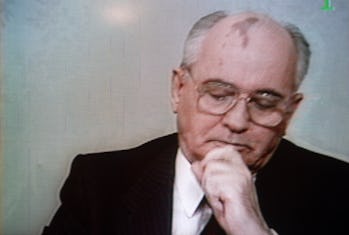
 It’s a familiar experience for many people in the northern hemisphere in December: Walking into school or work in the morning only to walk out again, hours later, under the emerging stars and set or setting Sun.But whatever your experience with the world-changing while at work — and that feeling of dislocation and familiarity, maybe a little depression — you’ve got nothing on cosmonaut Sergei Krikalev.Krikalev went to work on the Mir space station on May 18, 1991 and didn’t come home until March 1992. He went to work as a Soviet, and returned as a Russian — because, on December 26, 1991, the Soviet Union dissolved and Krikalev became a cosmonaut without a country.Going to work for the long shift— Krikalev, fellow cosmonaut Anatoly Artsebarsky, and British astronaut Helen Sharman climbed into their Soyuz capsule at the Baikonur Cosmodrome in Kazakhstan on May 18, 1991. At the time, Kazakhstan was still one of the “Soviet Socialist Republics.”The sky-bound cosmonauts and their astronaut guest had things other than politics on their minds. Their mission was the same as it is for most cosmonauts and astronauts aboard space stations: maintenance.“Cosmonauts, as astronauts, are generalists, and they're there to tend to scientific experiments,” National Air and Space Museum curator of space history Cathleen Lewis tells Inverse. They’re there to make sure experiments run, that the space station runs, and that their own bodies run — working out four hours a day to mitigate bone and muscle loss in microgravity.Krikalev’s days in the spring of 1991 were filled with exercise and conducting multiple EVAs to service the Mir space station. He had trained for, and planned on, staying aboard Mir for five months before returning to the Soviet Union and his native Leningrad. He would wind up staying in space for almost a year, returning to the new Russian Federation and a city returned to its name before the Bolshevik revolution, St. Petersburg.Empires fall slowly, then suddenly — The dissolution of the Soviet Union was not something anyone predicted, Lewis says. “Everything happens much like F. Scott Fitzgerald described going broke,” she says, “‘Gradually, and then suddenly.”In 1987, President Mikhail Gorbachev, then the Soviet Communist Party General Secretary, introduced a wide-ranging set of democratic and economic reforms that functioned, in part, to loosen the control of the Communist party over constituent nations in the USSR, including Baltic states such as Estonia and Latvia — and Kazakh Soviet Socialist Republic.While Gorbachev was pulling back, those nations were pulling away. There were riots in 1986 when Moscow replaced the leader of the Kazakh communist party, and the Kazakhs took advantage of lessening central political control to declare their nation a sovereign republic within the USSR in October 1990.Hardline members of the Communist Party of the Soviet Union, dismayed at Gorbachev’s efforts at reform (which included creating the office of president and his election to the post in 1990), would stage a failed coup in August 1991.Though Gorbachev retained power, the country was economically and politically weakened, and by December, the republics began to splinter into the Commonwealth of Independent States, an effort spearheaded by Belarus, Ukraine, and Russia, and signed by nine other former republics.Then, on Christmas Day 1991, Gorbachev resigned as president of the Soviet Union, 

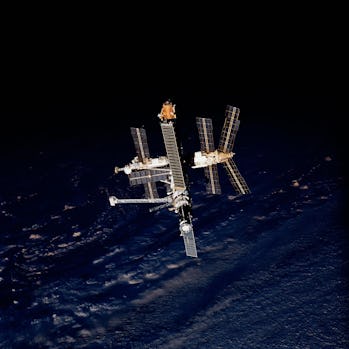
.Soviet President Mikhail Gorbachev looks downcast as he addresses the Nation to announce his resigna...Soviet President Mikhail Gorbachev announced his resignation as president of the USSR. How he came to stay — Before the August coup, before the fall of the Communist Party in Moscow, Gorbachev and his party tried to keep the USSR together. If he wasn’t going to roll in the tanks, that meant finding some carrots to dangle for nations such as the Kazakh Soviet Socialist Republic.Over the summer, Krikalev — who had spent 151 days aboard a previous Mir mission from 1988 to 1989 — was informed that the experienced cosmonaut that had been scheduled to relieve him had been bumped in favor of a less experienced Kazakh cosmonaut. He would have to hang on longer than his five months, end date TBD, for the sake of his country.MirThe Mir space station as seen from space in 1996.NASAKrikalev was less concerned with the political implications of this, Lewis says, than its implications for him personally. “He was more concerned about prolonging his mission and the impact that would have on his physical health,” she says. Bone and muscle mass deteriorate with time in space, and “he had trained for five months; he had not trained for a year-long mission.”Other cosmonauts would come and go over the next few months, but Krikalev would remain. Even after the fall of his country’s government. Even though the was a Soyuz lifeboat he and fellow cosmonaut Aleksandr Volkov, who was with Krikalev on December 26, could have taken home if they wished.But that would have meant leaving the Mir without a crew.“They were pledged to maintaining occupancy of the Mir, and it was continuously occupied for over 80 percent of the time that it was in orbit,” Lewis says. “The USSR had learned its lesson about leaving the station unattended in the experience of the Salyut-7 space station.”Left unoccupied, the Salyut-7 station malfunctioned and started tumbling out of control in 1985, threatening to make an uncontrolled re-entry that could have harmed people on the ground. A crew of cosmonauts was able to bring the station under control, and the Soviet space program was quite cognizant of the role the human element had played in averting disaster.Workers on the job above and below — The commitment of the people in the Soviet space program, both to preserving Mir and the space program as a whole, regardless of their government, was essential to keeping Krikalev alive and relatively well, even if he had to fly far longer than he had bargained for.“These people were still on the job, very dedicated to it,” Lewis says. Whatever successor state would arise in place of the former Soviet Union, “they recognized the need for the national prestige, to maintain the space station.”These were also very smart, highly educated people dedicated to working in space, Lewis adds. They had advanced degrees and were passionate about their work, even if they had been unable to make a real living doing it in years. In the late years of the USSR, she says, you could always get a ride from a pirate taxi, a pre-capitalist Uber, in Moscow, “and the likelihood would be that somebody with a Ph.D. in physics would be driving that car to make ends meet.”So Krikalev was hardly stranded alone and without contacts with the ground, even if they kept telling him they could not relieve him just yet.He also had use of a packet radio, a data sending radio device that he used to communicate with amateur radio enthusiasts around the globe, Lewis says. So while Krikalev may not have seen the fall of the USSR anymore than other observers, he may have been one of the better informed of its former citizens in the days and weeks following Gorbachev’s speech resigning the presidency.“That was a level of access with the ground, and with the broader community in the West and Australia, that previous cosmonauts had not had,” Lewis says.Krikalev’s next life — Finally relieved from duty, Krikalev returned to Earth in March 1992 a severely weakened man needing assistance to walk on the snow-covered soil of the Republic of Kazakhstan after 311 days aboard the Mir space stationKrikalev on the ISS
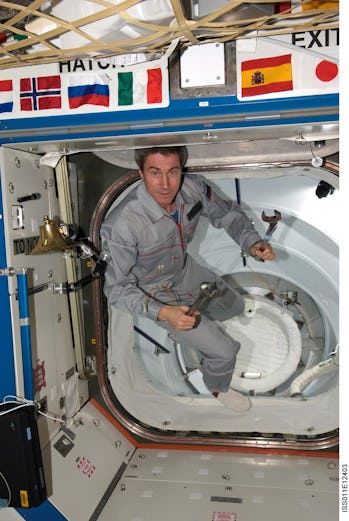
Krikalev on the International Space Station in 2005NASA

One might think that such an ordeal would lead a person to swear off space for good, but Krikalev would go on to more than double his time in space. He would fly on multiple space shuttle missions through the 1990s, representing the newly formed Russian Federation, and would serve as commander of the International Space Station in 2005. In 2007, Krikalev was named director of human spaceflight at the Russian state space agency, Roscosmos, a post he still holds.Krikalaev in 2019
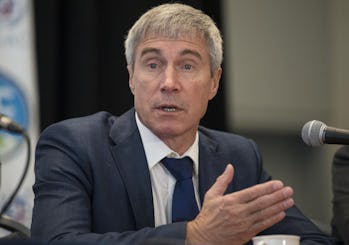
Krikalev representing Roscosmos at a conference in 2019. NASA

At 803 days, Krikalev currently sits third in the rankings of cumulative time in space, just below Russian Cosmonaut Yuri Malenchenko, in second place with 827 days, and Russian Cosmonaut Gennady Padalka, who holds first place with 878 days.

Krikalev is now 63, though “he still lives with infirmities” from his time in space, Lewis says. “He has to have his bone density checked.” But his legacy endures


Sunday, July 21, 2013

Apollo 11 engines located off Florida

This NASA file photo shows the first stage of the mighty Saturn V rocket used to launch the historic Apollo 11 moon landing mission in 1969 as the booster was being built. The five huge F-1 rocket engines were discarded into the Atlantic Ocean after the J
This NASA file photo shows the first stage of the mighty Saturn V rocket used to launch the historic Apollo 11 moon landing mission in 1969 as the booster was being built. The five huge F-1 rocket engines were discarded into the Atlantic Ocean after the July 16, 1969 launch.
Credit: NASA
When NASA's mighty Saturn V rocket launched the historic Apollo 11 mission to land the first men on the moon in 1969, the five powerful engines that powered the booster's first stage dropped into the Atlantic Ocean and were lost forever.
Lost, that is, until now.
A private expedition financed by Amazon.com founder and billionaire Jeff Bezos has discovered the five F-1 rocket engines used to launch Apollo 11 into space on July 16, 1969 and is drawing up plans to retrieve one or more so they can be publicly displayed.
- See more at: http://www.space.com/15075-apollo-11-moon-rocket-engines-discovered.html#sthash.QnqecjjH.dpuf
Sorry for the lack of Postings, I am working a lot of overtime$$$ and pushing airplanes out is more important than blogging.   I like blogging, but fixing airplanes is what pays the bills and my kid likes to eat and wear clothing.  I am expecting overtime to last until labor day when the summer push slows down.  All the airlines have as many planes in the air as possible to handle the summer demand, we in the maintenance field just enjoy the overtime and the long hours until it slows down.   

   I being a space nut saw this in the news a couple of days ago and was very excited.  I consider the Apollo program the Zenith of the American space program.   I do like the shuttles but the Apollo program put us on another planet.  I vaguely remember the Apollo program( what can I say...I was young)  I did have an Apollo/Saturn plastic model that was my favorite toy.  I liked being able to take it apart and pretend that I traveled to another planet.  Apollo was back when we as a nation could believe that we could do anything that we set our mind to.  After Apollo we were supposed to start planning trips to mars and even further out.  Unfortunately Space program took a backseat to the "Guns vs butter" debate.  Many people criticized the cost saying that we could feed the world for what it cost for us to do "space".  They forgot the point of Space travel, to feed and nurture the spirit and the mind and the quest of knowledge.  Instead we ushered in the malaise of the 70's when big brother 1.0 started with the government interference in industry, regulations and other intrusions and the socialist started the inroads into our education systems.  I hope to one day see us in space again...in American Spaceships....not Russian or Chinese for that matter.


A conservator has confirmed that one of the F-1 rocket engines that Amazon magnate Jeff Bezos's salvage team recovered from the ocean floor is in fact from Apollo 11, the first manned mission to the Moon.
Photo of a recovered Saturn V engine showing the serial number Beneath all the muck, the serial number reveals the rocket's historic heritage
Bezos – who is funding the salvage effort privately – announced in March that his crew had pulled up enough turbines, heat exchangers, fuel manifolds, and other rocket parts to build two complete engines, five of which powered each Saturn V rocket used in the Apollo program.
Confirming just which Apollo mission the parts had come from, however, was another matter. Having spent the last 44 years some 14,000 feet under the sea, the wreckage was understandably somewhat worse for wear, and heavy corrosion of the metal made looking for serial numbers or other identifying marks a difficult task.
But on Friday, Bezos blogged that one of the conservators at the Kansas Cosmosphere & Space Center in Hutchinson, Kansas had made a breakthrough. By scanning one of the recovered thrust chambers with an ultraviolet light and a special lens filter, the researcher was able to make out the number "2044" stenciled in black paint on the side of the object.
Encouraged, the conservator set about removing corrosion from the base of the thrust chamber and was eventually able to uncover the same number stamped into the metal itself. That information was all the team needed to confirm the object's source.
Photo showing the rocket's serial number revealed using UV light Black light to reveal black paint: the fateful serial number uncovered
According to Bezos, 2044 is the Rocketdyne serial number that corresponds to the NASA serial number for F-1 Engine #5 from the very Saturn V rocket that hurled Apollo 11 into space on July 16, 1969.
"44 years ago tomorrow Neil Armstrong stepped onto the moon, and now we have recovered a critical technological marvel that made it all possible," Bezos wrote.
Of course, lots more work needs to be done to restore the engines to a condition where they can be viewed by the public, and their ultimate fate remains unknown. The wreckage is still technically the property of NASA, so the space agency gets the final say on what to do with the restored engines.
Bezos says he expects NASA will want one to be put on display at the Smithsonian National Air and Space Museum in Washington, DC. Since his team was able to recover two engines, however, he says he has asked if the second one can be displayed at the Museum of Flight in Seattle, near Amazon's headquarters. ®
The crew of Apollo 11:     Neil Armstrong, Buzz Aldrin and Michael Collins.

 Showing the Saturn flying through a condensation ring.....Very nice Pic

Thursday, May 9, 2013

Virgin Galactic breaks sound barrier....

I pulled this off "Aviation Week".  Since the shuttle is grounded and we are having to pay the Russians a LOT of money to get our astronauts to the International Space Center.  I am very happy that private ventures are picking up the slack.  Virgin Galactic has broken the sound barrier with first powered flights.  More flights and faster speeds are in the works for 2014.  I will cut and paste the article.


SS2 Breaks Sound Barrier On First Powered Flight

By Guy Norris
Source: Aviation Week & Space Technology
May 06, 2013
Credit: Virgin Galactic
Guy Norris Los Angeles
Powered flight tests of Virgin Galactic's SpaceShipTwo (SS2) suborbital spaceplane are expected to resume by early June following the vehicle's first rocket-propelled flight over Mojave, Calif., on April 29.
Although only 16 sec. of SS2's 13-min. flight were powered by its hybrid RM2 rocket motor, the event was hailed by Virgin Galactic founder Richard Branson as the “single most important flight test to date.” Coming 2.5 years after the first glide flight of SS2, the powered test also marks the start of the final envelope-expansion phase and the “very realistic goal of full spaceflight by the year's end,” he adds.
Whether that is achievable will depend on the success of the forthcoming flights that will end with a maximum apogee demonstration flight to 361,000 ft. At that point, SS2 developer Scaled Composites will turn the vehicle over to Virgin Galactic, which plans to begin commercial suborbital services from Spaceport America, N.M., in 2014. Tests will follow a “methodical build-up” to the maximum apogee flight says Scaled President Kevin Mickey, gradually expanding the supersonic aerodynamic flight envelope, launch weight and structural loads.
Scaled is optimistic tests will remain on track partly because of experience gained during flight tests of the SpaceShipOne (SS1) vehicle during the build-up to winning the Ansari X-Prize almost a decade ago. “We learned a tremendous amount on SS1, which will minimize any test surprises,” says Mickey. The 17-flight SS1 test program included just six rocket-powered flights in 2003-04, and uncovered several issues with directional stability, flight control and avionics systems.
“With SS1, we leapt to the ultimate goal fairly quickly. The goal of this program is different to SS1. It is our job to help Virgin and The Spaceship Co. mature this into a commercial operation, and we'll take steps to ensure the vehicle's safety and robustness,” he adds. The Spaceship Co. (TSC) is Scaled Composites' wholly owned manufacturing sister business .
Although Mickey acknowledges that “with any testing, you don't know what you don't know,” he says the overall level of maturity of the SS2 design and systems makes the upcoming test effort more predictable. For example, maximum dynamic pressure (Max q) testing, which is the next major target, was almost completed on the rocket-powered April 29 flight. “That will be an important data point,” Mickey says.
The powered test flight began when SS2, mounted below the wing of the WhiteKnightTwo carrier aircraft, took off from Mojave at 7.03 a.m. local time. Launch occurred 45 min. later from an altitude of almost 47,000 ft. Following release from the carrier aircraft, Scaled test pilots Mark Stucky and Mike Alsbury “lit the rocket almost immediately,” says Mickey. The rocket boosted the vehicle to Mach 1.22 and an apogee of 56,200 ft. following rocket burnout after 16 sec.
    
“The pilots described it as being a gentler ignition than they expected. It was a smoother, gentler acceleration,” Mickey says. Transonic transition was nominal “which was the milestone of this flight,” he adds. The vehicle glided back to Mojave where it landed safely just after 8 a.m.
“It's a good start, but we still have to get through Max q and supersonic reentry and various other milestones,” says Virgin Galactic President/CEO George Whitesides. However, in terms of the overall flight-test program, Whitesides says the success of the initial powered flight is a pivotal achievement. “If you look at the overall risk embedded in the program, this flight reduced a large portion of that risk. With any supersonic vehicle, this is probably one of the most important test milestones to get through, and the vehicle's performance through Mach 1 looked good in terms of flutter. In terms of a single flight, this was probably the greatest burden of risk in the flight-test program.”
The start of powered tests is also expected to boost business for Virgin Galactic, the world's first registered spaceline. Passenger bookings have passed 570, according to Whitesides. “We are looking at up to 600 pretty soon. Most people are probably eager to have it tested out,” he says. In addition, business is anticipated from scientific experiments, including flight tests of developmental space-access technology payloads for NASA's Flight Opportunities Program.
Work on additional RM2 rocket motors meanwhile continues at Sierra Nevada Corp., which Whitesides confirms will continue to be the baseline choice for propulsion. “We've had a bunch of contracts looking at tweaks to the hybrid rocket, but our baseline is what we're doing now. We will keep working with different folks to keep improving (the propulsion system) but the qualification program went really well.”

Tuesday, January 1, 2013

Private Space Travel to increase


Private Space Travel to Make Giant Leaps in 2013

Private companies building new spaceships to soar through orbital and suborbital space are looking forward to an action-packed year in 2013, with new flight tests, launches, wind tunnel tests and rocket technology trials all planned during the new year.  
Of the many spacecraft being developed only one has already flown in space, the Dragon capsule built by Space Exploration Technologies (SpaceX) in Hawthorne, Calif.The unmanned cargo ship has flown in space three times so far, and carried supplies to the International Space Station twice in 2012 — first in May during a test and then again October.
SpaceX’s next cargo flight to the station is set for May 2013. But a new astronaut-carrying version of Dragon is also in the works. The crewed capsule will be different from its robotic predecessor in several key areas, with SpaceX set to advancing technology for the new ship in 2013.

SpaceX’s new Dragon
“Dragon Version 2 won’t look like [today’s Dragon]. I think it looks pretty cool. Dragon one, we didn’t really know what we were doing so that’s why Dragon looks similar to things that have happened in the past,” SpaceX founder Elon Musk told an audience during a talk at the UK’s Royal Aeronautical Society in London on Nov. 21. Musk described Dragon version 2 as having “legs that pop out” and added that it uses parachutes and its eight SuperDraco thrusters for a “propulsive landing”. [SpaceX’s Dragon at the Space Station (Photos)]
The SuperDraco thrusters, located around the base of the Dragon, also act as the pusher launch abort system to move the capsule (and crew) clear of its rocket during a launch emergency.
While Musk was unavailable for to discuss SpaceX’s plans for 2013, company officials did provide SPACE.com details on its expected activities.
In March the company will review its Dragon pad abort test that is planned for later in the year December; in May SpaceX will perform its human certification plan review for the capsule; in June the crewed Dragon on-orbit and entry design review is expected to occur; July would then see an in-flight abort test review;
A safety review is slated for October; and before the December pad abort test, November will see a flight review of an upgraded version of SpaceX’s Falcon 9 rocket, which launches Dragon capsules into orbit.
NASA needs private space taxis
SpaceX is developing the seven-person Dragon 2 capsule to compete for NASA’s International Space Station (ISS) crew transportation contract. NASA’s commercial crew program is helping industry develop competing space transportation systems to win this ISS contract. Ed Mango is the commercial crew program manager.
“2013 will be a huge year for us. In the first couple of months we’ll kick off work for our certification contract and we’ll award that shortly,” Mango told SPACE.com.
Companies selected for the certification contract will get $10 million each and have 15 months to demonstrate, with data, that their rockets and spacecraft can be considered for the space station transport mission. “The [contract winners] are not just making spacecraft and launch vehicles they are also doing it to meet a NASA mission, our mission to the [ISS],” Mango said. [NASA’s Private Space Taxi Plan (Video)]
In the second half of 2013, NASA will start the bidding process for its commercial crew contract that will lead to the certification of one transportation system to take astronauts to the space station. That contract will not be awarded until early 2014, and a few years later NASA astronauts could travel to the station on the successful launch system.

Private spaceship contenders
In theory, while any U.S.company can bid for those two contracts, Mango suggested that the three companies that have won funded space act agreements under the commercial crew program will be the likely contenders. Those three companies are: SpaceX; Boeing; and Sierra Nevada Corporation.
Boeing’s spacecraft is the Commercial Space Transportation 100 (CST-100) capsule and is designed to launch atop the Atlas 5 rockets built by the United Launch Alliance’s (ULA). The CST-100 capsule can carry up to seven astronauts and, like Dragon 2, it is expected to land on land. Its design includes airbags to cushion landing, as well as a pusher abort system.
Sierra Nevada’s Dream Chaser space plane is based on NASA’s HL-20, a spacecraft the agency studied 25 years ago. It is also designed to launch on an Atlas 5 rocket.
In 2012 a Dream Chase prototype was used for a captive carry flight test using a helicopter. In the first half of 2013 an unmanned Dream Chaser will fly low speed approaches and landing tests at NASA's DrydenFlightResearchCenterin California. [Dream Chaser Space Plane in Photos]
“These flight tests are similar to the approach and landing tests that NASA conducted on the Space Shuttle prior to the first launch of the Shuttle.  The [Dream Chaser] program is also continuing significant hardware testing throughout 2013 to continue to advance the design of our subsystems," John Roth, Sierra Nevada Space Systems vice president of business development told SPACE.com.
Because the Atlas 5 is the launcher for CST-100 and Dream Chaser, the rocket’s provider ULA is heavily involved with the Boeing and Sierra Nevada work.
“We’re contracted to support Boeing and Sierra Nevadato support their milestones, we’re directly supporting almost all of them,” George Sower, ULA’s Human launch Services vice president, said in an interview.
In 2013, ULA will be continuing to develop the dual engine Centaur upper stage its Atlas 5 needs for launching these manned spacecraft. For satellite launches, the unmanned Atlas 5 has only used a single engine powered Centaur. In April and May, ULA will test ducting to provide propellant for the new Centaur’s two engines. ULA is also planning wind tunnel tests to understand the different aerodynamics of having Boeing’s capsule and Sierra’s winged Dream Chaser on top of the Atlas 5.
Rise of suborbital space planes
While the orbital commercial human spaceflight providers are aiming for operational missions after 2015, the suborbital tourism companies are seeking revenue flights well before then. These suborbital spacecraft are designed to launch beyond the Earth’s atmosphere, but not to enter orbit around the planet. Instead, they will return to Earth to be readied to fly again.
In 2013, XCOR Aerospace is building its Lynx I, which will not fly beyond the 62-mile (100 kilometers) border line between the atmosphere and space. This Lynx rocket plane is a prototype for the planned Lynx Mark 2, which will fly into suborbital space.

“We’re looking at 2013 as the time for our test flight program and in early 2013 we’ll get started. For the Lynx Mark 1, our prototype craft, we’ll be doing test fights throughout the year from early 2013 and then go into commercial flights,” XCOR spokesman Bryan Campen told SPACE.com.
After 2013, the Lynx Mark 2, which will fly higher than 62 miles, will be manufactured in Floridaat or near the KennedySpaceCenter, XCOR officials said. The company is also setting up its new headquarters and research center in Midland, Texas.
Virgin Galactic’s SpaceShipTwo
After 22 gliding tests between October 2010 and August 2012, Virgin Galactic’s SpaceShipTwo has been edging closer to having its hybrid solid rocket motor added and making its first rocket powered flight. In May 2012 Virgin Galactic was awarded an experimental launch permit by the U.S. Federal Aviation Administration, which oversees commercial human spaceflight. At the time Virgin Galactic was anticipating a rocket-powered SpaceShipTwo flight by the end of the year.
By Sept. 20, the SpaceShipTwo rocket motor had been fired on the ground 17 times. On Oct. 19, Virgin Galactic released an image of the oxidizer tank being fitted to the first SpaceShipTwo, called the VSS Enterprise.
The oxidizer flows through the hollow center of the solid fuel rocket and when ignited will burn with the fuel to generate thrust. The first rocket-powered SpaceShipTwo flight is now expected in 2013.