Webster

The Constitution was made to guard the people against the dangers of good intentions." --American Statesman Daniel Webster (1782-1852)


Showing posts with label Battle Rifles. Show all posts

Friday, April 10, 2026

"The M-1 Garand wasn't that great...."

 I saw this on farcebook and read the article and initially was going to hiss and boo the author, but as I read it, I realized that he was accurate.  I own several other battle rifles used by the combatants of WWII,   

                                                                 2 of my enfields and my 03A3

                                                  My Garand and my 03A3

                       I also have a couple of nagants


                       Carbine Mosin with the "Dog Collars" and Garand, I also have a mosin made in 1939, it is considered "pre war" because the fit and finish is really good.   I have fired the bolt action rifles and yes the garand gave our guys the edge in a fight. You can use it like a rifle and if necessary, fix bayonets and go steel to steel with the other guys.  more difficult with the modern rifles of today.


I clipped this from Scott Duff on farcebook as part of his CMP postings

The M1 Garand Wasn’t That Great… (Yeah, I Said It)

Let’s just get this out of the way:

The M1 Garand wasn’t that great.

Go ahead, pause, clutch your pearls, fire off an angry comment. I’ll wait.

Because if you’ve spent any time around collectors, shooters, or historians, you know that saying anything less than glowing about the Garand borders on heresy. It’s the sacred cow of American military rifles. The untouchable. The legend. 

And that’s exactly the problem.

We’ve spent so much time polishing the mythology that we’ve forgotten something important: the M1 Garand wasn’t perfect. Not even close.

It was heavy.  

It was long.  

It had that infamous en-bloc clip that pinged like a dinner bell.  

It wasn’t exactly what you’d call “modular.”  

And let’s be honest it wasn’t the easiest rifle to maintain in the mud, snow, and chaos of war.

By modern standards? It’s downright clunky.

So no, the M1 Garand wasn’t that great.

Now that I’ve got your attention, let’s talk about why that statement is both completely true and completely ridiculous.

Because here’s the reality:

The M1 Garand didn’t need to be perfect. It needed to be better than everything else on the battlefield at the time.

And it was.

While much of the world was still issuing bolt-action rifles, American soldiers were carrying a semi-automatic rifle as standard issue. That alone changed the equation. Faster follow-up shots. Greater firepower per soldier. A tangible advantage in real combat not just on paper.

The Garand wasn’t just a rifle. It was a force multiplier.

General George S. Patton didn’t call it “the greatest battle implement ever devised” because it looked pretty in a display case. He said it because it worked again and again, under conditions that would expose any weakness.

Sure, it had quirks. Every great tool does.

But those quirks came wrapped in rugged reliability, practical accuracy, and a design that could be mass-produced and trusted by millions of soldiers who depended on it.

And that’s the part we sometimes overlook.

The M1 Garand wasn’t great because it was flawless.

It was great because it was effective.

It was great because it gave ordinary Americans: farm kids, factory workers, clerks - a rifle that could stand toe-to-toe with anything they faced.

It was great because it helped win a war.

So yeah… the M1 Garand wasn’t that great.

It was something better. It was one of the greatest rifles of all time.

And if that stirs the pot a little? Good 

Because maybe it reminds us to appreciate these rifles not as untouchable icons but as hard-used tools that earned their place in history the only way that matters:

By proving it when it counted.


Tuesday, February 14, 2023

"The Next Generation Squad Weapons System for the U.S. Army"

 I snagged this off "American Rifleman".  I was wondering what the Army was going to do, I knew that the proliferation of body armor was a concern. The Ballistic properties of the 5.56X45 round has problems with body armor (or hopped up skinnies on Khat, but that is another story).  I personally like the M16 pattern rifles, I carried them into battle and trust it, but I am not blind to the weakness of the caliber.  Well Apparently the Army is trying to get ahead of it for a change and I hope the ordinance dept does a better job with this than they did with the "Initial M16 Rollout".  Only time will tell how it goes.

soldier with rifle

The U.S. Army’s latest multi-billion-dollar, high-tech small arms program is moving forward and, and it represents nothing less than an entirely new direction in U.S. military small arms development.

In April of last year, the Army announced that it had selected the winners of the Next Generation Squad Weapon (NGSW) competition: an infantry rifle and a light machine gun, along with a new cartridge and optical system that the pair would share. The news sent shock waves through the firearm and defense communities.

“We should know that this is the first time in our lifetime, the first time in 65 years, that the Army will field a new weapon system of this nature—a rifle, an automatic rifle, a fire-control system and a new caliber family of ammunition,” said Brig. Gen. Larry Burris, the Soldier Lethality Cross-Functional Team Director, at a press conference for the selection. Then, for emphasis, he added, “This is revolutionary.” For those of us in the civilian world, the announcement prompted questions about how and why our tax dollars are being spent.

The Problem
Two decades of constant combat usage of the U.S. military’s small arms have exposed some deficiencies in the current inventory. These include the effective range of the 5.56 NATO cartridge, the ability of M16-derived systems to deliver suppressive fire, the need for modularity to accommodate modern accessories and the weight that small arms systems add to an already-burdened soldier. The search for solutions to these problems are defined by a defense industry buzzword and a catchphrase: “overmatch” and “near-peer adversaries.” Overmatch is the ability to outperform the range, accuracy and lethality of the weapons used by the enemy of an advanced military with capabilities similar to those of the United States, such as Russia and China, and such militaries are seen as near-peer adversaries (see p. 26).

While the 5.56 NATO has a similar effective range to the Russian 5.45x39 mm and Chinese 5.8x42 mm cartridges (approximately 500 meters), that range would have to be extended for “overmatch.” Additionally, many arms that U.S. soldiers have often found themselves facing use the 7.62x54 mm R cartridge, as fired by PSL and SVD rifles and the PK series of medium machine guns, which have an effective range of approximately 800 meters.

Another factor determining the next cartridge’s performance is the fact that, during the past decade, ballistic body armor technology has improved and is less costly, making it possible for near-peer adversaries to equip their entire front-line forces with protection against conventional projectiles. Additionally, the U.S. military is increasingly encountering body armor in the hands of irregular forces and terrorists.

In 2017, retired Maj. Gen. Robert H. Scales stated the problem succinctly to the Senate Armed Services Committee: “Survival [on the modern battlefield] depends on the ability to deliver more killing power at longer ranges and with greater precision than the enemy.”

In response, the U.S. military has adopted limited numbers of extended-range specialty weapons, incrementally upgraded existing systems with “Product Improvement Programs” and improved ammunition with “Enhanced Performance Round” versions of both the 5.56 NATO and 7.62 NATO cartridges. But the limits of 75-year-old cartridge and arms designs have been reached. As Brig. Gen. William Boruff, Joint Program Executive Officer for Armaments and Ammunition, explained at the NGSW press conference, “the current 5.56 cartridge has been maxed out from the performance perspective.”
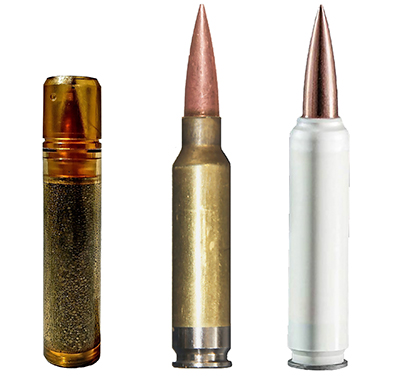
three cartridges considered for the NGSW program
The three cartridges considered for the NGSW program are exemplified by (l. to r.): a cased telescoped round by Textron; a hybrid-case round by SIG Sauer; and a composite-case round by True Velocity. All three were designed to fire the same copper-jacketed 6.8 mm bullet.

The History
From the conclusion of World War II, the U.S. military has sought solutions for increased lethality, greater hit probability and a lighter combat load in its small arms. When the Army announced the NGSW program in 2018, those who were skeptical that the effort would ever result in a finalized and adopted system were justified in their doubt. When the M16 was adopted in the early 1960s, the Army was already in the midst of a “future weapons” program—the Special Purpose Individual Weapon (SPIW). The SPIW program was an extension of Project SALVO, which itself was the result of the Army’s post-World War II analysis of how small arms were used by infantrymen in combat.

Its conclusion, which had already been reached by the Germans during the war, was that the most effective arm for an infantryman to carry was a fully-automatic rifle that fired an intermediate cartridge. The result was a compromise between the light weight and high volume of fire afforded by a submachine gun chambered in a pistol cartridge and the range, accuracy and ballistic payload of a full-size battle rifle. The groundbreaking “Sturmgewehr” design was quickly matched post-war by the Soviet Kalashnikov, and the rest of the world was left scrambling to update their arsenals.

Project SALVO worked on the idea that hit probability was increased by the greater number of projectiles you could throw at a target, essentially making a rifle into a long-range shotgun. The search for a lightweight “Small Caliber, High Velocity” rifle led to the adoption of the M16. The SPIW program sought to develop an arm that combined a grenade launcher with a rifle firing small, arrow-like “flechette” projectiles. It was abandoned in the early 1970s, and the M16 soldiered on.

By 1972, the Army was also looking for an arm that could cover the ground between the M16 and the M60 with the Squad Automatic Weapons (SAW) program. The program centered upon a new SAW-specific cartridge firing a 135-grain 6 mm bullet that gave a ballistic performance between the 5.56 mm and the 7.62 mm. While the Army eventually adopted the FN Minimi as the M249, it stuck with using the 5.56 NATO cartridge.

Soon after the M16A2 was adopted, in 1986, the Army began the Advanced Combat Rifle (ACR) program, the goal of which was once again to produce an arm that would increase hit probability on the battlefield. Many of the innovations developed during the SPIW program were examined again, including flechette rounds, duplex projectile loads and burst fire, along with new innovations such as polymer-case telescoping ammunition, caseless molded-propellant cartridges and the advantages provided by sound suppression and optical sighting systems. As no ACR candidate could provide “an enhancement in hit probability of at least 100 percent at combat ranges” over the M16, the program was canceled.

By the 1990s, the newest effort to replace the M16 was the Objective Individual Combat Weapon (OICW) program. The resulting arm combined a 5.56 NATO-firing rifle and a semi-automatic grenade launcher with a computer-assisted sighting system firing air-burst munitions, but it did not result in a practical design. An offshoot of this program was the further development of the Heckler & Koch G36-derived XM8, which was also eventually canceled.

The search for more effective small arms continued into the 21st century. In 2004, the Lightweight Small Arms Technologies (LSAT) program was formed to investigate polymer-case and caseless ammunition technologies. The program also developed a light machine gun prototype to replace the M249. An Individual Carbine competition seeking a replacement for the M4 ran from 2010 to 2014, but it ended without selecting a replacement. Ditto for the Interim Combat Service Rifle program. The M16 and its derivatives, it seemed, were here to stay.
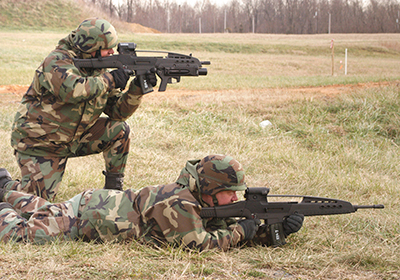
XM8 prototype
Since the adoption of the M16, the Army has sought a replacement. Pictured is testing of the XM8 prototype in the early 2000s.

The NGSW Competition
In many ways, the NGSW program was a ballistics-centric endeavor. Brigadier General Boruff summarized the purpose of the program when he stated it was, “all about energy on target and the longer ranges.” The Army knew the performance it wanted and sought an integrated system of a cartridge that provided those required ballistics, an arm to fire it and a sighting system that would give the average soldier the ability to utilize both to their maximum potential.

The Next Generation Squad Weapons program sought to select a new cartridge, a rifle (NGSW-R) and light machine gun or “automatic rifle” (NGSW-AR) to fire it and a “fire control” optical sighting system (NGSW-FC). Beginning in 2017, the requirements for the systems were announced. These stipulated the allowable size and weight of the new firearms and that they were to fire a cartridge of the submitting competitors’ own design that used a specific 6.8 mm bullet. The arm and cartridge combination were to be effective to 800+ meters. Initial competitors included Desert Tech, MARS/Cobalt Kinetic, FN America, General Dynamics, Textron and SIG Sauer.

The NGSW selection demonstrated a new process of developing, testing and adopting new technology with the Army’s use of “Cross-Functional Teams.” Each weapons system was given a “touch point” analysis by individual soldiers, with more than 1,000 soldiers providing 20,000 hours of feedback. In the Army’s estimation, the NGSW program condensed a process that would typically take eight to 10 years into 27 months.

In August 2019, the selection of three firearm finalists were announced. General Dynamics (its efforts were later taken over by Lonestar Future Weapons Systems) submitted a magazine-fed bullpup design for both the rifle and automatic rifle. The company partnered with Beretta for the design, which used the bullpup layout to incorporate a 20" barrel in a firearm that would yield the ballistics the Army sought at a reasonable pressure, yet maintain an overall length less than the current M4. They partnered with True Velocity ammunition to develop a composite-case cartridge of conventional shape made of polymer and a steel base.

Textron, which had worked with the Army on its LSAT program, submitted a magazine-fed rifle and belt-fed automatic rifle of conventional layout. It partnered with H&K on the firearms’ designs, Winchester Ammunition on the ammunition and Lewis Machine & Tool for the suppressor. Its cartridge featured a “cased telescoped” design, meaning the entire bullet is contained inside a polymer case, which results in reduced weight and overall length.

The last candidates were submitted by SIG Sauer, which ultimately was awarded a 10-year, indefinite-delivery, indefinite-quantity contract capped at $4.7 billion. The initial phase is a $20.4 million dollar contract to provide 25 XM5s and 15 XM250s, along with ammunition, for further development. Eventually, the Army expects to procure 107,000 XM5 rifles and 13,000 XM250 automatic rifles. SIG’s submissions are described below; although note that the components of the NGSW program are still being developed, so the specifications and capabilities stated below are subject to change.
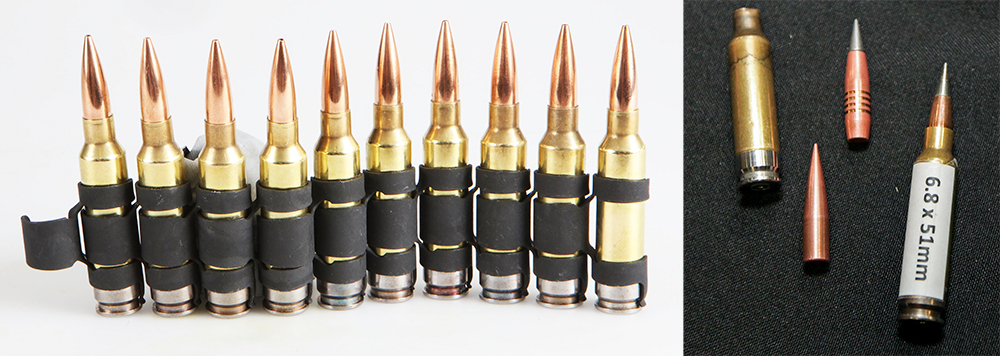
disintegrating-link belt, armor-piercing bullet
The XM250 automatic rifle feeds from a disintegrating-link belt (l.). The 6.8 mm Common Cartridge with its solid copper training/close-range bullet and its armor-piercing bullet (r.) was on display at the Association of the United States Army exposition in October 2022 in Washington, D.C.


The 6.8x51 mm Common Cartridge
As a result of several ballistics studies, the U.S. Army determined that a 6.8 mm-diameter (0.277 cal.) bullet with a weight of approximately 135 grains would be optimal for what it believes will be the conditions of the future battlefield. For the NGSW program, the Army produced a “General Purpose Projectile” that uses a hardened-steel penetrator with a copper jacket and core similar to the M855A1. It was provided to the competing manufacturers who were tasked with developing their own cartridge that used the projectile, met the Army’s ballistic requirements and weighed less than a 7.62 NATO cartridge.

The cartridge SIG developed for its winning NGSW firearms has been designated as the 6.8x51 mm Common Cartridge (CC). As can be inferred from the “51 mm” part of its designation, the cartridge’s case is the same length as the 7.62 NATO, necessitating an “AR-10”-size firearm platform. The case is almost the identical diameter as well, meaning that capacity in a box magazine is the same as the 7.62 NATO cartridge. While the Army hasn’t revealed the exact ballistic performance of the new cartridge, the 6.8 mm CC delivers more velocity than the M855A1 with a bullet more than twice as heavy. The Army claims that the new chambering is superior to both the 6.5 mm Creedmoor and 7.62 NATO at ranges up to 800 meters and that it can defeat Level III body armor with non-armor-piercing ammunition out to 600 meters.

The new cartridge is not to be confused with the 6.8 Remington SPC, another cartridge developed at the behest of the U.S. military. Designed in the early 2000s, the SPC has the same overall length as the 5.56 NATO, meaning that existing M4 and AR-15-type firearms could be adapted to use it.

Since defeating body armor comes down, in large part, to velocity, every effort was made to get the maximum performance out of the new cartridge. The result was a chambering that operates at very high pressure. The Sporting Arms and Ammunition Manufacturers’ Institute (SAAMI) specification for the cartridge is 80,000 p.s.i., or about 30 percent higher than the operating pressure of similar cartridges such as 7.62 NATO or 6.5 mm Creedmoor.
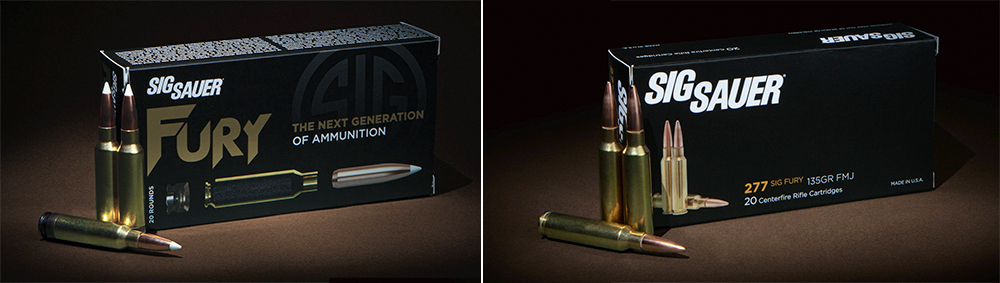
.277 Fury loads
Three .277 Fury loads are currently offered for the civilian market: conventional brass cartridge cases loaded with a 135-grain FMJ or soft-point bullet and hybrid-case cartridges with a 150-grain polymer-tip bullet.


When SAAMI certified the .277 Fury, the civilian version of the 6.8 mm CC cartridge, it included the warning that the cartridge, when loaded to pressures greater than 68,000 p.s.i., would “require cartridge case and/or firearms design that depart from traditional practices.” This is exactly what SIG did, developing a “hybrid” metal case for the cartridge. As the unsupported portion of a brass cartridge case that protrudes from the rear of the chamber and the primer pocket cannot handle these pressures, the SIG design uses a stainless-steel case head married to a brass case body. SIG claims the hybrid case design allows for an additional 350 f.p.s. in velocity over a conventional brass case.
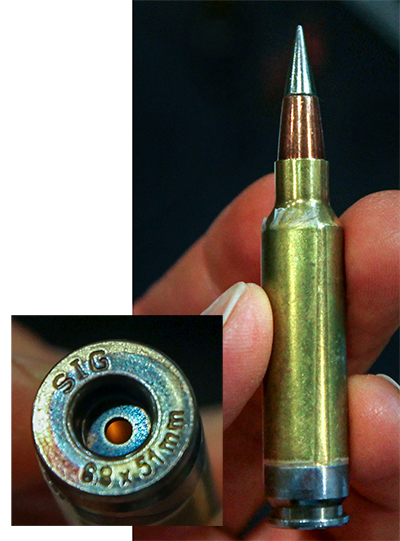
NGSW 6.8 mm Common Cartridge
The brass and stainless-steel hybrid case of the NGSW 6.8 mm Common Cartridge is designed to handle its 80,000 p.s.i. pressure.

In addition to its strength, steel is lighter than brass, so using it in what is the thickest part of the cartridge case keeps the overall weight of the loaded cartridge down. Though being nominally the same overall size, 6.8 mm CC weighs less than a 7.62 NATO cartridge.

The commercial .277 Fury launches a 150-grain bullet at 2,830 f.p.s. from a 16" barrel—or approximately the performance you’d expect from a .270 Win. fired from a 24" barrel. SIG also makes a reduced-power version of the .277 Fury cartridge that uses a conventional all-brass case and presumably operates at less than 68,000 p.s.i. The Army likewise plans to use a reduced-power version of the cartridge for training purposes and close-range combat scenarios where overpenetration is a risk.

SIG Sauer will be producing all of the Army’s 6.8 mm ammunition, using projectiles supplied by the Lake City Army Ammunition Plant, for the next few years. Lake City (a government-owned plant run by private contractor Winchester Ammunition) is building a new facility dedicated solely to producing the 6.8 mm CC ammunition that should be online by 2025 or 2026. By 2030, Lake City will take over as the lead producer of 6.8 ammunition. Lake City’s production of 5.56 NATO and 7.62 NATO will continue at current rates in the near future.
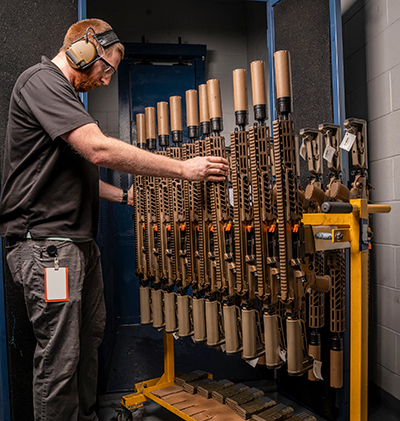
MCX-Spear rifles
Last year, SIG offered a limited run of MCX-Spear rifles for the civilian market in semi-automatic-only format.

XM5 Rifle
In many ways, SIG’s winning firearms were the most conventional NGSW choices. Its rifle prototype, adopted as the XM5, is based on the commercially available MCX, which combines features of the M16 with a short-stroke piston and recoil-spring system that mimics the AR-18. SIG had already scaled up the 5.56 mm MCX to AR-10 size to accommodate a .308 Win.-class cartridge with its MCX-MR, which was a competitor in the Army’s Compact Semi-Automatic Sniper System program.

The XM5’s controls are M16-style rendered bilaterally for full ambidextrous use. The magazine release, bolt release and safety selector are present on both sides of the rifle, along with a bilateral, AR-type, charging handle. Additionally, there is a second non-reciprocating charging handle positioned on the left side of the receiver. The rifle utilizes an M4-style forward-assist device and case deflector. While having a general M4 familiarity, the exterior of the XM5 is also updated. The aluminum-alloy handguard features M-Lok slots, and there are built-in push-button sling swivel sockets on the handguard and receiver.

The XM5 mechanism uses a multi-lug rotating bolt. Function is provided by a short-stroke gas piston with an adjustable gas regulator. The upper and lower receivers are made of aluminum alloy with steel inserts in high-wear locations. Because of the gas-piston design and recoil springs contained within the receiver, the XM5’s stock not only telescopes like an M4 but also folds to the left side, and the rifle can be fired with the stock folded. The barrel has a tapered heavy profile and is held in place by a clamping system that uses two Torx-head screws that allow it to be removed in the field. The rifle is supplied with a two-stage match trigger, uses SR-25-pattern magazines and is capable of both semi- and full-automatic fire.

The XM5 is designed to be used in conjunction with a suppressor. In 2021, the Marine Corps announced that it would be supplying all of its front-line personnel with suppressor-equipped arms, to both make communication on the battlefield easier and to prevent the long-term health effects of loud noise exposure, and the Army seems to be following that lead. The XM5’s suppressor is also made by SIG and is based on its SLX series developed for U.S. Special Operations. The backpressure that a suppressor adds to a firearm can result in increased gases directed back at the shooter. The XM5’s suppressor is engineered to have a “flow-through” design that yields “low toxic fume blowback,” and SIG claims that using the suppressor results in no additional gas being expelled through the rifle’s ejection port. The suppressor is mounted by threading onto the XM5’s muzzle device and is held in place with a locking ring. Due to suppressor usage, the XM5’s 13" barrel keeps the conventionally laid out rifle as compact as possible. With the suppressor installed, the XM5’s overall length is 36", and it weighs 9 lbs., 14 ozs. There is no provision for mounting a bayonet.
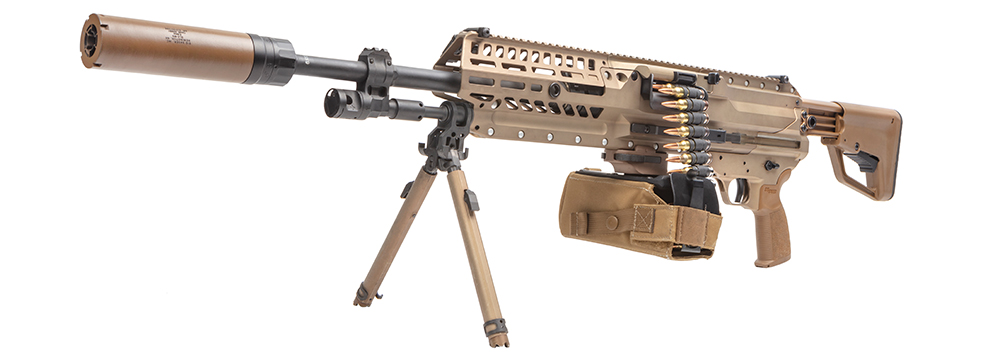
XM250
The XM250 is designed to be used with a suppressor. It feeds from 100-round disintegrating link belts housed in a polymer and canvas pouch that mounts below the receiver.


XM250 Automatic Rifle
 
SIG’s winning automatic rifle design is based on the company’s MG 338, a belt-fed .338 Norma Mag.-chambered machine gun designed for U.S. Special Operations. The XM250 is an air-cooled, belt-fed design that fires from an open bolt. The action is gas-operated with a short-stroke gas piston system and is capable of both semi-automatic and fully-automatic fire. Its rate of fire is between 650 and 750 rounds per minute, depending on the ammunition used.

While SIG has been tight-lipped about the internal features of the XM250, some design features can be inferred from details found in the company’s machine gun patent applications. The XM250 uses the recoil-mitigation system of its .338 big brother, where the rotating bolt operates within a “barrel extension” that is fixed to the barrel and recoils within the outer receiver, with the bolt and barrel extension using separate recoil springs. SIG claims the XM250’s felt recoil is less than an M4. Although the XM250’s 16" barrel is quick-change with the rotation of a collar, unlike the M249 it is not designed to be swapped under combat conditions. The XM250’s barrel-retaining system makes it field-adaptable for other cartridges in the 7.62 NATO class.

The XM250 is fed from 100-round disintegrating-link belts. The belts are housed in a polymer and canvas box that attaches below the gun with a “mag well” connection. Belts can be loaded into the gun whether the bolt is forward or back, in either safe or fire mode and with the feed tray open or closed. Unlike the M249, there is no provision that allows for the use of a detachable box magazine. The XM250 uses a left-side charging handle and has bilateral safety selector switches.

On the top of its receiver and handguard, the XM250 has a full-length Picatinny rail. It uses a feed tray cover that opens to the side to allow for mounting of optical systems without interference when the feed tray is open. Designed to be used with optics, the XM250 also has a set of offset back-up iron sights. The handguard features M-Lok slots, and the XM250’s bipod is made out of titanium to further save weight. The buttstock telescopes to multiple positions to adjust length of pull.

The XM250 is designed to use the same suppressor system as the XM5. Despite its visual bulk, the XM250 with bipod and suppressor weighs 3 lbs., 8 ozs., less than the M249 and is 13 lbs. lighter than the 7.62 NATO M240B. The size and weight of the XM250, along with its ability to fire semi-automatically, suggest that it could be used as a “rifle” in close-quarters engagements or, when combined with the new magnified optic, as a more precise “Designated Marksman Rifle” at longer ranges.
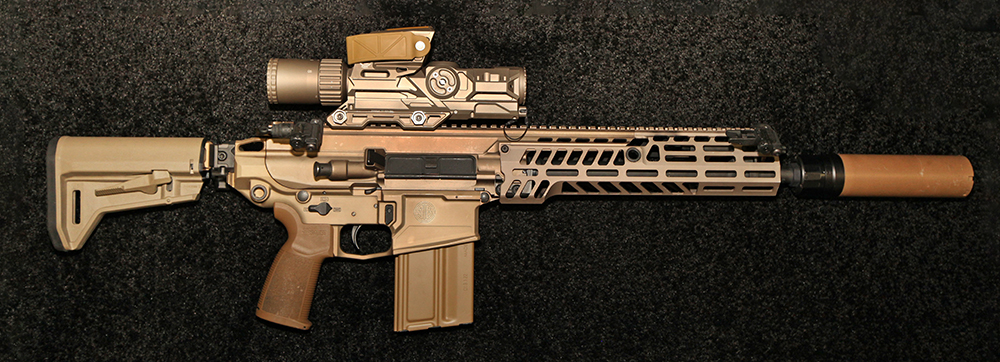
XM5 rifle
Shown atop an XM5 rifle at the AUSA expo in October 2022 in Washington, D.C., the XM157 Fire Control System, produced by Vortex, is a 1-8X riflescope with electronics that can take into account factors such as wind, elevation, inclination and range.


XM157 Fire Control System
The competition for an optical sight, or “Fire Control System,” included submissions from Vortex Optics and L3Harris (the former parent company of EOTech). The winner was Vortex’s offering, which was designated as the XM157.

The Fire Control System is the part of the NGSW program that represents the most radical leap forward in technology and capability. At the heart of the XM157 “Smart Optic” is a conventional 1-8X LPVO (low power variable optic) riflescope with a 30 mm objective lens and etched reticle that can operate without battery power. The “smart” side of the XM157 is information that can be projected as a digital Active Reticle onto a see-through display in the scope’s first focal plane. This allows for a customizable display that can include such information as ballistic drop or wind holds. The system has a built-in laser rangefinder and can compute other environmental factors, such as temperature, elevation, inclination and declination. This information is computed in real time by a unit that sits on top of the main scope’s body and adjusts the digital reticle accordingly. In addition to the rangefinder laser, the unit also contains visible and infrared aiming lasers. Again, some hints at the system’s possible capabilities can be gleaned from recent Vortex patents, such as a system that would allow the optic to display the number of rounds remaining in the magazine of the arm to which it is attached or the ability to display a virtual target for dry-fire practice.

While the XM157 sounds complicated, its function is simple and user-friendly, with all functionality displays seen through the scope. The system has passed all mil-standard optics tests of temperature, water immersion, dust, drops, shock, etc., so it’s as rugged as it is high-tech.

The system is powered by two CR123A batteries that will power the unit for “weeks” according to Vortex. While the actual weight of the system has not been revealed, according to Vortex, it is less than the combination of a conventional LPVO and ballistic computing system (presumably less than 30 ozs.). The entire unit is “modular and upgradeable,” meaning that newer capabilities can be added in the future, such as “augmented reality” modes that will allow soldiers to tag target points and share them wirelessly to other soldiers’ optics systems.

The XM157 will be made entirely in America of U.S.-made components, including the lenses. Vortex is scheduled to supply 250,000 systems over the next decade at the cost of up to $2.7 billion. As is apparent from that quantity, the XM157 is intended to be used not only on NGSW weapons but also on “legacy” platforms, such as the M4.
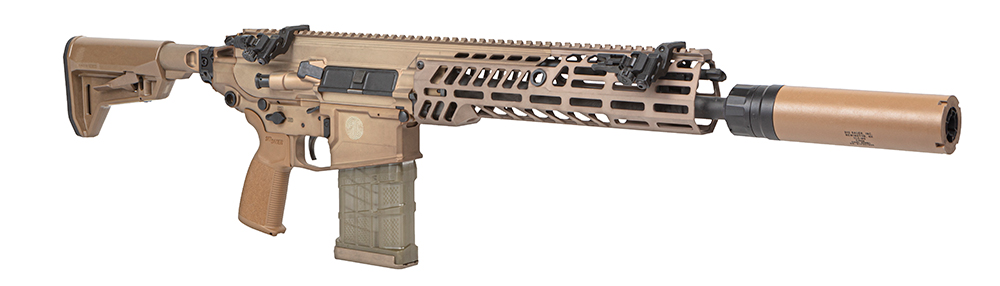
XM5 rifle
The XM5 rifle weighs 9 lbs., 13 ozs. with its suppressor mounted. Though equipped with offset backup iron sights, it is intended to be used with the XM157 optic.


The Reaction
Expectedly, the announcement that the Army was replacing the rifle and cartridge combination that it has used for more than half a century was met with a swift reaction. One of the first criticisms involved weight. When it comes to physics, there’s no free lunch. The Army’s ballistic needs required a cartridge larger than the 5.56 NATO and a weapon larger than an M4 to fire it. A loaded XM5 with the XM157 optic will weigh about 3 lbs., 4 ozs., more than a loaded M4A1 with an M68 optic. With a full combat load, the XM250 outweighs the M249 by about 3 lbs., 8 ozs., while carrying 200 fewer rounds.

This brings up the second criticism of a decreased round count and increased weight for a combat load. The larger diameter of the 6.8 mm cartridge means fewer rounds can be stacked in a magazine of similar size to the current 30-round M4 magazine. According to the Army, the XM5 basic combat load is seven, 20-round magazines, which weighs 9 lbs., 13 ozs., in total. For the XM250, the basic combat load is four 100-round pouches at 27 lbs., 1 oz. For comparison, the M4 carbine combat load, which is seven 30-round magazines, weighs 7 lbs., 6 ozs., and the M249 combat load is three 200-round pouches weighing 20 lbs., 14 ozs., in total. This would result in a real-world total combat weight of 21 lbs. for the XM5 and 43 lbs., 6 ozs., for the XM250, versus 15 lbs., 10 ozs., for the M4 and 39 lbs., 14 ozs., for the M249.

Based on these two points, many critics bring up the specter of the M14, a large and powerful rifle designed for the plains of Germany that found itself in the jungles of Vietnam. But the counterpoint is that the Next Generation Squad Weapons signal a shift in the Army’s small arms doctrine. In a way, the NGSW program is the antithesis of the post-World War II Project SALVO. Increased weight and decreased round count suggests that the Army expects the NGSW weapons and optics system to allow soldiers to eliminate their targets at longer ranges with fewer rounds. 
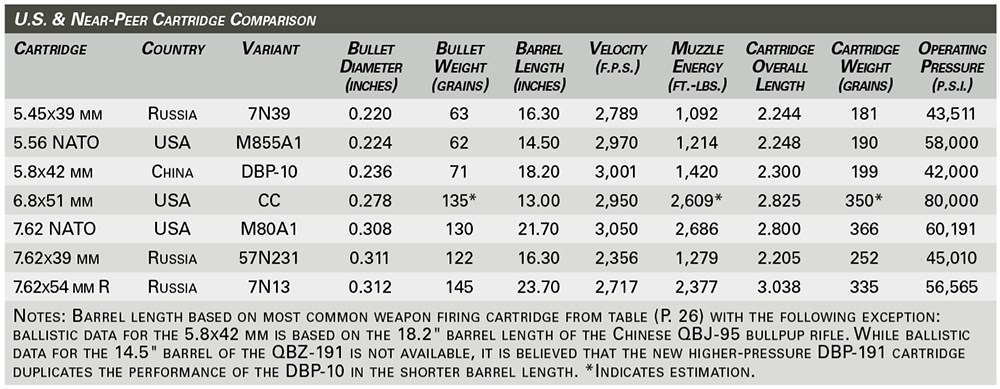
U.S. & Near-Peer Cartridge Comparison chart

Trickle Down
Military innovation eventually trickles down to the civilian world, and, in the case of the NGSW, it has already arrived. The .277 Fury cartridge has been introduced commercially in the SIG Cross bolt-action rifle. A limited-edition, semi-automatic-only version of the XM5, marketed as the MCX-Spear, has also been offered by SIG. In September, the company announced the MCX-Spear LT, a mid-size platform based on the XM5 offered in 5.56 NATO, .300 Blackout and 7.62x39 mm in rifle, short-barreled rifle and pistol configurations.

Innovations that did not win the NGSW competition have also made their way to the civilian world. This spring, SAAMI certified its first composite-case ammunition manufactured by True Velocity. Currently available in .308 Win., there are plans for the company to commercially release 6.5 mm Creedmoor and 5.56 NATO composite-case cartridges in the near future.

Looking Forward
The NGSW weapons are scheduled to complete their operational test by the third quarter of 2023, with the first Army units equipped with the new firearms in the fourth quarter of that same year. The entire roll-out to the “Close Combat Force” (a classification that includes infantrymen, cavalry scouts, combat engineers and forward observers, in addition to special forces) will be dependent on when ammunition production can be ramped up to meet demand. Like the M17 handgun recently adopted, other branches of the U.S. military, such as the Marine Corps, may end up adopting the XM5 and XM250 as well. The M4 and M249 will continue to soldier on with second-line support troops.

The NGSW program marks a radical departure in U.S. small arms doctrine, pushing the envelope of conventional cartridge performance and pairing it with a state-of-the-art optical system that can help soldiers make hits to the limits of their weapons’ potential. In an age of UAVs and precision-guided munitions, the individual combat soldier is expected to become a more precise instrument, and the NGSW program is providing the tools for the job.

It demonstrates that, on an increasingly sophisticated battlefield, the infantryman isn’t being replaced by technology, but adapting to meet new challenges, as no amount of innovation will change the fact that wars are ultimately won by boots on the ground and with rifles that soldiers hold in their hands.

The ultimate judgement about whether the path taken by the NGSW program is correct will come on the battlefield.
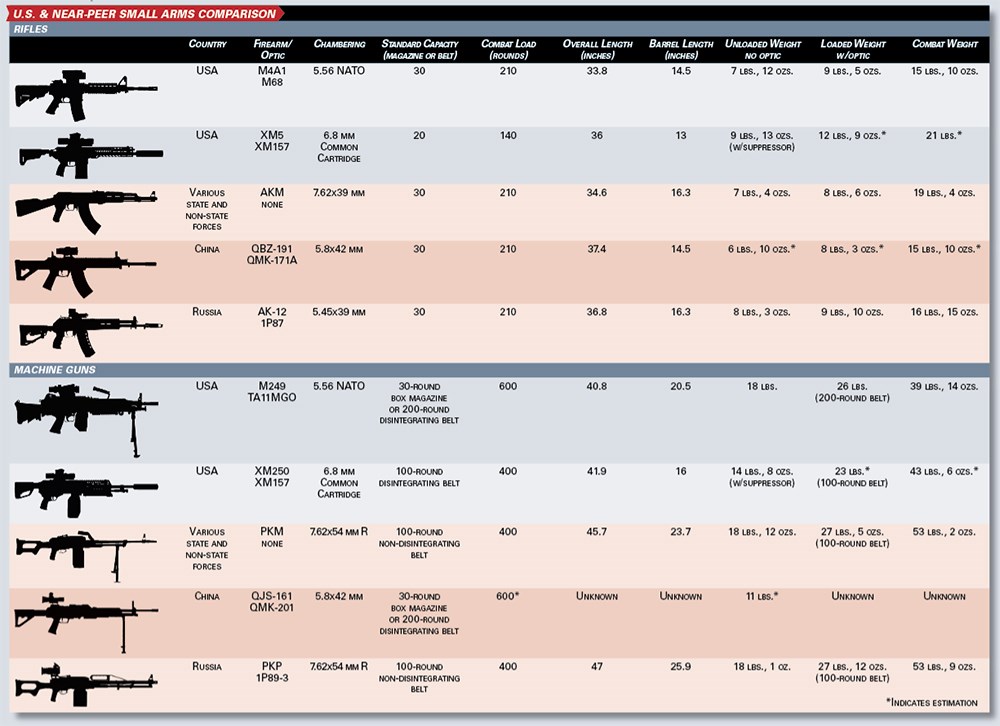
U.S. & near-peer small arms comparison
click here for enlargement

Conflicts in the early decades of the 21st century have highlighted deficiencies in U.S. small arms doctrine. To address these shortcomings, the military’s Next Generation Squad Weapons program settled on a new cartridge, rifle and machine gun. This table places current and future U.S. small arms in the larger context of firearms used by other nations.


Saturday, December 31, 2022

How Did The M1917 Enfield Compare to the 1903 Springfield?

 I ran across this article, There is something about Old school Battle Rifles, Sure I like the Plastic Fantastics, Or I did until that durn Canoe accident....But there is something about an old school Battle Rifle.  The History I suppose and if those Rifles could talk, the stories they could tell.  I own a Springfield 03 or I did before that durn Kayak and I can see the attraction, it is considered the epitome of an excellent Rifle.


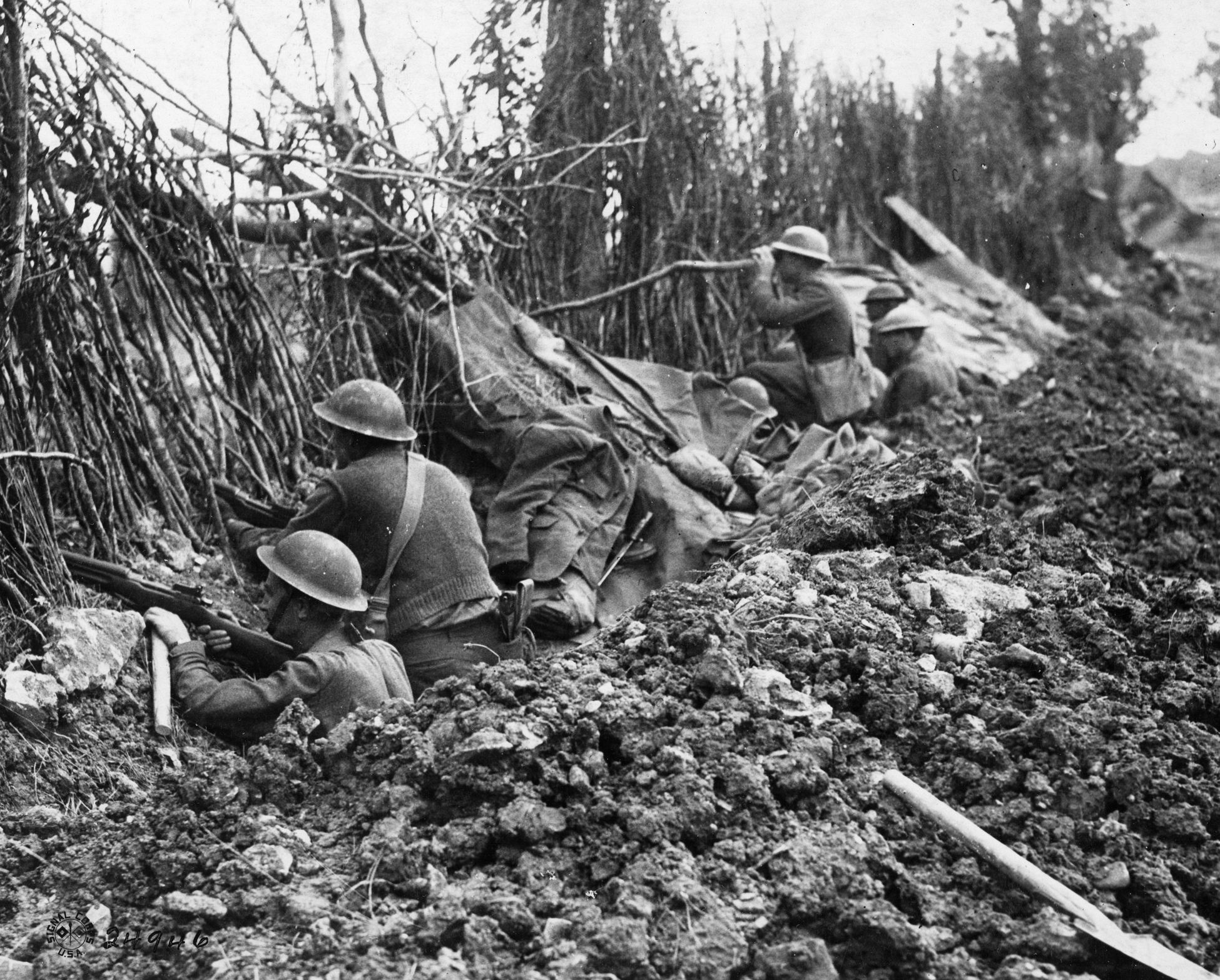
 American soldiers, armed with Model 1917 Enfield rifles, attack during the Second Battle of the Marne, in July 1918.

In director Howard Hawks’s 1941 film classic, Sergeant York, then-Corporal Alvin York, portrayed by Gary Cooper, single-handedly knocks out more than 30 German machine-gun nests and, with little assistance, captures 132 enemy soldiers. In the process, the former conscientious objector from Tennessee drops 25 Germans with 25 shots, many fired from his trusty 1903 U.S. Springfield rifle. The movie’s climactic scene helped cement the Springfield’s mystique with generations of military firearms collectors, history buffs, and re-enactors. Sleek and accurate, the Springfield seemed the perfect weapon for an iconic American hero.

Inspiring as the film was, York probably did not use a Springfield rifle on that October day in 1918 during the Meuse-Argonne offensive. It seems more likely that York achieved his stunning feat of arms carrying the less-well-known but more widely issued U.S. Rifle Model 1917. Although some confusion persists about which rifle York carried during the battle, in his diary he wrote: “We got to France at Le Havre. There we turned in our guns and got British guns. I had taken a liking to my gun by this time. I had taken it apart and cleaned it enough to learn every piece and I could almost put it back together with my eyes shut. I didn’t like the British guns so well. I don’t think they were as accurate as our American rifles.”

How did York wind up with a British gun? The explanation involves American ingenuity, productive capacity, and lack of preparedness for entry into the Great War. Having concluded that the Krag-Jorgensen rifles used by U.S. Army troops in the Spanish-American War were inferior to the 1893 Mauser rifles that the Spanish troops carried, the Army adopted the U.S. Magazine Rifle of 1903, commonly called the Springfield because it was  manufactured at the U.S. armory in Springfield, Massachusetts. Based on Peter Paul Mauser’s bolt-action rifle design, the Springfield proved short enough for cavalry use and long enough for infantry use, and fired the new 30.06 service cartridge that matched or surpassed the performance of any standard military cartridge in the world. American troops instantly loved the rifle for its butter-smooth action and tack-driving accuracy.

Even so, the Springfield suffered from one serious weakness: limited production. Before the United States entered World War I, this mattered little. In 1917, the U.S. Army mustered roughly 127,500 officers and men, fewer men than Portugal’s army. When Congress declared war on the Central Powers on April 6 and later implemented military conscription, the U.S. Army embarked on a 30-fold expansion, growing to roughly four million soldiers in just over a year.

Training and equipping so large a force quickly enough to enter the war before Germany overran the French and the British appeared insurmountable even for the United States. Lack of sufficient quantities of war materiel in general and infantry weapons in particular hampered preparations. The U.S. Army had 600,000 of its superb Springfield rifles in 1917. Another 160,000 of the old Krags in .30-caliber also remained available. For training purposes, the Army purchased 1891 Russian Mosin-Nagant rifles in 7.62 X 54 mm and roughly 20,000 .303-caliber Canadian Ross rifles that, if improperly assembled, occasionally launched their bolts into the shooter’s face. Even if these weapons were suitable for combat, their incompatible parts and calibers created a logistical nightmare.

World War I-era arms, left to right, include the 12-gauge shotgun with bayonet attached, American Enfield, and Springfield rifles.

The Army clearly preferred the 1903 Springfields, but only two factories had ever produced the rifle. The Springfield Armory, the larger of the two facilities, quickly maximized its production. The other facility, the Rock Island Arsenal in Illinois, also possessed the machinery necessary to produce Springfields, but the War Department had closed the plant in February 1914. As tensions mounted between the United States and Germany, the Rock Island Arsenal reopened two months prior to the American declaration of war. Unfortunately, much of the arsenal’s skilled work force had found employment elsewhere, delaying the plant’s return to full production capacity. The United States was fast creating an army without rifles.

The War Department considered issuing contracts to commercial firearms companies to produce the Springfields, but quickly rejected the idea. It would require far too much time to re-equip and retool plants and train the work force necessary to produce the rifles. A better option appeared when fully equipped factories with trained workers became available at exactly the right moment, though not for producing Springfields. In 1913, Great Britain had begun experimenting with a weapon to replace the Short Magazine Lee Enfield (SMLE) rifles issued to their army. Affectionately nicknamed “smellies” by British troops, the Mark III Lee Enfields, first issued in 1907, were chambered for the .303-caliber, rimmed, smokeless cartridge that had served the Royal Army as standard issue since the 1880s. Germany had long used the rimless 7.92mm in its service rifles, and the American adoption of its rimless 30.06 inspired Great Britain to consider replacing the SMLE with a stronger bolt-action rifle chambered for a more modern, more powerful cartridge. The British based their experimental rifle on the Mauser action, just as the Americans had, and developed a high-velocity, high-pressure .276-caliber rimless cartridge for the weapon.

The Royal Small Arms Factory at Enfield Lock produced 1,000 of the new rifles for tests, but abandoned the project when Britain entered the Great War. Britain faced the same problem the United States would confront three years later, expanding its small peacetime army, equipping it, and deploying it on the battlefield in time to defeat Germany. Adopting a new infantry rifle and cartridge seemed an impractical use of Great Britain’s limited resources. Worse yet, the new .276-caliber cartridge posed problems of rapid barrel erosion, exceptionally loud report, and bright muzzle flash. For the time being, the old “smellies” would have to do, but the British government doubted its ability to produce these in sufficient numbers. The solution was a compromise that permitted continued development of the new rifle, but in the old .303-caliber. To this end, Great Britain turned to the United States’ surplus manufacturing capacity.

The British government issued contracts for the production of the new rifle, designated the Pattern 1914, at three American plants: Winchester Repeating Arms of New Haven, Connecticut; Remington Arms Company at Ilion, New York; and Remington’s plant at Eddy-stone, Pennsylvania. The Pattern 14s differed little from their experimental predecessors aside from their .303 chambering. Despite rising production costs and delays occasioned by on-site British quality inspectors, the U.S. plants produced nearly 1,900,000 Pattern 14s, with Eddystone producing the greatest number and Winchester the least.

Just when Great Britain seemed poised to replace the SMLE rifle with the Pattern 14, the smellies, despite their supposed obsolescence, performed admirably in the trenches. The .303 cartridge proved perfectly adequate for modern warfare, and the standard Mark III Enfield not only functioned reliably but also held twice as many rounds in its detachable box magazine as Germany’s 1898 Mauser. More importantly, Britain’s accelerated SMLE production satisfied the Royal Army’s needs. American production of the Pattern 14 became unnecessary, and the British government canceled the American contracts. Production ended in July 1917, just as the United States mobilized for its own entry into the war.

The cancellation could not have come at a better time for the United States. The Ordnance Department had already considered adopting the Pattern 14 as an alternate infantry rifle to supplement the Springfield, but did not want a rifle in the .303-caliber British model. Now the United States found itself with three fully operational factories capable of producing a modern infantry rifle and seeking a buyer for their goods. War mobilization forced a quick decision. Rather than retool commercial firms and train a workforce to manufacture Springfields, a lengthy task at best, the Ordnance Department decided to purchase American-made Pattern 14s with one key modification. The otherwise identical rifles would be chambered for the 30.06 cartridge and the new rifle adopted as the U.S. Rifle Model 1917. With one brilliant administrative decision, the Ordnance Department solved the Army’s rifle shortage—or so it seemed.

American troops armed with the new Enfields practice bayonet tactics in France under the eyes of stern-faced instructor.

Modifying the Pattern 14 to fire the 30.06 cartridge proved simple enough. Built with the potent .276 cartridge in mind, the Pattern 14 boasted an exceptionally strong action perfectly capable of accommodating the high-pressure American cartridge. The only real difficulty involved parts interchangeability. Tests revealed that Pattern 14 parts were built to comparatively loose tolerances and often required time-consuming hand fitting. This threatened delivery schedules and complicated repair, but desperate for weapons, the War Department issued contracts for the new rifle’s production. Although the initial runs of 1917 rifles from Winchester suffered from this problem, the rifles eventually enjoyed 95 percent interchangeability, a satisfactory rate during wartime.

By February 1918, the three plants combined produced over 7,000 of the 1917 Enfield rifles daily for the princely sum of $26 per copy, half of what the P-14s had cost to produce. By war’s end, 75 percent of the doughboys carried the “U.S. Enfield,” as it was often called. The Marine Corps received 61,000 and the Navy received 604 1917s.

Although the 1917 rifle solved the War Department’s rifle supply problems, many American soldiers shared Alvin York’s preference for the Springfield. They complained about the new rifle’s weight, nearly a pound heavier than the Springfield, and its length, two inches longer. Some also disliked the fact that the 1917’s bolt cocked on closing, whereas the Springfield cocked on opening. Soldiers objected to the American Enfield’s lack of magazine cutoff. Because of this, the bolt could not be closed on an empty magazine unless the soldier depressed the magazine follower with his thumb or inserted a coin on top of it. Many also shared York’s opinion that the Springfield performed more accurately than the 1917. The 1917s sights lacked any device for windage adjustment, an omission that riled competitive shooters. A few soldiers even objected that the rifle’s sight protectors would distract the shooter from acquiring an adequate sight picture.

Despite the doughboys’ objections, the Enfield had definite advantages over the Springfield. Although the Enfield sights lacked windage adjustment, the Enfield’s aperture rear sight lay closer to the shooter’s eye and could be much more easily acquired in combat conditions. The 1917’s sights rested safely between protective “ears” that shielded them from abuse. Accuracy proved better than the rifle’s critics expected. In 1918, Marine Corporal F.L. Branson, using a 1917 rifle, won the 1,000-yard competition at the national matches at Camp Perry, Ohio.

The Enfield’s box magazine originally accommodated five .303 cartridges, but the 30.06 cartridge’s smaller-diameter rimless head occupied less space, giving the 1917 Enfield a six-round capacity compared to the Springfield’s five. Unfortunately, the Army still issued only five-round stripper clips, which undermined the advantage. Finally, the Enfield adapted readily to the French Viven-Bessiere grenade launcher. Equipped with such accessories as a 22-inch bayonet designed for the P-14, the 1917 proved itself equal or superior to any infantry rifle issued in the Great War.

By the time of the Armistice in November 1918, the Remington, Winchester, and Eddy-stone plants had produced 2,193,429 1917 rifles, so many that the War Department considered adopting them to replace the Springfields. In the end, the Springfield won the battle, partly because match shooters preferred its sights for competitive shooting. During the postwar years, the Army refurbished its inventory of 1917 rifles. Some were sold to the Philippines, and a few found their way home to ROTC units for drill purposes. Most simply languished in storage.


Armed with Enfields, American doughboys man an abandoned German position in the Meuse Valley north of Verdun

World War II changed all that. After the British Expeditionary Force abandoned its weapons on the beaches at Dunkirk, the Royal Army faced a German cross-Channel invasion lacking equipment of every kind, especially infantry rifles. The British government appealed to civilians to volunteer their firearms for home defense use, but post-World War I legal restrictions on firearms ownership and the manufacture of automatic weapons made suitable firearms scarce in the British Isles. Although many British civilians turned in the few weapons they had, their contributions did little to alleviate the shortage. The British government bought advertising space in U.S. publications asking Americans to “Send a Gun to Defend a British Home.” American citizens shipped a vast assortment of personal firearms to the beleaguered nation to fill the gap.

Despite American generosity, Great Britain’s army desperately needed uniform modern battle rifles. Once again, the 1917 rifle came to the rescue. Roughly one million of the Americanized Enfields reached Britain through the Lend-Lease program. To avoid confusion with the .303 Pattern 14 rifles still in Royal Army inventories, the British marked the 30.06 1917 butt stocks with red paint. Nationalist China also received shipments of the rifles.

When the Japanese attack on Pearl Harbor thrust the United States into World War II in December 1941, the U.S. Army, while better prepared for war than it had been in 1917, once again suffered equipment shortages. Over 200,000 1917s were issued for training purposes within the United States. A few also turned up in the hands of artillery and mortar crews during the North African campaign in 1942.

By 1943, the Army’s infantry rifle shortages abated. Supplies of the U.S. Rifle Model 1903-A3, a Springfield modified for rapid manufacture, appeared in growing numbers, and the magnificent U.S. Rifle Caliber .30 M-1, called the Garand in honor of its designer, became available by the millions. By October 1945, the 1917 rifle had been declared obsolete. The military life of the American Enfield had passed.

The American Enfield lives on in civilian hands. After World War I, many returning doughboys’ wartime weapons experience whetted their appetite for bolt-action sporting rifles. Remington possessed large stocks of 1917 rifle parts, and from 1926 to 1940 the company produced a sporting version of the American Enfield designated the Model 30. Many surplus 1917s were sold to civilians after World War II. Their stout nickel-steel actions made them suitable for conversion to powerful sporting cartridges, and many were converted into sport rifles. Today, unaltered 1917s have become increasingly scarce and collectible.

While it never developed the mystique associated with the Springfield rifle, , it was the American Enfield that Alvin York and most of his brothers in arms carried to victory in World War I.


Wednesday, July 6, 2022

Ward-Burton Bolt Action Rifle, the First American Military Bolt Action

 This was new to me, I thought our first bolt action  was the "Krag-Jorgensen" because I remember some of the troops fighting the Spaniards with their excellent Mausers in 1898 with "Trapdoor Springfields"  We were woefully outclassed and embarrassed, if it wasn't for superior leadership and tactics, the Spaniards would have beaten us.  We quickly got the "Springfield 1903" rifle and it was a world class rifle.

   I shamelessly clipped this from American Rifleman, I didn't know about this rifle, it was totally unheard of to me.

Ward-burton rifle overlay drawing rifle bolt-action america's first bolt-action
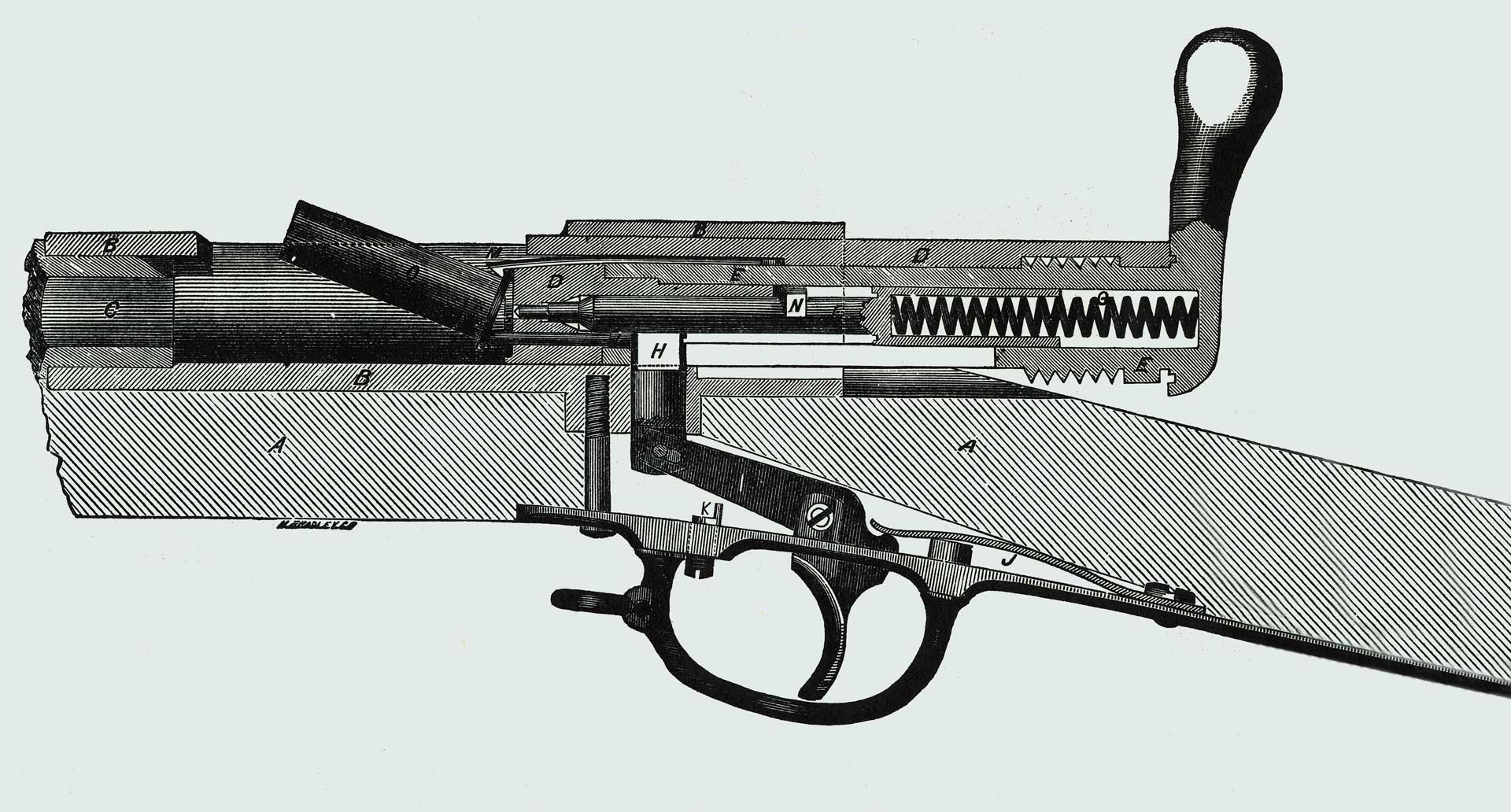
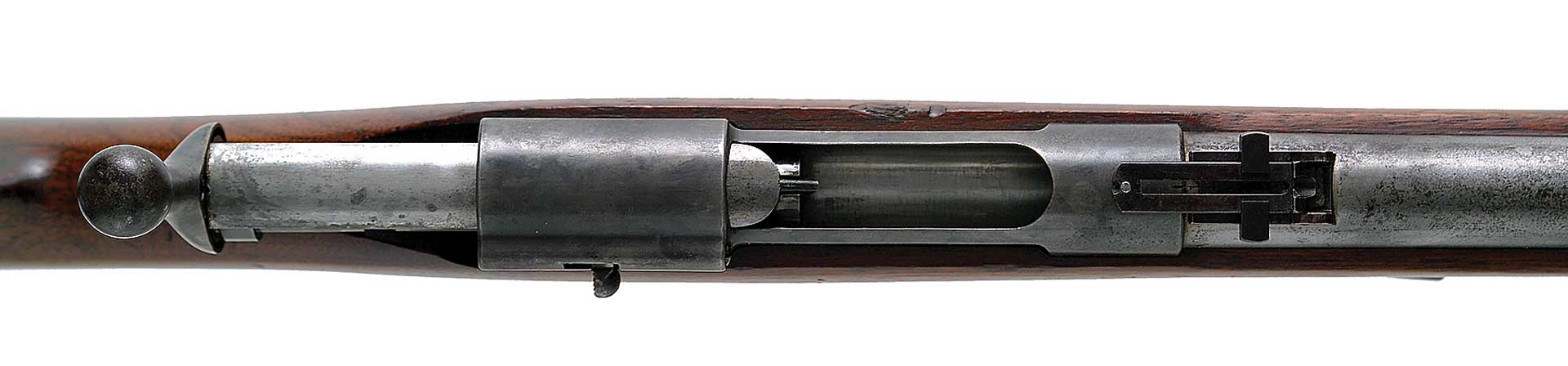
The Ward-Burton was America’s first true bolt-action military rifle. The stubby bolt rotated 90 degrees to unlock the two sets of threads on either side of the bolt body, which mated to corresponding recesses machined inside the receiver. The mechanism is easily understood by viewing the sectioned drawing from the U.S. Army manual on the rifle.
NRA Museums

For almost a half-century, the bolt-action rifle reigned supreme in America’s military small-arms arsenal. The long-lived use of the bolt-action was, by no means, unique to the United States. Almost without exception, the bolt-action military rifle was a staple in the arsenals of most industrialized nations from the late 1800s through the Second World War.

The United States’ first standardized bolt-action service rifle was the .30-40 Krag-Jorgenson, adopted in 1892 and put into production at the Springfield Armory two years later. The Krag was followed by the legendary Model of 1903 Springfield, which saw widespread service in both World Wars. The ’03 was augmented during World War I by another bolt-action rifle, the U.S. Model of 1917 “American Enfield.” Even after adoption of the semi-automatic M1 Garand rifle in 1936, the U.S. military relied heavily on bolt-action rifles throughout World War II. And today, bolt-action rifles remain in use by the American military as sniping arms in Iraq and Afghanistan.

Although the Krag was America’s first standardized bolt-action service rifle, it was not the first bolt-action utilized by our armed forces. From the late 1870s through the late 1880s, several types of bolt-action rifles were procured for testing, evaluation and limited issue by the U.S. Army, Navy and Marine Corps. These arms were the Hotchkiss, Remington-Lee, Remington-Keene and Chaffee-Reese, which were chambered for the same blackpowder .45-70 Gov’t cartridge used by the Model of 1873 “Trapdoor” Springfield. The Model of 1895 Winchester 6 mm U.S. Navy (Lee-Navy) rifle, which featured an unusual straight-pull bolt and clip-loading capability, was adopted in 1895. It was employed during the Spanish-American War and for a couple of years afterward.

vertical bolt action rifle wood stock metal gun Ward-Burton

Although these early repeating, bolt-action American military rifles may not be extremely well-known today, they were preceded by an even lesser-known bolt-action, the Model of 1871 Ward-Burton.

The genesis of the Ward-Burton occurred during the first few years following the conclusion of the War Between the States. After Appomattox, the U.S. Army had a large number of serviceable, but obsolete, muzzleloading rifle-muskets in its inventory. Since funds were tight in the immediate post-war period, the Ordnance Department chose to convert some of these surplus muzzleloaders into breechloaders. A conversion devised by Springfield Armory Master Armorer Erskine S. Allin was used to convert the leftover rifle-muskets. This was accomplished by milling out the top rear portion of the muzzleloader’s barrel and attaching a hinged breechblock. The altered arms were dubbed “Allin Conversions.” The Model of 1865 utilized a .58-cal., rimfire metallic cartridge and was the first of the so-called “Trapdoor Springfields.” The Model of 1865 was soon superseded by the much-improved Model of 1866, which featured a simpler breech mechanism and a greatly superior cartridge, the .50-70 Gov’t. The Model of 1866 was followed by another .50-70 Trapdoor Springfield, the Model of 1868, which utilized a newly made receiver rather than one fabricated from surplus muzzleloaders as were the previous two Allin Conversions.

Although a quantum leap forward as compared to the ponderous muzzleloaders, the Allin-designed Trapdoor was intended to be an interim arm until an improved breechloading system could be developed. The period of 1870 to 1872 was a time of experimentation and uncertainty for the U.S. Army Ordnance Department. It was clear that the muzzleloader was woefully out-of-date and that the breechloader was the future of military rifles. It was not certain, however, exactly what would be the optimum breechloading mechanism with which to arm the U.S. military.

To this end, the Ordnance Department encouraged submission of various designs so that the most promising could be field tested and evaluated for possible adoption as an improved breechloading service rifle. Four basic breechloading mechanisms were eventually selected for limited production and evaluation. Funds were appropriated by Congress for these designs to be manufactured by the Springfield Armory for trial and field testing. All were chambered for the standard .50-70 rifle cartridge (or its carbine equivalent), while the barrels and most of the furniture were finished in “National Armory Bright.” These arms were:

(1.) The Model of 1870 “Trapdoor” Springfield—Springfield Armory manufactured 11,533 M1870 rifles and 341 M1870 carbines. The Model of 1870 was a slightly modified version of the Model of 1868 Trapdoor Springfield rifle.

(2.) The Model of 1870 “Rolling Block”—Springfield manufactured 1,008 rifles and 314 carbines of this design for trial by the U.S. Army. Patent rights to the
Rolling Block mechanism were held by the Remington Arms Co. Shortly after production of the Model of 1870 trial arms ceased, Springfield Armory manufactured 10,001 Model of 1871 Rolling Block rifles. The Model of 1871 rifle featured an improved “locking action” mechanism, which automatically brought the hammer to half-cock when the breechblock was closed. The U.S. Navy issued some Springfield-made .50-70 Rolling Block rifles, also designated as the “Model of 1870,” during this period. Although differing in some relatively minor details from the U.S. Army Model of 1870 (including blued barrels and bayonet lugs), these were considered as issue arms by the Navy rather than trial arms.

(3) The Model of 1870 Springfield/Sharps—The Sharps was a popular civilian arm that had previously seen military use in the Civil War. A number of Civil
War-era percussion Sharps were modified after the war to chamber the .50-70 center-fire metallic cartridge, and a fair number, mainly Model of 1867 Carbines, were already in service with the U.S. Army. Most of the M1870 trial arms utilized modified Sharps percussion receivers, but 300 newly made actions were used by Springfield Armory to assemble some of the later trial rifles. With the exception of the basic Sharps action, Springfield produced the balance of the components. Total production of the M1870 Springfield/Sharps trial guns amounted to 1,300 rifles and 308 carbines.

(4) The Model of 1871 Ward-Burton Bolt-Action—The U.S. Springfield Armory produced 1,011 rifles and 316 carbines of the Ward-Burton pattern.

The above arms were each entirely different breechloading designs that enabled the Ordnance Department to evaluate the attributes—positive and negative—of the various mechanisms. The Trapdoor Springfield, Sharps and Rolling Block were, in varying degrees, familiar due to their prior U.S. military and civilian use. On the other hand, the bolt-action Ward-Burton was something of an unknown to the soldiers charged with its testing.

cutaway drawing bolt action ward-burton rifle left side action receiver


For the record, there were two “quasi bolt-action” U.S. military arms that predated the Ward-Burton. The Greene breechloading percussion rifle, made in very limited numbers from about 1859 into the early 1860s, featured a unique under-hammer action with a rudimentary bolt-operated mechanism. The Palmer carbine of the Civil War era utilized a bolt to open the chamber, but it was fired by means of a separate, side-mounted hammer. Neither were designed with what can be accurately characterized as a true bolt-action mechanism. Like virtually all subsequent modern bolt-action rifles, the Ward-Burton had the striker, ejector and extractor self-contained in the bolt body. While the norm for bolt-action designs today, this was a novel, if not radical, mechanism in the early 1870s.

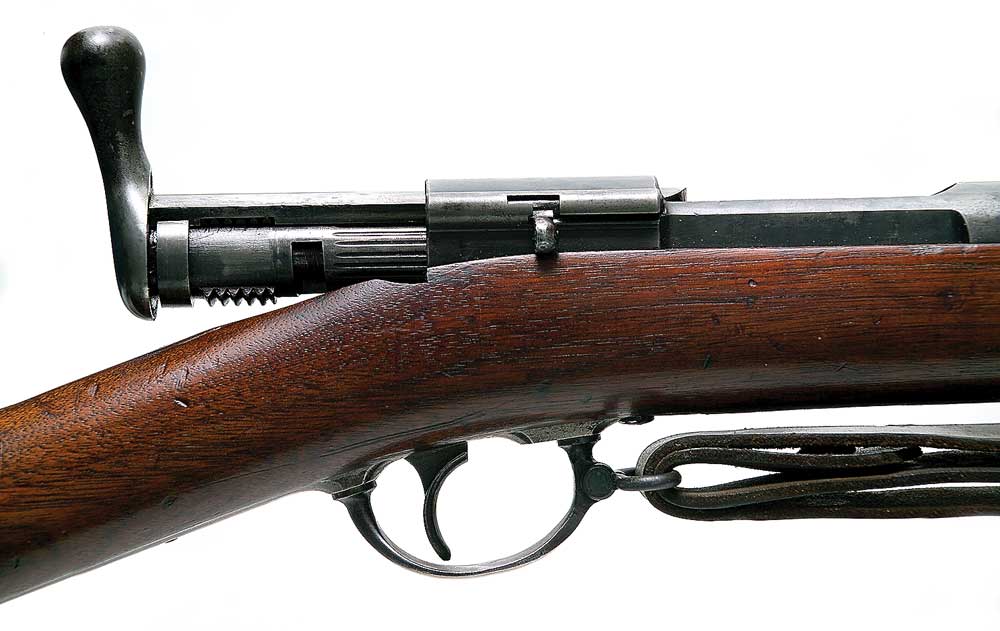
The Ward-Burton was invented and patented by two Americans, Gen. W.G. Ward and Bethel Burton. The Ward-Burton rifle was a single-shot design that featured a bolt with two sets of threads on either side of the body that locked into corresponding threads machined into the inside of the receiver. The stubby bolt handle rotated downward to lock the action and rotated upward to disengage.

When the bolt was drawn to the rear, the empty cartridge case was automatically ejected, and the rifle was ready for a fresh cartridge to be inserted. It was cocked when the bolt was pushed forward. There was a small, spring-loaded bolt lock on the right rear of the receiver that functioned as a safety.

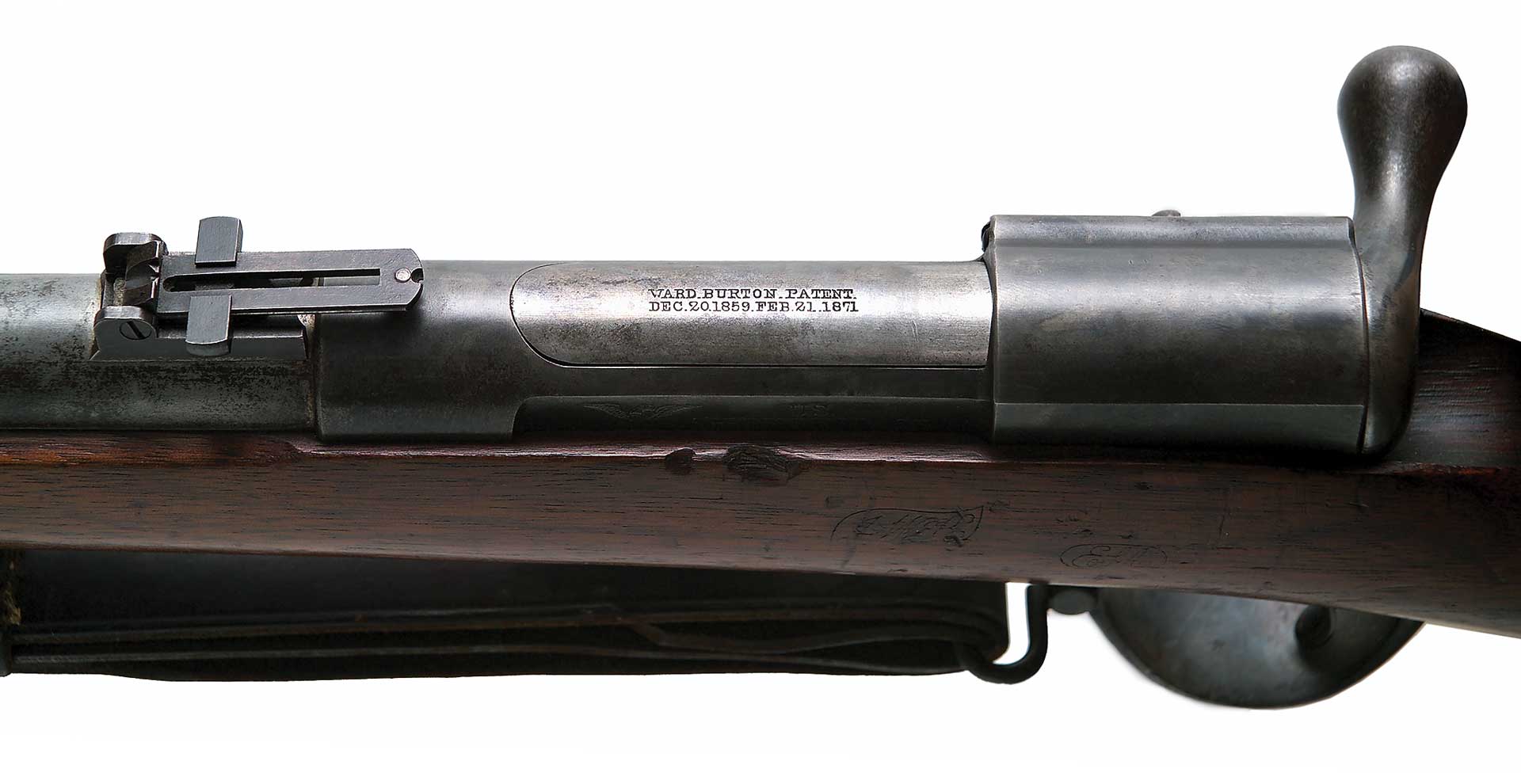
The Model of 1871 Ward-Burton was in production at Springfield Armory in 1871 and 1872. The receiver was case-hardened, and the left side was marked “WARD BURTON PATENT, DEC.20,1859, FEB.21.1871” with a “spread eagle” over “U.S. SPRINGFIELD 1871.” They were not serially numbered. The barrel and most of the furniture were finished in “National Armory Bright,” as were the other trial arms of the period. The Ward-Burton rifle had a 32 1⁄8" barrel secured to the full-length stock by two barrel bands and was fitted with a folding-leaf rear sight. It had the same type of cleaning rod as the Model of 1868 Trapdoor Springfield rifle. The Ward-Burton rifle was issued with the Model of 1855 socket bayonet and also used the same type of leather sling as the .50-70 Trapdoor Springfield rifles.

The Model of 1871 Ward-Burton carbine had a 22" barrel secured by a single barrel band to an appropriately shortened stock. It was fitted with a ring-and-bar attachment on the left side of the stock similar to the other Springfield Armory carbines of the era. The stocks of both the Ward-Burton rifle and carbine were typically marked with two different inspection stamps: “ESA” (Erskine S. Allin) and “JWK” (John W. Keene). Ward-Burton rifles and carbines were stamped “US’ on their buttplate tangs. With the obvious exception of the bolt-action mechanism, the Ward-Burton shared many of the same features as the Model of 1870 Trapdoor Springfield.

ward-burton left side bolt action receiver gun historical


The Model of 1871 Ward-Burton rifles and carbines were issued to a number of U.S. Army units for field testing, along with the other .50-70 breechloading trial designs. The U.S. Army’s 13th Infantry was one of the units that tested Ward-Burton rifles. While made in very limited numbers, Ward-Burton carbines saw a surprising amount of use by several Army units, including the 1st, 3rd, 4th, 5th 6th, 7th and 9th U.S. Cavalry companies. Most of these cavalry units were also concurrently issued Model of 1870 Trapdoor Springfield, Model of 1870 Rolling Block and Model of 1870 Sharps trial carbines.

While nominally trial arms, some of the Ward-Burtons—especially the carbines—saw at least a modicum of combat use. Ward-Burton carbines are known to have seen service during the Yellowstone Expedition, and they were issued to cavalry units stationed in Nebraska, Texas, Colorado and Kansas.

The various trial arms, including the Ward-Burton, were subjected to grueling and rigorous use. In the majority of the subsequent test reports, the Ward-Burton did not fare well in the estimation of the reporting officers. For example, an officer of the 6th U.S. Cavalry succinctly stated that the Ward-Burton carbine was “ ... unfit for cavalry service ... .” The Ward-Burton rifle did not perform any better than the carbine. As an illustration, an officer of the 13th Infantry opined that the Ward-Burton rifle had caused too many accidents, and “ ... the men are afraid of it … .” Another officer of the same unit initially found favor with the arm in his early reports in the summer of 1872, but by the winter of the same year, his opinion had totally changed. He proclaimed the Ward-Burton rifle as “ … a dangerous and inferior musket.” Ultimately, not one of the 95 final reports of field testing recommended the Ward-Burton for adoption.

right side ward-burton bolt action rifle historical

There were several reasons for the near universal dislike of the Ward-Burton. Undoubtedly, the unusual (for its day) bolt-action was distrusted by many of its users. Unlike the Trapdoor Springfield, Sharps and Rolling Blocks, all of which had large outside hammers that could be readily observed, it was difficult to ascertain whether the Ward-Burton’s action was cocked and/or loaded. A number of accidents occurred because troops unfamiliar with the design discharged guns they assumed were unloaded. Several design flaws contributed to the Ward-Burton’s problems, including a screw that could shear off during recoil. Improper heat treatment of the bolt also caused some failures, which led to further distrust.

As the results of the field trials were reviewed and evaluated, it became apparent that the Ward-Burton was not suitable for continued production or widespread issue, and it was dropped from further consideration. Ward and Burton developed a repeating, magazine-fed version, but the design didn’t even get into the trial stage due, in large measure, to the negative reputation of the Model of 1871 rifle and carbine.

The Model of 1870 Trapdoor Springfield was eventually selected as the best trial breechloader. A slightly modified version, the Model of 1873 chambered for the new .45-70 Gov’t cartridge, became the Army’s standardized shoulder arm. The .45-70 Trapdoor remained in production until shortly after adoption of the Krag in 1892.

bolt-action ward-burton reeiver rifle gun historical action open


Despite its shortcomings in the field trials and subsequent rejection by the Army, the Model of 1871 Ward-Burton rifle and carbine are popular with collectors today. A Ward-Burton rifle or carbine in excellent condition is among the most attractive U.S. martial arms of the Indian War period. When compared to its contemporaries, the Ward-Burton has a surprisingly modern appearance. Many saw hard use during the infantry and cavalry field trials, and most surviving specimens are well-worn. The Ward-Burton is significant as the first true bolt-action produced for the U.S. military. It is an example of an interesting—if ultimately unsuccessful—martial arm. Surviving examples, particularly carbines, are increasingly harder to find on the collector market today, especially in excellent condition.

While often overlooked alongside its better-known contemporaries, such as the Trapdoor Springfields, Rolling Blocks and Sharps, the Ward-Burton represents a significant milestone in the evolution of U.S. military arms. Whatever flaws it may have possessed, the Ward-Burton has the distinction of being the first U.S. military bolt-action rifle, and as such, is one of the more interesting, and historically significant, firearms of the Indian War era.


Wednesday, May 4, 2022

"What is a 1903A1?"

 I will be honest, I shamelessly clipped this from "American Rifleman", Anything to do with old Battle
rifles, I will shamelessly snag, especially if I have a variant of it in my safe, until that dastardly kayak accident*Sniff, Sniff*.   


Two rifles bolt-action Springfield M1903 top M1903A1 bottom wood stock gun

Q. I recently bought a Type S stock to backdate my C-stocked ’03 for a World War I living history impression. Sharing my plans with the seller, he warned me that I should first make sure I don’t have an M1903A1. What exactly is an M1903A1 Springfield? How do I tell?


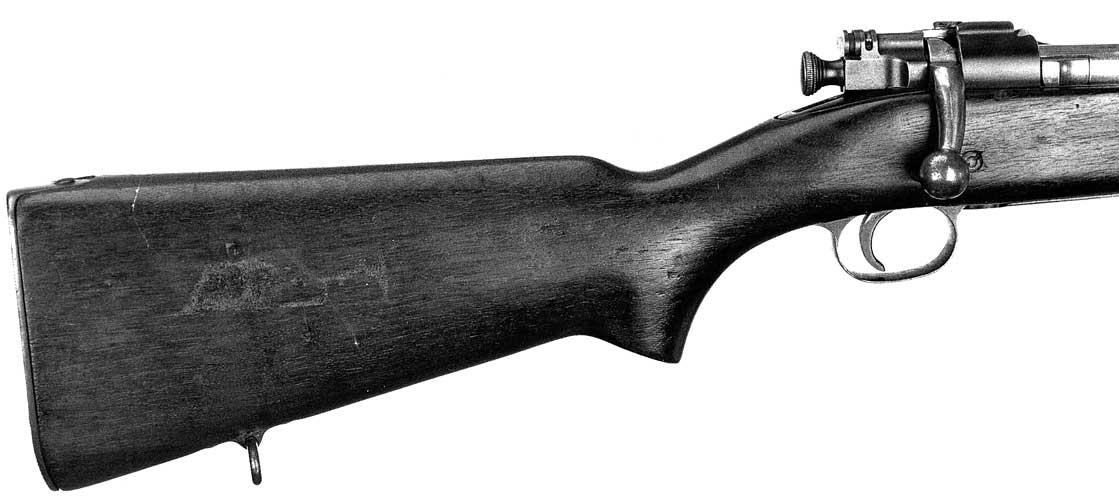
A. In 1929, the Type C stock was adopted for use with the M1903 rifle. This stock differed from the Type S stock used on the M1903 service rifles up to this time primarily in the fact that the stock had a pistol grip and the grasping grooves were eliminated. The configuration and dimensions of the Type C Stock were also improvements over the Type S stock for most shooters. The Type C stock was initially utilized on National Match rifles beginning in 1929 and was so favorably received that the stock was approved for use with service rifles when the supply of available Type S stocks became exhausted.

Upon adoption of the Type C stock, the designation of the service rifle became Model of 1903A1. Production of service rifles during the 1920s and 1930s was limited, and relatively few pure M1903A1 rifles were manufactured. To qualify as such, in addition to the stock, a rifle would have to be of 1929 or later Springfield Armory production (in the corresponding serial number range) with an appropriately dated barrel. Original M1903A1 rifles were finished in the distinctive 1930s vintage black-tinted Parkerizing.

right-side M1903 Type C gunstock rifle wood military gun

The original Springfield Armory Type C stocks were finely crafted and were stamped with a circled “P” proofmark on the grip and a final inspection stamp (cartouche) on the left side, slightly below the magazine cutoff recess. Several final inspection stamps may be encountered, including “dal” (for Springfield inspector Daniel A. Leary) and later, “sa/spg” (Springfield Armory/Stanley P. Gibbs). Both Leary and Gibbs were civilian inspectors who worked for Springfield Armory. Gibbs had been employed at Springfield since the First World War. A similar “sa/spg” inspection stamp will be found on early Springfield Armory M1 Garand rifles made prior to 1941.

Type C stocks were also made under subcontract during World War II, but these differed in several respects from the 1930s-vintage Type C stocks, primarily in the overall configuration. The finely crafted, pre-war Type C stocks were noticeably slimmer in profile than the World War II-vintage stocks of this type. The inspection stamping format will also help identify the earlier pre-war Type C stocks from the later World War II-contract variety. It should be noted that the standard Model of 1903 nomenclature on the receiver ring was retained on the M1903A1 variant, and the only substantive difference between the post-1929 rifles of this type and earlier M1903 rifles was the type of stock fitted.

There is some controversy today about exactly what constitutes a M1903A1 rifle. Apparently, the military considered any Springfield rifle fitted, even retrofitted, with a Type C stock as a M1903A1. Therefore, technically speaking, any M1903 rifle of any vintage fitted with a Type C stock can be classified as a M1903A1.

On the other hand, many collectors and students of the subject tend to take a more dogmatic approach and classify only those rifles made at Springfield Armory from 1929 until production ceased in the late 1930s, and equipped with the appropriate Type C stock, as true M1903A1s.
A true 1930s production M1903A1 service rifle is one of the rarest variants of the ’03 genre, and original examples are quite elusive. Many M1903 rifles of all vintages have subsequently been fitted with replacement Type C stocks during World War II (and later), but such assembled arms are infinitely more common and much less valuable than an original 1930s production M1903A1 service rifle.

—Bruce N. Canfield