I got this from "Angry Staff Officer", this guy uses Star War references as a teachable teaching tool for new Military officers. Again, there are spoilers on this and if so, please stop reading if you haven't seen the movie yet. I don't want to get fussed out for dropping some spoilers on the movie.
Thus is from. "Angry staff Officer, I got turned to him by Mack, so blame him, lol. Angry Staff Officer uses star war references to make a point. people will pay better attention if it is from the popular culture.
Most determine the great struggle in
Star Wars to be that
between the Light and Dark sides of the Force. But from a military
perspective it has always been between a highly regimented Empire and a
loosely organized Rebel force. And even within these communities there
have been contentions as to how best lead, direct, and motivate the
forces under their control. And nowhere is this seen more starkly as
with the First Order and the Resistance in
The Last Jedi.
So the film starts out in a nearly perfect demonstration of the
dichotomy in the leadership that divides the First Order from the
Resistance. The First Order appears out of hyperspace as the Resistance
is in the middle of evacuating their planetary base. Multiple star
destroyers pop into view surrounding the incredibly vulnerable
Resistance frigate that is being loaded with transports. Hoth it is not,
as the Resistance doesn’t even have any planetary weapons such as an
ion cannon to protect themselves. They are hopelessly outgunned and
surrounded.
So one would think this is the end of the Resistance for once and for all, but yet…
If there’s one thing that the Empire/First Order is good at doing it
is at getting in its own way through an overly regimented chain of
command. Rather than use his star destroyers to pummel the frigate or to
hit the base with orbital bombardment, the First Order’s fanatical
military commander General Armitage Hux gives orders for his ships to
standby as he brings up a new type of frigate: a dreadnought. Yeah,
rather than use his already incredibly useful star destroyers, Hux is
intent on dragging out yet another piece of tech – begging the question:
where does he get the money for this stuff?
Literally, the whole Imperial fleet just sits there with no movement.
Ship commanders can take zero initiative without the explicit direction
of General Hux. It is a massive amount of firepower, curtailed and
nullified by one man – and a thirty year tradition of micromanagement
and toxic leadership.
On the opposite side of the house, the Resistance has fighter pilot
Commander Poe Dameron who takes gamble after gamble to try to gain a
tactical edge on the First Order. Emphasis on the
tactical,
because Poe does not have a mind for the strategic. Poe goes so far as
to disobey a direct order from General Leia Organa to stop a bombing run
against the dreadnought and goes full “LEEEROYYYY JENKINNNNNSSS”
against the dreadnought. They do destroy the enemy ship, but at the cost
of the last two bomber squadrons in the entire Resistance. Which
perhaps explains where the rest of the Resistance fleet went if that’s
the way that Poe handles resource allocation.
Out of all of this, the First Order loses a dreadnought and the
Resistance loses their bombing fleet but is able to make the jump to
lightspeed. Of course, the First Order can easily afford the loss of a
capital ship while the Resistance is scraping the bottom of the barrel
for ships and pilots.
First Order leadership remains static the entire time, only
scrambling fighters when it’s nearly too late – as one of the First
Order’s bridge officers grumbles under his breath. And this motif
remains in place for the rest of the film: rigid leadership with no
flexibility. On the Resistance side, Leia finally loses patience with
Poe’s insubordination and busts him from commander to captain –
something that honestly should have been done a long time ago. Poe is a
tactical genius, yes, but has very little capacity for strategy. But
since he can pilot an X-wing like no one else, the Resistance can ill
afford to treat him badly and so continue giving him leadership roles.

Commander
Poe Dameron, a tactical wizard who has no comprehension of anything
above his own level and whose failure to think at the strategic level
has cost the Resistance most of its forces. (Lucasfilm Ltd)
But really, both sides have leadership issues going all the way to
the top. These problems influence the conduct of personnel up and down
the chain of command.
There’s this concept in the U.S. military called “mission command.”
It comes from the Prussian principle called “Auftragstaktik,” pioneered
by Helmuth von Moltke in the late 19th century and it boils down to
exercising disciplined initiative. That is, giving junior commanders the
ability to seize opportunities as they arise without jeopardizing the
entire force or operation. The German army used it to great effect in
World War I where their units were able to be more flexible and fluid
than those of their opponents. It is a concept that is markedly absent
from the Star Wars franchise. The Empire and the First Order operate
through the use of rigid command structures, with orders coming from the
top down. If those orders are not executed to the letter, subordinate
officers are in grave danger of being force-choked into submission. This
breeds a command culture of absolute and total dedication to orders,
which dooms them to fighting an unimaginative war. This is why Imperial
and First Order fleets rarely display the levels of ingenuity in war
that the Rebels and Resistance do.
And further, there is still the battle between the Sith and the
military establishment for control of their military force. The Sith
are focused on destroying the Jedi while the military leaders are driven
by the ultimate goal of crushing the rebellion. This plays out in
Last Jedi,
as Kylo Ren and General Hux battle for control of the First Order –
sometimes almost openly. With no unity of command – and Kylo Ren
becoming increasingly controlled by his emotions – the First Order can
only plod along and miss opportunity after opportunity to destroy the
Resistance.
The Resistance – much like the Rebellion – seems to be slowly moving
away from “command by consensus” which so hampered their abilities in
the past. With command power for all tactical and strategic decisions
now held by General Organa, the Resistance stands on the cusp of
actually having unity of command. However, because the Resistance prides
individuality almost too much, they have lost a significant number of
their ships to action with the First Order and so have little to no
force left to command. Audacity is usually an asset for military
leaders, but it can be taken to the level of foolishness. And in this
case, the Resistance has gambled its force so many times that they are
left with only a handful of pilots and fighters left at the end of the
film.

The First Order is not the only force riven by dissension. When Leia
is wounded and Admiral Ackbar is killed (we barely have had a chance to
mourn him), Vice Admiral Amilyn Holdo takes command. A skilled
strategist, Vice Admiral Holdo does have one key problem: she does not
know how to communicate her plans to subordinates in order to build
trust across the chain of command. When Poe and Finn doubt that she even
has a plan to save the Resistance, they launch a harebrained scheme of
their own that ultimately leads in the destruction of what is left of
the Resistance fleet and force.

Vice
Admiral Holdo was able to comprehend the real Resistance strategy:
survival. But her inability to communicate her leadership vision
completely undercut her integrity and led to total mission failure.
(Lucasfilm Ltd)
At this juncture, one has to ask: are there any competent leaders
anymore on either side? The First Order is hampered by its rigidity so
much that nearly removes their tactical edge, while the Resistance takes
so many risks that it is almost decimated. Both sides are left with
gaping holes in their top-tier levels of command at the end of the film
which will surely make the sequel to
The Last Jedi more interesting than ever.
Over the course of the
Star Wars
franchise, we’ve been treated to some epic battles: dogfights between
X-Wings and TIE fighters at Yavin-4, AT-ATs on the frozen wastes of
Hoth, jungle warfare on Endor, and
Rogue One’s epic battles on the beaches of Scarif.
The Last Jedi
offers no shortage of skirmishes, either. Except this time, the
Resistance’s consistently bad military tactics finally catch up with it.
From
a military perspective, one thing has always stood out: The Empire, and
now the First Order, have nearly limitless ships, equipment, and
manpower, while the Rebels/Resistance have scant resources. With every
engagement, this band of rebel fighters grows ever smaller while there
seems to be no lack of available Stormtroopers. At least previously,
though, those engagements ended with the destruction of Death Stars and a
Starkiller Base, even if unsound Rebel strategic thinking got them
there. Now, those bad choices are playing out more realistically—and
tragically—than ever.
Spoilers ahead.
While
The Last Jedi
mainly focuses on the Jedi order and its fate, perhaps the most
striking feature of the film is that the Resistance has finally played
its last card. The Resistance—and the Rebels before them—sought the
decisive battle, that one moment that would destroy the enemy’s will to
fight, and bring about peace in the Galaxy. That seemed to be the case
after
Return of the Jedi, and yet somehow in the intervening 30 years, the Republic squandered away all that they had won.
But
history shows that decisive battles do little to further a rebel cause.
During the American Civil War, Confederate General Robert E. Lee spent
years pursuing a decisive battle versus the United States Army. Yet,
even after one-sided Confederate successes such as Fredericksburg in
1862 and Chancellorsville in 1863, the US Army of the Potomac remained
in the field, inflicting losses that the Confederates could not afford.
Lee's search for decisive battle led to his force being winnowed away to
nearly nothing. The truly great generals throughout history have
realized that seeking a decisive battle only puts one's force in more
peril than the risk is worth.
In
The Last Jedi, the
Resistance lacks truly great generals. Commander Poe Dameron is a
skilled fighter pilot, but hardly a strategic thinker; he's a hammer who
sees a world full of nails. He gambles the Resistance bomber fleet on a
shot to take out a First Order dreadnought-class star destroyer. Not
only that, but he does so in violation of a direct order from General
Leia Organa. The mission succeeds in knocking out the enemy ship, but at
the cost of the entire Resistance bomber fleet, for which Poe is
reduced in rank.
Seeking that decisive battle with the First Order
only resulted in dead pilots and lost resources. It solved nothing in
the long term. And as the rest of
The Last Jedi makes clear,
for every enemy star destroyer or frigate the Resistance accounts for,
the First Order can replace it without blinking an eye.
Rather
than making massive sacrifices to blow up one big ship, the real
strength of the Resistance rests in its ability to survive. The presumed
heroics of individuals like Poe and Finn make it hard for them to do
even that.
In many ways, the Resistance shares that trait with
real-world rebellions throughout history. Most are worn down through the
sheer lack of resources and through attrition; a decisive battle
becomes their best way to make a grand statement.
In The Last Jedi, the Resistance lacks truly great generals.
The
successful counterexample, and a model the Resistance would have been
better served following, is the American Revolution. George Washington’s
genius lay less in his ability to take the fight to the
British—although he excelled at that—and more in the way that he
prioritized preservation of troops over seeking out a singular moment of
triumph. His ability to exfiltrate units from near-disaster mattered
just as much as his offensive strategies.
But
just as General Organa finally recognizes the importance of preserving
her force—too late, one could argue—she enters a coma after the First
Order begins its bombardment of the last Resistance Frigate. (RIP
Admiral Ackbar.) Command devolves to Vice Admiral Amilyn Holdo, who
recognizes the strategic need to protect their force, but has what
proves to be a fatal flaw: She fails to communicate well.
Holdo
knows that she can jettison the escape transports and they will be
cloaked from the First Order, but doesn’t share the plan with Poe. She
instead belittles him, and leaves him eager to take action. Left out of
the loop, Poe and Finn concoct a hare-brained scheme to save the last
three Resistance ships from First Order bombardment, another
all-or-nothing gambit that not only fails, but gets the majority of
transports destroyed in the process.
When
what remains of the Resistance lands on Crait, a planet that houses an
musty old Rebel Alliance outpost, they yet again seek a decisive
engagement, this time with only a handful of fighters and some infantry
left. Crait is a terrible spot for a last stand. The rebellion stuffs
itself into a cave, with only one entry and egress point, and little in
the way of protection.
They're shielded from planetary
bombardment, so the First Order lands a ground force. Now you've got
massive new AT-M6 walkers facing off against the serried trenches and
rusting turret guns of the Resistance.
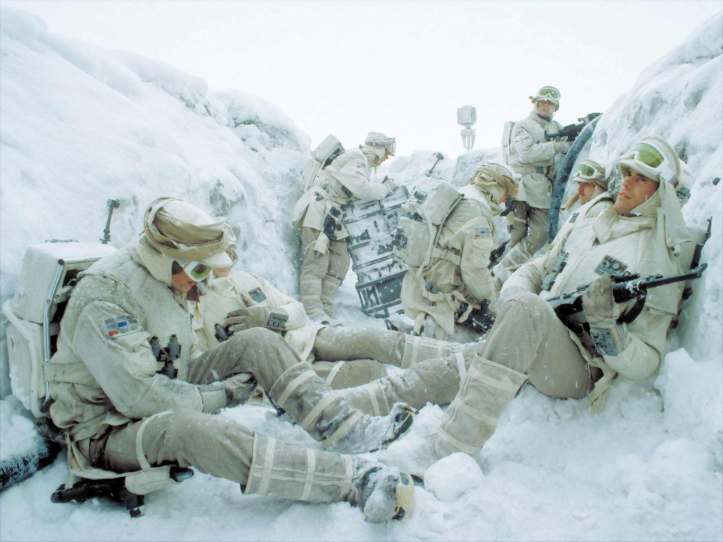
Sound familiar? Yes, it's looking like we're about to get
a repeat of The Empire Strikes Back's battle of Hoth, where resistance fighters just barely manage to escape after suffering grave losses.
Back
then, Imperial armor cut through the Rebels’ linear defenses, brushed
past Luke Skywalker's head-on air attack with snow speeders, and blasted
apart the shield generator. However, the plucky Rebel troopers had
managed to buy enough time for the main force to escape off planet,
under the protective fire of the ion cannon.
Fast-forward 30 years to Crait. The Resistance, clearly, has learned
nothing in the interim. Their dismounted troopers charge into World War
I-like trenches, gamely looking down blaster scopes at armored vehicles
they can't even hope to touch. Poe Dameron, while a wizard in the air,
can't muster two tactical brain cells as he flies his sortie of
incredibly ancient craft directly into the guns of the First Order’s
armor.
Much like Luke Skywalker in
Empire,
Poe doesn't seem to realize that the AT-series has no firepower on its
sides or rear. Nope, it's straight up the middle for Poe, with
predictable carnage for the last handful of Resistance pilots that
remain. At least Poe, unlike Luke, eventually realizes it's a suicide
mission, and pulls back after taking losses.
Of course, they’re
not much better off back in the cave. Only the arrival of Luke Skywalker
in full Jedi power mode saves the Resistance from being snuffed out in
entirety. But only just barely; all that’s left can fit inside the
Millennium Falcon.
By consistently refusing to learn the rules of
unity of command, communication across the chain of command, and the
necessity of preserving their force, the Resistance has fought itself
nearly out of existence. If rebellions are built on hope, then they
survive through skilled withdrawals—which almost never happens in the
Star Wars saga. And in The Last Jedi, that failure has brought what was
once a promising rebellion to the brink.







 Secret Base on [REDACTED]