Webster

The Constitution was made to guard the people against the dangers of good intentions." --American Statesman Daniel Webster (1782-1852)


Showing posts with label ships. Show all posts

Saturday, October 14, 2017

The U.S.S Pueblo, my thoughts on the ship

I have wondered about this for a long time, I even to this day can't understand this and I will explain.  The U.S.S Pueblo is a Navy ship although an "auxiliary" I believe the term is called.   I will give some background, the Pueblo was an intel gathering ship, all nations have them.  I have heard of Soviet Trawlers that would shadow American fleet movements and gather intelligence

Soviet Navy Trawler "Fishing"
We played games with them, it was understood that there were rules to this game and the NORKS broke the rules when they seized the ship.  I don't blame the Captain having to surrender, trying to save the lives of his crew after getting attacked by overwhelming NORK forces.  They seize the ship and try the crew for "spying".  What I can't understand is why didn't we bomb the ship, I remember when an American warship was captured by the Barbary pirates, a young lieutenant named Stephen Decatur and a sloop called the "Intrepid" sailed into the harbor and boarded the U.S.S. Philadelphia and tried to sail her away but were unable to so they destroyed the ship.   I know that during the Cold war, we had submarines in the Berent sea and by the Kola Peninsula sneak into the Soviet harbors and tap the communications cables.  and a bunch of other really sneaky stuff that still is classified to this day.  What get me is why didn't we sneak into the harbor, either like the French DGSE did with the Rainbow Warrior and sink the ship rather than keep allowing it to be used as a propaganda trophy by the NORKS.    I got this information of the Tripoli raid from "Wiki"  Like I said, this is my opinion and not supported by any body else private or government.
  

   On October 31, 1803, Philadelphia, under the command of Commodore William Bainbridge, ran aground on an uncharted reef (known as Kaliusa reef) near Tripoli's harbor. After desperate and failed attempts to refloat the ship she was subsequently captured and her crew imprisoned by Tripolitan forces. In an elaborate plan put together by Lieutenant Decatur, Decatur sailed for Tripoli with 80 volunteers (most of them being U.S. Marines) intending to enter the harbor with Intrepid without suspicion to board and set ablaze the frigate Philadelphia, denying its use to the corsairs. USS Syren, commanded by Lieutenant Charles Stewart, accompanied Intrepid to provide supporting fire during and after the assault. Before entering the harbor eight sailors from Syren boarded Intrepid, including Thomas Macdonough who had recently served aboard Philadelphia and knew the ship's layout intimately.
On February 16, 1804, at seven o'clock in the evening under the dim light of a waxing crescent moon, Intrepid slowly sailed into Tripoli harbor. Decatur's vessel was made to look like a common merchant ship from Malta and was outfitted with British colours. To further avoid suspicion, on board were five Sicilian volunteers including the pilot Salvador Catalano, who spoke Arabic. The boarding party remained hidden below in position, prepared to board the captured Philadelphia. The men were divided into several groups, each assigned to secure given areas of the ship, with the additional explicit instruction of refraining from the use of firearms unless it proved absolutely necessary.As Decatur's ship came closer to Philadelphia, Catalano called out to the harbor personnel in Arabic that their ship had lost its anchors during a recent storm and was seeking refuge at Tripoli for repairs. By 9:30 p.m. Decatur's ship was within 200 yards of Philadelphia, whose lower yards were now resting on the deck with her foremast missing, as Bainbridge had ordered it cut away and had also jettisoned some of her guns in a futile effort to refloat the ship by lightening her load.
 Burning of the USS Philadelphia by Edward Moran (1897)
Intrepid depicted in foreground
As Decatur approached the berthed Philadelphia he encountered a light wind that made his approach tedious. He had to casually position his ship close enough to Philadelphia to allow his men to board while not creating any suspicion. When the two vessels were finally close enough, Catalano obtained permission for Decatur to tie Intrepid to the captured Philadelphia. Decatur surprised the few Tripolitans on board when he shouted the order "board!", signaling to the hidden crew below to emerge and storm the captured ship. Without losing a single man, Decatur and 60 of his men, dressed as Maltese sailors or Arab seamen and armed with swords and boarding pikes, boarded and reclaimed Philadelphia in less than 10 minutes, killing at least 20 of the Tripolitan crew, capturing one wounded crewman, and forcing the rest to flee by jumping overboard. Only one of Decatur's men was slightly wounded by a saber blade. There was hope that the small boarding crew could launch the captured ship, but the vessel was in no condition to set sail for the open sea. Decatur soon realized that the small Intrepid could not tow the larger and heavier warship out of the harbor. Commodore Preble's order to Decatur was to destroy the ship where she berthed as a last resort, if Philadelphia was unseaworthy. With the ship secure, Decatur's crew began placing combustibles about Philadelphia with orders to set her ablaze. After making sure the fire was large enough to sustain itself, Decatur ordered his men to abandon the ship and was the last man to leave Philadelphia. As the flames intensified, the guns aboard Philadelphia, all loaded and ready for battle, became heated and began discharging, some firing into the town and shore batteries, while the ropes securing the ship burned off, allowing the vessel to drift into the rocks at the western entrance of the harbor.
While Intrepid was under fire from the Tripolitans who were now gathering along the shore and in small boats, the larger Syren was nearby providing covering fire at the Tripolitan shore batteries and gunboats. Decatur and his men left the burning vessel in Tripoli's harbor and set sail for the open sea, barely escaping in the confusion. With the cover of night helping to obscure the enemy gunfire, Intrepid and Syren made their way back to Syracuse, arriving February 18. After learning of Decatur's daring capture and destruction of Philadelphia without suffering a single fatality, British Vice Admiral Lord Horatio Nelson, who at the time was blockading the French port at Toulon, claimed that it was "the most bold and daring act of the Age." Decatur's daring and successful burning of Philadelphia made him an immediate national hero in the US.Appreciation for the efforts of Preble and Decatur were not limited to their peers and countrymen. At Naples, Decatur was praised and dubbed "Terror of the Foe" by the local media. Upon hearing the news of their victory in Tripoli, Pope Pius VII publicly declared that "the United States, though in their infancy, had done more to humble and humiliate the anti-Christian barbarians on the African coast in one night than all the European states had done for a long period of time." Upon his return to Syracuse, Decatur resumed command of Enterprise.


In Pyongyang, the North Korean Government keeps a trophy from 1968. Moored on the Botong River, alongside the Pyongyang Victorious War Museum sits the USS Pueblo (AGER-2).
It’s the second oldest still-commissioned U.S. Navy ship, and the only one held captive by another country.
The incident when North Korea seized the Pueblo along with her 83 crew members, killing one of them and wounding many others, occurred on January 23rd, 1968, a week before the start of the Tet Offensive in Vietnam. U.S. officials believed at the time that the North Koreans were acting upon instructions from the USSR (though this was confirmed to be untrue years later) and Cold War tensions were raised to one of the highest levels since the Cuban Missile Crisis a little more than five years earlier.
The crew was held for 11 months of negotiations between the U.S. and North Korea and were starved and tortured while in captivity. Many people reading this are probably not old enough to remember events like the Cuban Missile Crisis or even the Iran Hostage Crisis (1979-81).
For those who are too young, to give a sense of the intensity and fear in this situation, keep in mind that President Lyndon B. Johnson had officials advising him to demand the immediate return of the hostages from North Korea under threat of Nuclear Attack.
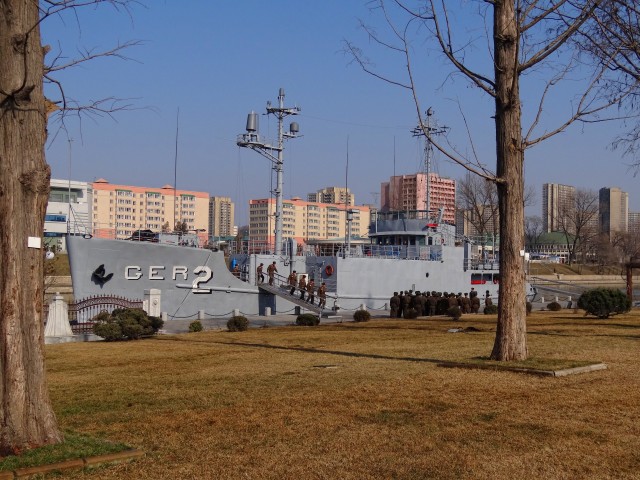

Pueblo-at-Pyongyang-Museum-2014
The USS Pueblo in Pyongyang, on display as a floating museum since 2013. By Bjørn Christian Tørrissen – 
Doomsday might not have been as close at it was when Russian ships drew closer and closer to the U.S. blockade around Cuba, but nervous hands wrung around fingers that were keeping that button squarely in mind.
The Pueblo wasn’t exactly taking a leisurely cruise around waters East of North Korea. It was a U.S. Auxiliary General Environmental Research (AGER) vessel under a program conducted by the Naval Security Group and the National Security Agency. Lead by Commander Lloyd M. Bucher, the Pueblo’s crew was there to gather intelligence and signal data from North Korea.
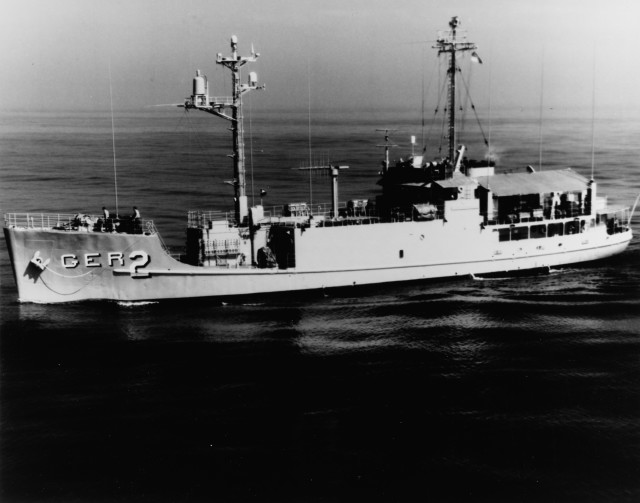

USS_Pueblo_(AGER-2)
The USS Pueblo in 1967.
According to U.S. officials, the commander and crew of the Pueblo, and Navy records, the Pueblo was 15.4 nautical miles off the Korean shore on January 20th, when a North Korean submarine chaser passed nearby. Two days later, they were again passed, this time by two North Korean fishing trawlers.
Vital to understanding the tensions surrounding this incident is the failed assassination attempt on South Korean President Park Chung-hee on the 22nd, of which the crew of Pueblo was not informed. Thirty-one North Koreans slipped over the border and tried to infiltrate the “Blue House” where the president resided, but were thwarted.
The next day, the 23rd, Pueblo was approached by another North Korean submarine chaser whose officers challenged Pueblo’s nationality. When the Pueblo’s U.S. flag was raised, she was ordered to stand down or be fired upon.


H75554
North Korean charts depicting their assertions about the Pueblo’s movements.
Commander Bucher tried to maneuver the ship away, in an effort to buy time for help from other U.S. forces and to destroy sensitive information held on the ship. The ship was slow, however, and the North Korean vessel was soon joined by others and MiG-21 fighters. Help never came.
Though the Pueblo had some light weaponry, Bucher knew a firefight wasn’t an option, that time was their greatest hope. According to the Operations Officer of the Pueblo, Skip Schumacher, this was the matchup: “The PUEBLO had no armor protection whatsoever; its armaments consisted of 10 Browning semi-automatic rifles, a handful of .45 caliber pistols and two .50 caliber machine guns wrapped in frozen tarps on the starboard and aft rails. With these tools it was asked to fend off 4 torpedo boats, 2 submarine chasers and MiG jet aircraft. Not very good odds”
As the Pueblo tried to flee, she was fired upon, without so much as a warning shot. One crewman was killed and 18 injured in the attack. Bucher broke off the run and surrendered to save the rest of his crew.
Schumacher also describes a startling realization of the ship’s vulnerability and the huge game-changer that this incident was as the North Koreans broke the de-facto rules of the cat-and-mouse, push-and-pull spy game that existed at the time and opened a chapter of full-out aggressive action.
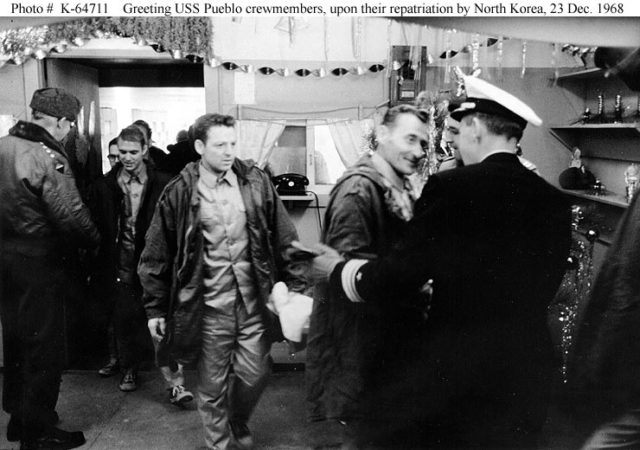


Crew of USS Pueblo upon release on 23 December 1968.
Though the Pueblo always stayed outside the 12 nautical mile border that International Law claims separates national sovereignty from international waters, the North Koreans insisted (and do to this day) that their sovereignty extends to 50 nautical miles and that Pueblo was in violation of this. Nevertheless, it was only after Bucher capitulated and the Pueblo was escorted to within that 12 miles, that she was boarded by a slew of high-ranking North Korean officials and the crew was taken into custody.
The North Korean regime, then as now, leaned heavily on their propaganda machine to instill their rule in the minds of their people and other nations. As they were forced to pose in photographs for this propaganda, the Americans, shot after shot, posed flipping their middle fingers, telling their captors at the time that it was a Hawaiian good luck gesture. When the North Koreans found out the true meaning of their mockery, the torture and starvation of the crew were increased.
Through the almost year-long imprisonment of the crew, slow, agitating negotiations were held between North Korean and U.S. officials at Panmunjom, the village where the armistice ending the full-out conflict of the Korean War was signed in 1953. Cultural and ideological differences made, what we would call in the West, decent compromise impossible.
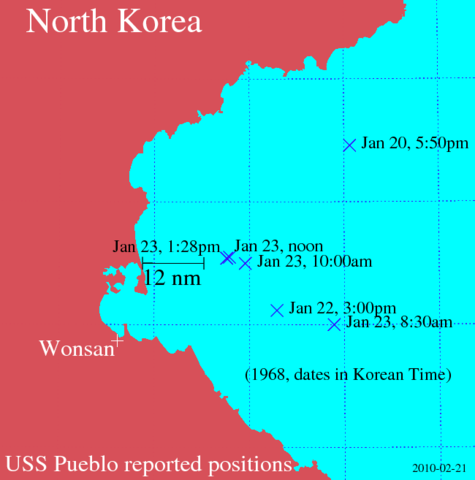


Reported positions of USS Pueblo.
There was added pressure from the South Koreans who were furious with the Americans for focusing more on their captive crew than on the blatant and brazen assassination attempt on January 22nd. They insisted on being a part of the negotiations. Anger and hostility between the North and South were approaching boiling point, with the U.S. in a very difficult position.
In the end, U.S. Army Major General Gilbert H. Woodward signed a full apology for the Pueblo spying on their nation and a promise that it wouldn’t happen again, and the North Koreans bussed the 82 remaining crew to the DMZ and handed them over. The apology and promise were hastily retracted.
In the following years, the commander and crew of the Pueblo were spared a court-marshal, with Secretary of the Navy John Chafee stating that the crew had been through enough. The North Koreans and Soviets were able to reverse-engineer the Pueblo’s communication devices, which gave them great insight into the communication of the U.S. Navy until the late 1980s.
The crew also had to wait until 1990 before their almost year-long ordeal was official recognized by the U.S. government and awards were given.

Wednesday, June 28, 2017

The HMAS Melbourne and the U.S.S. Evans Collision

 I was reading from my bloglist like I do every morning and got to "Grouchy Old Cripple"and they were talking about the collision of the Fitz and the container ship.  And this was in one of the comments.  Well I decided to do some digging and used Wiki to do some research and learned something new.

Remember back in “69” when the Frank Evans was cut in half by the Melbourne during exercises in the So China Sea. Captain was sleeping, he was Court Martialed and flushed out like a turd in the crapper. The two incompetents on the bridge had no business being there, Captain should have known their capabilities which, were shit. They survived the court martial, even with guilty pleas, but never got rank after that. Go figure. The Asshole Admiral that presided over the board of inquiry tried to put all the blame on the Melbourne and made a real spectacle (or was that Testicle) of himself. What a Dickhead. In that case, 74 Sailors died, and the two unqualified Assholes responsible for their deaths skated. We saw the remains of the Evans in dry dock in Subic and it looked like a giant Sawsall sliced it in half. Still can’t imagine how the rear half stayed afloat. With the Fitzgerald there are no excuses. It will be interesting to see how it all goes down and how the discipline gets dished out.


The Melbourne–Evans collision was a collision between the light aircraft carrier HMAS Melbourne of the Royal Australian Navy (RAN) and the destroyer USS Frank E. Evans of the United States Navy (USN). On 3 June 1969, the two ships were participating in SEATO exercise Sea Spirit in the South China Sea. At approximately 3:00 am, when ordered to a new escort station, Evans sailed under Melbourne's bow, where she was cut in two. Seventy-four of Evans' crew were killed.
A joint RAN–USN board of inquiry was held to establish the events of the collision and the responsibility of those involved. This inquiry, which was believed by the Australians to be biased against them, found that both ships were at fault for the collision. Four officers (the captains of Melbourne and Evans, plus the two junior officers in control of Evans at the time of the collision) were court-martialled based on the results of the inquiry; while the three USN officers were charged, the RAN officer was cleared of wrongdoing.

HMAS Melbourne was the lead ship of the Majestic class of aircraft carriers. She was laid down for the Royal Navy on 15 April 1943, but construction was stopped at the end of World War II. She was sold to the Royal Australian Navy in 1948, along with sister ship HMAS Sydney, but was heavily upgraded while construction was completed and did not enter service until the end of 1955. In 1964, Melbourne was involved in a collision with the Australian destroyer HMAS Voyager, sinking the smaller ship and killing 81 of her crew and one civilian dockyard worker.

USS Frank E. Evans was an Allen M. Sumner-class destroyer. She was laid down on 21 April 1944, and commissioned into the United States Navy on 3 February 1945. She served in World War II, the Korean War, and the Vietnam War, and earned 11 battle stars.

Melbourne's commanding officer during the SEATO exercise was Captain John Phillip Stevenson. Rear Admiral John Crabb, the Flag Officer Commanding Australian Fleet, was also embarked on the carrier.  During Sea Spirit, Melbourne was assigned five escorts: the US destroyers Everett F. Larson, Frank E. Evans and James E. Kyes, and the frigates HMNZS Blackpool and HMS Cleopatra. Stevenson held a dinner for the five escort captains at the start of the exercise, during which he recounted the events of the Melbourne–Voyager collision, emphasized the need for caution when operating near the carrier, and provided written instructions on how to avoid such a situation developing again. Additionally, during the lead-up to the exercise, Admiral Crabb had strongly warned that all repositioning maneuvers performed by the escorts had to commence with a turn away from Melbourne.
Despite these warnings, a near-miss occurred in the early hours of 31 May when Larson turned toward the carrier after being ordered to the plane guard station. Subsequent action narrowly prevented a collision. The escorts were again warned about the dangers of operating near the carrier and informed of Stevenson's expectations, while the minimum distance between carrier and escorts was increased from 2,000 to 3,000 yd (1,800 to 2,700 m).

On the night of 2–3 June, Melbourne and her escorts were involved in anti-submarine training exercises.  In preparation for launching a Grumman S-2 Tracker aircraft, Stevenson ordered Evans to the plane guard station, reminded the destroyer of Melbourne's course, and instructed the carrier's navigational lights to be brought to full brilliance. This was the fourth time that Evans had been asked to assume this station that night, and the previous three maneuvers had been without incident. Evans was positioned on Melbourne's port bow, but began the maneuver by turning starboard, toward the carrier. A radio message was sent from Melbourne to Evans's bridge and Combat Information Center, warning the destroyer that she was on a collision course, which Evans acknowledged. Seeing the destroyer take no action and on a course to place herself under Melbourne's bow, Stevenson ordered the carrier hard to port, signalling the turn by both radio and siren blasts.  At approximately the same time, Evans turned hard to starboard to avoid the approaching carrier. It is uncertain which ship began to maneuver first, but each ship's bridge crew claimed that they were informed of the other ship's turn after they commenced their own. After having narrowly passed in front of Melbourne, the turns quickly placed Evans back in the carrier's path. Melbourne hit Evans amidships at 3:15 am, cutting the destroyer in two.

The paths taken by HMAS Melbourne and USS Frank E. Evans in the minutes leading up to the collision
Melbourne stopped immediately after the collision and deployed her boats, liferafts and lifebuoys, before carefully manoeuvring alongside the stern section of Evans. Sailors from both ships used mooring lines to lash the two ships together, allowing Melbourne to evacuate the survivors in that section.  The bow section sank quickly; the majority of those killed were believed to have been trapped within. Members of Melbourne's crew dived into the water to rescue overboard survivors close to the carrier, while the carrier's boats and helicopters collected those farther out. Clothing, blankets and beer were provided to survivors from the carrier's stores, some RAN sailors offered their own uniforms, and the ship's band was instructed to set up on the flight deck to entertain and distract the USN personnel. All of the survivors were located within 12 minutes of the collision and rescued before half an hour had passed, although the search continued for 15 more hours.
Seventy-four of the 273 crew on Evans were killed. It was later learned that Evans's commanding officer—Commander Albert S. McLemore—was asleep in his quarters at the time of the incident, and charge of the vessel was held by Lieutenants Ronald Ramsey and James Hopson; the former had failed the qualification exam to stand watch, while the latter was at sea for the first time.

Following the evacuation of Evans's stern, the section was cast off while the carrier moved away to avoid damage, but against expectation, it failed to sink.  The stern was recovered and towed by fleet tug USS Tawasa to Subic Bay, arriving there on 9 June. After being stripped for parts, the hulk was decommissioned on 1 July, and was later sunk when used for target practice.

Melbourne travelled to Singapore, arriving on 6 June, where she received temporary repairs to her bow. The carrier departed on 27 June, and arrived in Sydney on 9 July, where she remained until November docked at Cockatoo Island Dockyard for repairs and installation of the new bow.
817 Squadron RAN—which was responsible for the Westland Wessex helicopters embarked on Melbourne at the time of the collision—was later awarded the Presidential Unit Citation for their rescue efforts. Five other decorations were presented to Australian personnel in relation to the rescue of Evans's crew: one George Medal, one Member of the Order of the British Empire (MBE), one Air Force Cross, and two British Empire Medals.  Fifteen additional commendations for gallantry were awarded by the Australian Naval Board.

A joint RAN–USN board of inquiry was established to investigate the incident, following the passing of special regulations allowing the presence of Australian personnel at a U.S. inquiry.  The board was in session for over 100 hours between 9 June and 14 July, with 79 witnesses interviewed: 48 USN, 28 RAN, and three from other navies.
The board was made up of six officers. The RAN representatives were Rear Admiral David Stevenson (no relation to Melbourne's Captain Stevenson), Captain Ken Shards, and Captain John Davidson. The USN officers were Captains S. L. Rusk and C. B. Anderson. Presiding over the board was USN Rear Admiral Jerome King: considered to be an unwise posting as he was the commanding officer of both the forces involved in the SEATO exercise and the fleet unit Evans normally belonged to, and was seen during the inquiry to be biased against Captain Stevenson and other RAN personnel.  King's attitude, performance, and conflict of interest were criticized by the Australians present at the inquiry and the press, and his handling of the inquiry was seen as detrimental to relations between the two countries.
Despite admissions by members of the USN, given privately to personnel in other navies, that the incident was entirely the fault of Evans, significant attempts were made to reduce the U.S. destroyer's culpability and place at least partial blame for the incident on Melbourne.  At the beginning of the inquiry, King banned one of the RAN legal advisers from attending, even as an observer.  He regularly intervened for American witnesses, but failed to do so on similar matters for the Australians.  Testimony on the collision and the subsequent rescue operation was to be given separately, and although requests by American personnel to give both sets of testimony at the same time in order to return to their duties were regularly granted, the same request made by Stevenson was denied by King. Testimony of members of the RAN had to be given under oath, and witnesses faced intense questioning from King, despite the same conditions not applying to USN personnel.  There was also a heavy focus on the adequacy of Melbourne's navigational lighting.Mentions of the near miss with Larson were interrupted with the instruction that those details could be recounted at a later time, but the matter was never raised by the board.
The unanimous decision of the board was that although Evans was partially at fault for the collision, Melbourne had contributed by not taking evasive action sooner, even though doing this would have been a direct contravention of international sea regulations, which stated that in the lead-up to a collision, the larger ship was required to maintain course and speed.  The report was inconsistent in several areas with the evidence given at the inquiry, including the falsity that Melbourne's navigational lights took significant time to come to full brilliance.  Several facts were also edited out of the transcripts of the inquiry.

Stevenson was informed on 29 July of the result, although not the details, and was told that a court-martial charging him for his role in the incident might be required.  Two charges of negligence—for failing to explicitly instruct Evans to change course to avoid collision and for failing to set the carrier's engines to full astern—were laid on 15 August, with the court martial held from 20 to 25 August.  Evidence presented during the hearing showed that going full astern would have made no difference to the collision, and on the matter of the failing-to-instruct charge, the presiding Judge Advocate concluded that reasonable warning had been given to the destroyer and asked "What was [Stevenson] supposed to do—turn his guns on them?". Of the evidence and testimony given at the court-martial, nothing suggested that Stevenson had done anything wrong; instead it was claimed that he had done everything reasonable to avoid collision, and had done it correctly.
The reasons for the court-martial given by historians vary. One reason suggested was that it was to appease the USN, which had court-martialled three officers from Evans and had threatened to prevent US ships from operating as part of Australian-led forces if no action was taken against Stevenson. The other view is that the court-martial was used in an attempt to clear Stevenson's name and to allow the RAN to distance itself from the findings of the joint board of inquiry.
The defence submitted that there was "no case to answer", resulting in the dropping of both charges, and the verdict of "Honourably Acquitted". Despite the findings, Stevenson's next posting was as chief of staff to a minor flag officer; seen by him as a demotion in all but name. The posting had been decided upon before the court-martial, and was announced while Stevenson was out of the country for the courts-martial of Evans's officers; he did not learn about it until his return to Australia.  Following the events—publicly considered to be another scapegoating of a commanding officer of Melbourne (the first enquiry into the collision between Melbourne and HMAS Voyager had laid significant blame on Captain John Robertson, the ship's commanding officer at the time)—Stevenson requested retirement, as he no longer wished to serve under people he no longer respected.  This retirement was initially denied, but was later permitted.

Commander Albert S. McLemore and Lieutenants Hopson and Ramsey also faced courts-martial for their contributions to the collision. Hopson and Ramsey both pleaded guilty to charges of dereliction of duty and negligence, and had their positions in the promotion list moved down. McLemore, who pleaded not guilty to the charges against him, was found guilty of dereliction of duty and negligently hazarding his ship. The formal reprimand effectively ended his naval career.


In 1999, McLemore publicly claimed that the collision was his responsibility, as he had left two inexperienced officers with the con of his ship.

A training film, I Relieve You, Sir, was developed by the USN for junior watch keeping officers. Based around the events of the collision, the film demonstrates the responsibility junior watch keeping officers hold, and the potential consequences of failing to do their job.
Unlike other naval casualties during the Vietnam War, the names of the 74 Evans crew killed are not inscribed on the Vietnam Veterans Memorial. Despite operating in Vietnamese waters immediately before deployment to Exercise Sea Spirit, and being scheduled to return to activities supporting the war effort after the exercise, it was determined that as Sea Spirit was not directly linked with U.S. operations in Vietnam, and the exercise took place outside the geographical limit for the conflict as defined by the outer edge of Market Time operations, the crew was ineligible for inclusion on 'The Wall'. Exceptions to the geographic limit rule have been made for other personnel killed as part of the conflict but not in Vietnam itself; for example those involved in operations in Laos, and those dying in transit to or from Vietnam. However, an act of Congress specifically permitting the inclusion of their names on the memorial is required: legislation to have those killed in the Melbourne–Evans collision has been introduced on several occasions, but has so far failed to gather sufficient support.
A memorial to the collision is located in Niobrara, Nebraska. The memorial specifically commemorates the three Sage brothers, all of whom were aboard Evans and were killed in the collision. They were the first group of siblings permitted to serve on the same ship since World War II, a result of the policy introduced when the five Sullivan brothers were killed following the sinking of USS Juneau. Collision survivors and family members of Evans personnel have held annual reunions to memorialise the accident. Australian sailors who served on Melbourne often attend.
In December 2012, Stevenson announced that his son had received a letter from the Minister for Defence, Stephen Smith, saying that he was "not treated fairly" by the government of the day and the Australian Navy. It also said, "Your father was a distinguished naval officer who served his country with honour in peace and war." "Should your father have continued his naval career, the Chief of Navy advises me that he would undoubtedly have been competitive for flag rank." Stevenson also said that he was supported throughout his ordeal by his wife, who had died just five months before the letter arrived.

 Official Apology by the Australian Navy for what happened to the Capt of the Melbourne

In September 2014 American journalist Louise Esola published American Boys: The True Story of the Lost 74 of the Vietnam War, which chronicles the lives of the 74 men killed on the USS Frank E. Evans and the efforts by survivors and families to have the men memorialized on the Vietnam Veterans Memorial in Washington, D.C.


Friday, June 9, 2017

The NAVY might bring back some mothballed ships.

I have commented about bringing some of the older ships out of retirement, and upgrading the systems, especially with the money that the navy has spend on the Littoral combat ship and some of the other choices.   I have also commented about bringing some of the battleships out of mothballs.  I had used for example the U.S.S Alabama, by sheer service hours that ship would be very young compared to the ships on duty now.  Nothing screams America like a carrier or a couple of battleships.    Just a thought....?     I saw this on the wire and thought it would be a cool article.


As the US Navy struggles to figure out how it can reach its new goal of a 355 ship fleet—up from 275 ships today—as quickly as possible, it has been looking towards extending the life of the ships it already has in service. Now the service is also examining the possibility of selectively pulling ships out of mothballs, refurbishing them, and sending them back to the fleet. One ship in particular may have a better shot than others at sailing the high seas once again—the USS Kitty Hawk (CV-63)—America's last operational conventionally fueled supercarrier..

The head of the Navy's Sea Systems Command, Vice Admiral Thomas Moore, stated that while most ships in the inactive fleet are in too sorry a state to be worth reviving, the USS Kitty Hawk may not be: "Of the carriers that are in inactive force, probably Kitty Hawk is the one that you could think about. But we studied that when we decommissioned Enterprise, and the carriers are pretty old."


USN

Certainly pulling a carrier directly back into service would go a long way to bridging America's "carrier gap" and would make President's Trump's demand for a 12 supercarrier fleet much more obtainable. Currently the Navy has 10 operational supercarriers, and with the USS Gerald Ford's (CVN-78) entry into service date murky at best, that number may not increase for years to come.

Even just the possibility of Kitty Hawk returning to the fleet is likely music to the ears of those in Mayport, Florida, who have been begging the US Navy to return a supercarrier to the naval station there. The facility was never upgraded to support nuclear propulsion, so after the USS John F. Kennedy (CV-67) was retired in 2007, it has been without a resident supercarrier, which hurt the local economy and also has strategic implications as well. The Kitty Hawk would be an ideal candidate to call the base home without the need for major infrastructure investments.


USN

Some of the other ships that would seem to be likely candidates for revival will probably be passed over—specifically the first five Ticonderoga class cruisers that sit quiet on the Delaware River. These ships didn't feature Mark 41 vertical launch systems, instead being equipped with twin-arm Mark 26 missile launchers and their associated magazines. But still, many have regarded their rickety reserve status a huge waste of latent surface warfare potential. Moore thinks otherwise, and probably for good reason.
The ships are vastly outdated compared to their active counterparts, and would take serious money to get them even close to their fleet counterparts standard. Not just that, but they have been cannibalized for spare parts in recent years. Moore says: "Most of those ships, from a combat systems perspective, are pretty obsolete...We probably wouldn’t bring them back and they’ve kind of been spare-parts lockers the last couple of years." 


Bigbird78/wikicommons
The sorry state of the USS Ticonderoga (CG-47) at naval yards in Philadelphia. 

Regenerating old ships is all about balancing the cost of bringing them back into service based on what mission sets they could provide, how degraded a capability compared to their modern counterparts is acceptable, and how long they could remain in service once the money has been invested in them.
Aside from the Kitty Hawk, the best candidates for regeneration are the ships that could take on lower-end tasks, and thus not require the huge amount of technological investment as their more advanced cousins require. Primarily this includes the Navy's mothballed logistical ships and especially its Oliver Hazard Perry class frigates. The tough Oliver Hazard Perry class ships were retired too soon by many accounts—a symptom of their fiscal neglect more than anything else—and were ripe for a major upgrade like many of the second-hand models operated by allied Navies around the globe have received. Some of these enhancements include the installation of Mark 41 vertical launch systems and upgrades to the ship's sensors and combat systems. 


USN
Oliver Hazard Perry class frigate USS Thatch patrols the Persian Gulf in 2009.
"We’ll go look at the FFGs, see if there is utility there... We’ll look at the combat logistics force, see if there’s utility there... So, there is limited opportunity in the inactive fleet but we’ll look at it ship-by-ship."
It is very likely President Trump would support such a plan, in fact we predicted exactly this type of asset regeneration program would occur under his administration. Trump also has a personal history with being very comfortable with operating aging but upgraded vehicles. He even hinted at the possibility of bringing back the Iowa class battleship during his campaign, although that is extremely unlikely to ever happen regardless of the political will involved.

Tuesday, October 30, 2012

H.M.S. Bounty sinks due to Sandy

H.M.S. Bounty...SInks due to Sandy

This is a shame, From what I have heard, the ship was moored at port and they were trying to get away from the storm, but a square rigger don't have the speed of a modern ship.  At sea she would have had a chance to survive.   If a ship is moored, the chances of damage and destruction is much more.   I always had an affinity for the sailing ships.  A thrill I had was taking my son to the U.S.S. Constitution in Boston harbor. 


In this July 7, 2010 file photo, the tall ship HMS Bounty sails on Lake Erie off Cleveland. The U.S. Coast Guard has rescued 14 members of the crew forced to abandon the HMS Bounty caught in Hurricane

In this July 7, 2010 file photo, the tall ship HMS Bounty sails on Lake Erie off Cleveland. The U.S. Coast Guard has rescued 14 members of the crew forced to abandon the HMS Bounty caught in Hurricane Sandy off North Carolina. The Coast Guard is searching for two other crew members. (AP Photo/Mark Duncan, File)
 

This photo provided by the U.S. Coast Guard shows the HMS Bounty, a 180-foot sailboat, submerged in the Atlantic Ocean during Hurricane Sandy approximately 90 miles southeast of Hatteras, N.C., Monday, Oct. 29, 2012. The Coast Guard rescued 14 of the 16 crew members by helicopter. Hours later, rescuers found one of the missing crew members, but she was unresponsive. They are still searching for the captain. (AP Photo/U.S. Coast Guard, Petty Officer 2nd Class Tim Kuklewski)

This information is by Tallshipsorg
The Bounty was built in 1960 for MGM studios' Mutiny on the Bounty with Marlon Brando. Since then, the new Bounty has starred in several feature-length films and dozens of TV shows and historical documentaries.
The studios commissioned the ship from the shipwrights of Smith and Ruhland in Lunenburg, Nova Scotia to commission a new Bounty to be built from scratch. Completely seaworthy and built just the way it would have been 200 years before, the new Bounty was constructed from the original ship's drawings still on file in the British admiralty archives.
After filming and a worldwide promotional tour, MGM berthed the ship in St. Petersburg as a permanent tourist attraction - where she stayed until the mid-1980s. In 1986 Ted Turner acquired the MGM film library and the Bounty with it. He used it to promote his enterprises, and filmed Treasure Island with Charlton Heston in 1989.
In 1993, Turner donated the ship to the Fall River Chamber Foundation, which established the Tall Ship Bounty Foundation to operate the ship as an educational venture.
In February of 2001 H.M.S. Bounty was purchased from the Foundation by HMS Bounty Organization LLC. She was in dyer need for repairs at the time. It was decided to take her to Boothbay Harbor Maine "Samples Shipyard" Later to be known as Boothbay Harbor Shipyard. When we were ready for the final refit it was only fitting to bring her "home." where Bounty was "on the rails" once again preparing for "A Round The World Voyage" - her first stop would be the United Kingdom.
The HMS Bounty Organization LLC is dedicated to keeping the ship sailing and using her as a vehicle for teaching the nearly lost arts of square rigged sailing and seamanship.
The Organization operates a variety of programs on board including sail training programs for the general public, group leadership and teamwork training, a Sail Away Summer Camp program, and dockside educational programs for elementary and secondary school children.

Saturday, June 9, 2012

India's Aircraft readies for sea trials..


India's Russian-built Aircraft Carrier Starts Sea Trials


RIA Novosti
10:30 08/06/2012 SEVERODVINSK, June 8 (RIA Novosti) - The Indian Navy's Russian-built aircraft carrier Vikramaditya (formerly Admiral Gorshkov) began sea trials early on Friday morning in the White Sea - four years after it was originally due to take to sea again.
The ship was refitted at the Sevmash shipyard in northern Russia. It was originally scheduled to begin sea trials, which will last 120 days, on May 25.
A mixed Russian-Indian crew is on board the vessel, with the Indian sailors learning how to operate the vessel. After initial sea trials in the White Sea the ship will sail to the Barents Sea for exercises with military aircraft.
India and Russia signed a $947 million dollar deal in 2005 for the purchase of the carrier, but delivery has already been delayed twice, pushing up the cost of refurbishing the carrier to $2.3 billion.
Sevmash shipyard director Vladimir Pastukhov, was fired in 2007 over his poor management of the project.
The Vikramaditya was originally built as the Soviet Project 1143.4 class aircraft carrier Admiral Gorshkov.
The ship was laid down in 1978 at the Nikolayev South shipyard in Ukraine, launched in 1982, and commissioned with the Soviet Navy in 1987.
It was renamed after the collapse of the Soviet Union in 1991. In 1994, the Admiral Gorshkov sat in dock for a year for repairs after a boiler room explosion. In 1995, it briefly returned to service but was was finally withdrawn and put up for sale in 1996.
The ship has a displacement of 45,000 tons, a maximum speed of 32 knots and an endurance of 13,500 nautical miles (25,000 km) at a cruising speed of 18 knots.
India has already started taking delivery of MiG-29K naval fighter aircraft for the Vikramaditya, as they were ready before the refit was completed. The MiG-29Ks will operate in STOBAR (short take-off but assisted recovery via arresting wires) mode.
The MiG-29K was reportedly selected over the larger and more-capable Su-33 naval fighter because India also hopes to operate them from its smaller, indigenous “Project-71 Air Defense Ship” carriers, according to defenseindustrydaily.com.