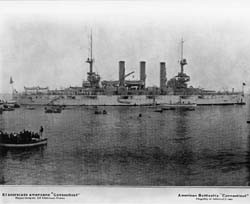
I had blogged a couple of days ago about the Virginius affair and the effect that it had on the U.S. Navy and American diplomacy, I remembered reading about the "Great white Fleet in Elementary school and there was a picture of the ships sailing and gleaming all in white and gold trim.
On the warm, cloudy morning of Dec. 16, 1907, President Theodore Roosevelt stood on the weather-deck of the presidential yacht
Mayflower,
anchored in the waters off Hampton Roads, Va. He flashed his famous
broad, toothy smile and thought how "bully" it was to see a mighty
armada of US battleships passing in review before him. The President,
and indeed the throngs of onlookers gathered on shore, felt a great
sense of pride and exhilaration as 16 battleships of the US Atlantic
Fleet, all painted white, save for gilded bows, steamed in a long
majestic column out of Hampton Roads to the open sea, flanked by their
attending auxiliary ships.
USS Connecticut (BB-18),
leading the Atlantic Fleet to Sea, circa December 1907, probably at the
start of the cruise around the world
To the familiar strains of "The Girl I left Behind Me," the
procession of battlewagons passed before the President at 400-yard
intervals with their crews smartly manning the rails. This newly
designated battle fleet was made up of ships commissioned since the end
of the Spanish-American War. They were USS Kearsarge (BB-5), USS Kentucky (BB-6), USS Illinois (BB-7), USS Alabama (BB-8), USS Maine (BB-10), USS Missouri (BB-11), USS Ohio (BB-12), USS Virginia (BB-13), USS Georgia (BB-15), USS New Jersey (BB-16), USS Rhode Island (BB-17), USS Connecticut (BB-18), USS Louisiana (BB-19), USS Vermont (BB-20), USS Kansas (BB-21) and USS Minnesota (BB-22).
The four squadrons of warships, dubbed the "Great White Fleet," were
manned by 14,000 sailors and marines under the command of Rear Adm.
Robley "Fighting Bob" Evans. All were embarking upon a naval deployment
the scale of which had never been attempted by any nation before - the
first 'round-the-world cruise by a fleet of steam-powered, steel
battleships. The 43,000 mile, 14-month circumnavigation would include 20
port calls on six continents; it is widely considered one of the
greatest peacetime achievements of the US Navy.
The idea of sending the new battle fleet around the world was the
brainchild of the energetic "Teddy" Roosevelt, former colonel of the
Rough Riders and one-time assistant secretary of the Navy. Assuming the
presidency after the assassination of President William McKinley in
1901, Roosevelt brought to the White House a deep conviction that only
through a strong navy could a nation project its power and prestige
abroad.
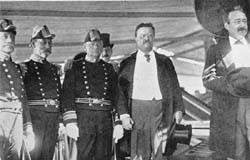
Admirals Brownson, Davis and Evans, President Theodore Roosevelt and Secretary Bonaparte.
In 1898, at the end of the
Spanish-American War, the United States was thrust into the mainstream
of international affairs and gained status as a world power, acquiring
as possessions the Philippines and Guam in the Pacific, then Puerto Rico
in the Caribbean. In 1904, the United States also established a naval
base at Guantanamo Bay, Cuba, to ensure the safety of the Panama Canal,
then under construction.
Roosevelt stressed the upgrading and expansion of the US fleet in
order to protect American interests abroad. From 1904 to 1907, American
shipyards turned out 11 new battleships to give the Navy awesome battle
capabilities. This was timely, for, in 1906, hostilities with Japan
seemed possible; the Japanese navy dominated the Pacific and posed a
potential threat to the Philippines.
America's problems with Japan arose shortly after Roosevelt mediated
the Treaty of Portsmouth in 1906, ending the Russo-Japanese War. In that
conflict the Russian fleet had been annihilated by the Japanese. But
despite their triumphs over the Russians on the high seas, the Japanese
failed to get all they felt they deserved at the peace table and blamed
Roosevelt for it.
In the same year, anti-Japanese feelings were sweeping California.
The San Francisco Board of Education ordered the segregation of all
immigrant and descendent Japanese school children.
When the news of this reached Japan, violent anti-American protests
broke out. Roosevelt managed to persuade the Board of Education to
discontinue its segregation policy in exchange for an agreement with
Japan to slow down its stream of immigrants into the United States.
Roosevelt didn't want a break with Japan, as the United States was
ill-prepared for war. Most of our battle fleet was concentrated in the
Atlantic, and there were only a handful of armored cruisers on duty in
the Pacific. In the event of war with Japan, this small contingent that
made up the Asiatic Battle Fleet would have to abandon the Philippines
for West Coast ports until the United States had strength enough to go
on the offensive.
Thus, to impress upon Japan that the US Navy could shift from the
Atlantic to the Pacific, Roosevelt ordered the Great White Fleet to sail
around the world.
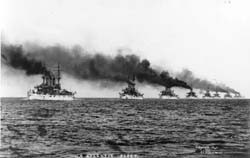
U.S. Atlantic Fleet Battleships,
steaming out of Hampton Roads, VA. , in December 1907, to begin their
cruise around the World. Leading two ships are: Kansas (BB-21) and Vermont (BB-22).
The President also wanted to find
out what condition the fleet would be in after such a transit. As he
stated before the fleet's departure, "I want all failures, blunders and
shortcomings to be made apparent in time of peace and not in time of
war."
But, more importantly, Roosevelt felt that a successful cruise of
this magnitude would provide the American people with an example of US
naval preparedness, strength and range. Such an impression, he hoped,
would help him get the desired appropriations for four more battleships.
With the exception of the few highest ranking naval officials, nobody
was aware of Roosevelt's intention to send the fleet around the world.
Even the President's own cabinet didn't know about it. All anyone knew
was that the fleet would be steaming from the east to West Coast in a
training exercise.
Once the plans for the cruise became public, not everyone was
impressed. Some critics felt that this show of force would encourage a
Japanese attack on the fleet. Others were worried that the Atlantic
naval defenses would be weakened by taking away so many ships. Also, it
was reasoned, since the Panama Canal was unfinished, the ships would
have to pass through the Straits of Magellan, an area that posed
considerable danger because of tricky currents and great storms.
Senator Eugene Hale from Maine, chairman of the Naval Appropriations
Committee, threatened to withhold money for the cruise. But this didn't
bother Roosevelt, who replied in his typically brusque and forthright
fashion that he already had the money and dared Congress to "try and get
it back."
Nobody took Roosevelt up on his challenge and the Great White Fleet
got underway that December morning, with the coal-burning ships' stacks
spewing billowing clouds of black smoke into the gray sky. Aboard the
flagship Connecticut, Rear Adm. Evans looked out with pride upon
the majestic fleet under his command. He had stated earlier that his
ships "were ready at the drop of a hat for a feast, a frolic or a
fight".
Late on the first day of steaming, Evans passed the word to the
officers and men of the fleet that after a short stay on the West Coast,
the fleet would return home by way of the Pacific, through the Suez
Canal, into the Mediterranean and then to the Atlantic. In short, they
would be transiting the globe. When this announcement became general
knowledge the next day, countries throughout the world tendered their
invitations for the fleet to visit their ports.
The first leg of the cruise took the fleet into the South Atlantic.
On Dec. 23, the fleet made its first port visit, at Port of Spain in
Trinidad, a small island off the coast of Venezuela.
Trinidad, as most of the sailors discovered, rated a pretty low score
when it came to liberty. According to one sailor, it was one of the
most boring places he'd been to and he remarked, "When we pulled in,
there were no people around and almost everything was closed up. Just
one building was open that had any beer in it. By the time we made it to
shore, the stuff was hot as hell. It was just like drinking boiler
water."
Another sailor noted that, aside from "looking at the flowers and
visiting a leper colony," there wasn't much to do. When the fleet left
Port of Spain Dec. 29, enroute to Brazil, there were few if any, who
longed to stay. All hoped for better liberty in the future. It couldn't
get any worse.
On Jan.6, the fleet steamed across the equator and "Crossing the
Line" ceremonies made up the plan of the day. Some 12,000 sailors were
introduced to Davy Jones. Following proper initiation rights that
included suffering through various indignities to make them worthy, all
were welcomed into the exhaulted realm of King Neptune.

USS Wisconsin, (BB-9). The Royal Party of the ship's "Crossing the Line" ceremonies, during the cruise around the world, 1908.
The fleet anchored in Rio de
Janeiro on Jan.13. Unfortunately, there was an incident the first night
that came close to shattering goodwill between the US Navy and Brazil.
It all began in one of Rio's rowdier drinking establishments when two
local longshoremen got into an argument. In expressing his particular
point of view, one of the longshoremen threw a beer bottle at the other.
The bottle missed its intended target and continued its flight across
the smoke-filled room. At the bar, a group of White Fleet sailors were
enjoying a brew and good conversation when the wayward bottle found a
target - a sailor from Louisiana. The rest is right out of a
Hollywood movie. Sailors rallied around the victim, the longshoremen
called up their reserves and the battle was joined.
When the shore patrol arrived, the donnybrook had flowed out into the
street, as longshoremen and sailors threw rocks and bricks at each
other. Shore patrol and local police brought about order, separated the
combatants, and escorted the sailors back to their ships.
The next day, during an inquiry, Louisiana's master-at-arms
testified that the "civilians seemed to be the aggressors." After all
the evidence was in, Brazilian officials agreed with this assessment
and, to improve relations, publicly invited the American sailors to
continue to enjoy Rio.
There were no further incidents while the fleet was in Rio and the
sailors all had a good time. Many of them even joined in local political
parades, marching gleefully with the locals and shouting slogans they
probably didn't remotely understand. Brazilian President Penna gave high
praise to what he termed "the glorious American Navy," and Penna's
foreign minister showered the Navy with praise and described the
visiting fleet as "the pride of the continent."
During the Rio visit, Evans suffered an attack of gout, an affliction
that plagued him from the start of the voyage and would be responsible
for his being relieved of command when the fleet arrived in San
Francisco.
It was also in Rio that the first of many wild rumors about threats
to the fleet began circulating. The Rio chief of police had been
advised, through unknown sources, that anarchists were plotting to blow
up the fleet. Nothing came of it, although Washington did cable for
details. These rumors would follow the feet throughout its voyage and
eventually gave the folks back home the impression that the Great White
Fleet was in constant peril.
On Jan. 21, the fleet weighed anchor and got underway, leaving Rio
and setting a course for the Straits of Magellan near the southern tip
of So. America.
There, rumor had it, massive whirlpools could twist a ship completely around. Winds, known as wiliwaws,
were said to be so wild that ships would be dashed to pieces on the
rocky shores of such nightmarish labeled places as Delusion Bay,
Desolation Island, Point Famine and Dislocation Point, all inhabited by
cannibals, of course. One newspaper in California, the Sacramento Union, prophesied shipwreck and cannibalism should the White Fleet attempt the Straits. "We don't want our Jackies eaten by terrible Tierra del Fuegans," wrote the editor.
A Chilean cruiser met the fleet and guided it through the Straits.
Although there was considerable fog and wind, the fleet completed its
passage without mishap and encountered none of the calamities conjured
up by the over-active imaginations of newspaper editors. Now in the
South Pacific, the fleet set its track for Peru, following visits to
Punta Arenas and Valparaiso, Chile.
Although normal day-to-day routine and training evolutions kept the
sailors busy while underway, there were diversions after hours for those
not on watch. Aboard the ships were pianos and phonographs, various
games, plenty of playing cards, and handball and billiard equipments.
There were also player pianos and silent movies.

"A Navy Barber", gives a shave to a battleship crewman, during the early 1900s.
In referring to the movies, a White Fleet veteran assigned to Connecticut remarked, "They had one they showed us about 50 times … The Perils of Pauline. It
was a film series. They might show number nine one day and then show
number 47 the next. But we enjoyed it anyway; she was always in some
kind of fix, getting thrown off cliffs and things like that."
The good times were earned by these sailors. There was the seemingly
endless round of cleaning chores, watches and drills. But even for the
hard-working deck force, life at sea wasn't quite so bad, not when
compared to the jobs of the so-called "black gang" in the fire room
below decks. At least topside, the deck force had the benefit of
sunlight and breezes; below decks, the engineers' world was dominated by
searing heat and coal dust.
Coal, commonly referred as "black diamonds," was the ship's sole
source of power. Ships would normally go into port and take on coal
every two weeks. "Coaling ship" was an all hands evolution and a dirty
job. It would take several days to coal a ship. Afterward, the crew
would spend several more days cleaning the ship, inside and out, fore
and aft, since coal dust settled everywhere.
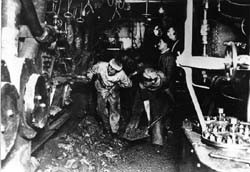
Members of the "Black Gang", stoke
the coal burning power plants of the Battleships of the Great White
Fleet. C. 1907-1908.
A member of the "black gang" on the battleship Connecticut described
coaling day. "Our ship held about 2,000 tons of the stuff. All the
deckhands would go down into the collier (coal supply ship) and fill
these big bags with about 500 pounds. Then they'd hoist 'em over to us
down in the coal bunkers and we'd spread out the coal with shovels until
all the bunkers - about 20 - were full to the top."
U.S.S. Connecticut (BB-18),
Flagship of Admiral Robley D. Evans, USN on the cruise around the world
of the Great White Fleet, shown here at Callao, Peru, 1907.
On Feb. 20, the fleet pulled in to
Callao, Peru, just north of Lima. Their arrival sparked a nine-day
celebration that included commemoration of George Washington's birthday,
a holiday the Peruvians felt they should share with their American
friends to the north. Peruvian composer, Ce'sar Penizo, paid homage to
the fleet by composing a special dance piece entitled "The White
Squadron." Wishing the American sailors to feel at home, a small tugboat
roved about the anchored ships, its passengers regaling the White Fleet
crews with lively renditions of Cornell football cheers.
Merchants aboard the U.S.S. Connecticut (BB-18) at Colombo during the cruise around the world of the Atlantic Fleet in 1908.
Having absorbed an abundance of
Peruvian hospitality, the White Fleet reluctantly got up steam to
continue its journey northward to California, with an intermediate
one-month stopover at Magdalena Bay in Baja California for gunnery
practice.
The fleet arrived March 12 for its gunnery exercises at Magdalena Bay
while California's coastal cities were trying everything in their power
to get the fleet into their ports. Ulysses S. Grant Jr., a noted
citizen of San Diego, went so far as to write Roosevelt to request that
the fleet steam directly into San Diego harbor instead of anchoring at
Coronado.
The President took this request under consideration and contacted the
Navy Department about the possibility. Word came back that, should the
fleet attempt anchoring in San Diego harbor, there was a good chance
that the ships would remain permanently mired in the mud. Thus, Grant
and his fellow San Diegans had to be content with greeting the fleet at
Coronado.
When the fleet pulled in on April 14, the sailors were greeted by
thousands of enthusiastic residents as the great ships anchored off the
Hotel del Coronado. Small boats of all descriptions surrounded the
warships, and sailors were pelted with blossoms by "Flower Committees"
and filled to capacity with free lemonade by "Fruit Committees." For the
next four days, San Diego celebrated, and the White Fleet sailors were
given the royal treatment that ended only with the fleet's departure for
Los Angeles on April 18.
In Los Angeles, the officers and men were feted to such
entertainments as a giant Spanish barbecue, thrilled to a breathtaking
balloon ascension by a group of daring aeronauts, and cheered a number
of prize fights between well-known local pugilists.
Meantime, as the fleet was being pampered and honored by the good
citizens of L.A., Santa Cruz, to the north, was gearing up for its
welcome to the fleet and attempting to crowd out rival Monterey just
across the bay. But when the Santa Cruz town fathers got the word that
only part of the fleet would be visiting their community, they were so
upset that they threatened to call off the entire reception if they
weren't visited by all the ships. The Navy relented and Santa Cruz got
its wish, after the fleet visited Santa Barbara and Monterey.
When the fleet arrived in San Francisco on May 6, the hills
surrounding the city by the Bay were packed with thousands of greeters,
many brought in by special trains from outlying communities. San
Francisco greeted the fleet in its typical warm-hearted and ostentatious
fashion by staging a 48-hour ball at the Fairmont Hotel where dinners
normally went for $10 per plate. The officers and men of the Great White
Fleet were treated to a welcome they would long remember.
During the sailor's stay in 'Frisco, the citizens went so far as to
pitch tents in Jefferson Square and Portsmouth Square for White Fleet
sailors who ran out of hotel money.
While in San Francisco, the battleships Maine and Alabama were replaced by USS Nebraska (BB-14) and USS Wisconsin (BB-9). The reason behind this change was due to Maine's and Alabama's voracious appetite for coal. They seemed to eat up more "'black diamonds" than any other ships in the fleet.
San Francisco was also the last port-of-call for fleet commander
Evans, still suffering from gout. He was relieved by Rear Adm. C. M.
Thomas. Thomas then commanded some of the ships during visits to ports
in Washington State, including Seattle, Bellingham and Tacoma.
Thomas nearly missed movement when that part of the fleet was ready
to get underway for the Northwest visits. He was to have been picked up
at his hotel lobby by auto and driven to his flagship. As a precaution,
two autos were sent to be sure he made it, but a traffic cop noticed
that the kerosene tail-lamp on the first car had been blown out,
violating a city traffic ordinance.
Putting the first car out of action, the observant police officer
noticed that the back-up car also had a blown tail-lamp. Luckily, the
driver was able to re-light that lamp, and after some smooth talking,
convinced the cop to let the admiral's car proceed. Thomas made it to
his ship, and San Francisco was inspired to change its auto lamp law.
The fleet visit up and down the West Coast was one week shy of three
months. That part of the cruise was like a constant party, with
everyone, sailor and civilian alike, celebrating this great adventure.
On July 7, the fleet, now reassembled under Rear Adm. Charles Sperry,
bid farewell to San Francisco and weighed anchor to continue its journey
across the Pacific.
On July 16, the fleet arrived in Hawaii. After a six-day layover at
Pearl Harbor, where it was feted with luaus and sailing regattas, the
great armada got underway for New Zealand, anchoring in Auckland on Aug.
9. The New Zealanders gave the fleet a very warm reception and invited
Sperry and his staff to observe tribal ceremonies at a Maori village. At
the conclusion of one of the dances, a tribesman bounded from the
circle of dancers. Halting before the admiral and his staff, the Maori
dancer broke into a broad, toothy smile and explained, "bully!" Even
among these rustics in the outback of New Zealand, Roosevelt had made
his mark, to the great surprise and amusement of Sperry and his staff.
On Aug. 15, the fleet sailed for Sydney, Australia, where it arrived
five days later. The fleet was greeted by more than 250,000 people, who
had stayed up all night so as not to miss the ships' arrival. For the
next eight days, there was a non-stop celebration in honor of the Navy
visitors.
With all this celebrating, some of the crewmen were beginning to feel
the wear and tear. One sailor was found asleep on a bench in one of
Sydney's parks. Not wishing to be disturbed, he posted a sign above his
head which read:
"Yes, I am delighted with the Australian people.
"Yes, I think your park is the finest in the world.
"I am very tired and would like to go to sleep."
Being truly hospitable, Sydney let him sleep.
Melbourne also rolled out the red carpet for the fleet. Nothing was
too good for the Yankee sailors, and they were given the key to the
city. Melbourne's hospitality made such an impression that many sailors
were reluctant to leave when the ships got underway for Manila on Sept.
18 and arrived Oct. 2.
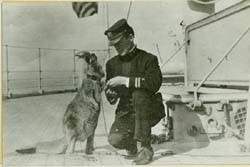
USS. Connecticut (BB-18).
View taken c.August 1908, showing Lt. John E. Lewis, USN, with the
kangaroo mascot presented to the ship by the citizens of Sydney,
Australia, at the occasion of the U.S. Fleet's visit to that port during
the round-the-world cruise, 1907-1908.
There was no liberty in Manila, due
to a cholera epidemic, but the mail caught up with the fleet and, just
like in today's Navy, mail call was the highlight of day. One White
Fleet veteran remembered one man aboard the Connecticut who
couldn't read. He said whenever this fellow got mail, "He'd have someone
read his letters to him. And he'd make whoever was doing it stick
cotton in his ears so he wouldn't be able to hear what he was reading.
He thought he could keep his privacy that way."
From Manila the squadron turned north for Japan on Oct. 10. While
enroute in the South China Sea, the fleet ran into one of the worst
typhoons in 40 years. According to one sailor, "The typhoon happened
right off Formosa. All you could see, when a ship was in trough, was the
trunk of its mast above the wave tops. That was all you could see of an
entire battleship. Then our turn would come to go into a trough, and we
couldn't see anything for a while."
In riding out the storm, there was a moment of high drama, when as
the sailor recalled, "Something happened that you're just not going to
believe. One of the sailors on a ship in our squadron was picked up and
washed overboard by a big wave. Then that same wave carried him over to
another ship in another squadron and it threw him up on the deck."
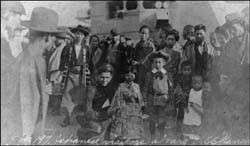
USS Kansas (BB-21). Japanese
children & other visitors aboard the ship, during one of the "Great
White Fleet's" stops in Japan, 1908.
The fleet came through the typhoon
unscathed, and as it approached Tokyo Bay and Yokohama, Sperry
circulated a directive concerning liberty in Japan. In it he stated
that, to insure against diplomatically damaging incidents, "only
first-class men, whose records showed no evidence of previous indulgence
in intoxicating liquor," would be allowed ashore. And, in reference to a
planned reception for the crew, the directive went on to state that
"the men will be made to understand that this, though an entertainment,
is a matter of military duty" and all sailors should conduct themselves
accordingly.
On Oct. 17, the day before the fleet's arrival, the Yokohama newspaper, Boyaki Shimpo came
out with what it called a "Fleet Banzai Number," and showered printed
praise upon the fleet. When the US ships arrived the next day, they were
escorted into the bay by three Japanese destroyers, while on shore,
school children sang "Hail Columbia" and the "Star-Spangled Banner."
Japanese hospitality was indeed overflowing. All flag officers of the
fleet were accommodated at the Emperor's Palace, while the ships'
captains occupied suites at Tokyo's elegant Imperial Hotel. Junior
officers were presented with railroad passes, and selected enlisted men
were given free trolley car privileges. For the entire week the fleet
was in Japan, there was a constant round of celebrations, balls and
parties. Adm. Togo of the Imperial Japanese Navy gave a garden party;
Premier Katsura hosted a formal ball; and 50,000 Tokyo citizens honored
the fleet with a torchlight parade.
During a champagne party aboard the Japanese battleship Nikasa, Sperry
suffered an indignity, albeit unintended by his Japanese navy hosts. It
occurred when a group of exuberant Imperial Navy cadets suddenly picked
up Sperry and hurled him into the air three times, shouting "Banzai!"
with each liftoff. In Japanese naval circles, the Banzai cheer and
tossing were considered tributes. This was explained to a ruffled Sperry
after he was placed back on the deck, gasping and trying to straighten
out his twisted sash, dislocated sword and wrinkled uniform. Sperry
accepted the tribute as graciously as possible under the circumstances.
One of the first diplomatic gestures came about, not as part of an
elaborately planned ceremony, but occurred spontaneously during a
crisis. On the night of Oct. 22, a flimsy arch, honoring the fleet,
caught fire and the flames began creeping up one side of the arch toward
a Japanese flag anchored on a pole at the top. Three US sailors and a
Marine raced toward the scene. The Marine, reaching the blazing arch
first, climbed the clear side of the arch and retrieved the Japanese
flag before the flames engulfed it. In the crowd that had gathered, the
Japanese went wild and the gusty Marine was hoisted onto shoulders and
paraded about the streets. Another small but important diplomatic coup
had been scored by the Great White Fleet.
The fleet's Japan visit had the desired result: it generated good
will between both countries and eased tensions that might otherwise have
led to open conflict. Much of the credit goes to Sperry, whose skill as
a diplomat and professionalism as an officer were crucial.
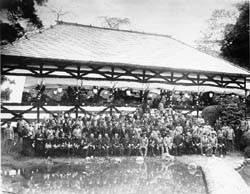
Officers of the U.S. Atlantic Fleet
who were entertained by the Japanese Minister of War in Tokyo, Japan,
while the Great White Fleet was on a cruise around the world, 1907-1908.
After Japan, half the fleet steamed
back to Manila for a month's gunnery practice and the other eight ships
set course for the Formosa Straits and the Chinese island of Amoy. The
Peking government was prepared to welcome 16 battleships, but when only
eight arrived, the local officials were a little disappointed and
embarrassed. Though this slight was due to operational requirements and
unintentional on the fleet's part, it did contribute to the peculiar
funk known to the Chinese as "losing face." But Peking rallied, and in
order to "save face," told the people that the rest of the fleet was
lost in a typhoon.
Because of a dangerous epidemic on Amoy, a specially-built
entertainment center awaited the officers and men of the fleet. All food
and drink was brought in from Shanghai, along with rickshaws, mandarin
chairs, horses and wagons. It was on Amoy that many of the sailors were
introduced to the oriental delicacy of shark fin soup.
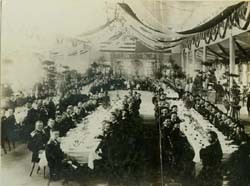
Officers of the Great White Fleet
in Amoy, China, 1 November 1908. Adm William H. Emory, USN. Radm Seaton
Schroeder, USN, Imperial Manchu Prince Yo Lang H.E, Sung Shou Viceroy
are among the guests.
Concluding its call on Amoy, the
eight ships steamed back to Manila to join the rest of the fleet on
maneuvers. From there, the entire fleet sailed into the Indian Ocean,
making a port call at Colombo, Ceylon (modern Sri Lanka), which lies off
the southeastern coast of India. While in Ceylon, the officers and crew
were swamped with complimentary tea from none other than Sir Thomas
Lipton, a man whose familiar face, even today, adorns boxes of tea bags
found in supermarkets throughout the United States.
Christmas of 1908 was celebrated by the fleet as it crossed the
Indian Ocean enroute to the Arabian Sea. During the holiday underway,
the ships were decorated with palms, colored streamers, coconuts and
other fruit. Holiday routine was set throughout the ships and sailors
enjoyed a number of competitions, including potato races, three-legged
races, sack races and bobbing for oranges.
Steaming through the Suez Canal, the fleet took on coal in Port Said,
Egypt. While in Port Said, Sperry received word of a terrible
earthquake that had struck Messina, Sicily. After coaling up, Connecticut and Illinois set
a course for Messina at top speed. When they arrived, sailors did
everything they could to assist the beleaguered city. One of their tasks
was to search for the American consul's daughter, who disappeared
during the quake. But the search was in vain. They never found her.
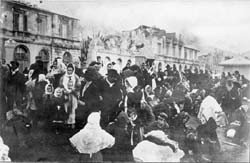
Refugees waiting for transportation at Messina, where the U.S.S. Culgoa (AF-3) and U.S.S. Yankton fed many of these hungry Sicilians, 1908.
The other White Fleet ships split
into several parties after leaving Port Said and visited Algiers,
Tripoli, Naples, Marseille, Athens and Malta. Regrouping once again on
Feb. 6, the fleet made a final stop at Gibraltar and then steamed out
into the Atlantic, the ships' bands playing "Home Sweet Home" on this
last leg of the voyage.
Having crossed the Atlantic, the fleet arrived at Hampton Roads, Va.,
on a rainy Feb. 22, 1909, ending its 14-month odyssey. Steaming into
the Roads, the ships, looking not quite as white as when they started
out, but majestic nonetheless, had their bands belt out the rollicking
tune "Strike Up The Band," followed by the slower, more poignant strains
of "There's No Place Like Home."
The enthusiasm of the cheering multitudes waiting on shore to greet
the fleet was not dampened by the inclement weather, and once again
aboard the presidential yacht
Mayflower, Roosevelt responded to
the rendering of the fleet's 21-gun salute with enthusiastic waves. With
only two weeks left in the White House before turning over the reins of
government to his successor, William Howard Taft, the return of the
fleet and the success of its mission prompted Roosevelt to declare later
that this cruise was "the most important service that I rendered for
peace."
A White Fleet sailor remembered the homecoming . "We hit Hampton
Roads on Washington's Birthday and it was raining. But by golly, we
celebrated with hardtack and sow belly dinner that day. Later, all the
deckhands had to go to Washington and parade in the snow for
(president-elect) Howard Taft."
The cruise of the Great White Fleet had many substantial results both
diplomatically for the nation and technically for the Navy. On the
diplomatic side, the cruise satisfied our country's desire to be
recognized as a world power. It was aptly proven that the United States
was capable of projecting its influence anywhere in the world on a
heretofore unprecedented scale.
Our relations with the countries visited were improved or initially
established in a positive way. The most important improvement of
relations was with Japan, the main diplomatic target from the beginning.
The visit by the fleet provided the main thrust behind the
Root-Takahira Agreement that went into effect shortly after the fleet's
return. According to this treaty, the United States and Japan agreed to
maintain the status quo in the Pacific and to respect each other's
possessions there. Also, both nations consented to respect the "Open
Door" policy in China and the independence and territorial integrity of
that country.
Operationally, the cruise was a resounding success. Initially, the
detractors of the enterprise didn't think the ships would be capable of
making the 'round-the-world' transit without continually breaking down.
Yet there were no serious repair of maintenance problems; there were no
breakdowns or serious accidents.
The voyage brought to light various technical defects in ship design.
It was found that, due to the heavy weather encountered, there was a
need for greater size and displacement of ships; shipboard habitability
wasn't adequate and ventilation had to be improved; hull casement
shutters couldn't keep the water out in rough seas; rapid-fire guns
placed close to the waterline could not be used effectively since spray
and water shipping into the gun ports were distracting to the crews; and
the lofty upperworks of the ships were found to be comfortable for
peacetime conditions but would be "shell exploders" during wartime.
In addition, the old-style military masts and "fighting tops" were
replaced by new cage masts with fire-control tops; top-heavy bridges and
charthouses were removed and replaced by open bridges; light-weight
torpedo-defense guns gave way to more powerful pieces; and new
fire-control gear as fitted out on the ships.
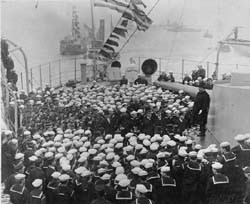
President Theodore Roosevelt addressing officers and men on-board U.S.S Connecticut (BB-18) at Hampton Roads, Virginia, after cruise around the world by the Great White Fleet, 1909.
Sperry also recommended that the
ships of the Navy should have their coloration changed from white to
gray, something naval officers had been recommending for years. It was
felt that Navy ships should not be in "holiday colors" going into
battle.
The cruise provided the officers and men of the fleet with thorough
at-sea training and brought about improvements in formation steaming,
coal economy, gunnery and morale. It also stressed the need for overseas
bases that could provide better coaling and supply services along with
more auxiliary ships. Foreign coaling ships or ports were used 90
percent of the time for coaling and resupply.
For the sailors who participated in this historic once-in-a-lifetime
adventure, the cruise reinforced their pride in service and country.
They had been the ambassadors of good will and the vehicles through
which others perceived and judged America and the Navy. The results were
gratifying. But even more concretely, the sailors saw their individual
roles and the role of the Great White Fleet as providing the muscle
behind US foreign policy.
As one sailor succinctly put it, "We just wanted to let the world
know we were prepared for anything they wanted to kick up. We wanted to
show the world what we could do."