I First heard of the AK-74 in high school in 1983? from "Soldier Of Fortune" and that SOF had snagged several from the "Mujahideen" that were giving the Soviets fits in Afganistan. I thought it was poetic justice in a way, the Soviets had supported the North Vietnamese and the Vietcong against the South Vietnamese with advisors and massive supplies and munitions and our idiotic rules of engagement prohibited us bombing or sinking the ships as they were stacked in Haipong Harbor off loading munitions to support the north. Now the Soviets were mired in Afghanistan being bled with no discernable results. I now recall that musing with a certain irony because we spent 20 years there being bled the same and the Soviets did a better job withdrawing out of that country in 1989 than we did in 2021. How the wheel turns...but I digress.
During the Cold War, both the USA and the USSR began using select-fire rifles chambered for soft-recoiling small-caliber, high-velocity cartridges. Under the Johnson administration, the U.S. military adopted the M16A1 in 5.56 NATO. When Leonid Brezhnev was general secretary of the communist party, the Soviet military began using a Kalashnikov in 5.45×39 mm - a rifle that received the designation AK-74.
Although the M16A1 uses the direct gas impingement operating system and the AK-74 uses a long-stroke gas piston, both rifles produce similar external ballistics and both rifles produce controllable full automatic fire. From the rice paddies of Vietnam to the foothills of the Hindu Kush, these are the rifles that fought the closing chapters of the Cold War. But when the 68-year reign of the Soviet Union ended officially in 1991, it did not mean that the service life of AK-74 ended, too.
Like the descendants of the M16 that continue to arm military forces of much of the Western world today, the AK-74 continues to arm the militaries of several former Warsaw Pact member nations, and the extent of its continuing service has been well-documented in a dramatic way by recent headline news. During the last several weeks, the AK-74 has been conspicuously present in photographs recording Ukraine’s war with Russia.
In images showing Ukrainian military or police forces, the AK-74 is always there. Members of the Ukrainian Parliament have been photographed carrying AK-74s that were issued to them for defending the capitol. If a photograph shows civil defense volunteers manning a checkpoint, the AK-74 is inevitably there, and it even shows up in a photo showing an armed Ukrainian mother crossing a busy street in central Kyiv while holding her daughter’s hand. It is, by far, the most prolific firearm being used in the present conflict.
The AK-74’s story dates to the early 1970s when Russian engineers began developing a new small-caliber, high-velocity cartridge to supplement and possibly even replace 7.62×39 mm. Since the AKM was a reliable and proven design, one of the project’s objectives from the start was to develop something new for it to shoot. At first, they tested a 6.5×39 mm commercial hunting round but soon found that it produced the kind of wide shot dispersion on full-automatic that the AKM was infamously known for. Then they tested a 4.5×39 mm load that, although it provided the desired controllability, did not provide the desired lethality.
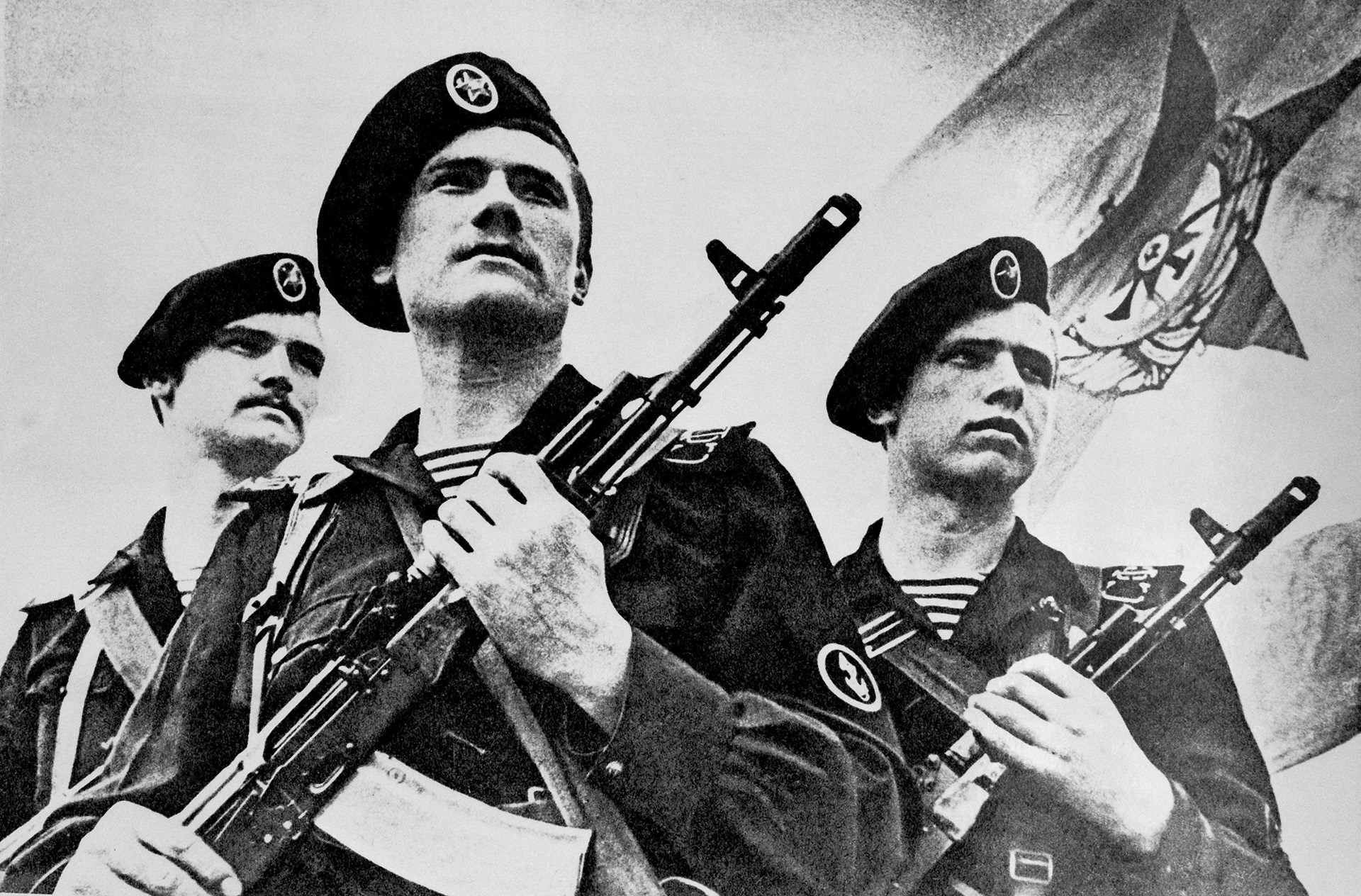 Three Soviet naval infantrymen armed with AK-74 rifles circa 1985. Like the AK-47 and the AKM that came before it, the AK-74 was a symbol of Russian military strength during the Cold War. (US Department of Defense photo DN-SN-86-00829)
In the end, the Russians adopted a cartridge with a case length of 39 mm that could accelerate a 53-grain 5.45 mm boat tail FMJ bullet to a muzzle velocity of 2,790 f.p.s. The new Kalashnikov chambered to fire this new cartridge was basically just a slightly modified version of the AKM, so it was capable of delivering either semi-automatic fire or full-automatic fire with a cyclic rate of 650 rounds per minute.
The most noticeable differences between the AK-74 and its predecessor the AKM were, first and foremost, the AK-74’s less curved AG-4S 30-round magazine. Sometimes these magazines are referred to as being made of Bakelite, but they are actually made of a thermoset phenol-formaldehyde resin reinforced with glass fiber. Secondly, a large and distinctive recoil compensating muzzle brake replaced the AKM’s old slant style brake and it meaningfully changed the appearance of the AK-74’s front end. The device not only reduced recoil, but it did so without directing any noticeable concussion back onto the shooter.
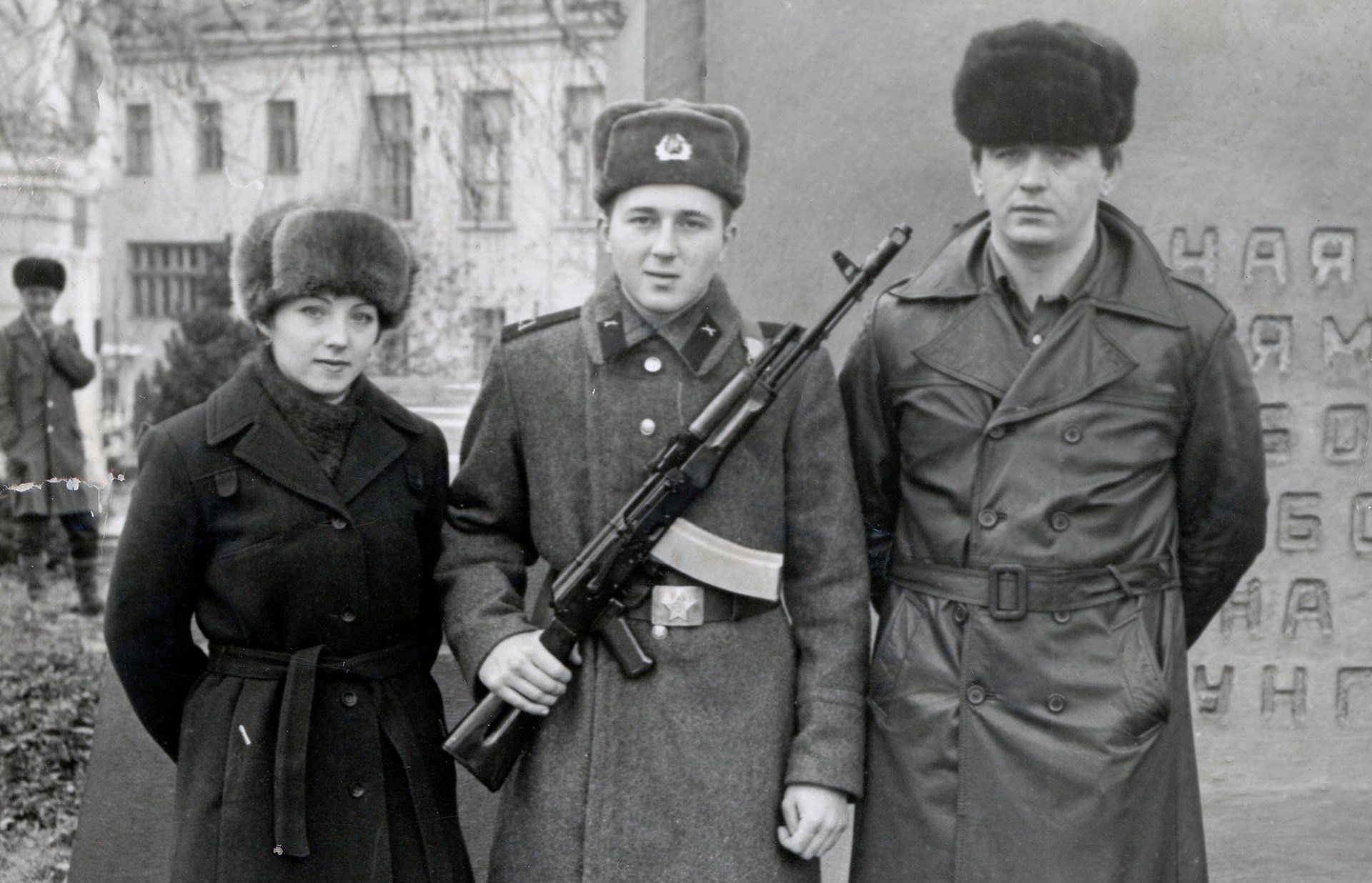 A Russian mother and father pose with their son, who is armed with an AK-74 that was produced before 1977. (Image courtesy of Thomas Laemlein)
Aside from those two noticeably different features that made it look unique, the early-production AK-74 closely resembled the late-production AKM, but things soon began to change. Like every other mass-produced service rifle in the history of small arms, the AK-74 evolved over its production history and the changes associated with that evolution started shortly after its adoption. By mid-1977, engineers became aware that the AKM’s 45-degree gas block sometimes caused bullet shear. This had never been a problem before with the slower 7.62 mm bullet, but with the faster 5.45 mm bullet, it was.
Engineers at Izhevsk solved the problem by introducing a 90-degree gas block that did away with the phenomenon altogether. The 90-degree design has remained unchanged ever since. Minor modifications to the muzzle brake, the dust cover and the front sight base were also introduced during this period, but then in late 1984 to early 1985, several big changes were introduced that altered the AK-74’s outward appearance even more.
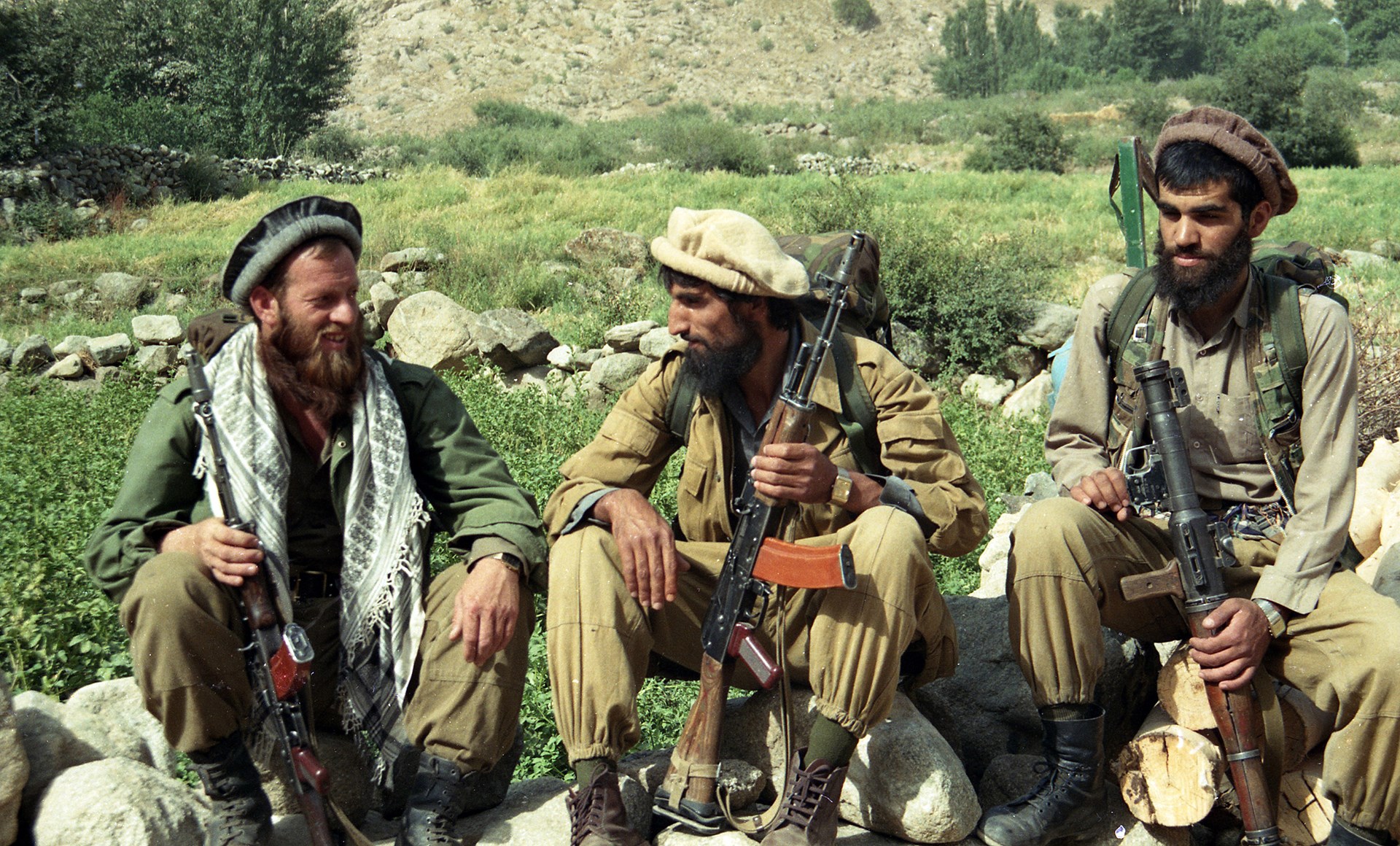 Three Mujahideen guerrillas in Afghanistan in 1989. They are armed with a pair of AK-74s and an RPG-7 recoilless, shoulder-fired, rocket-assisted grenade launcher. (Image courtesy of Thomas Laemlein)
From the outset of production, AK-74s were completed with laminated wood buttstocks and handguards, and Bakelite AKM type pistol grips, but when Konstantin Chernenko was briefly General Secretary of the Communist Party, plum-colored glass fiber reinforced polyamide plastic furniture was introduced. At about the same time, Izhevsk began using a simplified method for attaching the front sight base, the rear sight base and the gas block to the barrels of production AK-74s. Going all the way back to when the Kalashnikov was first born, these components were attached to the barrel of each rifle using the drilling and pinning method.
The assembly procedure that replaced this starting in mid-1985 involved punch pressing the sides of those components with enough force to lock them into corresponding relief cuts in the barrel. This method is used for AK-74 assembly to this day. Right about when the Berlin Wall fell in late 1989, the AK-74’s plum-colored furniture turned black and remained that color. Then, in 1991, a new version of the rifle emerged with the adoption of the AK-74M.
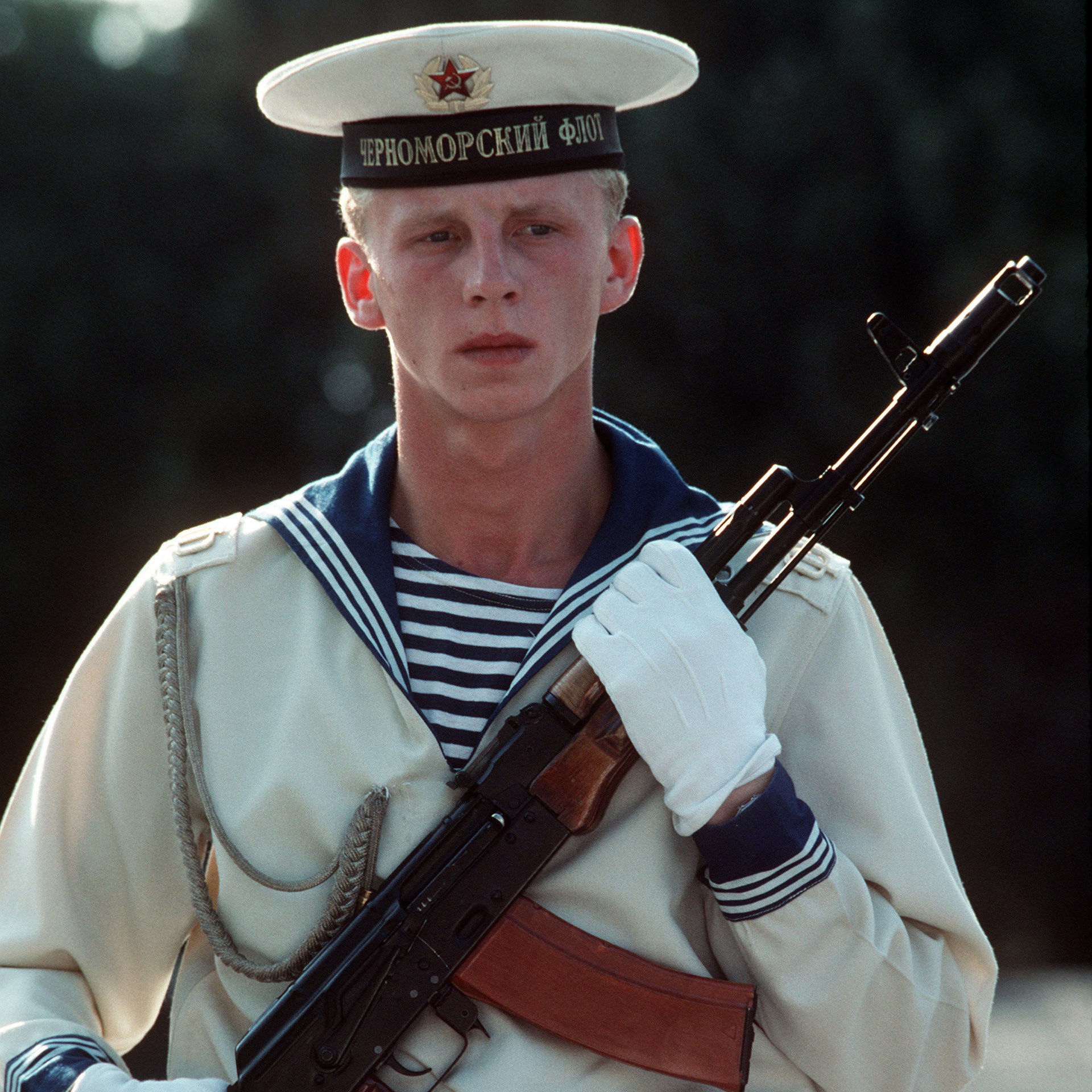 A Soviet sailor armed with an AK-74 stands at port arms during the port visit of the Aegis guided missile cruiser USS THOMAS S. GATES (CG 51) and the guided missile frigate USS KAUFFMAN (FFG 59) at Sevastopol on April 8, 1989. (National Archives & Records Administration #6454445/U.S. Department of Defense #330-CFD-DN-ST-90-00321 - Photo by JO1 Kip Burke)
This model incorporates a slightly modified muzzle brake, an accessory rail on the left side of the receiver for mounting optics, and a side-folding buttstock. A folding stock was nothing new for the AK-74, in fact, stretching back to initial production in the 1970s, a variant designated AKS-74 that used a metallic triangular side-folding stock had been in service. It is just that the AK-74M’s folding stock is not skeletal and it is not made of sheet metal. This version of the gun would have been adopted as the standard service rifle of the Soviet Union, but the Soviet Union ceased to exist in December 1991. Nevertheless, the AK-74M lives on today in the service of the Russian Federation.
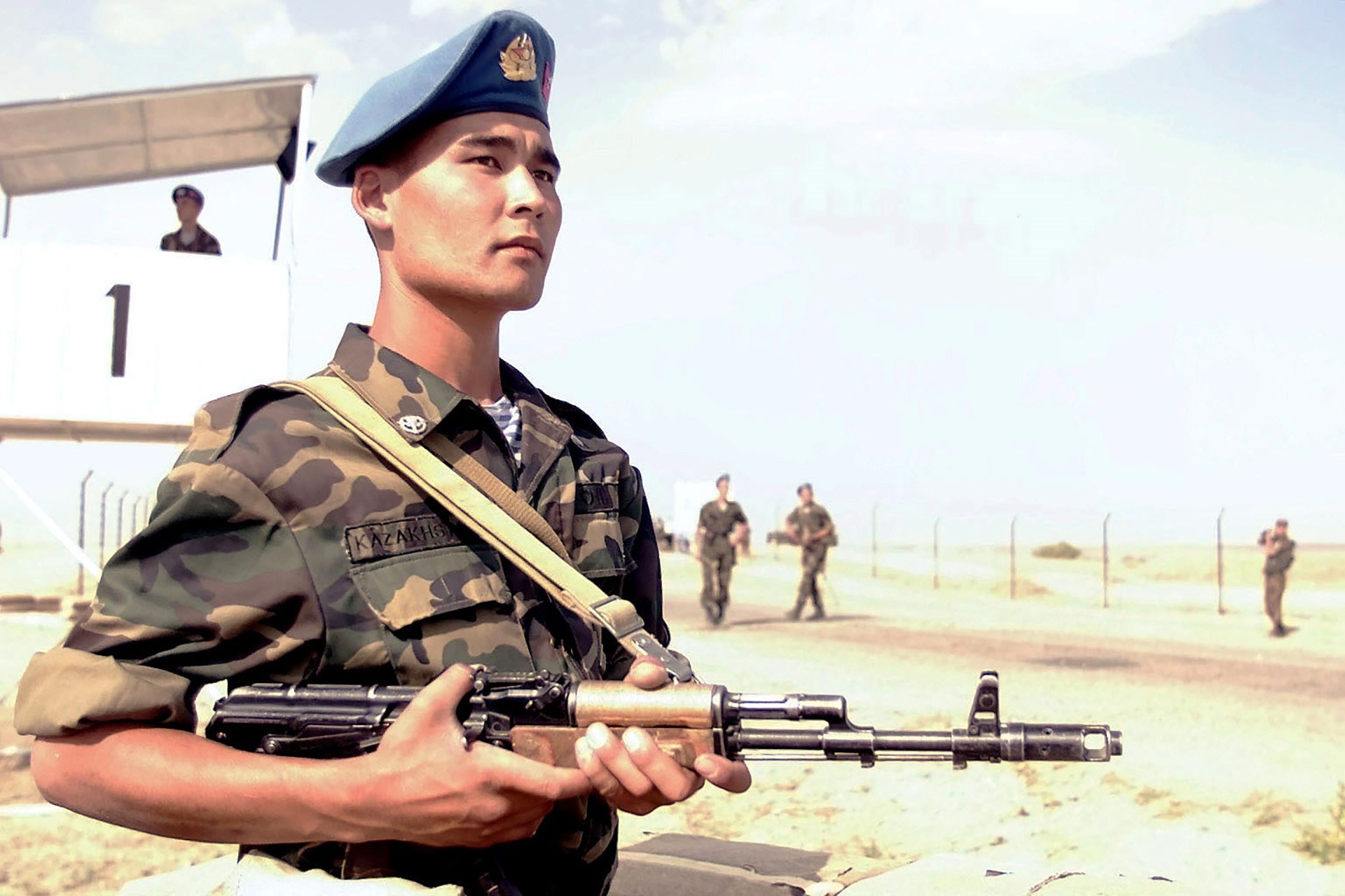 A Kazakh soldier armed with an AKS-74 rifle during the CENTRASBAT military exercise in Kazakhstan in September 2000. (National Archives & Records Administration - photograph by TSGT Jim Varhegyi, USAF)
The AK-74 has been there for many of the great Russian tragedies of the modern era and in a way, it has become a metaphor for the country’s decline. It wrote itself into the final chapter of Soviet military history during the war in Afghanistan, and then it continued fighting through the geopolitical convulsions that followed the breakup of the USSR–convulsions that brought blood and suffering first to Chechnya and then Georgia. It was used during the deadly Moscow theater hostage crisis in October 2002 and the even deadlier Beslan school siege in September 2004, so it was ultimately swept into the always-tragic story of the Global War on Terror.
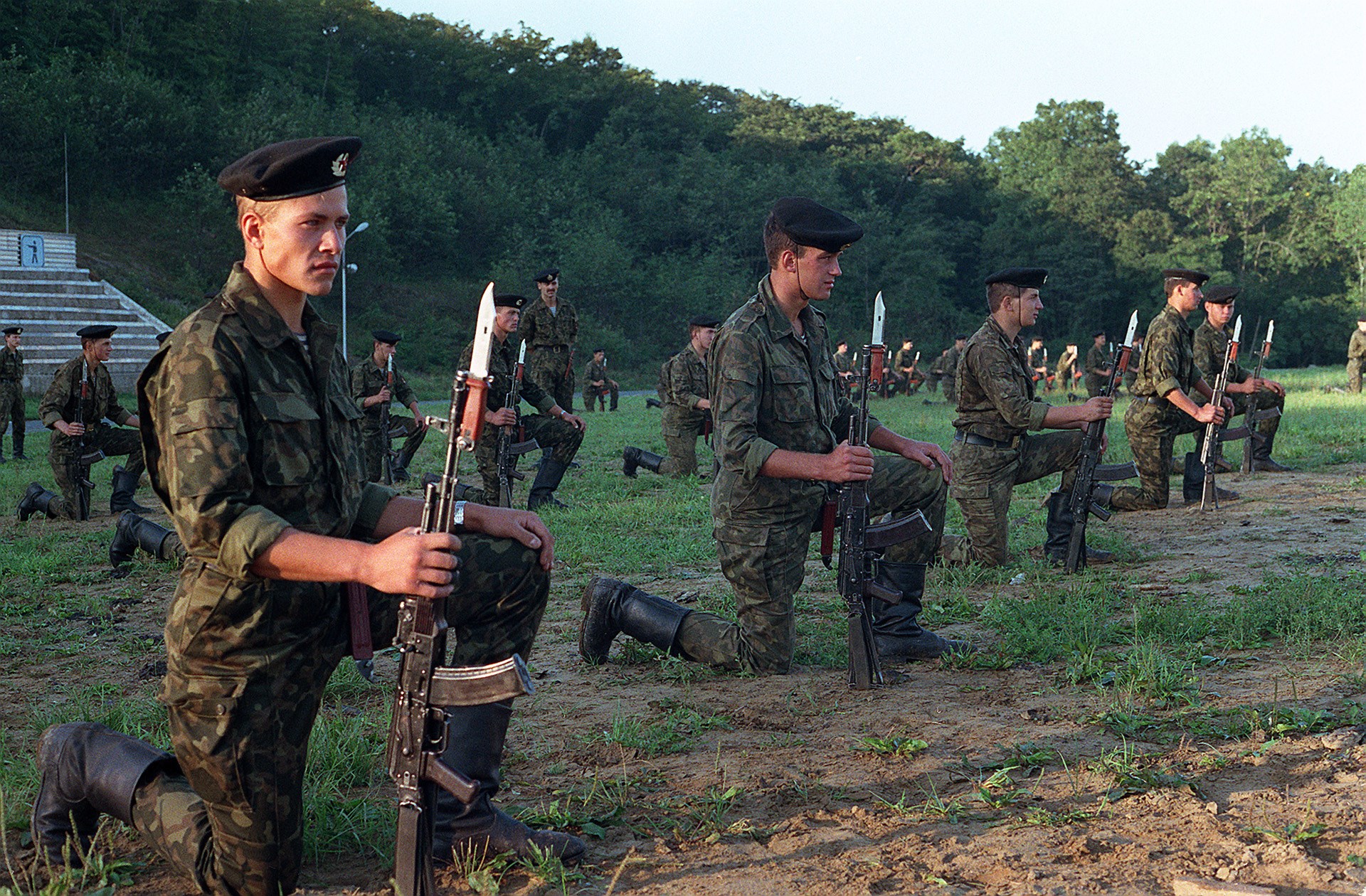 Soviet naval infantrymen kneel with their AKS-74 rifles during a demonstration conducted for visiting U.S. Navy personnel on September 10, 1990 (photo by PHCS Mitchell – photo #DN-SC-91-02252)
A decade later, the AK-74 was a part of Russia’s annexation of Crimea and the war in Donbas that followed. Today, it is being used by the armed forces of the Russian Federation in what might be the greatest Russian tragedy of them all, the invasion of Ukraine, but the Ukrainian people have appropriated the rifle for another purpose. In Kharkiv, Kherson and Mariupol, they have turned the AK-74–this symbol of Russian military hegemony–into a symbol of resistance. If you look closely at photographs coming out of Ukraine each day, you will notice that most of the AK-74s being used by Ukraine’s Territorial Defense Forces have wood furniture. When you see that, you are looking at rifles that were manufactured during the era of the Soviet Union.
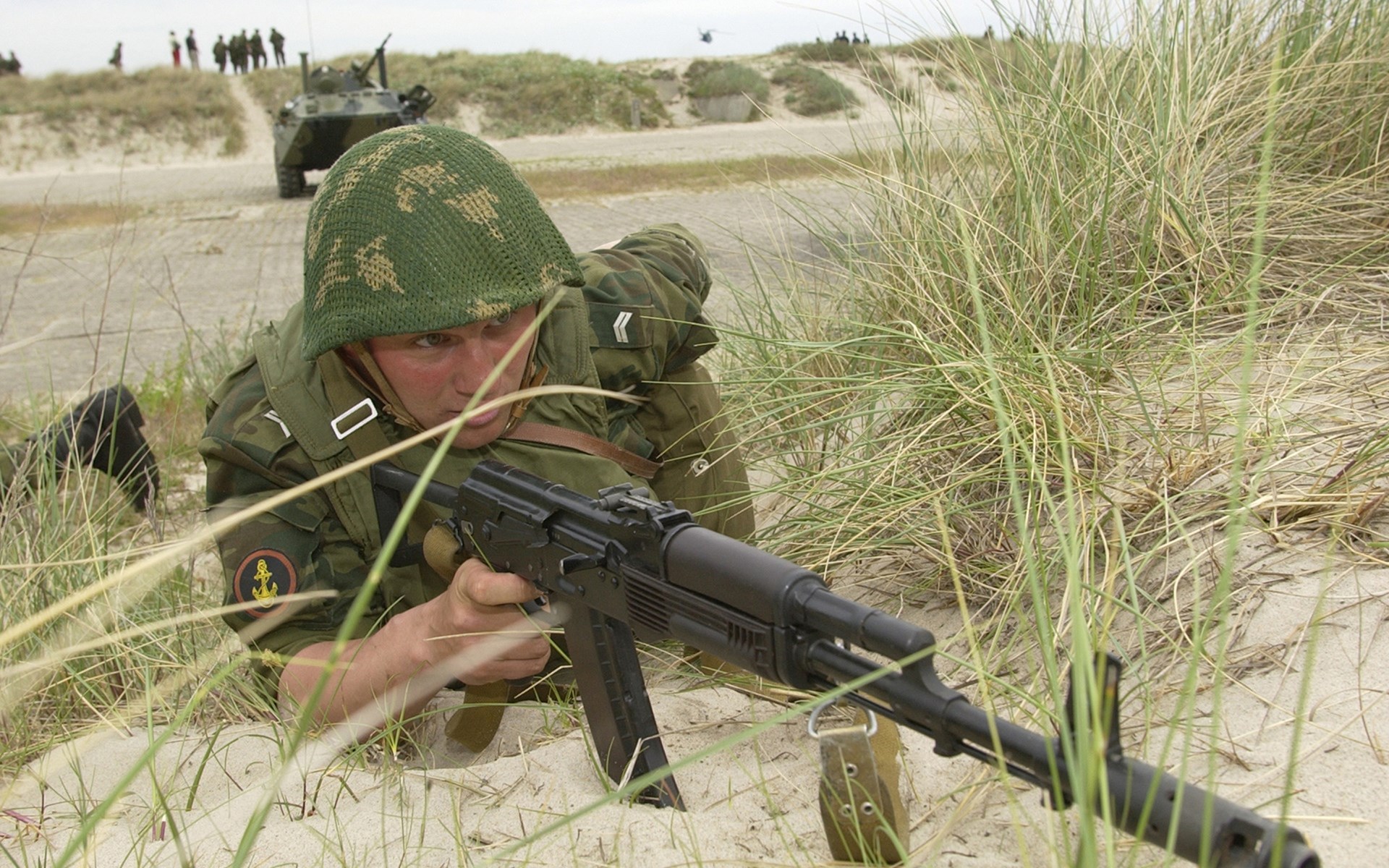 Ustka, Poland (June 12, 2003) — A Russian Naval Infantryman provides cover with his AKS-74N rifle for his counterparts from Denmark, Lithuania, Poland and United States during an exercise at Ustka, Poland as part of Baltic Operations (BALTOPS) 2003. (U.S. Navy photo by Photographer’s Mate 1st Class Chadwick Vann – photo #030612-N-3725V-001)
The fact that those old rifles are now being used to fight off the ghosts of that era is an irony of the greatest possible magnitude. Together with weapons like the Stinger and the Javelin, those rifles are being used by the Ukrainian people to put up the kind of fight that their invader did not expect and, in so doing, the Ukrainian people have reminded us that free women and men prefer to remain free. They will turn to the rifle if they are forced to. Like the Hungarians did three generations ago when they captured Kalashnikovs in the streets of Budapest, the Ukrainians have made the Kalashnikov a symbol of defiant solidarity in the streets of Kyiv. They have made the AK-74 a metaphor for an optimistic new world struggling to free itself from the dangerous specter of an old one.