Yep this was another Quora question and I shamelessly clipped it because it had infoo I never heard of before and I thought it was pretty neat.
Seventeen days before Apollo 11 landed, a loose metal fragment brought down a 3,000-ton Soviet moon rocket. It triggered one of the largest non-nuclear explosions in history.
This catastrophic failure on July 3, 1969, was the decisive blow to a secret crewed program that had made significant progress. The Soviet Union possessed much of the necessary spacecraft hardware for a human landing. They had designed the Soyuz 7K-LOK orbiter and constructed their own lunar lander, the Lunniy Korabl (LK). Unlike the two-person American Lunar Module, the LK was designed to carry a single cosmonaut to the surface. This hardware was not just theoretical; the Soviets had already built engineering models and flight units, eventually launching uncrewed LK landers into Earth orbit to verify the vehicle's systems.
An engineering test unit of the Soviet LK lunar lander, built in 1968, which was designed to carry a single cosmonaut to the lunar surface. Photo by Andrew Gray is licensed under CC BY-SA 3.0.
The bottleneck was the launch vehicle required to leave Earth orbit. To match the American Saturn V, Soviet engineers built the N1 rocket. While the Saturn V relied on five large engines on its first stage, the N1 used a ring of 30 smaller engines firing simultaneously. The plumbing required to synchronize and feed fuel to 30 engines created immense complexity. Lacking the budget for a ground test facility capable of firing the entire first stage at once, the Soviets were forced to test the complete system during live launches.
The first N1 rocket had already exploded 68 seconds into its flight in February 1969. During the second attempt in July, the loose fragment was ingested by an oxygen pump mere seconds after liftoff, automatically shutting down the engines. The fully fueled rocket fell back onto the pad, destroying the launch complex and ending any realistic chance of a crewed landing. "Here are the details of the N1 Rocket"
Still desperate to beat the Americans, the Soviets made one final play: a robotic sample return probe. On July 21, 1969, while Neil Armstrong and Buzz Aldrin were still on the Moon, the Luna 15 probe crashed into a mountain just 500 miles away, definitively concluding the space race.
Last week I had Blogged about the fall of the Soviet Union and I ran across this article and it kinda segue into that blog post.
It’s a familiar experience for many people in the northern
hemisphere in December: Walking into school or work in the morning only
to walk out again, hours later, under the emerging stars and set or
setting Sun.But whatever your experience with the world-changing while at work —
and that feeling of dislocation and familiarity, maybe a little
depression — you’ve got nothing on cosmonaut Sergei Krikalev.Krikalev went to work on the Mir space station
on May 18, 1991 and didn’t come home until March 1992. He went to work
as a Soviet, and returned as a Russian — because, on December 26, 1991,
the Soviet Union dissolved and Krikalev became a cosmonaut without a
country.Going to work for the long shift— Krikalev, fellow cosmonaut Anatoly Artsebarsky, and British astronaut Helen Sharman climbed into their Soyuz
capsule at the Baikonur Cosmodrome in Kazakhstan on May 18, 1991. At
the time, Kazakhstan was still one of the “Soviet Socialist Republics.”The
sky-bound cosmonauts and their astronaut guest had things other than
politics on their minds. Their mission was the same as it is for most
cosmonauts and astronauts aboard space stations: maintenance.“Cosmonauts, as astronauts, are generalists, and they're there to
tend to scientific experiments,” National Air and Space Museum curator
of space history Cathleen Lewis tells Inverse.
They’re there to make sure experiments run, that the space station
runs, and that their own bodies run — working out four hours a day to
mitigate bone and muscle loss in microgravity.Krikalev’s days in
the spring of 1991 were filled with exercise and conducting multiple
EVAs to service the Mir space station. He had trained for, and planned
on, staying aboard Mir for five months before returning to the Soviet
Union and his native Leningrad. He would wind up staying in space for
almost a year, returning to the new Russian Federation and a city
returned to its name before the Bolshevik revolution, St. Petersburg.Empires fall slowly, then suddenly — The
dissolution of the Soviet Union was not something anyone predicted,
Lewis says. “Everything happens much like F. Scott Fitzgerald described
going broke,” she says, “‘Gradually, and then suddenly.”In 1987,
President Mikhail Gorbachev, then the Soviet Communist Party General
Secretary, introduced a wide-ranging set of democratic and economic
reforms that functioned, in part, to loosen the control of the Communist
party over constituent nations in the USSR, including Baltic states
such as Estonia and Latvia — and Kazakh Soviet Socialist Republic.While Gorbachev was pulling back, those nations were pulling away.
There were riots in 1986 when Moscow replaced the leader of the Kazakh
communist party, and the Kazakhs took advantage of lessening central
political control to declare their nation a sovereign republic within
the USSR in October 1990.Hardline members of the Communist Party
of the Soviet Union, dismayed at Gorbachev’s efforts at reform (which
included creating the office of president and his election to the post
in 1990), would stage a failed coup in August 1991.Though
Gorbachev retained power, the country was economically and politically
weakened, and by December, the republics began to splinter into the
Commonwealth of Independent States, an effort spearheaded by Belarus,
Ukraine, and Russia, and signed by nine other former republics.Then, on Christmas Day 1991, Gorbachev resigned as president of the Soviet Union,
.Soviet President Mikhail Gorbachev announced his resignation as president of the USSR. How he came to stay — Before
the August coup, before the fall of the Communist Party in Moscow,
Gorbachev and his party tried to keep the USSR together. If he wasn’t
going to roll in the tanks, that meant finding some carrots to dangle
for nations such as the Kazakh Soviet Socialist Republic.Over the
summer, Krikalev — who had spent 151 days aboard a previous Mir mission
from 1988 to 1989 — was informed that the experienced cosmonaut that
had been scheduled to relieve him had been bumped in favor of a less
experienced Kazakh cosmonaut. He would have to hang on longer than his
five months, end date TBD, for the sake of his country.The Mir space station as seen from space in 1996.NASAKrikalev was less concerned with the political implications of this,
Lewis says, than its implications for him personally. “He was more
concerned about prolonging his mission and the impact that would have on
his physical health,” she says. Bone and muscle mass deteriorate with
time in space, and “he had trained for five months; he had not trained
for a year-long mission.”Other cosmonauts would come and go over
the next few months, but Krikalev would remain. Even after the fall of
his country’s government. Even though the was a Soyuz lifeboat he and
fellow cosmonaut Aleksandr Volkov, who was with Krikalev on December 26,
could have taken home if they wished.But that would have meant leaving the Mir without a crew.“They
were pledged to maintaining occupancy of the Mir, and it was
continuously occupied for over 80 percent of the time that it was in
orbit,” Lewis says. “The USSR had learned its lesson about leaving the
station unattended in the experience of the Salyut-7 space station.”Left
unoccupied, the Salyut-7 station malfunctioned and started tumbling out
of control in 1985, threatening to make an uncontrolled re-entry that
could have harmed people on the ground. A crew of cosmonauts was able to
bring the station under control, and the Soviet space program was quite
cognizant of the role the human element had played in averting
disaster.Workers on the job above and below — The
commitment of the people in the Soviet space program, both to preserving
Mir and the space program as a whole, regardless of their government,
was essential to keeping Krikalev alive and relatively well, even if he
had to fly far longer than he had bargained for.“These people
were still on the job, very dedicated to it,” Lewis says. Whatever
successor state would arise in place of the former Soviet Union, “they
recognized the need for the national prestige, to maintain the space
station.”These were also very smart, highly educated people
dedicated to working in space, Lewis adds. They had advanced degrees and
were passionate about their work, even if they had been unable to make a
real living doing it in years. In the late years of the USSR, she says,
you could always get a ride from a pirate taxi, a pre-capitalist Uber,
in Moscow, “and the likelihood would be that somebody with a Ph.D. in
physics would be driving that car to make ends meet.”So Krikalev was hardly stranded alone and without contacts with the
ground, even if they kept telling him they could not relieve him just
yet.He also had use of a packet radio, a data sending radio
device that he used to communicate with amateur radio enthusiasts around
the globe, Lewis says. So while Krikalev may not have seen the fall of
the USSR anymore than other observers, he may have been one of the
better informed of its former citizens in the days and weeks following
Gorbachev’s speech resigning the presidency.“That was a level of
access with the ground, and with the broader community in the West and
Australia, that previous cosmonauts had not had,” Lewis says.Krikalev’s next life — Finally
relieved from duty, Krikalev returned to Earth in March 1992 a severely
weakened man needing assistance to walk on the snow-covered soil of the
Republic of Kazakhstan after 311 days aboard the Mir space station
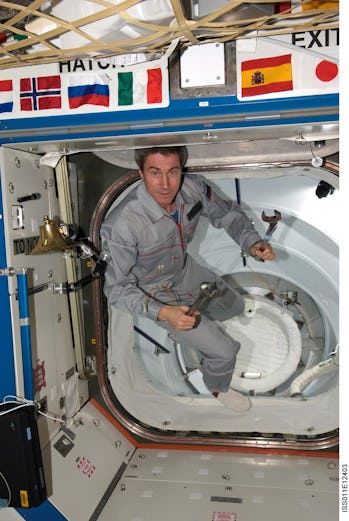
Krikalev on the International Space Station in 2005NASA
One
might think that such an ordeal would lead a person to swear off space
for good, but Krikalev would go on to more than double his time in
space. He would fly on multiple space shuttle missions through the
1990s, representing the newly formed Russian Federation, and would serve
as commander of the International Space Station
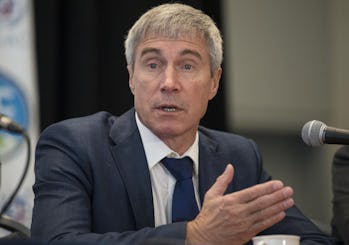
in 2005. In 2007, Krikalev was named director of human spaceflight at
the Russian state space agency, Roscosmos, a post he still holds.
Krikalev representing Roscosmos at a conference in 2019. NASA
At 803 days, Krikalev currently sits third in the rankings of
cumulative time in space, just below Russian Cosmonaut Yuri Malenchenko,
in second place with 827 days, and Russian Cosmonaut Gennady Padalka,
who holds first place with 878 days.
Krikalev is now 63, though
“he still lives with infirmities” from his time in space, Lewis says.
“He has to have his bone density checked.” But his legacy endures


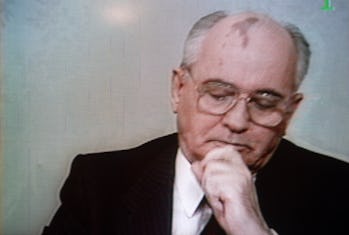 Soviet President Mikhail Gorbachev announced his resignation as president of the USSR. How he came to stay — Before
the August coup, before the fall of the Communist Party in Moscow,
Gorbachev and his party tried to keep the USSR together. If he wasn’t
going to roll in the tanks, that meant finding some carrots to dangle
for nations such as the Kazakh Soviet Socialist Republic.Over the
summer, Krikalev — who had spent 151 days aboard a previous Mir mission
from 1988 to 1989 — was informed that the experienced cosmonaut that
had been scheduled to relieve him had been bumped in favor of a less
experienced Kazakh cosmonaut. He would have to hang on longer than his
five months, end date TBD, for the sake of his country.
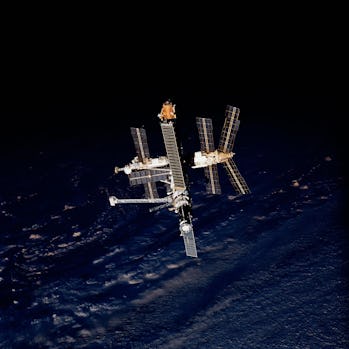 The Mir space station as seen from space in 1996.