Webster

The Constitution was made to guard the people against the dangers of good intentions." --American Statesman Daniel Webster (1782-1852)


Showing posts with label Pearl Harbor. Show all posts

Sunday, December 7, 2025

" A Day Which Will Live in Infamy"


Ironic that today is Sunday December 7 2025, how time has marched on and I read the last survivor from the U.S.S Arizona died last year and they only allow the interment of the Survivors of the U.S.S. Arizona and the U.S.S. Utah to be interned on their ships to join their shipmates, the other survivors can "Have their ashes scattered on the Harbor"


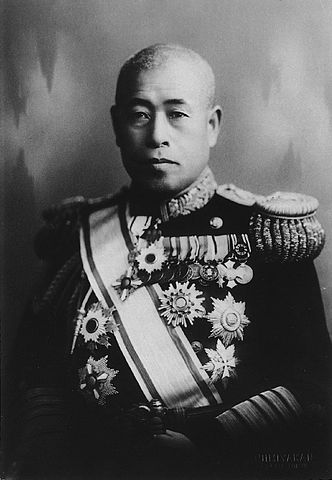
At 0755 a bomb exploded on the seaplane ramp at Ford island, this signified the start of the Japanese attack on Pearl Harbor.  When it was done, the American Pacific fleet was crippled, and 0ver 3000 Americans were dead.  The sinking of the fleet at Pearl Harbor galvanized the Americans, and since it was a sneak attack it was considered "dishonorable and underhanded".  This infuriated the Americans sense of fair play.  The Japanese had planned on attacking right after the ultimatum was delivered, but the secrecy that the Japanese demanded forced the Ambassador himself to decode it slowing the response down so they delivered the message to Secretary Hull after the attack has started.  The attack gave the Japanese several things...It was a tactical victory, it allowed them to move against the Philippines and the Dutch East Indies with the rubber and oil that the Japanese war machine needed to build the stuff that a modern nation needs to wage war. The Japanese Admiral Yamamoto who lead the attack on Pearl Harbor had studied the Americans at length while he was a naval attache and he told the General Staff who was pushing for the war "I will be able to give you 6 months, after that I cannot guarantee victory.   And true to events, the Japanese raised hell for 6 months until the Americans smashed 4 of the Japanese fleet carriers at Midway, a blow that the Japanese Naval aviation never recovered from.  The attack also forced the Americans to utilize the carriers to do any offensive work against the Japanese.   Also the Japanese didn't launch the 3rd strike against Pearl Harbor, the drydocks and the fuel farms were still intact.  The victory was a Pyrrhic victory because it ended on August 6 and August 9 of 1945 4 years later when the Japanese cities were the site of the Atom bomb and a small part of the logic of the bomb drop was to pay Japan back for the sneak attack.

   The attack on Pearl harbor was a huge shock to the Americans, for the fleet and the Army air corp to be so woefully unprepared for battle left a mark on the American psyche.  Never again would we be so defenseless.  Also the end results was that out of all the ships sunk and damaged at Pearl Harbor, all but 3 were repaired and returned to service. 

Thursday, December 16, 2021

Pearl Harbor Survivors M1903 Salvaged from the U.S.S California.


I clipped this from "American Rifleman", I thought it was a great story, I have or had a 1903 pattern rifle before I lost her in the great kayak mishap*sniff*Sniff*, the same time I lost my lamented Garand


Here they are during happier times before the Kayak mishap*Sniff*Sniff*.  Perhaps one day....the happier times will return, and I can look at ownership again.  The story behind this was really neat.


“December 7th, 1941, a date which will live in infamy, the United States of America was suddenly and deliberately attacked by naval and air forces of the Empire of Japan,” as said by President Franklin D. Roosevelt in Congress on Dec. 8, 1941. The suprise attack on Pearl Harbor, one of the most pivotal moments in United States history, severely crippled the fighting capabilities of the Pacific Fleet for the onset of World War II. After the attack, monumental efforts went into rescuing men still trapped on the sunken vessels and salvaging material from the wrecks. Now, 80 years later, three rifles salvaged from the U.S.S. California have been discovered by the Archival Research Group and can be documented to this recovery operation following the attacks on Pearl Harbor.

The U.S.S. California, BB-44, was a one of two Tennessee Class "super-dreadnought" battleships built by United States Navy during World War I and completed after the war. Launched in November 1919, the ship was over 600' long, weighed over 30,000 tons and was armed with 12 14" naval guns. After being commissioned in 1921, U.S.S. California became the flagship of the U.S. Pacific Battle Fleet and, along with her sister-ship U.S.S. Tennessee, helped form the backbone of the U.S. Navy's modern battle line during the inter-war period. She was nicknamed “The Old Prune Barge,” due to the large amount of prunes her namesake state of California produced at the time. In 1940, she also became one of the first battleships in the U.S. Navy to be fitted with radar.
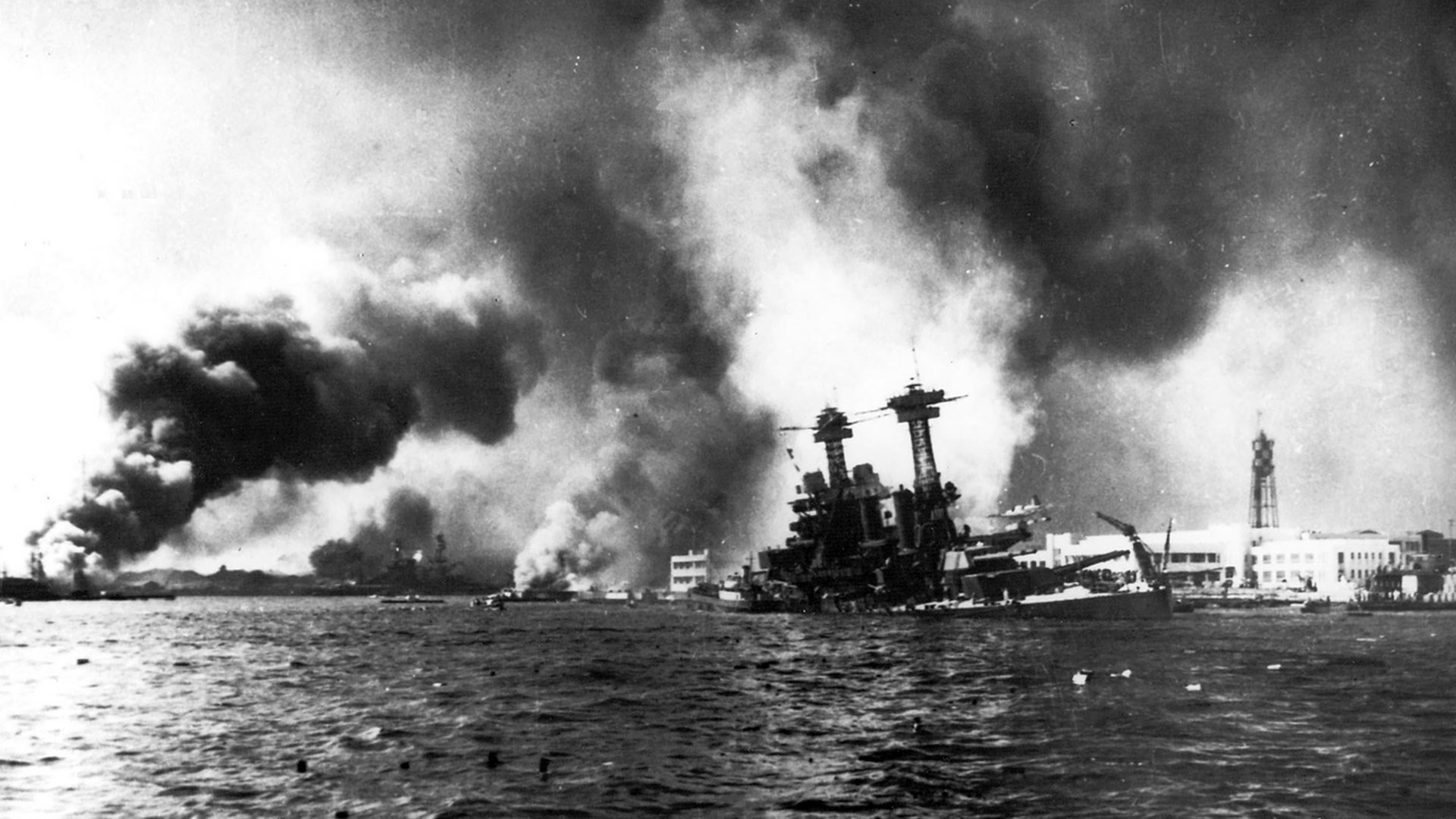
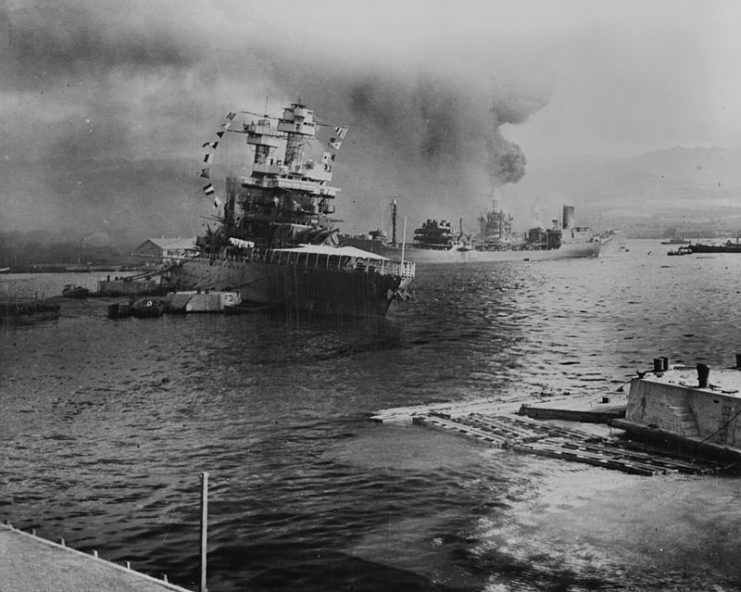
The U.S.S. California (BB-44) sinking at her moorings next to Ford Island during the attack on Pearl Harbor, Dec. 7, 1941. The ship is low in the water and listing to the port side after suffering two torpedo hits. In the background, the destroyer U.S.S. Shaw burns and the stricken battleship U.S.S. Nevada begins to beach herself at Hospital Point.   

On Sunday morning, Dec. 7, 1941, U.S.S. California was moored alone near the southeastern end of Ford Island in Pearl Harbor, just ahead of the fleet oiler U.S.S. Neosho and "Battleship Row." When the first wave of the attack began, the senior officer onboard roused the crew to general quarters and ordered preparations to get the ship underway. Gun crews rushed to their 5" and .50-cal. anti-aircraft armaments and began firing back at the swarming Japanese warplanes as they made strafing runs and dropped bombs. However, the ready use ammunition kept around the anti-aircraft batteries was limited and the ammunition magazines had to be unlocked.    

While the ship was still attached to her moorings, two Japanese Nakajima B5N "Kate" torpedo bombers approached from the southeast and released their ordnance, with both striking on the port side. The resulting explosions ripped massive holes into the U.S.S. California's hull under the waterline, compromising several internal compartments and structures. She immediately began to take on large volumes of water and heel to the port side, with the flooding only worsened by the fact that many below-deck hatches and doors had been left open for inspection. 
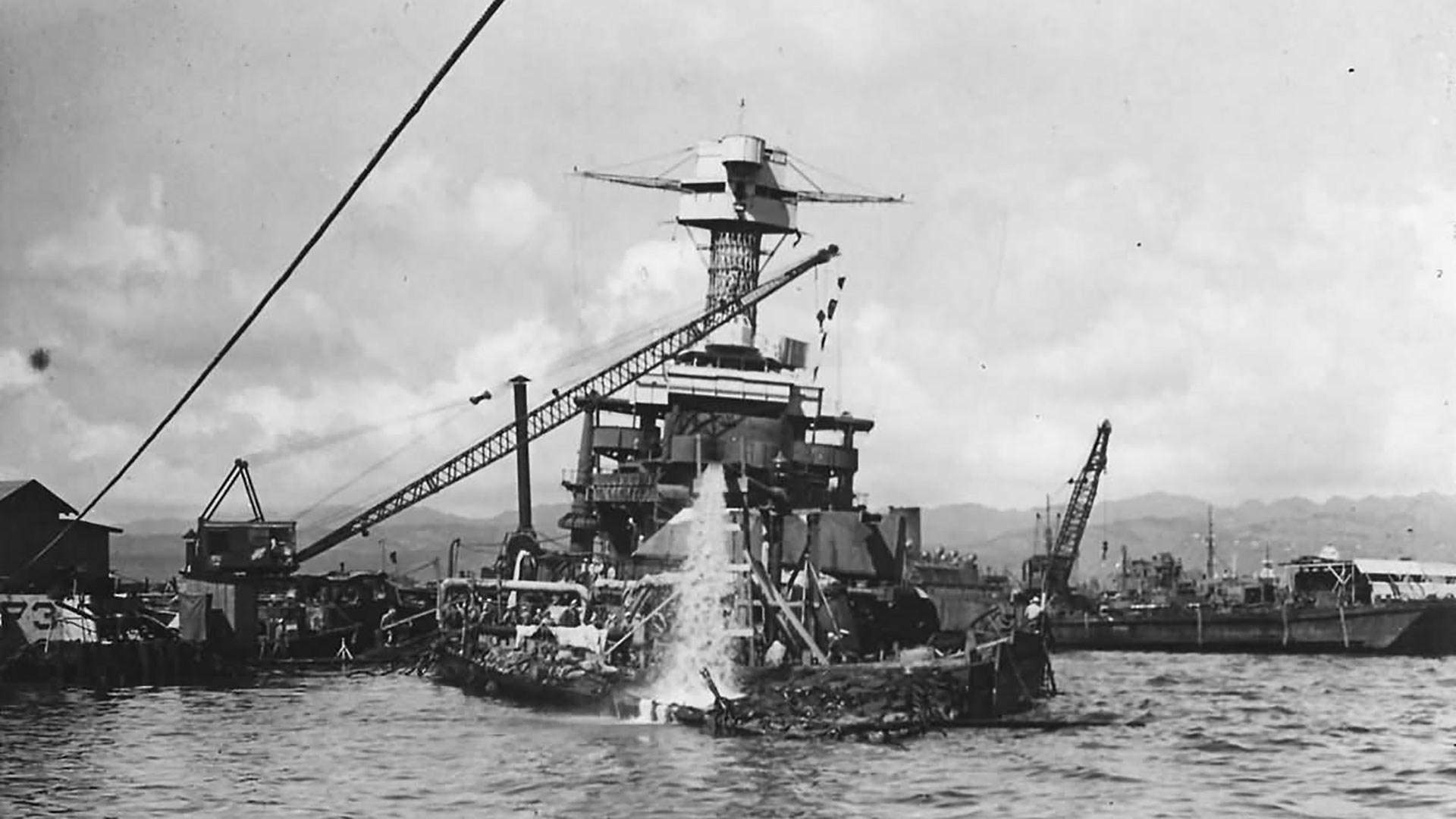
A photo of salvage operations underway on the wreck of U.S.S. California after the attack. Note how low the main deck is in the water, along with the water being pumped out of the hull. As the U.S.S. California settled onto bottom of Pearl Harbor, the hull began to sink down ever deeper into a silt embankment, necessitating the removal of usable materials and extra weight from the ship. This included the removal of the ship's 14" naval guns, which are already missing from the turrets in this photo.

Uncontrolled flooding spread through the port side compartments and the order was given to counter flood on the starboard side, in a desperate effort to keep the ship upright. To make matters worse, water entered the fuel lines and the ship lost power. As the crew fought to save the ship, Japanese Aichi D3A "Val" dive bombers made repeated attacks on the stricken vessel, scoring a bomb hit and two near misses that started fires and caused further damage. Dead in the water, U.S.S. California burned and began to slowly sink. Despite the efforts of the crew, surrounding vessels and portable pumps, the ship slowly settled into the mud of harbor bottom over the next three days, mostly upright with only her main deck and super-structure remaining above the waterline.

After the attack, extensive efforts were made to save men still trapped on the sunken vessels and salvage whatever equipment remained usable. Evaluations on the sunken ships were also conducted to determine if any could be raised and brought back into service. Of the four battleships sunk at Pearl Harbor, the U.S.S. California was the least damaged overall and prioritized for salvage. However, despite resting is the mud, the ship's hull began to sink even deeper into a silt embankment on the harbor bottom. Furthermore, the longer equipment still onboard the ship was exposed to the harbor's salty tropic waters, the less usable it would rapidly become. These factors necessitated efforts to remove extra weight and any usable materials from the ship as quickly as possible, including the removal of the ship's 14" naval guns from their turrets.
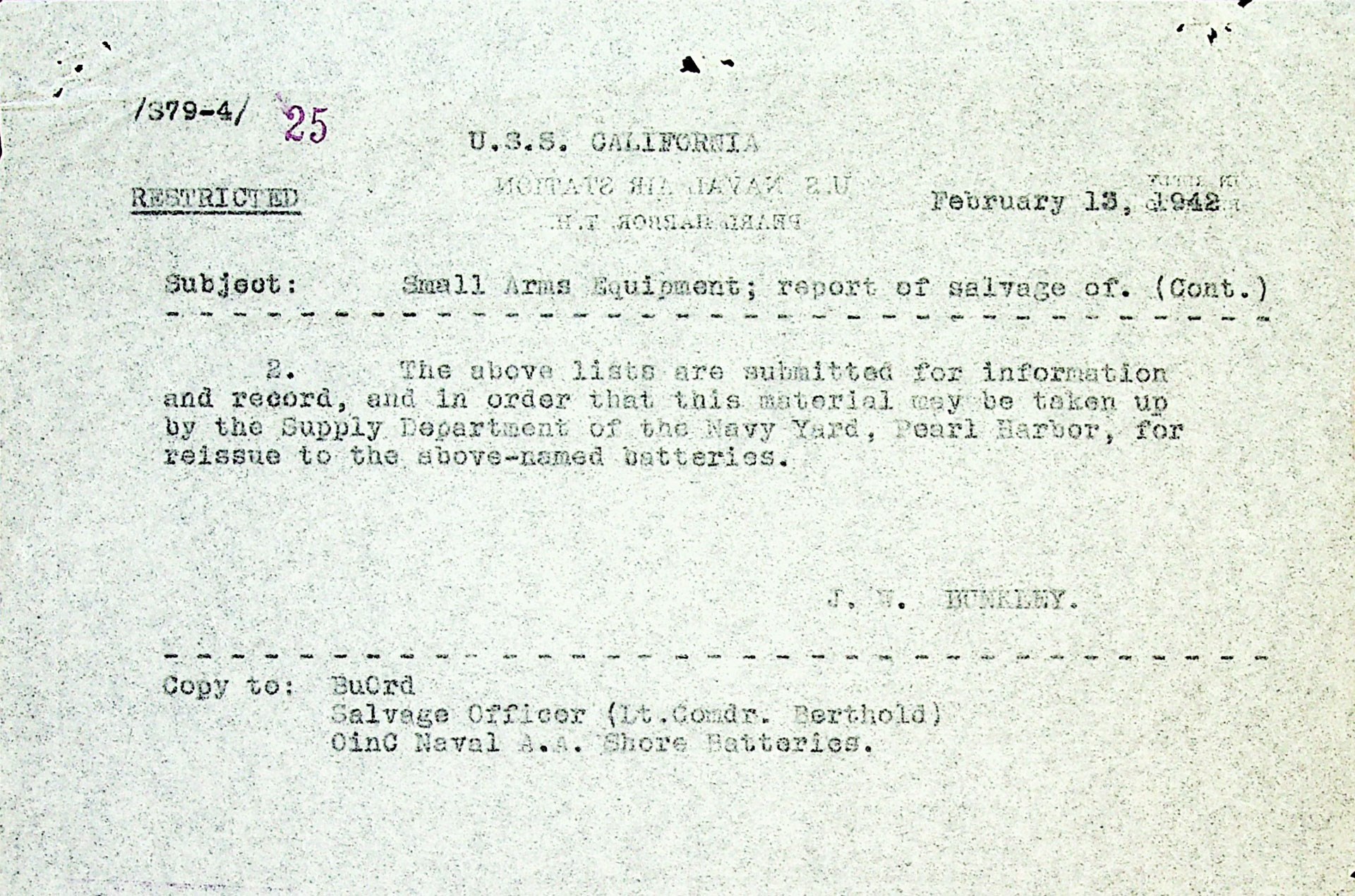
A page of the memorandum in which Capt. Joel Bunkley documents the transfer of the small arms to the Supply Department of the Pearl Harbor Navy Yard. Photo courtesy of Archival Research Group.

Other equipment of varying size, from the ship's radar to ammunition, was also salvaged. This included the recovery of the many small arms which were still stored in various armories below deck. Yet, what happened to these small arms that were recovered from the wreck since then? This is where documentation from the National Archives expands further. On a memorandum dated Feb. 13, 1942, Capt. Joel Bunkley wrote to the commandant of the Pearl Harbor Navy Yard to transfer the small arms salvaged from the U.S.S. California to various coastal artillery batteries located around the island of Oahu, Hawaii.

This transfer included 352 M1903 rifles, 53 M1911 pistols, 26 Browning Automatic Rifles, 16 Lewis machine guns and two Thompson submachine guns. The lists of serial numbers for the M1903 rifles in the memorandum does not specify whether the rifles are of Springfield Armory or Rock Island Arsenal manufacture. However, all are serial numbers exclusive to Springfield Armory production and above the range of duplicate serial numbers (Springfield Armory and Rock Island Arsenal bearing the same serial number on the receiver). The serial numbers were also recorded in ascending order, making it easier to see trends in serial number ranges present.
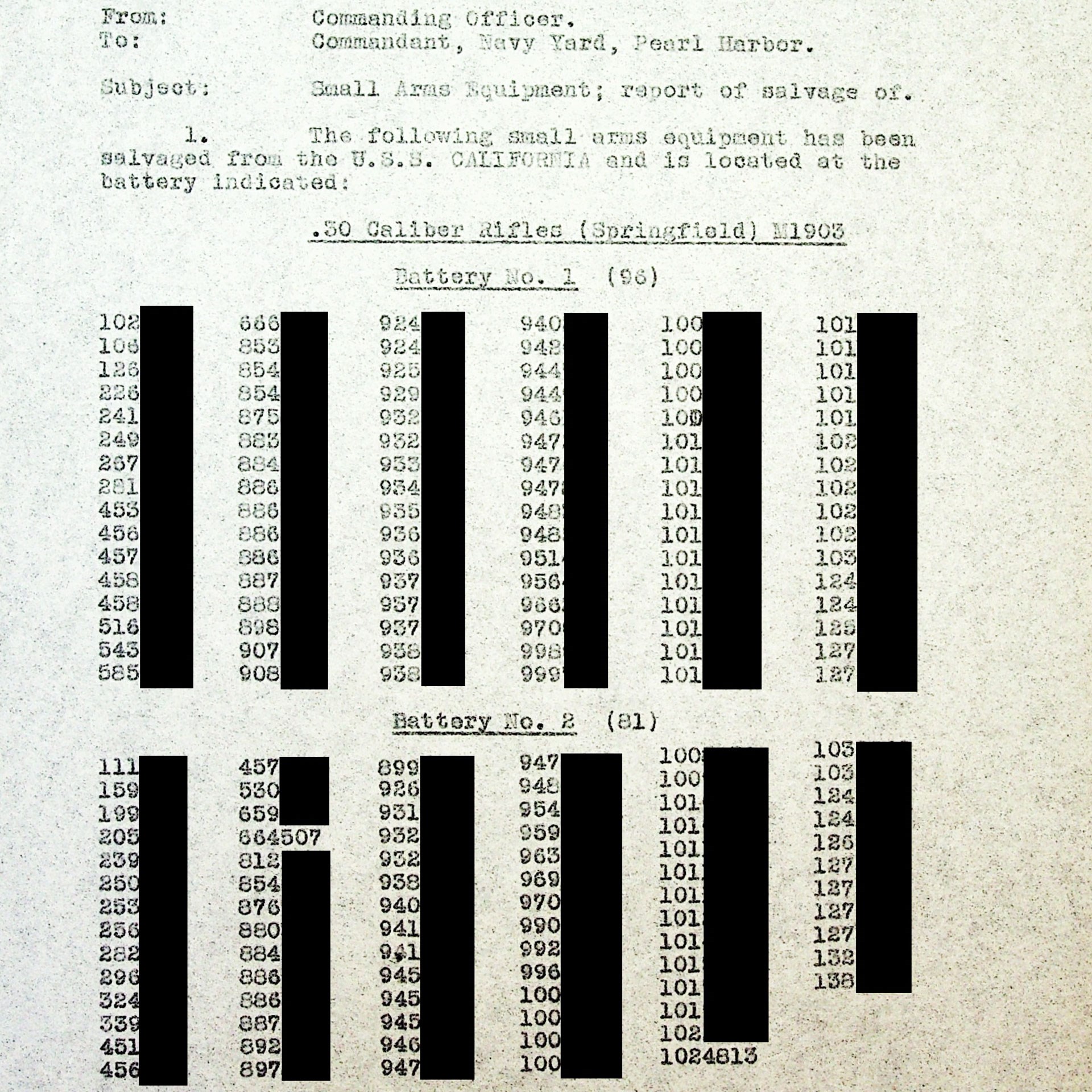
The first page from a list of rifle serial numbers from the commanding officer of the U.S.S. California, transferring salvaged property to the commandant of the Navy Yard of Pearl Harbor. Note rifle S/Ns 664504 and 1024813 are contained in the list of rifles sent to Battery No.2. Photo courtesy of Archival Research Group.  
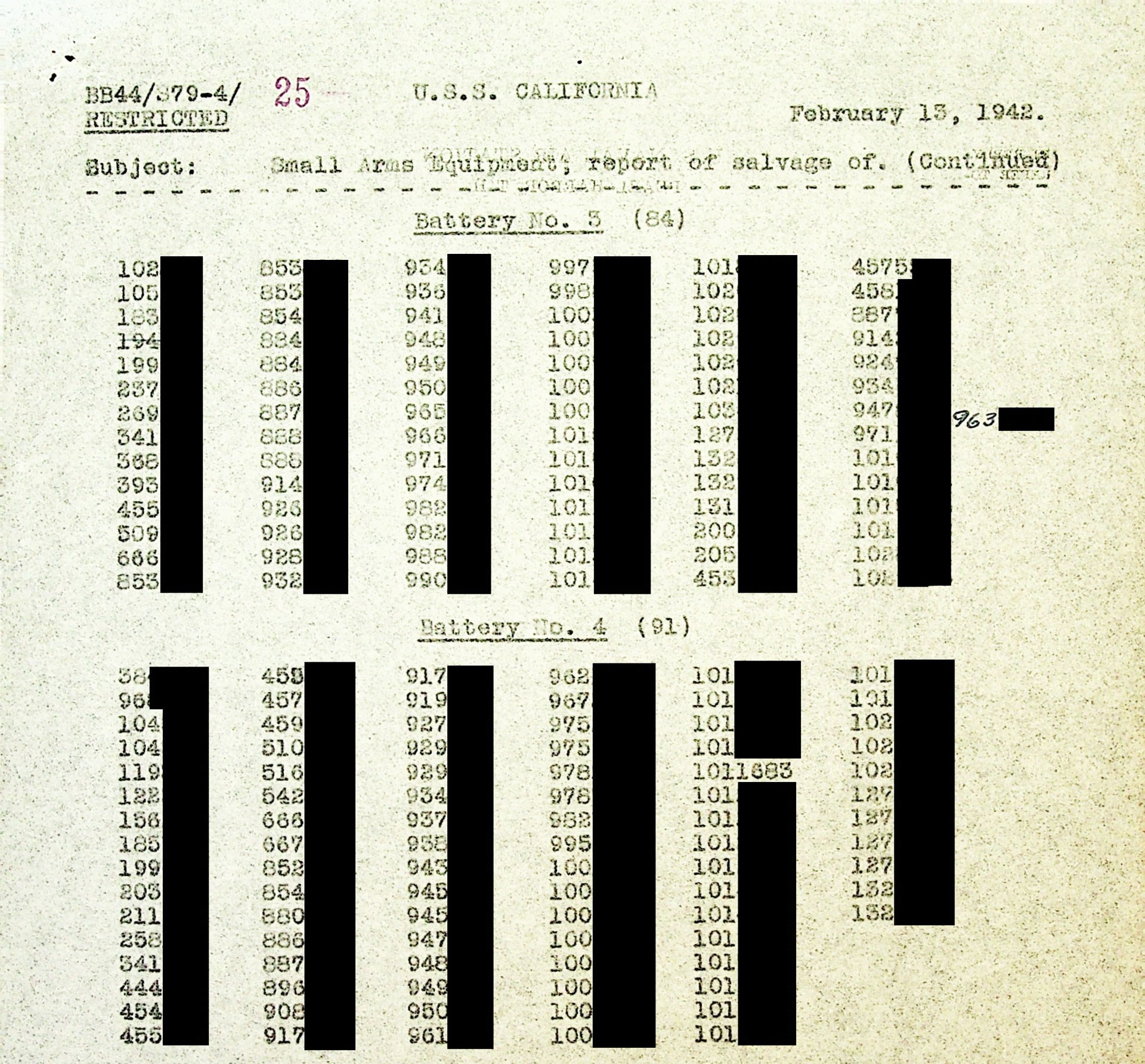
 

The second page of the list of M1903 rifle serial numbers recovered from the wreck of the U.S.S. California, with rifle S/N 1011683 transferred to Battery No. 4. Photo courtesy of Archival Research Group.

In the aftermath of the attack, the Territory of Hawaii was in a state of emergancy and security across the archipelago was put on high alert. Eight defensive batteries were hastily constructed around the island of Oahu to offer better protection against further seaborne attacks and even possible invasion. The salvaged M1903 rifles that came from the U.S.S. California were only sent to batteries one through four, with battery one receiving 96, battery two receiving 81, battery three receiving 84 and battery four receiving 91 of the rifles. The authors of this article have compiled a table of these eight coastal defense batteries built around the island, along with armament type and notes regarding each:

Battery

Number

LocationTypeNotes
No.1Hickam FieldFour 5" Naval GunsLocated at Hickam Village housing complex. No remains.
No.2WaipahuFour 5" Naval GunsLocated in a sugarcane field somewhere in the West Loch vicinity.
No.3

Fort Weaver (Puuloa)

Four 5" Naval GunsMost likely located adjacent to the Navy’s Fleet Machine Gun Training School. Marines here manned three batteries of .50-cal. anti-aircraft machine guns when the Japanese attacked on Dec. 7. This area was developed for housing in the 1950’s, adjacent to the present-day Marine Corps Puuloa Rifle Range.
No.4Ewa Marine Corps Air StationFour 5" Naval GunsNo remains, site developed.
No.5Ahua PointFour 5" Naval GunsSearchlights were emplaced here, as well as an anti-aircraft warning station (AAIS 10) (1940). No remains of any military structures.
No.6

Waipio (Pearl Harbor Naval Base)

Four 5" Naval GunsLocated on the point halfway on the eastside of the Waipio Peninsula along the shore of the Middle Loch. Also included a mobile 3" anti-aircraft gun battery. Two concrete gun emplacements, the power generator house and fire-control switchboard room.
No.7

Pearl Harbor (Ford Island)

Four 5" Naval GunsUnder the command of Fort Kamehameha.
No.8Aiea HeightsFour 5" Naval GunsHawaiian Anti-Aircraft Command, command post was located here.


In the 80 years that have passed since the attack, the history of these rifles and their whereabouts was largely forgotten and began to fade. Yet, thanks to the patient efforts of the Archival Research Group and the information discovered in Capt. Bunkley's 1942 memorandum, three of these salvaged rifles have been identified. These three M1903 rifles appear in the memorandum by serial number as being recovered from the U.S.S. California, and all three were carefully examined by the authors for any interesting features or details. A table with some of technical details of these M1903 rifles is below:

Rifle S/NBoltStockDisposition after salvage from U.S.S. California
664507J5Finger grasping groove with two stock screws. No inspector marks remain.Battery No.2
1011683J5Finger grasping groove with two stock screws. J.S.A. inspected.Battery No.4
1024813J5Finger grasping groove with two stock screws. D.A.L. inspected, followed by S.A./J.F.C. re-arsenal stamp.Battery No.2


Of the three rifles examined, the lowest numbered, S/N 664507, does not appear in like-new condition, but also does not show signs of extensive surface corrosion or pitting on its metal components. Meanwhile, S/N 1011683 is in an almost like-new condition. It exhibits many features of a non-rebuilt rifle with original finish, with both the metal and wood being in good condition with honest wear and patina, but no signs of water damage. As for S/N 1024813, while its stock and some other parts display signs of being rebuilt by Springfield Armory after the war, it still bears the original receiver finish and has no surface pitting.

When examining these rifles, a question that comes up is: “Why are these rifles not showing signs of salt-water damage?” Unfortunately, the documentation does not specify when exactly during the salvaging operations that these small arms were recovered. Without the confirmation of primary documentation, it theoretically could have been hours, days, or even weeks following the sinking that these small arms were removed. But, considering the intensity of the salvage operation and the conditions concerning the ship, the removal of such items would have been an urgent issue. With the observable conditions of the three rifles, it is likely these small arms were retrieved from the U.S.S. California before the damaging effects of salt-water corrosion could set in.
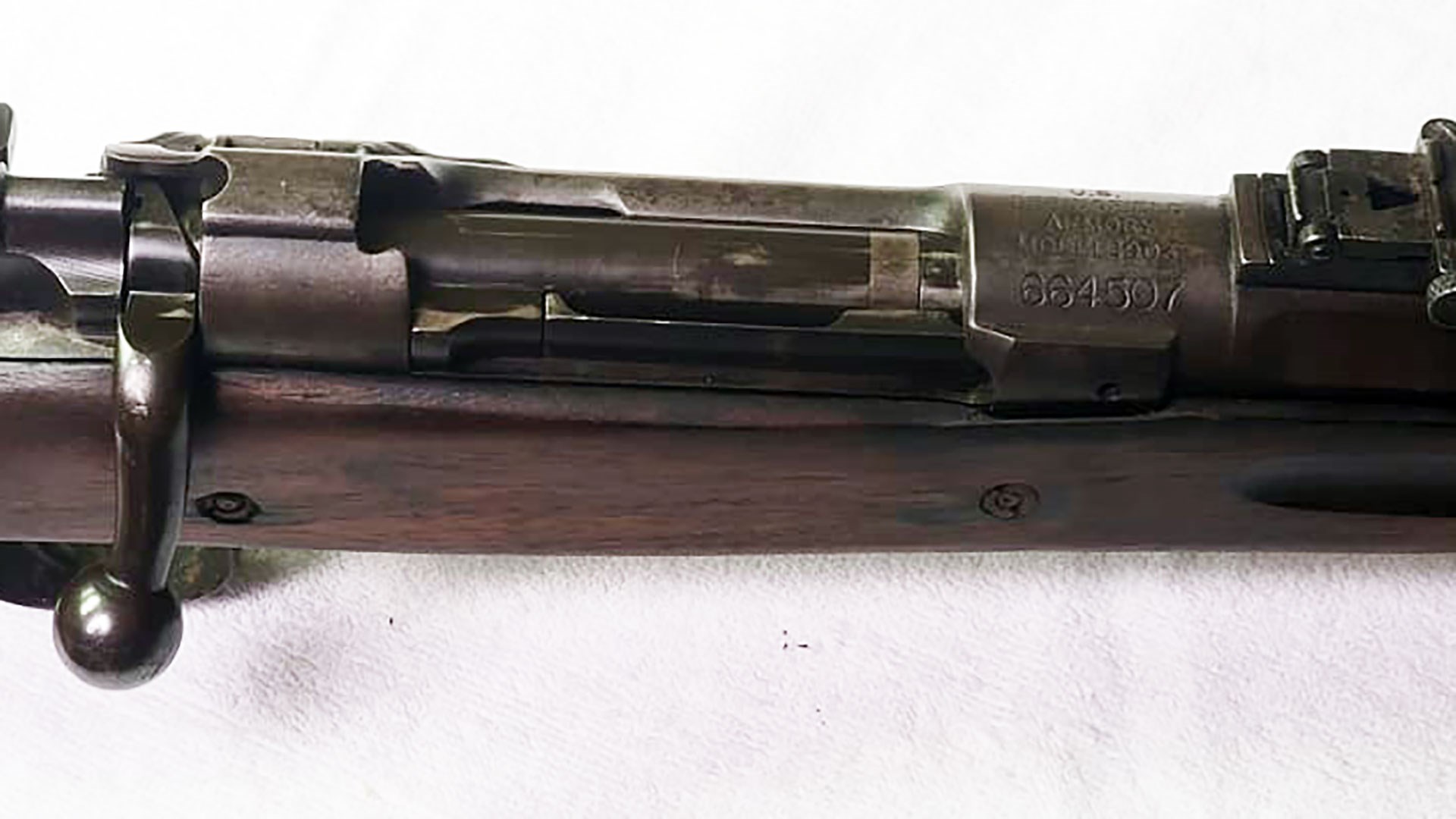
M1903 S/N 664507. 

The memo also does not state the conditions of the armories when the rifles were retrieved, that is, if they were in a partially flooded section or in a dry section. Furthermore, it does not provide any information as the the location or designations of the armories onboard the ship. Yet, these locations where the small arms were stored could have played a big factor in the rifles’ good condition. If the armories were located on the upper decks, they could have been unaffected by flooding due to the ship sinking in shallow water. Also, despite the fact that many watertight doors had been left open during the attack, the crew did manage to close a substantial number and there were lower compartments of the ship that remained water tight even after the sinking.

M1903 S/N 664507 does show some signs of light pitting and the sort of corrosion one would expect from a rifle that was salvaged from a wrecked vessel in a tropical harbor. However, S/Ns 1011683 and 1024813 do not show similar signs of corrosion. At the present time, it is unknown as to whether S/N 664507’s corrosion is linked to Pearl Harbor’s salt water or not. With the U.S.S. California out of action for the foreseeable future, the rifles were perfect candidates for redistribution to the island defenses. Thus, it is also reasonable to speculate that, due to the state of emergency on Oahu, they could have been prioritized to be removed immediately. 
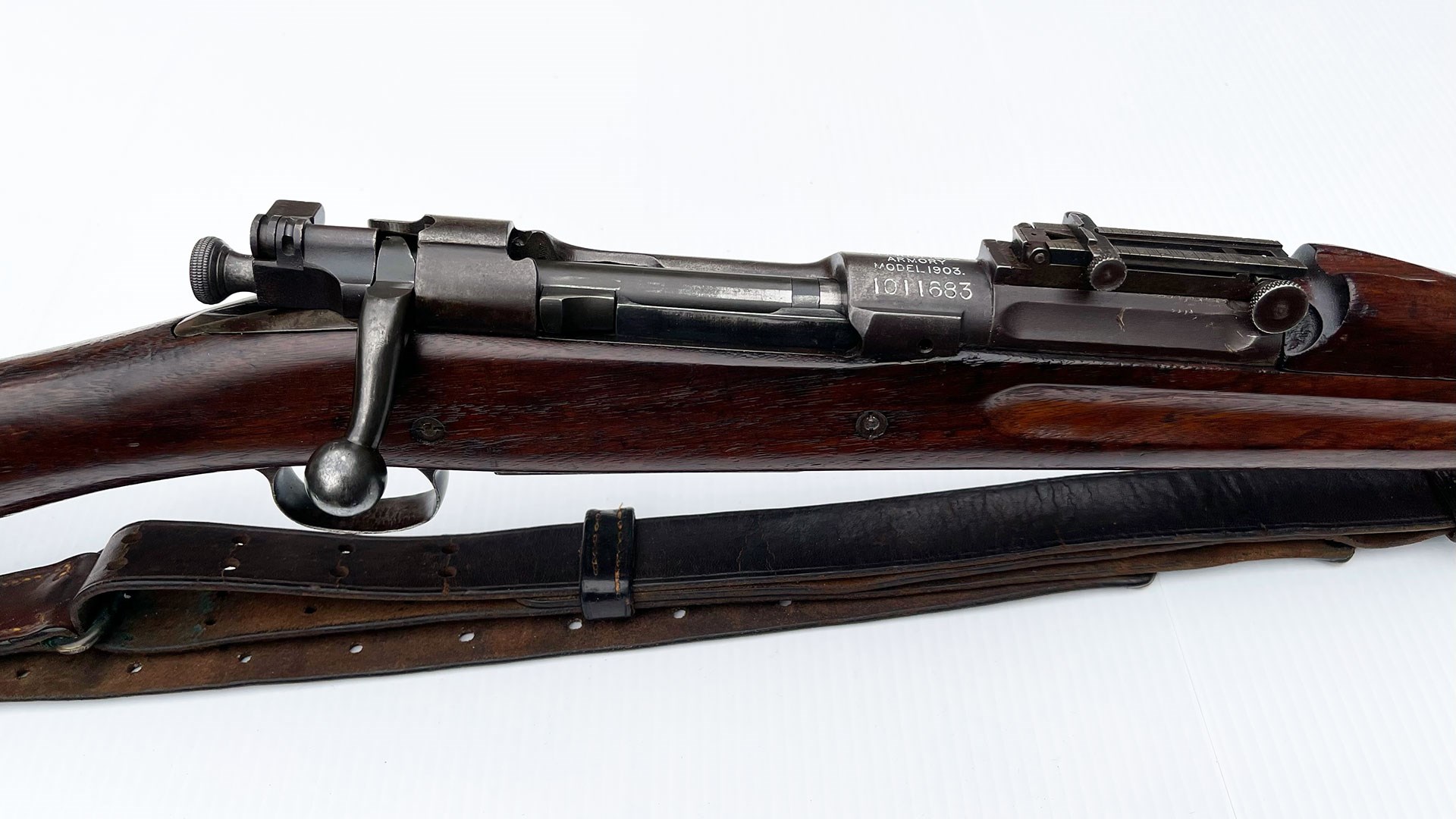
M1903 S/N 1011683.

When viewed through the lens of 2021, it is rather difficult to imagine a land invasion by Japanese troops on the island of Oahu after the attack. It is clear now that invasion was never an immediate strategic intention of the Imperial Japanese Navy. Yet, the strategic intentions of the Imperial Japanese Navy and Army were still unknown at the time. With the fear of a possible invasion looming, it is easy to understand why all weapons would be prioritized for reissue to bolster defenses around the island. However, this prioritization is not directly stipulated in the correspondence.

The details on the memorandum have also caused some confusion in its interpretation. Some have interpreted, based off the four "batteries" listed on the documents, that these small arms were salvaged from the ship's four main gun turrets and barbettes. Understanding Naval terminology can offer some additional clarification. A battleship’s armaments of the time were often referred to as primary and secondary "batteries," and the U.S.S. California did have four main battery turrets. However, these positions only serviced and housed the ship's larger caliber weapons. The term battery can also refer to a grouping of artillery or other large-caliber armaments in an established position, as is the case with the four defensive positions on the island the rifles were sent to.
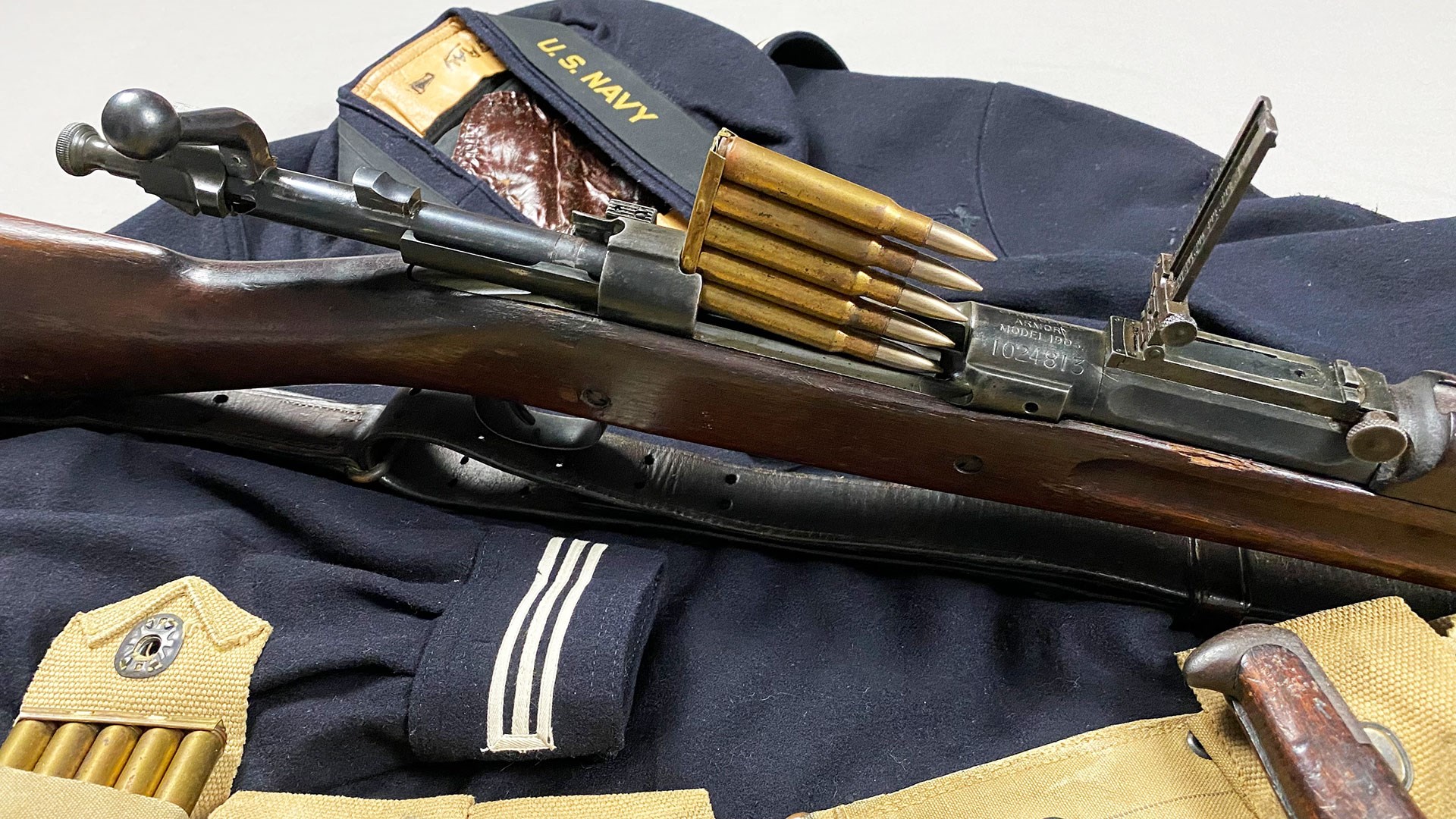
M1903 S/N 1024813.

Some historians have debated whether these rifles were used by Navy personnel or the Marine detachment while aboard the U.S.S. California. These rifles would almost certainly have been for issuance to the naval personnel and landing parties. At the time, the common practice for the Marine detachment was to bring aboard, maintain and handle their own small arms. The responsibility for these arms belonged to the commanding officer of the Marine detachment, not the captain of the ship. Thus, it seems unlikely that these rifles were from the marine detachment.

The next question that should be addressed is: "Why does a battleship even need small arms aboard?" The naval landing party would augment the Marine detachment aboard the ship when needed. It consisted of sailors who were normally assigned roles that were not crucial for the ship's operational needs. The primary role of these armed sailors was to function as the ship’s security. Though, this should not be confused with policing onboard the ship.
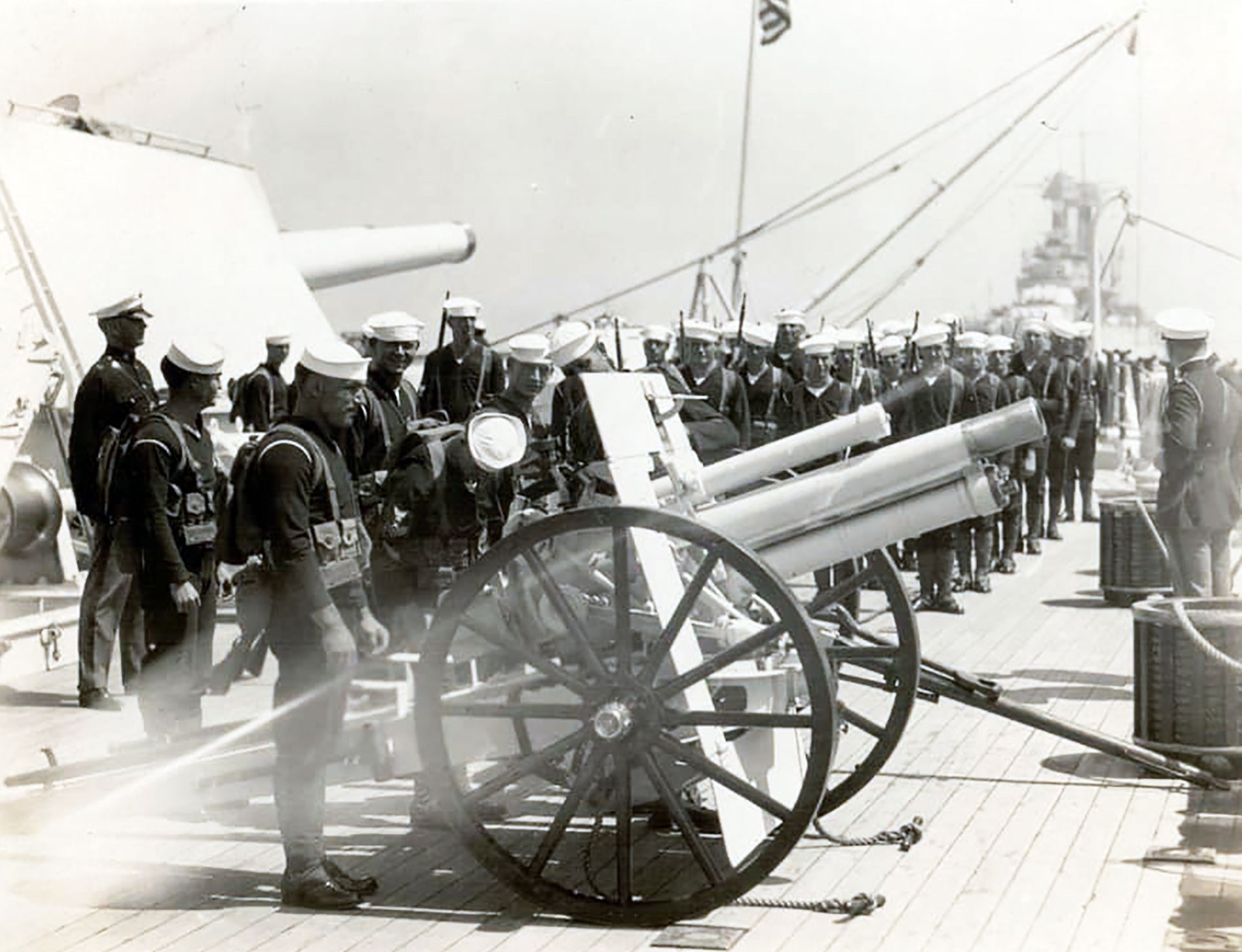
Landing party members aboard the U.S.S. California, sometime in the late 1920s to early 1930s. The U.S.S. California's sister-ship, the U.S.S. Tennessee, can be seen in the background. Take notice of the two Marine officers supervising the formation. It is reasonable to believe that the rifles we've examined may be shouldered by one of these sailors.

Naval personnel of the landing party would occasionally combine with the Marine detachment to form a larger landing force in certain situations, such as securing and stabilizing a hostile port. One example of the use of combined landing parties was the United States' occupation of Veracruz. The Marine detachment was also tasked with training the naval personnel in infantry tactics. It should also be noted that the Marines and Navy had separate armories for maintaining, repairing and storing their small arms. They only combined for training and carrying out landing party operations.

After the small arms were salvaged and sent to their respective batteries, it remains unclear what, if any, further service these rifles saw. It is possible that they sat out the rest of the war at the batteries, were transferred onto active duty ships, used for training or sent elsewhere. The U.S. Navy did not adopt the M1 Garand service rifle until September 1945, and the M1903 rifle was declared obsolete in 1947.
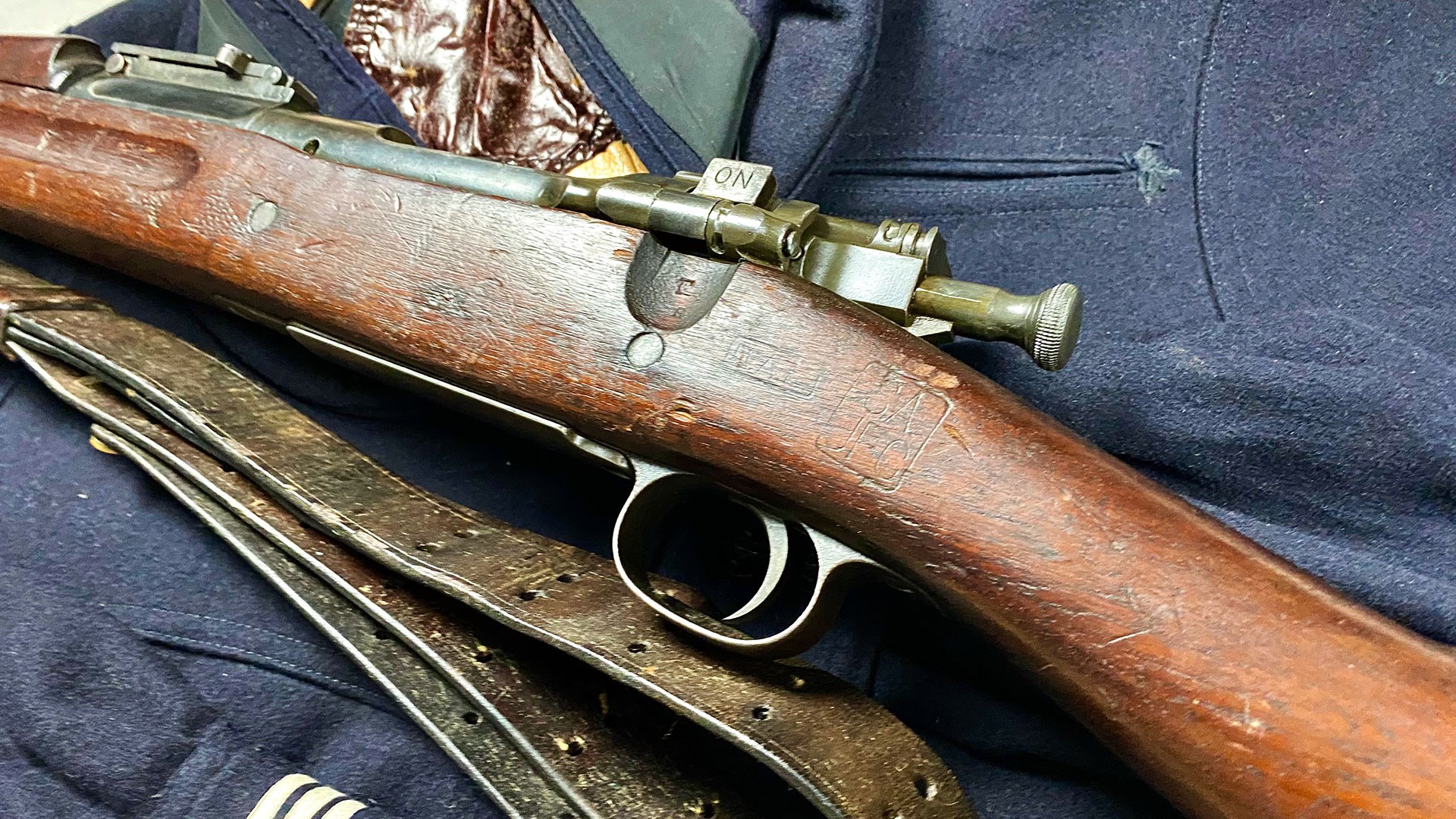
A view of the markings in the stock of M1903 S/N 1024813. Note the original D.A.L. inspector stamp followed by a post-war Springfield Armory S.A./J.F.C. rebuild cartouche as well as the added "Hatcher" hole in the receiver.

Thus, it is possible that these rifles could have served in other roles during the war, but that is unknown at the present time. It's also possible that these rifles were withdrawn from service sometime before or around the official adoption date of the M1 by the Navy in 1945, or shortly after the M1903 was declared obsolete. However, the presence of a Springfield Armory S.A./J.F.C. cartouche from a post-war rebuild in the stock of S/N 1024813 might indicate possible use into the 1950s. 

As for the U.S.S California, her story did not end in the mud of Pearl Harbor. After extensive efforts to patch the two torpedo holes and regain buoyancy, she was re-floated in March 1942. In October 1942, she sailed for Puget Sound Naval Yard, Wash., for long-term repairs and reconstruction. While being repaired, the ship was modernized and refitted with a new superstructure, radars and anti-aircraft mounts. Finally, on Jan. 31, 1944, the rebuild was completed, and she underwent a series of sea trials before rejoining the Pacific Fleet.
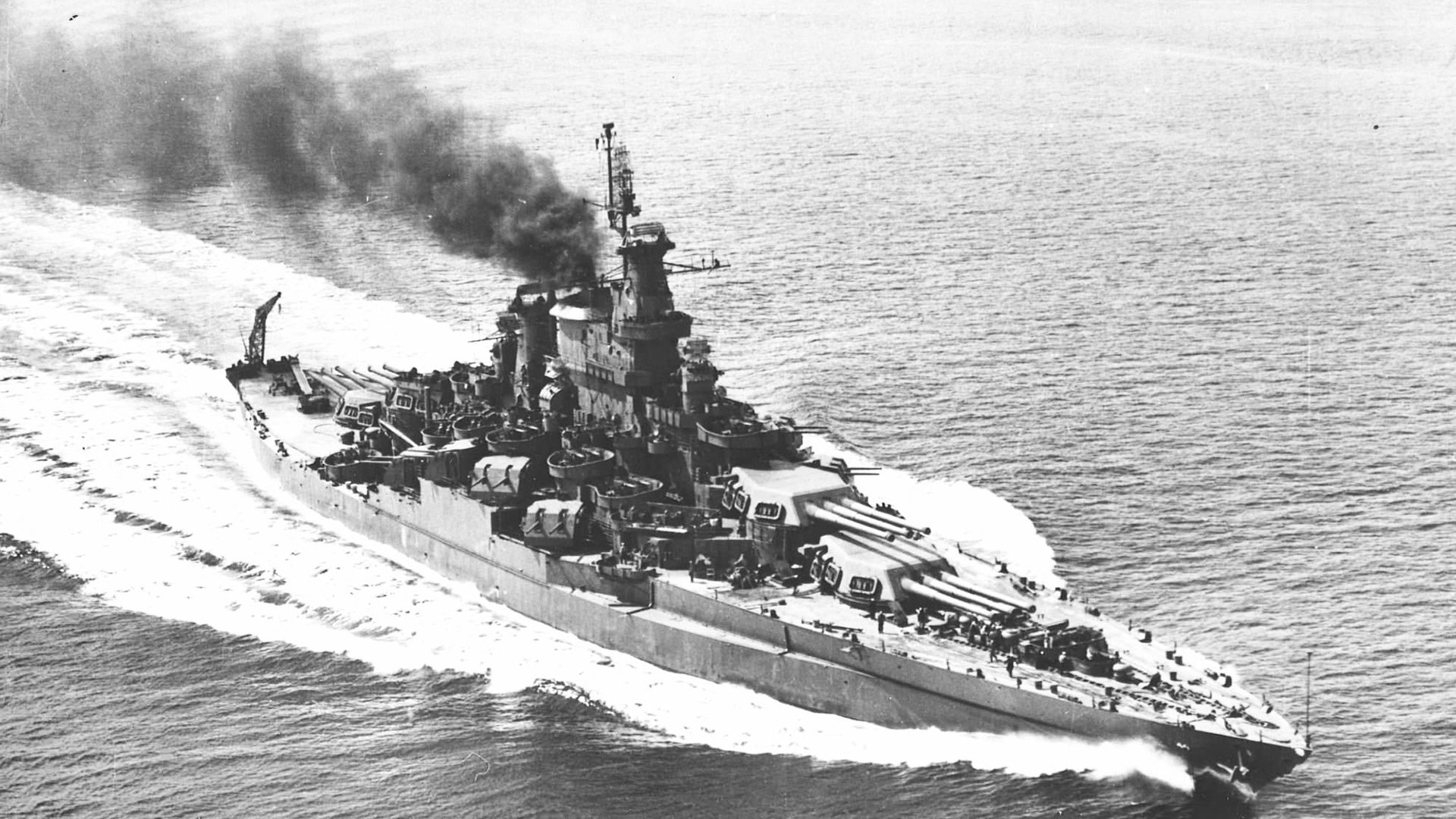
The U.S.S. California underway in 1944 after her extensive repairs and rebuild at Puget Sound Naval Yard, Wash. Note the redesigned superstructure, added radars and anti-aircraft mounts. 

Back in the fight, U.S.S. California’s battle record included the invasions of the Saipan, Guam and Tinian in the summer of that year. In October 1944, the ship took part in the largest naval battle of World War II, the Battle of Leyte Gulf in the Philippines. On the night of Oct. 25, 1944, a U.S. naval force under the command of Rear Adm. Jesse Oldendorf, which included the Pearl Harbor veteran battleships U.S.S. California, U.S.S. West Virginia and U.S.S. Tennessee, encountered a Japanese battle line sailing up the Surigo Strait.

The Japanese force, commanded by Vice Adm. Shoji Nishimura and comprised of the battleships I.J.N. Fuso, I.J.N. Yamashiro and the heavy cruiser I.J.N. Mogami, attempted to sneak up the strait toward U.S. amphibious forces landing on the island of Leyte. In the ensuing battle, the U.S. battleships crossed the enemy's "T" and opened fire with devastating accuracy, thanks to their radar-guided gunnery. All three Japanese ships were lost during this engagement, and it marked the final gun dual between battleships in naval history. U.S.S. California served for the remainder of the war in the Pacific, before being decommissioned in 1947 and placed in reserve. She and her sister-ship remained in mothballs until being scrapped in 1959.
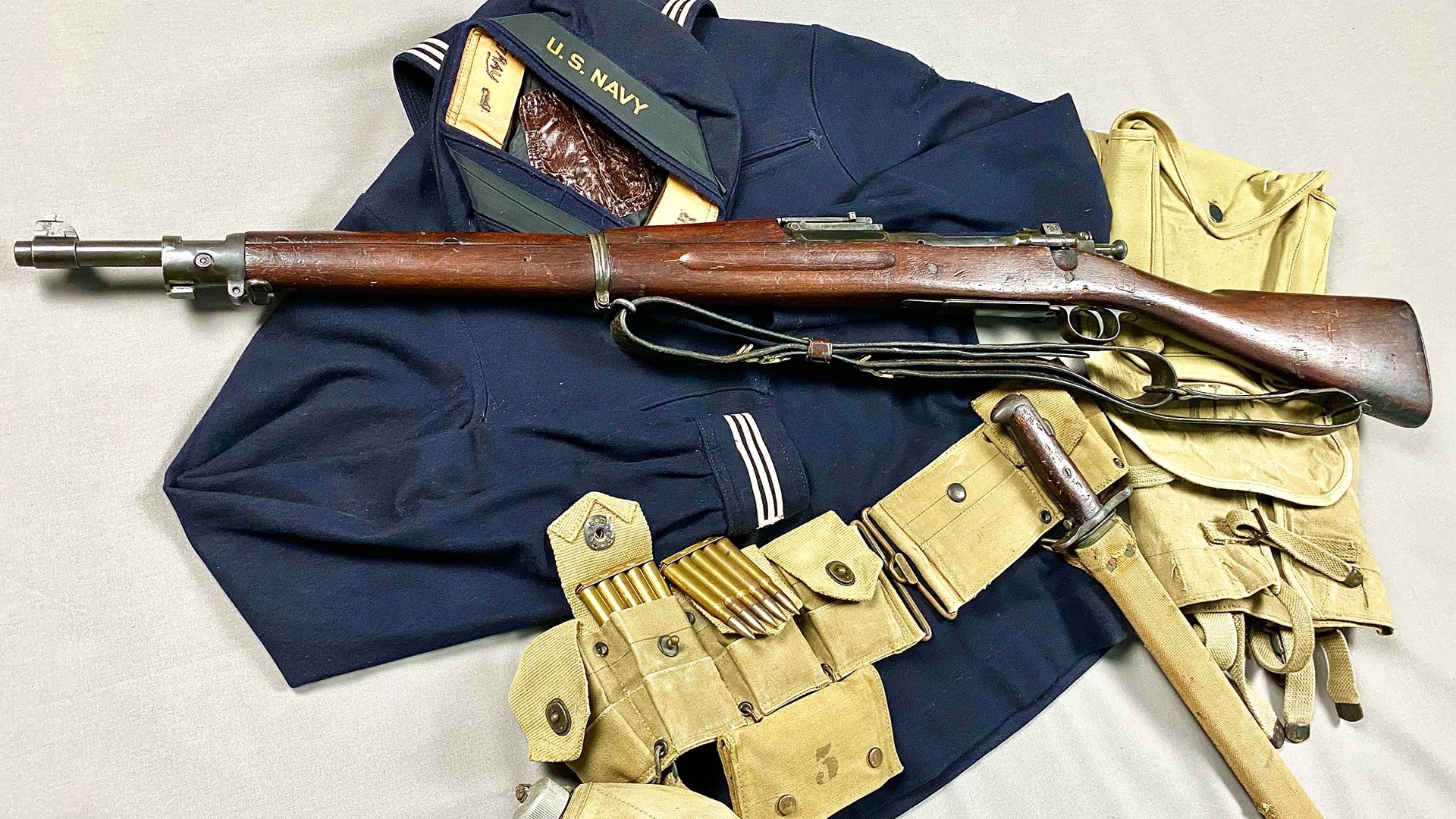
Another view of M1903 S/N 1024813.

It is often said in the firearm collecting community: “Buy the rifle and not the story.” These words are commonly repeated almost as a mantra when advising fellow collectors on the most intriguing of backstories attached to prospective purchases. Specifically, this advise aims to help avoid a costly mistake. Many stories attached to old arms with a price tag are typically just that, stories that cannot be validated.

These three rifles serve as the exception to that rule, and show that one can in fact accept and prove a story with primary source documentation. Their unique history would have been lost, had the connection not been made between the respective serial numbers and the 1942 memorandum obtained at the National Archives. They also serve as a humble reminder of one of the darkest moments in U.S. history, as 98 men perished onboard the U.S.S. California during the attack. For more information on other serial numbers of small arms salvaged from the U.S.S. California and other documentation, visit archivalresearchgroup.com.

Tuesday, December 7, 2021

December 7th 1941," A Day that Lives in Infamy"

 80 years ago, The attack that propelled us into the World stage and made us into a World Power when the War was over. 


At 0755 a bomb exploded on the seaplane ramp at Ford island, this signified the start of the Japanese attack on Pearl Harbor.  When it was done, the American Pacific fleet was crippled, and 0ver 3000 Americans were dead.  The sinking of the fleet at Pearl Harbor galvanized the Americans, and since it was a sneak attack it was considered "dishonorable and underhanded".  This infuriated the Americans sense of fair play.  The Japanese had planned on attacking right after the ultimatum was delivered, but the secrecy that the Japanese demanded forced the Ambassador himself to decode it slowing the response down so they delivered the message to Secretary Hull after the attack has started.  The attack gave the Japanese several things...It was a tactical victory, it allowed them to move against the Philippines and the Dutch East Indies with the rubber and oil that the Japanese war machine needed to build the stuff that a modern nation needs to wage war. The Japanese Admiral Yamamoto who lead the attack on Pearl Harbor had studied the Americans at length while he was a naval attache and he told the General Staff who was pushing for the war "I will be able to give you 6 months, after that I cannot guarantee victory.   And true to events, the Japanese raised hell for 6 months until the Americans smashed 4 of the Japanese fleet carriers at Midway, a blow that the Japanese Naval aviation never recovered from.  The attack also forced the Americans to utilize the carriers to do any offensive work against the Japanese.   Also the Japanese didn't launch the 3rd strike against Pearl Harbor, the drydocks and the fuel farms were still intact.  The victory was a Pyrrhic victory because it ended on August 6 and August 9 of 1945 4 years later when the Japanese cities were the site of the Atom bomb and a small part of the logic of the bomb drop was to pay Japan back for the sneak attack.
   The attack on Pearl harbor was a huge shock to the Americans, for the fleet and the Army air corp to be so woefully unprepared for battle left a mark on the American psyche.  Never again would we be so defenseless.  Also the end results was that out of all the ships sunk and damaged at Pearl Harbor, all but 3 were repaired and returned to service. 


Friday, February 1, 2019

Some information on the U.S.S Nevada (BB-36)

I decided to do something on the Pearl Harbor battleships after doing the blog postings about the  IJN Yamoto.  I still think that it was ironic that me being an Army guy happen to like Naval history. 


From her conception in 1911 to her survival at Pearl Harbor and use as a target for atomic testing, the battleship Nevada had a remarkable career. She served all around the world in times of war and peace, but it was her remarkable durability that strikes many readers.
The construction of Nevada was authorized in a period of rising tensions and the rapid introduction of new technologies. Not long after construction on Nevada began, that tension in Europe would lead to World War I.


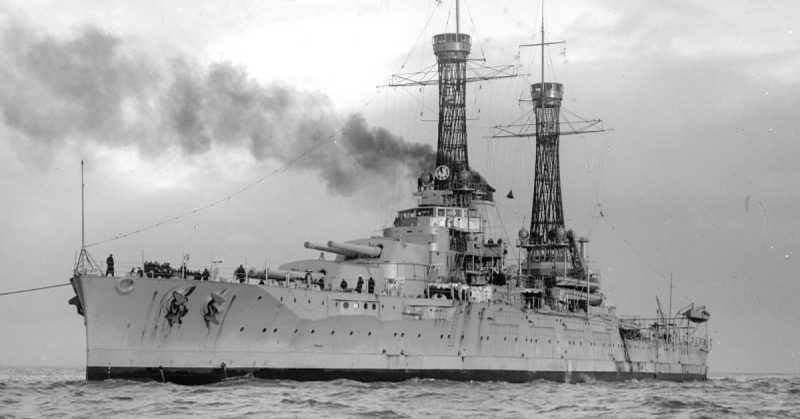
USS Nevada in 1925, probably during visit to Australia, prior to the removal of her cage masts
The Nevada was the first of a new class of US battleships to use triple gun turrets and “all or nothing” armor. With 14-inch guns, the use of triple turrets allowed more firepower to be put in the forward position. When bigger guns were used with triple turrets, such as those on the British Nelson-class battleships, this created an often-unstable firing platform.

Nevada underway off the Atlantic coast of the United States on 17 September 1944
Later battleships like the Colorado had bigger caliber guns and went back to two turrets, and ships with more tonnage like the North Dakota could handle the weight of four turrets in superfiring position.
On Nevada though, three turrets gave the ship a decent mix of firepower, weight, and speed. This development combined with the use of oil instead of coal for fuel represented a leap in dreadnought technology at the time.
The “all or nothing” armor came from a new military philosophy regarding potential threats. The increasing range and size of weapons often meant that battles took place at longer ranges. So designers maximized armor in the most likely areas to be targeted, while other areas of the ship had little to no armor.
This allowed the overall tonnage of the ship to remain low, which improved the ship’s speed. The design became standard around much of the world at the time. 
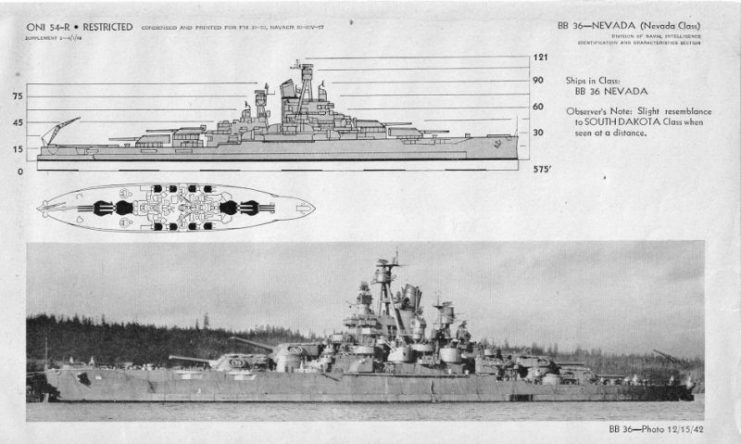
Division of Naval Intelligence identification sheet depicting Nevada after her 1942 repair and modernization
The major threats during the period leading up to World War I were torpedo boats and submarines, so the armor on the hull was far more sturdy than that on the deck. This would prove almost fatal when airplanes took a larger role in the fighting during World War II.
The Nevada didn’t see much overseas service in World War I due to fuel oil shortages in Great Britain. Toward the end of the war, it protected convoys out of Bantry Bay in Ireland.
After the war it served in many diplomatic missions and goodwill tours, and it was upgraded during those interwar years with tripod masts, an engine upgrade from the stricken North Dakota, and an increase in the caliber and number of its various guns.
Nevada during her running trials in early 1916
Nevada’s location at Pearl Harbor at the end of Battleship Row allowed it to maneuver during the surprise Japanese attack on December 7, 1941 that brought the US into World War II. It was the only ship to do so and as a result it became a priority target for the Japanese pilots. 
The Nevada sustained heavy damage, and would have suffered the same fate as the Arizona except for the fact that the shells in the main magazine were being exchanged for new and it was mostly empty at the time. The relatively thin armor on the deck made it particularly susceptible to bombing runs and the Nevada ended up running aground, suffering a total of 60 killed and 109 injured during the attack.
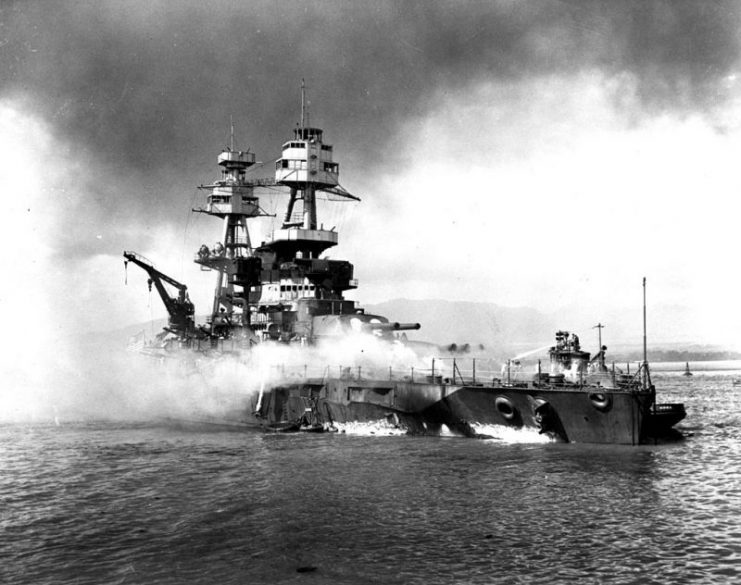
USS Nevada beached and burning as a result of damage sustained during the attack on Pearl Harbor
But the ship wasn’t done. It was repaired, upgraded, and sent to serve on convoy duty in the Atlantic Ocean. Even though the battleship was approaching 30 years old, it was still incredibly useful in the Battle of the Atlantic in case the Germans tried to use capital ships to destroy merchant shipping. This freed up newer and more advanced ships for other missions.
In June 1944, the Nevada unloaded a furious barrage in support of the D-Day invasion. Its sailors received a great deal of praise for their exceptional accuracy, and were thankful that in the 27 times their ship was straddled by the fire from shore batteries it was never hit.
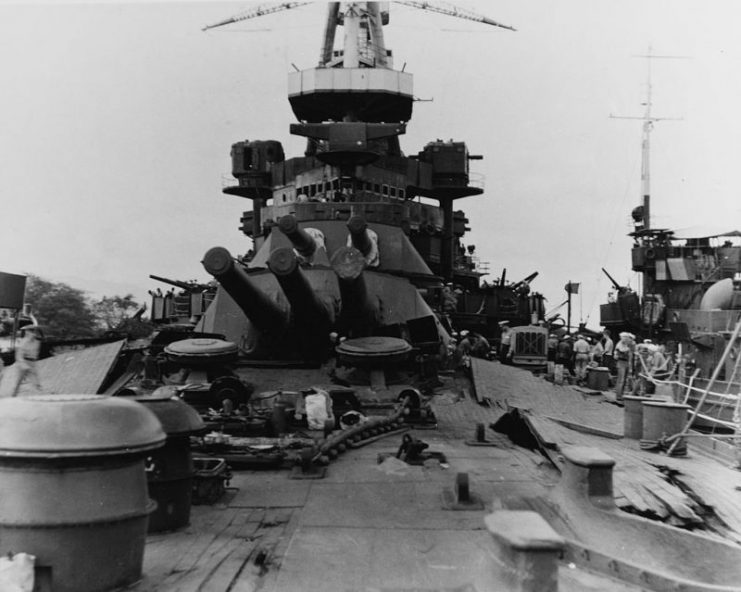
Damage sustained to the bow of Nevada, photographed five days after the attack
After this Nevada sailed to the Pacific theater where it again pummeled landing spots, this time at Iwo Jima and in Okinawa. It survived a kamikaze attack that crashed directly on its main deck, proving those deck repairs were worth it!


After the war Nevada was deemed too old to continue in the fleet and was assigned as a target at the Bikini Atoll for atomic testing. The ship was painted bright orange and sat near the atoll like a neon sentry.
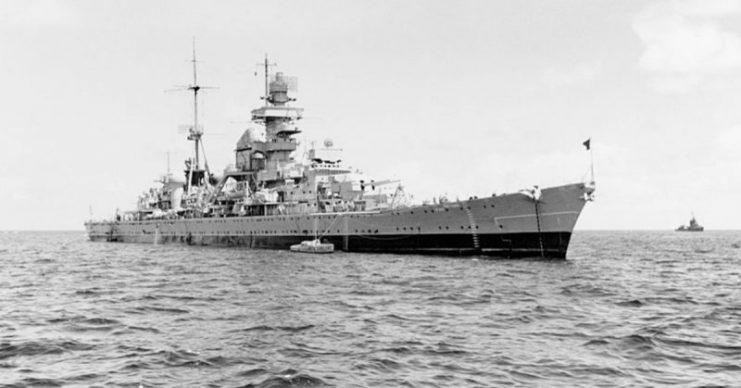
Prinz Eugen, before the Atomic bomb tests in the Bikini Atoll
 Nevada survived two different atomic tests, code named “Able” and “Baker.” In the first, the atomic bomb was delivered by bomber, and in the second one 24 days later, a bomb was detonated underwater. 


Nevada suffered heavy damage and was incredibly radioactive, but remained afloat and was towed back to Pearl Harbor for decontamination and other tests. It was later decommissioned and sunk as a gunnery practice target.


Throughout its career Nevada became a durable ship for the US Navy. It survived the devastation of Pearl Harbor, living to help pummel the Axis Powers into submission.
Even when its final assignment was supposed to be getting blown up by an atomic bomb, the ship was too stout to die. Its entire career is a testament to the inspiring awe of battleships and their seamen.


Friday, December 7, 2018

5 things about Pearl Harbor that wasn't commonly known.

I loaded this into my scheduler thingie back in August, and I really liked the different historical stuff on this post, I learned a lot with this one...Some of the things I already knew, but some of the stuff was new to me.
USS Arizona burning after the attack
A lot is known about the attack on Pearl Harbor, but how much is true and what has become twisted over the years? The war that followed the attack led to frenzy and panic, causing inaccurate information to spread at a rapid pace.
This inaccurate information led to myths about the attack, but what is the truth? Here are five of those myths and their realities.

A widely believed myth is that Pearl Harbor was the only target hit by the Japanese on December 7, 1941. While Pearl Harbor has become the best-known target, it was only one of 6 targets. The Japanese also attacked Guam, Wake Island, Midway, Thailand, and Malaya that day.

The U.S. Navy heavy cruiser USS Northampton (CA-26) under attack off Wake by a Japanese seaplane.
Pearl Harbor was a single part of a larger campaign by the Japanese to control the Pacific. This was a campaign which was successful throughout the following year. Only Pearl Harbor and Midway would not fall to the Japanese during the war.
The reason this has become a widely believed myth is the fact that Pearl Harbor was the most crippling of the attacks. It also resulted in the most American losses that day, which brought the war home to most people.

Japanese planes attack Midway.
 
This is another widely believed myth that states the country was caught off guard by the attack and had no prior knowledge that one would occur. While there was no way to know the date of an attack, the government was aware that an attack by the Japanese was likely to happen.
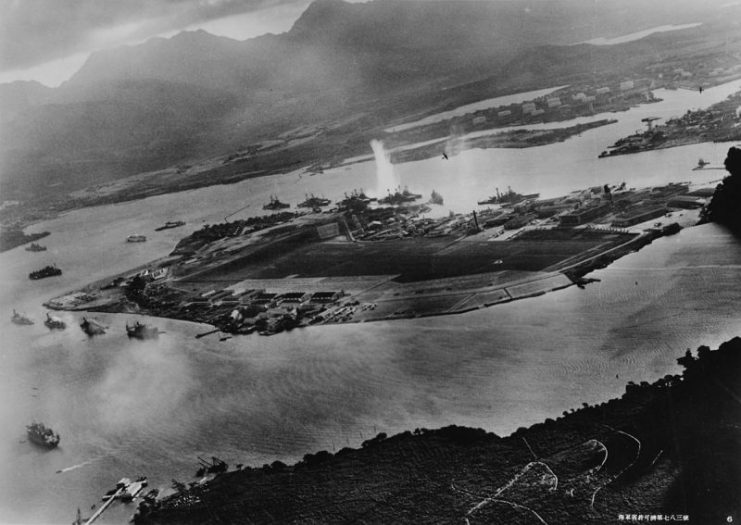
Photograph of Battleship Row taken from a Japanese plane at the beginning of the attack
The rising tension in the region and the increased aggression by the Japanese made this hard to miss. Accordingly, the War Department had already been analyzing intercepted cables between the Japanese Embassy in Washington and Tokyo.
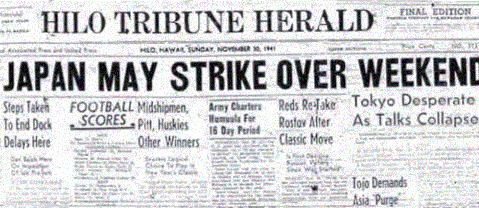
These cables led officials to believe that an attack would happen, with the initial date plotted as November 30. A warning of a possible attack on the islands was placed in a Hawaii newspaper.
Front page of Hawaii Tribune-Herald about a possible Japanese strike somewhere in Asia or the South Pacific, dated 30 November 1941. Fair use
While these warnings can be seen as general and a routine part of wartime, they do show that the government was aware that an attack could take place. Of course, the fact that a Japanese armada was able to travel between Japan and Hawaii undetected does lend some credibility to this myth.
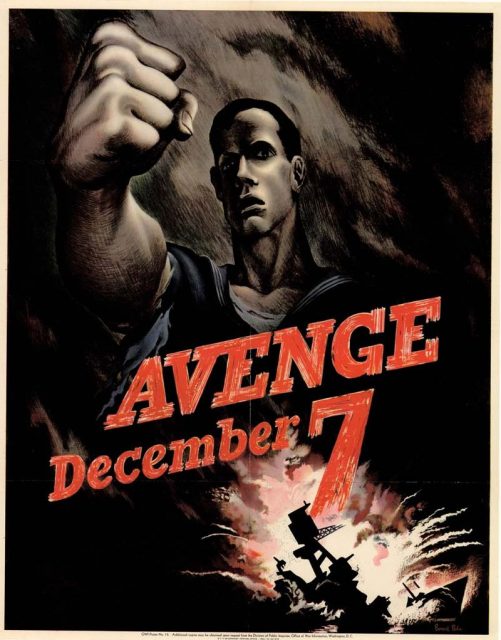
U.S. propaganda poster calling for revenge for the Pearl Harbor attack.

The internment of Japanese-Americans is well known and leads many to believe that they were the only ones detained after Pearl Harbor. Within 48 hours of the attack, more than 1,000 people were detained by the FBI as enemy aliens.
This included a large number of Japanese-Americans, but also included people of Italian and German descent. Over the course of the war, approximately 120,000 people would be placed in internment camps.
Heart Mountain Relocation Center, January 10, 1943
While the majority were Japanese-American, other descendants from Axis powers were also affected. Approximately 11,000 German residents were interned, and an estimated 600,000 people of Italian descent were kept under restrictions.
This myth grew to its standing today because of the harsher treatment the Japanese-Americans faced. The 110,000 Japanese-Americans living along the West Coast were forced into internment camps, but most of the descendants from other Axis powers were able to continue living in a manner similar to their lives before the war.
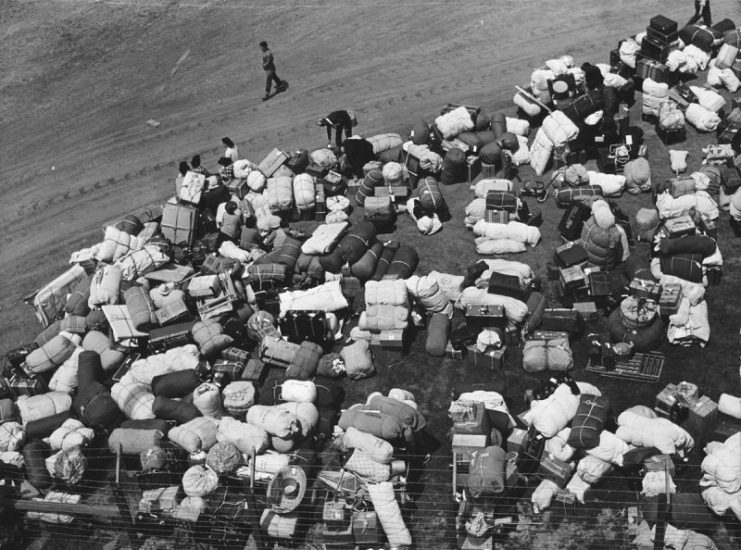
The baggage of Japanese Americans from the west coast, at a makeshift reception center located at a racetrack.
 
The idea that the US government and military responded to the devastating attack quickly and decisively is a popular one, but it is a myth. In the months after the attack, the US suffered multiple defeats in the Pacific region.
This myth may have started when a rumor spread through the country on December 8 that the Navy was in pursuit of the Japanese fleet. The notion of pursuit was false, and General Douglas MacArthur was pleading for more naval assistance.
The U.S.S. Neosho, navy oil tanker, cautiously backs away from her berth (right center) in a successful effort to escape the Japanese attack on Pearl Harbor, Dec. 7, 1941.
In reality, a telegram was sent to President Roosevelt asking for assistance and submarines to target Japanese vessels. This request was unanswered and is believed to have led to the fall of the Philippines to the Japanese.
The first major offensive by the US occurred in February 1942. This was when the US Pacific fleet started attacks on the Marshall and Gilbert islands. Before these attacks, the last successful engagement by the US had occurred before Pearl Harbor.
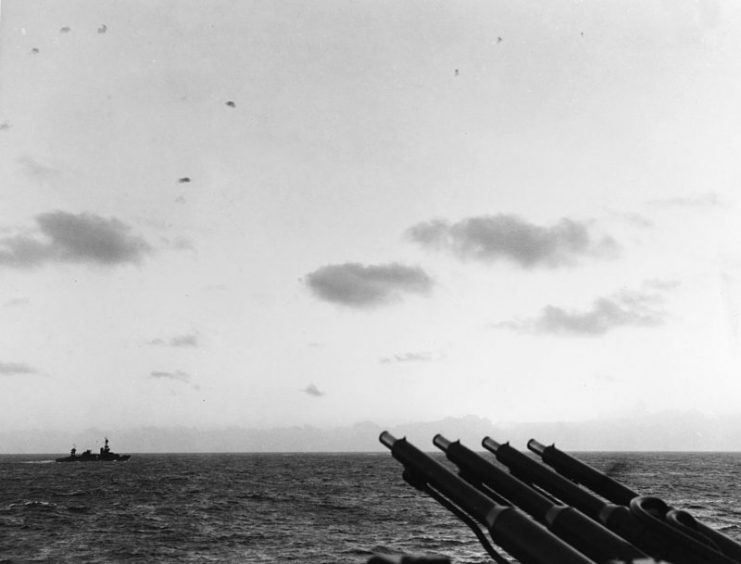
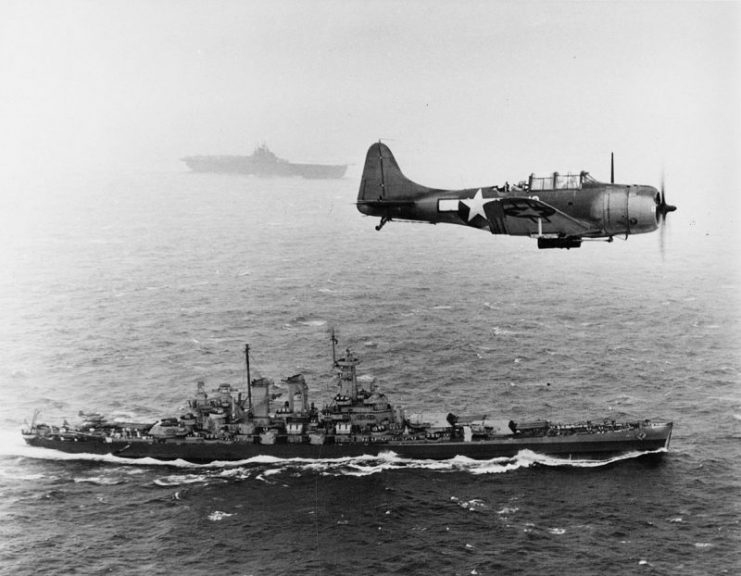
An SBD Dauntless flies patrol over USS Washington and USS Lexington during the Gilbert and Marshall islands campaign.  My sources identify the ships as the Washington and the Lexington,   The battleship does look like a North Carolina class Battleship but the carrier don't match the profile of the Lexington.  Looks more like a "Yorktown" class carrier to me
The most common myth is that the attack on Pearl Harbor propelled the US into WWII and turned the tide on the Axis powers. A closer look shows that this is not quite true. Before Pearl Harbor, America was largely isolationist and was unwilling to become embroiled in another European war.
Archivists found that after the attack, a declaration of war was drafted against Japan, Italy, and Germany. President Roosevelt was to deliver this to Congress on December 8, but it was scrapped and replaced with a declaration against Japan.
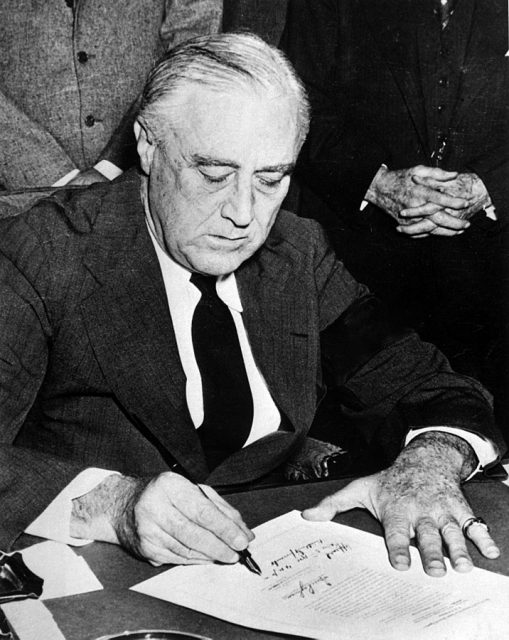
President Roosevelt, wearing a black armband, signs the Declaration of War on Japan on December 8, 1941.
 
Thus the US was propelled only into the Pacific war as a result of Pearl Harbor–not WWII.
Americans only became involved in the European war on December 11. This was the date when Italy and Germany declared war on the US, and Roosevelt had to respond in kind.


Saturday, February 17, 2018

The 2 American Fighter Pilots During Pearl Harbor...

I remembered this story when I first started reading on WWII especially the Pacific war and Pearl Harbor was where I started at and I remembered reading about Welch and Taylor and their attack on the Japanese Armada and it was one of the few bright spots on a day filled with errors and goofs by the Americans.  The thought of lining up all the P40's in straight rows and made them easy targets for the Japanese Zero fighters that were amazed by the vision they saw.  That the radar tower picked up the armada and was discounted and other errors that were committed by the Americans.  the Japanese committed mistakes also, the biggest was their timing of declaring war after the attack was a great dishonor and infuriated the already angry Americans and the ramifications were felt all the way to Nagasaki and Hiroshima.  And also that Admiral Nagumo not the best choice as an admiral of the Japanese strife force lost his nerve and didn't order the 3rd wave that would have targeted the repair facilities and the fuel farms that would have really crippled the U.S efforts afterwards. 

The nuances of military history are often lost to the passage of time and with the men who could give first-hand accounts.  As much as training and battle play a significant role in the story of war, so does the camaraderie built through nights of recreation and if rumor has it, a beverage or two, or three.
While there were no breathalyzers on the day to confirm the fact, by these two particular men’s admission, they had spent the night of December 6th, 1941 drinking heavily and had little to no sleep when the Japanese launched the most brutal surprise attack in American history. But that didn’t stop them from loading up into two P-40 fighters without orders and taking on the brunt of a massive Japanese assault.
This is a story the world knows whether it realizes it or not.  It was loosely depicted in the 2001 movie Pearl Harbor with the story of these two men played by Ben Affleck and Josh Harnett.  And while that particular movie was certainly full of its typically Hollywood artistic liberties, the 1970 movie Tora, Tora, Tora would be a much more accurate portrayal.


But make no mistake about it, two audacious men took to the skies against the mightiest air assault America has ever known.


The attack on December 7th, 1941 took place on a Sunday.  Which means for many on the island, particularly those stationed there, a typical Saturday night was all that separated them from that day and one which would live in infamy.
Returning to the barracks, 2nd Lieutenants George Welch and Ken Taylor of the 15th pursuit group had just returned from an epic night of partying and poker playing. To be musing about the nights activities one minute and watching the Japanese attack the next must have been a remarkably sobering sight.
The Attack on Pearl Harbor
The Japanese attacked in two waves with over 350 fighters, bombers, and torpedo planes from 6 different aircraft carriers.  The target was the American Pacific fleet most of which was anchored at Pearl Harbor when the attack began.
When it was over, 8 US battleships would be sunk or heavily damaged along with three light cruisers and three destroyers.  A total of 188 US aircraft were destroyed in the attack as well, mostly sitting wing to wing on the ground.  But that doesn’t mean a few brave fighters didn’t take to the sky to give the Japanese a little taste of what was to come in this long war they had just begun.


As Wheeler Air Field had become a primary target for the Japanese, Welch called out to Haleiwa Airfield to have to have two P-40 aircraft fueled and ready because two pilots were coming in hot.  Potentially a little drunk and hungover, but coming in hot all the same.
They sped to the airfield in their Buick and quickly mounted the planes without orders to do simply what they could.  The P-40s were initially only armed with .30 caliber ammo for the wing guns, but to these two men, that was enough to get started.


After they took off, they headed towards Barber’s Point at the southwest tip of Oahu, and initially saw an unarmed group of American B-17 Flying Fortress bombers arriving from the mainland United States. They soon arrived at Ewa Mooring Mast Field, which was being strafed by at least 12 Aichi D3A “Val” dive bombers of the second Japanese attack wave after expending their bomb ordinance at Pearl Harbor.
Although the two pilots were outnumbered six-to-one, they immediately began firing on the dive bombers. Taylor shot down two dive bombers and was able to damage another (the third damaged aircraft was considered Taylor’s first probable kill).
The two men continued to circle the skies fighting what targets presented themselves until they needed to return to base for more ammunition and fuel.  Returning to Wheeler under the threat of friendly anti-aircraft fire, they sought to refuel and load up with the more potent .50 caliber ammunition for the nose-mount synchronized machine guns too.
When they returned to Wheeler, the .50 caliber ammunition was, unfortunately, residing in a burning hanger.  Yet, two brave mechanics headed into the inferno in order to save the ammunition.
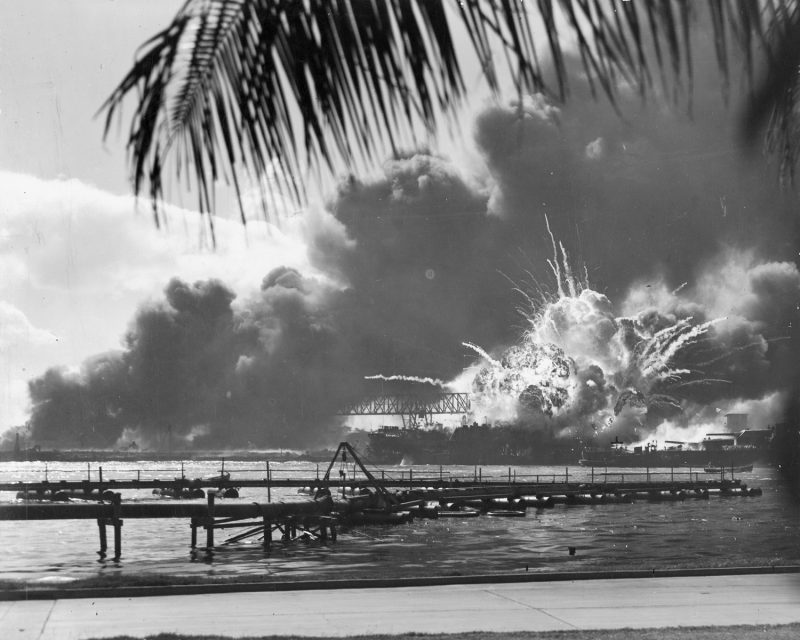
USS_SHAW_exploding_Pearl_Harbor_Nara_80-G-16871_2
With extra firepower, Welch and Taylor took to the skies again to take on the second wave of fighters and bombers. Taylor headed for a group of Japanese aircraft, and due to a combination of clouds and smoke, he unintentionally entered the middle of the formation of seven or eight A6M Zeros.
A Japanese rear-gunner from a dive bomber fired at Taylor’s aircraft and one of the bullets came within an inch of Taylor’s head and exploded in the cockpit. One piece went through his left arm and shrapnel entered his leg. Welch shot down the dive bomber aircraft that had injured Taylor, and Taylor damaged another aircraft (his second probable kill) before pulling away to assist Welch with a pursuing A6M Zero fighter.
The Zero and the rest of its formation soon broke off the pursuit and left to return to their carriers as Taylor neared Welch. Taylor continued to fire on several Japanese aircraft until he ran out of ammunition. Both pilots headed back to Haleiwa.
The attack was over and when it was done four planes would be claimed shot down by these two young Lieutenants with others damaged.  With the overwhelming odds they faced, each man could have easily claimed after the first sortie that they had done all they could.
Yet, each man insisted on returning to the sky for additional runs. They did so without orders from their superiors and in fact, some accounts have them denying the request of a higher officer to remain on the ground.  For their actions that day, each man was nominated for the Medal of Honor but were only awarded the Distinguished Serve Cross instead.

Staying in the War

After Pearl Harbor, Welch was initially tasked with giving war bond speeches to support the war effort while Taylor was assigned to the 44th Fighter Squadron where he would go on to get additional air to air kills.  Ken Taylor would later be wounded in an air raid at Guadalcanal and be sent home to train US pilots.
After the war, he remained in the service and became an officer in the newly formed United States Air Force.  He retired at the rank of Colonel.
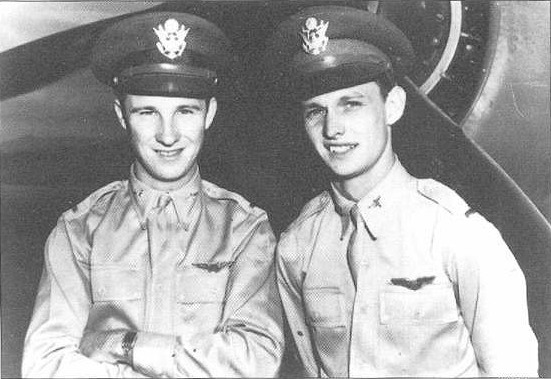
TaylorWelchPH
Taylor and Welch shortly after the Pearl Harbor attack
Welch’s story would be a little more tragic. In 1944, he resigned his commission to become a test pilot for some of America’s newly evolving jet aircraft.  While instructing and training American pilots on these new aircraft in the Korean War, it was reported that Welch scored several MiG kills in direct disobedience to orders while “supervising” his students.
However, in 1954 while test piloting an F-100 Super Sabre, the plane broke up in mid-air ultimately resulting in his death.  Welch would go on to be buried at Arlington National Cemetery.
While the fate of these two men would take separate courses after the war, what they accomplished together in the skies over Pearl Harbor inspired a nation.  They proved from early on that America was ready for a fight and the iconic words of Japanese Admiral Yamamoto to be true.
For when he said, “I fear all we have done is awaken a sleeping giant and fill him with a terrible resolve,” it would be because men like Welch and Taylor were determined to make that so.


Saturday, March 18, 2017

How Imperial Japan could have won the war against the Allies


I cribbed this on the internet and added some pictures and some of my comments to the article.  This is a "What If" kinda thing.

There was no possible way for Japan to compete against the US in WWII. As long as the US didn’t lose their will to fight and pushed their leaders to push to victory, Washington would claim a mandate that authorized them to use the industry available in the US to turn out a nearly limitless supply of ships, tanks, planes and weapons. Japan simply had no way to keep up with their economy about one-tenth of the US economy.

But that doesn’t mean that Japan could not have won the war. Sometimes the weaker party wins the fight. The legendary strategist Carl von Clausewitz notes that it can make sense for the weaker party to initiate the fight. If they believe that their chances of winning are only going to decrease over time then why not take action?

Von Clausewitz tells of three ways to win a war. First, you can destroy the enemy’s forces and enforce your will upon them. Second, you can make the cost of winning more than your enemy is willing to pay. In other words, figure out how many lives, weapons, and how much money the other side finds acceptable in order to defeat you and then make it cost more than that by taking action that raises the cost or dragging the conflict out until he no longer can afford to stay in. Third, you can convince him that he will never accomplish his goal and make him lose heart.
If you can dishearten him or make the war too expensive for him, he is likely to cut you a deal just to get out of it.
Since Tokyo had no chance at the first option, they needed to aim for one of the next two possibilities. If they had managed their resources better, they could have narrowed the gap between the two sides. Failing that, they could have inflicted such heavy damage that the Americans would lose their appetite for the fight. Or, they could have opted to not confront the US directly and possibly kept them from joining the fight at all.
It’s probably true to say that that there was no single course of action that was going to lead to a Japanese victory. Their military leaders needed to act more strategically and less tactically.
What follows are five possible ways Japan could have won World War II. They are not exclusive. Actually, Japan’s best chances lay in adopting all five strategies. True, some of them are a lot more obvious in hindsight than they would have been to Japan’s leaders at the time, but we can debate their plausibility later.

Wage One War At A Time

It is important for small countries to avoid taking on every other country at once. But Japan’s government was not established in such a way to allow civilian oversight over the military. Patterned after the German Imperial government, the power was entirely between the Japanese Army and Navy.

Without a strong emperor, the military branches were unmoderated in their jostling for power, constantly one-upping each other. The army was focused on conquering Manchuria in mainland China. The Navy was pushing to grab resources in Southeast Asia. By attempting both contradictory goals, Japan managed to surround itself with enemies. The Japanese government should have had set priorities. Then, it may have been able to achieve at least some of its goals.

Listen To Yamamoto


Admiral Isoroku Yamamoto is alleged to have warned his superiors that Japan had to win quickly and decisively to avoid waking the “sleeping giant” in America. He predicted that the Navy had six months to a year to impose its will before the Americans achieved full power in the Pacific. In that span, Japan needed to force the US into a compromise peace agreement that partitioned off the Pacific, giving Japan time to improve its defenses around their territories in the Pacific. If they failed, the US industry would crank out weapons in massive amounts while new ships would begin arriving in the Pacific. Yamamoto knew the American ability to behave against expectations and warned his superiors not to assume they knew how the US would act.

Don’t Listen To Yamamoto

While Yamamoto was proven correct in his strategic advice, he wasn’t as wise on the operational level. The way he saw to approach the problem of the superior US industry was to hit them in the core of their power – their naval fleet. The Japanese military leaders had long pictured themselves using “interceptive operations” to slow the US fleet as it headed to the Pacific, most likely to the aid of the Philippines.

Using planes and submarines, the Japanese Navy would reduce the size of the US operational fleet and the Japanese fleet would then engage in the ultimate battle. Yamamoto, however, convinced them to change the plans and strike a sudden blow at Pearl Harbor. His miscalculation was that the core power of the US fleet was not at Pearl Harbor but in the Atlantic and Pacific Oceans. All that Yamamoto’s actions could do, then, was delay the US entry into the war until 1943. The original plan appears to have had a better chance at success.

Concentrate Resources Instead Of Dispersing Them

Similar to the way the Japanese could not seem to be content with fighting one war at a time, they couldn’t seem to stop themselves from multiplying their active operations and combat theaters. In 1942 alone, the Navy attacked the British Eastern Fleet off Ceylon in the Indian Ocean. They assaulted the Aleutian Islands. They opened a new theater in the Solomon Islands, which required defending a vast amount of ocean. Japan raised the cost of the war for itself when it had the fewer resources available, The National Interest reported.

Wage Unrestricted Submarine Warfare

For some reason, the Japanese navy did not instruct their submarines to attack any enemy vessel on the open seas between the US and the South Pacific. They should have realized that the US fleet had to protect an enormous amount of water just to reach the South Pacific. Japanese submarines were every bit as good as the Americans’.
They could have used them to make the Pacific shipping lanes impassable to US transports. It was the most direct way the Japanese could have exacted the heavy toll necessary to make the US consider withdrawing from the war.


 The United States Navy did wage unrestricted warfare against the Japanese merchant fleet and this was done to starve the many garrisons that the Japanese had spread out in the pacific as part of the "whither on the vine".  The Japanese had won tactical victories like at Pearl Harbor, but they were strategic failures.  The Japanese were at the beginning of the war, far better trained and than we were, but that pendulum swung the other way the longer the war lasted.  At the end of the war, the Japanese were sending barely trained pilots and crew against the battle hardened and experienced American Navy and Army.