Webster

The Constitution was made to guard the people against the dangers of good intentions." --American Statesman Daniel Webster (1782-1852)


Showing posts with label accident. Show all posts

Thursday, January 4, 2024

JAL crash at Haneda.


I pulled this off my 3rd party email from work, I am amazed that they got all the passengers and crew off the A350 with no fatalities.

JAL A350-900 Haneda incursion burning

JAL Airbus A350-900, Tokyo Haneda Jan. 2, 2024

Credit: STR/JIJI PRESS/AFP via Getty Images

A Japan Airlines (JAL) Airbus A350-900 and a Japanese Coast Guard De Havilland Canada Dash 8 have been completely destroyed in a ground collision at Tokyo’s Haneda airport shortly after the JAL aircraft’s touch-down.

All 367 passengers and 12 crew members on board the A350 managed to escape the burning aircraft, but five of the six on board the Coast Guard aircraft have died. JAL said 13 passengers required medical attention. The airline also said the total passenger count included eight infants.

The accident is the first ever A350 hull-loss and Japan Airlines’ first accident since 1985.

JAL stated “[Flight] JL516 was involved in a collision with a Japan Coast Guard aircraft during its landing at Haneda Airport, resulting in a fire on the runway,” adding, “our thoughts and prayers are with the deceased members of the Japan Coast Guard. We want to assure you that all passengers and crew on our flight were safely evacuated.”

The carrier said it will “provide our full cooperation in the investigation of this unfortunate event.”

Airbus said, “In line with International Civil Aviation Organization (ICAO) Annex 13 recommendations, Airbus will provide technical assistance to the Bureau d’Enquêtes et d’Analyses (BEA) of France and to the Japan Transport Safety Board (JTSB) in charge of the investigation. For this purpose, Airbus is presently dispatching a team of specialists to assist the authorities.”

The aircraft manufacturer stated that “the exact circumstances of the event are still unknown.”

The A350 was operating flight JL516 from Sapporo with 367 passengers and 12 crew members and was landing at Haneda’s runway 34R at 5:47 p.m. local time, about 12 min. later than scheduled.

“The aircraft did not experience any issues or irregularities during its departure from New Chitose Airport or throughout the flight,” JAL said in a second statement. The A350’s pilots “acknowledged and repeated the landing permission from air traffic control, and then proceeded with the approach and landing procedures,” the airline added.

According to Flightradar24 data, the aircraft was crossing the runway threshold at a normal approach speed of 122 kt. and touched the ground shortly thereafter. Airport video footage shows how the aircraft was travelling down the initial part of the runway, when suddenly it appeared to hit an obstacle with large flames erupting. With its nose gear collapsed, the aircraft continued sliding down the runway and came to rest close to the end and to the right of it, not far from the airport perimeter fence on the edge of Tokyo Bay. A picture taken by one passenger shortly after having evacuated the aircraft, shows substantial impact damage to the nose of the aircraft and the nose gear missing.

The Coast Guard aircraft had reportedly loaded aid for support victims of Monday’s earthquake on the Noto Peninsula and was understood to be preparing to take off for a flight to Niigata Air Base.

Pictures of the A350 also show that escape slides had been deployed at the two front doors and the left rear door. Passengers appeared to not use the right rear door. While emergency services attempted to extinguish the fire, the aircraft ultimately burnt down completely.

“The aircraft’s announcement system malfunctioned during the evacuation, so cabin crew members conducted instructions using a megaphone and their voices,” JAL said. “Cabin crew members determined safe exits for evacuation, and all passengers and crew members evacuated through three emergency exits.”

According to the Aviation Week Network Fleet Discovery database, the aircraft registered JA13XJ (MSN 538) was delivered to JAL on Nov. 10, 2021. It had since accumulated 4,421 flight hrs. in 3,220 cycles. The aircraft was equipped in the high-density 367-seat configuration JAL has installed for domestic and short-haul flights. These include 12 seats in first, 94 in business and 263 in economy. The Coast Guard aircraft was a Dash 8-315Q registered JA722A. It has been delivered on Feb. 26, 2008. The aircraft had 7,573 hrs. and 2,700 cycles.

Haneda, one of Tokyo’s two international airports, stopped all take-offs or landings temporarily. According to Flightradar24, 110 flights scheduled to land at Haneda on the evening of Jan. 2 were either canceled or diverted to other airports including Tokyo-Narita.

Composite Structure Flammability

JL516 is the first A350 completely destroyed in an accident. The investigation could provide valuable insight into the flammability of large composite aircraft structures based on in-service experience that have so far been unavailable. In July 2013, an Ethiopian Airlines Boeing 787 suffered substantial, but much smaller, fire damage caused by a thermal runaway of the emergency locator transmitter (ELT) battery when on the ground at London Heathrow.

Flammability experts know composite-skinned airframes burn “inherently differently” than their aluminum counterparts, a 2012 U.S. Air Force Research Laboratory study on the subject noted. Aircraft composite material is a beneficial insulator that can help resist heat from nearby sources, such as an external fire, the study said. But those same properties make it difficult to cool down once it has heated up and present challenges for extinguishing parts of a fire that are hidden from firefighters.

Informal Boeing guidance on fighting composite aircraft fires issued after the 787 was introduced does not recommend “any major changes” from standard protocol.

“Extensive testing has been conducted in regards to combustibility and toxicity related to the composite structure,” the document, last updated in 2022, said. “This design not only adds to the strength of the product, but also makes it a good barrier to fire and heat. The structure does not aid in the spread of fire and acts as a barrier creating greater difficulty for an exterior fire to penetrate an intact fuselage. From a toxicity perspective, the composite structure during fire testing poses no greater hazard than an aluminum fuselage aircraft. Also, note that the burn through time on the composite structure is significantly longer than with the aluminum fuselage which may inherently provide greater safety to both the rescue fire responders and passengers in some scenarios.”

The accident will add to learnings from recent passenger evacuation and broader cabin safety improvement efforts. While the exact sequence of the evacuation will form part of the accident investigation, it is clear that all 389 people on board a densely configured widebody managed to escape the aircraft with only three of the four main slides being used.

JAL’s last hull-loss occurred on Aug 12, 1985, when a Boeing 747SR crashed into a mountain en route from Haneda to Osaka. The aircraft’s hydraulic systems ruptured after a violent failure of the rear pressure bulkhead. In one of the worst accidents in commercial aviation history, all 520 people on board died.

     This came in the next day, 

The Coast Guard Plane entered the Runway despite being told to "hold" by the tower.

Wreckage of Japan Coast Guard Dash 8 at Tokyo Haneda Airport, Jan. 3, 2024

Credit: Richard A. Brooks/AFP via Getty Images

WASHINGTON and SINGAPORE—The Japan Coast Guard De Havilland Canada Dash 8 struck by an arriving Japan Airlines (JAL) Airbus A350 at Tokyo International Airport Jan. 3 was on the runway despite air traffic control (ATC) instructions to hold short on an intersecting taxiway—directions that one of the Dash 8 pilots read back correctly, a transcript released by Japan’s Ministry of Land, Infrastructure, Transport and Tourism (MLIT) shows.

“Tower, JA722A C,” someone from the Japan Coast Guard (JCG) Dash 8-300 radioed to Tokyo Haneda (HND) tower ATC, indicating the aircraft is checking in from Taxiway C with its tail number as a call sign, according to the transcript.

“JA722A, Tokyo tower good evening,” a controller responded. “Number one, taxi to holding point C5.”

The “number one” suggests the aircraft is next in line to depart. The rest is clear: Move to the marked stopping point on taxiway C5, which connects to HND’s Runway 34 Right (34R).

“Taxi to holding point C5 JA722A, number one, thank you,” someone on the JCG Dash 8 said.

But instead of stopping at the hold-short line on C5, the Dash 8 taxied onto the runway.

Ten seconds before the exchange began, ATC cleared JAL Flight 516 (JAL516), the inbound A350-900, to land on 34R.

Surveillance video shows the Dash 8 moved onto 34R and stopped—something a pilot would do if executing a “line up and wait” ATC command that gives an aircraft permission to enter the runway but not depart.

Nearly 50 sec. after the Dash 8 stopped, the A350, which touched down seconds before closer to the runway end, struck the national guard aircraft. Five of the six Dash 8 occupants died, while all 379 onboard JAL516 evacuated safely once the widebody came to rest.

According to a transcript excerpt released by MLIT, JAL516 contacted Tokyo Tower at 5:43:02 p.m. local time, and was instructed by tower controller to continue its approach to runway 34R. JAL516, first in line to land, read back ATC’s instructions.

JAL516 was then cleared to land at 5:44:56 p.m. and a pilot read back the instructions.

At 5:45:11 p.m., JA722A called into tower frequency notifying of its position on taxiway C. ATC gave the instructions to proceed to the C5 hold line, which JA722A confirmed eight seconds later.

Communications from several other aircraft are detailed in the transcript excerpt, including departing Delta Air Lines and JAL flights told to hold short at C1 as well as another arriving JAL flight.

The transcript ends before the collision. A JAL statement puts JAL516’s arrival time at 5:47 p.m.

The exchange suggests how ATC instructions were given and followed will be one of the key focus areas for investigators as they work to piece together the accident’s chain of events.

Also of interest will be the status and condition of airfield lighting and safety aids. A Notice to Air Missions (NOTAM) issued Dec. 27, 2023, and effective through late February lists several airfield aids at HND as out of service. Among them: lights that illuminate stop bars along the connections between Taxiway C to the accident runway, including C5. Runway 34L centerline lights were also listed as inoperative. It is not clear if the C5 stop bar lights or centerline lights were working at the time of the accident.

Investigators will also look closely at how an aircraft could be on an active HND runway for nearly 1 min. without being detected, even in the dark. An ICAO document shows HND is one of many airports that uses surface movement radar—a long-used method of supplementing the visual view of the airfield controllers have. The system’s performance and controllers’ familiarity with it are other likely topics investigators will probe.

The Japan Safety Transport Board (JTSB) is leading the accident investigation with assistance from several organizations, including Airbus and investigators from France’s Bureau of Enquiry and Analysis for Civil Aviation Safety (BEA). JTSB has recovered the Dash 8 cockpit voice recorder.

The accident caused the cancellation of 137 domestic and four international flights from HND on Jan. 3, MLIT said.

Saturday, November 26, 2022

Airplane collides with Firetruck during Drill

  I got this report in my email last week and I pulled this together from several different sources. 

Incident Facts

Date of incident
Nov 18, 2022

Classification
Accident

Flight number
LA-2213

Departure
Lima, Perú

Destination
Juliaca, Perú

Aircraft Registration
CC-BHB

Aircraft Type
Airbus A320-200N

ICAO Type Designator
A20N

A LATAM Chile Airbus A320-200N, registration CC-BHB performing flight LA-2213 from Lima to Juliaca (Peru) with 102 passengers and 6 crew, was accelerating for takeoff from Lima's runway 16 at about 15:11L (20:11Z) when multiple fire trucks with flashing lights and sirenes sounding crossed the runway in front of the accelerating aircraft. The crew rejected takeoff at high speed (at about 125 knots over ground) but wasn't able to avoid contact with fire truck #3 although the truck tried to turn around turning right (into direction of the aircraft). The right main gear collapsed causing the aircraft to veer right towards the right hand runway edge coming to a stop partially off the runway about 2500 meters/8300 feet down the runway. A fire erupted around the right hand engine (PW1127G), all occupants were able to evacuate the aircraft. 4 passengers received serious and 36 passengers received minor injuries. The aircraft sustained substantial damage, the fire truck was destroyed. Two fire fighters on board of the truck involved in the collision did not survive, a third fire fighter on the truck involved received serious injuries.

The airline reported all occupants of the aircraft survived the accident. There were 102 passengers and 6 crew on board.
Lima's Airport Authority reported all passengers were "doing well" and are receiving the attention of their teams. According to recordings the fire truck(s) entered the runway without clearance. The fire trucks had been responding to another aircraft that had suffered mechanical problems. On Nov 19th 2022 the Airport Authority reported that works to remove the aircraft from the runway have begun. In the late evening of November 19th 2022 the airport authority announced, the aircraft had been moved off the runway in a very complex operation, repair works on the runway have begun. The runway had received extensive damage both in depth and length.

On Nov 20th 2022 Lima's Airport Authority (LAP) reported in a written communique, that a pre-planned response time exercise was performed by the Rescue Team, in which it was to prove that a response to an emergency on the runway would not take any more than 3 minutes. The exercise had been coordinated between the airport and the Air Traffic Authority (CORPAC) and set to be carried out between 15:00 and 16:00 local time on Nov 18th 2022. CORPAC (Control Tower) confirmed the start time of the exercise at 15:10L, the impact with the LATAM aircraft happened at 15:11. The exercise was duely authorized under the current aeronautical regulations. (Editorial note: this communique does not mention, whether the vehicles were cleared to enter the runway by tower or whether the pre-coordination with CORPAC also included that the vehicles would be cleared to enter the runway without actual tower clearance, in other words tower would halt all traffic at 15:10L).
On Nov 21st 2022 Peru's Ministry of Transport and Communication in its role as Civil Aviation Authority stated, that the communique by LAP was essentially correct, however, this communication and coordination did not mean that the trucks had been cleared to enter the active runway. The exercise is authorized, but this does not mean that using this exercise there is anyone cleared to enter the runway, in particular if there is an aircraft moving on the runway. At this time there is no comment available, whether the trucks were cleared to enter the runway or not. However, the ministry confirmed the LATAM aircraft was cleared for takeoff.

Medical Services reported 102 passengers and 6 crew were evacuated from the aircraft, 24 passengers were taken to hospitals with injuries. The numbers were later updated stating 4 passengers received serious and 36 passengers minor injuries.
The local prosecution office reported two firefighters died in the accident, another one was injured. The office have opened an investigation to determine the facts and possible culpability and are currently reviewing the CCTV recordings.

Peru's Comision de Investigacion de Accidentes de Aviacion (CIAA) opened an investigation into the accident.
On Sunday Nov 20th 2022 at 00:00L (05:00Z) the runway was opened for takeoffs and became fully available some time later. Flight operations at Lima Airport have resumed.

The transcript of the communication on ground frequency (tower frequency not available) in the crucial time between starting of the exercise (20:10:00Z) and the collision reads with all times in UTC (according to the ground recording Recate 6, Rescue vehicle #6, took position on taxiway Alpha near but outside the runway strip at 20:04, obviously being the target of the exercise, Ground cleared Recate 6 to a position 90 meters from the runway axis indicated by traffic cones).
Accident: LATAM Chile A20N at Lima on Nov 18th 2022, collision with fire truck on takeoff
By Simon Hradecky, created Friday, Nov 18th 2022 22:36Z, last updated Tuesday, Nov 22nd 2022 11:25Z

A LATAM Chile Airbus A320-200N, registration CC-BHB performing flight LA-2213 from Lima to Juliaca (Peru) with 102 passengers and 6 crew, was accelerating for takeoff from Lima's runway 16 at about 15:11L (20:11Z) when multiple fire trucks with flashing lights and sirenes sounding crossed the runway in front of the accelerating aircraft. The crew rejected takeoff at high speed (at about 125 knots over ground) but wasn't able to avoid contact with fire truck #3 although the truck tried to turn around turning right (into direction of the aircraft). The right main gear collapsed causing the aircraft to veer right towards the right hand runway edge coming to a stop partially off the runway about 2500 meters/8300 feet down the runway. A fire erupted around the right hand engine (PW1127G), all occupants were able to evacuate the aircraft. 4 passengers received serious and 36 passengers received minor injuries. The aircraft sustained substantial damage, the fire truck was destroyed. Two fire fighters on board of the truck involved in the collision did not survive, a third fire fighter on the truck involved received serious injuries.

The airline reported all occupants of the aircraft survived the accident. There were 102 passengers and 6 crew on board.

Lima's Airport Authority reported all passengers were "doing well" and are receiving the attention of their teams. According to recordings the fire truck(s) entered the runway without clearance. The fire trucks had been responding to another aircraft that had suffered mechanical problems. On Nov 19th 2022 the Airport Authority reported that works to remove the aircraft from the runway have begun. In the late evening of November 19th 2022 the airport authority announced, the aircraft had been moved off the runway in a very complex operation, repair works on the runway have begun. The runway had received extensive damage both in depth and length.

On Nov 20th 2022 Lima's Airport Authority (LAP) reported in a written communique, that a pre-planned response time exercise was performed by the Rescue Team, in which it was to prove that a response to an emergency on the runway would not take any more than 3 minutes. The exercise had been coordinated between the airport and the Air Traffic Authority (CORPAC) and set to be carried out between 15:00 and 16:00 local time on Nov 18th 2022. CORPAC (Control Tower) confirmed the start time of the exercise at 15:10L, the impact with the LATAM aircraft happened at 15:11. The exercise was duely authorized under the current aeronautical regulations. (Editorial note: this communique does not mention, whether the vehicles were cleared to enter the runway by tower or whether the pre-coordination with CORPAC also included that the vehicles would be cleared to enter the runway without actual tower clearance, in other words tower would halt all traffic at 15:10L).

On Nov 21st 2022 Peru's Ministry of Transport and Communication in its role as Civil Aviation Authority stated, that the communique by LAP was essentially correct, however, this communication and coordination did not mean that the trucks had been cleared to enter the active runway. The exercise is authorized, but this does not mean that using this exercise there is anyone cleared to enter the runway, in particular if there is an aircraft moving on the runway. At this time there is no comment available, whether the trucks were cleared to enter the runway or not. However, the ministry confirmed the LATAM aircraft was cleared for takeoff.

Medical Services reported 102 passengers and 6 crew were evacuated from the aircraft, 24 passengers were taken to hospitals with injuries. The numbers were later updated stating 4 passengers received serious and 36 passengers minor injuries.

The head of the fire fighters at Lima Airport reported that two fire fighters persished in the accident, a third was taken to a hospital with serious injuries and is in the Intensive Care Unit in stable condition. Later the head of the firefighters added, the surviving fire fighter was diagnosed with a fracture at the base of his skull, severe head trauma including bruises of the brain stem and facial trauma, the vital functions are stable, the neurological compromise can only be assessed at a later time. The next 24 hours will be crucial. On Nov 21st 2022 the condition of the injured firefighter was still assessed critical.

An ATC report states in writing that the rescue vehicle entered runway 16 from the west at the height of taxiway B without authorization and collided with flight LA-2213. Emergency procedures were invoked and rescue vehicles cleared onto the runway to deal with the accident. The runway was NOTAMed closed.

On Nov 21st 2022 CORPAC, Air Traffic Control, stated categorically, that no vehicle had been cleared to enter the runway. CORPAC confirmed there was coordination for an exercise to be carried out by rescue services, however, this did not affect the runway and was to be held outside the runway strip.

The airline reported that they do not know what the fire truck had to do on the runway and why it was there. They had no information about an emergency drill. In any case the normal procedure would be that any vehicle needing access to the runway would need to communicate with tower and obtain clearance to enter the runway. Their aircraft was cleared for takeoff.

The local prosecution office reported two firefighters died in the accident, another one was injured. The office have opened an investigation to determine the facts and possible culpability and are currently reviewing the CCTV recordings.

Peru's Comision de Investigacion de Accidentes de Aviacion (CIAA) opened an investigation into the accident.

On Sunday Nov 20th 2022 at 00:00L (05:00Z) the runway was opened for takeoffs and became fully available some time later. Flight operations at Lima Airport have resumed.


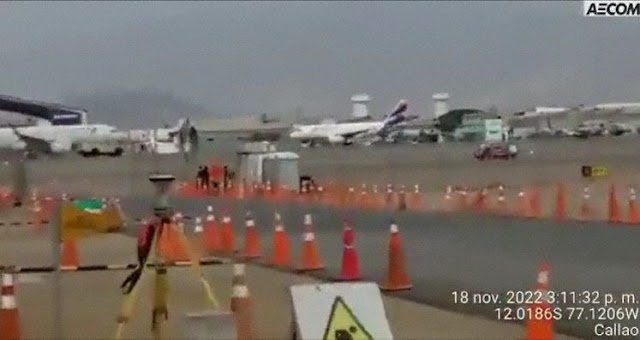
    Here are the Fire engines racing to the accident after the collision

Still image out of CCTV: moment just before the collision:
Still image out of CCTV: moment just before the collision


The remains of the fire truck #3 involved in the collision:
The remains of the fire truck #3 involved in the collision


The aircraft after the fire was put out:
The aircraft after the fire was put out


The aircraft after the fire was put out