Webster

The Constitution was made to guard the people against the dangers of good intentions." --American Statesman Daniel Webster (1782-1852)


Showing posts with label Chinese Spy Balloon. Show all posts

Wednesday, August 9, 2023

"Capturing the next CHICOM Balloon."

 Sorry about the delay in postings, Between Life and work, I couldn't catch the blog.

A bit back, the Communist Chinese floated a balloon all the way across the United States much to the outrage of everyone except anyone in the Xiden Administration allowing the Chinese to gather information at will.  Here is "Some Information" I posted during that event.


A U.S. Navy crew recovered the remains of a Chinese spy balloon in February after it was shot down at 60,000 ft. by a Lockheed Martin F-22. 

Credit: Petty Officer 1st Class Tyler Thompson/U.S. Navy

Instead of facing a heat-seeking missile launched by a Lockheed Martin F-22 at nearly 60,000 ft., the next airspace-violating Chinese spy balloon could be captured in flight, allowing its undamaged, intelligence-collecting payloads and stratospheric navigational technology to be inspected by U.S. analysts. 

That is the goal of the newly advertised Capturing Aerial Payloads to Unleash Reliable Exploitation (Capture) project by DARPA. Instead of shooting down the next buoyant airspace intruder, DARPA wants to find a way to haul high-altitude balloons down safely from up to 75,000 ft.

Capture focuses “on the ability to down high-altitude systems at a time and place of our choosing to minimize collateral damage, maximize usefulness of the recovered payload, and minimize the cost of the response,” Kyle Woerner, DARPA’s program manager, told Aerospace DAILY in an emailed statement. 

The program is being managed through DARPA’s Small Business Innovation Research (SBIR) program, which sets aside about $150 million out of the agency’s $3.8 billion budget for nontraditional defense companies to submit programs. 

The Capture effort skips the Phase 1 SBIR process and offers a direct-to-Phase 2 award. Such deals normally have a ceiling of about $1.8 million. The Capture effort is part of DARPA’s SBIR XL pilot, which raises the ceiling for Phase 2 awards to $4 million with an optional $500,000 enhancement. Although Capture falls an order of magnitude short of the funding for a conventional DARPA program, agency officials think it will be enough for a small company to demonstrate the minimal viable product of a Capture system for a high-altitude object. 

“If successful in a minimum viable program, DARPA may choose to further invest to mature such a technology, often with the support of our military service partners,” said Woerner, who also has managed DARPA’s Manta Ray uncrewed underwater vehicle program. 

The Chinese balloon shot down on Feb. 4 off the coast of South Carolina was estimated by Gen. Glen VanHerck, the commander of U.S. Northern Command, to weight “thousands of pounds.” The Capture program, however, is seeking solutions that could Capture a high-altitude aerial system weighing only 500-1,500 lb. 

But Woerner explained that the goals of the SBIR-funded project do not include demonstrating an operationally viable system. 

“DARPA does not necessarily create solutions that are ready to fully replicate and transition to the military services,” Woerner said. “Rather, DARPA’s mission focuses on rapidly retiring the most challenging risks of a specific problem, often seeking to find a solution to the hardest aspects that inhibit the services from pursuing a program of record.”

Any companies that respond before the Sept. 21 deadline face several technical challenges. Their proposed system must be able to capture an object at an altitude that can only be reached by a few of the most advanced aircraft types in the U.S. fleet, including the F-22 and the Lockheed U-2S. Then, the Capture system must take control of a potentially noncooperative object and do so “in a manner allowing for controlled descent for recovery near inhabited or otherwise currently avoided recovery areas,” according to DARPA’s solicitation.

The system also must be able to respond to “aerial systems of interest approaching or within any U.S. sovereign airspace” within hours of an engagement decision, the solicitation adds. Technically, that requirement means the system must be able to scale up to respond to any incursion over a vast area from Guam to Puerto Rico and the northern tip of Alaska to American Samoa. 

Another challenge is the capture method itself. In the past, the U.S. military has demonstrated midair captures by Lockheed Martin C-130s of film canisters dropped by satellites in orbit, and an inflight autonomous refueling capability by two high-altitude Northrop Grumman RQ-4 Global Hawks. In both cases, the objects were either cooperative or nonresistant, and took place tens of thousands of feet below the operating altitude of China’s spy balloons.  

“I don’t see high-altitude reconnaissance planes with all the complexities of flying so high being able to do the task,” said Luis Pacheco, the editor of StratoCat, which tracks high-altitude balloon technology. 

“I guess you first need to get the balloon down in a non-catastrophic way to a lower altitude on which you can use conventional aircraft (i.e. C-130) to catch the remains or the deflated bag,” Pacheco said. “Another approach could be some kind of ‘harpoon’ or similar device which could make the balloon burst and at the same time hook the bag to a big parachute to lower the descent.”

Thursday, March 2, 2023

"Balloon Shootdown reveals new insight into U.S. and Chinese Capabilities.

I shamelessly snagged this off my work email, it was in the "Aviation Intelligence" reports I get. and It was full of some good information and worthy of "Nicking".

Chinese balloon over Modoc, Illinois

A photo of the Chinese balloon over Modoc, Illinois, on Feb. 3 reveals potentially breakthrough design features for ultra-long-endurance, lighter-than-air systems.

Credit: Frank Melliere

More than two years before a U.S. Air Force F-22 shot down a Chinese spy balloon off the coast of South Carolina on Feb. 4, Zheng Zhenfeng, an employee for Taiwan’s weather service, photographed a similar object floating high above Taipei, Taiwan, on Sept. 26, 2021.

Zheng’s boss, Zheng Mingdian, is certain the two events are connected, revealing a perhaps yearslong, high-altitude spying campaign by the People’s Liberation Army across the world using a new form of lighter-than-air technology.

  • Japan, Taiwan and U.S. targeted by Chinese surveillance balloons
  • Opaque fabric points to possible innovation


“The high-altitude spying balloons in the news have been around a long time, and [my] weather-agency colleagues took [pictures of] them two years ago,” Zheng Mingdian, executive director of Taiwan’s weather service, wrote on Facebook on Feb. 4. “Before that, there were photo records elsewhere, too, for many years.”

The bizarre five-day, 2,000-mi. journey across the U.S. of China’s apparent spy balloon revealed three important new insights: A Raytheon AIM-9X Sidewinder-armed F-22 can shoot down a floating object above 60,000 ft., U.S. officials believe Beijing has waged a yearslong aerial spying campaign with high-altitude balloons, and some experts think the Chinese vessel reveals a potential breakthrough of ultra-long-endurance, lighter-than-air technology.

The Lockheed Martin stealth fighter’s capability to down a high-altitude balloon had never been tested or possibly even conceived, but the brazen violation of U.S. airspace prompted President Joe Biden on Feb. 1 to order a shoot-down attempt, White House officials say. Some criticized the decision to allow the balloon to cross the U.S. landmass, but military officials insisted the balloon’s surveillance capabilities posed no threat to national security. Military analysts also gained ample time to study the alleged spycraft’s behavior and emissions, while the fighter-pilot community ran simulations to determine the best way to attack the unfamiliar target.

“I don’t know that they’ve tested [the] AIM-9 at that altitude,” says Gen. Glen VanHerck, the head of North American Aerospace Defense Command. “I’m not aware of any engagements against a high-altitude balloon such as this.”

The F-22 from the 27th Fighter Sqdn. did not act alone on Feb. 4. Another F-22 flew armed and ready as backup in case the first shot missed. A high-altitude balloon—even a 200-ft.-tall balloon—presents a challenging target for a heat-seeking missile, with a dim thermal signature and a helium gas void within the envelope. The F-22 appeared to aim instead for a 70-100-ft.-long (20-30-m) horizontal truss dangling from a single line beneath the balloon—VanHerck compared its length to an Embraer ERJ 135 or ERJ 145. Ground-based civilian photography revealed that the structure carried 16 solar panel arrays and three inboard stations or pods.

The heat generated by the electronic systems appeared to be enough to provide a targeting lock for the imaging infrared seeker in the AIM-9X. The height of the target—60,000-65,000 ft.—still required the missile to ascend several thousand feet from a launch point at 58,000 ft., a senior defense official says. The result was a perhaps unlikely first air-to-air kill against a balloon by the U.S. Air Force’s premier fighter.

“I’m really incredibly proud of everybody that took part in this, but the F-22 was remarkable,” VanHerck says.

Two U.S. Navy ships—the amphibious landing ship USS Carter Hall and the survey ship USNS Pathfinder—are mapping and collecting pieces of the debris from the balloon that now lie scattered over an approximately 1 mi. X 1-mi. box about 50 ft. below the surface roughly 6 mi. off the South Carolina coast.

Balloon recovery

Sailors assigned to Explosive Ordnance Disposal Group 2 recovered the high-altitude surveillance balloon off the coast of Myrtle Beach, South Carolina, Feb. 5. Credit: Mass Communication Specialist 1st Class Tyler Thompson/U.S. Navy

In the age of hourly satellite overflights and relentless cyberattacks, an inflated surveillance system slowly drifting over Alaska, Canada and the continental U.S. appeared at first to stand as an unusual—inexplicable, even—one-off event. But the story quickly grew as reports emerged of similar balloon sightings around the world, including an ongoing balloon flight over South America, previous incidents in East Asia that had gone unexplained and a newly discovered trial of previous balloon flights over U.S. territory, including Guam, Hawaii, Texas and Florida. Instead of a singular provocation, a pattern has developed of Chinese spy flights by slow-moving high-altitude balloons, which had gone apparently undetected by U.S. surveillance systems.

“I will tell you that we did not detect those threats, and that’s a domain awareness gap that we have to figure out,” VanHerck says.

Although the previous overflights above U.S. soil had been missed, the intelligence community kept track of China’s spying balloon campaign in other parts of the world. Congress was briefed about the program in August, White House spokeswoman Karine Jean-Pierre says.

“There has been a program that has been in effect,” Jean-Pierre adds. “We have kept Congress abreast on that. But I don’t have anything more to say or to share.”

In fact, the evidence for such a spy effort has been available in the public domain for several years, but the shock of the U.S. overflight helped bring it back into focus. In addition to high-altitude balloon sightings over Taiwan in September 2021 and March 2022, Japanese government officials reopened reviews of similar publicly reported overflights of Japan in June 2020 and 2021.

When a similarly spherical white balloon flew near Miyagi prefecture in northeast Japan in 2020, photos of the object showed a perhaps earlier version of the technology that entered the U.S. on Jan. 31. In that case, the dangling support truss supported 24 solar panel arrays, payloads and a crosswise boom. The latter appeared to include a set of outboard-mounted propellers. It was not clear if the propulsive devices were being used to steer the balloon or the structure housing the payload.

By contrast, images of the latest balloon captured by photographers on the ground with telephoto zoom lenses appear to show a major evolution in the design of the payload module, including one-third fewer solar panels, three inboard payload modules and no clear evidence of any propellers.

Such long-distance visual evidence contrasted with remarks by John Kirby, the National Security Council spokesman. “It had propellers,” Kirby says. “It had a rudder, if you will, to allow it to change direction.” Civilian photos provided no signs of a rudder aboard the balloon, and it is not clear how such a control surface would help steer a spherical, slow-speed object. Kirby also may have been speaking metaphorically about a rudder.

In any case, members in the high-altitude balloon community have identified potentially significant technology advances exhibited by the Chinese vessel.

The few examples of ultra-long-distance, high-altitude balloons, such as Google’s canceled Loon project, share a few common traits: a pumpkin-shaped, superpressure envelope, internal ballonet and translucent fabric.

The final item in that list is essential for regulating the temperature—and therefore pressure—inside the helium envelope. A translucent fabric allows most light to pass through the balloon without heating the helium gas inside.

But the Chinese balloon appeared to use an opaque fabric over a pumpkin-shaped helium envelope. If confirmed, China’s program may have been the first successful design to use a helium envelope covered by a fabric that reflects the Sun’s energy rather than letting it pass through, says Dan Bowen, a former balloon systems engineer at Project Loon. The result suggests a breakthrough by creating a more efficient system to regulate temperature without adding too much structural weight.

“I’m sure the rest of the world will quickly investigate this,” Bowen says in an analysis released on Stratospheric Balloon Science, his YouTube channel.

The most advanced ultra-long-endurance, high-altitude balloons seldom use propellers for directional control. Instead, such aircraft pump regular air into an internal ballonet envelope to descend or release the air to climb, Bowen says. Altitude adjustments are made to find wind currents moving in other directions. The system provides a limited capability for directional control.

U.S. researchers have worked on similar technology with the Strat-OAWL (stratospheric optical autocovariance wind lidar) device, which Ball Aerospace flew on DARPA’s Adaptable Lighter-Than-Air (ALTA) balloon in 2019. ALTA was aimed at demonstrating a high-altitude, lighter-than-air vehicle capable of windborne navigation over extended ranges and, according to DARPA, could navigate without independent propulsion by changing altitudes in excess of 75,000 ft. 

A key element of ALTA was development of a Winds Aloft Sensor, which in the case of the DARPA project could send real-time stratospheric wind measurements back to the ground. The Ball Strat-OAWL system, which dates back as far as 2004 to proof-of-concept hardware efforts, is designed to measure winds from aerosol backscatter at the 355-nanometer or 532-nanometer wavelengths.

Meanwhile, the debris recovery effort also may help answer questions about the capabilities of the Chinese balloon’s alleged surveillance payload. The decision to allow the balloon to cross the U.S. before shooting it down was based on a military assessment that the onboard sensors provided no threat, Kirby says.

“The time that we had to study this balloon over the course of a few days last week we believe was important and will give us a lot more clarity not only on the capabilities that these balloons have, but what China’s trying to do with them,” he says

Friday, February 24, 2023

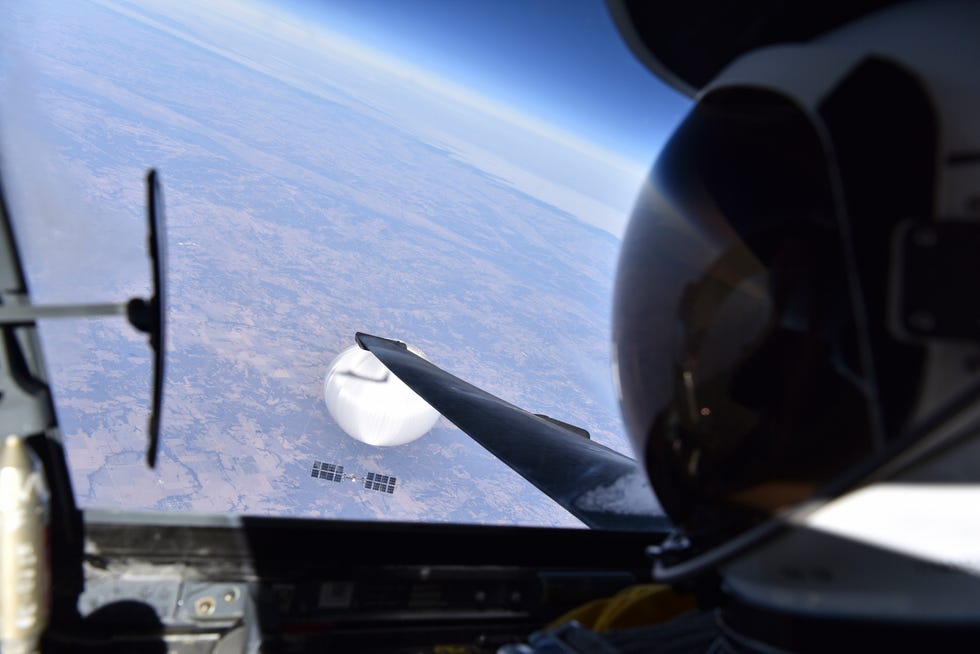
U-2 Pilot takes Selfie with Chinese Spy Balloon.

 I got this off "Popular Mechanics" and thought it was pretty neat.


Department of Defense
  • A rumored photo of the Chinese spy balloon taken by a U-2 pilot has emerged.
  • One open source intelligence devotee has identified the terrain below as rural Missouri.
  • The photo will likely be a defining image of a period when U.S.-Chinese relations began to truly deteriorate.

For more than two weeks, rumors swirled that there was a selfie, taken by a U-2 spy plane pilot, that included the now-infamous Chinese spy balloon in the background.

The secretive nature of the intelligence community suggested the photo, if it existed, might never see the light of day. Now, a photo has emerged that confirms it’s the real thing. The stunning image sheds light on how dedicated the U.S. government was to keeping tabs on the lighter-than-air intruder—and shooting it down when the time was right.

This content is imported from twitter. You may be able to find the same content in another format, or you may be able to find more information, at their web site.

The photo was shared yesterday on a number of social media accounts and appears above. The Twitter account explains that exactly where the photo came from is unknown, but seems to originate with the Dragon Lady Today website, which is devoted to all things U-2.

The photo really does appear to be a selfie taken by a U-2 pilot. The helmet’s sun visor is lowered in place, giving the pilot’s face the appearance of a round black marble. The knife-like right wing of the U-2 is clearly visible, as is the right side view mirror bolted inside the cockpit. The pilot was even able to catch the shadow of his own aircraft on the side of the 200 foot-wide balloon.

This content is imported from twitter. You may be able to find the same content in another format, or you may be able to find more information, at their web site.


One open source intelligence enthusiast was able to geolocate terrain features in the photo with the view over Washington, Missouri. The analyst states that the image is theoretically fakeable, “but it would be a lot of work to make everything match up.”

Update: The Pentagon admitted the photograph is real and has provided a newer, higher resolution photo, seen below. The location of Washington, Missouri is likely correct.

a us air force pilot looked down at the suspected chinese surveillance balloon as it hovered over the central continental united states february 3, 2023 recovery efforts began shortly after the balloon was downed photo courtesy of the department of defense
The photo officially released by the Department of Defense. The caption states: "A U.S. Air Force pilot looked down at the suspected Chinese surveillance balloon as it hovered over the central continental United States February 3, 2023."
Department of Defense

According to St. Louis Public Radio, the Chinese spy balloon was spotted over St. Louis, Missouri, on February 3. The balloon was shot down the next day in U.S. territorial waters, just off the coast of Myrtle Beach, South Carolina. U.S. Navy divers working from the amphibious dock ship USS Carter Hall salvaged the remains, an operation that concluded on February 16th.

The Chinese surveillance balloon was flying at an altitude of 60,000 feet, above the service ceiling of most combat aircraft. The U-2, on the other hand, typically flies above 70,000 feet and the Dragon Lady’s introduction into service, in the late 1950s, put an end to America’s clumsy experimentation with spy balloons.

While there was real practical value in having a spy plane snap close-up pictures of the balloon, the photo also distills America’s vast technological aerospace advantage over China into a single image.