Webster

The Constitution was made to guard the people against the dangers of good intentions." --American Statesman Daniel Webster (1782-1852)


Showing posts with label NavalPorn. Show all posts

Friday, April 15, 2016

Pensacola Naval Museum Part 2

This is part 2 of my Pensacola Trip to the Naval Aviation Museum.  The trip was awesome, and like I stated in the prior post, You can walk up and actually touch the airplanes....something that most museums don't allow.

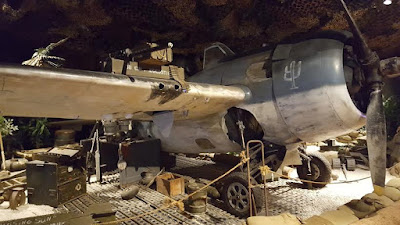
      Grumman Wildcat F4F-3
Cactus Air Force refers to the ensemble of Allied air power assigned to the island of Guadalcanal from August 1942 until December 1942 during the early stages of the Guadalcanal Campaign, particularly those operating from Henderson Field. After December, the official name of the unit became Commander, Aircraft, Solomons (AirSols), but Cactus Air Force was still used frequently to refer to the organization. The term "Cactus" comes from the Allied code name for the island. In April 1943 the organization was redesignated as AirSols.
      The airfield was frequently attacked by the Japanese Air units and their surface ships.  They even were shelled by a couple of Imperial Battleships, the Kongo and the Haruna.  The Navy and Marine Pilots and ground personnel held off the Japanese attacks, the Navy had several battles around Guadalcanal trying to protect the Marines on that island, The casualties and losses were immense, the Japanese would run "the Slot" trying to resupply their men and the U.S. Navy would try to stop them.  The end results was that it bled the Japanese and in the end, they finally withdrew what was left of their forces and the United States neutralized the huge Japanese base at Rabaul with the "wither on the vine" tactics. and their operations in the Solomon islands helped pave their eventual return to the Philippine Islands.
The ground crewmen frequently labeled bombs to help deal with the frustrations of being shelled and shot at by the Japanese.  In the modern world, such things might be frowned upon as "hurtful" but back then we were made of sterner stuff.  The Great depression and the Japanese Attack at Pearl Harbor had molded the United States servicemen into steel, the "special Snowflakes" had been weeded out by natural selection.  I could go on and on about the battle at Guadalcanal but that is a subject for another time.
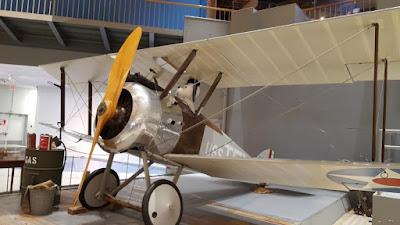
     

F.1 Camel C8228, built by Sopwith in 1917, is on display at the National Naval Aviation Museum in Pensacola, Florida.
Man Snoopy gets around...I saw him at the Apollo Spacecraft Museum in Florida last year...
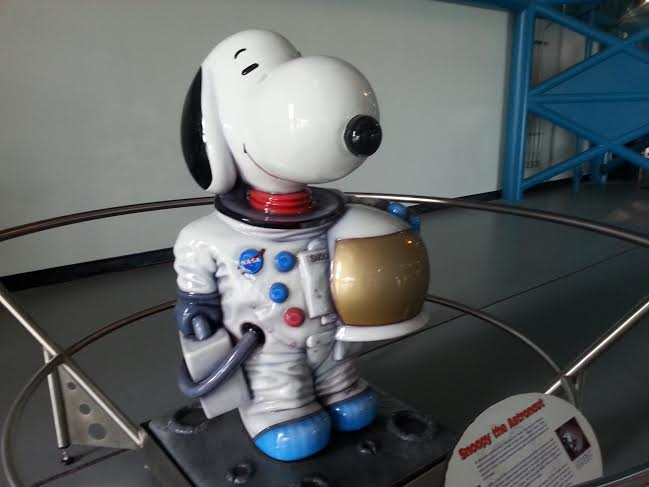
And here he is in the role that was made for him.....
The nemesis of the Red Baron
Here is a view of the "Main Area" what I call of the Museum
You see many airplanes on display, like I stated you can WALK up to an airplane and actually examine it.  I am sure that they would frown on you climbing on one...Just a guess.
   Here a few more things that I saw...
Here is the Story on this car....Notice the refueling probe on the roof.  
I also saw this airplane out there....the propellers are different as is the livery, I wonder if Old NFO can shed some light on it.  I saw no information on this airplane there..
 My son and I got hungry and so we ate at the "Cubi Cafe".  In addition to the displays, the museum operates an IMAX theatre, museum store, and cafe. The Cubi Point CafĂ© is itself an exhibit as it displays squadron memorabilia from the closed NAS Cubi Point Officers' 
I took pictures of a couple of the plaques, some were simple and others were very ornate.  I wonder if some "nugget" got voluntold "you are responsible for the plaque" and some of them really took the assignment and ran with it....like this one...
Or this one...
I wonder what fleet air units do now for plaques since the Cubi Air Station was closed down in 1992
and if they still do stuff like this.    The detail on some of these plaques are amazing.  It was interesting to see the history of a unit and after looking at some of them, I started recognizing names from past deployments.  
     Also there is a mockup on the floor of the Museum of the U.S.S Cabot island with a coupe of aircraft on "ready 5" I believe the term was..But today was some kind of ceremony from the chairs and color guard units standing around.
I and my son enjoyed the museum immensely, we would go again....Like I said in the prior post, you have to come in through the west gate off Blue Angel Parkway to get to the museum.  It is in my humble opinion one of the best aviation museums in the United States.   Did I say you can walk up to an airplane....there is no barrier ropes preventing examinations..?   I must have...somewhere.  Go check it out, I plan on going again  I am sure I missed stuff in there from my past 2 trips.


Wednesday, November 20, 2013

100 years of Naval Aviation *edit*

I am going to take a break...for a minute of all the Obungler scandals that are perking up like crabgrass and talk about something that I am fascinated with...Aviation...and in this case...Naval Aviation.  This article is for all the Naval aviation types like Old NFO and many others like the First President Bush who flew off carriers in WWII and got shot down in combat.   I remembered that he was castigated in the press for being a wimp or pansy.  Senior did a lot of things I wasn't crazy about but I never questioned his bravery or integrity.  He has seen the elephant and his mannerism reflected that.   I am an Army Veteran but I always have had a fascination with ships and airplanes.   I have visited 1 aircraft carrier...the U.S.S.  Yorktown for my sons scout trips.
I have flight benefits and I have taken my son to several museums, including The Smithsonian Museum in Washington D.C.   That was a great trip

I also took him to a favorite museum, that is the Naval Aviation Museum down in Pensacola and that one was a blast, from seeing where the Blue Angels hang at,  to seeing all the warplanes in their glory.  There also is a restaurant that is a duplicate of the Cubi point Bar Cafe with the plaques that showed all the deployments from all the aviation units from Vietnam to Desert Storm.
That trip is very worth the effort and the car rental was $27 dollars for the day for a Ford Focus.     We also stopped at Fort Barracas, which was one of the forts protecting Pensacola. from seaborn attack.   Advances in artillery and rocketry and aviation made the fort obsolete.


100 Years Ago, January, in San Francisco , when Eugene Ely invented naval aviation.
One hundred years is a very long time. Yet in the hierarchy of modern marvels, the ability to recover and launch aircraft from the deck of a moving ship stands out as one of our signature accomplishments. Which just goes to show you: Some tricks never grow old.

Naval aviation was invented one hundred years ago, on January 18, 1911, when a 24 year-old barnstormer pilot named Eugene B. Ely completed the world's first successful landing on a ship. It happened in San Francisco Bay , aboard the cruiser USS Pennsylvania, which had a temporary 133-foot wooden landing strip built above her afterdeck and gun turret as part of the experiment.


Ely accomplished his feat just eight years after the Wright Brothers made their first flight at Kitty Hawk . His aircraft was rudimentary: a Curtiss Model D "Pusher" biplane, equipped with a 60 hp V-8 engine that gave the aircraft a 50 mph airspeed. To get a sense of how simple it was, behold a contemporary replica of Ely's 1911 Curtiss Pusher that was built to celebrate this 100th anniversary:

But back then, innovation was afoot. Ely's Curtis Pusher had been fitted with a clever new invention called a tailhook. The idea was to quickly halt the aircraft after landing by using the tailhook to catch one or two of 22 rope lines -- each propped up a foot above the deck and weighted by 50-pound sandbags tied to each end -- strung three feet apart along the Pennsylvania 'S temporary flight deck.
Mark J. Denger of the California Center for Military History has written a tidy biography of Eugene Ely which narrates the historic day: On the morning of January 18, 1911, Eugene Ely, in a Curtiss pusher biplane specially equipped with arresting hooks on its axle, took off from Selfridge Field (Tanforan Racetrack, in San Bruno, Calif.) and headed for the San Francisco Bay. After about 10 minutes flying North toward Goat Island (now Yerba Buena), Eugene spotted his target through the gray haze – the PENNSYLVANIA .
Ely's plane was first sighted one-half mile from the PENNSYLVANIA's bridge at an altitude of 1,500 feet, cruising at a speed of approximately 60 mph. Now ten miles out from Tanforan, he circled the several vessels of the Pacific Fleet at anchor in San Francisco Bay . The aeroplane dipped to 400 feet as it passed directly over the MARYLAND and, still dropping, flew over the WEST VIRGINIA 'S bow at an height of only 100 feet. With a crosswind of almost 15 knots, he flew past the cruiser and then banked some 500 yards from the PENNSYLVANIA 'S starboard quarter to set up his landing approach. Ely now headed straight for the ship, cutting his engine when he was only 75 feet from the fantail, and allowed the wind to glide the aircraft onto the landing deck. At a speed of 40 mph Ely landed on the centerline of the PENNSYLVANIA 'S deck at 11:01 a.m.
The forward momentum of his plane was quickly retarded by the ropes stretched between the large movable bags of sand that had been placed along the entire length of the runway. As the plane landed, the hooks on the undercarriage caught the ropes exactly as planned, which brought the plane to a complete stop.
Once on board the PENNSYLVANIA, sheer pandemonium brook loose as Ely was greeted with a bombardment of cheers, boat horns and whistles, both aboard the PENNSYLVANIA and from the surrounding vessels.
Ely was immediately greeted by his wife, Mabel, who greeted him with an enthusiastic "I knew you could do it," and then by Captain Pond, Commanding Officer of the PENNSYLVANIA . Then it was time for interviews and a few photographs for the reporters.
Everything had gone exactly as planned. Pond called it "the most important landing of a bird since the dove flew back to Noah's ark." Pond would later report, "Nothing damaged, and not a bolt or brace startled, and Ely the coolest man on board." (NOTE: Safety first! Check out Ely's inner-tube life preserver!)

After completing several interviews, Ely was escorted to the Captain's cabin where he and his wife were the honored guests at an officers lunch. While they dined, the landing platform was cleared and the plane turned around in preparation for takeoff. Then the Elys, Pond and the others posed for photographs. 57 minutes later, he made a perfect take-off from the platform, returning to Selfridge Field at the Tanforan racetrack where another tremendous ovation awaited him.

Both the landing and take off were witnessed by several distinguished members of both U.S. Army and Navy, as well as state military officials. Ely had successfully demonstrated the possibility of the aircraft carrier.

Indeed. The US Navy's first aircraft carrier, the USS Langley, was commissioned in 1922, eleven years later. But Ely didn't live to witness the milestone; he died just a few months after his historic flight, on October 11, 1911, when he was thrown from his aircraft during a crash at an air show. But 100 years ago, he merged the power of naval warships and aviation in ways that remain cutting-edge, even today.


On October 19, 1911, while flying at an exhibition in Macon, Georgia, his plane was late pulling out of a dive and crashed. Ely jumped clear of the wrecked aircraft, but his neck was broken, and he died a few minutes later Spectators picked the wreckage clean looking for souvenirs, including Ely's gloves, tie and cap. On what would have been his twenty-fifth birthday, his body was returned to his birthplace for burial.
On February 16, 1933, Congress awarded the Distinguished Flying Cross posthumously to Ely, "for extraordinary achievement as a pioneer civilian aviator and for his significant contribution to the development of aviation in the United States Navy." An exhibit of retired naval aircraft at Naval Air Station Norfolk in Virginia bears Ely's name, and a granite historical marker in Newport News, Virginia, overlooks the waters where Ely made his historic flight in 1910 and recalls his contribution to military aviation, naval in particular.

Friday, August 17, 2012

U.S.S. Constitution to sail again

   We saw the Constitution last year in Boston and took a tour of her, her mast were off during that time as they were being overhauled.   This is my son visiting the Oldest commissioned warship in the world.   I loved visiting Boston,  "B" town was my favorite while I was stationed at Fort Devens in MASS for 9 long months during A.I.T.  I hated Massachusetts because of the way I was treated, but I loved Boston going where all the historical figures had walked was thrilling.  Seeing Boston Commons,  Fanual Hall, Quincy Marketplace and of course "Cheers"

Navy's oldest commissioned warship to sail again

BOSTON (AP) — The U.S. Navy's oldest commissioned warship will sail under its own power for just the second time in more than a century to commemorate the battle that won it the nickname "Old Ironsides."
The USS Constitution, which was first launched in 1797, will be tugged from its berth in Boston Harbor on Sunday to the main deepwater pathway into the harbor. It will then set out to open seas for a 10-minute cruise.
The short trip marks the day two centuries ago when the Constitution bested the British frigate HMS Guerriere in a fierce battle during the War of 1812. It follows a three-year restoration project and is the first time the Constitution has been to sea on its own since its 200th birthday in 1997.
Before that, it hadn't sailed under its own power since 1881. The Constitution is periodically tugged into the harbor for historical display.
Chief Petty Officer Frank Neely, a Constitution spokesman and crew member, said the crew wants to honor and preserve the Constitution with Sunday's sail.
"This ship is a national icon to us. ... She's very special to us. We think she's very special to the United States," he said.
The Constitution was under the command of Capt. Issac Hull when it engaged the Guerriere off Nova Scotia on Aug. 19, 1812. The young war was not going well for America, which had surrendered Detroit to the British with basically no resistance a week earlier.
But the Guerriere proved no match for the Constitution, which was heavier and longer. The vessels blasted away at each other at close range, even colliding at one point, during the 35-minute battle. The Constitution's 24-pound cannonballs felled the Guerriere's mast, while the British vessels' 18-pound cannonballs had trouble penetrating the Constitution's two-foot thick live oak hull, said Matthew Brenckle, a historian at the USS Constitution Museum.
Brenckle said a sailor's memoirs recorded how one cannonball seemed to slightly penetrate the ship, before dropping into the sea. The sailor then called out the quote that would give the Constitution its nickname, "Huzzah, her sides are made of iron! See where the shot fell out!"
It wasn't the first naval win in what would be a divisive, expensive war, but it set off celebrations around the country, Brenckle said.
"Strategically, it really did nothing to change the course of the war," he said. "But the morale boost that that provided for the American cause, I think was quite important."
During Sunday's sail, the Constitution's crew of about 65, accompanied by 150 sailors selected to be part of event, will unfurl four of its 36 sails, Neely said. The tugs will stand by as a precaution when the Constitution sails on its own. And the trip can't happen unless the weather conditions are right.
The ship won't move in winds less than five mph and anything over about 15 mph would put too much stress on the vessel, Neely said. But the forecast looks favorable.
The lengthy work in preparation for Sunday's sail was largely on the Constitution's aesthetics, though the masts were restored, Neely said. The crew also underwent extensive training on how to handle a vessel that's unlike any other in the U.S. Navy.
"A lot of hours of work went into this one day right here," Neely said. "I wouldn't be surprised if I broke a couple of tears after this."

Friday, April 13, 2012

Battleship X

I saw this on youtube, since I have a things for Navel vessels( yeah along with airplanes...)   I always liked the Battleships.  I was happy that the navy had them for soo many years after WWII.  They finally put them out to pasture in the 90's as part of Drawdown that Clinton wanted because the prog's wanted their peace dividend.
     There were 4 battleships that survived WWII and continued service, they are the Iowa class ships.
      here is a website that talked about various battleships and other capital ships.Linkie